Review

Cyber–Physical Systems for High-Performance Machining of Difficult to Cut Materials in I5.0 Era—A Review

by
Hossein Gohari
1,2,
Mahmoud Hassan
2,*,
Bin Shi
2,
Ahmad Sadek
2,
Helmi Attia
1,2 and
Rachid M’Saoubi
3
1
Department of Mechanical Engineering, McGill University, Montreal, QC H3A 0G4, Canada
2
Aerospace Manufacturing Technologies Center (AMTC), National Research Council Canada, Montreal, QC H3T 1J4, Canada
3
R&D Material and Technology Development, Seco Tools AB, SE-73782 Fagersta, Sweden
*
Author to whom correspondence should be addressed.
Sensors 2024, 24(7), 2324; https://doi.org/10.3390/s24072324
Submission received: 24 January 2024 / Revised: 28 March 2024 / Accepted: 3 April 2024 / Published: 5 April 2024

Abstract

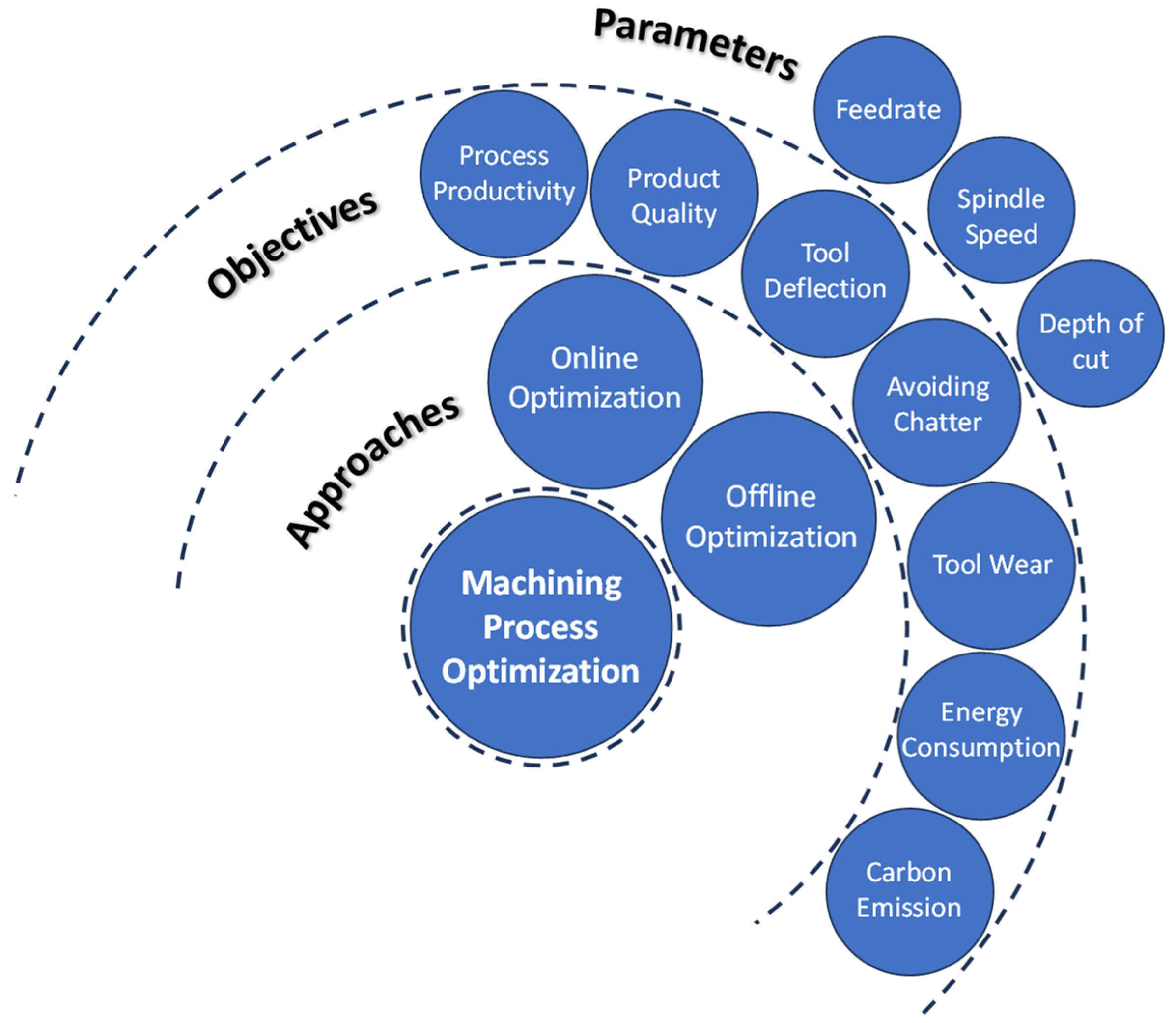
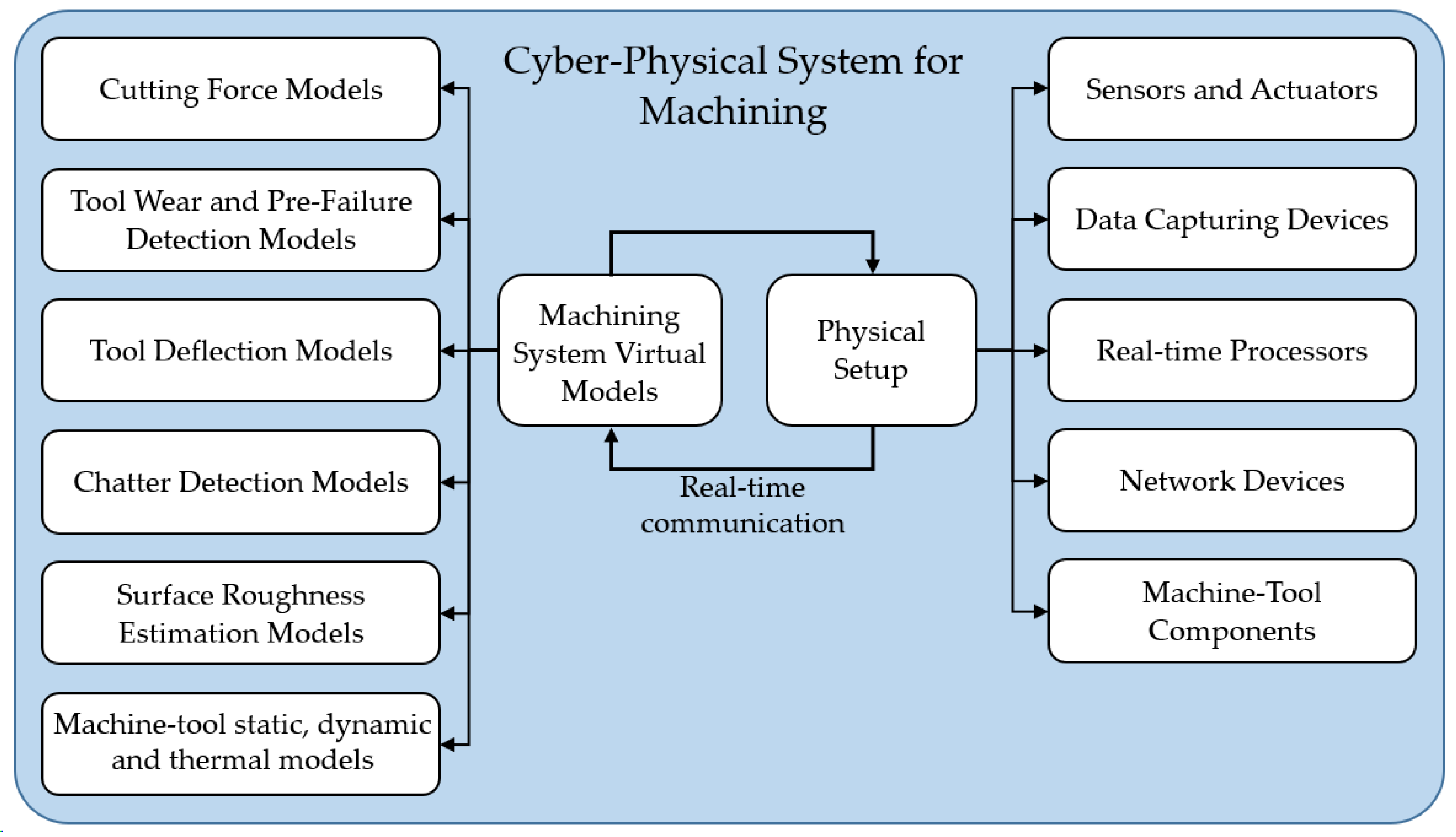
The fifth Industrial revolution (I5.0) prioritizes resilience and sustainability, integrating cognitive cyber-physical systems and advanced technologies to enhance machining processes. Numerous research studies have been conducted to optimize machining operations by identifying and reducing sources of uncertainty and estimating the optimal cutting parameters. Virtual modeling and Tool Condition Monitoring (TCM) methodologies have been developed to assess the cutting states during machining processes. With a precise estimation of cutting states, the safety margin necessary to deal with uncertainties can be reduced, resulting in improved process productivity. This paper reviews the recent advances in high-performance machining systems, with a focus on cyber-physical models developed for the cutting operation of difficult-to-cut materials using cemented carbide tools. An overview of the literature and background on the advances in offline and online process optimization approaches are presented. Process optimization objectives such as tool life utilization, dynamic stability, enhanced productivity, improved machined part quality, reduced energy consumption, and carbon emissions are independently investigated for these offline and online optimization methods. Addressing the critical objectives and constraints prevalent in industrial applications, this paper explores the challenges and opportunities inherent to developing a robust cyber–physical optimization system.
Keywords: process optimization; adaptive control; cyber–physical systems; industry 5.0; finite element analysis process optimization; adaptive control; cyber–physical systems; industry 5.0; finite element analysis