You are currently viewing a new version of our website. To view the old version click .
Sensors
  • Article
  • Open Access

1 February 2024

Ca2Lib: Simple and Accurate LiDAR-RGB Calibration Using Small Common Markers

,
,
,
,
and
Department of Computer, Control, and Management Engineering “Antonio Ruberti”, Sapienza University of Rome, 00185 Rome, Italy
*
Authors to whom correspondence should be addressed.
These authors contributed equally to this work.
This article belongs to the Section Sensors and Robotics

Abstract

Modern visual perception techniques often rely on multiple heterogeneous sensors to achieve accurate and robust estimates. Knowledge of their relative positions is a mandatory prerequisite to accomplish sensor fusion. Typically, this result is obtained through a calibration procedure that correlates the sensors’ measurements. In this context, we focus on LiDAR and RGB sensors that exhibit complementary capabilities. Given the sparsity of LiDAR measurements, current state-of-the-art calibration techniques often rely on complex or large calibration targets to resolve the relative pose estimation. As such, the geometric properties of the targets may hinder the calibration procedure in those cases where an ad hoc environment cannot be guaranteed. This paper addresses the problem of LiDAR-RGB calibration using common calibration patterns (i.e., A3 chessboard) with minimal human intervention. Our approach exploits the flatness of the target to find associations between the sensors’ measurements, leading to robust features and retrieval of the solution through nonlinear optimization. The results of quantitative and comparative experiments with other state-of-the-art approaches show that our simple schema performs on par or better than existing methods that rely on complex calibration targets.

1. Introduction

Integrating Light Detection And Ranging (LiDAR) with RGB imaging systems significantly boosts the fields of vision and perception. The complementary nature of these two vision sensors closes the gap between spatial and visual understanding of the operating environment: LiDAR technology is renowned for its high-accuracy depth-sensing capabilities, providing a foundation for understanding the spatial aspects of the environment. Concurrently, RGB cameras provides high-resolution color information that, on the other hand, allows intelligent systems to understand the visual aspect of the environment. Current research shows that the LiDAR-RGB combination may be fused together using guided depth completionapproaches to provide a unified dense RGB-D representation, which is widely employed for perception applications [1,2,3,4]. Furthermore, in the field of 3D reconstruction, recent findings show that coupling the two sensors may lead to a more robust and accurate estimate [5].
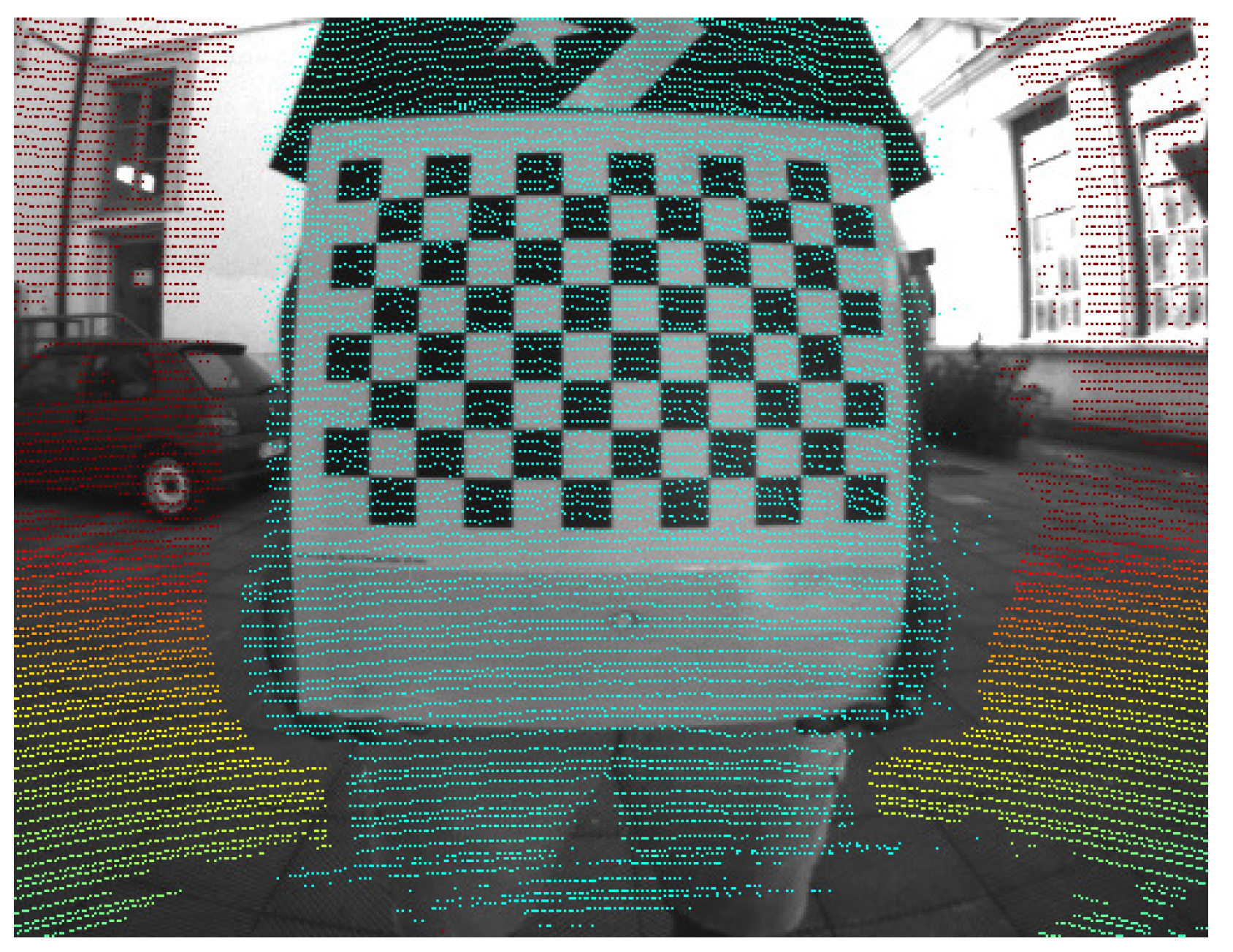
Still, integrating the two systems poses a significant challenge due to their inherently different natures. This challenge stems from the need to align and synchronize data streams with different modalities. We focus on the former, estimating the relative positions and orientations between these sensors (extrinsic calibration) using cues extracted from their measurements as shown in Figure 1. Currently, LiDAR-RGB calibration can be solved using a calibration target or marker, as done already for uni-modal sensor extrinsic estimation (i.e., multi-RGB [6]). The calibration target represents a unique object whose geometric and visual properties are known and, through tailored detection algorithms, can be measured precisely. Identifying common elements from both viewpoints is typically sufficient for determining spatial correlations between sensors. However, discerning which elements are relevant in this scenario remains problematic. Due to the sensors’ varying resolutions and visual patterns, traditional markers such as checkerboard corners are not viable. This necessitates the exploration of more complex features. One example could be the use of holes of known dimensions in the target: LiDARs would be able to infer the center of the hole by measuring the points on the border, while cameras could estimate the same point using typical circle detection algorithms [7]. Although these features have proven effective for extrinsic estimation, the requirement of ad hoc calibration targets poses more practical and often economical problems (these specific markers are often realized using CNC printers). Moreover, calibration is often carried out directly onsite, so the target’s portability and size are other problems that must be discussed. This paper introduces a method for extracting robust planar features readily obtainable from sensor data. We relax the requirements for calibration targets to typical patterns already used for RGB calibrations (i.e., checkerboards or ChAruCO [8]) with sizes down to A3/A4 dimensions for portability. Leveraging a direct nonlinear formulation, we can achieve a highly accurate relative pose estimate even with a minimum of three observations per sensor. Finally, we release an open-source implementation of our toolbox.
Figure 1. Reprojection of a LiDAR point cloud on a fisheye RGB camera rigidly attached to the former. The offset between the sensors leads to shadows in parts of the image.
The paper is structured as follows: Section 2 provides a comprehensive literature review highlighting previous works in LiDAR-RGB calibration. In Section 3, we describe preliminary concepts required to understand our approach, followed by details of our calibration pipeline. Section 4 describes the conducted experiments, their setup, data collection, and results. Finally, Section 5 summarizes our key contributions and potential limitations and suggests directions for future research.

3. Our Approach

This section provides a detailed and comprehensive description of our method. First, we describe the preliminaries required to understand our approach, and then every pipeline component is described, following the procedure from the acquisition of the measurements up to the computation of the relative poses between the two sensors (extrinsic parameter).
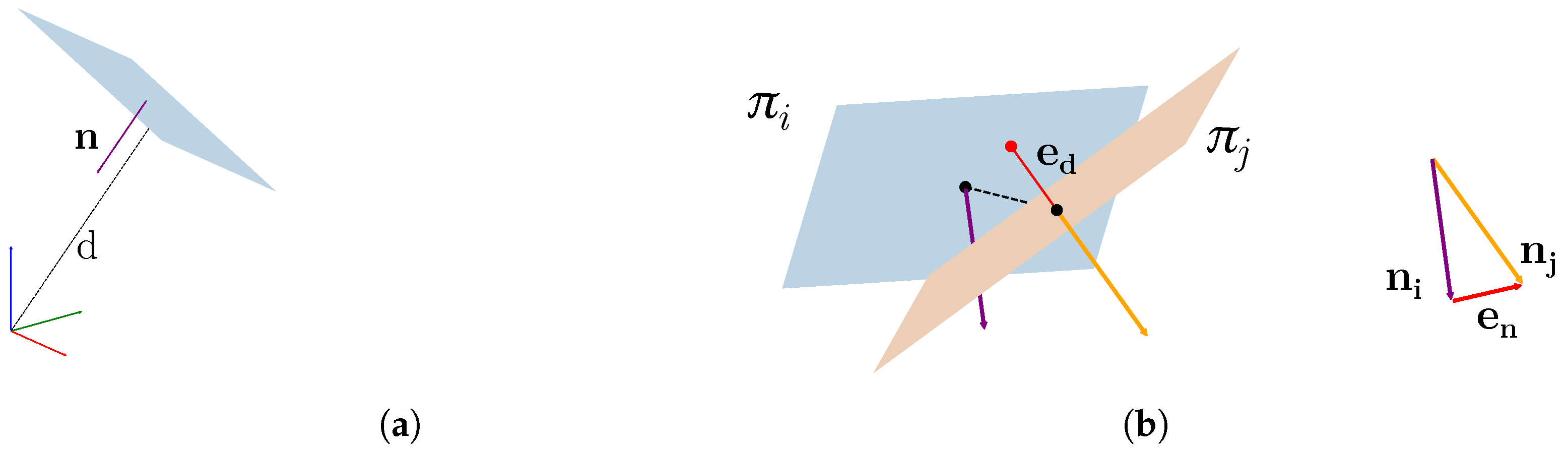
Plane Representation: Let π = ( n , d ) be a 3D plane, where n S 2 represents its normal and d R is its orthogonal distance concerning the origin coordinate system (visible in Figure 2a). Applying a transform X SE ( 3 ) to a plane π yields new coefficients π as follows:
X π = R n d + ( R n ) T t
Figure 2. Here, e n is the error for the normal term while e d represents the plane distances. (a) shows the plane representation used in this work. (b) A visual representation of the plane-to-plane error.
Here X = R ; t is represented by a rotation matrix R SO ( 3 ) , and the translation vector t R 3 .
We represent as Δ x the Lie algebra se ( 3 ) associated with the group SE ( 3 ) , parameterized as Δ x = [ Δ t , Δ r ] T ; Δ t R 3 is the translation, and Δ r R 3 is the rotation expressed in angle–axis representation. The rotation matrix can be calculated from the perturbation vector using the exponential map at the identity exp ( Δ r ) SO ( 3 ) . We extend the notation of the exponential map to refer to the transformation encoded in Δ x . If the transformation is modified by a small local perturbation Δ x = ( Δ r | Δ t ) , then we can rewrite:
( X exp ( Δ x ) ) π = exp ( Δ r ) R n d + ( R n ) T t + n T R T exp ( Δ r ) T Δ t
Deriving the result for Δ x leads to the following Jacobian:
( X exp ( Δ x ) ) π Δ x = 0 3 × 3 R n × n T R T 0 1 × 3 4 × 6
where v × maps the vector v into a skew-symmetric matrix defined as follows:
v × = 0 v z v y v z 0 v x v y v x 0
The distance between two planes depends on the difference between their normals and the signed distance of the planes from the origin, as shown in Figure 2b. These quantities can be captured by a 4D error vector e p expressing the plane-to-plane error metric:
p ( π k ) = n k d k
e p ( π i , π j ) = e n e d = n i n j n j T ( p ( π j ) p ( π i ) ) .
Here, p ( π k ) is the point on the plane closest to the origin of the reference system, and it is obtained by taking a point along the normal direction n at a distance d.
Pinhole Model (RGB): Let p be a point expressed in a camera frame and K be the camera matrix. Assuming any lens distortion effect has been previously corrected, then the projection on the image plane of p is computed as
π c ( p ) = ϕ ( K p )
K = f x 0 c x 0 f y c y 0 0 1
ϕ ( v ) = 1 v z v x v y
where ϕ ( v ) represents the homogeneous division and π c ( p ) the pinhole projection function. For simplicity, we detail only the pinhole camera projection; however, the same principle applies to more complex camera models.
Projection by ID (LiDAR): Let p be a point detected by the LiDAR and expressed in its frame. Its projection is computed as:
π l ( p ) = A ψ ( p )
A = f x 0 c x 0 1 0
ψ ( v ) = atan2 ( v y , v x ) ring ( v ) 1
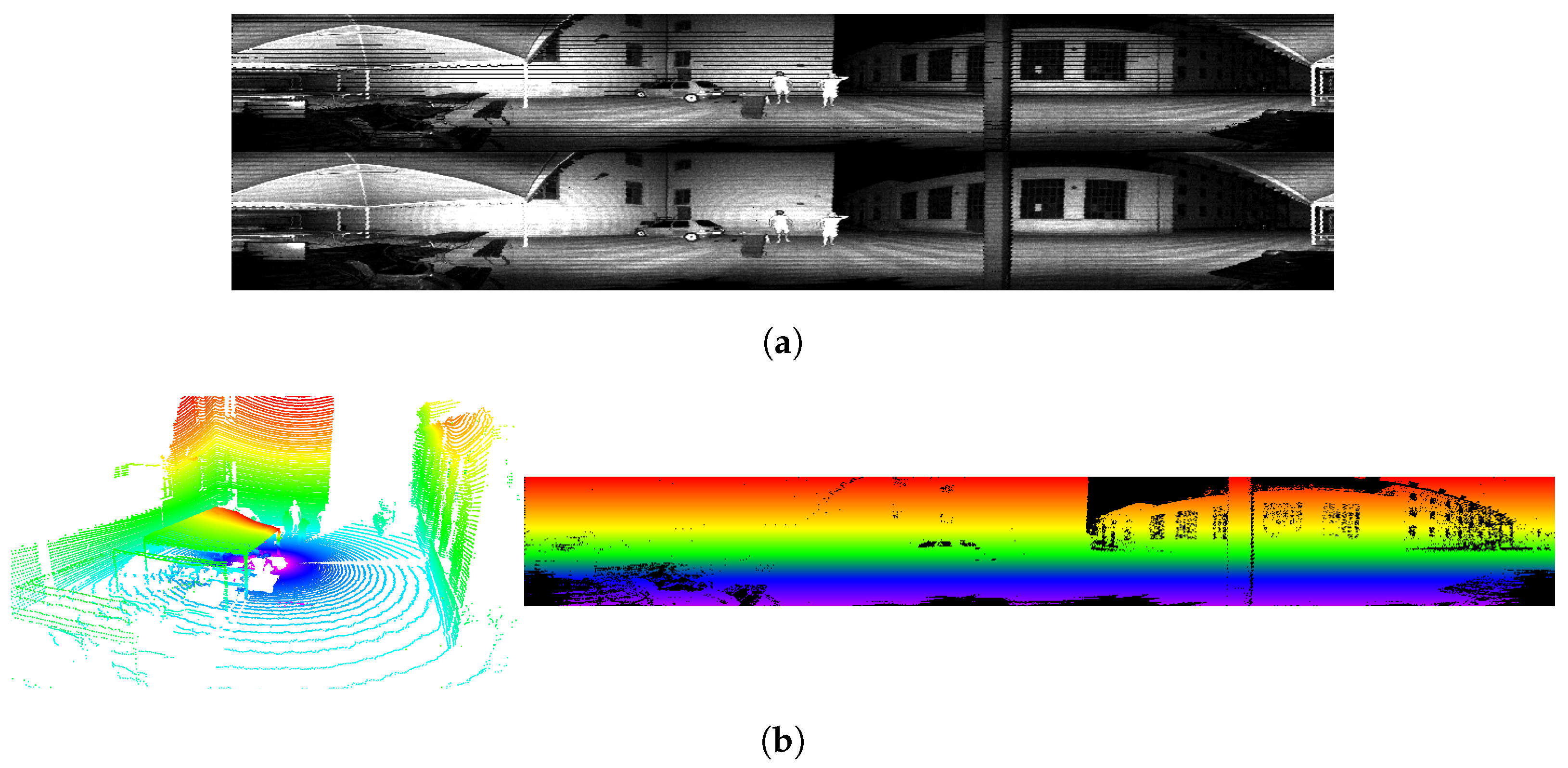
where f x represent the azimuth resolution of the LiDAR, while c x denotes the offset in pixels. The ring ( v ) function described in Figure 3b is usually provided by the LiDAR and represents the index of the vertical receiver that measured the point. If this information is unavailable and the cloud is ordered, then it is obtainable by dividing the point index by the horizontal resolution of the sensor. Figure 3a shows a comparison with the classical spherical projection. The projection by ID does not preserve the geometric consistency of the scene but provides an image with no holes, which is preferred for computer-vision applications.
Figure 3. (a) Comparison between the spherical projection (top) used for LiDAR images and the projection by ID (bottom) used for this work on intensity information. (b) Ring information before (left) and after (right) the projection. Points with the same color have been measured by the same vertical beam throughout the acquisition.
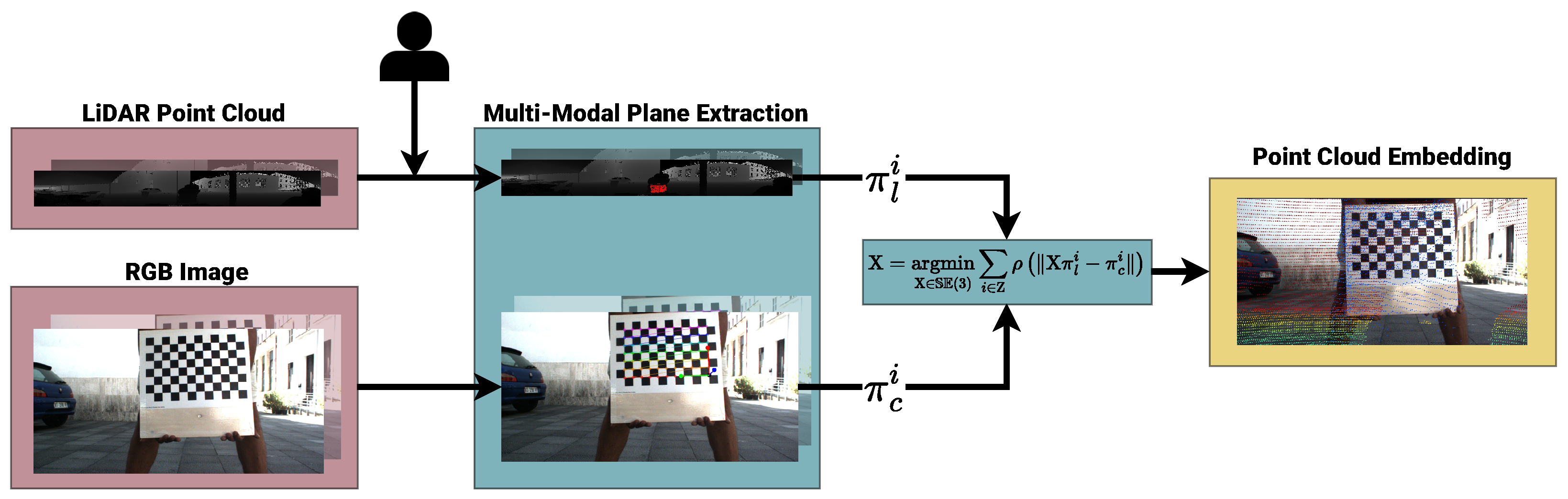
As shown in Figure 4, we process the incoming raw LiDAR and RGB measurements to acquire planar information. Assuming the scene remains static throughout the acquisition of a single joint measurement (in this context, a measurement represents a synchronized pair of LiDAR-RGB measurements), the LiDAR cloud is embedded in an image using the projection by ID. Moreover, the system awaits user interaction to guess the position of the calibration target on the LiDAR image.
Figure 4. Diagram of our calibration pipeline. Measurements are acquired, and calibration target detection is performed (LiDAR planar detection is performed via human intervention). The set of planes is used to solve the nonlinear optimization problem, leading to the optimal relative pose between the sensors.
A parametric circular patch around the user’s selection is used to estimate a plane using RANSAC, and concurrently, the calibration target detection is performed on the RGB image using a target-dependent method (i.e., OpenCV [6]). Once the target is detected, the RGB plane is computed by solving a PnP problem with OpenCV. If the user is satisfied with both the LiDAR and RGB planes, they are stored for processing.
Whereas a straightforward rank analysis of the Jacobians reveals that just three measurements are sufficient to constrain a solution, it is well known from the estimation theory that the accuracy grows with the number of measurements.
Once the set of measurements is acquired, we jointly estimate the relative orientation and translation of the LiDAR to the RGB sensor X SE ( 3 ) by solving the following nonlinear minimization problem:
X = argmin X SE ( 3 ) i Z X π l i π c i e p 2
where e p represents the plane-to-plane error.
During acquisition, the user may accept one or more wrongly estimated measurements. Due to the quadratic nature of the error terms, these outliers are often over-accounted for, resulting in wrong estimations. We employ a Huber M-estimator  ρ ( · ) that treats different measurements based on their error to account for this factor. We rewrite Equation (13) as follows:
X = argmin X SE ( 3 ) i Z ρ ( X π l i π c i ) .
To resolve Equation (14), we employ the Gauss-Newton (GN) algorithm.

4. Experimental Evaluation

In this section, we describe the experiments we conducted to establish the quality of our calibration toolbox. We perform quantitative experiments in the simulated environment provided by [22] to compare our estimates with the ground truth, while we also conduct qualitative and quantitative experiments on real scenarios using our acquisition system. We directly compare our results with [27], as it is the work closest to ours. In addition, we compare to [22], in which the authors produced accurate results by relying on a very complex target (CNC printed).

4.1. Synthetic Case

We conduct experiments on the Gazebo simulator [28] to evaluate the accuracy and robustness of our approach; we inject different noise figures into the sensor measurements. We also experiment with how the number of observations affects the final results. The scene setup includes a Velodyne HDL-64 LiDAR [29], a BlackFly-S RGB sensor [30], and a 6 × 8 checkerboard target with a corner size of 0.2 m. We randomly generate and acquire 53 valid measurements (a valid measurement is one for which both the LiDAR and RGB sensor can detect the target).
To quantify the impact of the number of measurements on the accuracy of our approach, we run the calibration procedure with an increasing number of measurements w s = [ 3 39 ] and at three different LiDAR noise levels σ l (0 mm, 7 mm, and 14 mm). For every w s , we sample 40 sets of measurements.
From Table 1, we observe a steady decrease in error for every noise level: reaching an average of 2.6 mm translation error in the intermediate noise case. In the case of three measurements, the high uncertainty is due to the potentially poorly conditioned system when using planes with similar normals. Nonetheless, we compare our best result with three measurements against the best results of the methods presented in [22,27]. Table 2 shows the results.
Table 1. Average translation error in millimeters with different noise levels and numbers of measurements N.
Table 2. Quantitative results on synthetic data achieved through calibration using N = 3 measurements. The best results are indicated in bold. We choose this measurement count for parity with the methodology proposed in [22]. In [22], a single measurement is deemed sufficient for calibration determination, with 3 measurements considered the optimal scenario. Beyond 3 measurements, accuracy does not improve significantly. Both for our study and in alignment with the findings in [27], 3 measurements represents the minimum requirement for solution determination, and an increase in this count is expected to result in more precise outcomes. Our results show that with our minimum number of measurements, we perform on par with [22] on rotation while outperforming all methods on translation using small commercial tags.

4.2. Real Case

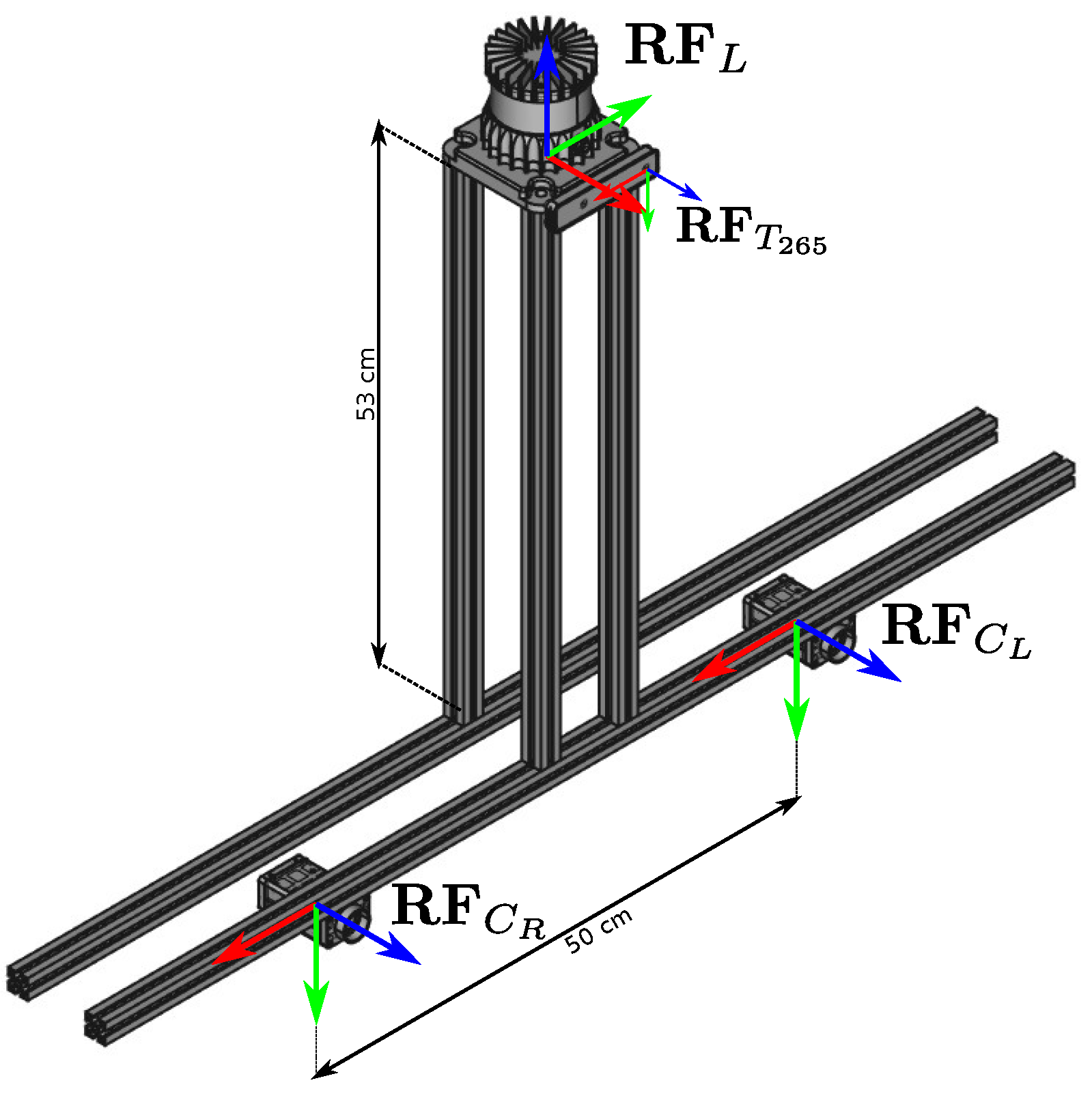
In this section, we describe the experiments conducted using real measurements. We perform a quantitative test on our acquisition system shown in Figure 5 that is equipped with an Ouster OS0-128 LiDAR [31] with a resolution of 128 × 1024 , a RealSense T-265 stereo camera, and two Manta-G145 [32] RGB cameras arranged in a wide horizontal stereo configuration.
Figure 5. Acquisition system used for the real-case experiments featuring delineated reference systems for each sensor. We report nominal measurements between the sensors. The Realsense T265 ( 180 horizontal field of view) is installed closer to the LiDAR, while the two Manta cameras (90° horizontal field of view) are mounted on a wider horizontal stereo baseline.
Since no ground truth information is available, we use the stereo extrinsic to estimate the calibration error. The offset between multiple cameras is measured using optical calibration procedures, which typically reach subpixel precision.
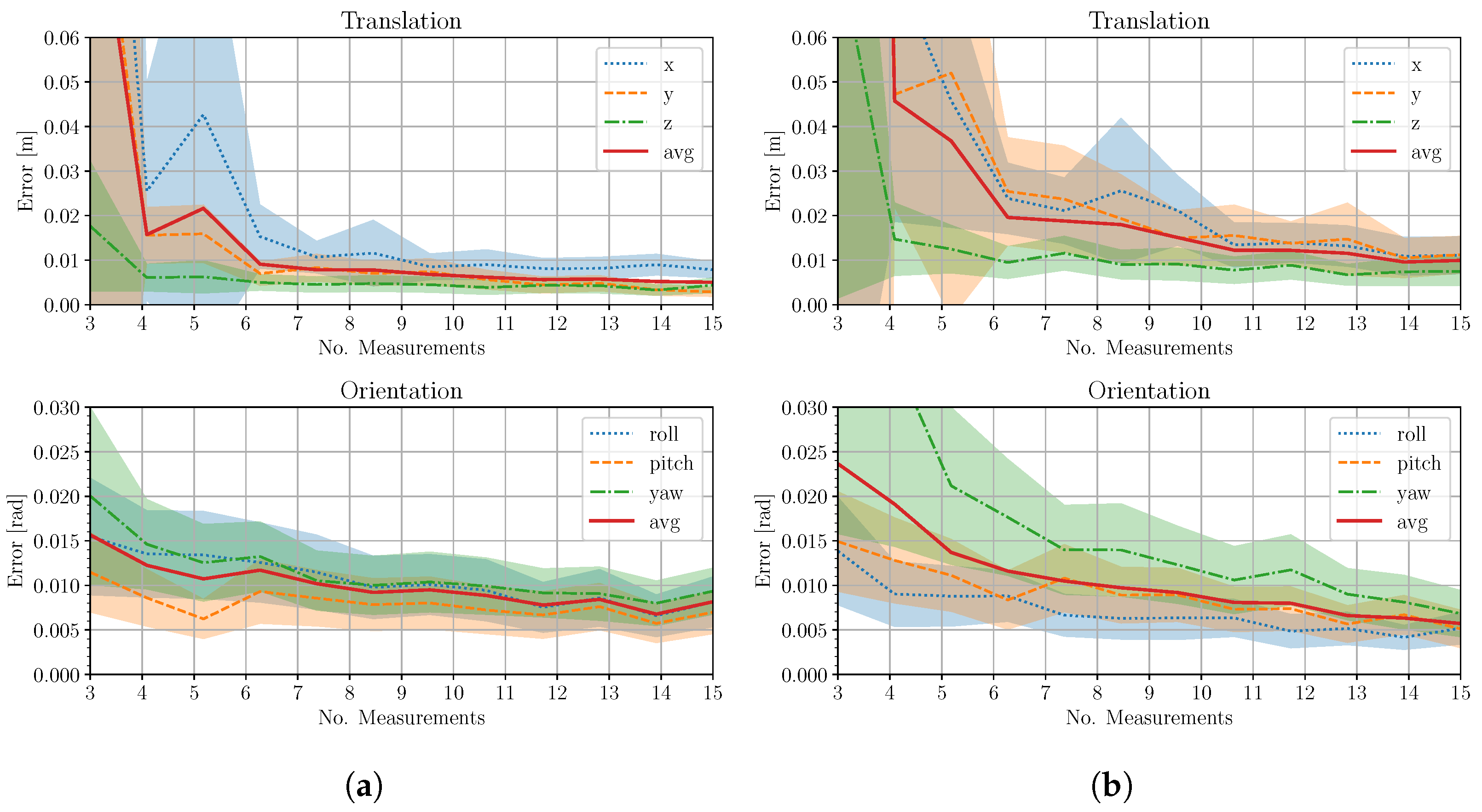
In the first experiment, we consider the LiDAR and the Realsense T-265 sensor [33], which provides two wide field-of-view fish-eye cameras with factory-calibrated intrinsic/extrinsic parameters. The task of the experiment is to demonstrate the accuracy of the calibrator in real-case scenarios and to understand how the number of measurements considered affects the quality of the solution. As in the synthetic case, we first acquire a set of 17 cloud-image LiDAR-RGB measurements for both cameras. Moreover, we perform 40 calibrations with w s randomly selected measurements with w s { 3 , 15 } . Finally, for every w s , we combine the computed extrinsics for each camera to obtain an estimated stereo transform. Assuming approximately symmetrical errors in the two cameras, Figure 6a shows the results of this experiment. We obtained, at best, an average error of 7.1 mm in translation and 0.01 rads in orientation.
Figure 6. (a) Average camera-wise calibration error for the LiDAR-T265, wide fov case. (b) Average camera-wise calibration error (standard deviation in shaded color) for the LiDAR-Manta case.
The second experiment is conducted using the wide stereo setup, for which we also calibrate the intrinsics and extrinsics of the cameras in order to obtain the results expected from a typical scenario. The large parallax between the LiDAR and each camera and the smaller field of view allow us to evaluate our approach in a stressful scenario. The acquisition procedure is the same as in the first experiment, and Figure 6b shows the experimental result, where we obtain the best solution with errors of 4.6 mm in translation and 0.2 × 10 2 rads in orientation.
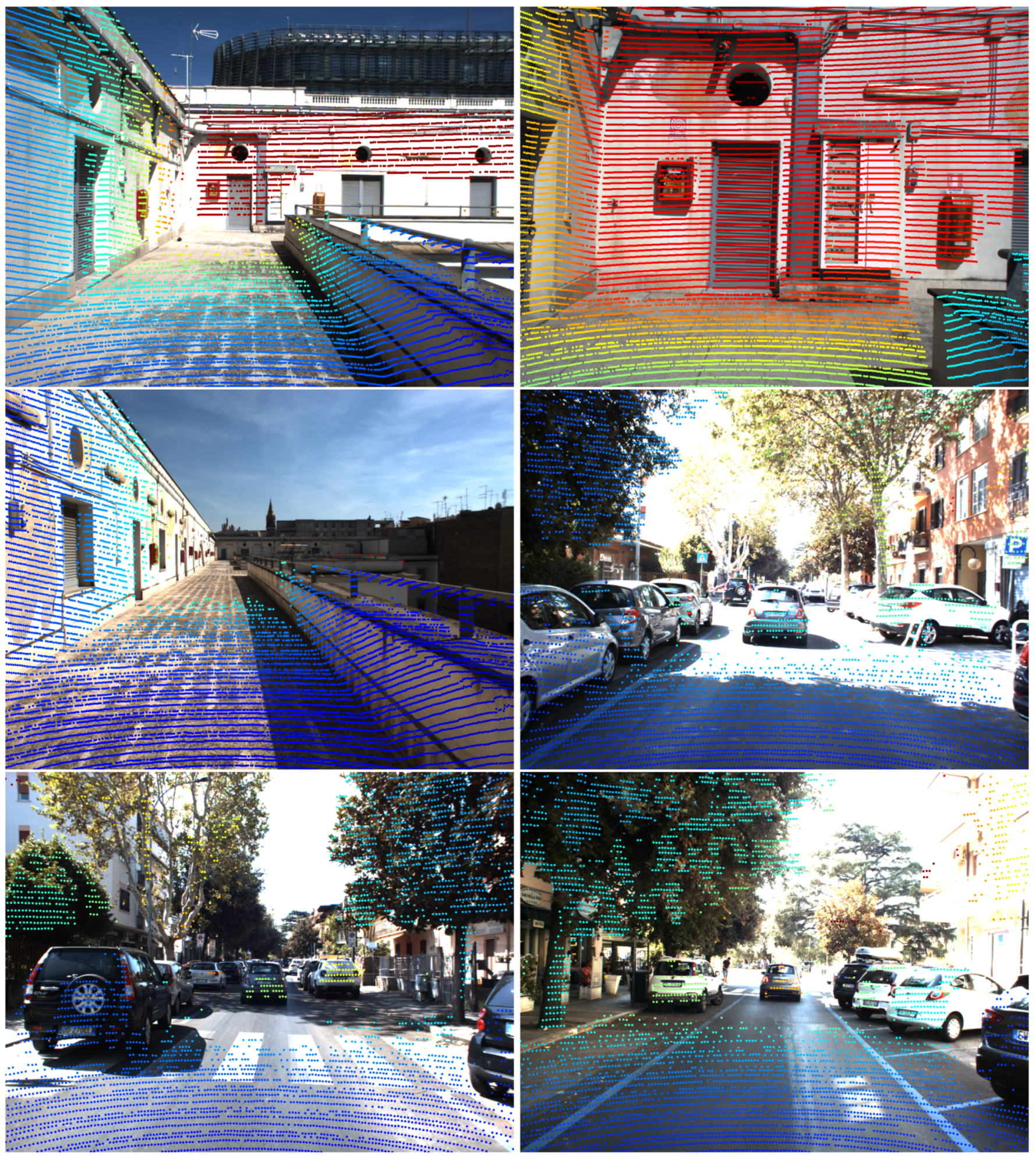
Moreover, Figure 1 and Figure 7, respectively, show the reprojection onto the right camera of the fisheye and wide baseline RGB sensor. For the latter, the large parallax between the sensors leads to strong occlusion effects that have been mitigated with a hidden point removal algorithm [34].
Figure 7. Qualitative samples showing LiDAR cloud projection on RGB image in the setting sketched in Figure 5, for which the parallax between the sensors is approximately 66 cm.
Our evaluation indicates that our method can generate extrinsic estimates comparable or superior to those obtained using other state-of-the-art approaches. It is important to note that careful consideration is required when selecting the minimal number of measurements. However, our experiments demonstrate that the accuracy of these estimates improves as the number of measurements increases.

5. Discussion

The experiments show that planar features are a valid alternative to existing solutions for LiDAR-RGB calibrations due to resiliency to LiDAR inherent noise. In particular, Table 1 shows that similar translation error occurs across different noise levels of the sensors. Moreover, real-case experiments support our claim concerning the dimensions of the calibration target, which was brought down to A3/A4 dimensions, along with the seamless integration of different camera models (Kannala-Brandt [35] for T-265 and Rad-Tan for Manta G-145). We suggest using our methodology in situations for which calibration should be performed onsite, where an ad hoc environment for calibration is not guaranteed, or where bringing more-specialized calibration targets is not feasible. An important note regards the sensors’ configuration and shared field of view. Ensuring a correct result requires multiple views of the calibration target from both perspectives. In those cases where the shared field of view is small, a single-shot calibration approach might produce better results in terms of accuracy. Finally, concerning situations where the calibration target is not static during acquisition, caution should be taken for temporal synchronization of the measurements. Our system assumes input measurements to be synchronized; moreover, even small offsets worsen the calibration accuracy. We remark on the difficulty of synchronizing these two sensors due to their different natures. In particular, the revolution period for typical LiDARs is higher compared to the exposure time of RGB sensors. We suggest acquiring RGB images when the LiDAR scan overlaps the camera field of view.
One possible addition that would benefit this work is an automatic detection system for calibration targets in LiDAR measurements. This problem may be tackled from a spatial perspective on the raw point cloud or visually by projecting the cloud onto a 2D embedding. This feature would either fully or partially replace the current human-aided LiDAR plane detection by providing a good initial guess regarding the calibration target’s position.
In conclusion, the paper introduces a simple and effective method for accurately estimating extrinsic parameters between LiDARs and RGB sensors. By leveraging the inherent planar shape of standard calibration patterns, we establish common observations between these sensors to greatly simplify the calibration procedure. Our experiments show that planar features mitigate the LiDAR noise, leading to accurate results even with common A3/A4 calibration patterns. Finally, we also release an open-source implementation to benefit the community.

Author Contributions

All authors contributed to the design and development of the software. E.G., O.S. and P.P. performed the experiments presented in this paper. E.G. wrote the manuscript. All authors have read and agreed to the published version of the manuscript.

Funding

This work has been supported by PNRR MUR project PE0000013-FAIR.

Data Availability Statement

The open-source implementation can be found at https://github.com/rvp-group/ca2lib (accessed on 29 January 2024).

Conflicts of Interest

The authors declare no conflicts of interest.

References

  1. Liu, T.Y.; Agrawal, P.; Chen, A.; Hong, B.W.; Wong, A. Monitored Distillation for Positive Congruent Depth Completion. arXiv 2022, arXiv:2203.16034. [Google Scholar]
  2. Wong, A.; Soatto, S. Unsupervised Depth Completion with Calibrated Backprojection Layers. In Proceedings of the IEEE/CVF International Conference on Computer Vision, Montreal, BC, Canada, 11–17 October 2021; pp. 12747–12756. [Google Scholar]
  3. Kam, J.; Kim, J.; Kim, S.; Park, J.; Lee, S. CostDCNet: Cost Volume Based Depth Completion for a Single RGB-D Image. In Proceedings of the Computer Vision–ECCV 2022: 17th European Conference, Tel Aviv, Israel, 23–27 October 2022; Proceedings, Part II. Springer: Berlin/Heidelberg, Germany, 2022; pp. 257–274. [Google Scholar]
  4. Park, J.; Joo, K.; Hu, Z.; Liu, C.K.; Kweon, I.S. Non-Local Spatial Propagation Network for Depth Completion. In Proceedings of the European Conference on Computer Vision (ECCV), Glasgow, UK, 23–28 August 2020. [Google Scholar]
  5. Di Giammarino, L.; Giacomini, E.; Brizi, L.; Salem, O.; Grisetti, G. Photometric LiDAR and RGB-D Bundle Adjustment. IEEE Robot. Autom. Lett. 2023, 8, 4362–4369. [Google Scholar] [CrossRef]
  6. Bradski, G. The OpenCV Library. Dr. Dobb’s J. Softw. Tools 2000, 25, 120–123. [Google Scholar]
  7. Illingworth, J.; Kittler, J. The Adaptive Hough Transform. IEEE Trans. Pattern Anal. Mach. Intell. 1987, PAMI-9, 690–698. [Google Scholar] [CrossRef] [PubMed]
  8. Garrido-Jurado, S.; Muñoz-Salinas, R.; Madrid-Cuevas, F.; Marín-Jiménez, M. Automatic generation and detection of highly reliable fiducial markers under occlusion. Pattern Recognit. 2014, 47, 2280–2292. [Google Scholar] [CrossRef]
  9. Pandey, G.; McBride, J.R.; Savarese, S.; Eustice, R.M. Automatic extrinsic calibration of vision and LiDAR by maximizing mutual information. J. Field Robot. 2015, 32, 696–722. [Google Scholar] [CrossRef]
  10. Yoon, B.H.; Jeong, H.W.; Choi, K.S. Targetless multiple camera-LiDAR extrinsic calibration using object pose estimation. In Proceedings of the 2021 IEEE International Conference on Robotics and Automation (ICRA), Xi’an, China, 30 May–5 June 2021; pp. 13377–13383. [Google Scholar]
  11. Bai, Z.; Jiang, G.; Xu, A. LiDAR-Camera Calibration Using Line Correspondences. Sensors 2020, 20, 6319. [Google Scholar] [CrossRef] [PubMed]
  12. Lv, X.; Wang, B.; Dou, Z.; Ye, D.; Wang, S. LCCNet: LiDAR and camera self-calibration using cost volume network. In Proceedings of the IEEE Conference on Computer Vision and Pattern Recognition (CVPR), Nashville, TN, USA, 19–25 June 2021; pp. 2894–2901. [Google Scholar]
  13. Sun, C.; Wei, Z.; Huang, W.; Liu, Q.; Wang, B. Automatic Targetless Calibration for LiDAR and Camera Based on Instance Segmentation. IEEE Robot. Autom. Lett. 2022, 8, 981–988. [Google Scholar] [CrossRef]
  14. Park, Y.; Yun, S.; Won, C.S.; Cho, K.; Um, K.; Sim, S. Calibration between Color Camera and 3D LIDAR Instruments with a Polygonal Planar Board. IEEE Sens. J. 2014, 14, 5333–5353. [Google Scholar] [CrossRef] [PubMed]
  15. Pusztai, Z.; Hajder, L. Accurate Calibration of LiDAR-Camera Systems Using Ordinary Boxes. In Proceedings of the IEEE International Conference on Computer Vision (ICCV), Venice, Italy, 22–29 October 2017; pp. 394–402. [Google Scholar] [CrossRef]
  16. Pusztai, Z.; Eichhardt, I.; Hajder, L. Accurate Calibration of Multi-LiDAR-Multi-Camera Systems. Sensors 2018, 18, 2139. [Google Scholar] [CrossRef] [PubMed]
  17. Zhou, L.; Li, Z.; Kaess, M. Automatic Extrinsic Calibration of a Camera and a 3D LiDAR Using Line and Plane Correspondences. In Proceedings of the 2018 IEEE/RSJ International Conference on Intelligent Robots and Systems (IROS), Madrid, Spain, 1–5 October 2018; pp. 5562–5569. [Google Scholar] [CrossRef]
  18. Fischler, M.A.; Bolles, R.C. Random Sample Consensus: A Paradigm for Model Fitting with Applications to Image Analysis and Automated Cartography. Commun. ACM 1981, 24, 381–395. [Google Scholar] [CrossRef]
  19. Olson, E. AprilTag: A robust and flexible visual fiducial system. In Proceedings of the 2011 IEEE International Conference on Robotics and Automation, Shanghai, China, 9–13 May 2011; pp. 3400–3407. [Google Scholar] [CrossRef]
  20. Grammatikopoulos, L.; Papanagnou, A.; Venianakis, A.; Kalisperakis, I.; Stentoumis, C. An Effective Camera-to-Lidar Spatiotemporal Calibration Based on a Simple Calibration Target. Sensors 2022, 22, 5576. [Google Scholar] [CrossRef] [PubMed]
  21. Tóth, T.; Pusztai, Z.; Hajder, L. Automatic LiDAR-Camera Calibration of Extrinsic Parameters Using a Spherical Target. In Proceedings of the IEEE International Conference on Robotics & Automation (ICRA), Paris, France, 31 May–31 August 2020; pp. 8580–8586. [Google Scholar] [CrossRef]
  22. Beltrán, J.; Guindel, C.; de la Escalera, A.; García, F. Automatic Extrinsic Calibration Method for LiDAR and Camera Sensor Setups. IEEE Trans. Intell. Transp. Syst. (ITS) 2022, 23, 17677–17689. [Google Scholar] [CrossRef]
  23. Li, X.; He, F.; Li, S.; Zhou, Y.; Xia, C.; Wang, X. Accurate and Automatic Extrinsic Calibration for a Monocular Camera and Heterogenous 3D LiDARs. IEEE Sens. J. 2022, 22, 16472–16480. [Google Scholar] [CrossRef]
  24. Fan, S.; Yu, Y.; Xu, M.; Zhao, L. High-Precision External Parameter Calibration Method for Camera and Lidar Based on a Calibration Device. IEEE Access 2023, 11, 18750–18760. [Google Scholar] [CrossRef]
  25. Singandhupe, A.; La, H.M.; Ha, Q.P. Single Frame Lidar-Camera Calibration Using Registration of 3D Planes. In Proceedings of the 2022 Sixth IEEE International Conference on Robotic Computing (IRC), Naples, Italy, 5–7 December 2022; pp. 395–402. [Google Scholar] [CrossRef]
  26. Mirzaei, F.M.; Kottas, D.G.; Roumeliotis, S.I. 3D LIDAR–camera intrinsic and extrinsic calibration: Identifiability and analytical least-squares-based initialization. Int. J. Robot. Res. (IJRR) 2012, 31, 452–467. [Google Scholar] [CrossRef]
  27. Kim, E.S.; Park, S.Y. Extrinsic Calibration between Camera and LiDAR Sensors by Matching Multiple 3D Planes. IEEE Sens. J. 2020, 20, 52. [Google Scholar] [CrossRef] [PubMed]
  28. Koenig, N.; Howard, A. Design and use paradigms for gazebo, an open-source multi-robot simulator. In Proceedings of the IEEE/RSJ International Conference on Intelligent Robots and Systems (IROS), Sendai, Japan, 28 September–2 October 2004; Volume 3, pp. 2149–2154. [Google Scholar]
  29. Velodyne Lidar. Datasheet for Velodyne HDL-64E S2; Velodyne: Morgan Hill, CA, USA; Available online: https://hypertech.co.il/wp-content/uploads/2015/12/HDL-64E-Data-Sheet.pdf (accessed on 29 January 2024).
  30. Teledyne FLIR LLC. Blackfly S. Available online: https://www.flir.it/products/blackfly-s-usb3/?vertical=machine+vision&segment=iis (accessed on 29 January 2024).
  31. Ouster Inc. High-Resolution OS0 LiDAR Sensor. Available online: https://ouster.com/products/hardware/os0-lidar-sensor (accessed on 29 January 2024).
  32. Allied Vision Technologies. Modular Machine Vision Camera with GigE Vision Interface. Available online: https://www.alliedvision.com/en/camera-selector/detail/manta/g-145/ (accessed on 29 January 2024).
  33. Intel Corporation. Datasheet for Realsense T265. Available online: https://dev.intelrealsense.com/docs/tracking-camera-t265-datasheet (accessed on 29 January 2024).
  34. Katz, S.; Tal, A.; Basri, R. Direct Visibility of Point Sets. ACM Trans. Graph. 2007, 26, 24–es. [Google Scholar] [CrossRef]
  35. Kannala, J.; Brandt, S. A generic camera model and calibration method for conventional, wide-angle, and fish-eye lenses. IEEE Trans. Pattern Anal. Mach. Intell. 2006, 28, 1335–1340. [Google Scholar] [CrossRef] [PubMed]
Disclaimer/Publisher’s Note: The statements, opinions and data contained in all publications are solely those of the individual author(s) and contributor(s) and not of MDPI and/or the editor(s). MDPI and/or the editor(s) disclaim responsibility for any injury to people or property resulting from any ideas, methods, instructions or products referred to in the content.

Article Metrics

Citations

Article Access Statistics

Multiple requests from the same IP address are counted as one view.