
Skip Content
You are currently on the new version of our website. Access the old version .
SensorsSensors
  • Article
  • Open Access

4 October 2024

Gear Classification in Skating Cross-Country Skiing Using Inertial Sensors and Deep Learning

,
,
,
,
,
,
,
and
1
ECsens, Department of Electronics and Computer Technology, Sport and Health University Research Institute (iMUDS-UGR), Research Centre for Information and Communications Technologies (CITIC-UGR), University of Granada, 18071 Granada, Spain
2
Department of Computer Engineering, Automatics and Robotics, Research Centre for Information and Communications Technologies (CITIC-UGR), University of Granada, 18071 Granada, Spain
3
Department of Health Sciences, University of San Jorge, Villanueva de Gállego, 50003 Zaragoza, Spain
*
Author to whom correspondence should be addressed.
This article belongs to the Special Issue Sensors for Human Posture and Movement

Abstract

The aim of this current work is to identify three different gears of cross-country skiing utilizing embedded inertial measurement units and a suitable deep learning model. The cross-country style studied was the skating style during the uphill, which involved three different gears: symmetric gear pushing with poles on both sides (G3) and two asymmetric gears pushing with poles on the right side (G2R) or to the left side (G2L). To monitor the technique, inertial measurement units (IMUs) were affixed to the skis, recording acceleration and Euler angle data during the uphill tests performed by two experienced skiers using the gears under study. The initiation and termination points of the tests were controlled via Bluetooth by a smartphone using a custom application developed with Android Studio. Data were collected on the smartphone and stored on the SD memory cards included in each IMU. Convolutional neural networks combined with long short-term memory were utilized to classify and extract spatio-temporal features. The performance of the model in cross-user evaluations demonstrated an overall accuracy of 90%, and it achieved an accuracy of 98% in the cross-scene evaluations for individual users. These results indicate a promising performance of the developed system in distinguishing between different ski gears within skating styles, providing a valuable tool to enhance ski training and analysis.

1. Introduction

The advancements in electronics and inertial sensors offer novel possibilities for monitoring human activities using compact and lightweight systems [1,2,3,4]. This sensorization enables the collection of valid movement data without affecting the corresponding biomechanical features in a complex sport with the objective of improving professional techniques and preventing injuries [5,6]. The advances in this type of analysis are even more significant in sports like cross-country skiing, which are performed in challenging environments such as ski tracks [7]. This precise analysis allows for a detailed examination of the technique in such demanding conditions.
In this way, different ski disciplines have been studied using inertial or positional sensors, such as alpine skiing [8] or cross-country skiing (XC), both classic [9,10] and skating styles [11]. Both XC skiing techniques involve multiple gears. A gear is defined as a movement pattern characterized by specific coordination between upper and lower body movements [12,13]. Different gears are used in both styles, depending on factors such as slope, skier fitness and technique, snow conditions, and speed of movement, among others. In the skating technique, four primary gears have been identified, ranging from gear-1 (G1) to gear-4 (G4). G1 is a recreational gear that is not typically used in competitive racing. G2 is an uphill technique for ascending steep slopes at low speeds, involving skis diverged at a wider angle than other techniques and asymmetric pole planting every two ski pushes. Therefore, two sub-techniques can be distinguished by direction: on the right (G2R) or at the left side (G2L). For less steep inclines or higher fitness levels, a different gear, G3, is used. G3 is a symmetric technique characterized by a cycle featuring a parallel pole plant with each lower-body skating stroke [14]. Finally, G4 is a technique used in flat terrain, with less divergence of skis and pole planting occurring every two ski strokes. Consequently, the divergence of skis, angulation, and force momentum vary between each technique or sub-technique [15].
During training sessions or competitions, skiers continuously switch between techniques to adapt to the ski track and conditions. Therefore, analyzing the timing and track sections where each gear is used is highly valuable for athletes and coaches seeking to improve skier performance. Typically, coaches cannot observe skiers throughout the ski track due to rugged terrain or vegetation that blocks visibility. Analysis of uphill techniques is particularly important since, as suggested by Torvik et al. (2019), 50% of race time and most time differences during a race occur in uphill sections [14]. Therefore, it would be especially valuable to have a system capable of analyzing the duration during which a skier uses each technique to establish a correlation between the different sections of the ski track and the corresponding technique used.
In this context, the objective of the present work is to develop a system capable of distinguishing three distinct styles of cross-country skiing by using inertial measurement units directly embedded in the skis in conjunction with a suitable deep learning model [16,17,18]. In this study, convolutional neural networks combined with long- and short-term memory are proposed to classify and extract spatio-temporal features.

3. Materials and Methods

3.1. Materials

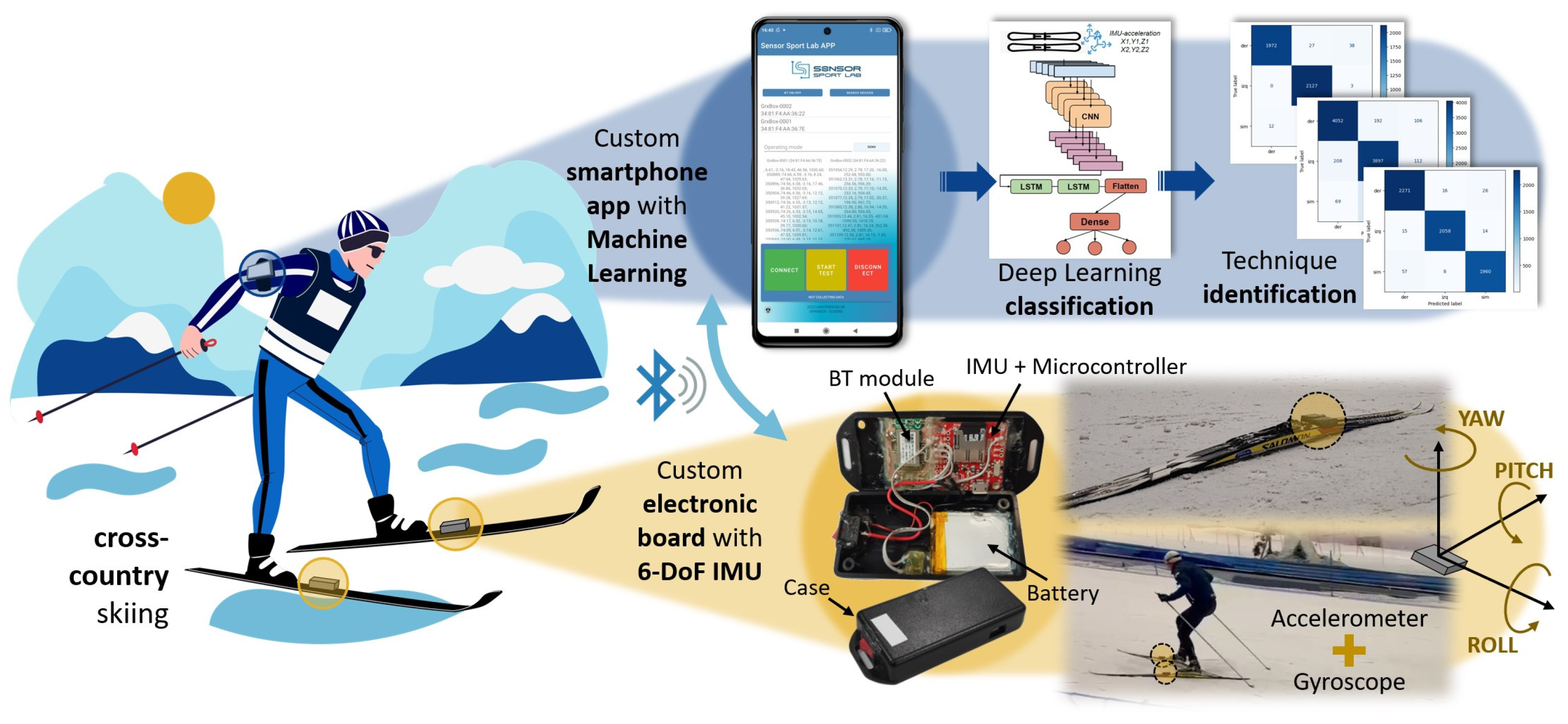
The tests were carried out using a modified version of our previously developed system [4]. The customized electronic board integrates an MPU-9250 (Invensense, San Jose, CA, USA) 9-degree-of-freedom IMU, which encompasses a 3-dimensional accelerometer, gyroscope, and magnetometer. In addition, the system incorporates an onboard SAMD21 low-power microcontroller (Microchip Technologies Inc., Chandler, AZ, USA).
The inertial motion sensor comprises a TDK-INVN 6-axis IMU MPU-6500 with a configurable acceleration range from ±2 g to ±16 g and a configurable gyroscope range from ±250 to ±2000 degrees per second (dps). It also features an AKM-8963 magnetometer (AKM Semiconductor, Inc., Tokyo, Japan) with a range of 4800 µT connected through the AUX-I2C port of the MPU-6500. This inertial measurement unit includes digital motion processor (DMP) technology, capable of filter processing and accurate calculation of three-dimensional orientation, or the so-called attitude heading reference system (AHRS), to determine the inertial angles of yaw, roll, and pitch.
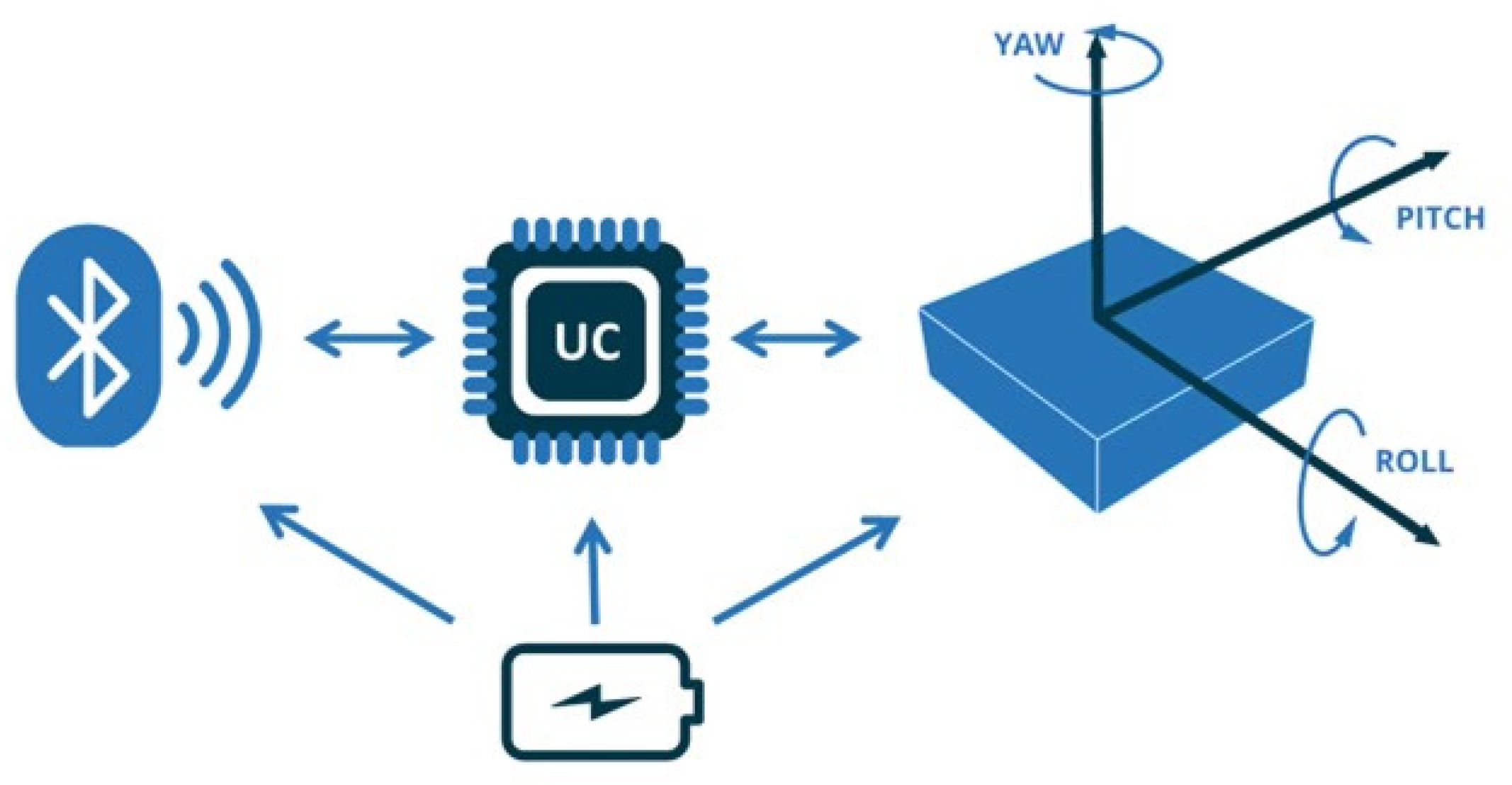
For three-dimensional orientation, sensor data fusion could be performed in the DMP to obtain rotation quaternions, which can then be used to calculate the Euler angles (pitch, roll, and yaw). However, in the present work, only the accelerometer data are used to minimize the sensor system’s complexity. Consequently, the three components of the acceleration are transmitted to the user’s smartphone via Bluetooth and are also saved on an onboard SD as a backup. Both the SD card and the BM78 Bluetooth module (Microchip Technologies Inc., Chandler, AZ, USA) are integral components of the custom-developed electronic board. Figure 2 shows the block diagram of the electronic instrumentation.
Figure 2. General block diagram of the system, illustrating the interconnection between the main components. The microcontroller unit (µC) receives data from the IMU and connects to the Bluetooth module for transmission to the end user. A battery supplies power to all system components.
To power the system, a 450 mAh battery is used, allowing continuous operation for over ten hours. Detailed consumption information is described in Table 1. It should be mentioned that a sample rate of 112 Hz was selected, and the accelerometer and gyroscope were configured in their maximum ranges (±16 g and ±2000 dps, respectively). The IMU incorporates an internal temperature sensor that is used to monitor the system temperature. This feature is crucial because the IMU operates under low-temperature conditions, and the well-being of the battery could be influenced by these conditions.
Table 1. Consumption specifications for the developed system.

3.2. Experimental Setup

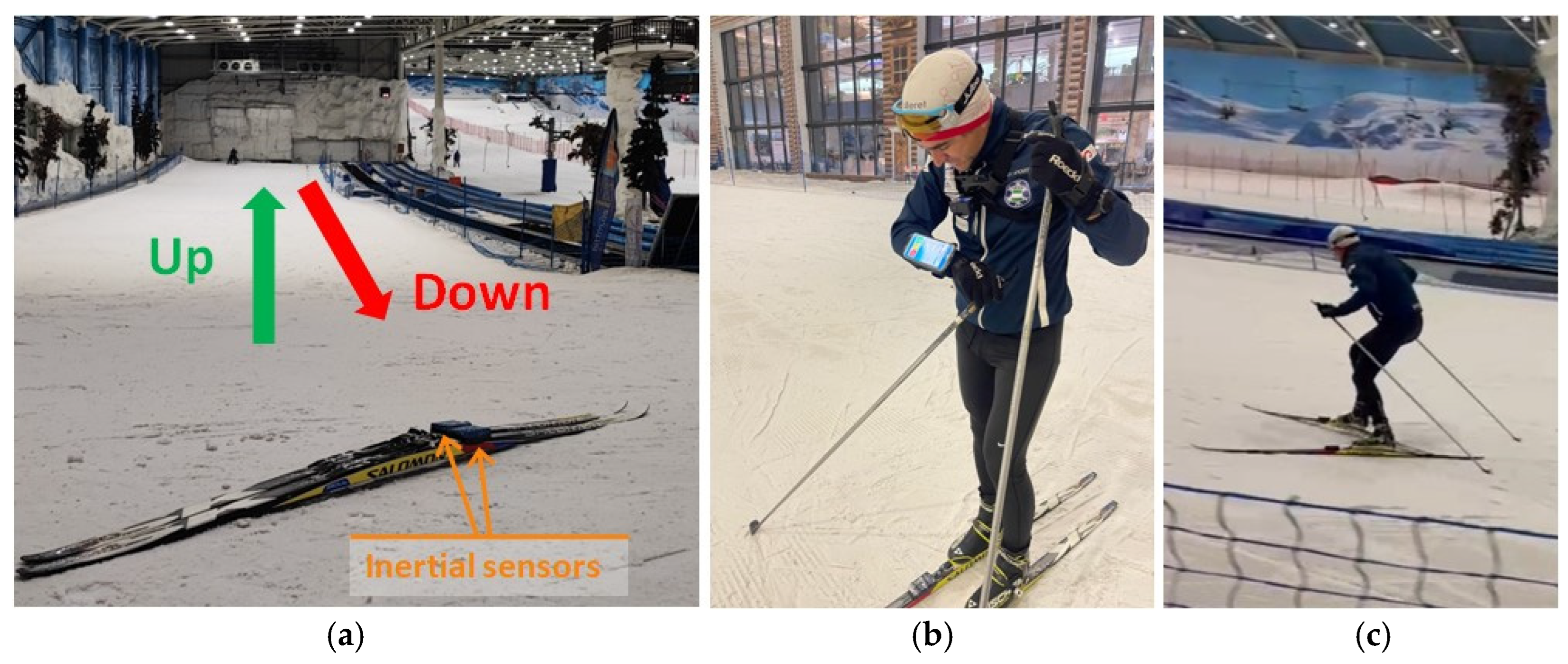
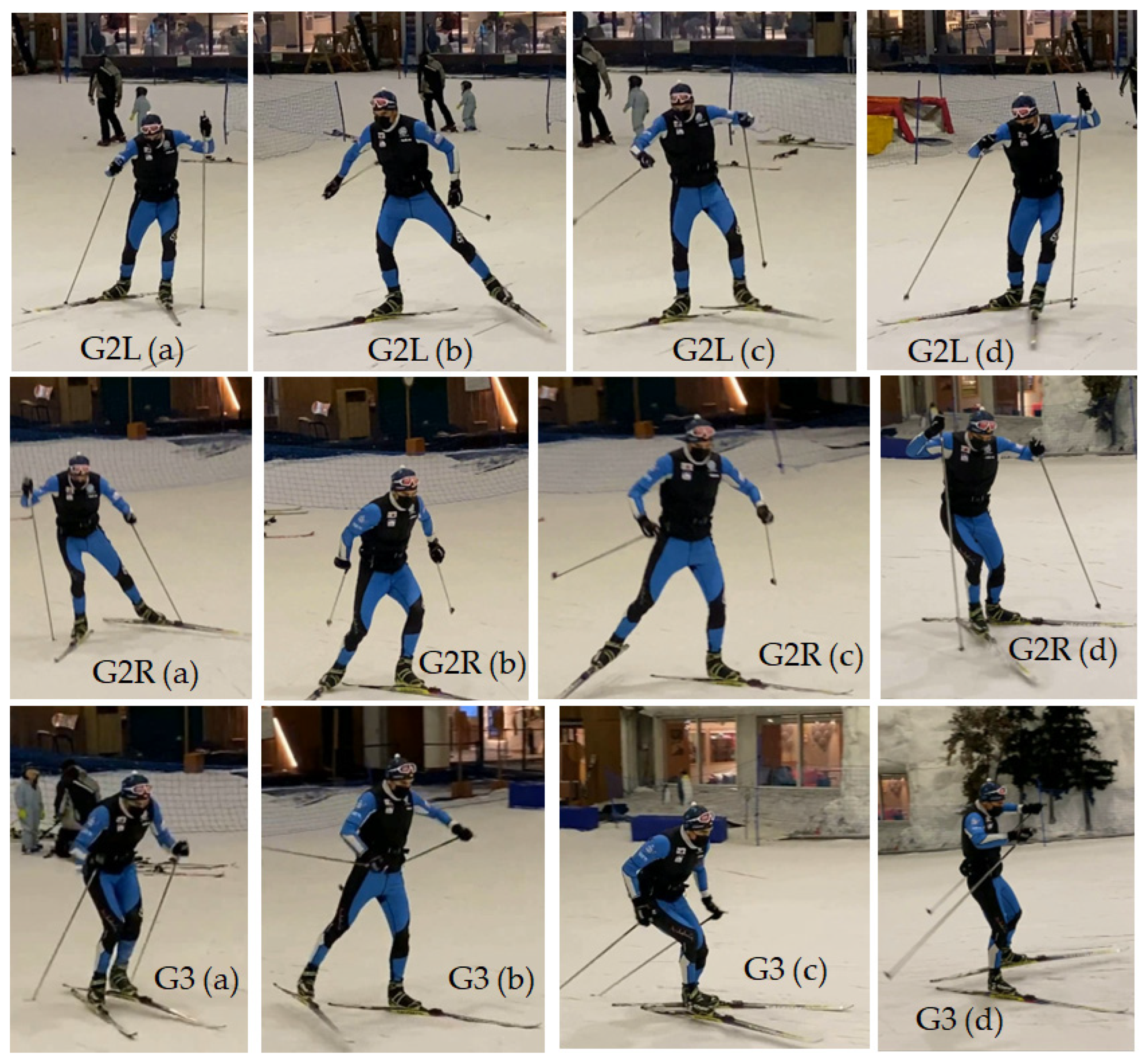
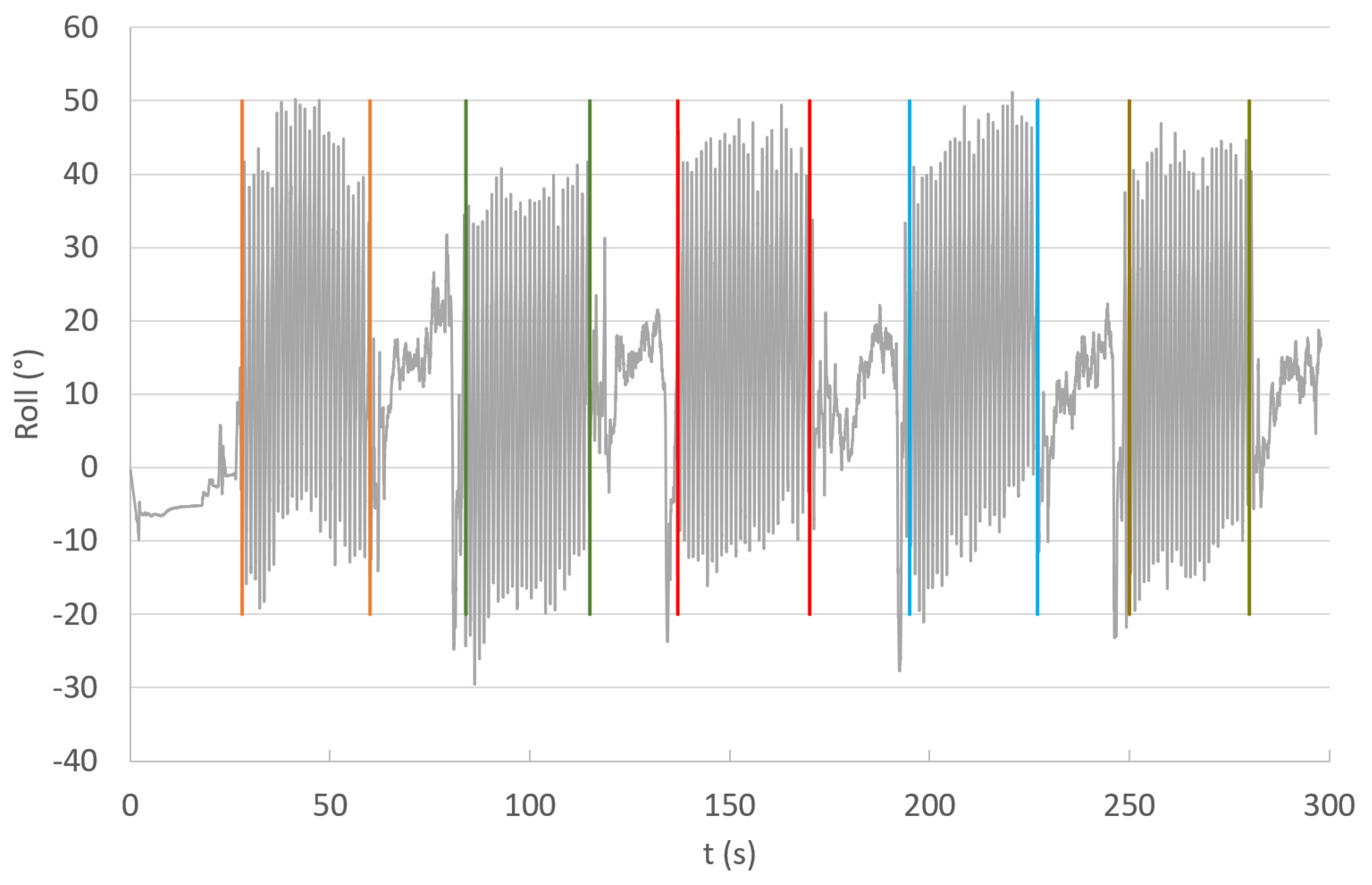
The dataset comprises experimental data recorded during multiple climbs at the SnoZone indoor ski resort located in Arroyomolinos (Madrid, Spain), as shown in Figure 3. IMUs could be attached to any ski, allowing their use in real conditions with any skier without affecting their technique. The inertial parameters of two subjects were recorded during uphill climbs using the three different gears under study, depicted in Figure 4. National-level skiers aged 45 and 40 climbed a 100 m uphill with a moderate slope of 10%. Each skier completed 20 climbs using each analyzed uphill technique: 20xG2R, 20xG2L, and 20xG3. The IMUs were covered with plastic film to waterproof them and fixed to a pair of Salomon SK10 skis using double-sided tape, as shown in Figure 3. Five series of four climbs per technique were recorded, recalibrating the IMUs at the beginning of each set of climbs to ensure accurate monitoring without exceeding the recommended usage time for high-accuracy mode monitoring, as reported in previous work [4]. Figure 4 displays frames from the data collection process for the three gears under study, illustrating the differences between them. The data collected per sequence were analyzed and segmented to discard downhill sections, as illustrated in Figure 5.
Figure 3. Experimental setup for dataset collection: (a) The ski track slope where the dataset was collected and inertial sensors placed on the skis. (b) One of the skiers uses the smartphone application to control the dataset collection, and (c) skier applying G3 during one climbing.
Figure 4. Illustration of cross-country skiing skating gears. G2L (a) planting poles while gliding with the left ski; (b) gliding with the right ski; (c) recovering arms; (d) planting poles at the end of the cycle. G2R (ad) is similar to G2L but with a push-off using the right ski while gliding. G3 (a) plating poles while gliding with the right ski; (b) recovering arms; (c) planting poles while gliding with the left ski; (d) recovery and end of cycle.
Figure 5. The roll angle of the left ski was recorded during five consecutive series using G2L. The uphills are marked between vertical bars with different colors.

3.3. Smartphone Application

A smartphone application was developed with the primary purpose of controlling the designed hardware and data acquisition, allowing simultaneous connection to two different devices, the IMUs for this study, and allowing synchronized measurements. The connection was established via Bluetooth, eliminating the need for additional cables.
For synchronization of both systems, the connection process is initiated by sequentially establishing a Bluetooth link with each device. Once that is established, the devices are ready to communicate with the application. The control is carried out by sending different commands that initiate or stop the measurements to achieve the desired synchronization. Data are stored on the SD card during the acquisition process. In addition, the smartphone stores the data in a backup file. After each test, the data are downloaded from the SD memory for subsequent processing and analysis.
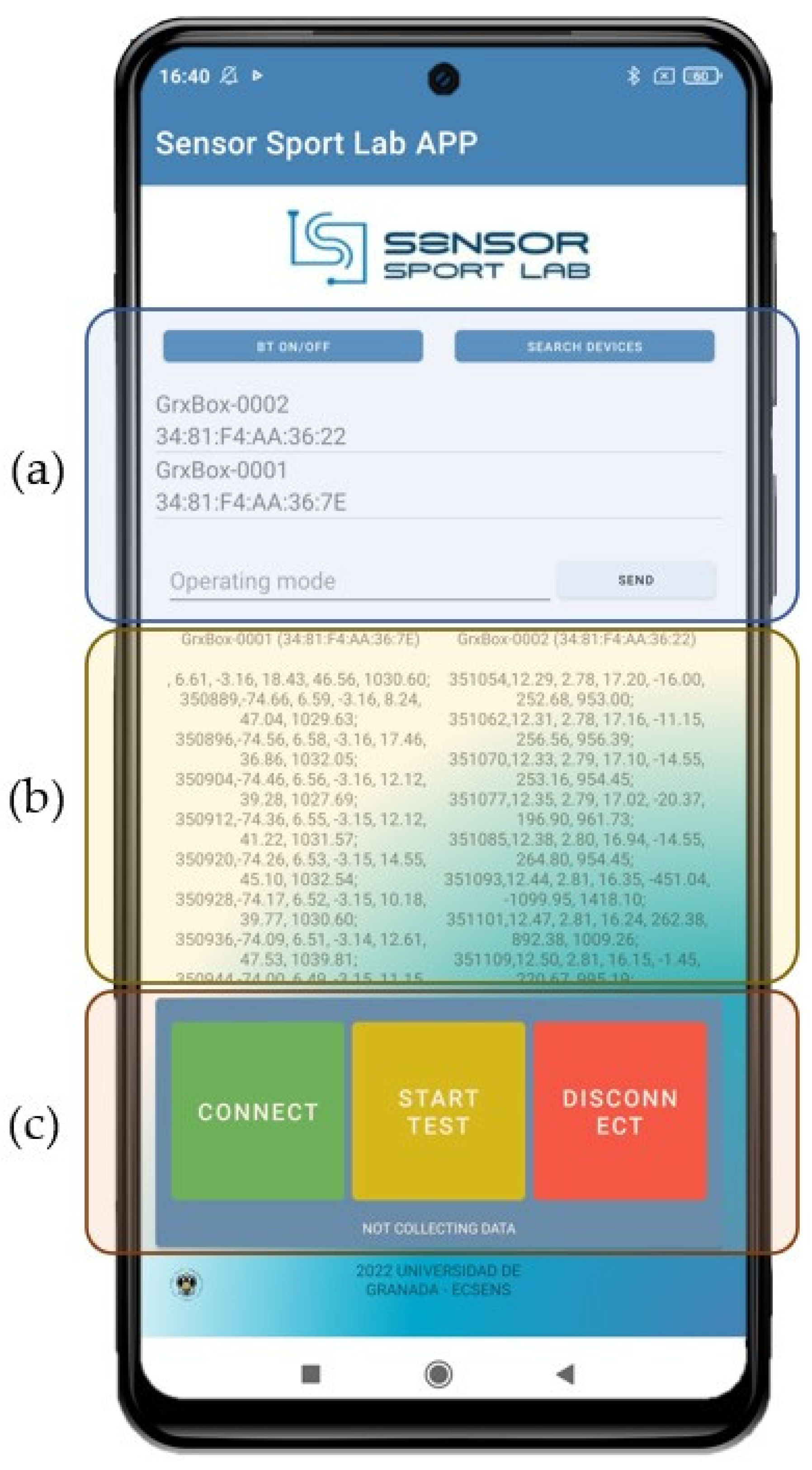
In terms of user interface, a key design requirement was simplicity, thus providing ease of use in training environments and situations where user-friendly operation and rapidity of acquisition are crucial. As shown in Figure 6, the designed user interface can be divided into several parts: (a) Bluetooth connection interface: This enables the search for nearby Bluetooth devices, displaying only the hardware developed after filtering. Additionally, it features a bar for free control of the devices, allowing the sending of any command. (b) Communication panel: This allows visualization of both the names of the connected devices and the real-time data received from each. (c) Quick communication panel: comprising three buttons for rapid control of tests. The green button establishes a link with the devices, the yellow button sends the measurement start command once connected, and the red button terminates the connection.
Figure 6. Screenshot of the control application for dataset collection: (a) Devices detected and connected to the smartphone via Bluetooth protocol. (b) Data collected from the two inertial systems. (c) Control buttons for connecting devices and starting/stopping data collection.
The application was programmed on a Xiaomi RedMi Note 9 using Android Studio IDE (Arctic Fox, version 2020.3.1) and is compatible with Android version 12.0 (API level 31).

3.4. Deep Learning Classification Model

Initially, the raw data collected by the inertial measurement units undergoes a segmentation process. A data stream S from a sensor s consists of a sequence of measurements s = s 0 , , s i . Each measurement s i is related to a different timestamp t i within the specified interval t 0 , t N . The study utilizes input sensors that capture 3-axis acceleration (X, Y, Z) from an IMU-based device on each ski board. Due to the device’s high sampling rate, a segmentation technique was developed to aggregate and resample the raw data into a streamlined and uniform stream. This process involves the short-term collection of samples within temporal windows, which have been proven to effectively represent sports activities [1,3,25]. The median function is used to compute the aggregation function.
Furthermore, a time step parameter Δ = 250 ms is introduced to accurately identify specific times to collect a data sequence and label it according to the gear performed. Real-time models require the use of both current and previous measurements; therefore, for each timestamp t i , a sequence W is defined, consisting of prior data S i * , spanning 320 samples (equivalent to 2.5 s), and noted as W = 320. Therefore, at least 3 s should be processed as the sample for gear classification. This sequence is maintained for each axis (X1, X2, Y1, Y2, Z1, Z2) of the IMU sensors on both ski boards (the IMU called GrxBox number 1 was placed on the left ski and number two on the right ski, see Figure 6a). The size of the sequence is consistent across all sources S s and is organized as follows:
S i * = S i S i 1 , , S i W
Based on the sequence of sample data, sized Wx6, the predictions are formulated according to the activity labeled by the ski user. Three gears have been identified: G2R, G2L, and G3. The association between the acceleration measured by the IMU devices on the ski board and the gear is determined through a classification model. A deep learning model employing CNN and LSTM architecture is suggested for this task. This state-of-the-art architecture has demonstrated its superiority in our previous research [1,3], as well as in the research of other authors [26,27,28] in the domains of IoT and sensor-based predictions.
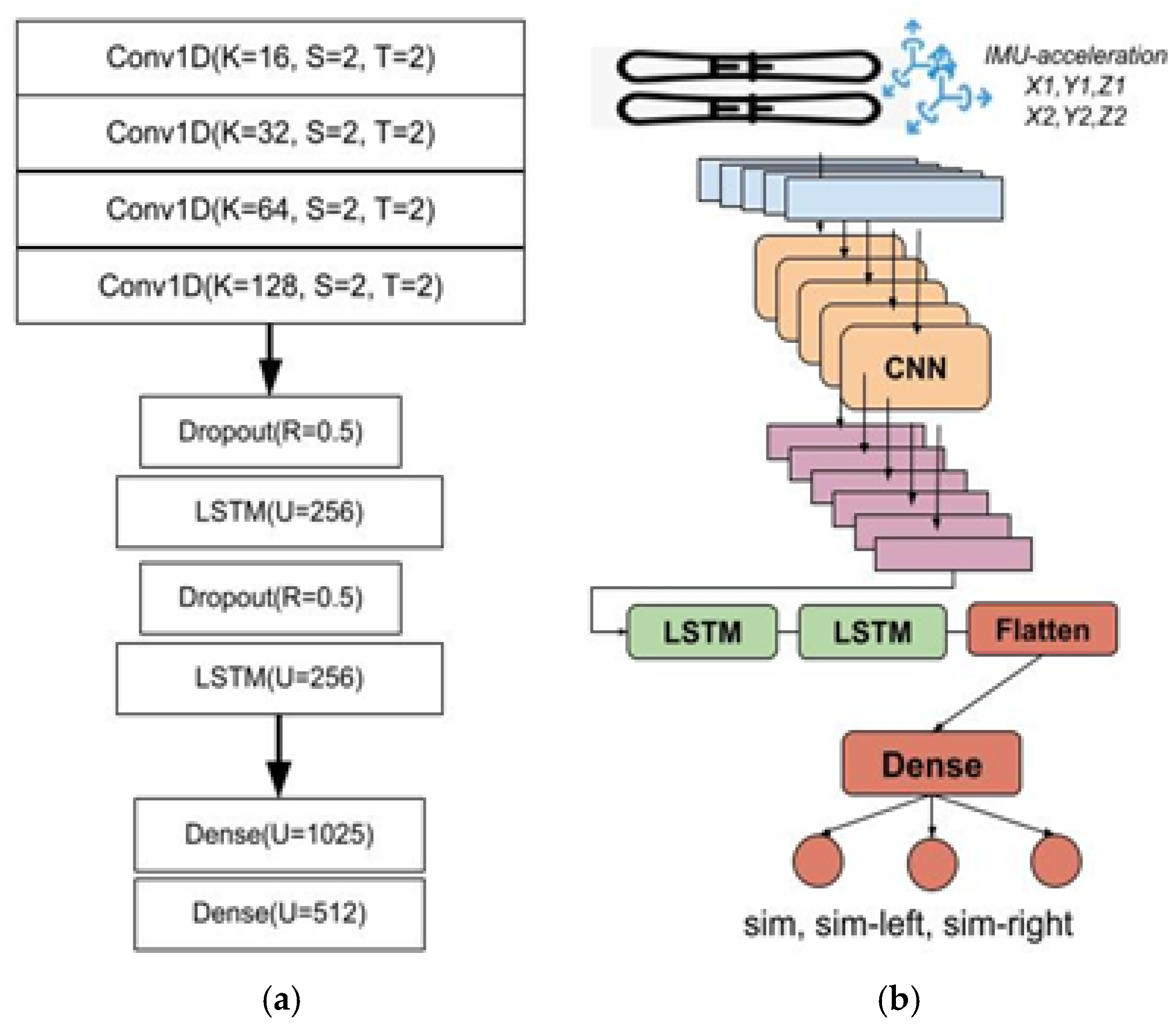
Initially, three 1D CNN layers, termed Conv1D(K,S,ST), where K is the number of kernels, S is the convolution size, and ST is the stride, are used as spatial feature extractors with a stride of 2 to halve the dimension of the input matrix in the output matrix, and include a ReLU activation function to address vanishing gradients and enhance training efficiency. The temporal patterns of the spatial features extracted by CNN are modeled using a two-layer LSTM network with 32 units each. Subsequently, two dense layers based on multilayer perceptrons map the spatio-temporal features to the final output, which consists of three units corresponding to the classes (Sym (G3), asym left (G2L), and asym right (G2R)), utilizing categorical cross-entropy as the loss function with the Adam optimizer, and measuring performance through accuracy. In Figure 7, the architecture and layers of the CNN-LSTM model are detailed.
Figure 7. CNN-LSTM model for the classification and estimation of ski exercises based on the acceleration data from ski boards. (a) Detailed description of the layers and parameters (K = number of convolutional filters; S = kernel size; T = stride size of the filter; R = dropout rate; U = number of units in the LSTM and dense layers). (b) A conceptual overview of the architecture illustrating Conv1D layers for local feature extraction and LSTMs for capturing temporal dependencies in the sequential data.

4. Results

Deep Learning Model Performance

This section presents the case study conducted to evaluate the performance of our ski-gear prediction model. The model is designed to classify ski-training exercises performed by a user into three distinct gears: G2L, G2R, and G3. We conducted a case study by recording a dataset in which two users performed five ascents in each gear over two scenes, resulting in a total of 12,390 recorded instances of the different gears described above. This dataset comprised 4350 instances of G2R, 4217 of G2L, and 3823 of G3. As mentioned in the previous section, the data used for both training and model evaluation were derived from the accelerometers (axes X1, X2, Y1, Y2, Z1, and Z2) of the sensors attached to each ski board, left and right. To thoroughly assess the data, we adopted different evaluation settings:
  • Intra-User Evaluation with Crossed Scenes: Each user’s data was split into two scenes, with one scene (comprising five ascents per gear) used for training and the other for evaluation. This process was reversed in a second iteration to ensure robustness in the evaluation. This method aimed to assess the model’s ability to learn and predict the ski gears for the same user under varying conditions. Table 2 and Table 3 present the precision, recall, F1 score, and support metrics for each class (G2R, G2L, and G3) for user 1 and user 2, respectively. Overall accuracy, macro-average, and weighted average values are also provided, demonstrating the model’s effective performance in classifying skating gears for individual users.
    Table 2. Intra-user evaluation metrics for user 1.
    Table 3. Intra-user evaluation metrics for user 2.
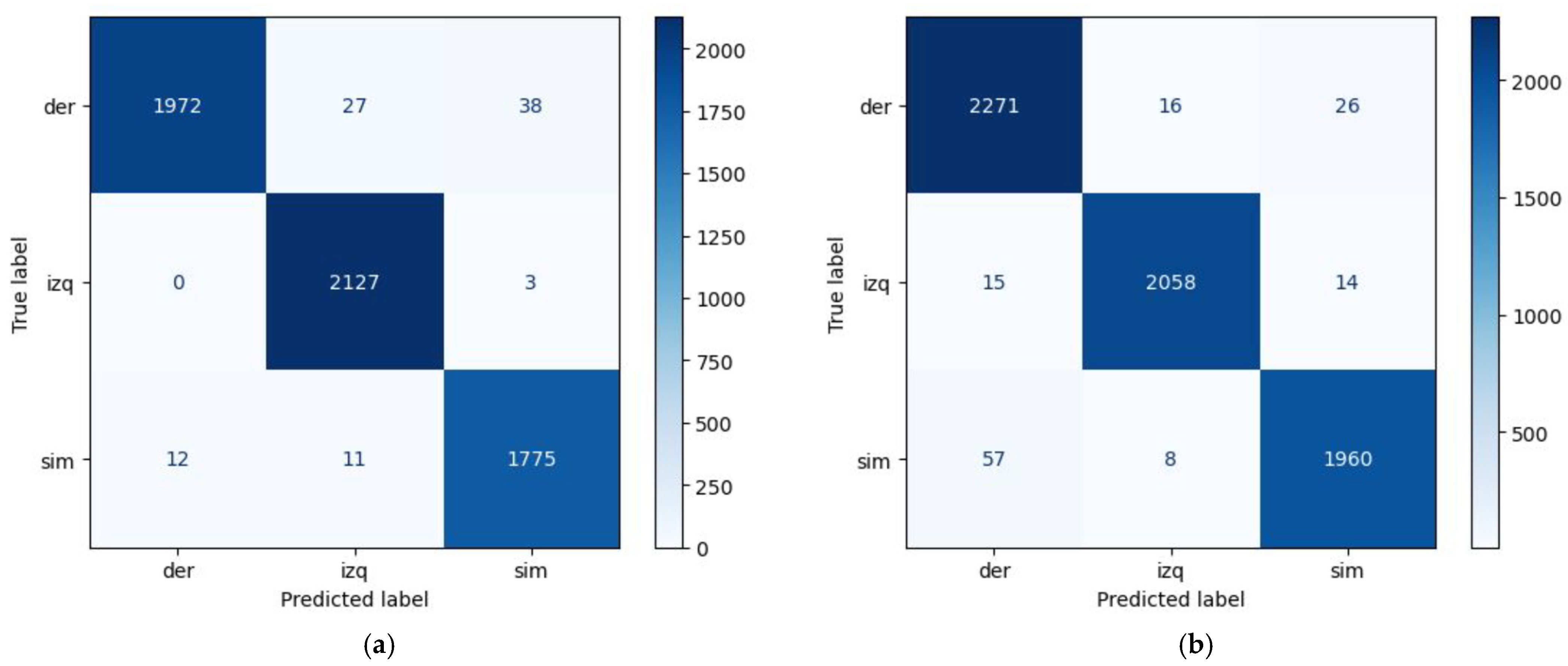
The performance of the model, when trained and tested on user 1’s data, demonstrated an accuracy of 98%. The precision, recall, and F1 scores were consistently high for the symmetric gears (G3), the asymmetric right gear (G2R), and the asymmetric left gear (G2L), with a perfect recall achieved for the G2L gear. The confusion matrix demonstrated minimal misclassification between gears (see Figure 8). In the case of user 2, the model also exhibited high precision, achieving an overall rate of 98%. The precision, recall, and F1 scores across all gears indicated strong performance, particularly for G3 and the asymmetric gears (G2L and G2R), which showed excellent recall.
Figure 8. Confusion matrices for intra-user evaluation. (a) ‘User 1’ with a total of 5965 samples. (b) ‘User 2’ with a total of 6425 samples.
  • Cross-user evaluation: The model was trained using data from user 1 and evaluated using data from user 2 and vice versa. This approach allowed us to assess the model’s generalizability between different users. Table 4 presents the precision, recall, F1 score, and support metrics for each class (G2R, G2L, and G3) in the cross-user evaluation.
    Table 4. Cross-user evaluation metrics.
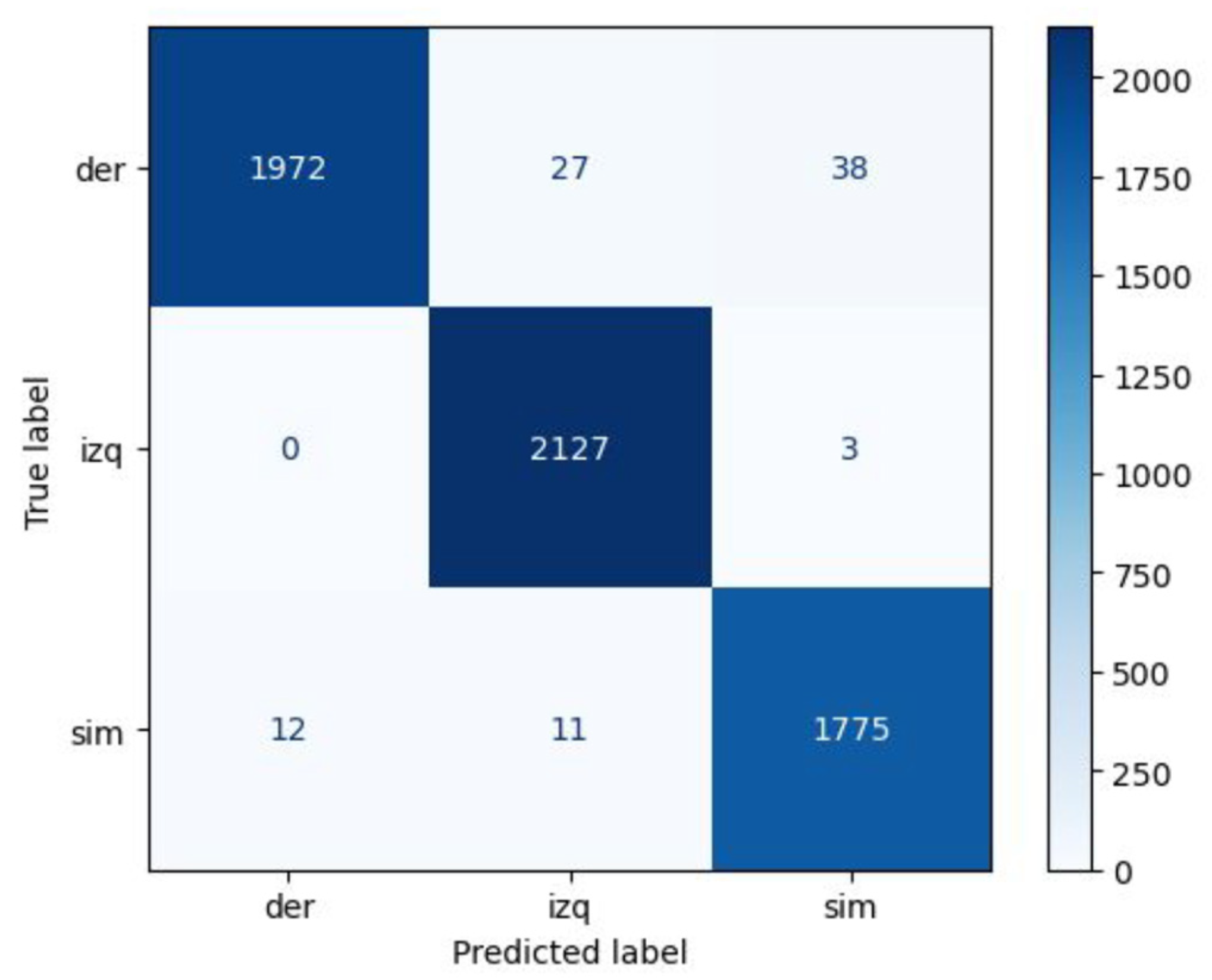
In a highly demanding evaluation scenario with cross-user validation (training from user 1 and testing on user 2, and vice versa), the model achieved an overall precision of 90%. Although the precision and recall rates for the right asymmetric gear remained robust, the left asymmetric gear exhibited some difficulties, resulting in a lower recall and F1 score, as shown in the confusion matrix (see Figure 9).
Figure 9. Confusion matrix for cross-user evaluation.
These findings highlight the model’s ability to accurately classify skiing gears, with particularly strong performance in distinguishing between the G2R, G2L, and G3 gears. The performance drop of the model in the cross-user evaluation points to potential challenges in generalizing the model across different users, indicating an area for further investigation and model refinement. The dataset and the models are available in the following repository: https://github.com/AuroraPR/Skiing-Classification (accessed on 1 October 2024), which includes the implementation of the proposed methods with Python 3.9.13 and Keras 2.11.0.
To highlight the main novelties and improvements reached by the system presented in the current work, the performance of the different classification systems described above has been summarized in Table 5, which provides a detailed overview of related works.
Table 5. Related works comparison table.
To evaluate the improvement of the presented system, it should be considered that using only the data reported by two 3D accelerometers and the machine learning model described above, the accuracy obtained was higher or similar to other more complex systems, as shown in Table 4.
In fact, the overall accuracy was 98% in the case where the training was carried out with the same skier (no cross-training) and 90% for cross-training with two skiers. Therefore, the system presented is simpler and more comfortable to use than others, making it suitable for field tests in real training sessions and reporting with high accuracy.

5. Conclusions

This work demonstrates the viability of detecting and classifying different gears of the skating style in cross-country skiing using two inertial measurement units placed on the skis along with a machine learning model. Acceleration values were sufficient to discriminate between different gears (G2R, G2L, and G3) during uphill, achieving an accuracy of 98% for individual skier training processes and dropping slightly to an acceptable 90% when using cross-skier data for training. The performance of the proposed system validates the inertial sensor system, the smartphone application, and the deep learning model described in the current work for their application to gear classification in cross-country skiing in the skating style, opening the possibility of application to other skiing styles.

Author Contributions

The individual contributions of the authors are specified as follows: Conceptualization: N.M.-C. and M.Á.C.; Methodology: J.A.M.-P., N.L.-R., N.M.-C., J.M.-Q. and M.Á.C.; Software: A.P.-G., A.P.-R., J.A.M.-P. and J.M.-Q.; Validation: A.P.-G., A.P.-R., J.A.M.-P., I.R.-G. and N.M.-C.; Formal analysis: A.P.-R., N.L.-R., N.M.-C. and M.Á.C.; Investigation: A.P.-G., N.M.-C., J.M.-Q. and M.Á.C.; Resources: M.Á.C.; Data curation: A.P.-R., J.A.M.-P., I.R.-G., N.L.-R., N.M.-C., J.M.-Q. and M.Á.C.; Writing—original draft: A.P.-G., A.P.-R., I.R.-G., P.E., N.L.-R., N.M.-C., J.M.-Q. and M.Á.C.; Writing—review and editing: P.E., N.L.-R., J.M.-Q. and M.Á.C.; Visualization: P.E.; Supervision: P.E. and M.Á.C.; Project administration: M.Á.C.; Funding acquisition: M.Á.C., P.E. and N.L.-R. All authors have read and agreed to the published version of the manuscript.

Funding

This work has been partly supported by the projects “SensorSportLab III”, (Redes de Investigación en Ciencias del Deporte 2024) by Consejo Superior de Deportes (Ministerio de Cultura y Deporte); and the project PPJIA2023-076, funded by the program ‘Proyectos de investigación precompetitivos para jóvenes investigadores, Modalidad A – Jóvenes Doctores,’ from the ‘Plan Propio de Investigación 2023’ of the University of Granada. Finally, P.E.-A. thanks the project IJC2020-043307-I funded by MCIN/AEI/10.13039/501100011033 and by the ‘European Union NextGenerationEU/PRTR’.

Institutional Review Board Statement

This study was conducted according to the guidelines of the Declaration of Helsinki.

Data Availability Statement

The data presented in this study are available at https://github.com/AuroraPR/Skiing-Classification (accessed on 1 October 2024).

Conflicts of Interest

All the authors declare that the research was conducted in the absence of any commercial or financial relationships that could be construed as a potential conflict of interest.

References

  1. Polo-Rodriguez, A.; Montoro-Lendinez, A.; Espinilla, M.; Medina-Quero, J. Classifying Sport-Related Human Activity from Thermal Vision Sensors Using CNN and LSTM. In Proceedings of the Image Analysis and Processing. ICIAP 2022 Workshops; Mazzeo, P.L., Frontoni, E., Sclaroff, S., Distante, C., Eds.; Springer International Publishing: Cham, Switzerland, 2022; pp. 38–48. [Google Scholar]
  2. Bernal Monroy, E.; Polo Rodríguez, A.; Espinilla Estevez, M.; Medina Quero, J. Fuzzy Monitoring of In-Bed Postural Changes for the Prevention of Pressure Ulcers Using Inertial Sensors Attached to Clothing. J. Biomed. Inform. 2020, 107, 103476. [Google Scholar] [CrossRef] [PubMed]
  3. Polo-Rodriguez, A.; Diaz-Jimenez, D.; Carvajal, M.A.; Baños, O.; Medina-Quero, J. Detection of Sets and Repetitions in Strength Exercises Using IMU-Based Wristband Wearables. In Proceedings of the Proceedings of the 15th International Conference on Ubiquitous Computing & Ambient Intelligence (UCAmI 2023); Bravo, J., Urzáiz, G., Eds.; Springer Nature Switzerland: Cham, Switzerland, 2023; pp. 71–80. [Google Scholar]
  4. Ruiz-García, I.; Navarro-Marchal, I.; Ocaña-Wilhelmi, J.; Palma, A.J.; Gómez-López, P.J.; Carvajal, M.A. Development and Evaluation of a Low-Drift Inertial Sensor-Based System for Analysis of Alpine Skiing Performance. Sensors 2021, 21, 2480. [Google Scholar] [CrossRef] [PubMed]
  5. Amendolara, A.; Pfister, D.; Settelmayer, M.; Shah, M.; Wu, V.; Donnelly, S.; Johnston, B.; Peterson, R.; Sant, D.; Kriak, J.; et al. An Overview of Machine Learning Applications in Sports Injury Prediction. Cureus 2023, 15, e46170. [Google Scholar] [CrossRef]
  6. Van Eetvelde, H.; Mendonça, L.D.; Ley, C.; Seil, R.; Tischer, T. Machine Learning Methods in Sport Injury Prediction and Prevention: A Systematic Review. J. Exp. Orthop. 2021, 8, 27. [Google Scholar] [CrossRef]
  7. Li, X.; Song, L.; Wu, H. Digitalization of Cross-Country Skiing Training Based on Multisensor Combination. J. Sens. 2021, 2021, 5662716. [Google Scholar] [CrossRef]
  8. Takeda, M.; Miyamoto, N.; Endo, T.; Ohtonen, O.; Lindinger, S.; Linnamo, V.; Stöggl, T. Cross-Country Skiing Analysis and Ski Technique Detection by High-Precision Kinematic Global Navigation Satellite System. Sensors 2019, 19, 4947. [Google Scholar] [CrossRef]
  9. Marsland, F.; Mackintosh, C.; Holmberg, H.-C.; Anson, J.; Waddington, G.; Lyons, K.; Chapman, D. Full Course Macro-Kinematic Analysis of a 10 Km Classical Cross-Country Skiing Competition. PLoS ONE 2017, 12, e0182262. [Google Scholar] [CrossRef]
  10. Seeberg, T.M.; Tjønnås, J.; Rindal, O.M.H.; Haugnes, P.; Dalgard, S.; Sandbakk, Ø. A Multi-Sensor System for Automatic Analysis of Classical Cross-Country Skiing Techniques. Sports Eng. 2017, 20, 313–327. [Google Scholar] [CrossRef]
  11. Johansson, M.; Korneliusson, M.; Lawrence, N.L. Identifying Cross Country Skiing Techniques Using Power Meters in Ski Poles. In Proceedings of the Nordic Artificial Intelligence Research and Development; Bach, K., Ruocco, M., Eds.; Springer International Publishing: Cham, Switzerland, 2019; pp. 52–57. [Google Scholar]
  12. Nilsson, J.; Tveit, P.; Eikrehagen, O. Effects of Speed on Temporal Patterns in Classical Style and Freestyle Cross-Country Skiing. Sports Biomech. 2004, 3, 85–107. [Google Scholar] [CrossRef]
  13. Andersson, E.; Supej, M.; Sandbakk, Ø.; Sperlich, B.; Stöggl, T.; Holmberg, H.-C. Analysis of Sprint Cross-Country Skiing Using a Differential Global Navigation Satellite System. Eur. J. Appl. Physiol. 2010, 110, 585–595. [Google Scholar] [CrossRef]
  14. Torvik, P.-Ø.; von Heimburg, E.D.; Sende, T.; Welde, B. The Effect of Pole Length on Physiological and Perceptual Responses during G3 Roller Ski Skating on Uphill Terrain. PLoS ONE 2019, 14, e0211550. [Google Scholar] [CrossRef] [PubMed]
  15. Stöggl, T.; Holst, A.; Jonasson, A.; Andersson, E.; Wunsch, T.; Norström, C.; Holmberg, H.-C. Automatic Classification of the Sub-Techniques (Gears) Used in Cross-Country Ski Skating Employing a Mobile Phone. Sensors 2014, 14, 20589–20601. [Google Scholar] [CrossRef] [PubMed]
  16. Liu, D.; He, M.; Hou, M.; Ma, Y. Deep Learning Based Ground Reaction Force Estimation for Stair Walking Using Kinematic Data. Measurement 2022, 198, 111344. [Google Scholar] [CrossRef]
  17. Fan, J.; Bi, S.; Xu, R.; Wang, L.; Zhang, L. Hybrid Lightweight Deep-Learning Model for Sensor-Fusion Basketball Shooting-Posture Recognition. Measurement 2022, 189, 110595. [Google Scholar] [CrossRef]
  18. Rassem, A.; El-Beltagy, M.; Saleh, M. Cross-Country Skiing Gears Classification Using Deep Learning. arXiv 2017. [Google Scholar] [CrossRef]
  19. Rindal, O.M.H.; Seeberg, T.M.; Tjønnås, J.; Haugnes, P.; Sandbakk, Ø. Automatic Classification of Sub-Techniques in Classical Cross-Country Skiing Using a Machine Learning Algorithm on Micro-Sensor Data. Sensors 2018, 18, 75. [Google Scholar] [CrossRef] [PubMed]
  20. Gløersen, Ø.; Gilgien, M. Classification of Cross-Country Ski Skating Sub-Technique Can Be Automated Using Carrier-Phase Differential GNSS Measurements of the Head’s Position. Sensors 2021, 21, 2705. [Google Scholar] [CrossRef]
  21. Crema, C.; Depari, A.; Flammini, A.; Sisinni, E.; Haslwanter, T.; Salzmann, S. Characterization of a Wearable System for Automatic Supervision of Fitness Exercises. Measurement 2019, 147, 106810. [Google Scholar] [CrossRef]
  22. Horvat, T.; Job, J. The Use of Machine Learning in Sport Outcome Prediction: A Review. WIREs Data Min. Knowl. Discov. 2020, 10, e1380. [Google Scholar] [CrossRef]
  23. Jang, J.; Ankit, A.; Kim, J.; Jang, Y.J.; Kim, H.Y.; Kim, J.H.; Xiong, S. A Unified Deep-Learning Model for Classifying the Cross-Country Skiing Techniques Using Wearable Gyroscope Sensors. Sensors 2018, 18, 3819. [Google Scholar] [CrossRef]
  24. Sakurai, Y.; Fujita, Z.; Ishige, Y. Automatic Identification of Subtechniques in Skating-Style Roller Skiing Using Inertial Sensors. Sensors 2016, 16, 473. [Google Scholar] [CrossRef] [PubMed]
  25. Sui, J.-D.; Chen, W.-H.; Shiang, T.-Y.; Chang, T.-S. Real-Time Wearable Gait Phase Segmentation for Running And Walking. In Proceedings of the 2020 IEEE International Symposium on Circuits and Systems (ISCAS), Seville, Spain, 12–14 October 2020; pp. 1–5. [Google Scholar]
  26. Koşar, E.; Barshan, B. A New CNN-LSTM Architecture for Activity Recognition Employing Wearable Motion Sensor Data: Enabling Diverse Feature Extraction. Eng. Appl. Artif. Intell. 2023, 124, 106529. [Google Scholar] [CrossRef]
  27. Ordóñez, F.J.; Roggen, D. Deep Convolutional and LSTM Recurrent Neural Networks for Multimodal Wearable Activity Recognition. Sensors 2016, 16, 115. [Google Scholar] [CrossRef] [PubMed]
  28. Xia, K.; Huang, J.; Wang, H. LSTM-CNN Architecture for Human Activity Recognition. IEEE Access 2020, 8, 56855–56866. [Google Scholar] [CrossRef]
Disclaimer/Publisher’s Note: The statements, opinions and data contained in all publications are solely those of the individual author(s) and contributor(s) and not of MDPI and/or the editor(s). MDPI and/or the editor(s) disclaim responsibility for any injury to people or property resulting from any ideas, methods, instructions or products referred to in the content.

Article Metrics

Citations

Article Access Statistics

Multiple requests from the same IP address are counted as one view.