Postfilter for Dual Channel Speech Enhancement Using Coherence and Statistical Model-Based Noise Estimation


Abstract
1. Introduction
2. System Overview and Review of SPP-Based Noise Estimation
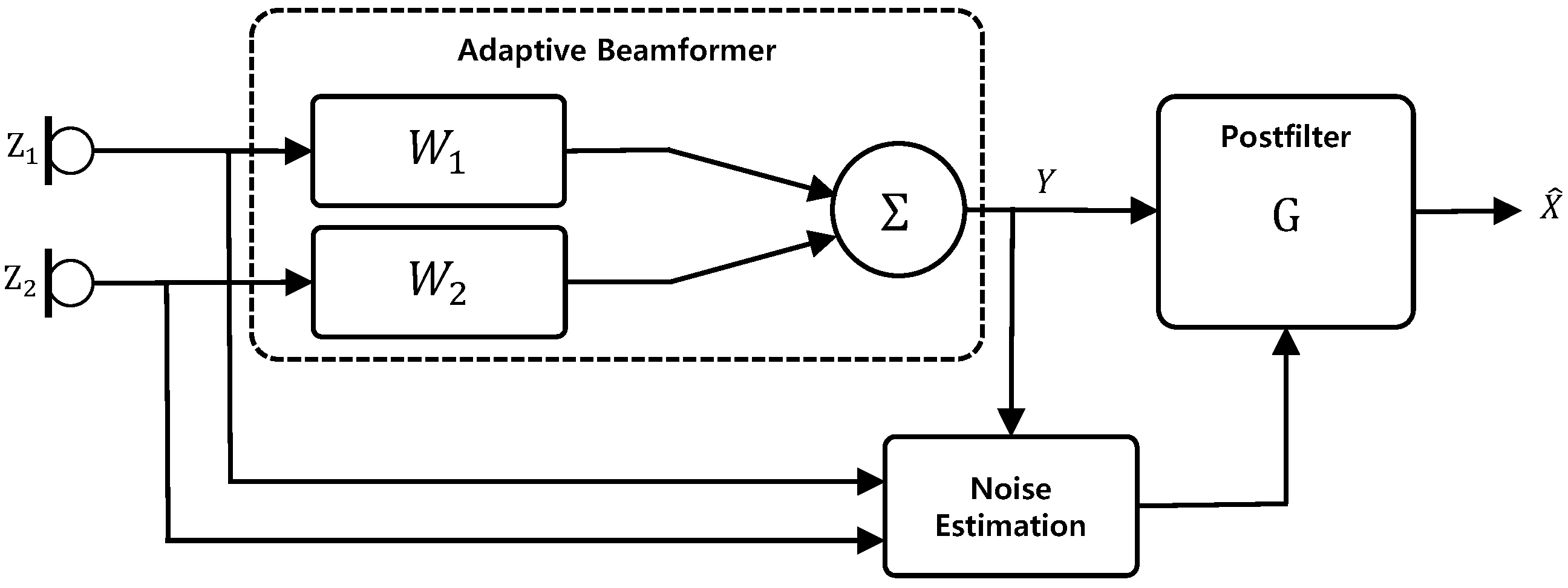
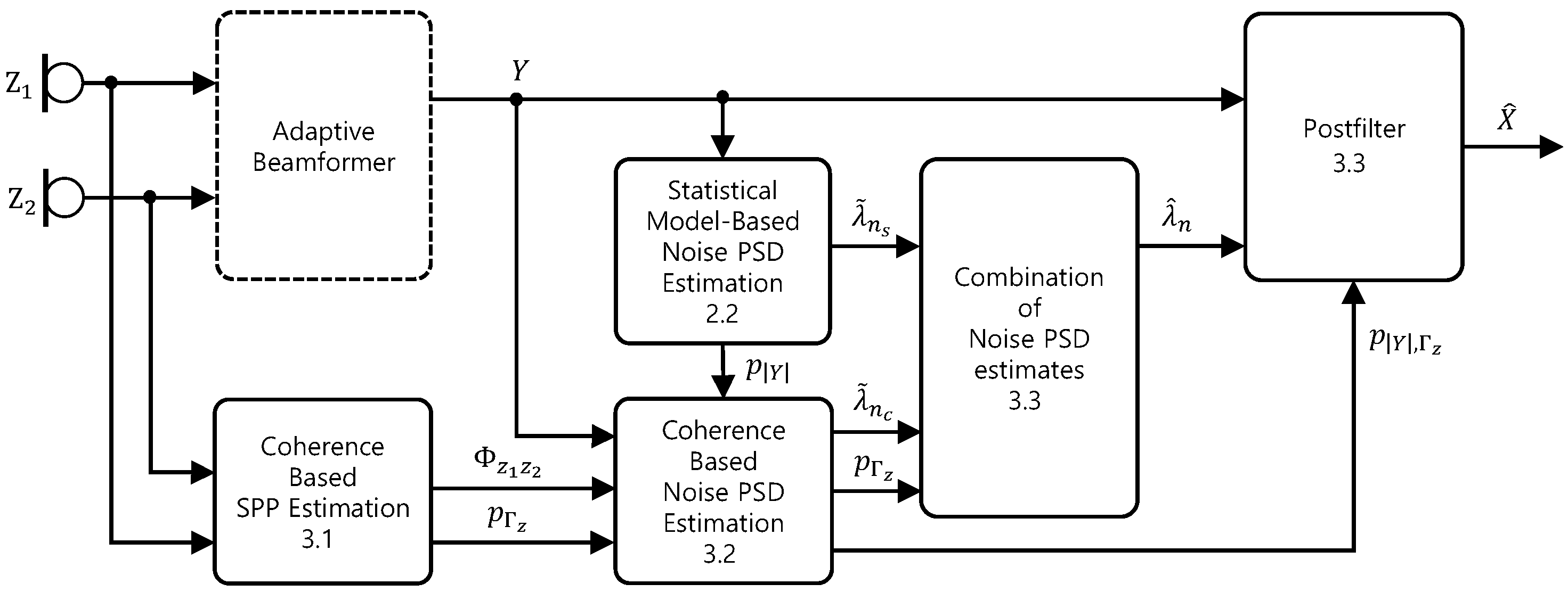
2.1. Problem Formulation and System Overview
2.2. Single-Channel Noise PSD Estimator Based on Speech Presence Probability
3. Postfilter for Dual Channel Speech Enhancement Utilizing Noise Estimation Based on Coherence and Statistical Model
3.1. Modeling of a Posteriori SPP Based on Coherence
3.2. Proposed Dual Channel Noise PSD Estimator Based on Coherence
3.3. Combining Noise PSD Estimates and Gain Calculation
4. Experimental and Results
4.1. Experimental Configurations
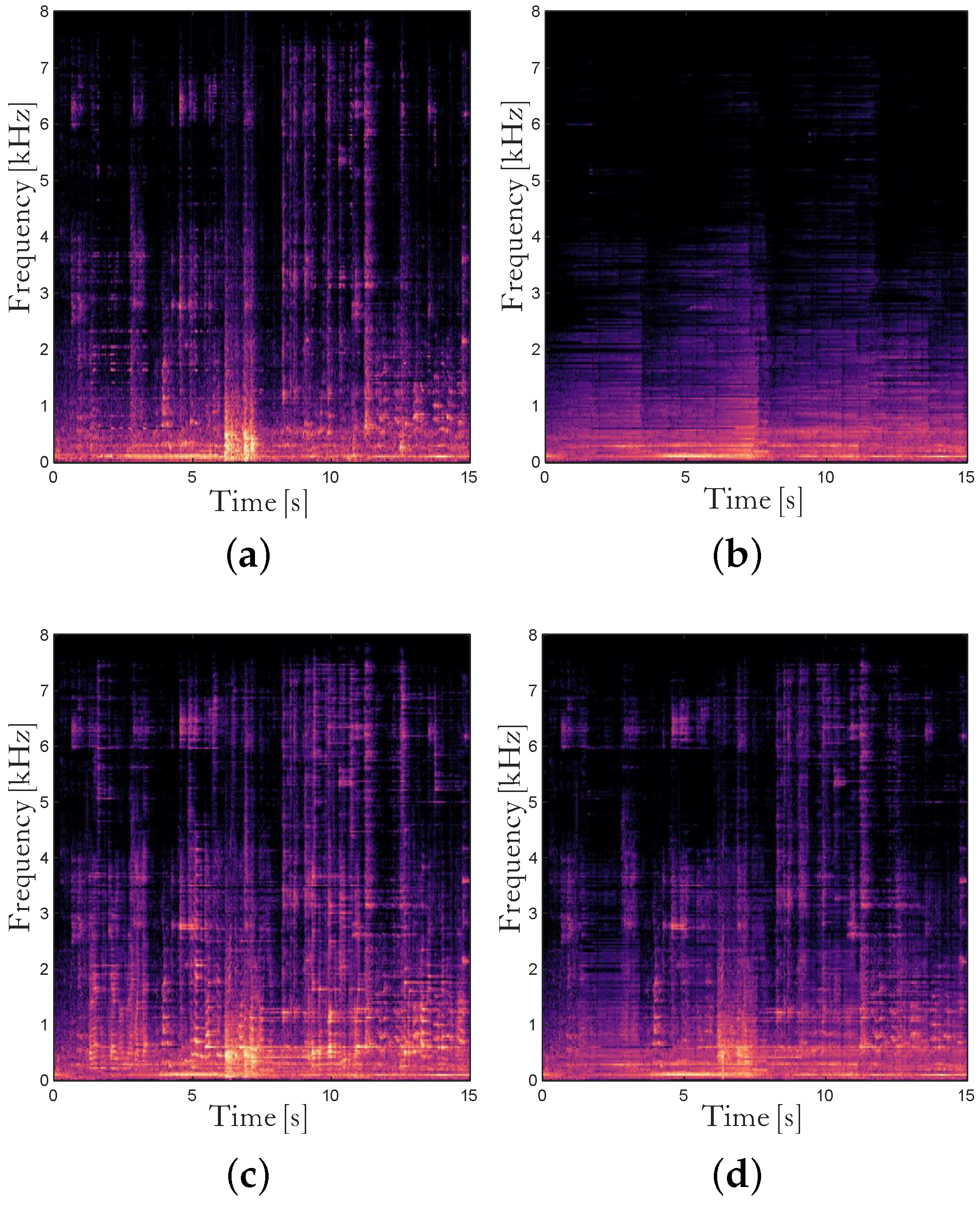
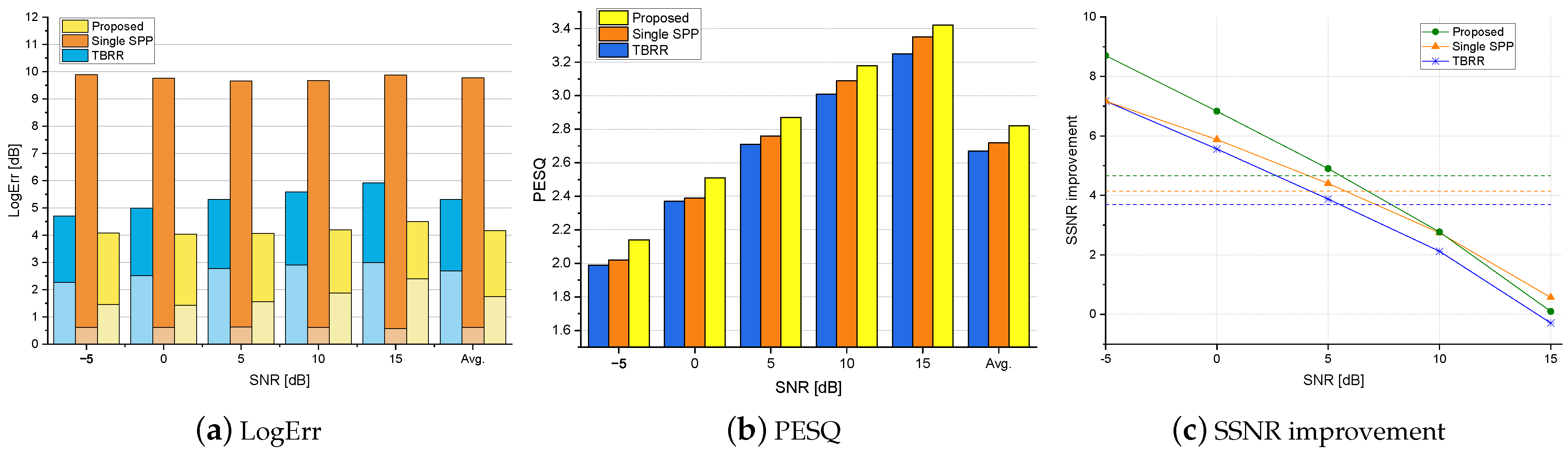
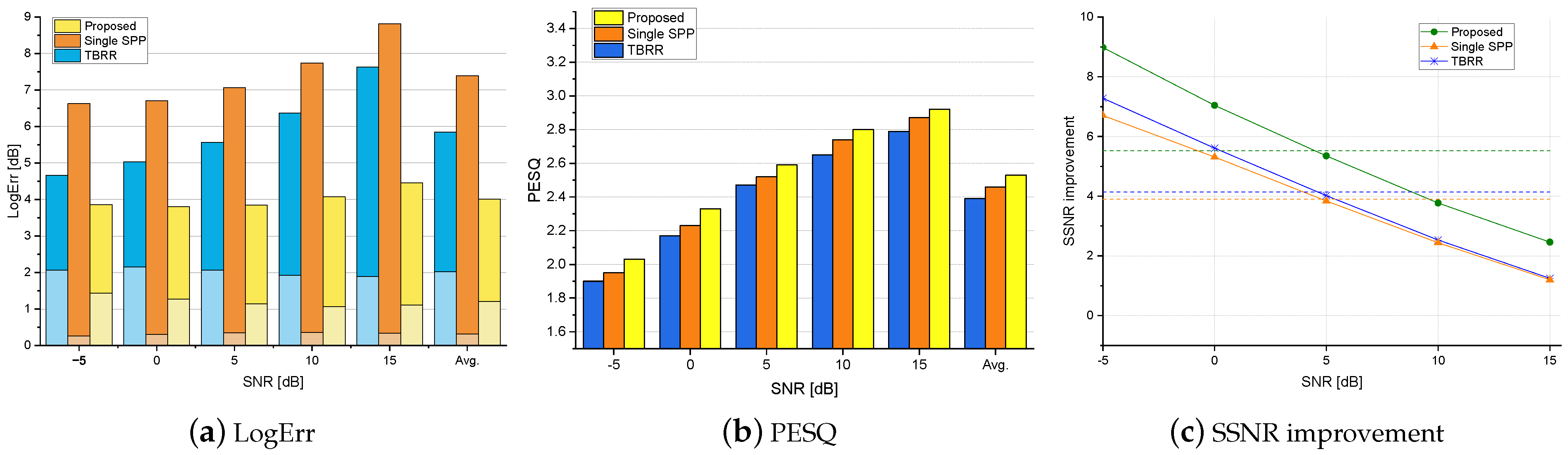
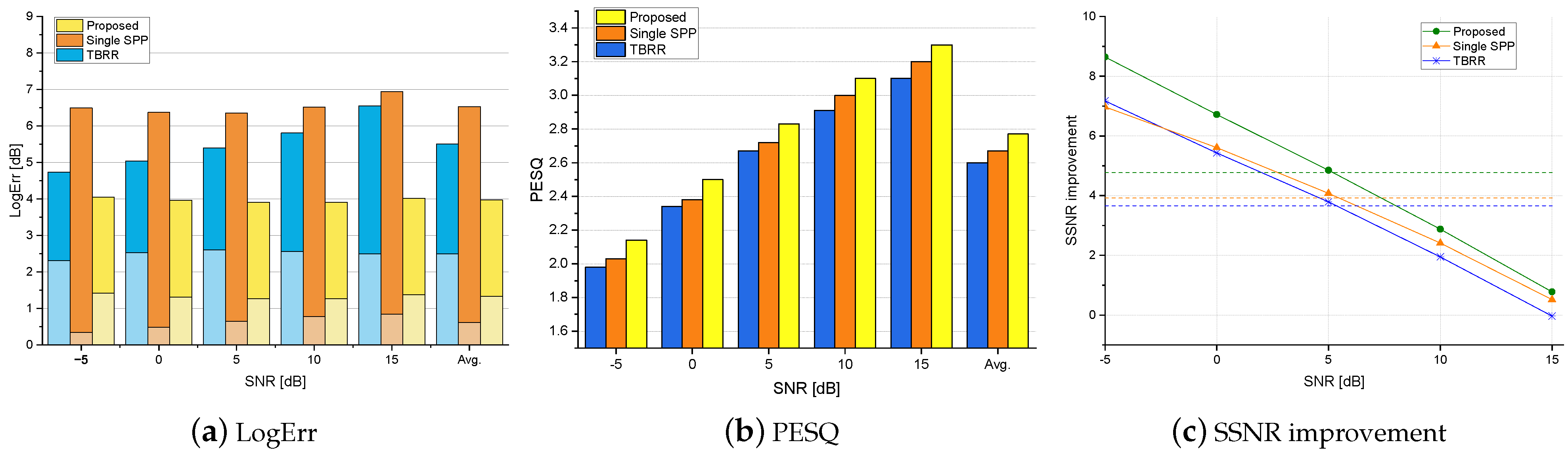
4.2. Experimental Results
5. Conclusions
Author Contributions
Funding
Institutional Review Board Statement
Informed Consent Statement
Data Availability Statement
Conflicts of Interest
References
- Vary, P.; Martin, R. Digital Speech Transmission: Enhancement, Coding and Error Concealment; John Wiley & Sons: Hoboken, NJ, USA, 2006. [Google Scholar]
- Benesty, J.; Chen, J.; Huang, Y. Microphone Array Signal Processing; Springer Science & Business Media: Berlin/Heidelberg, Germany, 2008; Volume 1. [Google Scholar]
- Kates, J.M. Digital Hearing Aids; Plural Publishing: San Diego, CA, USA, 2008. [Google Scholar]
- Rabiner, L. Fundamentals of Speech Recognition; PTR Prentice Hall: Hoboken, NJ, USA, 1993. [Google Scholar]
- Jin, Y.G.; Shin, J.W.; Kim, N.S. Decision-directed speech power spectral density matrix estimation for multichannel speech enhancement. J. Acoust. Soc. Am. 2017, 141, EL228–EL233. [Google Scholar] [CrossRef] [Scilit] [PubMed]
- Gannot, S.; Vincent, E.; Markovich-Golan, S.; Ozerov, A. A consolidated perspective on multimicrophone speech enhancement and source separation. IEEE/ACM Trans. Audio Speech Lang. Process. 2017, 25, 692–730. [Google Scholar] [CrossRef] [Scilit]
- Hwang, S.; Kim, M.; Shin, J.W. Dual microphone speech enhancement based on statistical modeling of interchannel phase difference. IEEE/ACM Trans. Audio Speech Lang. Process. 2022, 30, 2865–2874. [Google Scholar] [CrossRef] [Scilit]
- Rascon, C. A corpus-based evaluation of beamforming techniques and phase-based frequency masking. Sensors 2021, 21, 5005. [Google Scholar] [CrossRef] [Scilit] [PubMed]
- Neo, V.W.; Evers, C.; Naylor, P.A. Enhancement of noisy reverberant speech using polynomial matrix eigenvalue decomposition. IEEE/ACM Trans. Audio Speech Lang. Process. 2021, 29, 3255–3266. [Google Scholar] [CrossRef] [Scilit]
- Moore, A.H.; Hafezi, S.; Vos, R.R.; Naylor, P.A.; Brookes, M. A compact noise covariance matrix model for MVDR beamforming. IEEE/ACM Trans. Audio Speech Lang. Process. 2022, 30, 2049–2061. [Google Scholar] [CrossRef] [Scilit]
- Van Trees, H.L. Optimum Array Processing; John Wiley & Sons, Inc.: New York, NY, USA, 2002. [Google Scholar]
- Gannot, S.; Burshtein, D.; Weinstein, E. Signal enhancement using beamforming and nonstationarity with applications to speech. IEEE Trans. Signal Process. 2001, 49, 1614–1626. [Google Scholar] [CrossRef] [Scilit]
- Kim, H.; Shin, J.W. Dual-mic speech enhancement based on TF-GSC with leakage suppression and signal recovery. Appl. Sci. 2021, 11, 2816. [Google Scholar] [CrossRef] [Scilit]
- Simmer, K.U.; Bitzer, J.; Marro, C. Post-Filtering Techniques. In Microphone Arrays: Signal Processing Techniques and Applications; Springer Science & Business Media: Berlin/Heidelberg, Germany, 2001; pp. 39–60. [Google Scholar]
- Thüne, P.; Enzner, G. Maximum-likelihood approach with Bayesian refinement for multichannel-Wiener postfiltering. IEEE Trans. Signal Process. 2017, 65, 3399–3413. [Google Scholar] [CrossRef] [Scilit]
- Zelinski, R. A Microphone Array with Adaptive Post-Filtering for Noise Reduction in Reverberant Rooms. In Proceedings of the ICASSP-88, International Conference on Acoustics, Speech, and Signal Processing, New York, NY, USA, 11–14 April 1988; pp. 2578–2579. [Google Scholar]
- McCowan, I.A.; Bourlard, H. Microphone array post-filter based on noise field coherence. IEEE Trans. Speech Audio Process. 2003, 11, 709–716. [Google Scholar] [CrossRef] [Scilit]
- Kumatani, K.; Raj, B.; Singh, R.; McDonough, J. Microphone Array Post-Filter Based on Spatially-Correlated Noise Measurements for Distant Speech Recognition. In Proceedings of the Thirteenth Annual Conference of the International Speech Communication Association, Portland, OR, USA, 9–13 September 2012. [Google Scholar]
- Kim, M.; Cheong, S.; Song, H.; Shin, J.W. Improved speech spatial covariance matrix estimation for online multi-microphone speech enhancement. Sensors 2022, 23, 111. [Google Scholar] [CrossRef] [Scilit] [PubMed]
- Lefkimmiatis, S.; Maragos, P. A generalized estimation approach for linear and nonlinear microphone array post-filters. Speech Commun. 2007, 49, 657–666. [Google Scholar] [CrossRef] [Scilit]
- Gannot, S.; Cohen, I. Speech enhancement based on the general transfer function GSC and postfiltering. IEEE Trans. Speech Audio Process. 2004, 12, 561–571. [Google Scholar] [CrossRef]
- Cauchi, B.; Kodrasi, I.; Rehr, R.; Gerlach, S.; Jukic, A.; Gerkmann, T.; Doclo, S.; Goetze, S. Combination of MVDR beamforming and single-channel spectral processing for enhancing noisy and reverberant speech. EURASIP J. Adv. Signal Process. 2015, 2015, 61. [Google Scholar] [CrossRef] [Scilit]
- Cheng, R.; Bao, C. Speech Enhancement Based on Beamforming and Post-Filtering by Combining Phase Information. In Proceedings of the INTERSPEECH, Shanghai, China, 25–29 October 2020; pp. 4496–4500. [Google Scholar]
- Zhou, Y.; Chen, Y.; Ma, Y.; Liu, H. A real-time dual-microphone speech enhancement algorithm assisted by bone conduction sensor. Sensors 2020, 20, 5050. [Google Scholar] [CrossRef] [Scilit] [PubMed]
- Šarić, Z.; Subotić, M.; Bilibajkić, R.; Barjaktarović, M.; Stojanović, J. Supervised speech separation combined with adaptive beamforming. Comput. Speech Lang. 2022, 76, 101409. [Google Scholar] [CrossRef] [Scilit]
- Tao, T.; Zheng, H.; Yang, J.; Guo, Z.; Zhang, Y.; Ao, J.; Chen, Y.; Lin, W.; Tan, X. Sound localization and speech enhancement algorithm based on dual-microphone. Sensors 2022, 22, 715. [Google Scholar] [CrossRef] [Scilit]
- Kim, M.; Cheong, S.; Shin, J.W. DNN-based Parameter Estimation for MVDR Beamforming and Post-Filtering. In Proceedings of the INTERSPEECH, Dublin, Ireland, 20–24 August 2023; pp. 3879–3883. [Google Scholar]
- Sun, T.; Lei, T.; Zhang, X.; Hu, Y.; Zhu, C.; Lu, J. A Lightweight Hybrid Multi-Channel Speech Extraction System with Directional Voice Activity Detection. In Proceedings of the ICASSP 2024—2024 IEEE International Conference on Acoustics, Speech and Signal Processing (ICASSP), Seoul, Republic of Korea, 14–19 April 2024; IEEE: Piscataway, NJ, USA, 2024; pp. 1486–1490. [Google Scholar]
- Nelke, C.M.; Beaugeant, C.; Vary, P. Dual Microphone Noise PSD Estimation for Mobile Phones in Hands-Free Position Exploiting the Coherence and Speech Presence Probability. In Proceedings of the 2013 IEEE International Conference on Acoustics, Speech and Signal Processing, Vancouver, BC, Canada, 26–31 May 2013; IEEE: Piscataway, NJ, USA, 2013; pp. 7279–7283. [Google Scholar]
- Kim, K.; Jeong, S.Y.; Jeong, J.H.; Oh, K.C.; Kim, J. Dual Channel Noise Reduction Method Using Phase Difference-Based Spectral Amplitude Estimation. In Proceedings of the 2010 IEEE International Conference on Acoustics, Speech and Signal Processing, Dallas, TX, USA, 14–19 March 2010; IEEE: Piscataway, NJ, USA, 2010; pp. 217–220. [Google Scholar]
- Jeub, M.; Herglotz, C.; Nelke, C.; Beaugeant, C.; Vary, P. Noise Reduction for Dual-Microphone Mobile Phones Exploiting Power Level Differences. In Proceedings of the 2012 IEEE International Conference on Acoustics, Speech and Signal Processing (ICASSP), Kyoto, Japan, 25–30 March 2012; IEEE: Piscataway, NJ, USA, 2012; pp. 1693–1696. [Google Scholar]
- Jin, W.; Taghizadeh, M.J.; Chen, K.; Xiao, W. Multi-Channel Noise Reduction for Hands-Free Voice Communication on Mobile Phones. In Proceedings of the 2017 IEEE International Conference on Acoustics, Speech and Signal Processing (ICASSP), New Orleans, LA, USA, 5–9 March 2017; IEEE: Piscataway, NJ, USA, 2017; pp. 506–510. [Google Scholar]
- Martin, R. Noise power spectral density estimation based on optimal smoothing and minimum statistics. IEEE Trans. Speech Audio Process. 2001, 9, 504–512. [Google Scholar] [CrossRef] [Scilit]
- Cohen, I.; Berdugo, B. Noise estimation by minima controlled recursive averaging for robust speech enhancement. IEEE Signal Process. Lett. 2002, 9, 12–15. [Google Scholar] [CrossRef] [Scilit]
- Hendriks, R.C.; Heusdens, R.; Jensen, J. MMSE Based Noise PSD Tracking with Low Complexity. In Proceedings of the 2010 IEEE International Conference on Acoustics, Speech and Signal Processing, Dallas, TX, USA, 14–19 March 2010; IEEE: Piscataway, NJ, USA, 2010; pp. 4266–4269. [Google Scholar]
- Gerkmann, T.; Hendriks, R.C. Unbiased MMSE-based noise power estimation with low complexity and low tracking delay. IEEE Trans. Audio Speech Lang. Process. 2012, 20, 1383–1393. [Google Scholar] [CrossRef] [Scilit]
- Cohen, I. Noise spectrum estimation in adverse environments: Improved minima controlled recursive averaging. IEEE Trans. Speech Audio Process. 2003, 11, 466–475. [Google Scholar] [CrossRef] [Scilit]
- Cron, B.F.; Sherman, C.H. Spatial-correlation functions for various noise models. J. Acoust. Soc. Am. 1962, 34, 1732–1736. [Google Scholar] [CrossRef] [Scilit]
- Cohen, I.; Berdugo, B. Speech enhancement for non-stationary noise environments. Signal Process. 2001, 81, 2403–2418. [Google Scholar] [CrossRef] [Scilit]
- Ephraim, Y.; Malah, D. Speech enhancement using a minimum mean-square error log-spectral amplitude estimator. IEEE Trans. Acoust. Speech Signal Process. 1985, 33, 443–445. [Google Scholar] [CrossRef] [Scilit]
- Lehmann, E.A.; Johansson, A.M. Prediction of energy decay in room impulse responses simulated with an image-source model. J. Acoust. Soc. Am. 2008, 124, 269–277. [Google Scholar] [CrossRef] [Scilit]
- Lehmann, E.A.; Johansson, A.M.; Nordholm, S. Reverberation-Time Prediction Method for Room Impulse Responses Simulated with the Image-Source Model. In Proceedings of the 2007 IEEE Workshop on Applications of Signal Processing to Audio and Acoustics, New Paltz, NY, USA, 21–24 October 2007; pp. 159–162. [Google Scholar] [CrossRef] [Scilit]
- ETSI TS 126 132; Speech and Video Telephony Terminal. European Telecommunications Standards Institute: Sophia Antipolis, France, 2014.
- Hadad, E.; Heese, F.; Vary, P.; Gannot, S. Multichannel Audio Database in Various Acoustic Environments. In Proceedings of the 2014 14th International Workshop on Acoustic Signal Enhancement (IWAENC), Juan-les-Pins, France, 8–11 September 2014; IEEE: Piscataway, NJ, USA, 2014; pp. 313–317. [Google Scholar]
- Garofolo, J.S.; Lamel, L.F.; Fisher, W.M.; Fiscus, J.G.; Pallett, D.S.; Dahlgren, N.L. DARPA TIMIT Acoustic Phonetic Continuous Speech Corpus CDROM; Linguistic Data Consortium: Philadelphia, PA, USA, 1993. [Google Scholar]
- ETSI ES 202 396-1; Speech Processing, Transmission and Quality Aspects (STQ); Speech Quality Performance in the Presence of Background Noise Part 1: Background Noise Simulation Technique and Background Noise Database. European Telecommunications Standards Institute: Sophia Antipolis, France, 2008.
- Habets, E.A.P.; Cohen, I.; Gannot, S. Generating nonstationary multisensor signals under a spatial coherence constraint. J. Acoust. Soc. Am. 2008, 124, 2911–2917. [Google Scholar] [CrossRef] [Scilit]
- P.862.2; Wideband Extension to Recommendation P.862 for the Assessment of Wideband Telephone Networks and Speech Codec. International Telecommunication Union: Geneva, Switzerland, 2007.
- Garofolo, J.; Graff, D.; Paul, D.; Pallett, D. Csr-i (wsj0) Complete ldc93s6a; Linguistic Data Consortium: Philadelphia, PA, USA, 1993; Volume 83. [Google Scholar]






| 0.8 | 0.75 | 0.2 | 0.5 | 0.377 | 0.95 | 0.8 | 0.1 | 0.6 | −9 dB |
Disclaimer/Publisher’s Note: The statements, opinions and data contained in all publications are solely those of the individual author(s) and contributor(s) and not of MDPI and/or the editor(s). MDPI and/or the editor(s) disclaim responsibility for any injury to people or property resulting from any ideas, methods, instructions or products referred to in the content. |
© 2024 by the authors. Licensee MDPI, Basel, Switzerland. This article is an open access article distributed under the terms and conditions of the Creative Commons Attribution (CC BY) license (https://creativecommons.org/licenses/by/4.0/).
Share and Cite
Cheong, S.; Kim, M.; Shin, J.W. Postfilter for Dual Channel Speech Enhancement Using Coherence and Statistical Model-Based Noise Estimation. Sensors 2024, 24, 3979. https://doi.org/10.3390/s24123979
Cheong S, Kim M, Shin JW. Postfilter for Dual Channel Speech Enhancement Using Coherence and Statistical Model-Based Noise Estimation. Sensors. 2024; 24(12):3979. https://doi.org/10.3390/s24123979
Chicago/Turabian StyleCheong, Sein, Minseung Kim, and Jong Won Shin. 2024. "Postfilter for Dual Channel Speech Enhancement Using Coherence and Statistical Model-Based Noise Estimation" Sensors 24, no. 12: 3979. https://doi.org/10.3390/s24123979
APA StyleCheong, S., Kim, M., & Shin, J. W. (2024). Postfilter for Dual Channel Speech Enhancement Using Coherence and Statistical Model-Based Noise Estimation. Sensors, 24(12), 3979. https://doi.org/10.3390/s24123979