Guidance Framework for Developing IoT-Enabled Systems’ Cybersecurity




Abstract
1. Introduction
- Mapping of IoT attacks and security goals violation.
- Identification of most common limitation of existing frameworks for IoT security and privacy.
- Formalisation of a secure IoT framework, capable to assign different SLCs to IoT objects based on their hardware and communication capabilities.
- Showcasing feasibility of the proposed framework in the context of a smart home.
2. Related Work
2.1. IoT Security Challenges
2.2. IoT Attacks Vector
 ’ symbol when a security goal in question is violated by the described attack. The summary is outlined in Table 2.
2.3. Mitigation Techniques
2.4. Framework-Based Solutions
3. Methodology
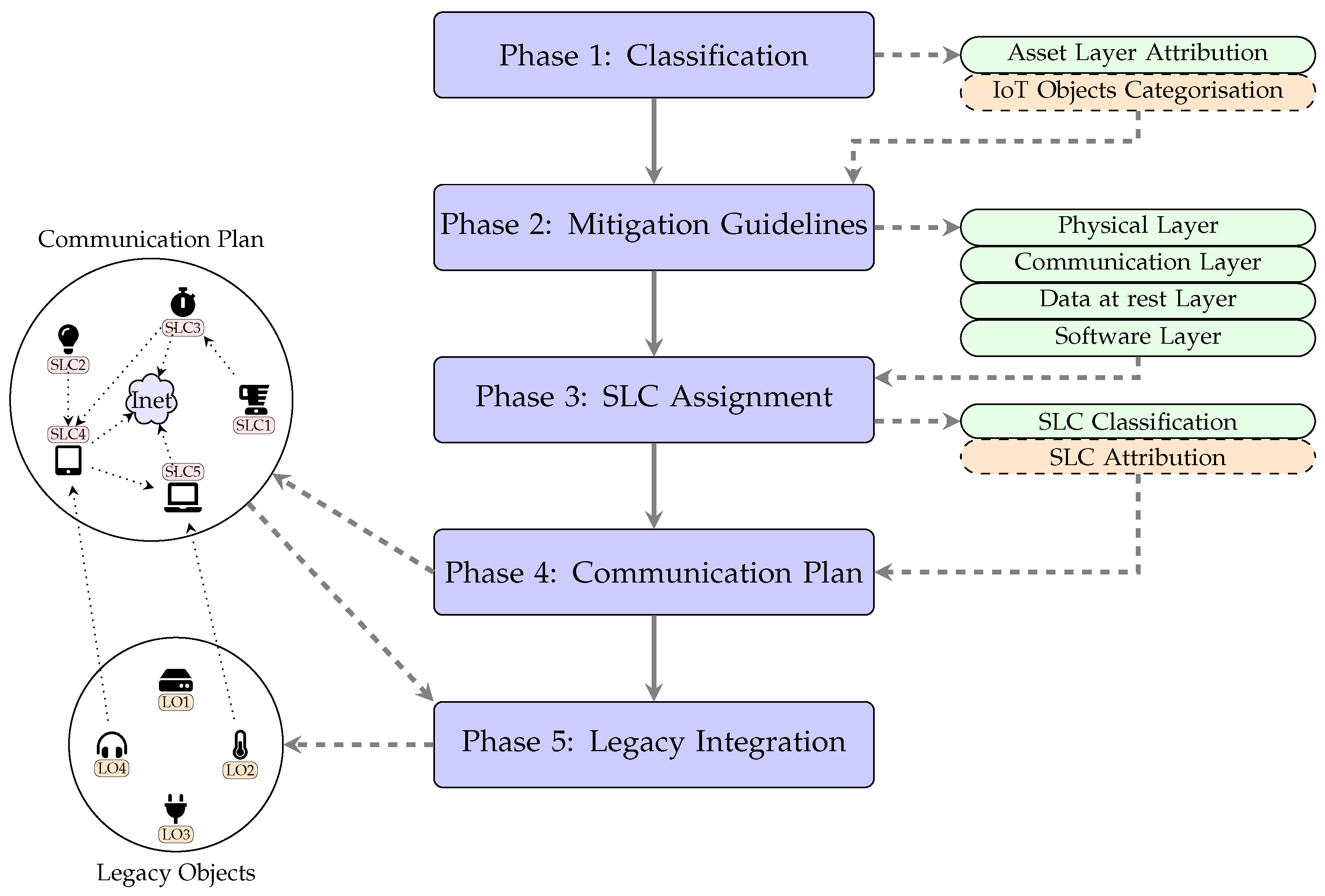
3.1. Phase 1: Classification
3.1.1. Asset Layer Attribution
- Physical layer: consists of computing nodes (RFID readers and sensor nodes) and RFID tags.
- Communication layer: includes all IoT protocols covering all IoT stack and the existing network infrastructures (e.g., routers and switches).
- Data at rest layer: involves data stored either in IoT objects or on the Cloud Storage Service (CSS)
- Software layer: is composed of IoT middleware, IoT applications, and IoT OSs.
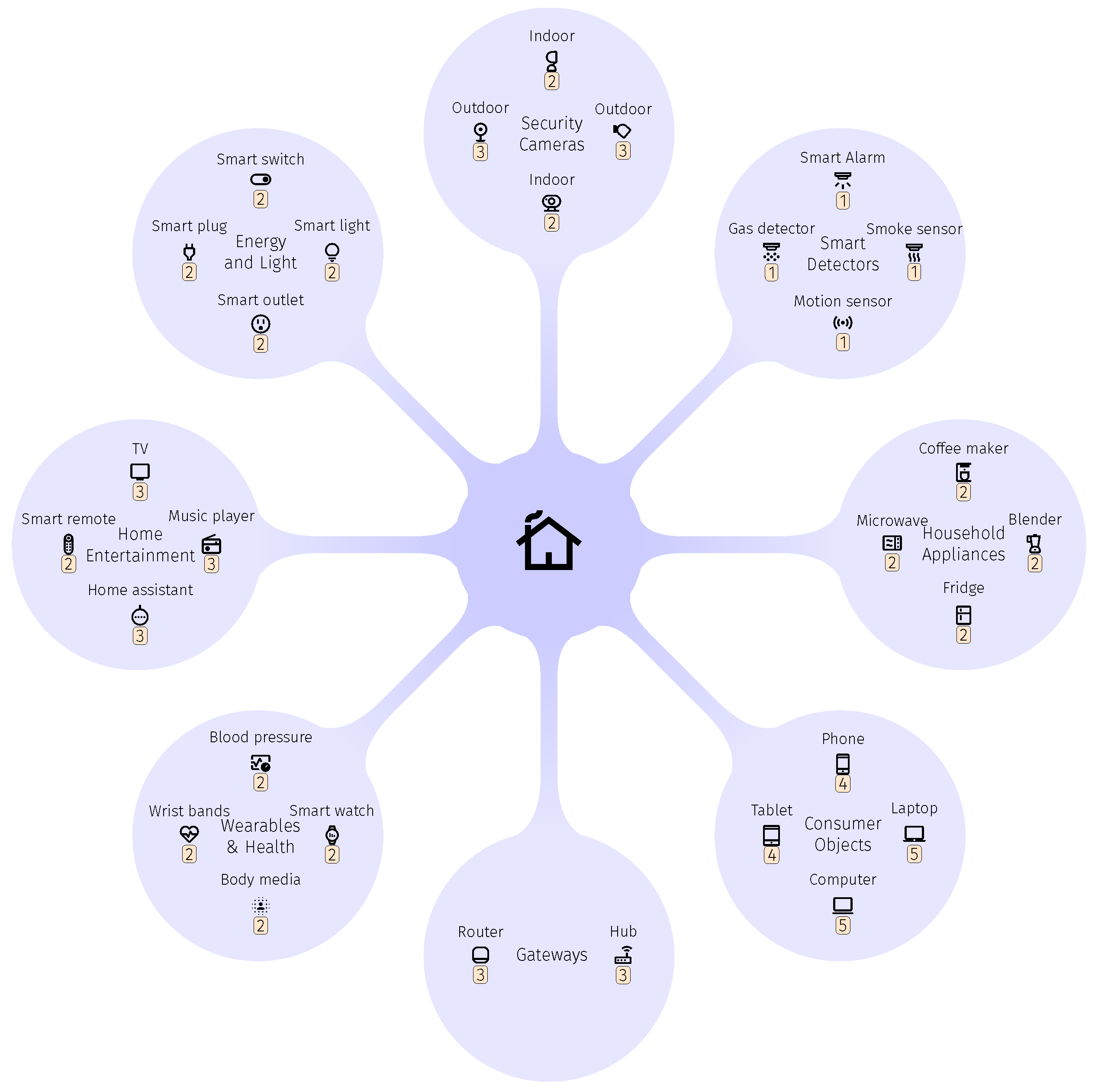
3.1.2. IoT Objects Categorisation
3.2. Phase 2: Mitigation Guidelines
3.2.1. Physical Layer
3.2.2. Communication Layer
3.2.3. Data at Rest Layer
3.2.4. Software Layer
3.3. Phase 3: SLC Assignment
3.3.1. SLCs Classification
3.3.2. SLC Attribution
3.3.3. SLC Implementation
3.4. Phase 4: Communication Plan
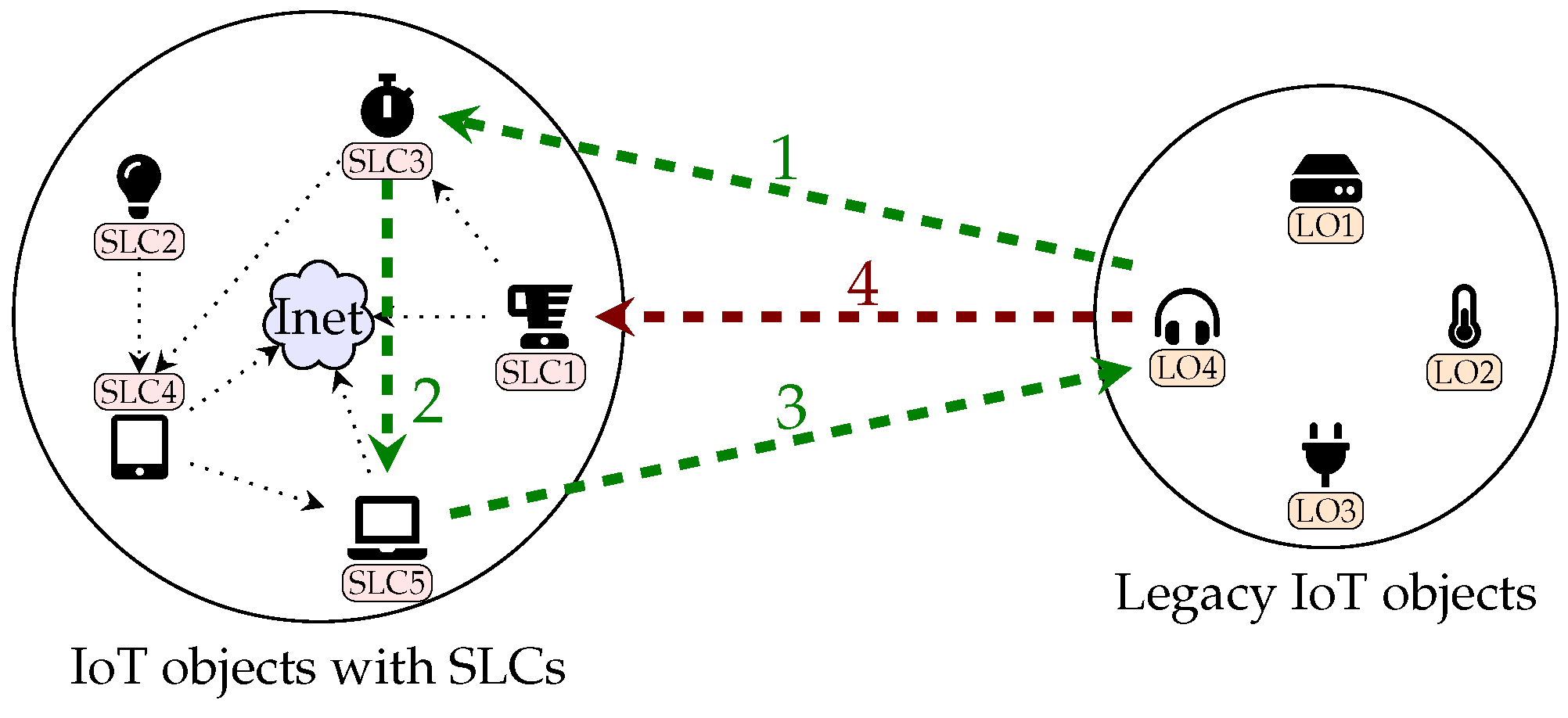
3.5. Phase 5: Legacy Integration
4. Case Study: Smart Home
4.1. Step 1
4.2. Step 2
4.3. Step 3
4.4. Step 4
5. Discussion and Future Work
5.1. Analysis on IoT Security Challenges
5.2. Attack and Threats Mitigation by SLC Framework
5.3. Limitations of the Study
5.4. Future Work
6. Conclusions
Author Contributions
Funding
Data Availability Statement
Conflicts of Interest
Abbreviations
| 6LoWPAN | IPv6 networking for Low power Wireless Personal Area Networks |
| ABE | Attribute-Based Encryption |
| AES | Advanced Encryption Standard |
| AMQP | Advanced Message Queuing Protocol |
| BITAG | Broadband Internet Technical Advisory Group |
| CIA | Confidentiality, Integrity, and Availability |
| CoAP | Constrained Application Protocol |
| CPU | Central Processing Unit |
| CSS | Cloud Storage Service |
| DAC | Discretionary Access Control |
| DDS | Data Distribution Service |
| DLLS | Data Link Layer Security |
| DoS | Denial of Service |
| DTLS | Datagram Transport Layer security |
| HIP | Host Identity Protocol |
| IAS | Information, Assurance, and Security |
| IC | Integrated Circuit |
| IDS | Intrusion Detection System |
| IoT | Internet of Things |
| IoTSF | IoT Security Foundation |
| LLN | Low-Power and Lossy Network |
| MAC | Mandatory Access Control |
| MQTT | MQ Telemetry Transport |
| OS | Operating System |
| OTA | Over-the-air |
| OWASP | Open Web Application Security Project |
| PUF | Physical Unclonable Function |
| RBAC | Role-Based Access Control |
| RFID | Radio Frequency Identification |
| RM | Reference Model |
| RPL | Routing Protocol for Low-Power and Lossy Networks |
| SDN | Software Defined Network |
| SE | Searchable Encryption |
| SLC | Security Level Certificate |
| SLC | Framework Security Level Certificates Framework |
| SQL | Structured Query Language |
| SSL | Secure Sockets Layer |
| TLS | Transport Layer Security |
| WSN | Wireless Sensor Network |
| XMPP | Extensible Messaging and Presence Protocol |
References
- Kouicem, D.E.; Bouabdallah, A.; Lakhlef, H. Internet of things security: A top-down survey. Comput. Netw. 2018, 141, 199–221. [Google Scholar] [CrossRef]
- Riahi Sfar, A.; Natalizio, E.; Challal, Y.; Chtourou, Z. A roadmap for security challenges in the Internet of Things. Digit. Commun. Netw. 2018, 4, 118–137. [Google Scholar] [CrossRef]
- Deogirikar, J.; Vidhate, A. Security attacks in IoT: A survey. In Proceedings of the International Conference on IoT in Social, Mobile, Analytics and Cloud, I-SMAC 2017, Palladam, Tamil Nadu, India, 10–11 February 2017; pp. 32–37. [Google Scholar] [CrossRef]
- Chang, C.T.; Chang, C.Y.; Shih, K.P.; Martinez, R.D.B.; Chen, P.T.; Chen, Y.D. An IoT multi-interface gateway for building a smart space. Open J. Soc. Sci. 2015, 3, 56–60. [Google Scholar] [CrossRef]
- Rodriguez, J.D.; Schreckling, D.; Posegga, J. Addressing data-centric security requirements for IOT-based systems. In Proceedings of the 2016 International Workshop on Secure Internet of Things, SIoT 2016, Heraklion, Greece, 26–30 September 2018; pp. 1–10. [Google Scholar] [CrossRef]
- Treadway, J. Using an IoT Gateway to Connect the ’Things’ to the Cloud. 2016. Available online: https://www.techtarget.com/iotagenda/feature/Using-an-IoT-gateway-to-connect-the-Things-to-the-cloud (accessed on 13 March 2023).
- Raza, S.; Trabalza, D.; Voigt, T. 6LoWPAN compressed DTLS for CoAP. In Proceedings of the IEEE International Conference on Distributed Computing in Sensor Systems, DCOSS 2012, Hangzhou, China, 16–18 May 2012; pp. 287–289. [Google Scholar] [CrossRef]
- Hartke, K. Practical Issues with Datagram Transport Layer Security in Constrained Environments; DICE Working Group: Beaverton, OR, USA, 2014; pp. 1–23. [Google Scholar]
- Sethi, M.; Arkko, J.; Keranen, A. End-to-end security for sleepy smart object networks. In Proceedings of the Conference on Local Computer Networks, LCN, Clearwater Beach, FL, USA, 22–25 October 2012; pp. 964–972. [Google Scholar] [CrossRef]
- Kothmayr, T.; Schmitt, C.; Hu, W.; Brunig, M.; Carle, G. A DTLS based end-to-end security architecture for the Internet of Things with two-way authentication. In Proceedings of the Conference on Local Computer Networks, LCN, Clearwater Beach, FL, USA, 22–25 October 2012; pp. 956–963. [Google Scholar] [CrossRef]
- Medvedev, A.; Zaslavsky, A.; Khoruzhnikov, S.; Grudinin, V. Interoperability and open-source solutions for the internet of things. Lect. Notes Comput. Sci. 2015, 9001, 169–182. [Google Scholar] [CrossRef]
- Fremantle, P.; Scott, P. A survey of secure middleware for the internet of things. Peerj Comput. Sci. 2017, 3, e114. [Google Scholar] [CrossRef]
- Renner, T.; Kliem, A.; Kao, O. The device cloud—Applying cloud computing concepts to the internet of things. In Proceedings of the 2014 IEEE International Conference on Ubiquitous Intelligence and Computing, 2014 IEEE International Conference on Autonomic and Trusted Computing, 2014 IEEE International Conference on Scalable Computing and Communications and Associated Workshops, Bali, Indonesia, 9–12 December 2014; pp. 396–401. [Google Scholar] [CrossRef]
- Baldini, G.; Skarmeta, A.; Fourneret, E.; Neisse, R.; Legeard, B.; Le Gall, F. Security certification and labelling in Internet of Things. In Proceedings of the 2016 IEEE 3rd World Forum on Internet of Things, WF-IoT 2016, Reston, VA, USA, 12–14 December 2016; pp. 627–632. [Google Scholar] [CrossRef]
- Matheu-García, S.N.; Hernández-Ramos, J.L.; Skarmeta, A.F.; Baldini, G. Risk-based automated assessment and testing for the cybersecurity certification and labelling of IoT devices. Comput. Stand. Interfaces 2019, 62, 64–83. [Google Scholar] [CrossRef]
- Matheu, S.N.; Hernández-Ramos, J.L.; Skarmeta, A.F.; Baldini, G. A survey of cybersecurity certification for the internet of things. ACM Comput. Surv. 2021, 53, 1–36. [Google Scholar] [CrossRef]
- Moosavi, S.R.; Gia, T.N.; Rahmani, A.M.; Nigussie, E.; Virtanen, S.; Isoaho, J.; Tenhunen, H. SEA: A secure and efficient authentication and authorization architecture for IoT-based healthcare using smart gateways. In Proceedings of the 6th International Conference on Ambient Systems, Networks and Technologies (ANT-2015), the 5th International Conference on Sustainable Energy Information Technology (SEIT-2015), London, UK, 2–5 June 2015; Volume 52, pp. 452–459, ISSN 18770509. [Google Scholar] [CrossRef]
- Turab, N.M. Internet of Things: A Survey of Existing architectural models and their security Protocols. Int. J. Comput. Sci. Netw. Secur. 2017, 17, 197–205. [Google Scholar]
- Abdul-Ghani, H.A.; Konstantas, D. A comprehensive study of security and privacy guidelines, threats, and countermeasures: An IoT perspective. J. Sens. Actuator Netw. 2019, 8, 22. [Google Scholar] [CrossRef]
- Sadhu, P.K.; Yanambaka, V.P.; Abdelgawad, A. Internet of things: Security and solutions survey. Sensors 2022, 22, 7433. [Google Scholar] [CrossRef]
- El-Attar, M.; Abdul-Ghani, H.A. Using security robustness analysis for early-stage validation of functional security requirements. Requir. Eng. 2016, 21, 1–27. [Google Scholar] [CrossRef][Green Version]
- Taleby, M.; Li, Q.; Rabbani, M.; Raza, A. A survey on smartphones security: Software vulnerabilities, malware, and attacks. Int. J. Adv. Comput. Sci. Appl. 2017, 8. [Google Scholar] [CrossRef]
- Yoon, S.; Kim, J.; Jeon, Y. Security considerations based on classification of IoT device capabilities. In Proceedings of the SERVICE COMPUTATION 2017: The Ninth International Conferences on Advanced Service Computing, Athens, Greece, 19–23 February 2017; pp. 1–63, ISBN 978-1-61208-528-9. [Google Scholar]
- Shon, T. In-vehicle Networking/Autonomous vehicle security for internet of Things/Vehicles. Electronicsweek 2021, 10, 637. [Google Scholar] [CrossRef]
- Bettayeb, M.; Nasir, Q.; Talib, M.A. Firmware update attacks and security for IoT devices. In Proceedings of the ArabWIC 6th Annual International Conference Research Track, Rabat, Morocco, 7–9 March 2019; ACM: New York, NY, USA, 2019; pp. 1–6. [Google Scholar] [CrossRef]
- El Jaouhari, S.; Bouvet, E. Secure firmware over-the-air updates for IoT: Survey, challenges, and discussions. Internet Things 2022, 18, 100508. [Google Scholar] [CrossRef]
- Sen, J. Security in wireless sensor networks. In Wireless Sensor Networks: Current Status and Future Trends; CPC Press: Boca Raton, FL, USA, 2016; pp. 407–460. ISBN 9781466506084. [Google Scholar]
- Yang, G.; Dai, L.; Wei, Z. Challenges, threats, security issues and new trends of underwater wireless sensor networks. Sensors 2018, 18, 3907. [Google Scholar] [CrossRef]
- Ender, M.; Swierczynski, P.; Wallat, S.; Wilhelm, M.; Knopp, P.M.; Paar, C. Insights into the mind of a trojan designer: The challenge to integrate a trojan into the bitstream. In Proceedings of the 24th Asia and South Pacific Design Automation Conference, Tokyo, Japan, 21–24 January 2019; ACM: Tokyo, Japan, 2019; pp. 112–119. [Google Scholar] [CrossRef]
- Sathyadevan, S.; Achuthan, K.; Doss, R.; Pan, L. Protean Authentication Scheme—A Time-Bound Dynamic KeyGen Authentication Technique for IoT Edge Nodes in Outdoor Deployments. IEEE Access 2019, 7, 92419–92435. [Google Scholar] [CrossRef]
- Cherdantseva, Y.; Hilton, J. A reference model of information assurance & security. In Proceedings of the 2013 International Conference on Availability, Reliability and Security, ARES 2013, Regensburg, Germany, 2–6 September 2013; pp. 546–555. [Google Scholar] [CrossRef]
- Abdulghani, H.A.; Nijdam, N.A.; Collen, A.; Konstantas, D. A study on security and privacy guidelines, countermeasures, threats: IoT data at rest perspective. Symmetry 2019, 11, 774. [Google Scholar] [CrossRef]
- Mohsen Nia, A.; Sur-Kolay, S.; Raghunathan, A.; Jha, N.K. Physiological information leakage: A new frontier in health information security. IEEE Trans. Emerg. Top. Comput. 2015, 4, 321–334. [Google Scholar] [CrossRef]
- Montenegro, G.; Kushalnagar, N.; Hui, J.; Culler, D. Transmission of IPv6 Packets over IEEE 802.15.4 Networks, RFC 4944; RFC Editor: Fremont, CA, USA, 2007; pp. 1–30. [Google Scholar] [CrossRef]
- Watteyne, T.; Palattella, M.; Grieco, L. Using IEEE 802.15. 4e Time-Slotted Channel Hopping (TSCH) in the Internet of Things (IoT): Problem Statement; RFC 7554; RFC Editor: Fremont, CA, USA, 2015; pp. 1–23. [Google Scholar] [CrossRef]
- Roman, R.; Alcaraz, C.; Lopez, J.; Sklavos, N. Key management systems for sensor networks in the context of the Internet of Things. Comput. Electr. Eng. 2011, 37, 147–159. [Google Scholar] [CrossRef]
- ArchRock Corporation. Phynet n4x Series. 2008. Available online: https://urgentcomm.com/2008/11/01/sensor-nodes-handle-harsh-environments/ (accessed on 13 March 2023).
- Hong, S.; Kim, D.; Ha, M.; Bae, S.; Park, S.; Jung, W.; Kim, J.E. SNAIL: An IP-based wireless sensor network approach to the Internet of things. IEEE Wirel. Commun. 2010, 17, 34–42. [Google Scholar] [CrossRef]
- Raza, S.; Duquennoy, S.; Höglund, J.; Roedig, U.; Voigt, T. Secure communication for the Internet of Things-a comparison of link-layer security and IPsec for 6LoWPAN. Secur. Commun. Netw. 2014, 7, 2654–2668. [Google Scholar] [CrossRef]
- Law, Y.W.; Zhang, Y.; Jin, J.; Palaniswami, M.; Havinga, P. Secure rateless deluge: Pollution-resistant reprogramming and data dissemination for wireless sensor networks. Eurasip J. Wirel. Commun. Netw. 2011, 1–22. [Google Scholar] [CrossRef]
- Saiful Islam Mamun, M.; Sultanul Kabir, A.; Sakhawat Hossen, M.; Hayat Khan, M. Policy based intrusion detection and response system in hierarchical WSN architecture. arXiv 2012, arXiv:1209.1678. [Google Scholar] [CrossRef]
- Hu, K.; Nowroz, A.N.; Reda, S.; Koushanfar, F. High-sensitivity hardware trojan detection using multimodal characterization. In Proceedings of the Design, Automation and Test in Europe, DATE, Grenoble, France, 18–22 March 2013; pp. 1271–1276, ISSN 15301591. [Google Scholar] [CrossRef]
- Alliance, A.S.C. Embedded hardware security for IoT applications. In A Smart card Alliance Internet of Things Security Council White Paper; Technical Report December 2016; Smart Card Alliance, CA, USA; Available online: https://www.securetechalliance.org/wp-content/uploads/Embedded-HW-Security-for-IoT-WP-FINAL-December-2016.pdf (accessed on 13 March 2023).
- Heer, T.; Garcia-Morchon, O.; Hummen, R.; Keoh, S.L.; Kumar, S.S.; Wehrle, K. Security challenges in the IP-based Internet of Things. Wirel. Pers. Commun. 2011, 61, 527–542. [Google Scholar] [CrossRef]
- Moskowitz, H.; Komu, M. HIP Diet EXchange (DEX) draft-ietf-hip-dex-18. Hip 2020, 5, 1. [Google Scholar]
- Jung, S.W.; Jung, S. Secure bootstrapping and rebootstrapping for resource-constrained thing in internet of things. Int. J. Distrib. Sens. Netw. 2015, 11, 174383. [Google Scholar] [CrossRef]
- Conoscenti, M.; Vetro, A.; De Martin, J.C. Blockchain for the Internet of Things: A systematic literature review. In Proceedings of the IEEE/ACS International Conference on Computer Systems and Applications, AICCSA, Agadir, Morocco, 29 November–2 December 2016; pp. 1–6. [Google Scholar] [CrossRef]
- Mosenia, A.; Jha, N.K. A comprehensive study of security of internet-of-things. IEEE Trans. Emerg. Top. Comput. 2017, 5, 586–602. [Google Scholar] [CrossRef]
- Hristozov, S.; Heyszl, J.; Wagner, S.; Sigl, G. Practical runtime attestation for tiny IoT devices. In Proceedings of the Proceedings 2018 Workshop on DECENTRALIZED IoT Security and Standards, San Diego, CA, USA, 18 February 2018. [Google Scholar] [CrossRef]
- Rashid, F.; Miri, A.; Woungang, I. A secure data deduplication framework for cloud environments. In Proceedings of the 2012 10th Annual International Conference on Privacy, Security and Trust, PST 2012, Paris, France, 16–18 July 2012; pp. 81–87. [Google Scholar] [CrossRef]
- Yu, S.; Guo, S. Big data concepts, theories, and applications. In Big Data Concepts, Theories, and Applications; Springer International Publishing: Cham, Switzerland, 2016; pp. 1–437. [Google Scholar] [CrossRef]
- Machanavajjhala, A.; Kifer, D.; Gehrke, J.; Venkitasubramaniam, M. L-diversity: Privacy beyond k-anonymity. ACM Trans. Knowl. Discov. Data 2007, 1, 3. [Google Scholar] [CrossRef]
- Li, N.; Li, T.; Venkatasubramanian, S. t-closeness: Privacy beyond k-anonymity and l-diversity. In Proceedings of the 2007 IEEE 23rd International Conference on data Engineering, Istanbul, Turkey, 14–20 April 2006; pp. 106–115. [Google Scholar]
- Narendra, N.C.; Nayak, S.; Shukla, A. Managing large-scale transient data in IoT systems. In Proceedings of the 2018 10th International Conference on Communication Systems and Networks, COMSNETS 2018, Bengaluru, India, 3–7 January 2018; Volume 2018, pp. 565–568. [Google Scholar] [CrossRef]
- Jiang, H.; Shen, F.; Chen, S.; Li, K.C.; Jeong, Y.S. A secure and scalable storage system for aggregate data in IoT. Future Gener. Comput. Syst. 2015, 49, 133–141. [Google Scholar] [CrossRef]
- Storer, M.W.; Greenan, K.M.; Miller, E.L.; Voruganti, K. POTSHARDS: Secure long-term storage without encryption. In Proceedings of the 2007 USENIX Annual Technical Conference, Santa Clara, CA, USA, 17–22 June 2007; pp. 143–156, ISBN 9998888776. [Google Scholar]
- Anand, M. Cloud monitor: Monitoring applications in cloud. In Proceedings of the IEEE Cloud Computing for Emerging Markets, CCEM 2012, Bangalore, India, 11–12 October 2012; pp. 58–61. [Google Scholar] [CrossRef]
- Brinkmann, A.; Fiehe, C.; Litvina, A.; Lück, I.; Nagel, L.; Narayanan, K.; Ostermair, F.; Thronicke, W. Scalable monitoring system for clouds. In Proceedings of the 2013 IEEE/ACM 6th International Conference on Utility and Cloud Computing, UCC 2013, Dresden, Germany, 9–12 December 2013; pp. 351–356. [Google Scholar] [CrossRef]
- Kumar, A.; Narendra, N.C.; Bellur, U. Uploading and replicating internet of things (IoT) data on distributed cloud storage. In Proceedings of the 2016 IEEE 9th International Conference on Cloud Computing (CLOUD), San Francisco, CA, USA, 27 June–2 July 2016; pp. 670–677. [Google Scholar] [CrossRef]
- Jayant, D.B.; Swapnaja, A.U.; Sulabha, S.A.; Dattatray, G.M. Analysis of DAC MAC RBAC access control based models for security. Int. J. Comput. Appl. 2014, 104, 6–13. [Google Scholar] [CrossRef]
- Javed, F.; Afzal, M.K.; Sharif, M.; Kim, B.S. Internet of things (IoT) operating systems support, networking technologies, applications, and challenges: A comparative review. IEEE Commun. Surv. Tutor. 2018, 20, 2062–2100. [Google Scholar] [CrossRef]
- Granjal, J.; Monteiro, E.; Silva, J.S. Application-layer security for the WoT: Extending CoAP to support end-to-end message security for internet-integrated sensing applications. In Proceedings of the Lecture Notes in Computer Science (Including Subseries Lecture Notes in Artificial Intelligence and Lecture Notes in Bioinformatics), St. Petersburg, Russia, 5–7 June 2013; Volume 7889, pp. 140–153, ISSN 03029743. [Google Scholar] [CrossRef]
- Perera, C.; McCormick, C.; Bandara, A.K.; Price, B.A.; Nuseibeh, B. Privacy-by-design framework for assessing internet of things applications and platforms. In Proceedings of the ACM International Conference Proceeding Series, Stuttgart, Germany, 7–9 November 2016; pp. 83–92. [Google Scholar] [CrossRef]
- Broadband Internet Technical Advisory Group. Internet of things (IoT) security and privacy recommendations: A uniform agreement report. In Broadband Internet Technical Advisory Group Technical Working Group Report; Technical Report November 2016; Broadband Internet Technical Advisory Group: Denver, CO, USA; Available online: https://www.bitag.org/report-internet-of-things-security-privacy-recommendations.php (accessed on 13 March 2023).
- OWASP Internet of Things. Available online: https://owasp.org/www-project-internet-of-things/ (accessed on 13 March 2023).
- IoT Security Foundation (IoTSF). IoT Security Compliance Framework Release 2.1; Technical report; IoT Security Foundation: Livingston, UK, 2020. [Google Scholar]
- Gubbi, J.; Buyya, R.; Marusic, S.; Palaniswami, M. Internet of Things (IoT): A vision, architectural elements, and future directions. Future Gener. Comput. Syst. 2013, 29, 1645–1660. [Google Scholar] [CrossRef]
- Atzori, L.; Iera, A.; Morabito, G. The Internet of Things: A survey. Comput. Netw. 2010, 54, 2787–2805. [Google Scholar] [CrossRef]
- Green, J. The internet of things reference model. In Internet Things World Forum; CISCO: San Jose, CA, USA, 2014; pp. 1–12. ISBN 9781479959402. [Google Scholar]
- Pierce, L.; Tragoudas, S. Multi-level secure JTAG architecture. In Proceedings of the 2011 IEEE 17th International On-Line Testing Symposium, IOLTS 2011, Athens, Greece, 13–15 July 2011; pp. 208–209. [Google Scholar] [CrossRef]
- Moriyama, D.; Matsuo, I.; Yung, M. PUF-Based RFID authentication secure and private under memory leakage. Cryptol. ePrint Arch. 2013, 712. [Google Scholar]
- Doddapaneni, K.; Lakkundi, R.; Rao, S.; Kulkarni, S.G.; Bhat, B. Secure FoTA object for IoT. In Proceedings of the 2017 IEEE 42nd Conference on Local Computer Networks Workshops, LCN Workshops 2017, Singapore, 9 October 2017; pp. 154–159. [Google Scholar] [CrossRef]
- Mauw, S.; Piramuthu, S. A PUF-based authentication protocol to address ticket-switching of RFID-tagged items. In Lecture Notes in Computer Science; Springer: Berlin/Heidelberg, Germany, 2013; Volume 7783, pp. 209–224. ISSN 03029743. [Google Scholar] [CrossRef]
- Dofe, J.; Frey, J.; Yu, Q. Hardware security assurance in emerging IoT applications. In Proceedings of the IEEE International Symposium on Circuits and Systems, Montreal, QC, Canada, 22–25 May 2016; pp. 2050–2053, ISSN 02714310. [Google Scholar] [CrossRef]
- Tomić, I.; McCann, J.A. A survey of potential security issues in existing wireless sensor network protocols. IEEE Internet Things J. 2017, 4, 1910–1923. [Google Scholar] [CrossRef]
- Granjal, J.; Monteiro, E.; Silva, J.S. Network-layer security for the Internet of Things using TinyOS and BLIP. Int. J. Commun. Syst. 2014, 27, 1938–1963. [Google Scholar] [CrossRef]
- Granjal, J.; Monteiro, E.; Silva, J.S. Security in the integration of low-power Wireless Sensor Networks with the Internet: A survey. Ad Hoc Netw. 2015, 24, 264–287. [Google Scholar] [CrossRef]
- Otte, P.; de Vos, M.; Pouwelse, J. TrustChain: A sybil-resistant scalable blockchain. Future Gener. Comput. Syst. 2020, 107, 770–780. [Google Scholar] [CrossRef]
- Gonzalez, C.; Charfadine, S.M.; Flauzac, O.; Nolot, F. SDN-based security framework for the IoT in distributed grid. In Proceedings of the 2016 International Multidisciplinary Conference on Computer and Energy Science, SpliTech 2016. University of Split, FESB, Split, Croatia, 13–15 July 2016; pp. 1–5. [Google Scholar] [CrossRef]
- Yan, Z.; Wang, M.; Li, Y.; Vasilakos, A.V. Encrypted data management with deduplication in cloud computing. IEEE Cloud Comput. 2016, 3, 28–35. [Google Scholar] [CrossRef]
- Xu, Y.; Qin, X.; Yang, Z.; Yang, Y.; Huang, C. An algorithm of k-anonymity for data releasing based on fine-grained generalization. J. Inf. Comput. Sci. 2012, 9, 3071–3080. [Google Scholar]
- Bokefode, J.D.; Bhise, A.S.; Satarkar, P.A.; Modani, D.G. Developing A secure cloud storage system for storing IoT data by applying role based encryption. Procedia Comput. Sci. 2016, 89, 43–50. [Google Scholar] [CrossRef]
- Sun, W.; Yu, S.; Lou, W.; Hou, Y.T.; Li, H. Protecting your right: Verifiable attribute-based keyword search with fine-grained owner-enforced search authorization in the cloud. IEEE Trans. Parallel Distrib. Syst. 2016, 27, 1187–1198. [Google Scholar] [CrossRef]
- Yu, Z.; Au, M.H.; Xu, Q.; Yang, R.; Han, J. Towards leakage-resilient fine-grained access control in fog computing. Future Gener. Comput. Syst. 2018, 78, 763–777. [Google Scholar] [CrossRef]
- Yohan, A.; Lo, N.W. An over-the-blockchain firmware update framework for IoT devices. In Proceedings of the DSC 2018—2018 IEEE Conference on Dependable and Secure Computing, Kaohsiung, Taiwan, 10–13 December 2018; pp. 1–8. [Google Scholar] [CrossRef]
- Yohan, A.; Lo, N.W.; Achawapong, S. Blockchain-based firmware update framework for internet-of-things environment. In Proceedings of the Conf. Information and Knowledge Engineering, Athens, Las Vegas, NV, USA, 30 July–2 August 2018; pp. 151–155. [Google Scholar]



| Security Requirements | Definition | Abbreviations |
|---|---|---|
| Confidentiality | Only authorised objects or users can obtain access to the data | CONF |
| Integrity | Data completeness and accuracy is preserved | INTG |
| Non-repudiation | IoT system can validate the occurrence of any event | NREP |
| Availability | Ensuring accessibility of an IoT system and its services | AVAL |
| Privacy | Presence of privacy rules or policies | PRIV |
| Auditability | Monitoring of the IoT object activity | AUDI |
| Accountability | End users can take charge of their actions | ACNT |
| Trustworthiness | Reliability on IoT object identity | TRST |
| Attack ID | CONF | INTG | NREP | AVAL | PRIV | AUDI | ACNT | TRST |
|---|---|---|---|---|---|---|---|---|
| AT1 | | | | |||||
| AT2 | | | | | | | | |
| AT3 | | | | |||||
| AT4 | | | | | | | | |
| AT5 | | | | | | |||
| AT6 | | | | | | | | |
| ID | Mitigation Techniques | Attack IDs |
|---|---|---|
| MT1 | Link layer security | AT1 |
| MT8 | Secure bootstrapping | AT1 |
| MT2 | Transport layer security | AT1, AT3, AT5 |
| MT3 | Network layer security | AT1, AT5 |
| MT4 | Firmware update methods | AT6 |
| MT15 | Searchable encryption | AT1, |
| MT10 | Hardware-based solutions | AT2, AT4, AT6 |
| MT6 | Side channel protection | AT3 |
| MT18 | Access control methods | AT2, AT3, AT4 |
| MT19 | Secure IoT OSs | AT6 |
| MT20 | SDN-based solutions | AT1, AT4, AT5 |
| MT21 | Application layer security | AT1, AT3, AT6 |
| MT22 | Cryptographic schemes | AT2, AT3, AT4 |
| MT9 | Blockchain solutions | AT1, AT5, AT6 |
| MT14 | Secure storage schemes | AT1, AT2 |
| MT13 | Transient data storage | AT5 |
| MT7 | Decommissioning methods | AT2 |
| MT11 | Deduplication schemes | AT1, AT2, AT4 |
| MT12 | Anonymisation schemes | AT4, AT6 |
| MT16 | Monitoring and auditing | AT2, AT4, AT6 |
| MT17 | Recovery strategy | AT6 |
| MT5 | Intrusion detection system | AT1, AT4, AT5, AT6 |
| Addressed Features | State-of-the Art Work | ||||||||||
|---|---|---|---|---|---|---|---|---|---|---|---|
| [63] | [64] | [65] | [32] | [66] | [19] | [23] | [14] | [15] | This Work | ||
| Addressed IoT SCs | SC1 | ✓ | ✓ | ✓ | ✓ | ✓ | ✓ | ✓ | ✓ | ✓ | ✓ |
| SC2 | ✗ | ✗ | ✗ | ✗ | ✓ | ✓ | ✓ | ✓ | ✓ | ✓ | |
| SC3 | ✓ | ✗ | ✗ | ✗ | ✗ | ✗ | ✗ | ✓ | ✓ | ✓ | |
| SC4 | ✗ | ✗ | ✗ | ✗ | ✗ | ✗ | ✗ | ✓ | ✓ | ✗ | |
| SC5 | ✓ | ✓ | ✓ | ✗ | ✓ | ✓ | ✓ | ✓ | ✓ | ✓ | |
| SC6 | ✗ | ✗ | ✗ | ✗ | ✗ | ✓ | ✗ | ✓ | ✓ | ✓ | |
| SC7 | ✗ | ✗ | ✗ | ✗ | ✗ | ✗ | ✗ | ✓ | ✓ | ✗ | |
| SC8 | ✗ | ✗ | ✗ | ✗ | ✗ | ✓ | ✗ | ✓ | ✓ | ✓ | |
| Addressed IoT attacks | AT1 | - | - | - | - | - | ✓ | ✓ | - | - | ✓ |
| AT2 | - | - | - | - | - | ✓ | ✓ | - | - | ✓ | |
| AT3 | - | - | - | - | - | ✓ | ✗ | - | - | ✓ | |
| AT4 | - | - | - | - | - | ✓ | ✗ | - | - | ✓ | |
| AT5 | - | - | - | - | - | ✓ | ✗ | - | - | ✓ | |
| AT6 | - | - | - | - | - | ✓ | ✓ | - | - | ✓ | |
| Types of guidelines | Privacy | ✓ | ✓ | ✓ | ✗ | ✓ | ✓ | ✗ | ✗ | ✗ | ✓ |
| Security | ✗ | ✓ | ✓ | ✓ | ✓ | ✓ | ✓ | ✗ | ✗ | ✓ | |
| Communication Plan | ✗ | ✗ | ✗ | ✗ | ✗ | ✗ | ✗ | ✗ | ✗ | ✓ | |
| Objects classification | ✗ | ✗ | ✗ | ✗ | ✗ | ✗ | ✓ | ✓ | ✓ | ✓ | |
| Protection measures classification | ✗ | ✗ | ✗ | ✗ | ✗ | ✗ | ✓ | ✗ | ✓ | ✓ | |
| Object Categories | CPU/ Microcontroller | Memory (M) | On-Board Storage | Power Consumption (P) | Example |
|---|---|---|---|---|---|
| Category 1 | Low CPU such as 8- bit Microcontroller 16 MHz | M ≤ 32 KB | None | P ≤ 1 W | Arduino Mego |
| Category 2 | Moderate CPU such as 32- bit Microcontroller 80 MHz | 32 KB < M ≤ 80 KB | None | P ≤ 1 W | NodeMCU ESP-12 |
| Category 3 | Single core CPU (e.g., ARM1176 single-core 1 GHz) | 80 KB < M ≤ 512 MB | ≤4 GB | 1 W < P ≤ 2W | Raspberry Pi Zero |
| Category 4 | Quad core CPU (e.g., ARM Cortex-A53 quad-core 1.2 GH) | 512 MB < M ≤ 2 GB | ≤8 GB | 2 W < P ≤ 4 W | Raspberry Pi 3 |
| Category 5 | High (e.g., ARM Cortex-A57 quad-core 2 GHz) | M ≥ 8 GB | High (≥32 GB) | High | NVIDIA Jetson TX2 |
| Guidelines | Reasoning | Implementation Techniques |
|---|---|---|
| Secure boot process | Fixed hardware secure boot process prevents running a malicious code | MT22: Cryptographic schemes [70], MT10: Hardware-based solutions [49,71] |
| Update firmware securely | Secure firmware update enables detection of a malicious firmware | MT4: Firmware update methods [72] |
| Use hardware identifier | Unique identifier can serve as a proof of origin and permit threat source attribution | MT10: Hardware-based solutions |
| Prevent physical tampering | A tamper-resistant measure prevents physical attacks | MT10: Hardware-based solutions (e.g., tamper-proofing techniques) |
| Safe disposal | Destruct data properly when reaching end-of-life stage | MT7: Decommissioning methods [43] |
| Implement hardware trust | A hardware trust method prevents malicious modification of data | MT10: Hardware-based solutions (e.g., a PUF-based authentication [73]) |
| Detect abnormal nodes | Attackers may modify behaviour of the IoT object for various purposes | MT5: IDS techniques (e.g., a method based on Markov model [41]) |
| Prevent node replication | Safeguard object’s identification number | MT22: Cryptographic schemes |
| Prevent unwanted IC modifications | Detect malicious modifications on its IC | MT6: Side channel analysis (e.g., dynamic permutation [74]), MT10: Hardware-based solutions |
| Guidelines | Reasoning | Implementation Techniques |
|---|---|---|
| Implement hop to hop security | Encrypt and decrypt packets to the next object through shared keys | MT1: DLLS such as IEEE 802.15.4 [75] |
| Secure bootstrapping | Exchange of network settings, such as link-layer encryption keys, network names, and wireless channels | MT8: Diet HIP [45] |
| Prevent packet modification | Message integrity mechanism to prevent packet injection attacks | MT2: Transport layer security [8], MT3: Network layer security [76], MT21: Application layer security [77] |
| Encrypt data communication | Prevent unauthorised access to sensitive data | MT2: Transport layer security, MT3: Network layer security, MT9: Blockchain solutions [78], MT20: SDN-based solutions in [79] |
| Support end to end security | Prevent unauthorised access to sensitive data | MT2: Transport layer security, MT3: Network layer security, MT9: Blockchain solutions |
| Prevent packet duplication | Prevent reply attacks | MT2: Transport layer security, MT3: Network layer security, MT21: Application layer security |
| Strong key management | Protect data during communication | MT20: SDN-based solutions, MT9: Blockchain solutions, MT2: Transport layer security, MT21: Application layer security |
| Hidden data routing | Anonymous routing methods to protect routing data | MT20: SDN-based solutions, M9: Blockchain solutions, MT3: Network layer security |
| Ensure continuous monitoring | Monitor abnormal activities | MT5: IDS techniques |
| Guidelines | Reasoning | Implementation Techniques |
|---|---|---|
| Minimise data storage | Reduce IoT breaches by deleting any portion of data not required to achieve a certain task | MT11: Deduplication [80], MT12: Anonymisation schemes [81] |
| Minimise data retention | Prevent data breaches | MT13: Transient data storage [54] |
| Encrypt data storage | Avoid data leakage | MT14: Secure storage schemes [82], MT15: Searchable encryption [83] |
| Prevent data leakage | Data are vulnerable to side channel attacks | MT16: Monitoring and auditing, MT15: Searchable encryption, MT12: Anonymisation schemes, MT13: Transient data storage |
| Ensure data availability | Ensure functioning of the data dependent applications | MT11: Deduplication schemes, MT17: Recovery strategy [59] |
| Ensure authorised access | Prevent unauthorised access | MT18: Physical security [84] |
| Remove or hide sensitive data | Identity protection | MT12: Anonymisation schemes |
| Search on encrypted data | Application functionality over encrypted data | MT15: Searchable encryption |
| Proper data destruction | Prevent data leakage | MT7: Decommissioning |
| Guidelines | Reasoning | Implementation Techniques |
|---|---|---|
| Prevent malicious requests | Defence in depth | MT18: Access control methods |
| Integrate OS with network security | To offer data integrity and privacy | MT19: Secure IoT OSs |
| Provide memory protection | Strong process management to manage resources | MT19: Secure IoT OSs |
| Validate and encrypt updates | Prevent the injection of malware during the update | MT19: Secure IoT OSs, MT4: Secure update methods |
| Provide events trace | Continuously monitor logs, processes and software | MT16: Monitoring and auditing |
| Provide memory protection | Properly allocate/deallocate memory for different threads and processes | MT19: Secure IoT OSs |
| ID | Mitigation Techniques | SLC1 | SLC2 | SLC3 | SLC4 | SLC5 |
|---|---|---|---|---|---|---|
| MT1 | Link layer security | ✓ | ✓ | ✓ | ✓ | ✓ |
| MT8 | Secure bootstrapping | ✓ | ✓ | ✓ | ✓ | ✓ |
| MT2 | Transport layer security | ✗ | ✓ | ✓ | ✓ | ✓ |
| MT3 | Network layer security | ✗ | ✓ | ✓ | ✓ | ✓ |
| MT4 | Firmware update methods | ✗ | ✓ | ✓ | ✓ | ✓ |
| MT15 | Searchable encryption | ✗ | ✗ | ✓ | ✓ | ✓ |
| MT10 | Hardware-based solutions | ✗ | ✗ | ✓ | ✓ | ✓ |
| MT6 | Side channel protection | ✗ | ✗ | ✓ | ✓ | ✓ |
| MT18 | Access control methods | ✗ | ✗ | ✓ | ✓ | ✓ |
| MT19 | Secure IoT OSs | ✗ | ✗ | ✓ | ✓ | ✓ |
| MT20 | SDN-based solutions | ✗ | ✗ | ✓ | ✓ | ✓ |
| MT21 | Application layer security | ✗ | ✗ | ✓ | ✓ | ✓ |
| MT22 | Cryptographic schemes | ✗ | ✗ | ✓ | ✓ | ✓ |
| MT9 | Blockchain solutions | ✗ | ✗ | ✗ | ✓ | ✓ |
| MT14 | Secure storage schemes | ✗ | ✗ | ✗ | ✓ | ✓ |
| MT13 | Transient data storage | ✗ | ✗ | ✓ | ✓ | ✗ |
| MT7 | Decommissioning methods | ✗ | ✗ | ✗ | ✗ | ✓ |
| MT11 | Deduplication schemes | ✗ | ✗ | ✗ | ✗ | ✓ |
| MT12 | Anonymisation schemes | ✗ | ✗ | ✗ | ✗ | ✓ |
| MT16 | Monitoring and auditing | ✗ | ✗ | ✗ | ✗ | ✓ |
| MT17 | Recovery strategy | ✗ | ✗ | ✗ | ✗ | ✓ |
| MT5 | Intrusion detection system | ✗ | ✗ | ✓ | ✗ | ✗ |
| SLC1 | SLC2 | SLC3 | SLC4 | SLC5 | |
|---|---|---|---|---|---|
| Category 1 | ✓ | ✓ | ✗ | ✗ | ✗ |
| Category 2 | ✓ | ✓ | ✗ | ✗ | ✗ |
| Category 3 | ✓ | ✓ | ✓ | ✗ | ✗ |
| Category 4 | ✓ | ✓ | ✓ | ✓ | ✗ |
| Category 5 | ✓ | ✓ | ✓ | ✓ | ✓ |
| SLC1 | SLC2 | SLC3 | SLC4 | SLC5 | Internet | |
|---|---|---|---|---|---|---|
| SLC1 | ✗ | ✓ | ✗ | ✗ | ✗ | ✗ |
| SLC2 | ✓ | ✓ | ✓ | ✓ | ✓ | ✗ |
| SLC3 | ✗ | ✓ | ✓ | ✓ | ✓ | ✓ |
| SLC4 | ✗ | ✓ | ✓ | ✓ | ✓ | ✓ |
| SLC5 | ✗ | ✓ | ✓ | ✓ | ✓ | ✓ |
| Object Category | Example | Object Class | SLC Type | Mitigation Techniques |
|---|---|---|---|---|
| Smart detectors | Smoke, gas, motion, alarm | Category 1 | SLC1 | MT1 and MT8 |
| Security Cameras | Indoor | Category 2 | SLC2 | MT1, MT2, MT3, MT4, MT8 |
| Security Cameras | Outdoor | Category 3 | SLC3 | MT1, MT2, MT3, MT4, MT5, MT6, MT8, MT10, MT13, MT15, MT18, MT19, MT20, MT21, MT22 |
| Energy and lighting | Smart light, -switch, -plug, -outlet | Category 2 | SLC2 | MT1, MT2, MT3, MT4, MT8 |
| Home entertainment | Home assistant, TV, music player | Category 3 | SLC3 | MT1, MT2, MT3, MT4, MT5, MT6, MT8, MT10, MT13, MT15, MT18, MT19, MT20, MT21, MT22 |
| Home entertainment | Smart remote | Category 2 | SLC2 | MT1, MT2, MT3, MT4, MT8 |
| Smart health | Blood pressure, wrist band, smart watch, body media | Category 2 | SLC2 | MT1, MT2, MT3, MT4, MT8 |
| Household appliances | Fridge, coffee maker, blender, microwave | Category 2 | SLC2 | MT1, MT2, MT3, MT4, MT8 |
| Consumer objects | Smart phone, tablet | Category 4 | SLC4 | MT1, MT2, MT3, MT4, MT6, MT8, MT9, MT10, MT13, MT14, MT15, MT18, MT19, MT20, MT21, MT22 |
| Consumer objects | Laptops, computers | Category 5 | SLC5 | MT1, MT2, MT3, MT4, MT6, MT7, MT8, MT9, MT10, MT11, MT12, MT14, MT15, MT16, MT17, MT18, MT19, MT20, MT21, MT22 |
| Gateways | Router, hub | Category 3 | SLC3 | MT1, MT2, MT3, MT4, MT5, MT6, MT8, MT10, MT13, MT15, MT18, MT19, MT20, MT21, MT22 |
| Smart Detectors | Indoor Security Cameras | Outdoor Security Cameras | Energy and Lighting | Smart Health | Household Appliance | Smart Phones/ Tablets | Laptops/ Computers | Gateways | Internet | Legacy Objects | |
|---|---|---|---|---|---|---|---|---|---|---|---|
| Smart detectors | ✗ | ✓ | ✗ | ✓ | ✓ | ✓ | ✗ | ✗ | ✗ | ✗ | ✗ |
| Indoor security cameras | ✓ | ✓ | ✓ | ✓ | ✓ | ✓ | ✓ | ✓ | ✓ | ✗ | ✗ |
| Outdoor security cameras | ✗ | ✓ | ✓ | ✓ | ✓ | ✓ | ✓ | ✓ | ✓ | ✓ | ✓ |
| Energy and lighting | ✓ | ✓ | ✓ | ✓ | ✓ | ✓ | ✓ | ✓ | ✓ | ✗ | ✗ |
| Smart health | ✓ | ✓ | ✓ | ✓ | ✓ | ✓ | ✓ | ✓ | ✓ | ✗ | ✗ |
| Household appliance | ✓ | ✓ | ✓ | ✓ | ✓ | ✓ | ✓ | ✓ | ✓ | ✗ | ✗ |
| Smart phones/tablets | ✗ | ✓ | ✓ | ✓ | ✓ | ✓ | ✓ | ✓ | ✓ | ✓ | ✓ |
| Laptops/computers | ✗ | ✓ | ✓ | ✓ | ✓ | ✓ | ✓ | ✓ | ✓ | ✓ | ✓ |
| Gateways | ✗ | ✓ | ✓ | ✓ | ✓ | ✓ | ✓ | ✓ | ✓ | ✓ | ✓ |
Disclaimer/Publisher’s Note: The statements, opinions and data contained in all publications are solely those of the individual author(s) and contributor(s) and not of MDPI and/or the editor(s). MDPI and/or the editor(s) disclaim responsibility for any injury to people or property resulting from any ideas, methods, instructions or products referred to in the content. |
© 2023 by the authors. Licensee MDPI, Basel, Switzerland. This article is an open access article distributed under the terms and conditions of the Creative Commons Attribution (CC BY) license (https://creativecommons.org/licenses/by/4.0/).
Share and Cite
Abdulghani, H.A.; Collen, A.; Nijdam, N.A. Guidance Framework for Developing IoT-Enabled Systems’ Cybersecurity. Sensors 2023, 23, 4174. https://doi.org/10.3390/s23084174
Abdulghani HA, Collen A, Nijdam NA. Guidance Framework for Developing IoT-Enabled Systems’ Cybersecurity. Sensors. 2023; 23(8):4174. https://doi.org/10.3390/s23084174
Chicago/Turabian StyleAbdulghani, Hezam Akram, Anastasija Collen, and Niels Alexander Nijdam. 2023. "Guidance Framework for Developing IoT-Enabled Systems’ Cybersecurity" Sensors 23, no. 8: 4174. https://doi.org/10.3390/s23084174
APA StyleAbdulghani, H. A., Collen, A., & Nijdam, N. A. (2023). Guidance Framework for Developing IoT-Enabled Systems’ Cybersecurity. Sensors, 23(8), 4174. https://doi.org/10.3390/s23084174