Article

ConMLP: MLP-Based Self-Supervised Contrastive Learning for Skeleton Data Analysis and Action Recognition

1
School of Computing and Engineering, University of Huddersfield, Huddersfield HD1 3DH, UK
2
School of Cyberspace Security, Xi’an University of Posts and Telecommunications, Xi’an 710061, China
3
International Joint Research Center for Wireless Communication and Information Processing, Xi’an 710121, China
4
School of Communications and Information Engineering, Xi’an University of Posts and Telecommunications, Xi’an 710061, China
*
Author to whom correspondence should be addressed.
Sensors 2023, 23(5), 2452; https://doi.org/10.3390/s23052452
Submission received: 16 January 2023 / Revised: 20 February 2023 / Accepted: 21 February 2023 / Published: 22 February 2023

Abstract

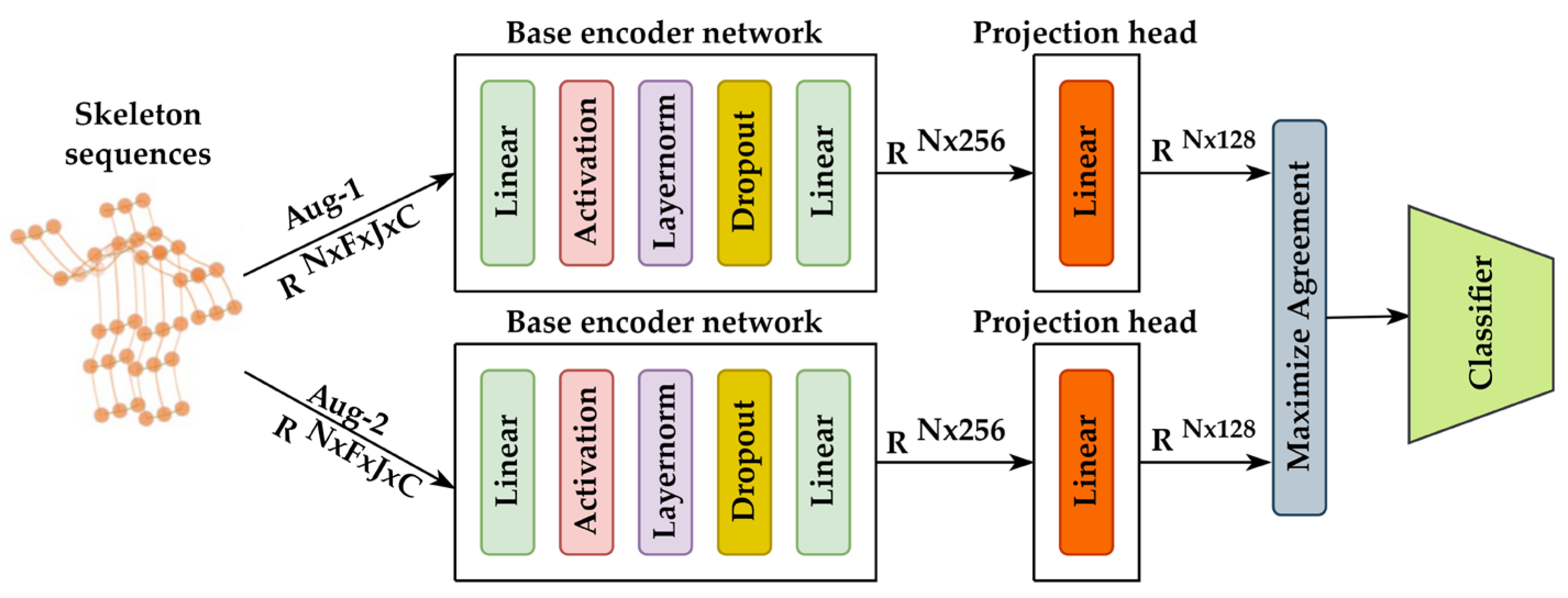
Human action recognition has drawn significant attention because of its importance in computer vision-based applications. Action recognition based on skeleton sequences has rapidly advanced in the last decade. Conventional deep learning-based approaches are based on extracting skeleton sequences through convolutional operations. Most of these architectures are implemented by learning spatial and temporal features through multiple streams. These studies have enlightened the action recognition endeavor from various algorithmic angles. However, three common issues are observed: (1) The models are usually complicated; therefore, they have a correspondingly higher computational complexity. (2) For supervised learning models, the reliance on labels during training is always a drawback. (3) Implementing large models is not beneficial to real-time applications. To address the above issues, in this paper, we propose a multi-layer perceptron (MLP)-based self-supervised learning framework with a contrastive learning loss function (ConMLP). ConMLP does not require a massive computational setup; it can effectively reduce the consumption of computational resources. Compared with supervised learning frameworks, ConMLP is friendly to the huge amount of unlabeled training data. In addition, it has low requirements for system configuration and is more conducive to being embedded in real-world applications. Extensive experiments show that ConMLP achieves the top one inference result of 96.9% on the NTU RGB+D dataset. This accuracy is higher than the state-of-the-art self-supervised learning method. Meanwhile, ConMLP is also evaluated in a supervised learning manner, which has achieved comparable performance to the state of the art of recognition accuracy.
Keywords: human action recognition; skeleton data; multi-layer perceptron; self-supervised learning human action recognition; skeleton data; multi-layer perceptron; self-supervised learning