Article

A Wavelet Derivative Spectrum Length Method of TFBG Sensor Demodulation

by
Sławomir Cięszczyk
1,*,
Krzysztof Skorupski
1,
Martyna Wawrzyk
2 and
Patryk Panas
1
1
Institute of Electronics and Information Technology, Lublin University of Technology, Nadbystrzycka 38A, 20-618 Lublin, Poland
2
Doctoral School, Lublin University of Technology, Nadbystrzycka 38D/406, 20-618 Lublin, Poland
*
Author to whom correspondence should be addressed.
Sensors 2023, 23(4), 2295; https://doi.org/10.3390/s23042295
Submission received: 28 January 2023 / Revised: 15 February 2023 / Accepted: 16 February 2023 / Published: 18 February 2023
(This article belongs to the Special Issue New Prospects in Fiber Optic Sensors and Applications)

Abstract

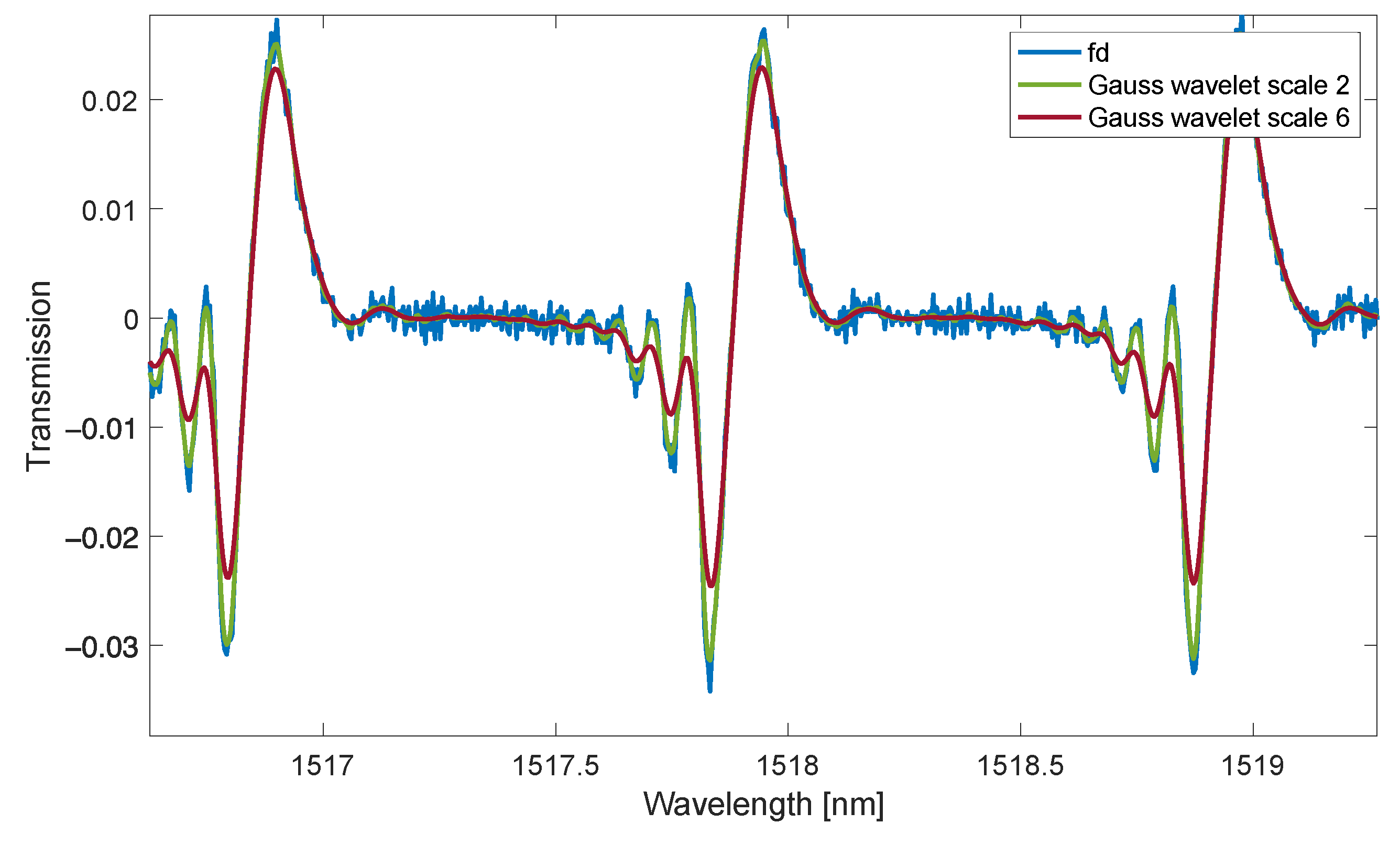
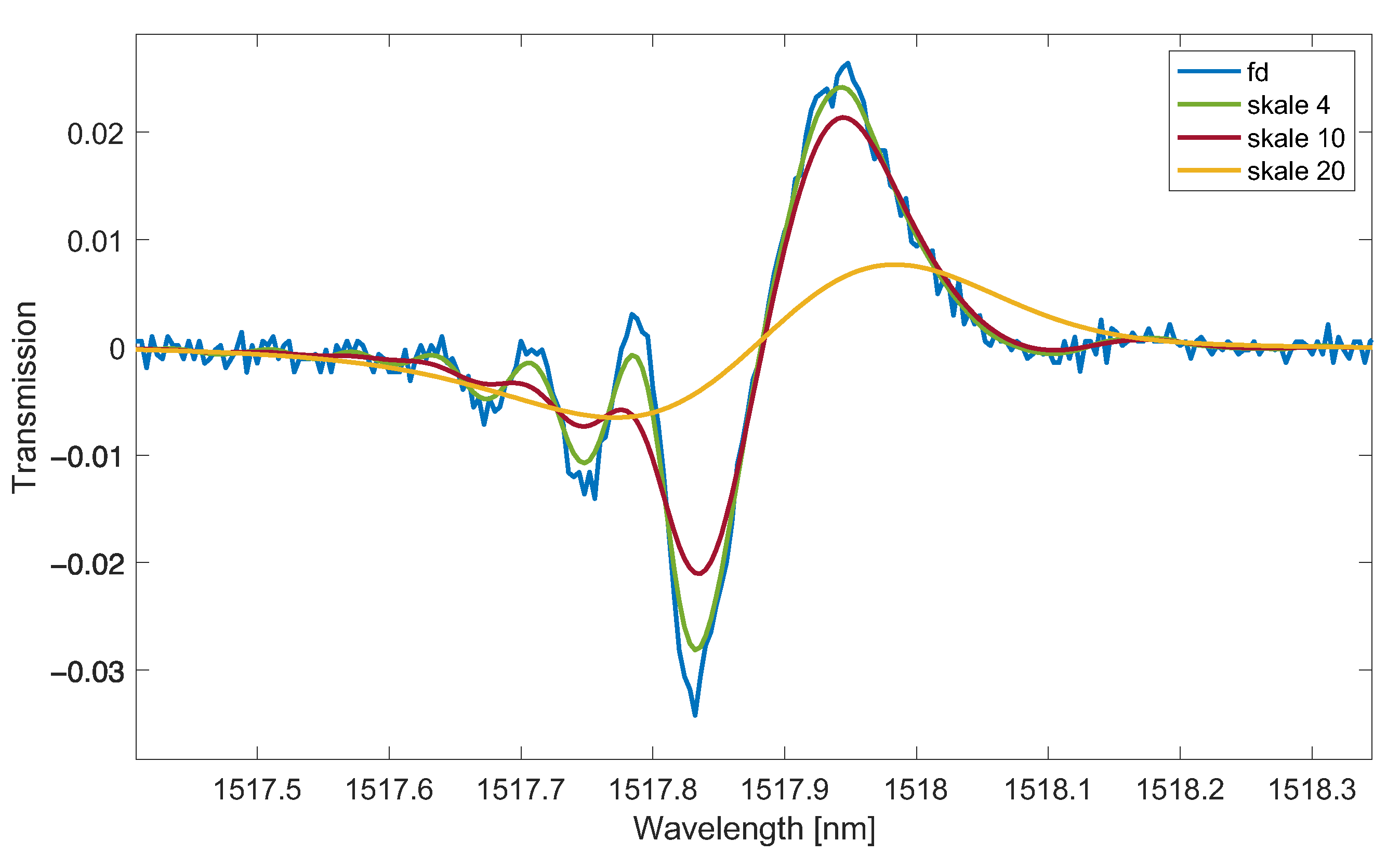
Fibre optic sensors using tilted fibre Bragg grating (TFBG) have high sensitivity for refractive index measurements. In order to achieve good metrological parameters of the measurement, an appropriate method of spectrum demodulation must be used. The method proposed in the article is an improvement of the spectral length algorithm. The spectral length parameter is treated as the sum of the derivative filter responses. In the original version, the first difference of spectrum elements was used, while this article proposes to use the wavelet transform to calculate the numerical derivative approximation. The advantage of this solution is an easy way to select the level of smoothing filtration by changing the scale parameter. The derivation is appropriate even for a relatively low signal-to-noise level. The approximation of the spectral length by the derivative calculated using the wavelet transform eliminates the high-frequency noise of the optical signal. The absolute value of determined spectral derivatives after significant smoothing can be used to estimate the wavelength of the decay of modes. After analyzing experimental data and performing calculations, it turns out that this is a linear method with better resolution than the contour length algorithm.
Keywords: TFBG sensors; refractive index; optical spectra analysis TFBG sensors; refractive index; optical spectra analysis