You are currently viewing a new version of our website. To view the old version click .
Sensors
  • Article
  • Open Access

9 November 2023

Person-Specific Template Matching Using a Dynamic Time Warping Step-Count Algorithm for Multiple Walking Activities

,
,
and
1
Institute of Medical and Biological Engineering, University of Leeds, Leeds LS2 9JT, UK
2
Warwick Clinical Trials Unit, University of Warwick, Coventry CV4 7AL, UK
3
Leeds Institute of Rheumatic and Musculoskeletal Medicine, University of Leeds, Leeds LS2 9JT, UK
4
Leeds Institute of Health Informatics, University of Leeds, Leeds LS2 9JT, UK
This article belongs to the Special Issue IMU Sensors for Human Activity Monitoring

Abstract

This study aimed to develop and evaluate a new step-count algorithm, StepMatchDTWBA, for the accurate measurement of physical activity using wearable devices in both healthy and pathological populations. We conducted a study with 30 healthy volunteers wearing a wrist-worn MOX accelerometer (Maastricht Instruments, NL). The StepMatchDTWBA algorithm used dynamic time warping (DTW) barycentre averaging to create personalised templates for representative steps, accounting for individual walking variations. DTW was then used to measure the similarity between the template and accelerometer epoch. The StepMatchDTWBA algorithm had an average root-mean-square error of 2 steps for healthy gaits and 12 steps for simulated pathological gaits over a distance of about 10 m (GAITRite walkway) and one flight of stairs. It outperformed benchmark algorithms for the simulated pathological population, showcasing the potential for improved accuracy in personalised step counting for pathological populations. The StepMatchDTWBA algorithm represents a significant advancement in accurate step counting for both healthy and pathological populations. This development holds promise for creating more precise and personalised activity monitoring systems, benefiting various health and wellness applications.

1. Introduction

Being physically active is important for health and well-being as it helps to delay and prevent many chronic conditions [1]. Walking is one of the most common activities performed by humans in their everyday lives [2]. It has multiple benefits such as improving musculoskeletal, mental, metabolic, and cardiorespiratory health [3]. Walking and its characteristics have been previously measured in a laboratory environment using expensive and large systems [4,5] or in a free-living environment using inexpensive, time-consuming subjective measures such as surveys, diaries, and questionnaires, which demonstrate limited reliability [6,7].
Due to the increased demand for measuring physical activity in our everyday lives, several advances have been made in commercial wearable technology [5]. Accelerometers are at the core of the most popular wearables and are used to measure physical activity in terms of frequency, intensity, type, and duration [4]. Information from accelerometers can also be used to derive the number of steps taken during a time interval [8,9]. The total step count is increasingly being used as a metric to represent the overall health of individuals [5].
Although accelerometers offer several advantages, the algorithms used in consumer devices are usually targeted at a generally healthy population [10]. When they have been independently validated in pathological populations with impaired gait, the results have been mixed and there is evidence of poor accuracy in people with greater levels of impairment [11,12].
Our aim was to undertake a pilot study to develop and initially evaluate a new step-count algorithm that would perform well for individuals with pathological gait. Our approach uses person-specific templates of the accelerometer gait signal. We hypothesise that a personalised approach avoids issues that would be present in a model derived from a population with inter-individual variation. In the absence of a real pathological population, we used the simulated pathological gaits from healthy volunteers.

3. Materials and Methods

This section describes the development of a new step-count algorithm (StepMatchDTWBA) based on template matching using the dynamic time warping (DTW) method and its extension, DTW barycentre averaging (DBA). The aim of StepMatchDTWBA is to enable more accurate step-count predictions in people with walking impairments. We first describe some of the constituent methods used and then describe the algorithm in full.

3.1. Background Methods

3.1.1. Dynamic Time Warping (DTW)

DTW is an algorithm that calculates the optimal alignment of two sequences (signals) to determine their similarity. This is achieved by identifying flexible similarities in the time dimension (x-axis) by aligning the elements inside both sequences. The process results in a non-linear alignment that enables the matching of similar shapes, even when the sequences might be out of phase.
Specifically, we can visualise DTW via an n-by-m grid for two sequences of length n, m. A potential alignment between the components of the two sequences is represented by each point on the grid. An alignment pattern that matches every component of the two sequences is known as a warping path. There are several possible warping paths, but the shortest path is considered to be the best option [24].
The cost of the optimal alignment is computed recursively by:
D ( Q n , P m ) = δ ( q n , p m ) + min D ( Q n 1 , P m 1 ) D ( Q n , P m 1 ) D ( Q n 1 , P m )
where Q n and P m are the sub-sequences < q 1 , , q n > and < p 1 , , p m > , respectively. δ represents the Levenshtein distance between the elements of the sequences [25]. Once the path with the best alignment is identified, a similarity score, which describes the fit between the two sequences, is calculated as the total cost over the entire sequence length:
D ( Q | Q | , P | P | ) = D ( Q n , P m )

3.1.2. DTW Barycentre Averaging (DBA)

Barycentre averaging is a non-linear method of averaging a set of sequences [25]. DBA allows the resulting averaged sequence to keep the morphology of the individual sequences when they are out of phase, which may otherwise be averaged out in a simple Euclidean average.
DTW barycentre averaging (DBA) is an iterative algorithm in which DTW is used to align N sequences, S = S 1 , , S N , to an average sequence, A = < a 1 , , a T > .
An initial guess for A, A = < a 1 , , a T > , is chosen randomly from S. A is then updated by calculating the DTW similarity and path between A and each individual sequence S i . Each element of A is updated as the barycentre of the elements associated with it during the previous step:
A t = b a r y c e n t r e ( a s s o c ( A t ) ) where b a r y c e n t r e ( S 1 , , S N ) = S 1 + + S N N
The assoc function is applied to the sequence A t , which returns the associations between each coordinate in A t and the barycentric average sequence. These associations are then used in the barycentre calculation [25].
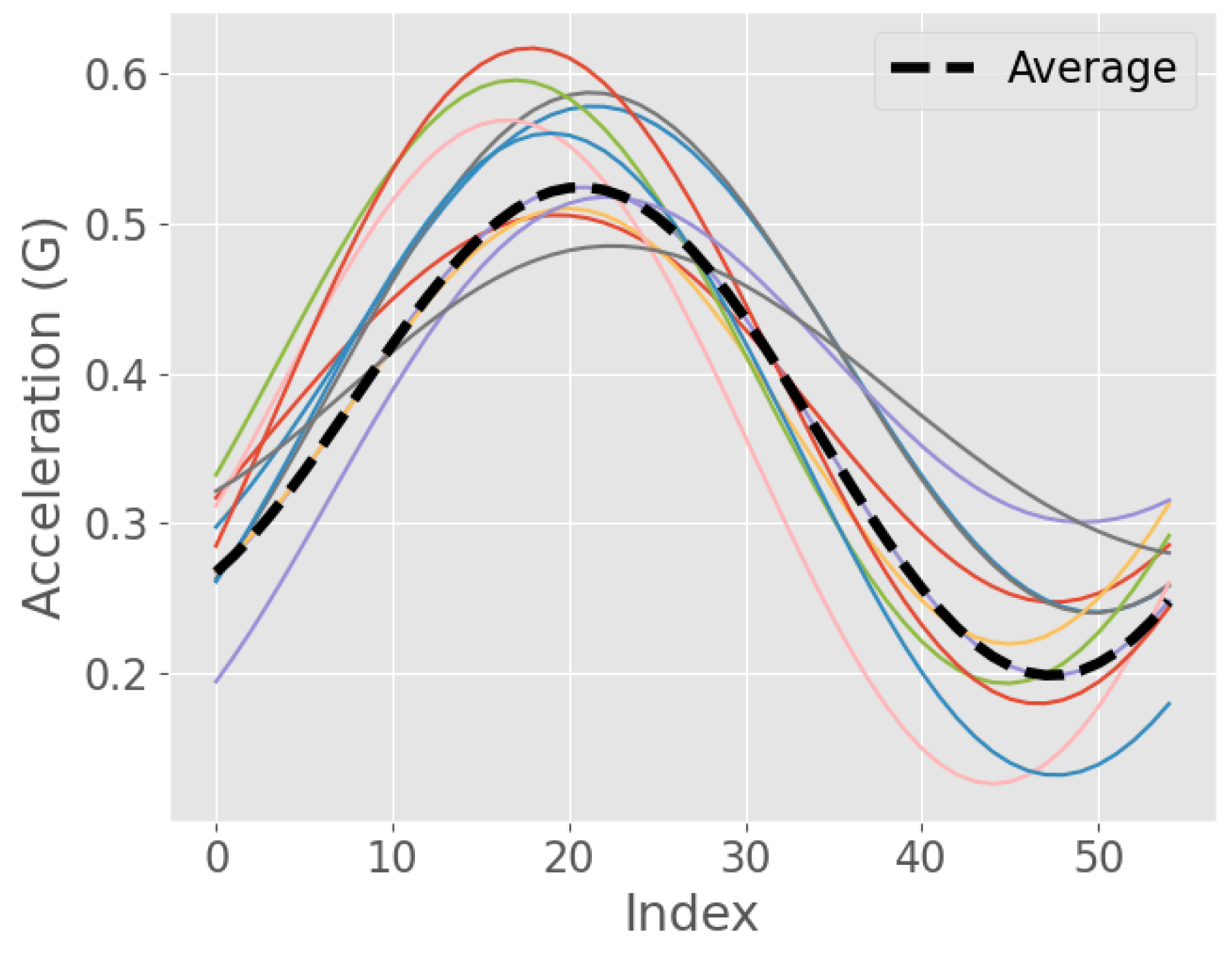
Figure 1 demonstrates several sequences that represent a single walking step and their DBA average. It shows how the overall shape of the sequences is preserved, despite the slight differences in the phase and frequency. Additionally, the figure provides a visual insight into the robustness of the DBA method in aligning and averaging time-series data, making it a powerful tool for analysing and comparing gait-cycle patterns.
Figure 1. Averaging dynamic time warping of segmented acceleration signals in multiple colours using barycentre averaging.

3.2. Algorithm Development

The StepMatchDTWBA algorithm automatically detects the number of steps undertaken by a person, solely from wrist acceleration signals.
The key concept is to create a representative step from the acceleration signal as a template and then compare the template to the acceleration signal. It is assumed that a step corresponds to a match between the template and a particular area of the acceleration signal. The StepMatchDTWBA algorithm employs a template that models the overall shape of the signal, in contrast to many conventional step-count algorithms, which only take the number of peaks in a cyclical gait acceleration signal into account.
Our algorithm, StepMatchDTWBA, was inspired by several authors [20,26], but we mainly built upon the work of Micó-Amigo et al. [27], who created a personalised template of a walking period. However, there are two key differences in our approach. Firstly, our algorithm calculates the template length of a single step using both the peaks and troughs of the acceleration signal, whereas Micó-Amigo et al. only used the peaks. By considering both the peaks and troughs, our algorithm can capture the full range of motion involved in a step, making it more robust and accurate. Secondly, Micó-Amigo et al. [27] used correlation measures to identify the number of steps, whereas our algorithm uses dynamic time warping (DTW). DTW is a more powerful technique compared to correlation measures, especially when dealing with inconsistent gait morphology over time. By using DTW, our algorithm is more able to accurately identify the number of steps, even in cases where there is variability in the gait pattern.
All computations were undertaken in Python, and the source code has been uploaded in a GitHub repository that is available at https://github.com/ValeriaF22/Thesis-Project, accessed on 6 November 2023. However, the raw data are unavailable, as participants did not consent to share their data more widely.

3.3. Signal Preprocessing

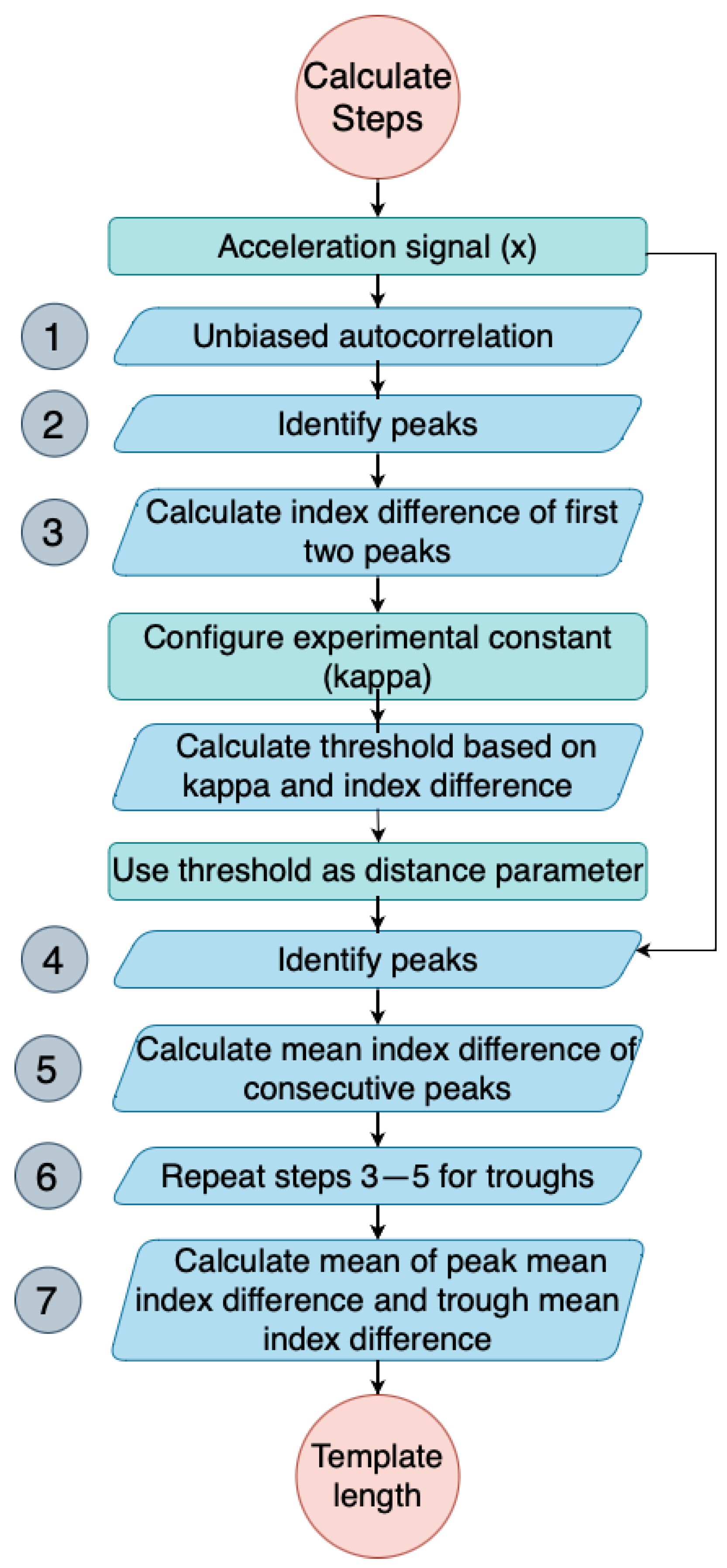
To reduce the impact of high-frequency noise generated during data capture (caused, for instance, by muscle contraction), the accelerometer signal is first filtered using a 6th-order low-pass Butterworth filter with a 3 Hz cutoff frequency. The frequency of human activity is between 0 and 20 Hz, and almost all of the signal energy is contained below 3 Hz [28,29,30]. The flowchart in Figure 2 depicts the steps in the algorithm, with its output being the total number of steps. It is important to mention that the templates generated used the whole time series of the acceleration signal collected.
Figure 2. Flowchart of StepMatchDTWBA algorithm.

3.3.1. Template Length Calculation

After the filtering process of the acceleration signal, the template length corresponding to a full gait cycle is extracted as follows:
  • Obtain the unbiased autocorrelation signal of the input acceleration signal. This autocorrelation signal will be used to identify the periodicity of the signal, which is an important feature in detecting steps.
    A unbiased = 1 N | m | i = 1 N | m | x i x i + m
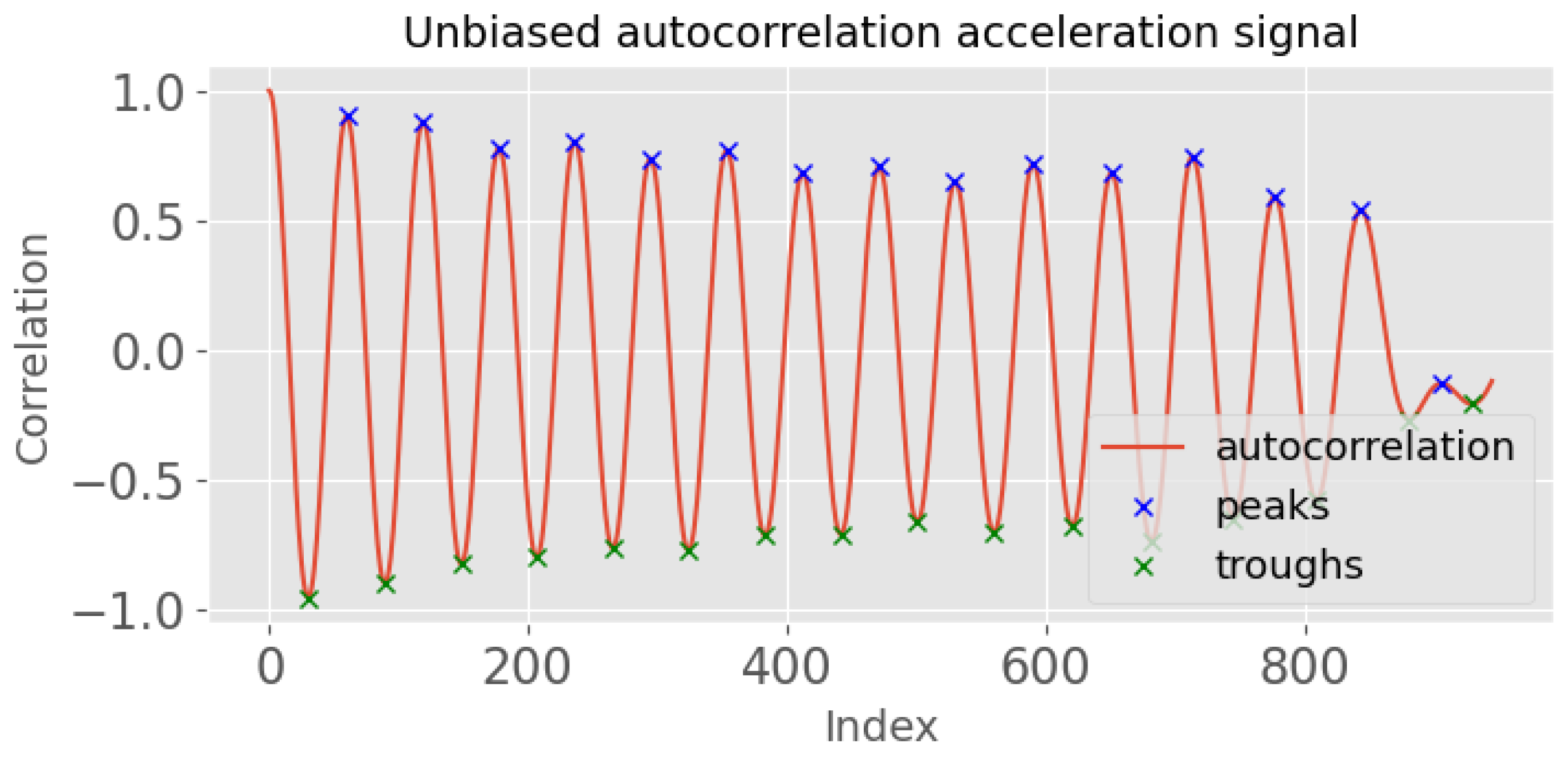
    where x i is the acceleration signal, N is the length of the signal, and m is the time lag. An example output is shown in Figure 3, where the x-axis is the index for a given time lag (m). By analysing this autocorrelation plot, the periodicity of the signal can be identified by measuring the time difference between the first two prominent peaks, which corresponds to its fundamental period.
    Figure 3. Unbiased autocorrelation signal of normal walking with peaks and troughs.
  • Identify the peaks of the autocorrelation signal, P c o r r , using scipy.signal.find_peaks. The peaks correspond to the periodicity of the input signal.
  • Calculate the index (time) difference between the first two peaks of the autocorrelation signal ( m i n _ t i m e = P c o r r 2 P c o r r 1 ). This time difference provides an estimate of the minimum allowable time between neighbouring peaks in the input signal.
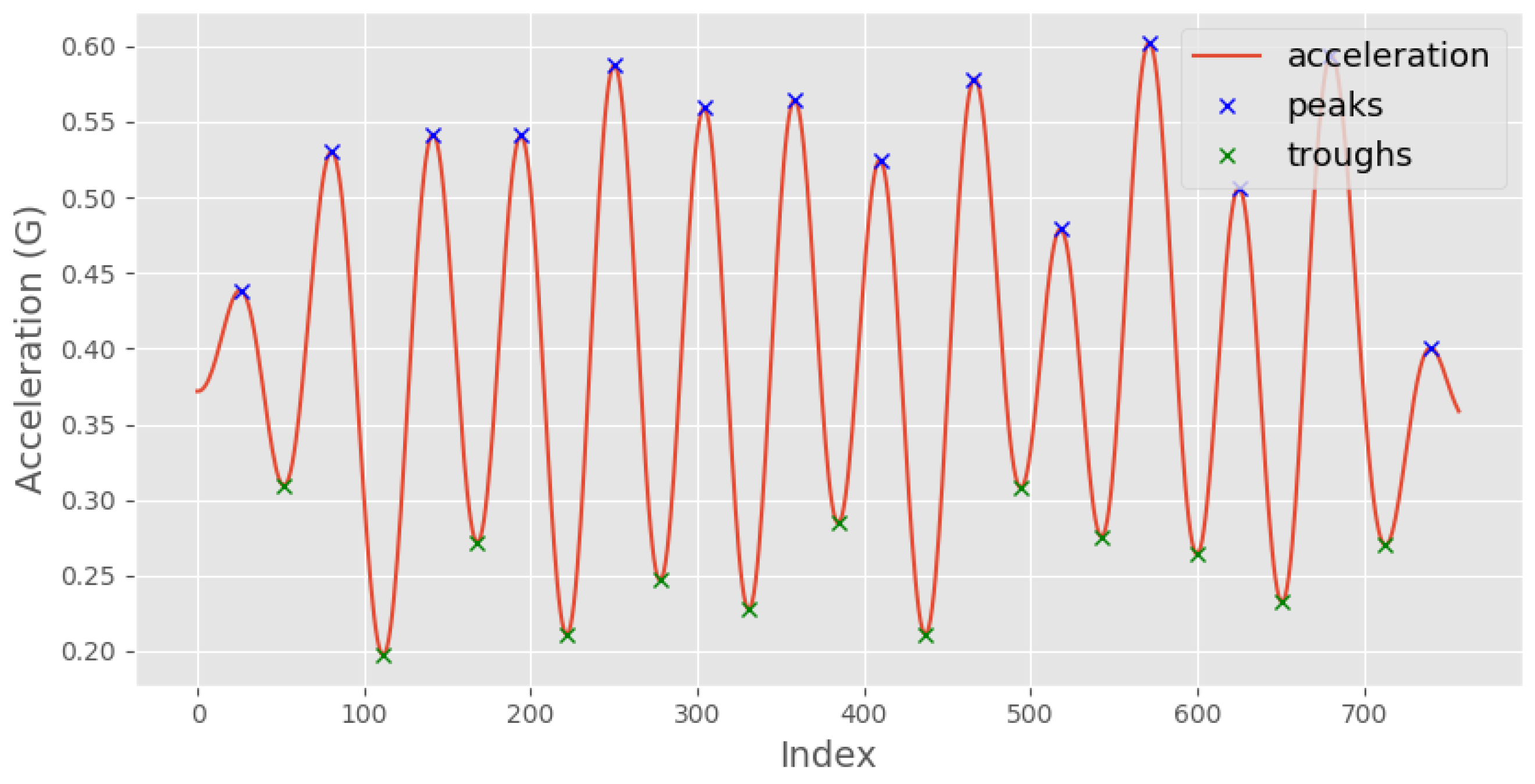
  • Identify the peaks of the original acceleration signal using scipy.signal.find_peaks (Figure 4). The minimum allowable time between neighbouring peaks was set at κ × m i n _ t i m e . κ is an activity-specific parameter that was estimated experimentally (Table 1).
    Figure 4. Acceleration signal of normal walking with peaks and troughs.
    Table 1. Constant, κ , used to calculate the adaptive threshold for each individual dynamic activity.
  • Calculate the mean time difference between each consecutive pair of peaks in the original acceleration signal (from step 4). This value represents the average time period of the detected steps in the input signal.
  • Repeat steps 3–5 for the troughs, which correspond to the negative peaks of the acceleration signal.
  • Calculate the template length as the mean of the mean time difference of the peaks and the mean time difference of the troughs. This value represents the average time period of both the positive and negative peaks in the input signal.

3.3.2. Template Signal Generation

The template length calculated in the previous step is used to generate the template signal. This length is used to segment the filtered acceleration signal into epochs, where each epoch has the same length and there is no overlap between epochs. We then use DBA to average the epochs together and create a single template signal for each acceleration signal, as demonstrated in Figure 1. The template is unique to each individual and activity.

3.3.3. Template Matching to Calculate the Number of Steps Undertaken

The template signal can be used to estimate the step count for accelerometer data from the same individual. Data are first segmented into epochs of length = template length. Each epoch is then compared to the template signal using DTW, and the result is multiple similarity scores.
similarity scores = d t w ( t e m p l a t e , e p o c h )
For each volunteer, several similarity scores are calculated by comparing the average template signal with each step signal sequence (epoch) using DTW. This similarity score is a measure of how closely the acceleration pattern of the epoch resembles the template.
To determine if a step has occurred, we introduce a threshold that acts as a cutoff point for similarity. A single value representing the upper bound of the confidence interval for the similarity scores was calculated for each activity under healthy and simulated pathological conditions. This value is used as a threshold to identify the number of steps. If a similarity score falls below this threshold, we consider it indicative of a step. The choice of using the upper bound of the confidence interval is grounded in statistics, as it provides a range that encompasses the true mean with a certain level of confidence. To determine the appropriate threshold values for healthy and simulated pathological conditions, we considered the inherent variability in the walking patterns of participants. For healthy individuals, we found that a threshold of “mean + 3 × std” provided the best results. This threshold takes into account slight variations in the walking patterns of healthy participants while maintaining the concept of similarity. On the other hand, pathological signals often exhibit greater variability due to irregularities, spikes, or fluctuations caused by the underlying condition. To handle this increased variability, we found that a more conservative threshold of “mean + 1 × std” was appropriate for simulated pathological conditions.
threshold = mean + n × std
where n = 3 for healthy conditions and n = 1 for simulated pathological conditions.
By incorporating this upper bound of the confidence interval as the threshold, our algorithm can accurately identify and quantify steps, even when the sequences are not identical but exhibit similar patterns. This enhances the algorithm’s ability to capture variations in walking activity while ensuring reliable step counting, making it more adaptable to individual variations and differentiating between healthy and pathological cases.

4. Experiments

We investigated the proposed algorithm using data collected from 30 healthy participants. The recruitment of participants was conducted through email invitations and word of mouth by both staff and students at the University of Leeds. The eligibility criteria for participants included the ability to walk without discomfort for a duration of two minutes, the absence of any musculoskeletal or gait-affecting conditions, and an age of 18 years or older. Informed consent was obtained from every subject who took part in the research. Ethical approval for the study was granted by the University of Leeds (Ref#: MREC16-172).

4.1. Data Acquisition

Each participant wore a MOX tri-axial accelerometer (Maastricht Instruments, Maastricht, NL), which was held in place on the non-dominant wrist by an elasticated strap. The accelerometer had a measurement range of ±8 g and a sampling frequency of 100 Hz. The recorded signals were stored locally on the device and subsequently retrieved upon the completion of each participant’s trial.
The true number of steps was measured from video recordings. We recorded video of each participant as they walked using a smartphone camera. The camera was focused on the participant at a distance of approximately 2 m, such that the whole participant’s body was in the frame. A researcher (V.F.) used slow-motion playback of the videos to count steps and label the accelerometer data three times for reliability purposes [31].
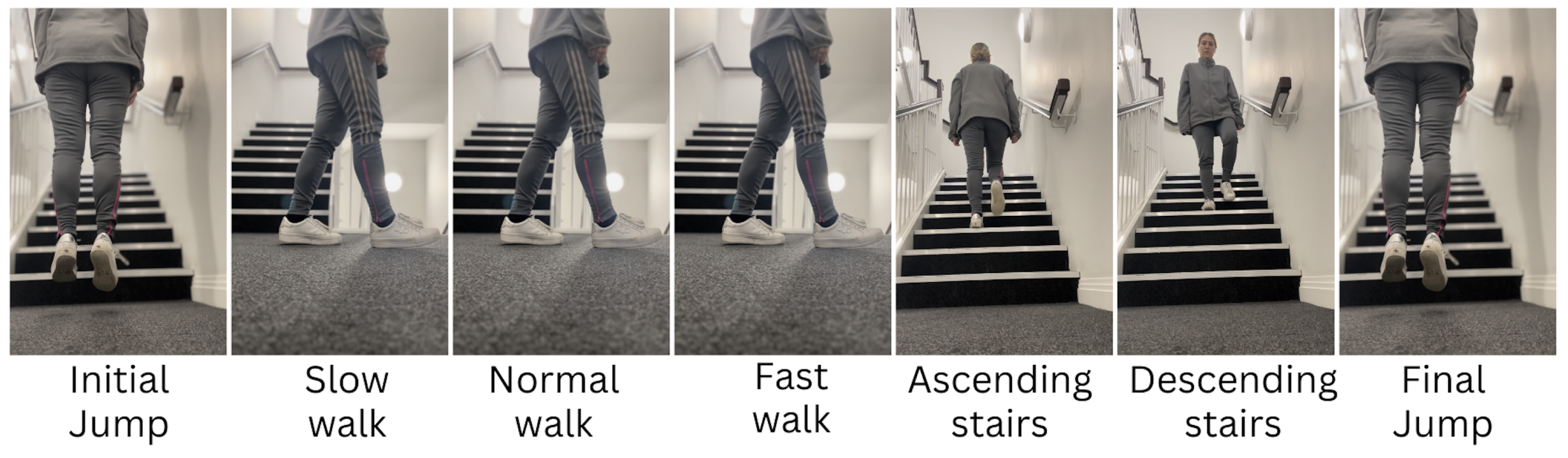
Prior to attaching the activity monitor, participants received instructions and a video representation detailing the five activities they would engage in: a slow walk, a normal walk, and a fast walk along a GAITRite walkway spanning approximately 10 m, as well as ascending and descending a single flight of stairs, as demonstrated in Figure 5. Following the attachment of the accelerometer, participants were requested to execute a single jump to aid in aligning the video footage with the accelerometer data. Subsequently, participants undertook the activities in a sequential manner, with verbal reminders provided for each task. After completing the activities, participants were asked to perform another single jump.
Figure 5. Sequence of activities performed by the volunteers during the experiment.
Each sequence of tasks was executed twice: once in a state of normal health and subsequently under simulated pathological conditions. The decision to employ simulated pathological conditions was driven by the impracticality of recruiting actual patients, given the exploratory nature of the research, and the need to mitigate the potential risk of exposing an immunosuppressed population to SARS-CoV-2 during the pandemic. Under these simulated pathological conditions, participants were instructed to repeat the series of activities while adopting a shuffling gait and performing the tasks at a slower pace. A shuffling gait was defined as a situation in which the foot moved forward during initial contact or mid-swing, with the foot either remaining flat or striking with the heel, typically accompanied by shorter steps, reduced arm movement, and a forward-flexed posture [32]. They had the opportunity to practice before commencing data acquisition.

4.2. Model Validation

We used the root-mean-square error (RMSE) for each activity to measure the difference between the predicted and the true number of steps for all the participants. As a reminder, each activity was standardised to a distance of about 10 m (GAITRite walkway) in the case of walking and one flight of stairs for ascending and descending stairs.
The results were also assessed using Bland–Altman analysis. This first involved creating a Bland–Altman plot to visually inspect the agreement between the predicted and the true number of steps. The Bland–Altman plot is a scatter plot, in which the Y-axis demonstrates the difference between the two paired measurements, and the X-axis shows the average of these measures [33]. In our case, the X-axis shows the true number of steps instead of the average of the two methods [33,34].
Two key metrics can be derived from the Bland–Altman plot. The bias is used to identify any systematic difference between the predicted and the true number of steps. The limits of agreement (LOA) represent the range where most differences between the measurements of the two methods, gold standard and algorithm, will lie. They are calculated based on the mean and standard deviation of the differences between the measurements [35]. In this analysis, we used a V-shaped 95% LOA because we expected the total error in the predicted steps to increase with the total number of steps [36].

5. Results

5.1. Root-Mean-Square Error

The mean age of participants was 32.7 years (s.d. 12.7). Of the 30 participants, 14 identified as female. Their mean height was 171.5 cm (s.d. 7.1), and their mean weight was 69.2 kg (s.d. 13.6). The following results compare the algorithm developed for this study to several algorithms of different types: template matching [27], peak detection [37], and thresholding in the frequency domain [38].
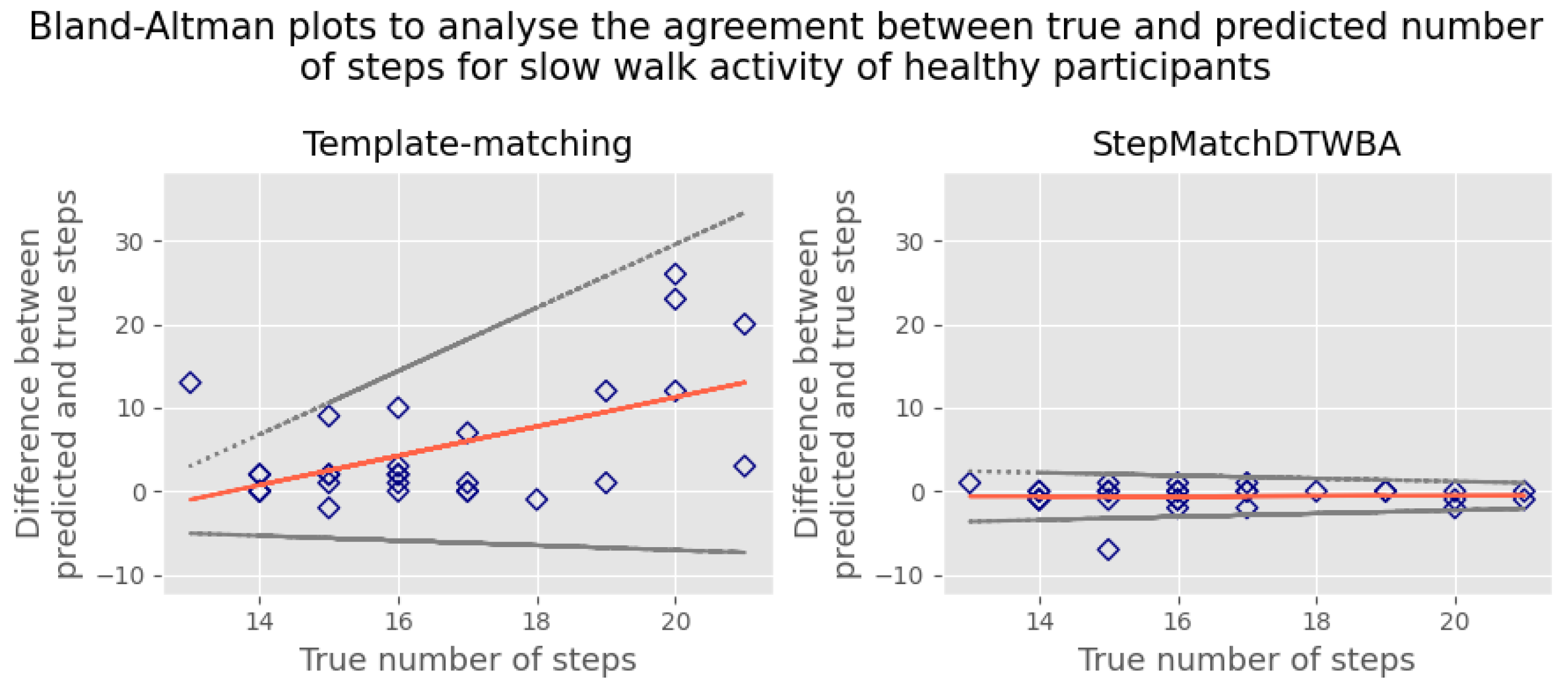
Table 2 presents the comparative performance of StepMatchDTWBA and the template-matching algorithm across various activities, revealing StepMatchDTWBA’s superior results for slow and normal walking activities. However, for the remaining activities, the template-matching algorithm exhibited marginally better outcomes. To further illustrate the agreement between the predicted and the true number of steps for each algorithm, Bland–Altman plots, as shown in Figure 6, were generated, specifically focusing on walking at a slow speed under healthy conditions. The first plot demonstrates the agreement achieved using the template-matching algorithm, whereas the second plot represents the agreement obtained using StepMatchDTWBA. In this comparison, StepMatchDTWBA displayed a consistent bias of −0.59 (indicated by the red line) across different step counts, with the 95% limits of agreement (LOA) ranging from −3.48 to 2.30 (represented by the grey dotted lines). In contrast, the template-matching algorithm exhibited greater variability in the results, with a bias of 5.21 and 95% LOA ranging from −9.15 to 19.57.
Table 2. RMSE of steps per 10 m walking test results for the step-count algorithm for individual dynamic activities under healthy and simulated pathological conditions. Low and high confidence intervals are shown in brackets.
Figure 6. Bland–Altman plot under healthy conditions.
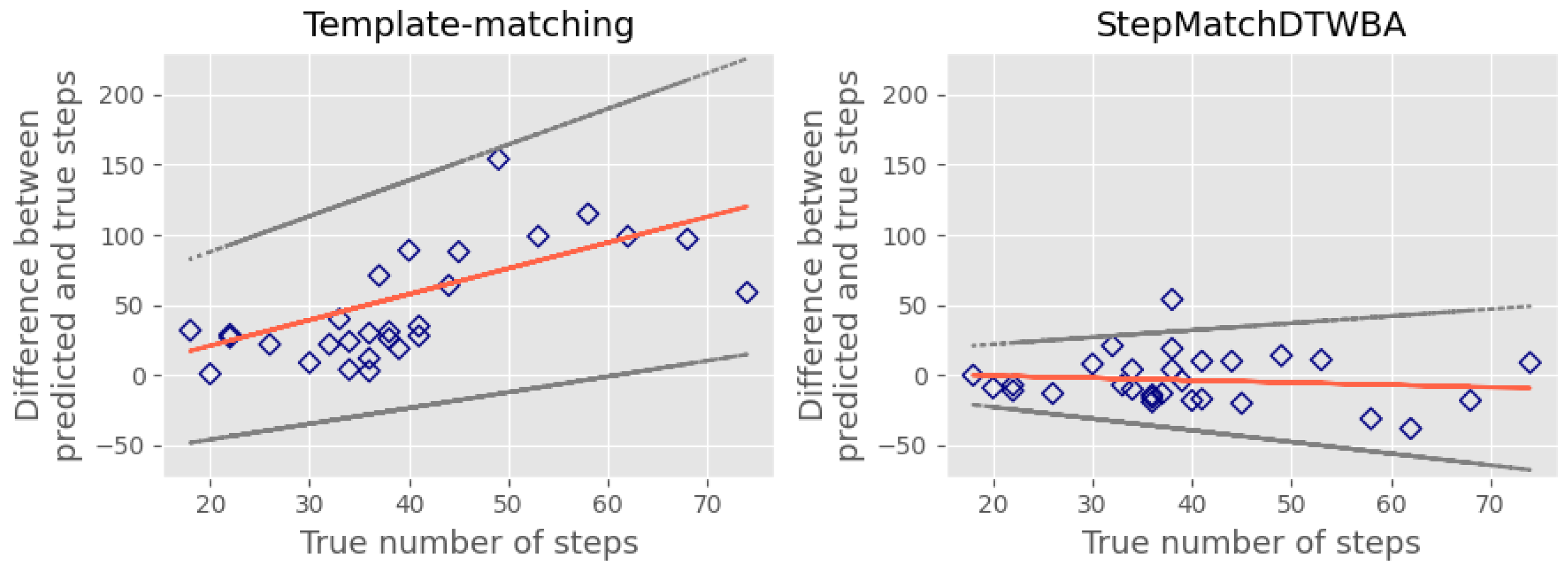
Under simulated pathological conditions, the performance of all algorithms deteriorated compared to the healthy conditions. Table 2 reveals that the StepMatchDTWBA algorithm outperformed the template-matching algorithm across all five activities under these conditions. Figure 7 illustrates the increased error observed for both algorithms when operating under simulated pathological conditions, with a specific focus on slow-speed walking. StepMatchDTWBA demonstrated superior performance over the template-matching algorithm, exhibiting a bias of −3.48 (indicated by the red line) and 95% limits of agreement (LOA) ranging from −38.71 to 31.75 (represented by the grey dotted lines). Conversely, the template-matching algorithm displayed a bias of 56.72 and 95% LOA ranging from −64.90 to 178.35.
Figure 7. Bland–Altman plot under simulated pathological conditions.

5.2. Testing the StepMatchDTWBA Algorithm on an External Public Dataset

To further validate the StepMatchDTWBA algorithm, we conducted a comprehensive test utilising the publicly available Oxford Step-Counter external dataset [39,40]. This dataset is unique, as it provides both raw accelerometer outputs and ground-truth values for step counts, offering an opportunity to assess the algorithm’s accuracy in real-world scenarios. Although the dataset features only two subjects, it remains a highly valuable resource for evaluating step-counting precision. The data collection process involved a Samsung S6 smartphone placed in six different positions: (1) hand, (2) front pocket, (3) back pocket, (4) neck pouch, (5) bag, and (6) armband. In our experiments, we focused solely on data obtained from the hand and armband locations. The Oxford Step-Counter dataset was originally collected by Salvi et al. [40], who also devised an algorithm based on windowed peak detection. Additionally, Pham et al. [41] developed another algorithm and tested it on the same dataset. Their approach incorporated peak detection and four essential features: minimal peak distance, minimal peak prominence, dynamic thresholding, and vibration elimination. Table 3 presents a comprehensive comparison of the true number of steps and the predicted number of steps generated by the StepMatchDTWBA and Pham et al. [41] algorithms. The StepMatchDTWBA algorithm demonstrated a maximum difference of four steps between the true and the predicted step counts, whereas the algorithm by Pham et al. exhibited a maximum difference of eight steps.
Table 3. Number of steps calculated using StepMatchDTWBA and Pham et al. [41] algorithms on the Oxford Step-Counter dataset. Bolded items indicate the better-performing method for each position.

6. Discussion

Multiple approaches have previously been used to estimate step counts from accelerometers. Researchers have observed that there is a need for better step-count algorithms to be employed in (a) people with slow walking activity; (b) functionally compromised patient populations; and (c) when devices are worn on the wrist.
Our results align with those of prior research. We observed a reduced error (average RMSE of 1.91 steps over all activities) when using our step-count StepMatchDTWBA algorithm on data from normal gaits compared to data from simulated pathological gaits (average RMSE of 11.60 steps over all activities). We also conducted a comparative analysis between our algorithm and the nearest existing method, the template-matching algorithm [27], which also employs DTW. These two algorithms demonstrated similar performance when applied to healthy conditions. However, under simulated pathological conditions, our algorithm outperformed the template-matching algorithm.
The variation in algorithm performance can be attributed to various factors. Notably, the template-matching algorithm was originally designed for devices worn in different locations and targeted at distinct populations. Additionally, its primary objective was to calculate the step length rather than the total number of steps, with step counting serving as an intermediate stage.
The differences in error between the estimates of the healthy and simulated pathological gait steps can be attributed to various factors. In general, the acceleration signal recorded from the healthy condition group was periodic since the walking process is a rhythmic movement [42,43]. On the other hand, the acceleration signal recorded from the pathological condition group (in this case, simulated pathological) was less regular and contained more noise. The lack of regularity in the pathological group is one potential reason that existing methods showed a drop in performance. Additionally, the variability of the walking signal played an important role, especially for simulated pathological conditions. Healthy participants performed activities under both their normal routines and under pathological conditions. In their attempt to perform the activities under pathological conditions, the variability of their gait was much greater. The Bland–Altman plots showed that the range of the LOA for the healthy conditions was much smaller than the range of the LOA for the simulated pathological conditions.
The StepMatchDTWBA algorithm showed excellent performance when using the data from healthy participants. It also showed improved performance over existing algorithms when using the data from the simulated pathological gaits. This is very encouraging as it may enable more accurate step-count data estimates in patients who suffer from chronic impairments. This could be used to more accurately personalise treatment and recovery plans. Additionally, the algorithm was tested on data with varying speeds on flat surfaces and stairs. The results showed good performance in healthy participants (RMSE = 4.34 steps). On the other hand, the results were poorer for simulated pathological gaits (RMSE = 63.04 steps). In comparison to the template-matching algorithm, StepMatchDTWBA was almost five times more accurate. This might be because StepMatchDTWBA created more accurate templates since both peaks and troughs were considered.
Finally, the StepMatchDTWBA algorithm was also tested on the Oxford Step-Counter dataset. For the purposes of this study, only the accelerometer data from the hand and arm were used. The percentage error between the true number of steps and the predicted number of steps was ±1%. This suggests that the StepMatchDTWBA algorithm showed excellent generalisation to unseen external data from normal participants with normal gaits.
This study was limited in the following ways. First, the comparator algorithms by Micó-Amigo et al. [27], Aboy et al. [37], and Dirican et al. [38] did not have associated code and needed to be re-implemented. Second, the algorithms were tested only on healthy subjects, who performed the activities under healthy and pathological conditions. We hypothesise that our algorithm would perform worse on people with real walking impairments. Additionally, the algorithm was developed and tested offline. While we are unsure whether it is fast enough in real time, we note that the dynamic time warping used in DTW is of complexity O ( N 2 ) and tends not to scale well. Lastly, the StepMatchDTWBA algorithm uses a threshold depending on the activity; therefore, activity classification should be performed prior to the use of this algorithm in order to select the appropriate threshold. The threshold can be updated as more data become available, increasing its generalisability and applicability.
The specific strengths of this study include the combination of two powerful techniques: DTW and DBA. The performance of our algorithm, StepMatchDTWBA, proved to be superior in both healthy and simulated pathological conditions in comparison to Micó-Amigo et al.’s algorithm, from which it drew inspiration. Additionally, the StepMatchDTWBA algorithm outperformed Aboy et al.’s baseline peak detection method and Dirican et al.’s thresholding method. Finally, the StepMatchDTWBA algorithm developed for this study is suitable not only for normal-speed walking but also for various walking speeds and climbing stairs. The majority of existing studies in the literature tested the step-count algorithms for normal walking, and some studies tested various walking speeds. However, only a few studies tested a step-count algorithm in more challenging activities such as climbing stairs, which represents a progression of previous work towards testing in real-life situations.

7. Conclusions

In this study, we compared a novel StepMatchDTWBA algorithm to an existing template-matching algorithm from the literature. The algorithms were tested using data collected from participants performing various activities under both healthy and simulated pathological conditions [44]. The StepMatchDTWBA algorithm demonstrated excellent accuracy for slow and normal walking speeds in the healthy condition group. For fast walking, stair ascent, and stair descent, the results were satisfactory and comparable to those of the template-matching algorithm. Although the StepMatchDTWBA algorithm’s performance in the simulated pathological condition group was not as strong as in the healthy group, it still outperformed the template-matching algorithm. These findings suggest the potential to develop more effective step-count algorithms for functionally impaired patient populations. This, in turn, could provide clinicians with more accurate and consistent results, accommodating individuals with varying functional abilities.

Author Contributions

Conceptualization, V.F.; methodology, V.F.; software, V.F.; validation, V.F.; formal analysis, V.F.; investigation, V.F.; resources, V.F.; data curation, V.F.; writing—original draft preparation, V.F.; writing—review and editing, M.R.B. and A.C.R. and D.C.W.; visualization, V.F.; supervision, M.R.B. and A.C.R. and D.C.W.; project administration, V.F.; funding acquisition, V.F. All authors have read and agreed to the published version of the manuscript.

Funding

This study was supported by the Engineering and Physical Sciences Research Council (EPSRC) Centre for Doctoral Training in Tissue Engineering and Regenerative Medicine—EP/L014823/1 and by the Open Access Gateway of the University of Manchester Library.

Institutional Review Board Statement

Ethical review and approval for this study was provided by the University of Leeds (Ref#: MREC16-172).

Data Availability Statement

Data are contained within the article.

Conflicts of Interest

The authors declare no conflict of interest.

References

  1. Phillips, S.M.; Cadmus-Bertram, L.; Rosenberg, D.; Buman, M.P.; Lynch, B.M. Wearable technology and physical activity in chronic disease: Opportunities and challenges. Am. J. Prev. Med. 2018, 54, 144–150. [Google Scholar] [CrossRef]
  2. Ryu, U.; Ahn, K.; Kim, E.; Kim, M.; Kim, B.; Woo, S.; Chang, Y. Adaptive step detection algorithm for wireless smart step counter. In Proceedings of the International Conference on Information Science and Applications, Pattaya, Thailand, 24–26 June 2013; pp. 1–4. [Google Scholar] [CrossRef]
  3. Chow, J.J.; Thom, J.M.; Wewege, M.A.; Ward, R.E.; Parmenter, B.J. Accuracy of step count measured by physical activity monitors: The effect of gait speed and anatomical placement site. Gait Posture 2017, 57, 199–203. [Google Scholar] [CrossRef]
  4. Strath, S.J.; Kaminsky, L.A.; Ainsworth, B.E.; Ekelund, U.; Freedson, P.S.; Gary, R.A.; Richardson, C.R.; Smith, D.T.; Swartz, A.M.; American Heart Association Physical Activity Committee of the Council on Lifestyle and Cardiometabolic Health and Cardiovascular, Exercise, Cardiac Rehabilitation and Prevention Committee of the Council on Clinical Cardiology, and Council. Guide to the assessment of physical activity: Clinical and research applications: A scientific statement from the American Heart Association. Circulation 2013, 128, 2259–2279. [Google Scholar]
  5. Godfrey, A.; Del Din, S.; Barry, G.; Mathers, J.C.; Rochester, L. Instrumenting gait with an accelerometer: A system and algorithm examination. Med. Eng. Phys. 2015, 37, 400–407. [Google Scholar] [CrossRef]
  6. Broderick, J.M.; Ryan, J.; O’Donnell, D.M.; Hussey, J. A guide to assessing physical activity using accelerometry in cancer patients. Support. Care Cancer 2014, 22, 1121–1130. [Google Scholar] [CrossRef]
  7. Ummels, D.; Beekman, E.; Theunissen, K.; Braun, S.; Beurskens, A.J. Counting steps in activities of daily living in people with a chronic disease using nine commercially available fitness trackers: Cross-sectional validity study. JMIR mHealth uHealth 2018, 6, e70. [Google Scholar] [PubMed]
  8. Walker, R.K.; Hickey, A.M.; Freedson, P.S. Advantages and limitations of wearable activity trackers: Considerations for patients and clinicians. Clin. J. Oncol. Nurs. 2016, 20, 606–610. [Google Scholar] [CrossRef] [PubMed]
  9. Muñoz-Organero, M.; Ruiz-Blázquez, R. Detecting steps walking at very low speeds combining outlier detection, transition matrices and autoencoders from acceleration patterns. Sensors 2017, 17, 2274. [Google Scholar] [CrossRef]
  10. Fulk, G.D.; Combs, S.A.; Danks, K.A.; Nirider, C.D.; Raja, B.; Reisman, D.S. Accuracy of 2 activity monitors in detecting steps in people with stroke and traumatic brain injury. Phys. Ther. 2014, 94, 222–229. [Google Scholar] [CrossRef]
  11. Backhouse, M.R.; Hensor, E.M.A.; White, D.; Keenan, A.M.; Helliwell, P.S.; Redmond, A.C. Concurrent validation of activity monitors in patients with rheumatoid arthritis. Clin. Biomech. 2013, 28, 473–479. [Google Scholar] [CrossRef]
  12. Chandrasekar, A.; Hensor, E.M.A.; Mackie, S.L.; Backhouse, M.R.; Harris, E. Preliminary concurrent validity of the Fitbit-Zip and ActiGraph activity monitors for measuring steps in people with polymyalgia rheumatica. Gait Posture 2018, 61, 339–345. [Google Scholar] [CrossRef] [PubMed]
  13. Marschollek, M.; Goevercin, M.; Wolf, K.H.; Song, B.; Gietzelt, M.; Haux, R.; Steinhagen-Thiessen, E. A performance comparison of accelerometry-based step detection algorithms on a large, non-laboratory sample of healthy and mobility-impaired persons. In Proceedings of the Annual International Conference of the IEEE Engineering in Medicine and Biology Society, Vancouver, BC, Canada, 20–25 August 2008. [Google Scholar]
  14. Capela, N.A.; Lemaire, E.D.; Baddour, N. Feature selection for wearable smartphone-based human activity recognition with able bodied, elderly, and stroke patients. PLoS ONE 2015, 10, e0124414. [Google Scholar]
  15. Oudre, L.; Barrois-Müller, R.; Moreau, T.; Truong, C.; Vienne-Jumeau, A.; Ricard, D.; Vayatis, N.; Vidal, P.P. Template-based step detection with inertial measurement units. Sensors 2018, 18, 4033. [Google Scholar] [CrossRef]
  16. Fortune, E.; Lugade, V.; Morrow, M.; Kaufman, K. Validity of using tri-axial accelerometers to measure human movement—Part II: Step counts at a wide range of gait velocities. Med. Eng. Phys. 2014, 36, 659–669. [Google Scholar] [CrossRef]
  17. Genovese, V.; Mannini, A.; Sabatini, A.M. A smartwatch step counter for slow and intermittent ambulation. IEEE Access 2017, 5, 13028–13037. [Google Scholar] [CrossRef]
  18. Huang, Y.; Zheng, H.; Nugent, C.; McCullagh, P.; Black, N.; Burns, W.; Tully, M.A.; McDonough, S.M. An orientation free adaptive step detection algorithm using a smart phone in physical activity monitoring. Health Technol. 2012, 2, 249–258. [Google Scholar] [CrossRef]
  19. Liu, H.; Schultz, T. How Long Are Various Types of Daily Activities? Statistical Analysis of a Multimodal Wearable Sensor-Based Human Activity Dataset. In Proceedings of the 15th International Joint Conference on Biomedical Engineering Systems and Technologies (BIOSTEC 2022), Online, 9–11 February 2022. [Google Scholar] [CrossRef]
  20. Xu, C.; He, J.; Zhang, X.; Wang, C.; Duan, S. Detection of freezing of gait using template-matching based approaches. J. Sens. 2017, 2017, 1260734. [Google Scholar] [CrossRef]
  21. Folgado, D.; Barandas, M.; Antunes, M.; Nunes, M.L.; Liu, H.; Hartmann, Y.; Schultz, T.; Gamboa, H. TSSEARCH: Time Series Subsequence Search Library. SoftwareX 2022, 18, 101049. [Google Scholar] [CrossRef]
  22. Small, S.R.; Chan, S.; Walmsley, R.; von Fritsch, L.; Acquah, A.; Mertes, G.; Feakins, B.G.; Creagh, A.; Strange, A.; Matthews, C.E.; et al. Development and validation of a machine learning wrist-worn step detection algorithm with deployment in the UK biobank. medRxiv 2023. [Google Scholar] [CrossRef]
  23. Luu, L.; Pillai, A.; Lea, H.; Buendia, R.; Khan, F.M.; Dennis, G. Accurate step count with generalized and personalized deep learning on accelerometer data. Sensors 2022, 22, 3989. [Google Scholar] [CrossRef]
  24. Berndt, D.J.; Clifford, J. Using dynamic time warping to find patterns in time series. In Proceedings of the 3rd International Conference on Knowledge Discovery and Data Mining, AAAIWS’94, Seattle, WA, USA, 31 July–1 August 1994; pp. 359–370. [Google Scholar]
  25. Petitjean, F.; Ketterlin, A.; Gancarski, P. A global averaging method for dynamic time warping, with applications to clustering. Pattern Recognit. 2011, 44, 678–693. [Google Scholar] [CrossRef]
  26. Kaptein, R.G.; Wezenberg, D.; IJmker, T.; Houdijk, H.; Beek, P.J.; Lamoth, C.J.C.; Daffertshofer, A. Shotgun approaches to gait analysis: Insights & limitations. J. NeuroEng. Rehabil. 2014, 11, 120. [Google Scholar]
  27. Micó-Amigo, M.E.; Kingma, I.; Ainsworth, E.; Walgaard, S.; Niessen, M.; van Lummel, R.C.; van Dieën, J.H. A novel accelerometry-based algorithm for the detection of step durations over short episodes of gait in healthy elderly. J. NeuroEng. Rehabil. 2016, 13, 38. [Google Scholar] [CrossRef]
  28. Wang, W.; Guo, Y.; Huang, B.; Zhao, G.; Liu, B.; Wang, L. Analysis of filtering methods for 3D acceleration signals in body sensor network. In Proceedings of the International Symposium on Bioelectronics and Bioinformations 2011, Suzhou, China, 3–5 November 2011; pp. 263–266. [Google Scholar] [CrossRef]
  29. Mathie, M. Monitoring and Interpreting Human Movement Patterns Using a Triaxial Accelerometer. Doctoral Dissertation, UNSW, Sydney, Australia, 2003. [Google Scholar]
  30. Antonsson, E.K.; Mann, R.W. The frequency content of gait. J. Biomech. 1985, 18, 39–47. [Google Scholar] [CrossRef]
  31. Johnston, W.; Judice, P.B.; Molina García, P.; Mühlen, J.M.; Lykke Skovgaard, E.; Stang, J.; Schumann, M.; Cheng, S.; Bloch, W.; Brønd, J.C.; et al. Recommendations for determining the validity of consumer wearable and smartphone step count: Expert statement and checklist of the INTERLIVE network. Br. J. Sport. Med. 2021, 55, 780–793. [Google Scholar] [CrossRef]
  32. Salzman, B. Gait and balance disorders in older adults. Am. Fam. Phys. 2010, 82, 61–68. [Google Scholar]
  33. Giavarina, D. Understanding Bland-Altman analysis. Biochem. Medica 2015, 25, 141–151. [Google Scholar] [CrossRef]
  34. Sasko, B.; Thiem, U.; Christ, M.; Trappe, H.J.; Ritter, O.; Pagonas, N. Size matters: An observational study investigating estimated height as a reference size for calculating tidal volumes if low tidal volume ventilation is required. PLoS ONE 2018, 13, e0199917. [Google Scholar] [CrossRef]
  35. Bland, J.M.; Altman, D.G. Measuring agreement in method comparison studies. Stat. Methods Med. Res. 1999, 8, 135–160. [Google Scholar] [CrossRef]
  36. Pottel, H. Critical review of method comparison studies for the evaluation of estimating glomerular filtration rate equations. Int. J. Nephrol. Kidney Fail. 2015, 1, 1–7. [Google Scholar] [CrossRef]
  37. Aboy, M.; Crespo, C.; McNames, J.; Bassale, J.; Goldstein, B. Automatic detection algorithm for physiologic pressure signal components. In Proceedings of the Second Joint 24th Annual Conference and the Annual Fall Meeting of the Biomedical Engineering Society, Houston, TX, USA, 23–26 October 2002; Volume 1, pp. 196–197. [Google Scholar] [CrossRef]
  38. Dirican, A.; Aksoy, S. Step Counting Using Smartphone Accelerometer and Fast Fourier Trransform. J. Eng. Nat. Sci. 2017, 8, 175–182. [Google Scholar]
  39. Brajdic, A.; Harle, R. Walk detection and step counting on unconstrained smartphones. In Proceedings of the 2013 ACM International Joint Conference on Pervasive and Ubiquitous Computing, UbiComp ’13, Zurich, Switzerland, 8–12 September 2013; Association for Computing Machinery: New York, NY, USA, 2013; pp. 225–234. [Google Scholar] [CrossRef]
  40. Salvi, D.; Velardo, C.; Brynes, J.; Tarassenko, L. An optimised algorithm for accurate steps counting from smart-phone accelerometry. In Proceedings of the 40th Annual International Conference of the IEEE Engineering in Medicine and Biology Society (EMBC), Honolulu, HI, USA, 18–21 July 2018; pp. 4423–4427. [Google Scholar] [CrossRef]
  41. Pham, V.T.; Nguyen, D.A.; Dang, N.D.; Pham, H.H.; Tran, V.A.; Sandrasegaran, K.; Tran, D.T. Highly accurate step counting at various walking states using low-cost inertial measurement unit support indoor positioning system. Sensors 2018, 18, 3186. [Google Scholar] [CrossRef]
  42. Menz, H.B.; Lord, S.R.; Fitzpatrick, R.C. Acceleration patterns of the head and pelvis when walking on level and irregular surfaces. Gait Posture 2003, 18, 35–46. [Google Scholar] [CrossRef] [PubMed]
  43. Yan, L.; Zhen, T.; Kong, J.L.; Wang, L.M.; Zhou, X.L.; Voit, E.O. Walking gait phase detection based on acceleration signals using voting-weighted integrated neural network. Complexity 2020, 2020, 4760297. [Google Scholar] [CrossRef]
  44. Filippou, V.; Redmond, A.C.; Bennion, J.; Backhouse, M.R.; Wong, D. Capturing accelerometer outputs in healthy volunteers under normal and simulated-pathological conditions using ML classifiers. Annu. Int. Conf. IEEE Eng. Med. Biol. Soc. 2020, 2020, 4604–4607. [Google Scholar] [PubMed]
Disclaimer/Publisher’s Note: The statements, opinions and data contained in all publications are solely those of the individual author(s) and contributor(s) and not of MDPI and/or the editor(s). MDPI and/or the editor(s) disclaim responsibility for any injury to people or property resulting from any ideas, methods, instructions or products referred to in the content.

Article Metrics

Citations

Article Access Statistics

Multiple requests from the same IP address are counted as one view.