Article

Automatic Registration of Homogeneous and Cross-Source TomoSAR Point Clouds in Urban Areas

1
School of Geomatics and Urban Spatial Informatics, Beijing University of Civil Engineering and Architecture, Beijing 102616, China
2
Aerospace Information Research Institute, Chinese Academy of Sciences, Beijing 100094, China
*
Author to whom correspondence should be addressed.
Sensors 2023, 23(2), 852; https://doi.org/10.3390/s23020852
Submission received: 14 December 2022 / Revised: 5 January 2023 / Accepted: 9 January 2023 / Published: 11 January 2023
(This article belongs to the Special Issue Intelligent Point Cloud Processing, Sensing and Understanding)

Abstract

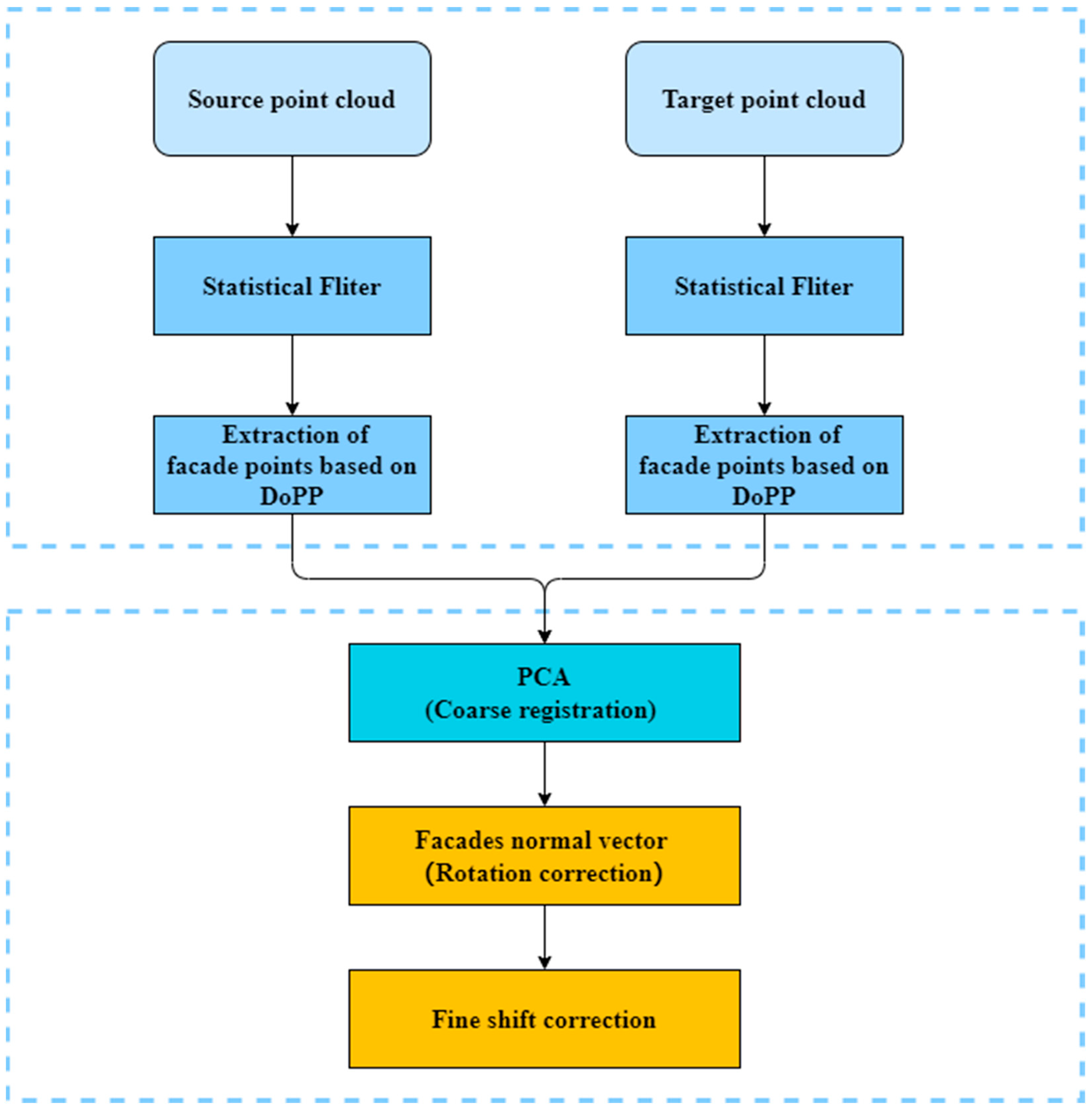
Building reconstruction using high-resolution satellite-based synthetic SAR tomography (TomoSAR) is of great importance in urban planning and city modeling applications. However, since the imaging mode of SAR is side-by-side, the TomoSAR point cloud of a single orbit cannot achieve a complete observation of buildings. It is difficult for existing methods to extract the same features, as well as to use the overlap rate to achieve the alignment of the homologous TomoSAR point cloud and the cross-source TomoSAR point cloud. Therefore, this paper proposes a robust alignment method for TomoSAR point clouds in urban areas. First, noise points and outlier points are filtered by statistical filtering, and density of projection point (DoPP)-based projection is used to extract TomoSAR building point clouds and obtain the facade points for subsequent calculations based on density clustering. Subsequently, coarse alignment of source and target point clouds was performed using principal component analysis (PCA). Lastly, the rotation and translation coefficients were calculated using the angle of the normal vector of the opposite facade of the building and the distance of the outer end of the facade projection. The experimental results verify the feasibility and robustness of the proposed method. For the homologous TomoSAR point cloud, the experimental results show that the average rotation error of the proposed method was less than 0.1°, and the average translation error was less than 0.25 m. The alignment accuracy of the cross-source TomoSAR point cloud was evaluated for the defined angle and distance, whose values were less than 0.2° and 0.25 m.
Keywords: homologous TomoSAR point cloud; cross-source TomoSAR point cloud; the normal vector of the opposite facade; the facade projection homologous TomoSAR point cloud; cross-source TomoSAR point cloud; the normal vector of the opposite facade; the facade projection