Article

Cross-Platform Implementation of an SSVEP-Based BCI for the Control of a 6-DOF Robotic Arm

1
Instituto de Automática e Informática Industrial, Universitat Politècnica de València, 46022 Valencia, Spain
2
Facultad de Ingeniería, Ingeniería Mecatrónica, Universidad Autónoma de Bucaramanga, Bucaramanga 680003, Colombia
*
Author to whom correspondence should be addressed.
Sensors 2022, 22(13), 5000; https://doi.org/10.3390/s22135000
Submission received: 2 May 2022 / Revised: 28 June 2022 / Accepted: 29 June 2022 / Published: 2 July 2022
(This article belongs to the Special Issue Real-Life Wearable EEG-Based BCI: Open Challenges)

Abstract

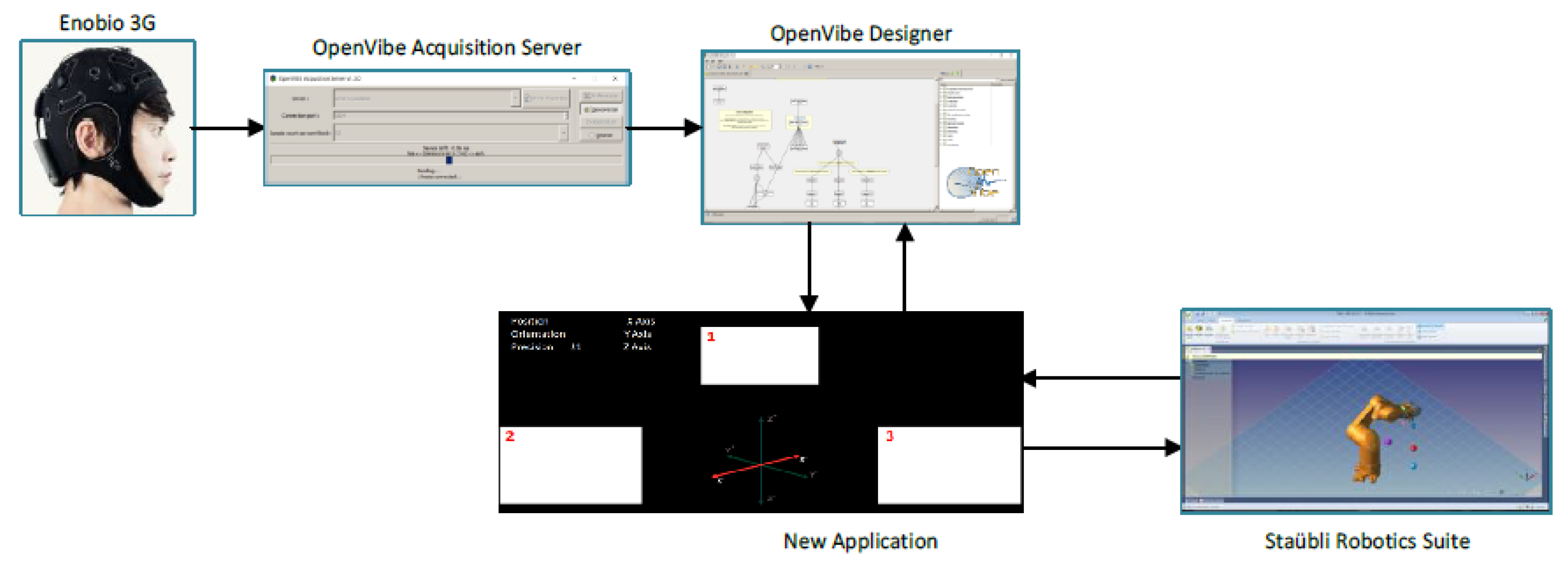
Robotics has been successfully applied in the design of collaborative robots for assistance to people with motor disabilities. However, man-machine interaction is difficult for those who suffer severe motor disabilities. The aim of this study was to test the feasibility of a low-cost robotic arm control system with an EEG-based brain-computer interface (BCI). The BCI system relays on the Steady State Visually Evoked Potentials (SSVEP) paradigm. A cross-platform application was obtained in C++. This C++ platform, together with the open-source software Openvibe was used to control a Stäubli robot arm model TX60. Communication between Openvibe and the robot was carried out through the Virtual Reality Peripheral Network (VRPN) protocol. EEG signals were acquired with the 8-channel Enobio amplifier from Neuroelectrics. For the processing of the EEG signals, Common Spatial Pattern (CSP) filters and a Linear Discriminant Analysis classifier (LDA) were used. Five healthy subjects tried the BCI. This work allowed the communication and integration of a well-known BCI development platform such as Openvibe with the specific control software of a robot arm such as Stäubli TX60 using the VRPN protocol. It can be concluded from this study that it is possible to control the robotic arm with an SSVEP-based BCI with a reduced number of dry electrodes to facilitate the use of the system.
Keywords: brain computer interface (BCI); Electroencephalography (EEG); Steady-State Visually Evoked Potential (SSVEP); robot control; C++ brain computer interface (BCI); Electroencephalography (EEG); Steady-State Visually Evoked Potential (SSVEP); robot control; C++