1. Introduction
The Genetic algorithm (GA) [
1] is a class of bio-inspired algorithms that can produce the optimal or near-optimal solution of complex optimization problems in a reasonable time. It was first proposed by Holland [
2] inspired by Darwin’s principle of survival of the fittest. The possible solution of an optimization problem is encoded in a chromosome which consists of an array of bits called genes. The individual chromosome is evaluated by a fitness function. A genetic population consists of a finite number of chromosomes. The chromosomes of the new population are generated by the application of genetic operations such as crossover, mutation, and reproduction on the present population. The new population optimizes the fitness function and thus provides an improved solution. The solution thus approaches the optimal solution over several generations. There exist many applications of GA viz. optimization [
3,
4], machine learning [
5], neural networks [
6], fuzzy logic controllers [
7], identification [
8], fault diagnosis [
9], and financial market [
10].
As quantum technology emerges as a powerful computational tool, there was an effort to combine quantum computation [
11,
12] with intelligent optimization algorithms. The first attempt to combine quantum mechanics principles and Genetic Algorithm was made by Narayanan and Moore to propose Quantum Genetic Algorithm (QGA) [
13]. QGA is applicable to the category of problems which are solved using conventional genetic algorithm. Moreover, QGA speeds up the computation of genetic evolutionary process by exploiting the power of quantum computation. QGA has higher convergence rate, less execution time, less population size, and strong global search capability [
14,
15,
16]. QGA has been proved to be efficient in solving various kind of problems such as combinatorial and functional optimization problems, engineering optimization problems, image processing and identification, and many others. A few example application can be found in [
14,
17,
18,
19,
20,
21,
22,
23,
24] and many more.
The GA and QGA discussed so far consider the chromosomes as a one-dimensional array. Obviously, these chromosomes cannot represent a possible solution for the problems which naturally have two-dimensional representation. Examples of such problems include Ising problem, Packing problem, Scheduling problem, Optimal topology in Multi-Agent Systems etc. These type of problems were solved using 2D-GA. Ising problem is discussed in [
25]. Ising model is a famous model which is used to study thermodynamic properties, magnetic spin correlations, phase transitions, and many other applications. In general, the problem is to minimize the total energy function for a given matrix
E of interaction energies and external field
H by finding an assignment of the spin variables. Packing problem is discussed in [
26]. The primary purpose of this kind of problems is to obtain a high packing density in two or three dimensions. Examples of such problem are the layout of mechanical and electromechanical components and assemblies, bin packing, and container and car loading. Industries such as transportation, glass, leather Packing etc. require packing as well. 2D-GA can solve the 2D layout or packing problem successfully. In [
27], 2D-GA is implemented to address the scheduling problem. A variety of two-dimensional crossover and mutation operations are presented to generate a new population. The proposed algorithm was applied to solve the aircraft scheduling problem. In [
28], a genetic algorithm with a multidimensional chromosome is used to describe nodes belonging to multiple communities in dense overlapping communities. Another critical and new application of 2D-GA is found in [
29,
30]. The objective of this paper is to obtain an optimal communication topology to achieve consensus among agents such that the consensus control energy of the agents is minimized.
Although 2D-GA solves the problems with 2D representation, it does not inherit the computation power such as QGA. Keeping this in mind, the two-dimensional-QGA (2D-QGA) is proposed in this paper to solve the 2D problems. The genetic evolutionary processes in 2D-QGA inherit the power of quantum computation to solve the 2D problems with higher convergence rate, less execution time, and less population size. In the algorithm, the two-dimensional quantum population is generated, and two new Qgate rotation processes (named ‘type-I’ and ‘type-II’) are proposed to generate the new population for the next generation. The proposed algorithm is applied to solve the Multi-robot task allocation problem, which can be represented in two dimensions. The 2D-QGA and 2D-GA are compared based on execution time, iteration, and population size. Performance of 2D-QGA is found to be better compared to 2D-GA.
The contributions of this work are given below:
A novel 2D-QGA is proposed in this paper, which is a new algorithm in GA family. Thus, the power of quantum computation can be used to solve problems having two-dimensional representation. The quantum computation speeds up the computation and delivers optimal results in less time with a smaller population size.
New Qgate rotation technique for 2D chromosomes is proposed in this work. This Qgate is the key factor to speed up the computation in 2D-QGA.
The proposed algorithm is implemented to multi-robot task allocation problem, which has the two-dimensional form and it is egarded as NP-hard.
A detailed analysis of the convergence time, iteration, cost, execution time of 2D-QGA is discussed. It also includes a detailed comparison with existing 2D-GA.
The rest of the paper is organized as follows. In
Section 2, details of QGA is presented, which is the preliminary for two-dimensional QGA. In
Section 3, 2D-QGA is introduced. An application of the algorithm is shown in
Section 4. The comparison study is presented in
Section 5. A brief conclusion is given in
Section 6.
2. Quantum Genetic Algorithm (QGA)
In this section, the Quantum Genetic Algorithm is discussed, which is the preliminary for two-dimensional QGA. In quantum computation, independent states can be represented using m qubits. However, during the measurement of the qubits, a single state of the quantum state (i.e., or ) is obtained, which is similar to a conventional genetic algorithm, i.e., a chromosome’s representation is defined as a string of m information units.
2.1. Qubit Representation
Qubit is the basic unit of information used in quantum computations. In a quantum system, the basic state is not deterministic; i.e., it does not have a fixed value. The basic state maybe
,
, or any complex value which is a linear combination or superposition of basis states. A qubit is represented in Equation (
1) as
where
and
are complex numbers which signify the magnitude of left and right vector respectively.
and
satisfy the condition given in Equation (
2).
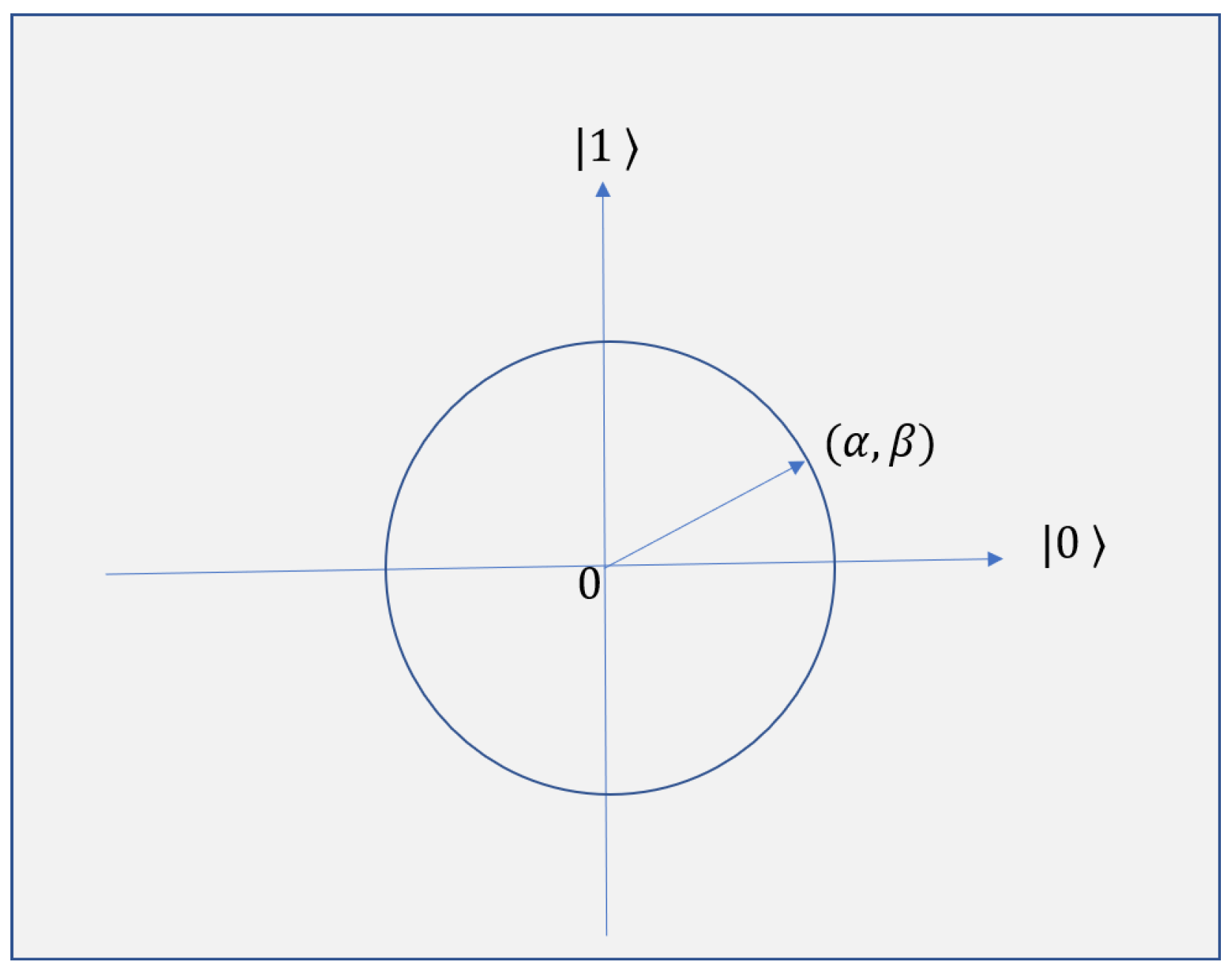
and
provide the probabilities that the qubit can be found in the ‘0’ state and ‘1’ state, respectively. The pictorial representation of qubit is given in
Figure 1.
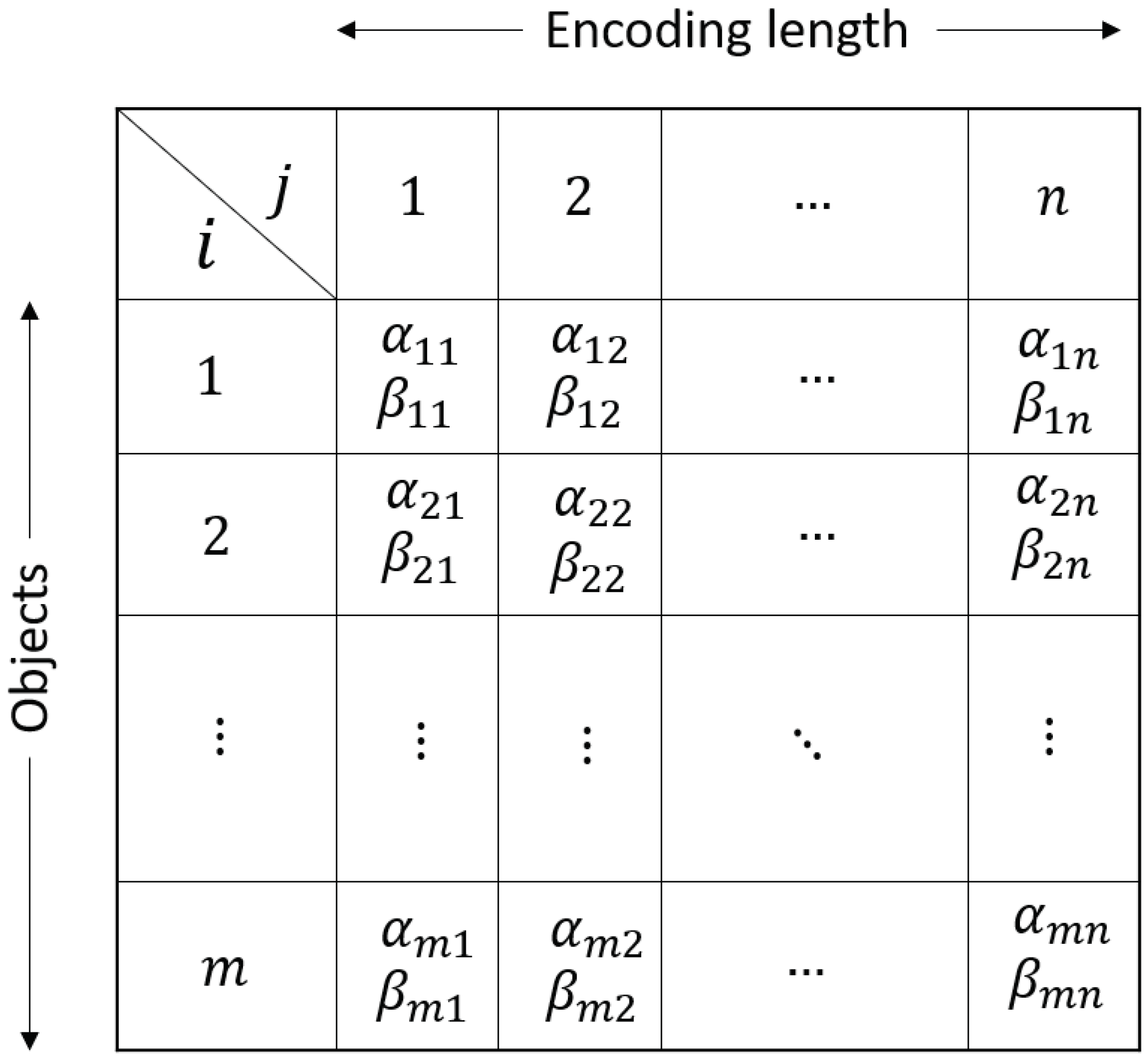
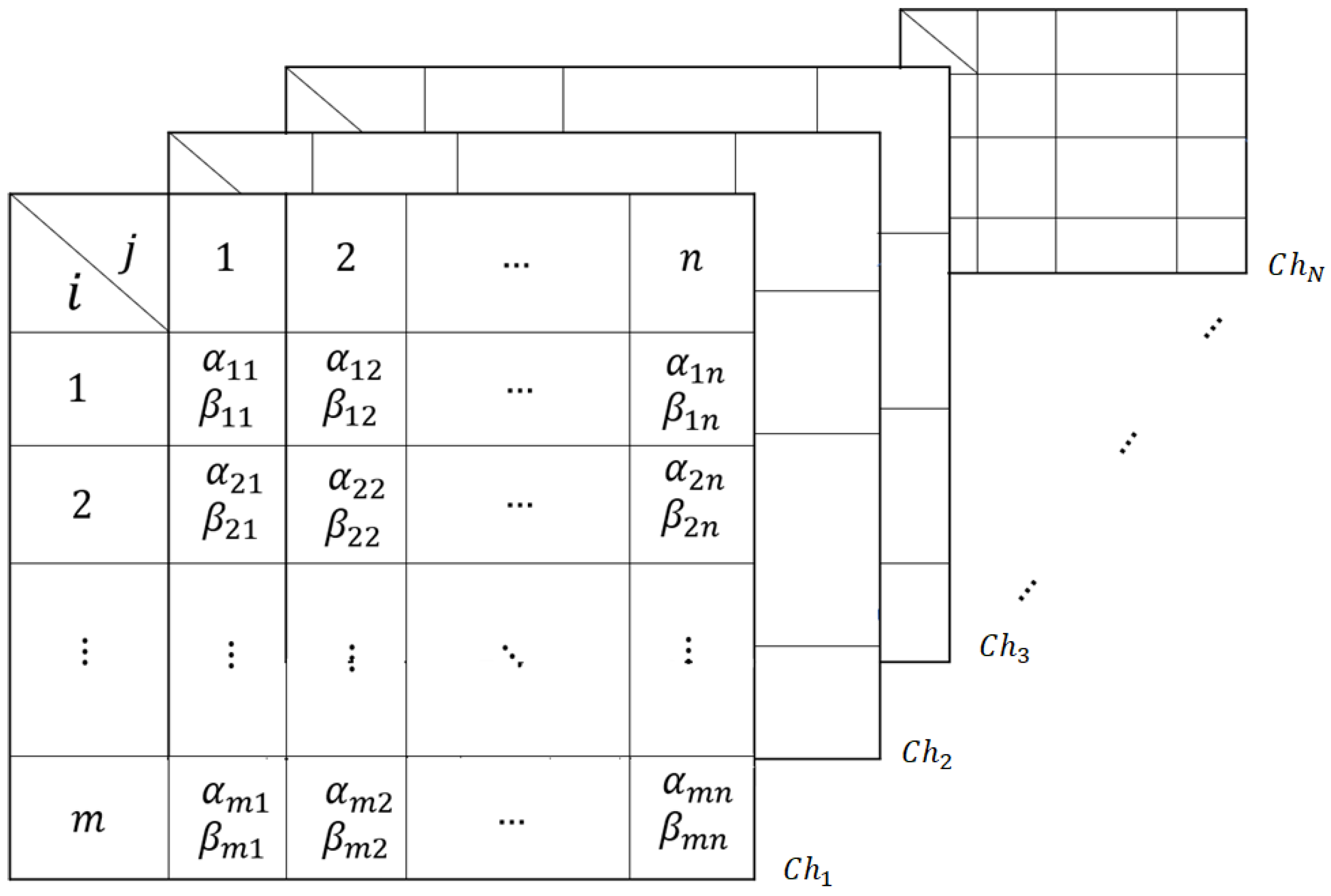
A chromosome is represented by a string of qubits (given in Equation (
3)). The encoding length of the chromosome is
n.
where
. The genes are represented by each pair of
,
. In the next section Qgate rotation which is used to obtain new generation in QGA is discussed.
2.2. Quantum Gate Rotation (Qgate)
The operation for changing the state of the qubit is known as the quantum gate or Qgate. There exist several quantum gates. Examples of such gates are Not gate, controlled-NOT gate, rotation gate, Hadamard gate etc. One of the widely used gates is the rotation gate which is described as follows.
The rotation gate is operated on the present population to obtain the new one. It helps to maintain the diversity of the population, which is a key updating operation in quantum evolution algorithm. Rotation gate
is employed to update the probability amplitude of quantum states. The
ith qubit
is updated as follows.
where
where
T is a rotation matrix and
is rotation angle.
is the sign of
and it determines the rotation direction.
is the amount of rotation. The rotation sign and magnitude is determined in a look-up table which is shown in
Table 1.
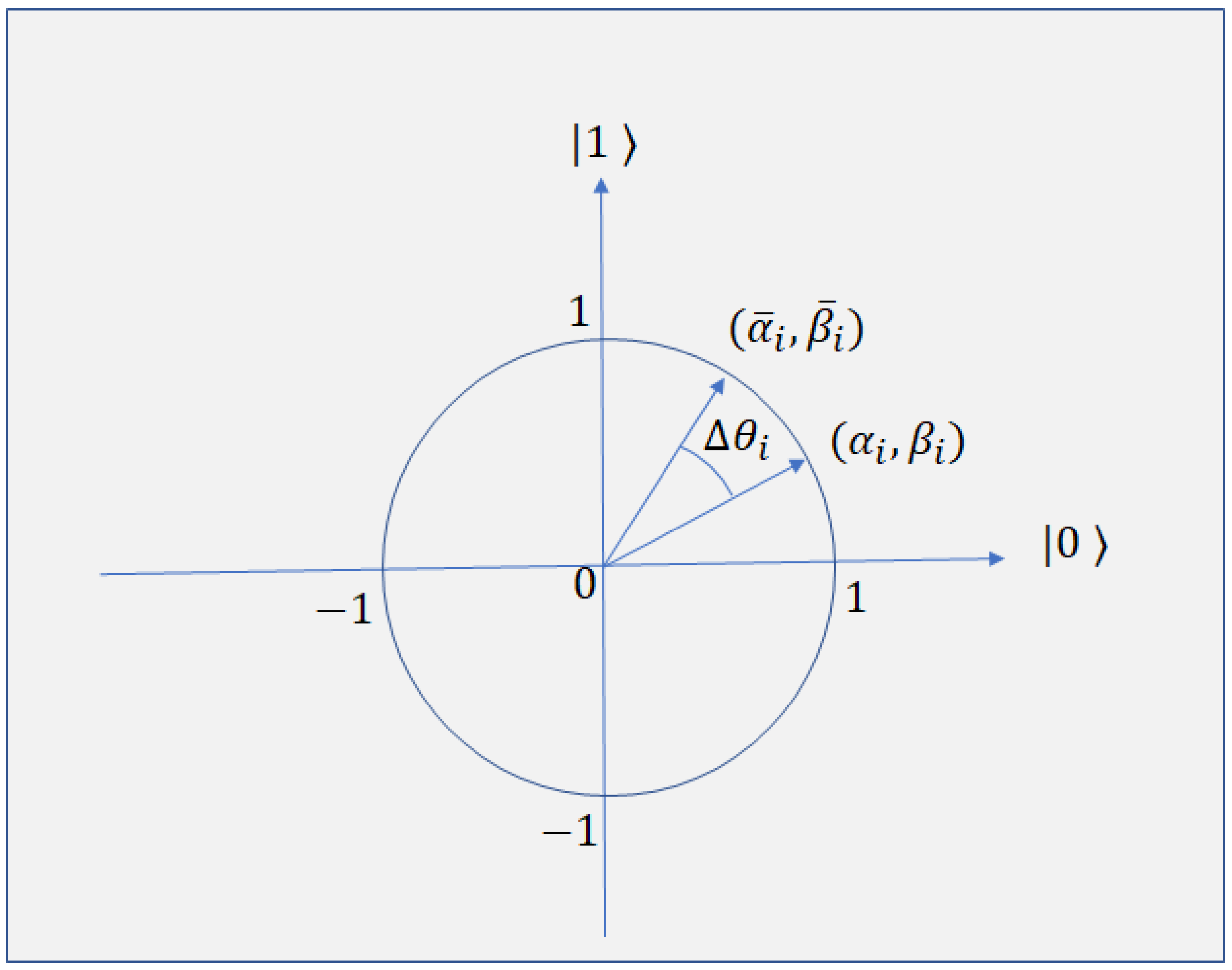
The rotation gate for qubit individuals in a polar plot is shown in
Figure 2. The solution
of current generation is rotated by an angle of
anticlockwise to obtain possible best solution
.
corresponds to the binary code of individual chromosome i. The binary code corresponding to the best individual is and denotes the fitness function to find the fitness value. signifies that they lie in the first or third quadrant. If then the individual i lies in the second or fourth quadrant. If the combination is 0-1, set the rotation angle to be . If the combination is similar, i.e., 0-0 and 1-1, select a smaller rotation of angle . If it is not possible to determine specific quadrant, then rotation is not preferred.
2.3. Initial Population Generation
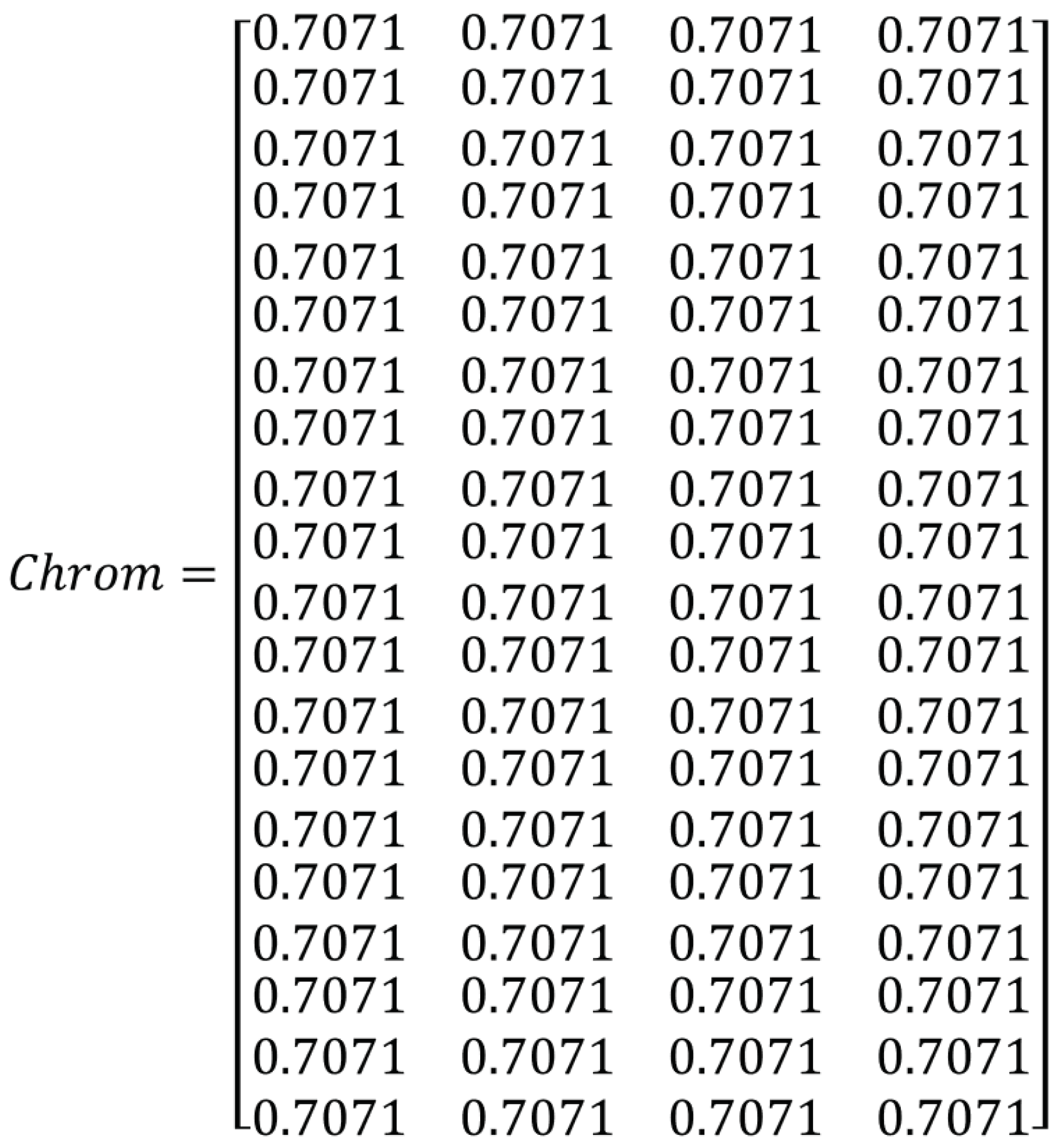
The qubits present in the initial population have equal probability to be in the state of
and
. For such case,
and
, i.e.,
. The chromosomes have string of such
and
. The encoding length of the chromosome is
n and the population size is
N. The algorithm for generation population is given in Algorithm 1.
| Algorithm 1 Initial population of quantum chromosomes |
for to N do
for to n do
for
for
end for
end for |
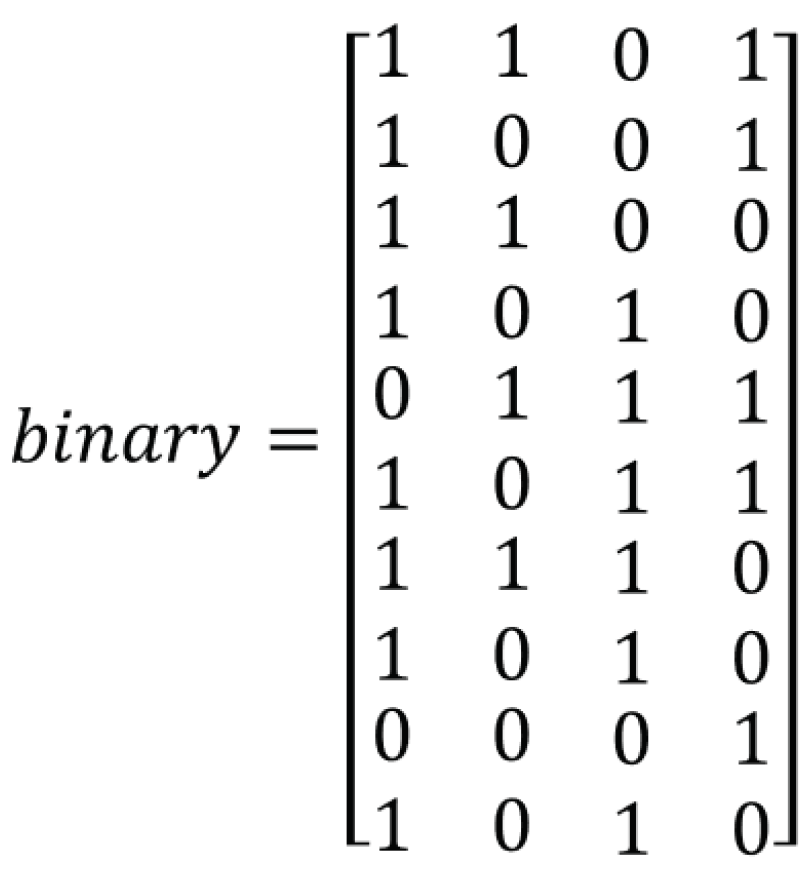
2.4. Generate Binary String by Measuring Quantum Chromosome
The function for measuring the quantum chromosome
is shown in Algorithm 2. In this algorithm, a random number
is generated by MATLAB function
and it is compared to each
(denoted as
) of the chromosome.
| Algorithm 2 Initial population of quantum chromosome |
for to N do
for to n do
if then
else
end if
end for
end for |
If the the th element of a temporary matrix B is assigned as 0; otherwise assigned as 1. This matrix B is stacked in a 3D matrix .
2.5. QGA Algorithm
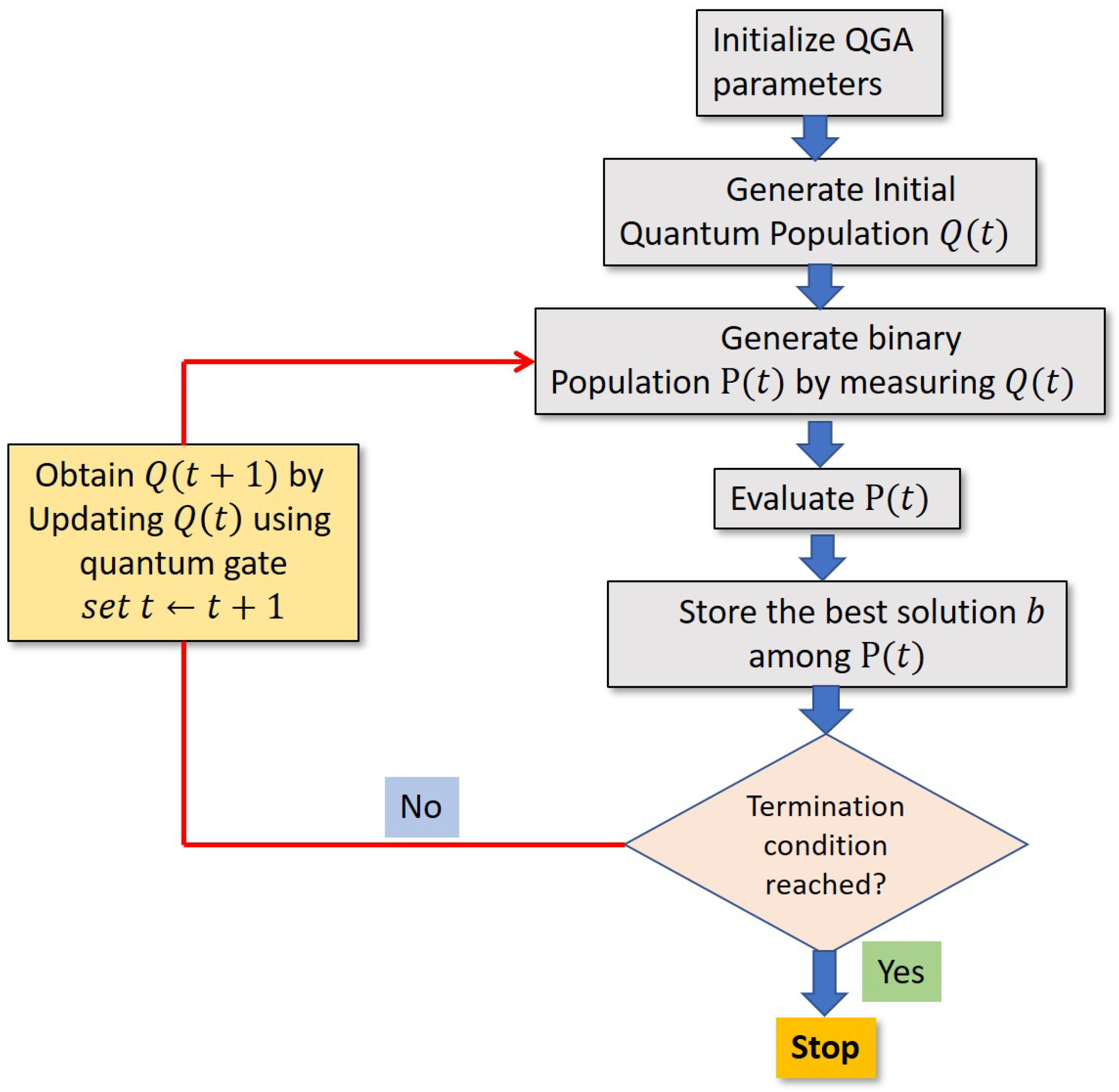
For better understanding, the QGA algorithm is shown in Algorithm 3. It includes the operations for QGA which are described so far.
| Algorithm 3 QGA algorithm |
Initialize QGA parameters
Generate initial quantum population
for to N do
Generate binary initial population
Store the best solution b among
if converged then
Stop
else
Obtain by updating using Qgate
Set
end if
end for |
4. Application to Task Allocation Problem
The problems which naturally have two-dimensional representation can be solved using 2D-QGA, which considers 2D quantum chromosome as a probable solution. It can be mentioned that the task assignment problem can be represented in two-dimension. In this paper, we will study the implementation of 2D-QGA to solve task assignment problem. It is important to note that the problem considered here is for demonstration purpose. The main focus of the work is to show the implementation of the algorithm to such a problem. The assumptions made for this problem are given as follows.
Each drone can perform one task at a time i.e., each drone is assigned to one task at a time.
At least one drone is required to finish each task
All drones should be assigned with a task
The task and drone positions are known
The problem is formulated considering these assumptions and given in the following section.
4.1. Problem Formulation
The set of task
T is denoted by
, where
is the number of tasks. These tasks are considered to be scattered in a field of specific length and width. The set of drones
D is denoted by
, where number of drones are denoted by
. The number of drones (
) is higher than the number of tasks (
), i.e.,
. The allocation problem is given as follows.
Equations (
6)–(
8) defines a constrained optimization problem. The constraints in Equations (
7) and (
8) signifies the assumptions 1–3. The variable
is the distance between
ith drone and
jth task.
is a binary variable which takes a value of 1 if
ith drone is assigned to
jth task, i.e.,
, otherwise
. This cost function is purely distance-based. The objective of the cost function is to minimize the overall distance between the drones and task positions i.e., assign tasks to the drones depending on their distance from them.
4.2. Simulation Study
The simulation study is performed considering ten drones (i.e., ; ) and four tasks (i.e., ; ). It can be mentioned that, this is an example problem. The user can increase the problem size as per the requirement. The task and drones positions are generated in a random manner in an area of length 1000 m and width 100 m using the MATLAB command ‘randi’. The task allocation problem has been solved using both types of 2D-QGA, i.e., type-I and II. The simulation is performed on a PC with AMD Ryzen5 ( GHz) processor and 8 Gb RAM. The results obtained using the proposed algorithm are discussed in the following sections.
4.2.1. Results Obtained Using 2D-QGA with Qgate Type-I
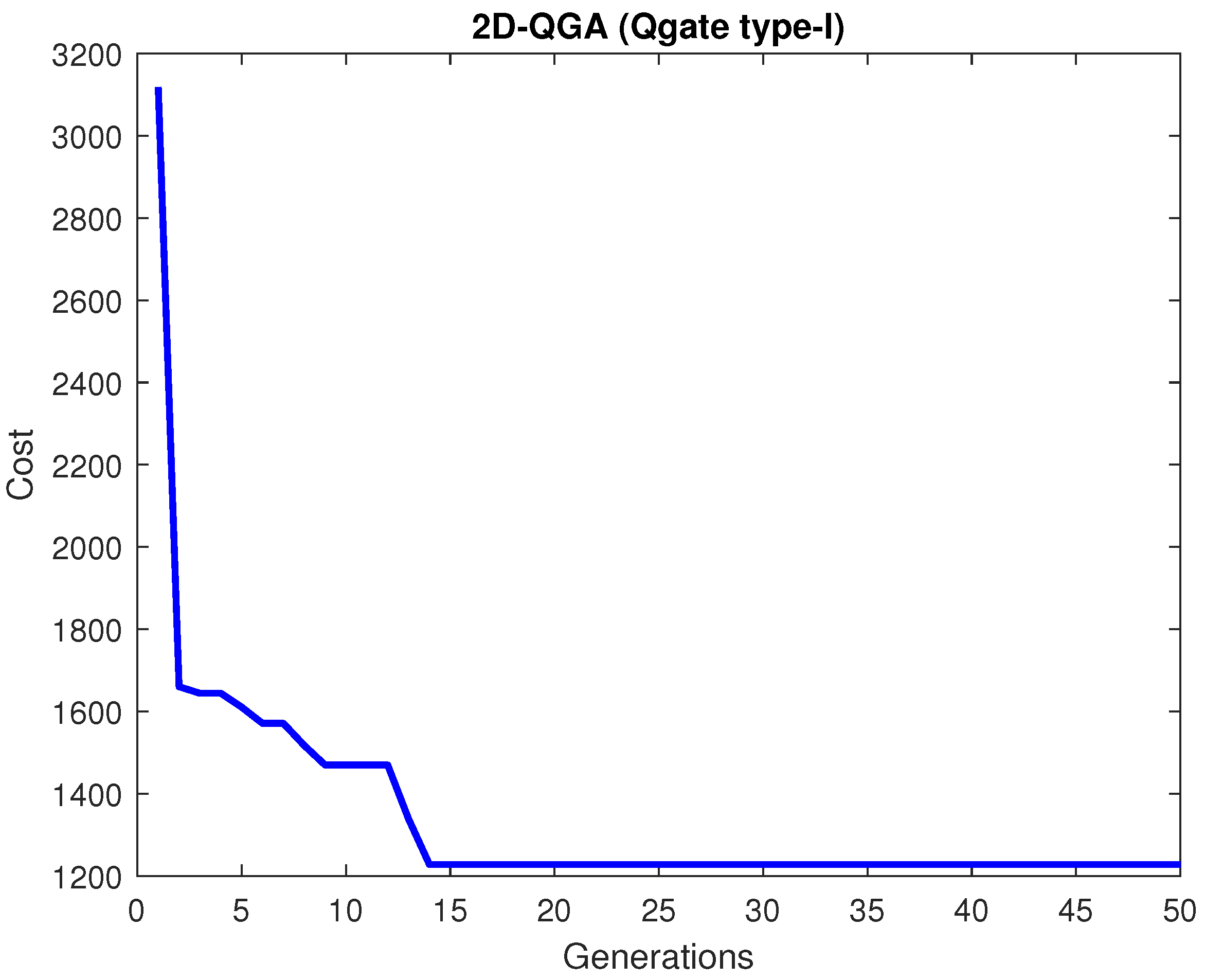
The results generated using 2D-QGA with Qgate type-I is shown here. The algorithm is executed for fifty generations. The cost (
J) generated for all generations is shown in
Figure 8.
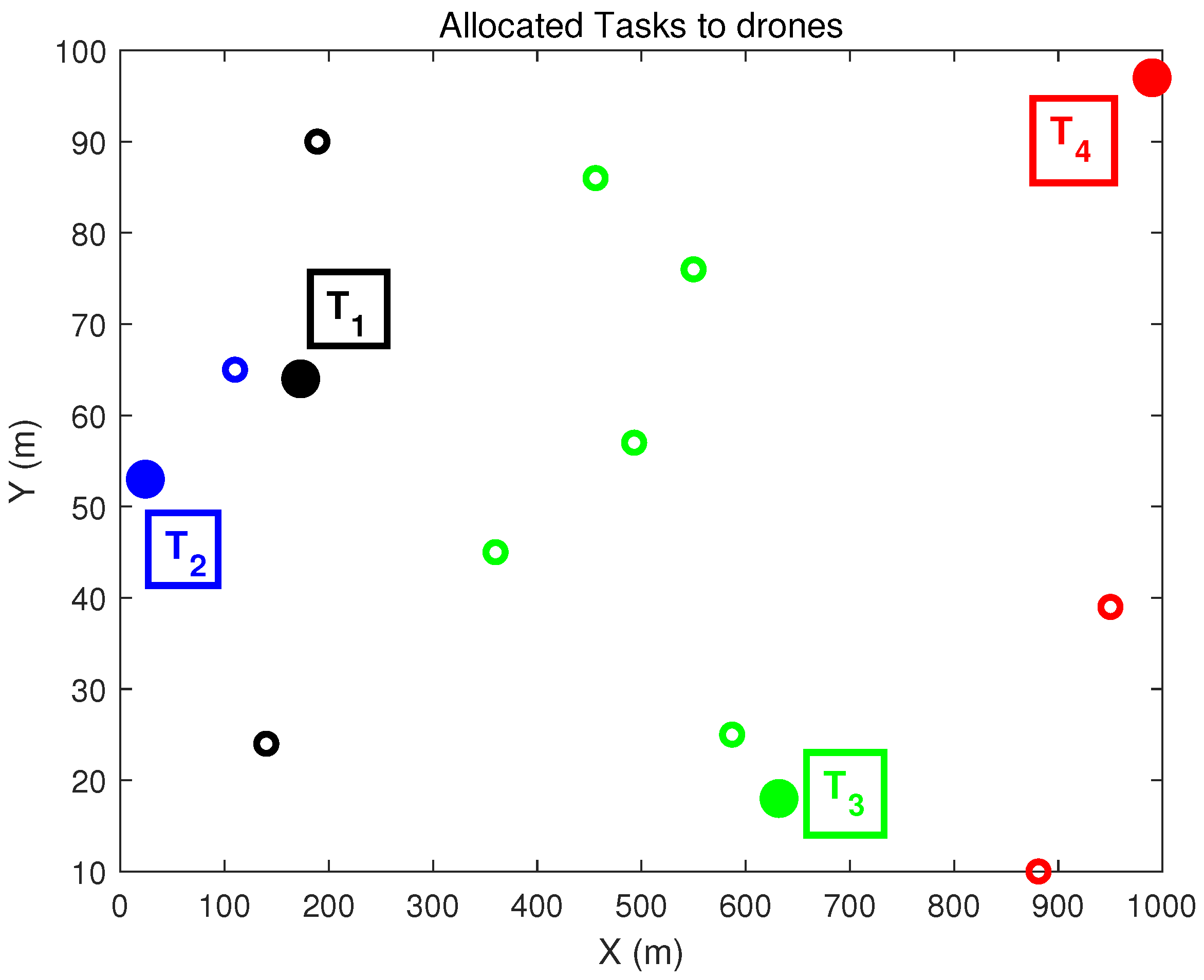
The algorithm has converged in fourteen generations to achieve minimum cost. The assignment matrix (optimal solution) is a 2D chromosome. This chromosome shows the optimal assignment of drones to the tasks, as shown in
Figure 9. A particular task and the drones assigned to that task are marked with the same colour. The tasks
are shown in solid circles, and the drones are shown as empty circles.
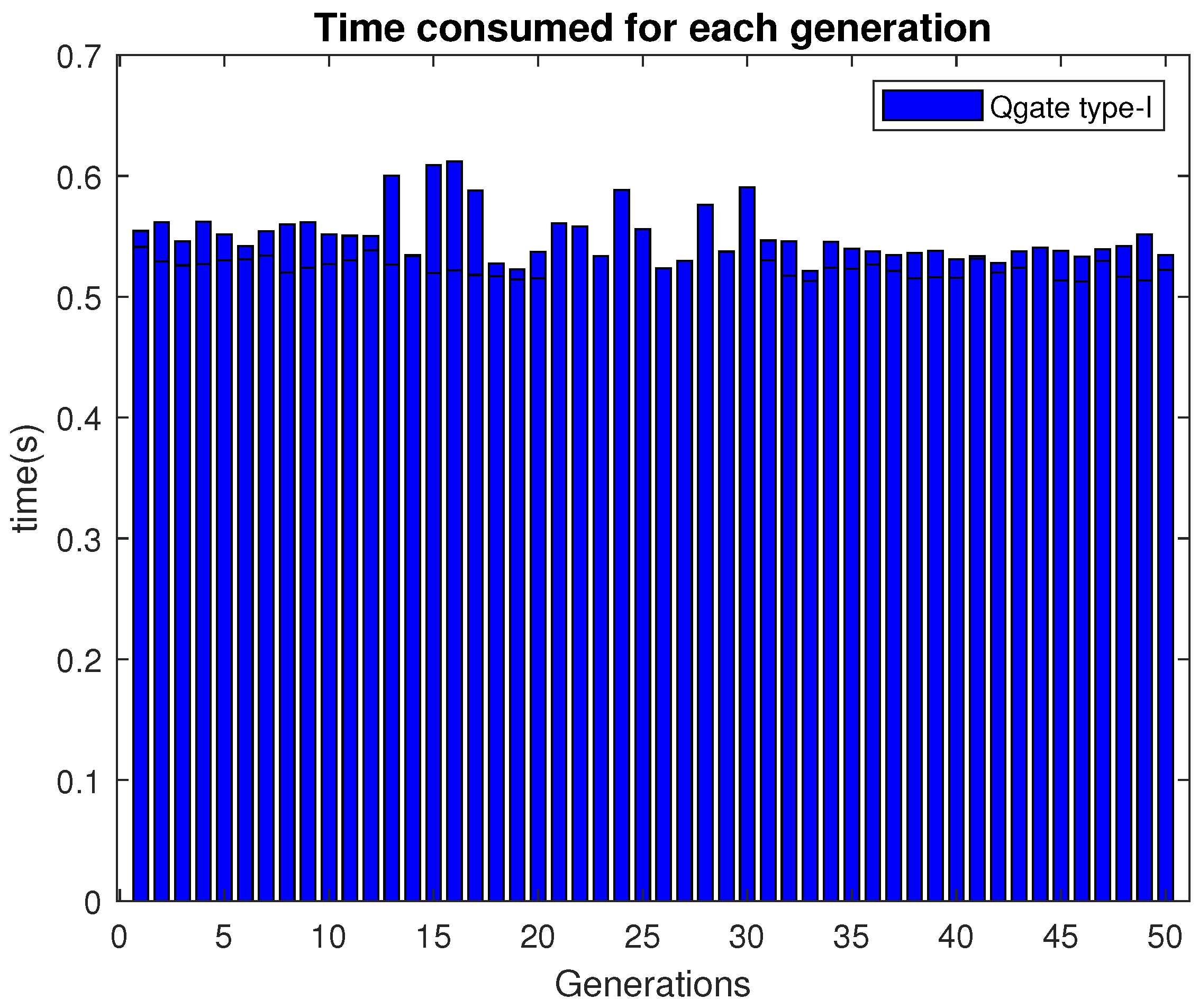
It can be noticed that each drone is assigned to one task. At least one drone is allocated to execute each task. Therefore the constraints are satisfied. The time consumed to execute each generation is shown in
Figure 10. It can be observed that most of the generation consumed around
s.
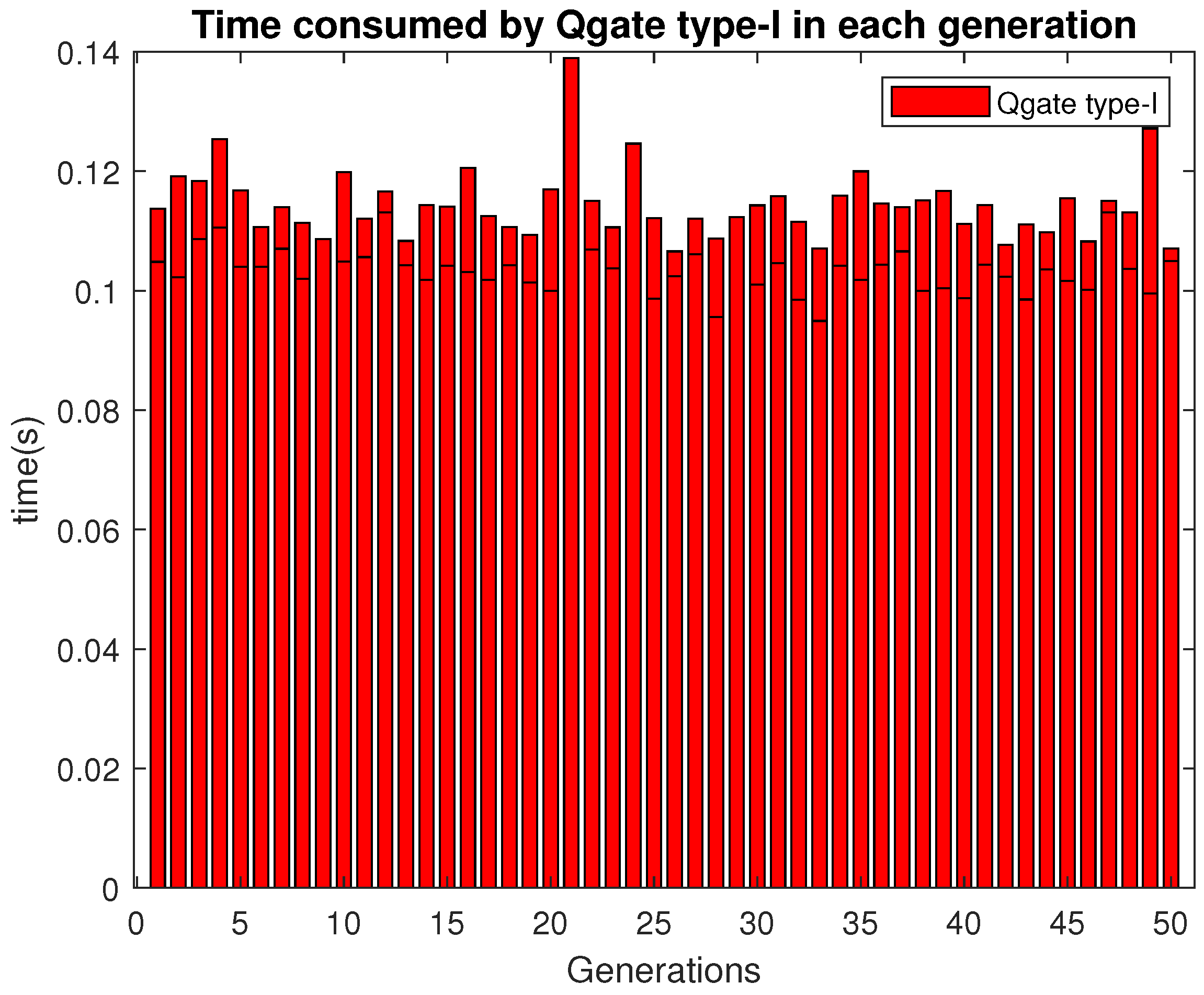
The Qgate type-I consumes around
s in most of the generations as shown in
Figure 11.
4.2.2. Results Obtained Using 2D-QGA with Qgate Type-II
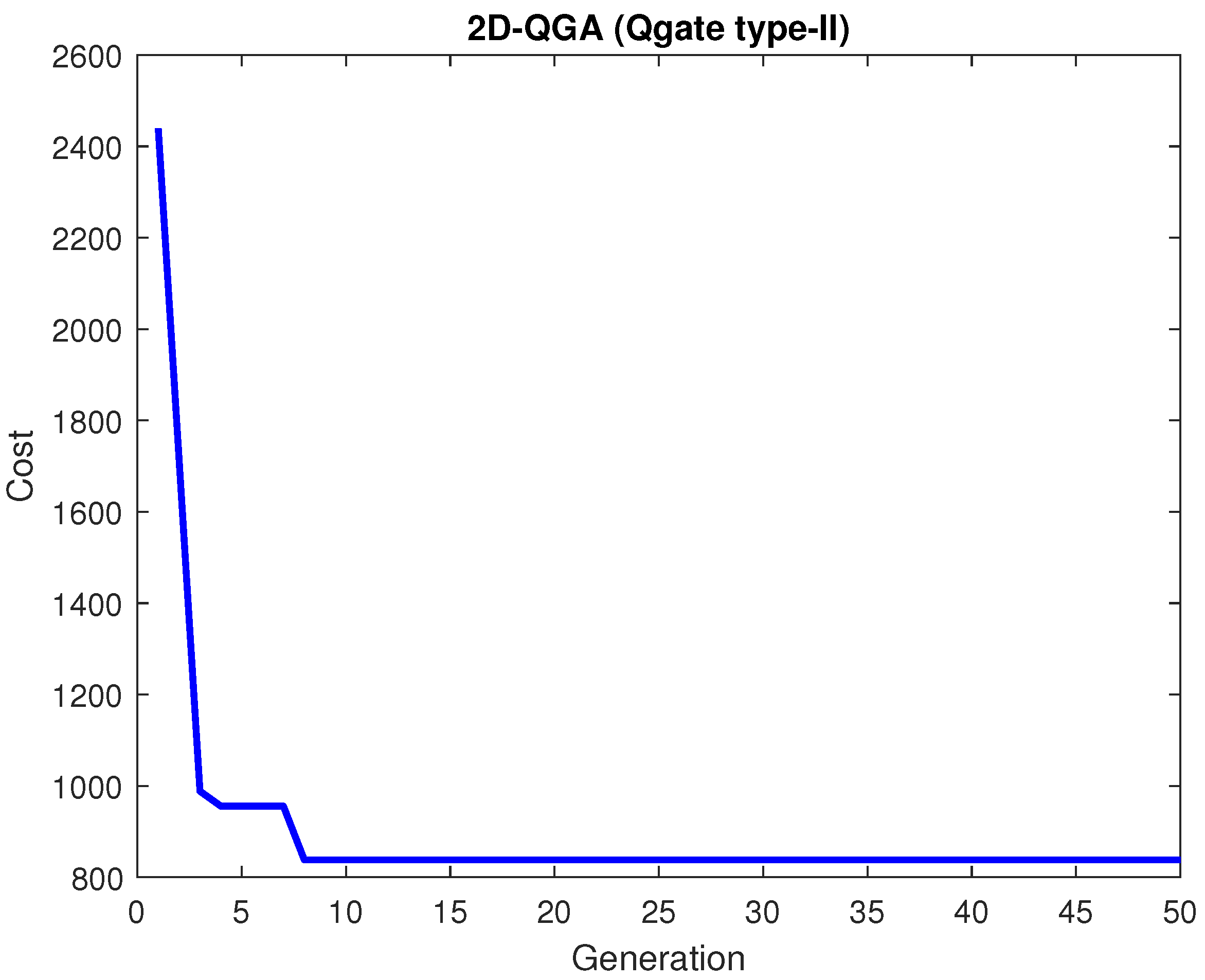
In this case, a different set of task and drone positions are generated. The results are generated using 2D-QGA with Qgate type-II. The cost for all generations is shown in
Figure 12. The algorithm converged in 8 generations to produce minimum cost.
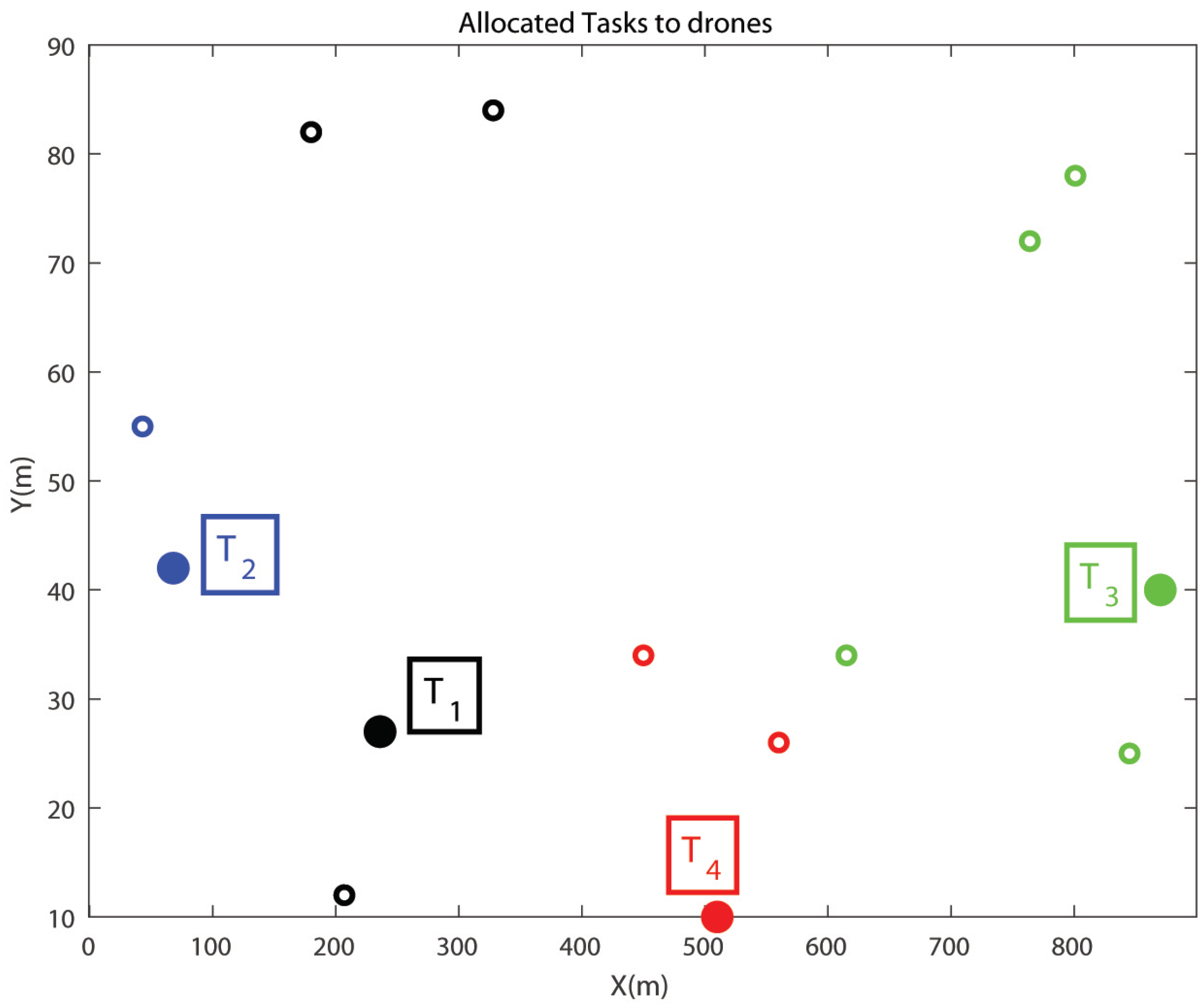
The task allocation to the drones is shown in
Figure 13. The tasks
and the drones assigned to the tasks are shown in the same colour as described in the previous case. Also, the tasks are shown in solid circles and drones in empty circles.
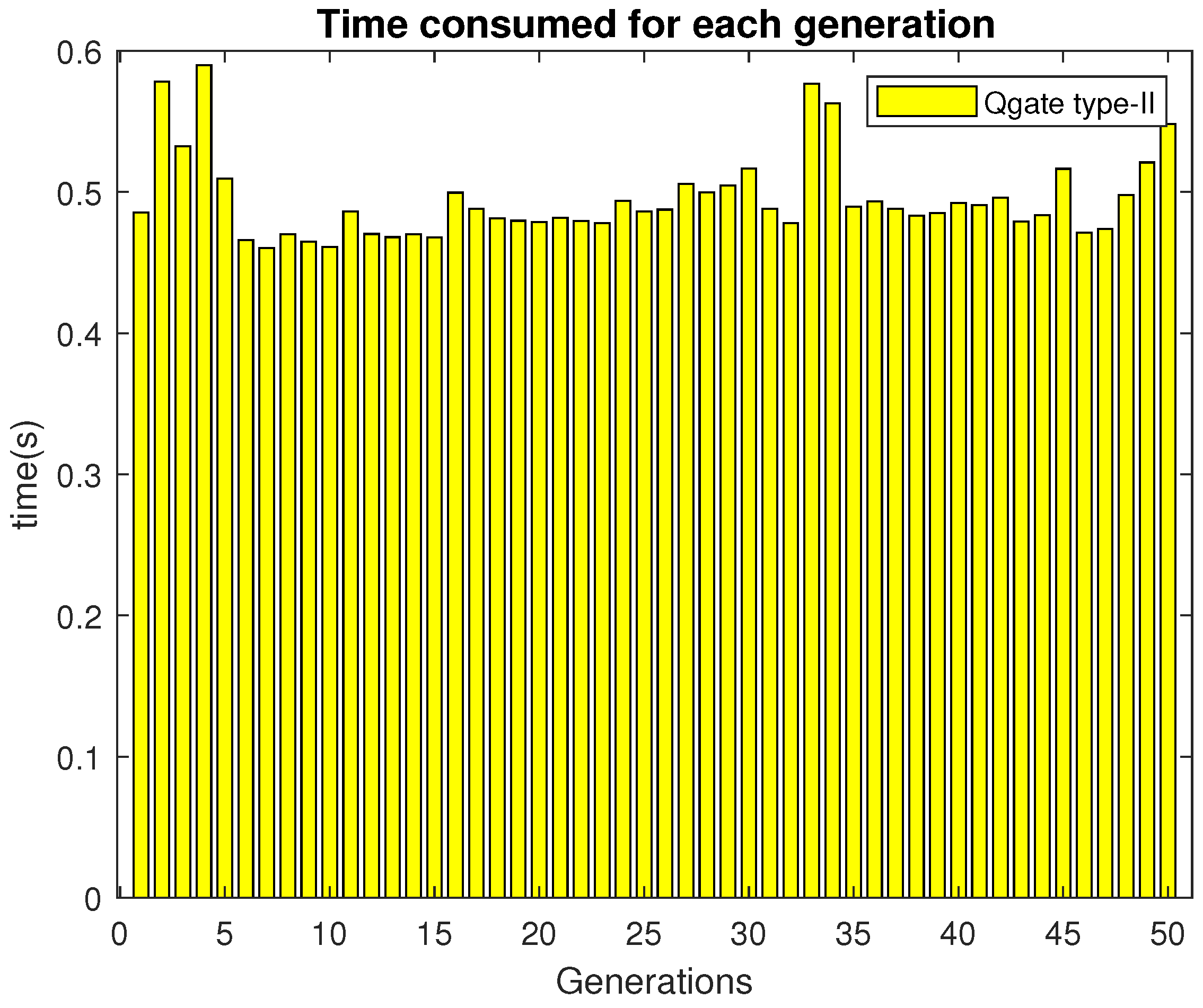
Each drone is assigned to one task, and each task is allocated at least one drone. Therefore, the constraints are satisfied by the 2D-QGA type-II. The time consumed to execute each generation is shown in
Figure 14.
It can be observed that most of the generation consumed around s.
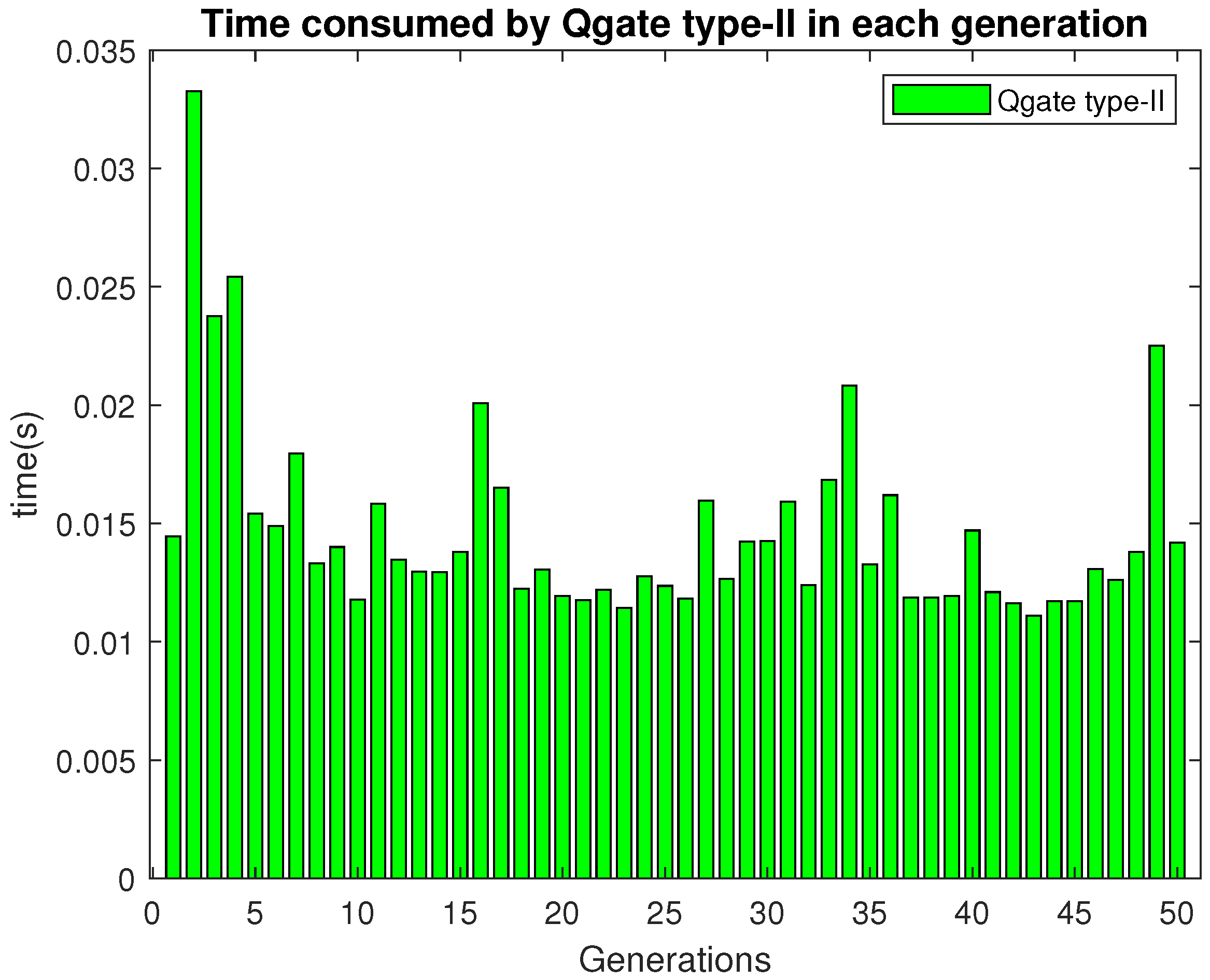
The time to execute Qgate type-II in each generation is shown in
Figure 15. In most of the generations, Qgate type-II needs around 0.011–0.014 s for execution.
The results generated using the proposed 2D-QGA algorithms (type-I and II) are discussed individually. However, the effect of quantum computation in 2D-QGA should be evaluated. The appropriate way should be to compare 2D-QGA with an algorithm which solves similar problems. It has been discussed in the introduction section that 2D-GA can solve the problems with two-dimensional representation. Therefore, the performance of 2D-QGA is compared to 2D-GA when they are used to solve the task allocation problem. The results obtained are discussed in the following section.
5. Comparison Study
The whole study is divided into three parts. In each part, two algorithms among 2D-GA, 2D-QGA type-I, and 2D-QGA type-II are compared. In the first part, the comparison between 2D-GA and 2D-QGA type-I is presented. In the second part, 2D-GA and 2D-QGA type-II are compared, and in the last part 2D-QGA, type-I and II are compared. The algorithms of each part are executed to solve the task allocation problem. It can be mentioned that the task and drone positions remain identical for each part. The comparison is performed by executing the pair of algorithms of each part for a finite number of iterations. In this study, the number of iterations considered to be 50. The general structure of the iteration is shown in Algorithm 8. In the algorithm, the iteration number
N is set as 50, but the user can select a different number.
| Algorithm 8 Iteration for each part |
for to N do
Execute 1 of each part
Execute 2 of each part
end for |
In each iteration, the algorithms are allowed to evolve for fifty generations. The comparison between algorithms in each part is based on the points as follows.
Average time consumed (execution time) per generation by each algorithm of each pair. It is measured by
This is an important measure because it gives quantitative feeling about how each generation is evolving for each algorithm.
The percentage of iteration each algorithm of a pair converges in fewer generations. This measure shows how many times (or %) in a specific number of iterations one algorithm converges in fewer iterations compared to another one.
The percentage of iteration one algorithm of a pair takes less time compared to the other one. This is the time consumed by each algorithm of a pair to execute the maximum number of generation in one iteration.
The percentage of iteration one algorithm of a pair produces less cost compared to the other one.
These measures are essential to understand the importance of the features that 2D-QGA has. The results obtained for each part is discussed in the following sections.
5.1. Part 1: Comparison between 2D-GA and 2D-QGA Type-I
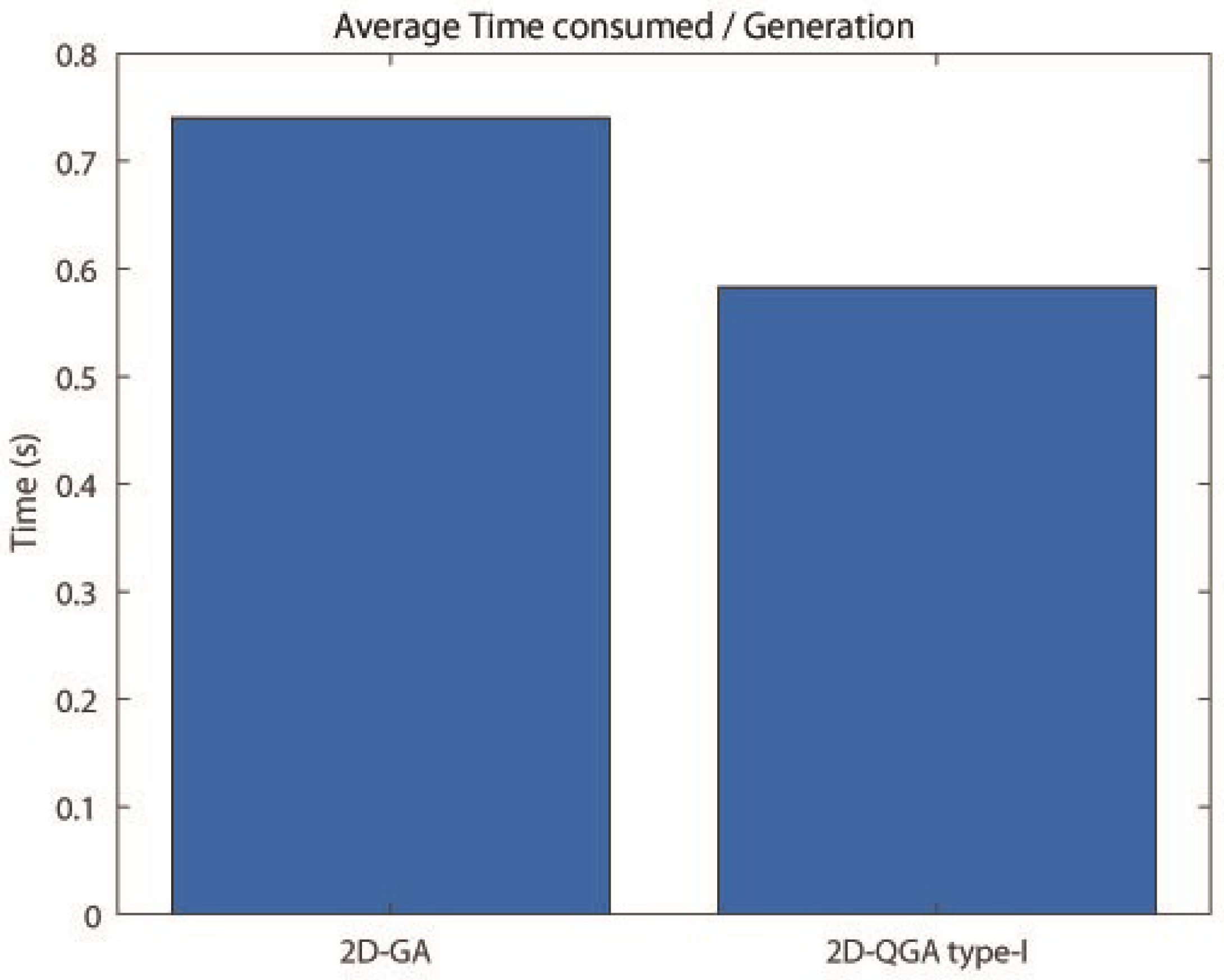
The comparison between 2D-GA and 2D-QGA type-I is given in this section. The population size of both 2D-GA and 2D-QGA type-I is considered to be 2000. The first comparison is about ‘Average time consumed’ by these algorithms. The comparison result is shown in
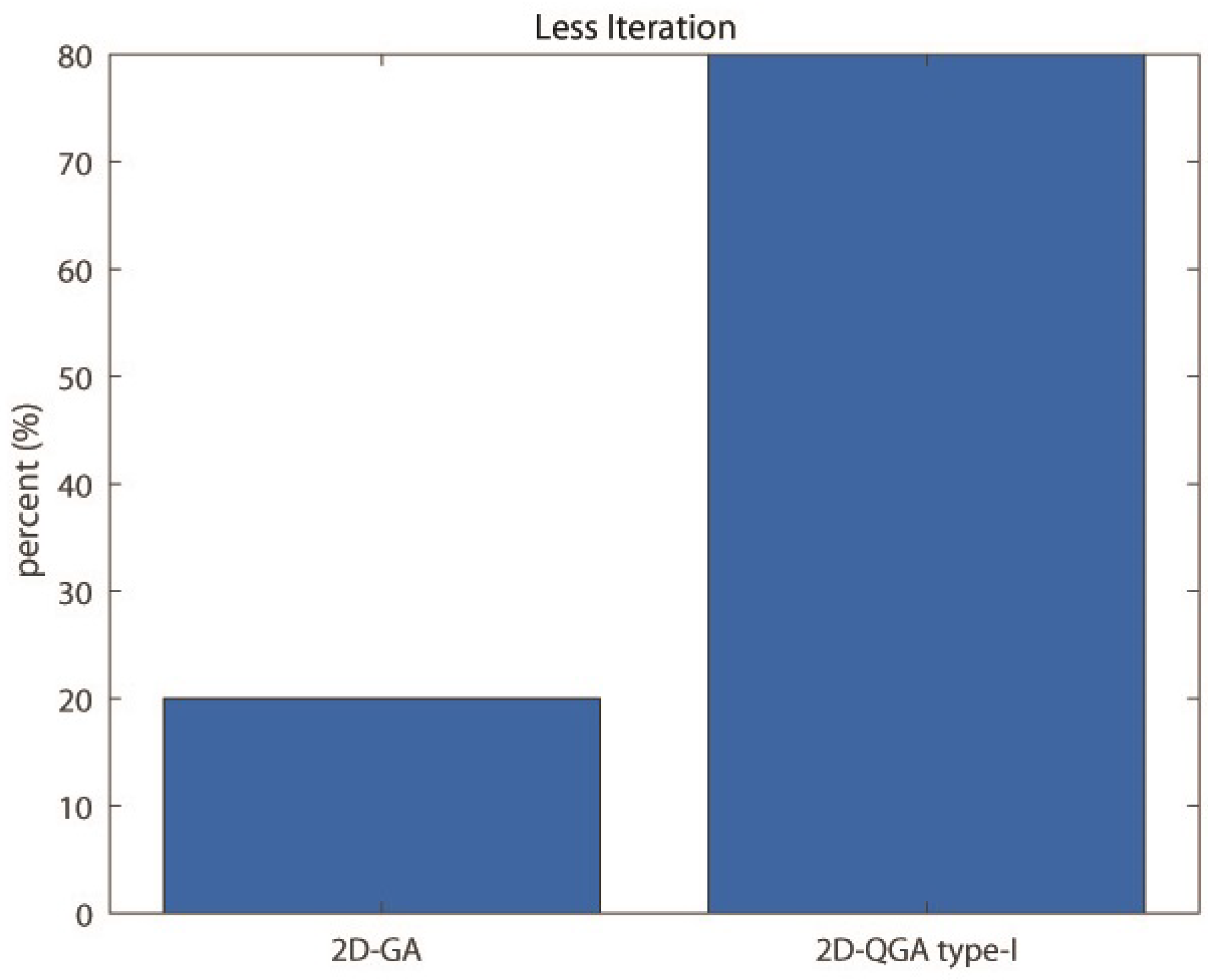
Figure 16. It can be observed that 2D-GA consumed more time to execute each generation compared to 2D-QGA type-I. The operations involved in each generation for 2D-QGA type-I are designed by quantum computation. The next comparison is about the percentage of iteration the algorithms take fewer generations for convergence. The comparison is shown in
Figure 17. It can be observed that
of iterations the 2D-QGA type-I takes fewer generations to converge.
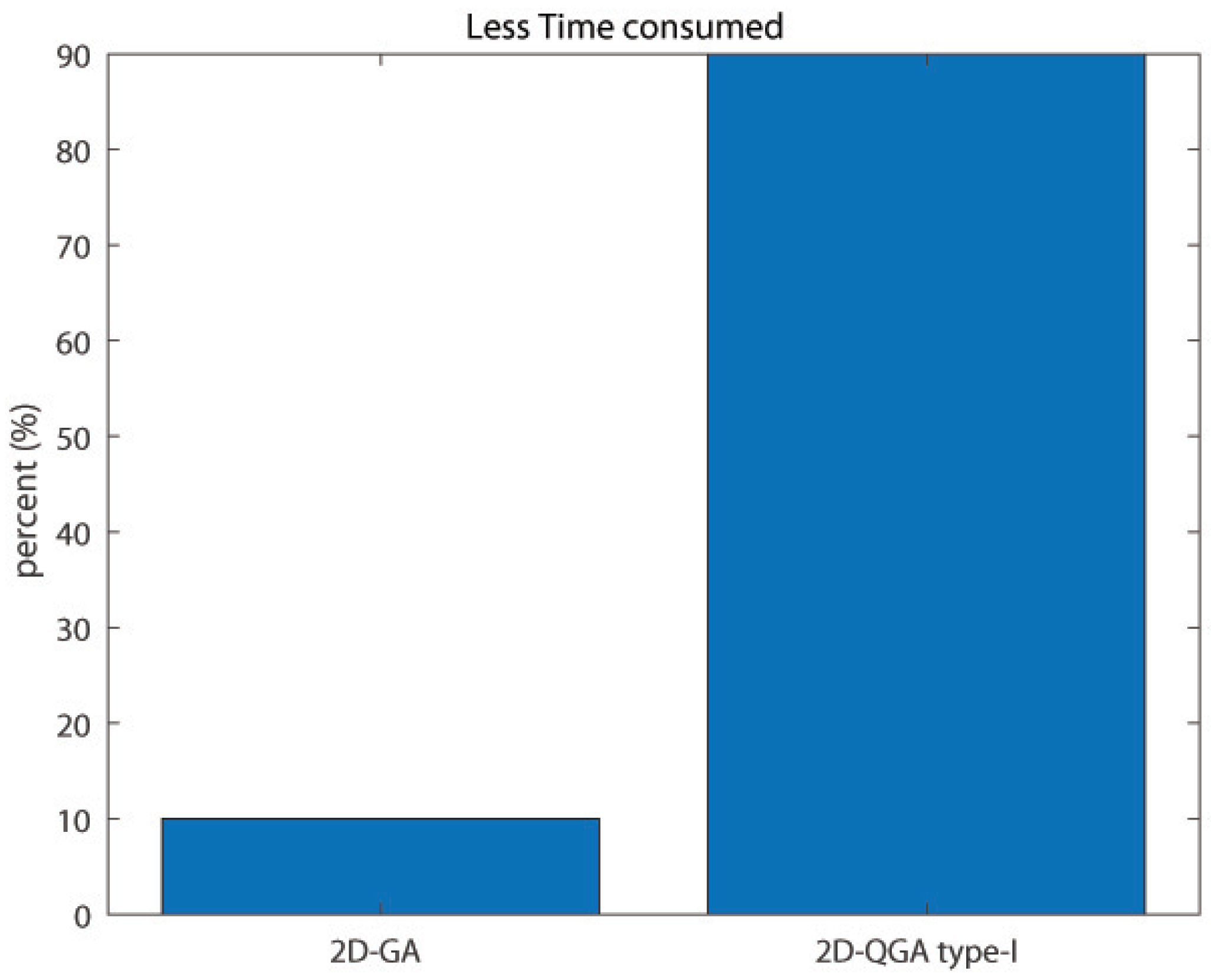
Another important comparison is the total time taken by the algorithms to execute an equal number of generations. The result obtained is shown in
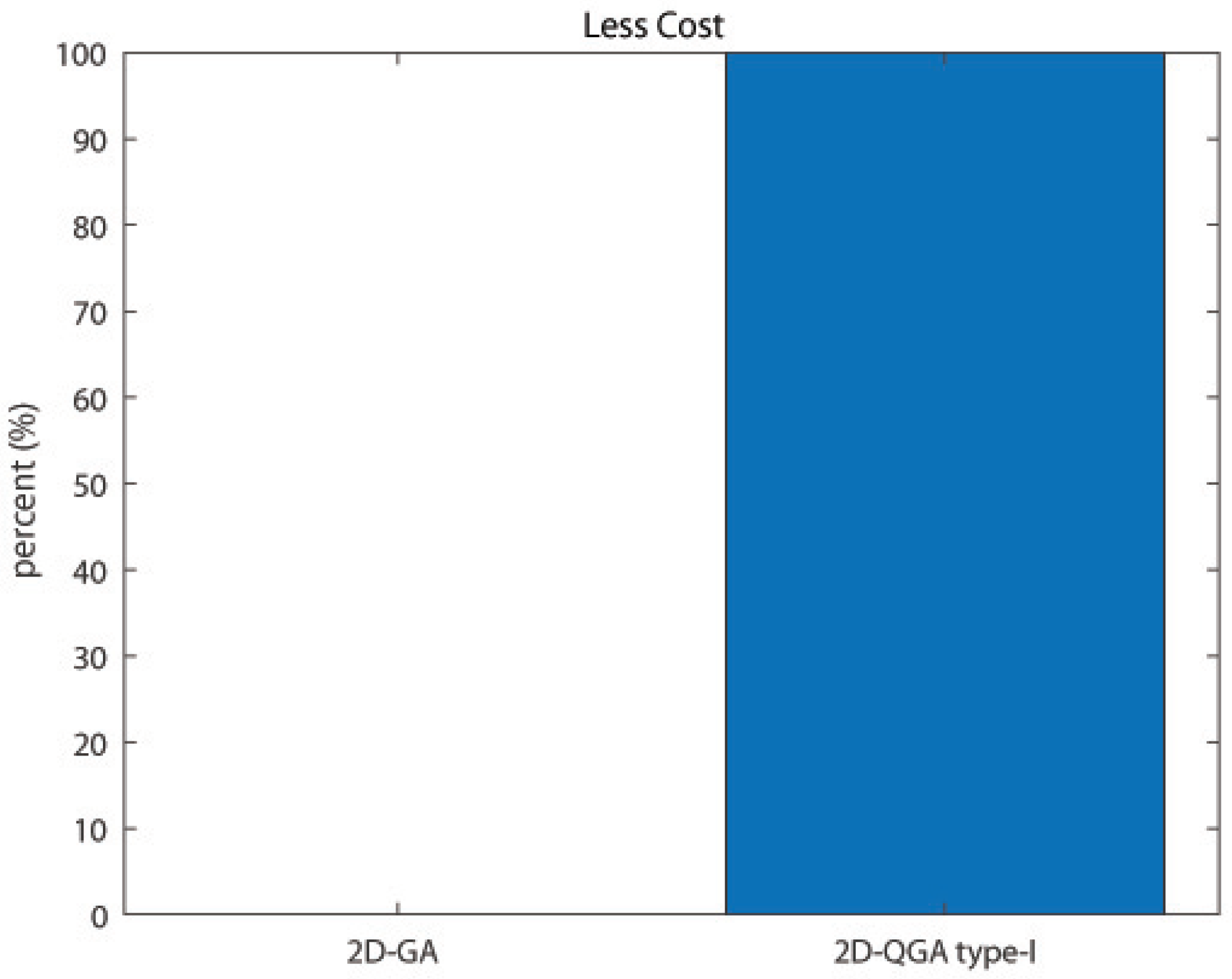
Figure 18. It can be noticed that 2D-QGA type-I need lees execution time for all the iterations. The last and one of the most important comparison is the percentage of iterations the algorithms produce less cost. 2D-QGA type-I produces less cost for
of the iterations, as shown in
Figure 19. The comparison is summarized in
Table 2.
In this study, it is clear that 2D-QGA type-I is more efficient compared to 2D-GA. In the following section, the comparison between 2D-GA and 2D-QGA type-II is presented.
5.2. Part 2: Comparison between 2D-GA and 2D-QGA Type-II
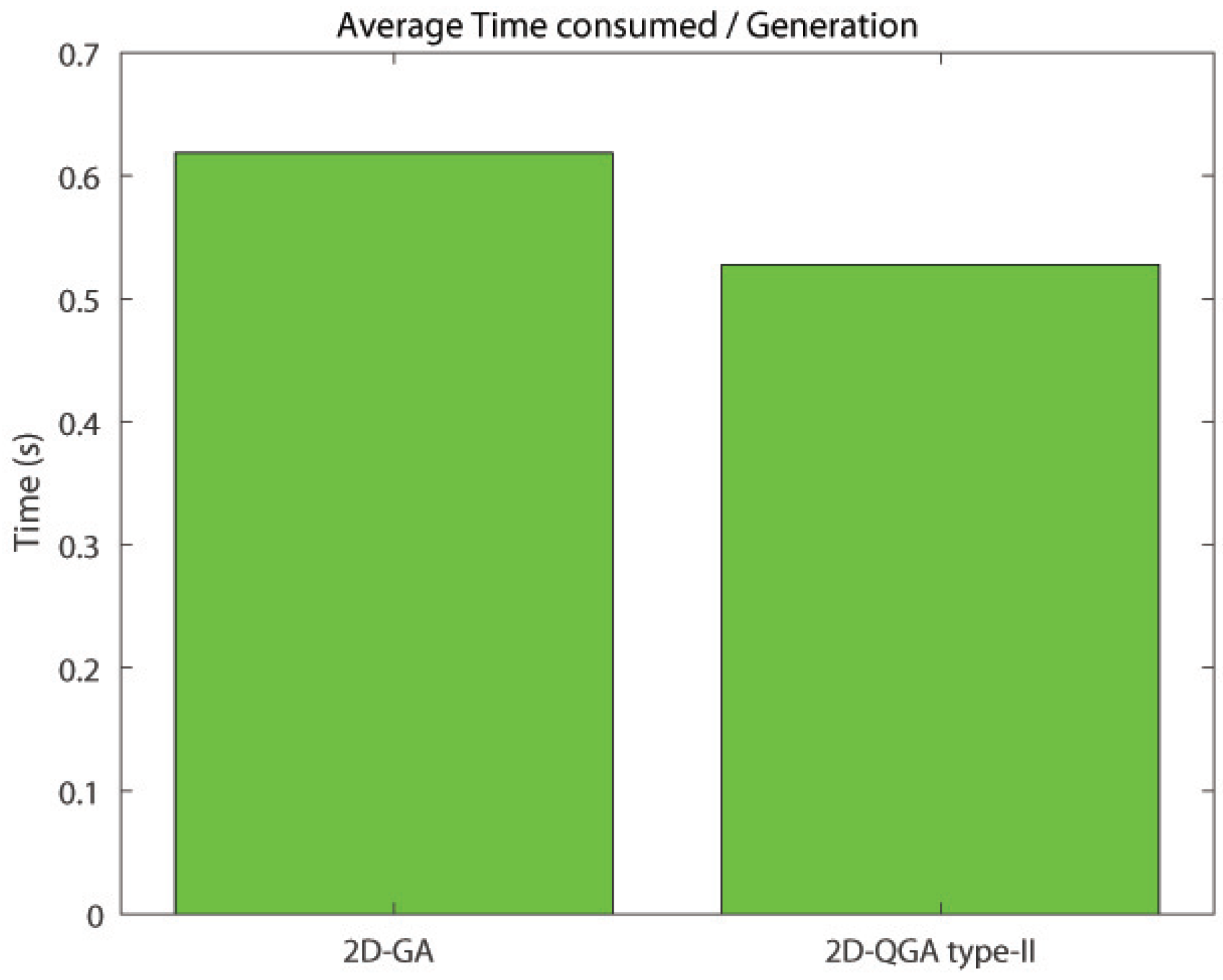
The comparison between 2D-GA and 2D-QGA type-II is given in this section. The population size of both 2D-GA and 2D-QGA type-II are 2000. The average time consumed by 2D-GA and 2D-QGA type-II is shown in
Figure 20. The time consumed to execute each generation by 2D-QGA type-II is less compared to 2D-GA.
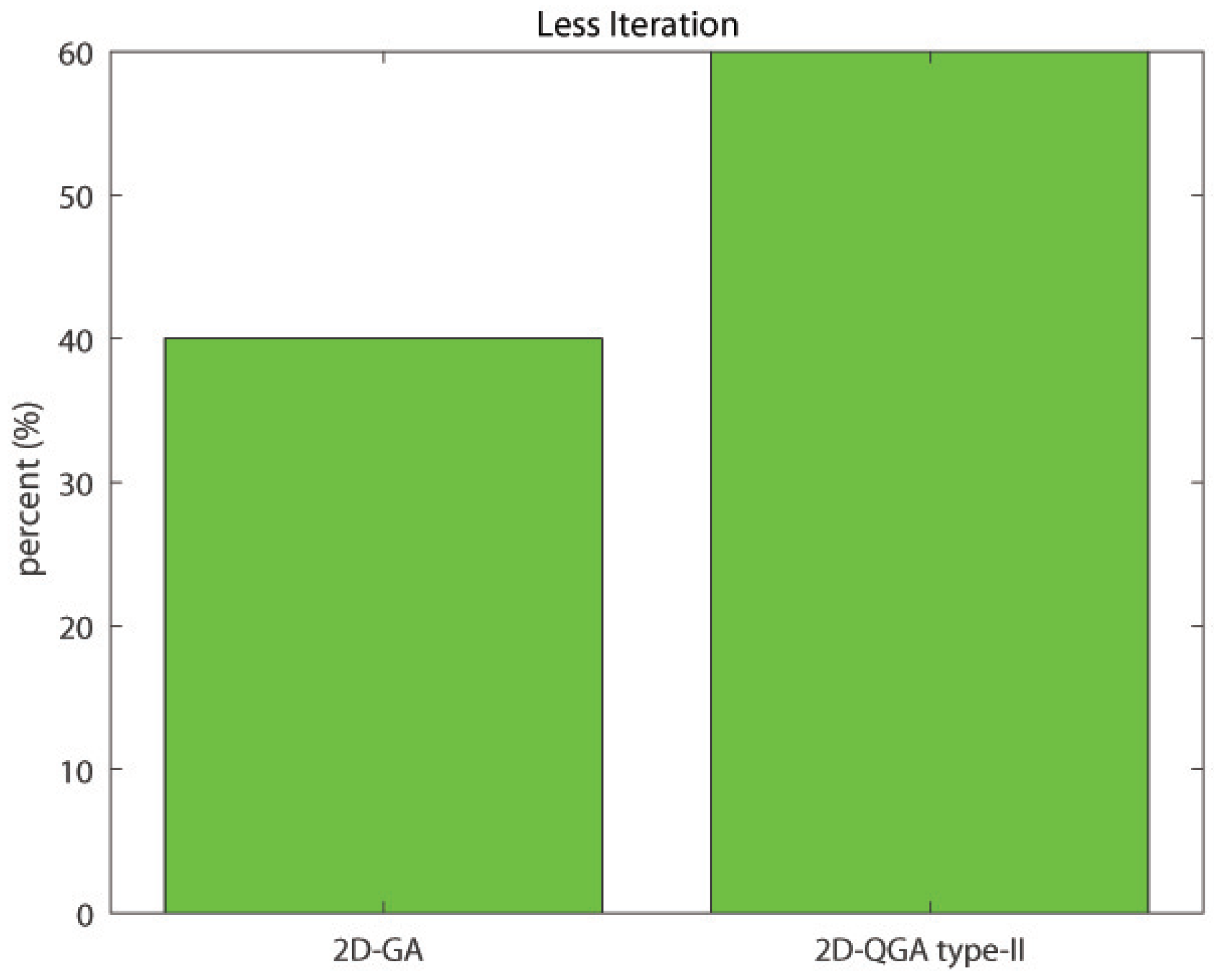
Figure 21 shows the percentage of iterations the algorithms converge with fewer generations. It is clear that 2D-QGA type-II converges with fewer generations for
of iterations.
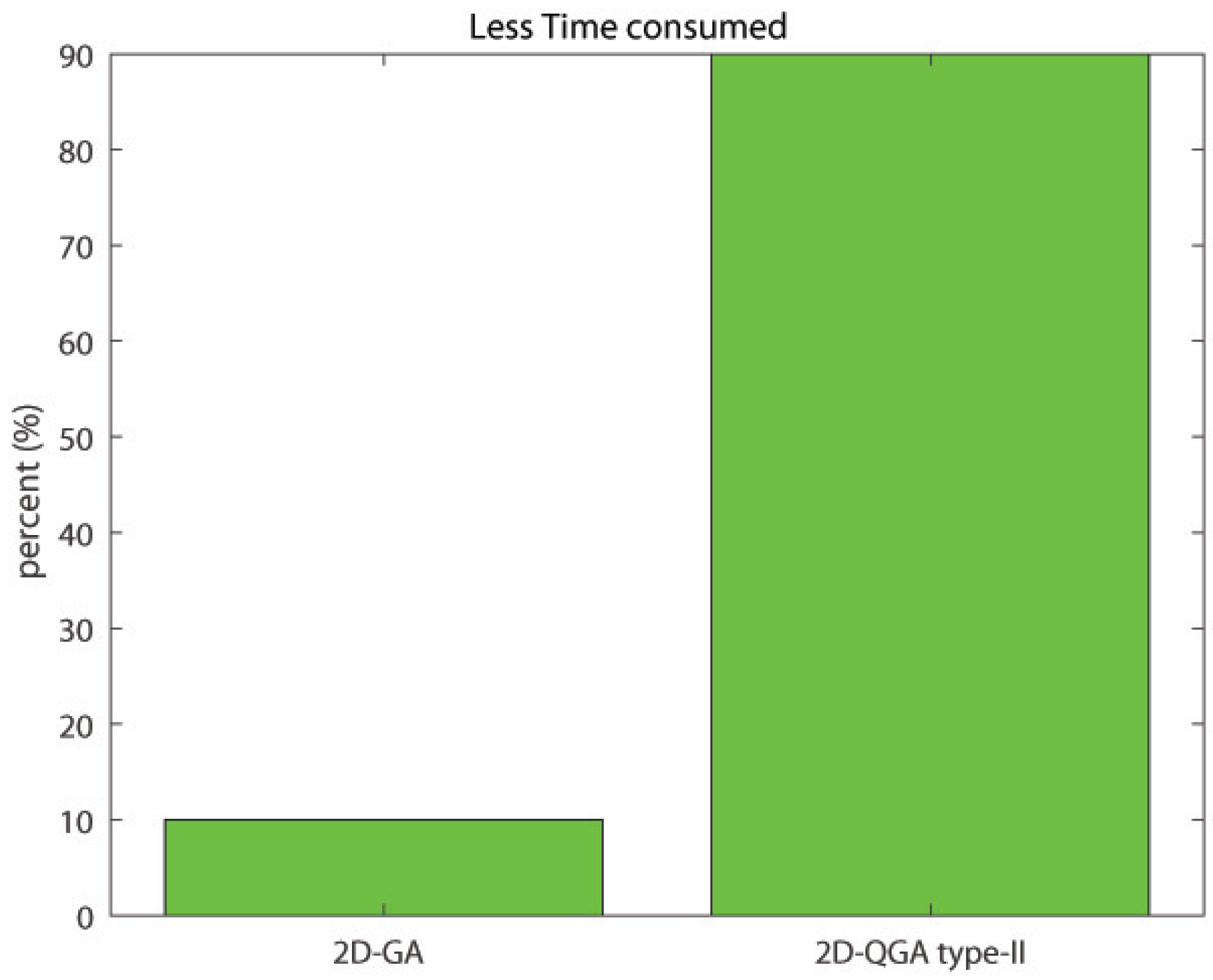
The total time of execution of the same number of generations is compared in
Figure 22. 2D-QGA type-II has consumed less execution time for
of iterations.
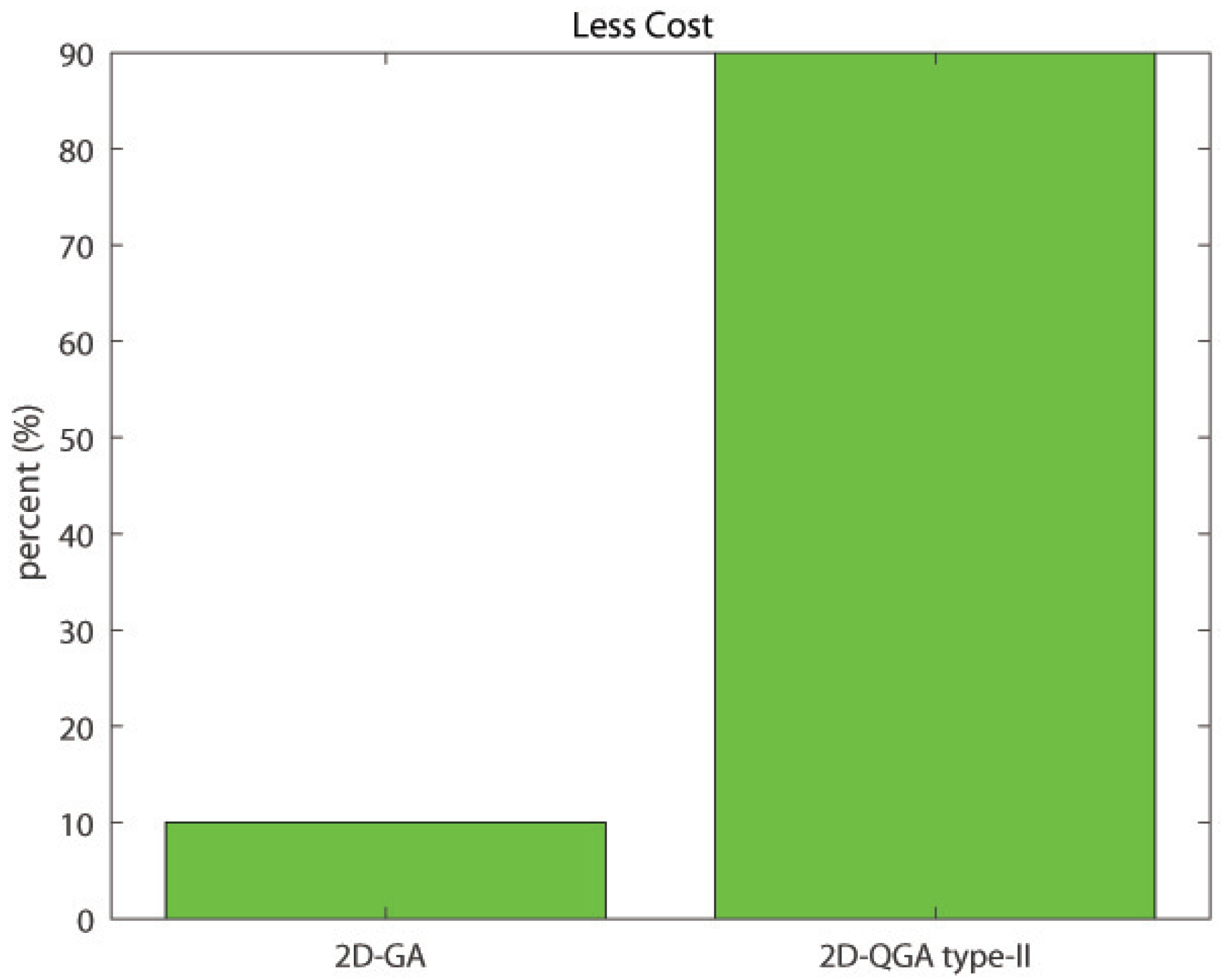
The comparison of percent of less cost generation is shown in
Figure 23. It can be noticed that 2D-QGA type-II produces less cost for
of iterations. The comparison is summarized in
Table 3.
The comparison between 2D-GA and 2D-QGA (type-I and II) is made in parts 1 and 2. Both types of 2D-QGA have performed much better compared to 2D-GA in terms of average execution time per generation, per cent of iterations each algorithm converges in fewer generations, consumes less execution time, and produces less cost. Moreover, the quantum computation helped the 2D-QGA to reduce the number of generations for convergence and overall execution time. Therefore the 2D-QGA speeds up the computation for the class of problems discussed in this paper.
It is clear that both types (I and II) of 2D-QGA are more efficient than 2D-GA. Also, there should be a similar comparison between them to identify the more efficient one. This comparison primarily reflects the influence of the Qgate operation involved in each type of 2D-QGA. In part 3, the comparison between 2D-QGA type-I and type-II is presented.
5.3. Part 3: Comparison between 2D-QGA Type-I and 2D-QGA Type-II
The comparison between 2D-QGA type-I and 2D-QGA type-II is given in this section. For a proper comparison, the population size of both 2D-QGA type-I and 2D-QGA type-II is considered to be 2000.
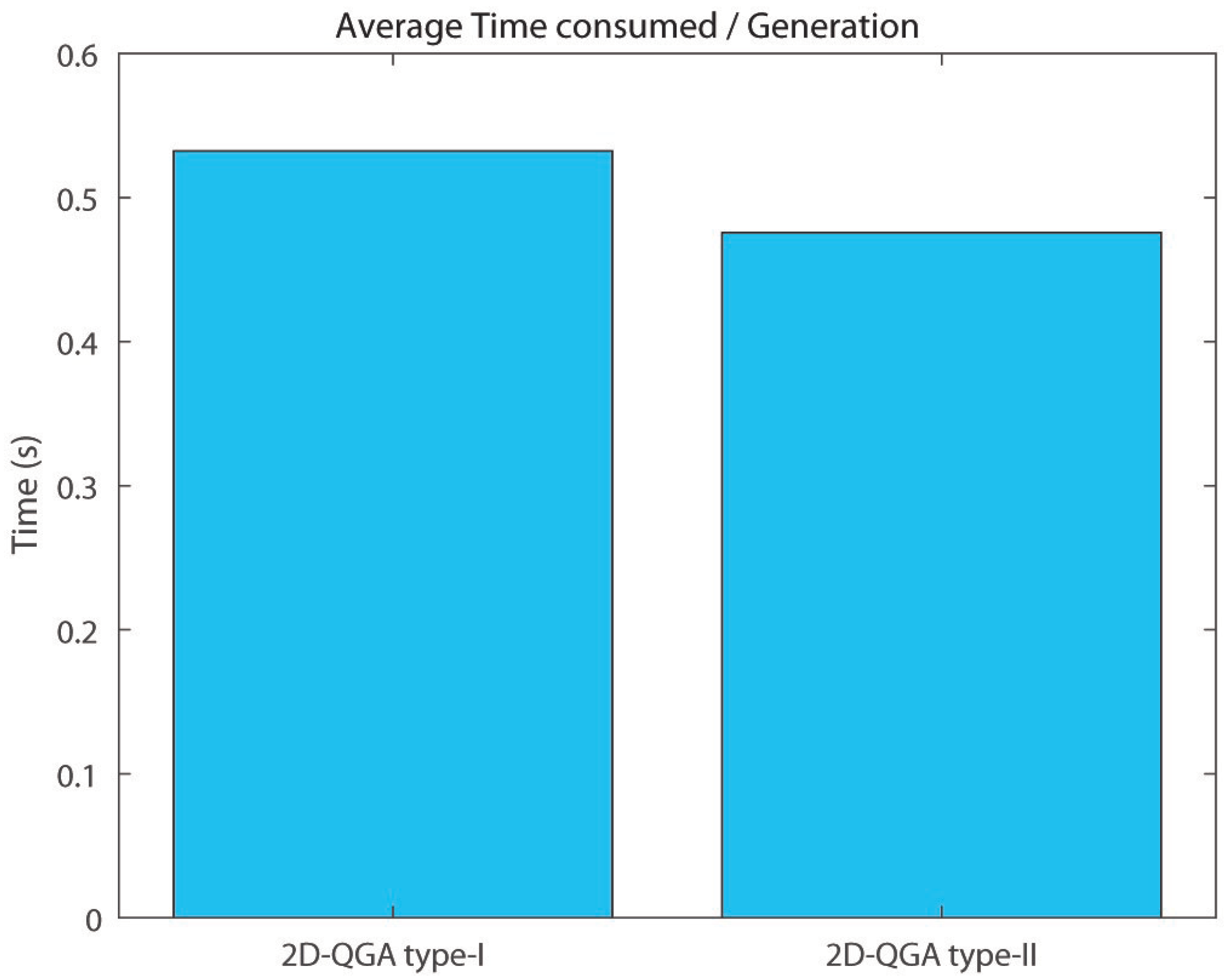
It can be observed that the average execution time per generation consumed by 2D-QGA type-II (around
s) is less than 2D-QGA type-I (around
s) as shown in
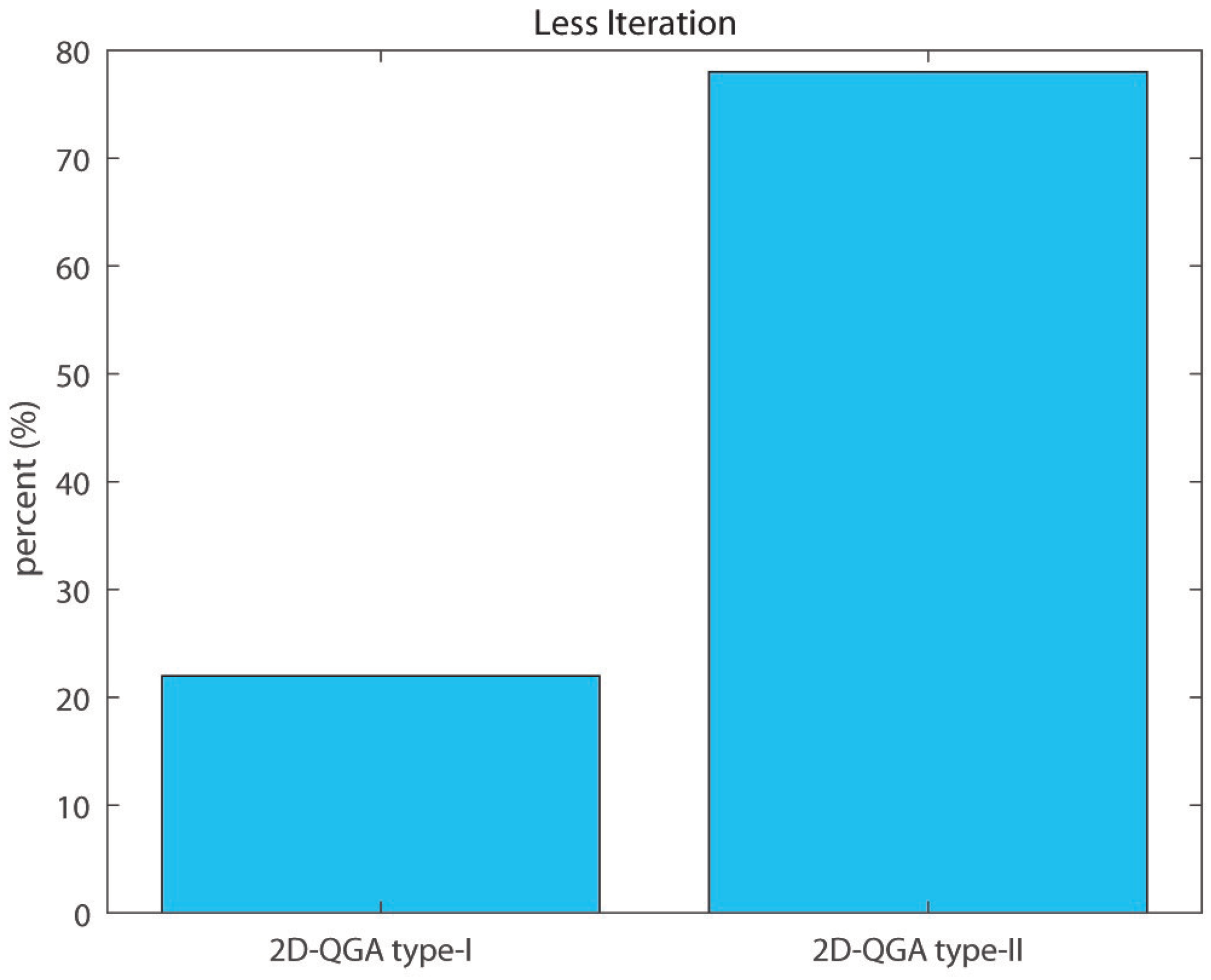
Figure 24. The percentage of iteration each algorithm converges in fewer generations is shown in
Figure 25. It can be observed that
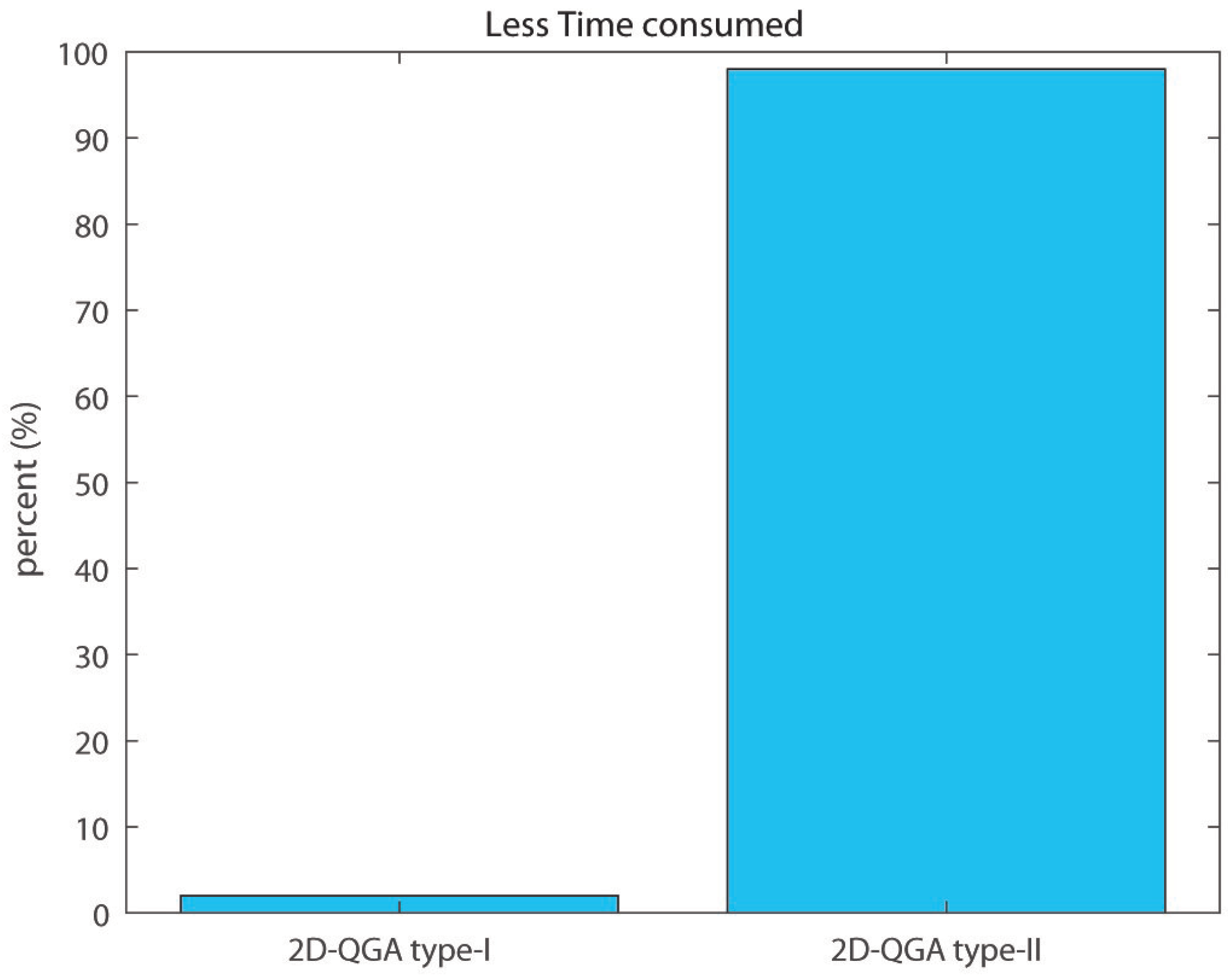
of the iterations, 2D-QGA type-II converges in fewer generations compared to 2D-QGA type-I. In case of total execution time, 2D-QGA type-II consumes less for almost all of the iterations (
) as shown in
Figure 26.
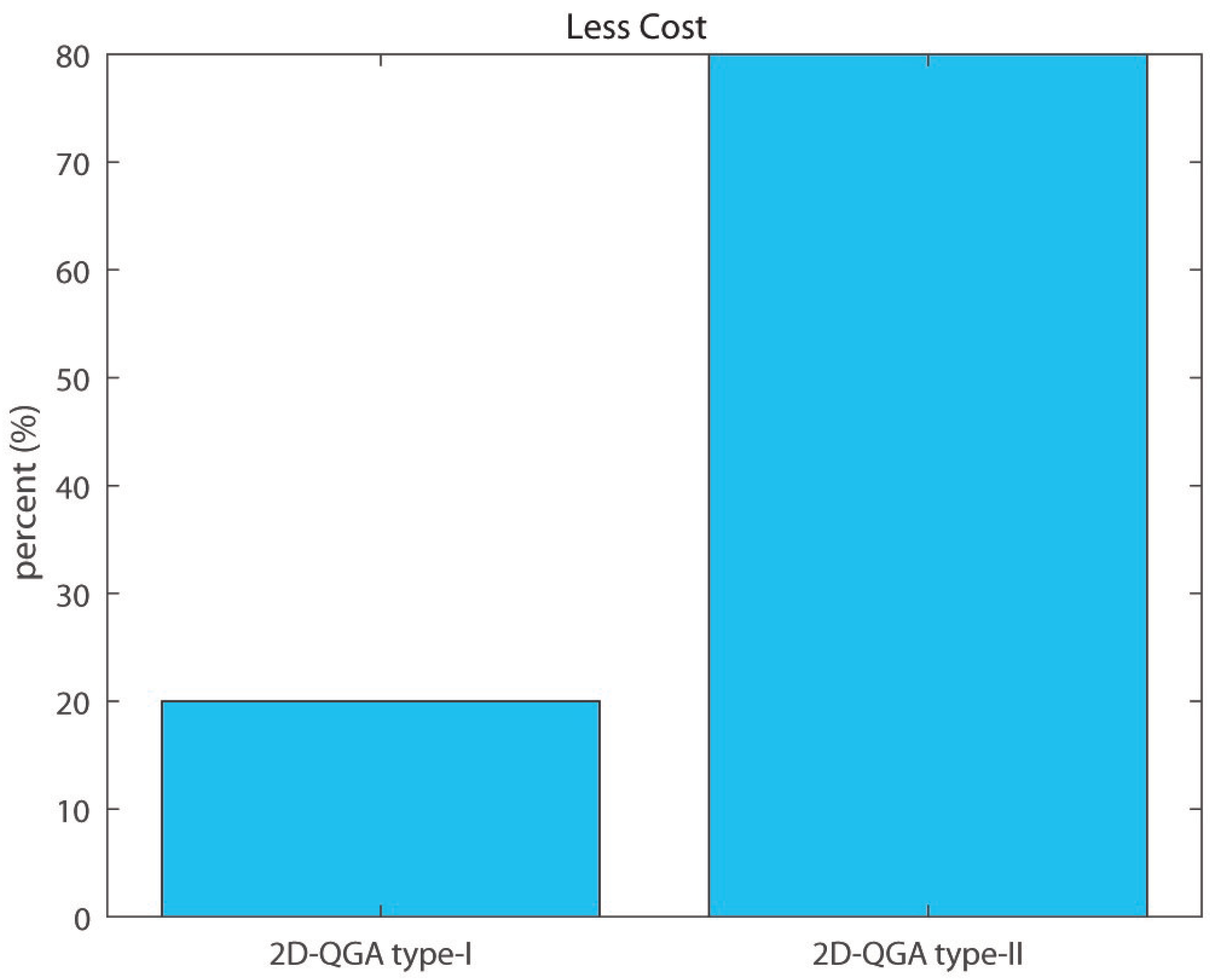
Percent of iterations each algorithm produces less cost is shown in
Figure 27. 2D-QGA type-II produces less cost for
of the iterations. The comparison is summarized in
Table 4.
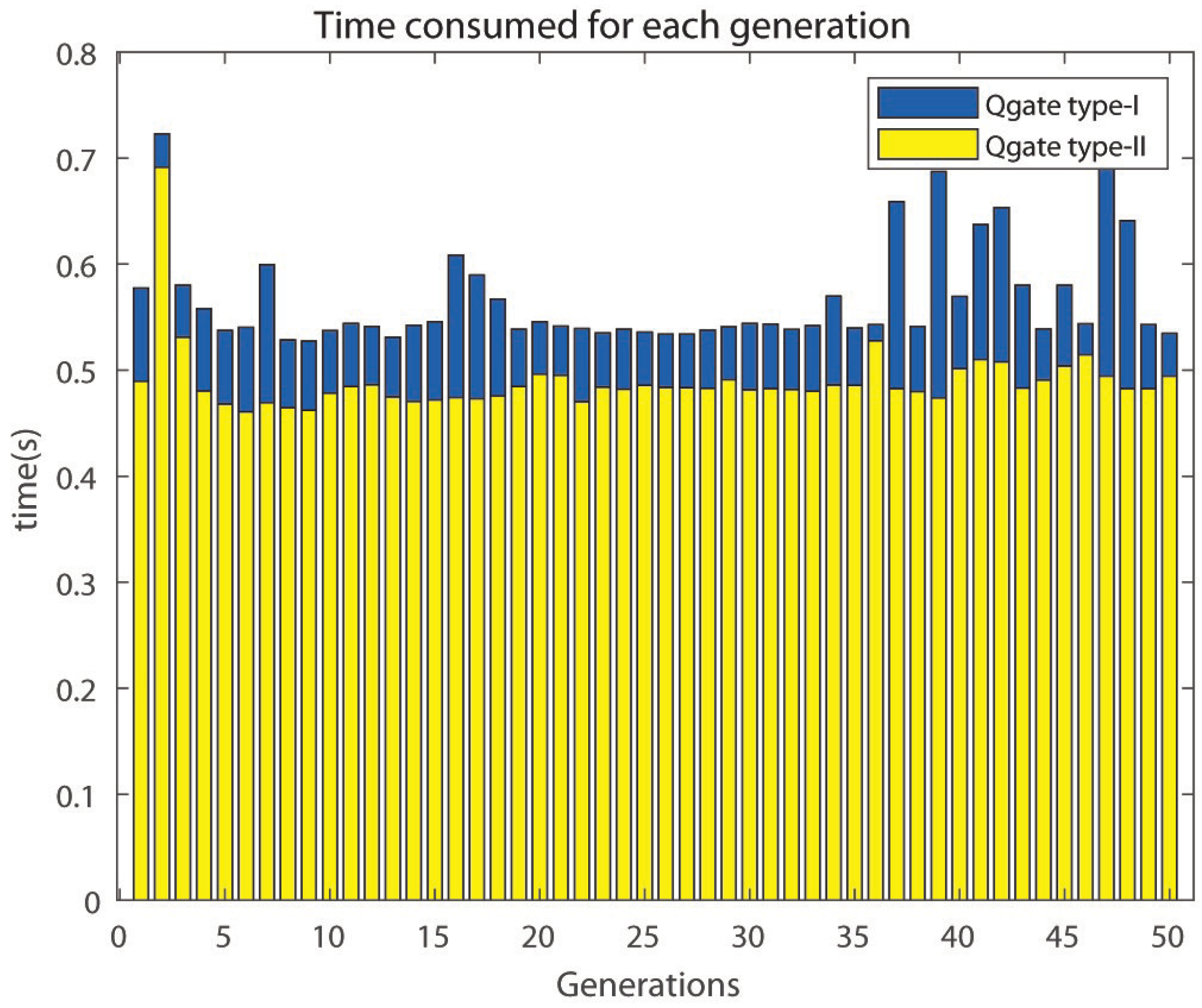
In addition to the comparison shown above, it is important to compare the execution time of 2D-QGA type-I and II for each generation in the same iteration. This comparison is shown in
Figure 28. The execution time for each generation for type-I is more than type-II, i.e., type-II is faster. It can be observed that type-II takes around
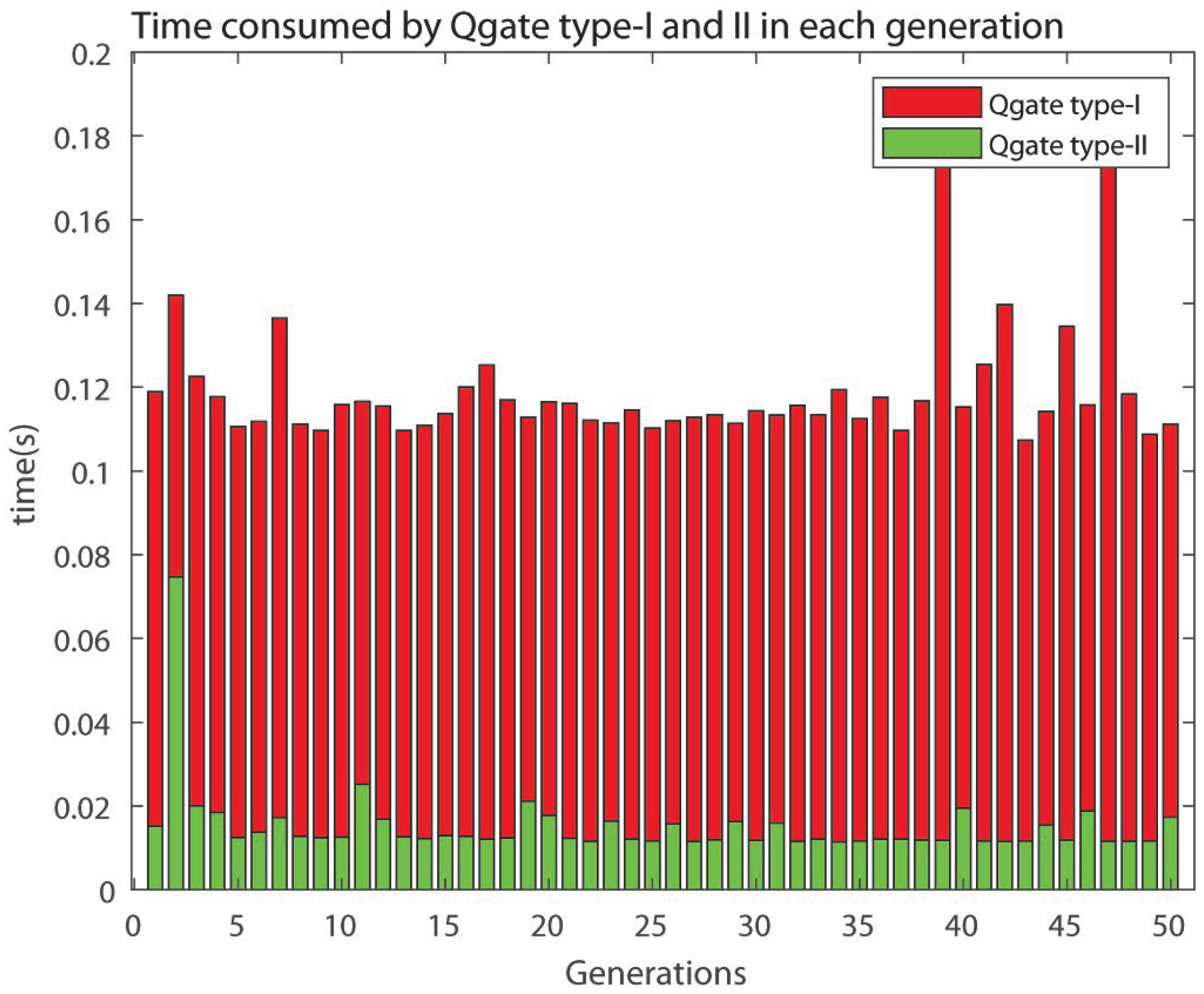
s less time per generation compared to type-I and saves around 4–5 s over 50 generations. The saving of time increases if the number of generations is increased. The main reason behind type-II being faster is the time consumed by the Qgate process in type-II is much less than type-I.
The time consumed by Qgate of type-I and II is shown in
Figure 29. The time consumed by Qgate type-I and II is around (average value)
s and
s respectively.
It is clear that 2D-QGA type-II has the advantage over type-I in terms of execution time per generation, total execution time, and convergence iterations. These advantages are important features of 2D-QGA type-II, which are useful for solving problems having two-dimensional representation. There are a few factors that can affect the performance of the proposed algorithm. The quality of optimal solution depends on the population size, the number of generations, formulation of appropriate cost function etc.