Article

Energy-Efficient Packet Forwarding Scheme Based on Fuzzy Decision-Making in Underwater Sensor Networks

by
Jitander Kumar Pabani
1,2,
Miguel-Ángel Luque-Nieto
1,*,
Waheeduddin Hyder
3 and
Pablo Otero
1
1
Institute of Oceanic Engineering Research, University of Malaga, 29010 Málaga, Spain
2
Department of Telecommunication Engineering, Dawood University of Engineering and Technology, Karachi 74800, Pakistan
3
Department of Computer Science, Faculty of Science and Technology, Ilma University, Karachi 75190, Pakistan
*
Author to whom correspondence should be addressed.
Sensors 2021, 21(13), 4368; https://doi.org/10.3390/s21134368
Submission received: 14 May 2021 / Revised: 17 June 2021 / Accepted: 23 June 2021 / Published: 25 June 2021
(This article belongs to the Section Sensor Networks)

Abstract

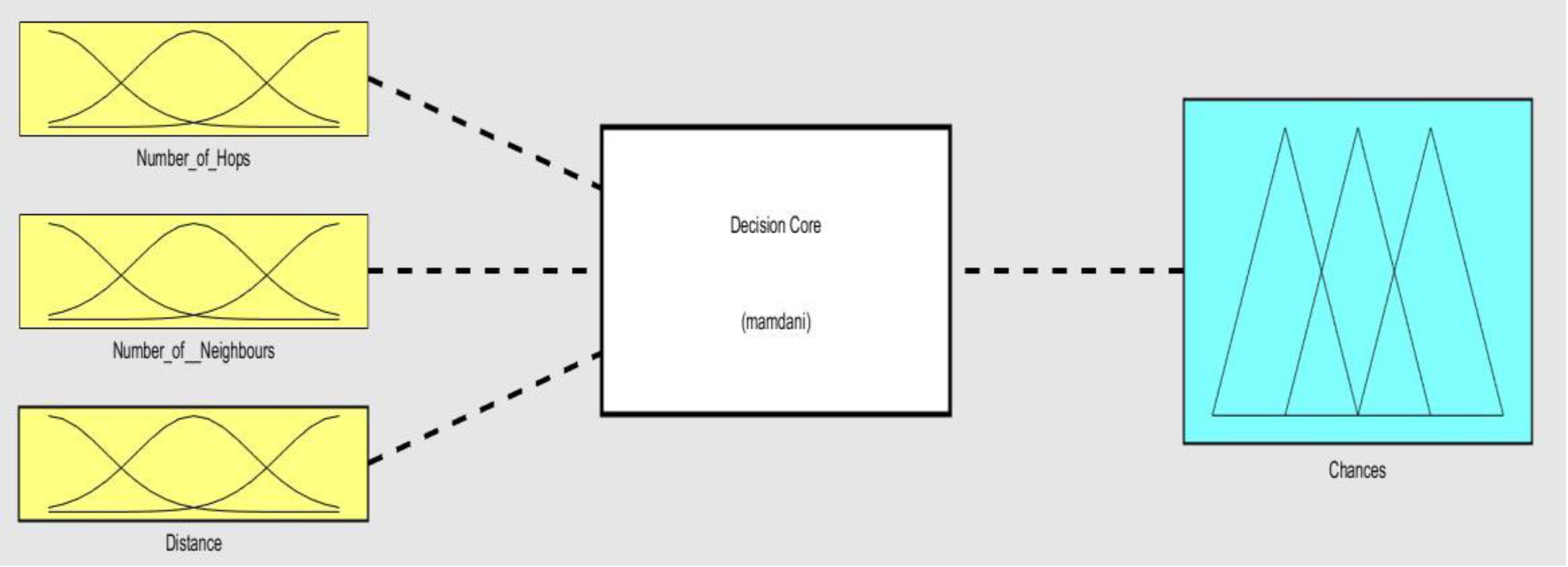
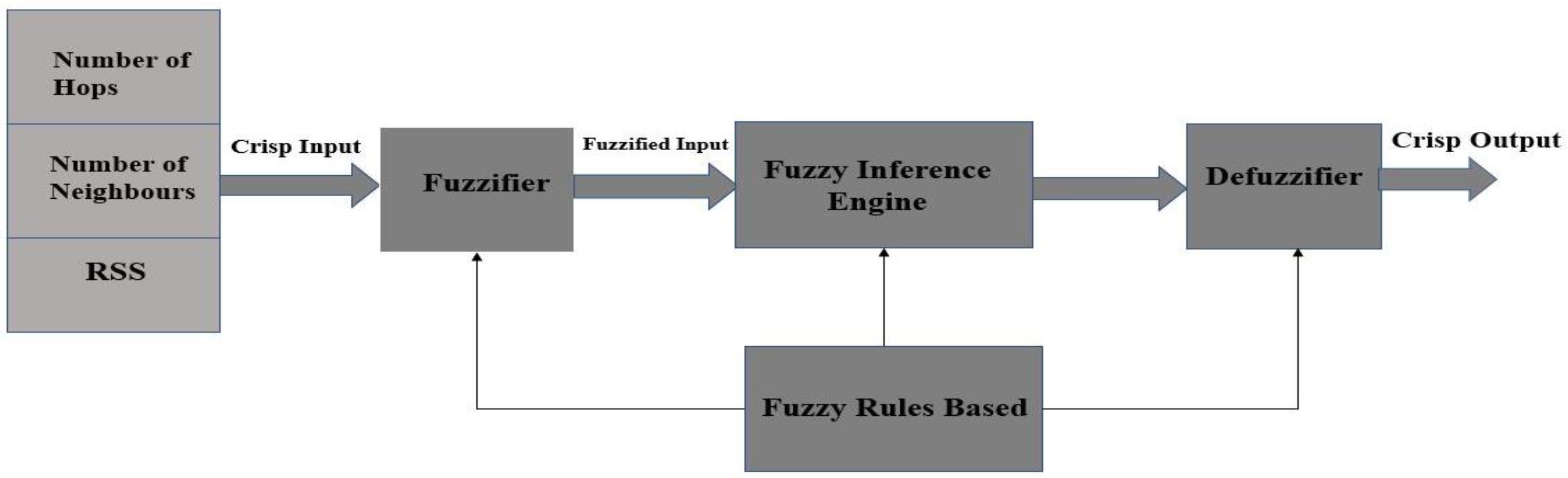
Underwater Wireless Sensor Networks (UWSNs) are subjected to a multitude of real-life challenges. Maintaining adequate power consumption is one of the critical ones, for obvious reasons. This includes proper energy consumption due to nodes close to and far from the sink node (gateway), which affect the overall energy efficiency of the system. These wireless sensors gather and route the data to the onshore base station through the gateway at the sea surface. However, finding an optimum and efficient path from the source node to the gateway is a challenging task. The common reasons for the loss of energy in existing routing protocols for underwater are (1) a node shut down due to battery drainage, (2) packet loss or packet collision which causes re-transmission and hence affects the performance of the system, and (3) inappropriate selection of sensor node for forwarding data. To address these issues, an energy efficient packet forwarding scheme using fuzzy logic is proposed in this work. The proposed protocol uses three metrics: number of hops to reach the gateway node, number of neighbors (in the transmission range of a node) and the distance (or its equivalent received signal strength indicator, RSSI) in a 3D UWSN architecture. In addition, the performance of the system is also tested with adaptive and non-adaptive transmission ranges and scalable number of nodes to see the impact on energy consumption and number of hops. Simulation results show that the proposed protocol performs better than other existing techniques or in terms of parameters used in this scheme.
Keywords: underwater sensor networks; packet forwarding probability; fuzzy logic underwater sensor networks; packet forwarding probability; fuzzy logic