You are currently viewing a new version of our website. To view the old version click .
Sensors
  • Article
  • Open Access

2 January 2021

Single- and Cross-Modality Near Duplicate Image Pairs Detection via Spatial Transformer Comparing CNN


,
,
and
1
School of Computer Science, National Engineering Laboratory for Integrated Aero-Space-Ground-Ocean Big Data Application Technology, Shaanxi Provincial Key Laboratory of Speech & Image Information Processing, Northwestern Polytechnical University, Xi’an 710129, China
2
School of Communication and Information Engineering, Xi’an University of Posts and Telecommunications, Xi’an 710121, China
*
Author to whom correspondence should be addressed.
This article belongs to the Section Intelligent Sensors

Abstract

Recently, both single modality and cross modality near-duplicate image detection tasks have received wide attention in the community of pattern recognition and computer vision. Existing deep neural networks-based methods have achieved remarkable performance in this task. However, most of the methods mainly focus on the learning of each image from the image pair, thus leading to less use of the information between the near duplicate image pairs to some extent. In this paper, to make more use of the correlations between image pairs, we propose a spatial transformer comparing convolutional neural network (CNN) model to compare near-duplicate image pairs. Specifically, we firstly propose a comparing CNN framework, which is equipped with a cross-stream to fully learn the correlation information between image pairs, while considering the features of each image. Furthermore, to deal with the local deformations led by cropping, translation, scaling, and non-rigid transformations, we additionally introduce a spatial transformer comparing CNN model by incorporating a spatial transformer module to the comparing CNN architecture. To demonstrate the effectiveness of the proposed method on both the single-modality and cross-modality (Optical-InfraRed) near-duplicate image pair detection tasks, we conduct extensive experiments on three popular benchmark datasets, namely CaliforniaND (ND means near duplicate), Mir-Flickr Near Duplicate, and TNO Multi-band Image Data Collection. The experimental results show that the proposed method can achieve superior performance compared with many state-of-the-art methods on both tasks.

1. Introduction

With the rapid development of portable multimedia sensors and mobile Internet technologies, the amount of multimedia data has been growing at a really fast speed. Thus, there are many near-duplicate images existing among the massive data. Near-duplicate images are typically considered as images containing the same scene or objects [1,2,3], but in various viewpoints, illumination conditions and camera settings etc, or images obtained through reediting of the original image [4], including but not limited to changing contrast, tone, cropping, rotating and watermarking. Automatic near-duplicate image pair detection by using computer vision and pattern recognition technology has been attracting wide attention recently, as it has great potential values in the application of image copyright violations detection, fake image detection, management of device hardware storage, and autonomous vehicle driving.
Conventional human-crafted local features-based approaches, such as the widely adopted scale-invariant feature transform (SIFT) [5], histograms of oriented gradients (HOG) [6] descriptors, obtain the image-level features through aggregating strategies, like vector of locally aggregated descriptors (VLAD) [7], Fisher Vector [8], etc. These methods suffer from the problem of complicated extraction steps and limited representation abilities. More recently, thanks to the great feature learning ability of convolutional neural network (CNN), researchers have resorted to CNN to deal with the near-duplicate image pair detection problem.
By using deep neural networks to represent images and combining different similarity measurement strategies to implement this task, CNN-based methods have achieved great performance. However, existing methods still show the following disadvantages. Vanilla CNN models incorporate many convolution and down-sampling/pooling layers to learn layered representations. Typically, higher layer features (low resolution) represent more semantic information which relates more to the content of the input image, while they contain less for pixel-level or even region-level information. In addition, conventional CNN models designed for image classification could not fully exploit the correlations between pairwise images. Most existing methods focus on the features of each image from the image pair, and they usually do not connect two images until the process of similarity measurement on the basis of these features, while few methods stack two images as an entire input and feed it into networks, which can fuse two images in very early processing phases but probably ignore the local information of each image to some extent.
To address these problems, in this paper, we propose a comparing CNN (CCNN)-based model to make more use of different resolution features to encode the correlations of image pairs and detect whether they are near duplicate pairs, as illustrated in Figure 1. This architecture focuses on learning to discriminate image pairs as near-duplicate or non-near-duplicate. Furthermore, to tackle the spatial variations, we introduce a spatial transformer (ST) module into the model, termed as ST-CCNN, to learn the features which are robust to cropping, translation, scaling, and non-rigid transformations. To demonstrate the effectiveness of the proposed method on both the single-modality and cross-modality (Optical-InfraRed) near-duplicate image pair detection task, we conduct extensive experiments on three popular benchmark datasets. The evaluation results show that the proposed method can achieve superior performances compared with many state-of-the-art methods.
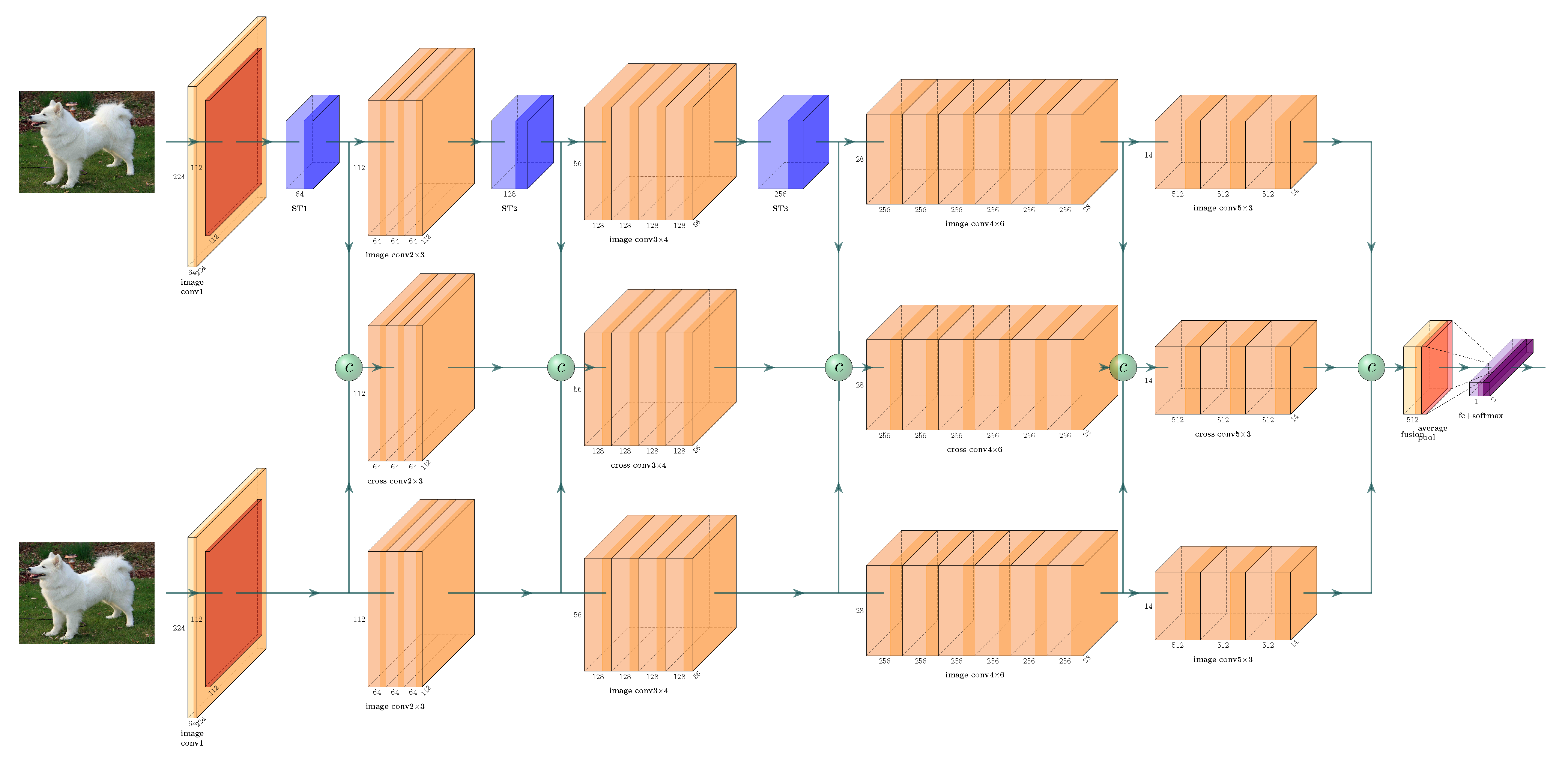
Figure 1. Illustration of spatial transformer-comparing convolutional neural network (ST-CCNN) architecture. The input images (showing in a slightly cropped image pair) are fed into two image streams (top and bottom), each of which consists of a convolutional block and four residual blocks. The cross stream (middle) shares the later residual blocks with the image streams. Feature maps of these three streams are fused by concatenation and convolutional layers to a vector into a fully connected layer and a Softmax layer.
In summary, the main contributions of this paper are threefold:
  • We propose a CCNN model to the task of near-duplicate image pair detection, which makes more use of rich resolution features to encode the correlations between image pairs.
  • We further propose the ST-CCNN model by introducing a spatial transformer module into the comparing CNN architecture, which can improve the robustness to variations, such as cropping, translation, scaling, and non-rigid transformations.
  • Comprehensive experiments on both the single-modality and cross-modality (Optical-InfraRed) near-duplicate image pair detection tasks are conducted to verify the effectiveness of the proposed method.
The remainder of the paper is organized as follows: Section 2 reviews the literature on image comparing techniques. Section 3 elaborates the proposed model and the training method. Section 4 shows the experimental results and ablation studies. Section 5 discusses the proposed model. In Section 6, we draw the conclusion of the paper.

3. Methodology

To make more use of various resolution features and learn the image pair jointly, as shown in Figure 1, we apply a ST-CCNN with triple-stream-based model and ST modules to conduct near duplicate image comparing. Accordingly, in this section, we elaborate the proposed model in terms of triple-stream architecture and the ST modules, respectively.

3.1. Triple-Stream Framework

Given an image pair ( I l , I r ) as the input, the purpose of the models is to learn the similarity between its images and obtain a probability, which shows the possibility that the input image pair is a near duplicate (ND)/non-near duplicate (NND) pair. The process can be illustrated as
P = S ( I l , I r ) ,
where P refers to the probability, S ( · ) refers to the similarity learning, and I l and I r refer to left image and right image in the image pair. By building up an end-to-end network architecture and predicting the probability directly, the near duplicate image pair detection is converted into a classification task for image pairs. Depending on the input strategy of I l and I r , existing architectures can be roughly categorized into 2-stream and 2-channel. The 2-stream framework that shares structures and parameters, namely Siamese network, feeds each image into each network stream, separately. Siamese is one of the most commonly used frameworks in the field of tasks processing image pairs, and it performs greatly in image comparing tasks. In the task of comparing, Siamese mainly utilize the stream equipped network as feature extraction and compare these features in decision layers. Based on these frameworks, there is hardly interactive processing before the latter comparing stage. Different from separately processing images, 2-channel framework have neglected the extraction of each single image features and stack I l and I r as one input into a network. Though the framework using this strategy can learn the correlation between images earlier than the 2-stream framework, its neglect of feature extraction of each image tends to lead to a missing consideration of low level or local features, especially on the network built on Vanilla CNN. In terms of patch comparing, 2-channel framework performs well [36]. However, when it is directly applied to wider scenario [39], it only performs well for images with low difficulty, such as images that are very visually similar, while, when images involve local correlation, such as replacement, viewpoints change, etc., this framework is hardly to accurately detect those challenging near duplicate pairs.
As shown in Figure 1, ST-CCNN processes image pairs using a triple-stream-based network. Among these streams, I l and I r are resized to 224 × 224 × 3 and fed into two image streams, the top and the bottom streams in Figure 1, respectively. The image streams share the backbone and parameters. Each image stream is composed of five convolutional sets, of which the first set is a combination of a single convolution layer, a Rectified Linear Unit (ReLU) layer and a max-pooling layer. The remaining four sets are combinations of residual convolutional blocks. Each convolutional set includes numbers of 3, 4, 6, and 3 residual blocks, and each residual block is a standard basic residual block, mainly consisting of two convolutional layers. The structure of the cross stream, which lies in the middle of two image streams in Figure 1, shares the later four convolutional sets with image stream. The input of each set is the combination of feature maps from each image stream and the cross stream itself on the same stage (the same ID of the convolutional sets). In order to provide greater capacity of feature extraction, these feature maps are combined through concatenation and a single convolutional layer followed by a ReLU layer. The cross stream can embed features from each image on multiple scales gradually and jointly, thus representing the potential displacement of relevant regions within the image pair. Considering the displacements those regions within ND pairs are usually limited, we apply each convolutional layer in the later four convolutional sets with unique kernel size of 3 × 3 . In this way, the triple-stream network allows capturing potentially local and global correspondences by gradually fusion multi-scale features and residual learning in encoding the image pair into the one-dimension vector for classification.

3.2. Spatial Transformer

The changes between images in an ND pair usually include spatial transformations but without specific labeling on these changes, such as translation, rotation, cropping, etc. Vanilla CNNs achieve translation invariance to a certain extent through the max-pooling layers, that is, if the regions/objects transform within the pooling unit, the activation values can be identical, thus achieving certain invariance. However, the pooling units are generally with small sizes, commonly 2 × 2 , which imposes an obvious limitation on the spatial invariance of Vanilla CNN. The introduction of triple-stream structure can solve multi-range displacement by carrying out the stack of multi-scale feature maps from each image stream. However, for scaling, rotation, and several non-rigid transformations, Vanilla CNN-based networks are difficult to cope with. Therefore, we introduce the ST modules to maintain the robustness of the model to various transformations of regions/objects within the image pairs.
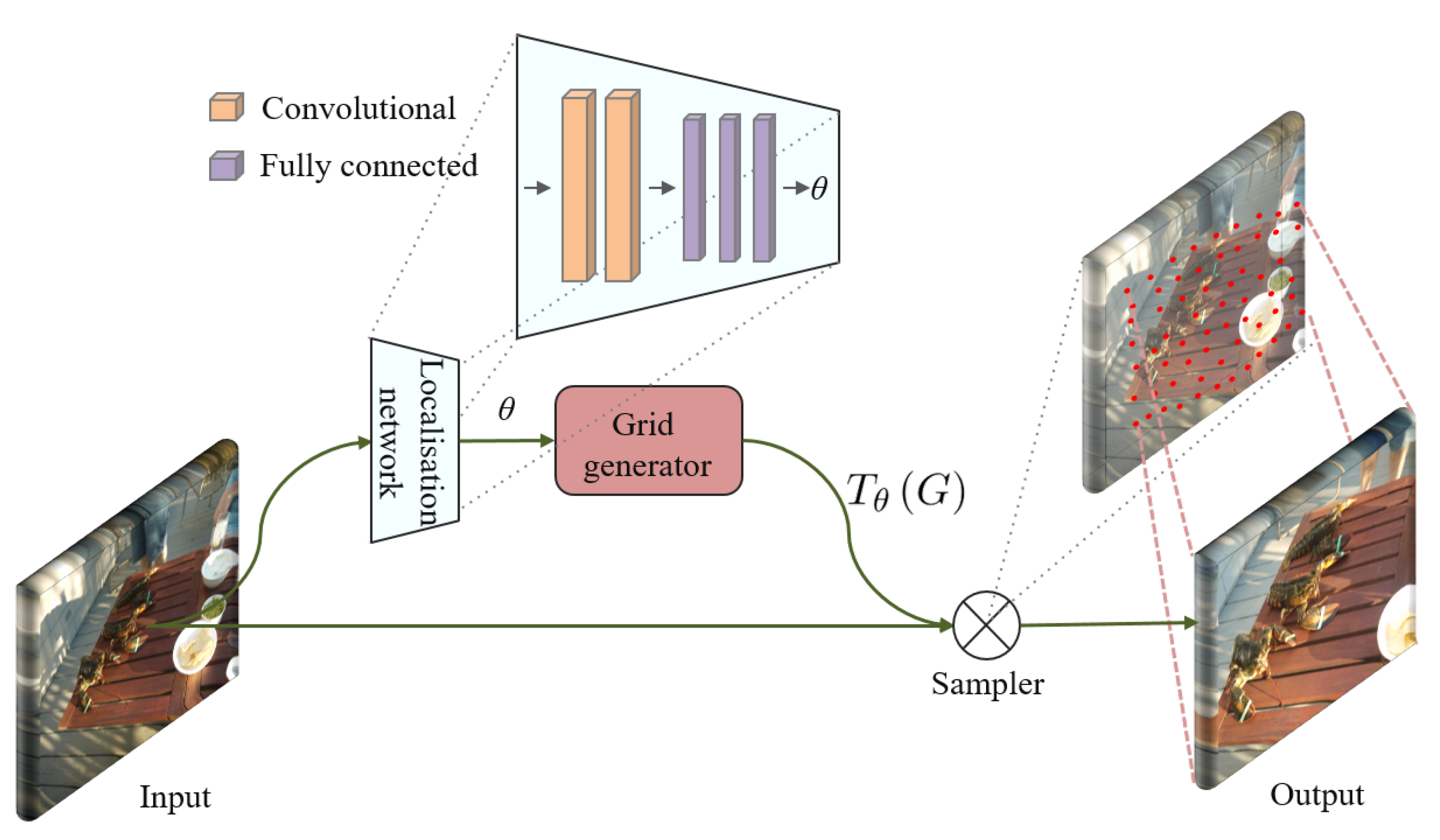
The ST module is with a self-adaptive mechanism, which mainly consists of three components, as shown in Figure 2: the localization network returns the spatial transformer parameter θ of the input feature maps; and then the grid generator uses this parameter to generate a sampling grid T θ ( G ) ; finally, according to this grid, the differentiable sampling kernel uses the grid T θ ( G ) to sample the input feature maps, and then the output feature maps with spatial transformed is obtained. The first component, localization network, consists of two sets of a convolutional layer followed by a max-pooling layer, also a ReLU layer and three fully connected layers. The input to the localization network is the feature maps X R H × W × C , and the output is the localization parameter θ = f l o c ( X ) , where f l o c ( · ) means the regression of localization network. This parameter reflects the mapping of coordinate relationship between input X and the expected spatial transformed feature maps X s t R H × W × C . The size of the parameter is set to a classic 2D affine transformation with dimension of 2 × 3 , which can deal with cropping, translation, scaling and rotation. Based on this, the second component grid generator performs matrix operations with all coordinates in ordinary grid G = { G i } , G i = ( x i s t , y i s t ) in X s t as independent variables and with θ as the parameter, so as to obtain the corresponding coordinate points grid T θ ( G ) = { G i s r c } , G i s r c = ( x i s r c , y i s r c ) of each coordinate in X s t at the input X. This operation can be represented as follows:
x i s r c y i s r c = θ x i s t y i s t 1 = θ 11 θ 12 θ 13 θ 13 θ 22 θ 23 = x i s t y i s t 1 ,
where i means the index of all coordinates of the feature maps X s t , ( x i s r c , y i s r c ) refers to the coordinate values mapping to the i-th coordinate ( x i s t , y i s t ) in X s t , that is, the source coordinate of i-th coordinate in X s t is ( x i s r c , y i s r c ) in the input X. Then, the third component differentiable sampling kernel takes X and T θ ( G ) as input to calculate each pixel value in X s t . Considering the spatial transformation information of ND pairs is mainly involved in high resolution features, such as displacement, pose change, and cropping in small range, we deploy the ST modules on the shallow convolutional sets which with smaller respective fields than deeper sets. In order to avoid that the features extraction of each image stream tend to be equal, we deployed ST modules on only one of the image streams, which will be clarified in the subsequent Section 4.4.3
Figure 2. Illustration of a spatial transformer module architecture. The input feature maps X is fed into a localization network, which regresses the transformation parameters θ . The regular spatial grid G over output is transformed to the sampling grid T θ ( G ) which is applied to input to generate the warped output feature map X s t .

3.3. Loss Function

The feature maps obtained by the three streams are mapped to a one dimension vector in length of 2, by concatenating and average pooling. After a Softmax layer, all values in the vector are always in the range [0,1], and add up to 1, thus forming a probability distribution. According to the image classification strategy, we consider that the index of the larger value represents the category of the input image pair, that is, index 1/0 corresponds to ND/NND. The training is supervised by the label l { 0 , 1 } of each image pair ( I l , I r ) with binary cross entropy loss function, which can be presented as follows:
L o s s ( p i , l i ) = w i [ l i l o g p i + ( 1 l i ) l o g ( 1 p i ) ] ,
where i refers to the i-th image pair in the training dataset, p i refers to the probability that the input image pair is predicted as an ND pair, l i refers to the real label of input image pair is an ND pair, and w i refers to the weight of each batch. Considering the ST-CCNN is an asymmetric network, we cover all the training and testing image pairs with their left and right flips, and we completely random input them to the networks.

4. Experiments

4.1. Datasets and Settings

We implement our model on three benchmark datasets: CaliforniaND [3] and Mir-Flickr Near Duplicate (MFND) [4] for single-modality near duplicate image pairs comparing, while TNO Multi-band Image Data Collection (TNO) [41] for cross-modality near duplicate image pairs comparing.
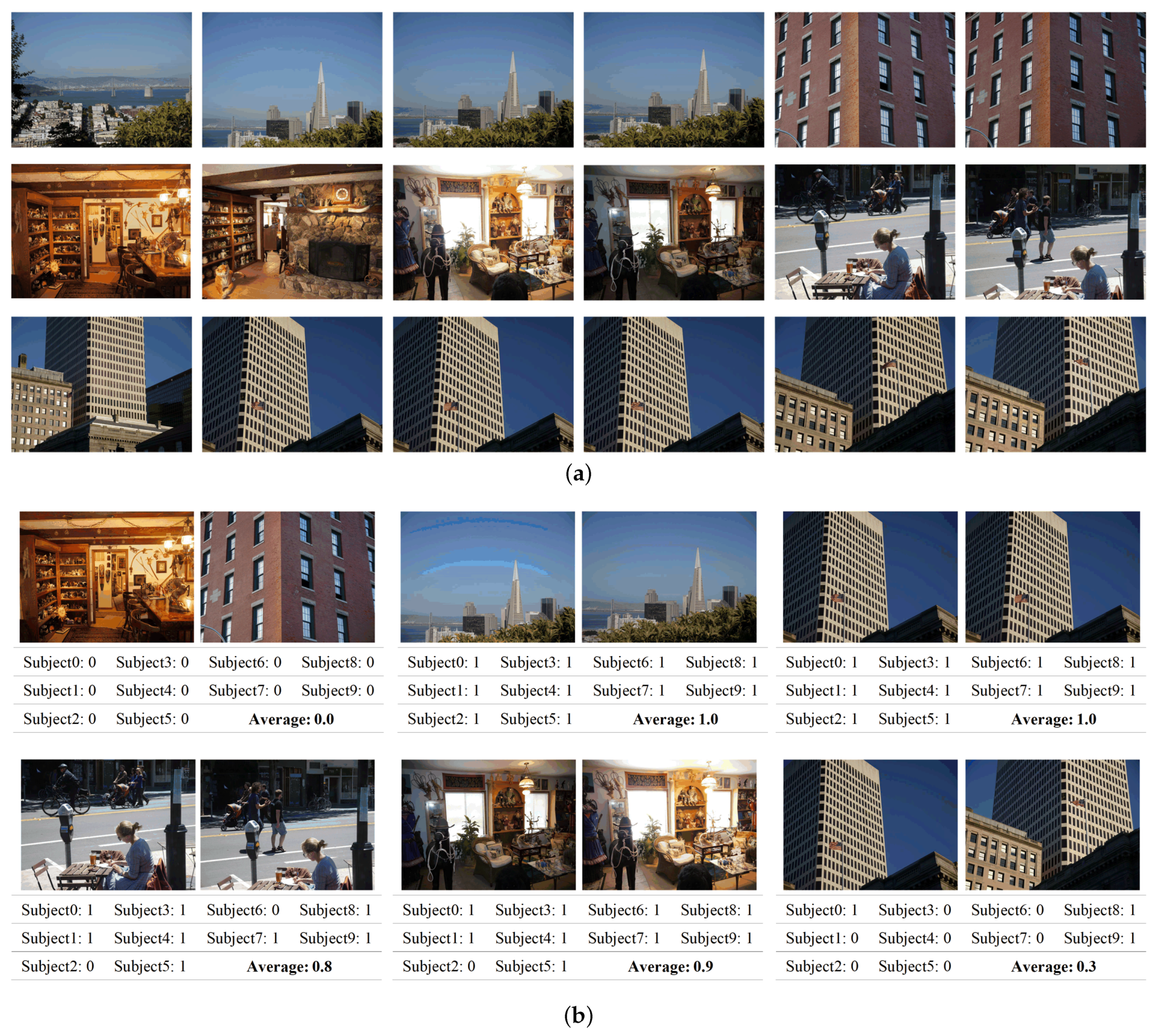
CaliforniaND is a dataset containing 701 photographs taken directly from a real personal travel photo collection taken by one photographer. As shown in Figure 3a, the original images in this dataset are usually consecutive shots (including burst shots, moving background shots, panoramic shots, etc.) of similar scenes during a short time period. It contains many difficult cases and types of near duplicate pairs. To deal with the inevitable ambiguity presented by near duplicate pairs, this dataset is annotated by giving binary decisions from 10 subjects, including the photographer himself. As illustrated in Figure 3b, these annotations correlation matrices are combined and averaged into a non-binary ground truth, presenting the probability that the observers might consider a pair of images are near duplicate. Each image considered as a near duplicate can have change of target or background, different camera parameter settings, image noise, color environment, and resolution, and other factors will affect the image quality. Our experiments are implemented on the average matrices of 10 subjects. This dataset is relatively challenging due to the fact that it contains many non-identical ND pairs of real-world scenes [1].
Figure 3. Illustration of examples from CaliforniaND (ND = near duplicate). (a) Raw photos in CaliforniaND. (b) Image pairs with their binary annotations and the average probability to be a near duplicate image pair. In the first row, three samples are given by all subjects with the same binary label, which are obvious near duplicate/non-duplicate image pairs. The second row shows pairs that are not extremely visually similar. The changes between pairs, which are considered as near duplicate averagely, include rotation and translation of views, target changes, and camera exposure setting changes.
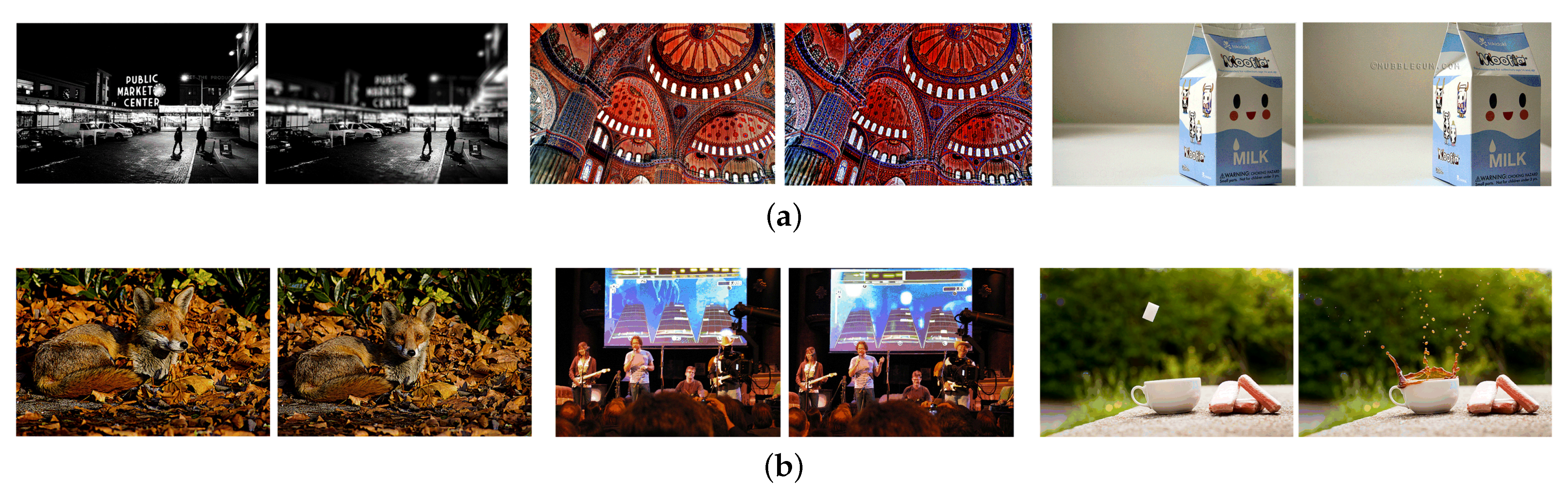
MFND is a benchmark near duplicate detection based on the pre-existing MIR-FLICKR collection. As shown in Figure 4 Image pairs are labeled as duplicates, identical near-duplicate (IND), and non-identical near-duplicates (NIND). Duplicate images are defined as those are the same size and have the same value in each pixel. IND pairs appear to have been derived from a common precursor via manipulation. NIND pairs are non-duplicate pairs, but which nonetheless have a striking visual similarity. From the perspective of human vision, the difficulty of comparing these pairs and giving binary decisions is that NIND is more difficult than IND, and IND is more difficult than duplicates. Following other methods, our experiments on this dataset are mainly carried out on subset MFND-IND and MFND-ALL, where ALL indicates IND and NIND.
Figure 4. Illustration of near duplicate image pair samples from Mir-Flickr Near Duplicate (MFND). (a) Pairs from MFND-identical near-duplicate (IND). From left to right, the changes between near duplicate pairs are focus change, scale change, color tune change, border, and watermark addition. These pairs are extremely visually similar, and there is no displacement or posture change of the objects or background in the images. (b) Pairs from MFND-non-identical near-duplicates (NIND).
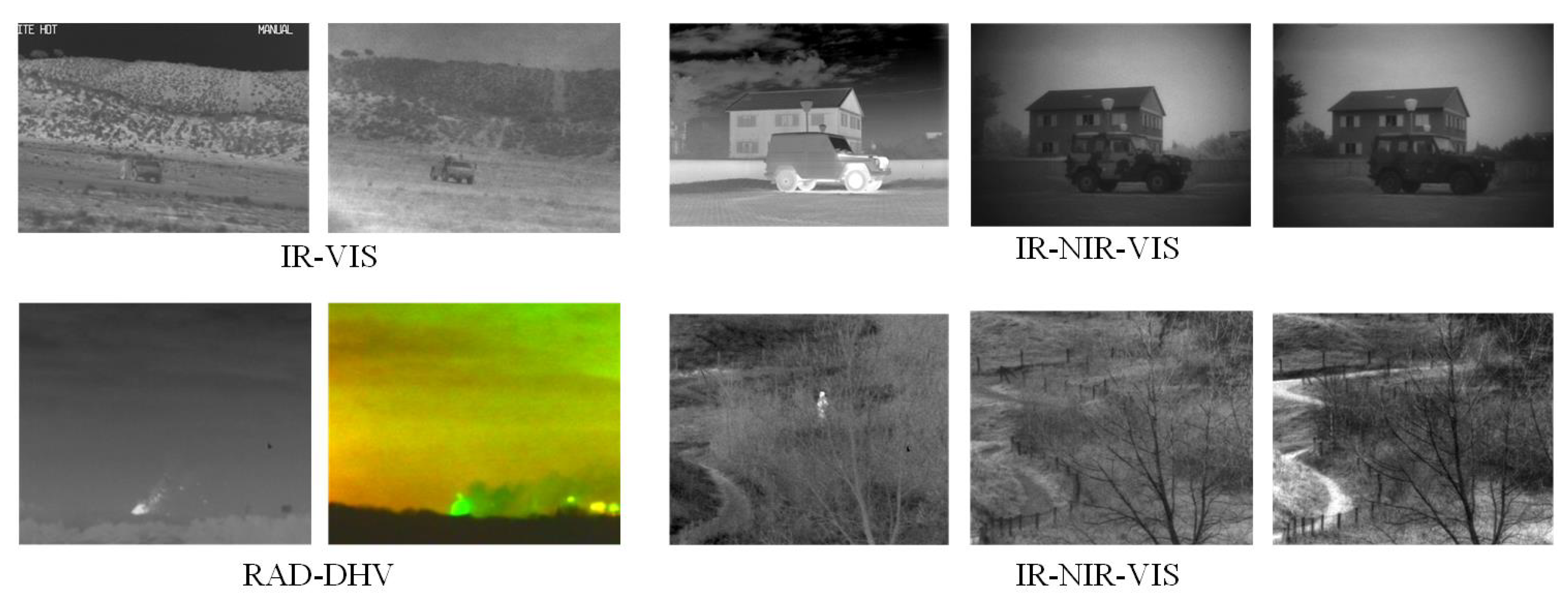
The TNO consists of multi-spectral (intensified visible (390–700 nm), near-infrared (700–1000 nm), and long-wave infrared or thermal (8–12 m)) nighttime imagery of different military relevant scenarios, registered with different multi-band camera systems, including Athena, dark hard vitreous (DHV), free electron laser (FEL), and TRI-band Color Low-light OBServation(TRICLOBS). We fed image-pairs from identical scenes as near duplicate pairs into proposed models. As shown in Figure 5, cross modality images captured on identical scenes showing identical targets (e.g., people, vehicles) in different (e.g., rural, urban) backgrounds.
Figure 5. Illustration of examples in TNO. In different imaging modalities, the foreground and background are emphasized according to their temperature states. For instance, the texture features of the object are not clear in the night visible image (upper right), or even the objects are not obvious.
To observe and verify the effectiveness of the proposed models, in Section 4.3, we compare our proposed networks with state-of-the-art methods. In addition, we organize sufficient ablation study on the proposed network in Section 4.4. These experiments are conducted with the platform of PyTorch (version 1.0.1) under the Ubuntu 16.04 operation system on a workstation with Intel Xeon(R) E5-2640 v4 @2.40 GHz and NVIDIA GTX 1080Ti GPU, with batch size of 8 image pairs, and learning rate at 5 × 10 4 . For each dataset, we select all ND pairs (average metric with threshold = 0.5 in CaliforniaND) and randomly select NND pairs with the number of approximately equal to the number of ND pairs. We randomly divide experimental data from each dataset into a train set and test set according to about 3:1. According to the data size of the datasets, we adopt the random stochastic data augmentation, that is, according to a random augmentation probability, input I l and I r in were randomly performed identical transformation in the following modes when loading data of each batch, including horizontal flipping, vertical flipping, and rotation of 90 , 180 , and 270 . In all implementations, we use two backbones, the standard Visual Geometry Group Network-16 (VGG16) and ResNet34. The parameters for ST modules equipped are shown in Table 1 (where FC refers to fully connected layers).
Table 1. Channels parameter setting for ST modules in VGG16 and ResNet34.

4.2. Evaluation Metrics

We evaluate the prediction results with ground truth labels based on confusion matrix. Specifically, we use Accuracy, Recall, Precision, F1-score, and area under the ROC (AUROC), where ROC means receiver operating characteristic. For the proposed model, the output from Softmax layer of each image pair is a vector in size of 1 × 2 . The sum of two values is 1.0 and, respectively, presenting the probabilities that the model predicts the input image pair belongs category-0 (non-duplicate) or category-1 (near-duplicate). Therefore, according to the common principle of image classification, we consider the index of the maximum value in this vector as the predicted binary label (equivalent to threshold = 0.5). Thus, in the case that all datasets used are completely manually labeled, based on the predicted binary labels and ground truth labels, we can obtain the complete confusion matrix items, namely true positive (TP), true negative (TN), false positive (FP), and false negative(FN). Based on this, the following measurements calculate as:
A c c u r a c y = T P + T N T P + T N + F P + F N ,
P r e c i s i o n = T P T P + F P ,
R e c a l l = T P T P + F N ,
F 1 = 2 × P r e c i s i o n × R e c a l l P r e c i s i o n + R e c a l l ,
where Precision refers to the proportion of the real positive to all the ‘positive’ predicted by the model, while Recall refers to the proportion of the model predicted ‘positive’ to all real positive samples. These two measurements are a pair of contradictory measurements; thus, the F1-score is considered as with more comprehensively measurement ability.
The evaluation above is based on the predicted binary labels. Furthermore, based on predicated probability, we use ROC and the area under it, which are one of the most widely used measures in machine learning to evaluate classification ability and robustness. ROC curve is a curve reflecting the relationship between sensitivity and specificity. Its x-axis is 1-specificity, also known as false positive rate (FPR). Its y-axis is sensitivity, also known as true positive rate (TPR). Thus, according to the curve, the entire plot is divided into two parts. The area under the curve (AUC) represents the prediction ability. The higher AUC value is, the superior the model prediction ability will be. The closer the curve is to the upper left corner (smaller x, larger y), the more accurate the prediction will be.

4.3. Result Comparison

To prove the effectiveness of the proposed model, we compare the proposed ST-CCNN with state-of-the-art methods. These methods include (1) 2-channel network [39], which stacks images from an image pair as one input and fed into neural networks, based on VGG16 and ResNet34; (2) SPoC [2] based on VGG16 and pretrained on Place205 [42] (SP-VGG16-PL), SPoC based on VGG19 and pretrained on ImageNet [43] (SP-VGG19IN), SPoC based on VGG16 and pretrained on Hybrid dataset (SP-VGG16-HY) where Hybrid is Place205&ImageNet, ResNet101 and pretrained on ImageNet (ResNet101-IN) and ResNet152-IN [2] utilize backbones pre-trained on Place205, ImageNet, Hybrid(showing in names by PL, IN, H, respectively) to the SPoC, which extract features from the pre-trained neural networks and spatially aggregated using sum pooling, and then measure the features by L 2 normalization after PCA whitening and compression; and (3) DeepRet500-L and DeepRet800-L [2] (where L refers to fine-tuning on Landmarks dataset) firstly conduct ROI pooling from images and feed the image triples separately using triplet loss on this basis. The advantage of this method is that it is able to apply a compact global image representation and improve the accuracy by using triplet loss for the slight changes between images. The AUROC results comparison were summarized as shown in Table 2 and Table 3, on single-modality datasets and cross-modality dataset, respectively. The best AUROC values are highlighted with bold and red, while green and blue refer to the second-best and the third-best, respectively.
Table 2. Area under the receiver operating characteristic (AUROC) comparison on single modality datasets of ST-CCNN and other state-of-the-art methods.
Table 3. AUROC comparison on cross-modality dataset TNO of ST-CCNN and other state-of-the-art methods.

4.3.1. Single-Modality Results

It can be observed in Table 2 that, in the challenging dataset CaliforniaND, our network performs superior than state-of-the-art methods obviously. The networks of 2-channel perform obviously lower than other comparison methods, due to the simple strategy of concatenating images before input to the network. Though this strategy can process images jointly, because of its neglect of single image features extraction, especially the low resolution local features, it is hard to correctly detect the ND pairs with objects/background change and visually similar NND pairs. For SPoC frameworks based on VGG16-PL, VGG16-HY, and VGG19-IN, the networks based on VGG16 achieve AUROC around 0.900+, while VGG19 achieves 0.887. It indicates that, for challenging pairs, a deeper network does not lead to better performance. With the introduction of residual learning by shortcuts and deep network structures, the ResNet-based networks improve performance by more than 2%. However, the 512-layer network is not superior than the 101-layer network on this dataset, which indicates that a deeper network is not necessarily a better result under the same network architecture. By introducing the triplet loss focusing on slight difference and ROI pooling, the DeepRet based on ResNet101 performs similarly in CaliforniaND with SPoC methods based on ResNets. It indicates that the use of ROI pooling and the region proposal network (RPN) in the test phase is not sufficient to mine more of the changes that occur within image pairs. Our proposed ST-CCNN reaches the top and the second top AUROC on CaliforniaND, based on ResNet34 and VGG16, respectively. This may be because the introduction of cross stream and ST can deal with the displacement, rotation, scaling, and view change of foreground or background targets with image pairs, which provides possibilities for superior classification ability of the networks.
In MFND, we will discuss MFND-IND and MFND-ALL, respectively. In MFND-IND, a subset that is considered relatively simpler than other datasets [1,2], which can be observed in Figure 4a. The performance gaps among methods are not significant, and the performance is gradually improved as the networks going deeper also the structures becoming more complex. On this subset, DeepRet800 reaches the top performance at 0.996, followed by our ST-CCNN and DeepRet500, which are only 0.002 below. In addition, our ST-CCNN is based on ResNet34, which is much less layers than the backbone ResNet101 of DeepRet500. In MFND-ALL, which includes more challenging pairs, our ST-CCNN reaches the top AUROC. Generally, the overall performance distribution of all methods is similar to that of CaliforniaND, except that the improvement of SPoC backbones from VGGs to ResNets is more obvious. In addition, the structure of DeepRet shows significant advantages than in CaliforniaND. The advantage is that the design of ROI pooling and triplet loss is particularly suitable for MFND-ALL data, including some content changes of the targets, spatial changes (less than pairs in CaliforniaND) that can be captured by the triplet loss which is designed specifically for the slight differences, and ROI pooling also provides capacity for interesting regions concerns. Compared with VGGs-based networks, our ST-CCNN-VGG16 exceeds the others by more than 4%. While based on ResNet34, our ST-CCNN achieves the top AUROC at 0.992, which indicates that our model also performs well on the data with slight spatial variations.

4.3.2. Cross-Modality Results

As shown in Table 3, all methods AUROC values do not exceed 0.80. The difficulties of ND detection on TNO lie in the following two aspects: (1) the limited size of the dataset; and (2), for different wave length on the identical scene imaging, these images mainly correspond in the correlation of various saliency regions, including identical targets of various visual views, such as people, vehicles, buildings, and paths. The first limitation of dataset size is reflected in all comparing methods. In particular, under the same architecture, the AUROC of ResNet152 pre-trained is lower than ResNet101, also the VGG19 is lower than that of VGG16, which may be caused by over-fitting problem. The later limitation is particularly apparent for networks that mainly use global features extraction, where the performance of the 2-channel and SPoc frameworks is obviously lower than other networks. DeepRet and our ST-CCNN have significant advantages due to their saliency region focusing design applied to these networks, and our ST-CCNN shows more effectiveness and reaches the top AUROC at 0.782.

4.4. Ablation Study

We implement ablation experiments on single-modality and cross-modality datasets, CaliforniaND and TNO, respectively. Based on the backbone of VGG16 and ResNet34, the ablation analysis of triple-stream, ST, and asymmetric ST structures are conducted, including quantitative comparison and visualization.

4.4.1. Effectiveness of Triple Stream Structures

We implement comparing CNN in with/without the triple stream, presenting as CCNN-w-cross (CCNN with cross-stream) and CCNN-o-cross (CCNN without cross-stream to prove the effectiveness of our triple stream frameworks. As shown in the quantitative comparison Table 4, the addition of the triple stream can obviously improve the performance in F1-score and AUROC. Specifically, on VGG16 backbone, benefits from its great ability of image representation, the CCNN-o-cross network achieves 0.910 in recall, which means a good ND detection ability. However, its precision is 0.811, far lower than recall, which indicates that a certain number of pairs that are predicted to be ND are truly NND. By introducing the triple stream, CCNN-w-cross can slightly improve all measurements than CCNN-o-cross network but still shows a large difference in precision and recall. The possible reason is that its stacking of convolutional and pooling layers in each VGG16 streams would neglect the discriminative information of NND in the image features extraction process. Similarly, CCNN-o-cross network based on ResNet34 still has the problem of recall far exceeding precision. While the CCNN-w-cross based on ResNet34 solves this problem well, which indicates that the residual learning combined with the gradually stacking of multi-scale feature maps from dual streams in cross stream can properly retain both ND and NND discriminative information, providing the capacity for the network to accurately predict the category of the input image pair.
Table 4. Ablation study of with/without triple stream on single modality dataset CaliforniaND.
For cross-modality data, showing in Table 5, compared with dual stream networks, the introduction of cross stream can obviously improve the scores of all measurements, especially when ResNet34 is applied as the backbone. To be specific, the most relatively obvious improvement is on precision scores, which may be due to the introduction of cross stream which can provide more discriminative information as NND pairs when image stream feature maps tend to identify an NND as an ND. However, the recall scores are higher than the precision scores in all dual stream and triple stream networks.
Table 5. Ablation study of with/without triple stream on cross-modality dataset TNO.
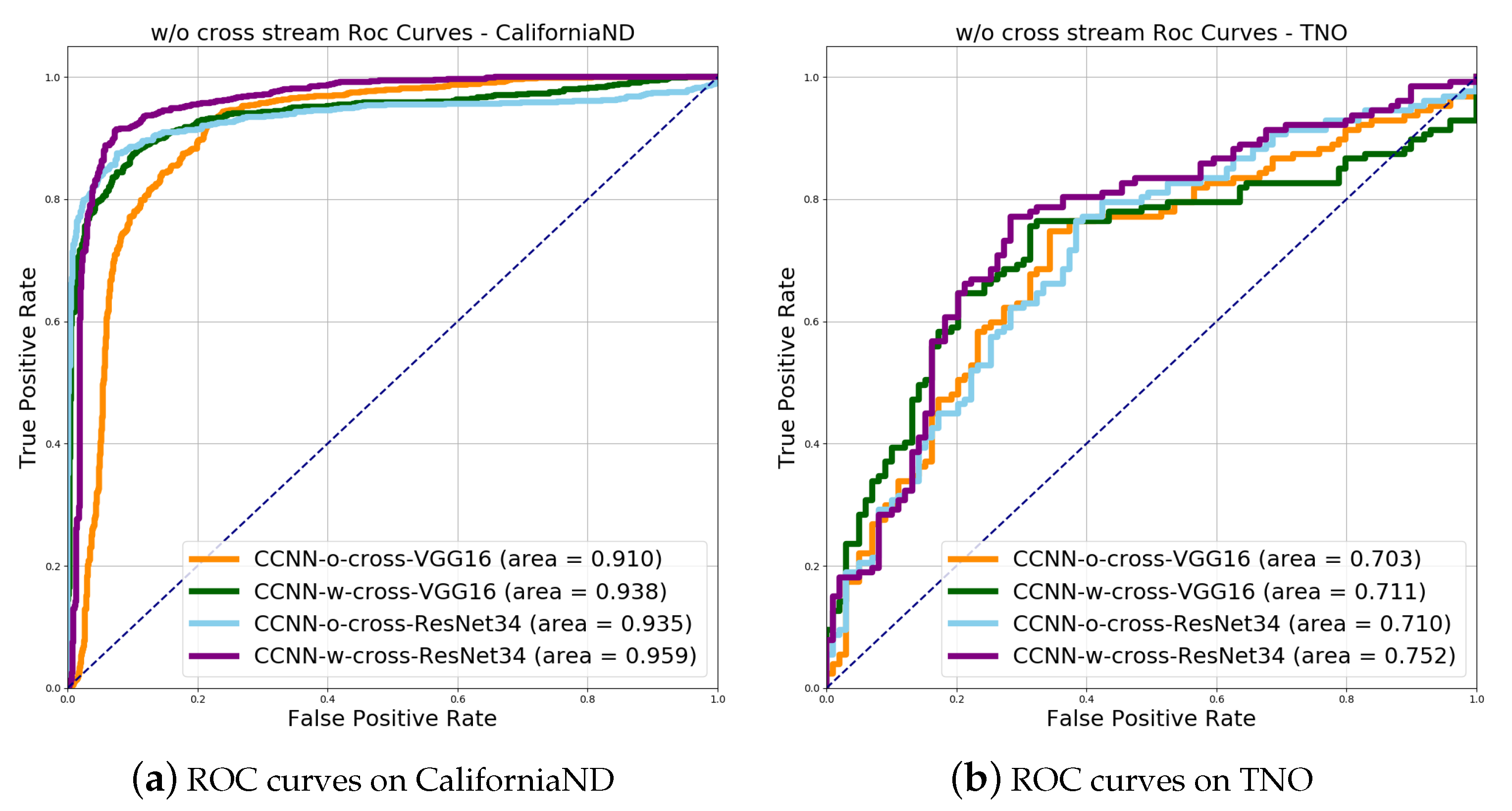
It can be observed in Figure 6 that, among two-stream and triple-stream networks based on VGG16 and ResNet34, the classification ability of CCNN-o-cross based on VGG16 is obviously lower than other networks, while the classification ability of CCNN-w-cross based on ResNet34 is relatively the best on both single-modality and cross-modality, with the largest area and the closest to the upper left corner. The difference between the two modality situations is mainly reflected in the CCNN-o-cross network based on ResNet34. In single-modality, the ResNet with stronger image representing capability shows its effectiveness. However, in cross-modality, residual learning still hardly solves the problems that VGG networks find hard to deal with.
Figure 6. Illustration of ROC curves of networks with/without cross stream on single-modality and cross-modality. In both scenarios, CCNN-w-cross networks obviously perform better than CCNN-o-cross networks.
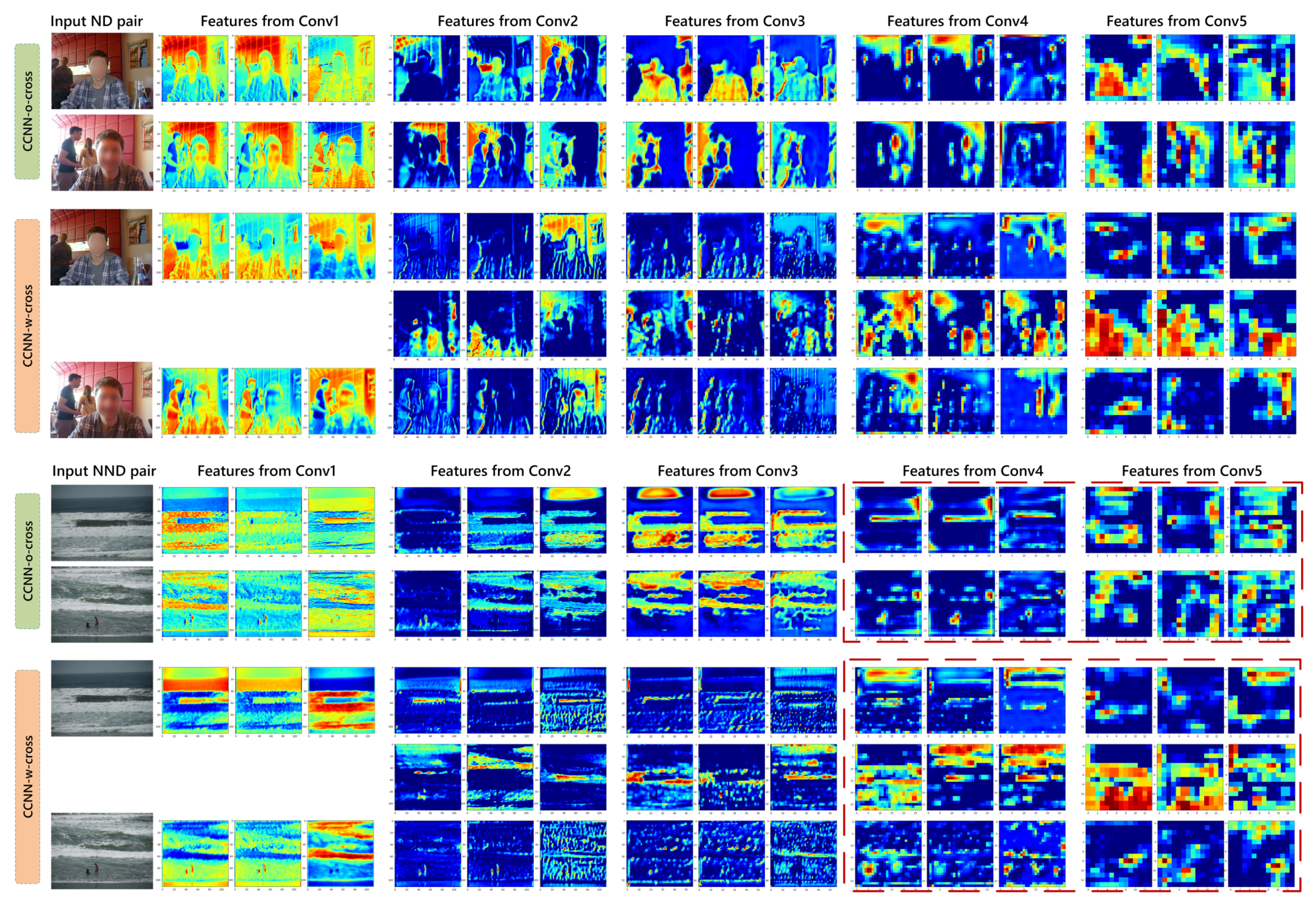
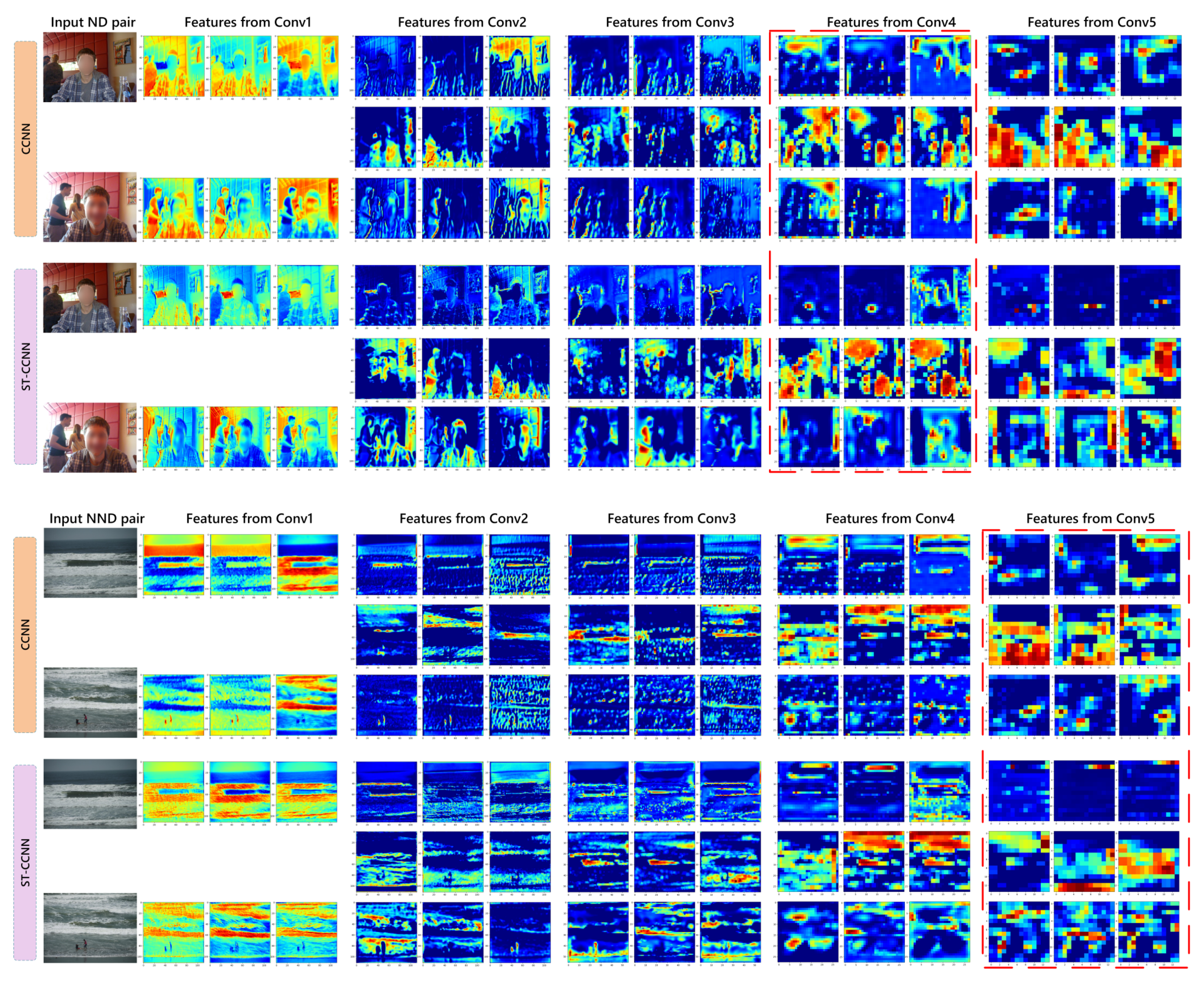
To better observe the network, in Figure 7, we visualize the output feature maps of each convolutional sets (represented as ‘Conv1–Conv5’) of a challenging ND pair and NND pair. The ND pair is within the foreground and background objects moving, while the NND pair is visually similar. It can be observed that, for the ND pair, CCNN-w-cross makes the feature maps in two image streams closer than CCNN-o-cross. For the NND pair, the feature maps of each image in deep layers of CCNN-o-cross are basically similar. This corresponds to the previous quantitative comparison that its recall is much higher than precision, while the feature maps in CCNN-w-cross image streams show greater discrimination than CCNN-o-cross.
Figure 7. Visualization of the first three slices feature maps on each convolutional set of networks with/without triple stream. As highlighted in the red dashed boxes, for visually similar non-near duplicate (NND) pair, which is easily predicted as near duplicate (ND) by CCNN-o-cross, CCNN-w-cross is able to capture more discriminative information of visually similar NND.

4.4.2. Effectiveness of Spatial Transformers

We implement ST-CCNN in with/without ST modules, presenting as CCNN versus ST-CCNN, based on VGG16 and ResNet34 on the challenging dataset CaliforniaND. The quantitative comparison in Table 6 indicates that, based on both backbones, the introduction of ST modules can significantly improve precision, (increase by 0.102 on VGG16 and 0.050 on ResNet34). For VGG16, ST modules tackle the problem of a high false alarm rate which the triple stream hardly deals with. Based on ResNet34, ST modules can help with the increase of 0.054 of recall. Thus, ST-CCNN based on ResNet34 achieves best among all comparing ablation models with F1-score at 0.958 and AUROC at 0.990.
Table 6. Ablation study of with/without ST on single modality datasets CaliforniaND.
The introduction of ST modules effectively deals with the false alarm problem that cross stream is difficult to solve, as shown in Table 7, based on both backbones, ST-CCNN’s precision scores are higher than recall scores. However, the recall of ST-CCNN based on VGG16 is obviously reduced, which may be due to the limited data and the VGG structure of continuously pooling. In addition, there is barely spatial transformations of the visually different identical targets from ND pairs from TNO. For the above reasons, ST modules lack guidance, which improves the precision of ND pairs, while reducing the detection rate at the same time. The use of ResNet solves this problem, with the injection of residual learning by shortcuts, retains high resolution features information appropriately, provides sufficient courage for adaptive self learning, and enables the recall and precision to maintain higher scores, thus achieving the top F1 score and AUROC value.
Table 7. Ablation study of with/without ST on single modality datasets TNO.
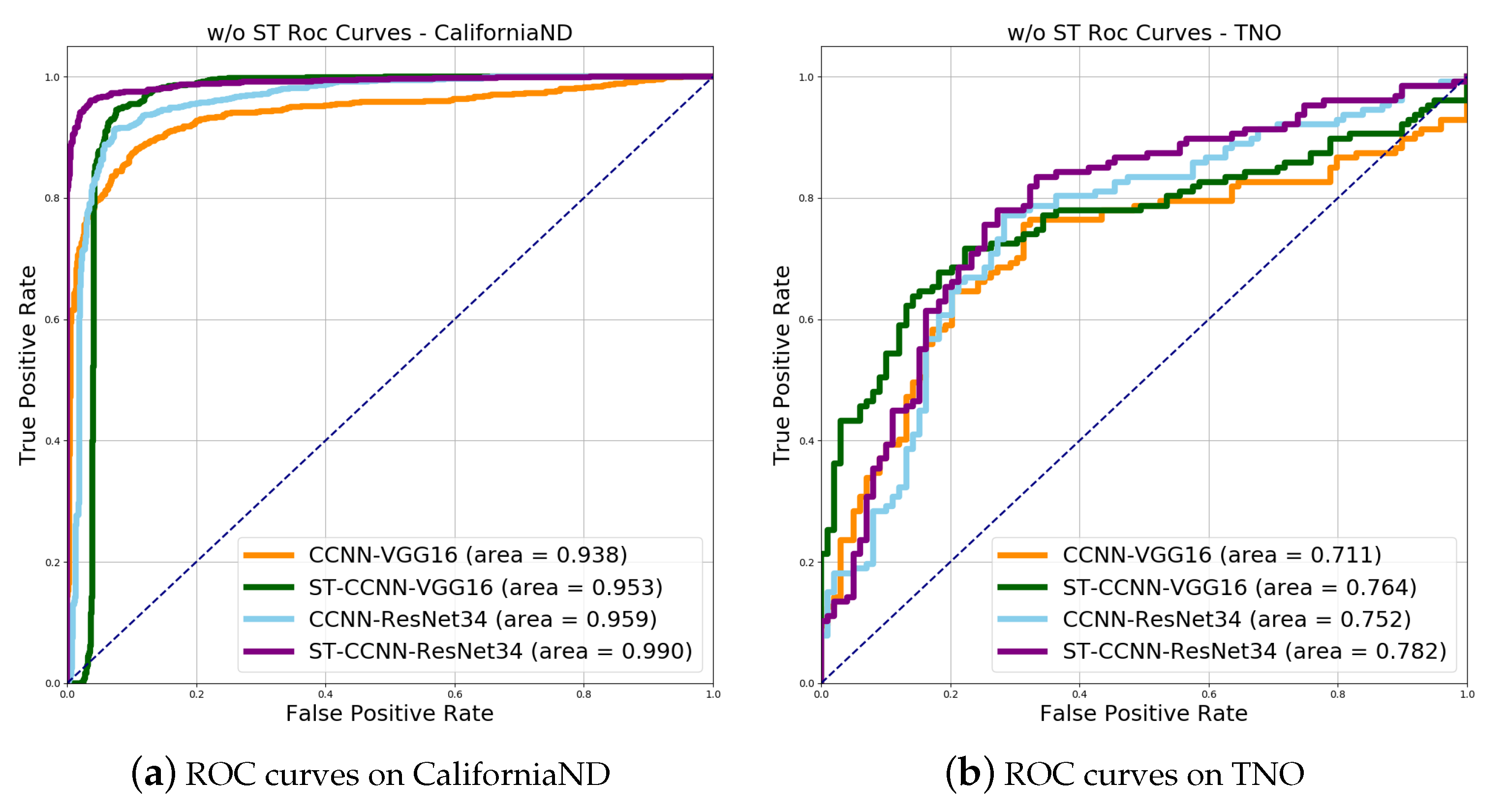
As shown in Figure 8, among networks with/without ST modules, under single-modality, the ROC curve of ST-CCNN based on ResNet is the closest to upper left corner and with the highest value of AUROC. The ST-CCNN based on VGG16 and CCNN based on ResNet34 achieve similar AUROC. The ST-CCNN based on VGG16 has higher TPR when they range similar FPR, which means its ND detection capability is higher than the CCNN based on ResNet34, while the probabilities predicted by CCNN based on ResNet34 are distributed near ground truth label {0, 1}, which enables it to achieve a similar AUROC at a slightly lower F1-score with ST-CCNN based on VGG16. While under cross-modality, though the ST-CCNN-ResNet34 reaches the highest AUROC value, it is not obviously closer to the upper left corner than other curves because ST-CCNN-VGG16 draws closest to y-axis, indicating a higher precision. Generally, ST-CCNNs present obvious advantages compared to networks without ST modules.
Figure 8. Illustration of ROC curves of networks with/without ST modules on single-modality and cross-modality. In both scenarios, ST-CCNN-based networks perform better than networks without ST modules.
The visualization of feature maps of networks with/without ST modules are illustrated in Figure 9. It can be observed that the changes in the ND pair showing is that the foreground male portrait has a slight pose change and zooming, and the background objects move and change. Compared with CCNN, as shown highlighted by a red dashed box, ST-CCNN performs proper transformation on the foreground object, making it more similar to the pose in the other input image. Meanwhile, the feature maps in the cross stream are more concentrated in the identical regions of the input images. For the visual similar challenging NND pair shown in the illustration, the deeper feature maps show that CCNN is able to capture discriminative information for non-duplicate, while the feature maps of image streams of ST-CCNN shows discrimination more obviously. The feature maps slices in the cross stream of ST-CCNN focused on the saliency regions of each image in the NND pair, which provides sufficient information for accurate classification of whether the pair is ND or NND.
Figure 9. Visualization of the first three slices feature maps on each convolutional set of networks with/without the ST modules. For the ND pair, as shown highlighted by red dashed box, cross stream feature maps of ST-CCNN are more concentrated in the identical regions with slight displacements and zooming of the ND pair. For the NND pair, the feature maps in image streams show more obvious discrimination and the feature maps slices in the cross stream capture more saliency regions of each image in the NND pair, which can provide greater capacity for accurate decisions on challenging pairs.

4.4.3. Effectiveness of Asymmetric ST Structure

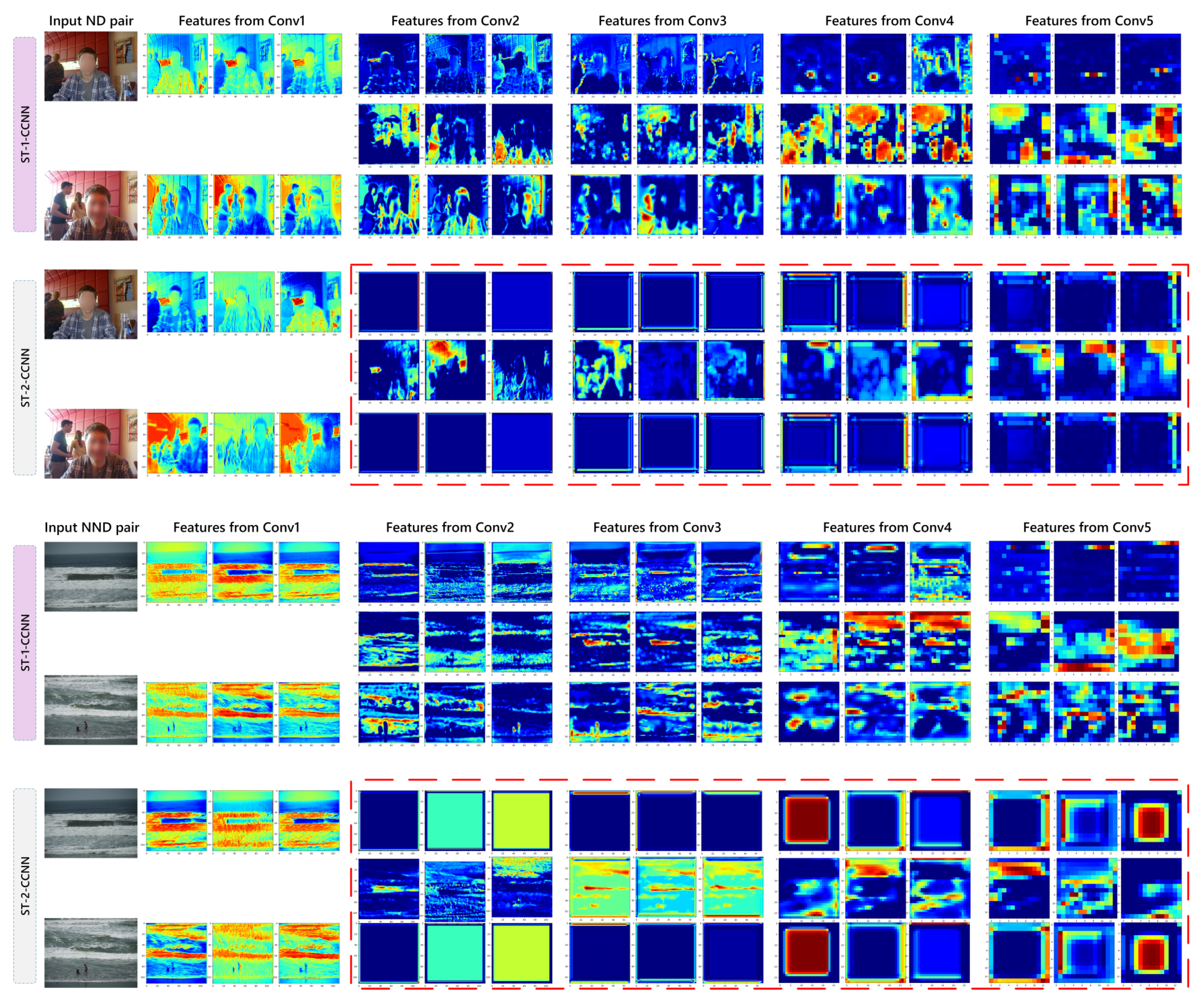
We implement ST-CCNN with a single image stream equipped with ST modules (ST-1-CCNN) and two image streams equipped with ST modules (ST-2-CCNN). In the experiments, it can be observed that, on ST-2-CCNN, whether or not the parallel ST modules share parameters, the recall scores are extremely high, while the precision scores are much lower than the recall. It indicates that the dual ST modules lead to a high false alarm rate. We visualized examples in Figure 10 to discuss it.
Figure 10. Visualization of the first three slices feature maps on each convolutional set of networks with ST modules on single/dual image stream. The dual here represents the CCNN equipped with parallel ST modules not sharing parameters.
As illustrated in Figure 10, we present the feature maps of single and dual ST-CCNN models. In order to simplify the expression, the ST-2-CCNN represents the ST-2-CCNN not sharing ST modules parameter, which performs relatively better in quantitative measurements among ST-2-CCNNs. It can be observed that, when ST-CCNN is dually equipped with ST modules, regardless of whether the input is an ND or NND pair, the feature maps of image streams tend to be equal. It leads to the fact that the effective feature extractions are mainly on the cross stream. However, the decision layers operate on the fusion of feature maps from image streams and cross stream, which makes the accuracy of ST-2-CCNN probably lower than the preliminary 2-channel architecture. The possible reason is that the training process of ST self-adaptive mechanism requires effective and sufficient guidance, while, in this task, the ground truth is a simple binary label. In the gradient backward process, if both image streams involve self-adaptive parameters, insufficient guidance may lead to the activation tending to be zero and being the same as each other, which reduces the binary classification precision.

5. Discussion

The existing methods rarely process image pairs jointly with well consideration of both low- and high- level features which can provide sufficient information for accurate near duplicate detection. In addition, the ND pairs are usually with spatial transformation of identical foreground or background objects, which has not been explicitly labeled. Based on these, we propose to perform an ST-CCNN to conduct the near duplicate image pairs detection task.
By comparing with state-of-the-art methods on AUROC, which can well measure the binary classification abilities of models, it proves the effectiveness of our proposed network, especially on the more challenging datasets. Such challenging data is mainly reflected in the identical targets displacement, scaling, rotation, etc., of the foreground or background, which leads to obvious shortcomings in existing methods. The advantages of our proposed model may benefit from the introduction of the cross stream to fuse low- and high- level features gradually, while considering the near range displacements. Moreover, the potential correlation within the image pairs is learned by the self-adaptive ST-modules to strengthen the model discrimination capturing abilities on ND pairs with spatial changes and visually similar NND pairs, so as to make the model superior to other models.
It is worth mentioning that the ST modules increase a certain number of parameters; thus, it requires sufficient data support in the process of self-adaptive learning, which has obvious limitations on its flexibility and learning capability. How to solve this problem in future research is worth addressing. The possible direction could include intensive learning, weakly supervised learning, in recent years, and so on.

6. Conclusions

In this work, an ST-CCNN model is proposed to conduct the single-modality and cross-modality near duplicate image pairs detection. Specifically, a triple-stream network is applied to fuse multi-scale features gradually, which allows the model to process images from a pair jointly and provides more capacity for learning the correlation between images. In addition, the self-adaptive ST modules are introduced to address the spatial transformations which are not explicitly labeled. Our model achieves superior performance on three benchmark datasets compared with state-of-the-art methods, especially on the challenging dataset CaliforniaND which contains various spatial transformations of the identical objects within ND pairs and the visually similar NND pairs. In the future, to deal with the insufficient training data and further improve the performance, we will study weakly supervised learning methods and plan to use other more powerful network structures.

Author Contributions

Conceptualization, Y.Z. (Yi Zhang); methodology, Y.Z. (Yi Zhang); experiments implementation, Y.Z. (Yi Zhang); experiments design, Y.Z. (Yi Zhang), Y.L., S.Z.; formal analysis, Y.Z. (Yi Zhang) and Y.L.; investigation, Y.Z. (Yi Zhang); writing—original draft preparation, Y.Z. (Yi Zhang); writing—review and editing, S.Z. and Y.L.; visualization, Y.Z. (Yi Zhang); supervision, Y.Z. (Yanning Zhang). All authors have read and agreed to the published version of the manuscript.

Funding

This work is supported by the National Natural Science Foundation of China under Grants U19B2037.

Institutional Review Board Statement

Not applicable.

Data Availability Statement

All real world images appearing in the manuscript are from open access databases.

Acknowledgments

We sincerely appreciate the editors and reviewers give their helpful comments and constructive suggestions.

Conflicts of Interest

The authors declare no conflict of interest.

Abbreviations

The following abbreviations are used in this manuscript:
CNNconvolutional neural networks
STspatial transformer
ST-CCNNspatial transformer comparing CNN
SIFTscale-invariant feature transform
HOGhistograms of oriented gradients
VLADvector of locally aggregated descriptors
PCA-SIFTprincipal component analysis scale-invariant feature transform
LSHlocality-sensitive hashing
BoWbag-of-word
ROIregions of interest
ARGattributed relational graph
GVPgeometry-preserving visual phrases
MOPmulti-scale orderless pooling
MOFmulti-layer orderless fusion
CNNHconvolutional neural network hashing
PCAprinciple components analysis
SPoCsum-pooled convolutional
RPNregion proposal network
NDnear duplicate
NNDnon-near duplicate
TPtrue positive
TNtrue negative
FPfalse positive
FNfalse negative
MFNDmir-Flickr near duplicate
ROCreceiver operating characteristic
AUCArea Under Curve
AUROCarea under receiver operating characteristic

References

  1. Thyagharajan, K.; Kalaiarasi, G. A Review on Near-Duplicate Detection of Images using Computer Vision Techniques. Arch. Comput. Methods Eng. 2020, 1–20. [Google Scholar] [CrossRef]
  2. Morra, L.; Lamberti, F. Benchmarking unsupervised near-duplicate image detection. Expert Syst. Appl. 2019, 135, 313–326. [Google Scholar] [CrossRef]
  3. Jinda-Apiraksa, A.; Vonikakis, V.; Winkler, S. California-ND: An annotated dataset for near-duplicate detection in personal photo collections. In Proceedings of the 2013 Fifth International Workshop on Quality of Multimedia Experience (QoMEX), Wörthersee, Austria, 3–5 July 2013; pp. 142–147. [Google Scholar] [CrossRef]
  4. Connor, R.; MacKenzie-Leigh, S.; Cardillo, F.A.; Moss, R. Identification of MIR-Flickr near-duplicate images: A benchmark collection for near-duplicate detection. In Proceedings of the 10th International Conference on Computer Vision Theory and Applications (VISAPP 2015), Berlin, Germany, 11–14 March 2015; pp. 565–571. [Google Scholar]
  5. Lowe, D.G. Distinctive Image Features from Scale-Invariant Keypoints. Int. J. Comput. Vis. 2004, 60, 91–110. [Google Scholar] [CrossRef]
  6. Dalal, N.; Triggs, B. Histograms of oriented gradients for human detection. In Proceedings of the 2005 IEEE Computer Society Conference on Computer Vision and Pattern Recognition (CVPR’05), San Diego, CA, USA, 20–26 June 2005; Volume 1, pp. 886–893. [Google Scholar] [CrossRef]
  7. Jégou, H.; Perronnin, F.; Douze, M.; Sánchez, J.; Pérez, P.; Schmid, C. Aggregating Local Image Descriptors into Compact Codes. IEEE Trans. Pattern Anal. Mach. Intell. 2012, 34, 1704–1716. [Google Scholar] [CrossRef] [PubMed]
  8. Perronnin, F.; Dance, C. Fisher Kernels on Visual Vocabularies for Image Categorization. In Proceedings of the 2007 IEEE Conference on Computer Vision and Pattern Recognition, Minneapolis, MN, USA, 18–23 June 2007; pp. 1–8. [Google Scholar] [CrossRef]
  9. Mikolajczyk, K.; Schmid, C. Scale & Affine Invariant Interest Point Detectors. Int. J. Comput. Vis. 2004, 60, 63–86. [Google Scholar] [CrossRef]
  10. Ke, Y.; Sukthankar, R.; Huston, L. Efficient near-duplicate detection and sub-image retrieval. In Proceedings of the ACM International Conference on Multimedia (MM), New York, NY, USA, 10–16 October 2004; Volume 4, p. 5. [Google Scholar]
  11. Zhang, S.; Tian, Q.; Lu, K.; Huang, Q.; Gao, W. Edge-SIFT: Discriminative Binary Descriptor for Scalable Partial-Duplicate Mobile Search. IEEE Trans. Image Process. 2013, 22, 2889–2902. [Google Scholar] [CrossRef] [PubMed]
  12. Zhang, D.Q.; Chang, S.F. Detecting Image Near-duplicate by Stochastic Attributed Relational Graph Matching with Learning. In Proceedings of the 12th Annual ACM International Conference on Multimedia, MULTIMEDIA ’04, New York, NY, USA, 10–16 October 2004; pp. 877–884. [Google Scholar] [CrossRef]
  13. Xu, D.; Cham, T.J.; Yan, S.; Duan, L.; Chang, S.F. Near Duplicate Identification With Spatially Aligned Pyramid Matching. IEEE Trans. Circuits Syst. Video Technol. 2010, 20, 1068–1079. [Google Scholar] [CrossRef]
  14. Zhang, Y.; Jia, Z.; Chen, T. Image retrieval with geometry-preserving visual phrases. In Proceedings of the 2011 IEEE Computer Society Conference on Computer Vision and Pattern Recognition (CVPR), Colorado Springs, CO, USA, 21–23 June 2011; pp. 809–816. [Google Scholar] [CrossRef]
  15. Chum, O.; Philbin, J.; Zisserman, A. Near Duplicate Image Detection: Min-Hash and tf-idf Weighting. In Proceedings of the British Machine Vision Conference, Leeds, UK, 1–4 September 2008; pp. 50.1–50.10. [Google Scholar] [CrossRef]
  16. Zhao, W.L.; Ngo, C.W. Scale-Rotation Invariant Pattern Entropy for Keypoint-Based Near-Duplicate Detection. IEEE Trans. Image Process. 2009, 18, 412–423. [Google Scholar] [CrossRef] [PubMed]
  17. Zheng, L.; Wang, S.; Tian, Q. Coupled Binary Embedding for Large-Scale Image Retrieval. IEEE Trans. Image Process. 2014, 23, 3368–3380. [Google Scholar] [CrossRef] [PubMed]
  18. Wan, J.; Wang, D.; Hoi, S.C.H.; Wu, P.; Zhu, J.; Zhang, Y.; Li, J. Deep Learning for Content-Based Image Retrieval: A Comprehensive Study. In Proceedings of the 22Nd ACM International Conference on Multimedia, MM ’14, Orlando, FL, USA, 3–7 November 2014; pp. 157–166. [Google Scholar] [CrossRef]
  19. Babenko, A.; Slesarev, A.; Chigorin, A.; Lempitsky, V. Neural Codes for Image Retrieval. In Computer Vision—ECCV 2014: 13th European Conference, Zurich, Switzerland, 6–12 September 2014; Proceedings, Part I; Fleet, D., Pajdla, T., Schiele, B., Tuytelaars, T., Eds.; Springer International Publishing: Cham, Switzerland, 2014; pp. 584–599. [Google Scholar] [CrossRef]
  20. Gong, Y.; Wang, L.; Guo, R.; Lazebnik, S. Multi-scale Orderless Pooling of Deep Convolutional Activation Features. In Computer Vision—ECCV 2014: 13th European Conference, Zurich, Switzerland, 6–12 September 2014; Proceedings, Part VII; Fleet, D., Pajdla, T., Schiele, B., Tuytelaars, T., Eds.; Springer International Publishing: Cham, Switzerland, 2014; pp. 392–407. [Google Scholar] [CrossRef]
  21. Mopuri, K.R.; Babu, R.V. Object level deep feature pooling for compact image representation. In Proceedings of the 2015 IEEE Conference on Computer Vision and Pattern Recognition Workshops (CVPRW), Boston, MA, USA, 8–10 June 2015; pp. 62–70. [Google Scholar] [CrossRef]
  22. Xie, L.; Hong, R.; Zhang, B.; Tian, Q. Image Classification and Retrieval Are ONE. In Proceedings of the 5th ACM on International Conference on Multimedia Retrieval, ICMR ’15, Shanghai, China, 23–26 June 2015; pp. 3–10. [Google Scholar] [CrossRef]
  23. Zheng, L.; Wang, S.; Wang, J.; Tian, Q. Accurate Image Search with Multi-Scale Contextual Evidences. Int. J. Comput. Vis. 2016, 120, 1–13. [Google Scholar] [CrossRef]
  24. Yan, K.; Wang, Y.; Liang, D.; Huang, T.; Tian, Y. CNN vs. SIFT for Image Retrieval: Alternative or Complementary? In Proceedings of the 2016 ACM on Multimedia Conference, MM ’16, Amsterdam, The Netherlands, 15–19 October 2016; pp. 407–411. [Google Scholar] [CrossRef]
  25. Babenko, A.; Lempitsky, V. Aggregating local deep features for image retrieval. In Proceedings of the IEEE International Conference on Computer Vision, Santiago, Chile, 7–13 December 2015; pp. 1269–1277. [Google Scholar]
  26. Lai, H.; Pan, Y.; Liu, Y.; Yan, S. Simultaneous feature learning and hash coding with deep neural networks. In Proceedings of the 2015 IEEE Conference on Computer Vision and Pattern Recognition (CVPR), Boston, MA, USA, 8–10 June 2015; pp. 3270–3278. [Google Scholar] [CrossRef]
  27. Zhao, F.; Huang, Y.; Wang, L.; Tan, T. Deep Semantic Ranking Based Hashing for Multi-Label Image Retrieval. In Proceedings of the IEEE Conference on Computer Vision and Pattern Recognition (CVPR), Boston, MA, USA, 8–10 June 2015. [Google Scholar]
  28. Li, Y.; Kong, X.; Zheng, L.; Tian, Q. Exploiting Hierarchical Activations of Neural Network for Image Retrieval. In Proceedings of the 2016 ACM on Multimedia Conference, Amsterdam, The Netherlands, 15–19 October 2016; pp. 132–136. [Google Scholar]
  29. Xia, R.; Pan, Y.; Lai, H.; Liu, C.; Yan, S. Supervised Hashing for Image Retrieval via Image Representation Learning. In Proceedings of the Twenty-Eighth AAAI Conference on Artificial Intelligence, AAAI’14, Québec City, QC, Canada, 27–31 July 2014; pp. 2156–2162. [Google Scholar]
  30. Luo, W.; Schwing, A.G.; Urtasun, R. Efficient Deep Learning for Stereo Matching. In Proceedings of the 2016 IEEE Conference on Computer Vision and Pattern Recognition (CVPR), Las Vegas, NV, USA, 26 June–1 July 2016; pp. 5695–5703. [Google Scholar] [CrossRef]
  31. Altwaijry, H.; Trulls, E.; Hays, J.; Fua, P.; Belongie, S. Learning to Match Aerial Images with Deep Attentive Architectures. In Proceedings of the 2016 IEEE Conference on Computer Vision and Pattern Recognition (CVPR), Las Vegas, NV, USA, 26 June–1 July 2016; pp. 3539–3547. [Google Scholar] [CrossRef]
  32. Žbontar, J.; LeCun, Y. Computing the stereo matching cost with a convolutional neural network. In Proceedings of the 2015 IEEE Conference on Computer Vision and Pattern Recognition (CVPR), Boston, MA, USA, 8–10 June 2015; pp. 1592–1599. [Google Scholar] [CrossRef]
  33. Žbontar, J.; LeCun, Y. Stereo Matching by Training a Convolutional Neural Network to Compare Image Patches. J. Mach. Learn. Res. 2016, 17, 2287–2318. [Google Scholar]
  34. Jaderberg, M.; Simonyan, K.; Zisserman, A.; Kavukcuoglu, K. Spatial Transformer Networks. In Proceedings of the Advances in Neural Information Processing Systems 28, Palais des Congrès de Montréal, Montréal, QC, Canada, 7–12 December 2015; Cortes, C., Lawrence, N.D., Lee, D.D., Sugiyama, M., Garnett, R., Eds.; Curran Associates, Inc.: Red Hook, NY, USA, 2015; pp. 2017–2025. [Google Scholar]
  35. Zhang, R.; Lin, L.; Zhang, R.; Zuo, W.; Zhang, L. Bit-Scalable Deep Hashing With Regularized Similarity Learning for Image Retrieval and Person Re-Identification. IEEE Trans. Image Process. 2015, 24, 4766–4779. [Google Scholar] [CrossRef] [PubMed]
  36. Zagoruyko, S.; Komodakis, N. Learning to compare image patches via convolutional neural networks. In Proceedings of the 2015 IEEE Conference on Computer Vision and Pattern Recognition (CVPR), Boston, MA, USA, 8–10 June 2015; pp. 4353–4361. [Google Scholar] [CrossRef]
  37. Gordo, A.; Almazán, J.; Revaud, J.; Larlus, D. Deep image retrieval: Learning global representations for image search. In Proceedings of the European Conference on Computer Vision, Amsterdam, The Netherlands, 10–16 October 2016; pp. 241–257. [Google Scholar]
  38. Liu, J.; Huang, Z.; Cai, H.; Shen, H.T.; Ngo, C.W.; Wang, W. Near-duplicate Video Retrieval: Current Research and Future Trends. ACM Comput. Surv. 2013, 45, 44:1–44:23. [Google Scholar] [CrossRef]
  39. Zhang, Y.; Zhang, Y.; Sun, J.; Li, H.; Zhu, Y. Learning Near Duplicate Image Pairs using Convolutional Neural Networks. Int. J. Perform. Eng. 2018, 14, 168. [Google Scholar] [CrossRef][Green Version]
  40. Revaud, J.; Weinzaepfel, P.; Harchaoui, Z.; Schmid, C. DeepMatching: Hierarchical Deformable Dense Matching. Int. J. Comput. Vis. 2016, 120, 300–323. [Google Scholar] [CrossRef]
  41. Toet, A. The TNO Multiband Image Data Collection. Data Brief 2017, 15, 249–251. [Google Scholar] [CrossRef] [PubMed]
  42. Zhou, B.; Lapedriza, A.; Xiao, J.; Torralba, A.; Oliva, A. Learning deep features for scene recognition using places database. In Proceedings of the Advances in Neural Information Processing Systems, Montreal, QC, Canada, 8–13 December 2014; pp. 487–495. [Google Scholar]
  43. Deng, J.; Dong, W.; Socher, R.; Li, L.; Kai, L.; Li, F.-F. ImageNet: A large-scale hierarchical image database. In Proceedings of the 2009 IEEE Conference on Computer Vision and Pattern Recognition, Miami, FL, USA, 20–25 June 2009; pp. 248–255. [Google Scholar] [CrossRef]
Publisher’s Note: MDPI stays neutral with regard to jurisdictional claims in published maps and institutional affiliations.

Article Metrics

Citations

Article Access Statistics

Multiple requests from the same IP address are counted as one view.