A Stackelberg Game-Based Caching Incentive Scheme for Roadside Units in VANETs

Abstract
1. Introduction
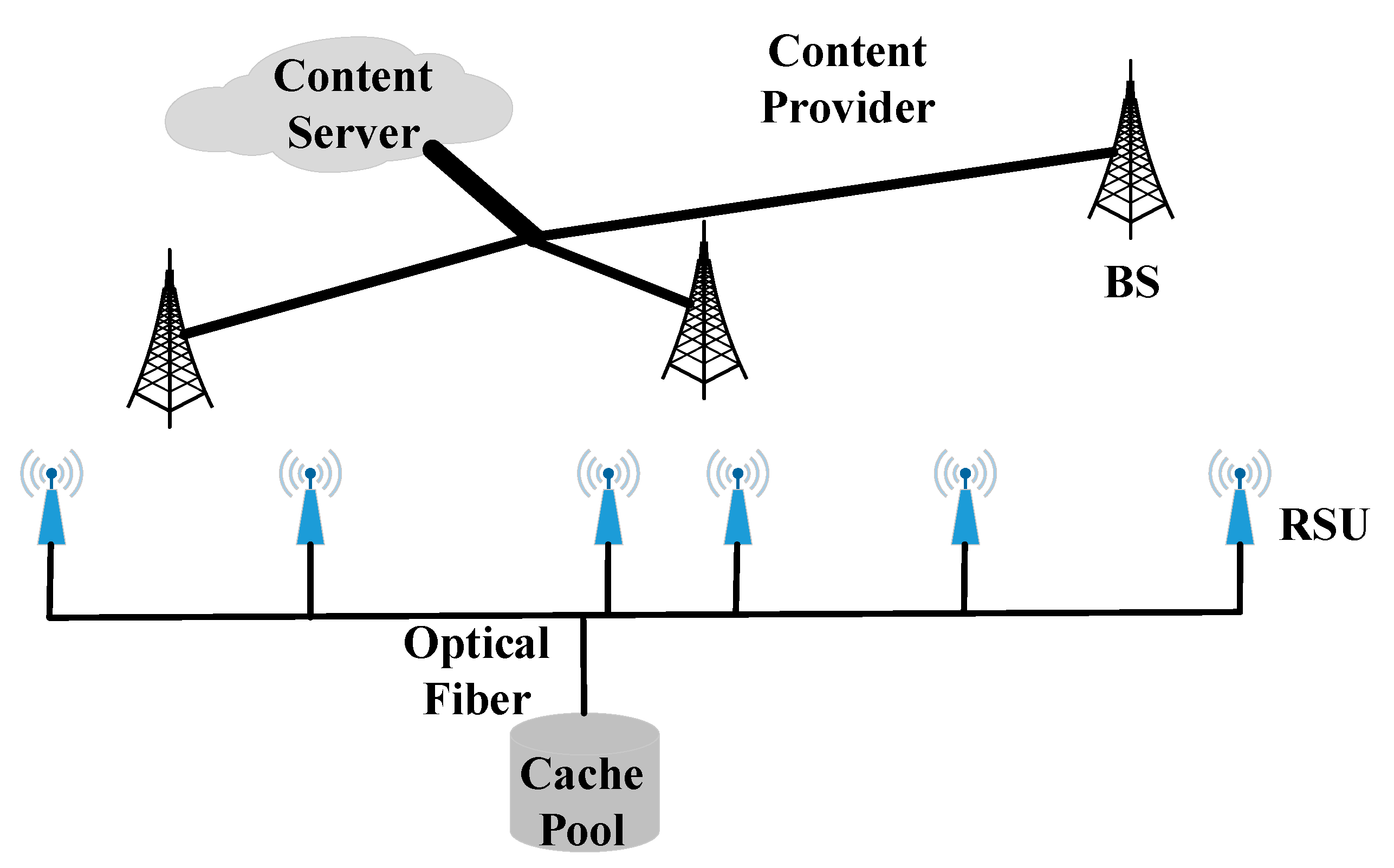
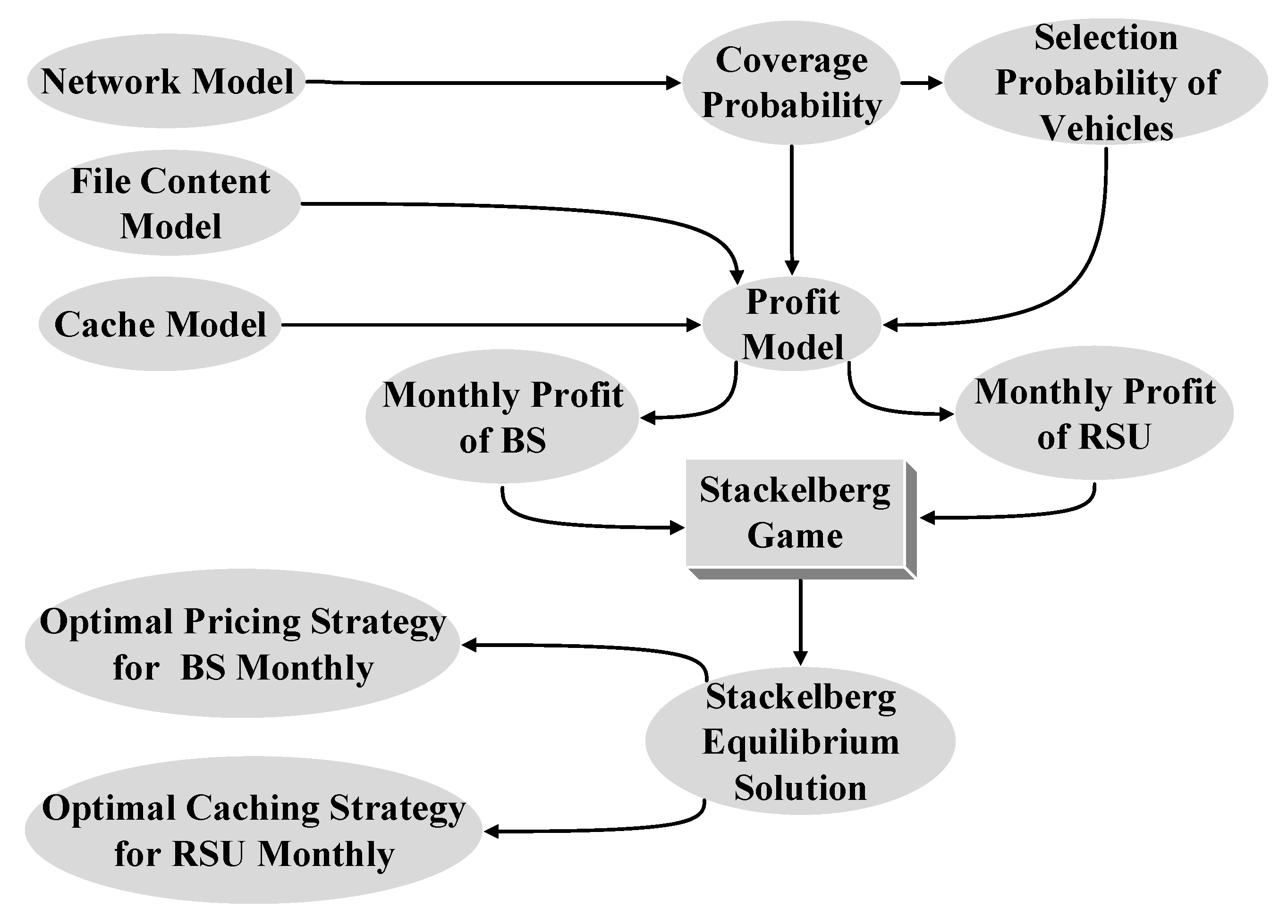
- We propose a Stackelberg game-based caching incentive scheme for the RSU in VANETs. Both BS and RSU can deliver content to moving vehicles alone to obtain profit. The moving vehicles can make a choice of downloading content from BS or RSU based on the received signal-to-interference-plus-noise ratio (SINR).
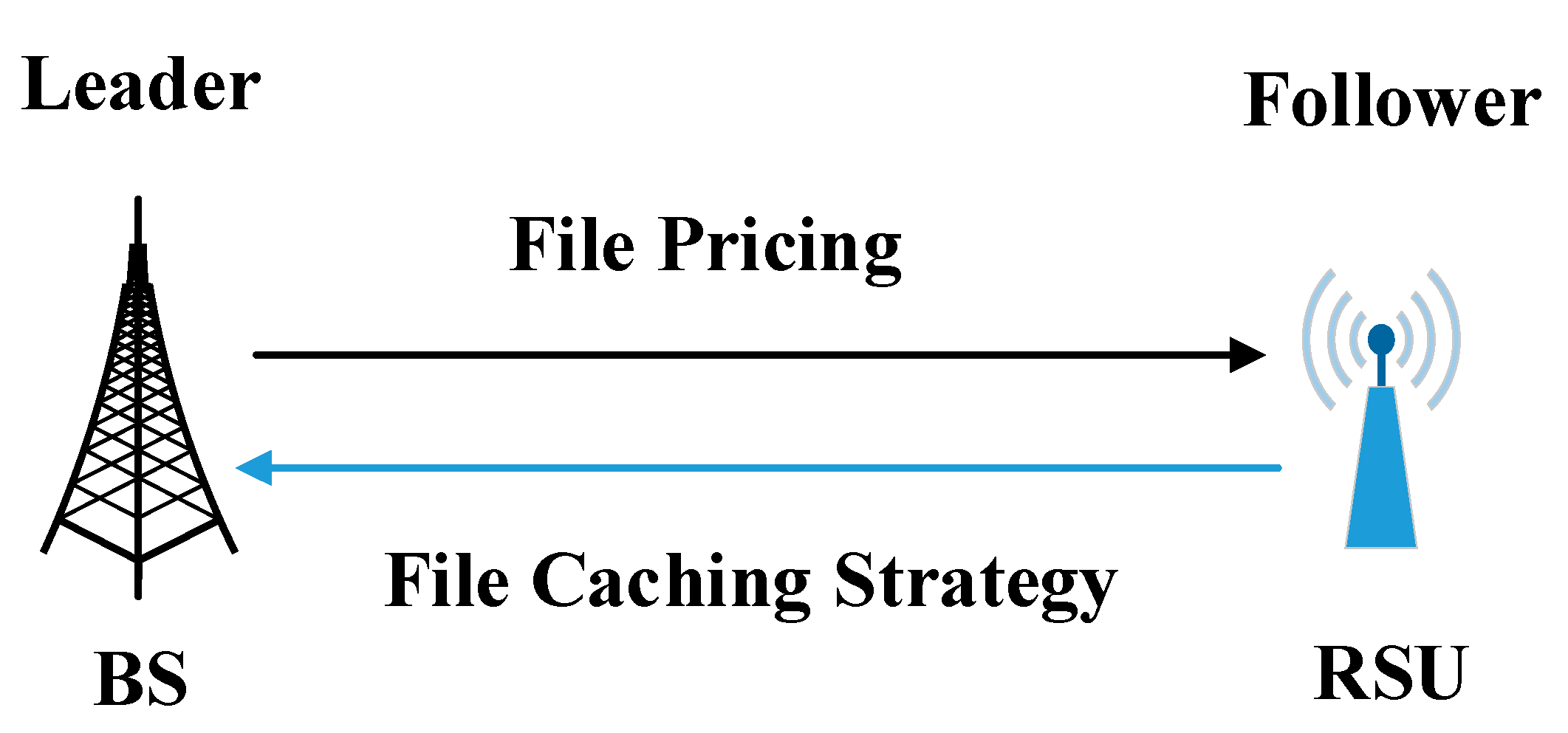
- Based on the Stackelberg game, a model is given to show the interaction among the BS and the RSU. A backward introduction method is introduced to solve the Stackelberg equilibrium. Based on the established profit models of both BS and RSU, we first solve the optimal caching scheme of RSU w.r.t. the price determined by the BS. Then, based on the scheme, we solve the optimal pricing strategy of the BS. Finally, the Stackelberg equilibrium solution can be obtained.
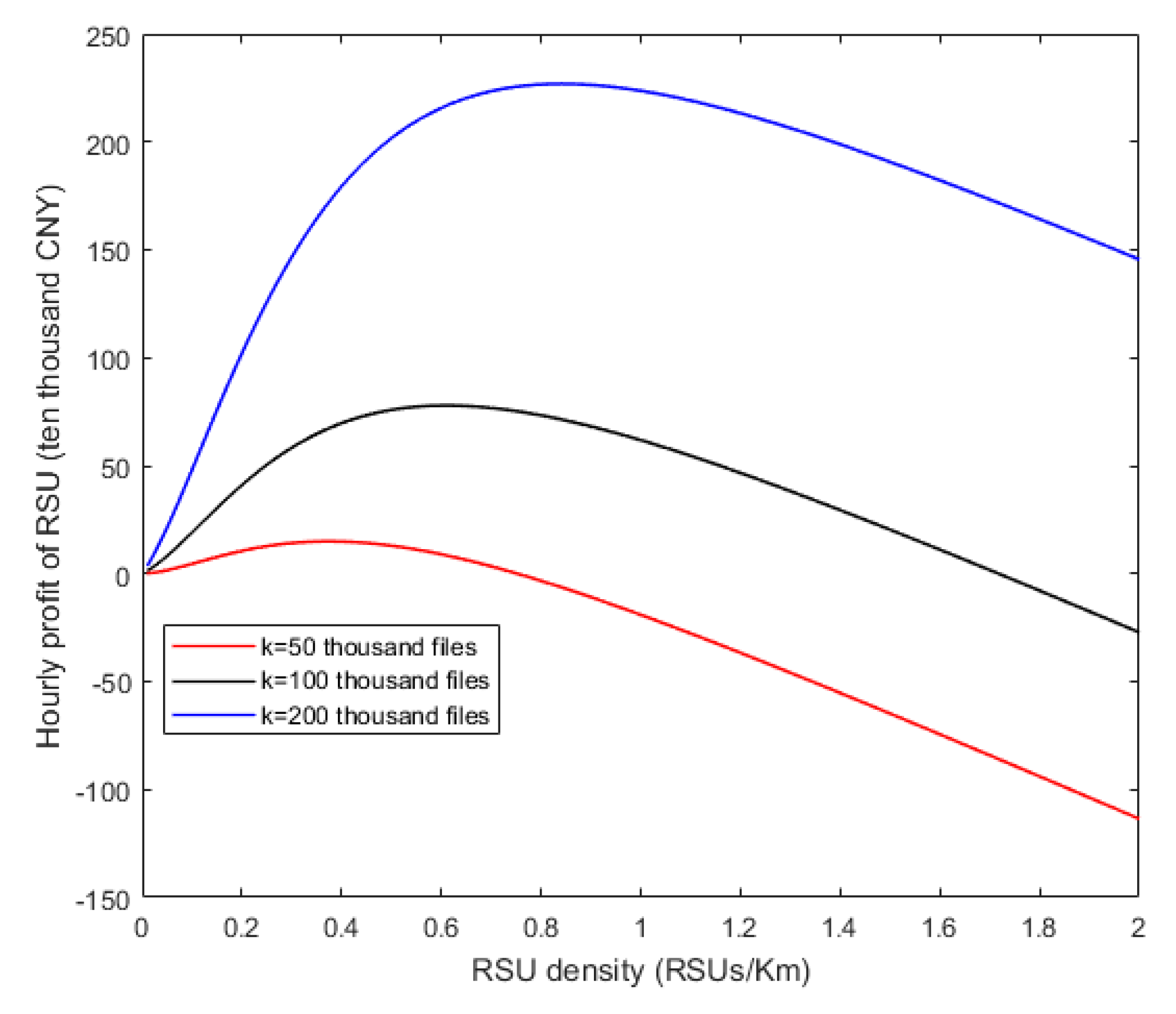
- The operation state adjustment scheme of RSUs within a day is designed. Based on the above, work and the running cost of RSUs is further considered. After analyzing the established one-hour profit model of RSUs, the optimal activity density of RSUs at different hours can be obtained.
2. System Model
2.1. Network Model
2.2. File Content Model
2.3. Caching Model
2.4. Effective Service Coverage Probability
2.4.1. Coverage Probabilities of Cellular Network and VANET
2.4.2. Coverage Probability of the Heterogeneous Network
2.4.3. Operator Selection of Moving Vehicles
3. Caching Incentive Scheme of RSU
3.1. Stackelberg Game
3.2. Profit Models of BS and RSU
3.3. Stackelberg Equilibrium Solution
3.3.1. Profit Analysis of RSU
3.3.2. Profit Analysis of BS
- (1)
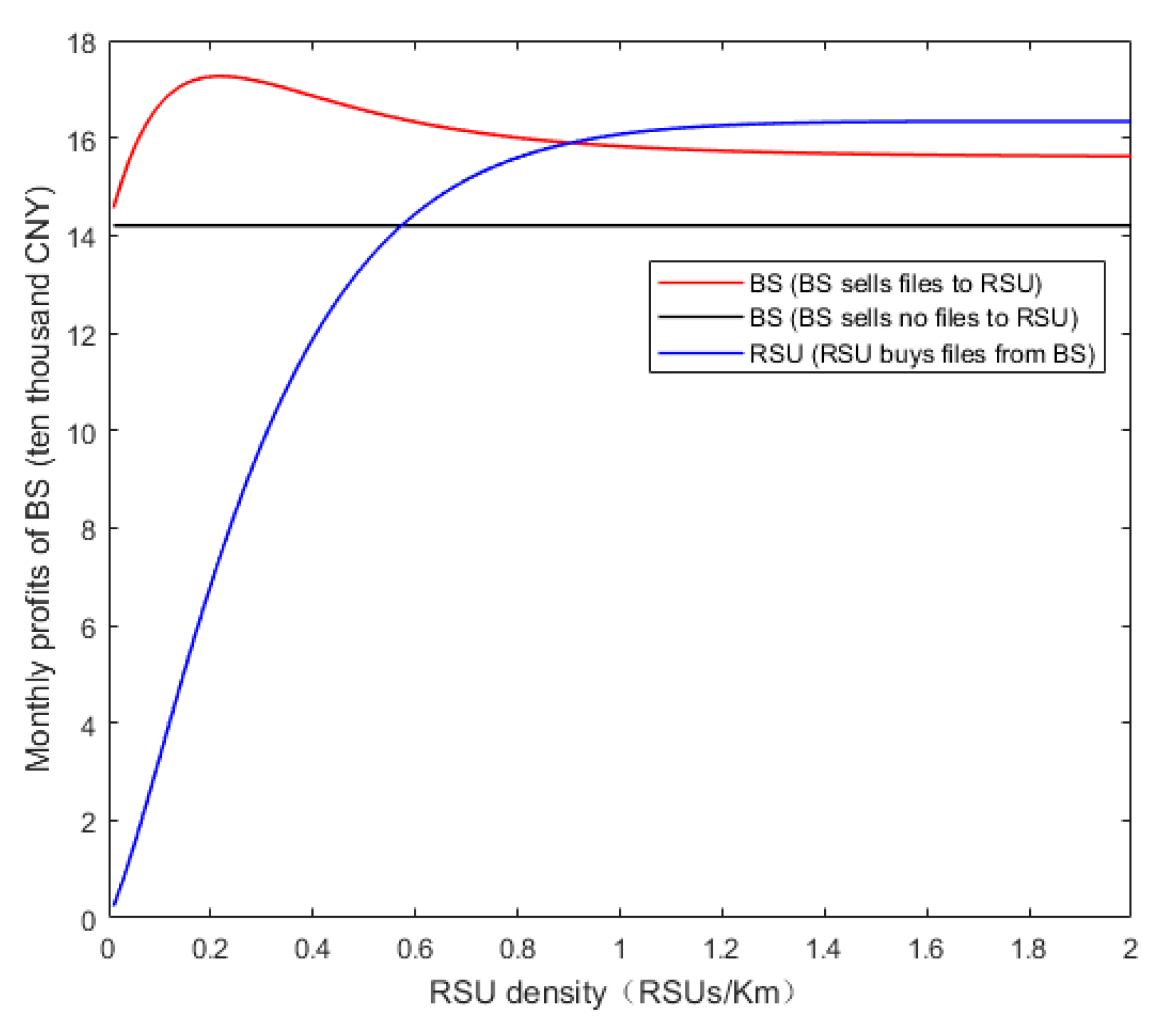
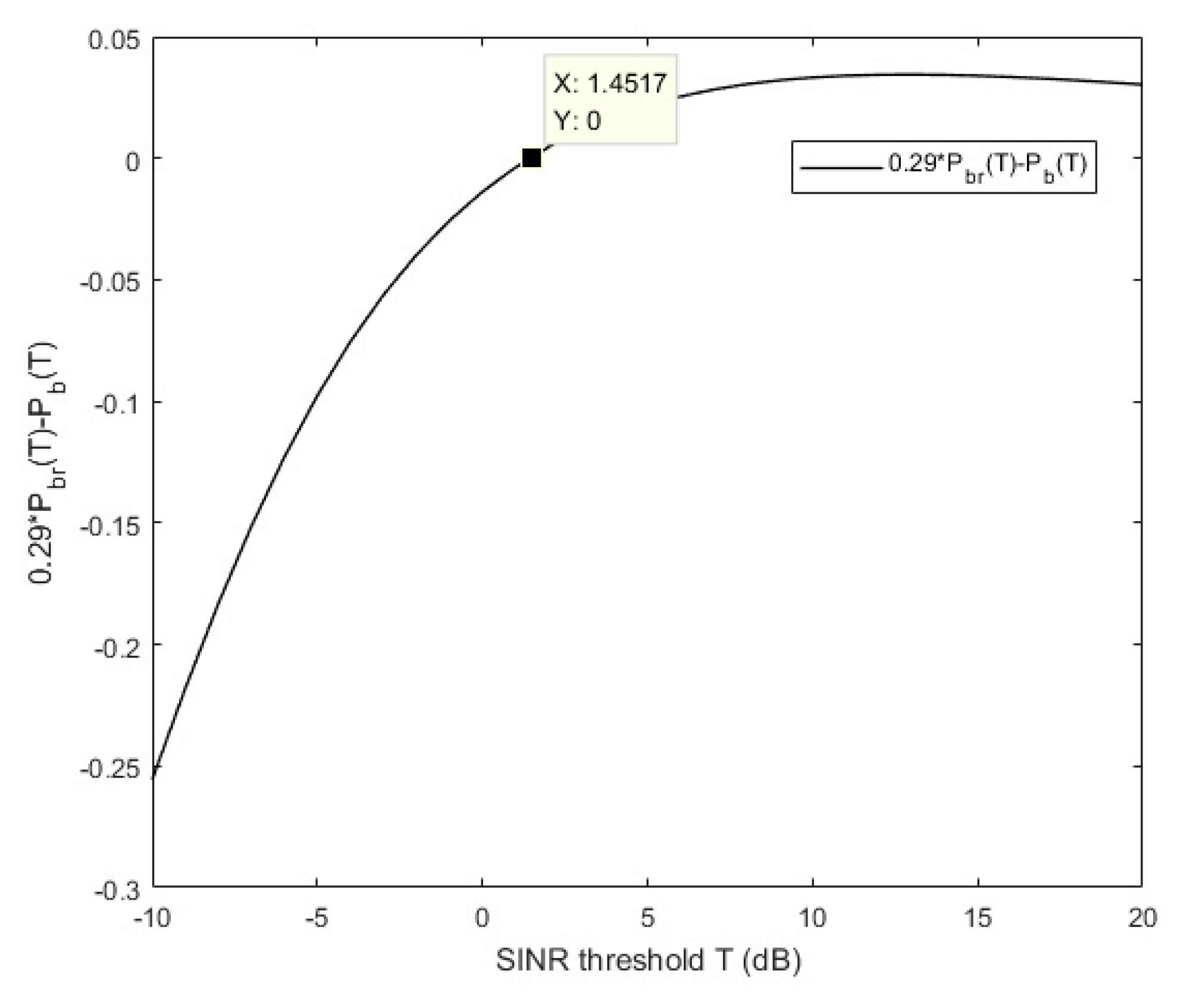
- When , can be obtained. Since decreases monotonically w.r.t., can be maximized by . This demonstrates that if the coverage probability of the heterogeneous network is not large enough, it leads to lower the total profit of BS after RSU caches files. Therefore, the BS sets a large value of and forbids the RSU from caching any file.
- (2)
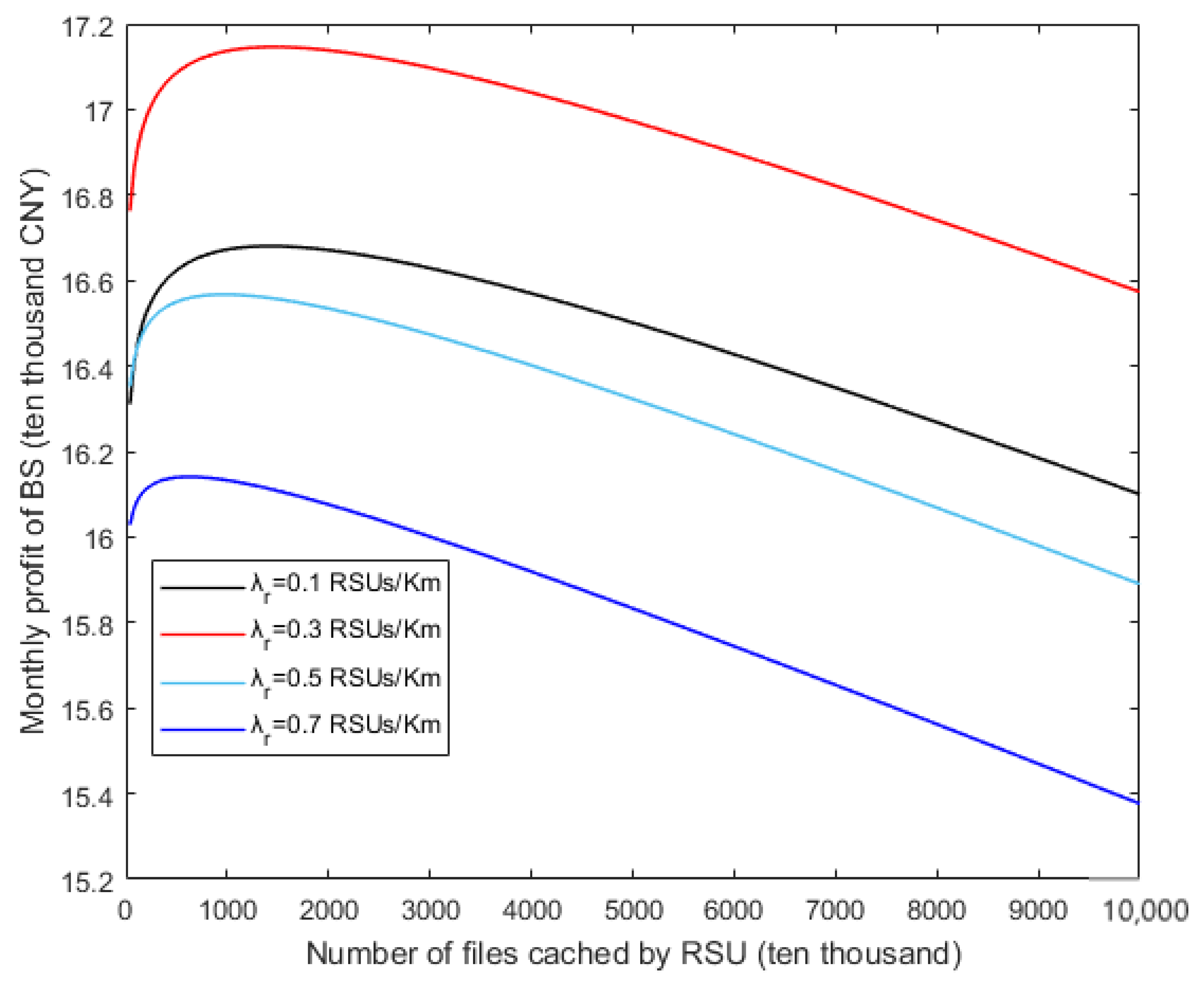
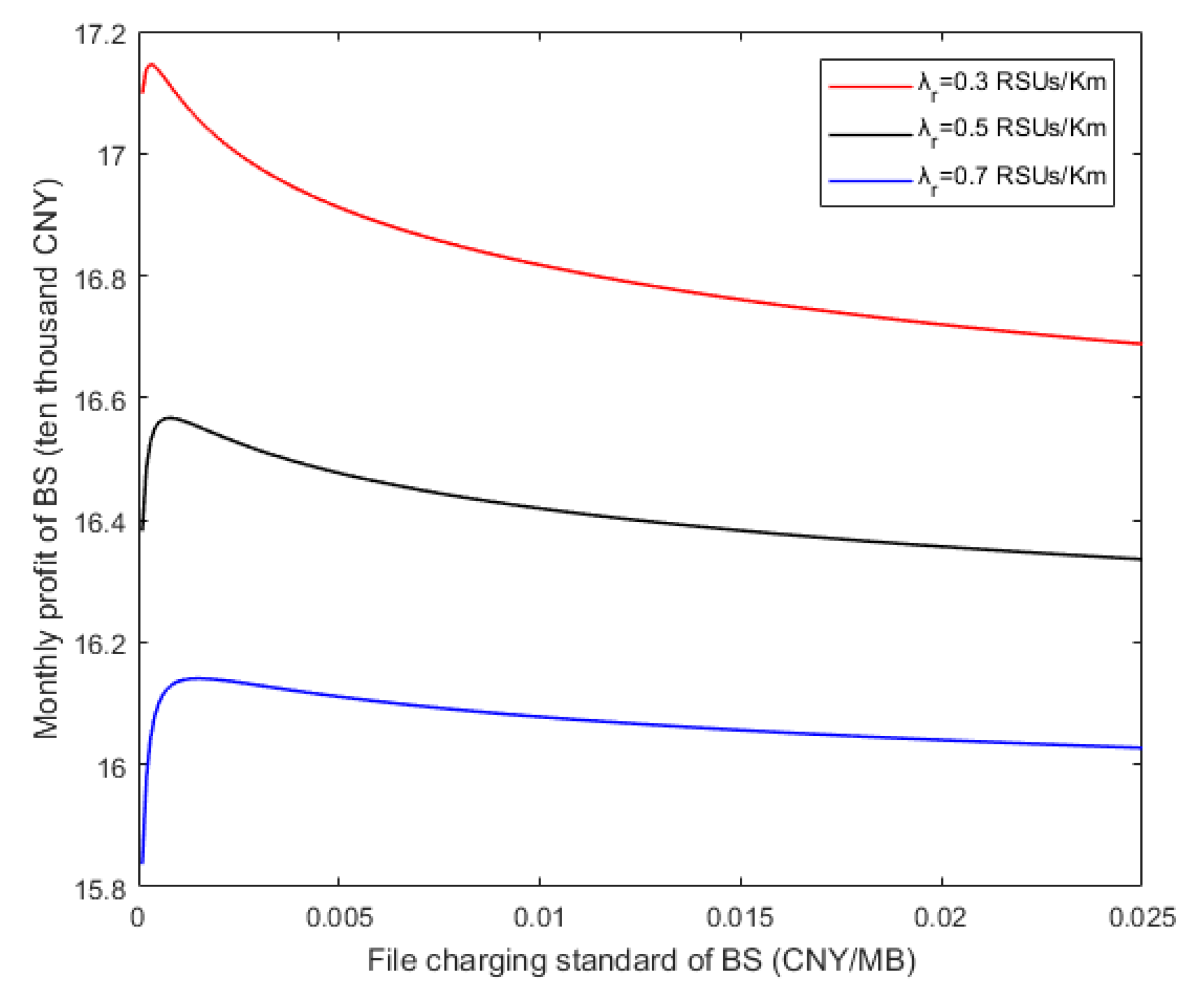
- When , can be obtained as well as and . Therefore, is a strictly concave function w.r.t. and the maximum exists. Let , the optimal strategy of RSU is
3.3.3. Changes of File Popularity
4. Operation State Adjustment for RSUs
5. Validation of the Proposed Scheme
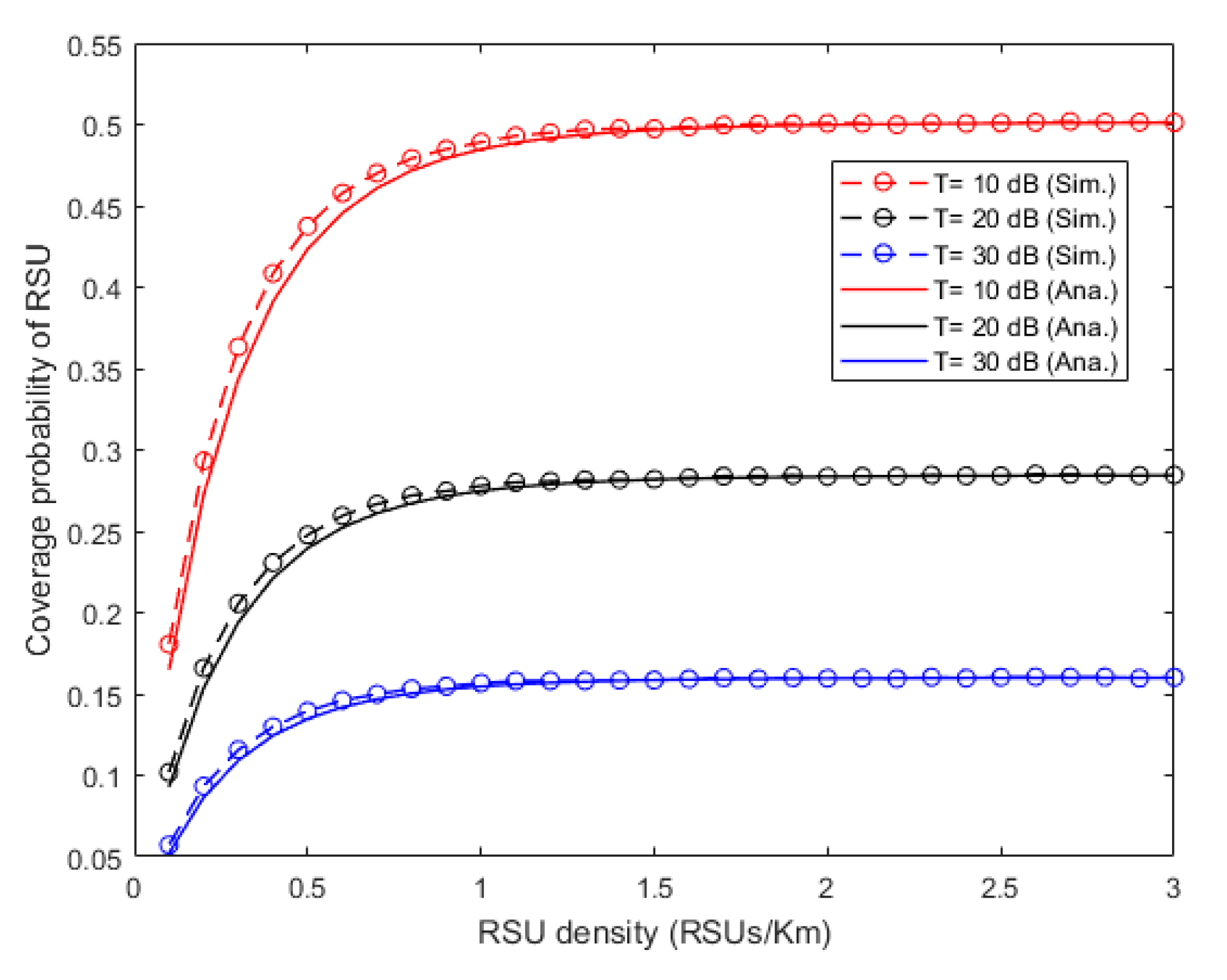
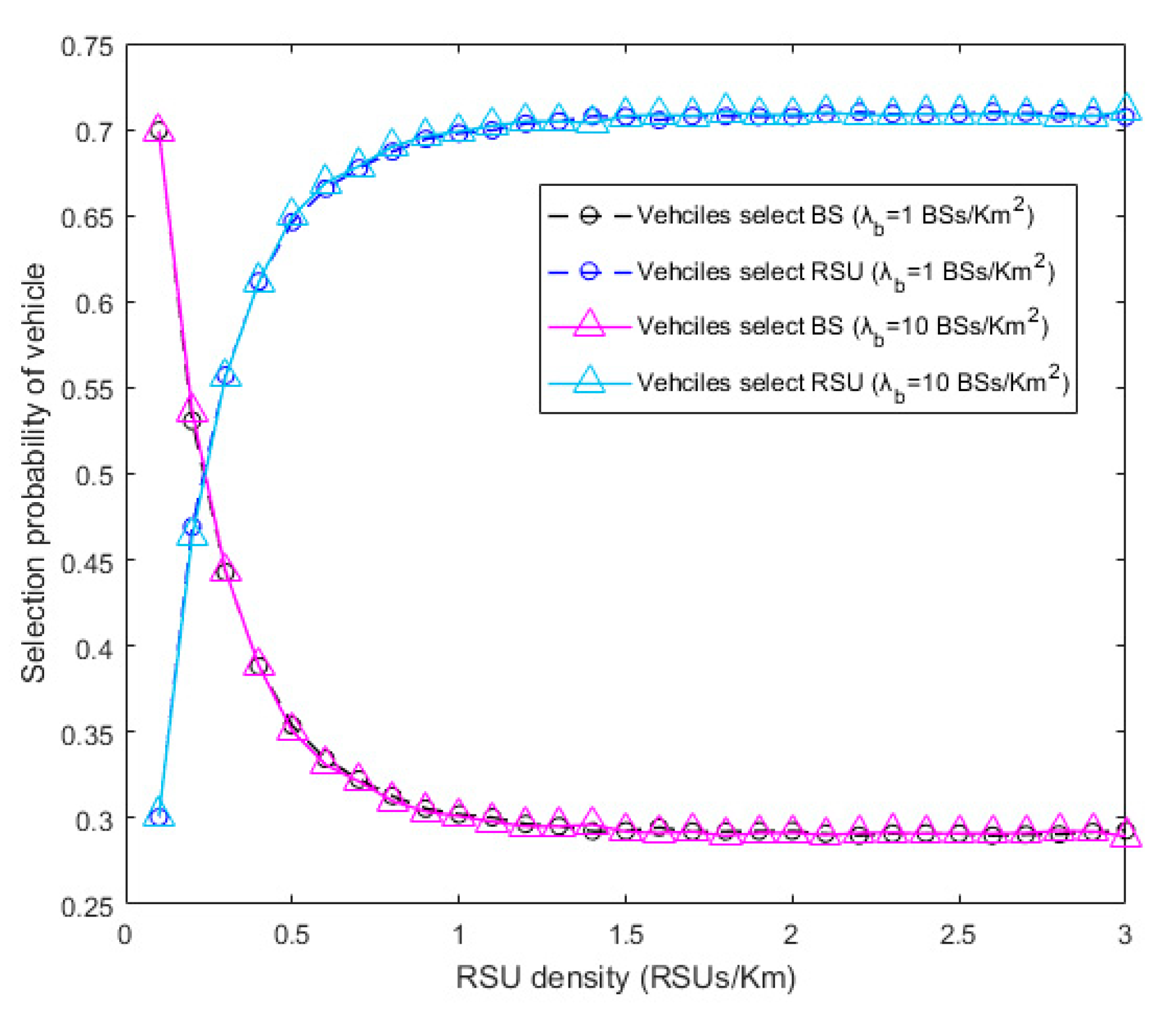
5.1. Verification of Expressions of Coverage Probability of RSU and Selection Probability of Vehicle
5.2. Performance Analysis of the Proposed Game model
6. Conclusions
Author Contributions
Funding
Conflicts of Interest
Appendix A
Appendix B
References
- Chen, S.; Hu, J.; Shi, Y.; Zhao, L. LTE-V: A TD-LTE-Based V2X solution for future vehicular network. IEEE Internet Things J. 2016, 3, 997–1005. [Google Scholar] [CrossRef] [Scilit]
- Wang, Y.; Shi, J.; Chen, L.; Lu, B.; Yang, Q. A novel capture-aware TDMA-based MAC protocol for safety messages broadcast in vehicular ad hoc networks. IEEE Access. 2019, 7, 116542–116554. [Google Scholar] [CrossRef] [Scilit]
- Campolo, C.; Molinaro, A. Multichannel communications in vehicular ad hoc networks: A survey. IEEE Commun. Mag. 2013, 55, 158–169. [Google Scholar] [CrossRef] [Scilit]
- Zheng, J.; Wu, Q. Performance modeling and analysis of the IEEE 802.11p EDCA mechanism for VANET. IEEE Trans. Veh. Technol. 2016, 65, 2673–2688. [Google Scholar] [CrossRef] [Scilit]
- Wu, Q.; Liu, H.; Wang, R.; Fan, P.; Fan, Q.; Li, Z. Delay Sensitive Task Offloading in the 802.11p Based Vehicular Fog Computing Systems. IEEE Internet Things J. 2020, 7, 773–785. [Google Scholar] [CrossRef] [Scilit]
- Hadded, M.; Muhlethaler, P.; Laouiti, A.; Zagrouba, R.; Saidane, L.A. TDMA-based MAC protocols for vehicular ad hoc networks: A survey, qualitative analysis, and open research issues. IEEE Commun. Surveys Tuts. 2015, 17, 2461–2492. [Google Scholar] [CrossRef] [Scilit]
- Kim, D.; Velasco, Y.; Wang, W.; Uma, R.N.; Hussain, R.; Lee, S. A new comprehensive RSU installation strategy for cost-efficient VANET deployment. IEEE Trans. Veh. Technol. 2017, 66, 4200–4211. [Google Scholar] [CrossRef] [Scilit]
- Su, Z.; Xu, Q.; Hui, Y.; Wen, M.; Guo, S. A game theoretic approach to parked vehicle assisted content delivery in vehicular ad hoc networks. IEEE Trans. Veh. Technol. 2017, 66, 6461–6474. [Google Scholar] [CrossRef] [Scilit]
- Lyu, F.; Zhu, H.; Cheng, N.; Zhou, H.; Xu, W.; Li, M.; Shen, X. Characterizing urban vehicle-to-vehicle communications for reliable safety applications. IEEE Trans. Intell. Transp. Syst. 2020, 21, 2586–2602. [Google Scholar] [CrossRef] [Scilit]
- Luong, H.P.; Panda, M.; Vu, H.L.; Vo, B.Q. Beacon rate optimization for vehicular safety applications in highway scenarios. IEEE Trans. Veh. Technol. 2017, 67, 524–536. [Google Scholar] [CrossRef] [Scilit]
- Zhou, H.; Xu, S.; Ren, D.; Huang, C.; Zhang, H. Analysis of event-driven warning message propagation in vehicular ad hoc networks. Ad Hoc Netw. 2017, 55, 87–96. [Google Scholar] [CrossRef] [Scilit]
- Amadeo, M.; Campolo, C.; Molinaro, A. Information-centric networking for connected vehicles: A survey and future perspectives. IEEE Commun. Mag. 2016, 54, 98–104. [Google Scholar] [CrossRef] [Scilit]
- Wu, Q.; Ge, H.; Fan, P.; Wang, J.; Fan, Q.; Li, Z. Time-dependent Performance Analysis of the 802.11p-based Platooning Communications Under Disturbance. IEEE Trans. Veh. Technol. 2020. [Google Scholar] [CrossRef] [Scilit]
- Fadlallah, Y.; Tulino, A.M.; Barone, D.; Vettigli, G.; Llorca, J.; Gorce, J.-M. Coding for caching in 5G networks. IEEE Commun. Mag. 2017, 55, 106–113. [Google Scholar] [CrossRef]
- Yang, F.; Yan, J.; Guo, Y.; Luo, X. Stackelberg-Game-Based Mechanism for Opportunistic Data Offloading Using Moving Vehicles. IEEE Access. 2019, 7, 166435–166450. [Google Scholar] [CrossRef] [Scilit]
- Wang, X.; Li, Y. Content Delivery Based on Vehicular Cloud. IEEE Trans. Veh. Technol. 2020, 69, 2105–2113. [Google Scholar] [CrossRef] [Scilit]
- Sun, Y.; Xu, L.; Tang, Y.; Zhuang, W. Traffic offloading for online video service in vehicular networks: A cooperative approach. IEEE Trans. Veh. Technol. 2018, 67, 7630–7642. [Google Scholar] [CrossRef] [Scilit]
- Ndikumana, A.; Tran, N.H.; Kim, D.H.; Kim, K.T.; Hong, C.S. Deep Learning Based Caching for Self-Driving Cars in Multi-Access Edge Computing. IEEE Trans. Intell. Transp. Syst. 2020. [Google Scholar] [CrossRef] [Scilit]
- Yao, L.; Wang, Y.; Wang, X.; Wu, G. Cooperative Caching in Vehicular Content Centric Network based on Social Attributes and Mobility. IEEE Trans. Mob. Comput. 2019. [Google Scholar] [CrossRef] [Scilit]
- Liu, T.; Zhou, S.; Niu, Z. Joint Optimization of Cache Allocation and Content Placement in Urban Vehicular Networks. In Proceedings of the IEEE Global Communications Conference (GLOBECOM), Abu Dhabi, UAE, 9–13 December 2018; pp. 1–6. [Google Scholar]
- Rahima, M.; Javeda, M.A.; Alvia, A.N.; Imran, M. An efficient caching policy for content retrieval in autonomous connected vehicles. Transp. Res. Part A Policy Pract. 2020, 140, 142–152. [Google Scholar] [CrossRef] [Scilit]
- Su, Z.; Hui, Y.; Yang, Q. The next generation vehicular networks: A content-centric framework. IEEE Wirel. Commun. 2017, 24, 60–66. [Google Scholar] [CrossRef] [Scilit]
- Hui, Y.; Su, Z.; Luan, T.H.; Cai, J. Content in motion: An edge computing based relay scheme for content dissemination in urban vehicular networks. IEEE Trans. Intell. Transp. Syst. 2019, 20, 3115–3128. [Google Scholar] [CrossRef] [Scilit]
- Hui, Y.; Su, Z.; Luan, T.H. Optimal access control in heterogeneous vehicular networks: A game theoretic approach. In Proceedings of the IEEE Global Communications Conference (GLOBECOM), Singapore, 4–8 December 2017; pp. 1–5. [Google Scholar]
- Wang, S.; Zhang, Z.; Yu, R.; Zhang, Y. Low-latency caching with auction game in vehicular edge computing. In Proceedings of the IEEE/CIC International Conference on Communications in China (ICCC), Qingdao, China, 22–24 October 2017; pp. 1–6. [Google Scholar]
- Li, J.; Xing, R.; Su, Z.; Zhang, N.; Hui, Y.; Luan, T.H.; Shan, H. Trust Based Secure Content Delivery in Vehicular Networks: A Bargaining Game Theoretical Approach. IEEE Trans. Veh. Technol. 2020, 69, 3267–3279. [Google Scholar] [CrossRef] [Scilit]
- Fudenberg, D.; Tirole, J. Game Theory; MIT Press: Cambridge, MA, USA, 1993; ISBN 0262061414. [Google Scholar]
- Haenggi, M. Stochastic Geometry for Wireless Networks; Cambridge University Press: Cambridge, UK, 2012; ISBN 9781107014695. [Google Scholar]
- Kingman, J.F.C. Poisson Processes; Clarendon Press: Gloucestershire, UK, 1992; ISBN 9780191591242. [Google Scholar]
- Andrews, J.G.; Baccelli, F.; Ganti, R.K. A tractable approach to coverage and rate in cellular networks. IEEE Trans. Commun. 2011, 59, 3122–3134. [Google Scholar] [CrossRef] [Scilit]
- Cha, M.; Kwak, H.; Rodriguez, P.; Ahn, Y.-Y.; Moon, S. I tube, you tube, everybody tubes: Analyzing the world’s largest user generated content video system. In Proceedings of the 7th ACM SIGCOMM Conference Internet Measurement (IMC), San Diego, CA, USA, 24–26 October 2007; pp. 1–14. [Google Scholar]
- Havil, J. Gamma: Exploring Euler’s Constant; Princeton University Press: Princeton, NJ, USA, 2003; ISBN 978-0691141336. [Google Scholar]
- Zhou, Y.; Chen, L.; Yang, C.; Chiu, D.M. Video popularity dynamics and its implication for replication. IEEE Trans. Multimed. 2015, 17, 1273–1285. [Google Scholar] [CrossRef] [Scilit]
- Chen, L.; Zhou, Y.; Chiu, D.M. A lifetime model of online video popularity. In Proceedings of the 23rd International Conference on Computer Communication and Networks (ICCCN), Shanghai, China, 4–7 August 2014; pp. 1–8. [Google Scholar]
- Guha, S. Cellular-Assisted Vehicular Communications: A Stochastic Geometric Approach. Master’s Thesis, Virginia Polytechnic Institute State University, Blacksburg, VA, USA, 2016. [Google Scholar]
- Zhang, S.; Zhang, N.; Fang, X.; Yang, P.; Shen, X.S. Cost-effective vehicular network planning with cache-enabled green roadside units. In Proceedings of the IEEE International Conference on Communications (ICC), Paris, France, 21–25 May 2017; pp. 1–6. [Google Scholar]
- Lowen, S.B.; Teich, M.C. Power-law shot noise. IEEE Trans. Inf. Theory 1990, 36, 1302–1318. [Google Scholar] [CrossRef] [Scilit]
- Haenggi, M.; Ganti, R.K. Interference in Large Wireless Networks. In Foundations and Trends in Networking; NOW: Hanover, MA, USA, 2008; Volume 3, pp. 127–248. ISBN 9781601982988. [Google Scholar]
- Stoyan, D.; Kendall, W.; Mecke, J. Stochastic Geometry and Its Applications, 2nd ed.; John Wiley and Sons: Hoboken, NJ, USA, 1996. [Google Scholar]
- Grant, M.; Boyd, S. Graph implementations for nonsmooth convex programs. In Recent Advances in Learning and Control (Series Lecture Notes in Control and Information Sciences); Blondel, V., Boyd, S., Kimura, H., Eds.; Springer: Berlin/Heidelberg, Germany, 2008; Volume 371, pp. 95–110. [Google Scholar]
- Grant, M.; Boyd, S.; Ye, Y. Disciplined convex programming. In Global Optimization: From Theory to Implementation, Nonconvex Optimization and Its Applications; Springer: Boston, MA, USA, 2006; pp. 155–210. [Google Scholar]
- Rudin, W. Principles of Mathematical Analysis, 3rd ed.; McGraw-Hill: New York, NY, USA, 1976; ISBN 9780070542358. [Google Scholar]



| Parameter | Value |
|---|---|
| Radius of base station distribution area | |
| Transmission power of BS | [35] |
| Transmission power of RSU | [36] |
| Bandwidth | |
| Power spectral density of noise | |
| Path loss exponent |
| Parameter | Value |
|---|---|
| Zipf distribution parameter | |
| Threshold of effective coverage | |
| Transmission power of RSU | |
| Bandwidth | |
| Power spectral density of noise | |
| Path loss exponent | |
| Size of single content file | |
| Total number of files | |
| Euler’s constant | |
| Number of file downloading requests from vehicles in one month | |
| Number of file downloading requests from vehicles within an hour | |
| BSs and RSUs charge vehicles for unit traffic pricing | 0.01 CNY/MB |
| Pricing difference determined by BS | CNY/MB |
| Hourly running cost for single RSU | CNY/h |
| Length of the road |
Publisher’s Note: MDPI stays neutral with regard to jurisdictional claims in published maps and institutional affiliations. |
© 2020 by the authors. Licensee MDPI, Basel, Switzerland. This article is an open access article distributed under the terms and conditions of the Creative Commons Attribution (CC BY) license (http://creativecommons.org/licenses/by/4.0/).
Share and Cite
Wang, Y.; Lin, Y.; Chen, L.; Shi, J. A Stackelberg Game-Based Caching Incentive Scheme for Roadside Units in VANETs. Sensors 2020, 20, 6625. https://doi.org/10.3390/s20226625
Wang Y, Lin Y, Chen L, Shi J. A Stackelberg Game-Based Caching Incentive Scheme for Roadside Units in VANETs. Sensors. 2020; 20(22):6625. https://doi.org/10.3390/s20226625
Chicago/Turabian StyleWang, Yang, Yuankun Lin, Lingyu Chen, and Jianghong Shi. 2020. "A Stackelberg Game-Based Caching Incentive Scheme for Roadside Units in VANETs" Sensors 20, no. 22: 6625. https://doi.org/10.3390/s20226625
APA StyleWang, Y., Lin, Y., Chen, L., & Shi, J. (2020). A Stackelberg Game-Based Caching Incentive Scheme for Roadside Units in VANETs. Sensors, 20(22), 6625. https://doi.org/10.3390/s20226625