Article

Joint Congestion Control and Resource Allocation in Cache-Enabled Sensor Networks


Shaanxi Key Laboratory of Information Communication Network and Security, Xi’an University of Posts and Telecommunications, Xi’an 710121, China
*
Authors to whom correspondence should be addressed.
Sensors 2019, 19(13), 2961; https://doi.org/10.3390/s19132961
Submission received: 14 June 2019 / Revised: 1 July 2019 / Accepted: 2 July 2019 / Published: 5 July 2019
(This article belongs to the Section Sensor Networks)

Abstract

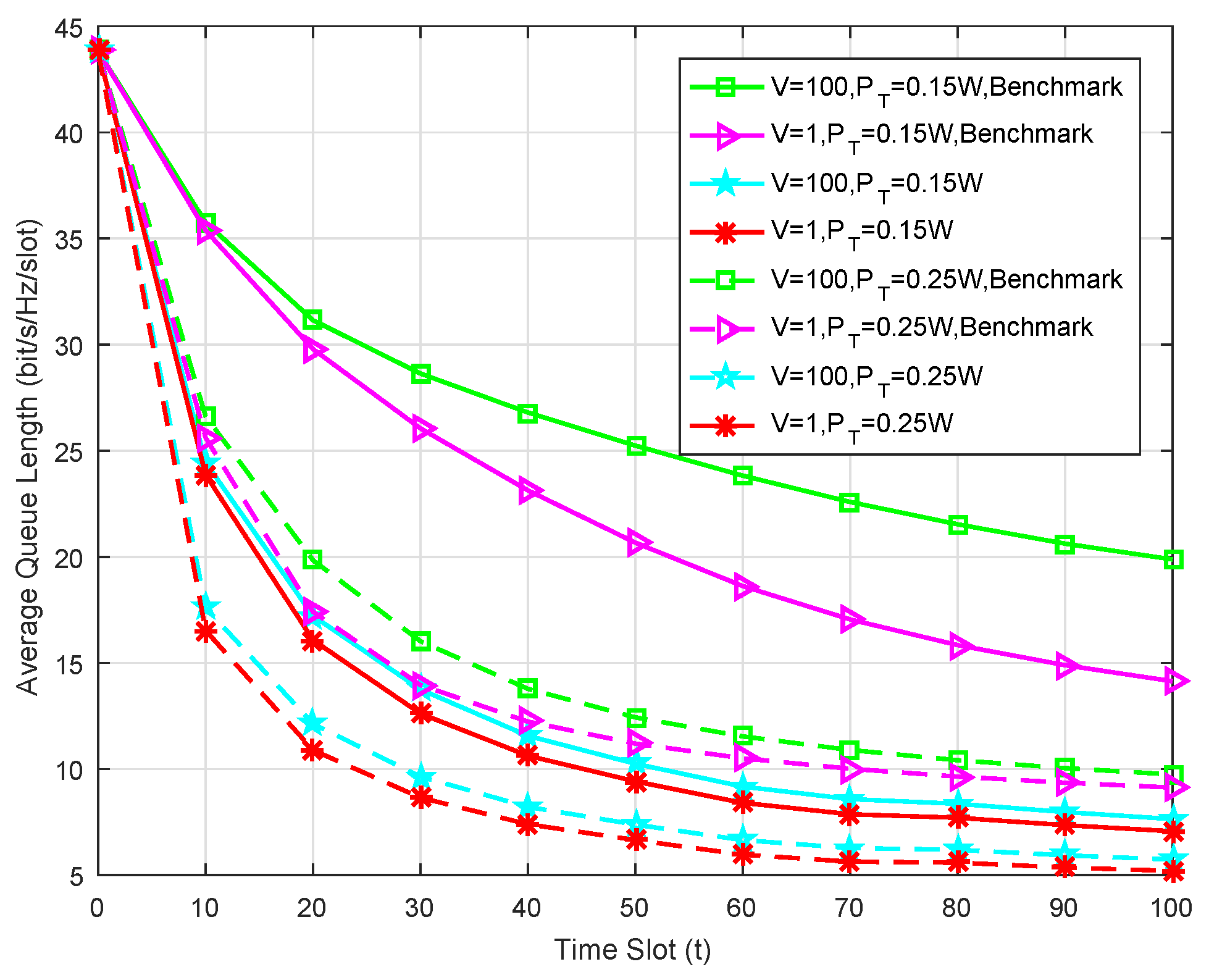
In this paper, we investigate the optimal beamforming design to achieve joint congestion control and energy-efficient resource allocation in cache-enabled sensor networks. The network of interest works in the time-slotted mode. The dynamic buffering queue for each node is introduced to reflect the degree of network congestion and service delay. Then, a time-averaged sum rate maximization problem is proposed under the constraints of queue stability, instantaneous power consumption, average power consumption, and the minimum quality of service requirements. By introducing the method of Lyapunov optimization, the importance of buffering queue backlogs and sum rate maximization can be traded off, then the original queue-aware and time-averaged optimization problem is transformed into a weighted sum rate maximization problem at each time slot. It can be further converted into a second-order cone-programming problem by successive convex approximation, which is convex and can be efficiently solved by off-the-shelf solvers. Numerical results validate that wireless caching can greatly relieve the network congestion by reducing the buffering backlogs, and show that the proposed scheme can trade off the average queue length and time-averaged sum rate by selecting different control parameters.
Keywords: beamforming; congestion control; resource allocation; cache-enabled sensor networks; successive convex approximation; Internet of Things beamforming; congestion control; resource allocation; cache-enabled sensor networks; successive convex approximation; Internet of Things