You are currently viewing a new version of our website. To view the old version click .
Sensors
  • Article
  • Open Access

26 August 2018

New DoS Defense Method Based on Strong Designated Verifier Signatures


,
,
and
1
Cyber Security INCT, University of Brasília, Brasília 70910-900, Brazil
2
Group of Analysis, Security and Systems (GASS), Department of Software Engineering and Artificial Intelligence (DISIA), Faculty of Computer Science and Engineering, Office 431, Universidad Complutense de Madrid (UCM), Calle Profesor José García Santesmases, 9, Ciudad Universitaria, 28040 Madrid, Spain
3
Department of Convergence Security, Sungshin Women’s University, 249-1 Dongseon-Dong 3-ga, Seoul 136-742, Korea
*
Author to whom correspondence should be addressed.
This article belongs to the Special Issue Advances on Resources Management for Multi-Platform Infrastructures

Abstract

We present a novel technique for source authentication of a packet stream in a network, which intends to give guarantees that a specific network flow really comes from a claimed origin. This mechanism, named packet level authentication (PLA), can be an essential tool for addressing Denial of Service (DoS) attacks. Based on designated verifier signature schemes, our proposal is an appropriate and unprecedented solution applying digital signatures for DoS prevention. Our scheme does not rely on an expensive public-key infrastructure and makes use of light cryptography machinery that is suitable in the context of the Internet of Things (IoT). We analyze our proposed scheme as a defense measure considering known DoS attacks and present a formal proof of its resilience face to eventual adversaries. Furthermore, we compare our solution to already existent strategies, highlighting its advantages and drawbacks.

1. Introduction

The recent dissemination of Internet-based technologies such as peer-to-peer computing, cloud computing, and the Internet of Things yield to application scenarios where a non-measurable number of devices are connected and participate in multiple information flows supported by the Internet Protocol (IP) packet routing infrastructure. These new scenarios have introduced security challenges that are distinct mainly because they establish conditions to adversarial attacks in dimensions that are hardly manageable, especially in the case of denial of service attacks (DoS).
Recent distributed denial of services attacks have involved a massive number of IoT devices. These threats were among the causes of the Mirai botnet attacks [1], which used IoT devices infected by a malware that launched DoS attacks pushing massive volume traffic never seen before. Devices in the IoT ecosystem lack several security resources and, for that reason, they have been taken to trigger DoS attacks [2]. Considering the ever-increasing ubiquity and the persistent limitations of a large variety of IoT devices, regarding energy, memory, computing and communications capacity, it is a challenge to counter network security threats originated in these devices [3].
This paper presents a novel defense mechanism, consisting of a cryptographic protocol for the authentication of packet streams, which can be used to integrate a set of measures against DoS attacks. Our proposal makes use of basic cryptography tools, and to our best knowledge presents a new contribution in the way the digital signature is applied. Besides the description of this contribution, we show how our proposal is resilient to known DoS attacks, showing the advantages of its application in the security of IoT environments, mainly regarding DoS attacks inside IoT systems, but also that can be useful for countering attacks started from IoT devices to attain targets outside the IoT realm.
The remainder of this paper is organized as follows. Section 2 discusses related work highlighting some of the already known solutions to the DoS problem. In Section 3, we give an overview of cryptographic tools to be used in our work, and, in Section 4, we present the main result, by describing the proposed scheme. In Section 5, we present possible utilization scenarios where our scheme can be applied. In Section 6, we discuss how our proposal is resistant to DoS attacks and give a formal demonstration of it in Section 7. This paper is closed with our conclusion and future work goals in Section 8.

3. Cryptographic Tools and Assumptions

This section presents an overview of some cryptographic tools used in the construction of our scheme. We discuss the concept of digital signatures and how it is related to authentication and give an overview of the proof paradigms used for demonstrating the security of these protocols.

3.1. Digital Signature and Message Authentication

A digital signature is a primitive that allows a signer to convince a verifier that a statement is valid utilizing a digital proof. A similar concept is of message authentication, both methods allowing validation of data content, i.e., they permit to verify that a given document, information, was approved by a certain entity [52].
A digital signature must be universal in the sense that everyone can check the validity of what is being proved. A fundamental requirement from a digital signature method is that it must be unforgeable [52]:
  • A signer can efficiently create a signature of any document, and everyone can efficiently check the validity of a given signature.
  • It is not feasible to forge a signature in the name of another user, that is, one cannot create a signature to a document that the other did not sign.
On the other hand, authentication methods consider an insecure channel and are only verifiable by communicating parties which created the authentication tag. It is expected that authentication systems satisfy the following requirements over an insecure channel [52]:
  • Each of the communicating parties can efficiently create an authenticating tag to any message of its choice.
  • Each communicating party can efficiently verify an authentication tag of a given message.
  • It is infeasible to any external party (not in the communicating set) to create an authenticating tag.
More formally, a signature scheme is defined as follows:
  • A key generation algorithm G : the algorithm ( K S , K P ) G 1 K produces the respective secret and public keys, and it considers the security parameter k, where 1 k is the unary representation of the intended security level. G is probabilistic in the sense that it considers some random value ω to process the keys generation.
  • The signature algorithm Σ : The signer, by owning both secret and public keys, can execute algorithm Σ to produce the signature σ of a given message m. The signature algorithm can be probabilistic, making use of a random value as an input.
  • The verification algorithm V : The verifier takes the signature σ and the public key K P and checks if σ is a valid signature of the message m.
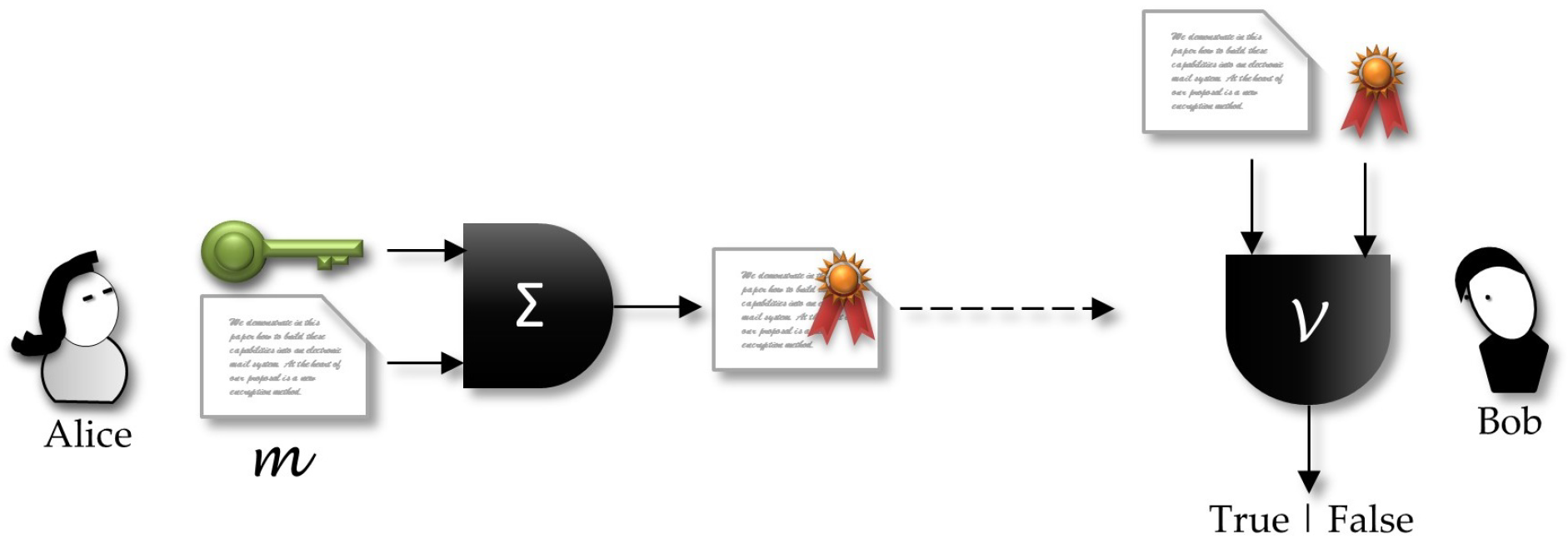
Figure 1 shows a sender, Alice, who holds a private key K P . Using a signature algorithm Σ , she inputs a clear-text and the secret key. The output is the correspondent (text, signature) pair that will be sent to the receiver. Any receiver that gets the signed message can verify the signature using the sender public key.
Figure 1. Signature of a message m by the sender, and the verification process by the receiver.
Working with digital signatures standards that use public key based digital certificates, such as the ones in the X.509 family, public and secret keys will be under the management of a third-party entity, the certification authority (CA). Thus, a more realistic scenario should include this third entity in Figure 1.

3.2. Proof of Security Paradigms

As we already mentioned in Section 2, a proof of security of a protocol requires a precise and rigorous definition. Therefore, a formal definition of a secure signature demands an adequate formalization of what it must consider as the adversarial model, and what kind of proof it will use. In the next subsections, we briefly discuss some of the main paradigms of proof of security for signature schemes.

3.2.1. Simulation-Based Formulation

An important security paradigm is the concept of semantic security [53]. This proof of security compares what the adversary can learn by inspecting the ciphertext (i.e., the cryptosystem output) and what he can learn by himself without looking at the ciphertext. The argument is that, if what the adversary can learn observing the ciphertext is not more than what he can learn doing a simulation himself [54], the information the cryptosystem leak will not help him to break the scheme. The proof holds if the amount of information learned by looking at the ciphertext is very close to what is captured by inspecting the adversary simulated by himself.
The paradigm of simulation holds that the security of protocols can be proved by stating that everything the adversary can learn is limited to what he can simulate by himself. In other words, the fact that he can inspect encrypted messages does not give him any advantage that could not be already learned before the encrypted output was created.
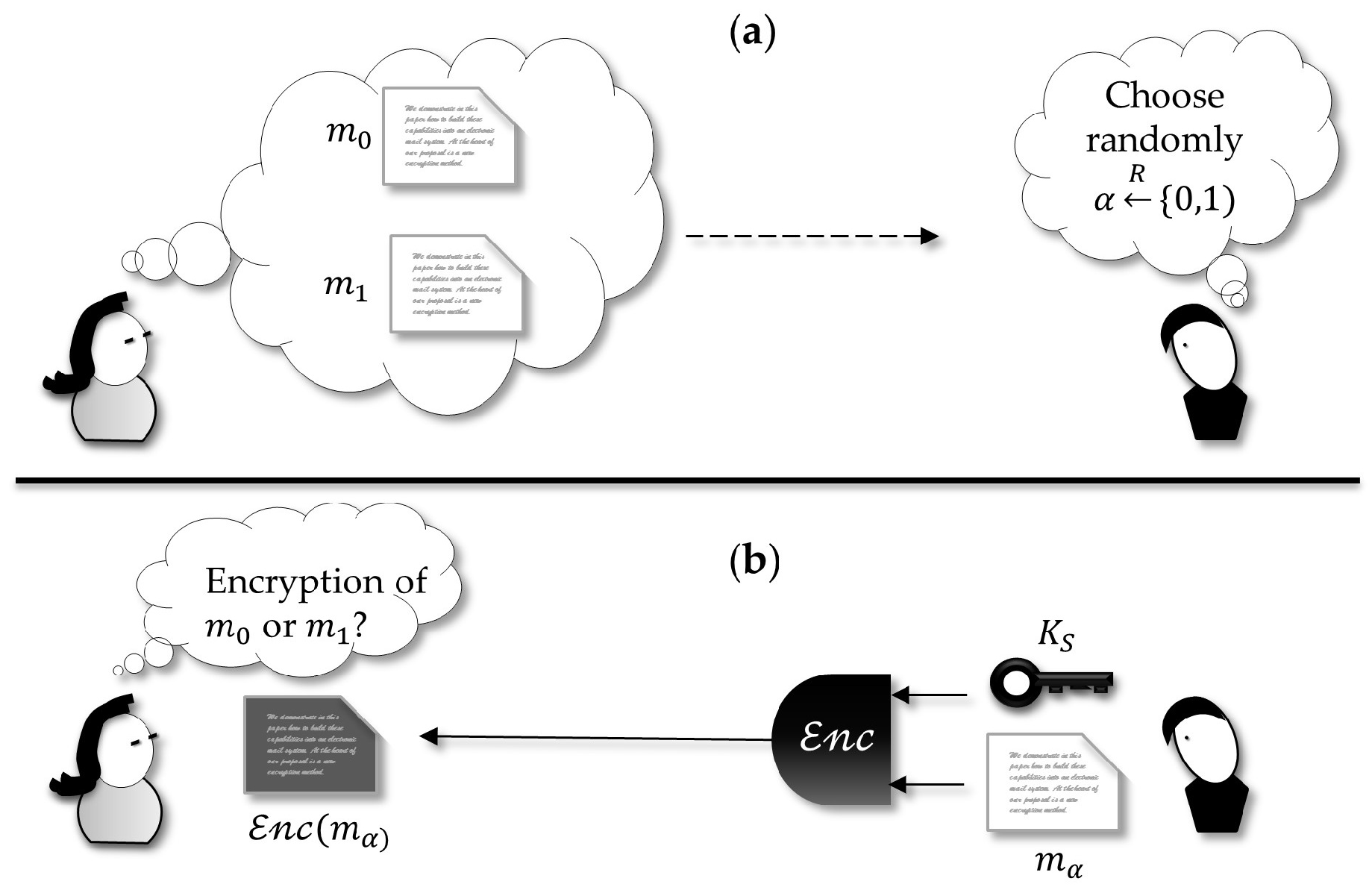
This is commonly illustrated by a hypothetical scenario where an adversary challenges an honest party that is executing an encryption scheme (Figure 2). The adversary chooses two messages that he gets randomly and submits them to the honest party, demanding this party as an encryption oracle. The honest encipher flips a coin and so chooses randomly one of the two messages, encrypts it and sends it back to the challenger adversary. In this case, the probability of attack against the cryptosystem is put in terms of the chance the adversary wins the following game: if he can guess with an advantage no greater than 0.5 (not better than a random choice) which one is the clear-text corresponding to the enciphered, then the ciphertext leaks no information useful for breaking the cryptosystem. In other words, the encrypted message is indistinguishable from a random message.
Figure 2. (a) The challenger Alice takes two messages randomly chosen and sends them to the signer Bob. (b) The signer flips a coin and chooses either 0 or 1, then he encrypts one of the messages and sends the enciphered message back to the challenger, who wins the game if she finds which m was encrypted.

3.2.2. Proof by Reduction

Another approach for the proof of security gives us a mathematical measure of how feasible it is for an adversary to break the secure protocol by showing that the underlying hard problem that sustains this protocol must be broken by the adversary to attack the protocol successfully. This kind of proof construction is named proof by reduction. This paradigm is largely used in the literature. For instance, when a secure protocol is based in the assumption of the hardness of the discrete logarithm problem, the proof occurs by showing that any attack strategy to the protocol can be used for constructing a mechanism to solve the discrete logarithms.

3.2.3. Random Oracle Model

Another widely used proof method is the so-called random oracle model due to Bellare and Rogaway [55]. It considers an idealized uniformly random function that is accessed by the protocol participants only in a black-box way, i.e., the random function can be called for evaluations, but no description of it is given. By its turn, when called two or more times under the same argument, the random oracle returns the same answer. Then, the security is proved considering this idealized functionality, i.e., recognizing the existence of functionality that has a stronger security assumption than whatever can be computationally run to concretize it. There is no real computing system which can run as a true random oracle [56]; in practice, random oracles are substituted by hash functions, as these functions are considered an acceptable oracle candidate. That distance between what is idealized and what can be really done computationally is a source of debate about the model [56].
Therefore, the random oracle model takes a vital role in the proof of secure digital signature schemes [57], mainly because hash functions are a fundamental building block in digital signature protocols.

3.3. Secure Digital Signature Definitions

The seminal work of Pointcheval and Stern [57,58,59] was the first to argue about the security of signature schemes, and their work was settled under the random oracle methodology. It considered an adversarial model in which the adversaries know a list of message–signature pairs and then try to break the protocol by analyzing these signed messages. Thus, the referred work gives a formal adversarial model for signature protocols, pointing the main attacks against signature systems, such as when the adversary can disclose the signer secret key, breaking the entire system.
Among the important attacks modeled, the cited work underlines the adversary ability to forge the signatures of messages, which is then named universal forgery. Another described attack comprises the ability to provide a new message–signature pair for a random message, i.e., the adversary is not looking at a specific signature for a given message. This attack is named existential forgery. Given these definitions, the mentioned work proposes the following description of security for digital signature schemes:
Secure Signature Scheme [57]: A signature scheme is secure if an existential forgery is computationally impossible, even under an adaptively chosen message attack.
Existential unforgeability under a chosen message attack for a digital signature scheme ( G , Σ , V ) as pointed in definition is defined using the following game between a challenger and an adversary A [60]:
  • Setup: The challenger calls the key-generation algorithm G and gets keys pair K S and K P ; the adversary A receives the public key K P .
  • Queries: Adversary A chooses n messages of his choice m 0 , , m n and requests the challenger the correspondent signatures σ 0 , , σ n , where σ i = Σ ( K S , m i ) .
  • Output : Adversary A wins the game when he eventually outputs a pair ( M , σ ) , where M was not asked in the previous step.

3.4. Undeniable Signature

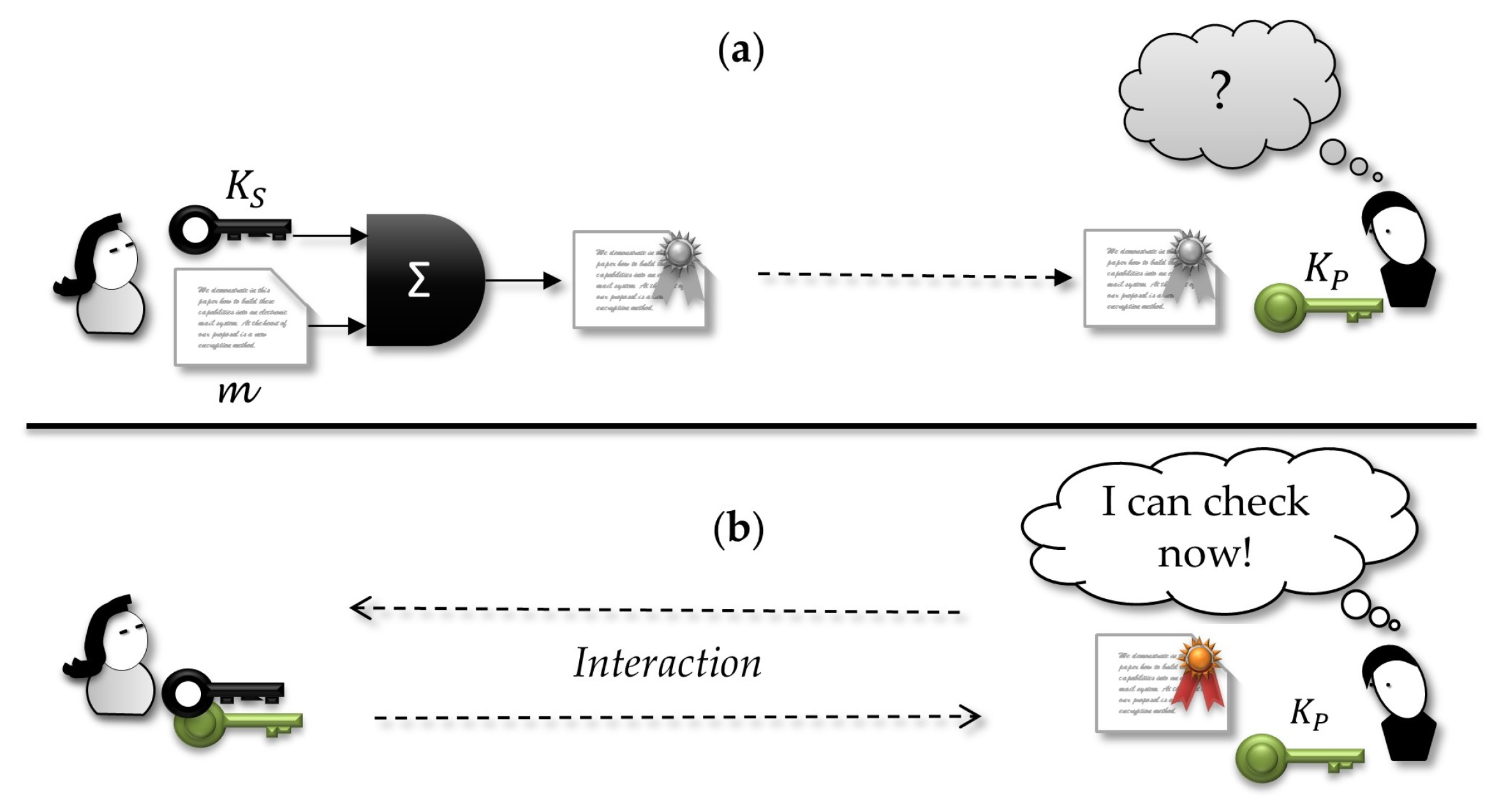
As an extension to the original design, Chaum, and Antwerpen [60] proposed the idea of undeniable signature, in which the verifier needs the cooperation of the signer to verify the signature effectively. Thus, apart from the classical signatures, an undeniable signature cannot be verified openly by everyone. This scheme can be more realistic for many applications because traditional digital signatures can be copied and tested by everyone anytime while undeniable signature allows the signer to manage who can check the signature or can later refuse to cooperate in the validation interaction.
Figure 3 illustrates undeniable signature. First, the signer sends a valid signed document to the verifier, although they do not have yet any interaction for verification. Thus, in the first moment, the signature is indistinguishable from a random bit sequence. When they agree on an interaction, all signature information can be checked by the receiver and only after that it can make sense to him.
Figure 3. In undeniable signature, (a) the receiver is not able to verify the validity of a signature until (b) the signer agrees to perform a validation interaction.
Originally, the authors intended to give the signer the control of who and when a signed document is checkable, an operation that requires an interaction with the signer. However, the signer does not hold full control of who can verify the signature, neither has control over how many times it can be done. In this sense, the protocol does not reach its intended goal of full management of who can verify the authenticity of a signature. Effectively, the signer controls only the moment of verification. Furthermore, one disadvantage of this scheme is the complexity of the interaction needed for verification, which can make the protocol useless for some applications.

3.5. Designated Verifier Signature—DVS

Jakobsson, Sako and Impagliazzo [61] introduced the concept of designated verifier signatures (DVS). Extending the notion of undeniable signature, DVS allows the signer to choose which verifiers can check the signature validity; furthermore, the verification procedure does not demand interaction with the signer. Thus, this kind of signature presents the advantage of operating in a disconnected way, which is appropriate for the problem managed in the present paper.
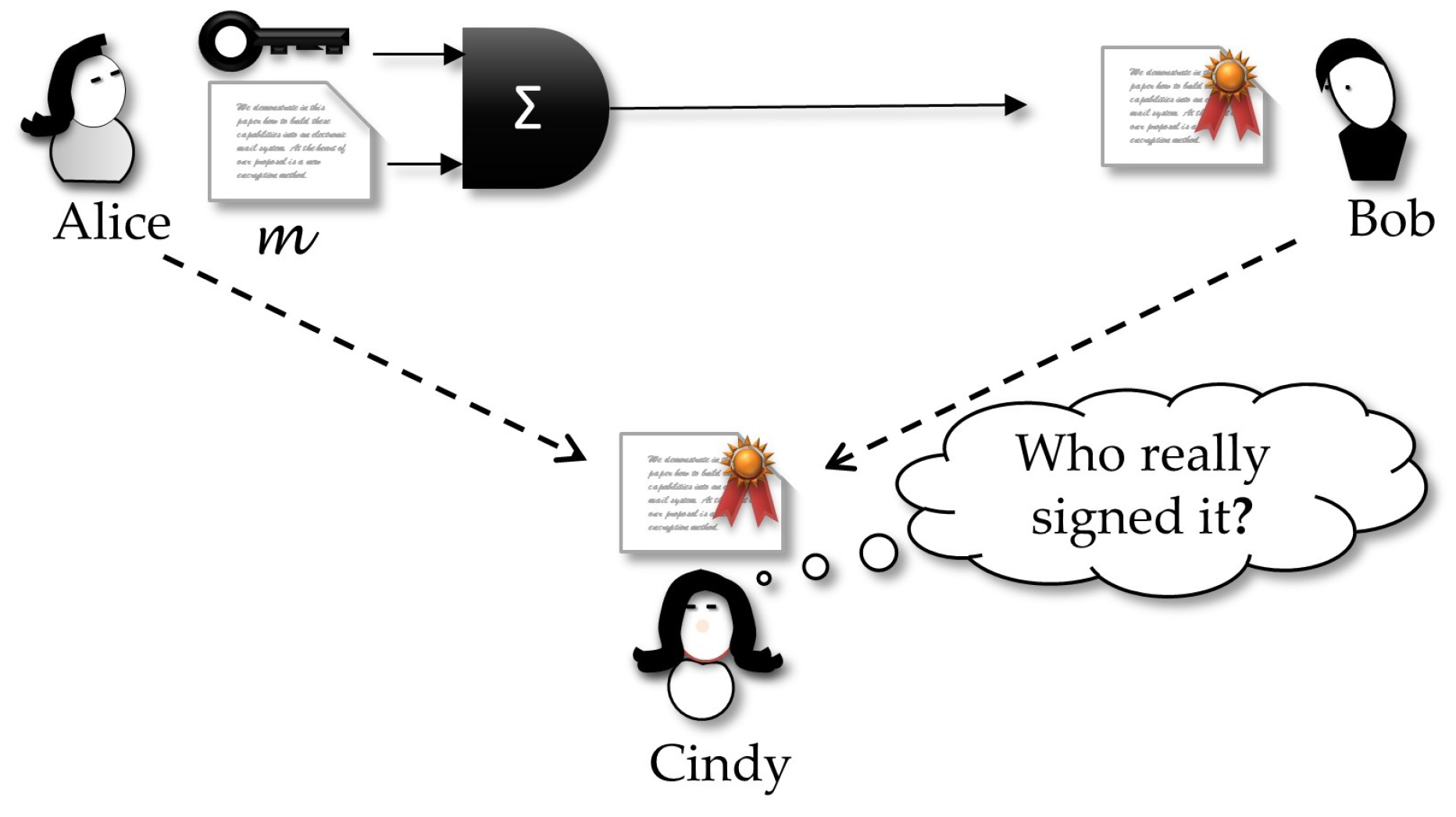
Different from traditional signature schemes, DVS adds the restriction that if Bob tries to forward the signature to a third party, Cindy, she will not be convinced about who really signed the document, because it could be a production of Bob. In other words, the receiver Bob can forge a dummy signature by himself, such that this new one looks indistinguishable from the original created by Alice. This property is an interesting characteristic, non-transferability, that thwarts Bob’s intent of leaking a signature in a message, just because only Bob can really verify and believe the signature. More formally, we have the following definition:
Designated verifier signature [61]: Let P A , P B be a protocol for Alice to prove the truth of the statement θ to Bob. We say that Bob is a designated verifier if the following is true: for any protocol P A , P B , P C involving Alice, Bob, and Cindy, in which Bob proves the truth of ϑ to Cindy, there is another protocol P B , P C such that Bob can perform the calculations of P B , and Cindy cannot distinguish transcripts of P A , P B , P C from those of P B , P C .
The above definition can be interpreted by following game (Figure 4): anything a curious Cindy can capture from Bob does not help her to believe it is the real proof sent by Alice or is a dummy proof produced by Bob. In other words, if Bob sends Cindy the transcription of the protocol by which he really received the signature from Alice, Cindy cannot distinguish this from the transcription of a protocol by which she received the claimed signature from Bob. This way, Cindy does not have any reason for believing Bob.
Figure 4. Bob is able to verify the validity of the signature as the designated verifier. The view of Cindy is that the signatures are indistinguishable of any other created by Bob.

3.6. Strong Designated Verifier Signature —SDVS

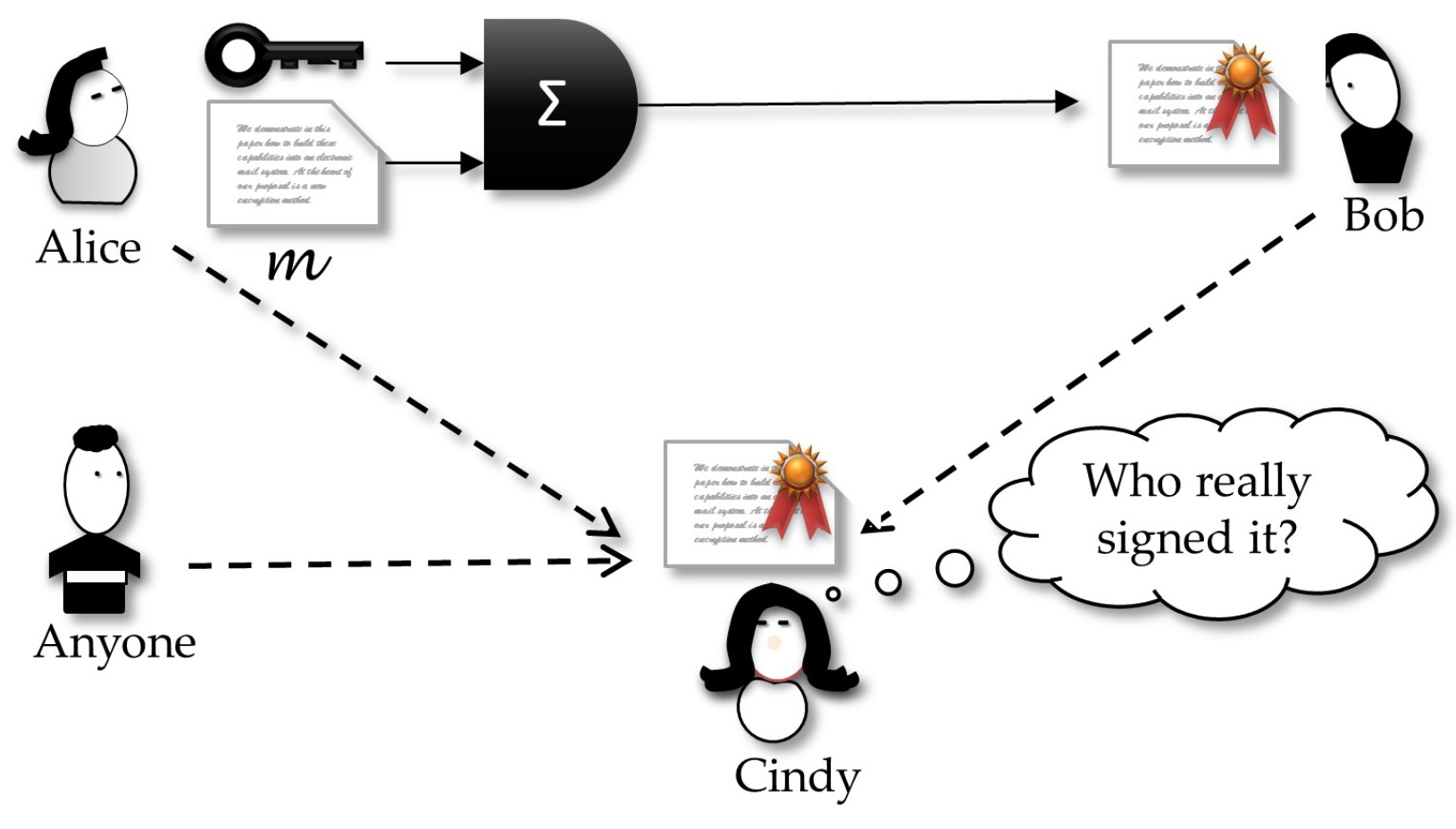
The concept of strong designated verifier signatures protocols extends the original DVS and makes it run securely even in the context where it is widely believed that Bob is honest and will not engage in a forgery and forward the resulting forged signature as a genuine one. In this case, even if a cheating Alice leaks a signature she addressed to Bob, then Cindy can get it but will not check if this a valid signature, because only Bob can do this verification. This impossibility is since not only Bob can forge a signature that looks indistinguishable from the original created by Alice, but everyone else can do the same. That property is the illustrated in Figure 5 showing that this new scheme works in a scenario where not only Bob can leak the signature received from Alice, but also Alice can be dishonest and try to forward a signature created by her and sent to Bob. In the two cases, a curious Cindy will not be sure about who really created the signature.
Figure 5. In SDVS, a curious Cindy cannot decide who is the author of the signature, because this one is indistinguishable from any other that anybody could create.
Strong designated verifier signature [62]: Let P ( A , B ) be a protocol for Alice to prove the truth of the statement Ω to Bob. We say that P ( A , B ) is a strong designated verifier proof if anybody can produce identically distributed transcripts that are indistinguishable from those of P ( A , B ) , for everybody, except for Bob.
This definition requires that the transcript of the protocol execution between Alice and Bob does not leak any clue about the real proof, since the transcript is indistinguishable from any other created by any person, including Alice, Bob or whoever else. This property fits appropriately to our proposal in the present paper.
In this case, a curious Cindy will equivocally interpret the signature origin. In our proposal, we use this in the following convenient way: Alice must sign a contract and send it to Bob, but she knows that they are using an insecure channel in which a curious and malicious Cindy can eavesdrop the signed message. Thus, Cindy will be sure about the origin of the document, but the SDVS property implies that she will not be able to convince any other, except Bob, about the authorship of the signature. However, if Alice is worried about Cindy’s curiosity, Alice can get the message she wants to sign and mix it with n other different messages. Now, Alice will sign all these n + 1 messages but be producing a valid signature only relative to the original message. At the other end of the channel, Bob will be able to check all signed message and discern the correct message and its signature. The convenient property of SDVS is that now Cindy will not realize which message–signature pair is the valid one, because all the wiretapped pairs look like the same.

4. Description of Our Scheme

In this section, we integrate the concepts described in preceding sections to present our proposed protocol, showing how those cryptographic tools are used for constructing an authentication method suitable for a packet switching network, such as the IP routing infrastructure.

4.1. Tagging Packets

Our basic conception is a protocol that allows a receiver of a packet stream be sure about the authenticity, or identification, of an alleged source in the network. As already pointed out, this protocol uses designated verifier signature as its basic cryptographic tool.
The idea of inserting a tag in network packets enabling some capability-based control is not new. For example, some works have proposed the insertion of tags (containing, e.g., a hash of some data flow property) in packets and schemes based on this form of capability mechanism already exist [63,64]. In [63], the authors inserted a Bloom filter calculated from packet addresses, thus constructing a control for the IP forwarding mechanism that has inspired other DoS defense measures [64].
A naive scheme would be one in which the sender signs all the packets and attaches the signature to the IP header. In this case, classical signature schemes are not enough protective, because an adversary can easily spoof all the traffic and replay it. Thus, the signature machinery will not help in any aspect. Moreover, the price to produce signatures for every packet is high, as is the price of checking every signature in the receiver. We propose a more efficient way to use signatures. Furthermore, we consider that an anti-DoS cryptography-based mechanism must employ some protective measure regarding packets that have already been sent, for the case of the adversary trying to replay network traffic, and this can be a very expensive task. A more efficient management of this task is another contribution of our protocol.
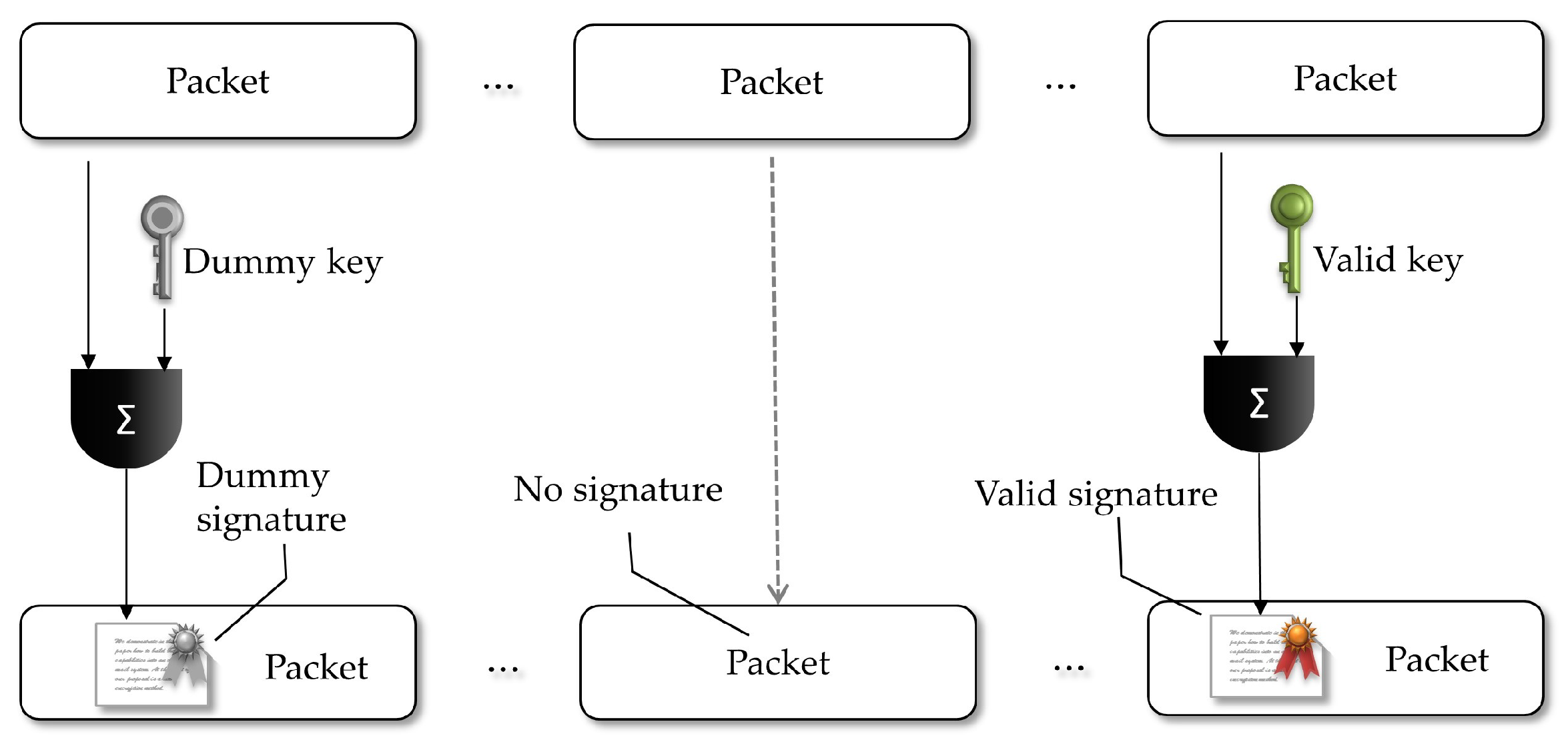
Our strategy explores the equivocation property of SDVS schemes, allowing the sender to sign some packets in a valid way (recognizable by the designated receiver) and to insert dummy signatures in some other packets. More specifically, we put the sender to use his private key and the receiver public key in an SDVS protocol to sign some packets coherently. The sender also generates dummy signatures using chosen random keys. As shown in Section 3, it is indistinguishable to the adversary which signatures are coherent and which are the dummy. However, the (designated) receiver will be able to distinguish if any of the packets was coherently signed by the sender and will keep track of that authentication signal in memory. As shown in Figure 6, with the goal of sustaining a chain of authentication signals, the sender will always choose randomly what specific packet he will sign coherently, doing it periodically for the forwarded groups of packets. The complete scheme defines two sets of packets: (1) packets with signatures, being those coherent or dummy ones; and (2) packets with no signatures.
Figure 6. The proposed mode of generating packets signatures by the sender, thus producing packets with dummy and coherent signatures and packets with no signature.

4.2. Design Details and Parameters of the Proposed Scheme

This section presents our protocol details, showing its parameters and how they fit in our complete solution. The proposed scheme uses the following security parameters:
  • n: the size of the sequence of packets to be considered when a set of signatures must be inserted;
  • Σ : the total number of packets in which some signature will be inserted, i.e., for each n packets sequence, Σ have a signature (valid or dummy), n Σ have no one;
  • σ : the total number of valid signatures in a set of Σ signatures inserted in an n-packet segment; and
  • τ : the threshold number of n-packet segments without valid signatures, i.e., the receiver will expect at most τ · n received packets with no valid signature. Otherwise, the authentication status is switched off for that sender.
The proposed protocol works as follows. The sender, to prove he is an authentic source of a network packet stream will exchange information needed to get the destination public key (we do not suppose this public key must be accessed from a public key infrastructure; the supposition here is that the receiver just keeps it publicly accessible).
Once this setup phase is concluded, for every n packet to be transmitted, the sender will execute one round of the algorithm, that is: randomly choose Σ packets where some signature will be inserted, and among these choose σ of them which will get valid signatures. In its turn, the receiver will be able to check the validity of the signatures and count the valid ones, thus being aware to verify if the threshold of τ rounds is reached with no valid signature received, interpreting this as a loss of authentication status for the sender.
In a formal systematic specification, we describe our protocol as the sequence of the following steps:
  • Initialization: This phase starts with the parties openly agreeing about the security parameter 1 N and then calculating their respective secret and public keys using the key generation algorithm G . The parties make their public keys openly accessible. That is described in the Algorithm 1.
    Algorithm 1: Initialization
    begin
      Alice gets ( K P A , K S A ) R G 1 N
      Bob gets ( K P B , K S B ) R G 1 N
    end
  • Signature: After that initial phase, the signer Alice, for a round that must be executed for every n packets to be transmitted, must randomly choose the subset Σ among them, the ones in which she will fit some signature. In addition, inside this subset, she must at random choose the σ packets that will receive valid designated signature that can effectively be verified by the receiver Bob. The code in Algorithm 2 describes this signature process.
    Algorithm 2: Alice (sender/signer).
    begin
      for { p 1 , , p n } do
       Generates dummy keys: ( K D u m m y A , K D u m m y A ) R G 1 N
       Randomly chooses: Σ = { p 1 , , p Σ }
       Randomly chooses: σ Σ
       for p i σ do
         σ i S i g n ( p i , K S A , K P B )
        Append( p i | σ i )
       end
       for p i Σ σ do
         σ j S i g n ( p j , K d u m m y A , K d u m m y B )
        Append( p i | σ i )
       end
      end
    end
  • Signature verification: For each signed packet, Bob must verify if the inserted signature is valid and counts to find at least one valid signature in every sequence of τ · n received packets. thus, for Bob, if the source of the packet is not able to put a valid designated packet in such intervals, it is assumed that with a good probability (we will give a formal description of this in Section 6) the source is not authentic, or someone is trying to cheat. All this process is as the code in Algorithm 3.
    Algorithm 3: Bob (receiver/verifier).
    begin
      for every received signed packet: ( p i | σ i ) do
       if V e r i f y ( σ i ) is True then
        update the threshold authentication ( τ )
       end
       else
        update the threshold authentication ( τ )
       end
      end
    end
  • Simulator: Similar to proofs in SDVS schemes in [61,62], here a simulator takes an important role in the proof of security of the protocol. In the security proof of the SDVS, the existence a simulator that allows mimicking the transcript of an authentic conversation is used as an argument of the hardness to anyone, except the designated verifier, to distinguish what is a valid designated signature and a random one. The simulator will drop some coins to get some randomness, take as inputs the public keys ( K P A , K P B ) and the packet to be signed, and uses a simulator Simul of the underlying SDVS (because as the SDVS is supposed to be secure, it is required that a simulator exists for it) and with some scheme will return a signature σ that by the correspondent properties will give guarantees that the returned signature is indistinguishable from the valid one, except for the designated verifier. The simulator heuristic is described in Algorithm 4.
    Algorithm 4: Simulator.
    Input: n packets: Σ = { p 1 , , p n } ;
       K D u m m y A , K D u m m y B G ( 1 N )
    begin
      for p i i n Σ do
        σ i S i m u l ( p i , K D u m m y A , K D u m m y B )
      end
    end
We argue that, if some adversary holds any strategy to efficiently distinguish between the set of signed packets took from the simulator described above and a set indeed signed by Alice, such adversary strategy can be used to construct an efficient distinguisher for an underlying SDVS, contradicting the supposed properties of the scheme, i.e., that is infeasible for anyone, except the designated verifier, to recognize a valid signature when challenged with a pair containing a simulated and a valid signature. In other words, the ability of an adversary to distinguish the simulator output implies the ability to distinguish the used SDVS output.
We also argue that, if there is a simulator such as the one described above, that can be used by anybody to simulate an indistinguishable signature, one can synthesize a sequence of signed packets that is indistinguishable of that really signed by Alice. Therefore, if any strategy exists that can give some advantage in recognizing the one coming out of this simulator and the one really signed by Alice, this strategy can break the designated property of the underlying SDVS scheme, by distinguishing a pair of messages.
It must be considered that there are two types of signatures coming from Alice: the valid ones and the others created using randomness, which we designate σ v a and σ r a , respectively. They both are indistinguishable from the ones synthesized by the simulator, called here σ S i m . Therefore, what someone needs to distinguish between two sets of elements is at least to be able to recognize some individuals in each of the sets. That is, any strategy able to distinguish the two sets must recognize at least one signature that was created by Alice in one set and another signature output by the simulator in the other side. However, by the SDVS properties, the pairs σ v a , σ S i m and σ r a , σ S i m both have elements that are indistinguishable, and these two types of tuples are the ones the adversary strategy must distinct.
Thus, if one strategy can make a distinction between two sequences as described above, we can use this strategy to construct a distinguisher that violates the privacy property of the SDVS scheme by recognizing a valid signature. This can be done by simply creating two sequences of messages, generating keys and signing like the simulator signs, and then randomly choosing one of these sequences and randomly choosing where to open a slot to insert the signed message we want to verify as valid or not. Then, we submit this construction to the adversary strategy that must distinguish the entire sequence and eventually point the one with a valid signature when this is truly the case. This way we have shown that if there is any advantage given by the adversary strategy in recognizing the entire sequence of signed messages, it will give us an advantage in breaking the SDVS scheme, which is a contradiction to the supposition that it is secure.

5. Envisaged Application Scenarios

We present two possible utilization scenarios in which our solution works as an element of a DoS defense mechanism. The first scenario is designed as a packet authentication resource for a general purpose network, while the second one is intended to IoT environments.

5.1. Application in a General Network Scenario

We present a possible utilization scenario in which our solution works as a DoS defense mechanism. It considers DoS threats over an Internet-connected network where IoT devices are supported. The proposed strategy, in this case, is that the defense scheme is activated just when a DoS attack is detected by a receiver, that is, under an offensive. Thus, while under this attack, the receiver will require the senders to only transmit signed traffic, since the receiver will allow only this traffic possibly being aided by routers and firewalls nearby.
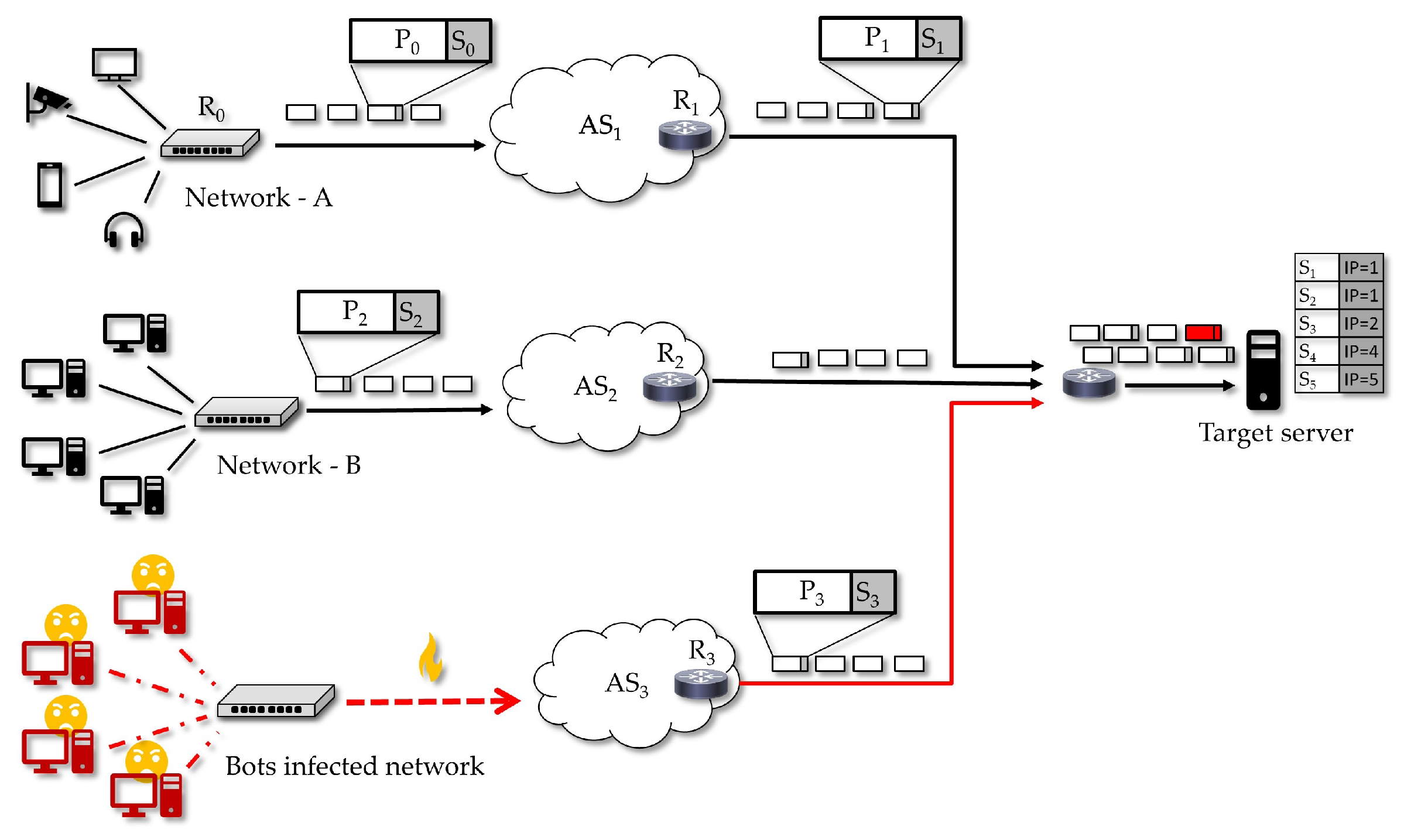
In the scenario illustrated in Figure 7, it is considered that a target server is facing a DoS attack from a botnet and that this attack can result in the server eventually denying access to legitimate clients in Network-A and Network-B. Using our scheme, when an attack is detected by the target server (or by an IDS that alarms this server), it can activate the defense scheme by requiring that every sender who wants to transmit must appropriately sign the sent traffic packets. By performing the required signature (an operation that can be performed by endpoint devices, access routers and autonomous systems (AS) routers), Network-A and Network-B will have their network traffic recognized by the target, while any unsolicited traffic can be blocked by the server, possibly with the help of nearby routers and firewalls.
Figure 7. A possible utilization scenario for the proposed DoS defense. During a DoS attack, the target server requires signed traffic from the senders and, since in this case just Network-A and Network-B can do it, the other sender is blocked.
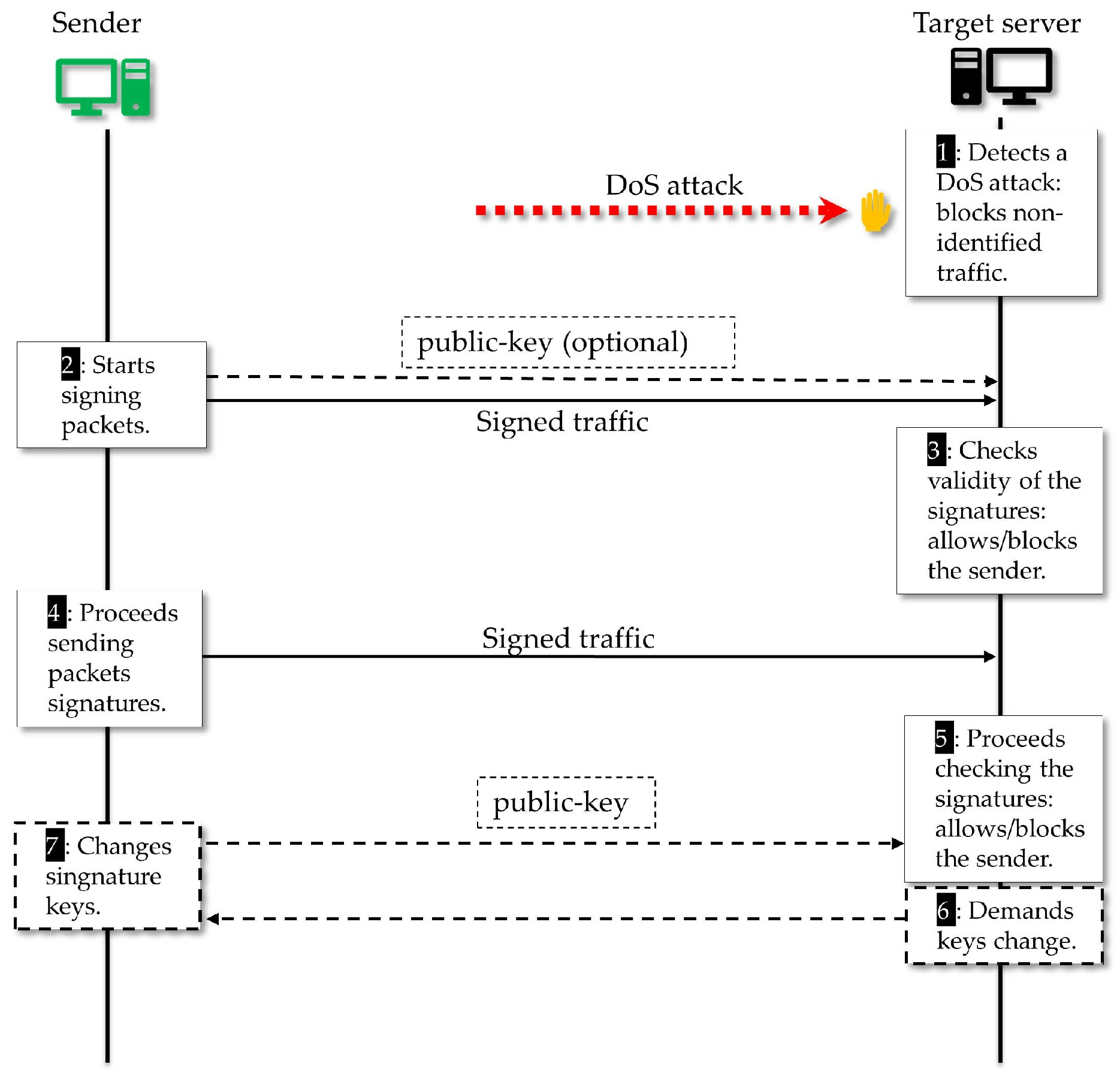
In Figure 8, we present an overview of the proposed protocol dynamics. In Step (1), the target server detects a DoS attack and activates the defense mechanism. Given the requirement of the target server, in Step (2), the Sender starts the packet signature process. There are several ways the receiver can get the sender public-key: as long it is public, it is optional for the sender to forward it together with the traffic, we highlight that in this phase there is no interaction with a third party like a certification authority (CA), as in a conventional public-key based signatures. It is broadly known that the verification by a public CA chain of trust is needed when a conventional signature is used to check the validity concerning personal or organizational identity. We also highlight that the SDVS signature scheme used in our mechanism was created to protect the anonymity of the signer. Hence, we argue that our choice is enough for our objective which is to provide a way to distinguish a particular sender flow and decide to block or to allow this flow. Therefore, if a malicious adversary tries to impersonate a legitimate sender, e.g., by copying its public key, he will not succeed, unless he knows how to break the signature scheme. We emphasize that we have a light signature scheme that does not depend on a third-party and that is enough for the identification of a source, a feature that is useful for network traffic filtering, which is done by the target server in Step (5). After that, if the sender wants to continue sending traffic, it must keep signing the packets and, if the target server intends to stay receiving that specific network flow, it must carry on checking the sender signatures, as shown in Step (5).
Figure 8. Overview of the proposed defense dynamics showing the interaction between sender and receiver.
It is interesting to give an example of how our proposed scheme is resistant to spoofing attacks, since they are an important tool for performing DoS attacks. Considering an adversary that is spoofing traffic in the name of a public entity such as Google.com, with the attacker for instance forging traffic as it was originated in one of this company DNS servers, for example, the one whose IP address is 8.8.8.8. This adversary, when trying to use this address to run a spoofing attack will be asked by a receiver about the public key linked to 8.8.8.8. The adversary will answer with a public key of his choice (even a key copied from the real server). The receiver does not have any option, but to believe that the answer is a legitimate key (i.e., a real Google.com key). The point here is that our scheme works perfectly if the adversary tries to send DoS traffic, just because the receiver that activates our scheme in this situation will be able to distinguish the adversary flow and block it, no matter the adversary signatures are not really a genuine proof of a Google signature. Hence, the DoS traffic is blocked.
We reiterate that our proposed defense allows attack filtering and blocking and that it does not open a door for spoofing attacks, a concern for other network defenses that can be dealt if these defenses are joined to ours. In fact, with the proposed scheme activated, even if an adversary decides to appropriately sign DoS traffic, its network flow will be distinguished and blocked.
We also highlight that one advantage of our proposed scheme that makes it suitable for simple IoT devices concerns the private key. First, this key is not required to be managed by a certification authority, but it could be, e.g., if the router of the IoT perimeter performs the function of the signer. It is is the same case for even the border router in an autonomous system (AS). Secondly, that private key differs from a password, in the sense that it does not have to be memorized by the users or device owners, so it could be created and updated by some hardware functionally of the device, and this operation can get some simple intervention from the user, such as simply pressing a button for a random time. Finally, the scheme does not demand this key to be strong, information theoretically speaking. The requirement is that the adversary must expend a time to break or extract the key, this period being enough to turn infeasible a massive a DoS attack.
As mentioned in Section 2.2, the vulnerability consequent to the easiness for an adversary to hack passwords and then take control of IoT devices is really an important challenge. Our proposal is to use authentication failures to trigger a filter, during the detection of an attack, thus blocking all the traffic except the traffic flows which can be identified. In our proposal, the receiver is able to block the senders that are not trusted and allow those that are identified as well behaved ones.
Our argument is that, if an active adversary tries to send DoS traffic, this adversary will be distinguished. Even if this adversary tries to cheat with a private-key (used to sign messages) chosen on its will, the related network flow will be distinguished. In addition, if an active adversary tries to cheat by periodically changing the private-key or using a private-key stolen from other devices, the receiver will continue to be aware of who is really sending harmless traffic. In the attack context, the receiver will be filtering traffic, and the allowed flows will be those recognized as coming from well-behaving sources.
Another interesting case is when the adversary hacks an already identified device thus getting its password to start sending malicious traffic in the name of a sender rated as well behaved. That was the case in the Mirai botnet DDoS attack [8]. In our proposal, such coordinated attacks can be managed if the receiver requires that well-rated senders change their private signature keys (Steps (6) and (7) in Figure 8). We argue that it is infeasible for the adversary to coordinate its attack operations in view of this change in the entire set of owned devices, since this a costly procedure both computationally and regarding communication efforts. The defense controller is able to pose an increasingly costly challenge to the attacker, even if the attacker has provable full control of the devices.

5.2. Application within an IoT Network Scenario

As the IoT concept can involve potentially different hardware platforms and operating systems, IoT middleware, communication protocols, data models, types of applications, and security policies, among other components, we refer not to a single, homogeneous and cohesive Internet of Things, but to the various incarnations or instances of the Internet of Things that support simultaneous and parallel IoT applications.
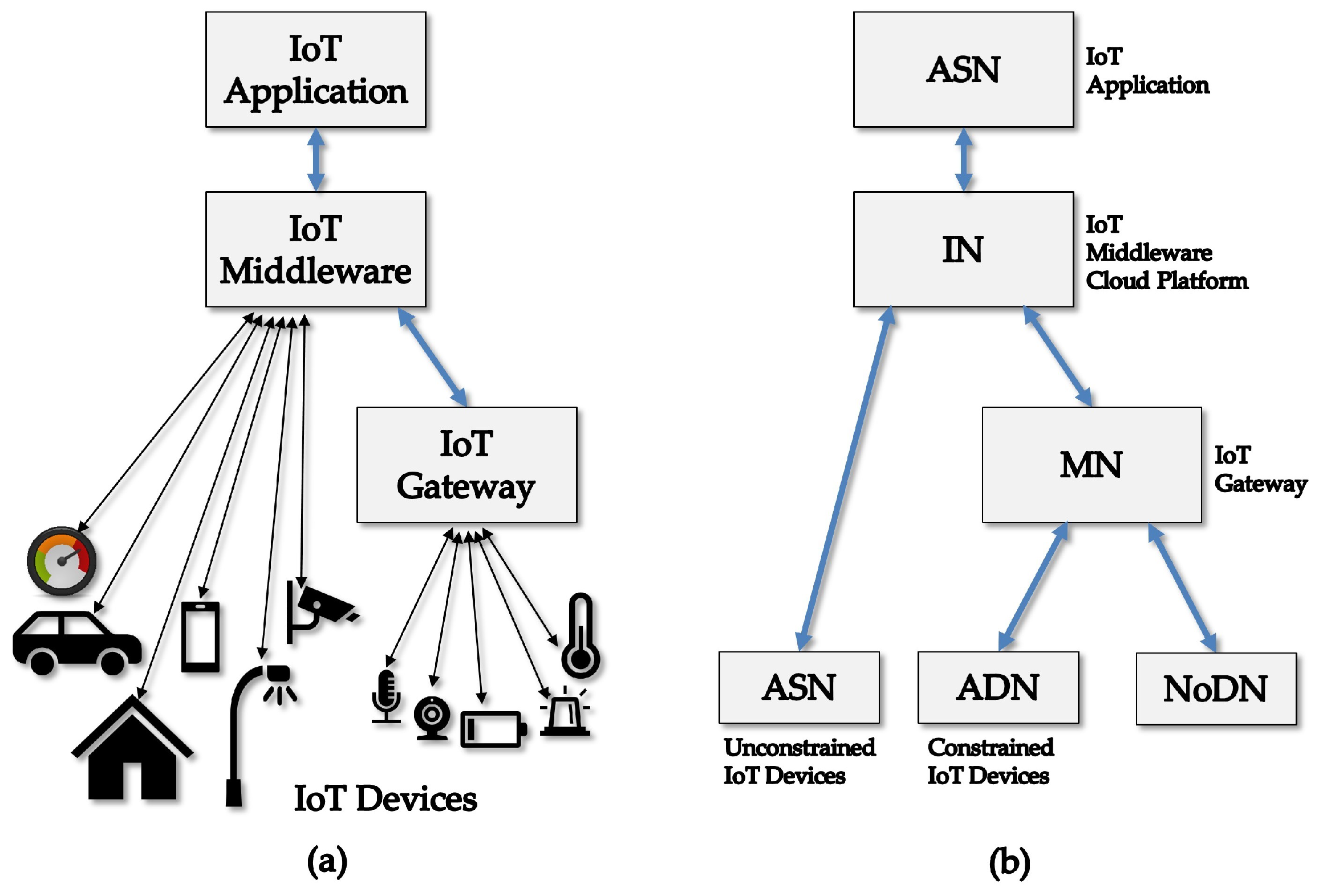
A typical organization for IoT instances comprises IoT devices, both constrained (simple sensors and actuators) and relatively unconstrained ones (smart objects), IoT gateways that provide protocol conversions and mediation services for some of these devices, IoT middleware, and IoT applications, as shown in Figure 9a. The IoT middleware effectively manages the various heterogeneous components that must interconnect and interoperate. Specifically, the IoT middleware is a software layer between the physical layer of devices and their interfaces and the application layer that integrates the logic and control of the IoT instance. Because easy integration and communication among heterogeneous components are desired, the IoT middleware is required to provide a set of programming abstractions, including device discovery, access to services, and administration tasks.
Figure 9. A common IoT Instance (a); and its corresponding oneM2M functional configuration (b).
In addition, in Figure 9b presents the mapping of the described common IoT instance to the functional architecture of oneM2M [65], which is one of the most supported bodies to promote standards for M2M and the Internet of Things. According to this figure, in oneM2M, IoT instances comprise infrastructure nodes (IN), middle nodes (MN), application service nodes (ASN), application dedicate nodes (ADN) and non-oneM2M nodes (NoDN). NoDNs correspond to simple sensors and actuators while ADNs are smart objects. ASNs can be smart objects or client application devices or gateways for simple devices. MNs are unconstrained devices. INs are cloud platforms or servers for the main middleware modules.
The security solution adopted in oneM2M [66] literally mandates that the functional entities need to be mutually identified and authenticated, to protect against unauthorized access and Denial of Service attacks. This mutual authentication enables to additionally provide encryption and integrity protection for the exchange of messages across the reference points that constitute the interfaces among oneM2M entities. Besides, the application entities that require similar protection for their own information exchanges can be provisioned with the same security method to their communications.
We adopt a point of view similar to the oneM2M standard, and other authors, that entity and message authentication are essential measures contributing to mitigating Denial of Service attacks in IoT. The authentication protocol proposed in the present paper suits the oneM2M standard specification and presents the advantageous feature of dynamically adapting the number of signed packets, thus reducing computation efforts compared to a protocol that mandates signing every packet. This feature is particularly interesting for constrained IoT devices.
However, we recognize that DoS attacks are rather complex distributed and combined operations such as scanning victims, performing intrusion, malware distribution, command and control, reporting, performing attacks on command, etc. [67]. These articulated operations cannot be countered just with cryptography and cryptographic protocols such as the authentication protocol proposed in this paper.
Regarding DoS attacks related to IoT, it is worth distinguishing DoS attacks internal to the IoT instance or the IoT realm from the attacks that use IoT devices as bots to attack other systems and services, such as the DNS, corporate web servers, cloud platforms, content providers, and so on.
In a previous related paper [11], we argue that, when the security requirements demand preventing DoS and DDoS attacks against IoT instances, a possible counter-measure is that the IoT middleware should count and correlate received messages with the objective to filter and to attend authentic requests while discarding messages classified as vehicles for DoS/DDoS.
However, this is not a general measure to counter other variants of DDoS, such as those originating in IoT devices against entities in other IoT instances or in other networks, systems, and services. These attacks seem to require fully distributed countermeasures which are IoT security measures that must not necessarily be implemented inside the middleware but just count on the middleware support to be deployed in the form of applications collaborating with devices in fully distributed operations. Thus, it is required that the devices implement local security services to be used for the distributed security applications. Using the same principles of a fully distributed model proposed for MANETs in [68], IoT instances can count on these fully distributed security measures that can be organized using the devices local security services cooperating with central security application hubs. For instance, a smart device can embed a local intrusion detection system (LIDS), a local anomaly detection module, a local autonomic trust reasoning module, a local DDoS probe, a local logbook, and so. These probes can announce their services throughout the IoT middleware to be used by the corresponding distributed IoT security application.
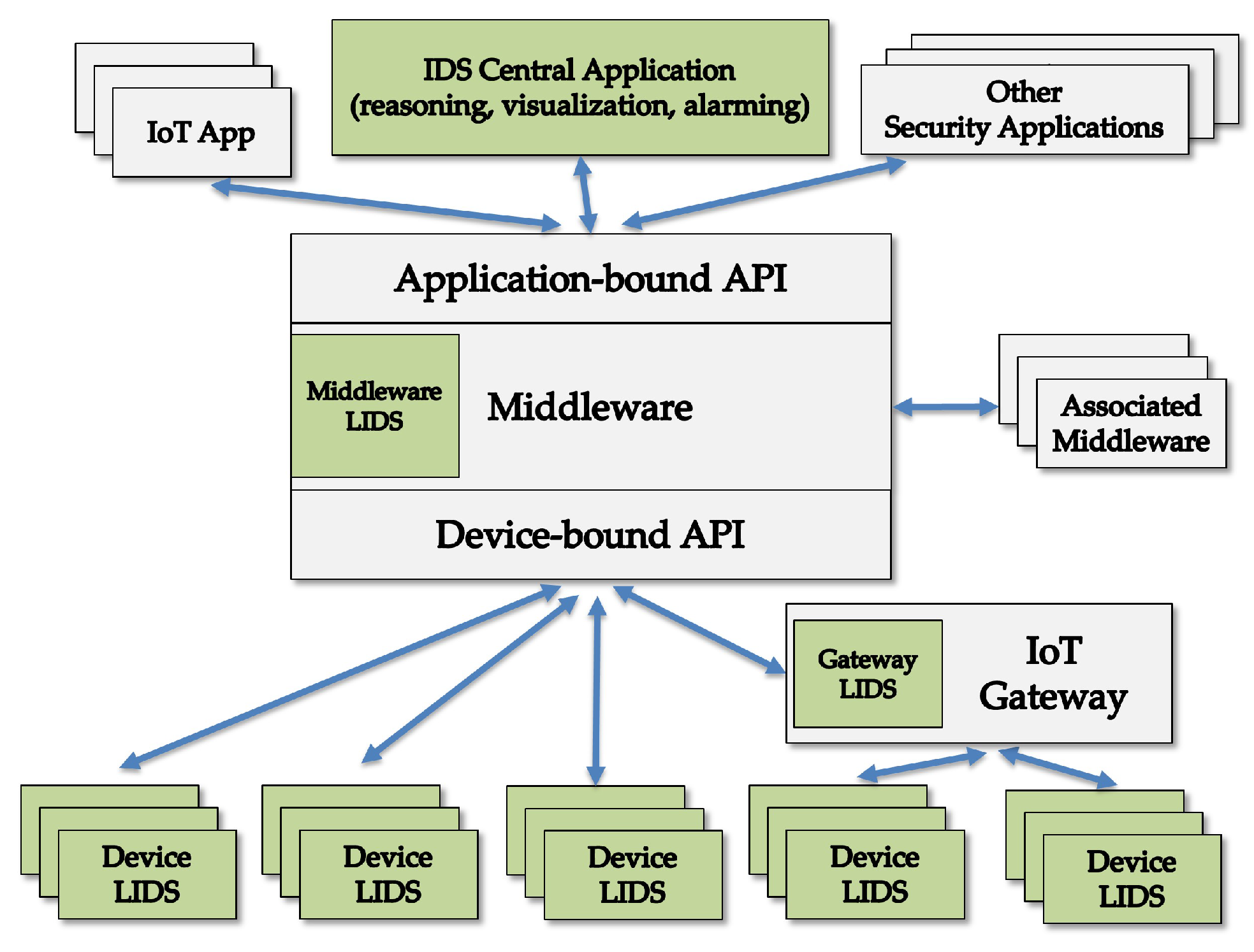
Figure 10 exemplifies a distributed intrusion detection system (DIDS) for IoT in which a central application implements IDS reasoning, visualization and alarming, and this application collaborates with local intrusion detection systems (LIDS). These LIDS are located in smart devices and count on the IoT middleware itself to support the information flows. This DIDS is one possible companion measure to the authentication protocol proposed in this paper so that together they are viewed as an authentication-based filtering scheme against DoS.
Figure 10. A fully distributed IDS for IoT.
Considering the attacks against passwords of IoT devices, as referred to in Section 2.2, the LIDS plays the role of detecting the misuse of the password in a device and then sending corresponding alarms to the other DIDS components. The rules applied by the LIDS, in this case, may include for instance verifications regarding old passwords never or rarely used, modifications of passwords, passwords being used to access device services with messages coming from sources that are outside the IoT realm, dictionary attacks against device passwords, and other similar ones.

6. Resilience of Our Scheme in Face of DoS Attacks

In this section, we formalize the measure of how much resilience our proposal brings against DoS attacks by showing what chances an adversary can earn by attacking a network in which the senders and receivers apply our proposed protocol. With this purpose in mind, we analyze common attack scenarios already pointed out in previous sections.

6.1. Spoofing Attacks

We discuss in this section how our strategy brings difficulties to who plan to perform a DoS attack based on spoofing. Any attempt to spoof traffic, e.g., by copying or forging packets with the intention to inject malicious traffic, will be successful if the attacker can synthesize a valid signature in the SDVS scheme. Therefore, we demonstrate that there is no efficient adversary strategy to inject forged traffic that brings him authentication with a likely probability unless the adversary breaks the underlying SDVS scheme.
As already mentioned, no one except the designated verifier will recognize a valid signed message. Thus, we argue that, unless the adversary knows how to break the privacy property of the SDVS scheme, the adversary cannot deal with the probability of σ / Σ when he tries to cheat in every stream of n packets. Thus, the strategy that remains for spoofing or replay attack is to copy all the signed packets and to replay them, an event that should be considered as an alert of DoS by the receiver. It is interesting also to note that in IP the insertion of packets is not always free for the attacker; however, we are not relying on any control mechanism such as packet sequencing, or any other congestion control.
Another point is that parameter τ is the threshold that puts the limits of how many groups of n packets the receiver will tolerate if not finding any valid signature among them. In fact, if the attacker has got a good guess of which ones are the packet with a valid signature, the mere copy of that packet for future replay in a spoofed packet stream will allow him to transmit no more than 2 · τ · n packets (a sequence of τ · n packets with no valid signature, and another one with a forged signature) until the receiver be warned by a fault regarding the valid signature threshold. However, considering that this hypothetical guess is not feasible, the adversary will be allowed to inject a τ · n sequence of a malicious packet, i.e., if it is required a tight and small τ = 1 , the possibility is just of n malicious packets.

6.2. Flooding Attacks

The adversary can also add malicious packets to the regular network flow. By this, he will be drifting forward the authentic packets, but the chances of transparently doing it depends on the knowledge of the position of the valid signatures on the stream. Regardless, pushing spurious packets in the packet stream, the adversary can disturb the proposed authentication mechanism because this can turn a n packets segment in a non-authenticated one. However, the adversary must fit the inserted traffic in a convenient place. Remembering that the rate of packets with a valid signature is σ / Σ for every n packets, the expected distance between any two valid signatures is n / σ , i.e., the best strategy to the adversary is to put the malicious traffic on the half way between to valid signed packets, but he will do it just if he previously distinguished valid signatures from dummy ones. Therefore, he will not perform better than a procedure of random position inserting.
Therefore, the adversary cannot know where the valid signed packet is and will see every signed packet as the same, and the strategy that remains for him is for inserting malicious traffic between all signed packets. As the sender will be signing packets randomly, the space where malicious traffic can be inserted will be close to n / Σ in probability.

6.3. Denial of Capability Attacks

We have already defined capability in Section 2. When an adversary attempts to disturb an authentication mechanism based on capabilities, i.e., based on something the user owns for proving his identity (e.g., a key, a token, or a digital certificate), we call it a denial of capability attack [22]. Our scheme proposes a capability based on packet content, and an attempt of dropping packets in the network level must be considered as a denial of capability attack. Packet dropping has its proper countermeasures [69] in protocols such as IP, including congestion control and retransmission mechanisms. Notwithstanding, an adversary can launch a packet content manipulation as an effective tool to achieve denial of capabilities attacks.
Therefore, to effectively realize a denial of capability attack against our scheme, the adversary will need to recognize which packets are the ones with designated and valid signatures. As already mentioned, finding it demands breaking the SDVS scheme. If the adversary drops all (or a good portion of) the signed packets, or if he modifies the content of them, it will trouble the authentication mechanism.
Hence, the chances the adversary has for successfully denying an authentic sender and not being caught depends on the rate of signed packets Σ / n and on the rate of valid signed packets σ / Σ . The higher the rate Σ / n of signatures per packets, the more the adversary will get obfuscated concerning which packets he must target the dropping attack, and the least strategy is by manipulating all the Σ signed packets. An attack dropping all the packets is impossible to fix because there is no defense to such an event. Consequently, if the adversary cannot recognize valid signatures, he can only drop all signatures because of the resilience of the protocol faces the loss of signature packets.

6.4. Content Forgery Attack

The question here concerns the chances for the adversary that follows any strategy of manipulating a subset of signed packets. An attacker can attempt to thwart an authentication artifact by manipulating the content of the packet, by modifying or just dropping the signatures. First, if the adversary tries to throw out a targeted packet entirely, he will not reach his objective because the retransmission mechanisms will make the sender repeat the same packet on the network. Alternatively, by trying to modify δ of the Σ packets, the chance of success will raise with δ , but, for every time the sender attempts to keep the authentication alive, the adversary must play the same attack, until attaining the τ threshold. Doing so many manipulations on the packet content, the adversary will get exposed by his intention of offense. For example, if the attacker tries to frustrate an authentication stream t times, the chance of success will be ( δ / Σ ) t , and he will have to manipulate t · δ packets.
For a practical example, when we have a scheme set by signed Σ = 10 , σ = 1 for each n = 100 packets, with the tolerance of up τ = 5 , if the adversary tries to drop five of these signed packets, he will have a chance of 5 / 10 = 50 % of being successful one of the times he tries to thwart the connection. However, the sender will insist on the connection by retransmitting signed packets, which leaves the adversary with the chance of 5 / 10 5 0.0312 after the fifth performance by the sender.

7. Finite State Analysis Regarding the Resilience of the Proposed Protocol

In this section, we present a proof of how secure our protocol is, showing how resilient it is in the face of a considered adversarial model. We proceed using an essential formal proof tool: finite state machines.
Protocol design demands proof of security, and formal specification is one of several methodologies for this task. Directly speaking, a formal specification is the use of mathematical techniques to give certainty that a protocol in analysis conforms to some precisely written notion. In this line of reasoning, the modeling of protocols by finite state machines, or automata, is a paradigm often used for computer language specification, and very common in network protocols specification and performance evaluation.
In the field of secure protocols design, several works make use of formal specification for finite state analysis [70,71,72], and in some of these works the use of automated verification is applied [73,74], especially when a manual proof is infeasible.

7.1. Finite State Automata

Briefly speaking, a finite state automaton (FSA), or finite state machine, is an abstraction of a step-by-ptep process. With this powerful tool, it is possible to model any computing process. The model gives an abstraction of binary relations on a set. The elements of the set are the states, and the relationships between these elements are called transitions. A transition S Q is the one from the state S ruled by a correspondent condition that when satisfied makes the local state to be updated to Q. More formally:
Finite state automaton [75]—a finite state automaton is a tuple ( Q , Σ , q 0 , F , δ ) where Q is a non-empty set of states, among them q 0 is called the initial state. Σ is a non-empty finite alphabet, and F Q is the subset of final/accepting states. The transition function is δ : Q × Σ Q , that is, when applied to an element of alphabet return the next state: e.g., δ : ( q 1 , c’) q 2 .
A very simple example of a state machine is the one that models a character counting in a processed string. Let us suppose the counting program is fed by a string { a 0 , a 1 , , a n } and count the number of matches of a specific character ‘c’ up to the limit value 5. The scheme is illustrated in Figure 11 and Table 1 lists the rules of the process.
S t a t e s : = { q 0 , q 1 , q 2 , q 3 , q 4 } S t a r t s t a t e : = q 0 A l p h a b e t : = a , b , z , A , B , , Z T r a n s i t i o n s : = δ q i , c q i + 1 | i < 5 F i n a l s t a t e s : = q 1 , q 2 , q 3 , q 4
Figure 11. Overview of a state machine. The process reads the first character and, for every “c” found, a transition is realized.
Table 1. The relation among the current state, the symbol being read, and the after state.
In the above example, the finite automaton represents a process that consumes every character of a given string and will end counting q n · n characters when q n is where it stopped or will find at least five matches if the final state is q 5 .
As a tool for the proof of security of protocols, FSA can represent the behavior of players from a high-level viewpoint. Thus, the desired properties of the protocol are described as states, and the modeling process intends to enumerate all possible actions of the players as transitions among these states, pointing what are the (in)secure states, analyzing the probability of reaching each of them.
The typical approach to proofs of security using FSA is first to show that the protocol is correct for honest players. Then, dishonest players are added to the model, and the security is demonstrated by considering how these players can trouble the protocol. To develop the proof of security of our proposed protocol, we first show that the protocol is correct considering that honest players who know some secret key, by running the protocol, can reach the authenticated state, i.e., another player, the owner of the service, will be convinced about the identity of those players. After that, we demonstrate that it is infeasible to the adversary to reach that same state without the knowledge of that secret information, which will allow us to prove the security concerning the behavior of the honest players and the adversary.

7.2. The Invariant Principle

Proving the security of a protocol by modeling it as a finite state machine can be hard because this kind of proof must trace all the paths the protocol can take throughout the states. When there is a very high number of path possibilities, automatic tools are very useful for the proof. Another useful means is given by the invariant principle [70,71,72] that guides the proof by an induction method applied to finite state automata. An invariant is a statement that is proved to be true to all reachable states. In a proof by induction, we show that the invariant is true in the start state and demonstrate that it stays true to all reachable states.
An approach commonly taken for the proof of security using FSA is to show which states the adversary can reach, proving that among these states there are none where the invariant is violated [71]. For instance, if we suppose that the invariant is the adversary ignorance about a secret key, we can demonstrate the adversary never becomes authenticated; otherwise, if the adversary attains an authenticated state, this implies that the adversary breaks the supposed invariant. Furthermore, considering that, for a given state the invariant is true, even if the adversary increases his knowledge, regardless of what strategy he can use, this will not turn false the supposed invariant. More formally, this proof is defined as follows.
Invariant: An invariant is a predicate P over the states, such that whenever it is true for some state q i , i.e., P ( q i ) is true, and there is a transition q i q j , the predicate will also be true in state q j , i.e., P ( q j ) is true.
To get a security proof of our protocol, we follow the approach in [71], since in this work the authors expressed the behavior of honest and dishonest players as a finite state machine and formally define the security properties of the protocol regarding invariants.

7.3. Proving the Protocol Secure by Means of an FSA

This section describes the formalism used to model our protocol as an FSA, using the notation presented in [70]. Thus, hereafter, the work is devoted to modeling the behavior of the honest parties and the adversary through a finite state machine.
To this objective, we describe the operations performed by honest parties and the strategy of the adversary to break the protocol according to the approach in [70,71,72] which for our protocol is performed using the following script:
  • Describe the entire protocol regarding honest players and adversary behavior, showing a list of states of the running protocol and the transition rules.
  • Model the adversary behavior, considering what he can do to drive the protocol to an insecure state.
  • Demonstrate the resilience of the protocol showing how the honest parties run to keep the invariants true, despite the dishonest participants, thus presenting the probability of these adversaries violating that invariant.

7.3.1. The Protocol as a State Automata

We denote q S , q R the local states of the sender Alice and the receiver Bob, respectively. We translate all the network elements which can represent the network status to the local states of these parties. Thus, we include in the players states the messages m i to represent the current message in the local network of the i-th player. We also denote by v i all internal values, that is, all the current and past information the player knows, which includes all the information that he has seen in past executions of protocol. This way, the representation of the complete current state of the two parties is denoted respectively by:
q S = < v S i , m S i > , q R = < v R i , m R i > ,
Furthermore, still following [70], we define the adversary state as q A = m A 1 , m A 2 , , m A M , the set of messages he has captured so far, added to the previous knowledge he keeps. The protocol’s global state is so denoted by the triple:
q S , q R , q A ,
In addition, we use the following formalism to denote the transitions rules:
r k i | q A = i f C k q i | q A t h e n s s ,
The condition in the rule C k s i | q A depends on the current state q i = < v k i , m k i > , so the transition rule considers the current internal values the participant keeps, v k i , and what is the message intended to him m k i , ready to be read from the network. In the adversary case, this condition also depends on what he already knows q A , so this is the general case presented above. Therefore, the specific case for the honest participants can be written as r k i = i f C k ( q i ) t h e n s s .
According to this rule, we give an example of a transition rule for the sender as follows:
r S i = If C S ( q S i = < v S i , m S i > ) Then q S i = < v S i , m s i > , q R i = < v R i , ε > , q S i + = < v S i + , ε > , q R i + = < v R i , m R i > ,
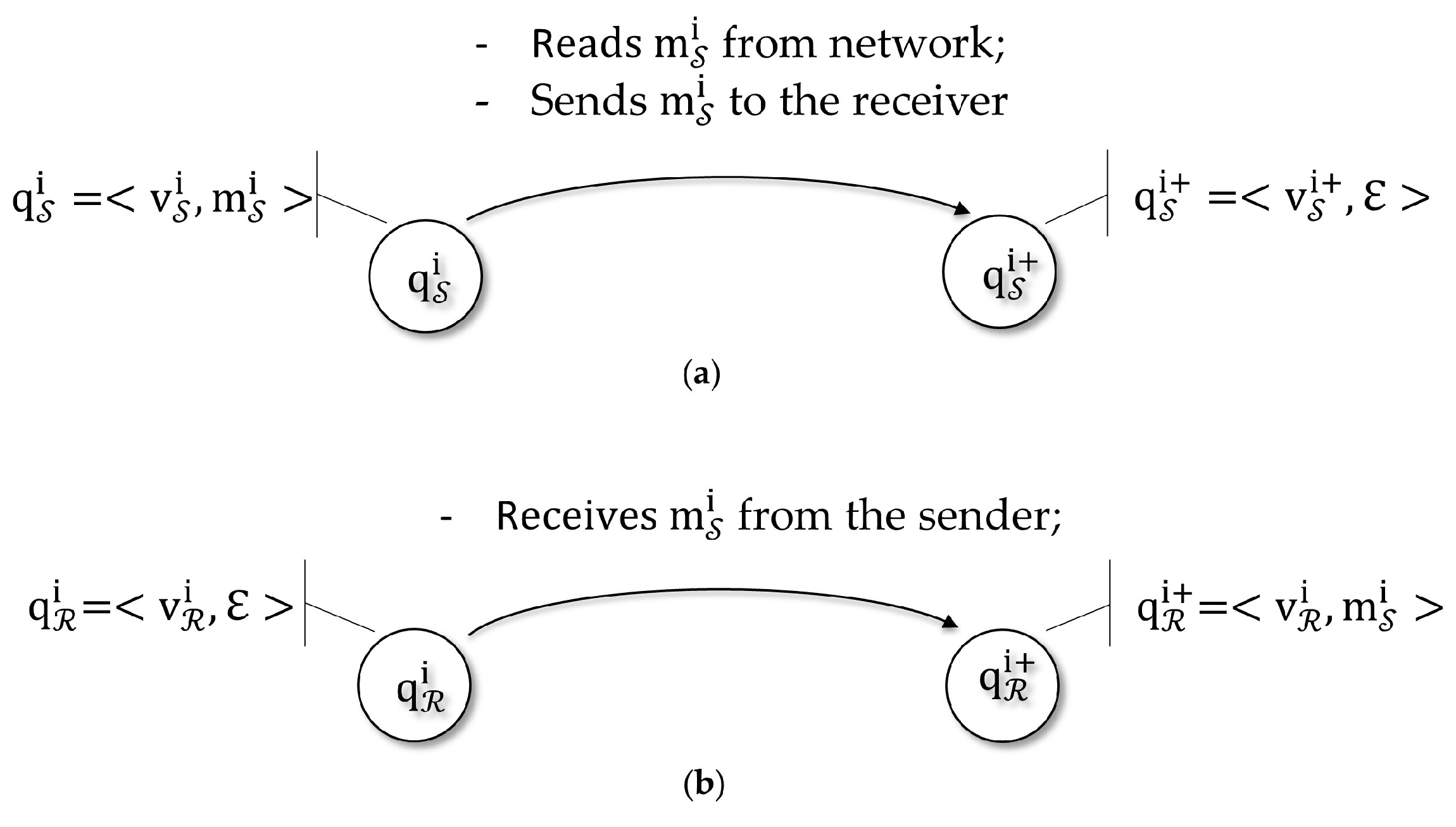
The above example demonstrates the case for a sender who is currently in the state q S i = < v S i , m S i > , that is, keeping its internal variable v S i and reading the incoming message m S i . Once the sender processes this message, it reacts by sending a message m R i to the receiver and moves to the state q S i + = < v S i + , ε > , that is, he has changed the knowledge in his memory and is now waiting for the next message, which is indicated by an empty message ε in the network queue. Therefore, the rule, when processed, changes the global state of the protocol. The transition of states shows that the receiver, as a destination of the message sent, has his internal state changed from q R i to q R i + , keeping the transmitted message on the network queue ready to be processed. This new state for the receiver will so be considered for the rule of its next transition. The finite state diagram shown in Figure 12 illustrates this dynamic.
Figure 12. An overview of transition rules on a finite state machine: (a) the sender transmits a message to the receiver after reading m S i ; and (b) the receiver responds to the sender after he gets the sender message.

7.3.2. The FSA States for the Players

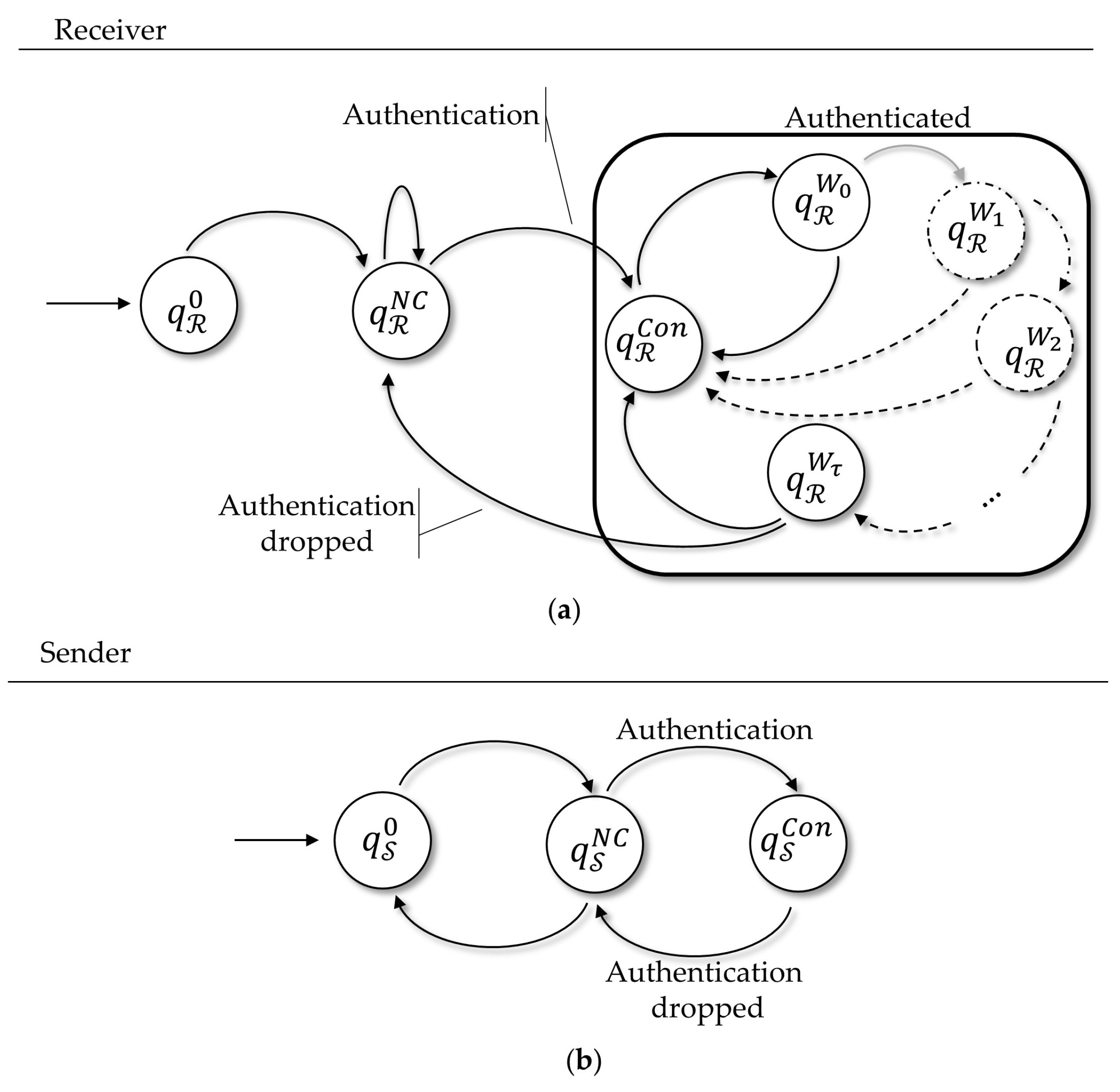
Once the syntax is introduced, and referring to Figure 13, we present the description of our proposed protocol as the following set of states and transition rules:
States for the receiver
q R 0 The initial state of the protocol, no transmission done yet;
q R N C This represents the state of no authentication. If the sender has tried to send network communications to establish the authentication, it was not successful;
q R A u t h The receiver recognizes the authentication signal sent by the sender and keeps this information in his internals variables;
q R W i , i 0 The receiver was waiting for a new authentication signal because there were i sequences of n packets with no valid signature;
q R W τ Threshold limit was reached without the valid recognizable communications from the sender that could keep the authenticated status on.
States for the sender
q S 0 The initial state of the protocol, no transmission done yet;
q S N A This represents the state of no authentication awareness. If the sender has tried to send network communications to be identified, it was not successful;
q S A u t h Represents the states of being authenticated.
Adversary states
q A 0 Initial state of the protocol, no transmission done yet;
q A N A Represents the state of no authentication;
q A A u t h Represents the states where the adversary reaches a successful authentication.
Figure 13. The finite state machine for the receiver (a) and the sender (b) in our proposed protocol.

7.3.3. The Transition Rules for the Players

This section presents the transition rules for the participants of our proposal, writing them in the syntax introduced earlier.
Receiver rules
r R 0 = If C R ( q R 0 = < v s i , m S 0 > Then , q R 0 , , q R N A ,
r R N A = If C R ( q R N A = < v R i , m S i > ; V e r i f y ( m R i ) ) Then , q R N A , , q R A u t h ,
r R A u t h = If C R ( q R A u t h = < v R i , m R i > ; ¬ V e r i f y ( m R i ) ) Then , q R A u t h , , q R W 0 ,
r R W j = If C R ( q R W j = < v R j , m R j > ; V e r i f y ( m R j ) ) Then , q R W j , , q R A u t h ,
r R W j = If C R ( q R W j = < v R j , m R j > ; ¬ V e r i f y ( m R j ) ; j < τ ) ; Then , q R W j , , q R W j + 1 ,
r R W τ = If C R ( q R W τ = < v R τ , m R τ > ; ¬ V e r i f y ( m R τ ) ) Then , q R W τ , , q R N A ,
Sender rules
r S 0 = If C R ( q S 0 ) Then q S 0 , q S N A ,
r S N A = If C R ( q R N A ) Then q S N A , q R N A = < v R N A , ε > , q S A u t h , q R N A + = < v R N A , m S N A : S i g n > ,
r S W i = If C R ( q R W i ) Then q S W i , q R W i = < v R i , ε > , q S A u t h , q R W i + = < v R i , m S W i : S i g n > ,

7.3.4. The Proposed Protocol Invariants

This section aims to demonstrate the security of the proposed protocol by defining its invariants and showing how they relate to the security properties we want to hold. This approach consists in proving that the invariants keep valid in face of attacks from the adversary.
Invariant 1: The adversary does not know the secret key for a valid signature. This invariant gives us the certainty that whoever starts the protocol being unable to create a valid signature of a message will end the protocol still unable to sign messages, despite what this entity learns or sees. This also tells us that, if a dishonest player wants to get authenticated, he will not succeed since if it reaches the authenticated state it will break the invariant validity. The adversary, despite all the information he gets, will be unable to use it to synthesize signatures S y n t h ( e ) ; otherwise, it has earned the secret key. The honest sender capability of signature will be represented here by S i g n ( m ) , m { 0 , 1 } * function.
To demonstrate that this variant holds during all the reachable states, we will on the states which represent the authenticated status, i.e., Q = { q R A u t h , q R W 0 , q R W τ } . It is enough to demonstrate that to reach any of these states a sender must make the receiver transit from the state q R N A to the state q R A u t h . Therefore, an honest participant will reach that by using the rule:
r S N A = If C S ( q R N A ) Then q S N A , q R N A = < v R i , ε > , q S A u t h , q R N A + = < v R i , m R N A : S i g n > ,
That is, the honest sender uses a valid key to create a valid signature of a message and append it to the message m R N A and sends this message to the receiver.
If the adversary can create a valid signature and therefore reach any of the states in Q = { q R A u t h , q R W 0 , q R W τ } , then he violates the invariant. Thus, he would break the invariant because the rule that makes the adversary convince his authenticity to the receiver is the one that uses all the collected information q A as support for the adversary to synthesize a signature S y n t h ( q A ) :
r S N A = If C S ( q S N A | q A ) Then q S N A , q R N A = < v R i , ε > , q S A u t h , q R N A + = < v R i , m S N A : S y n t h ( q A ) > ,
However, we already know that doing it with success will be a violation of a fundamental property of the considered digital signature scheme: infeasibility to forge a valid signature. In addition, we reiterate that it cannot be done despite the previous knowledge q A acquired by the adversary.
Furthermore, let us suppose the adversary has convinced the receiver about his identity and led the receiver to some of the states in Q and let us also assume the invariant was not violated, that is, the adversary still does not know the valid key to sign messages but became able to do it using some other strategy to synthesize a signature that the receiver recognizes as a valid one. In this case, the adversary will be able to stay in the set of states Q the same number of times he can synthesize new signatures as such. This is because the rule that makes the receiver to change the state from any of the waiting states { q R W i } to the s t a t e , q R A u t h requires a (synthesized) valid signature. Otherwise, the sender knows the secret key, which violates the considered invariant.
Invariant 2: An authenticated sender stays in the authenticated state. This invariant must hold if the protocol is resilient to adversary attacks to thwart the authentication mechanism, e.g., when a malicious adversary controlling the network has interfered in messages needed to establish the authentication relation.
It is worth observing that a packet network flow and congestion control mechanism will possibly try to retransmit any packet dropped by an adversary. However, in our proof, we do not have any supposition about the flow and congestion control of the underlying network protocols. Thus, let us suppose the adversary has successfully stolen packets in a way the receiver is not aware. At the same time, we assume that the adversary can use a stolen packet in the future and fit it in a new network flow. In addition, the adversary can drop the signature from the packet and resend the packet just with the plaintext. Here, we do not make a distinction between these two cases and consider as the same effect if the adversary drops packet signatures or the whole packets.
The proof of this invariant can be given modeling the involved protocol states as a Markov chain, where the whole protocol dynamic described by the presented finite state machine will be represented by a transition matrix P as expressed in Equation (7). We denote δ the probability of the adversary interfering in all valid signed packets, despite unknowing which are the valid ones. Thus, if the adversary wins targeting all the valid signed packets, we represent his strategy by the probability δ = 1 , while if he fails we have δ = 0 . In the next subsection, we give a measure of how δ depends on the sender signing strategy.
P = A u t h W 0 W 1 W τ N A A u t h 1 δ δ 0 0 0 W 0 1 δ 0 δ 0 0 W 1 1 δ 0 0 0 0 W τ 1 δ 0 0 0 δ N A 1 δ 0 0 0 δ
In the matrix presented in Equation (7), the elements Auth, W 0 , , W τ , N A correspond to the index of states in the finite automata shown in Figure 13 and each of the matrix cells P m , n is the probability of transition between the correspondent states in the index. Based on this matrix, we analyze the stationary distribution of the Markov chain, since it is well known that the stationary distribution tells us the proportion of how many times the process stays in each state in a long time run of the Markov process. Thus, we infer from this distribution what is the chance of a sender losing the authenticated status, considering the interference that the adversary can make by controlling the network channel.
This way, we consider the Markov process with the state space S = { q R A u t h , q R W 0 , q R W τ , q R N A } and the matrix of transition probabilities P. Furthermore, if π j , j S is a distribution over S . That is, π is a row vector with | S | elements such that j π j = 1 , π j 0 , for every j S . Then, if some initial distribution π 0 makes the Markov chain stationary with stationary distribution π , we have
π j = π · P
Then, for all j S , π j is the dot product between π and the jth column of P:
π j = i S π i · P i , j
Now we find the distribution of the stationary state for the Markov chain modeling our protocol. From matrix P we have:
1 = π A u t h + π W 0 + π W 1 + + π W τ + π W N A
π A u t h = ( 1 δ ) · π A u t h + ( 1 δ ) · π 0 + + ( 1 δ ) · π τ + ( 1 δ ) · π N A
π W 0 = δ . π A u t h
π W 1 = δ · π W 0 = δ 2 · π A u t h
π W 2 = δ · π W 1 = δ 3 · π A u t h
π W τ = δ · π W τ 1 = δ τ + 1 · π A u t h
π N A = δ · π W τ + δ · π N A = δ τ + 2 · π A u t h + δ · π N A
Doing substitutions in ( 10 ) , we reach:
1 = π A u t h + π W 0 + π W 1 + + π W τ + π W N A = π A u t h + δ · π A u t h + δ 2 · π A u t h + + δ τ + 2 · π A u t h + δ · π N A = π A u t h · ( 1 + δ + δ 2 + + δ τ + 2 ) + δ · π N A
Using the general form for a sum of a geometric series and doing substitutions, we reach:
π N A = δ ( τ + 2 ) 1 δ · π A u t h 1 = π A u t h · 1 δ ( τ + 3 ) 1 δ · δ · π N A π A u t h = 1 δ 1 + δ τ + 2 δ τ + 3
Finally, we use π A u t h to determine how much the adversary can thwart an authentication relation:
π A u t h = δ τ + 2 1 + δ τ + 2 δ τ + 3
Observing this indicator, we can see that when the adversary does not interfere with the packets, whether because he could not catch the valid signature or whatever else, the probability of the sender staying in the state π A u t h will be driven just by the sender behavior. Otherwise, when the malicious participants try to interfere in the signed messages, thwarting all the valid ones with probability δ , the higher is δ , the lower is the chance for the process to stay in π A u t h , hence δ = 1 implies π A u t h = 0 .

7.3.5. How δ Depends on the Sender Signing Mechanism

If the adversary produces a low interference rate δ 1 , the process will stay on the authenticated states with higher probability. We argue that no effective adversary strategy gives him a good chance of thwarting the authentication of a sender, except if the adversary drops most of the packets or targets the valid signed ones because he has broken the signature secrets.
As a numerical example, let us suppose a scenario in which the following parameters are defined: one round will be executed for every n = 100 packets and we produce and process a signature for every Σ = 10 of these packets, signing with a designated and valid key just one of them, σ = 1 . The receiver is set to tolerate up to τ = 3 of these rounds with no valid signature.
If the adversary, for example, tries to drop just one packet, this gives a rate of δ = 1 / 10 which will result in π N A very close to zero (9.9 × 10 6 ), i.e., the chance is of 99,999 % for the receiver staying in one of the states q R A u t h , q R W 0 , , q R W τ .
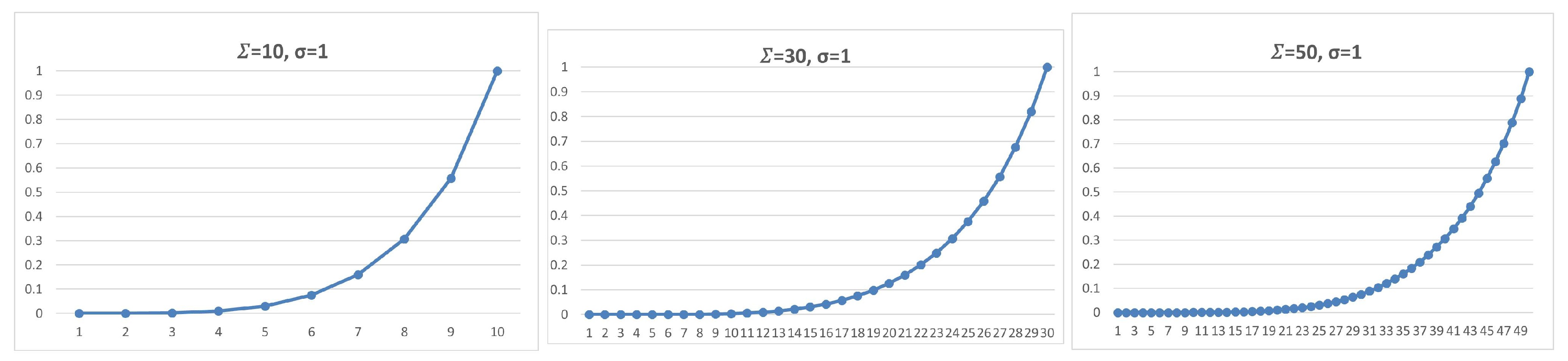
By extending this example, it is possible to present numerical results calculated for the proposed protocol performance. We consider the same setup in which the round is executed for every n = 100 packets and just one packet is signed with a designated and valid key, so σ = 1 . The receiver still tolerates up to τ = 3 of these rounds with no valid signature. We plot in Figure 14 the results for the values of Σ = 10 , Σ = 30 and Σ = 50 , showing the probability of the receiver not holding the authentication status of a sender when the adversary drops a number of packets varying from 1 up to the total Σ , 10, 30 and 50, respectively.
Figure 14. Relation between the number of packets the adversary manipulates and the probability π N A of the receiver not holding the authenticated status for a sender.
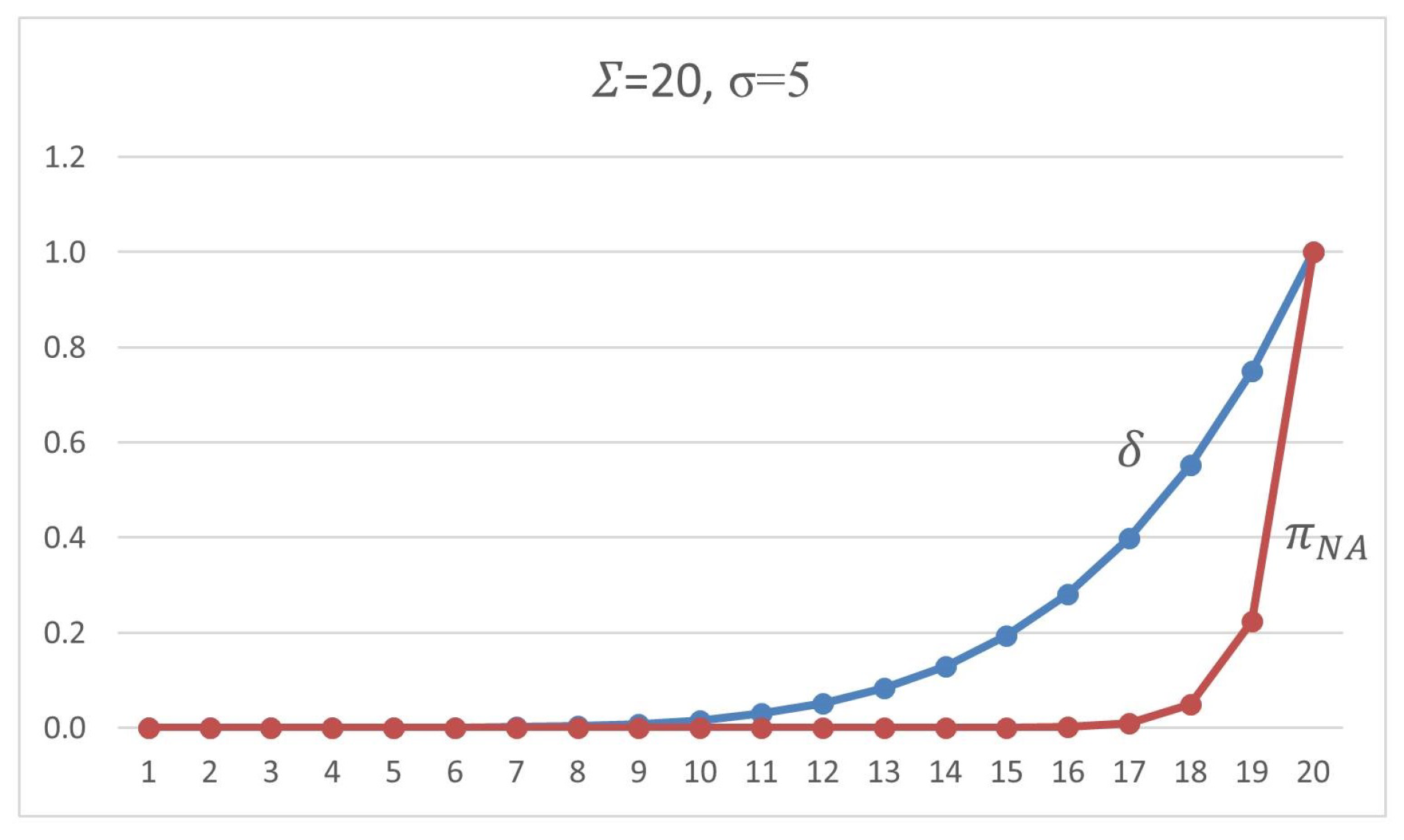
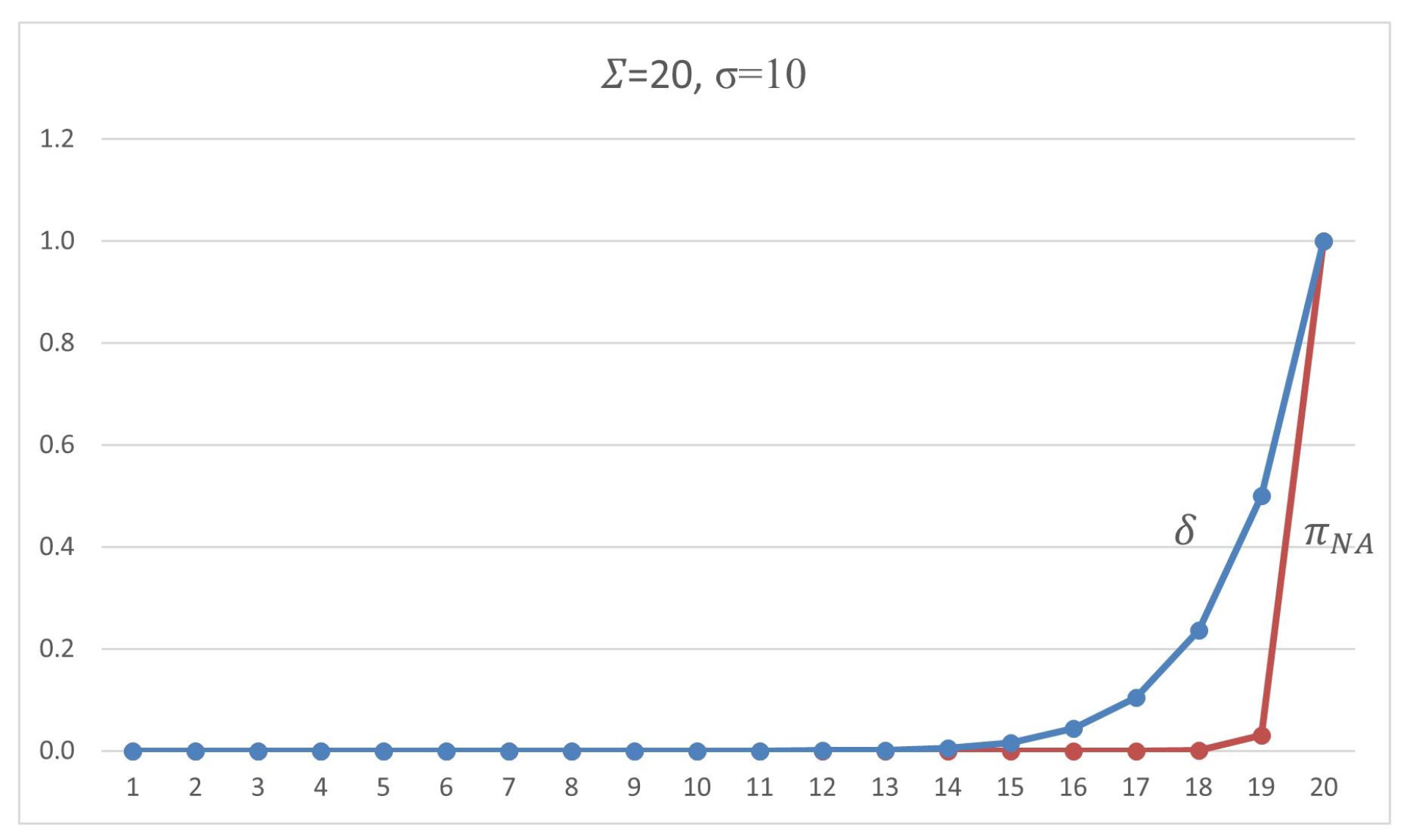
Furthermore, the case where the sender puts more than one valid signature must be analyzed. The sender can fit the σ > 1 valid signatures in Σ σ ways, which increases the hardness for an adversary to interfere with the scheme, mainly because it is needed to hit at least σ valid signatures. Thus, the adversary attacking up to σ 1 of them will not interfere in the scheme. The fact that the proposed protocol mixes valid and non-valid signatures amplifies the hardness of the attack. For instance, when we combine Σ = 10 and σ = 2 , we have 10 2 = 42 options on how we can fit the signatures. Thus, while σ = 1 required the attacker to manipulate only five packets to get a 50 % chance to hit the valid signed message, with σ = 2 the attacker will need to interfere in at least seven packets to get the same probability of successfully hitting the designated signed packets.
Another numerical example is presented considering Σ = 20 and σ = 5 , n = 1000 . In this case, the sender has 20 5 = 15,504 different ways to dispose of the valid/non-valid signed packets. Figure 15 illustrates the chances when the adversary attacks a number of packets varying from 1 to 20 packets. The figure shows that the adversary by interfering in less than five packets will get no chance to thwart an authentication.
Figure 15. Relation between the number of packets the adversary manipulates, the probability of hitting valid signatures δ and the probability π N A of invalidating an authentication, working with σ = 2 . In this case, the adversary gets a higher chance only after dropping most of the packets (more than 19 packets in 20).
That said, the reasoning proves that the Markov process representing our proposed protocol authentication mechanism has a stationary state that shows the protocol as resilient in face of adversary attacks. Whenever the sender wants to establish an authentication relation with the receiver, he will be identified with success. Otherwise, there would be a violation of the security assumption on the protocol setup.
The resilience gain resulting from using more than one signed message and mixing it among the others can be amplified when we choose a combination of σ among Σ in its maximum, i.e., when σ σ / 2 . Thus, the adversary has still fewer chances when he tries a guess of d < Σ . When he chooses d = Σ 1 , the chances of matching are easily verified as:
Σ σ Σ 1 σ 2 ,   when   σ Σ / 2
Hence, Equation (20) tells us that if the adversary does not try an all-guess interference in the signed packets, even if he does not proceed for all but one packet, the chance δ of matching the signed packets will be dropped by 1 / 2 . This ability to hide the valid signatures will have a huge effect that can be verified in Figure 16.
Figure 16. Relation between the number of packets the adversary manipulates, the probability of hitting valid signatures δ and the probability π N A of invalidating an authentication, working with σ = 10 . In this case, the adversary has a chance only after dropping the total of the packets. With these settings, the all-or-nothing nature of our defense scheme is clear.

8. Conclusions

We have presented a protocol that allows authentication between a sender and a receiver in a context of packet-switching networks. Our solution is innovative in the way we apply digital signatures, and therefore our contribution comes from the original way we use cryptography for building an anti-DoS defense mechanism which executes a strategy of packet authentication-based traffic filtering to counter DoS attacks. Our proposal does not rely on an expensive public-key infrastructure and requires light cryptography machinery that is suitable in the context of the Internet of Things.
We also presented how our solution is resistant to known denial of services attacks. That was done using the formal specification of the proposed protocol, describing it through the finite state formalism, and thus we have formally demonstrated the security of the proposed scheme.
Experimental validation of our proposal in a controlled testing environment is planned. Indeed, implementation details of any security protocol involve secure software development processes and the analysis of trust assumptions that are out of the scope of the present paper, being appropriate for further study. An experimental evaluation presents new challenges that we consider, for instance, the choice of a signature algorithm to be used, since there are recent proposals of short and efficient algorithms for designated signatures. We must also choose the security parameters and the network parameters, among other questions such as language and simulation environment.

Author Contributions

M.P.d.A. and R.T.d.S.J. conceived the security architecture and the proposed authentication protocol based on strong designated verifier signatures. L.J.G.V. and T.-H.K. contributed to the formal proof of the proposed defense method. All authors contributed to writing the original draft and reviewing and editing the manuscript.

Funding

This research received no external funding.

Acknowledgments

This research work was supported by Sungshin Women’s University. In addition, L.J.G.V. thanks the RAMSES project which has received funding from the European Union’s Horizon 2020 research and innovation programme under grant agreement 700326 (website: http://ramses2020.eu). R.T.d.S.J. and M.P.d.A. thank the Brazilian research and innovation Agencies CAPES—Coordination for the Improvement of Higher Education Personnel (Grant 23038.007604/2014-69 FORTE—Tempestive Forensics Project), CNPq—National Council for Scientific and Technological Development (Grant 465741/2014-2 Science and Technology National Institute—INCT on Cybersecurity) and FAPDF—Research Support Foundation of the Federal District (Grants 0193.001366/2016 UIoT—Universal Internet of Things and 0193.001365/2016—Secure Software Defined Data Center—SSDDC), as well as the Institutional Security Office of the Presidency of the Republic of Brazil (Grant 002/2017), and the Ministry of Planning, Development and Management (Grants 005/2016 DIPLA—Planning and Management Directorate, and 011/2016 SEST—Secretariat of State-owned Federal Companies).

Conflicts of Interest

The authors declare no conflict of interest. The founding sponsors had no role in the design of the study; in the collection, analyses or interpretation of data; in the writing of the manuscript; nor in the decision to publish the results.

References

  1. Kolias, C.; Kambourakis, G.; Stavrou, A.; Voas, J. DDoS in the IoT: Mirai and Other Botnets. Computer 2017, 50, 80–84. [Google Scholar] [CrossRef]
  2. Bertino, E.; Islam, N. Botnets and Internet of Things Security. Computer 2017, 50, 76–79. [Google Scholar] [CrossRef]
  3. Lyu, M.; Sherratt, D.; Sivanathan, A.; Gharakheili, H.H.; Radford, A.; Sivaraman, V. Quantifying the Reflective DDoS Attack Capability of Household IoT Devices. In Proceedings of the 10th ACM Conference on Security and Privacy in Wireless and Mobile Networks, WiSec ’17, Boston, MA, USA, 18–20 July 2017; ACM: New York, NY, USA, 2017; pp. 46–51. [Google Scholar]
  4. Osanaiye, O.A.; Alfa, A.S.; Hancke, G.P. Denial of Service Defence for Resource Availability in Wireless Sensor Networks. IEEE Access 2018, 6, 6975–7004. [Google Scholar] [CrossRef]
  5. Yang, Y.; Wu, L.; Yin, G.; Li, L.; Zhao, H. A Survey on Security and Privacy Issues in Internet-of-Things. IEEE Int. Things J. 2017, 4, 1250–1258. [Google Scholar] [CrossRef]
  6. Wang, D.; Wang, P. The Emperor’s New Password Creation Policies. In Proceedings of the European Symposium on Research in Computer Security ESORICS 2015, Vienna, Austria, 21–25 September 2015; pp. 456–477. [Google Scholar]
  7. Wang, D.; Zhang, Z.; Wang, P.; Yan, J.; Huang, X. Targeted Online Password Guessing: An Underestimated Threat. In Proceedings of the 2016 ACM SIGSAC Conference on Computer and Communications Security, CCS ’16, Vienna, Austria, 24–28 October 2016; ACM: New York, NY, USA, 2016; pp. 1242–1254. [Google Scholar]
  8. Cheyenne, M.; Abigail, B. Passwords Used in the Biggest Ever Cyberattack Revealed—and ‘12345’ and ‘Password’ Were Top. Available online: http://www.dailymail.co.uk/sciencetech/article-3825740/ (accessed on 14 August 2018).
  9. US-CERT. Heightened DDoS Threat Posed by Mirai and Other Botnets—Alert TA16-288A. Available online: www.us-cert.gov/ncas/alerts/TA16-288A (accessed on 11 May 2018).
  10. Brachmann, M.; Keoh, S.L.; Morchon, O.G.; Kumar, S.S. End-to-End Transport Security in the IP-Based Internet of Things. In Proceedings of the 21st International Conference on Computer Communications and Networks (ICCCN), Munich, Germany, 30 July–2 August 2012; pp. 1–5. [Google Scholar]
  11. Ferreira, H.G.C.; Junior, R.T.S. Security analysis of a proposed internet of things middleware. Clust. Comput. 2017, 20, 651–660. [Google Scholar] [CrossRef]
  12. Kalkan, K.; Gür, G.; Alagöz, F. Filtering-Based Defense Mechanisms Against DDoS Attacks: A Survey. IEEE Syst. J. 2017, 11, 2761–2773. [Google Scholar] [CrossRef]
  13. Bonguet, A.; Bellaiche, M. A Survey of Denial-of-Service and Distributed Denial of Service Attacks and Defenses in Cloud Computing. Future Internet 2017, 9, 43. [Google Scholar] [CrossRef]
  14. Zargar, S.T.; Joshi, J.; Tipper, D. A Survey of Defense Mechanisms Against Distributed Denial of Service (DDoS) Flooding Attacks. IEEE Commun. Surv. Tutor. 2013, 15, 2046–2069. [Google Scholar] [CrossRef]
  15. Andersen, D.G.; Balakrishnan, H.; Feamster, N.; Koponen, T.; Moon, D.; Shenker, S. Accountable Internet Protocol (AIP). In Proceedings of the ACM SIGCOMM 2008, Seattle, WA, USA, 17–22 August 2008; pp. 339–350. [Google Scholar]
  16. Haeberlen, A.; Rodrigues, R.; Gummadi, K.; Druschel, P. Pretty Good Packet Authentication. In Proceedings of the Fourth Conference on Hot topics in System Dependability (HotDep’08), San Diego, CA, USA, 8–10 December 2008. [Google Scholar]
  17. Ferguson, P.; Senie, D. Network Ingress Filtering: Defeating Denial of Service Attacks that Employ IP Source Address Spoofing. Available online: https://tools.ietf.org/html/rfc2827 (accessed on 21 October 2017).
  18. Kent, S.; Atkinson, R. Security Architecture for the Internet Protocol. Available online: https://tools.ietf.org/html/rfc1825 (accessed on 10 November 2017).
  19. Abdelsayed, S.; Glimsholt, D.; Leckie, C.; Ryan, S.; Shami, S. An Efficient Filter for Denial–of–Service Bandwidth Attacks. In Proceedings of the IEEE Global Telecommunications Conference (GLOBECOM ’03), San Francisco, CA, USA, 1–5 December 2003; pp. 1353–1357. [Google Scholar]
  20. Mirkovic, J.; Prier, G.; Reihe, P. Source–End DDoS Defense. In Proceedings of the 2nd IEEE International Symposium on Network Computing and Applications, Cambridge, MA, USA, 18 April 2003; pp. 171–178. [Google Scholar]
  21. Song, D.; Perrig, A. Advanced and Authenticated Marking Schemes for IP Traceback. In Proceedings of the Twentieth Annual Joint Conference of the IEEE Computer and Communications Societies (INFOCOM 2001), Anchorage, AK, USA, 22–26 April 2001; pp. 878–886. [Google Scholar]
  22. Parno, B.; Wendlandt, D.; Shi, E.; Perrig, A.; Maggs, B.; Hu, Y. Portcullis: Protecting Connection Setup from Denial–of–Capability Attacks. In Proceedings of the 2007 Conference on Applications, Technologies, Architectures, and Protocols for Computer Communications (SIGCOMM ’07), New York, NY, USA, 27–31 August 2007; pp. 289–300. [Google Scholar]
  23. Pimenta Rodrigues, G.A.; de Oliveira Albuquerque, R.; Gomes de Deus, F.E.; de Sousa, R.T., Jr.; de Oliveira Júnior, G.A.; García Villalba, L.J.; Kim, T.-H. Cybersecurity and Network Forensics: Analysis of Malicious Traffic towards a Honeynet with Deep Packet Inspection. Appl. Sci. 2017, 7, 1082. [Google Scholar] [CrossRef]
  24. Peng, T.; Leckie, C.; Ramamohanarao, K. Protection from Distributed Denial of Service Attacks Using History–Based IP Filtering. In Proceedings of the IEEE International Conference on Communications (ICC’03), Anchorage, AK, USA, 11–15 May 2003; pp. 482–486. [Google Scholar]
  25. Yaar, A.; Perrig, A.; Song, D. Pi: A Path Identification Mechanism to Defend against DDoS Attacks. In Proceedings of the IEEE Symposium on Security and Privacy, Berkeley, CA, USA, 11–14 May 2003. [Google Scholar]
  26. Bellovin, S. Problem Areas for the IP Security Protocols. In Proceedings of the Sixth Usenix Unix Security Symposium, San Jose, CA, USA, 22–25 July 1996; pp. 1–16. [Google Scholar]
  27. Paterson, K.G.; Yau, A.K.L. Cryptography in Theory and Practice: The Case of Encryption in IPsec. In Proceedings of the Annual International Conference on the Theory and Applications of Cryptographic Techniques (Eurocrypt’06), St. Petersburg, Russia, 28 May–1 June 2006; pp. 12–29. [Google Scholar]
  28. Bellare, M.; Namprempre, C. Authenticated Encryption: Relations among Notions and Analysis of the Generic Composition Paradigm. In Proceedings of the International Conference on the Theory and Application of Cryptology and Information Security (ASIACRYPT 2000), Kyoto, Japan, 3–7 December 2000; pp. 531–545. [Google Scholar]
  29. Bloom, B.H. Space/Time Trade–offs in Hash Coding with Allowable Errors. Commun. ACM 1970, 13, 422–426. [Google Scholar] [CrossRef]
  30. Antikainen, M.; Aura, T.; Särelä, M. Denial–of–Service Attacks in Bloom–Filter–Based Forwarding. Cluster 2014, 22, 1463–1476. [Google Scholar] [CrossRef]
  31. Mullin, J.K. A Second Look at Bloom Filters. Commun. ACM 1983, 26, 570–571. [Google Scholar] [CrossRef]
  32. Qian, J.; Zhu, Q.; Wang, Y. Bloom Filter Based Associative Deletion. IEEE Trans. Parallel Distrib. Syst. 2014, 25, 1986–1998. [Google Scholar] [CrossRef]
  33. Kirsch, A.; Mitzenmacher, M. Less Hashing, Same Performance: Building a Better Bloom Filter. In Proceedings of the European Symposium on Algorithms, Zurich, Switzerland, 11–13 September 2006; pp. 456–467. [Google Scholar]
  34. Rottenstreich, O.; Keslassy, I. The Bloom Paradox: When Not to Use a Bloom Filter. IEEE ACM Trans. Netw. 2014, 23, 703–716. [Google Scholar] [CrossRef]
  35. Merkle, R.C. Secure communications over insecure channels. Commun. ACM 1978, 21, 294–299. [Google Scholar] [CrossRef]
  36. Dwork, C.; Naor, M. Pricing via Processing or Combatting Junk Mail. In Proceedings of the 12th Annual International Cryptology Conference on Advances in Cryptology (CRYPTO’92), Santa Barbara, CA, USA, 16–20 August 1992; pp. 139–147. [Google Scholar]
  37. Juels, A.; Brainard, J. Client Puzzles: A Cryptographic Defense Against Connection Depletion. In Proceedings of the Network and Distributed System Security Symposium (NDSS’99), San Diego, CA, USA, 24–27 February 1999; pp. 151–165. [Google Scholar]
  38. Dean, D.; Stubblefield, A. Using Client Puzzles to Protect TLS. In Proceedings of the 10th Conference on USENIX Security Symposium (SSYM’01), Washington, DC, USA, 13–17 August 2001. [Google Scholar]
  39. Aura, T.; Nikander, P.; Leiwo, J. DoS-Resistant Authentication with Client Puzzles. In Proceedings of the Security Protocols: 8th International Workshop, Cambridge, UK, 3–5 April 2001; pp. 170–177. [Google Scholar]
  40. Wang, X.; Reiter, M. Defending Against Denial-of-Service Attacks with Puzzle Auctions. In Proceedings of the IEEE Symposium on Security and Privacy, Berkeley, CA, USA, 11–14 May 2003; pp. 78–93. [Google Scholar]
  41. Feng, W.; Kaiser, E.; Luu, A. The Design and Implementation of Network Puzzles. In Proceedings of the IEEE 24th Annual Joint Conference of the IEEE Computer and Communications Societies, Miami, FL, USA, 13–17 March 2005; pp. 2372–2382. [Google Scholar]
  42. Feng, W. The Case for TCP/IP Puzzles. In Proceedings of the ACM SIGCOMM workshop on Future directions in Network Architecture, Karlsruhe, Germany, 25–27 August 2003; pp. 322–327. [Google Scholar] [CrossRef]
  43. Gendreau, A.A.; Moorman, M. Survey of Intrusion Detection Systems towards an End to End Secure Internet of Things. In Proceedings of the IEEE 4th International Conference on Future Internet of Things and Cloud (FiCloud), Vienna, Austria, 22–24 August 2016; pp. 84–90. [Google Scholar]
  44. Zarpelão, B.B.; Miani, R.S.; Kawakani, C.T.; de Alvarenga, S.C. A survey of intrusion detection in Internet of Things. J. Netw. Comput. Appl. 2017, 84, 25–37. [Google Scholar] [CrossRef]
  45. Pa, Y.M.P.; Suzuki, S.; Yoshioka, K.; Matsumoto, T.; Kasama, T.; Rossow, C. IoTPOT: A Novel Honeypot for Revealing Current IoT Threats. J. Inf. Process. 2016, 24, 522–533. [Google Scholar] [CrossRef]
  46. Gupta, N.; Naik, V.; Sengupta, S. A Firewall for Internet of Things. In Proceedings of the 9th International Conference on Communication Systems and Networks (COMSNETS), Bangalore, India, 4–8 January 2017; pp. 411–412. [Google Scholar]
  47. Jang, S.; Lim, D.; Kang, J.; Joe, I. An Efficient Device Authentication Protocol Without Certification Authority for Internet of Things. Wirel. Pers. Commun. 2016, 91, 1681–1695. [Google Scholar] [CrossRef]
  48. Porambage, P.; Schmitt, C.; Kumar, P.; Gurtov, A.; Ylianttila, M. Two-Phase Authentication Protocol for Wireless Sensor Networks in Distributed IoT Applications. In Proceedings of the IEEE Wireless Communications and Networking Conference (WCNC), Istanbul, Turkey, 6–9 April 2014; pp. 2728–2733. [Google Scholar]
  49. Salmon, H.M.; De Farias, C.M.; Loureiro, P.; Pirmez, L.; Rossetto, S.; Rodrigues, P.H.; Pirmez, R.; Delicato, F.C.; da Costa Carmo, L.F. Intrusion Detection System for Wireless Sensor Networks Using Danger Theory Immune-Inspired Techniques. Int. J. Wirel. Inf. Netw. 2013, 20, 39–66. [Google Scholar] [CrossRef]
  50. Argyraki, K.; Cheriton, D.R. Network Capabilities: The Good, the Bad and the Ugly. In Proceedings of the Fourth Workshop on Hot Topics in Networks (HotNets-IV), College Park, MD, USA, 14–15 November 2005; ACM Press: Bel Air, MD, USA, 2005. [Google Scholar]
  51. Argyraki, K.; Cheriton, D.R. Scalable Network-Layer Defense Against Internet Bandwidth-Flooding Attacks. IEEE/ACM Trans. Netw. 2009, 17, 1284–1297. [Google Scholar] [CrossRef]
  52. Goldreich, O. Foundations of Cryptography: Volume 2, Basic Applications; Cambridge University Press: New York, NY, USA, 2004; ISBN 052111991X. [Google Scholar]
  53. Katz, J.; Lindell, Y. Introduction to Modern Cryptography, 1st ed.; Chapman & Hall/CRC: Boca Raton, FL, USA, 2007; ISBN 9781466570269. [Google Scholar]
  54. Lindell, Y. How to Simulate It—A Tutorial on the Simulation Proof Technique. Available online: https://eprint.iacr.org/2016/046 (accessed on 8 February 2018).
  55. Bellare, M.; Rogaway, P. Random Oracles are Practical: A Paradigm for Designing Efficient Protocols. In Proceedings of the ACM Conference on Computer and Communications Security (CCS’93), Fairfax, VA, USA, 3–5 November 1993; pp. 62–73. [Google Scholar]
  56. Koblitz, N.; Menezes, A.J. The random oracle model: A twenty–year retrospective. Des. Codes Cryptogr. 2015, 77, 587–610. [Google Scholar] [CrossRef]
  57. Pointcheval, D.; Stern, J. Security Arguments for Digital Signatures and Blind Signatures. J. Cryptol. 2000, 13, 361–396. [Google Scholar] [CrossRef]
  58. Pointcheval, D.; Stern, J. Provably Secure Blind Signature Schemes. In Proceedings of the International Conference on the Theory and Application of Cryptology and Information Security (ASIACRYPT’96), Kyongju, Korea, 3–7 November 1996; pp. 252–265. [Google Scholar]
  59. Pointcheval, D.; Stern, J. Security Proofs for Signature Schemes. In Proceedings of the International Conference on the Theory and Applications of Cryptographic Techniques (Eurocrypt ’96), Saragossa, Spain, 12–16 May 1996; pp. 387–398. [Google Scholar]
  60. Chaum, D.; Antwerpen, H.V. Undeniable Signatures. In Proceedings of the Conference on the Theory and Application of Cryptology (CRYPTO’89), Santa Barbara, CA, USA, 20–24 August 1989; pp. 212–216. [Google Scholar]
  61. Jakobsson, M.; Sako, K.; Impagliazzo, R. Designated Verifier Proofs and Their Applications. In Proceedings of the 15th Annual International Conference on Theory and Application of Cryptographic Techniques (EUROCRYPT’96), Saragossa, Spain, 12–16 May 1996; pp. 143–154. [Google Scholar]
  62. Saeednia, S.; Kremer, S.; Markowitch, O. An Efficient Strong Designated Verifier Signature Scheme. In Proceedings of the International Conference on Information Security and Cryptology (ICISC 2003), Seoul, Korea, 27–28 November 2003; pp. 40–54. [Google Scholar]
  63. Jokela, P.; Zahemszky, A.; Rothenberg, C.E.; Arianfar, S.; Nikander, P. LIPSIN: Line speed publish/subscribe inter–networking. In Proceedings of the ACM SIGCOMM 2009 Conference on Data Communication (SIGCOMM ’09), Barcelona, Spain, 16–21 August 2009; pp. 195–206. [Google Scholar]
  64. Rothenberg, C.E.; Jokela, P.; Nikander, P.; Sarela, M.S.; Ylitalo, J. Self-Routing Denial-of-Service Resistant Capabilities Using In-Packet Bloom Filters. In Proceedings of the 2009 European Conference on Computer Network Defense (EC2ND ’09), Milan, Italy, 9–10 November 2009; pp. 46–51. [Google Scholar]
  65. oneM2M Partners. TS-0001 Functional Architecture (V2.18.1). Available online: http://www.onem2m.org/component/rsfiles/ (accessed on 9 July 2018).
  66. oneM2M Partners. TS-0003 Security Solutions (V2.12.1). Available online: http://www.onem2m.org/component/rsfiles/ (accessed on 9 July 2018).
  67. Angrishi, K. Turning Internet of Things (IoT) into Internet of Vulnerabilities (IoV): IoT Botnets. arXiv, 2017; arXiv:1702.03681v1. [Google Scholar]
  68. Puttini, R.S.; Percher, J.-M.; Me, L.; Sousa, R.T., Jr. A Fully Distributed IDS for MANET. In Proceedings of the Ninth International Symposium on Computers and Communications (ISCC 2004), Alexandria, Egypt, 28 June–1 July 2004; pp. 331–338. [Google Scholar]
  69. Paxson, V. End-to-End Internet Packet Dynamics. In Proceedings of the ACM SIGCOMM ’97 Conference on Applications, Technologies, Architectures, and Protocols for Computer Communication, Cannes, France, 14–18 September 1997; pp. 139–152. [Google Scholar] [CrossRef]
  70. Shmatikov, V.; Stern, U. Efficient Finite-State Analysis for Large Security Protocols. In Proceedings of the 11th IEEE Computer Security Foundations Workshop, Rockport, MA, USA, 11 June 1998; pp. 106–115. [Google Scholar]
  71. Shmatikov, V.; Mitchell, J.C. Finite-state analysis of two contract signing protocols. Theor. Comput. Sci. 2002, 283, 419–450. [Google Scholar] [CrossRef]
  72. Mitchell, J.C.; Shmatikov, V.; Stern, U. Finite State Analysis of SSL 3.0. In Proceedings of the 7th conference on USENIX Security Symposium (SSYM’98), San Antonio, TX, USA, 26–29 January 1998; pp. 201–215. [Google Scholar]
  73. Bolignano, D. Towards a Mechanization of Cryptographic Protocol Verification. In Proceedings of the International Conference on Computer Aided Verification, Haifa, Israel, 22–25 June 1997; pp. 131–142. [Google Scholar]
  74. Mitchell, J.C.; Mitchell, M.; Stern, U. Automated Analysis of Cryptographic Protocols Using Murϕ. In Proceedings of the IEEE Symposium on Security and Privacy, Oakland, CA, USA, 4–7 May 1997; pp. 141–151. [Google Scholar]
  75. Sipser, M. Introduction to the Theory of Computation, 2nd ed.; International Thomson Publishing: Boston, MA, USA, 1996. [Google Scholar]

Article Metrics

Citations

Article Access Statistics

Multiple requests from the same IP address are counted as one view.