Multi-UAV Path Planning for Autonomous Missions in Mixed GNSS Coverage Scenarios




Abstract
1. Introduction
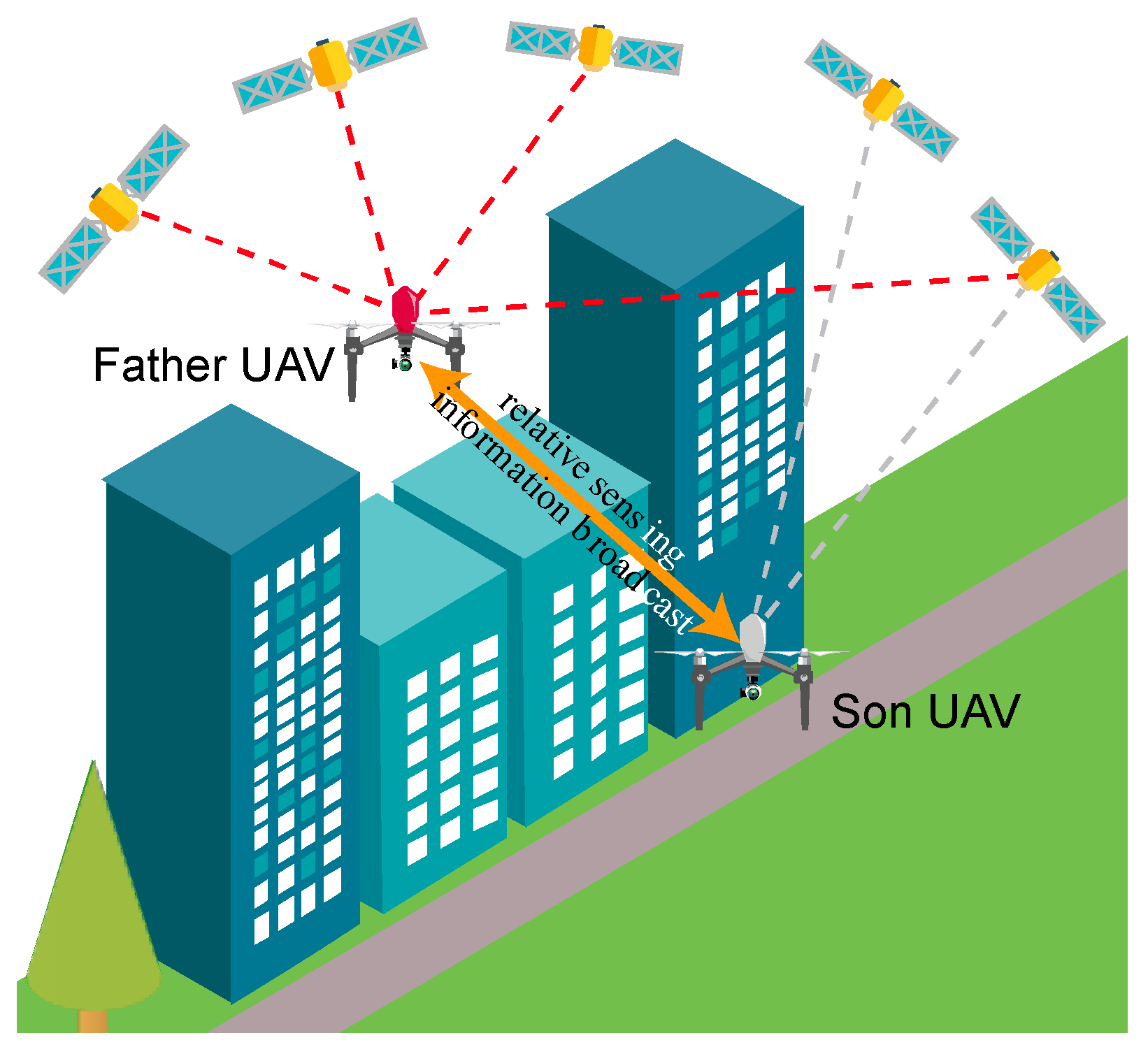
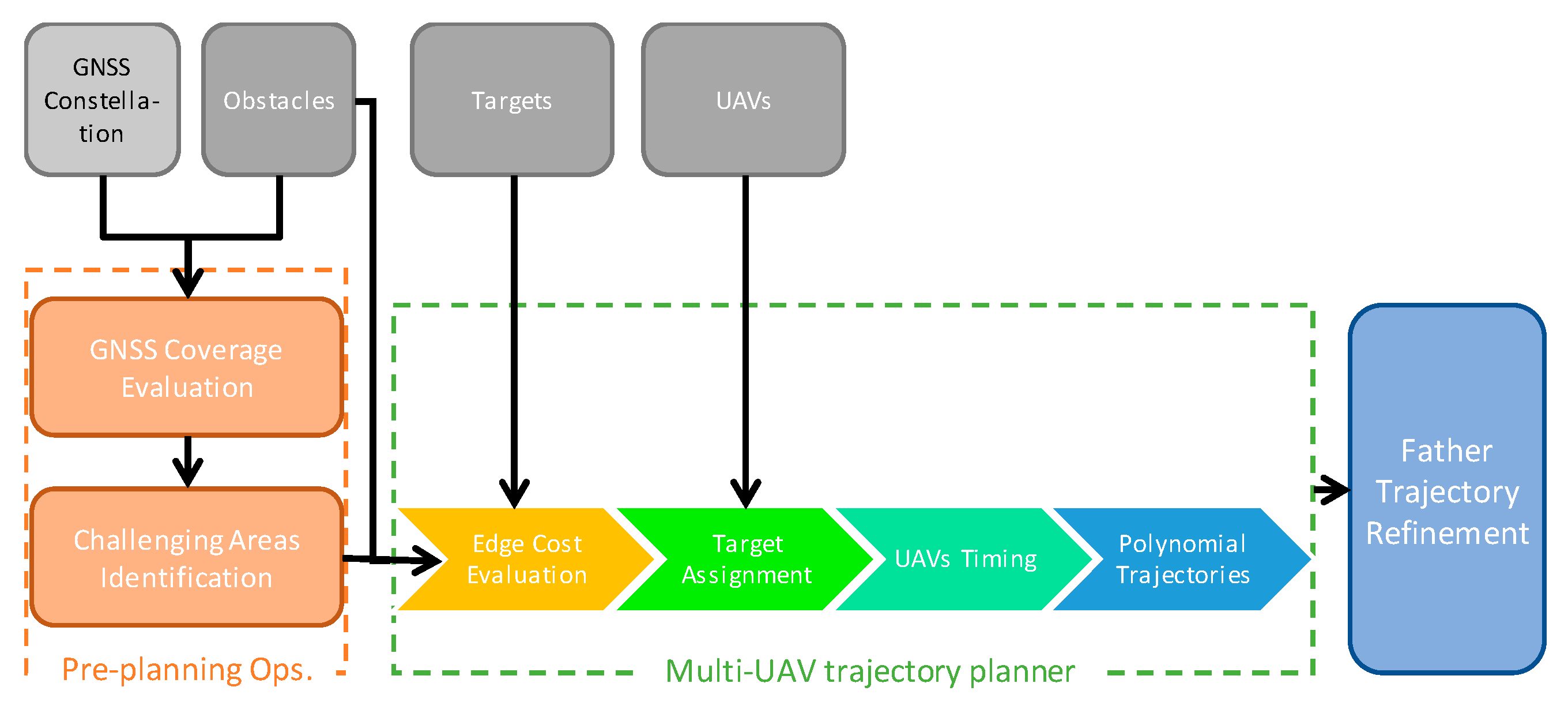
- Preprocessing operations aimed at evaluating the GNSS-challenging zones where UAVs cannot fly autonomously without support from other vehicles. They are based on the knowledge of a coarse representation of the 3D mission environment, and of the time and date the mission is performed (i.e., GNSS constellation geometry). Once the constellation of satellites and the surrounding environment are known, it is possible to define a 3D grid of the volume where the UAVs are designed to fly, in order to map the dilution of precision (DOP) and define the challenging areas as explained in Section 2;
- A multi-step path planning algorithm that assigns to all the UAVs flyable trajectories that fulfill mission and navigation constraints. This is discussed in detail in this paper;
- An algorithm to refine the trajectories of the father UAVs when operating in challenging zones. This algorithm allows, once the trajectories of the sons in challenging areas are defined, shaping father trajectories based on the navigation needs. This is oriented towards real time guidance and is described in [15].
2. Planning Concept and Assumptions
- A sequence of target positions, with the associated service time;
- Definition of GNSS-challenging areas (where navigation requirements cannot be fulfilled by single vehicle techniques), and of the number of fathers required at each of them for supporting the son flight. This information is the output of pre-processing operations based on a coarse knowledge of geometry of the three-dimensional (3D) environment (including obstacles), the GNSS geometry at the time the mission must be executed, and the assumed cooperative navigation sensors/approaches [13];
- Definition of eventual no-fly zones, which are seen as obstacles;
- Number and dynamic constraints (e.g., maximum speed) of the adopted UAVs. It is assumed that all the UAVs have the same constraints and capabilities.
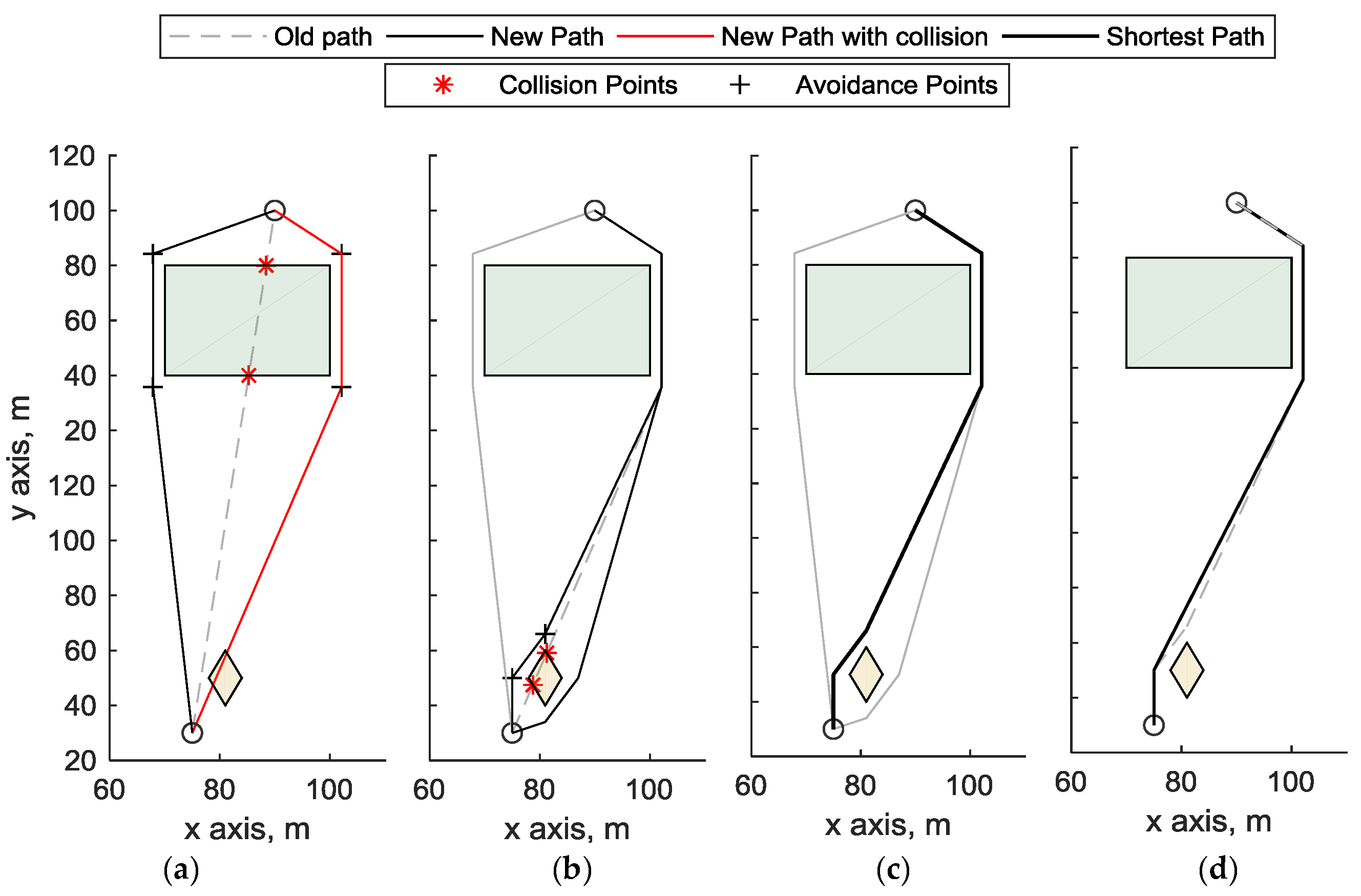
- The first step (edge cost evaluation, presented in Section 3) is aimed at defining obstacle-free paths between each couple of targets, and evaluating their length;
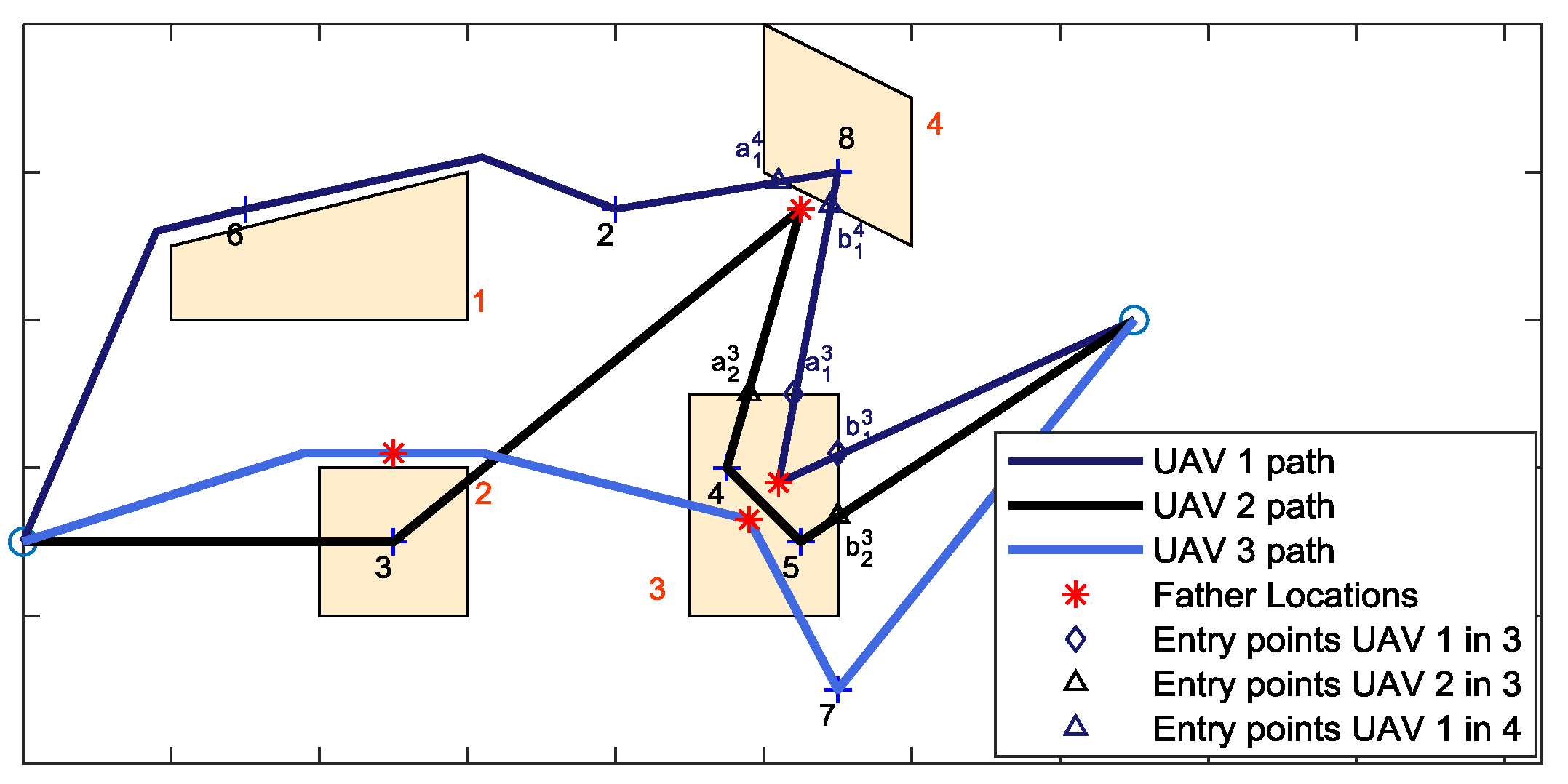
- The second part of the path planning algorithm (target assignment, Section 4) assigns all the waypoints and tasks to the UAVs, with the aim of minimizing the overall mission time. This is done minimizing the total path length while also ensuring uniformity in load distribution among UAVs. As an output of this step, each UAV is assigned a trajectory that is a polygonal chain composed by a number of waypoints and the edges between them;
- The timing step of the planning algorithm (Section 5) consists in defining the velocity that each UAV must hold along its trajectory in order to synchronize son and father arrival and departure to/from the challenging zones;
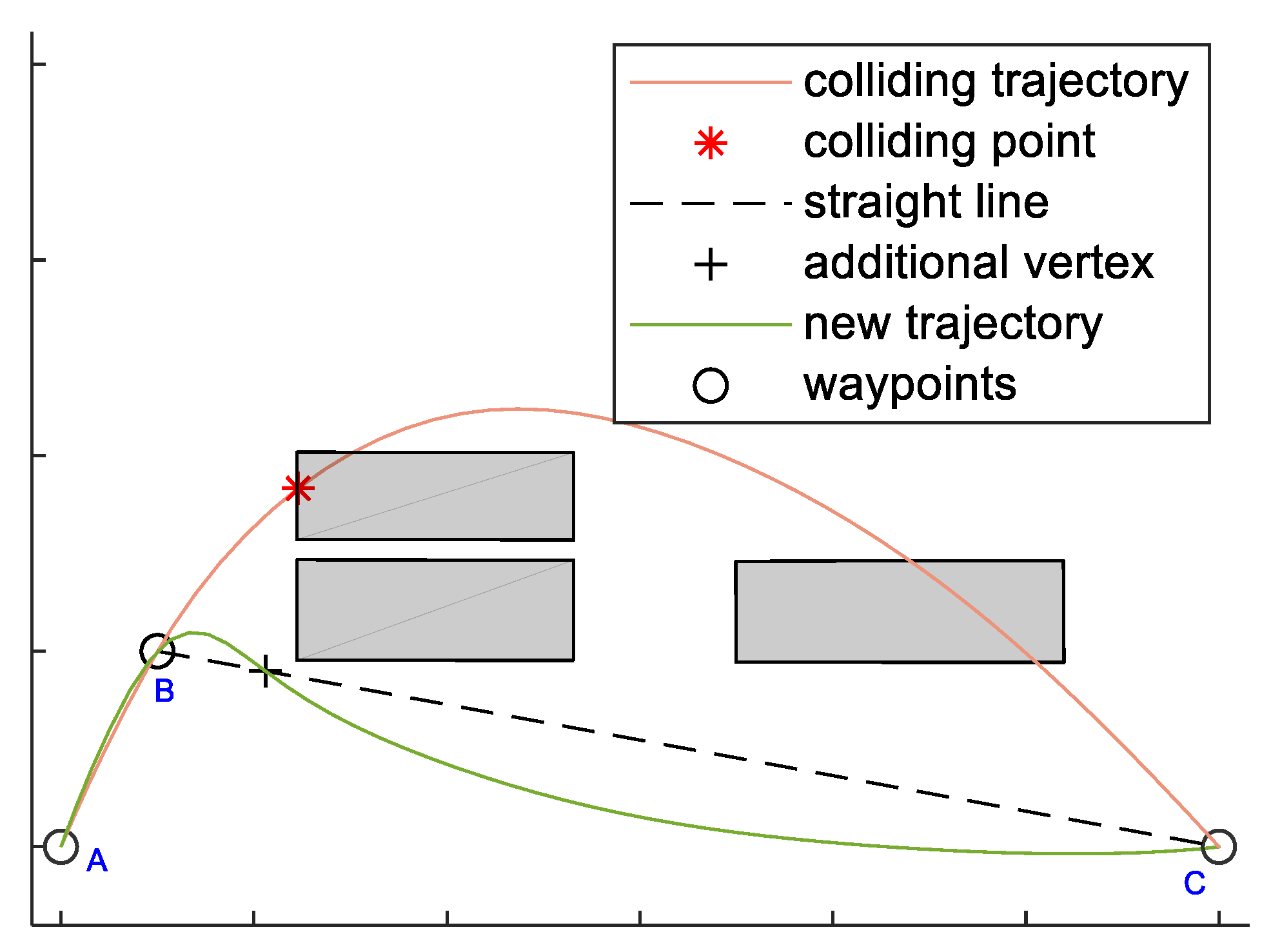
- Finally, polynomial paths are defined for all the UAVs to connect waypoints with flyable and smooth trajectories (Section 6). Polynomials allow easily deriving 3D position and its derivatives for each time epoch.
3. Edge Cost Evaluation
4. Target Assignment
4.1. Waypoint Insertion Procedure
- (a)
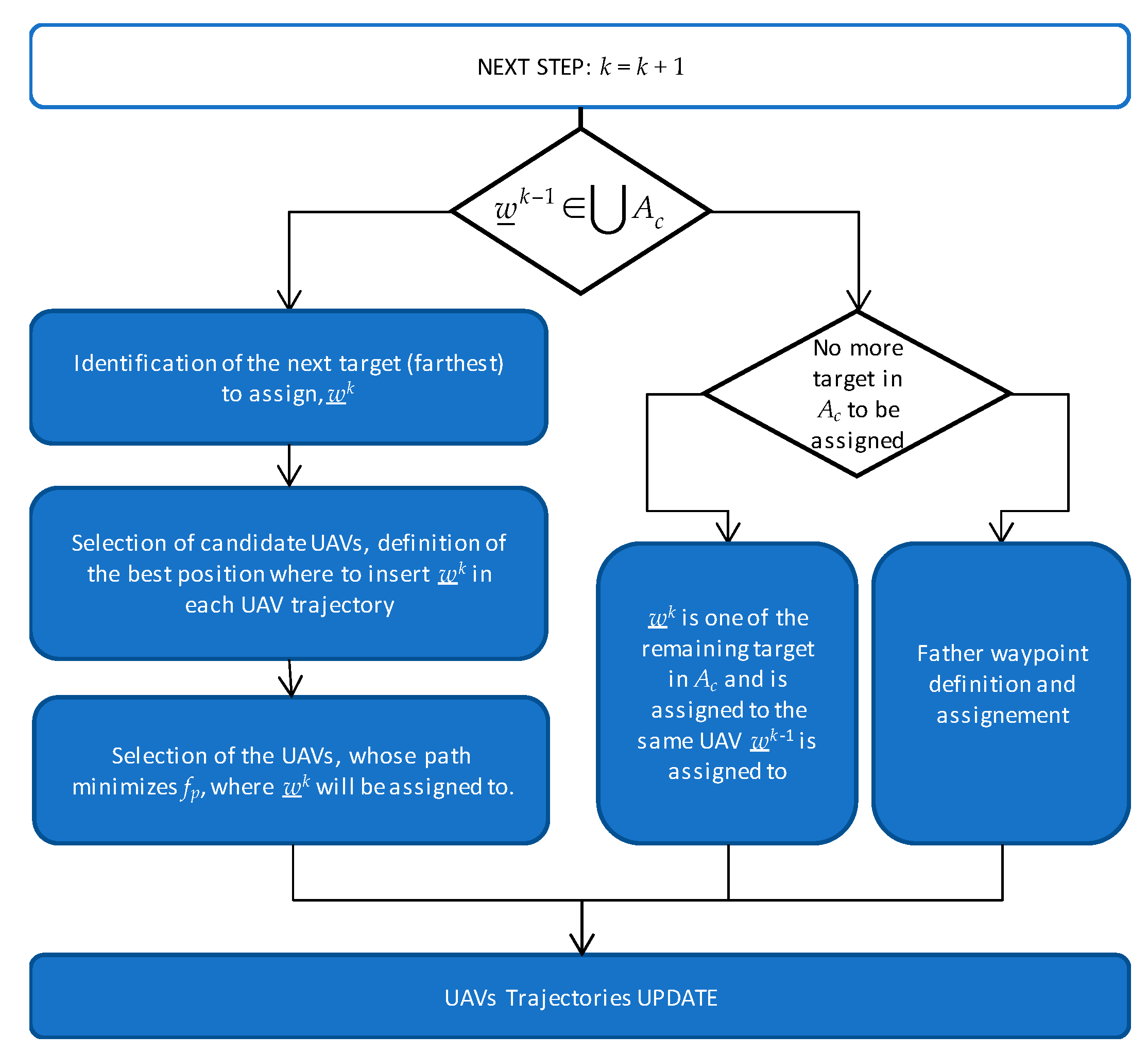
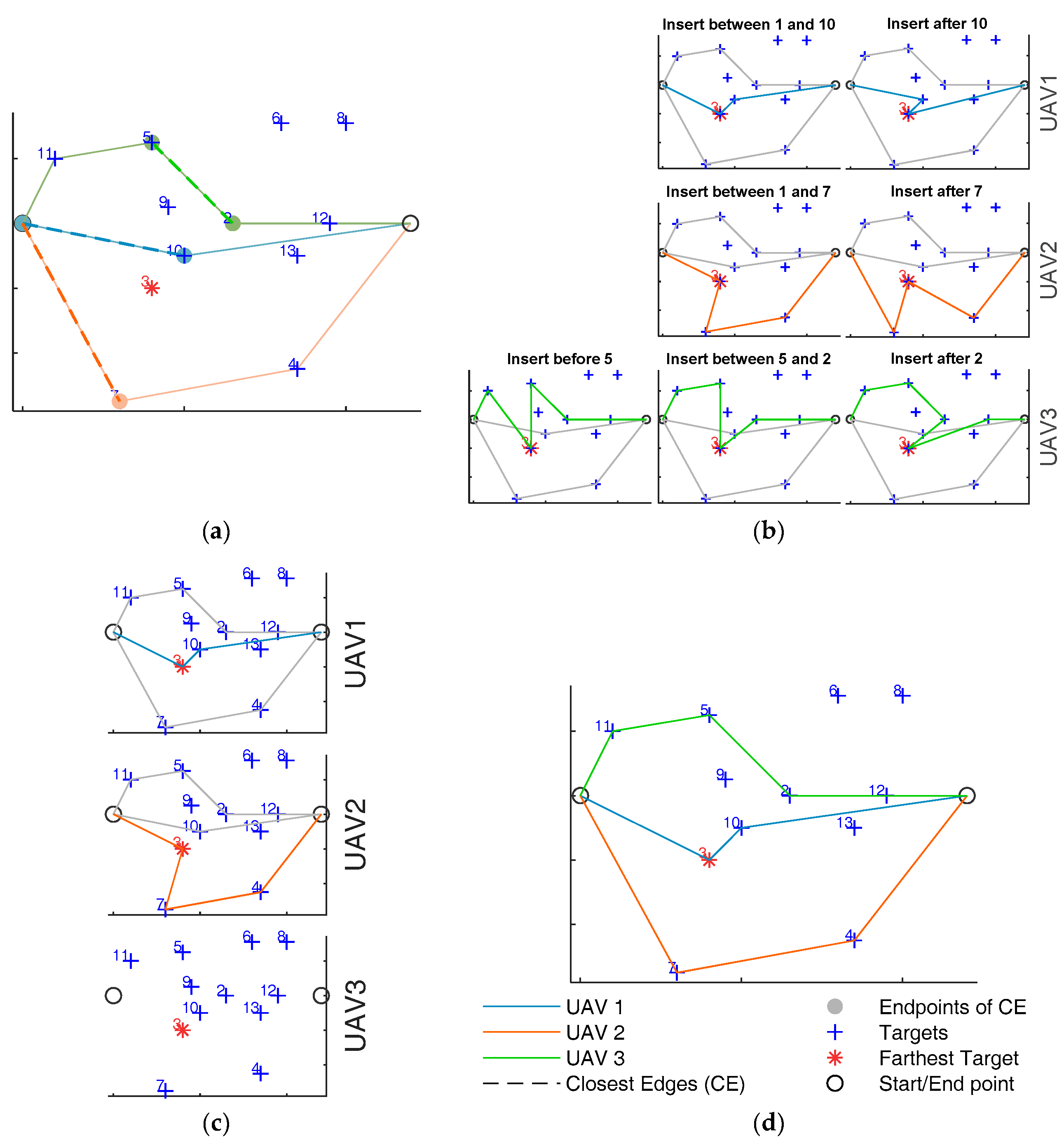
- Select the target i to be added (“farthest” target) as the one that maximizes fT:where dij is the distance (computed along the relevant edge) between the not yet assigned target i, and the already assigned target j. j enumerates the already assigned waypoints (including fathers’ ones) and l the already assigned edges, whose distance from the target i is named Dil.
- (b)
- Find the three edges that are closest to the farthest target, and the UAVs whose trajectories at k-1 include at least one of the endpoints (we) of these edges. For each UAV, the farthest target is tried to be inserted before and after the point we. The resulting paths that intersect the path of the other UAVs are discarded to avoid that targets could be assigned to farther trajectories when the path equalizing logic prevails. In addition, this improves the capability of the algorithm to mimic optimal techniques. Then, the best insertion location is defined as the one that minimizes path increase. The trajectory obtained by adding the farthest target to the path of the g-th UAV is defined as
- (c)
- The UAV which the target is assigned to, is selected minimizing the cost function fp, reported in Equation (2). This cost function is composed by two terms aimed at minimizing the overall distance and reducing the standard deviation (std) among UAV path lengths, thus ensuring (up to a certain level) uniformity in load distribution among UAVs. This is an innovative point of the target assignment procedure. The cost function is written as:where is the vector containing path lengths at step k-1 for all UAVs excluding the g-th UAV, for which path length is computed accounting for the farthest target added at the k-th step and defined as . is the path length of the g-th UAV at time step k − 1. mean is the operator that yields the mean of the variables, α is a tuning coefficient whose role is relevant to the trade-off between path lengths uniformity and minimization.
4.2. Father Waypoint Definition and Assignment Procedure
- (a)
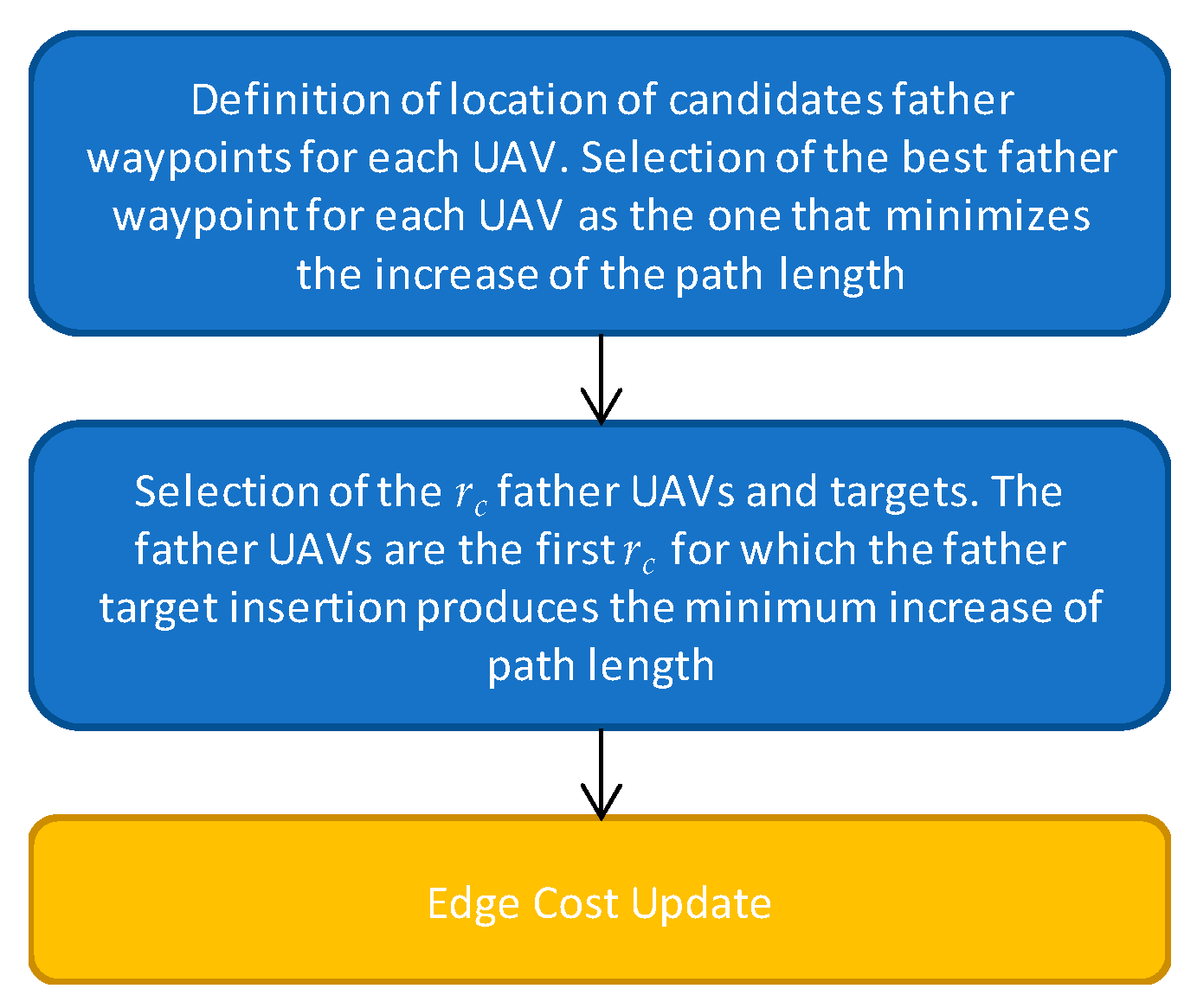
- For the c-th challenging zone, candidate father waypoints , are estimated assuming that father(s) can be placed on an open face of the c-th challenging volume, where oc is the number of open faces of that volume. Since that volume is a prism, one can easily identify the open faces as the ones not adjacent to any obstacle. For each open face, the candidate waypoint is defined projecting the barycenter of the targets inside the challenging area on a plane parallel to the face and located at a distance of 3 m from it (outside the challenging zone). It is assumed that the UAV designed as father must hold that position for the whole time required to the son UAV for flying inside the challenging zone, unless the father target is located on top of the challenging volume. In that case the father UAV flies over the challenging area passing by the father waypoints.Candidate father UAVs are all the UAVs, excluding the one that is son for the c-th challenging zone. For each candidate UAV, all the possible father waypoints are tried to be inserted in between all the waypoints belonging to the trajectory at step k − 1. The best insertion is defined, along with the best father, as the couple that minimizes the increase of path length :where is the increase of the h-th UAV trajectory length due to adding ic father point after the ih element of the sequence. is the Euclidean distance, used instead of the distance on the obstacle-free polygonal chain, to simplify operations and reduce the computational burden. is the total distance between the targets served by the son UAV in the c-th challenging zone, that is summed up to the Euclidean increase of trajectory length. is added to , to take into account the fact that the father trajectory must be defined to serve the son UAV within the challenging zone, and the time spent to do this is strictly connected with the time the son UAV requires to fly inside the challenging area. Indeed, when planning the father trajectory, one must account for the time spent to serve the son, when the father must fly over or hover next to the challenging area.
- (b)
- The UAVs to which father targets are assigned are the first rc for which is smaller, where rc is the number of required fathers for the c-th challenging zone. If more than one UAV choose the same father position, i.e., the same face from where to serve the son, evenly spaced points around the initially considered father position are designed as UAV father points to prevent those UAVs from holding the same position during son operations. Therefore, father assignment yields rc new points to the UAVs trajectory, even if some of the fathers serve the son using the same face. As previously pointed out, father waypoints are only an indicative location for the true father trajectory in servicing the son. The definition of the specific father/son aiding geometry can be left to cooperative navigation studies [15], while the presented definition of father waypoints has sufficient level of detail in view of path planning aims.
- (c)
- The last step consists in updating the edge cost definition including the rc father waypoints. The cost to travel from the newly defined father targets to the already defined wi targets is estimated, in order to account also for the father waypoints in the definition and assignment of the farthest target for the next steps of the assignment procedure.
5. UAV Timing
5.1. Arrival and Exit Time of the Challenging Areas
5.2. Time of Arrival and Departure for Each Waypoint
6. Polynomial Paths
7. Performance Assessment
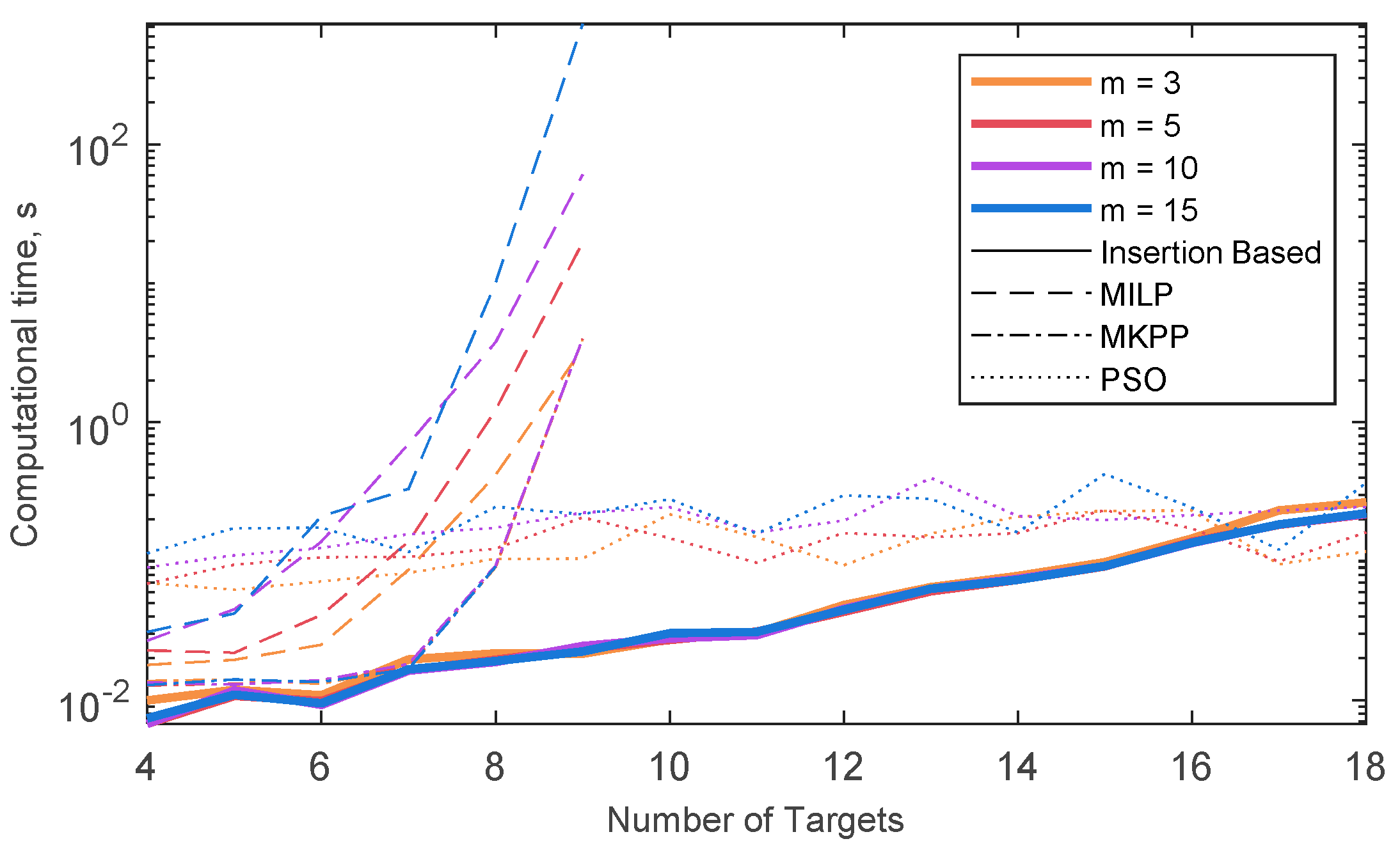
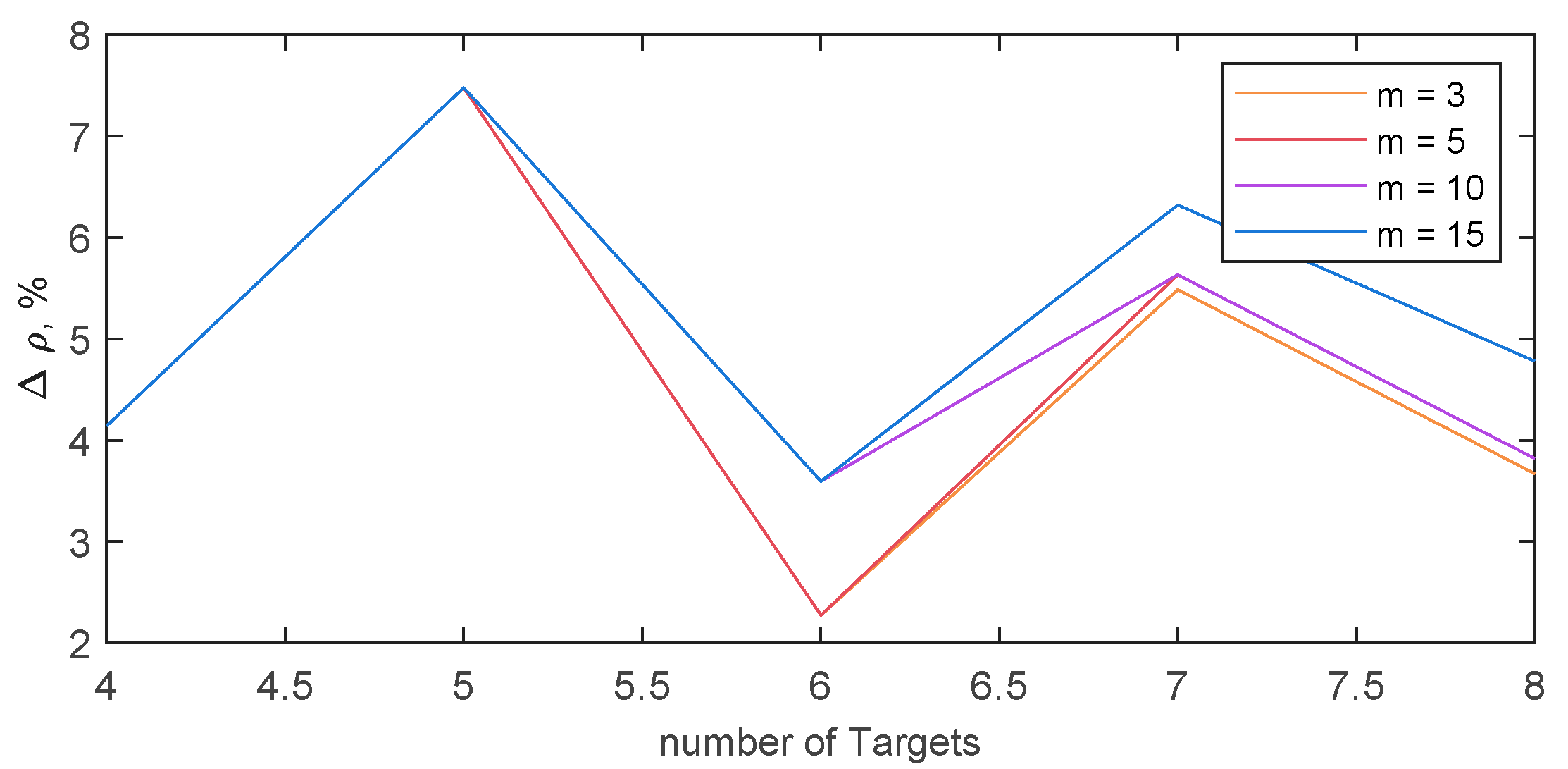
7.1. Comparison with Optimal and Heuristic Techniques
- The classical MILP formulation [16], whose solution is a binary variable that is 1 if the edge from the target i to the target j is included in the h-th UAV path;
- The MILP formulated as set-covering [16], e.g., Multi-dimensional Multiple-choice Knapsack Problem (MMKP), that instead of the edges assumes the solution for each UAV connected to a circuit, i.e., a feasible sequence of edges. Therefore, the binary variable is 1 if the l-th circuit is assigned to the h-th UAV, 0 otherwise.
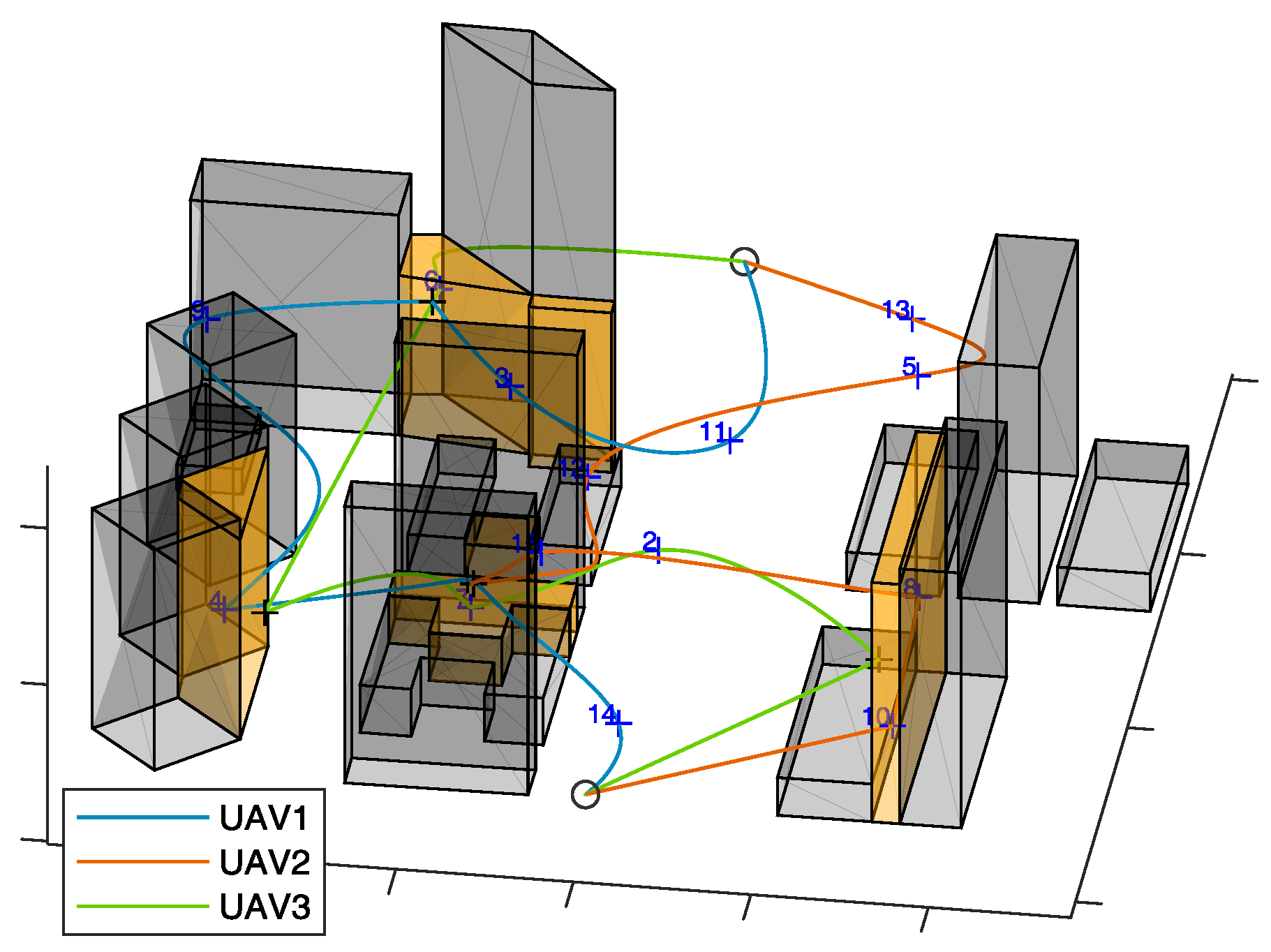
7.2. Results of Routing Algorithm in Real-World Scenario
7.2.1. Scenario
7.2.2. Results
7.2.3. Algorithm’s Performance with Varying m and n
8. Conclusions
Supplementary Materials
Author Contributions
Funding
Acknowledgments
Conflicts of Interest
References
- Rufa, J.R.; Atkins, E.M. Unmanned Aircraft System Navigation in the Urban Environment: A Systems Analysis. J. Aerosp. Inf. Syst. 2016, 13, 143–160. [Google Scholar] [CrossRef]
- Dalamagkidis, K.; Valavanis, K.; Piegl, L. On Integrating Unmanned Aircraft Systems into the National Airspace System; Springer: Berlin, Germany, 2012; Volume 36, ISBN 978-94-007-2478-5. [Google Scholar]
- Chowdhary, G.; Johnson, E.N.; Magree, D.; Wu, A.; Shein, A. GPS-denied Indoor and Outdoor Monocular Vision Aided Navigation and Control of Unmanned Aircraft. J. Field Robot. 2013, 30, 415–438. [Google Scholar] [CrossRef]
- Prentice, S.; Roy, N. The Belief Roadmap: Efficient Planning in Belief Space by Factoring the Covariance. Int. J. Rob. Res. 2009, 28, 1448–1465. [Google Scholar] [CrossRef]
- Sundar, K.; Misra, S.; Rathinam, S.; Sharma, R. Routing unmanned vehicles in GPS-denied environments. In Proceedings of the 2017 International Conference on Unmanned Aircraft Systems (ICUAS), Miami, FL, USA, 13–16 June 2017; pp. 62–71. [Google Scholar]
- Lie, A.; Mokhtarzadeh, H.; Freeman, P.; Larson, J.; Layh, T.; Hu, B.; Taylor, B.; Gerbe-Egziabher, D.; Seiler, P.; Balas, G. Inside GNSS; Gibbons Media and Research LLC: Eugene, OR, USA, 2014; pp. 40–47. [Google Scholar]
- Zahran, S.; Moussa, A.; El-Sheimy, N. Enhanced UAV navigation in GNSS denied environment using repeated dynamics pattern recognition. In Proceedings of the 2018 IEEE/ION Position, Location and Navigation Symposium (PLANS), Monterey, CA, USA, 23–26 April 2018; pp. 1135–1142. [Google Scholar]
- Zhu, Z.; Roumeliotis, S.; Hesch, J.; Park, H.; Venable, D. Architecture for asymmetric collaborative navigation. In Proceedings of the 2012 IEEE/ION Position, Location and Navigation Symposium, Myrtle Beach, SC, USA, 24–26 April 2012; pp. 777–782. [Google Scholar]
- Mokhtarzadeh, H.; Gebre-Egziabher, D. Performance of networked dead reckoning navigation system. IEEE Trans. Aerosp. Electron. Syst. 2016, 52, 2539–2553. [Google Scholar] [CrossRef]
- Rutkowski, A.J.; Barnes, J.E.; Smith, A.T. Path planning for optimal cooperative navigation. In Proceedings of the IEEE/ION Position, Location and Navigation Symposium, PLANS 2016, Savannah, CA, USA, 11–14 April 2016; pp. 359–365. [Google Scholar]
- Sharma, V.; Jayakody, D.N.K.; You, I.; Kumar, R.; Li, J. Secure and Efficient Context-Aware Localization of Drones in Urban Scenarios. IEEE Commun. Mag. 2018, 56, 120–128. [Google Scholar] [CrossRef]
- Sivaneri, V.O.; Gross, J.N. UGV-to-UAV cooperative ranging for robust navigation in GNSS-challenged environments. Aerosp. Sci. Technol. 2017, 71, 245–255. [Google Scholar] [CrossRef]
- Causa, F.; Vetrella, A.R.; Fasano, G.; Accardo, D. Multi-UAV Formation Geometries for Cooperative Navigation in GNSS-challenging Environments. In Proceedings of the 2018 IEEE/ION Position, Location and Navigation Symposium (PLANS), Monterey, CA, USA, 23–26 April 2018; pp. 775–785. [Google Scholar]
- Vetrella, A.R.; Opromolla, R.; Fasano, G.; Accardo, D.; Grassi, M. Autonomous Flight in GPS-Challenging Environments Exploiting Multi-UAV Cooperation and Vision-aided Navigation. In AIAA Information Systems-AIAA Infotech @ Aerospace; AIAA SciTech Forum; American Institute of Aeronautics and Astronautics: Reston, VA, USA, 2017. [Google Scholar]
- Causa, F.; Popović, M.; Fasano, G.; Grassi, M.; Nieto, J.; Siegwart, R. Navigation aware planning for tandem UAV missions in GNSS challenging Environments. In 2019 AIAA Guidance Navigation and Control Conference; AIAA SciTech Forum; American Institute of Aeronautics and Astronautics: Reston, VA, USA, 2019. [Google Scholar]
- Toth, P.; Vigo, D. The Vehicle Routing Problem; Monographs on Discrete Mathematics and Applications; Society for Industrial and Applied Mathematics: Philadelphia, PA, USA, 2002; ISBN 9780898715798. [Google Scholar]
- Chattopadhyay, P.; Jha, D.K.; Sarkar, S.; Ray, A. Path planning in GPS-denied environments: A collective intelligence approach. In Proceedings of the 2015 American Control Conference (ACC), Chicago, IL, USA, 1–3 July 2015; pp. 3082–3087. [Google Scholar]
- Singh, S.; Sujit, P.B. Landmarks based path planning for UAVs in GPS-denied areas∗∗This work is partially funded by FCT grant SFRH/BPD/103962/2014. IFAC-PapersOnLine 2016, 49, 396–400. [Google Scholar] [CrossRef]
- Bopardikar, S.D.; Englot, B.; Speranzon, A. Multi-objective path planning in GPS denied environments under localization constraints. In Proceedings of the 2014 American Control Conference, Portland, OR, USA, 4–6 June 2014; pp. 1872–1879. [Google Scholar]
- Watanabe, Y.; Veillard, A.; Chanel, C. Navigation and Guidance Strategy Planning for UAV Urban Operation. In AIAA Infotech @ Aerospace; AIAA SciTech Forum; American Institute of Aeronautics and Astronautics: Reston, VA, USA, 2016. [Google Scholar]
- Wei, Y.; Blake, M.B.; Madey, G.R. An Operation-Time Simulation Framework for UAV Swarm Configuration and Mission Planning. Procedia Comput. Sci. 2013, 18, 1949–1958. [Google Scholar] [CrossRef]
- Oh, H.; Kim, S.; Tsourdos, A.; White, B.A. Coordinated road-network search route planning by a team of UAVs. Int. J. Syst. Sci. 2014, 45, 825–840. [Google Scholar] [CrossRef]
- Bellingham, J.; Tillerson, M.; Richards, A.; How, J.P. Multi-Task Allocation and Path Planning for Cooperating UAVs. In Cooperative Control: Models, Applications and Algorithms; Butenko, S., Murphey, R., Pardalos, P.M., Eds.; Springer US: Boston, MA, USA, 2003; pp. 23–41. ISBN 978-1-4757-3758-5. [Google Scholar]
- Ruiz, R.; Maroto, C.; Alcaraz, J. A decision support system for a real vehicle routing problem. Eur. J. Oper. Res. 2004, 153, 593–606. [Google Scholar] [CrossRef]
- Avellar, S.G.; Pereira, A.G.; Pimenta, C.L.; Iscold, P. Multi-UAV Routing for Area Coverage and Remote Sensing with Minimum Time. Sensors 2015, 15, 27783–27803. [Google Scholar] [CrossRef] [PubMed]
- Kothari, M.; Postlethwaite, I.; Gu, D. Multi-UAV path planning in obstacle rich environments using Rapidly-exploring Random Trees. In Proceedings of the 48h IEEE Conference on Decision and Control (CDC) Held Jointly with 2009 28th Chinese Control Conference, Shanghai, China, 15–18 December 2009; pp. 3069–3074. [Google Scholar]
- Perez-Carabaza, S.; Bermudez-Ortega, J.; Besada-Portas, E.; Lopez-Orozco, J.A.; de la Cruz, J.M. A multi-UAV Minimum Time Search Planner Based on ACOR. In Proceedings of the Genetic and Evolutionary Computation Conference; GECCO ’17; ACM: New York, NY, USA, 2017; pp. 35–42. [Google Scholar]
- Cekmez, U.; Ozsiginan, M.; Sahingoz, O.K. Multi colony ant optimization for UAV path planning with obstacle avoidance. In Proceedings of the 2016 International Conference on Unmanned Aircraft Systems, ICUAS, Arlington, VA, USA, 7–10 June 2016; pp. 47–52. [Google Scholar]
- Bertuccelli, L.F.; How, J.P. Active Exploration in Robust Unmanned Vehicle Task Assignment. J. Aerosp. Comput. Inf. Commun. 2011, 8, 250–268. [Google Scholar] [CrossRef]
- Moon, S.; Oh, E.; Shim, D.H. An Integral Framework of Task Assignment and Path Planning for Multiple Unmanned Aerial Vehicles in Dynamic Environments. J. Intell. Robot. Syst. 2013, 70, 303–313. [Google Scholar] [CrossRef]
- Ousingsawat, J.; Campbell, M.E. On-line estimation and path planning for multiple vehicles in an uncertain environment. Int. J. Robust Nonlinear Control 2004, 14, 741–766. [Google Scholar] [CrossRef]
- Pan, F.; Hu, X.; Eberhart, R.; Chen, Y. A new UAV assignment model based on PSO. In Proceedings of the 2008 IEEE Swarm Intelligence Symposium, St. Louis, MO, USA, 21–23 September 2008; pp. 1–7. [Google Scholar]
- Maddula, T.; Minai, A.A.; Polycarpou, M.M. Multi-Target Assignment and Path Planning for Groups of UAVs. In Recent Developments in Cooperative Control and Optimization; Butenko, S., Murphey, R., Pardalos, P.M., Eds.; Springer: Boston, MA, USA, 2004; pp. 261–272. ISBN 978-1-4613-0219-3. [Google Scholar]
- Oh, H.; Kim, S.; Suk, J.; Tsourdos, A. Coordinated Trajectory Planning for Efficient Communication Relay Using Multiple UAVs. IFAC Proc. Vol. 2013, 46, 119–124. [Google Scholar] [CrossRef]
- Bircher, A.; Alexis, K.; Burri, M.; Oettershagen, P.; Omari, S.; Mantel, T.; Siegwart, R. Structural inspection path planning via iterative viewpoint resampling with application to aerial robotics. In Proceedings of the 2015 IEEE International Conference on Robotics and Automation (ICRA), Seattle, WA, USA, 26–30 May 2015; pp. 6423–6430. [Google Scholar]
- Opromolla, R.; Fasano, G.; Accardo, D. A Vision-Based Approach to UAV Detection and Tracking in Cooperative Applications. Sensors 2018, 18, 3391. [Google Scholar] [CrossRef] [PubMed]
- Richter, C.; Bry, A.; Roy, N. Polynomial Trajectory Planning for Aggressive Quadrotor Flight in Dense Indoor Environments. In Robotics Research: The 16th International Symposium ISRR; Inaba, M., Corke, P., Eds.; Springer International Publishing: Cham, Switzerlands, 2016; pp. 649–666. [Google Scholar]
- Burri, M.; Oleynikova, H.; Achtelik, M.W.; Siegwart, R. Real-time visual-inertial mapping, re-localization and planning onboard MAVs in unknown environments. In Proceedings of the 2015 IEEE/RSJ International Conference on Intelligent Robots and Systems (IROS), Hamburg, Germany, 28 September–2 October 2015; pp. 1872–1878. [Google Scholar]
- Furrer, F.; Burri, M.; Achtelik, M.; Siegwart, R. RotorS—A Modular Gazebo MAV Simulator Framework. In Robot Operating System (ROS): The Complete Reference (Volume 1); Koubaa, A., Ed.; Springer International Publishing: Cham, Switzerlands, 2016; pp. 595–625. ISBN 978-3-319-26054-9. [Google Scholar]
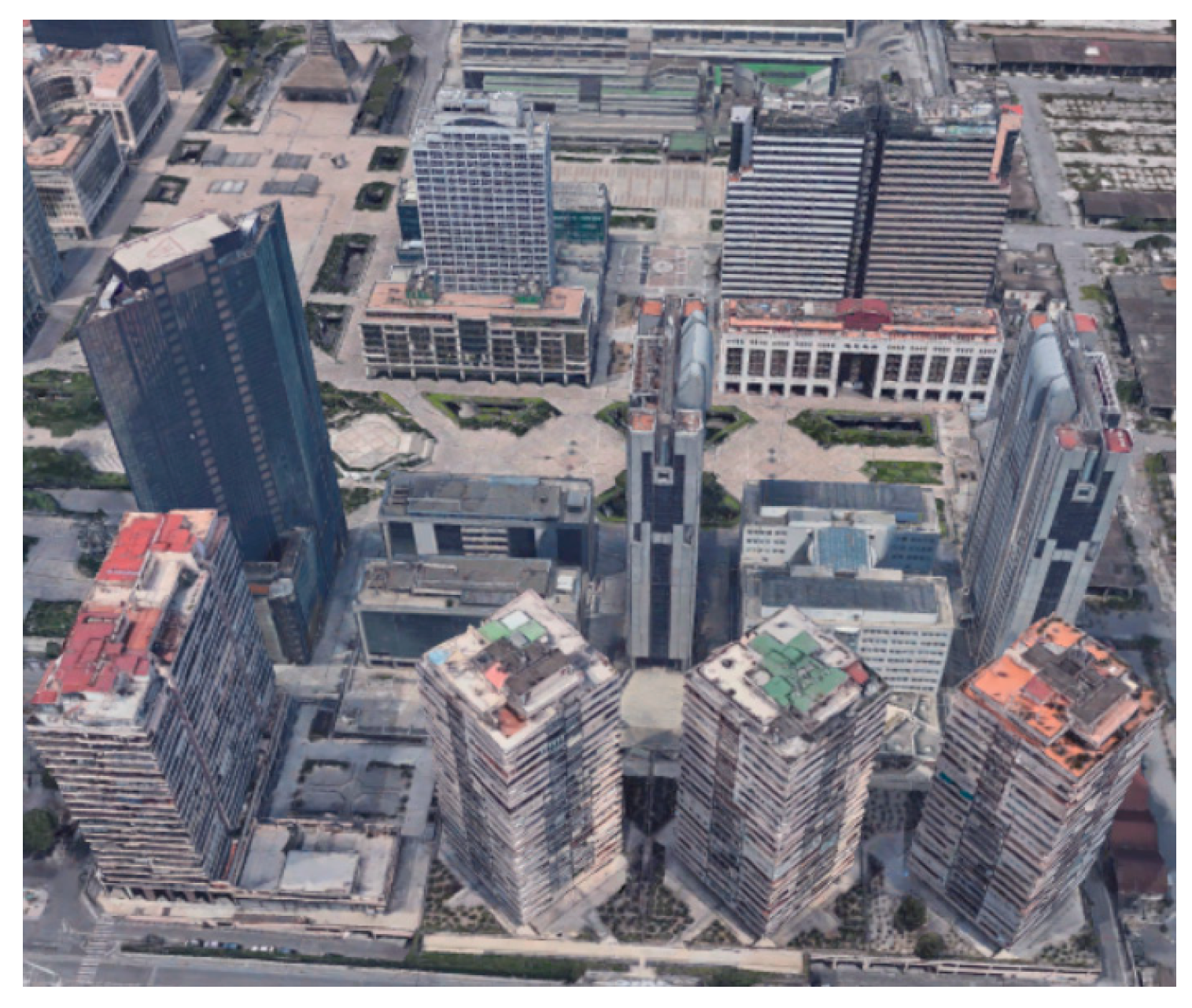
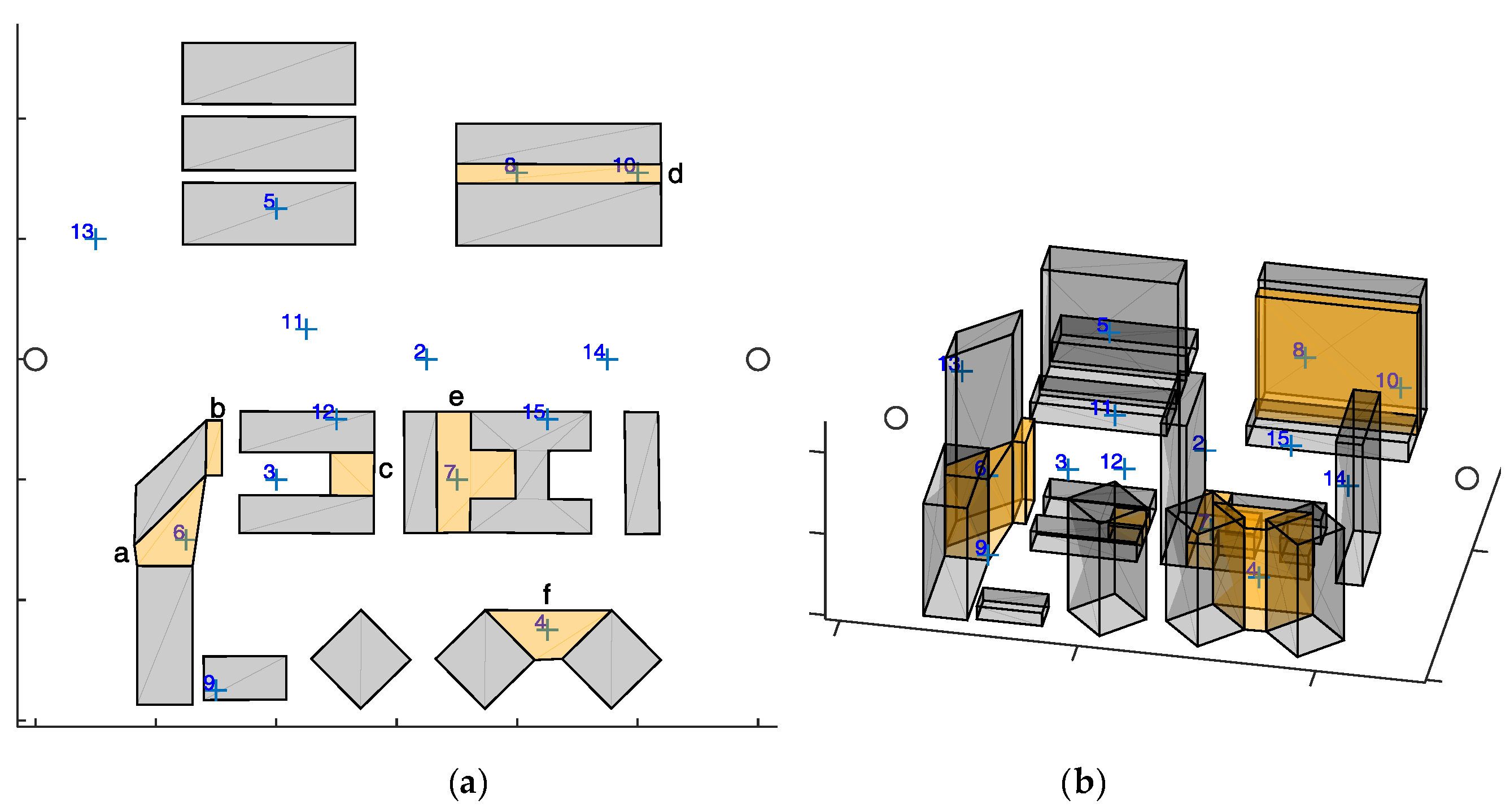
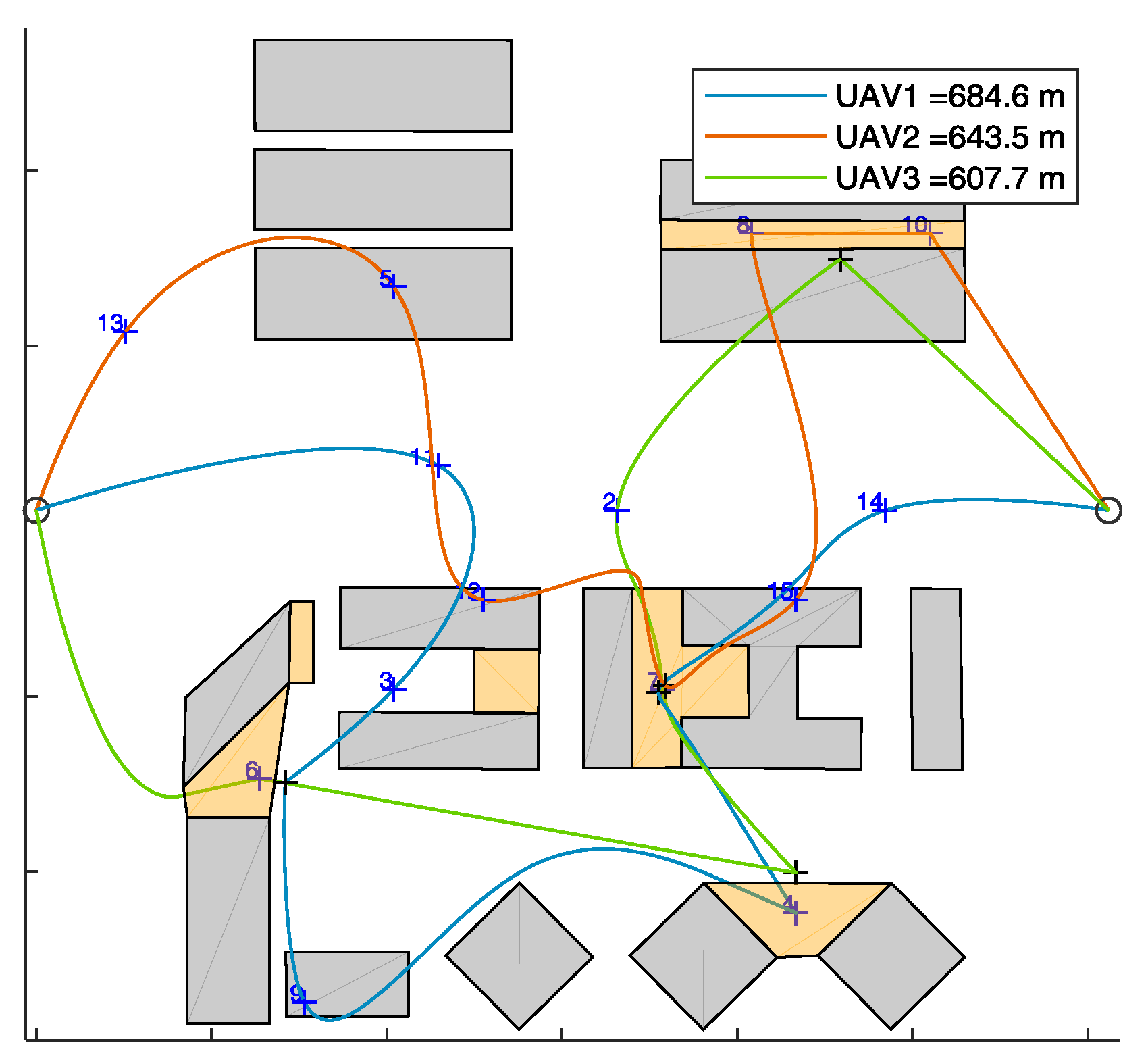

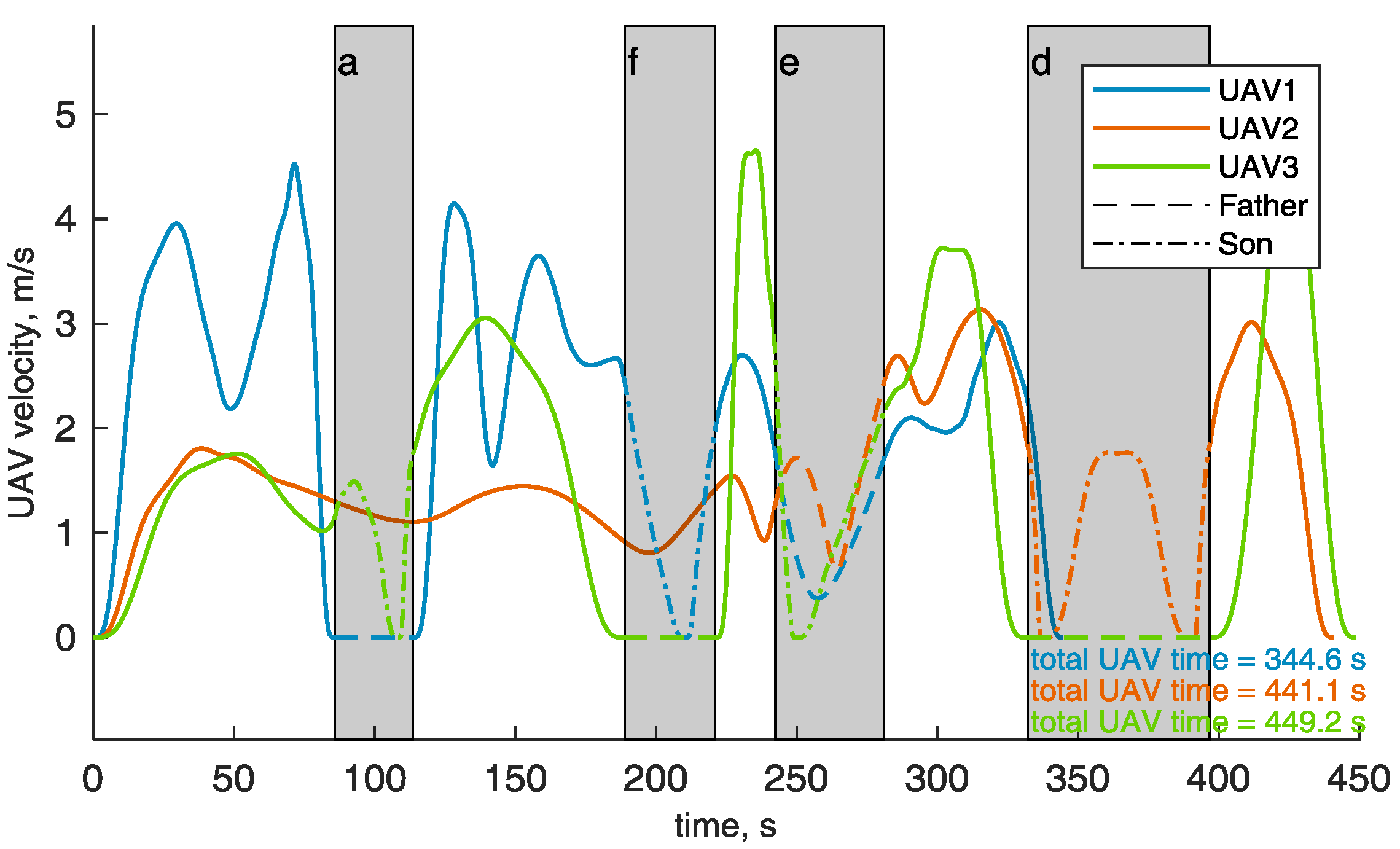
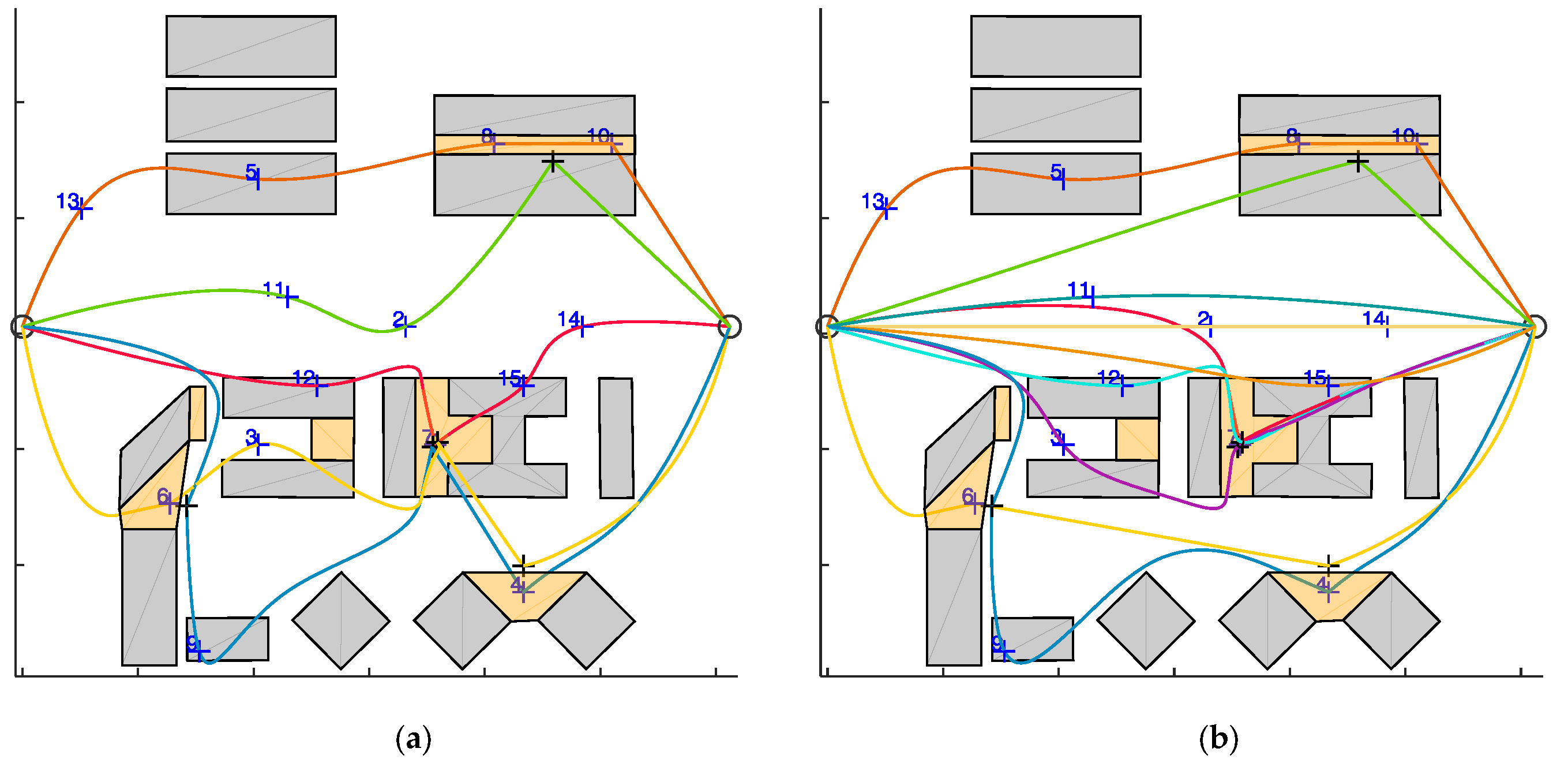

| Challenging Zone | Father(s) ID | Son ID | Arrival Time, s | Exit Time, s |
|---|---|---|---|---|
| a | 1 | 3 | 24.06 | 36.35 |
| e | 2,3 | 1 | 65.80 | 78.15 |
| f | 3 | 1 | 90.45 | 98.96 |
| d | 3 | 2 | 125.39 | 151.91 |
| b | - | - | - | - |
| c | - | - | - | - |
| m | Computation Time 1, s | Mission Time, s | ||||
|---|---|---|---|---|---|---|
| Edge Cost | Target Assignment | UAV Timing | Polynomial Trajectory | Total Time | ||
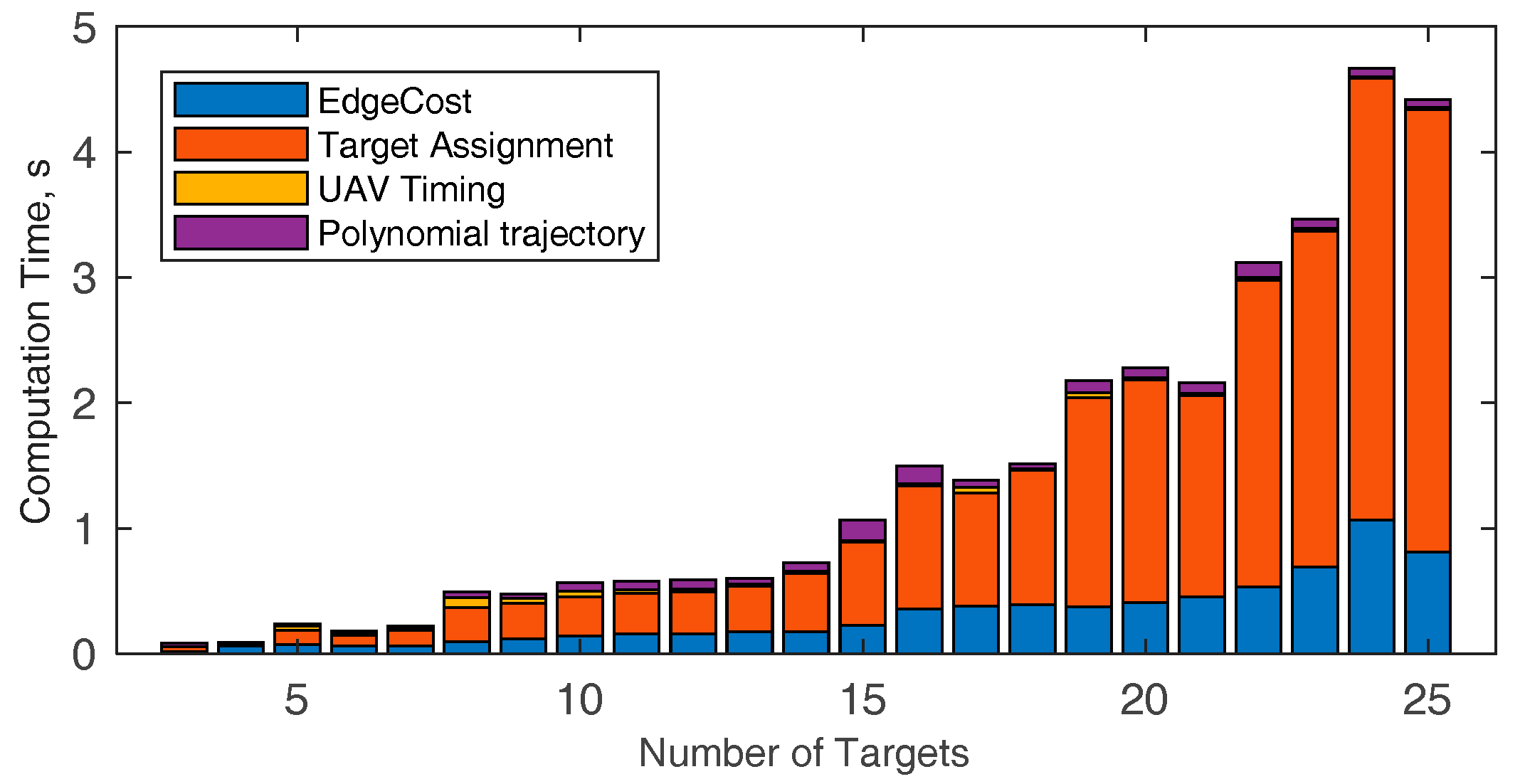
| 3 | 0.23 | 0.78 | 0.01 | 0.07 | 1.09 | 496.46 |
| 4 | 0.22 | 0.65 | 0.01 | 0.06 | 0.94 | 394.27 |
| 5 | 0.23 | 0.68 | 0.01 | 0.08 | 1.00 | 333.39 |
| 6 | 0.23 | 0.72 | 0.01 | 0.05 | 1.01 | 321.64 |
| 7 | 0.22 | 0.75 | 0.01 | 0.06 | 1.04 | 265.74 |
| 8 | 0.23 | 0.75 | 0.01 | 0.06 | 1.05 | 265.74 |
| 9 | 0.23 | 0.75 | 0.01 | 0.06 | 1.05 | 265.74 |
| 10 | 0.23 | 0.79 | 0.01 | 0.08 | 1.11 | 265.74 |
| 11 | 0.22 | 0.78 | 0.01 | 0.08 | 1.09 | 265.74 |
| 12 | 0.22 | 0.80 | 0.01 | 0.08 | 1.11 | 265.74 |
| 13 | 0.24 | 0.88 | 0.01 | 0.08 | 1.21 | 265.74 |
| 14 | 0.23 | 0.83 | 0.01 | 0.08 | 1.15 | 265.74 |
| 15 | 0.23 | 0.83 | 0.01 | 0.08 | 1.15 | 265.74 |
| 16 | 0.23 | 0.83 | 0.01 | 0.08 | 1.15 | 265.74 |
| 17 | 0.23 | 0.81 | 0.01 | 0.08 | 1.13 | 265.74 |
| 18 | 0.22 | 0.83 | 0.01 | 0.09 | 1.15 | 265.74 |
| 19 | 0.22 | 0.87 | 0.01 | 0.09 | 1.19 | 265.74 |
| 20 | 0.22 | 0.85 | 0.01 | 0.08 | 1.17 | 265.74 |
| Numbers of UAVs (m) | |||||
|---|---|---|---|---|---|
| UAV Id | 8 | 9 | 10 | 11 | 11–20 |
| 1 | 1-3-19-9-4-16 | 1-3-19-9-4-16 | 1-3-19-9-4-16 | 1-19-9-4-16 | 1-19-9-4-16 |
| 2 | 1-13-5-8-10-16 | 1-13-5-8-10-16 | 1-13-5-8-10-16 | 1-13-5-8-10-16 | 1-13-5-8-10-16 |
| 3 | 1-17-16 | 1-17-16 | 1-17-16 | 1-17-16 | 1-17-16 |
| 4 | 1-6-18-16 | 1-6-18-16 | 1-6-18-16 | 1-6-18-16 | 1-6-18-16 |
| 5 | 1-7-15-16 | 1-7-16 | 1-7-16 | 1-7-16 | 1-7-16 |
| 6 | 1-12-20-16 | 1-12-2-20-16 | 1-12-2-20-16 | 1-12-20-16 | 1-12-20-16 |
| 7 | 1-3-21-16 | 1-3-21-16 | 1-3-21-16 | 1-3-21-16 | 1-3-21-16 |
| 8 | 1-11-2-14-16 | 1-11-14-16 | 1-11-16 | 1-11-16 | 1-11-16 |
| 9 | - | 1-15-16 | 1-15-16 | 1-15-16 | 1-15-16 |
| 10 | - | - | 1-14-16 | 1-14-16 | 1-14-16 |
| 11 | - | - | - | 1-2-16 | 1-2-16 |
| 12–20 | - | - | - | - | 1-16 |
| Computation Time, s | |||||
|---|---|---|---|---|---|
| Numbers of UAVs (m) | 3 | 9 | 15 | 20 | |
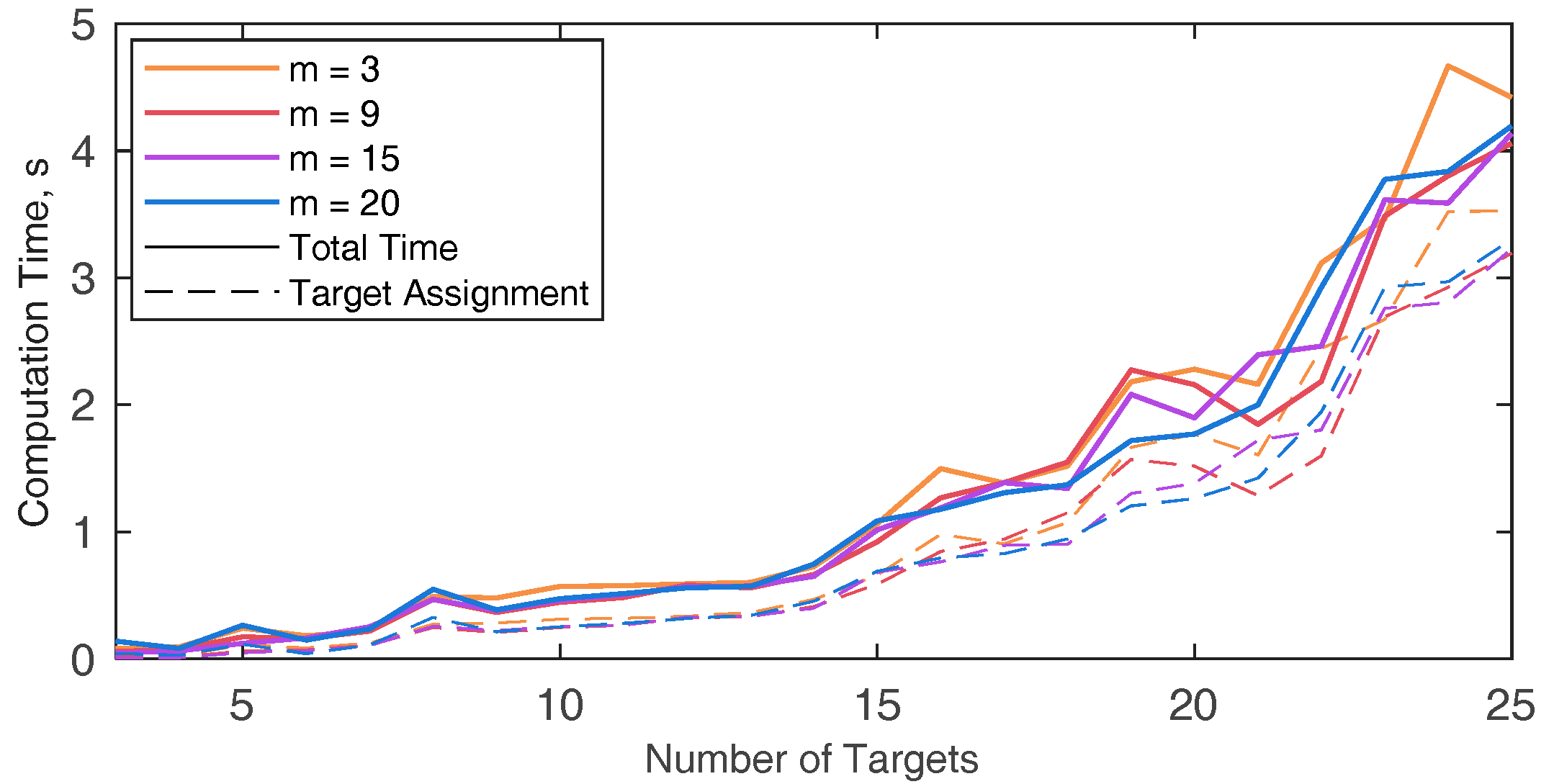
| Number of Targets | 30 | 7.41 | 7.35 | 7.18 | 7.14 |
| 35 | 12.53 | 12.39 | 11.74 | 11.55 | |
| 40 | 19.04 | 20.35 | 20.0 | 19.83 | |
| 50 | 58.75 | 60.84 | 55.35 | 60.03 | |
| 60 | 109.54 | 108.90 | 108.84 | 108.95 | |
| 70 | 223.12 | 225.89 | 224.79 | 226.57 | |
| 80 | 339.47 | 336.90 | 337.45 | 338.40 | |
| 90 | 594.79 | 595.54 | 593.70 | 596.80 | |
© 2018 by the authors. Licensee MDPI, Basel, Switzerland. This article is an open access article distributed under the terms and conditions of the Creative Commons Attribution (CC BY) license (http://creativecommons.org/licenses/by/4.0/).
Share and Cite
Causa, F.; Fasano, G.; Grassi, M. Multi-UAV Path Planning for Autonomous Missions in Mixed GNSS Coverage Scenarios. Sensors 2018, 18, 4188. https://doi.org/10.3390/s18124188
Causa F, Fasano G, Grassi M. Multi-UAV Path Planning for Autonomous Missions in Mixed GNSS Coverage Scenarios. Sensors. 2018; 18(12):4188. https://doi.org/10.3390/s18124188
Chicago/Turabian StyleCausa, Flavia, Giancarmine Fasano, and Michele Grassi. 2018. "Multi-UAV Path Planning for Autonomous Missions in Mixed GNSS Coverage Scenarios" Sensors 18, no. 12: 4188. https://doi.org/10.3390/s18124188
APA StyleCausa, F., Fasano, G., & Grassi, M. (2018). Multi-UAV Path Planning for Autonomous Missions in Mixed GNSS Coverage Scenarios. Sensors, 18(12), 4188. https://doi.org/10.3390/s18124188