Next Article in Journal
A Depth-Adjustment Deployment Algorithm Based on Two-Dimensional Convex Hull and Spanning Tree for Underwater Wireless Sensor Networks
Previous Article in Journal
Ultrasonic Sensing of Plant Water Needs for Agriculture
Article

Towards an Improved LAI Collection Protocol via Simulated and Field-Based PAR Sensing
1
Chester F. Carlson Center for Imaging Science, Rochester Institute of Technology, 54 Lomb Memorial Drive, Rochester, NY 14623, USA
2
Department of Geography, University College London, Pearson Building, Gower Street, London WC1E 6BT, UK
*
Author to whom correspondence should be addressed.
Academic Editor: Hans Tømmervik
Sensors 2016, 16(7), 1092; https://doi.org/10.3390/s16071092
Received: 7 June 2016 / Revised: 5 July 2016 / Accepted: 7 July 2016 / Published: 14 July 2016
(This article belongs to the Section Remote Sensors)
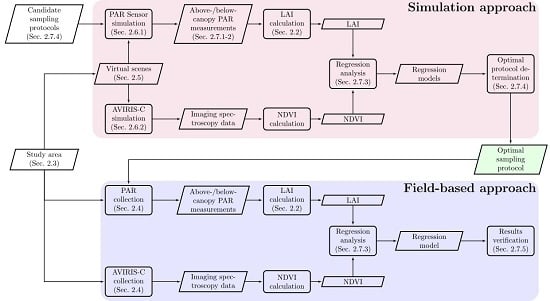
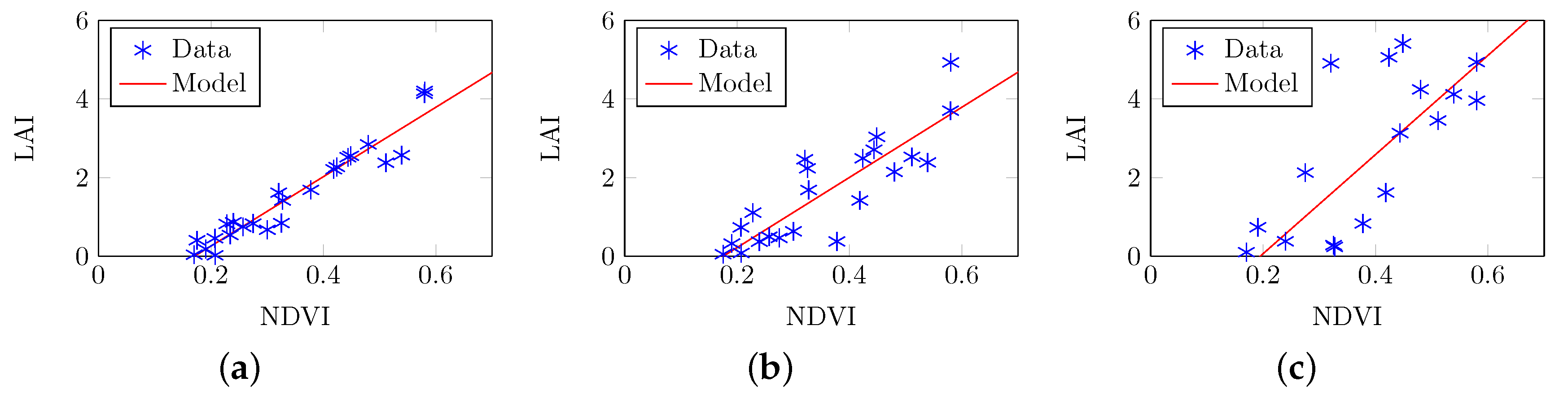
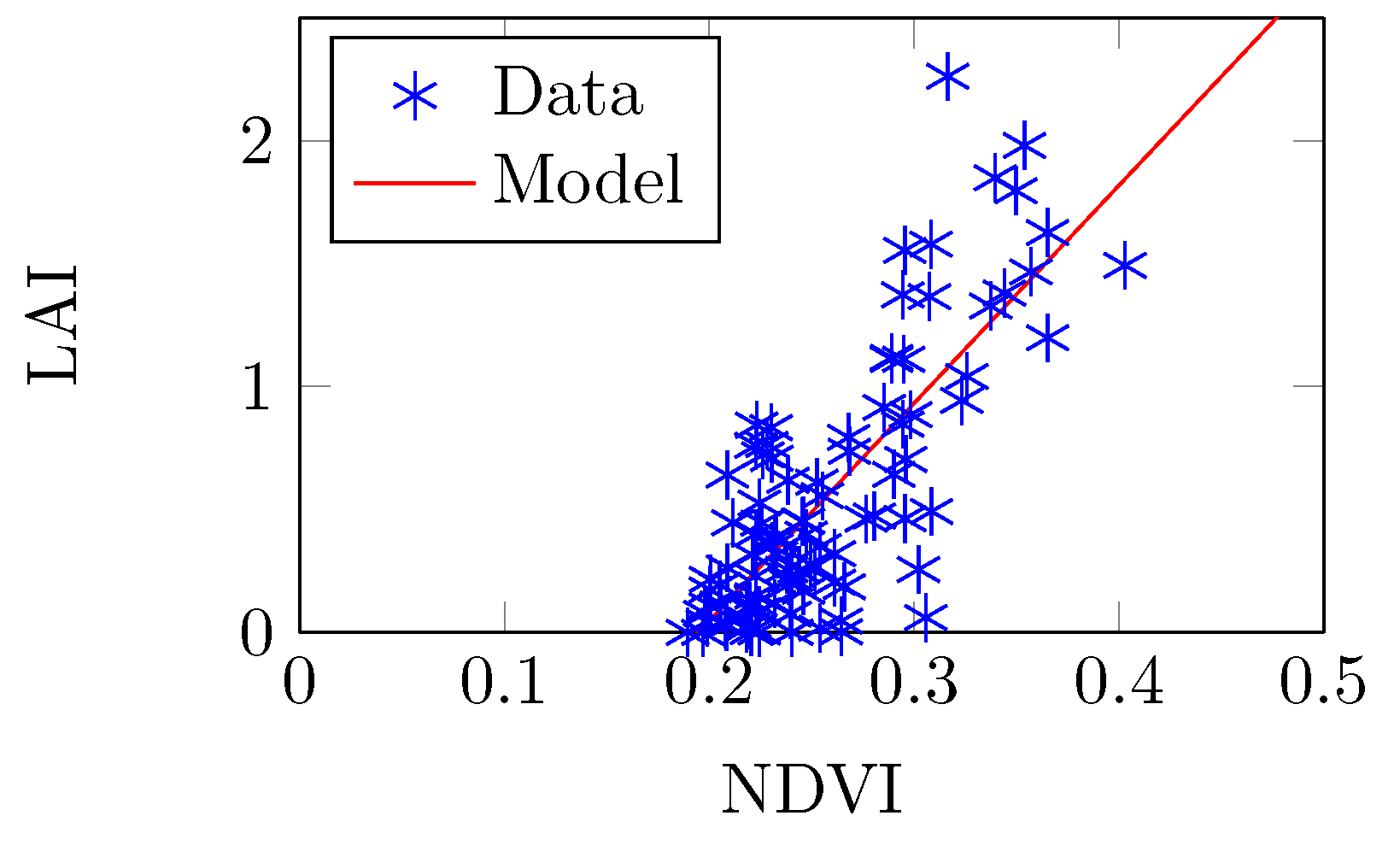
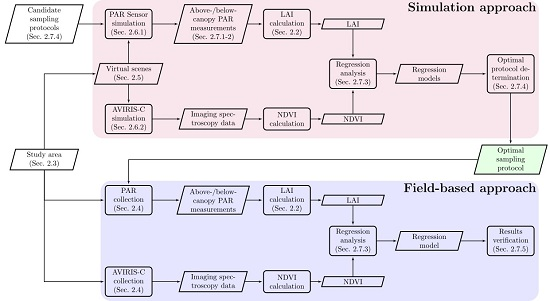
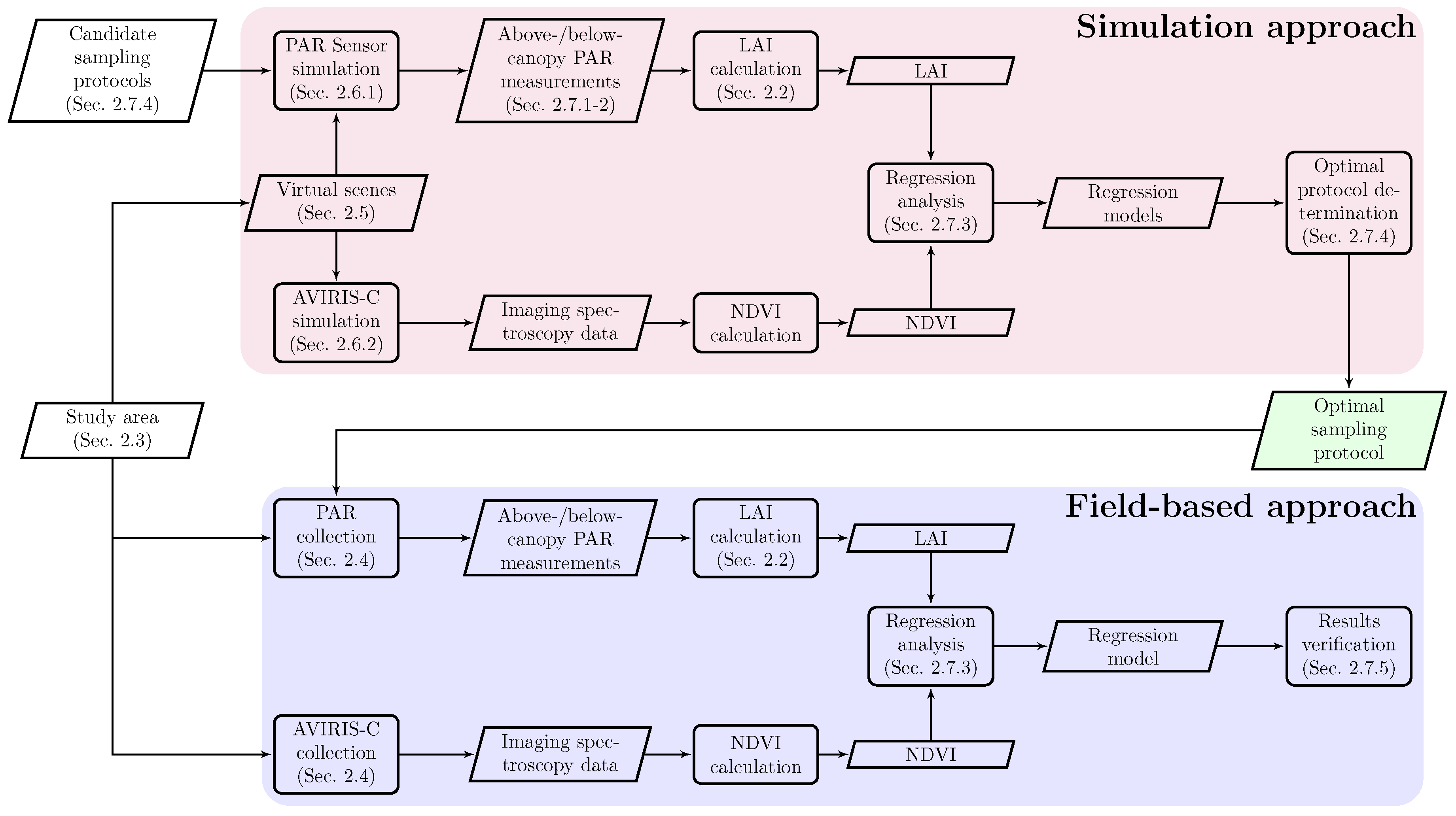
In support of NASA’s next-generation spectrometer—the Hyperspectral Infrared Imager (HyspIRI)—we are working towards assessing sub-pixel vegetation structure from imaging spectroscopy data. Of particular interest is Leaf Area Index (LAI), which is an informative, yet notoriously challenging parameter to efficiently measure in situ. While photosynthetically-active radiation (PAR) sensors have been validated for measuring crop LAI, there is limited literature on the efficacy of PAR-based LAI measurement in the forest environment. This study (i) validates PAR-based LAI measurement in forest environments, and (ii) proposes a suitable collection protocol, which balances efficiency with measurement variation, e.g., due to sun flecks and various-sized canopy gaps. A synthetic PAR sensor model was developed in the Digital Imaging and Remote Sensing Image Generation (DIRSIG) model and used to validate LAI measurement based on first-principles and explicitly-known leaf geometry. Simulated collection parameters were adjusted to empirically identify optimal collection protocols. These collection protocols were then validated in the field by correlating PAR-based LAI measurement to the normalized difference vegetation index (NDVI) extracted from the “classic” Airborne Visible Infrared Imaging Spectrometer (AVIRIS-C) data ( R 2 was 0.61). The results indicate that our proposed collecting protocol is suitable for measuring the LAI of sparse forest (LAI < 3–5 ( m 2 / m 2 )). View Full-Text
Keywords: HyspIRI; AVIRIS; DIRSIG; leaf area index; photosynthetically active radiation HyspIRI; AVIRIS; DIRSIG; leaf area index; photosynthetically active radiation
Show Figures

Graphical abstract

MDPI and ACS Style

Yao, W.; Kelbe, D.; Leeuwen, M.V.; Romanczyk, P.; Aardt, J.V. Towards an Improved LAI Collection Protocol via Simulated and Field-Based PAR Sensing. Sensors 2016, 16, 1092. https://doi.org/10.3390/s16071092

AMA Style

Yao W, Kelbe D, Leeuwen MV, Romanczyk P, Aardt JV. Towards an Improved LAI Collection Protocol via Simulated and Field-Based PAR Sensing. Sensors. 2016; 16(7):1092. https://doi.org/10.3390/s16071092
Chicago/Turabian Style

Yao, Wei, David Kelbe, Martin V. Leeuwen, Paul Romanczyk, and Jan V. Aardt. 2016. "Towards an Improved LAI Collection Protocol via Simulated and Field-Based PAR Sensing" Sensors 16, no. 7: 1092. https://doi.org/10.3390/s16071092
Find Other Styles
Note that from the first issue of 2016, MDPI journals use article numbers instead of page numbers. See further details here.

Article Access Map by Country/Region

1
Back to TopTop