

Small Private Key MQPKS on an Embedded Microprocessor


1. Introduction
The technology related to embedded systems has made significant progress, making many applications, such as home automation, surveillance systems and environment monitoring services, feasible. However, without secure and robust data protection from security threats, these services cannot be put into practice. To solve these problems, public key cryptography has been studied for several decades. The current main stream is Elliptic Curve Cryptography (ECC), which is an approach based on the algebraic structure of elliptic curves over finite fields. The use of elliptic curves in cryptography was suggested independently by Koblitz [1] and Miller [2] in 1985. The technology provides a short key-size and various applications, including Elliptic Curve Digital Signature Algorithm (ECDSA), Elliptic Curve Diffie-Hellman (ECDH).
The alternative multivariate quadratic (
 ) cryptography provides encryption and digital signatures with modest computational resources [3]. There is no feasible attack to lattice-based cryptosystems that has been discovered yet under a quantum computing environment, while those to factoring for Rivest Shamir Adleman (RSA) and Digital Signature Algorithm (DSA) and Elliptic Curve Cryptography (ECC))-based systems already exist. However, the large size of the public and private keys required makes it difficult to fit such systems into low-cost devices like Radio-frequency identification (RFID) tags and smart-cards.
In this paper, we study an efficient implementation of
cryptography in terms of shortening the private key and reducing the computational cost of signature generation and verification. We focus on
techniques on an embedded processor, because ECC has been studied for several decades and has reached its technological pinnacle [4]. In contrast,
cryptography has only recently begun to receive attention, and there is considerable room to improve its performance. Previously, small public key implementations have been actively studied, but the private key analogue has not. In this paper, we implement small private key
cryptography using a Pseudo-Random Number Generator (PRNG). To enhance its performance, we adopt an Advanced Encryption Standard (AES) module for the PRNG and hash function and use optimized techniques, including parallel computation, on-the-fly computation, vinegar monomials, optimized logarithmrepresentation and assembly programming.
The paper is organized as follows. In Section 2, we give an introduction to the basic structure of Multivariate Quadratic Public Key Scheme (
PKS)and related technologies. In Section 3, we present efficient implementation techniques for embedded microprocessors. In Section 4, we evaluate and analyze the performance of the proposed method. Finally, in Section 5, we conclude the paper with a brief summary of our contributions.
2. Related Work
2.1. Unbalanced Oil and Vinegar
The idea of Unbalanced Oil and Vinegar (UOV)-signature schemes is to use a public multivariate quadratic map, , with:
In order to hide this trapdoor, secret linear transformation
 is chosen, such that
 :=
:=
 ◦
[6]. For the UOV signature scheme, we define two variables called vinegar (ui, i ∈ V := {1,…, υ}) and oil (ui, i ∈ O := {υ + 1,…, n}). The central map,
, is given by:
◦
[6]. For the UOV signature scheme, we define two variables called vinegar (ui, i ∈ V := {1,…, υ}) and oil (ui, i ∈ O := {υ + 1,…, n}). The central map,
, is given by:
The number of vinegar variables is twice the number of oil variables to make the protocol secure. The transformation involves fully mixing the oil and vinegar variables, so that malicious users cannot obtain secret values by separating the oil and vinegar variables.
2.1.1. Signature Generation
To sign a document, d, a hash function,
, is used to compute the hash value
. Next, one computes y =
−1(h) and then z = S−1(y). The signature of a document, d, is
.
2.1.2. Signature Verification
To verify the authenticity of a signature, the hash value, h, of the corresponding document and the value h′ =
(z) must be computed. If h = h′ holds, the signature is accepted; otherwise, it is rejected.
2.1.3. Public Key Optimization
At CHES2011 (Cryptographic Hardware and Embedded Systems, 2011), the 0/1 UOV method for reducing the size of the public key was presented [7]. Choosing the special structure (
,
), it was reported that the key size and runtime of the verification algorithm could be reduced. The concept behind the reduction of the public key size is the use of a partially cyclic public key and GF(2) (Galois Field) elements for coefficients. The method proceeds by generating a partially circulant matrix and then computes the public key transformation matrix from a linear map to compute the corresponding secret key. If the specific requirements are met, we can generate the public key from small-size cyclic keys. Furthermore, coefficients of the GF(2) form are easily computable, reducing both the size and verification time.
2.1.4. Private Key Optimization
To reduce the private key size of
schemes, we can use a PRNG for key generation. This reduces the key size down to the size of the seed values. Recently, private key generation has been implemented using an RC4-based PRNG [8]. The basic idea is to generate a private key from symmetric cryptography, which can be used as the private coefficients. However, the method is implemented on PCs using JAVAso straight-forward implementation of this method on resource constrained device is infeasible, because PRNG has high overheads for embedded microprocessors. For a light-weight implementation, an embedded encryption module could be exploited. This approach was firstly introduced in INDOCRYPT2012 [9], where sub-operation of the RFSB-509 generating constant is concurrently computable by accumulating previous results. In terms of PRNG, the first implementation of AES-based PRNG was described in [10]. The method exploits AES counter mode of operation to generate high entropy random numbers with high throughput.
2.2. Previous Implementations on Embedded Microprocessors
A software implementation of enTTS (20, 28) on a MSP 430 microprocessor was reported in [11]. The signing and verification operations were executed within 71 ms and 726 ms, respectively. At CHES2004, Yang et al. reported signs of TTS(20, 28) in 144 ms, 170 ms and 60 ms and TTS(24, 32) in 191 ms, 227 ms and 85 ms for i8032AH, i8051AH and W77E59, respectively [12]. Recently, at CHES2012, implementations of UOV, Rainbow and enTTS on an eight-bit microprocessor were reported. The author implemented
signatures with security levels of 264, 280, and 2128 and demonstrated the feasibility of such protocols on resource-constrained devices. They also provided specific implementation techniques, such as self-invertible linear maps, LU decomposition and logarithm representation. First, self-invertible linear maps do not, by definition, require inversion, and their private key is smaller than a normal map. Second, LU decomposition factorizes a matrix into the product of lower triangular and upper triangular matrices. The decomposition representation reduced the straightforward implementation cost of Gaussian elimination. Finally, logarithm representation simply performs multiplication on a Galois field by computing addition. Until now, few implementations have been reported on embedded microprocessors, and even private key optimization has not been studied. For this reason, we have focused on a private key reduced model for embedded microprocessors.
2.3. Target Platform and Tools
We used ATxmega128a1on an Xplain board as our target platform. This microprocessor has a clock frequency of 32 MHz, 128 KB flash program memory and 8 KB SRAM. Furthermore, the device provides an AES crypto-accelerator that computes the encryption within 375 clock cycles. This is significant progress compared to the software implementation of AES on the ATmega128 processor, which requires 1,993 ∼ 3,766 clock cycles [13,14] with pre-computations. In this paper, we provide a novel signature generation for modern microprocessors that uses an embedded AES accelerator for the PRNG and hash function. These approaches significantly reduce the size of the private key and optimize the computational performance, as well. To use AES module, we should trigger AES operation by following instructions as described in Algorithm 1. First, a status bit for AES operation is set. Second, a key and plain text are allocated to the AES accelerator, and then, we trigger the AES execution, which takes 375 clock cycles. During the execution, we can perform other operations using the microprocessor, because AES operations are independently executed on the AES accelerator. After the execution, we obtain the cipher-text generated from the AES accelerator by accessing the storage address. Our program is written in assembly for the main computations and partly C language for the interface. The development tool is the latest version of Atmel Studio 6.0.
| Algorithm 1: AES encryption using AES accelerator | |
| Input: Secret key k, plain text p | |
| Output: Cipher-text c | |
| 1. | AES accelerator setting |
| 2. | Move k to key storage in AES accelerator |
| 3. | Move p to plain text storage in AES accelerator |
| 4. | Execute the AES accelerator |
| 5. | Wait for completion (375 clock cycles) |
| 6. | Get c from cipher-text storage in AES accelerator |
2.4. Random Number Generator Based on a Block Cipher
Random numbers are widely used as seeds for cryptographic operations and secret key generation. Among various types of random number generators, a block cipher-based random number generator is considered in this paper to exploit the AES module in an embedded board. The following equation outlines the process of random number generation. The notations, enc, C, k and R, represent the encryption process, counter (secret seed), secret key and random number stream. First, the counter is encrypted with secret key, k. The output is then bitwise XORedwith counter value Ci, and the encryption can proceed. This process is iterated until we obtain a suitable size of random numbers.
The purpose of introducing the block cipher-based random number generator is that we will use it to generate the secret coefficients. This is possible using the AES accelerator on modern embedded boards, which can generate encrypted data conveniently. The AES accelerator is a peripheral device, so it operates independently of the microprocessor. We can order the encryption on the AES accelerator while simultaneously computing a signature on the microprocessor. This method can boost performance and reduce the required program memory. Furthermore, the PRNG process follows cipher-block chaining (CBC); this is efficiently executed using the CBC option on an embedded processor. In our implementation on ATXmega, timing and ROM cost around 40 (clock/bytes) and 204 (bytes), respectively. This result is reasonable for embedded processors. For randomness characteristic, we evaluated our random sequence on the National Institute of Standards and Technology (NIST)-test suite [15]. Firstly we collected a pseudo random number sequence from block cipher-based PRNG by two gigabytes. Then, we operated the NIST statistical test suite version 1.6 with the number of bit streams and the length of the bit set to 100 and 1,024, respectively. The results are described in Table 1, and reasonable proportion rates are achieved.
For the security concern, the strength is based on the bit-length of block-cipher. If the inner state of the generator is compromised once, the adversary could foresee future outputs. To resolve this problem, we should compute random numbers with refreshed seed values. One possible challenge to AES in counter mode would be a timing attack on the value of the counter. We can prevent these attacks by using a counter that always takes the same amount of time to increment its value, and AES-based PRNG could give a periodic generation. This drawback could be solved by reseeding the secret values on proper timing.
2.5. Hash Function Based on a Block Cipher
Hash functions compress an input of arbitrary length to a string of fixed length. Our main motivation for constructing a hash function based on a block cipher is to minimize the design and implementation effort. The hash function based on the block cipher is conducted according to Equation (2), where H, pi, N and E denote the hash code, plain text, nonce and encryption process, respectively. This structure follows the Davies–Meyer single-block-length compression function. The security level of the one-way hash function is determined by the minimum of the size of the key and the block length [16]. To ensure a sufficient security level, we used a 128-bit secret key for the AES-based hash function.
In our hash function, we exploit the AES-accelerator for the block-cipher-based hash function. Previous
PKS implementations on an embedded board were not concerned much with hash functions. However hash function should be included for practical purposes, because normally, a message is compressed in its own embedded board, not other places. In Table 2, we can find hash function implementations on the ATmega board. Compared with other results, our result improves speed and size altogether. In the case of speed, we use a dedicated hardware crypto module, so this is faster than other results that implement the functions in software. Furthermore, our result does not use much memory, because we only need to use hardware control code.
The
PKS implementation consists of two parts, including signature generation and verification. The signature generation produces private coefficients and computes a signature message. In the case of signature verification, the signature is verified by checking the validity of the provided signature. By introducing AES-based PRNG, we significantly reduced the private key size, and with the optimized implementation, we show performance enhancements in both the signature generation and verification parts. The following subsections describe the optimization and implementation methods in detail.
2.6. Parallel Computation
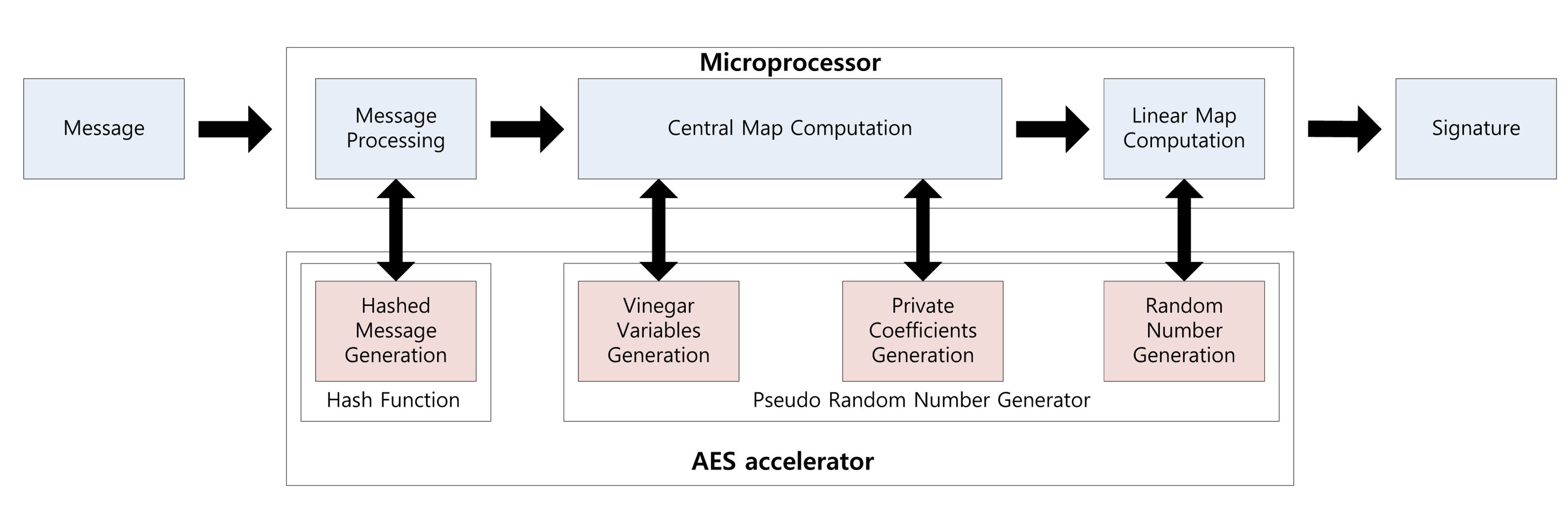
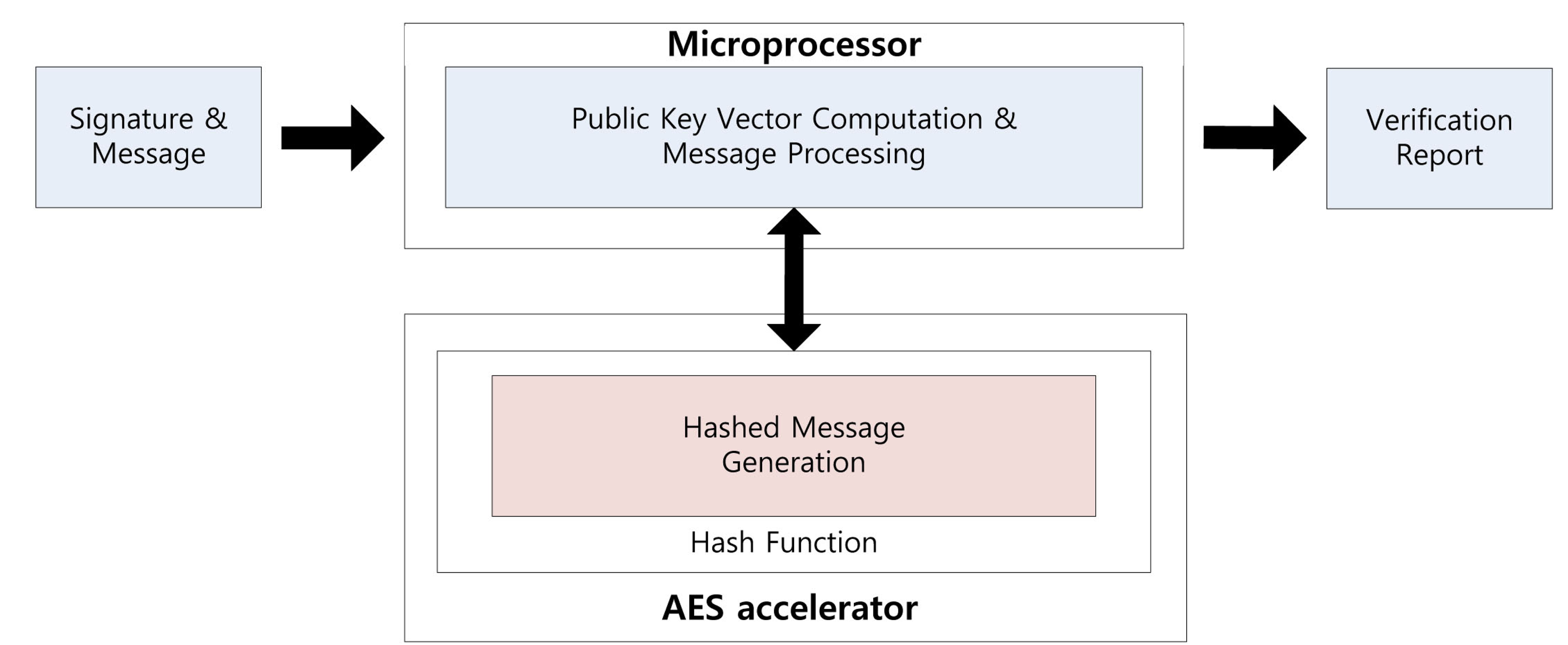
Using the parallel feature of the AES accelerator, we can compute a signature while generating the private coefficients. Signature generation on the embedded processor is described in Figure 1. First, the message is hashed using the hash function. The output is 16 bytes each time and takes 375 clock cycles. Central map computation is then executed, while vinegar variables and private coefficients are generated. These operations are conducted in independent modules, so we can compute both operations together. For this reason, we do not need any additional computation costs to generate the private coefficients. After central map computation, we generate the coefficients of the linear map. As a result of this, the overheads of the key generation process are absorbed in the central and linear map computations. This parallel computation technique can be applied to the verification process for message hashing, which is described in Figure 2. We can the conduct hash function computing the verification process, so one operation is absorbed into other operations.
3. Implementation of Small Private Key
![Sensors 14 05441i1]() PKS
PKS
3.1. Logarithm Representation
Multiplication and inversion operations on GF(28) can be easily computed using logarithm representation in Algorithm 2, which transforms multiplication to a simple addition operation.
| Algorithm 2: Implementation of Gaussian Elimination. | |
| Input: Coefficients of Gaussian map g(i,j), message mi, where 1 < i, j ≤ o, symbol o denotes the number of oil variables, the upper subscript describes the representation transition and the bottom subscript denotes the index. Steps from 1 to 18 describe forward elimination and steps from 19 to 26 describe backward elimination. | |
| Output: Result ri of Gaussian elimination. | |
| 1. | for i = 1 to (o − 1) do |
| 2. | for t = i to o do |
| 3. | |
| 4. | for k = i to o do |
| 5. | |
| 6. | |
| 7. | end for |
| 8. | |
| 9. | |
| 10. | end for |
| 11. | for k = i + 1 to o do |
| 12. | for t = i to o do |
| 13. | |
| 14. | end for |
| 15. | |
| 16. | end for |
| 17. | end for |
| 18. | |
| 19. | count = 1 |
| 20. | for i = o − 2 to 0 do |
| 21. | for j = o − 2 to o − 1 − count do |
| 22. | |
| 23. | end for |
| 24. | |
| 25. | count = count + 1 |
| 26. | end for |
To compute multiplication, values are first converted into their logarithm form by looking up the logarithm table. Then, the relevant values are added, and the sum is returned to a normal representation by looking up the exponential table.
The representation setting is selected in an optimized way when we generate the private coefficients, vinegar values and coefficients of the linear map. The values are randomly generated and are considered to be in logarithm form, because the private coefficients, linear map coefficient and vinegar values are directly multiplied from the first computation. Thus, storing values in logarithm representation is more efficient than leaving them in their normal representation when we consider the next operation. This method has one more advantage. In the logarithm representation, we can express the additional value of “0”, which does not exist in the logarithm look-up table, so it cannot be used in the normal representation. However, the value exists in the exponential table, so we can use this representation for private coefficients.
To find the inverse of a value, we can use an inversion table, which transforms the value using the logarithm table and then subtracts 0xff (255) before returning the resulting value to a normal representation. In our implementation, we use the modified inversion table described in Table A1, which outputs results in logarithm representation with input variables in normal representation. These directly multiply the inverse value in the Gaussian elimination process described in Algorithm 3, in which the first column is inverted and then multiplied with the remaining values in the same row, thus setting the first column to one. After that, each row is bit-wise exclusive-ORed with other rows. This process, called forward elimination, continues to generate triangular form. In the backward elimination, from the last row, the equation is solved by each row.
| Algorithm 3: Multiplication algorithm using logarithm representation written in assembly where ADD, ADC and CLR is addition, addition with carry and clear and Rd and Rr are destination and source registers, (ADD Rd, Rr : Rd←Rd+Rr, ADC Rd, Rr: Rd←Rd+Rr+C, CLR Rd: Rd←Rd ⊕Rd, Rd: destination register, Rr: source register, r1 is cleared.) | |
| Input: Unsigned bytes Al(R2), Bl(R3) | |
| Output: Unsigned byte Al(R2) = Al(R2) + Bl(R3) | |
| 1. | ADD R2, R3 |
| 2. | ADC R2, R1 |
3.2. Assembly Programming
Assembly programming generally exhibits higher performance than high-level programming, such as C and JAVA. This is because we can optimize register allocation and use the status register, which provides a carry bit to determine a certain condition. In our implementation, we adopt assembly programming throughout the whole process to reach to highest performance. Multiplication in logarithm representation can be simplified in addition by using the assembly described in Algorithm 3. First, register r1 is reset. Second, the operands are added. However, if the result is bigger than 0xff, an addition operation on the eight-bit microprocessor generates an output that is subtracted from 256, setting the carry bit. Therefore, this does not give the expected result. However, conducting an addition with the carry bit on the results, we can output the correct result, as we expected.
There is another case that exists. Algorithm 4 describes the exception condition. After central map computations, every parameter is stored into normal representation. The representation cannot map a zero variable into logarithm representation, so we should conduct exception handling for the zero variable. In this case, we directly output zero as a result without computation. In Algorithm 4, Step 1 clears destination register R8. From Steps 2 to 5, input variables (R2 and R3) are compared with zero (R1) to determine the zero variable. From Steps 6 to 13, logarithm mapping is conducted. In Steps 14 and 15, multiplication of R2 and R3 is conducted in logarithm representation. In Steps 16 to 19, mapping to normal representation is conducted.
| Algorithm 4: Exception handling in multiplication for zero variables, where CP, BRCC and MOVW are compare, branch with carry and move register, (CP Rd, Rr: Rd-Rr, BRCC k: if (C=0) then PC ← PC+k+1, MOVW Rd, Rr: Rd+1:Rd ← Rr+1:Rr, ADD Rd, Rr: Rd←Rd+Rr, ADC Rd, Rr: Rd←Rd+Rr+C, CLR Rd: Rd←Rd ⊕Rd, Rd: destination register, Rr: source register, k: label, R1 is cleared, R4, R5 indicate logarithm table, R6, R8 indicate exponential table, R28, R29 indicate Y pointer, ZERO: label name.) | |
| Input: Unsigned bytes An(R2), Bn(R3) | |
| Output: Unsigned byte Cn(R8) = An(R2) × Bn(R3) | |
| 1. | CLR R8 |
| 2. | CP R1, R2 |
| 3. | BRCC ZERO |
| 4. | CP R1, R3 |
| 5. | BRCC ZERO |
| 6. | MOVW R28, R4 |
| 7. | ADD R28, R2 |
| 8. | ADC R29, R1 |
| 9. | LD R2, Y |
| 10. | MOVW R28, R4 |
| 11. | ADD R28, R3 |
| 12. | ADC R29, R1 |
| 13. | LD R3, Y |
| 14. | ADD R2, R3 |
| 15. | ADC R2, R0 |
| 16. | MOVW R28, R6 |
| 17. | ADD R28, R2 |
| 18. | ADC R29, R1 |
| 19. | LD R8, Y |
| 20. | ZERO: |
3.3. Vinegar Monomials
Central map computation is multiplying private coefficients with vinegar variables by the following equation: . These vinegar computations are executed in every central map computation, so vinegar monomials can reduce the vinegar variable computations throughout the whole processes by removing multiplication operations between each vinegar variable. Algorithm 5 describes the pre-computation of vinegar variables, in which we can generate vinegar monomials. The vinegar variables are generated in logarithm form. We left vinegar monomials as a logarithm form, because these variables are directly used for multiplication operations in ∑i∈V,j∈V γijp(i,j), where γ and p are the private coefficient and vinegar monomials, respectively.
| Algorithm 5: Pre-computation of vinegar variables; symbols V and n denote the number of vinegar variables and the total number of vinegar and oil variables, respectively. | |
| Input: Vinegar variables ui. | |
| Output: vinegar monomials p(i,j), 0 < i, j < V. | |
| 1. | for i = 1 to V do |
| 2. | for j = i to V do |
| 3. | p(i,j) = ui × uj |
| 4. | end for |
| 5. | end for |
3.4. On-the-Fly Computation
PKS requires a large key size. If we firstly compute all private keys before we use them, these occupy a huge storage amount for retaining these values. To avoid this condition, we selected the on-the-fly method, which generates private keys, and then, these keys are used directly. The AES-based PRNG that we chose generates 16 bytes of secret information every computation. These variables are directly used for central and linear map computation. For efficient computation, we divide central map computation into vinegar and oil parts. Firstly, the vinegar part is computing
with vinegar coefficients, vinegar monomials and message variables, and then, the oil part is executing
with vinegar and private coefficients.
3.5. Overview of the Computation Process
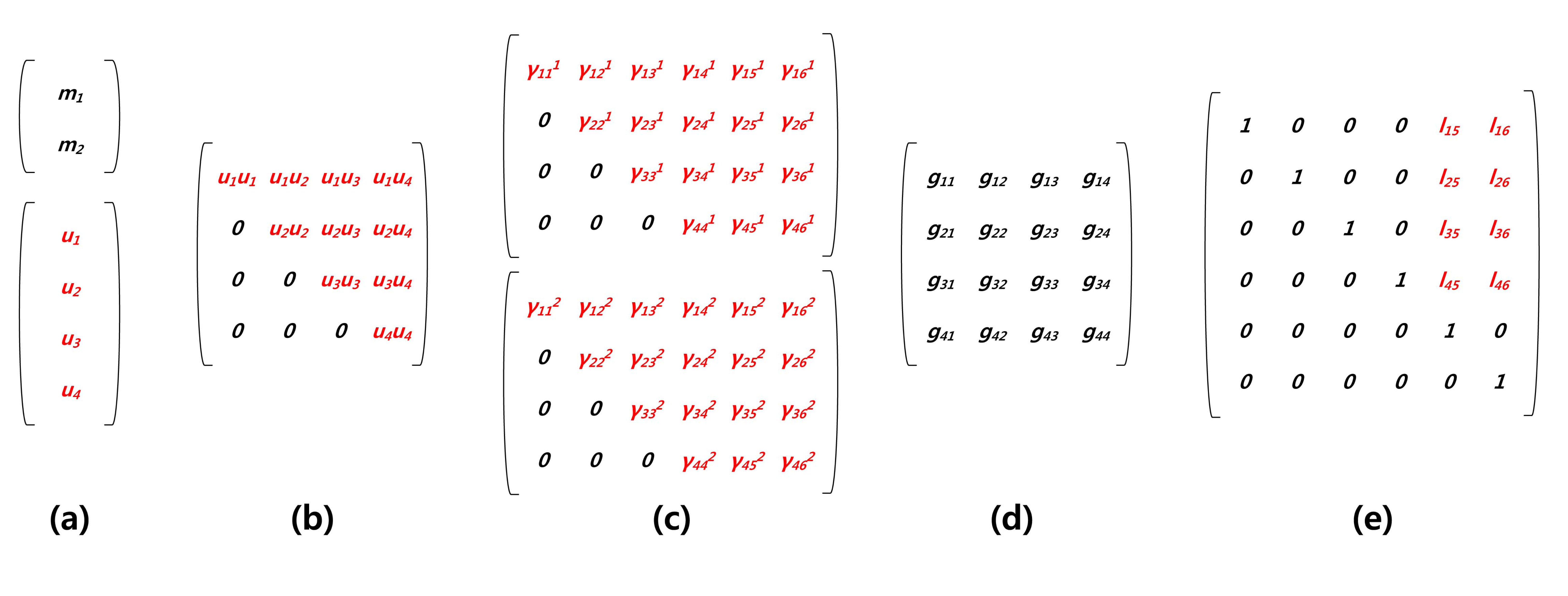
In Figure 3, briefly, we describe the representation of variables for each computation. Firstly, in Figure 3a, a message is hashed and outputted in normal representation. In the case of vinegar variables, logarithm representation is selected. In Figure 3b, ∑i∈V,j∈Vuiuj are the vinegar monomials for efficient computation and are stored in logarithm form. In Figure 3c, we firstly compute ∑i∈V, j∈Vγijp(i,j), where γ and p are private coefficient and vinegar monomials, respectively. After that, we compute the remaining part, ∑i∈V ,j∈OVγiju(i,j), to complete central map computation. In Figure 3d, Gaussian elimination is conducted with the results of the previous step. Finally, in Figure 3e, we generate linear map coefficients in logarithm representation and then compute the linear map computations.
4. Results
In this section, we provide evaluation results on a UOV scheme implementation in terms of memory consumption and computational complexity. Memory consumption is mainly used for key storage. The private key size is for central map and linear map coefficients.
To compute the signature generation, previous implementations stored the private key in memory. However, our implementation stores only the seed values for the random number generator used for secret coefficient generation. For this reason, we can reduce the size of the private key by up to 99.9%. Furthermore, we show a performance enhancement by about 5.78% and 12.19% in signature generation and verification, respectively. This performance is achieved by adopting various optimization techniques that we explored before. The detailed evaluation results are available in Table 3 and 4, respectively.
4.1. Computational Costs
Table 5 shows a detailed analysis of the computation costs for each operation. We separate whole computations into six categories. In central map computation, we divide into vinegar and oil parts. In Gaussian elimination, we divide into forward and backward eliminations. Our method exploits the AES operation for PRNG, so computations that need many private coefficients take many clock cycles. In our implementation, central map computation is the most expensive operation, because the private coefficient size is o(oυ), and it needs 882 AES operations. This result could be reduced more, because we compute two AES operations (32 outputs) in each column for 28 coefficients and did not use four remaining outputs, due to the difficult variable handling. If we fully use 32 outputs, the speed would be improved further.
4.2. Source Code Storage (ROM) Requirements
Table 3 shows the reduction in size of the private key compared with traditional implementations. The size of the seed is computed with the following requirements (security level bit × 3, two for PRNG and one for the hash function). For all parameter variations, our implementation shows a 99.9% reduction in private key size. This is because our method generates private coefficients on the spot, so we store small seed values instead of whole private key values.
4.3. Variable Storage (RAM) Requirements
RAM stores persistent, counting or temporary variables for computation. The minimal RAM requirements are those for storing Gaussian elimination variables, which are generally of o2 complexity. For better performance, we used more RAM to compute the vinegar variables and look-up tables. The computed vinegar variables, which multiply two vinegar variables, are used several times in the central map, so maintaining these values is more beneficial than computing them each time. These have a size of . Second, the logarithm, exponential and inversion tables are used for converting the representations, and each table has a size of 256 bytes. By storing values in RAM, we can access data that is frequently required with lower overheads. The detailed information is available in Table 6.
4.4. Security Analysis
In this paper, we used representative block cipher AES as a core operation of random number generator and hash function to reduce the private key size. Therefore, the security levels highly rely on the strength of the block cipher. Recently, the vulnerability of a symmetric cryptosystem toward a quantum system has been proven by applying Grover’s algorithm to break a symmetric algorithm by brute force, requiring 2n/2 of time, where n is the security bit [21,22]. For this reason, we should select a double-bit size to maintain the same security level of
PK. This is the main strength of a quantum cryptosystem. To meet the n-bit security level of
PK, we should select at least a 2n-security level. For this reason, we selected 128-bit AES encryption to meet the 64-bit security level of
PK. To ensure the 96-, 128-bit security level, we could use 192-, 256-bit AES operations, which are also available in modern microprocessors. There is no specific conference and journal described.
4.5. Impacts on Other Protocols and Target Devices
We selected ATxmega128a1 as a target device to implement
PKS. This does not mean that our method is limited to only the ATxmega128a1 board. There are only two requirements that exist for applying our methods. First, the microprocessor should support above an eight-bit word size, because our algorithm requires at least an eight-bit word size to use optimal GF(28). Recently, eight-, 16-, 32-bit machines have been most widely used in embedded environments. The representative target devices in eight-, 16- and 32-bit are the XMEGA, MSP and ARM series, respectively. This means the majority of the embedded system could be improved by our methods. Second, the AES accelerator should be embedded in target devices. This requirement is also commonly met in modern microprocessors. Previously, we mentioned the representative target devices, including XMEGA, MSP and ARM v8, provide the AES accelerator as a peripheral.
In the case of this scheme, our method would have huge impacts on other
PKS. We implemented the UOV scheme in this paper, presenting private key reduction methods. This could be applied to other schemes, including UOV, Rainbow and enTTS, without difficulty. Because these are variant of the UOV scheme, the key generation process is similar to the UOV scheme. Furthermore, this is not limited to the size of the finite field, because our method is generally ideal; so it could be extended to other fields, as well.
5. Conclusions
The majority of previous results focused on small public key
PKS implementations. However, no practical results on the reduction of private key size in embedded microprocessors have been reported. In this paper, we presented a novel parallel computing method using a block cipher-based random number generator and a hash function to reduce the size of the private key and to boost speed performance. The method generates private coefficients, computing the central and linear maps simultaneously, because the AES accelerator embedded in modern microprocessors, including the ATxmega, MSP430 and ARMv8 series, can compute AES operations independently with the microprocessor. The results showed a significant reduction in private key size and enhancement in computation costs for signature generation and verification. These results can be applied to other schemes, such as Rainbow and enTTS, to generate private coefficients. Future work involves implementing this scheme on recent platforms, including Compute Unified Device Architecture (CUDA), Open Computing Language (OpenCL), NEON, Streaming SIMD Extensions (SSE) and Advanced Vector Extensions (AVX).
Acknowledgments
This work was supported by the Industrial Strategic Technology Development Program (no. 10043907, Development of high performance IoT device and Open Platform with Intelligent Software) funded by the Ministry of Science, ICT & Future Planning (MSIF, Korea).
Appendix
Inversion Table
Table A1 describes the inversion look-up table on GF(28). I = The input is the normal representation, but the output value is the inverse of the input in logarithm representation form.

| 0 | 1 | 2 | 3 | 4 | 5 | 6 | 7 | 8 | 9 | a | b | c | d | e | f | |
|---|---|---|---|---|---|---|---|---|---|---|---|---|---|---|---|---|
| 0 | — | 00 | e6 | fe | cd | fd | e5 | 39 | b4 | 38 | e4 | 97 | cc | 11 | 20 | fc |
| 1 | 9b | fb | 1f | f1 | cb | 72 | 7e | 10 | b3 | 8e | f7 | 37 | 07 | 96 | e3 | 3e |
| 2 | 82 | 3d | e2 | 4a | 06 | 46 | d8 | 95 | b2 | 1b | 59 | 8d | 65 | 36 | f6 | 87 |
| 3 | 9a | d0 | 75 | fa | de | f0 | 1e | db | ed | 0f | 7d | ba | ca | 6c | 25 | 71 |
| 4 | 69 | 70 | 24 | 42 | c9 | 2f | 31 | 6b | ec | a3 | 2d | 0e | bf | b9 | 7c | c7 |
| 5 | 99 | 22 | 02 | cf | 40 | f9 | 74 | 9d | 4c | da | 1d | 67 | dd | 77 | 6e | ef |
| 6 | 81 | 91 | b7 | 3c | 5c | 49 | e1 | bd | c5 | 94 | d7 | ab | 05 | 7a | c2 | 45 |
| 7 | d4 | 86 | f5 | ea | 64 | 60 | a1 | 35 | b1 | 2b | 53 | 1a | 0c | 8c | 58 | a8 |
| 8 | 50 | a7 | 57 | af | 0b | 15 | 29 | 8b | b0 | 51 | 16 | 2a | 18 | 19 | 52 | 17 |
| 9 | d3 | 28 | 8a | 85 | 14 | e9 | f4 | 0a | a6 | 34 | a0 | 4f | 63 | 56 | ae | 5f |
| a | 80 | f3 | 09 | 90 | e8 | 3b | b6 | 13 | 27 | bc | e0 | d2 | 5b | 89 | 84 | 48 |
| b | 33 | 44 | c1 | a5 | 04 | 9f | 4e | 79 | c4 | ad | 5e | 93 | 55 | aa | d6 | 62 |
| c | 68 | 4d | 78 | 6f | 9e | 41 | 23 | 03 | 43 | 6a | 30 | 32 | c8 | c0 | a4 | 2e |
| d | ac | c6 | 7b | c3 | be | 5d | 92 | b8 | eb | d5 | 61 | a2 | a9 | 0d | 2c | 54 |
| e | bb | ee | 6d | 26 | dc | df | d1 | 76 | 4b | 83 | 47 | d9 | 88 | 66 | 1c | 5a |
| f | 98 | b5 | 12 | 21 | 3a | ce | 01 | e7 | f2 | 9c | 73 | 7f | 3f | 08 | 8f | f8 |
Conflicts of Interests
The authors declare no conflict of interest.
References
- Koblitz, N. Elliptic curve cryptosystems. Math. Comput. 1987, 48, 203–209. [Google Scholar]
- Miller, V.S. Use of Ellipticin Curves in Cryptography. In Advances in Cryptology—CRYPTO85 Proceedings; Springer: Berlin, Germany, 1986; pp. 417–426. [Google Scholar]
- Ding, J.; Schmidt, D. Multivariate Public Key Cryptosystems. In Advances in Information Security; Citeseer: Forest Grove, OR, USA, 2006. [Google Scholar]
- Oliveira, L.B.; Aranha, D.F.; Gouvêa, C.P.; Scott, M.; Câmara, D.F.; López, J.; Dahab, R. Tinypbc: Pairings for authenticated identity-based non-interactive key distribution in sensor networks. Comput. Commun. 2011, 34, 485–493. [Google Scholar]
- Braeken, A.; Wolf, C.; Preneel, B. A Study of the Security of Unbalanced Oil and Vinegar Signature Schemes. In Topics in Cryptology–CT-RSA 2005; Springer: Berlin, Germany, 2005; pp. 29–43. [Google Scholar]
- Kipnis, A.; Patarin, J.; Goubin, L. Unbalanced Oil and Vinegar Signature Schemes. In Advances in Cryptology—EUROCRYPT99; Springer: Berlin/Heidelberg, Germany, 1999; pp. 206–222. [Google Scholar]
- Petzoldt, A.; Thomae, E.; Bulygin, S.; Wolf, C. Small Public Keys and Fast Verification for Ultivariate Mathcal {Q} Uadratic Public Key Systems. In Cryptographic Hardware and Embedded Systems–CHES 2011; Springer: Berlin, Germany, 2011; pp. 475–490. [Google Scholar]
- Borges, F.; Petzoldt, A.; Portugal, R. Small Private Keys for Systems of Multivariate Quadratic Equations Using Symmetric Cryptography. Avaliable online: http://www.informatik.tu-darmstadt.de/fileadmin/user_upload/Group_TK/UOV_cnmac2012-final.pdf (accessed on 10 January 2014).
- Von Maurich, I.; Güneysu, T. Embedded Syndrome-Based Hashing. In Progress in Cryptology-INDOCRYPT 2012; Springer: Berlin, Germany, 2012; pp. 339–357. [Google Scholar]
- Prescott, T. Random Number Generation Using Aes. Technical Report, Atmel, Availabel online: http://www.atmel.com/ja/jp/Images/article_random_number.pdf (accessed on 10 January 2014).
- Yang, B.-Y.; Cheng, C.-M.; Chen, B.-R.; Chen, J.-M. Implementing Minimized Multivariate Pkc on Low-resource Embedded Systems. In Security in Pervasive Computing; Springer: Berlin, Germany, 2006; pp. 73–88. [Google Scholar]
- Yang, B.-Y.; Chen, J.-M.; Chen, Y.-H. Tts: High-speed Signatures on a Low-cost Smart Card. In Cryptographic Hardware and Embedded Systems-CHES 2004; Springer: Berlin, Germany, 2004; pp. 371–385. [Google Scholar]
- Eisenbarth, T.; Kumar, S. A survey of lightweight-cryptography implementations. IEEE Des. Test Comput. 2007, 24, 522–533. [Google Scholar]
- Osvik, D.A.; Bos, J.W.; Stefan, D.; Canright, D. Fast software aes encryption. In Fast Software Encryption; Springer: Berlin, Germany, 2010; pp. 75–93. [Google Scholar]
- Rukhin, A.; Soto, J.; Nechvatal, J.; Smid, M.; Barker, E. A Statistical Test Suite for Random and Pseudorandom Number Generators for Cryptographic Applications; National Institute of Standards and Technology: Gaithersburg, MD, USA, 2001. [Google Scholar]
- Preneel, B.; Govaerts, R.; Vandewalle, J. Hash Functions Based on Block Ciphers: A Synthetic Approach. In Advances in Cryptology—CRYPTO93; Springer: Berlin, Germany, 1994; pp. 368–378. [Google Scholar]
- Otte, D. Avrcryptolib.2009. Technical Report, 2009. Availabel online: http://www.daslabor.org/wiki/AVRCryptoLib/en (accessed on 10 January 2014). [Google Scholar]
- Osvik, D.A. Fast embedded software hashing. IACR Cryptol. ePrint Arch. 2012, 156, 2012. [Google Scholar]
- Eisenbarth, T.; Heyse, S.; Von Maurich, I.; Poeppelmann, T.; Rave, J.; Reuber, C.; Wild, A. Evaluation of Sha-3 Candidates for 8-bit Embedded Processors. Proceedings of the Second SHA-3 Candidate Conference, Santa Barbara, CA, USA, 23–24 August 2010.
- Czypek, P.; Heyse, S.; Thomae, E. Efficient Implementations of Mqpks on Constrained Devices. In Cryptographic Hardware and Embedded Systems–CHES 2012; Springer: Berlin, Germany, 2012; pp. 374–389. [Google Scholar]
- Bennett, C.H.; Bernstein, E.; Brassard, G.; Vazirani, U. Strengths and weaknesses of quantum computing. SIAM J. Comput. 1997, 26, 1510–1523. [Google Scholar]
- Kobayashi, H.; Gall, F.L. Dihedral hidden subgroup problem: A survey. IPSJ Digital Courier 2005, 1, 470–477. [Google Scholar]
| Statistical Test | Proportion(%) |
|---|---|
| Frequency | 99 |
| Block-Frequency | 99.4 |
| Cumulative-sums | 99.2 |
| Runs | 99.5 |
| Longest-run | 100 |
| Rank | 100 |
| FFT | 100 |
| Serial | 100 |
| Lempel–Ziv | 100 |
| Linear-complexity | 100 |
| Algorithm | Time (cycles/byte) | RAM (bytes) | ROM (bytes) |
|---|---|---|---|
| SHA-1 [17] | 579 | 198 | 1,022 |
| SHA-1 [18] | 177 | 122 | 1,352 |
| SHA-256 [17] | 783 | 416 | 1,598 |
| SHA-256 [18] | 335 | 158 | 2,720 |
| Blake-32 [17] | 1,115 | 245 | 6,684 |
| Blake-32 [19] | 324 | 251 | 1,804 |
| Blake-32 [18] | 263 | 206 | 2,076 |
| Skein-256 [18] | 287 | 123 | 2,464 |
| Ours (Davies et al.) | 50 | 48 | 144 |
| Scheme | Private Key (Byte) | Cycles ×103 | Time (ms) 32 MHz | ROM (Byte) | RAM (Byte) | Program Language |
|---|---|---|---|---|---|---|
| UOV (21,28) [20] | 21,462 | 1,615 | 50.49 | 2,188 | 441 | C + ASM |
| 0/1 UOV (21,28) [20] | 21,462 | 1,577 | 49.29 | 2,258 | 441 | C + ASM |
| Our UOV (21,28) | 48 | 1,486 | 46.37 | 4,814 | 2,499 | ASM |
| Scheme | Private Key (Byte) | Cycles × 103 | Time (ms) 32 MHz | ROM (Byte) | RAM (Byte) | Program Language |
|---|---|---|---|---|---|---|
| UOV (21,28) [20] | 25,725 | 1,690 | 52.83 | 466 | n/a | C + ASM |
| 0/1 UOV (21,28) [20] | 4,851/20,874 | 1,395 | 43.60 | 578 | n/a | C + ASM |
| Our UOV (21,28) | 25,725 | 1,225 | 38.30 | 2,069 | 562 | ASM |
| Operation | Clock Cycle | Proportion (%) | Number of AES Operation |
|---|---|---|---|
| Vin-genand pre-com | 9,396 | 0.63 | 2 |
| Central-vinegar | 514,070 | 34.59 | 546 |
| Central-oil | 769,107 | 51.75 | 882 |
| Gaussian-forward | 128,253 | 8.69 | - |
| Gaussian-backward | 1,460 | 0.09 | - |
| Linear | 62,896 | 4.23 | 42 |
| Total | 1,486,182 | 100 | 1,367 |
| Scheme | UOV (21,28) | UOV (28,37) | UOV (44,59) | General |
|---|---|---|---|---|
| Minimal | 441 | 784 | 1,936 | o2 |
| Our | 1,615 | 2,255 | 4,474 |
© 2014 by the authors; licensee MDPI, Basel, Switzerland. This article is an open access article distributed under the terms and conditions of the Creative Commons Attribution license ( http://creativecommons.org/licenses/by/3.0/).
Share and Cite
Seo, H.; Kim, J.; Choi, J.; Park, T.; Liu, Z.; Kim, H. Small Private Key MQPKS on an Embedded Microprocessor. Sensors 2014, 14, 5441-5458. https://doi.org/10.3390/s140305441
Seo H, Kim J, Choi J, Park T, Liu Z, Kim H. Small Private Key MQPKS on an Embedded Microprocessor. Sensors. 2014; 14(3):5441-5458. https://doi.org/10.3390/s140305441
Chicago/Turabian StyleSeo, Hwajeong, Jihyun Kim, Jongseok Choi, Taehwan Park, Zhe Liu, and Howon Kim. 2014. "Small Private Key MQPKS on an Embedded Microprocessor" Sensors 14, no. 3: 5441-5458. https://doi.org/10.3390/s140305441
APA StyleSeo, H., Kim, J., Choi, J., Park, T., Liu, Z., & Kim, H. (2014). Small Private Key MQPKS on an Embedded Microprocessor. Sensors, 14(3), 5441-5458. https://doi.org/10.3390/s140305441

