
Siliceous Outcrops Host New Records of Biodiversity Interest for Arctic–Alpine Lichens in the Southern Apennines: An Assessment Based on Field Surveys and Herbarium Data

 ,
, 
 , and
, and 
Abstract
1. Introduction
2. Materials and Methods
2.1. The Study Area and Geological Setting
2.2. Sampling Strategy and Study Sites
3. Results
4. Discussion
Author Contributions
Funding
Institutional Review Board Statement
Data Availability Statement
Acknowledgments
Conflicts of Interest
References
- Patacca, E.; Scandone, P. Geology of the Southern Apennines. Boll. Soc. Geol. Ital. 2007, 7, 75–119. [Google Scholar]
- Vallese, C.; Di Nuzzo, L.; Francesconi, L.; Giordani, P.; Spitale, D.; Benesperi, R.; Gheza, G.; Mair, P.; Nascimbene, J. Bedrock-Dependent Effects of Climate Change on Terricolous Lichens Along Elevational Gradients in the Alps. J. Fungi 2024, 10, 836. [Google Scholar] [CrossRef] [Scilit]
- Chytrý, M.; Tichý, L.; Hennekens, S.M.; Knollová, I.; Janssen, J.A.M.; Rodwell, J.S.; Peterka, T.; Marcenò, C.; Landucci, F.; Danihelka, J.; et al. EUNIS Habitat Classification: Expert System Characteristic Species Combinations and Distribution Maps of European Habitats. Appl. Veg. Sci. 2020, 23, 648–675. [Google Scholar] [CrossRef] [Scilit]
- EEA. Europe’s Environment 2025: Conservation Status of Species (Left) and Habitats (Right) Under the EU Habitats Directive. 2025. Available online: https://www.eea.europa.eu/en/europe-environment-2025/main-report/conservation-status-of-species (accessed on 25 May 2026).
- Hughes, P.D.; Woodward, J.C. Timing of Glaciation in the Mediterranean Mountains during the Last Cold Stage. J. Quat. Sci. 2008, 23, 575–588. [Google Scholar] [CrossRef] [Scilit]
- Rossetti, F.; Faccenna, C.; Goffé, B.; Monié, P.; Argentieri, A.; Funiciello, R.; Mattei, M. Alpine Structural and Metamorphic Signature of the Sila Piccola Massif Nappe Stack (Calabria Italy): Insights for the Tectonic Evolution of the Calabrian Arc. Tectonics 2001, 20, 112–133. [Google Scholar] [CrossRef] [Scilit]
- Nimis, P.L. ITALIC—The Information System on Italian Lichens, Version 8.0.; University of Trieste Dept. of Biology: Trieste, Italy, 2026. Available online: https://italic.units.it/ (accessed on 25 May 2026).
- Lesica, P.; McCune, B. Decline of Arctic-alpine Plants at the Southern Margin of Their Range Following a Decade of Climatic Warming. J. Veg. Sci. 2004, 15, 679–690. [Google Scholar] [CrossRef]
- Weber, L.; Niittynen, P.; Kantelinen, A. Lichens in times of climate change—Impacts and responses especially in boreal and polar ecosystems. MycoKeys 2026, 128, 29–72. [Google Scholar] [CrossRef] [Scilit]
- Bravo, D.N.; Araújo, M.B.; Lasanta, T.; Moreno, J.I.L. Climate Change in Mediterranean Mountains during the 21st Century. AMBIO J. Hum. Environ. 2008, 37, 280–285. [Google Scholar] [CrossRef] [Scilit]
- Cherif, S.; Doblas-Miranda, E.; Lionello, P.; Borrego, C.; Giorgi, F.; Iglesias, A.; Jebari, S.; Mahmoudi, E.; Moriondo, M.; Pringault, O.; et al. First Mediterranean Assessment Report—Chapter 2: Drivers of Change; Cramer, W., Guiot, J., Marini, K., Eds.; MedECC Reports; MedECC Secretariat: Marseille, France, 2020. [Google Scholar]
- Ogniben, L. Schema Introduttivo Alla Geologia Del Confine Calabro-Lucano. Mem. Soc. Geol. Ital. 1969, 8, 453–763. [Google Scholar]
- Roux, C. Échantillonnage de La Végétation Lichénique et Approche Critique Des Méthodes de Relevé. Cryptogam. Bryol. Lichénol. 1990, 11, 95–108. [Google Scholar]
- Nimis, P.L. Developments in Lichen Community Studies. Lichenologist 1991, 23, 215–225. [Google Scholar] [CrossRef] [Scilit]
- Martellos, S.; Conti, M.; Nimis, P.L. Aggregation of Italian Lichen Data in ITALIC 7.0. J. Fungi 2023, 9, 556. [Google Scholar] [CrossRef] [Scilit]
- Ravera, S.; Vizzini, A.; Cogoni, A.; Totti, C.; Agostini, M.; Aleffi, M.; Benesperi, R.; Boccardo, F.; Bonanno, R.; Bonini, I.; et al. Notulae to the Italian Flora of Algae Bryophytes Fungi and Lichens: 20. Ital. Bot. 2025, 20, 125–148. [Google Scholar] [CrossRef] [Scilit]
- Ravera, S.; Vizzini, A.; Cogoni, A.; Totti, C.; Aleffi, M.; Benesperi, R.; Bianchi, E.; Von Brackel, W.; Buffa, G.; Cancellieri, L.; et al. Notulae to the Italian Flora of Algae Bryophytes Fungi and Lichens: 19. Ital. Bot. 2025, 19, 119–142. [Google Scholar] [CrossRef] [Scilit]
- Nascimbene, J.; Nimis, P.L.; Ravera, S. Evaluating the Conservation Status of Epiphytic Lichens of Italy: A Red List. Plant Biosyst. Int. J. Deal. All Asp. Plant Biol. 2013, 147, 898–904. [Google Scholar] [CrossRef] [Scilit]
- Gheza, G.; Ottonello, M.; Nascimbene, J.; Mayrhofer, H. The Genus Cladonia in Western Liguria (Northern Italy). Herzogia 2020, 33, 57–67. [Google Scholar] [CrossRef] [Scilit]
- Giordani, P.; Nicora, P.; Rellini, I.; Brunialti, G.; Elix, J.A. The Lichen Genus Xanthoparmelia (Ascomycotina Parmeliaceae) in Italy. Lichenologist 2002, 34, 189–198. [Google Scholar] [CrossRef] [Scilit]
- Prieto, M.; Martínez, I.; Aragón, G.; Otálora, M.A.G.; Lutzoni, F. Phylogenetic Study of Catapyrenium s. str. (Verrucariaceae Lichen-Forming Ascomycota) and Related Genus Placidiopsis. Mycologia 2010, 102, 291–304. [Google Scholar] [CrossRef] [Scilit]
- Breuss, O. An Updated World-Wide Key to the Catapyrenioid Lichens (Verrucariaceae). Herzogia 2010, 23, 205–216. [Google Scholar] [CrossRef] [Scilit]
- Breuss, O. On the Lichen genera Placocarpus and Placidiopsis (Verrucariaceae). Plant Syst. Evol. 1985, 148, 313–315. [Google Scholar] [CrossRef] [Scilit]
- Nascimbene, J.; Gheza, G.; Bilovitz, P.O.; Francesconi, L.; Hafellner, J.; Mayrhofer, H.; Salvadori, M.; Vallese, C.; Nimis, P.L. A Hotspot of Lichen Diversity and Lichenological Research in the Alps: The Paneveggio-Pale Di San Martino Natural Park (Italy). MycoKeys 2022, 94, 37–50. [Google Scholar] [CrossRef] [Scilit]
- Nascimbene, J. Lichenological Studies in N-Italy: New Records for Lombardy. Cryptogam. Mycol. 2006, 27, 79–82. [Google Scholar]
- Francesconi, L.; Conti, M.; Martellos, S.; Di Nuzzo, L.; Gheza, G.; Nimis, P.L.; Pistocchi, C.; Nascimbene, J. Dolichens: An Information System on the Lichens of the Dolomites. J. Fungi 2025, 11, 624. [Google Scholar] [CrossRef] [Scilit]
- Isocrono, D.; Matteucci, E.; Falletti, C.; Piervittori, R. Contributo alle conoscenze licheniche nelle Alpi Pennine (Valsesia Piemonte-Italia). Boll. Mus. Reg. Sci. Nat. Torino 2004, 21, 261–474. [Google Scholar]
- Watson, P. (Ed.) Birmingham Botany Collections. Lichens; Birmingham Museums: Marseille, France, 2014; 186p. [Google Scholar]
- Pistocchi, C.; Gheza, G.; Di Nuzzo, L.; Francesconi, L.; Girlanda, S.; Hafellner, J.; Kray, R.; Mayrhofer, H.; Nimis, P.L.; Thüs, H.; et al. Exploring the lichen biota of Italy: New records from the Italian Alps and Northern Apennines. MycoKeys 2026, 138, 237–247. [Google Scholar] [CrossRef] [Scilit]
- Hestmark, G.; Miadlikowska, J.; Kauff, F.; Fraker, E.; Molnar, K.; Lutzoni, F. Single Origin and Subsequent Diversification of Central Andean Endemic Umbilicaria Species. Mycologia 2011, 103, 45–56. [Google Scholar] [CrossRef] [Scilit]
- Llano, G.A. A Monograph of the Lichen Family Umbilicariaceae in the Western Hemisphere; Office of Naval Research Department of the Navy: Washington, DC, USA, 1950.
- Christensen, S.N. Umbilicaria subpolyphylla Oxner: Notes on Its Morphology and Ecology and New Records for Italy and Greece. Herzogia 2022, 35, 32–40. [Google Scholar] [CrossRef] [Scilit]
- Codogno, M.; Poelt, J.; Puntillo, D. Umbilicaria freyi spec. nova und der Formenkreis von Umbilicaria hirsuta in Europa (Lichenes Umbilicariaceae). Plant Syst. Evol. 1989, 165, 55–69. [Google Scholar] [CrossRef] [Scilit]
- Davydov, E.A.; Himelbrant, D.E.; Kuznetsova, E.S.; Stepanchikova, I.S.; Yakovchenko, L.S. Multilocus Molecular Phylogeny of the Umbilicaria aprina Group (Umbilicariaceae Lichenized Ascomycota) Supports Species Level and Neo-Endemic Status of Umbilicaria krascheninnikovii. Plants 2024, 13, 729. [Google Scholar] [CrossRef] [Scilit]
- Davydov, E.A.; Peršoh, D.; Rambold, G. Umbilicariaceae (Lichenized Ascomycota)—Trait Evolution and a New Generic Concept. Taxon 2017, 66, 1282–1303. [Google Scholar] [CrossRef] [Scilit]
- Friedmann, E.I. Lichens of Antarctica and South Georgia: A Guide to Their Identification and Ecology. Arct. Antarct. Alp. Res. 2003, 35, 410. [Google Scholar] [CrossRef] [Scilit][Green Version]
- Harańczyk, H.; Bacior, M.; Olech, M.A. Deep Dehydration of Umbilicaria aprina Thalli Observed by Proton NMR and Sorption Isotherm. Antarct. Sci. 2008, 20, 527–535. [Google Scholar] [CrossRef] [Scilit]
- Bentivenga, M.; Palladino, G.; Prosser, G.; Guglielmi, P.; Geremia, F.; Laviano, A. A Geological Itinerary Through the Southern Apennine Thrust Belt (Basilicata—Southern Italy). Geoheritage 2017, 9, 1–17. [Google Scholar] [CrossRef] [Scilit]
- Bonardi, G.; Cavazza, W.; Perrone, V.; Rossi, S. Calabria-Peloritani Terrane and Northern Ionian Sea. In Anatomy of an Orogen: The Apennines and Adjacent Mediterranean Basins; Vai, G.B., Martini, I.P., Eds.; Springer: Dordrecht, The Netherlands, 2001; pp. 287–306. ISBN 978-90-481-4020-6. [Google Scholar]
- Fahselt, D.; Fahselt, D.; Alstrup, V. Visualization of Extracellular Deposits in Recent and Subfossil Umbilicaria Hyperborea. Lichenologist 1997, 29, 547–557. [Google Scholar] [CrossRef] [Scilit]
- Gloser, J.; Gloser, V. Changes in Spectral Reflectance of a Foliar Lichen Umbilicaria hirsuta during Desiccation. Biol. Plant. 2007, 51, 395–398. [Google Scholar] [CrossRef] [Scilit]
- Inoue, M. The lichen flora and habitats of the Syowa region continental Antarctica. Lichenologist 1995, 27, 451–462. [Google Scholar] [CrossRef] [Scilit]



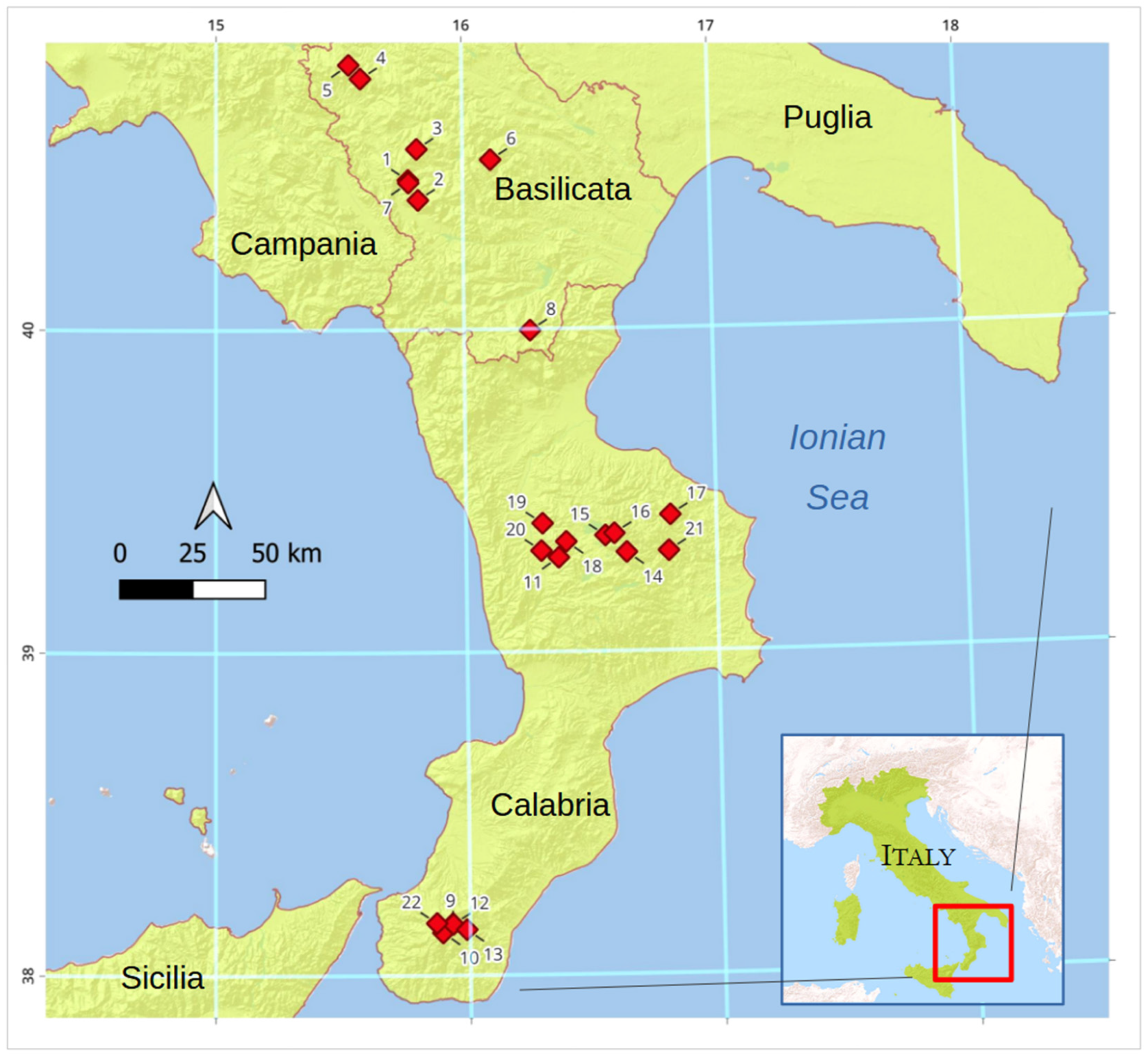
| Site ID | Geology | Municipality | Locality | Latitude (N) (LAT) | Longitude (E) (LON) | Altitude (m a.s.l.) | Collection Year | Field Visits/ Herbarium |
|---|---|---|---|---|---|---|---|---|
| 1 | schists | Calvello | Serra di Calvello | 40.463289 | 15.779016 | 1200 | 2017 | 3 field visits |
| 2 | schists | Marsicovetere | Monte Volturino | 40.401308 | 15.818906 | 1575 | 2011; 2025 | 4 field visits |
| 3 | schists | Abriola | Il Ciglio | 40.559300 | 15.814320 | 1380 | 2019 | 4 field visits |
| 4 | schists | Bella | Monte Santa Croce | 40.778290 | 15.587290 | 1390 | 2024 | 3 field visits |
| 5 | schists | San Fele | Monte Castello | 40.821060 | 15.540030 | 900 | 2024 | 3 field visits |
| 6 | schists | Oliveto Lucano | Gallipoli Cognato | 40.525022 | 16.113721 | 900 | 2011 | 3 field visits |
| 7 | schists | Marsico Nuovo | Monte Lama | 40.455292 | 15.780228 | 1400 | 2023 | 3 field visits |
| 8 | ophiolites | Terranova di Pollino | Timpa di Pietrasasso | 39.995517 | 16.266318 | 1300 | 2023 | 3 field visits |
| 9 | biotite gneiss | San Luca | Pietra Impiccata | 38.159734 | 15.931542 | 1650 | 1989 | Herbarium |
| 10 | biotite gneiss | Roghudi | Valle del Fiume Menta | 38.131823 | 15.893180 | 1650 | 1984 | Herbarium |
| 11 | schists | Casali del Manco | C. Ceraso | 39.290994 | 16.368603 | 1017 | 1994 | Herbarium |
| 12 | biotite gneiss | San Luca | Serra Priolo | 38.158054 | 15.933187 | 1670 | 1987 | Herbarium |
| 13 | biotite gneiss | San Luca | Puntone Gramolara | 38.141221 | 15.986891 | 1370 | 1987 | Herbarium |
| 14 | granites | San Giovanni in Fiore | Colle Donato | 39.305565 | 16.640331 | 1470 | 1987 | Herbarium |
| 15 | quartzite | Spezzano della Sila | Pietra Bianca | 39.357720 | 16.556024 | 1420 | 1988 | Herbarium |
| 16 | quartzite | Casali del Manco | Serra Ripollata | 39.364084 | 16.591788 | 1650 | 1998 | Herbarium |
| 17 | ophiolites | Campana | Rupi di Campana | 39.419377 | 16.816973 | 560 | 1985 | Herbarium |
| 18 | gneiss | Celico | Monte Scuro | 39.340125 | 16.399115 | 1600 | 1985; 1991 | Herbarium |
| 19 | schists | Rose | Vallone Giancorella | 39.397313 | 16.305572 | 610 | 2015 | Herbarium |
| 20 | granites | Casali del Manco | San Nicola Silano | 39.312351 | 16.299601 | 1420 | 1985 | Herbarium |
| 21 | biotite gneiss | Savelli | Valle Torrente Senapite | 39.308558 | 16.808687 | 450 | 1984 | Herbarium |
| 22 | biotite gneiss | Scilla | Monte Nardello | 38.161157 | 15.869407 | 1700 | 2015 | Herbarium |
| N | Taxon | Substrate | Site ID | Herbarium and Voucher No. | Notes |
|---|---|---|---|---|---|
| 1 | Adelolecia pilati (Hepp) Hertel & Hafellner | Siliceous rock | 9 10 | CLU [No. 6533 8110 8201 9662 10528; 6991 10793] | Arctic–alpine |
| 2 | Agonimia tristicula (Nyl.) Zahlbr. | Terricolous mosses | 2 | CLU [No. 17799] TSB [No. 22115] | A widespread probably holarctic species |
| 3 | Anaptychia crinalis (Schaer.) J. Nowak | Siliceous soil | 2 3 4 | HLUC [No. 623; 676; 746; 792] | Historical record confirmed Threatened taxa |
| 4 | Brodoa intestiniformis (Vill.) Goward | Siliceous rock | 9 | CLU [No. 878 2801 5177] TSB [No. 6699 11376] | Arctic–alpine |
| 5 | Bryoria fuscescens (Gyeln.) Brodo & D. Hawksw. | Terricolous mosses | 3 9 | CLU [No. 773 2226] | A circumpolar temperate-to-boreal–montane species |
| 6 | Bryoria smithii (Du Rietz) Brodo & D. Hawksw. | Siliceous rock | 2 | HLUC [No. 663] | A temperate species |
| 7 | Calogaya schistidii (Anzi) Arup Frödén & Søchting | Terricolous mosses | 1 2 3 4 | CLU [No. 16567 17780; 16507] TSB [No. 22160] HLUC [No. 662; 680] | Most common in upland areas |
| 8 | Caloplaca stillicidiorum (Vahl) Lynge var. muscorum (A. Massal.) | Mosses | 2 8 | CLU [No. 13455] | Mostly found in dry-continental areas on basic siliceous substrata |
| 9 | Candelariella coralliza (Nyl.) H. Magn. | Siliceous rock | 1 2 3 4 8 | CLU [No. 1100; 638; 1103] | A mainly boreal–montane to arctic–alpine circumpolar species |
| 10 | Catapyrenium cinereum (Pers.) Körb. | Siliceous soil | 9 | CLU [No. 2877] | A boreal–montane-to-arctic–alpine circumpolar species |
| 11 | Catapyrenium daedaleum (Kremp.) Stein | Siliceous soil | 4 | HLUC [No. 1101] | A boreal–montane-to-arctic–alpine species recently reported in the Basilicata Region [16] |
| 12 | Cetraria aculeata (Schreb.) Fr. | Siliceous soil | 1 2 3 4 6 | CLU [No. 16870] HLUC [No. 796a; 767] TSB [No. 22154; 10730] | Widespread mainly temperate |
| 13 | Cetraria islandica (L.) Ach. | Siliciferous soil | 2 9 | CLU [No. 6966 10856] HLUC [No. 57] | An arctic–alpine-to-boreal–montane circumpolar lichen |
| 14 | Cetraria muricata (Ach.) Eckfeldt | Siliceous soil | 2 3 9 10 | HLUC [No. 56; 796b] CLU [No. 855 2315; 40] | Optimum on siliceous soil in wind-exposed siliceous ridges above treeline but also found on decalcified soils over calcareous substrata |
| 15 | Cladonia cariosa (Ach.) Spreng | Siliceous soil | 4 15 | CLU [No. 5411] | A cool-temperate-to-subarctic–subalpine circumpolar lichen |
| 16 | Cladonia cervicornis (Ach.) Flot. | Siliceous soil | 4 | HLUC [No. 228] | A temperate-to-southern boreal–montane lichen |
| 17 | Cladonia coccifera (L.) Willd. | Siliceous soil | 5 | HLUC [No. 1102; 677] | A cool-temperate-to-arctic–alpine species recently reported in Basilicata [17] |
| 18 | Cladonia coniocraea (Flörke) Spreng. | Siliceous soil | 1 3 15 | HLUC [No. 785] CLU [No. 5368 5392] | A widespread holarctic species |
| 19 | Cladonia foliacea (Huds.) Willd. | Siliceous soil | 1 3 6 10 13 16 | CLU [No. 4075 10323] | A mild-temperate lichen found on both calcareous and siliceous soil |
| 20 | Cladonia furcata (Huds.) Schrad. subsp. furcata | Siliceous soil | 1 3 6 22 | HLUC [No. 784; 789b] TSB [No. 6805] CLU [No. 46] | A holarctic temperate-to-boreal–montane lichen |
| 21 | Cladonia furcata subsp. subrangiformis auct. non (Sandst.) Abbayes | Siliceous soil | 4 | HLUC [No. 790] | A mild-temperate lichen |
| 22 | Cladonia pyxidata (L.) Hoffm. f. pyxidata | Siliceous soil | 3 4 5 | HLUC [No. 493; 498] | A widespread very polymorphic holarctic species |
| 23 | Cladonia ramulosa (With.) J.R. Laundon | Siliceous soil | 4 9 | HLUC [No. 1104] CLU [No. 2791] | Recently reported in Basilicata [16] |
| 24 | Cladonia rangiformis Hoffm. | Siliceous soil | 1 2 3 4 5 6 7 8 9 10 13 | CLU [No. 759] TSB [No. 22102; 775; 814] | A mainly temperate lichen in open habitats |
| 25 | Cornicularia normoerica (Gunnerus) Du Rietz | Siliceous rocks | 2 9 10 | CLU [No. 10677 757 760 880; 763] HLUC [No. 777] | A circumpolar arctic–alpine lichen with optimum above treeline |
| 26 | Cystocoleus ebeneus (Dillwyn) Thwaites | Siliceous rocks | 1 2 9 10 | HLUC [No. 758] CLU [No. 1981 2759 2812; 4733] | A cool-temperate-to-boreal–montane probably holarctic lichen |
| 27 | Dermatocarpon intestiniforme (Körb.) Hasse | Siliceous rocks | 2 9 10 | HLUC [No. 665] TSB [No. 7016] | A mainly boreal–montane-to-arctic–alpine circumpolar lichen |
| 28 | Dermatocarpon luridum (With.) J.R. Laundon | Siliceous rocks | 2 5 | HLUC [No. 640 748] | A cool-temperate-to-subarctic–subalpine probably circumpolar species |
| 29 | Diploschistes scruposus (Schreb.) Norman | Siliceous rocks | 1 2 3 4 11 | HLUC [No. 634 751 793] | A widespread holarctic lichen found on siliceous rocks |
| 30 | Enterographa zonata (Körb.) Torrente & Egea | Siliceous rocks | 1 | CLU [No. 13214] | A temperate to southern-boreal-montane pheraps circumpolar |
| 31 | Fuscidea cyathoides (Ach.) V. Wirth & Vězda | Siliceous rocks | 2 | HLUC [No. 723] | A cold-temperate to southern boreal-montane, perhaps circumpolar lichen |
| 32 | Glaucomaria rupicola (L.) P.F. Cannon subsp. rupicola var. rupicola | Siliceous | 1 2 3 4 6 18 | CLU [No. 16566; 363] TSB [No. 11780] | A widespread holarctic silicicolous lichen |
| 33 | Hypogymnia bitteri (Lynge) Ahti | Siliceous rocks | 3 | HLUC [No. 772] | A cool-temperate-to-boreal–montane circumpolar lichen |
| 34 | Hypogymnia physodes (L.) Nyl. | Siliceous rocks | 2 3 4 | HLUC [No. 740] | A widespread holarctic lichen on bark or lignum |
| 35 | Hypogymnia tubulosa (Schaer.) Hav. | Siliceous rocks | 2 3 4 10 | HLUC [No. 771] | A widespread holarctic lichen on bark or lignium |
| 36 | Lecidea sarcogynoides Körb. | Siliceous rocks | 9 18 | CLU [No. 5369 7968; 9797 9866] | A temperate species of siliceous mineral-rich rocks |
| 37 | Leptochidium albociliatum (Desm.) M. Choisy | Mosses | 2 3 6 10 16 | HLUC [No. 234; 682; 769; 791; 799] CLU [No. 5416 7641] TSB [No. 6827] | A cool-temperate-to-arctic–alpine lichen |
| 38 | Leprocaulon quisquiliare (Leers) M. Choisy | Siliceous rock | 3 4 | HLUC [No. 766] | A mainly mild-temperate-to-Mediterranean lichen |
| 39 | Leptogium furfuraceum (Harm.) Sierk | Siliceous soil | 4 | HLUC [No. 726] | A mild-temperate-to-humid subtropical species; epiphytic lichens are classified as Endangered [18] |
| 40 | Lethariella intricata (Moris) Krog | Siliceous rock | 3 | Not collected due to conservation concerns | Probably an old relict Mediterranean species Near-threatened [18] |
| 41 | Melanelia stygia (L.) Essl. | Siliceous rock | 2 9 12 | HLUC [No. 805] TSB [No. 11240; 10092] | A circumpolar arctic–alpine lichen Recently reported in Basilicata [17] |
| 42 | Myriospora smaragdula (Ach.) Uloth | Siliceous rock | 1 2 8 15 | CLU [No. 12261; 5389] | A cool-temperate-to-boreal–montane perhaps circumpolar lichen |
| 43 | Nephroma parile (Ach.) Ach. | Mosses | 4 | Not collected | A cool-temperate-to-circumboreal–montane lichen |
| 44 | Ophioparma ventosa (L.) Norman | Siliceous rock | 9 | CLU [No. 6637] | An arctic–alpine circumpolar lichen |
| 45 | Parmelia omphalodes (L.) Ach. | Siliceous rock | 2 3 4 6 9 10 13 22 | HLUC [No. 626; 743; 795; 804] CLU [No. 776; 1247; 109] | An arctic–alpine circumpolar lichen |
| 46 | Parmelia saxatilis (L.) Ach. | Siliceous rock | 3 4 6 9 10 13 | HLUC [No. 721] CLU [No. 11336; 4787; 1243] | Very common saxicolous species |
| 47 | Parmelina pastillifera (Harm.) Hale | Siliceous rock | 2 3 4 | HLUC [No. 749; 724; 761; 775] | A temperate lichen in humid regions |
| 48 | Parmelina tiliacea (Hoffm.) Hale | Siliceous rock | 2 3 4 21 | A mainly mild-temperate lichen | |
| 49 | Peltigera horizontalis (Huds.) Baumg. | Siliceous soil | 3 4 6 18 | HLUC [No. 750] CLU [No. 1910] | Lichen with a wide altitudinal range but with optimum in the montane belt. |
| 50 | Peltigera rufescens (Weiss) Humb. | Siliceoussoil | 4 | HLUC [No. 725] | A widespread holarctic lichen but also in Mediterranean belt |
| 51 | Physconia muscigena (Ach.) Poelt var. muscigena | Siliceous soil | 4 | HLUC [No. 736] | A circulpolar arctic–alpine lichen in open situation |
| 52 | Pisutiella grimmiae (Nyl.) S. Y. Kondr. L. Lőkös & E. Farkas | On Candelariella sp. | 2 6 8 | CLU [No. 16554; 18078] | A holarctic temperate to boreal–montane lichen |
| 53 | Placidium adami-borosi Szatala | Siliceous soil | 2 4 9 10 | CLU [No. 2794 6242] TSB [No. 13947] HLUC [No. 810] | A mainly Mediterranean (-montane) lichen found on soil derived from metamorphic base-rich rocks |
| 54 | Placidium subrufescens (Breuss) Breuss | Siliceous soil | 2 4 | HLUC [No. 811] | A mainly Mediterranean-to-Mediterranean–montane lichen, this species is generally calcicolous but in this case was found on different siliceous substrata |
| 55 | Placocarpus schaereri (Fr.) Breuss | Siliceous rock | 1 2 5 9 | HLUC [No. 611] CLU [No. 764 10121] | A Mediterranean-to-mild-temperate lichen; this species is generally calcicolous but in this case was found on different siliceous substrata |
| 56 | Platismatia glauca (L.) W.L. Culb. & C.F. Culb. | Siliceous rock | 2 3 4 9 10 16 | HLUC [No. 734 741 744 790] CLU [No. 2167; 1127; 310 449] | A cool-temperate-to-boreal holarctic species |
| 57 | Pleopsidium chlorophanum (Wahlenb.) Zopf | Siliceous rock | 2 10 | HLUC [No. 621 774 807] CLU [No. 2767 2817 2822] | An arctic–alpine bipolar lichen |
| 58 | Protoparmelia badia (Hoffm.) Hafellner var. badia | Siliceous rock | 1 2 9 | CLU [No. 16685; 16504 16540 16600] TSB [No. 10731] | Has a wide altitudinal range reaching the nival belt of the Alps |
| 59 | Protoparmeliopsis laatokkensis (Räsänen) Moberg & R. Sant. | Siliceous rock | 9 | CLU [No. 5173 10887] TSB [No. 11254] | Found on schist serpentine and amphibolite mostly on horizontal faces near the ground |
| 60 | Protoparmeliopsis bolcana (Pollini) Lumbsch | Siliceous rock | 2 14 | TSB [No. 22199] | Ecologically similar to P. muralis but more restricted to natural habitats |
| 61 | Pseudephebe minuscula (Arnold) Brodo & D. Hawksw. | Mosses | 2 3 9 10 | HLUC [No. 736] TSB [No. 11254] | An arctic–alpine circumpolar species |
| 62 | Pseudephebe pubescens (L.) M. Choisy | Siliceous rock | 2 9 10 | HLUC [No. 798; 732] CLU [No. 16511 16542 16558; 879] TSB [No. 10903; 6812] | A lichen that is arctic–alpine to (more rarely) boreal–montane |
| 63 | Pseudevernia furfuracea (L.) Zopf | Siliceous rock | 1 2 3 4 | HLUC [No. 585 620 720; 683; 770; 745 762] | A cool-temperate-to-boreal–montane lichen |
| 64 | Psilolechia lucida (Ach.) M. Choisy | Siliceous rock | 1 | CLU [No. 18220] | Restricted to natural habitats In Italy most frequent in the Alps and in the most humid parts of the Mediterranean belt |
| 65 | Psorinia conglomerata (Ach.) Gotth. Schneid. | Siliceous rock | 2 4 | HLUC [No. 794; 1105] | A mainly arctic–alpine circumpolar species |
| 66 | Ramalina capitata var. digitellata (Nyl.) Nimis | Siliceous rock | 19 | CLU [No. 17410] | Found on top of exposed siliceous boulders frequently visited by birds in Mediterranean Italy |
| 67 | Ramalina polymorpha (Lilj.) Ach. | Siliceous rock | 2 8 18 20 | HLUC [No. 778 779] CLU [No. 1218; 18050] | Found on top of isolated siliceous boulders manured by birds |
| 68 | Rhizocarpon geminatum Körb. | Siliceous rock | 2 9 | TSB [No. 22200] CLU [No. 6496 6974] | A widespread lichen of dry-continental areas |
| 69 | Rhizocarpon geographicum (L.) DC. subsp. geographicum | Siliceous rock | 1–22 | HLUC [No. 105] CLU [No. 105; 16540 16561] | Widespread |
| 70 | Schaereria fuscocinerea (Nyl.) Clauzade & Cl. Roux | Siliceous rock | 2 9 | HLUC [No. 759] TSB [No. 10727] CLU [No. 6141 9436] | An arctic–alpine-to-boreal–montane circumpolar species. |
| 71 | Scytinium palmatum (Huds.) Gray | Mosses | 2 3 4 9 | HLUC [No. 587; 681] | A mild-temperate lichen |
| 72 | Thalloidima opuntioides (Vill.) Kistenich Timdal Bendiksby & S.Ekman | soil | 4 | CLU [No. 10258] HLUC [No. 727] | Widespread circumpolar arctic to temperate |
| 73 | Thalloidima tauricum Szatala | Siliceoussoil | 2 | HLUC [No. 800] | A mainly southern species with a Eurasian distribution but generally rare in the Mediterranean belt |
| 74 | Toninia squalida (Ach.) A. Massal. | Siiceoussoil | 9 | CLU [No. 2882 5371] | An incompletely holarctic lichen |
| 75 | Umbilicaria cylindrica (L.) Delise var. cilindrica | Siliceous rock | 2 3 9 13 15 | CLU [No. 16849; 16514 16518 16519 16540 16559; 5646] TSB [No. 10818] HLUC [No. 718 722] | An ecologically wide-ranging cool-temperate-to-arctic–alpine circumpolar lichen |
| 76 | Umbilicaria cylindrica v. tornata (Ach.) Nyl. | Siliceous rock | 2 9 | HLUC [No. 669] | An arctic–alpine lichen on exposed siliceous rocks |
| 77 | Umbilicaria crustulosa subsp. punctata A. Crespo & Sancho | Siliceous rock | 3 | HLUC [No. 678] | A rare Mediterranean–montane lichen |
| 78 | Umbilicaria decussata (Vill.) Zahlbr. | Siliceous rock | 2 | HLUC [No. 709 808] | An arctic–alpine-to-boreal–montane circumpolar lichen |
| 79 | Umbilicaria deusta (L.) Baumg. | Siliceous rock | 2 4 9 10 14 16 22 | HLUC [No. 182 716] CLU [No. 16515 16517 16521; 5645; 9125; 783 794 805 2866 2867 9138] | An arctic–alpine-to-boreal–montane circumpolar lichen |
| 80 | Umbilicaria freyi Codogno Poelt & Puntillo | Siliceous rock | 11 13 19 | TSB [No. 11045] CLU [No. 3129] | Ranging from the Alps to the mountains of Calabria |
| 81 | Umbilicaria grisea Hoffm. | Siliceous rock | 2 4 5 6 11 13 17 19 | HLUC [No. 488] CLU [No. 9098; 3131] | Usually below the alpine belt |
| 82 | Umbilicaria hirsuta (Westr.) Hoffm. | Siliceous rock | 1 9 10 11 12 13 18 19 | HLUC [No. 668] CLU [No. 16665; 1216 1217; 1048 10900; 822 2868 2869] TSB [No. 4048 10900] | A widespread arctic–alpine-to-boreal–montane circumpolar lichen |
| 83 | Umbilicaria hispanica (Frey) Davydov Peršoh & Rambold | Siliceous rock | 2 9 10 13 14 | HLUC [No. 688] CLU [No. 786 797 801 819 2856 9137; 35 802] | Mostly in upland areas of the Mediterranean Region |
| 84 | Umbilicaria hyperborea (Ach.) Hoffm. | Siliceous rock | 2 | HLUC [No. 641] | An arctic–alpine probably circumpolar lichen |
| 85 | Umbilicaria nylanderiana (Zahlbr.) H. Magn. | Siliceous rock | 2 9 12 19 | CLU [No. 803 808 818 2853 28549099 9376] TSB [No. 44864 44865] HLUC [No. 642 708] | An arctic–alpine probably circumpolar lichen |
| 86 | Umbilicaria polyphylla (L.) Baumg. | Siliceous rock | 1 2 3 8 9 10 13 14 16 18 20 | HLUC [No. 666] CLU [No. 12597; 16576; 794 799 2855 2870 9136 9138; 761] TSB [No. 30846] | Present both in the Alps and in the high Mediterranean mountains |
| 87 | Umbilicaria proboscidea (L.) Schrad. | Siliceous rock | 2 | HLUC [No. 714] | A mainly arctic–alpine circumpolar lichen |
| 88 | Umbilicaria pustulata (L.) Hoffm. | Siliceous rock | 1–8 10 14 15 18 20 21 | HLUC [No. 39; 679; 719; 754; 815] CLU [No. 712; 352 353] | A temperate-to-boreal–montane circumpolar species |
| 89 | Umbilicaria subpolyphylla Oxner | Siliceous rock | 2 | HLUC [No. 627] | A southern European species |
| 90 | Umbilicaria torrefacta (Lightf.) Schrad. | Siliceous rock | 2 9 10 14 | HLUC [No. 717] CLU [No. 787 807 820 2871 2872 5644 9099; 9365] | An arctic–alpine circumpolar lichen |
| 91 | Umbilicaria vellea (L.) Ach. | Siliceous rock | 1 2 9 11 12 19 | HLUC [No. 801; 711] CLU [No. 784] TSB [No. 11268; 11053] | An arctic–alpine probably circumpolar lichen |
| 92 | Xanthoparmelia angustiphylla (Gyeln.) Hale | Siliceous rock | 2 9 | HLUC [No. 733] | More widespread in Mediterranean Italy |
| 93 | Xanthoparmelia conspersa (Ach.) Hale | Siliceous rock | 1–9 21 | HLUC [No. 731; 766; 812] TSB [No. 6625] | Restricted to upland areas in southern Italy less frequent than the vicariant X. tinctina in the Mediterranean belt |
| 94 | Xanthoparmelia loxodes (Nyl.) O. Blanco et al. | Siliceous rock | 1 3 4 5 6 | Not collected | A mainly temperate common species of basic siliceous rocks |
| 95 | Xanthoparmelia perrugata (Nyl.) O. Blanco et al. | Siliceous rock | 2 4 | HLUC [No. 624 742] | A species that is boreal to (mainly) Mediterranean |
| 96 | Xanthoparmelia protomatrae (Gyeln.) Hale | Siliceous rock | 4 | HLUC [No. 753] | A mainly temperate-to-Mediterranean species |
| 97 | Xanthoparmelia pulla (Ach.) O. Blanco et al. | Siliceous rock | 1 2 3 4 7 10 18 | HLUC [No. 735; 747] CLU [No. 1228; 42 9128] TSB [No. 10729] | Has a very wide altitudinal range |
| 98 | Xanthoparmelia stenophylla (Ach.) Ahti & D. Hawksw. | Siliceous rock | 1 3 4 5 | HLUC [No. 619; 675; 730] TSB [No. 22203] | A Eurasian species with a very wide altitudinal range |
| 99 | Xanthoparmelia sublaevis (Cout.) Hale | Siliceous rock | 4 5 | HLUC [No. 820] | Common in the Mediterranean belt but also occurs in dry–warm alpine valleys |
| 100 | Xanthoparmelia tinctina (Maheu & A. Gillet) Hale | Siliceous rock | 1 3 4 5 | HLUC [No. 137] CLU [No. 3487] | A mainly mediterranean species found on siliceous rocks |
| 101 | Xanthoparmelia verruculifera (Nyl.) O. Blanco et al. | Siliceous rock | 2 | HLUC [No. 821] | Widespread on siliceous rocks in North America Europe and northern Africa |
| 102 | Zeora sulphurea (Hoffm.) Flot. | Siliceous rock | 2 | CLU [No. 16533] HLUC [No. 613] TSB [No. 22094] |
| Site ID | Species Richness (Total Taxa) | Arctic–Alpine Taxa | Rare/Threatened Taxa Present (Notes) | Ecological Zone/Altitudinal Proxy |
|---|---|---|---|---|
| 1 | 26 | 2 | 0 | Lowland to mid-montane |
| 2 | 62 | 17 | 1 (Anaptychia crinalis Bryoria smithii Placidium subrufescens Psorinia conglomerate Umbilicaria proboscidea) | Broad transitional altitudinal belt |
| 3 | 38 | 4 | 2 (Anaptychia crinalis Lethariella intricata) | Montane/old-growth forest edge |
| 4 | 43 | 4 | 2 (Anaptychia crinalis Leptogium furfuraceum Placidium subrufescens Psorinia conglomerata) | Montane open habitats |
| 5 | 13 | 1 | 0 | Transitional montane |
| 6 | 16 | 2 | 0 | Mid-montane |
| 7 | 4 | 0 | 0 | Restricted local sampling |
| 8 | 9 | 1 | 0 | Dry-continental xeric rock |
| 9 | 35 | 15 | 0 | High alpine (above treeline/ridge) |
| 10 | 24 | 10 | 0 | High alpine (above treeline) |
| 11 | 5 | 2 | 0 | Transitional montane |
| 12 | 5 | 3 | 0 | High alpine (above treeline/ridge) |
| 13 | 11 | 2 | 0 | High alpine/open heath |
| 14 | 5 | 2 | 0 | Transitional montane |
| 15 | 6 | 0 | 0 | Lower montane soil |
| 16 | 6 | 1 | 0 | Restricted cold-temperate spot |
| 17 | 2 | 0 | 0 | Montane open habitats |
| 18 | 8 | 1 | 0 | Montane open habitats |
| 19 | 5 | 3 | 0 | Montane open habitats |
| 20 | 3 | 0 | 0 | Montane open habitats |
| 21 | 2 | 0 | 0 | Montane open habitats |
| 22 | 4 | 2 | 0 | Montane open habitats |
| Taxon | Floristic Novelty Category | Phytogeographical and Ecological Interest |
|---|---|---|
| Bryoria smithii | New to southern Italy | Boreal–montane; highly disjunct and rare in the South. |
| Cladonia cariosa | New to Basilicata | Associated with early-successional pioneer soil communities. |
| Dermatocarpon intestiniforme | New to southern Italy | Boreal–montane-to-arctic–alpine circumpolar lichen. |
| Dermatocarpon luridum | New to Basilicata | Amphibious species; restricted to periodically inundated rocks. |
| Fuscidea cyathoides | New to Basilicata | Mostly in humid upland areas. |
| Leptogium furfuraceum | New to Basilicata | In warm–humid areas near wood. |
| Nephroma parile | New to Basilicata | Sensitive cyanolichen; indicator of pristine air quality. |
| Placidium adami-borosi | New to Basilicata | On soil derived from metamorphic base-rich rocks. |
| Placidium subrufescens | New to Italy | Mediterranean–montane; rare on siliceous soils. |
| Pseudephebe minuscula | New to Basilicata | Arctic–alpine element at its extreme southern distribution limit. |
| Psorinia conglomerata | New to southern Italy | Arctic–alpine relict; indicator of stable glacial niches. |
| Schaereria fuscocinerea | New to Basilicata | In exposed situations on hard siliceous rocks. |
| Thalloidima tauricum | New to Basilicata | specialist in dry–xeric grasslands. |
| Umbilicaria crustulosa subsp. punctata | New to southern Italy | Mediterranean-montane; on siliceous rocks |
| Umbilicaria proboscidea | New to southern Italy | Arctic–alpine relict; high conservation priority. |
| Umbilicaria subpolyphylla | New to southern Italy | Often overlooked due to morphological similarities. |
| Xanthoparmelia angustiphylla | New to Basilicata | Typical of exposed Mediterranean–montane outcrops. |
| Xanthoparmelia perrugata | New to Basilicata | Silicicolous species showing competitive traits on bare rock. |
| Xanthoparmelia protomatrae | New to Basilicata | Rare sub-Mediterranean element on sunny metal-rich rocks. |
| Xanthoparmelia sublaevis | New to southern Italy | Specialized on thermophytic siliceous rocky outcrops. |
| Xanthoparmelia verruculifera | New to Basilicata | Common elsewhere but officially missing from past regional lists. |
Disclaimer/Publisher’s Note: The statements, opinions and data contained in all publications are solely those of the individual author(s) and contributor(s) and not of MDPI and/or the editor(s). MDPI and/or the editor(s) disclaim responsibility for any injury to people or property resulting from any ideas, methods, instructions or products referred to in the content. |
© 2026 by the authors. Licensee MDPI, Basel, Switzerland. This article is an open access article distributed under the terms and conditions of the Creative Commons Attribution (CC BY) license.
Share and Cite
Potenza, G.; Breuss, O.; Gheza, G.; Di Nuzzo, L.; Puntillo, D.; Isocrono, D.; Fascetti, S.; Rosati, L. Siliceous Outcrops Host New Records of Biodiversity Interest for Arctic–Alpine Lichens in the Southern Apennines: An Assessment Based on Field Surveys and Herbarium Data. Diversity 2026, 18, 521. https://doi.org/10.3390/d18090521
Potenza G, Breuss O, Gheza G, Di Nuzzo L, Puntillo D, Isocrono D, Fascetti S, Rosati L. Siliceous Outcrops Host New Records of Biodiversity Interest for Arctic–Alpine Lichens in the Southern Apennines: An Assessment Based on Field Surveys and Herbarium Data. Diversity. 2026; 18(9):521. https://doi.org/10.3390/d18090521
Chicago/Turabian StylePotenza, Giovanna, Othmar Breuss, Gabriele Gheza, Luca Di Nuzzo, Domenico Puntillo, Deborah Isocrono, Simonetta Fascetti, and Leonardo Rosati. 2026. "Siliceous Outcrops Host New Records of Biodiversity Interest for Arctic–Alpine Lichens in the Southern Apennines: An Assessment Based on Field Surveys and Herbarium Data" Diversity 18, no. 9: 521. https://doi.org/10.3390/d18090521
APA StylePotenza, G., Breuss, O., Gheza, G., Di Nuzzo, L., Puntillo, D., Isocrono, D., Fascetti, S., & Rosati, L. (2026). Siliceous Outcrops Host New Records of Biodiversity Interest for Arctic–Alpine Lichens in the Southern Apennines: An Assessment Based on Field Surveys and Herbarium Data. Diversity, 18(9), 521. https://doi.org/10.3390/d18090521