Modeling the Potential Distribution and Spatial Dynamics of Chenopodium hybridum in China Under Climate Change and Human Disturbance

 , , and
Abstract
1. Introduction
2. Materials and Methods
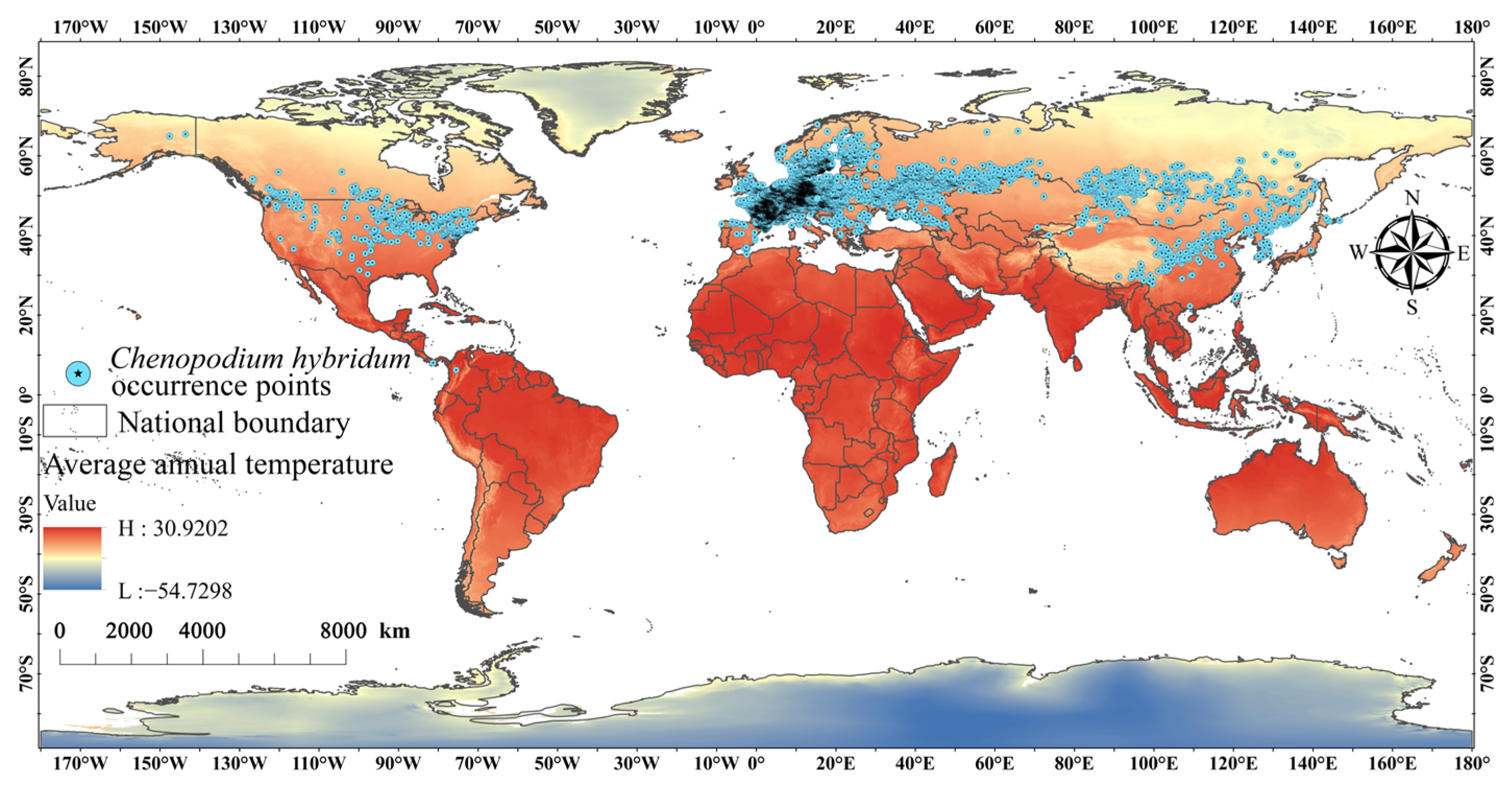
2.1. Occurrence Data of C. hybridum and Delineation of the Model Calibration Area
2.2. Sources of Environmental Predictor Variables
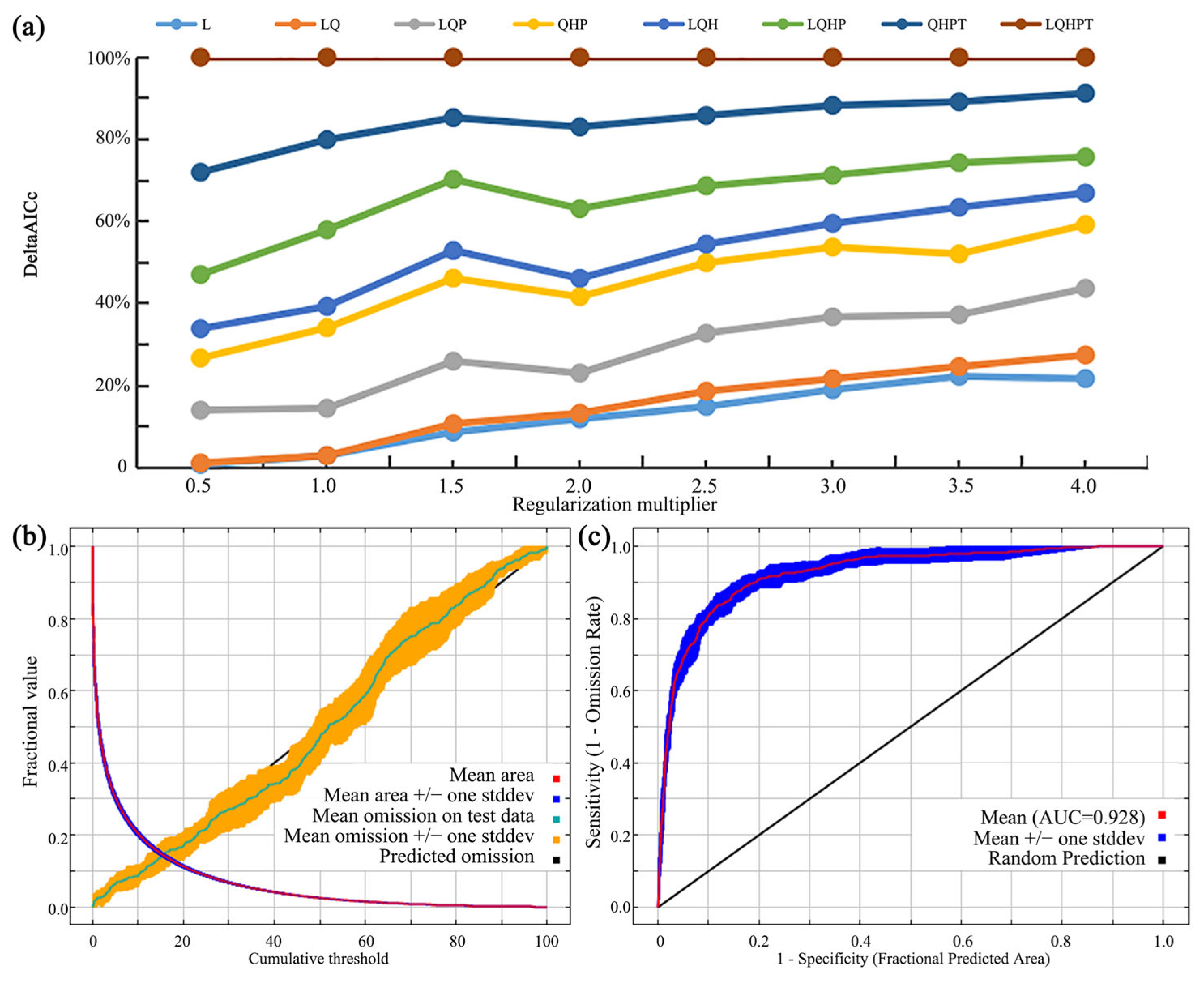
2.3. Model Optimization and Calibration
2.4. Model Evaluation and Output Generation
Spatial Dynamics and Habitat Turnover Rate Analysis
3. Results
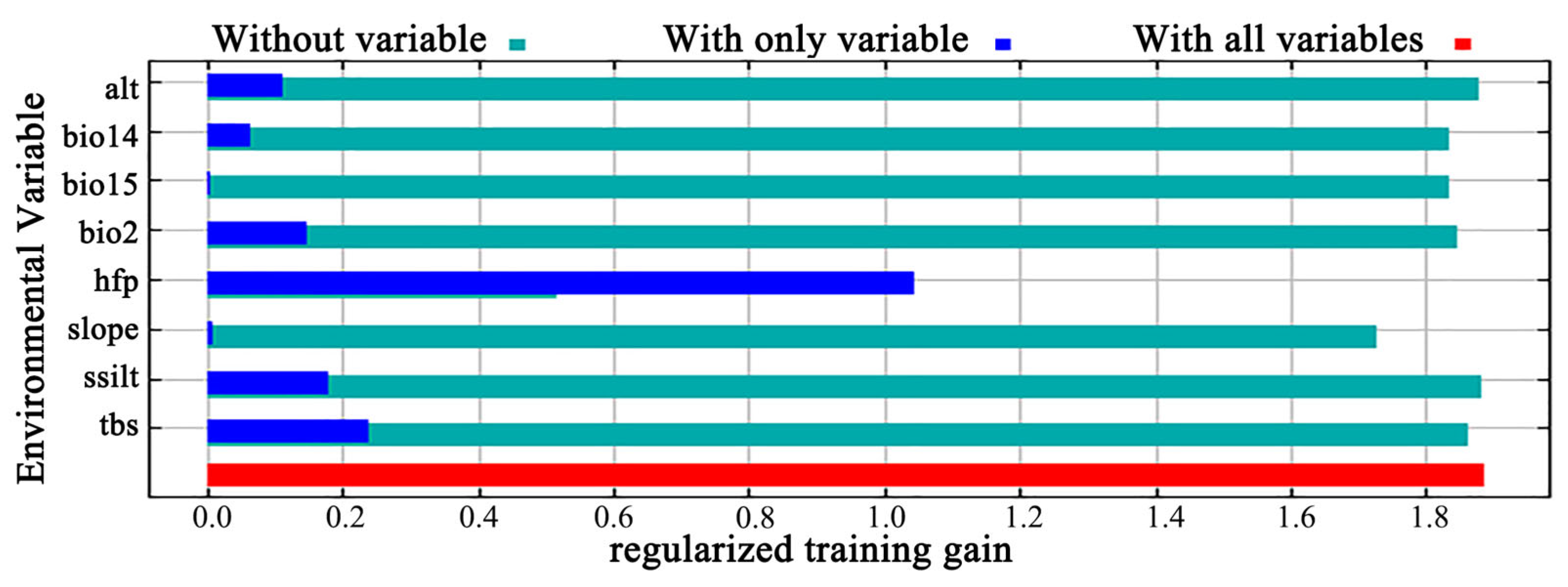
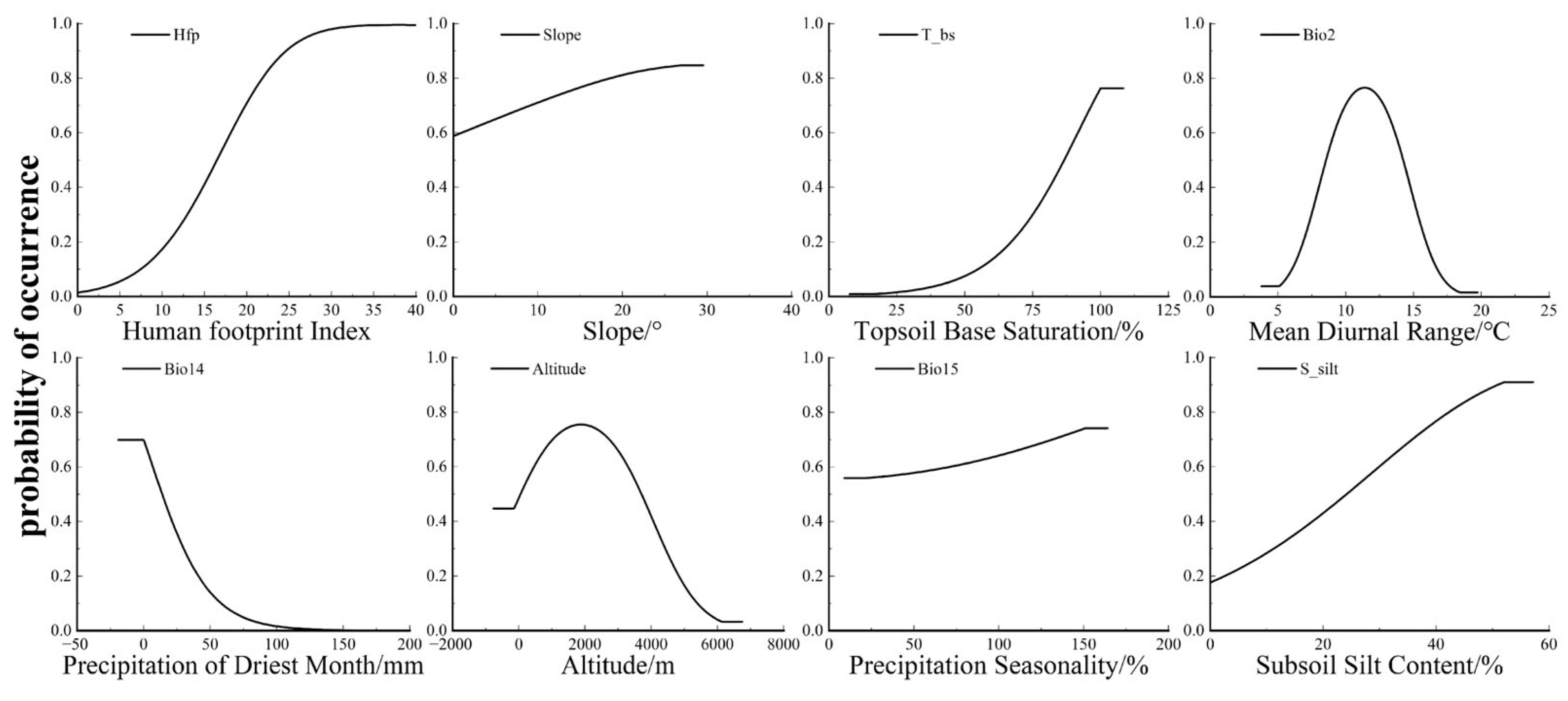
3.1. Model Performance Evaluation and Primary Environmental Predictors
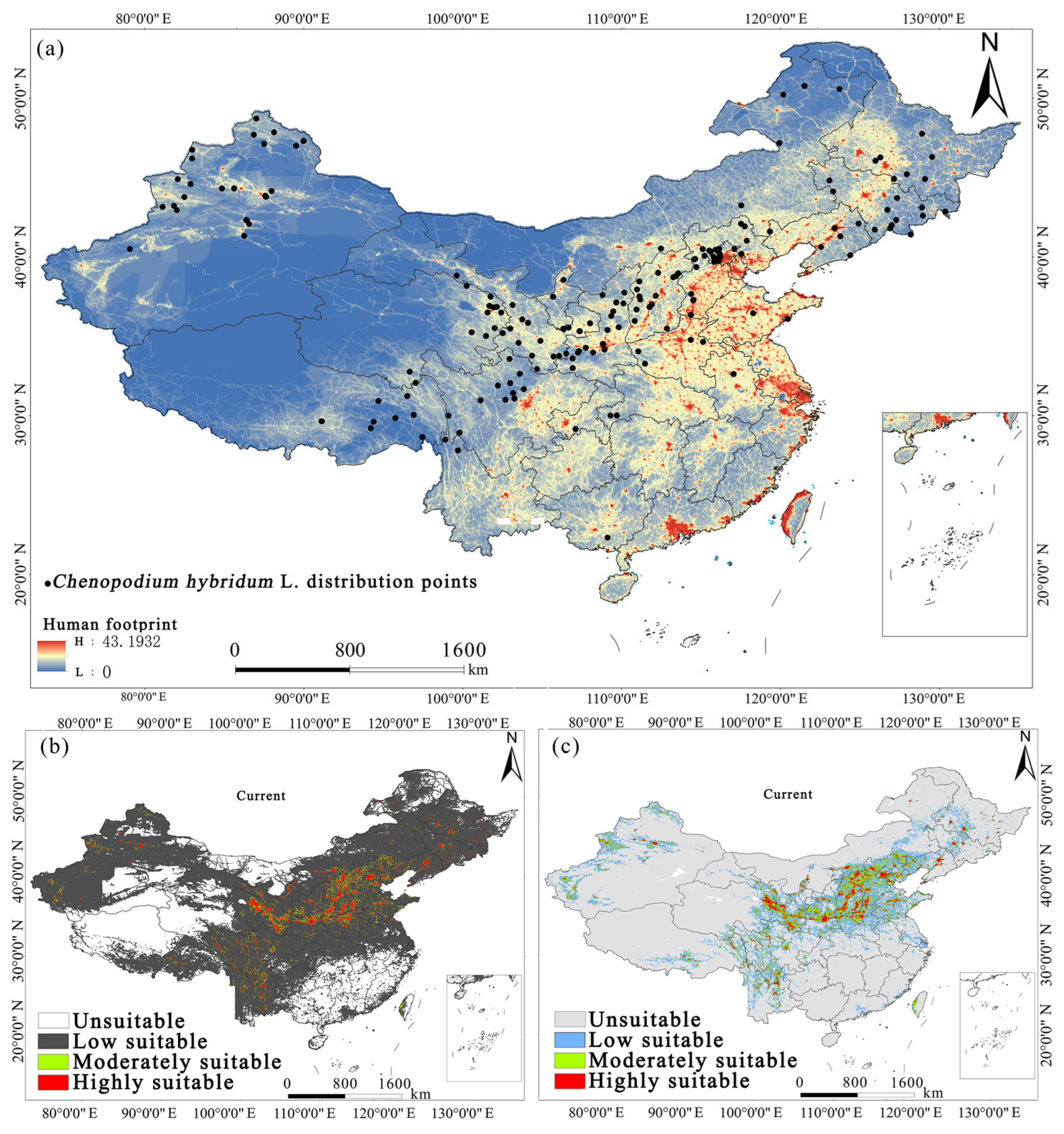
3.2. Spatial Distribution Characteristics and Potential Suitable Habitats Under Current Environmental Conditions
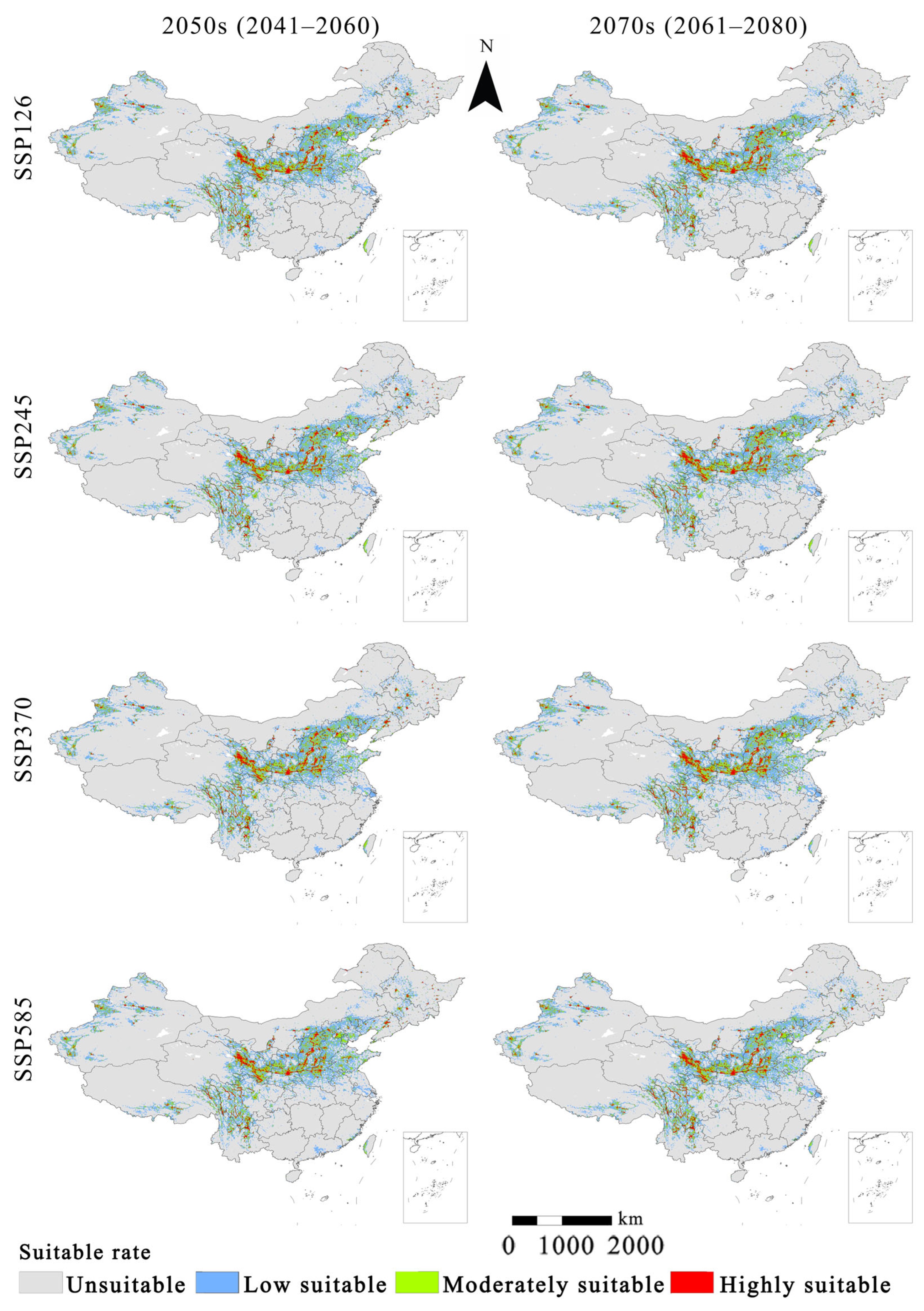
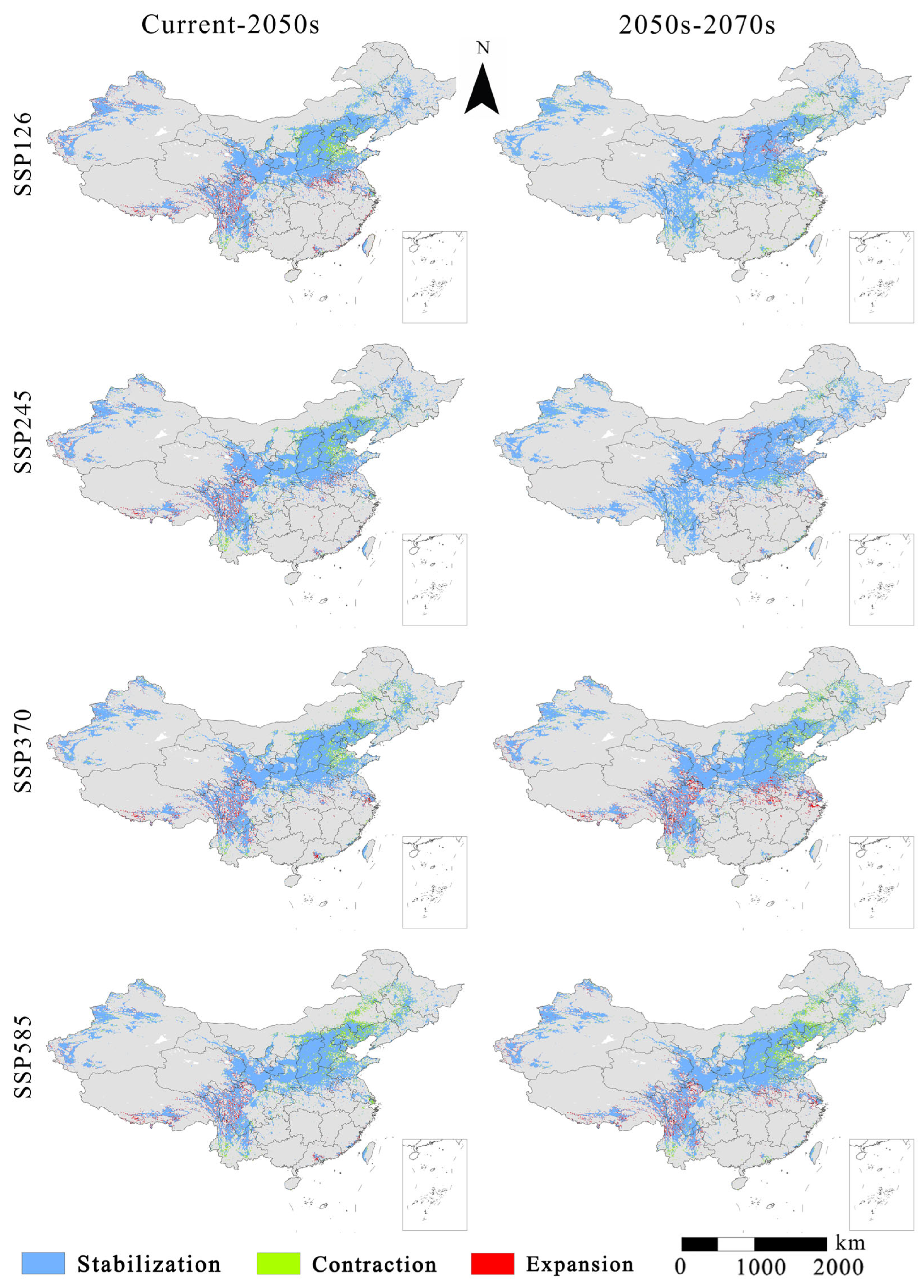
3.3. Spatiotemporal Dynamics and Spatial Shifts of Potential Suitable Habitats Under Future Climate Scenarios
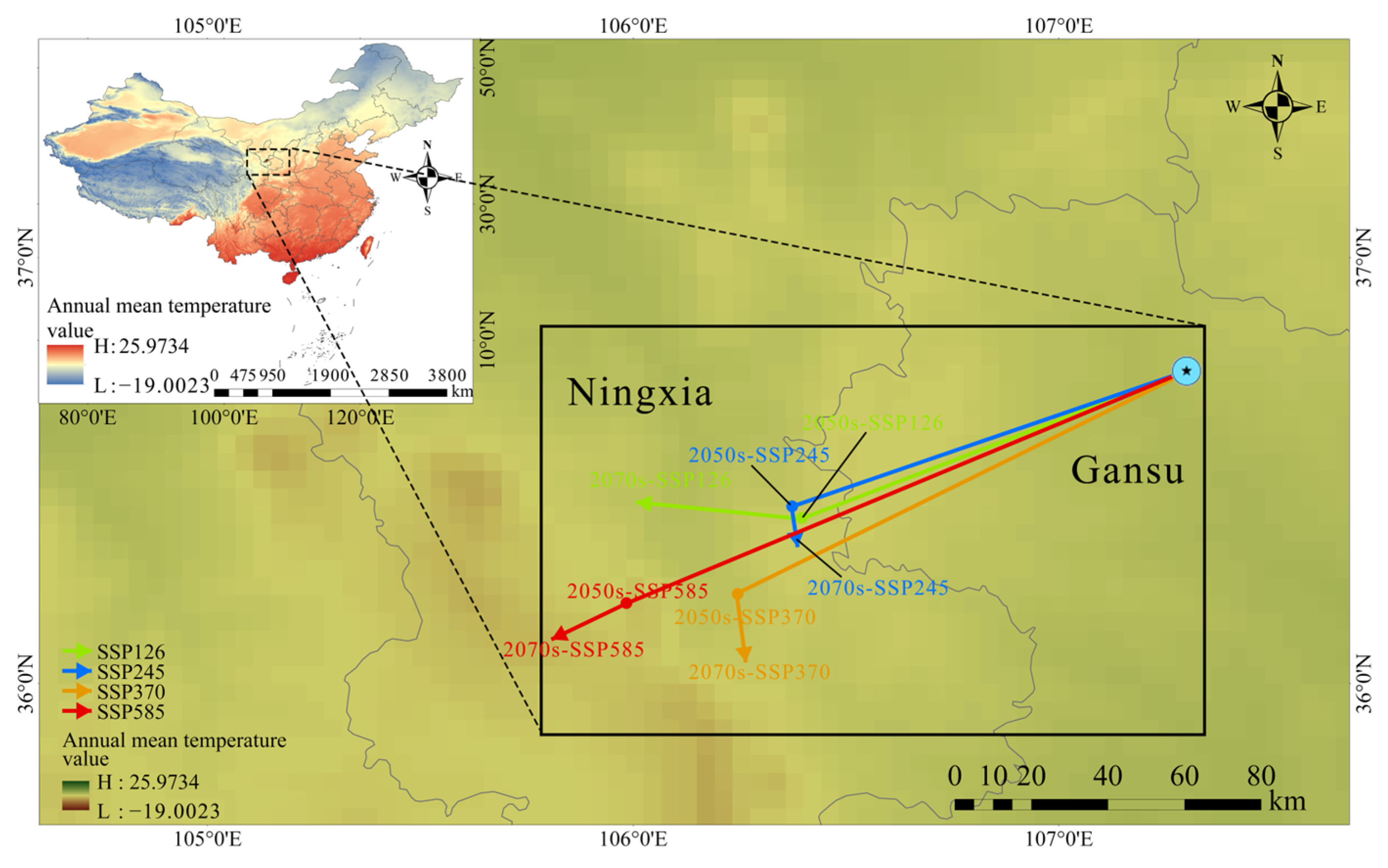
3.4. Migration Trajectories of the Distribution Centroids Within Potential Suitable Habitats
4. Discussion
4.1. Model Reliability and Predominant Environmental Constraints
4.2. Distributional Analysis of Potential Suitable Habitats for C. hybridum in China
4.3. Uncertainties and Limitations of the Model
4.4. Potential Threats to Native Ecosystems and Alpine Protected Areas
5. Conclusions
Supplementary Materials
Author Contributions
Funding
Institutional Review Board Statement
Data Availability Statement
Conflicts of Interest
Abbreviations
| AICc | Corrected Akaike Information Criterion |
| AUC | Area Under the Receiver Operating Characteristic Curve |
| CMIP6 | Coupled Model Intercomparison Project Phase 6 |
| DEM | Digital Elevation Model |
| FC | Feature Combination |
| GBIF | Global Biodiversity Information Facility |
| GCM | Global Climate Model |
| Hfp | Human Footprint |
| HWSD | Harmonized World Soil Database |
| LPT | Lowest Presence Threshold |
| LUCC | Land Use and Land Cover Change |
| MaxEnt | Maximum Entropy |
| MTSS | Maximum Training Sensitivity plus Specificity |
| RM | Regularization Multiplier |
| ROC | Receiver Operating Characteristic |
| SDMs | Species Distribution Models |
| SSP | Shared Socioeconomic Pathway |
| TSS | True Skill Statistic |
| VIF | Variance Inflation Factor |
| WorldClim | World Climate Database |
References
- Robinson, T.B.; Martin, N.; Loureiro, T.G.; Matikinca, P.; Robertson, M.P. Double Trouble: The Implications of Climate Change for Biological Invasions. NeoBiota 2020, 62, 463–487. [Google Scholar] [CrossRef]
- Wesselmann, M.; Apostolaki, E.T.; Anton, A. Species Range Shifts, Biological Invasions and Ocean Warming. Mar. Ecol. Prog. Ser. 2024, 728, 81–83. [Google Scholar] [CrossRef]
- Briscoe Runquist, R.D.; Lake, T.A.; Moeller, D.A. Improving Predictions of Range Expansion for Invasive Species Using Joint Species Distribution Models and Surrogate Co-occurring Species. J. Biogeogr. 2021, 48, 1693–1705. [Google Scholar] [CrossRef]
- Ni, M.; Deane, D.C.; Li, S.; Wu, Y.; Sui, X.; Xu, H.; Chu, C.; He, F.; Fang, S. Invasion Success and Impacts Depend on Different Characteristics in Non-native Plants. Divers. Distrib. 2021, 27, 1194–1207. [Google Scholar] [CrossRef]
- Fristoe, T.S.; Chytrý, M.; Dawson, W.; Essl, F.; Heleno, R.; Kreft, H.; Maurel, N.; Pergl, J.; Pyšek, P.; Seebens, H. Dimensions of Invasiveness: Links between Local Abundance, Geographic Range Size, and Habitat Breadth in Europe’s Alien and Native Floras. Proc. Natl. Acad. Sci. USA 2021, 118, e2021173118. [Google Scholar] [CrossRef]
- Cao Pinna, L.; Axmanová, I.; Chytrý, M.; Malavasi, M.; Acosta, A.T.; Giulio, S.; Attorre, F.; Bergmeier, E.; Biurrun, I.; Campos, J.A. The Biogeography of Alien Plant Invasions in the Mediterranean Basin. J. Veg. Sci. 2021, 32, e12980. [Google Scholar] [CrossRef]
- Qin, F.; Han, B.; Bussmann, R.W.; Xue, T.; Liang, Y.; Zhang, W.; Liu, Q.; Chen, T.; Yu, S. Present Status, Future Trends, and Control Strategies of Invasive Alien Plants in China Affected by Human Activities and Climate Change. Ecography 2024, 2024, e06919. [Google Scholar] [CrossRef]
- Fuentes-Lillo, E.; Lembrechts, J.J.; Cavieres, L.A.; Jiménez, A.; Haider, S.; Barros, A.; Pauchard, A. Anthropogenic Factors Overrule Local Abiotic Variables in Determining Non-Native Plant Invasions in Mountains. Biol. Invasions 2021, 23, 3671–3686. [Google Scholar] [CrossRef]
- Beaury, E.M.; Allen, J.M.; Evans, A.E.; Fertakos, M.E.; Pfadenhauer, W.G.; Bradley, B.A. Horticulture Could Facilitate Invasive Plant Range Infilling and Range Expansion with Climate Change. BioScience 2023, 73, 635–642. [Google Scholar] [CrossRef]
- Editorial Committee Flora of China. Flora of China; Volume 5: Ulmaceae through Basellaceae; Editorial Committee Flora of China: Beijing, China, 2003. [Google Scholar]
- Lososová, Z.; Chytrý, M.; Kühn, I.; Hájek, O.; Horáková, V.; Pyšek, P.; Tichý, L. Patterns of Plant Traits in Annual Vegetation of Man-Made Habitats in Central Europe. Perspect. Plant Ecol. Evol. Syst. 2006, 8, 69–81. [Google Scholar] [CrossRef]
- Hu, X.; Pan, J.; Min, D.; Fan, Y.; Ding, X.; Fan, S.; Baskin, C.; Baskin, J. Seed Dormancy and Soil Seedbank of the Invasive Weed Chenopodium hybridum in North-western China. Weed Res. 2017, 57, 54–64. [Google Scholar] [CrossRef]
- Kroschel, J.; Fritsch, E.; Huber, J. Biological Control of the Potato Tuber Moth (Phthorimaea Operculella Zeller) in the Republic of Yemen Using Granulosis Virus: Biochemical Characterization, Pathogenicity and Stability of the Virus. Biocontrol Sci. Technol. 1996, 6, 207–216. [Google Scholar] [CrossRef]
- Cimmino, A.; Andolfi, A.; Zonno, M.C.; Avolio, F.; Santini, A.; Tuzi, A.; Berestetskyi, A.; Vurro, M.; Evidente, A. Chenopodolin: A Phytotoxic Unrearranged Ent-Pimaradiene Diterpene Produced by Phoma chenopodicola, a Fungal Pathogen for Chenopodium album Biocontrol. J. Nat. Prod. 2013, 76, 1291–1297. [Google Scholar] [CrossRef] [PubMed]
- Netland, J.; Dutton, L.C.; Greaves, M.P.; Baldwin, M.; Vurro, M.; Evidente, A.; Einhorn, G.; Scheepens, P.C.; French, L.W. Biological Control of Chenopodium album L. in Europe. BioControl 2001, 46, 175–196. [Google Scholar] [CrossRef]
- Al-Andal, A.; Radwan, A.M.; Donia, A.M.; Balah, M.A. Allelopathic Pathways and Impacts of Chenopodium Species via Leachates, Decaying Residues, and Essential Oils. PLoS ONE 2025, 20, e0321782. [Google Scholar] [CrossRef] [PubMed]
- Tu, W.; Xiong, Q.; Qiu, X.; Zhang, Y. Dynamics of Invasive Alien Plant Species in China under Climate Change Scenarios. Ecol. Indic. 2021, 129, 107919. [Google Scholar] [CrossRef]
- Yang, Q.; Weigelt, P.; Fristoe, T.S.; Zhang, Z.; Kreft, H.; Stein, A.; Seebens, H.; Dawson, W.; Essl, F.; König, C. The Global Loss of Floristic Uniqueness. Nat. Commun. 2021, 12, 7290. [Google Scholar] [CrossRef]
- Zheng, H.; Mao, X.; Fu, K.; Qiao, L.; Deng, P.; Chen, Y.; Wu, Y. Integrated Niche and Dispersal Modeling Reveals Global Expansion Patterns and Invasion Risks of Tithonia Diversifolia under CMIP6 Climate Scenarios. Ecol. Indic. 2026, 182, 114614. [Google Scholar] [CrossRef]
- Cheng, H.; Johansen, K.; Jin, B.; Xu, S.; Zhao, X.; Han, L.; McCabe, M.F. Human Footprint with Machine Learning Identifies Risks of the Invasive Weed Conyza Sumatrensis across Land-Use Types under Climate Change. Glob. Ecol. Conserv. 2025, 61, e03657. [Google Scholar] [CrossRef]
- Ye, Y.; Tong, L.; Huang, W.; Jing, A.; Wu, Z.; Han, Y. Prediction of the Distribution of Chenopodium hybridum L. in Potential. Suitable Areas China Via Optimised Maxent Model. Res. Sq. 2025. [Google Scholar] [CrossRef]
- Phillips, S.J.; Anderson, R.P.; Dudík, M.; Schapire, R.E.; Blair, M.E. Opening the Black Box: An Open-source Release of Maxent. Ecography 2017, 40, 887–893. [Google Scholar] [CrossRef]
- Kass, J.M.; Muscarella, R.; Galante, P.J.; Bohl, C.L.; Pinilla-Buitrago, G.E.; Boria, R.A.; Soley-Guardia, M.; Anderson, R.P. ENMeval 2.0: Redesigned for Customizable and Reproducible Modeling of Species’ Niches and Distributions. Methods Ecol. Evol. 2021, 12, 1602–1608. [Google Scholar] [CrossRef]
- Gallardo, B.; Zieritz, A.; Aldridge, D.C. The Importance of the Human Footprint in Shaping the Global Distribution of Terrestrial, Freshwater and Marine Invaders. PLoS ONE 2015, 10, e0125801. [Google Scholar] [CrossRef]
- Iseli, E.; Chisholm, C.; Lenoir, J.; Haider, S.; Seipel, T.; Barros, A.; Hargreaves, A.L.; Kardol, P.; Lembrechts, J.J.; McDougall, K. Rapid Upwards Spread of Non-Native Plants in Mountains across Continents. Nat. Ecol. Evol. 2023, 7, 405–413. [Google Scholar] [CrossRef] [PubMed]
- Santoianni, L.A.; Innangi, M.; Varricchione, M.; Carboni, M.; La Bella, G.; Haider, S.; Stanisci, A. Ecological Features Facilitating Spread of Alien Plants along Mediterranean Mountain Roads. Biol. Invasions 2024, 26, 3879–3899. [Google Scholar] [CrossRef] [PubMed]
- Xiong, W.; Cheng, T.; Liu, S.; Liu, X.; Ding, H.; Yin, M.; Sun, W.; Zhang, Y. Diversity Patterns, Abiotic and Biotic Drivers, and Future Dynamics of Native Invasive Plants on the Qinghai-Tibet Plateau. Front. Plant Sci. 2025, 16, 1715360. [Google Scholar] [CrossRef]
- Jackowiak, B.; Lawenda, M. How Does Sharing Data from Research Institutions on Global Biodiversity Information Facility Enhance Its Scientific Value? Diversity 2025, 17, 221. [Google Scholar] [CrossRef]
- GBIF.org. GBIF Occurrence Download. Available online: https://doi.org/10.15468/dl.az7548 (accessed on 30 December 2025).
- Palacio, R.D.; Negret, P.J.; Velásquez-Tibatá, J.; Jacobson, A.P. A Data-driven Geospatial Workflow to Map Species Distributions for Conservation Assessments. Divers. Distrib. 2021, 27, 2559–2570. [Google Scholar] [CrossRef]
- Fick, S.E.; Hijmans, R.J. WorldClim 2: New 1-km Spatial Resolution Climate Surfaces for Global Land Areas. Int. J. Climatol. 2017, 37, 4302–4315. [Google Scholar] [CrossRef]
- Nachtergaele, F.; Van Velthuizen, H.; Verelst, L.; Batjes, N.; Dijkshoorn, K.; van Engelen, V.; Fischer, G.; Jones, A.; Montanarella, L.; Petri, M. Harmonized World Soil Database; International Union of Soil Sciences: Rome, Italy, 2010; Volume 2010, pp. 34–37. [Google Scholar]
- Mu, H.; Li, X.; Wen, Y.; Huang, J.; Du, P.; Su, W.; Miao, S.; Geng, M. A Global Record of Annual Terrestrial Human Footprint Dataset from 2000 to 2018. Sci. Data 2022, 9, 176. [Google Scholar] [CrossRef]
- Warren, D.L.; Matzke, N.J.; Cardillo, M.; Baumgartner, J.B.; Beaumont, L.J.; Turelli, M.; Glor, R.E.; Huron, N.A.; Simões, M.; Iglesias, T.L. ENMTools 1.0: An R Package for Comparative Ecological Biogeography. Ecography 2021, 44, 504–511. [Google Scholar] [CrossRef]
- Fox, J.; Weisberg, S. An R Companion to Applied Regression; Sage Publications: Thousand Oaks, CA, USA, 2018; ISBN 1-5443-3645-4. [Google Scholar]
- Warren, D.L.; Seifert, S.N. Ecological Niche Modeling in Maxent: The Importance of Model Complexity and the Performance of Model Selection Criteria. Ecol. Appl. 2011, 21, 335–342. [Google Scholar] [CrossRef] [PubMed]
- Merow, C.; Smith, M.J.; Silander, J.A., Jr. A Practical Guide to MaxEnt for Modeling Species’ Distributions: What It Does, and Why Inputs and Settings Matter. Ecography 2013, 36, 1058–1069. [Google Scholar] [CrossRef]
- Burnham, K.P.; Anderson, D.R. Model Selection and Multimodel Inference: A Practical Information-Theoretic Approach; Springer: New York, NY, USA, 2002. [Google Scholar]
- Pearson, R.G.; Raxworthy, C.J.; Nakamura, M.; Townsend Peterson, A. Predicting Species Distributions from Small Numbers of Occurrence Records: A Test Case Using Cryptic Geckos in Madagascar. J. Biogeogr. 2007, 34, 102–117. [Google Scholar] [CrossRef]
- Elith, J.; Phillips, S.J.; Hastie, T.; Dudík, M.; Chee, Y.E.; Yates, C.J. A Statistical Explanation of MaxEnt for Ecologists. Divers. Distrib. 2011, 17, 43–57. [Google Scholar] [CrossRef]
- Swets, J.A. Measuring the Accuracy of Diagnostic Systems. Science 1988, 240, 1285–1293. [Google Scholar] [CrossRef]
- Liu, C.; Newell, G.; White, M. On the Selection of Thresholds for Predicting Species Occurrence with Presence-only Data. Ecol. Evol. 2016, 6, 337–348. [Google Scholar] [CrossRef] [PubMed]
- Shabani, F.; Kumar, L.; Ahmadi, M. A Comparison of Absolute Performance of Different Correlative and Mechanistic Species Distribution Models in an Independent Area. Ecol. Evol. 2016, 6, 5973–5986. [Google Scholar] [CrossRef]
- Sun, Y.; Deng, Y.; Yao, S.; Sun, Y.; Degen, A.A.; Dong, L.; Luo, J.; Xie, S.; Hou, Q.; Tang, D. Distribution Range and Richness of Plant Species Are Predicted to Increase by 2100 Due to a Warmer and Wetter Climate in Northern China. Glob. Change Biol. 2025, 31, e70334. [Google Scholar] [CrossRef]
- Geng, S.-L.; Chen, Q.; Cai, W.-L.; Cao, A.-C.; Ou-Yang, C.-B. Genetic Variation in the Invasive Weed Mikania Micrantha (Asteraceae) Suggests Highways as Corridors for Its Dispersal in Southern China. Ann. Bot. 2017, 119, 457–464. [Google Scholar] [CrossRef][Green Version]
- Davis, H.G. R-Selected Traits in an Invasive Population. Evol. Ecol. 2005, 19, 255–274. [Google Scholar] [CrossRef]
- Rejmanek, M.; Richardson, D.M. What Attributes Make Some Plant Species More Invasive? Ecology 1996, 77, 1655–1661. [Google Scholar] [CrossRef]
- McDougall, K.L.; Lembrechts, J.; Rew, L.J.; Haider, S.; Cavieres, L.A.; Kueffer, C.; Milbau, A.; Naylor, B.J.; Nuñez, M.A.; Pauchard, A. Running off the Road: Roadside Non-Native Plants Invading Mountain Vegetation. Biol. Invasions 2018, 20, 3461–3473. [Google Scholar] [CrossRef]
- Dornbusch, M.J.; Limb, R.F.; Gasch, C.K. Facilitation of an Exotic Grass through Nitrogen Enrichment by an Exotic Legume. Rangel. Ecol. Manag. 2018, 71, 691–694. [Google Scholar] [CrossRef]
- Van Den Bosch, M.; Costanza, J.; Peek, R.; Mola, J.; Steel, Z. Climate Change Scenarios Forecast Increased Drought Exposure for Terrestrial Vertebrates in the Contiguous United States. Commun. Earth Environ. 2024, 5, 708. [Google Scholar] [CrossRef]
- Lloret, F.; Kitzberger, T. Historical and Event-based Bioclimatic Suitability Predicts Regional Forest Vulnerability to Compound Effects of Severe Drought and Bark Beetle Infestation. Glob. Change Biol. 2018, 24, 1952–1964. [Google Scholar] [CrossRef]
- Smale, D.A.; Wernberg, T. Extreme Climatic Event Drives Range Contraction of a Habitat-Forming Species. Proc. R. Soc. B Biol. Sci. 2013, 280, 20122829. [Google Scholar] [CrossRef]
- Aguilée, R.; Raoul, G.; Rousset, F.; Ronce, O. Pollen Dispersal Slows Geographical Range Shift and Accelerates Ecological Niche Shift under Climate Change. Proc. Natl. Acad. Sci. USA 2016, 113, E5741–E5748. [Google Scholar] [CrossRef]
- Lin, N.; Liu, Q.; Landis, J.B.; Rana, H.K.; Li, Z.; Wang, H.; Sun, H.; Deng, T. Staying in Situ or Shifting Range under Ongoing Climate Change: A Case of an Endemic Herb in the Himalaya-Hengduan Mountains across Elevational Gradients. Divers. Distrib. 2023, 29, 524–542. [Google Scholar] [CrossRef]
- Dainese, M.; Aikio, S.; Hulme, P.E.; Bertolli, A.; Prosser, F.; Marini, L. Human Disturbance and Upward Expansion of Plants in a Warming Climate. Nat. Clim. Change 2017, 7, 577–580. [Google Scholar] [CrossRef]
- Stanton, J.C.; Pearson, R.G.; Horning, N.; Ersts, P.; Reşit Akçakaya, H. Combining Static and Dynamic Variables in Species Distribution Models under Climate Change. Methods Ecol. Evol. 2012, 3, 349–357. [Google Scholar] [CrossRef]
- Zangiabadi, S.; Zaremaivan, H.; Brotons, L.; Mostafavi, H.; Ranjbar, H. Using Climatic Variables Alone Overestimate Climate Change Impacts on Predicting Distribution of an Endemic Species. PLoS ONE 2021, 16, e0256918. [Google Scholar] [CrossRef]
- Milanesi, P.; Della Rocca, F.; Robinson, R.A. Integrating Dynamic Environmental Predictors and Species Occurrences: Toward True Dynamic Species Distribution Models. Ecol. Evol. 2020, 10, 1087–1092. [Google Scholar] [CrossRef] [PubMed]
- Zu, K.; Wang, Z.; Zhu, X.; Lenoir, J.; Shrestha, N.; Lyu, T.; Luo, A.; Li, Y.; Ji, C.; Peng, S. Upward Shift and Elevational Range Contractions of Subtropical Mountain Plants in Response to Climate Change. Sci. Total Environ. 2021, 783, 146896. [Google Scholar] [CrossRef] [PubMed]
- Wambulwa, M.C.; Zhu, G.; Luo, Y.; Wu, Z.; Provan, J.; Cadotte, M.W.; Jump, A.S.; Wachira, F.N.; Gao, L.; Yi, T. Incorporating Genetic Diversity to Optimize the Plant Conservation Network in the Third Pole. Glob. Change Biol. 2025, 31, e70122. [Google Scholar] [CrossRef]
- Ye, X.; Liu, G.; Li, Z.; Wang, H.; Zeng, Y. Assessing Local and Surrounding Threats to the Protected Area Network in a Biodiversity Hotspot: The Hengduan Mountains of Southwest China. PLoS ONE 2015, 10, e0138533. [Google Scholar] [CrossRef]
- Ye, Y.; Huang, W.; Tong, L.; Wu, Z.; Hu, M.; Han, Y. Adaptive Distribution of a High-Altitude Endemic Plant with Significant Medicinal Potential under Climate Change. Pak. J. Bot. 2026, 58. [Google Scholar] [CrossRef]
- Qu, T.; Du, X.; Peng, Y.; Guo, W.; Zhao, C.; Losapio, G. Invasive Species Allelopathy Decreases Plant Growth and Soil Microbial Activity. PLoS ONE 2021, 16, e0246685. [Google Scholar] [CrossRef]
- Ye, Y.; Wu, Z.; Zhang, S.; Tong, L.; Huang, W.; Cui, Z.; Han, Y. Effects of Nitrogen Addition on SOC in Alpine Grasslands of the Qinghai-Tibetan Plateau and Adjacent Mountain Regions: A Meta-Analysis. Front. Environ. Sci. 2025, 13, 1677328. [Google Scholar] [CrossRef]
- Haring, S.; Gaudin, A.C.; Hanson, B.D. Functionally Diverse Cover Crops Support Ecological Weed Management in Orchard Cropping Systems. Renew. Agric. Food Syst. 2023, 38, e54. [Google Scholar] [CrossRef]
- Rouge, A.; Wallace, J.M.; Cordeau, S.; Moreau, D.; Guillemin, J.; Lowry, C.J. Soil-mediated Effects of Cover Crops on Weed-crop Competition. Weed Res. 2025, 65, e12680. [Google Scholar] [CrossRef]



| Code | Variable Description | Percent Contribution (%) | Permutation Importance (%) |
|---|---|---|---|
| Hfp | Human footprint | 58.4 | 64.7 |
| Slope | Slope | 11.1 | 9.1 |
| Tbs | Topsoil base saturation | 10.4 | 2.2 |
| Bio2 | Mean diurnal range | 5.0 | 3.8 |
| Bio14 | Precipitation in the driest month | 4.4 | 9.5 |
| Alt | Elevation | 2.7 | 0.5 |
| Bio15 | Precipitation seasonality | 2.0 | 3.1 |
| Ssilt | Silt content in subsoil | 1.8 | 0.3 |
| Habitat Suitability | Comparison Indicators | Baseline | SSP126 | SSP245 | SSP370 | SSP585 | ||||
|---|---|---|---|---|---|---|---|---|---|---|
| 2041–2060 | 2061–2080 | 2041–2060 | 2061–2080 | 2041–2060 | 2061–2080 | 2041–2060 | 2061–2080 | |||
| Highly suitable | Area | 23.19 | 19.91 | 18.8 | 18.65 | 19.52 | 19.34 | 20.57 | 17.82 | 18.23 |
| Net change | — | −3.28 | −4.39 | −4.54 | −3.67 | −3.85 | −2.62 | −5.37 | −4.96 | |
| Proportion (%) | 2.42 | 2.07 | 1.96 | 1.94 | 2.03 | 2.01 | 2.14 | 1.86 | 1.9 | |
| Moderately suitable | Area | 49.95 | 49.24 | 46.5 | 46.85 | 48.08 | 47.74 | 49.18 | 45.23 | 46.17 |
| Net change | — | −0.71 | −3.45 | −3.10 | −1.87 | −2.21 | −0.77 | −4.72 | −3.78 | |
| Proportion (%) | 5.20 | 5.13 | 4.84 | 4.88 | 5.01 | 4.97 | 5.12 | 4.71 | 4.81 | |
| Low suitable | Area | 132.45 | 138.8 | 129.85 | 136.27 | 133.66 | 133.03 | 136.31 | 129.89 | 131.59 |
| Net change | — | 6.35 | −2.60 | 3.82 | 1.21 | 0.58 | 3.86 | −2.56 | −0.86 | |
| Proportion (%) | 13.8 | 14.46 | 13.53 | 14.19 | 13.92 | 13.86 | 14.2 | 13.53 | 13.71 | |
| Unsuitable | Area | 754.41 | 752.05 | 764.85 | 758.23 | 758.74 | 759.89 | 753.94 | 767.06 | 764.01 |
| Net change | — | −2.36 | 10.44 | 3.82 | 4.33 | 5.48 | −0.47 | 12.65 | 9.60 | |
| Proportion (%) | 78.58 | 78.34 | 79.67 | 78.98 | 79.04 | 79.16 | 78.54 | 79.90 | 79.58 | |
| Total suitable | Area | 205.59 | 207.95 | 195.15 | 201.77 | 201.26 | 200.11 | 206.06 | 192.94 | 195.99 |
| Net change | — | 2.36 | −10.44 | −3.82 | −4.33 | −5.48 | 0.47 | −12.65 | −9.60 | |
| Proportion (%) | 21.42 | 21.66 | 20.33 | 21.02 | 20.96 | 20.84 | 21.46 | 20.10 | 20.42 | |
| Period and Comparison Baseline | Scenario | Area of Expanded Suitable Habitats | Area of Stable Suitable Habitats | Area of Contracted Suitable Habitats | Spatial Turnover Rate (%) |
|---|---|---|---|---|---|
| 2050s vs. Current | SSP126 | 15.36 | 192.60 | 12.69 | 12.71 |
| SSP245 | 12.01 | 189.75 | 15.53 | 12.67 | |
| SSP370 | 11.55 | 188.56 | 16.73 | 13.04 | |
| SSP585 | 9.79 | 183.14 | 22.14 | 14.85 | |
| 2070s vs. 2050s | SSP126 | 2.61 | 192.53 | 15.42 | 8.56 |
| SSP245 | 5.16 | 196.1 | 5.67 | 5.23 | |
| SSP370 | 17.95 | 188.11 | 17.18 | 15.74 | |
| SSP585 | 13.07 | 182.92 | 22.37 | 16.23 |
| Period and Comparison Baseline | Scenario | Longitude (°E) | Latitude (°N) | Migration Distance (km) | Migration Direction | Geographic Location |
|---|---|---|---|---|---|---|
| Baseline | Current | 107.318799 | 36.739255 | — | — | Gansu Province |
| 2050s vs. Current | SSP126 | 106.397998 | 36.383184 | 91.4 | Southwest | Ningxia |
| SSP245 | 106.373576 | 36.414969 | 91.6 | Southwest | Ningxia | |
| SSP370 | 106.245415 | 36.209914 | 113.0 | Southwest | Ningxia | |
| SSP585 | 105.984583 | 36.185494 | 134.6 | Southwest | Ningxia | |
| 2070s vs. 2050s | SSP126 | 106.010417 | 36.423794 | 34.9 | Northwest | Ningxia |
| SSP245 | 106.389121 | 36.320592 | 10.6 | Southeast | Ningxia | |
| SSP370 | 106.266735 | 36.049131 | 18.0 | Southeast | Ningxia | |
| SSP585 | 105.808967 | 36.101423 | 18.3 | Southwest | Ningxia |
Disclaimer/Publisher’s Note: The statements, opinions and data contained in all publications are solely those of the individual author(s) and contributor(s) and not of MDPI and/or the editor(s). MDPI and/or the editor(s) disclaim responsibility for any injury to people or property resulting from any ideas, methods, instructions or products referred to in the content. |
© 2026 by the authors. Licensee MDPI, Basel, Switzerland. This article is an open access article distributed under the terms and conditions of the Creative Commons Attribution (CC BY) license.
Share and Cite
Tong, L.; Wu, Z.; Huang, W.; Hu, M.; Liu, S.; Han, Y.; Zhang, G.; Ye, Y. Modeling the Potential Distribution and Spatial Dynamics of Chenopodium hybridum in China Under Climate Change and Human Disturbance. Diversity 2026, 18, 333. https://doi.org/10.3390/d18060333
Tong L, Wu Z, Huang W, Hu M, Liu S, Han Y, Zhang G, Ye Y. Modeling the Potential Distribution and Spatial Dynamics of Chenopodium hybridum in China Under Climate Change and Human Disturbance. Diversity. 2026; 18(6):333. https://doi.org/10.3390/d18060333
Chicago/Turabian StyleTong, Lingchen, Zheng Wu, Wenqiang Huang, Minghang Hu, Shuang Liu, Yanying Han, Guangyu Zhang, and Yanhui Ye. 2026. "Modeling the Potential Distribution and Spatial Dynamics of Chenopodium hybridum in China Under Climate Change and Human Disturbance" Diversity 18, no. 6: 333. https://doi.org/10.3390/d18060333
APA StyleTong, L., Wu, Z., Huang, W., Hu, M., Liu, S., Han, Y., Zhang, G., & Ye, Y. (2026). Modeling the Potential Distribution and Spatial Dynamics of Chenopodium hybridum in China Under Climate Change and Human Disturbance. Diversity, 18(6), 333. https://doi.org/10.3390/d18060333