Article

Modeling the Potential Distribution and Spatial Dynamics of Chenopodium hybridum in China Under Climate Change and Human Disturbance


1
College of Forestry and Grassland, Xizang Agricultural and Animal Husbandry University, Nyingchi 860000, China
2
Key Laboratory of Forest Ecology in Xizang Plateau, Xizang Agricultural and Animal Husbandry University, Ministry of Education, Nyingchi 860000, China
3
Institute of Geographic Sciences and Natural Resources Research, Chinese Academy of Sciences, Beijing 100101, China
4
Lhasa Plateau Ecosystem Research Station, Key Laboratory of Ecosystem Network Observation and Modeling, Institute of Geographic Sciences and Natural Resources Research, Lhasa 850000, China
5
Beijing Key Laboratory of Biodiversity and Organic Agriculture, China Agricultural University, Beijing 100193, China
*
Author to whom correspondence should be addressed.
These authors contributed equally to this work.
Diversity 2026, 18(6), 333; https://doi.org/10.3390/d18060333
Submission received: 11 May 2026 / Revised: 29 May 2026 / Accepted: 30 May 2026 / Published: 2 June 2026
(This article belongs to the Section Biodiversity Loss & Dynamics)

Abstract

(1) Background: The rapid spatial expansion of the ruderal weed Chenopodium hybridum L. poses a potential challenge to agricultural production and regional ecosystems in China. However, the spatial evolution characteristics of its potential geographic distribution remain unclear under the compound scenarios of global warming and intensified human activities. (2) Methods: Utilizing an optimized MaxEnt model (regularization multiplier (RM) = 0.5, feature combination (FC) = LQ), this study integrated bioclimatic, topographic, soil, and Human Footprint (Hfp) data to predict the potential suitable habitats of C. hybridum in China under current conditions and four future Shared Socioeconomic Pathways (SSPs) emission scenarios (SSP126, SSP245, SSP370, and SSP585) for the 2050s and 2070s. Additionally, spatial turnover rate and centroid migration analyses were incorporated to elucidate its spatiotemporal dynamics. (3) Results: The results indicate that the optimized model exhibited robust predictive performance (Area Under the Curve (AUC) = 0.928). The Human Footprint (Hfp) was the environmental factor most prominently associated with the macro-spatial distribution of C. hybridum, with a relative contribution of 58.4%—significantly higher than any single natural geographic factor. Currently, potential suitable habitats are primarily concentrated in North, Central, and Southwest China, totaling approximately 205.59 × 10⁴ km2. Under future climate scenarios, the highly suitable core habitats exhibit a consistent contraction trend, whereas the marginal suitable habitats shift spatially toward the arid inland regions of the northwest and the high-altitude areas of the southwest. By the 2070s under the higher-emission scenario (SSP585), the spatial turnover rate reaches a peak value (16.23%), and the distributional centroids of the potential suitable habitats exhibit localized directional shifts. (4) Conclusions: The spatial expansion trajectory of C. hybridum exhibits a high degree of spatial congruence with human activity corridors, reflecting a distinct macro-ecological niche spatial response characterized by shifts toward higher latitudes and elevations. It must be emphasized that the projections of this study reflect potential habitat suitability rather than definitive future actual distributions. The three-tier spatial management framework proposed herein—encompassing transport regulation, ecological management in core areas, and early warning in marginal zones—can serve as a scientific basis for the early monitoring and spatial management of this species under climate change.

1. Introduction

Concomitant with the intensification of human activities, the rapid spatial expansion of opportunistic species, such as ruderal weeds, has been widely recognized as a defining characteristic of the Anthropocene, presenting profound challenges to global agricultural production, biodiversity, and ecosystem services [1]. In the context of global climate change, these ruderal weeds frequently exhibit pronounced ecological niche dynamics and spatial evolution within their distribution ranges [2,3]. For typical ruderal weeds characterized by r-selected life history traits, their rapid dispersal and widespread spatial distribution are generally strongly associated with high reproductive rates and broad environmental tolerance [4,5]. Furthermore, their spatial expansion is not exclusively constrained by large-scale climatic gradients [6]; rather, it exhibits significant spatial associations with landscape fragmentation and anthropogenic disturbances (e.g., land-use alterations and transportation network expansion) [7,8]. Notably, frequent human activities (e.g., agricultural logistics and species introduction) may facilitate direct dispersal pathways and act synergistically with climate change, suggesting an elevated risk of cross-regional spread for such species [9]. Consequently, elucidating the spatial association characteristics and relative contributions of anthropogenic activities and climatic factors to the shifting geographic boundaries of ruderal weeds—given that previous research demonstrates the spatial association with the Human Footprint (Hfp) can substantially outweigh that of climatic variables for certain species [8]—has emerged as a significant topic in contemporary biogeography and macroecology.
Native to Eurasia, Chenopodium hybridum L. is a widely distributed annual broadleaf weed that has established populations in multiple regions of China, including Xinjiang, Tibet, and Northeast China [10]. Given its Eurasian origin, C. hybridum is not classified as a typical intercontinental invasive species in China, but rather as an expanding weed or ruderal weed. This species exhibits high adaptability to nutrient-enriched, anthropogenically disturbed habitats (e.g., agricultural margins, road verges, and degraded grasslands) [11]. It reproduces primarily through prolific seed production; a single individual can yield thousands of highly viable and persistently dormant seeds, which may facilitate cross-regional dispersal via agricultural machinery, freight logistics, and livestock [12]. Within its native habitats, its population abundance is partially regulated by natural enemies, such as obligate herbivorous insects and fungal pathogens [13,14,15]. However, in newly colonized alpine or arid marginal habitats, the absence or temporal lag of natural enemy constraints, coupled with the species’ broad environmental tolerance and allelopathic potential [16], may facilitate its escape from biological regulation, thereby potentially impacting local crop yields [17]. Furthermore, C. hybridum not only presents severe competitive challenges in agricultural systems, but its toxicity and highly allergenic pollen also pose potential ecological and health risks in agropastoral regions. As a typical ruderal weed, the colonization and dispersal of C. hybridum are strongly associated with anthropogenic disturbances [8], a process that contributes to the homogenization of the global flora [18]. Previous studies on this species have predominantly focused on localized distribution surveys or the analysis of individual physiological traits; consequently, there is a lack of quantitative assessments regarding its future potential expansion risks at a macro-scale, particularly those integrating the Human Footprint (Hfp) under coupled Coupled Model Intercomparison Project Phase 6 (CMIP6) scenarios [19,20].
A preliminary study by Ye et al. [21] utilized a MaxEnt model to simulate the potential suitable habitats of C. hybridum in China. However, that study predominantly focused on predicting its habitat distribution under climate warming scenarios, without elucidating the prominent spatial association of anthropogenic disturbances with the species’ distribution patterns, nor did it explore the spatiotemporal coupling between dynamic climate change and static anthropogenic factors. Regarding analytical metrics, relying solely on traditional assessments of suitable area variations and centroid migration analyses is insufficient to quantitatively characterize the degree of future habitat reorganization. Consequently, this study established a more targeted assessment framework that systematically categorized environmental factors into four dimensions—bioclimate, topography, soil physicochemical properties, and anthropogenic disturbances—to specifically elucidate the relative importance of the Human Footprint (Hfp) in the spatial pattern evolution of C. hybridum. Concurrently, the spatial turnover rate metric was introduced to quantify the intensity of habitat reorganization under different climate scenarios. Based on these analyses, a three-tier spatial management and monitoring framework—encompassing transport regulation, ecological management in core areas, and early warning in marginal zones—was proposed, thereby providing a scientific basis from a macroecological perspective for formulating spatial management strategies for this ruderal weed.
Owing to its robustness in handling presence-only data, the Maximum Entropy (MaxEnt) model has emerged as a primary tool for predicting the potential distributions of species [22]. However, the model’s overreliance on default parameters frequently leads to overfitting and limited ecological interpretability [23]. Recently, macroecological studies have demonstrated that the Human Footprint has profoundly reshaped the distribution boundaries of opportunistic species at a global scale [24], and that transportation corridors often function as natural stepping stones for range-expanding plants to colonize vulnerable habitats, such as alpine ecosystems [25,26,27]. Nevertheless, for the specific species C. hybridum, the spatiotemporal coupling effects of these mechanisms under future climate change scenarios remain lacking in quantitative assessment. Therefore, this study aims to construct a highly accurate predictive framework for C. hybridum by systematically optimizing the regularization multiplier (RM) and feature combination (FC), and to thereby test the following two scientific hypotheses: (i) relative to traditional climatic factors, anthropogenic disturbances (Hfp) exhibit a strong spatial association with the current distribution pattern of C. hybridum; and (ii) under future climate change, the expansion of C. hybridum will not manifest as a simple poleward shift, but rather exhibit a high degree of spatial congruence with human activity corridors, suggesting an elevated risk of dispersal into ecologically fragile, high-altitude regions. The results of this study not only elucidate the spatial evolution dynamics of this expanding weed’s potential distribution under climate change but also provide decision-making support for early warning and targeted quarantine in the ecological barrier zones of western China.

2. Materials and Methods

2.1. Occurrence Data of C. hybridum and Delineation of the Model Calibration Area

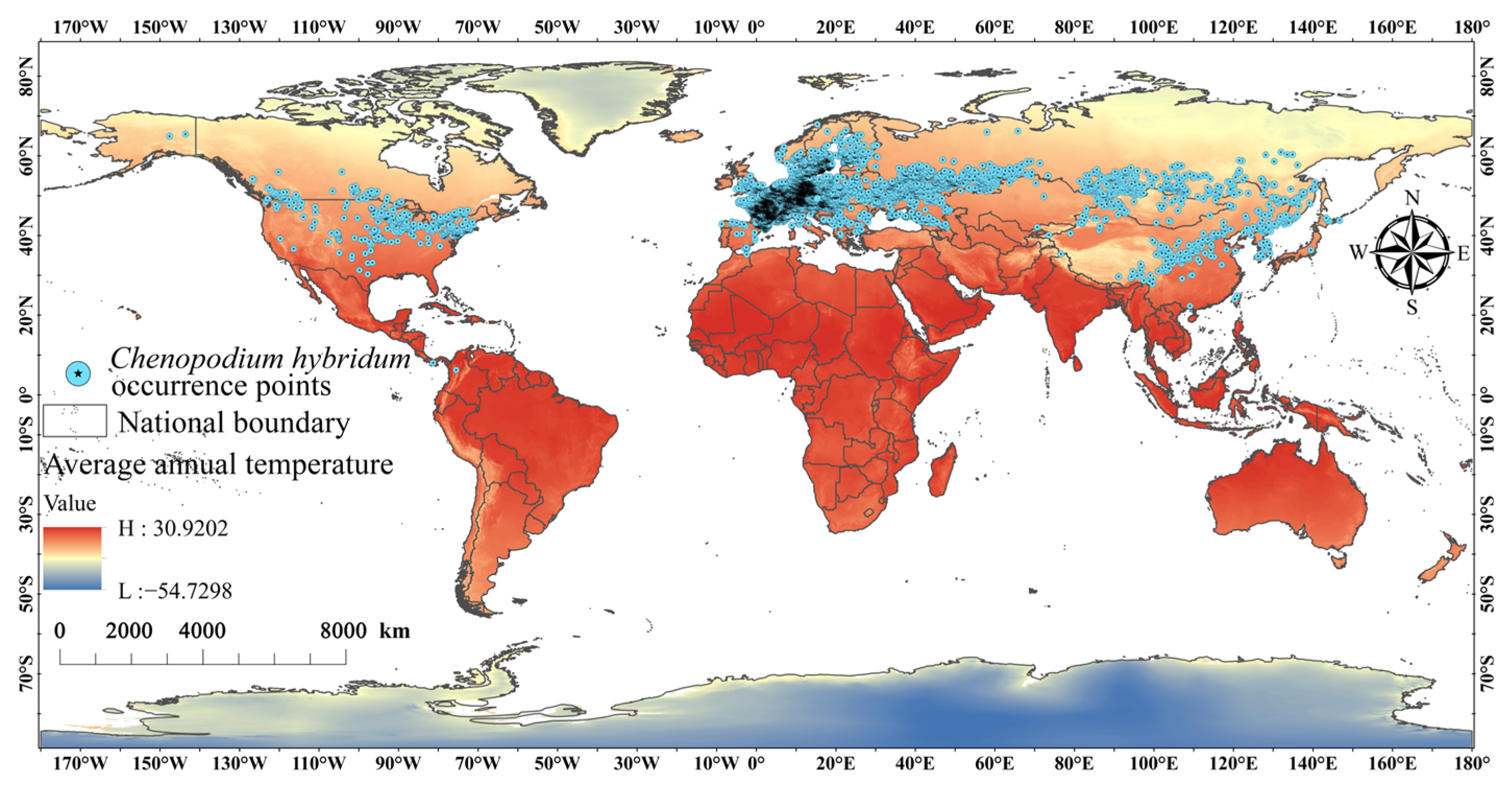
Geographic occurrence data for C. hybridum were retrieved from the Global Biodiversity Information Facility (GBIF) database [28,29], initially yielding a total of 25,539 raw records globally. To ensure data quality, a standardized preprocessing workflow was executed in ArcGIS Desktop 10.8 (ESRI, Redlands, CA, USA) [30]. First, occurrences located in non-terrestrial areas were eliminated to maintain spatial validity. Second, spatial thinning was conducted to remove duplicate records within each 2.5 arc-minute resolution grid cell, retaining only a single valid coordinate per cell. Finally, anomalous records with evident georeferencing errors were excluded. Following this multi-step quality control procedure, 10,701 valid global occurrence records were retained (Figure 1). Specifically within China, an initial set of 490 records was subjected to the aforementioned spatial thinning, ultimately yielding 192 spatially independent occurrence records for subsequent modeling.
Given that the core objective of this study is to evaluate the compound spatial association characteristics of anthropogenic disturbances and climate change at a specific regional scale, and to provide a scientific basis for the spatial planning and monitoring strategies of this ruderal weed, the model calibration area was restricted to the terrestrial boundaries of China. Consequently, only spatially independent occurrence records within China were utilized for regional model calibration. During model implementation, this study adhered to the standard MaxEnt modeling protocol. A random sampling approach was employed to randomly extract 5000 environmental grid cells within the defined terrestrial calibration area as background points. These points served to represent the environmental baseline of the study area for subsequent model training and evaluation. The base geographic maps of China utilized in this study were sourced from the Standard Map Service System of the Ministry of Natural Resources (http://bzdt.ch.mnr.gov.cn/, accessed on 30 December 2025), under map approval number GS(2024)0650.

2.2. Sources of Environmental Predictor Variables

To model the species distribution, a total of 59 environmental predictor variables were initially selected (Table S1), systematically categorized into four dimensions: bioclimatic variables, topography, soil properties, and anthropogenic impacts. Both current and future bioclimatic data were retrieved from the WorldClim database [31] (https://worldclim.org/) at a spatial resolution of 2.5 arc-minutes. For future climate projections, variables were derived from the BCC-CSM2-MR global climate model for two target periods—the 2050s (2041–2060) and the 2070s (2061–2080)—across four Shared Socioeconomic Pathways (SSPs): SSP126 (low-emission scenario), SSP245 (low-to-medium-emission scenario), SSP370 (medium-to-high-emission scenario), and SSP585 (high-emission scenario). Topographic data were acquired from the Geospatial Data Cloud (https://www.gscloud.cn/); digital elevation data were processed in ArcGIS Desktop 10.8 to generate three topographic variables: elevation, slope, and aspect. Soil data were obtained from the Harmonized World Soil Database (HWSD) [32]. Finally, to account for the spatial association with human activities, the Human Footprint (Hfp) index was incorporated into the model as an anthropogenic disturbance variable, utilizing the global Human Footprint dataset generated by Mu et al. [33].
Incorporating an excessive number of environmental variables can over-parameterize the ecological space, thereby compromising the predictive performance of the model. Consequently, a rigorous screening of the environmental predictors was executed. First, the Extract Multi Values to Points tool within ArcGIS Desktop 10.8 was utilized to extract the environmental data from the 59 candidate predictors corresponding to the occurrence records (Figure S1). Subsequently, Pearson correlation analysis was performed using the ENMTools package (version 1.1.2) in R. In conjunction with the Jackknife test for variable importance, predictors exhibiting a high correlation coefficient (|r| ≥ 0.8) and a low relative contribution to the model were eliminated [34]. Additionally, to mitigate the risk of model overfitting induced by multicollinearity, Variance Inflation Factor (VIF) analyses were conducted on the preliminarily selected variables, rigorously retaining only those with a VIF value of less than 10 [35]. Furthermore, prior to model integration, all topographic, soil, and Human Footprint raster layers were resampled in ArcGIS to a spatial resolution of 2.5 arc-minutes to ensure spatial congruence with the grid cell size of the bioclimatic variables. Ultimately, eight environmental predictors were selected for final modeling: Human Footprint (Hfp), slope (Slope), topsoil base saturation (Tbs), mean diurnal temperature range (Bio2), precipitation in the driest month (Bio14), elevation (Altitude), subsoil silt fraction (Ssilt), and precipitation seasonality (Bio15).

2.3. Model Optimization and Calibration

The MaxEnt model is known to be highly sensitive to sampling bias and susceptible to overfitting; relying solely on default parameter settings can introduce substantial uncertainty into the resulting predictions [36]. To mitigate this limitation, a systematic parameter tuning process was executed to enhance the predictive transferability of the model [37]. The regularization multiplier (RM) and feature combination (FC) are critical parameters dictating model complexity. In this study, the ENMeval package (version 2.0.0) within the R statistical environment (version 4.4.3; R Foundation for Statistical Computing, Vienna, Austria) was utilized to systematically calibrate these two parameters [23].
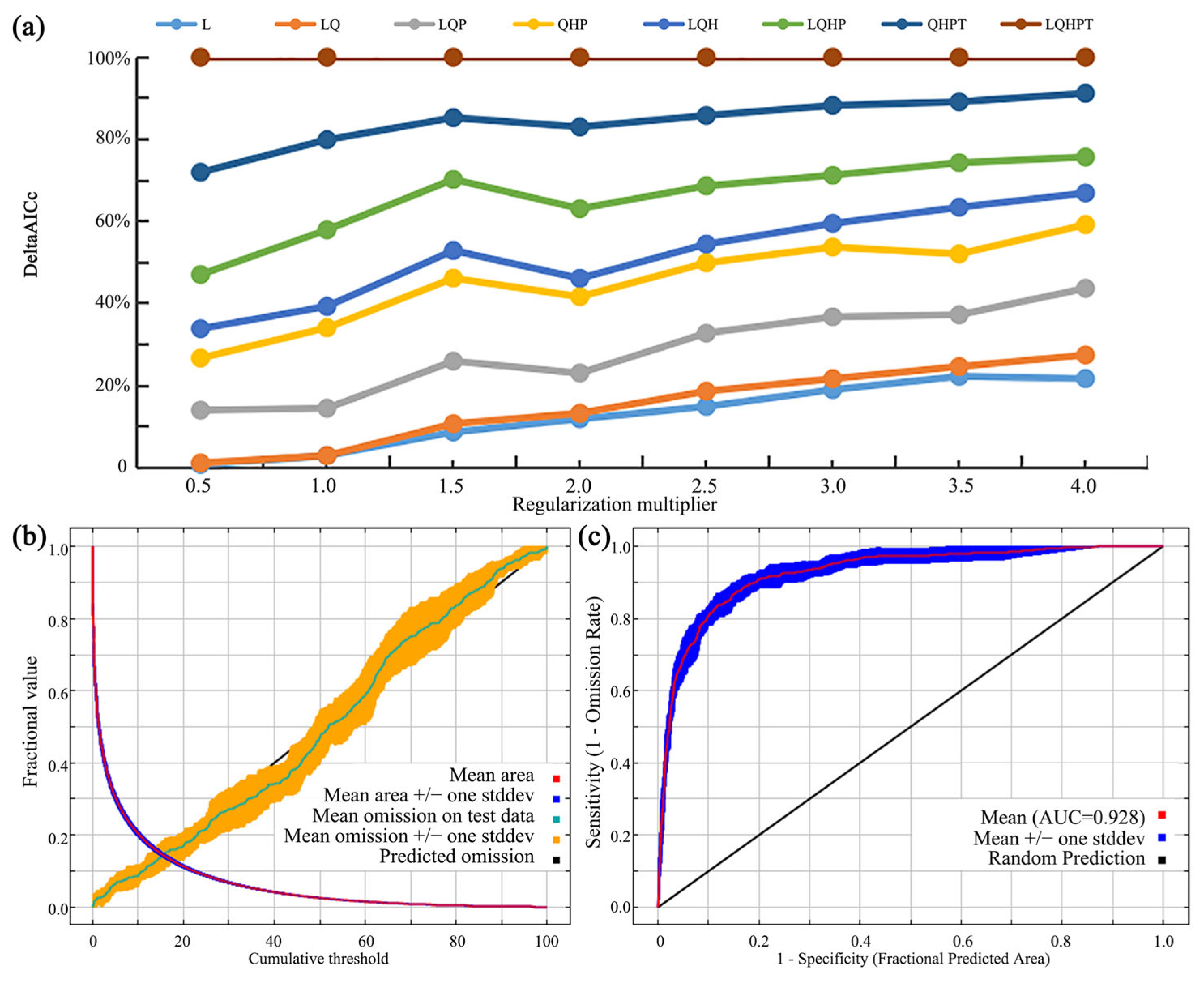
The RM was evaluated across eight values, ranging from 0.5 to 4.0 at increments of 0.5. Concurrently, eight distinct FC classes were assessed: L, LQ, LQH, LQHP, LQHPT, QHP, QHPT, and HPT. A full factorial design was implemented, yielding a total of 64 parameter combinations for model calibration and evaluation. To rigorously assess model performance and penalize over-complexity, the corrected Akaike Information Criterion (AICc) and the average difference between training and testing AUC values (avg.AUCDIFF) were employed [38,39]. Ultimately, the combination of RM = 0.5 and FC = LQ (linear and quadratic features) was identified as the optimal parameter setting (ΔAICc = 0, with an avg. AUCDIFF lower than that of the default model). The avg.AUCDIFF metric serves as a crucial indicator of the degree of model overfitting, where a lower value signifies stronger generalization capability.
During the execution of the MaxEnt model (version 3.4.4), the optimized regularization multiplier and feature combination were applied. Twenty-five percent of the occurrence records were randomly partitioned as the testing dataset [40]. The output format was specified as cloglog [22]. Ten replicate runs were conducted utilizing the subsample method [23], with a maximum of 5000 iterations. Furthermore, the Jackknife test for variable importance, the generation of response curves, and the ASCII (.asc) output format were enabled, while all remaining parameters were retained at their default settings.

2.4. Model Evaluation and Output Generation

The predictive performance of the MaxEnt model was evaluated utilizing the omission rate and the Area Under the Receiver Operating Characteristic Curve (AUC). A high degree of concordance between the testing omission rate and the theoretically expected omission rate signifies superior model accuracy. The AUC metric ranges from 0 to 1, with distinct intervals serving as standardized criteria for assessing predictive reliability. To avoid redundancy, model performance was classified into five standardized categories: unreliable (AUC ≤ 0.6), poor (0.6 < AUC ≤ 0.7), fair (0.7 < AUC ≤ 0.8), good (0.8 < AUC ≤ 0.9), and excellent (0.9 < AUC ≤ 1.0) [41].
The MaxEnt model automatically generated the average of the 10 replicate runs, yielding a continuous habitat suitability index ranging from 0 to 1. When delineating the binary distribution limits, preliminary analyses indicated that the traditional Lowest Presence Threshold (LPT) is highly sensitive to extreme outliers, frequently resulting in an overestimation of the suitable range (e.g., the erroneous inclusion of hyper-arid regions). Consequently, rather than adopting this conventional threshold, the Maximum Training Sensitivity plus Specificity (MTSS) threshold was employed. Statistically, MTSS optimizes the trade-off between omission and commission errors, serving as a robust and objective criterion for generating binary habitat suitability maps [42,43].
Following the extraction of the total suitable area utilizing the MTSS threshold, the Jenks Natural Breaks optimization algorithm was applied to hierarchically classify suitable habitats under the current environmental conditions, thereby effectively characterizing the spatial heterogeneity of habitat suitability. To establish a rigorous methodological foundation for spatiotemporal comparisons of suitable areas across diverse future climate scenarios, and to circumvent statistical artifacts induced by fluctuating classification thresholds, the classification nodes derived from the current scenario were extracted as fixed thresholds. These fixed thresholds were subsequently applied with strict uniformity to the suitability reclassification of all future projections. Specifically, all spatiotemporal scenarios were classified into four standardized categories based on this unified baseline: unsuitable, low suitability, moderate suitability, and high suitability habitats. Implementing this fixed baseline effectively minimizes statistical bias associated with dynamic classification criteria, thereby providing a more objective reflection of actual ecological suitability shifts in future habitats.

Spatial Dynamics and Habitat Turnover Rate Analysis

To quantitatively evaluate the magnitude of spatial restructuring within the suitable habitats of C. hybridum under projected climate change, we incorporated the Spatial Turnover Rate metric [44]. Utilizing the Raster Calculator in ArcGIS, binary habitat suitability layers for the baseline and specific future climate scenarios were spatially overlaid. This spatial operation delineated the discrete geographic areas of habitat expansion, contraction, and stability. The spatial turnover rate was computed using the following equation:
T u r n o v e r = E x p a n s i o n   +   C o n t r a c t i o n S t a b l e   +   E x p a n s i o n   +   C o n t r a c t i o n × 100 % .
This metric effectively quantifies the dynamism of spatial range reorganization across varying greenhouse gas emission scenarios. Consequently, a higher turnover rate signifies more drastic habitat shifts and geographic displacement for the species under a given climatic trajectory.

3. Results

3.1. Model Performance Evaluation and Primary Environmental Predictors

The results of model optimization and performance evaluation revealed that the combination of a regularization multiplier (RM) of 0.5 and the LQ (linear and quadratic) feature combination yielded a delta corrected Akaike Information Criterion (ΔAICc) of 0. Furthermore, the average difference between the training and testing AUC (avg.AUCDIFF) was lower than that of the default model. This indicates that the optimized parameters effectively mitigated model complexity and the risk of overfitting. Under these optimized settings, the testing omission rate of the MaxEnt model closely aligned with the theoretically expected values. Under current climatic conditions, the model yielded an AUC value of 0.928, demonstrating excellent predictive performance (0.9 < AUC ≤ 1.0) (Figure 2).
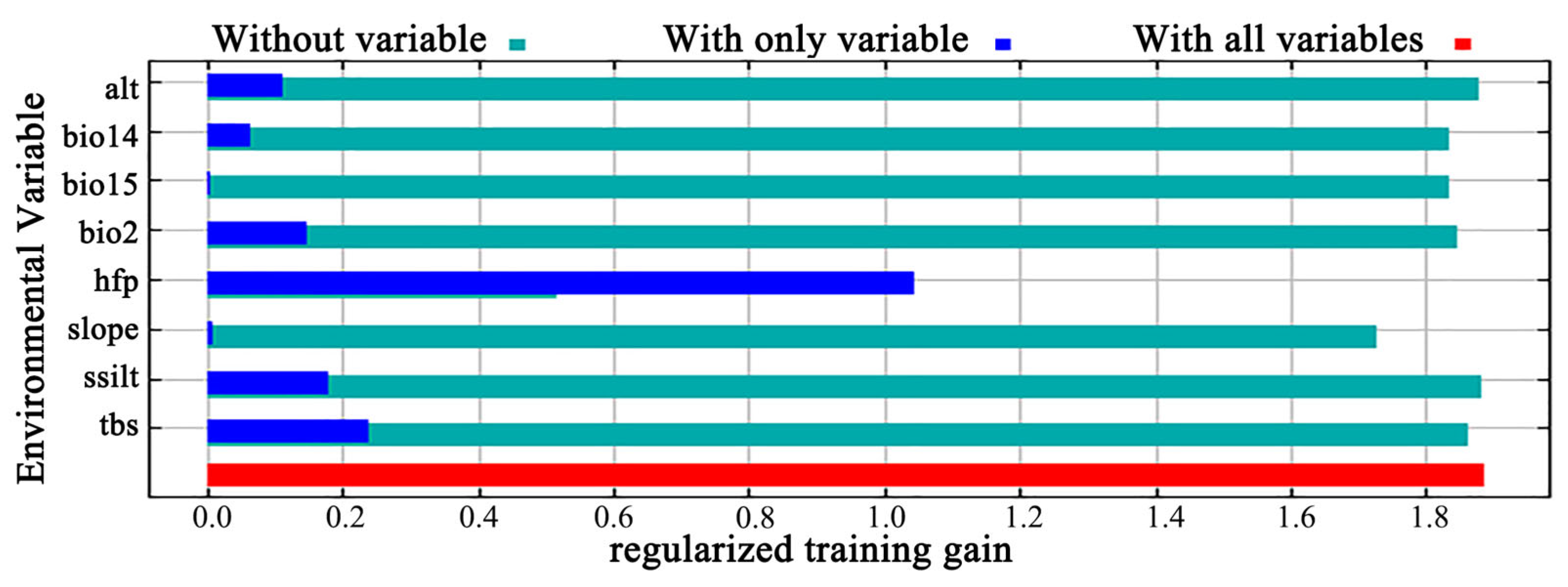
Following the establishment of the optimal model parameters, the Jackknife test and variable importance assessments identified the key environmental predictors strongly associated with the spatial distribution of C. hybridum (Figure 3). The analyses indicated that the Human Footprint (Hfp) exhibited the most prominent contribution, ranking first in both relative contribution (58.4%) and permutation importance (64.7%)—significantly surpassing any single natural geographic factor (Table 1). Topographic, edaphic, and bioclimatic factors followed, with slope (Slope, 11.1%), topsoil base saturation (Tbs, 10.4%), and precipitation in the driest month (Bio14, 4.4%) collectively manifesting secondary spatial associations.
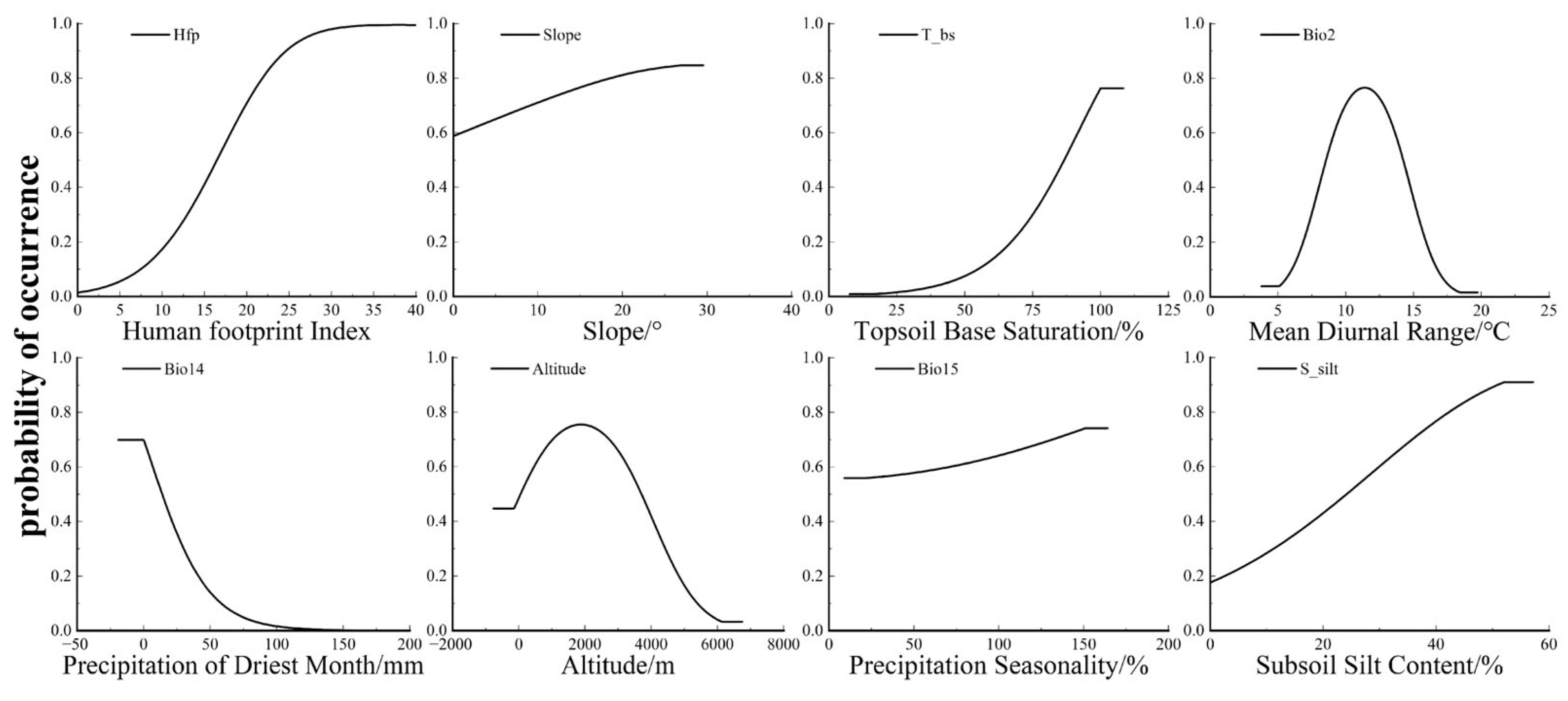
Response curves further elucidate the environmental tolerance thresholds and ecological preferences of C. hybridum (Figure 4). Notably, the probability of occurrence for C. hybridum peaks when the precipitation in the driest month (Bio14) is below 10 mm, subsequently declining sharply with increasing precipitation. This observation not only reflects its broad environmental tolerance to arid habitats but also suggests that abundant moisture conditions may, conversely, act as a limiting factor for its population expansion. Furthermore, its optimal slope is concentrated in gently undulating terrains (Slope < 22°), and it exhibits a pronounced preference for high topsoil base saturation (Tbs 87–100%). Given the prominent contribution of the Human Footprint (Hfp)—where the probability of occurrence rises significantly at Hfp > 18—it is evident that C. hybridum exhibits a high degree of spatial congruence with anthropogenically modified, flat, nutrient-enriched, yet intermittently water-deficient disturbed habitats (e.g., agricultural margins, roadside drainage ditches, and degraded pastures). Consequently, these regions constitute its highly suitable potential habitats.

3.2. Spatial Distribution Characteristics and Potential Suitable Habitats Under Current Environmental Conditions

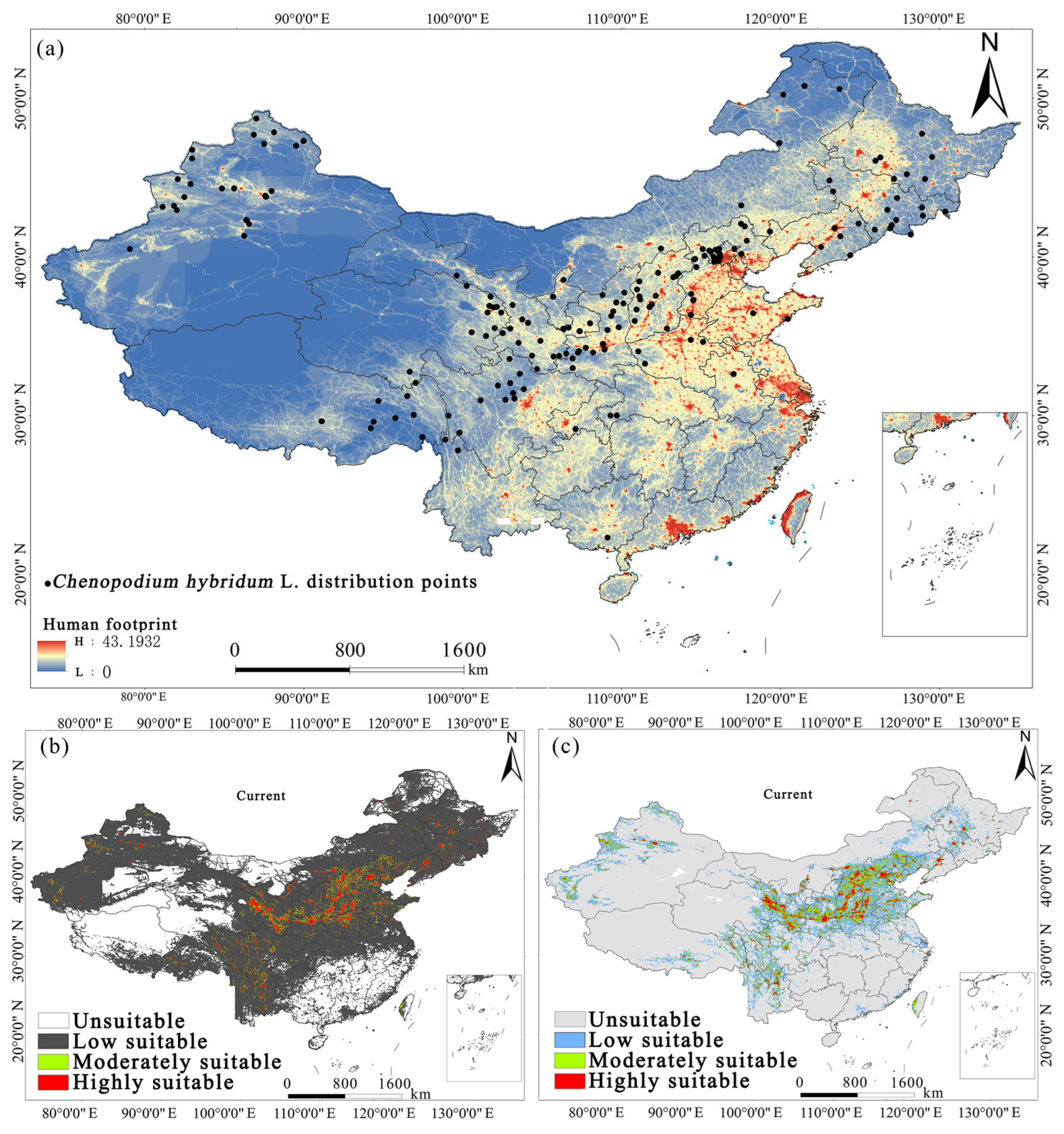
A total of 192 valid occurrence records of C. hybridum were utilized in China. Its spatial distribution pattern exhibited a high degree of spatial congruence with the Human Footprint (Hfp) (Figure 5a). The Jackknife test for variable importance revealed that the relative contribution of Hfp was 58.4%, indicating a substantial spatial overlap between anthropogenically disturbed areas and the current core distribution of the species. For instance, both highly suitable habitats and actual occurrences of C. hybridum were documented in geographically isolated regions of northwestern Xinjiang, as well as in the high-altitude Nyingchi region of Tibet (along National Highway 318).
When delineating the boundaries of potential suitable habitats, this study compared manual thresholding with the Jenks Natural Breaks classification. Preliminary analyses demonstrated that manual classification erroneously categorized hyper-arid regions that fail to meet the basic ecological requirements of C. hybridum (e.g., the western margins of the Taklamakan Desert) as low-suitability habitats (Figure 5b). In contrast, the Jenks Natural Breaks algorithm more objectively characterizes the spatial heterogeneity of habitat suitability (Figure 5c); consequently, this method was adopted for all subsequent suitability classifications in this study.
Based on the MTSS threshold and the Jenks Natural Breaks classification (specific fixed thresholds delineating each suitability class are detailed in Table S2, Supplementary Materials), under current environmental conditions, the total suitable habitat for C. hybridum in China covers approximately 205.59 × 10⁴ km2, accounting for roughly 21.0% of the national terrestrial area. In terms of spatial distribution, the suitable habitats form a core distribution centered across the North China Plain, the Loess Plateau, and southwestern China, exhibiting a fragmented radiation pattern toward the northeast and northwest. Specifically, high suitability areas are spatially restricted and dispersed (approximately 23.19 × 10⁴ km2), predominantly aggregated around Beijing, Shanxi, central Shaanxi and Gansu, and central-western Sichuan; moderate suitability areas (49.95 × 10⁴ km2) typically encircle the high suitability habitats, encompassing northern Hebei, southeastern Inner Mongolia, northwestern Ningxia, and eastern Qinghai; conversely, low suitability areas (132.45 × 10⁴ km2) exhibit the most extensive distribution, constituting the bulk of the potential suitable range, primarily situated within the agropastoral ecotones of central-western Shandong, southeastern Jiangsu, and central-northern Gansu.

3.3. Spatiotemporal Dynamics and Spatial Shifts of Potential Suitable Habitats Under Future Climate Scenarios

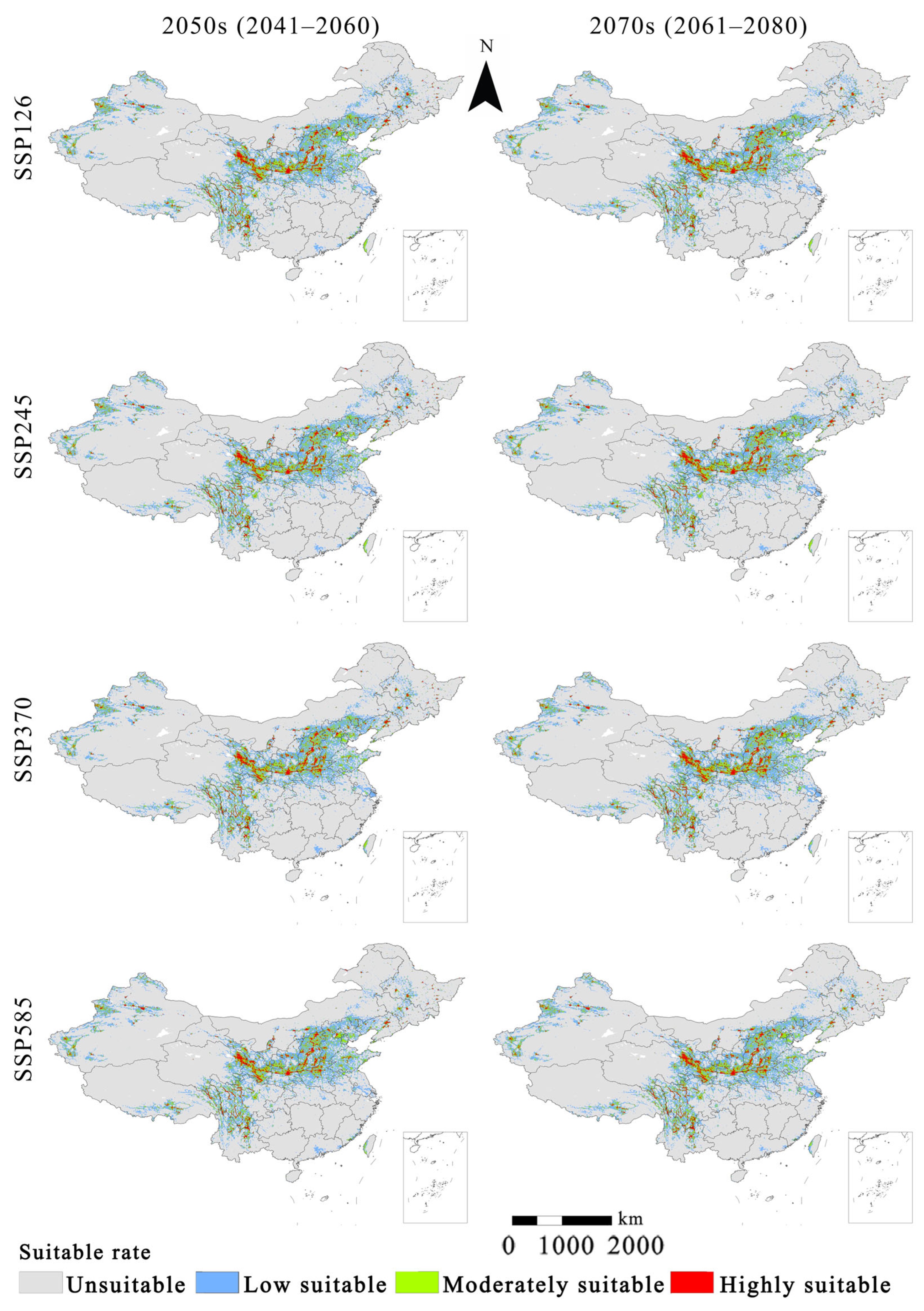
Compared to current environmental conditions, and strictly adhering to the unified classification threshold baseline, the total potential suitable area for C. hybridum exhibited fluctuations across diverse future climate scenarios (Figure 6). Specifically, under the SSP126-2050s and SSP370-2070s scenarios, the total suitable area experienced minor expansions, yielding net increments of 2.36 × 10⁴ km2 and 0.47 × 10⁴ km2, respectively (Table 2). Conversely, under the SSP585-2050s scenario, the total suitable area underwent the most pronounced contraction, decreasing by 12.65 × 10⁴ km2. Regarding the internal hierarchical composition of the suitable habitats, the high suitability areas demonstrated a consistent contraction trend across all future climate scenarios and time periods, with net reductions ranging from 2.62 × 10⁴ to 5.37 × 10⁴ km2; notably, no spatial expansion was observed within this category.
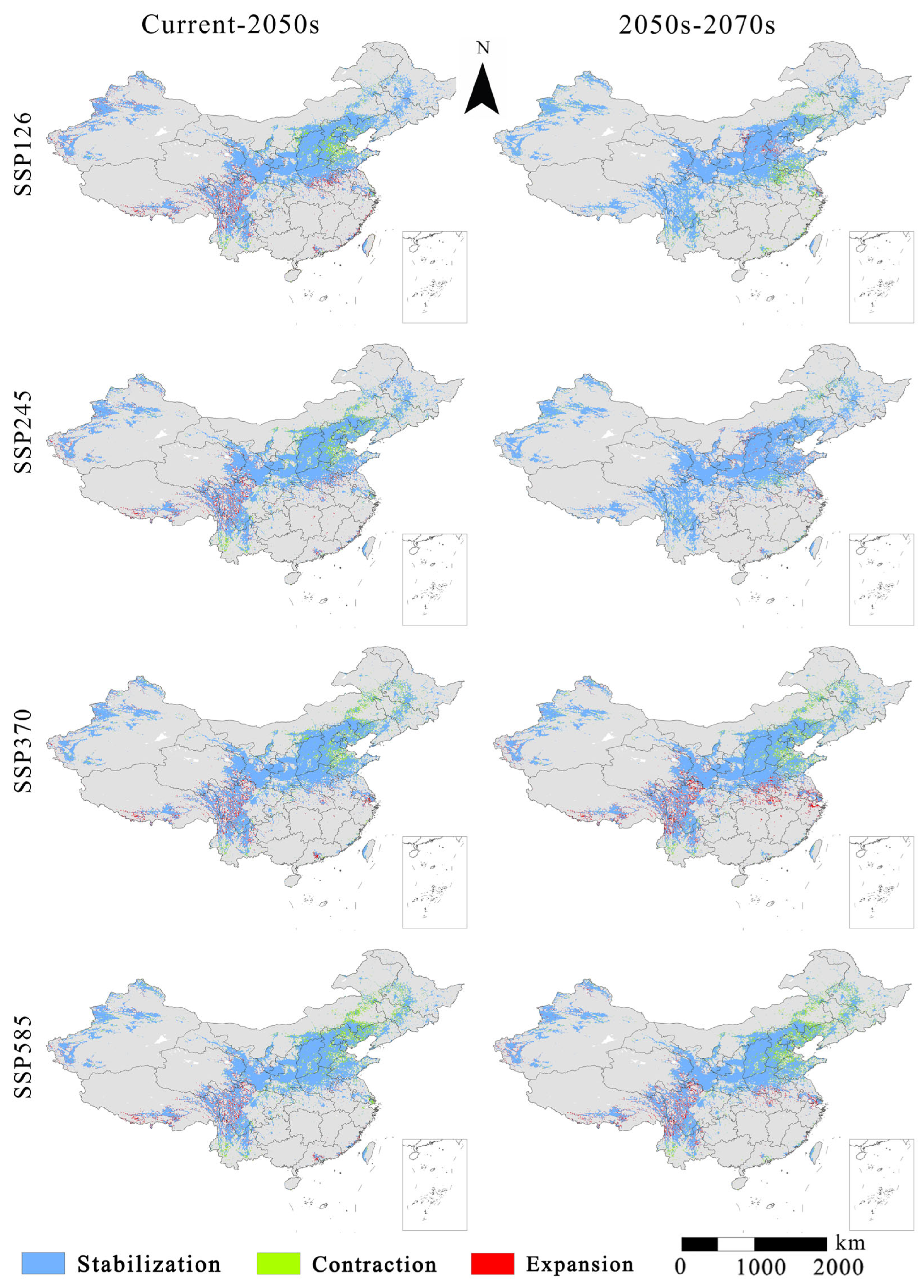
Regarding spatial shift patterns, the expansion and contraction of potential suitable habitats exhibited distinct variations across different time periods and emission scenarios (Figure 7). Relative to the current baseline, the expansion of potential habitats for C. hybridum during the 2050s was primarily concentrated under the SSP126 scenario (an addition of 15.36 × 10⁴ km2); geographically, this expansion was predominantly situated along the northwestern and southwestern margins of its current distribution. Conversely, habitat contraction during this period was most pronounced under the SSP585 scenario (amounting to 22.14 × 10⁴ km2), occurring primarily within historical core distribution areas such as the North China Plain. Advancing into the 2070s (relative to the 2050s), the scenarios corresponding to the extremes of these spatial shifts transitioned: the peak of habitat expansion shifted to the SSP370 scenario (a gain of 17.95 × 10⁴ km2), whereas the maximum habitat contraction remained consistently under the SSP585 scenario (a loss of 22.37 × 10⁴ km2).
Spatial turnover analysis further quantified the magnitude of dynamic reorganization within the suitable habitat patches of C. hybridum under climate change (Table 3). During the 2050s, the spatial turnover rates across the various SSP scenarios exhibited minimal variation, ranging from 12.67% to 14.85%. Advancing into the 2070s (relative to the 2050s), spatial reorganization across different emission pathways demonstrated quantitative divergence: under the lower-emission scenarios (SSP126 and SSP245), spatial turnover rates declined to 8.56% and 5.23%, respectively; conversely, under the higher-emission scenarios (SSP370 and SSP585), turnover rates persisted at elevated levels of 15.74% and 16.23%.

3.4. Migration Trajectories of the Distribution Centroids Within Potential Suitable Habitats

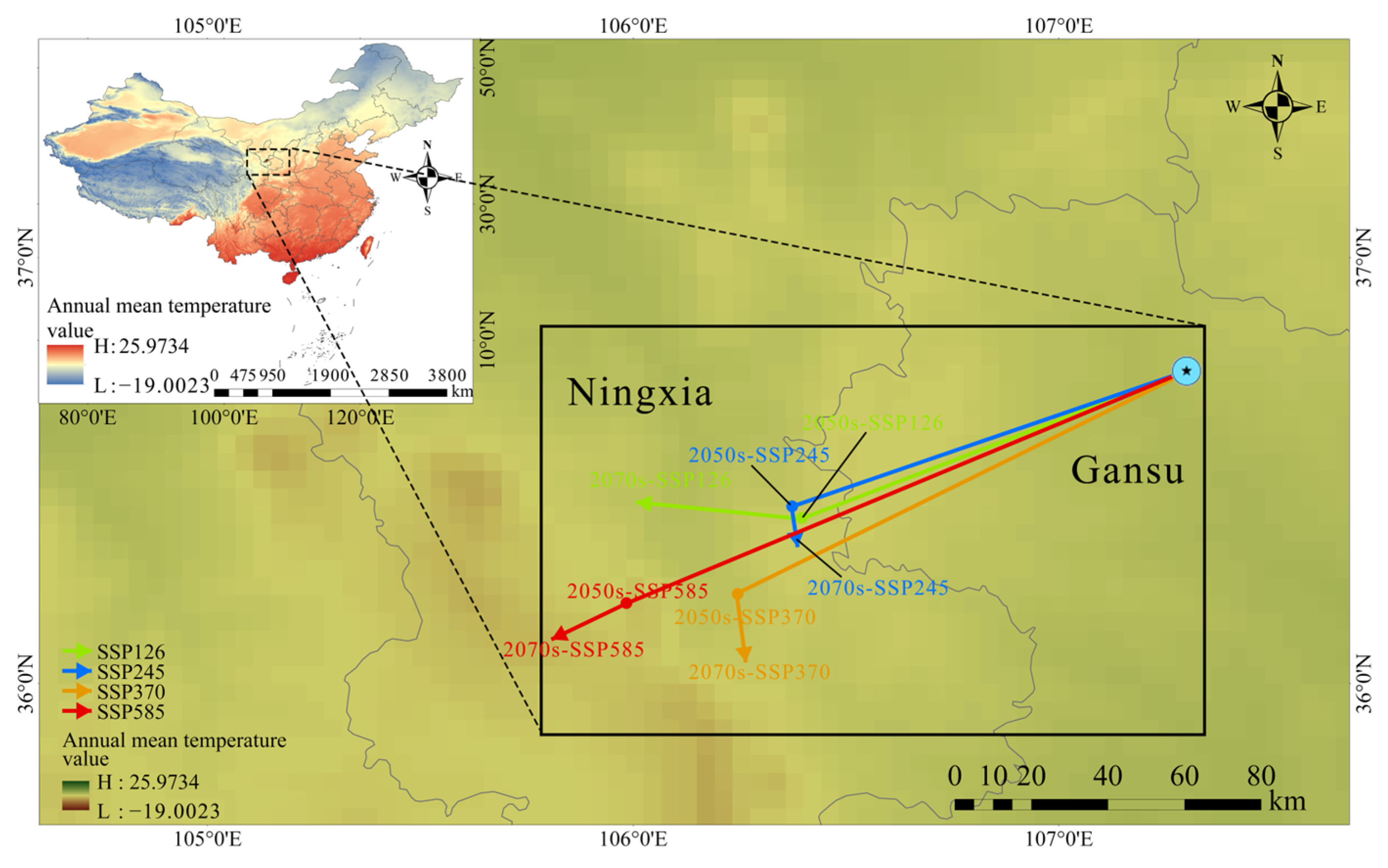
Centroid migration analysis quantified the spatial evolutionary trajectories of the geographic centroids for the potential suitable habitats of C. hybridum across different future climate scenarios (Figure 8). Under the current environmental baseline, the geographic centroid of the potential suitable habitat was located in eastern Gansu Province (107.32° E, 36.74° N) (Table 4). Advancing into the 2050s (relative to the current baseline), the centroids of the potential suitable habitats consistently shifted southwestward (toward central-southern Ningxia) across all SSP scenarios, with linear migration distances ranging from 91.4 km (SSP126) to 134.6 km (SSP585).
By the 2070s (relative to the 2050s), the migration distances and directions of the centroids exhibited distinct shifts compared to the preceding period. The overall migration distances contracted, ranging from 10.6 km to 34.9 km. Regarding migration directions, spatial divergences emerged across the different emission pathways: under the SSP126 and SSP585 scenarios, the centroids migrated northwestward and southwestward, respectively; conversely, under the SSP245 and SSP370 scenarios, the centroids migrated southeastward.

4. Discussion

4.1. Model Reliability and Predominant Environmental Constraints

By systematically optimizing the parameters of the MaxEnt model (RM = 0.5, FC = LQ), this study not only precisely delineated the potential suitable habitats for C. hybridum in China (AUC = 0.928) but also demonstrated that the resulting spatial patterns align robustly with the core hypotheses posited in the Introduction: (i) relative to natural bioclimatic and topographic factors, high-intensity anthropogenic disturbances (Human Footprint, Hfp) exhibit a more pronounced spatial association with the current distribution pattern of C. hybridum; and (ii) under future climate change scenarios, the spatial evolutionary trajectories of the potential suitable habitats exhibit a high degree of spatial congruence with existing anthropogenic activity corridors in northwestern and southwestern China, indicating an escalated potential risk of its expansion into ecologically fragile high-altitude regions.
The Human Footprint (Hfp) was identified as the primary environmental predictor closely associated with the distribution of C. hybridum (relative contribution: 58.4%; permutation importance: 64.7%). Its prominence significantly surpassed that of bioclimatic and topographic variables, indicating a high degree of spatial congruence between anthropogenic activities and the cross-regional dispersal of this species [24]. As revealed by the current distribution model (Section 3.2), highly suitable habitats and actual occurrence records of C. hybridum persist in hyper-arid regions deep within the interior of Xinjiang and in high-altitude plateau areas such as Nyingchi, Tibet, despite harsh natural climatic conditions. This suggests that frequent anthropogenic disturbances and logistical transportation along major arterial routes, such as National Highway 318, may have provided potential dispersal corridors for the species to overcome natural geographic barriers [45]. Although precipitation in the driest month (Bio14, 0–10 mm), slope (Slope, 0–22°), and topsoil base saturation (Tbs, 87–100%) exhibited secondary negative spatial associations, anthropogenically disturbed areas (Hfp > 18) offered alternative habitats, thereby corroborating the species’ broad environmental tolerance to arid and nutrient-poor conditions.
Synthesizing the existing literature, C. hybridum, as a ruderal weed exhibiting r-selected life history traits, possesses substantial reproductive potential and broad environmental tolerance [46,47]. Within this context, high-intensity anthropogenic activities along major arterial routes (e.g., National Highway 318) and within agropastoral ecotones—such as road expansion, agricultural reclamation, and high-frequency grazing—serve as direct vectors, facilitating its dispersal across natural geographic barriers via vehicular attachment and logistical transport [48]. Furthermore, macroecological research indicates that intense anthropogenic disturbances frequently alter the physical structure of localized habitats (e.g., generating bare soil patches), which theoretically provides favorable secondary environments for the colonization of disturbance-dependent weeds [26,49]. The spatial pattern of such anthropogenic disturbances aligns robustly with the pronounced dependence of C. hybridum on human activities, thereby elucidating, from a spatial perspective, why this species maintains high habitat suitability within climatically suboptimal inland hyper-arid regions.

4.2. Distributional Analysis of Potential Suitable Habitats for C. hybridum in China

Under current environmental conditions, the potential suitable habitats for C. hybridum in China (205.59 × 10⁴ km2) are primarily centered across the North China Plain, the Loess Plateau, the northern Yunnan-Guizhou Plateau, and regions within northeastern and northwestern China. The core patches of the currently predicted suitable habitats exhibit a high degree of spatial congruence with the known high-density occurrence areas of the species. Coupled with the high AUC value and low omission rate, this alignment substantiates the reliability of the model in fitting the current environmental baseline. Specifically, high suitability areas (2.42%) are spatially fragmented, predominantly distributed around Beijing, Shanxi, Shaanxi, and central Gansu, as well as interspersed across northeastern, northwestern, and southwestern China.
Under future climate scenarios, strictly adhering to the unified classification threshold baseline, the total potential suitable area exhibited nonlinear fluctuations (e.g., a minor expansion of 2.36 × 10⁴ km2 under SSP126-2050s, contrasted by a pronounced contraction of 12.65 × 10⁴ km2 under SSP585-2050s). However, the high suitability areas demonstrated a continuous contraction across all projected scenarios (with net reductions ranging from 2.62 × 10⁴ to 5.37 × 10⁴ km2). Synthesizing the relevant literature, this persistent decline may be associated with soil moisture threshold mismatches induced by the increasing frequency of extreme drought events [50]. Under higher-emission pathways (e.g., SSP370 and SSP585), the spatial turnover rates of C. hybridum persisted at elevated levels of 15.74% to 16.23% during the 2070s. This phenomenon suggests that, despite the broad environmental tolerance of C. hybridum, the compound effects of extreme climatic events (e.g., persistent anomalous heatwaves and severe droughts) may approach or surpass its potential environmental tolerance thresholds within these regions [51,52]. From the perspective of macroecological niche dynamics, when shifts in key environmental predictors—such as the precipitation in the driest month—deviate from their optimal ranges, the historical core distribution areas of the species across the North China Plain and the Loess Plateau may face a heightened risk of declining suitability, manifested as a pronounced degradation of high suitability habitats. Concurrently, the expansion of marginal habitats into regions such as northwestern Xinjiang (e.g., the western margins of the Taklamakan Desert), southern Tibet (the Yarlung Tsangpo River Valley), and central-western Sichuan further substantiates the spatial characteristic of this species: shifting its spatial distribution to respond to the aridification pressures within its original habitats [53,54,55]. The contraction of high suitability areas may precipitate the fragmentation of its core habitat patches, whereas its expansion into novel regions could theoretically amplify niche overlap with native plant communities in these newly colonized areas.
The distributional centroid migrated from eastern Gansu Province (107.32° E, 36.74° N) toward central-southern Ningxia (achieving a maximum linear displacement of 134.6 km under the SSP585-2050s scenario). This migration trajectory not only exhibits spatial congruence with shifts in hydrothermal suitability at the destination but also demonstrates extensive overlap with agricultural and pastoral development zones, reflecting a potential underlying association with anthropogenic activities. Specifically, the environmental characteristics of the migration terminus correspond to the optimal ecological thresholds of the species concerning the precipitation in the driest month (Bio14 < 10 mm) and topsoil base saturation (Tbs > 87%). Furthermore, the spatial congruence between the migration corridor (eastern Gansu to central-southern Ningxia) and the local agropastoral ecotones further corroborates prior inferences in the literature suggesting that agricultural exploitation and grazing activities may generate disturbed habitats which are conducive to the dispersal of C. hybridum.

4.3. Uncertainties and Limitations of the Model

Although this study significantly enhanced the predictive accuracy of the model through rigorous parameter optimization, the reliance on certain static environmental predictors may still introduce inherent uncertainties when projecting macro-scale suitable habitats into the future. When evaluating the 2050s and 2070s scenarios, this study integrated dynamic CMIP6 future climate layers while retaining the current baselines for edaphic properties and the Human Footprint (Hfp). Given that soil physicochemical properties exhibit relative stability over decadal timescales, incorporating them as static predictors is a standard convention in current large-scale species distribution modeling (SDMs) [56,57]. However, because Hfp is currently the environmental predictor exhibiting the most pronounced spatial association with the distribution of C. hybridum, treating it as relatively static represents an idealized baseline assumption.
It is imperative to note that the primary scientific value of depicting future shifts in suitable habitats within this study lies in quantification; that is, determining the patterns of potential niche shifts and spatial reorganization of the species in response to future climate evolution (e.g., drastic alterations in temperature and precipitation regimes), while controlling for a constant level of anthropogenic disturbance in existing habitats. In reality, the divergence of socioeconomic pathways and land-use changes across different SSP scenarios inevitably precipitate spatial reconfiguration of the Human Footprint [58]. Consequently, future research should endeavor to integrate dynamic, high-spatiotemporal-resolution Land Use and Land Cover Change (LUCC) data with transportation network dynamics, thereby enabling more precise projections of the spatial evolutionary patterns of this species under compound scenarios of climate change and anthropogenic activities.
Certain methodological limitations and constraints regarding result interpretation remain. First, concerning model performance evaluation, this study currently relies predominantly on the AUC and omission rate derived from a conventional random 75%/25% data partition. Given the potential for spatial autocorrelation among occurrence records, this conventional partitioning approach may lead to overestimation of the model’s predictive performance. Future studies should incorporate spatial block cross-validation and supplement the analysis with multiple evaluation metrics—such as partial ROC, the Boyce index, the True Skill Statistic (TSS), and the omission rate on independent spatial blocks—to more robustly assess the biological realism of the models.
Second, although this study employed the Jackknife test as a sensitivity analysis to evaluate model gain with and without the Human Footprint (Hfp) predictor, relying solely on spatial rarefaction cannot completely eliminate the spatial sampling bias inherent in open-access occurrence data. Considering that the fundamental niche of C. hybridum, as a ruderal weed, inherently exhibits extensive spatial congruence with anthropogenic activity zones, this sampling bias may have amplified the relative contribution of Hfp within the models, to some extent. Consequently, the current models primarily elucidate that the distribution is strongly associated with environmental predictors rather than proving the actual mechanisms of dispersal. Future research must incorporate strategies such as spatial bias files or target-group background approaches to further disentangle these confounding effects. Finally, the Hfp utilized in this study was a static predictor and was not dynamically temporally synchronized with future climate scenarios; this limitation may yield somewhat conservative projections regarding the spatial impacts of future anthropogenic activity shifts.

4.4. Potential Threats to Native Ecosystems and Alpine Protected Areas

By integrating the evolutionary dynamics of future suitable habitats with centroid migration trajectories, this study elucidates a noteworthy spatial shift: under future climate change, the potential suitable habitats of C. hybridum exhibit a pronounced expansion trend toward high-elevation or high-latitude regions, such as the southeastern Tibetan Plateau (e.g., Nyingchi and the middle Yarlung Tsangpo River Valley in Tibet), the mountainous areas of western Sichuan, and northwestern Xinjiang. This spatial shift toward higher elevations and latitudes is temporally congruent with the increasing aridification trend within its central and eastern core distribution areas [59], indicating a potential risk of colonization within the fragile alpine ecosystems of western China [60]. Southeastern Tibet and the western Sichuan Plateau constitute critical biodiversity hotspots in China [61]. Unlike native alpine flora, expanding weeds such as C. hybridum may encounter distinct competitive niche dynamics within these regions [62]. Synthesizing the relevant literature, the potential spatial expansion of this species could be accompanied by complex microecological interactions. Theoretically, these could involve allelopathic effects [16] and intricate interactions with the rhizosphere soil microbiome [63] and the symbiotic mycorrhizal fungi of native plants [64]. This potential metabolite–microbiome–soil–plant cascade may exhibit increasingly complex dynamic characteristics under the compound scenarios of elevated atmospheric nitrogen deposition and global climate change.
To address the potential expansion of suitable habitats for C. hybridum, this study proposes a targeted three-tiered spatial management and monitoring framework as a preliminary reference. First, given the pronounced spatial association with the Human Footprint, intensifying regulatory oversight and phytosanitary measures along major transportation hubs and agricultural logistical corridors is imperative to constrain its long-distance dispersal via anthropogenically mediated pathways. Second, within high suitability core areas, management strategies could explore ecological substitution mechanisms, such as integrating adapted cover cropping systems into disturbed habitats. By occupying vacant ecological niches through spatial competition, these systems could theoretically attenuate the colonization probability of opportunistic weeds [65,66]. Finally, targeted at high-elevation frontier regions (e.g., Tibet and Xinjiang) where potential suitable habitats are projected to expand, establishing early warning and monitoring networks along anthropogenic disturbance corridors as potential management priority areas is of paramount importance.
It must be emphasized that this study relies on macroecological niche modeling and does not incorporate direct quantification of the aforementioned micro-biogeochemical parameters. Consequently, microecological interaction mechanisms—such as allelopathic effects and potential impacts on the soil microbiome—are strictly posited herein as theoretical hypotheses derived from the existing literature. Future research must empirically validate these proposed mechanisms through independent controlled field experiments coupled with metagenomic sequencing analyses. Concurrently, in the absence of independent field validation, the current projections of suitable habitats within marginal regions (e.g., Tibet and Xinjiang) must be objectively interpreted as spatial hypotheses for early monitoring. Executing systematic field surveys within these critical alpine regions constitutes an indispensable avenue for future research to substantiate model projections and optimize spatial management frameworks.

5. Conclusions

By constructing an optimized MaxEnt model, this study indicates a pronounced spatial association between anthropogenic disturbances (the Human Footprint) and the macro-spatial distribution of C. hybridum. Strictly adhering to the unified classification threshold baseline, future climate scenario projections reveal that the potential high suitability areas for this species exhibit a consistent contraction trend across all spatiotemporal scenarios; conversely, marginal suitable habitats demonstrate a spatial dynamic of expansion toward the northwestern inland arid regions and southwestern alpine regions. Accordingly, the distributional centroids of the potential suitable habitats exhibited a consistent, long-distance southwestward migration (toward central-southern Ningxia) during the 2050s, with linear migration distances ranging from 91.4 km to 134.6 km. Advancing into the 2070s, these migration trajectories transitioned into localized directional fluctuations.
Based on the spatial projection results and centroid migration trajectories, this study recommends establishing a three-tiered spatial management framework encompassing regulatory oversight, ecological management within core areas, and early warning systems in frontier regions. Specifically, given the pronounced spatial association between anthropogenic activities and the distribution of C. hybridum, the centroid migration corridor (from eastern Gansu Province to central-southern Ningxia) alongside key transportation networks (e.g., major national arterial routes and logistical hubs) should be prioritized as potential management priority areas to constrain the passive dispersal of the species. Implementing stringent phytosanitary measures and transport regulations at these critical nodes will aid in mitigating the risk of long-distance leapfrog dispersal mediated by anthropogenic transport. In conclusion, while continuously monitoring population dynamics within the existing core suitable habitats (e.g., the North China Plain and the Loess Plateau), it is imperative to proactively establish early warning and monitoring networks directed at potential future high-elevation expansion regions (e.g., southwestern China, southeastern Tibet, and northwestern Xinjiang).

Supplementary Materials

The following supporting information can be downloaded at: https://www.mdpi.com/article/10.3390/d18060333/s1, Table S1: Descriptions and units of the 59 candidate environmental predictors initially compiled for the ecological niche modeling of C. hybridum; Figure S1: Pearson correlation matrix of the 59 candidate environmental predictors; Table S2: Classification thresholds for the potential suitable habitats of C. hybridum.

Author Contributions

L.T. and Z.W. made equal contributions to this work: Writing—original draft, Data curation, Conceptualization. W.H.: Writing—review and editing, Resources, Formal analysis, Conceptualization. M.H.: Writing—review and editing, Formal analysis, Conceptualization. S.L.: Visualization, Validation, Investigation. Y.H.: Visualization, Software. G.Z.: Visualization, Supervision. Y.Y.: Supervision, Project administration. All authors have read and agreed to the published version of the manuscript.

Funding

This research was funded by the Science and Technology Department of Xizang Autonomous Region, grant numbers XZ202401ZY0032, XZ202401ZY0074, XZ202501ZY0086, and RKZ2024ZYYDDFXM-02; the Science and Technology Bureau of Nyingchi City, grant number 2023-XYQ-006; and Xizang Agricultural and Animal Husbandry University, grant numbers YJSXY202601, YJSXY202606, YJSJD202602, 533325001, and 53013001804. The APC was funded by grant numbers XZ202401ZY0032, XZ202401ZY0074, XZ202501ZY0086, and RKZ2024ZYYDDFXM-02.

Institutional Review Board Statement

Not applicable.

Data Availability Statement

The data presented in this study are openly available in public repositories. Occurrence records of Chenopodium hybridum were obtained from the Global Biodiversity Information Facility (GBIF) [29] at https://www.gbif.org. Baseline and future macroclimatic data are available from the WorldClim database at https://worldclim.org. Topographic data were acquired from the Geospatial Data Cloud at https://www.gscloud.cn. Edaphic data were extracted from the Harmonized World Soil Database (HWSD). The human footprint (Hfp) dataset is publicly available as described in the reference by Mu et al. (2022) [33].

Conflicts of Interest

The authors declare no conflicts of interest. The funders had no role in the design of the study; in the collection, analyses, or interpretation of data; in the writing of the manuscript; or in the decision to publish the results.

Abbreviations

The following abbreviations are used in this manuscript:
AICcCorrected Akaike Information Criterion
AUCArea Under the Receiver Operating Characteristic Curve
CMIP6Coupled Model Intercomparison Project Phase 6
DEMDigital Elevation Model
FCFeature Combination
GBIFGlobal Biodiversity Information Facility
GCMGlobal Climate Model
HfpHuman Footprint
HWSDHarmonized World Soil Database
LPTLowest Presence Threshold
LUCCLand Use and Land Cover Change
MaxEntMaximum Entropy
MTSSMaximum Training Sensitivity plus Specificity
RMRegularization Multiplier
ROCReceiver Operating Characteristic
SDMsSpecies Distribution Models
SSPShared Socioeconomic Pathway
TSSTrue Skill Statistic
VIFVariance Inflation Factor
WorldClimWorld Climate Database

References

  1. Robinson, T.B.; Martin, N.; Loureiro, T.G.; Matikinca, P.; Robertson, M.P. Double Trouble: The Implications of Climate Change for Biological Invasions. NeoBiota 2020, 62, 463–487. [Google Scholar] [CrossRef]
  2. Wesselmann, M.; Apostolaki, E.T.; Anton, A. Species Range Shifts, Biological Invasions and Ocean Warming. Mar. Ecol. Prog. Ser. 2024, 728, 81–83. [Google Scholar] [CrossRef]
  3. Briscoe Runquist, R.D.; Lake, T.A.; Moeller, D.A. Improving Predictions of Range Expansion for Invasive Species Using Joint Species Distribution Models and Surrogate Co-occurring Species. J. Biogeogr. 2021, 48, 1693–1705. [Google Scholar] [CrossRef]
  4. Ni, M.; Deane, D.C.; Li, S.; Wu, Y.; Sui, X.; Xu, H.; Chu, C.; He, F.; Fang, S. Invasion Success and Impacts Depend on Different Characteristics in Non-native Plants. Divers. Distrib. 2021, 27, 1194–1207. [Google Scholar] [CrossRef]
  5. Fristoe, T.S.; Chytrý, M.; Dawson, W.; Essl, F.; Heleno, R.; Kreft, H.; Maurel, N.; Pergl, J.; Pyšek, P.; Seebens, H. Dimensions of Invasiveness: Links between Local Abundance, Geographic Range Size, and Habitat Breadth in Europe’s Alien and Native Floras. Proc. Natl. Acad. Sci. USA 2021, 118, e2021173118. [Google Scholar] [CrossRef]
  6. Cao Pinna, L.; Axmanová, I.; Chytrý, M.; Malavasi, M.; Acosta, A.T.; Giulio, S.; Attorre, F.; Bergmeier, E.; Biurrun, I.; Campos, J.A. The Biogeography of Alien Plant Invasions in the Mediterranean Basin. J. Veg. Sci. 2021, 32, e12980. [Google Scholar] [CrossRef]
  7. Qin, F.; Han, B.; Bussmann, R.W.; Xue, T.; Liang, Y.; Zhang, W.; Liu, Q.; Chen, T.; Yu, S. Present Status, Future Trends, and Control Strategies of Invasive Alien Plants in China Affected by Human Activities and Climate Change. Ecography 2024, 2024, e06919. [Google Scholar] [CrossRef]
  8. Fuentes-Lillo, E.; Lembrechts, J.J.; Cavieres, L.A.; Jiménez, A.; Haider, S.; Barros, A.; Pauchard, A. Anthropogenic Factors Overrule Local Abiotic Variables in Determining Non-Native Plant Invasions in Mountains. Biol. Invasions 2021, 23, 3671–3686. [Google Scholar] [CrossRef]
  9. Beaury, E.M.; Allen, J.M.; Evans, A.E.; Fertakos, M.E.; Pfadenhauer, W.G.; Bradley, B.A. Horticulture Could Facilitate Invasive Plant Range Infilling and Range Expansion with Climate Change. BioScience 2023, 73, 635–642. [Google Scholar] [CrossRef]
  10. Editorial Committee Flora of China. Flora of China; Volume 5: Ulmaceae through Basellaceae; Editorial Committee Flora of China: Beijing, China, 2003. [Google Scholar]
  11. Lososová, Z.; Chytrý, M.; Kühn, I.; Hájek, O.; Horáková, V.; Pyšek, P.; Tichý, L. Patterns of Plant Traits in Annual Vegetation of Man-Made Habitats in Central Europe. Perspect. Plant Ecol. Evol. Syst. 2006, 8, 69–81. [Google Scholar] [CrossRef]
  12. Hu, X.; Pan, J.; Min, D.; Fan, Y.; Ding, X.; Fan, S.; Baskin, C.; Baskin, J. Seed Dormancy and Soil Seedbank of the Invasive Weed Chenopodium hybridum in North-western China. Weed Res. 2017, 57, 54–64. [Google Scholar] [CrossRef]
  13. Kroschel, J.; Fritsch, E.; Huber, J. Biological Control of the Potato Tuber Moth (Phthorimaea Operculella Zeller) in the Republic of Yemen Using Granulosis Virus: Biochemical Characterization, Pathogenicity and Stability of the Virus. Biocontrol Sci. Technol. 1996, 6, 207–216. [Google Scholar] [CrossRef]
  14. Cimmino, A.; Andolfi, A.; Zonno, M.C.; Avolio, F.; Santini, A.; Tuzi, A.; Berestetskyi, A.; Vurro, M.; Evidente, A. Chenopodolin: A Phytotoxic Unrearranged Ent-Pimaradiene Diterpene Produced by Phoma chenopodicola, a Fungal Pathogen for Chenopodium album Biocontrol. J. Nat. Prod. 2013, 76, 1291–1297. [Google Scholar] [CrossRef] [PubMed]
  15. Netland, J.; Dutton, L.C.; Greaves, M.P.; Baldwin, M.; Vurro, M.; Evidente, A.; Einhorn, G.; Scheepens, P.C.; French, L.W. Biological Control of Chenopodium album L. in Europe. BioControl 2001, 46, 175–196. [Google Scholar] [CrossRef]
  16. Al-Andal, A.; Radwan, A.M.; Donia, A.M.; Balah, M.A. Allelopathic Pathways and Impacts of Chenopodium Species via Leachates, Decaying Residues, and Essential Oils. PLoS ONE 2025, 20, e0321782. [Google Scholar] [CrossRef] [PubMed]
  17. Tu, W.; Xiong, Q.; Qiu, X.; Zhang, Y. Dynamics of Invasive Alien Plant Species in China under Climate Change Scenarios. Ecol. Indic. 2021, 129, 107919. [Google Scholar] [CrossRef]
  18. Yang, Q.; Weigelt, P.; Fristoe, T.S.; Zhang, Z.; Kreft, H.; Stein, A.; Seebens, H.; Dawson, W.; Essl, F.; König, C. The Global Loss of Floristic Uniqueness. Nat. Commun. 2021, 12, 7290. [Google Scholar] [CrossRef]
  19. Zheng, H.; Mao, X.; Fu, K.; Qiao, L.; Deng, P.; Chen, Y.; Wu, Y. Integrated Niche and Dispersal Modeling Reveals Global Expansion Patterns and Invasion Risks of Tithonia Diversifolia under CMIP6 Climate Scenarios. Ecol. Indic. 2026, 182, 114614. [Google Scholar] [CrossRef]
  20. Cheng, H.; Johansen, K.; Jin, B.; Xu, S.; Zhao, X.; Han, L.; McCabe, M.F. Human Footprint with Machine Learning Identifies Risks of the Invasive Weed Conyza Sumatrensis across Land-Use Types under Climate Change. Glob. Ecol. Conserv. 2025, 61, e03657. [Google Scholar] [CrossRef]
  21. Ye, Y.; Tong, L.; Huang, W.; Jing, A.; Wu, Z.; Han, Y. Prediction of the Distribution of Chenopodium hybridum L. in Potential. Suitable Areas China Via Optimised Maxent Model. Res. Sq. 2025. [Google Scholar] [CrossRef]
  22. Phillips, S.J.; Anderson, R.P.; Dudík, M.; Schapire, R.E.; Blair, M.E. Opening the Black Box: An Open-source Release of Maxent. Ecography 2017, 40, 887–893. [Google Scholar] [CrossRef]
  23. Kass, J.M.; Muscarella, R.; Galante, P.J.; Bohl, C.L.; Pinilla-Buitrago, G.E.; Boria, R.A.; Soley-Guardia, M.; Anderson, R.P. ENMeval 2.0: Redesigned for Customizable and Reproducible Modeling of Species’ Niches and Distributions. Methods Ecol. Evol. 2021, 12, 1602–1608. [Google Scholar] [CrossRef]
  24. Gallardo, B.; Zieritz, A.; Aldridge, D.C. The Importance of the Human Footprint in Shaping the Global Distribution of Terrestrial, Freshwater and Marine Invaders. PLoS ONE 2015, 10, e0125801. [Google Scholar] [CrossRef]
  25. Iseli, E.; Chisholm, C.; Lenoir, J.; Haider, S.; Seipel, T.; Barros, A.; Hargreaves, A.L.; Kardol, P.; Lembrechts, J.J.; McDougall, K. Rapid Upwards Spread of Non-Native Plants in Mountains across Continents. Nat. Ecol. Evol. 2023, 7, 405–413. [Google Scholar] [CrossRef] [PubMed]
  26. Santoianni, L.A.; Innangi, M.; Varricchione, M.; Carboni, M.; La Bella, G.; Haider, S.; Stanisci, A. Ecological Features Facilitating Spread of Alien Plants along Mediterranean Mountain Roads. Biol. Invasions 2024, 26, 3879–3899. [Google Scholar] [CrossRef] [PubMed]
  27. Xiong, W.; Cheng, T.; Liu, S.; Liu, X.; Ding, H.; Yin, M.; Sun, W.; Zhang, Y. Diversity Patterns, Abiotic and Biotic Drivers, and Future Dynamics of Native Invasive Plants on the Qinghai-Tibet Plateau. Front. Plant Sci. 2025, 16, 1715360. [Google Scholar] [CrossRef]
  28. Jackowiak, B.; Lawenda, M. How Does Sharing Data from Research Institutions on Global Biodiversity Information Facility Enhance Its Scientific Value? Diversity 2025, 17, 221. [Google Scholar] [CrossRef]
  29. GBIF.org. GBIF Occurrence Download. Available online: https://doi.org/10.15468/dl.az7548 (accessed on 30 December 2025).
  30. Palacio, R.D.; Negret, P.J.; Velásquez-Tibatá, J.; Jacobson, A.P. A Data-driven Geospatial Workflow to Map Species Distributions for Conservation Assessments. Divers. Distrib. 2021, 27, 2559–2570. [Google Scholar] [CrossRef]
  31. Fick, S.E.; Hijmans, R.J. WorldClim 2: New 1-km Spatial Resolution Climate Surfaces for Global Land Areas. Int. J. Climatol. 2017, 37, 4302–4315. [Google Scholar] [CrossRef]
  32. Nachtergaele, F.; Van Velthuizen, H.; Verelst, L.; Batjes, N.; Dijkshoorn, K.; van Engelen, V.; Fischer, G.; Jones, A.; Montanarella, L.; Petri, M. Harmonized World Soil Database; International Union of Soil Sciences: Rome, Italy, 2010; Volume 2010, pp. 34–37. [Google Scholar]
  33. Mu, H.; Li, X.; Wen, Y.; Huang, J.; Du, P.; Su, W.; Miao, S.; Geng, M. A Global Record of Annual Terrestrial Human Footprint Dataset from 2000 to 2018. Sci. Data 2022, 9, 176. [Google Scholar] [CrossRef]
  34. Warren, D.L.; Matzke, N.J.; Cardillo, M.; Baumgartner, J.B.; Beaumont, L.J.; Turelli, M.; Glor, R.E.; Huron, N.A.; Simões, M.; Iglesias, T.L. ENMTools 1.0: An R Package for Comparative Ecological Biogeography. Ecography 2021, 44, 504–511. [Google Scholar] [CrossRef]
  35. Fox, J.; Weisberg, S. An R Companion to Applied Regression; Sage Publications: Thousand Oaks, CA, USA, 2018; ISBN 1-5443-3645-4. [Google Scholar]
  36. Warren, D.L.; Seifert, S.N. Ecological Niche Modeling in Maxent: The Importance of Model Complexity and the Performance of Model Selection Criteria. Ecol. Appl. 2011, 21, 335–342. [Google Scholar] [CrossRef] [PubMed]
  37. Merow, C.; Smith, M.J.; Silander, J.A., Jr. A Practical Guide to MaxEnt for Modeling Species’ Distributions: What It Does, and Why Inputs and Settings Matter. Ecography 2013, 36, 1058–1069. [Google Scholar] [CrossRef]
  38. Burnham, K.P.; Anderson, D.R. Model Selection and Multimodel Inference: A Practical Information-Theoretic Approach; Springer: New York, NY, USA, 2002. [Google Scholar]
  39. Pearson, R.G.; Raxworthy, C.J.; Nakamura, M.; Townsend Peterson, A. Predicting Species Distributions from Small Numbers of Occurrence Records: A Test Case Using Cryptic Geckos in Madagascar. J. Biogeogr. 2007, 34, 102–117. [Google Scholar] [CrossRef]
  40. Elith, J.; Phillips, S.J.; Hastie, T.; Dudík, M.; Chee, Y.E.; Yates, C.J. A Statistical Explanation of MaxEnt for Ecologists. Divers. Distrib. 2011, 17, 43–57. [Google Scholar] [CrossRef]
  41. Swets, J.A. Measuring the Accuracy of Diagnostic Systems. Science 1988, 240, 1285–1293. [Google Scholar] [CrossRef]
  42. Liu, C.; Newell, G.; White, M. On the Selection of Thresholds for Predicting Species Occurrence with Presence-only Data. Ecol. Evol. 2016, 6, 337–348. [Google Scholar] [CrossRef] [PubMed]
  43. Shabani, F.; Kumar, L.; Ahmadi, M. A Comparison of Absolute Performance of Different Correlative and Mechanistic Species Distribution Models in an Independent Area. Ecol. Evol. 2016, 6, 5973–5986. [Google Scholar] [CrossRef]
  44. Sun, Y.; Deng, Y.; Yao, S.; Sun, Y.; Degen, A.A.; Dong, L.; Luo, J.; Xie, S.; Hou, Q.; Tang, D. Distribution Range and Richness of Plant Species Are Predicted to Increase by 2100 Due to a Warmer and Wetter Climate in Northern China. Glob. Change Biol. 2025, 31, e70334. [Google Scholar] [CrossRef]
  45. Geng, S.-L.; Chen, Q.; Cai, W.-L.; Cao, A.-C.; Ou-Yang, C.-B. Genetic Variation in the Invasive Weed Mikania Micrantha (Asteraceae) Suggests Highways as Corridors for Its Dispersal in Southern China. Ann. Bot. 2017, 119, 457–464. [Google Scholar] [CrossRef][Green Version]
  46. Davis, H.G. R-Selected Traits in an Invasive Population. Evol. Ecol. 2005, 19, 255–274. [Google Scholar] [CrossRef]
  47. Rejmanek, M.; Richardson, D.M. What Attributes Make Some Plant Species More Invasive? Ecology 1996, 77, 1655–1661. [Google Scholar] [CrossRef]
  48. McDougall, K.L.; Lembrechts, J.; Rew, L.J.; Haider, S.; Cavieres, L.A.; Kueffer, C.; Milbau, A.; Naylor, B.J.; Nuñez, M.A.; Pauchard, A. Running off the Road: Roadside Non-Native Plants Invading Mountain Vegetation. Biol. Invasions 2018, 20, 3461–3473. [Google Scholar] [CrossRef]
  49. Dornbusch, M.J.; Limb, R.F.; Gasch, C.K. Facilitation of an Exotic Grass through Nitrogen Enrichment by an Exotic Legume. Rangel. Ecol. Manag. 2018, 71, 691–694. [Google Scholar] [CrossRef]
  50. Van Den Bosch, M.; Costanza, J.; Peek, R.; Mola, J.; Steel, Z. Climate Change Scenarios Forecast Increased Drought Exposure for Terrestrial Vertebrates in the Contiguous United States. Commun. Earth Environ. 2024, 5, 708. [Google Scholar] [CrossRef]
  51. Lloret, F.; Kitzberger, T. Historical and Event-based Bioclimatic Suitability Predicts Regional Forest Vulnerability to Compound Effects of Severe Drought and Bark Beetle Infestation. Glob. Change Biol. 2018, 24, 1952–1964. [Google Scholar] [CrossRef]
  52. Smale, D.A.; Wernberg, T. Extreme Climatic Event Drives Range Contraction of a Habitat-Forming Species. Proc. R. Soc. B Biol. Sci. 2013, 280, 20122829. [Google Scholar] [CrossRef]
  53. Aguilée, R.; Raoul, G.; Rousset, F.; Ronce, O. Pollen Dispersal Slows Geographical Range Shift and Accelerates Ecological Niche Shift under Climate Change. Proc. Natl. Acad. Sci. USA 2016, 113, E5741–E5748. [Google Scholar] [CrossRef]
  54. Lin, N.; Liu, Q.; Landis, J.B.; Rana, H.K.; Li, Z.; Wang, H.; Sun, H.; Deng, T. Staying in Situ or Shifting Range under Ongoing Climate Change: A Case of an Endemic Herb in the Himalaya-Hengduan Mountains across Elevational Gradients. Divers. Distrib. 2023, 29, 524–542. [Google Scholar] [CrossRef]
  55. Dainese, M.; Aikio, S.; Hulme, P.E.; Bertolli, A.; Prosser, F.; Marini, L. Human Disturbance and Upward Expansion of Plants in a Warming Climate. Nat. Clim. Change 2017, 7, 577–580. [Google Scholar] [CrossRef]
  56. Stanton, J.C.; Pearson, R.G.; Horning, N.; Ersts, P.; Reşit Akçakaya, H. Combining Static and Dynamic Variables in Species Distribution Models under Climate Change. Methods Ecol. Evol. 2012, 3, 349–357. [Google Scholar] [CrossRef]
  57. Zangiabadi, S.; Zaremaivan, H.; Brotons, L.; Mostafavi, H.; Ranjbar, H. Using Climatic Variables Alone Overestimate Climate Change Impacts on Predicting Distribution of an Endemic Species. PLoS ONE 2021, 16, e0256918. [Google Scholar] [CrossRef]
  58. Milanesi, P.; Della Rocca, F.; Robinson, R.A. Integrating Dynamic Environmental Predictors and Species Occurrences: Toward True Dynamic Species Distribution Models. Ecol. Evol. 2020, 10, 1087–1092. [Google Scholar] [CrossRef] [PubMed]
  59. Zu, K.; Wang, Z.; Zhu, X.; Lenoir, J.; Shrestha, N.; Lyu, T.; Luo, A.; Li, Y.; Ji, C.; Peng, S. Upward Shift and Elevational Range Contractions of Subtropical Mountain Plants in Response to Climate Change. Sci. Total Environ. 2021, 783, 146896. [Google Scholar] [CrossRef] [PubMed]
  60. Wambulwa, M.C.; Zhu, G.; Luo, Y.; Wu, Z.; Provan, J.; Cadotte, M.W.; Jump, A.S.; Wachira, F.N.; Gao, L.; Yi, T. Incorporating Genetic Diversity to Optimize the Plant Conservation Network in the Third Pole. Glob. Change Biol. 2025, 31, e70122. [Google Scholar] [CrossRef]
  61. Ye, X.; Liu, G.; Li, Z.; Wang, H.; Zeng, Y. Assessing Local and Surrounding Threats to the Protected Area Network in a Biodiversity Hotspot: The Hengduan Mountains of Southwest China. PLoS ONE 2015, 10, e0138533. [Google Scholar] [CrossRef]
  62. Ye, Y.; Huang, W.; Tong, L.; Wu, Z.; Hu, M.; Han, Y. Adaptive Distribution of a High-Altitude Endemic Plant with Significant Medicinal Potential under Climate Change. Pak. J. Bot. 2026, 58. [Google Scholar] [CrossRef]
  63. Qu, T.; Du, X.; Peng, Y.; Guo, W.; Zhao, C.; Losapio, G. Invasive Species Allelopathy Decreases Plant Growth and Soil Microbial Activity. PLoS ONE 2021, 16, e0246685. [Google Scholar] [CrossRef]
  64. Ye, Y.; Wu, Z.; Zhang, S.; Tong, L.; Huang, W.; Cui, Z.; Han, Y. Effects of Nitrogen Addition on SOC in Alpine Grasslands of the Qinghai-Tibetan Plateau and Adjacent Mountain Regions: A Meta-Analysis. Front. Environ. Sci. 2025, 13, 1677328. [Google Scholar] [CrossRef]
  65. Haring, S.; Gaudin, A.C.; Hanson, B.D. Functionally Diverse Cover Crops Support Ecological Weed Management in Orchard Cropping Systems. Renew. Agric. Food Syst. 2023, 38, e54. [Google Scholar] [CrossRef]
  66. Rouge, A.; Wallace, J.M.; Cordeau, S.; Moreau, D.; Guillemin, J.; Lowry, C.J. Soil-mediated Effects of Cover Crops on Weed-crop Competition. Weed Res. 2025, 65, e12680. [Google Scholar] [CrossRef]
Figure 1. Global spatial distribution of validated C. hybridum occurrence records. The blue markers denote the 10,701 spatially independent occurrence records retained following rigorous spatial rarefaction. The background color gradient illustrates the global mean annual temperature (°C), serving as the macroclimatic baseline.
Diversity 18 00333 g001
Figure 2. Performance evaluation and parameter optimization of the Maximum Entropy (MaxEnt) model. (a) Parameter tuning profiles depicting delta corrected Akaike Information Criterion (ΔAICc) values across varying Regularization Multipliers (RM) and Feature Class (FC) combinations. (b) Omission rate and predicted area curves for the optimized model. (c) Receiver Operating Characteristic (ROC) curve under the current environmental baseline, yielding a mean Area Under the Curve (AUC) of 0.928.
Diversity 18 00333 g002
Figure 3. Jackknife test of regularized training gain for the environmental predictors of C. hybridum. The blue bars (“With only variable”) represent the training gain achieved when a predictor is utilized in isolation, indicating its independent predictive capability. The teal bars (“Without variable”) depict the model gain when the specific predictor is excluded, highlighting the unique information it contributes. The red bar (“With all variables”) indicates the aggregate gain of the optimized model comprising all predictors.
Diversity 18 00333 g003
Figure 4. Response curves of the primary environmental predictors associated with the potential distribution of C. hybridum. Each curve illustrates the quantitative trajectory of the predicted probability of presence across the gradient of a specific environmental predictor, delineating the ecological tolerance thresholds and niche preferences of the species.
Diversity 18 00333 g004
Figure 5. Spatial distribution of C. hybridum occurrence records and potential suitable habitats under the current environmental baseline across distinct classification schemes. (a) Spatial congruence between the 192 validated occurrence records and Human Footprint (Hfp) intensity. (b) Potential suitable habitats delineated via the manual classification scheme, exhibiting a pronounced overestimation of low suitability habitats within the hyper-arid western regions. (c) Optimized suitable habitats categorized utilizing the Natural Breaks (Jenks) optimization and the Maximum Training Sensitivity plus Specificity (MTSS) threshold. The label “Current” within the figure denotes the current environmental baseline.
Diversity 18 00333 g005
Figure 6. Projected potential distribution of C. hybridum in China under future climate scenarios. The panels illustrate the spatial dynamics of habitat suitability across four Shared Socioeconomic Pathways (SSP126, SSP245, SSP370, and SSP585) during the 2050s (2041–2060) and 2070s (2061–2080) time horizons.
Diversity 18 00333 g006
Figure 7. Spatial transition dynamics of potential suitable habitats for C. hybridum under future climate scenarios. The panels delineate the spatial reorganization of the potential suitable habitats—specifically, habitat expansion, contraction, and stabilization—across four Shared Socioeconomic Pathways (SSP126, SSP245, SSP370, and SSP585). Spatial transitions are computed across two successive temporal intervals: from the current environmental baseline to the 2050s (left column), and from the 2050s to the 2070s (right column). The label “Current” within the figure denotes the current environmental baseline.
Diversity 18 00333 g007
Figure 8. Migration trajectories of the distributional centroids for potential suitable habitats of C. hybridum under future climate scenarios. The top-left inset map outlines the macro-regional localization of the centroid migration zone within China. The main panel delineates the directional shifts of the centroids from the current environmental baseline location (blue star in Gansu Province) to the projected spatial coordinates within Ningxia under four Shared Socioeconomic Pathways (SSPs) across the 2050s and 2070s time horizons. The background color gradient illustrates the annual mean temperature. The blue star within the main panel denotes the distributional centroid under the current environmental baseline. Distinct colored arrows represent the directional trajectories of centroid migration corresponding to specific future climate scenarios.
Diversity 18 00333 g008
Table 1. Primary environmental predictors and their relative contributions and permutation importance for the potential distribution of C. hybridum.
CodeVariable DescriptionPercent
Contribution (%)
Permutation
Importance (%)
HfpHuman footprint58.464.7
SlopeSlope11.19.1
TbsTopsoil base saturation10.42.2
Bio2Mean diurnal range5.03.8
Bio14Precipitation in the driest month4.49.5
AltElevation2.70.5
Bio15Precipitation seasonality2.03.1
SsiltSilt content in subsoil1.80.3
Note: Relative contribution represents the proportional contribution of each environmental predictor to the model gain during the regularized training process. Permutation importance indicates the decrease in the training Area Under the Curve (AUC) resulting from the random permutation of a given predictor’s values; higher values signify a greater dependence of the model on that specific predictor.
Table 2. Dynamic changes in potential suitable habitats for C. hybridum in China under the current baseline and future climate change scenarios.
Habitat SuitabilityComparison IndicatorsBaselineSSP126SSP245SSP370SSP585
2041–20602061–20802041–20602061–20802041–20602061–20802041–20602061–2080
Highly
suitable
Area23.1919.9118.818.6519.5219.3420.5717.8218.23
Net change−3.28−4.39−4.54−3.67−3.85−2.62−5.37−4.96
Proportion (%)2.422.071.961.942.032.012.141.861.9
Moderately
suitable
Area49.9549.2446.546.8548.0847.7449.1845.2346.17
Net change−0.71−3.45−3.10−1.87−2.21−0.77−4.72−3.78
Proportion (%)5.205.134.844.885.014.975.124.714.81
Low
suitable
Area132.45138.8129.85136.27133.66133.03136.31129.89131.59
Net change6.35−2.603.821.210.583.86−2.56−0.86
Proportion (%)13.814.4613.5314.1913.9213.8614.213.5313.71
UnsuitableArea754.41752.05764.85758.23758.74759.89753.94767.06764.01
Net change−2.3610.443.824.335.48−0.4712.659.60
Proportion (%)78.5878.3479.6778.9879.0479.1678.5479.9079.58
Total
suitable
Area205.59207.95195.15201.77201.26200.11206.06192.94195.99
Net change2.36−10.44−3.82−4.33−5.480.47−12.65−9.60
Proportion (%)21.4221.6620.3321.0220.9620.8421.4620.1020.42
Note: The units for Area and Net change are 104 km2. Net change denotes the difference in area between a specific future climate scenario and the current environmental baseline; negative values indicate an areal contraction relative to the baseline. Proportion (%) represents the percentage of a specific suitability class relative to the total land area of China. The periods 2041–2060 and 2061–2080 correspond to the 2050s and 2070s time horizons, respectively. SSP (Shared Socioeconomic Pathways) represents the future scenarios coupling greenhouse gas emission pathways with socioeconomic development trajectories.
Table 3. Spatiotemporal shifts and turnover rates of potential suitable habitats for C. hybridum under future climate scenarios.
Period and
Comparison Baseline
ScenarioArea of Expanded
Suitable Habitats
Area of Stable
Suitable Habitats
Area of Contracted
Suitable Habitats
Spatial
Turnover Rate (%)
2050s vs. CurrentSSP12615.36192.6012.6912.71
SSP24512.01189.7515.5312.67
SSP37011.55188.5616.7313.04
SSP5859.79183.1422.1414.85
2070s vs. 2050sSSP1262.61192.5315.428.56
SSP2455.16196.15.675.23
SSP37017.95188.1117.1815.74
SSP58513.07182.9222.3716.23
Note: The units for expanded, stable, and contracted habitat areas are 104 km2. The spatial turnover rate quantifies the intensity of dynamic habitat restructuring, calculated as the ratio of the sum of expanded and contracted areas to the total area of suitable habitats (i.e., the sum of expanded, contracted, and stable areas). Higher values signify more pronounced spatial reorganization under the corresponding climate scenario.
Table 4. Spatial migration dynamics of the distributional centroids for potential suitable habitats of C. hybridum under future climate scenarios.
Period and
Comparison Baseline
ScenarioLongitude
(°E)
Latitude
(°N)
Migration
Distance (km)
Migration
Direction
Geographic
Location
BaselineCurrent107.31879936.739255Gansu Province
2050s vs. CurrentSSP126106.39799836.38318491.4SouthwestNingxia
SSP245106.37357636.41496991.6SouthwestNingxia
SSP370106.24541536.209914113.0SouthwestNingxia
SSP585105.98458336.185494134.6SouthwestNingxia
2070s vs. 2050sSSP126106.01041736.42379434.9NorthwestNingxia
SSP245106.38912136.32059210.6SoutheastNingxia
SSP370106.26673536.04913118.0SoutheastNingxia
SSP585105.80896736.10142318.3SouthwestNingxia
Note: Longitude and latitude represent the geographic coordinates of the distributional centroids under the corresponding climate scenarios and time horizons. Migration distance values for the 2050s denote the linear displacement relative to the current environmental baseline centroid, whereas values for the 2070s represent the linear displacement relative to the corresponding 2050s centroid. Migration direction indicates the directional shift of centroid movement relative to its position in the preceding period.
Disclaimer/Publisher’s Note: The statements, opinions and data contained in all publications are solely those of the individual author(s) and contributor(s) and not of MDPI and/or the editor(s). MDPI and/or the editor(s) disclaim responsibility for any injury to people or property resulting from any ideas, methods, instructions or products referred to in the content.