
Dose-Dependent Effects of a Gut-Derived Bacillus on Survival and Feeding in a Neotropical Termite

 , ,
, ,  ,
,  , , and
Abstract
1. Introduction
2. Materials and Methods
2.1. Study Area and Termite Sampling
2.2. Isolation and Cultivation of Gut-Associated Bacteria
2.3. Molecular Identification of Bacterial Isolates
2.4. Experimental Bioassays
2.5. Assessment of Feeding Activity
2.6. Statistical Analysis
3. Results
3.1. Phylogenetic Characterization and Selection of Bacillus Isolate
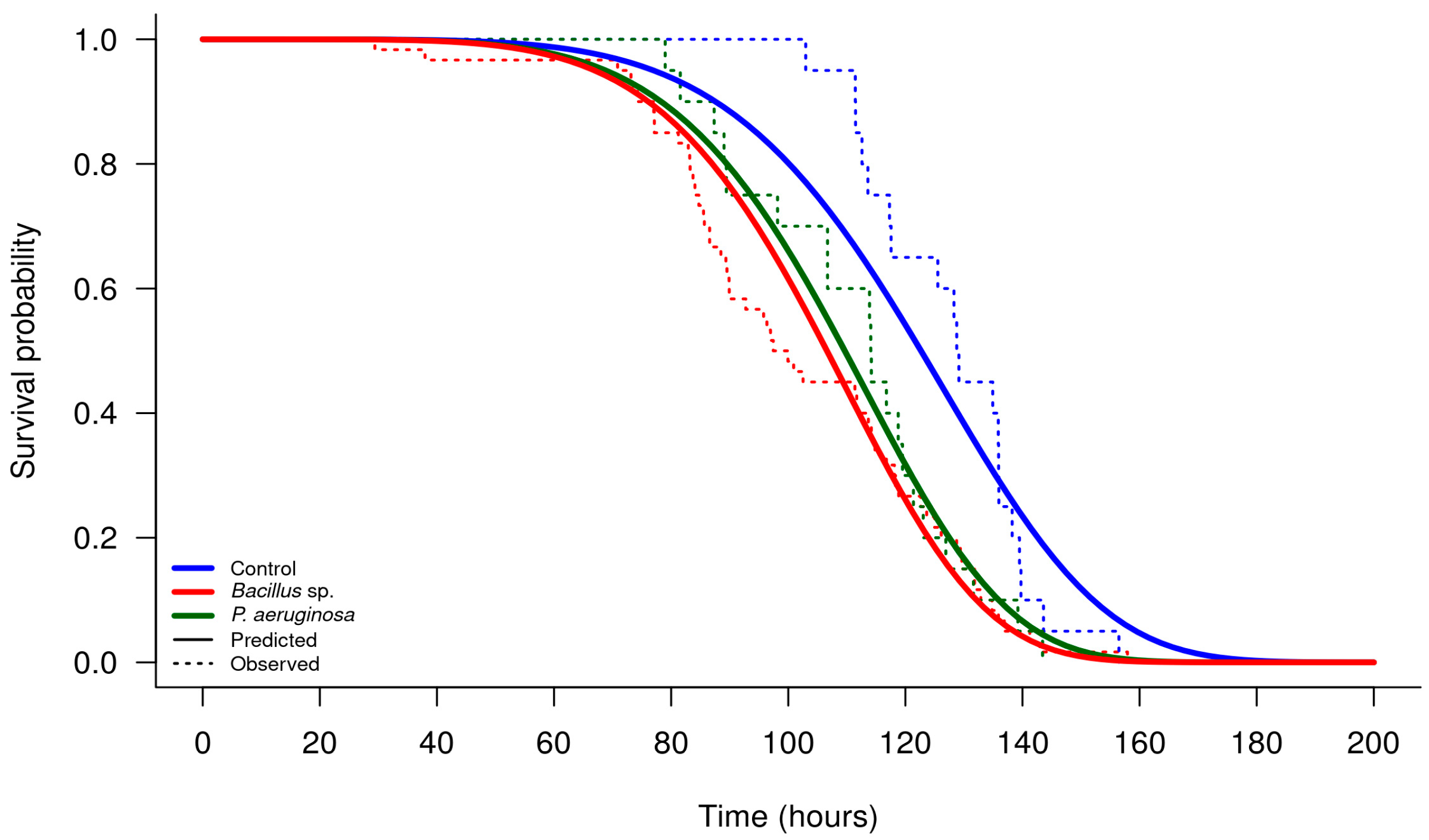
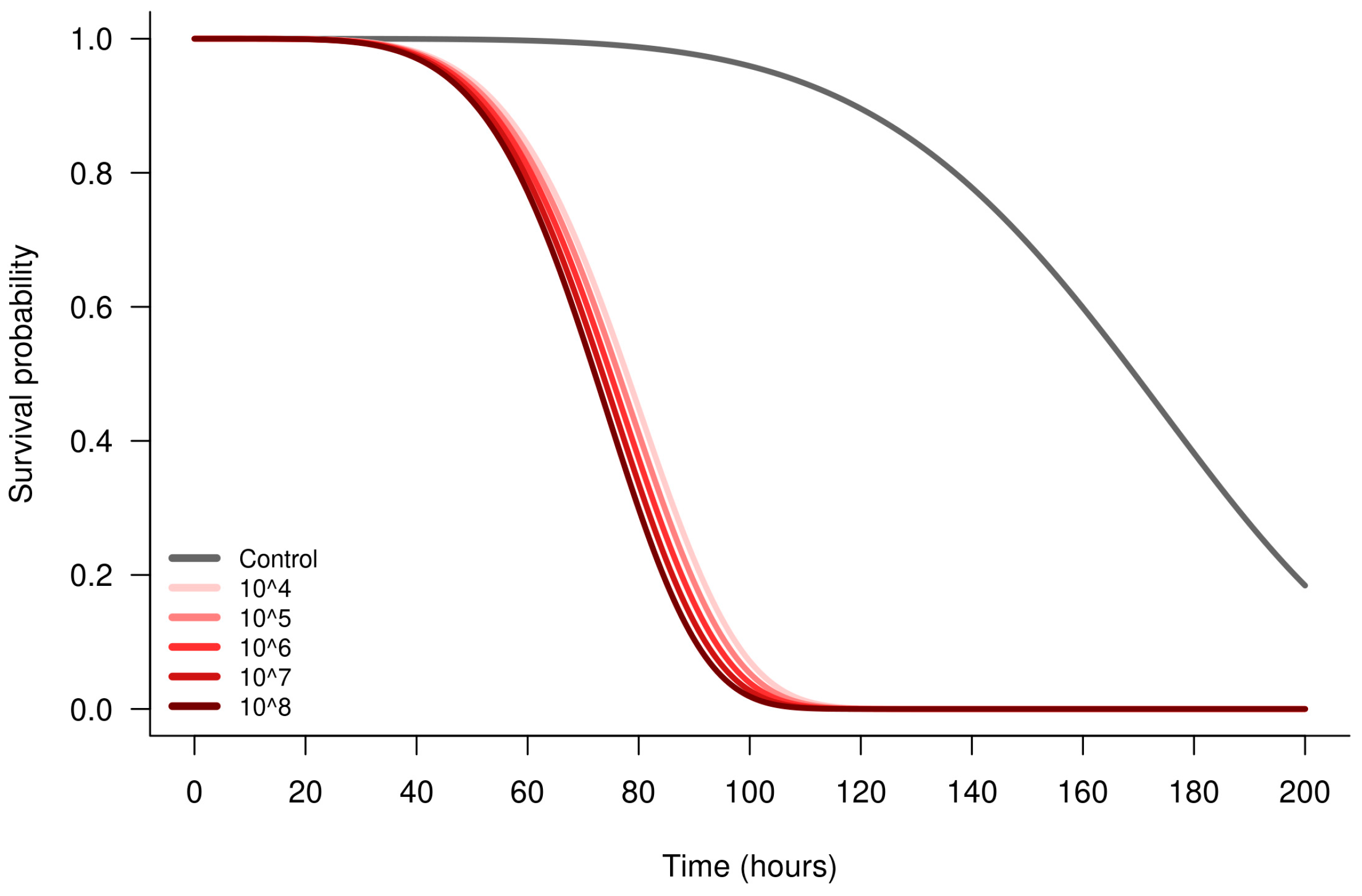
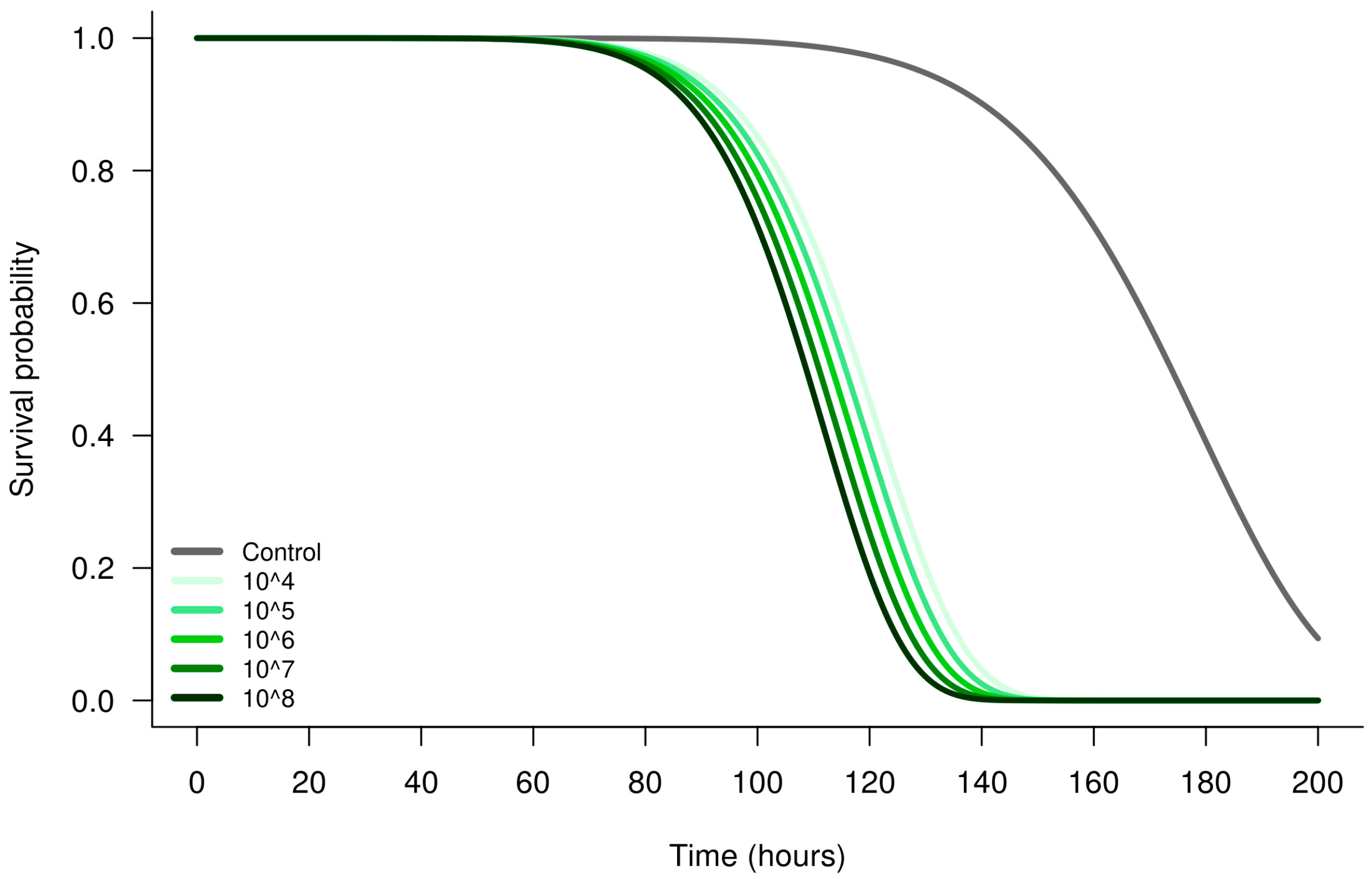
3.2. Effects of Bacillus sp. on Worker Survival
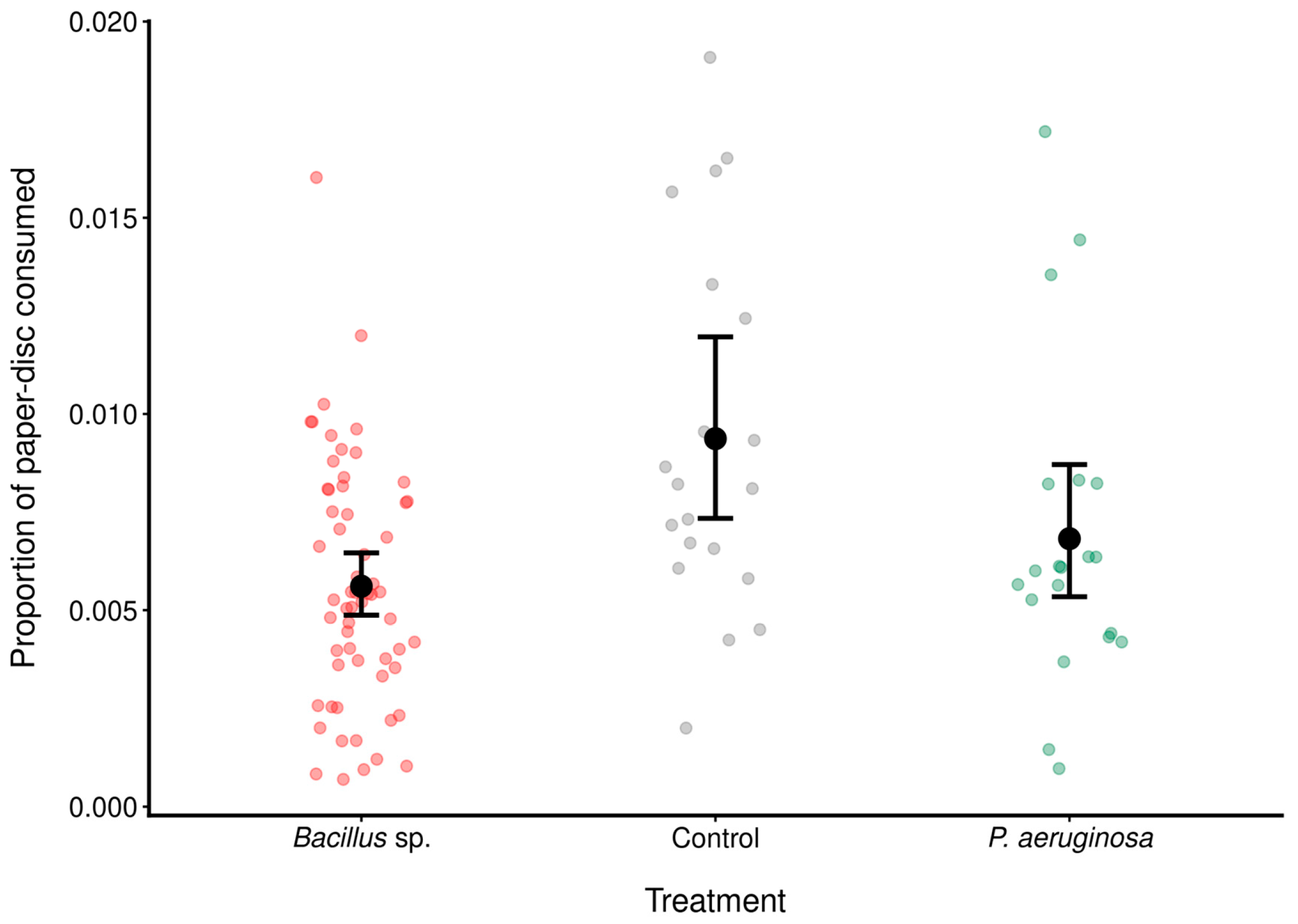
3.3. Feeding Behavior and Sickness Response
4. Discussion
4.1. Pathogenic Potential of Gut-Derived Bacillus
4.2. Dose Dependency and Virulence Strategies
4.3. Behavioral Impairment and Physiological Collapse
5. Conclusions
Supplementary Materials
Author Contributions
Funding
Institutional Review Board Statement
Data Availability Statement
Acknowledgments
Conflicts of Interest
References
- Berlanga, M.; Guerrero, R. The holobiont concept: The case of xylophagous termites and cockroaches. Symbiosis 2016, 68, 49–60. [Google Scholar] [CrossRef] [Scilit]
- Germer, J.; Cerveau, N.; Jackson, D.J. The Holo-Transcriptome of a Calcified Early Branching Metazoan. Front. Mar. Sci. 2017, 4, 81. [Google Scholar] [CrossRef] [Scilit]
- Dittami, S.M.; Arboleda, E.; Auguet, J.-C.; Bigalke, A.; Briand, E.; Cárdenas, P.; Cardini, U.; Decelle, J.; Engelen, A.H.; Eveillard, D. A community perspective on the concept of marine holobionts: Current status, challenges, and future directions. PeerJ 2021, 9, e10911. [Google Scholar] [CrossRef] [Scilit]
- Tamarit, D.; Andersson, S.G.E. Rethinking microbial symbioses. FEMS Microbiol. Lett. 2020, 367, fnz255. [Google Scholar] [CrossRef] [Scilit] [PubMed]
- Wiesmann, C.L.; Wang, N.R.; Zhang, Y.; Liu, Z.; Haney, C.H. Origins of symbiosis: Shared mechanisms underlying microbial pathogenesis, commensalism and mutualism of plants and animals. FEMS Microbiol. Rev. 2023, 47, fuac048. [Google Scholar] [CrossRef] [Scilit] [PubMed]
- Hajra, D.; Kirthivasan, N.; Chakravortty, D. Symbiotic Synergy from Sponges to Humans: Microflora-Host Harmony is Crucial for Ensuring Survival and Shielding against Invading Pathogens. ACS Infect. Dis. 2024, 10, 317–336. [Google Scholar] [CrossRef] [Scilit] [PubMed]
- Moraïs, S.; Mizrahi, I. Islands in the stream: From individual to communal fiber degradation in the rumen ecosystem. FEMS Microbiol. Rev. 2019, 43, 362–379. [Google Scholar] [CrossRef] [Scilit]
- Hoepfner, C.; Guzmán, D.; Vidal-Veuthey, B.; Foronda, V.; Beggs, A.; Cárdenas, J.P.; Vargas, V.A.; Alfaro, F.D. Functional stratification and enzymatic arrangement in microbial communities across a hypersaline depth gradient. Front. Microbiol. 2025, 16, 1624058. [Google Scholar] [CrossRef] [Scilit]
- Lushchak, V.I. Symphony of Digestion: Coordinated Host–Microbiome Enzymatic Interplay in Gut Ecosystem. Biomolecules 2025, 15, 1151. [Google Scholar] [CrossRef] [Scilit]
- Liu, H.; Macdonald, C.A.; Cook, J.; Anderson, I.C.; Singh, B.K. An Ecological Loop: Host Microbiomes across Multitrophic Interactions. Trends Ecol. Evol. 2019, 34, 1118–1130. [Google Scholar] [CrossRef] [Scilit]
- Weiss, S. Microbiota as mediator and moderator of stress. BioEssays News Rev. Mol. Cell. Dev. Biol. 2021, 43, e2000277. [Google Scholar] [CrossRef] [Scilit]
- Bastías, D.A.; Balestrini, R.; Pollmann, S.; Gundel, P.E. Environmental interference of plant−microbe interactions. Plant Cell Environ. 2022, 45, 3387–3398. [Google Scholar] [CrossRef] [Scilit] [PubMed]
- Lai, T.-T.; Liou, C.-W.; Tsai, Y.-H.; Lin, Y.-Y.; Wu, W.-L. Butterflies in the gut: The interplay between intestinal microbiota and stress. J. Biomed. Sci. 2023, 30, 92. [Google Scholar] [CrossRef] [Scilit]
- Ohkuma, M.; Brune, A. Diversity, Structure, and Evolution of the Termite Gut Microbial Community. In Biology of Termites: A Modern Synthesis; Springer: Dordrecht, The Netherlands, 2010; pp. 413–438. [Google Scholar]
- Sabree, Z.L.; Huang, C.Y.; Arakawa, G.; Tokuda, G.; Lo, N.; Watanabe, H.; Moran, N.A. Genome shrinkage and loss of nutrient-providing potential in the obligate symbiont of the primitive termite Mastotermes darwiniensis. Appl. Environ. Microbiol. 2012, 78, 204–210. [Google Scholar] [CrossRef] [Scilit]
- Brune, A. Symbiotic digestion of lignocellulose in termite guts. Nat. Rev. Microbiol. 2014, 12, 168–180. [Google Scholar] [CrossRef] [Scilit]
- Chouvenc, T.; Šobotník, J.; Engel, M.S.; Bourguignon, T. Termite evolution: Mutualistic associations, key innovations, and the rise of Termitidae. Cell. Mol. Life Sci. 2021, 78, 2749–2769. [Google Scholar] [CrossRef] [Scilit]
- Brune, A.; Dietrich, C. The Gut Microbiota of Termites: Digesting the Diversity in the Light of Ecology and Evolution. Annu. Rev. Microbiol. 2015, 69, 145–166. [Google Scholar] [CrossRef] [Scilit] [PubMed]
- Arora, J.; Kinjo, Y.; Šobotník, J.; Buček, A.; Clitheroe, C.; Stiblik, P.; Roisin, Y.; Žifčáková, L.; Park, Y.C.; Kim, K.Y.; et al. The functional evolution of termite gut microbiota. Microbiome 2022, 10, 78. [Google Scholar] [CrossRef] [Scilit]
- Sero, E.T.; Amobonye, A.; Bhagwat, P.; Singh, N.K.; de Carvalho, J.C.; Permaul, K.; Pillai, S. Exploring the termite gut as a hub of industrially important microbes and enzymes for biofuel production. Biomass Bioenergy 2025, 199, 107899. [Google Scholar] [CrossRef] [Scilit]
- Calleri, D.V.; McGrail Reid, E.; Rosengaus, R.B.; Vargo, E.L.; Traniello, J.F.A. Inbreeding and disease resistance in a social insect: Effects of heterozygosity on immunocompetence in the termite Zootermopsis angusticollis. Proc. Biol. Sci. 2006, 273, 2633–2640. [Google Scholar] [CrossRef] [Scilit] [PubMed]
- Rosengaus, R.; Traniello, J.; Bulmer, M. Ecology, Behavior and Evolution of Disease Resistance in Termites. In Biology of Termites: A Modern Synthesis; Springer: Dordrecht, The Netherlands, 2010; pp. 165–191. [Google Scholar]
- Wisselink, M.; Aanen, D.K.; van’t Padje, A. The Longevity of Colonies of Fungus-Growing Termites and the Stability of the Symbiosis. Insects 2020, 11, 527. [Google Scholar] [CrossRef] [Scilit]
- Traniello, J.F.A.; Rosengaus, R.B.; Savoie, K. The development of immunity in a social insect: Evidence for the group facilitation of disease resistance. Proc. Natl. Acad. Sci. USA 2002, 99, 6838–6842. [Google Scholar] [CrossRef] [Scilit] [PubMed]
- Rozen, D. Faecal pharmaceuticals and external immunity in termites. J. Exp. Biol. 2014, 217, 161. [Google Scholar] [CrossRef] [Scilit]
- Moran, M.N.; Aguero, C.M.; Eyer, P.-A.; Vargo, E.L. Rescue Strategy in a Termite: Workers Exposed to a Fungal Pathogen are Reintegrated into the Colony. Front. Ecol. Evol. 2022, 10, 840223. [Google Scholar] [CrossRef] [Scilit]
- Liu, L.; Zhao, X.-Y.; Tang, Q.-B.; Lei, C.-L.; Huang, Q.-Y. The Mechanisms of Social Immunity Against Fungal Infections in Eusocial Insects. Toxins 2019, 11, 244. [Google Scholar] [CrossRef] [Scilit]
- Palma, L.; Muñoz, D.; Berry, C.; Murillo, J.; Caballero, P. Bacillus thuringiensis Toxins: An Overview of Their Biocidal Activity. Toxins 2014, 6, 3296–3325. [Google Scholar] [CrossRef] [Scilit] [PubMed]
- Baranek, J.; Pluskota, M.; Rusin, M.; Konecka, E.; Kaznowski, A.; Wiland-Szymańska, J. Insecticidal activity of Bacillus thuringiensis strains isolated from tropical greenhouses towards Cydia pomonella and Spodoptera exigua larvae. BioControl 2023, 68, 39–48. [Google Scholar] [CrossRef] [Scilit]
- Ma, X.; Hu, J.; Ding, C.; Portieles, R.; Xu, H.; Gao, J.; Du, L.; Gao, X.; Yue, Q.; Zhao, L.; et al. New native Bacillus thuringiensis strains induce high insecticidal action against Culex pipiens pallens larvae and adults. BMC Microbiol. 2023, 23, 100. [Google Scholar] [CrossRef] [Scilit]
- König, H. Bacillus species in the intestine of termites and other soil invertebrates. J. Appl. Microbiol. 2006, 101, 620–627. [Google Scholar] [CrossRef] [Scilit]
- Mathew, G.M.; Ju, Y.-M.; Lai, C.-Y.; Mathew, D.C.; Huang, C.C. Microbial community analysis in the termite gut and fungus comb of Odontotermes formosanus: The implication of Bacillus as mutualists. FEMS Microbiol. Ecol. 2012, 79, 504–517. [Google Scholar] [CrossRef] [Scilit]
- Mathew, G.M.; Mathew, D.C.; Lo, S.-C.; Alexios, G.M.; Yang, J.-C.; Sashikumar, J.M.; Shaikh, T.M.; Huang, C.-C. Synergistic collaboration of gut symbionts in Odontotermes formosanus for lignocellulosic degradation and bio-hydrogen production. Bioresour. Technol. 2013, 145, 337–344. [Google Scholar] [CrossRef] [Scilit]
- Korsa, G.; Beyene, A.; Ayele, A. Bacterial diversity from soil-feeding termite gut and their potential application. Ann. Microbiol. 2023, 73, 38. [Google Scholar] [CrossRef] [Scilit]
- Moura, F.M.S.; Vasconcellos, A.; Araújo, V.F.P.; Bandeira, A.G. Seasonality in foraging behaviour of Constrictotermes cyphergaster (Termitidae, Nasutitermitinae) in the Caatinga of Northeastern Brazil. Insectes Sociaux 2006, 53, 472–479. [Google Scholar] [CrossRef] [Scilit]
- Oliveira, M.H.d.; Viana-Junior, A.B.; Rolim, M.d.S.L.; Eloi, I.; Andrade, M.R.d.L.; Souza, J.J.L.L.d.; Bezerra-Gusmão, M.A. The Impact of Constrictotermes cyphergaster (Termitidae: Nasutitermitinae) Termites on Semiarid Ecosystems in Brazil: A Review of Current Research. Insects 2022, 13, 704. [Google Scholar] [CrossRef] [Scilit]
- Arab, A.; Paulino, L.C.; Rolim, M.S.L.; de Menezes, L.R.; de Oliveira, M.H.; dos Santos, R.A.C.; Cairo, J.P.L.F.; Bezerra-Gusmão, M.A.; Costa-Leonardo, A.M.; Cunha, H.; et al. The gut microbiome and lignocellulose digestion in Constrictotermes cyphergaster (Termitidae: Nasutitermitinae): A termite incorporating lichen into its diet. Diversity 2024, 16, 623. [Google Scholar] [CrossRef] [Scilit]
- de Oliveira, M.H.; Lacerda-Rolim, M.d.S.; Barbosa-Silva, A.M.; Abad, A.C.A.; Mota, R.A.; Pereira, E.C.; Martins, M.C.B.; de Lima, L.M.; Bezerra-Gusmão, M.A. Inhibitory effect of usnic acid on the gut microbiota of the termite Constrictotermes cyphergaster. Symbiosis 2023, 89, 329–335. [Google Scholar] [CrossRef] [Scilit]
- Lacerda, M.; Eloi, I.; Lira, D.; Araújo, E.G.L.; Oliveira, M.H.; Abad, A.C.A.; Lima, L.M.; Pereira, E.C.; Martins, M.C.B.; Mota, R.A.; et al. Lichen-derived atranorin effects on cultivable gut-associated bacteria in Constrictotermes cyphergaster. Symbiosis, 2026; accepted. [CrossRef] [Scilit]
- Barreto, M.R.; Loguercio, L.L.; Valicente, F.H.; Paiva, E. Insecticidal activity of culture supernatants from Bacillus thuringiensis Berliner strains against Spodoptera frugiperda Smith (Lepidoptera: Noctuidae) larvae. An. Soc. Entomológica Bras. 1999, 28, 675–685. [Google Scholar] [CrossRef] [Scilit]
- Doyle, J.J.; Doyle, J.L. A rapid DNA isolation procedure for small quantities of fresh leaf tissue. Phytochem. Bull. 1987, 19, 11–15. [Google Scholar]
- Wright, E.S. Using DECIPHER v2.0 to analyze big biological sequence data in R. R J. 2016, 8, 352–359. [Google Scholar] [CrossRef] [Scilit]
- R Core Team. R: A Language and Environment for Statistical Computing; R Foundation for Statistical Computing: Vienna, Austria, 2024; Available online: https://www.R-project.org/.
- Schliep, K.P. phangorn: Phylogenetic analysis in R. Bioinformatics 2011, 27, 592–593. [Google Scholar] [CrossRef] [Scilit] [PubMed]
- Hall-Stoodley, L.; Costerton, J.W.; Stoodley, P. Bacterial biofilms: From the natural environment to infectious diseases. Nat. Rev. Microbiol. 2004, 2, 95–108. [Google Scholar] [CrossRef] [Scilit] [PubMed]
- Zhang, Q.; Wang, S.; Zhang, X.; Zhang, R.; Zhang, Z. Negative Impact of Pseudomonas aeruginosa Y12 on Its Host Musca domestica. Front. Microbiol. 2021, 12, 691158. [Google Scholar] [CrossRef] [Scilit]
- Campanini, E.B.; Davolos, C.C.; Alves, E.C.d.C.; Lemos, M.V.F. Caracterização de novos isolados de Bacillus thuringiensis para o controle de importantes insetos-praga da agricultura. Bragantia 2012, 71, 362–369. [Google Scholar] [CrossRef] [Scilit]
- Lenth, R.V. Emmeans: Estimated Marginal Means, aka Least-Squares Means, R package version 2025; Comprehensive R Archive Network: Vienna, Austria, 2025. [Google Scholar]
- Brugger, S.D.; Bomar, L.; Lemon, K.P. Commensal–Pathogen Interactions along the Human Nasal Passages. PLoS Pathog. 2016, 12, e1005633. [Google Scholar] [CrossRef] [Scilit]
- Pitlik, S.D.; Koren, O. How holobionts get sick—Toward a unifying scheme of disease. Microbiome 2017, 5, 64. [Google Scholar] [CrossRef] [Scilit]
- Cho, K.; Spasova, D.; Hong, S.-W.; O, E.; Surh, C.D.; Im, S.-H.; Kim, K.S. Listeria monocytogenes Establishes Commensalism in Germ-Free Mice Through the Reversible Downregulation of Virulence Gene Expression. Front. Immunol. 2021, 12, 666088. [Google Scholar] [CrossRef] [Scilit]
- Li, H.; Miao, M.; Jia, C.; Cao, Y.-B.; Yan, T.-H.; Jiang, Y.-Y.; Yang, F. Interactions between Candida albicans and the resident microbiota. Front. Microbiol. 2022, 13, 930495. [Google Scholar] [CrossRef] [Scilit]
- Bass, D.; Stentiford, G.D.; Wang, H.-C.; Koskella, B.; Tyler, C.R. The Pathobiome in Animal and Plant Diseases. Trends Ecol. Evol. 2019, 34, 996–1008. [Google Scholar] [CrossRef] [Scilit]
- Burmeister, A.R.; Hansen, E.; Cunningham, J.J.; Rego, E.H.; Turner, P.E.; Weitz, J.S.; Hochberg, M.E. Fighting microbial pathogens by integrating host ecosystem interactions and evolution. BioEssays 2021, 43, 2000272. [Google Scholar] [CrossRef] [Scilit]
- Hanson, M.A. When the microbiome shapes the host: Immune evolution implications for infectious disease. Philos. Trans. R. Soc. B Biol. Sci. 2024, 379, 20230061. [Google Scholar] [CrossRef] [Scilit] [PubMed]
- Hoang, K.L.; Read, T.D.; King, K.C. Incomplete immunity in a natural animal-microbiota interaction selects for higher pathogen virulence. Curr. Biol. 2024, 34, 1357–1363.e3. [Google Scholar] [CrossRef] [Scilit]
- Hegedus, D.; Erlandson, M.; Gillott, C.; Toprak, U. New insights into peritrophic matrix synthesis, architecture, and function. Annu. Rev. Entomol. 2009, 54, 285–302. [Google Scholar] [CrossRef] [Scilit] [PubMed]
- Abraham, N.M.; Liu, L.; Jutras, B.L.; Yadav, A.K.; Narasimhan, S.; Gopalakrishnan, V.; Ansari, J.M.; Jefferson, K.K.; Cava, F.; Jacobs-Wagner, C.; et al. Pathogen-mediated manipulation of arthropod microbiota to promote infection. Proc. Natl. Acad. Sci. USA 2017, 114, E781–E790. [Google Scholar] [CrossRef] [Scilit]
- Prakash, A.; Monteith, K.M.; Vale, P.F. Mechanisms of damage prevention, signalling and repair impact disease tolerance. Proc. R. Soc. B Biol. Sci. 2022, 289, 20220837. [Google Scholar] [CrossRef] [Scilit]
- Gupta, P.K. (Ed.) Principles of Toxicology. In Problem Solving Questions in Toxicology: A Study Guide for the Board and Other Examinations; Springer International Publishing: Cham, Switzerland, 2020; pp. 27–45. [Google Scholar]
- Moffett, D.; Elmasri, H.; Fowler, B. General Considerations of Dose-Effect and Dose-Response Relationships. In Handbook on the Toxicology of Metals; Academic Press: Cambridge, MA, USA, 2007; pp. 101–115. [Google Scholar]
- Petersen, C.; Round, J.L. Defining dysbiosis and its influence on host immunity and disease. Cell. Microbiol. 2014, 16, 1024–1033. [Google Scholar] [CrossRef] [Scilit]
- Fujita, H.; Ushio, M.; Suzuki, K.; Abe, M.S.; Yamamichi, M.; Iwayama, K.; Canarini, A.; Hayashi, I.; Fukushima, K.; Fukuda, S.; et al. Alternative stable states, nonlinear behavior, and predictability of microbiome dynamics. Microbiome 2023, 11, 63. [Google Scholar] [CrossRef] [Scilit]
- Kamada, N.; Chen, G.Y.; Inohara, N.; Núñez, G. Control of pathogens and pathobionts by the gut microbiota. Nat. Immunol. 2013, 14, 685–690. [Google Scholar] [CrossRef] [Scilit]
- Iacob, S.; Iacob, D.G. Infectious Threats, the Intestinal Barrier, and Its Trojan Horse: Dysbiosis. Front. Microbiol. 2019, 10, 1676. [Google Scholar] [CrossRef] [Scilit] [PubMed]
- Sugihara, K.; Kamada, N. Metabolic network of the gut microbiota in inflammatory bowel disease. Inflamm. Regen. 2024, 44, 11. [Google Scholar] [CrossRef] [Scilit]
- Darch, S.E.; West, S.A.; Winzer, K.; Diggle, S.P. Density-dependent fitness benefits in quorum-sensing bacterial populations. Proc. Natl. Acad. Sci. USA 2012, 109, 8259–8263. [Google Scholar] [CrossRef] [Scilit]
- Gellatly, S.L.; Hancock, R.E.W. Pseudomonas aeruginosa: New insights into pathogenesis and host defenses. Pathog. Dis. 2013, 67, 159–173. [Google Scholar] [CrossRef] [Scilit] [PubMed]
- Faure, E.; Kwong, K.; Nguyen, D. Pseudomonas aeruginosa in Chronic Lung Infections: How to Adapt Within the Host? Front. Immunol. 2018, 9, 2416. [Google Scholar] [CrossRef] [Scilit]
- Arango, R.A.; Carlson, C.M.; Currie, C.R.; McDonald, B.R.; Book, A.J.; Green, F.; Lebow, N.K.; Raffa, K.F. Antimicrobial Activity of Actinobacteria Isolated From the Guts of Subterranean Termites. Environ. Entomol. 2016, 45, 1415–1423. [Google Scholar] [CrossRef] [Scilit]
- Mitaka, Y.; Mori, N.; Matsuura, K. A termite fungistatic compound, mellein, inhibits entomopathogenic fungi but not egg-mimicking termite ball fungi. Appl. Entomol. Zool. 2018, 54, 39–46. [Google Scholar] [CrossRef] [Scilit]
- Li, X.; Wang, M.; Feng, K.; Sun, H.; Tang, F. The Function of Termicin from Odontotermes formosanus (Shiraki) in the Defense against Bacillus thuringiensis (Bt) and Beauveria bassiana (Bb) Infection. Insects 2024, 15, 360. [Google Scholar] [CrossRef] [Scilit]
- Nakashima, M.; Mitaka, Y.; Inagaki, T.; Matsuura, K. An antifungal compound secreted by termite workers, phenylacetic acid, inhibits the growth of both termite egg-mimicking fungus and entomopathogenic fungi. Insectes Sociaux 2024, 71, 221–232. [Google Scholar] [CrossRef] [Scilit]
- Nakashima, M.; Matsuura, K. Termite antimicrobial defense through interaction with symbiotic microorganisms in nest materials. Sci. Rep. 2025, 15, 23391. [Google Scholar] [CrossRef] [Scilit]
- Roxinol, J.; Costantin, E.; Castiblanco, J.; Rolim, M.D.S.L.; Bezerra-Gusmão, M.A.; Rosengaus, R.; DeSouza, O. Resilience that goes beyond prophylaxis: Benefits of faecal accumulation within termite nests. Ecol. Entomol. 2025, 50, 1044–1056. [Google Scholar] [CrossRef] [Scilit]
- Ayres, J.S.; Schneider, D.S. The Role of Anorexia in Resistance and Tolerance to Infections in Drosophila. PLoS Biol. 2009, 7, e1000150. [Google Scholar] [CrossRef] [Scilit] [PubMed]
- Eakin, L.; Wang, M.; Dwyer, G. The effects of the avoidance of infectious hosts on infection risk in an insect-pathogen interaction. Am. Nat. 2015, 185, 100–112. [Google Scholar] [CrossRef] [Scilit]
- Surendran, S.; Hückesfeld, S.; Wäschle, B.; Pankratz, M.J. Pathogen-induced food evasion behavior in Drosophila larvae. J. Exp. Biol. 2017, 220, 1774–1780. [Google Scholar] [CrossRef] [Scilit] [PubMed]
- Hite, J.L.; Pfenning, A.C.; Cressler, C.E. Starving the Enemy? Feeding Behavior Shapes Host-Parasite Interactions. Trends Ecol. Evol. 2020, 35, 68–80. [Google Scholar] [CrossRef] [Scilit]
- Sieksmeyer, T.; He, S.; Esparza-Mora, M.A.; Jiang, S.; Petrašiūnaitė, V.; Kuropka, B.; Banasiak, R.; Julseth, M.J.; Weise, C.; Johnston, P.R.; et al. Eating in a losing cause: Limited benefit of modified macronutrient consumption following infection in the oriental cockroach Blatta orientalis. BMC Ecol. Evol. 2022, 22, 67. [Google Scholar] [CrossRef] [Scilit] [PubMed]
- Lightfoot, Y.L.; Yang, T.; Sahay, B.; Zadeh, M.; Cheng, S.X.; Wang, G.P.; Owen, J.L.; Mohamadzadeh, M. Colonic Immune Suppression, Barrier Dysfunction, and Dysbiosis by Gastrointestinal Bacillus anthracis Infection. PLoS ONE 2014, 9, e100532. [Google Scholar] [CrossRef] [Scilit]
- Glare, T.; Jurat-Fuentes, J.; O’Callaghan, M. Basic and Applied Research. In Microbial Control of Insect and Mite Pests; Academic Press: Cambridge, MA, USA, 2017; pp. 47–67. [Google Scholar]
- Ningshen, T.J.; Chauhan, V.K.; Dhania, N.K.; Dutta-Gupta, A. Insecticidal Effects of Hemocoelic Delivery of Bacillus thuringiensis Cry Toxins in Achaea janata Larvae. Front. Physiol. 2017, 8, 289. [Google Scholar] [CrossRef] [Scilit] [PubMed]


Disclaimer/Publisher’s Note: The statements, opinions and data contained in all publications are solely those of the individual author(s) and contributor(s) and not of MDPI and/or the editor(s). MDPI and/or the editor(s) disclaim responsibility for any injury to people or property resulting from any ideas, methods, instructions or products referred to in the content. |
© 2026 by the authors. Licensee MDPI, Basel, Switzerland. This article is an open access article distributed under the terms and conditions of the Creative Commons Attribution (CC BY) license.
Share and Cite
Lacerda, M.; Lira, D.; Arab, A.; Oliveira, M.H.d.; de Lima, L.M.; Lambais, É.; Bezerra-Gusmão, M.A. Dose-Dependent Effects of a Gut-Derived Bacillus on Survival and Feeding in a Neotropical Termite. Diversity 2026, 18, 281. https://doi.org/10.3390/d18050281
Lacerda M, Lira D, Arab A, Oliveira MHd, de Lima LM, Lambais É, Bezerra-Gusmão MA. Dose-Dependent Effects of a Gut-Derived Bacillus on Survival and Feeding in a Neotropical Termite. Diversity. 2026; 18(5):281. https://doi.org/10.3390/d18050281
Chicago/Turabian StyleLacerda, Maria, Derick Lira, Alberto Arab, Mário Herculano de Oliveira, Liziane Maria de Lima, Érica Lambais, and Maria Avany Bezerra-Gusmão. 2026. "Dose-Dependent Effects of a Gut-Derived Bacillus on Survival and Feeding in a Neotropical Termite" Diversity 18, no. 5: 281. https://doi.org/10.3390/d18050281
APA StyleLacerda, M., Lira, D., Arab, A., Oliveira, M. H. d., de Lima, L. M., Lambais, É., & Bezerra-Gusmão, M. A. (2026). Dose-Dependent Effects of a Gut-Derived Bacillus on Survival and Feeding in a Neotropical Termite. Diversity, 18(5), 281. https://doi.org/10.3390/d18050281