Article

Ambrosia Beetles (Coleoptera: Curculionidae: Scolytinae) Attracted to Necrotraps: Insights into Their Diversity in the Sierra Norte De Puebla, Mexico


by
Rodolfo J. Cancino-López
1,
Jesús Alberto Acuña-Soto
2,
Martha Patricia Chaires-Grijalva
3,
Francisco Armendáriz-Toledano
4,
Osiris Valerio-Mendoza
1,4,
Gerardo Cuellar-Rodríguez
1 and
Mauricio Pérez-Silva
4,*
1
Facultad de Ciencias Forestales, Universidad Autónoma de Nuevo León, km. 145 Carr. Linares-Ciudad Victoria, Linares 67700, Nuevo León, Mexico
2
Instituto Tecnológico Superior de Tlatlauquitepec, Carretera Federal Amozoc Nautla Km. 122+600 Almoloni Tlatlauquitepec, Teziutlán-Acajete 73907, Puebla, Mexico
3
Facultad de Ingeniería y Ciencias, Universidad Autónoma de Tamaulipas, Circuito Universitario Col, Universidad Poniente, Tampico 89336, Tamaulipas, Mexico
4
Colección Nacional de Insectos, Instituto de Biología, Universidad Nacional Autónoma de México, Circuito Exterior s/n, Ciudad Universitaria, Coyoacán 04510, Ciudad de México, Mexico
*
Author to whom correspondence should be addressed.
Diversity 2026, 18(5), 264; https://doi.org/10.3390/d18050264
Submission received: 21 March 2026 / Revised: 26 April 2026 / Accepted: 27 April 2026 / Published: 28 April 2026
(This article belongs to the Section Animal Diversity)

Abstract

Ambrosia beetles (Coleoptera: Curculionidae: Scolytinae) are diverse components of tropical forest ecosystems, but their community structure is often influenced by the sampling method used. We assessed species richness, alpha diversity (Hill numbers), and beta diversity of ambrosia beetles attracted to NTP-80 necrotraps in five forest fragments along an altitudinal gradient in the Sierra Norte de Puebla, Mexico. A total of 2074 individuals representing 18 species were recorded, effectively doubling the number of species previously reported for the Sierra Norte de Puebla. Among these, two species—Amphicranus torneutes and Cocotrypes carpophagus—represent new records for the state of Puebla. The assemblage was strongly dominated by the generalist Xyleborus affinis (86% of individuals). Richness estimators, including Chao 1 and ACE, indicated that sampling completeness was highest at the CF Relict site, reaching 88% of the estimated species. Conversely, the TER Nursery site showed the lowest completeness at 40%. These results, coupled with a low observed species richness compared to regional inventories, suggest that a significant portion of the local diversity may remain undetected. The altered evergreen rainforest sites tended to show higher evenness and dominance values than those in the relict cloud forest; however, these patterns should be interpreted cautiously, as the low species richness and strong dominance structure of the assemblage may influence these metrics. Beta diversity was moderate (βsor = 58%) and was primarily due to species turnover rather than nestedness, indicating species replacement in habitats. Our results suggest that necrotraps selectively sample ethanol-sensitive generalist ambrosia beetles, providing information on the dispersal- and disturbance-adapted component of Scolytinae assemblages while underestimating overall richness. Therefore, integrated sampling approaches are needed to accurately characterize ambrosia beetle diversity in tropical mountain systems.

1. Introduction

The subfamily Scolytinae, which comprises approximately 6500 described species, 30 tribes and 260 genera worldwide [1], is currently classified within the family Curculionidae, following the systematic arrangement of the superfamily Curculionoidea, updated by Alonso-Zarazaga et al. [2]. Although historical classifications frequently treated Scolytidae as a separate family due to their highly specialized morphology for wood-boring, contemporary phylogenies confirm their position as a highly derived lineage within the ‘true weevils’ [3]. Current knowledge of ambrosia beetle diversity is largely derived from faunal inventories conducted at different spatial scales across diverse regions worldwide, such as Poland [4], Thailand [5], South Africa [6], Peru ([7], Cuba [8], Argentina [9], and Mexico (Tabasco [10], Xalapa [11], Durango [12])). These studies are essential for documenting species richness and distribution patterns and for improving our understanding of global Scolytinae diversity.
The subfamily Scolytinae comprises bark and ambrosia beetles, a highly diverse group of weevils. These beetles spend most of their life cycle within plant tissues and play critical roles in forest ecosystems [13,14]. Ambrosia beetles maintain obligate mutualistic relationships with ambrosia fungi—primarily within the order Ophiostomatales—which serve as their primary food source [15,16]. Their fungus farming, and generalist host ranges, together with the wood-boring behavior of adults, have likely promoted diversification by enabling the exploitation of woody plants and the establishment of specialized beetle–fungus associations [15,17].
At local and regional scales, studies in tropical forests have shown that Scolytinae communities can exhibit high diversity and strong spatial and temporal variation, with differences in species composition between natural forests and commercial plantations, as well as seasonal patterns associated with climatic variables [18,19,20,21]. These patterns suggest that both environmental conditions and sampling approaches may influence the observed structure of ambrosia beetle assemblages.
Ambrosia beetles are frequently attracted to freshly cut wood or weakened trees, likely in response to plant-derived volatiles such as oleoresins, terpenes, and alcohols, which function as cues for host colonization [14]. This attraction has been widely exploited in the design of trapping and monitoring systems for species of economic importance, including Xyleborus glabratus Eichhoff [22,23]. Additionally, other trapping methods not specifically designed for ambrosia beetles, such as ultraviolet light traps and alcohol-baited traps, have proven effective in collecting a wide range of Scolytinae species, regardless of their feeding habits [19,24].
Some trapping systems originally developed for other insect groups have also been shown to incidentally capture ambrosia beetles. Among these, necrotraps designed to attract necrophilous insects [25] have yielded Scolytinae specimens in several studies conducted in Mexico [26,27,28,29]. Although necrotraps are not commonly considered for monitoring or control programs targeting ambrosia beetles, these studies indicate that such traps can provide valuable information on species presence, abundance, and community composition. Consequently, necrotraps may represent a useful complementary tool for assessing Scolytinae diversity at local or regional scales and across different vegetation types, including evaluations of alpha diversity and species turnover (beta diversity) among sites [30,31]. However, their effectiveness is constrained by their selective attraction to ethanol-responsive species, meaning that they primarily reflect a subset of the assemblage.
Despite the recognized diversity of Scolytinae in Mexico, with approximately 962 species reported across the country, the Sierra Norte de Puebla remains poorly documented, both due to the limited availability of faunistic inventories and the lack of standardized, methodologically robust assessments of diversity across its heterogeneous vegetation types and pronounced altitudinal gradients. Puebla lies at the convergence of multiple biogeographic provinces, including the Trans-Mexican Volcanic Belt, the Sierra Madre Oriental, and the Gulf of Mexico provinces [32], contributing to high environmental heterogeneity and species turnover. Mountainous tropical regions are widely recognized as centers of biodiversity and spatial compositional change due to strong climatic and elevational gradients [33,34]. However, systematic inventories of Scolytinae in such heterogeneous landscapes remain scarce in Mexico [7,35]. Consequently, baseline information on species composition, diversity patterns, and spatial turnover in the Sierra Norte de Puebla remains limited.
In this context, the objectives of this study were to characterize the abundance, species richness, and patterns of alpha and beta diversity of ambrosia beetles attracted to necrotraps across five locations along an altitudinal gradient in the Sierra Norte de Puebla, and to examine spatial turnover in assemblage composition across heterogeneous vegetation types. Based on the known selectivity of necrotrap sampling, we expected that the assemblages would be dominated by ethanol-responsive, dispersive species, resulting in relatively low observed species richness and reduced representation of host-specialized taxa. We also expected that differences among sites would be primarily reflected in species turnover rather than nestedness, given the environmental heterogeneity of the study area.

2. Materials and Methods

2.1. Study Area

The municipality of Zihuateutla is located in the Sierra norte region, in the state of Puebla, Mexico; is situated within the physiographic province of the Sierra Madre Oriental and the Carso Huasteco subprovince. Geographically, it lies between parallels 20°12′ and 20°23′ North and meridians 97°40′ and 97°58′ West, with an altitudinal gradient ranging from 100 to 1800 m a.s.l. However, the sampling sites used in this study were restricted to a narrower altitudinal range (380–1226 m a.s.l.), corresponding to the locations described below. The landscape is characterized by a mosaic of low and steep mountain ranges under warm, humid climatic conditions with consistent rainfall. Geology is dominated by extrusive igneous rocks, with the presence of sedimentary formations such as shale, sandstone, and limestone. Land use is primarily agricultural, interspersed with grassland, tropical rainforest, and patches of temperate forest vegetation [36].

2.2. Fieldwork

We established an altitudinal transect encompassing five locations in the western part of Zihuateutla municipality: Patla, El Pozo, El Albergue, Cafetal, and El Portal. At Patla (20°14′28″ N, 97°51′35″ W, Alt. 380 m a.s.l.), situated within the ecotone of the tropical evergreen rainforest and the cloud forest (TER/CF Ecotone). El Pozo (20°14′21″ N, 97°53′25″ W, Alt. 442 m a.s.l.), once densely vegetated but largely destroyed six decades ago, a preserved reduced area housing a cloud forest (CF Relict). El Albergue (20°15′38″ N, 97°52′25″ W, 639 m a.s.l.), predominantly induced grassland for sheep farming, exhibits tropical evergreen rainforest vegetation in upper parts and various crops in lower regions (TER Grassland). Cafetal (20°13′59″ N, 97°54′27″ W, 840 m a.s.l.), primarily a tropical evergreen rainforest, has traps set within a coffee plantation (TER Cafetal plantation). El Portal (20°13′41″ N, 97°57′19″ W, 1226 m a.s.l.), situated within a tropical evergreen rainforest, nursery area, represents the highest altitude site (TER Nursery) (Figure 1). Although the sampling sites are distributed along an altitudinal gradient, they also differ in land use and vegetation type (e.g., plantations, grasslands, conserved forest), which should be considered when interpreting spatial patterns.

2.3. Sampling

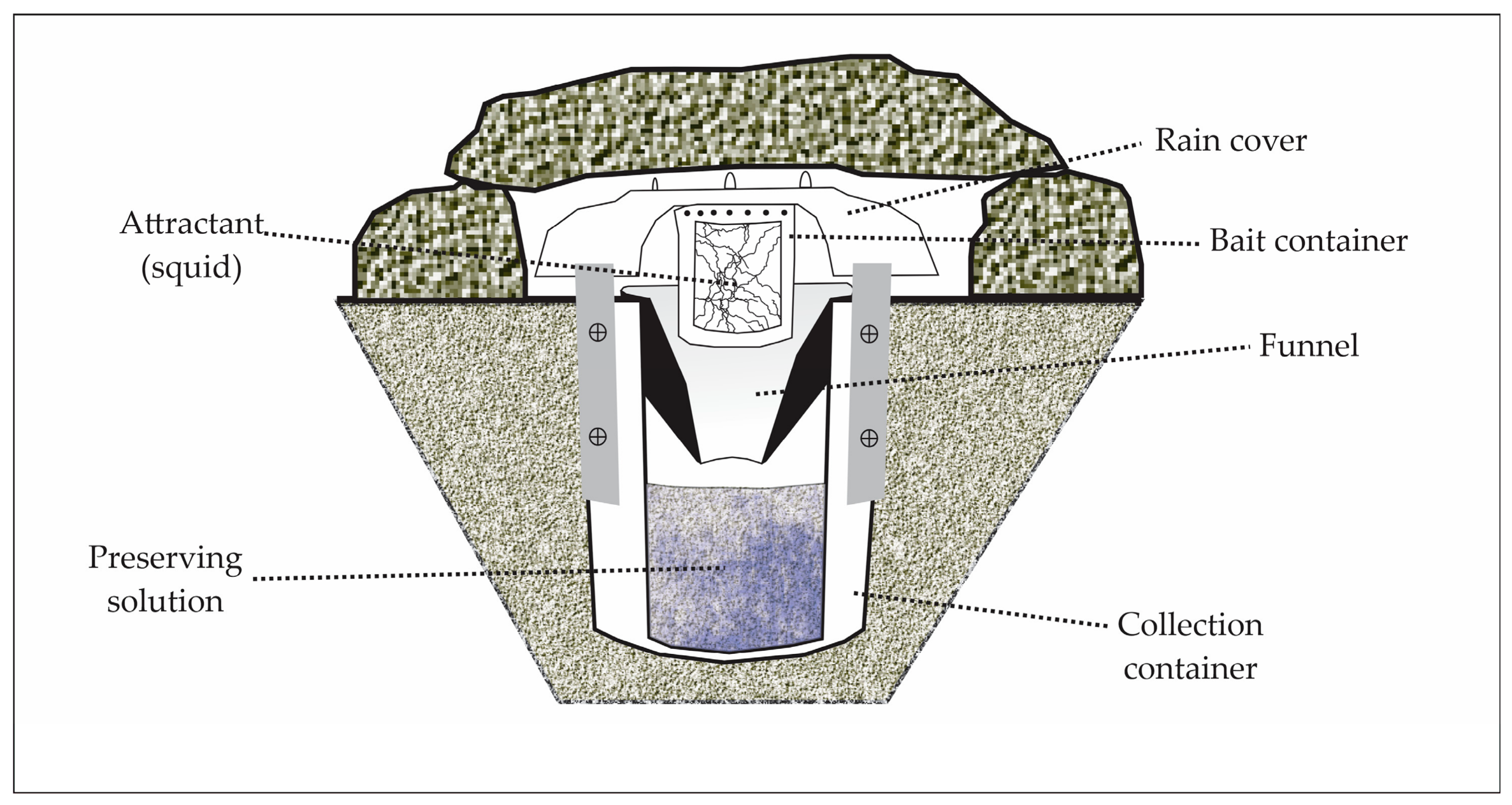
At each location, we deployed two NTP-80 type traps, designed and described by Morón and Terrón [25] (Figure 2). Baited with squid, the containers were buried in the soil to function as pitfall traps. Squid-baited NTP-80 traps function as carrion-baited traps (necrotrap-type attractants), as they rely on decomposing animal tissue to attract insects associated with organic matter and saproxylic substrates, including ambrosia beetles. The trap-preserving liquid consisted of 95 parts of 75% alcohol and five parts of glacial acetic acid. Because NTP-80 traps use ethanol-based preserving solutions, captures likely reflect attraction to fermentation volatiles rather than carrion per se. Sampling from March to November 2002 and monthly visits were conducted to replenish bait and collect captured fauna, preserved in 70% alcohol for transfer to the Zoology Laboratory of FES Iztacala. Although necrotraps are effective for collecting ambrosia beetles, this method is not specifically designed for Scolytinae and is known to preferentially attract ethanol-responsive species. Additionally, the use of two traps per site may limit spatial representativeness. These aspects should be considered when interpreting patterns of community composition and diversity.

2.4. Insect Identification

Scolytinae specimens were identified using taxonomic keys by Wood [14,37] at the genus and species level, and Xyleborini were identified using keys by Pérez-Silva et al. [38]. As complementary support, the bark and ambrosia beetles of the Americas website were consulted [39]. Taxonomic nomenclature for tribes, genera, and species was standardized following the updated classification of Johnson et al. [1].

2.5. Data Analysis

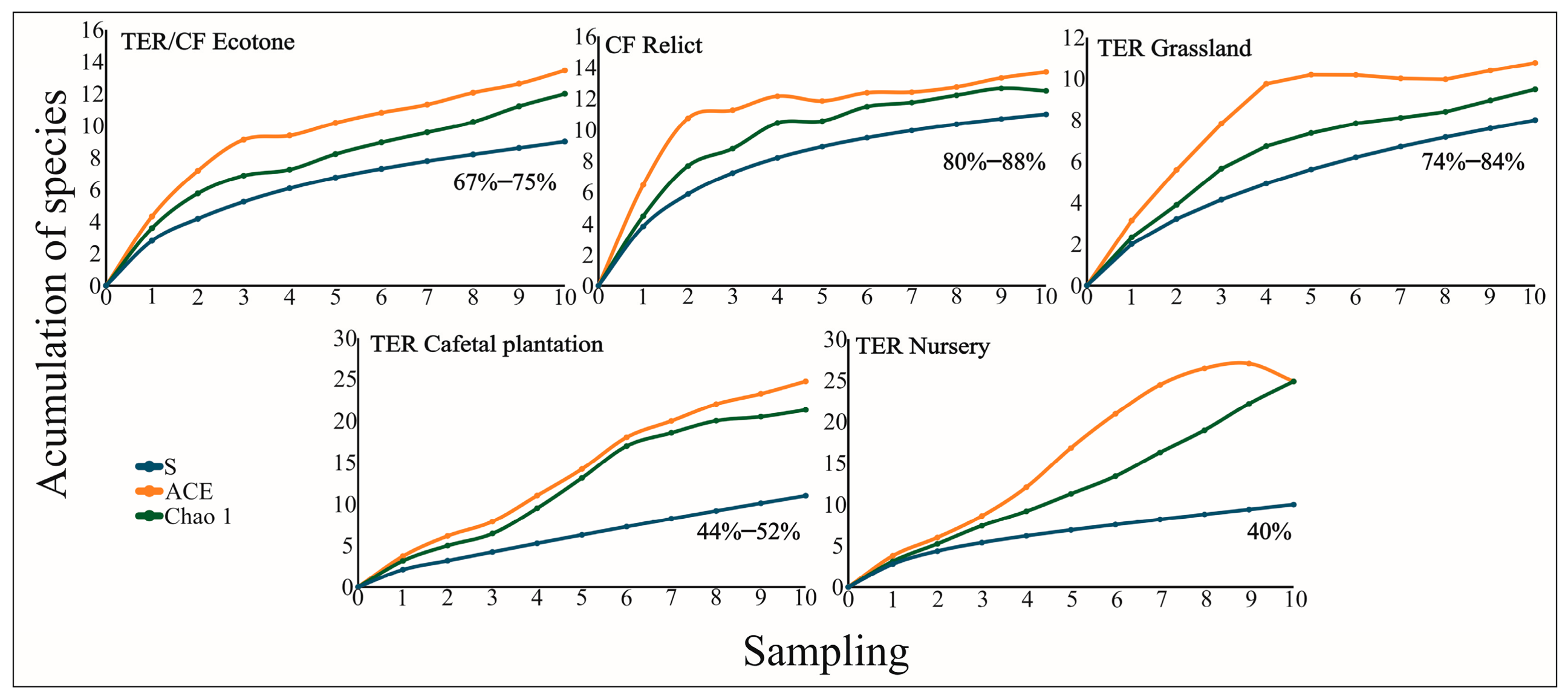
For the general analysis, the abundance and richness of Scolytinae species were determined both at a general level and by site. To evaluate sampling efficiency, species accumulation curves were constructed using each collection event per site as a measure of sampling effort. Expected richness and inventory completeness were estimated using the non-parametric Chao 1 and Abundance Coverage Estimator (ACE) indices. All estimates were calculated using EstimateS v9.1.0 software [40].
With the five most abundant species per site, a rank–abundance curve was made with the relative frequencies. Abundance was quantified as the total number of individuals captured per site across the entire sampling period. Alpha diversity was estimated independently for each sampling site to characterize local diversity patterns. An alpha diversity analysis was performed using the iNEXT online software [41], to calculate the effective number of species. Richness and diversity were then compared using Hill numbers or effective species numbers with three orders of diversity: q0 (richness), q1 (evenness, equivalent to the exponential of Shannon’s entropy index) and q2 (dominance, equivalent to Simpson’s inverse) [42]. Statistical significance for diversity differences was determined through the visual comparison of the 95% confidence intervals, derived from 1000 bootstrap replications; non-overlapping intervals were considered indicative of significant differences at a level of p < 0.05. Additionally, sample completeness was assessed using sample coverage (SC) estimates and their corresponding confidence intervals [42].
Partitioning beta diversity into turnover and nestedness components allows discrimination between species replacement and richness gradients along environmental variation [43,44]. The total beta diversity was evaluated with the Sorensen index (sor) and was analyzed with its two components: the dissimilarity due to turnover (sim) and the dissimilarity due to differences in richness (nestedness) (nes) under the multiple site approach [43]. In addition, under the pairwise approach, the beta diversity between consecutive sites was measured through the altitudinal transect (βsor = βsim + βnes), calculating the relative contribution of each component (in percentages) based on the incidence of the species [45,46]. Beta diversity was estimated using the R program with the Betapart package [44].

3. Results

3.1. Species Composition and Abundance

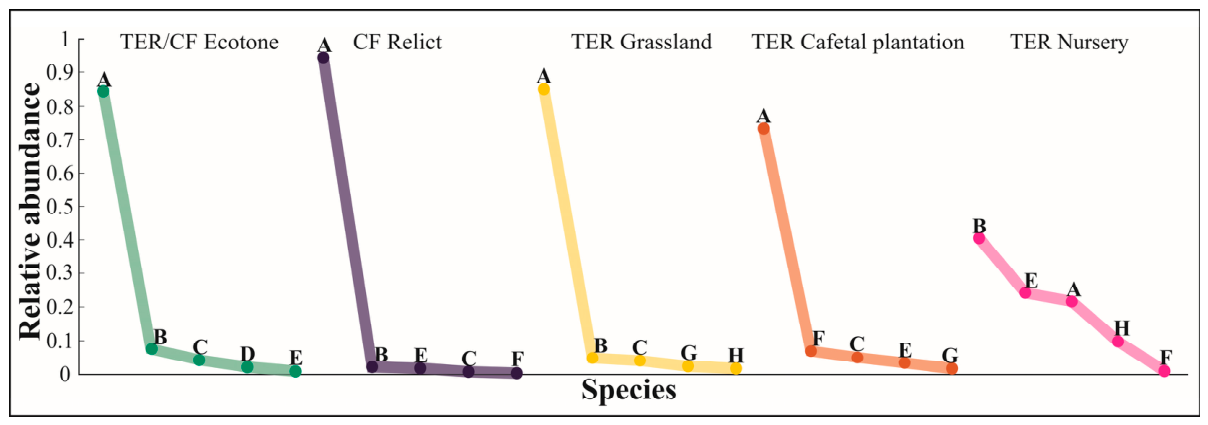
A total of 2074 specimens representing 18 species, eight genera, and three tribes were collected (Table 1, Figure A1 and Figure A2). The most abundant species was Xyleborus affinis Eichhoff, with 1789 individuals representing 86% of the total specimens. Xyleborus intersetosus (Blandford) was the second most abundant species, with 124 individuals (Figure 3). Six species were represented by only one specimen (Ambrosiodmus coffeiceus (Schedl), Amphicranus torneutes Blandford, Monarthrum sp., Tricolus frontalis Wood, Tricolus sp., and Xyleborus spinulosus Blandford). Amphicranus torneutes and Cocotrypes carpophagus (Hornung), were reported for the first time in Puebla.

3.2. Estimated Species Richness and Accumulation

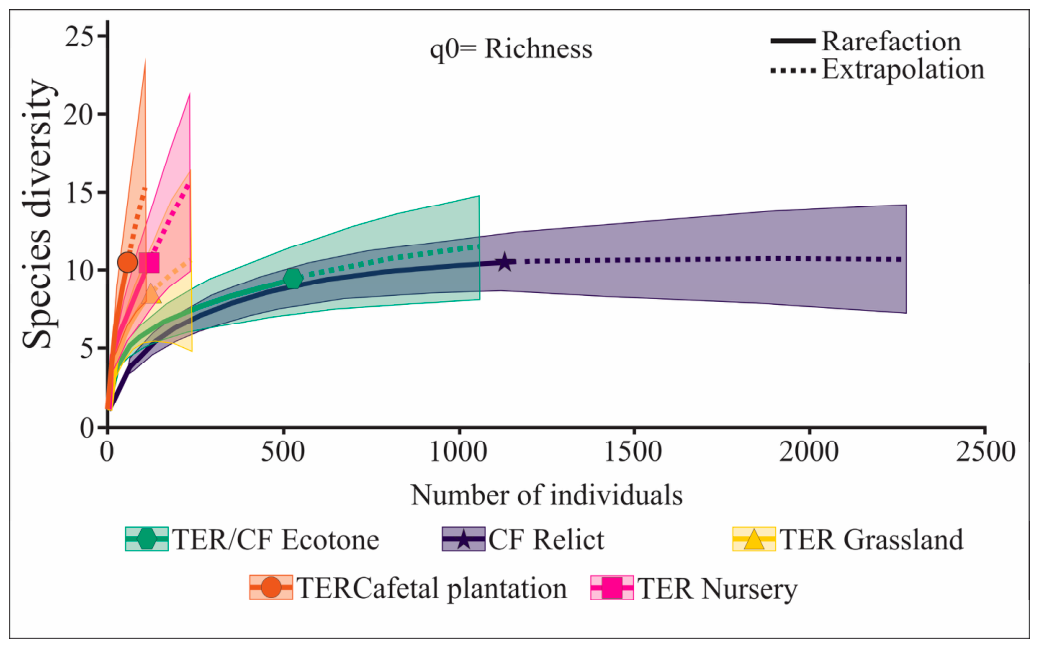
The total richness consisted of 18 species in total. Observed and estimated species richness (q0) showed minor variation among sampling sites (Figure 4). The highest observed values were recorded at the TER Cafetal plantation and TER Nursery sites (approximately 10 species each), followed closely by CF Relict and TER/CF Ecotone, whereas TER Grassland exhibited the lowest richness (approximately eight species). Extrapolated values indicated only slight increases beyond observed richness, particularly for CF Relict and TER/CF Ecotone. Wider confidence intervals at lower sampling sizes in some altered habitats reflect greater uncertainty associated with reduced numbers of individuals. Substantial overlap among 95% confidence intervals suggests that differences in species richness among vegetation types were limited, with overall richness remaining relatively similar across the five sites.
Sampling completeness was higher at site 2, cloud forest relict, where up to 88% of the estimated species were collected, while in the tropical evergreen forest/nursery only 40% of the species were collected (Figure 5).

3.3. Evenness and Dominance

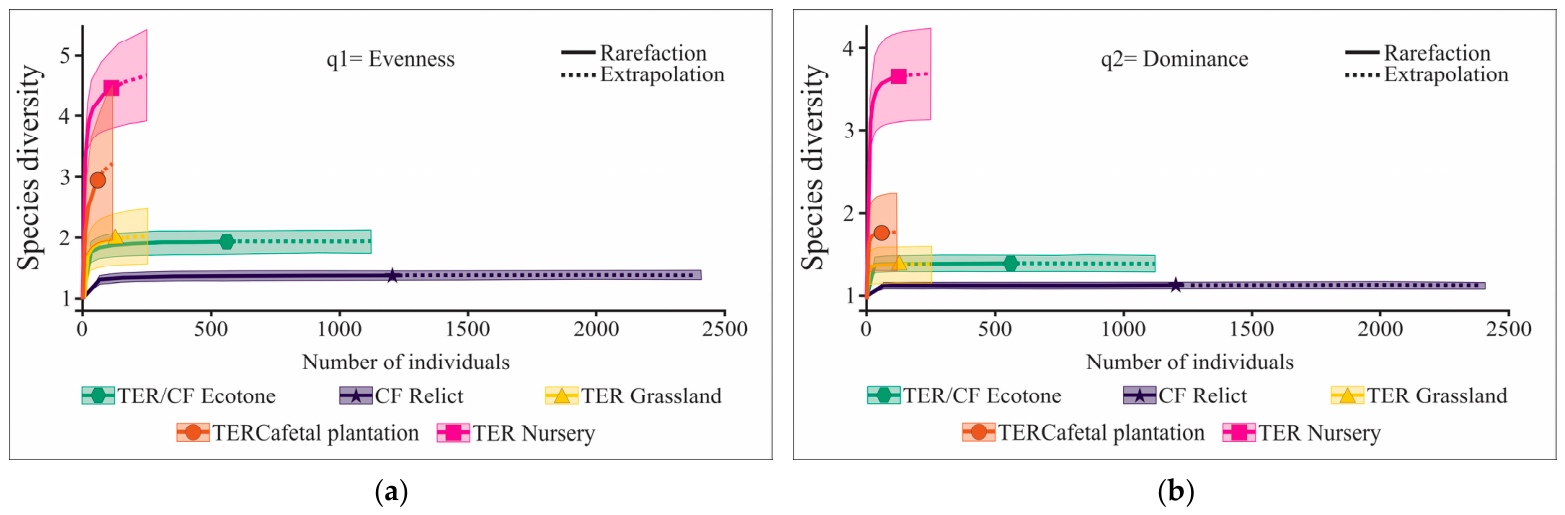
Despite this relative similarity in richness, patterns of abundance distribution differed among sites. Effective diversity based on evenness (q1) differed among sampling sites (Figure 6a). The TER Nursery site exhibited the highest values, approaching 4–5 effective species under rarefaction and extrapolation, indicating a comparatively more equitable distribution of individuals among species. In contrast, the CF Relict site showed the lowest evenness values (approximately 1.3–1.4 effective species), consistent with a strong concentration of individuals in a single species. The TER Cafetal plantation displayed intermediate evenness (around three effective species), whereas the TER/CF Ecotone and TER Grassland sites showed lower and similar values (approximately 1.8–2.0 effective species). Differences among sites were evaluated by visually comparing 95% confidence intervals derived from rarefaction/extrapolation curves, considering non-overlap as indicative of potential differences among assemblages, revealed clear separation between TER Nursery and CF Relict, while partial overlap among the remaining sites suggests more moderate differences in evenness.
Effective species diversity based on dominance (q2) differed among sampling sites (Figure 6b). The TER Nursery exhibited the highest effective number of dominant species, approaching four equally abundant species under rarefaction and extrapolation, whereas the CF Relict site showed values close to one effective species, reflecting the overwhelming numerical dominance of Xyleborus affinis. The TER/CF Ecotone and TER Grassland displayed intermediate values (approximately 1.3–1.5 effective species), while the TER Cafetal plantation reached slightly higher levels (around 1.8 effective species).
Visual comparison of 95% confidence intervals revealed no overlap between TER Nursery and CF Relict, supporting a strong contrast in dominance structure between these habitats. Overall, dominance patterns indicate greater abundance concentration in the cloud forest and a more equitable distribution of dominant species in the altered tropical evergreen rainforest sites.

3.4. Beta Diversity

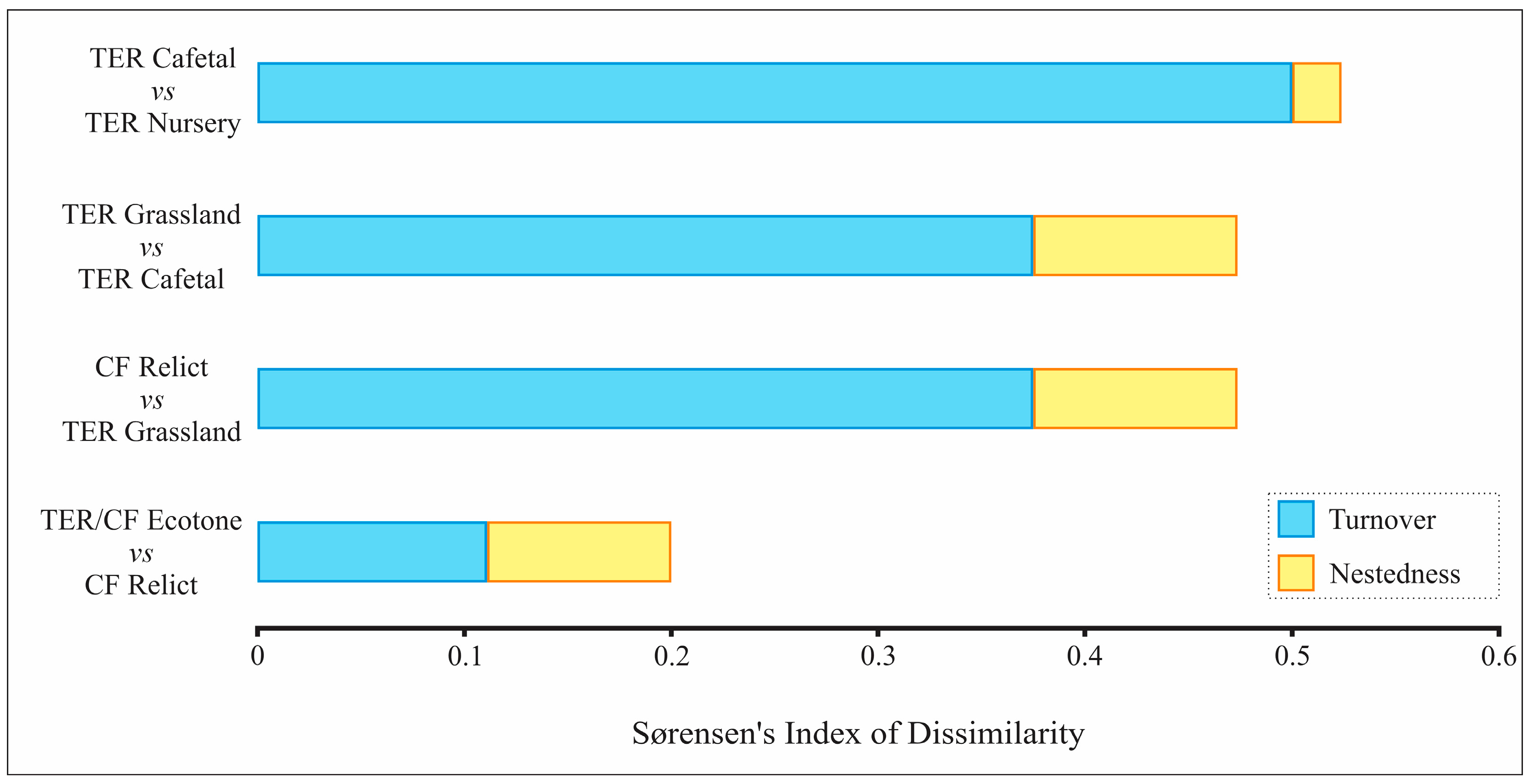
The total dissimilarity (beta diversity), based on the presence or absence of species (Sorensen index), was average among the five sampling sites (βsor = 58%) and was mainly due to species turnover (βsim = 53%), with a minor contribution from nestedness (βnes = 5%). In comparisons between sites, dissimilarity ranged from low to medium: (βsor = 20%) between ecotone tropical evergreen forest/cloud forest versus cloud forest relict (TER/CF Ecotone vs. CF Relict); the highest dissimilarity was observed between cloud forest relict and tropical evergreen forest/nurseries (βsor = 52%), as well as between tropical evergreen forest/nurseries and tropical evergreen forest/coffee plantation (βsor = 52%) (Figure 7). At all sites, dissimilarity was primarily attributed to changes in species composition. These results indicate that compositional differences among sites were mainly attributable to species replacement rather than progressive species loss along the altitudinal gradient.

4. Discussion

This study provides the first systematic assessment of Scolytinae diversity in the Sierra Norte de Puebla, a region historically underrepresented. While the neighboring Sierra Nororiental reports 49 species of Scolytinae, only 11 were previously documented for the Sierra Norte [39]. This disparity is likely driven by their distinct biogeographic affinities—the Sierra Madre Oriental versus the Veracruzana province [32]. Our findings significantly address this knowledge gap, as 15 of the species reported here constitute first records for the region (Table A1). However, these captures represent only a small fraction of the 175 species known for the state [39], primarily based on the work of Wood [14] and Atkinson and Equihua [47], with additional sporadic records from more recent studies [29,48,49,50]. Given that Puebla lies at the convergence of five biogeographic provinces [32], the documented richness remains low, underscoring the need for increased sampling effort in these heterogeneous montane systems beyond single-trap surveys.
Species composition was dominated by generalist ambrosia beetles belonging to the tribes Corthylini and Xyleborini, which are two of the most numerous and abundant groups within Scolytinae. The Xyleborini tribe is globally distributed throughout tropical and subtropical regions [51] and includes widespread species such as X. affinis, X. ferrugineus (Fabricius), X. perforans Wood and Bright, 1992, and X. volvulus (Fabricius, 1775) [52]. The first two of these species were recorded in this study. The overwhelming dominance of Xyleborus affinis and other widespread Xyleborini suggests that necrotrap sampling likely emphasizes the dispersive and disturbance tolerant component of Scolytinae communities [16,53]. In this context, X. affinis is reported as a species with relatively high abundances, particularly in tropical ecosystems or those with some degree of disturbance in Tabasco and Chiapas [19,21]. Furthermore, the dominance of Xyleborus species, including X. affinis, has been attributed to their high capacity for exploiting available resources, their polyphagy, and their broad distribution [21].
The extreme numerical dominance of Xyleborus affinis (86% of all individuals) likely reduced community evenness and may have masked finer scale ecological differentiation among sites, a common effect when a highly dispersive generalist dominates standardized trap collections. Ethanol-responsive species capable of colonizing stressed hosts are more likely to be detected using this method, whereas host specialized or canopy-restricted taxa may remain undetected [54,55]. Thus, observed diversity patterns likely reflect behavioral filtering imposed by trap chemistry rather than the full community spectrum [56]. In contrast, Corthylini is largely restricted to the Neotropical region [37]. This pattern is reflected in our results, in which this tribe accounted for the highest number of species. However, much of the Neotropical Corthylini fauna remains undescribed, which may partially explain the presence of morphospecies or taxa that could not be confidently assigned to described species in this study [7,56]. This marked dominance likely had a strong influence on diversity metrics, particularly reducing evenness and increasing dominance values across sites. As a result, patterns of community structure should be interpreted with caution, as they may be disproportionately driven by the abundance of this single species rather than reflecting broader assemblage dynamics.
Beyond general diversity patterns, several species recorded in this study provide relevant ecological and biogeographic insights. The extreme dominance of Xyleborus affinis, a widely distributed and highly dispersive species, is consistent with its known association with disturbed environments and its strong attraction to ethanol-based cues. Its prevalence across all sites suggests that it may play a key role in early colonization processes and in shaping community structure under conditions of environmental disturbance.
In contrast, the presence of less abundant species highlights the contribution of rarer or potentially more specialized taxa to regional diversity. Although some species were represented by few individuals, their occurrence suggests that even sampling methods biased toward generalist taxa can capture key elements of the broader community. Additionally, the detection of taxa that may represent new or previously unrecorded species for the region underscores the importance of continued sampling and taxonomic study in the Sierra Norte de Puebla.
The observed richness of 18 species is relatively low compared to inventories from other Mexican regions, such as Tabasco, Michoacán, Chiapas, and the State of Mexico, where between 35 and 74 species have been reported [57,58,59,60]. However, previous studies in Mexico using NTP-80 necrotraps have consistently reported low Scolytinae richness, ranging from 5 to 11 species [26,27,28,29], closely matching our site-level values (8–10 species). This suggests that necrotraps tend to sample only a subset of the local Scolytinae fauna, primarily widespread generalist ambrosia beetles, consequently, rarer or more host-specific species likely to be underrepresented. Lower sampling completeness at some sites (e.g., TER Nursery) suggests that additional species may remain undetected, reinforcing the need for complementary sampling methods. These methodological constraints, including the selective nature of necrotrap sampling and the limited number of traps per site, may influence the observed patterns by emphasizing a subset of the community and reducing the spatial representativeness of samples.
Diversity patterns showed limited variation in richness but clearer differences in abundance structure among sites. The sites where the greatest diversity was observed were the tropical evergreen forest with a coffee plantation (TER Cafetal) and the tropical evergreen forest with nurseries (TER Nursery). These sites also had the highest estimated number of species. Sites that have been modified often exhibit significant alterations to diversity patterns compared to conserved ecosystems [61,62]. In the present study, we found that, although the degree of modification at each site varied greatly, each site had different environmental conditions, including variables such as vegetation type, altitude and degree of conservation. These factors may also explain the differences observed in Scolytinae diversity patterns [18,20]. The relatively homogeneous alpha diversity across sites, despite differences in vegetation type and altitude, suggests that the assemblage detected by necrotraps may represent a functionally similar subset of the regional fauna rather than the full environmental gradient.
It is important to recognize that, although simplification or modification of forests can significantly affect species composition, the same is not necessarily true for diversity. Indeed, there are studies in which changing the plant structure of sites has been shown to maintain or increase Scolytinae diversity, particularly in agroecosystems such as cocoa [19], avocado [57], or coffee cultivation [59]. This finding suggests that Scolytinae diversity may be sustained or even augmented by the incorporation of native species and those specifically associated with crops, given the structural heterogeneity of forests, as plant composition can promote the survival of local fauna [63]. However, on a larger scale, this may result in forest fragmentation and inherently affect the richness and diversity of both potential host species and Scolytinae species. Rojas et al. [64] suggest that fragmentation can have a positive effect on the diversity of exotic species and a negative effect on native species.
In addition to characterizing species richness, abundance and alpha diversity, this study explicitly examined spatial turnover in assemblage composition across heterogeneous vegetation types. Our results revealed that beta diversity was primarily driven by species turnover rather than nestedness, indicating that differences among sites reflect species replacement across the altitudinal gradient rather than a simple loss of species. While alpha diversity patterns appeared relatively homogeneous, beta-diversity analysis revealed substantial species turnover among habitats. However, these patterns should be interpreted with caution, as necrotrap-based sampling likely emphasizes dispersive, ethanol-responsive species. Therefore, the observed turnover may reflect variation within this functional subset of the community rather than the full Scolytinae assemblage.
The predominance of species turnover (βsim) over nestedness (βnes) suggests that differences among sites were primarily driven by species replacement rather than by a progressive loss of species along the altitudinal gradient. Such patterns are characteristic of heterogeneous mountainous landscapes, where sharp environmental transitions promote compositional shifts across relatively short spatial distances [33,34]. High turnover coupled with low nestedness suggests that each site contributes uniquely to regional diversity, reinforcing the importance of environmental filtering and microhabitat differentiation in structuring Scolytinae assemblages. In tropical montane systems, climatic variation, vegetation structure, and host plant availability often vary predictably with elevation, generating mosaic-like patterns of community composition rather than simple richness gradients [33]. The low contribution of nestedness observed here further suggests that assemblages at higher elevations do not merely represent subsets of lowland communities but instead harbor distinct combinations of species. Similar dominance of turnover components has been reported in other insect assemblages across elevational gradients, where spatial replacement reflects localized adaptation, dispersal dynamics, and habitat specialization [30,43].
Despite the filtering effect associated with necrotrap sampling, the observed beta-diversity structure suggests the interpretation that environmental heterogeneity along the altitudinal transect plays a central role in shaping ambrosia beetle community composition in the Sierra Norte de Puebla. This indicates that spatial structuring along the altitudinal gradient is not solely an artifact of trap selectivity but reflects genuine ecological differentiation among sites. The marked contribution of turnover also suggests that conservation strategies in montane landscapes should prioritize habitat mosaics, as each site contributes distinct elements to regional diversity.
Notably, the compositional differences between the Cloud Forest (CF) and Tropical Evergreen Rainforest (TER) were relatively low; the CF yielded only one exclusive species, whereas the TER hosted six of ambrosia beetles. This result appears contradictory, as cloud forests are typically recognized as one of the ecosystems with the highest species richness [10,21]. However, it likely reflects the high sensitivity of montane cloud forests to internal habitat disturbance. Previous research in Mexican montane forests has shown that disturbance within fragments—rather than fragmentation per se—is a primary driver of diversity loss, leading to a marked simplification of community structure [65]. Similar responses have been documented in other insect groups, such as ants, where biodiversity patterns depend more on internal habitat quality and canopy integrity than on fragment size [66]. Such degradation can mask the expected high richness of these ecosystems, as observed in our study.
However, the interpretation of spatial patterns along the altitudinal gradient should be made with caution, as sampling sites differ not only in elevation but also in vegetation type, land use, and degree of disturbance. These factors may act as confounding variables, making it difficult to attribute observed patterns solely to altitude [21].
The relatively low differences in diversity observed among the sites may also be indicative of the sampling method employed. Scolytinae were not the primary target of the necrotrap survey, and their capture was largely incidental, driven by attraction to ethanol and other alcohols used as preservatives in the traps. These compounds have been shown to simulate the volatiles released by stressed or dying trees, which have been demonstrated to act as powerful attractants for bark and ambrosia beetles [53]. However, it must be emphasized that NTP-80 traps are likely to capture predominantly common, generalist ambrosia beetles, which could potentially introduce a bias in the estimates of species richness and community structure; consequently, this selectivity should be considered when interpreting patterns of diversity and community structure.
Historically, most of the knowledge concerning the biodiversity of Scolytinae was derived from direct collections from host plants, which facilitated detailed study of species richness, host associations, and biology [14,35]. Among the most significant contributions are the works of Wood [14], and the intensive sampling by Atkinson and Equihua and collaborators during the 1980s. This approach significantly enriched the understanding of species richness at both national and state levels, as reflected in the vertical increase in the species accumulation curve during that period [35,67]. In contrast, in recent years, a diverse selection of trapping techniques has been developed, including Lindgren funnel traps [55], ethanol-baited bottle traps, and other flight-intercept devices, which have found extensive application in forestry and agricultural systems [24,68,69]. Canopy fogging has also been demonstrated to be a highly effective method for the documentation of tropical Scolytinae diversity [56].
However, most diversity surveys employ a solitary trapping method, a practice which has the potential to severely underestimate true biodiversity, a phenomenon that is especially prevalent in tropical and montane forests. The findings of this study, when considered in conjunction with those of Dole et al. [56], underscore the necessity for integrated sampling protocols that encompass a combination of multiple trapping techniques and direct host sampling. Such an approach is imperative for accurately characterizing Scolytinae communities, improving estimates of alpha and beta diversity, and producing more complete faunal inventories. In montane tropical systems characterized by pronounced environmental heterogeneity, reliance on a single sampling method may obscure both taxonomic richness and patterns of spatial turnover, ultimately limiting our understanding of Scolytinae biogeography and ecosystem functioning.

5. Conclusions

This study suggests that, even when sampling is biased toward a restricted functional subset of the fauna, ambrosia beetle communities in tropical montane landscapes exhibit spatial structuring driven primarily by species turnover. However, these patterns should be interpreted considering the selective nature of necrotrap sampling, which likely captures only a subset of the Scolytinae community. The predominance of turnover over nestedness suggests that differences among sites do not reflect simple gradients of richness loss but rather the replacement of species across habitats, consistent with metacommunity and habitat filtering models in heterogeneous tropical environments. These findings confirm that spatial turnover is a key component structuring ambrosia beetle assemblages across heterogeneous vegetation types in the Sierra Norte de Puebla.
The dominance of widespread generalist Xyleborini, particularly Xyleborus affinis, together with the low representation of rare and host-specialized taxa, reveals that necrotrap-based sampling selectively captures beetles associated with ethanol-mediated host location and opportunistic colonization strategies. This functional filtering provides an implicit view of the dispersive and disturbance adapted component of Scolytinae communities, which appears to be broadly distributed across vegetation types but reorganized through turnover along environmental gradients.

Author Contributions

Conceptualization, R.J.C.-L. and M.P.-S.; methodology, J.A.A.-S. and M.P.C.-G.; validation, F.A.-T. and G.C.-R.; formal analysis, M.P.-S. and R.J.C.-L.; investigation, J.A.A.-S., M.P.-S. and R.J.C.-L.; resources, R.J.C.-L., J.A.A.-S., M.P.C.-G., F.A.-T., O.V.-M., G.C.-R. and M.P.-S.; data curation, M.P.-S.; writing—original draft preparation, R.J.C.-L. and M.P.-S.; writing—review and editing, O.V.-M., F.A.-T., M.P.C.-G. and G.C.-R.; visualization, O.V.-M. and M.P.-S.; supervision, M.P.-S. and F.A.-T.; project administration, J.A.A.-S.; funding acquisition, R.J.C.-L., J.A.A.-S., M.P.C.-G., F.A.-T., O.V.-M., G.C.-R. and M.P.-S. All authors have read and agreed to the published version of the manuscript.

Funding

The present research is funded by SECIHTI through PRONAII-2024-3 “Documentación sistematizada de la riqueza biótica de México para la generación de conocimiento científico y la promoción de su apropiación social”.

Data Availability Statement

The original contributions presented in the study are included in the article, further inquiries can be directed to the corresponding author.

Acknowledgments

The authors would like to express their gratitude to the local communities, proprietors of the sites, and administrative bodies that facilitated access to the study locations and the provision of the necessary facilities for the execution of this research. Special thanks to Andrea B. Cervantes Martinez for her support in translating the manuscript in the early stages. This research was supported by SECIHTI through the award of postdoctoral fellowships to M.P.-S. (CVU 493511), R.J.C.-L. (CVU 631403) and O.V.-M. (439918).

Conflicts of Interest

The authors declare no conflicts of interest.

Appendix A

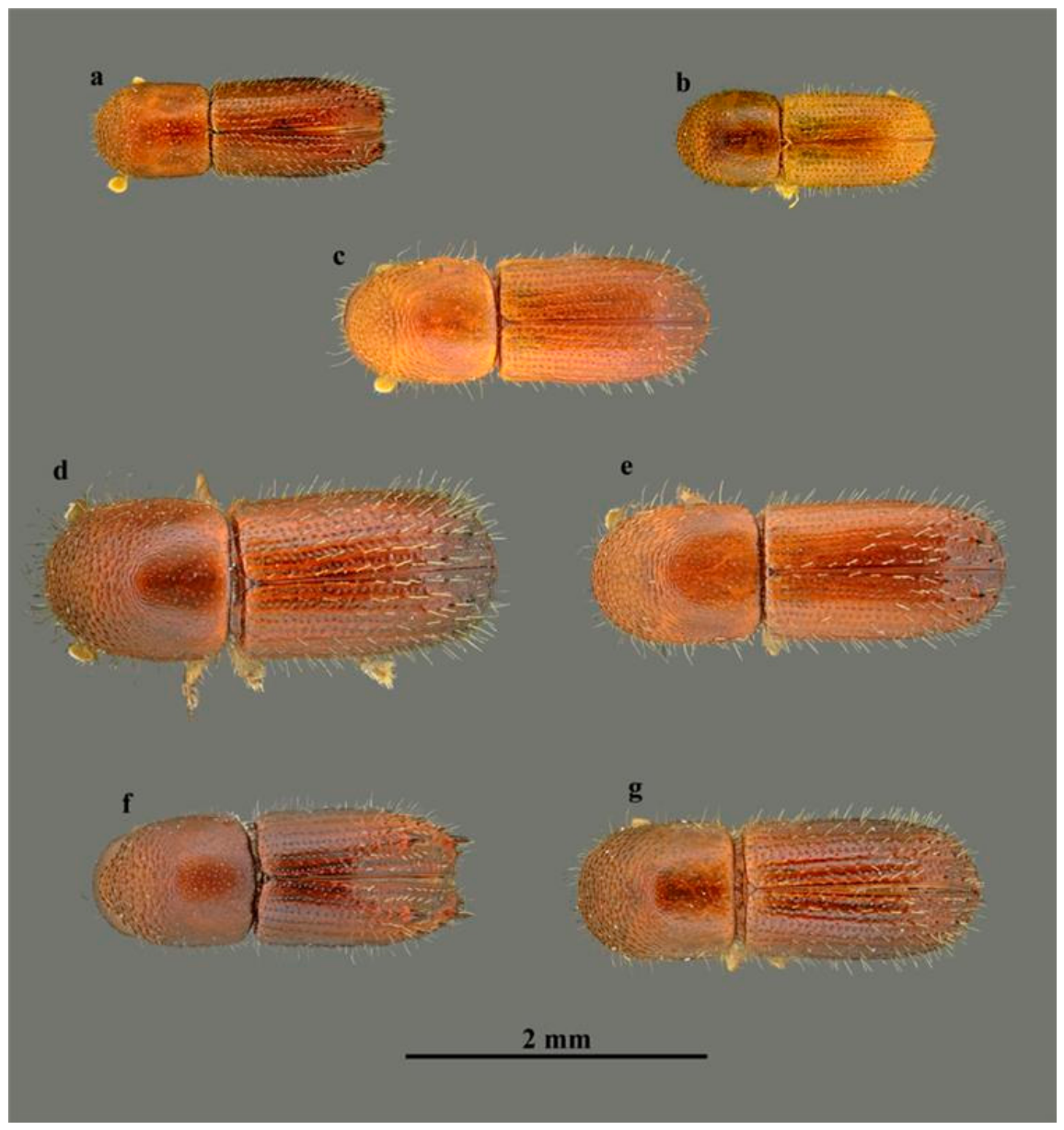
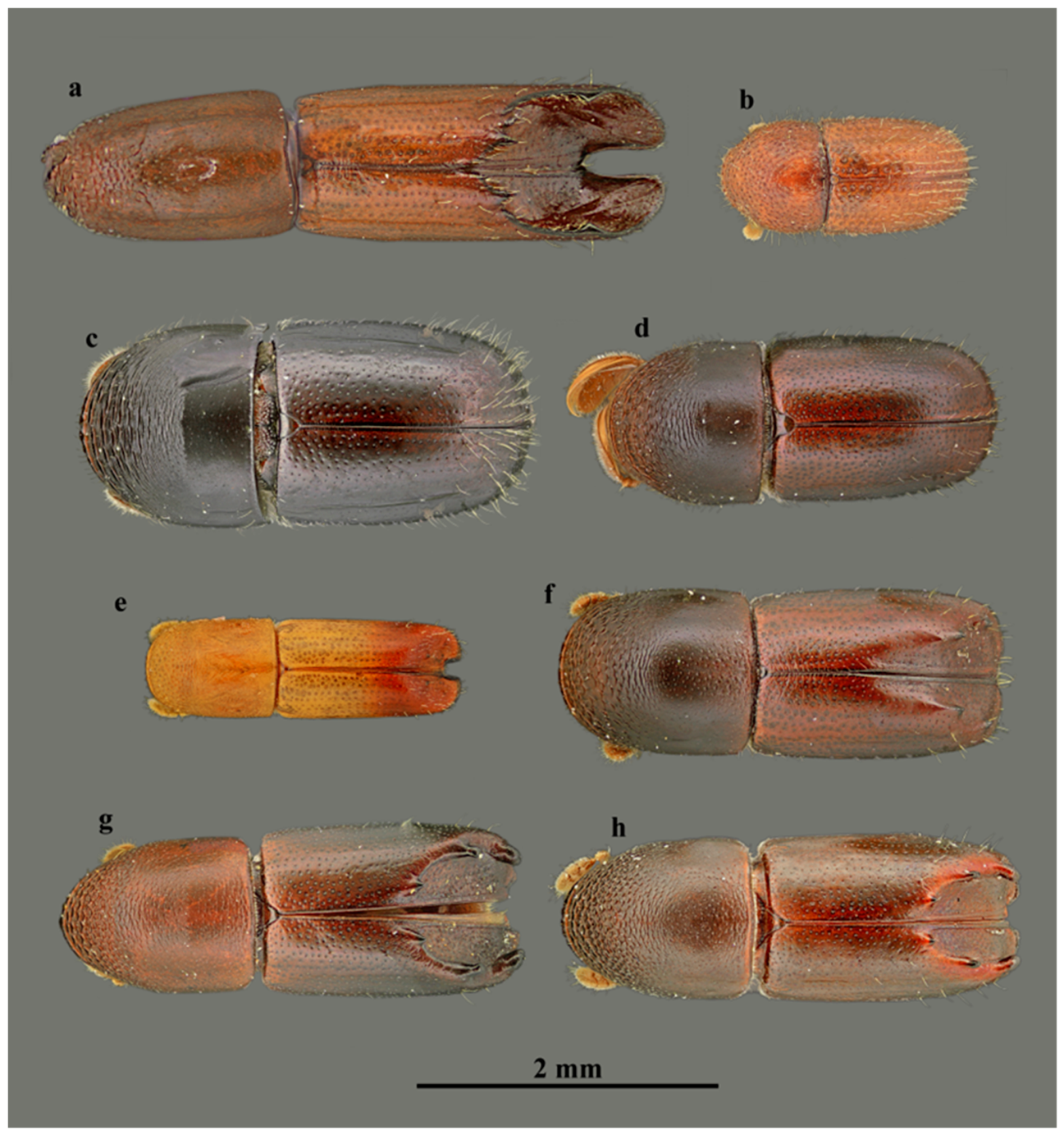
Figure A1. Dorsal view of species from the Dryocoetini and Corthylini tribes collected in NTP-80 type traps. (a) Amphicranus torneutes, (b) Cocotrypes carpophagus, (c) Corthylus consimilis, (d) Corthylus comatus, (e) Monarthrum exornatum, (f) Monarthrum robustum, (g) Tricolus frontalis and (h) Tricolus ovicollis.
Diversity 18 00264 g0a1
Figure A2. Dorsal view of species from the Xyleborini tribe collected in NTP-80 type traps. (a) Xyleborinus gracilis, (b) Xyleborinus intersetosus, (c) Xyleborus affinis, (d) Xyleborus bispinatus, (e) Xyleborus ferrugineus, (f) Xyleborus spinulosus, and (g) Xyleborus torquatus.
Diversity 18 00264 g0a2
Table A1. Checklist of Scolytinae species recorded in the Sierra Norte de Puebla from both historical literature and the present study.
TribeSpecies
Corthylini: CorthylinaAmphicranus torneutes Blandford *
Corthylus mexicanus Schedl
Corthylus comatus Blandford *
Corthylus consimilis Wood *
Glochinocerus gemellus Blandford
Monarthrum exornatum (Schedl) *
Monarthrum robustum (Schedl) *
Tricolus ovicollis Blandford *
Tricolus frontalis Wood *
Corthylini: PityphthorinaConophthorus mexicanus Wood §
Pityophthorus festus Wood §
Pseudopityophthorus pruinosus (Eichhoff) §
DryocoetiniCocotrypes carpophagus (Hornung) *
HylugininiHylurgops planirostris (Chapuis) §
Hylocurus nodulus Wood
ScolytiniScolytus mundus Wood §
TrypophloeiniHypothenemus seriatus (Eichhoff) †§
XyleboriniAmbrosiodmus rugicollis (Blandford) §
Ambrosiodmus coffeiceus (Schedl) *
Xyleborinus gracilis (Eichhoff) *
Xyleborinus intersetosus (Blandford) *
Xyleborus affinis Eichhoff *
Xyleborus bispinatus Eichhoff *
Xyleborus ferrugineus (Fabricius) *
Xyleborus spinulosus Blandford *
Xyleborus torquatus Eichhoff *
* Recorded in the present study. Record obtained from Wood [14]. § Record obtained from Wood [39].

References

  1. Johnson, A.J.; Atkinson, T.H.; Beaver, R.A.; Cognato, A.I.; Jordal, B.H.; Knížek, M.; Mandelshtam, M.Y.; Rabaglia, R.J.; Smith, S.M.; Hulcr, J. A comprehensive taxonomic checklist of bark and ambrosia beetle species (Curculionidae, Scolytinae). ZooKeys 2026, 1271, 1–285. [Google Scholar] [CrossRef]
  2. Alonso-Zarazaga, M.A.; Barrios, H.; Borovec, R.; Bouchard, P.; Caldara, R.; Colonnelli, E.; Gültekin, L.; Hlaváč, P.; Korotyaev, B.; Lyal, C.H.C.; et al. Cooperative Catalogue of Palaearctic Coleoptera Curculionoidea, 2nd ed.; Monografías Electrónicas S.E.A.: Zaragoza, Spain, 2017; Volume 14, 780p. [Google Scholar]
  3. Jordal, B.H.; Smith, S.M.; Cognato, A.I. Classification of weevils as a data-driven science: Leaving opinion behind. ZooKeys 2014, 439, 1–18. [Google Scholar] [CrossRef]
  4. Mokrzycki, T.; Hilszczański, J.; Borowski, J.; Cieślak, R.; Mazur, A.; Miłkowski, M.; Szołtys, H. Faunistic review of Polish Platypodinae and Scolytinae (Coleoptera: Curculionidae). Pol. J. Entomol. 2011, 80, 343–364. [Google Scholar] [CrossRef]
  5. Beaver, R.A.; Sittichaya, W.; Liu, L.Y. A synopsis of the Scolytine ambrosia beetles of Thailand (Coleoptera: Curculionidae: Scolytinae). Zootaxa 2014, 3875, 1–82. [Google Scholar] [CrossRef] [PubMed]
  6. Nel, W.J.; Duong, T.A.; Fell, S.; Herron, D.A.; Paap, T.; Wingfield, M.J.; de Beer, Z.W.; Hulcr, J.; Johnson, A.J. A checklist of South African bark and ambrosia beetles (Coleoptera: Curculionidae: Scolytinae, Platypodinae). Zootaxa 2025, 5648, 1–101. [Google Scholar] [CrossRef] [PubMed]
  7. Smith, S.M.; Petrov, A.V.; Cognato, A.I. Beetles (Coleoptera) of Peru: A survey of the families. Curculionidae: Scolytinae. Coleopt. Bull. 2017, 71, 77–94. [Google Scholar] [CrossRef]
  8. Gómez, D.F.; Johnson, A.J.; De Grammont, P.C.; Alfonso-Simonetti, J.; Montaigne, J.; Elizondo, A.I.; Muiño, B.L.; Ojeda, D.; Vidal, J.; Hulcr, J. New records of bark and ambrosia beetles (Coleoptera: Scolytinae) from Cuba with description of a new species. Fla. Entomol. 2020, 102, 717–724. [Google Scholar] [CrossRef]
  9. Córdoba, S.P.; Atkinson, T.H.; Mendoza, E.A. Listado preliminar de Scolytinae (Coleoptera: Curculionidae) de la provincia de Tucumán (adiciones y correcciones) y sus plantas hospedantes de Argentina. Dugesiana 2025, 32, 13–38. [Google Scholar] [CrossRef]
  10. Falcón-Brindis, A.; Pérez-De La Cruz, M.; Mata-Zayas, E.E.; Cruz-Pérez, A.D.L.; Sánchez-Soto, S.; Burelo-Ramos, C.M. Scolytinae y Platypodinae (Coleoptera: Curculionidae) de Tabasco, México. Acta Zool. Mex. 2018, 34, 1–12. [Google Scholar] [CrossRef]
  11. Atkinson, T.H.; Ibarra, J.L.A. Corrections and additions to the checklist of bark and ambrosia beetles (Coleoptera: Curculionidae: Scolytinae, Platypodinae) of mesic montane forest in Xalapa, Veracruz, México. Coleopt. Bull. 2021, 75, 227–239. [Google Scholar] [CrossRef]
  12. Fernández-García, J.A.; Marrufo-Madrid, R.; Equihua-Martínez, A.; Estrada-Venegas, E.G.; Segura-León, O. Nuevos registros de Scolytinae (Coleoptera: Curculionidae) en bosques templados de Durango. Acta Zool. Mex. 2023, 39, 1–15. [Google Scholar] [CrossRef]
  13. Raffa, K.F.; Grégoire, J.C.; Lindgren, B.S. Natural History and Ecology of Bark Beetles. In Bark Beetles: Biology and Ecology of Native and Invasive Species; Vega, F.E., Hofstetter, R.W., Eds.; Academic Press: New York, NY, USA, 2015; pp. 1–40. [Google Scholar]
  14. Wood, S.L. The Bark and Ambrosia Beetles of North and Central America (Coleoptera: Scolytinae), a Taxonomic Monograph; Great Basin Naturalist Memoirs: Provo, UT, USA, 1982; pp. 1–1356. [Google Scholar]
  15. Farrell, B.D.; Sequeira, A.S.; O’Meara, B.C.; Normark, B.B.; Chung, J.H.; Jordal, B.H. The evolution of agriculture in beetles (Curculionidae: Scolytinae and Platypodinae). Evolution 2001, 55, 2011–2027. [Google Scholar] [CrossRef]
  16. Hulcr, J.; Stelinski, L.L. The ambrosia symbiosis: From evolutionary ecology to practical management. Annu. Rev. Entomol. 2017, 62, 285–303. [Google Scholar] [CrossRef]
  17. Johnson, A.J.; McKenna, D.D.; Jordal, B.H.; Cognato, A.I.; Smith, S.M.; Lemmon, A.R.; Lemmon, E.M.; Hulcr, J. Phylogenomics clarifies repeated evolutionary origins of inbreeding and fungus farming in bark beetles (Curculionidae, Scolytinae). Mol. Phylogenetics Evol. 2018, 127, 229–238. [Google Scholar] [CrossRef]
  18. Martínez, M.; Cognato, A.I.; Guachambala, M.; Boivin, T. Bark and Ambrosia Beetle (Coleoptera: Curculionidae: Scolytinae) Diversity in Natural and Plantation Forests in Ecuador. Environ. Entomol. 2019, 48, 603–613. [Google Scholar] [CrossRef]
  19. Pérez-De la Cruz, M.; Equihua-Martínez, A.; Romero-Nápoles, J.; Sánchez-Soto, S.; García-López, E. Diversidad, fluctuación poblacional y plantas huésped de escolitinos (Coleoptera: Curculionidae) asociados con el agroecosistema cacao en Tabasco, México. Rev. Mex. Biodivers. 2009, 80, 779–791. [Google Scholar] [CrossRef]
  20. Dong, Y.; Shepherd, S.; Stork, N.E.; Johnson, A.J.; Smith, S.M.; Wardhaugh, C.; Beaver, R.A.; Hulcr, J. Scolytine beetle diversity along an altitudinal gradient in Papua New Guinea. Insect Conserv. Divers. 2025, 18, 552–566. [Google Scholar] [CrossRef]
  21. Pérez-Silva, M.; Cancino-López, R.J.; Dueñas-Cedillo, A.; Contreras-Ramos, A.; Armendáriz-Toledano, F. Elevational Gradients as Natural Filters: Assemblage Structure and Diversity of Ambrosia Beetles (Curculionidae: Scolytinae) on the Tacaná Volcano, Chiapas, Mexico. Diversity 2026, 18, 212. [Google Scholar] [CrossRef]
  22. Kuhns, E.H.; Martini, X.; Tribuiani, Y.; Coy, M.; Gibbard, C.; Peña, J.; Hulcr, J.; Stelinski, L.L. Eucalyptol is an Attractant of the Redbay Ambrosia Beetle, Xyleborus glabratus. J. Chem. Ecol. 2014, 40, 355–362. [Google Scholar] [CrossRef]
  23. Martini, X.; Hughes, M.A.; Smith, J.A.; Stelinski, L.L. Attraction of Redbay Ambrosia Beetle, Xyleborus glabratus, to leaf volatiles of its host plants in North America. J. Chem. Ecol. 2015, 41, 613–621. [Google Scholar] [CrossRef]
  24. Steininger, M.S.; Hulcr, J.; Sigut, M.; Lucky, A. Simple and Efficient Trap for Bark and ambrosia beetles (Coleoptera: Curculionidae) to facilitate Invasive species monitoring and citizen involvement. J. Econ. Entomol. 2015, 108, 1115–1123. [Google Scholar] [CrossRef] [PubMed]
  25. Morón, M.A.; Terrón, R.A. Distribución altitudinal y estacional de los insectos necrófilos en la Sierra Norte de Hidalgo, México. Acta Zool. Mex. 1984, 3, 1–47. [Google Scholar] [CrossRef]
  26. Equihua Martínez, A. Coleópteros Scolytidae atraídos a trampas NTP-80 en el área norte de la reserva de la biosfera “Sian Ka’an”, Quintana Roo, México. Folia Entomol. Mex. 1988, 74, 179–180. [Google Scholar]
  27. Equihua Martínez, A. Coleópteros Scolytidae atraídos a trampas NTP-80 en el Soconusco, Chiapas, México. Folia Entomol. Mex. 1992, 84, 55–66. [Google Scholar]
  28. Burgos-Solorio, A. Escarabajos barrenadores Platypodidae y Scolytidae (Coleoptera) atraídos a trampas NTP-80 de la cañada de los alrededores de San José de los Laureles, Tlayacapan, Morelos, México. Dugesiana 1998, 5, 29–34. [Google Scholar]
  29. Quezada-García, R.; Jiménez-Sánchez, E.; Equihua-Martínez, A.; Padilla-Ramírez, J. Escolitinos y platipodinos (Coleoptera: Curculionidae) atraídos a trampas tipo NTP-80 en Zapotitlán de las Salinas, Puebla, México. Acta Zool. Mex. 2014, 30, 625–636. [Google Scholar] [CrossRef][Green Version]
  30. Ulrich, W.; Zalewski, M.; Komosiński, K. Diversity of carrion visiting beetles at rural and urban sites. Community Ecol. 2007, 8, 173–187. [Google Scholar] [CrossRef]
  31. Caballero, U.; León-Cortés, J.L. High diversity beetle assemblages attracted to carrion and dung in threatened tropical oak forests in Southern Mexico. J. Insect Conserv. 2012, 16, 537–547. [Google Scholar] [CrossRef]
  32. Morrone, J.J.; Escalante, T.; Rodríguez-Tapia, G. Mexican biogeographic provinces: Map and shapefiles. Zootaxa 2017, 4277, 277–279. [Google Scholar] [CrossRef]
  33. Rahbek, C.; Borregaard, M.K.; Antonelli, A.; Colwell, R.K.; Holt, B.G.; Nogues-Bravo, D.; Rasmussen, C.M.Ø.; Richardson, K.; Rosing, M.T.; Fjeldså, J. Building mountain biodiversity: Geo-logical and evolutionary processes. Science 2019, 365, 1114–1119. [Google Scholar] [CrossRef]
  34. Qian, H.; Ricklefs, R.E. A latitudinal gradient in large-scale beta diversity for vascular plants in North America. Ecol. Lett. 2007, 10, 737–744. [Google Scholar] [CrossRef]
  35. Atkinson, T.H. Estado de conocimiento de la taxonomía de los escarabajos descortezadores y ambrosiales de México (Coleoptera: Curculionidae: Scolytinae). In Memorias del XVI Simposio Nacional de Parasitología Forestal; CONAFOR: Cuernavaca, Mexico; Universidad Autónoma de Morelos: Cuernavaca, Mexico, 2013; pp. 13–27. [Google Scholar]
  36. Compendio de Información Geográfica Municipal 2010. Zihuateutla, Puebla. Available online: https://www.inegi.org.mx/contenidos/app/mexicocifras/datos_geograficos/21/21213.pdf (accessed on 20 January 2026).
  37. Wood, S.L. Bark and Ambrosia Beetles of South America (Coleoptera: Scolytidae); Brigham Young University: Provo, UT, USA, 2007. [Google Scholar]
  38. Pérez-Silva, M.; Equihua-Martínez, A.; Atkinson, T.H.; Romero-Nápoles, J.; López-Buenfil, J.A. Claves ilustradas para la identificación de géneros y especies de la tribu Xyleborini (Curculionidae: Scolytinae) de México. Rev. Mex. Biodivers. 2021, 92, e923817. [Google Scholar] [CrossRef]
  39. Atkinson, T.H. Bark and Ambrosia Beetles. Available online: https://www.barkbeetles.info/about.php (accessed on 17 March 2026).
  40. Colwell, R.K. EstimateS, Version 9.1.0; Statistical Estimation of Species Richness and Shared Species from Samples; University of Connecticut: Storrs, CT, USA, 2013. [Google Scholar]
  41. Chao, A.; Ma, K.H.; Hsieh, T.C. iNEXT Online: Software for Interpolation and Extrapolation of Species Diversity. Program and User’s Guide 2016. Available online: http://chao.stat.nthu.edu.tw/wordpress/software_download/inext-online/ (accessed on 10 December 2025).
  42. Jost, L. Entropy and diversity. Oikos 2006, 113, 363–375. [Google Scholar] [CrossRef]
  43. Baselga, A. Partitioning the turnover and nestedness components of beta diversity. Glob. Ecol. Biogeogr. 2010, 19, 134–143. [Google Scholar] [CrossRef]
  44. Baselga, A.; Orme, C.D.L. betapart: An R package for the study of beta diversity. Methods Ecol. Evol. 2012, 3, 808–812. [Google Scholar] [CrossRef]
  45. Perillo, L.N.; Neves, F.D.S.; Antonini, Y.; Martins, R.P. Compositional changes in bee and wasp communities along Neotropical Mountain altitudinal gradient. PLoS ONE 2017, 12, e0182054. [Google Scholar] [CrossRef]
  46. Cancino-López, R.J.; Moreno, C.E.; Contreras-Ramos, A. Diversity of Lacewings (Neuroptera) in an Altitudinal Gradient of the Tacaná Volcano, Southern Mexico. Insects 2022, 13, 652. [Google Scholar] [CrossRef]
  47. Atkinson, T.H.; Equihua-Martínez, A. Lista comentada de los coleópteros Scolytidae y Platypodidae del Valle de México. Folia Entomol. Mex. 1985, 65, 63–108. [Google Scholar]
  48. Pérez-Silva, M.; Equihua-Martínez, A.; Romero-Nápoles, J.; Segura-León, O.L.; Atkinson, T.H.; López-Buenfil, J.A.; Chamé-Vázquez, E.R. New distribution and host plant records of xyleborini (Coleoptera: Curculionidae: Scolytinae) in Mexico. Coleopt. Bull. 2020, 74, 860–868. [Google Scholar] [CrossRef]
  49. Equihua-Martínez, A.; Robledo-Martínez, J.D.; Barrera, J.F. The presence of Xylosandrus compactus (Coleoptera: Curculionidae: Scolytinae) in the Sierra Negra of Puebla, Veracruz and Oaxaca, Mexico. Fla. Entomol. 2023, 106, 192–194. [Google Scholar] [CrossRef]
  50. Romero-Nápoles, J.; Atkinson, T.H.; López-Buenfil, J.A. First Record of Two Scolytinae Attacking Cinnamon Trees in Puebla, Mexico. Southwest. Entomol. 2024, 49, 743–746. [Google Scholar] [CrossRef]
  51. Smith, S.M.; Beaver, R.A.; Cognato, A.I. A monograph of the Xyleborini (Coleoptera, Curculionidae, Scolytinae) of the Indochinese peninsula (except Malaysia) and China. ZooKeys 2020, 983, 1–442. [Google Scholar] [CrossRef] [PubMed]
  52. Gohli, J.; Selvarajah, T.; Kirkendall, L.R.; Jordal, B.H. Globally distributed Xyleborus species reveal recurrent intercontinental dispersal in a landscape of ancient worldwide distributions. BMC Evol. Biol. 2016, 16, 37. [Google Scholar] [CrossRef]
  53. Miller, D.R.; Rabaglia, R.J. Ethanol and (−)-α-pinene: Attractant kairomones for bark and ambrosia beetles in the southeastern US. J. Chem. Ecol. 2009, 35, 435–448. [Google Scholar] [CrossRef]
  54. Tobin, K.N.; Lizarraga, S.; Acharya, R.; Barman, A.K.; Short, B.D.; Acebes-Doria, A.L.; Rivera, M.J. Comparison of ethanol-baited trap designs for ambrosia beetles in orchards in the eastern United States. J. Econ. Entomol. 2024, 117, 1476–1484. [Google Scholar] [CrossRef]
  55. Lindgren, B.S.; Borden, J.H.; Chong, L.; Friskie, L.M.; Orr, D.B. Factors influencing the efficiency of pheromone-baited traps for three species of ambrosia beetles (Coleoptera: Scolytidae). Can. Entomol. 1983, 115, 303–313. [Google Scholar] [CrossRef]
  56. Dole, S.A.; Hulcr, J.; Cognato, A.I. Species-rich bark and ambrosia beetle fauna (Coleoptera, Curculionidae, Scolytinae) of the Ecuadorian Amazonian Forest Canopy. In Systematic Zoology and Biodiversity Science: A Tribute to Terry Erwin (1940–2020); Spence, J., Casale, A., Assmann, T., Liebherr, J.K., Penev, L., Eds.; ZooKeys: Sofia, Bulgaria, 2021; pp. 797–813. [Google Scholar]
  57. Lázaro-Dzul, M.O.; Equihua-Martínez, A.; Romero-Nápoles, J.; González-Hernández, H.; Alvarado-Rosales, D.; Macías-Sámano, J.E.; Castañeda-Vildózola, A.C.; Atkinson, T.H. Diversity of Scolytinae (Coleoptera: Curculionidae) at three sites in the central avocado-producing region of Michoacán, Mexico. Coleopt. Bull. 2020, 74, 454–462. [Google Scholar] [CrossRef]
  58. Laureano-Ahuelicán, B.; Romero-Nápoles, J.; González-Hernández, H.; López-Buenfil, J.A.; de Jesús García-Ávila, C.; Equihua-Martínez, A. Diversidad de Scolytinae en Huertos de Aguacate en el Estado de México. Southwest. Entomol. 2022, 47, 691–698. [Google Scholar] [CrossRef]
  59. Aguilar-Castillo, C.E.; Equihua-Martínez, A.; Segura-León, O.L.; Estrada-Venegas, E.G. Diversity of Scolytinae in Coffee Plantations in the Frailesca Region of Chiapas, Mexico. Southwest. Entomol. 2024, 49, 1307–1316. [Google Scholar] [CrossRef]
  60. Álvarez-Ramón, Ó.I.; Pérez-De La Cruz, M.; Gerónimo-Torres, J.D.C.; Cruz-Pérez, A.D.L.; Pozo-Santiago, C.O. Diversidad de Scolytinae y Platypodinae (Coleoptera: Curculionidae) asociados a un agroecosistema de cacao (Theobroma cacao) bajo sol y bajo sombra en Tabasco, México. Acta Zool. Mex. 2025, 41, 1–20. [Google Scholar] [CrossRef]
  61. Etter, A.; McAlpine, C.; Wilson, K.; Phinn, S.; Possingham, H. Regional patterns of agricultural land use and deforestation in Colombia. Agric. Ecosyst. Environ. 2006, 114, 369–386. [Google Scholar] [CrossRef]
  62. Jaramillo-Castillo, D.; Amarillo-Suárez, A.R.; Suarez-Guacaneme, J.F. Efecto de las áreas perturbadas y la precipitación en las redes ecológicas de mariposas (Lepidoptera: Papilionoidea y Hesperoidea) y Angiospermas en Bosque Seco Tropical Colombiano. Caldasia 2023, 45, 98–112. [Google Scholar] [CrossRef]
  63. Castro-Olaya, J.; Chirinos, D.T.; Kondo, T. Scolytines (Coleoptera: Curculionidae: Scolytinae) asociated with cacao monoculture and agroforestry systems. Sarhad J. Agric. 2024, 39, 93–102. [Google Scholar] [CrossRef]
  64. Rojas, I.; Becerra, P.; Galvez, N.; Laker, J.; Bonacic, C.; Hester, A. Relationship between fragmentation, degradation and native and exotic species richness in an Andean temperate forest of Chile. Gayana Bot. 2011, 68, 163–175. [Google Scholar] [CrossRef]
  65. Cayuela, L.; Golicher, D.J.; Rey Benayas, J.M.; González-Espinosa, M.; Ramírez-Marcial, N. Fragmentation, disturbance and tree diversity conservation in tropical montane forests. J. Appl. Ecol. 2006, 43, 1172–1181. [Google Scholar] [CrossRef]
  66. García-Martínez, M.A.; Martínez-Tlapa, D.L.; Pérez-Toledo, G.R.; Quiroz-Robledo, L.N.; Valenzuela-González, J.E. Myrmecofauna (Hymenoptera: Formicidae) response to habitat characteristics of tropical montane cloud forests in central Veracruz, Mexico. Fla. Entomol. 2016, 99, 248–256. [Google Scholar] [CrossRef][Green Version]
  67. Equihua-Martínez, A.; Burgos-Solorio, A. Scolytidae (Coleoptera). In En Biodiversidad, Taxonomía y Biogeografía de Artrópodos de México: Hacia una Síntesis de su Conocimiento; Llorente-Bousquets, J., Morrone, J.J., Eds.; Universidad Nacional Autónoma de México: Ciudad de Mexico, Mexico, 2002; Volume III, pp. 539–557. [Google Scholar]
  68. Macías-Sámano, J.E.; Niño-Domínguez, A. Protocolo para Monitoreo de Descortezadores de Coníferas Mediante el uso de Atrayentes y Semioquímicos para México y Centroamérica; Colegio de la Frontera Sur: San Cristóbal de las Casas, Mexico, 2016; p. 14. [Google Scholar]
  69. Díaz-Ramos, S.G.; Equihua Martínez, A.; Rodríguez Rivas, A.; Valdez Carrasco, J.; Segura-León, O.L.; Atkinson, T.H. Fluctuación de Pityophthorus Eichhoff (Curculionidae: Scolytinae) capturados en trampas cebadas con feromonas en el bosque La Primavera, Jalisco. Acta Zool. Mex. 2016, 32, 296–299. [Google Scholar] [CrossRef][Green Version]
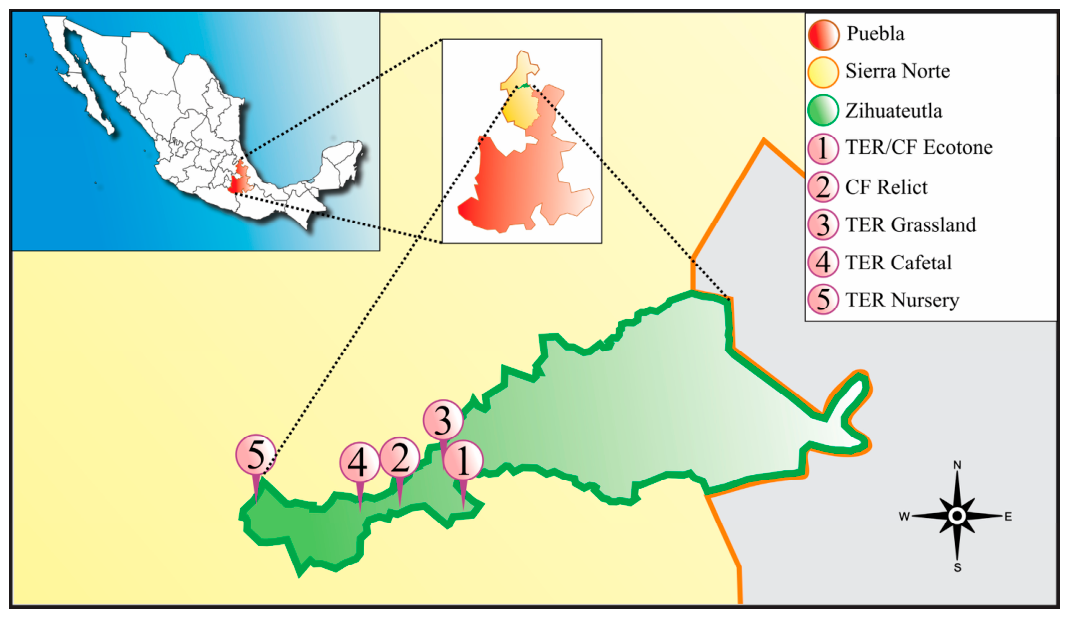
Figure 1. The map shows the five sampling sites in the Zihuateutla municipality, Sierra Norte of Puebla.
Diversity 18 00264 g001
Figure 2. Schematic representation and components of the NTP-80 necrotrap, as originally designed and described by Morón and Terrón [25].
Diversity 18 00264 g002
Figure 3. Rank-abundance curves of Scolytinae species for the different sampling sites. CF: Cloud Forest, TER: Tropical evergreen Rainforest. Species: (A) Xyleborus affinis, (B) Xyleborinus intersetosus, (C) Xyleborus torquatus, (D) Xyleborus ferrugineus, (E) Corthylus consimilis, (F) Xyleborus bispinatus, (G) Xyleborinus gracilis, and (H) Corthylus comatus.
Diversity 18 00264 g003
Figure 4. Richness of Scolytinae species for the different sampling sites in Zihuateutla, collected in NTP-80 type traps. CF: Cloud Forest, TER: Tropical evergreen Rainforest. The shaded areas denote the 95% confidence intervals.
Diversity 18 00264 g004
Figure 5. Accumulation curves of the five sampling sites, S: Number of species observed, ACE: Abundance Coverage Estimator and Chao1: non-parametric richness estimator. CF: Cloud Forest, TER: Tropical evergreen Rainforest.
Diversity 18 00264 g005
Figure 6. Alpha diversity of Scolytinae species for the different sampling sites in Zihuateutla, collected in NTP-80 type traps. CF: Cloud Forest, TER: Tropical evergreen Rainforest: (a) Evenness of Scolytinae species; (b) Dominance of Scolytinae species. The shaded areas denote the 95% confidence intervals. Non-overlapping shaded areas indicate statistically significant differences (p < 0.05) in diversity estimates between assemblages.
Diversity 18 00264 g006
Figure 7. Dissimilarity based on Sørensen’s index of the Scolytinae community in Zihuateutla, collected in NTP-80 type traps. CF: Cloud Forest, TER: Tropical evergreen Rainforest.
Diversity 18 00264 g007
Table 1. Species of the subfamily Scolytinae collected in NTP-80 traps at five locations in Zi-huateutla, Sierra Norte de Puebla. S1: Patla (TER/CF Ecotone), S2: El Pozo (CF Relict), S3: El Albergue (TER Grassland), S4: Cafetal (TER Cafetal plantation) and S5: El Portal (TER Nursery) (CF: Cloud Forest, TER: Tropical evergreen Rainforest).
TribeS1S2S3S4S5Total
Species
Corthylini
Amphicranus torneutes Blandford *000101
Monarthrum exornatum (Schedl)131106
Monarthrum robustum (Schedl)020114
Monarthrum sp.000011
Tricolus ovicollis Blandford 001012
Tricolus frontalis Wood010001
Tricolus sp.000011
Corthylus comatus Blandford 10201215
Corthylus consimilis Wood 521023058
Dryocoetini
Cocotrypes carpophagus (Hornung) *120003
Xyleborini
Ambrosiodmus coffeiceus (Schedl) 000011
Xyleborinus gracilis (Eichhoff)003104
Xyleborinus intersetosus (Blandford)42236350124
Xyleborus affinis Eichhoff474113610844271789
Xyleborus bispinatus Eichhoff3414113
Xyleborus ferrugineus (Fabricius)12401017
Xyleborus spinulosus Blandford 000101
Xyleborus torquatus Eichhoff23850036
Total species9108101018
Total specimens5621204127591252074
* First records of these species in Puebla.
Disclaimer/Publisher’s Note: The statements, opinions and data contained in all publications are solely those of the individual author(s) and contributor(s) and not of MDPI and/or the editor(s). MDPI and/or the editor(s) disclaim responsibility for any injury to people or property resulting from any ideas, methods, instructions or products referred to in the content.