
Helminths of the Pelophylax esculentus Complex (Anura, Amphibia) in the Middle Volga Region (Russia)

 ,
,  ,
,  and
and
Abstract
1. Introduction
2. Materials and Methods
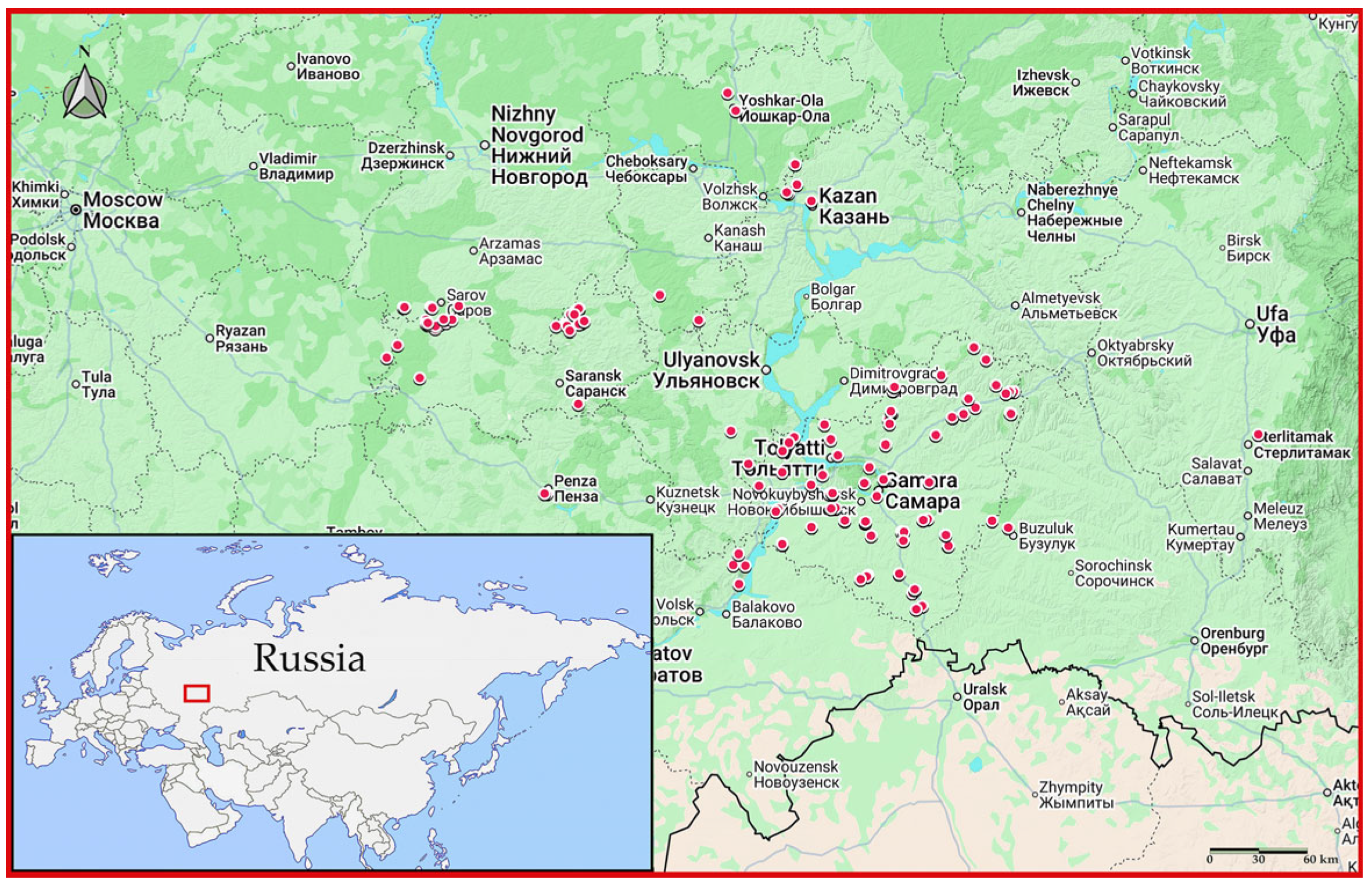
2.1. Study Area
2.2. Description of Parasitological Data
3. Results
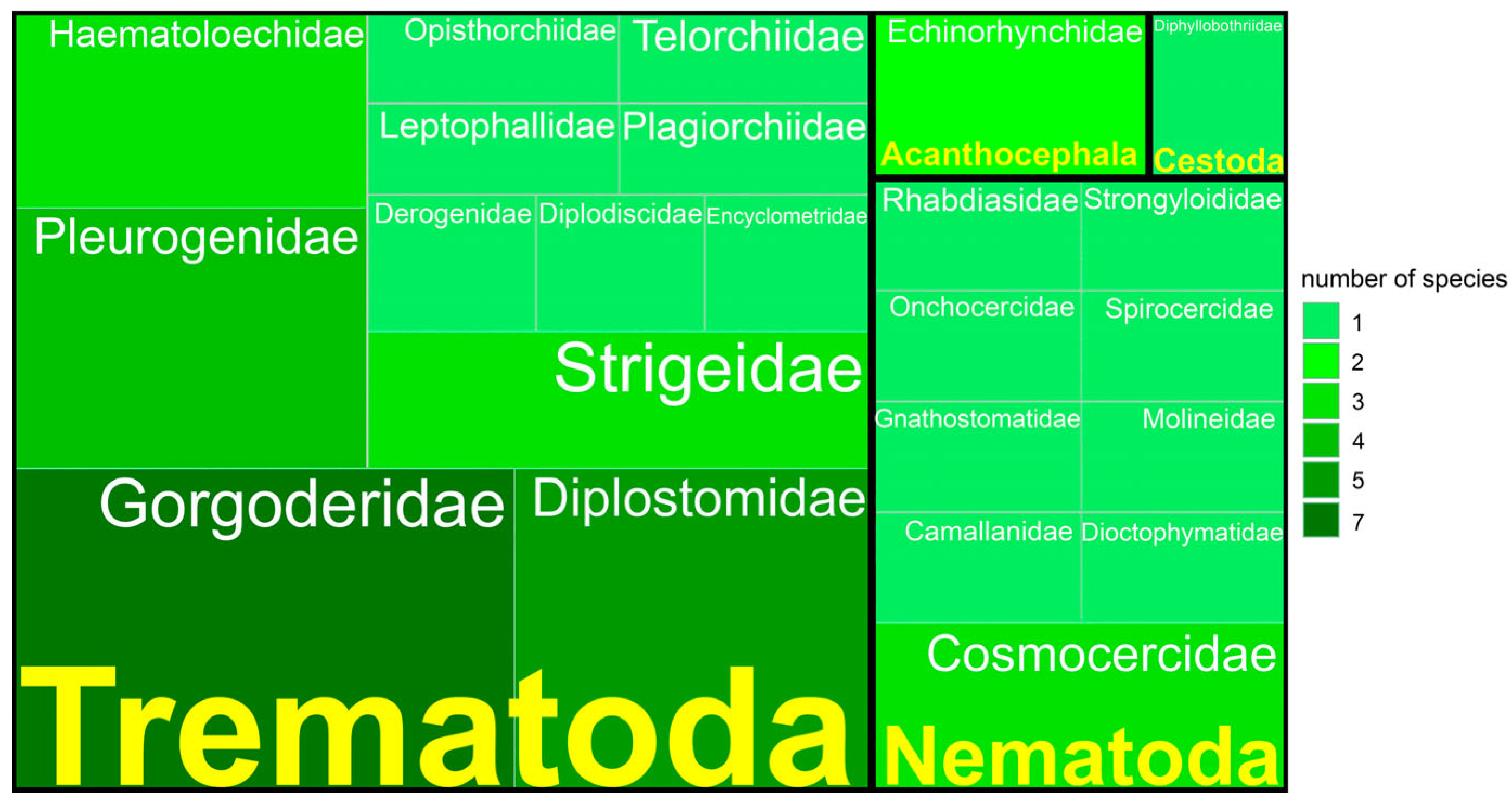
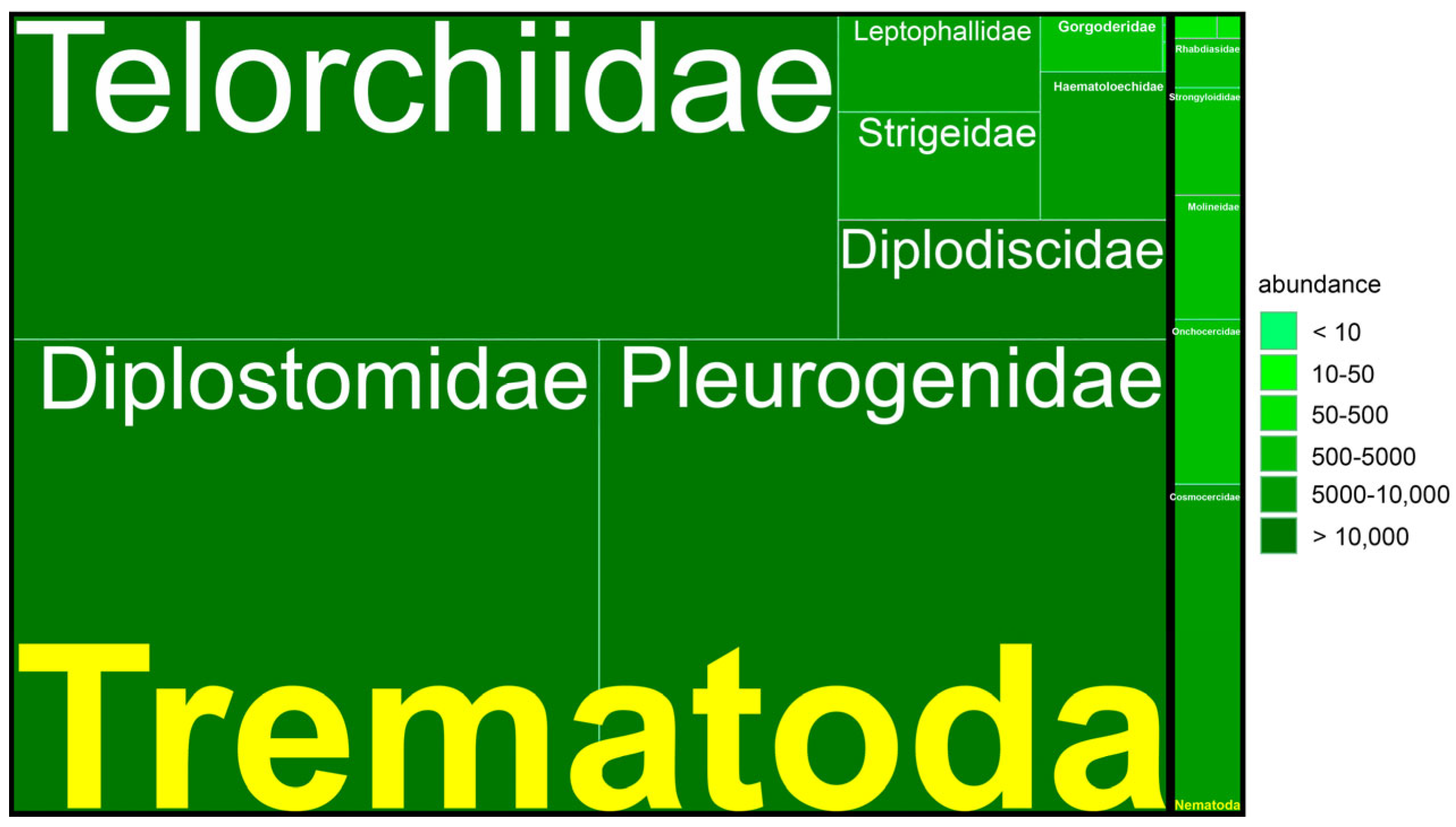
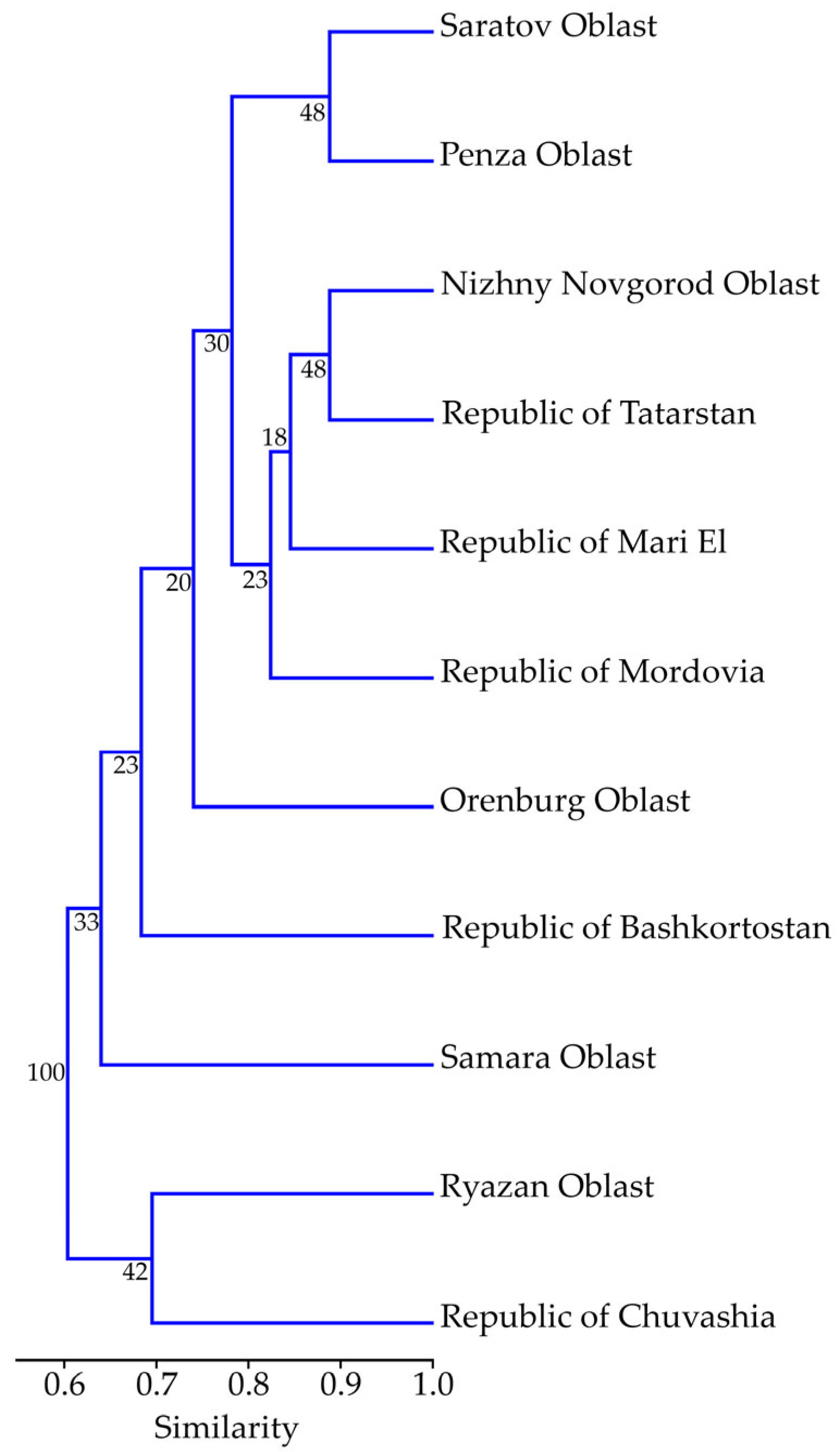
3.1. Structure of Dataset
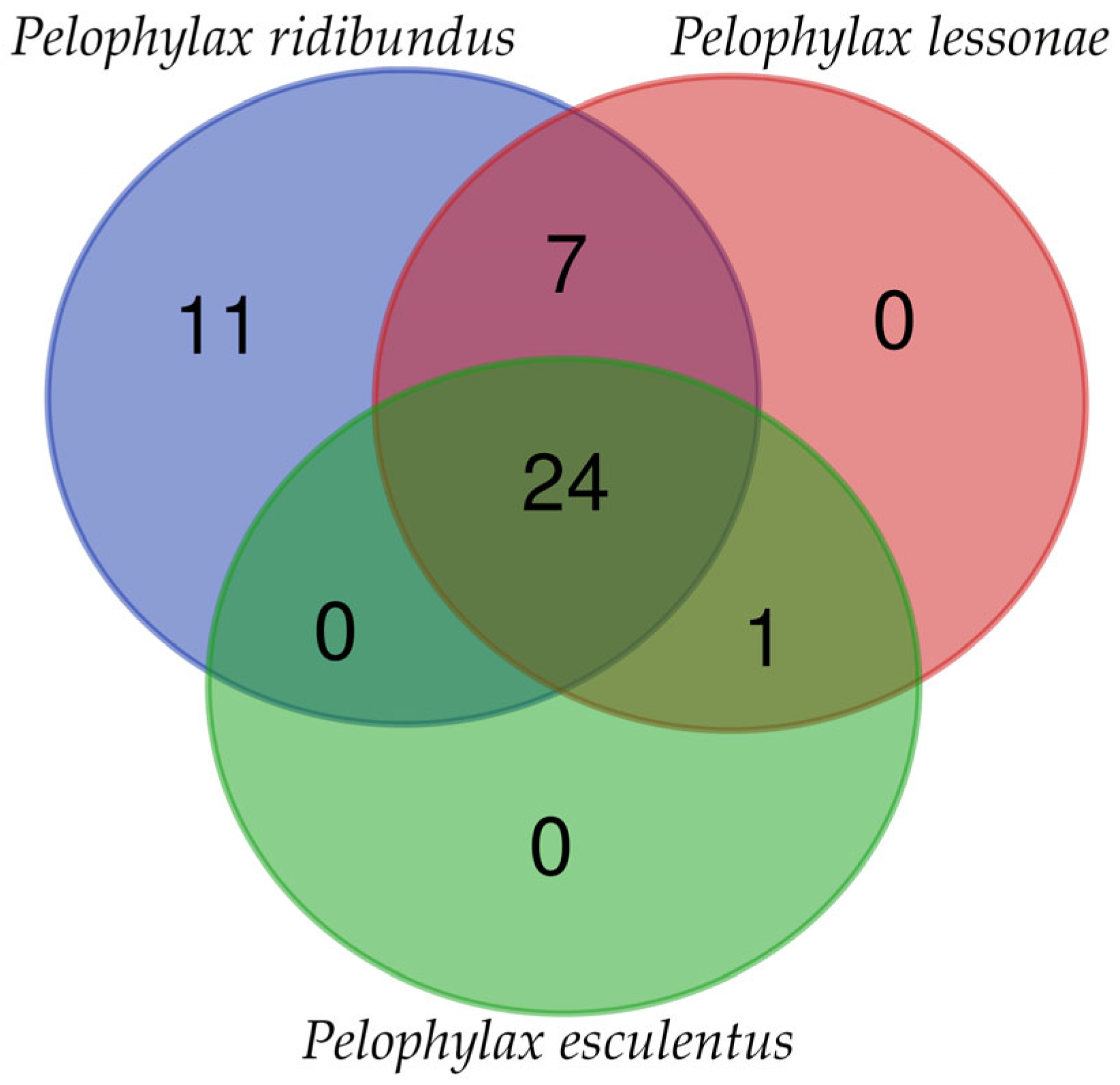
3.2. Dataset Data Description
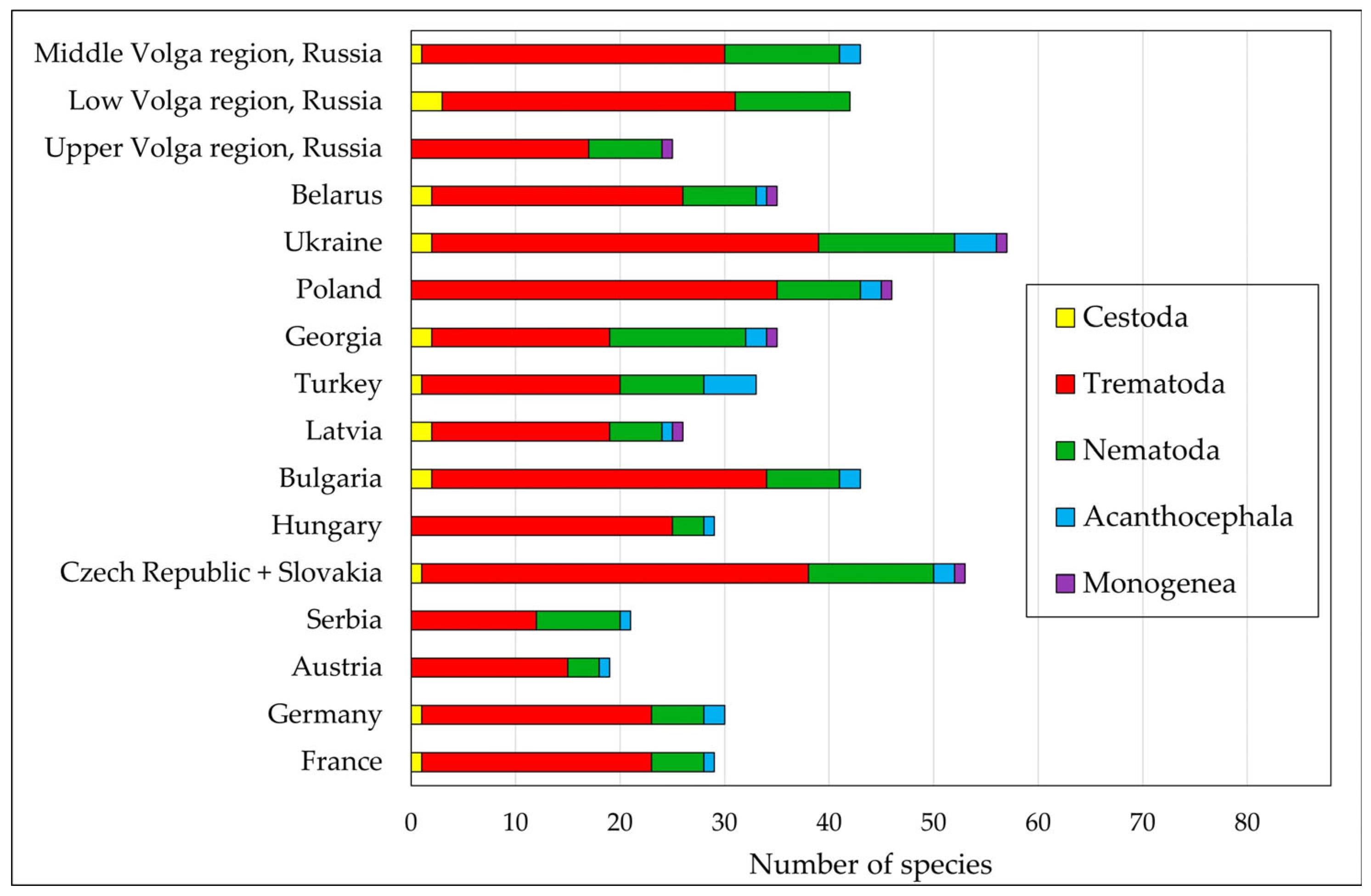
4. Discussion
5. Conclusions
Supplementary Materials
Author Contributions
Funding
Institutional Review Board Statement
Data Availability Statement
Acknowledgments
Conflicts of Interest
Abbreviations
| GBIF | Global Biodiversity Information Facility |
| IEVB RAS | Institute of Ecology of the Volga River basin of the Russian Academy of Sciences |
| msc. | Mesocercaria |
| mtc. | Metacercaria |
| plc. | Plerocercoid |
| juv. | Juvenile |
| UPGMA | Unweighted pair group method with arithmetic mean |
References
- Pough, F.H.; Andrews, R.M.; Cadle, J.E.; Crump, M.L.; Savitsky, A.H.; Wells, K.D. Herpetology, 3rd ed.; Benjamin Cummings: San-Francisco, CA, USA, 2003; pp. 3–736. [Google Scholar]
- Amphibian Ark. Available online: https://www.amphibianark.org/the-crisis/the-importance-of-amphibians/ (accessed on 11 March 2026).
- Duellman, W.E.; Trueb, L. Biology of Amphibians; Johns Hopkins University Press: Baltimore, MD, USA, 1994; pp. 3–670. [Google Scholar]
- Koprivnikar, J.; Marcogliese, D.J.; Rohr, J.R.; Orlofske, S.A.; Raffel, T.R.; Johnson, P.T.J. Macroparasite infections of amphibians: What can they tell us? EcoHealth 2012, 9, 342–360. [Google Scholar] [CrossRef]
- Alford, R.A.; Richards, S.J. Global amphibian declines: A problem in applied ecology. Ann. Rev. Ecol. Syst. 1999, 30, 133–165. [Google Scholar] [CrossRef]
- Houlahan, J.E.; Findlay, C.S.; Schmidt, B.R.; Meyer, A.H.; Kuzmin, S.L. Quantitative evidence for global amphibian population declines. Nature 2000, 404, 752–755. [Google Scholar] [CrossRef]
- Alford, R.A.; Dixon, P.M.; Pechmann, J.H.K. Global amphibian population declines. Nature 2001, 412, 499–500. [Google Scholar] [CrossRef]
- Blaustein, A.R.; Kiesecker, J.M. Complexity in conservation: Lessons from the global decline of amphibian populations. Ecol. Lett. 2002, 5, 597. [Google Scholar] [CrossRef]
- Lips, K.R.; Burrowes, P.A.; Mendelson, J.R.; Parra-Olea, G. Amphibian population declines in Latin America: A synthesis. Biotropica 2005, 37, 222–226. [Google Scholar] [CrossRef]
- McCallum, M.L. Amphibian decline or extinction? Current declines dwarf background extinction rate. J. Herpetol. 2007, 41, 483–491. [Google Scholar] [CrossRef]
- Fayzulin, A.I.; Zamaletdinov, R.I.; Litvinchuk, S.N.; Rosanov, J.M.; Borkin, L.J.; Ermakov, O.A.; Ruchin, A.B.; Lada, G.A.; Svinin, A.O.; Bashinsky, I.V.; et al. Species composition and distributional peculiarities of green frogs (Pelophylax esculentus complex) in protected areas of the Middle Volga Region (Russia). Nat. Conserv. Res. 2018, 3, 1–16. (In Russian) [Google Scholar] [CrossRef]
- Lebedinskii, A.A.; Noskova, O.S.; Dmitriev, A.I. Post-fire recovery of terrestrial vertebrates in the Kerzhensky State Nature Biosphere Reserve (Central Volga Region, Russia). Nat. Conserv. Res. 2019, 4, 45–56. [Google Scholar] [CrossRef]
- Kolenda, K.; Kaczmarski, M.; Żurawska, J.; Ogielska, M. Decline of Pelophylax lessonae in mixed populations of water frogs over the last 50 years. Eur. Zool. J. 2024, 91, 94–104. [Google Scholar] [CrossRef]
- Vallan, D. Effects of anthropogenic environmental changes on amphibian diversity in the rain forests of eastern Madagascar. J. Trop. Ecol. 2002, 18, 725–742. [Google Scholar] [CrossRef]
- Wake, D.B.; Vredenburg, V.T. Are we in the midst of the sixth mass extinction? A view from the world of amphibians. Proc. Nat. Acad. Sci. USA 2008, 105, 11466–11473. [Google Scholar] [CrossRef]
- Hayes, T.B.; Falso, P.; Gallipeau, S.; Stice, M. The cause of global amphibian declines: A developmental endocrinologist’s perspective. J. Exp. Biol. 2010, 213, 921–933. [Google Scholar] [CrossRef] [PubMed]
- Kilpatrick, A.M.; Briggs, C.J.; Daszak, P. The ecology and impact of chytridiomycosis, an emerging disease of amphibians. Trend. Ecol. Evol. 2010, 25, 109–118. [Google Scholar] [CrossRef] [PubMed]
- Tytar, V.; Nekrasova, O.; Pupina, A.; Pupins, M.; Oskyrko, O. Long-term bioclimatic modelling the distribution of the fire-bellied toad, Bombina bombina (Anura, Bombinatoridae), under the influence of global climate change. Vestn. Zool. 2018, 52, 341–348. [Google Scholar] [CrossRef]
- Pham, V.T.; Le Duc, O.; Leprince, B.; Bordes, C.; Ducotterd, C.; Luu, V.Q.; An, L.T.; Nguyen, M.H.; Lo, V.O.; Ha, V.N.; et al. An assessment of turtle communities in Bach Ma National Park, Vietnam. Nat. Conserv. Res. 2023, 8, 72–80. [Google Scholar] [CrossRef]
- Samson, A.; Princy, J.L.; Ramakrishnan, B. Population, nesting characteristics, and breeding ecology of the critically endangered Gyps indicus in Mudumalai Tiger Reserve, South India. Nat. Conserv. Res. 2024, 9, 9–20. [Google Scholar] [CrossRef]
- Kovalchuk, L.A.; Mishchenko, V.A.; Chernaya, L.V.; Mikshevich, N.V. Ecology and physiological adaptation strategy of migratory (Vespertilio murinus, Pipistrellus nathusii) and resident (Myotis dasycneme) bat species (Mammalia Chiroptera) in the fauna of the Urals (Russia). Nat. Conserv. Res. 2025, 10, 76–97. (In Russian) [Google Scholar] [CrossRef]
- Lisachova, L.S.; Lisachov, A.P.; Ermakov, O.A.; Svinin, A.O.; Chernigova, P.I.; Lyapkov, S.M.; Zamaletdinov, R.I.; Pavlov, A.V.; Zaks, S.S.; Fayzulin, A.I.; et al. Continent-Wide Distribution of CMTV-Like Ranavirus, from the Urals to the Atlantic Ocean. Ecohealth 2025, 263, e5949. [Google Scholar] [CrossRef]
- Smyth, J.D.; Smyth, M.M. Frogs as Host-Parasite Systems I. An Introduction to Parasitology through the Parasites of Rana Temporaria, R. esculenta and R. pipiens; Macmillan Publishers Limited: London, UK, 1980; pp. 3–112. [Google Scholar]
- Galaktionov, K.V.; Dobrovolskij, A.A. The Biology and Evolution of Trematodes: An Essay on the Biology, Morphology, Life Cycles, Transmission, and Evolution of Digenetic Trematodes; Kluwer: Dordrecht, The Netherlands, 2003; pp. 3–592. [Google Scholar]
- Toledo, R.; Fried, B. Digenetic Trematodes; Springer: Cham, Switzerland, 2014; Volume 766, pp. 3–474. [Google Scholar]
- Chikhlyaev, I.V.; Ruchin, A.B. Materials on helminth fauna in grass frogs Rana temporaria Linnaeus, 1768 (Amphibia: Anura) in the Republic of Mordovia. Ross. Parazitol. Zhurnal 2015, 1, 20–28. (In Russian) [Google Scholar]
- Bełcik, A.; Cencek, T.; Korpysa-Dzirba, W.; Samorek-Pierog, M.; Karamon, J.; Sroka, J.; Zdybel, J.; Skubida, M.; Bilska-Zajac, E. A comprehensive review of Alaria alata (Goeze1782) (Platyhelminthes, Trematoda) in different animal hosts. Pathogens 2025, 14, 625. [Google Scholar] [CrossRef] [PubMed]
- Gherasim, E. The role of amphibians in maintaining parasitic zoonoses (trematodosis) in fish in the Republic of Moldova. Sci. Papers. Ser. D Anim. Sci. 2023, 66, 561–566. [Google Scholar]
- Shevtsov, A.A. Enzootic outbreak of poultry echinochasmosis in Ukraine. Veterinariya 1965, 1, 55–56. [Google Scholar]
- Dubinina, M.N. Ecological study of the parasite fauna of the marsh frog (Rana ridibunda Pall.) in the Volga Delta. Parasitol. Misc. Zool. Inst. Acad. Sci. USSR 1950, 12, 300–350. [Google Scholar]
- Ryzhikov, K.M.; Sharpilo, V.P.; Shevchenko, N.N. Helminths of Amphibians of the Fauna of the USSR; Nauka: Moscow, Russia, 1980; pp. 3–278. [Google Scholar]
- Lipnitsky, S.S.; Litvinov, V.F.; Shimko, V.V.; Gantimurov, A.I. Handbook of Diseases of Domestic and Eexotic Animals; Phoenix: Rostov-on-Don, Russia, 2002; pp. 3–448. [Google Scholar]
- Soulsby, E.J.L. Helminths, Arthropods and Protozoa of Domesticated Animals, 7th ed.; Bailliere Tindall: London, UK, 1982; pp. 3–809. [Google Scholar]
- Petrov, Y.F.; Kryuchkova, E.N.; Korenskova, E.V. Methodological provisions for the prevention of crenosomiasis in carnivores in the Russian Federation. Russ. J. Parasitol. 2011, 2, 120–121. [Google Scholar] [CrossRef]
- Maguza, V.S. Helminth Fauna of Amphibians of Polesia of Ukraine. Ph.D. Thesis, Institute of Zoology, Kiev, Ukraine, 1973; 27p. (In Russian) [Google Scholar]
- Ganzorig, S.; Batsaikhan, N.; Samiya, R.; Morishima, Y.; Oku, Y.; Kamiya, M. A second record of adult Ascarops strongylina (Rudolphi, 1819) (Nematoda: Spirocercidae) in a rodent host. J. Parasitol. 1999, 85, 283–285. [Google Scholar] [CrossRef]
- Kirillova, N.Y.; Ruchin, A.B.; Kirillov, A.A.; Chikhlyaev, I.V.; Alpeev, M.A. Overview of helminths in land vertebrates from the Mordovia State Nature Reserve (Russia). Nat. Environ. Poll. Technol. 2023, 22, 1667–1690. [Google Scholar] [CrossRef]
- Akramova, F.D.; Azimov, D.A.; Shakarboev, E.B.; Shakarbaev, U.A.; Mirzaeva, A.U.; Safarova, F.E.; Arepbaev, I.M.; Toremuratov, M.S. Ecological and faunistic analysis of Spirurida order nematodes—Zooparasites of Uzbekistan. Russ. J. Parasitol. 2019, 13, 11–24. [Google Scholar] [CrossRef]
- Temirova, S.I.; Skryabin, A.S.; Chertkova, A.N.; Kosupko, G.A. Fundamentals of Cestodology. Tetrabotriates and Mesocestoidates—Tapeworms of Birds and Mammals; Nauka: Moscow, Russia, 1978; Volume 9, pp. 3–230. [Google Scholar]
- McAllister, C.T.; Trauth, S.E.; Conn, D.B. First report of Mesocestoides sp. tetrathyridia (Cestoda: Cyclophyllidea) from the American bullfrog, Rana catesbeiana (Anura: Ranidae). Proc. Okla. Acad. Sci. 2017, 97, 15–20. [Google Scholar]
- Aliev, S.T.; Amirov, O.O. Morphological, epizootological and molecular-genetic classification of Mesocestoides lineatus (Goeze, 1782), larvae (Cestoda: Cyclophyllidea) in Uzbekistan. Sci. Rev. Biol. Ser. 2025, 1, 22–26. [Google Scholar] [CrossRef]
- Fernandez, B.J.; Cooper, J.D.; Cullen, J.B. Systematic infection with Alaria americana (Trematoda). Can. Med. Assoc. J. 1976, 115, 1111–1114. [Google Scholar]
- Freeman, R.S.; Stuart, P.F.; Cullen, J.B. Fatal human infection with metacercariae of the trematode Alaria americana. Amer. J. Trop. Med. Hyg. 1976, 25, 803–806. [Google Scholar] [CrossRef] [PubMed]
- Garsia, L.S. Diagnostic Medical Parasitology; ASM Press: Washington, DC, USA, 2001; pp. 3–640. [Google Scholar]
- Dubinina, M.N. On the biology and distribution of Diphyllobothrium erinaceieuropaei. Zool. Zhurn. 1951, 30, 421–429. (In Russian) [Google Scholar]
- Le, A.T.; Thi Do, L.-Q.; Thi Nguyen, H.-B.; Thi Nguyen, H.-N.; Do, A.N. Case report: The first case of human infection by adult of Spirometra erinaceieuropaei in Vietnam. BMC Infect. Dis. 2017, 17, 669. [Google Scholar] [CrossRef]
- Scholz, T.; Kuchta, R.; Brabec, J. Broad tapeworms (Diphyllobothriidae), parasites of wildlife and humans: Recent progress and future challenges. Int. J. Parasitol. Parasit. Wildl. 2019, 9, 359–369. [Google Scholar] [CrossRef]
- Ivanov, V.M.; Semenova, N.N.; Kalmykov, A.P. Helminths in the Ecosystem of the Volga Delta. Trematodes; Volga: Astrakhan, Russia, 2012; Volume 1, pp. 3–254. (In Russian) [Google Scholar]
- Kirillov, A.A.; Kirillova, N.Y.; Chikhlyaev, I.V. Trematodes of Terrestrial Vertebrates of the Middle Volga Region; Cassandra: Togliatti, Russia, 2012; pp. 3–329. (In Russian) [Google Scholar]
- Kalmykov, A.P.; Semenova, N.N.; Ivanov, V.M. Helminths in the Ecosystem of the Volga Delta. Nematodes; Print: Izhevsk, Russia, 2017; Volume 2, pp. 3–348. (In Russian) [Google Scholar]
- Ellwanger, J.H.; Cavallero, S. Editorial: Soil-transmitted helminth infections from a One Health perspective. Front. Med. 2023, 10, 1167812. [Google Scholar] [CrossRef]
- Kontsevaya, A.V.; Antsiferova, A.A.; Mukaneeva, D.K.; Ipatov, P.V.; Drapkina, O.M. «One Health» approach: A comprehensive approach to human, animal and environmental health. Russ. J. Prevent. Med. 2024, 27, 7–12. [Google Scholar] [CrossRef]
- Pitt, S.J.; Gunn, A. “The One Health Concept”. Brit. J. Biomed. Sci. 2024, 81, 12366. [Google Scholar] [CrossRef]
- Bjelic-Cabrilo, O.; Popovic, E.; Paunovic, A. Helminthofauna of Pelophylax kl. esculentus (Linne, 1758) from Petrovaradinski Rit Marsh (Serbia). Helminthologia 2009, 46, 107–111. [Google Scholar] [CrossRef]
- Shimalov, V.V. Helminth fauna of amphibians (Vertebrata: Amphibia) in the Republic of Belarus. Parazitologiya 2009, 43, 118–129. (In Russian) [Google Scholar]
- Düşen, S.; Oguz, C.; Barton, D.P.; Aral, A.; Sulecoglu, S.; Tepe, Y. Metazoan parasitological research on three species of anurans collected from Çanakkale Province, Northwestern Turkey. North-West. J. Zool. 2010, 6, 25–35. [Google Scholar]
- Rezvantseva, M.V.; Lada, G.A.; Aksenov, D.S.; Shabanov, D.A.; Korshunov, A.V.; Chikhlyaev, I.V.; Borkin, L.Y.; Litvinchuk, S.N.; Rozanov, Y.M. Materials on the helminth fauna of green frogs (Rana esculenta complex) in the Kharkiv region. In Theoretical and Practical Problems of Parasitology; Mosvesyan, C.O., Zinovieva, S.V., Pelgunov, A.N., Spiridonov, S.E., Eds.; Parasitology Center of the Institute of Ecology and Evolution Problems RAS: Moscow, Russia, 2010; pp. 308–312. (In Russian) [Google Scholar]
- Popiolek, M.; Rozenblut-Koscisty, B.; Kot, M.; Nosal, W.; Ogielska, M. Endoparasitic helminths of water frog complex in Poland: Do differences exist between the parental species Pelophylax ridibundus and Pelophylax lessonae, and their natural hybrid Pelophylax esculentus? Helminthologia 2011, 48, 108–115. [Google Scholar] [CrossRef]
- Rezvantseva, M.V.; Lada, G.A.; Chikhlyaev, I.V.; Kulakova, E.Y. Helminth faunas of green frogs (Rana esculenta complex) in the Central Chernozem territory of Russia. Russ. J. Herpetol. 2011, 18, 1–6. [Google Scholar]
- Düşen, S.; Öz, M. Helminth fauna of the Eurasian marsh frog, Pelophylax ridibundus (Pallas, 1771) (Anura: Ranidae), collected from Denizli Province, Inner-West Anatolia Region, Turkey. Helminthologia 2013, 50, 57–66. [Google Scholar] [CrossRef]
- Okulewicz, A.; Hildebrand, J.; Lysowski, R.; Bunkowska, K.; Perec-Matysiak, A. Helminth communities of green and brown frogs from Poland (Lower Silesia region). J. Herpetol. 2014, 48, 34–37. [Google Scholar] [CrossRef]
- Erhan, D.; Gherasim, E. Trematode fauna Pelophylax esculentus complex (Amphibia, Anura) from the central forests of the Republic of Moldova. 1. Families Plagiorchiidae, Cephalogonimidae. Tudor Univ. Mold. 2015, 1, 148–159. (In Romanian). Available online: https://ojs.studiamsu.md/index.php/stiinte_reale_naturii/article/view/825/870.
- Koyun, M.; Birlik, S.; Sumer, N.; Yildirimhan, H.S. Helminth fauna of Eurasian marsh frog, Pelophylax ridibundus (Pallas, 1771) (Anura: Ranidae) from Bingöl, Eastern Anatolia, Turkey. Biharean Biol. 2015, 9, 128–132. [Google Scholar]
- Herczeg, D.; Voros, J.; Vegvari, Z.; Kuzmin, Y.; Brooks, D.R. Helminth parasites of the Pelophylax esculentus complex (Anura: Ranidae) in Hortobagy National Park (Hungary). Comp. Parasitol. 2016, 83, 36–48. [Google Scholar] [CrossRef]
- Kuzmin, Y.; Dmytrieva, I.; Marushchak, O.; Morozov-Leonov, S.; Oskyrko, O.; Nekrasova, O. Helminth species and infracommunities in frogs Pelophylax ridibundus and P. esculentus (Amphibia: Ranidae) in Northern Ukraine. Acta Parasitol. 2020, 65, 341–353. [Google Scholar] [CrossRef]
- Miron, L.; Erhan, D.; Cozari, T. Structure of the helminth fauna (trematoda) of Rana ridibunda species (Amphibia, Anura) in the central area of the Republic of Moldova. Acta Comment. Exactarum Nat. Sci. 2020, 9, 60–63. [Google Scholar] [CrossRef]
- Ceirans, A.; Gravele, E.; Gavarane, I.; Pupins, M.; Mezaraupe, L.; Rubenina, I.; Kvach, Y.; Skute, A.; Oskyrko, O.; Nekrasova, O.; et al. Helminth communities in amphibians from Latvia, with an emphasis on their connection to host ecology. J. Helminthol. 2021, 95, e48. [Google Scholar] [CrossRef]
- Tepe, Y.; Yilan, Y. New records of trematode and acanthocephalan species in frogs in Erzurum Province, Turkey. Helminthologia 2021, 58, 372–384. [Google Scholar] [CrossRef] [PubMed]
- Prisniy, Y.A.; Kononova, M.I. Species composition of helminths of marsh frogs Pelophylax ridibundus (Pallas, 1771) in the rivers of the Belgorod region. Russ. J. Parasitol. 2022, 16, 137–146. (In Russian) [Google Scholar] [CrossRef]
- Dubois, A. The anomaly P in palaearctic green frogs of the genus Pelophylax (Ranidae). In Anomalies and Pathologies of Amphibians and Reptiles: Methodology, Evolutionary Significance, the Ability to Assess the Health of the Environment; Vershinin, V.L., Ed.; Ural University: Ekaterinburg, Russia, 2014; pp. 96–104. [Google Scholar]
- Svinin, A.O.; Bashinskiy, I.V.; Litvinchuk, S.N.; Ermakov, O.A.; Ivanov, A.Y.; Neymark, L.A.; Vedernikov, A.A.; Osipov, V.V.; Drobot, G.P.; Dubois, A. Strigea robusta causes polydactyly and severe forms of Rostand’s anomaly P in water frogs. Parasites Vectors 2020, 13, 381. [Google Scholar] [CrossRef] [PubMed]
- Svinin, A.; Bashinskiy, I.; Ermakov, O.; Litvinchuk, S.N. Effects of minimum Strigea robusta (Digenea: Strigeidae) cercariae doses and localization of cysts on the anomaly P manifestation in Pelophylax lessonae (Anura: Ranidae) tadpoles. Parasitol. Res. 2023, 122, 889–894. [Google Scholar] [CrossRef]
- Fayzulin, A.I.; Chikhlyaev, I.V.; Mineev, A.K.; Kuzovenko, A.E.; Mihaylov, R.A.; Zaripova, F.F.; Popov, A.I.; Ermakov, O.A. New data on the anomalies of tailless amphibians of the Volga Basin. KnE Life Sci. 2018, 4, 29–35. [Google Scholar] [CrossRef]
- Fayzulin, A.I. Amphibians of the Middle Volga Region. Fauna and Ecology, 2nd ed.; Institute of Ecology of the Volga River Basin of RAS: Togliatti, Russia, 2022; pp. 3–196. (In Russian) [Google Scholar]
- Sudarikov, V.E. On the fauna of vertebrate trematodes in the Middle Volga region. Proc. Helminthol. Lab. Acad. Sci. USSR 1950, 3, 131–141. (In Russian) [Google Scholar]
- Sudarikov, V.E. Fauna of vertebrate helminths in the Middle Volga region. Proc. Helminthol. Lab. Acad. Sci. USSR 1951, 5, 326–330. (In Russian) [Google Scholar]
- Chikhlyaev, I.V.; Fayzulin, A.I.; Zamaletdinov, R.I. Helminths of the edible frog Rana esculenta Linnaeus, 1758 (Anura, Amphibia) from the Middle Volga region. Povolzh. J. Ecol. 2009, 3, 270–274. (In Russian) [Google Scholar]
- Chikhlyaev, I.V.; Fayzulin, A.I.; Zamaletdinov, R.I.; Kuzovenko, A.E. Trophic relations and helminth fauna of green frogs Rana esculenta complex (Anura, Amphibia) in urbanized areas of the Volga basin. Proc. Ukr. Herpetol. Soc. 2009, 2, 102–109. (In Russian) [Google Scholar]
- Chikhlyaev, I.V.; Fayzulin, A.I. Materials to the pool frogs Pelophylax lessonae (Camerano, 1882) helminth fauna in the Chuvash Republic. Proc. Prisursky State Nat. Reserve 2015, 30, 276–279. (In Russian) [Google Scholar]
- Chikhlyaev, I.V.; Faizulin, A.I. Materials for the helminth fauna of the edible frog Pelophylax esculentus (Linnaeus, 1758) in the Volga Basin. Bull. St. Petersburg Univ. Biol. Ser. 2016, 3, 175–180. (In Russian) [Google Scholar] [CrossRef]
- Chikhlyaev, I.V.; Kirillova, N.Y.; Kirillov, A.A. Overview of helminths of amphibians (Amphibia) from the Samara region. Proc. Sam. Sci. Cent. RAS 2018, 20, 385–400. (In Russian) [Google Scholar]
- Chikhlyaev, I.V.; Kirillova, N.Y.; Kirillov, A.A. Ecological analysis of trematodes (Trematoda) of the marsh frog Pelophylax ridibundus (Ranidae, Anura) from various habitats of the National Park “Samarskaya Luka” (Russia). Nat. Conserv. Res. 2018, 3, 36–50. (In Russian) [Google Scholar] [CrossRef]
- Chikhlyaev, I.V.; Ruchin, A.B.; Fayzulin, A.I. Short communication: An overview of the trematodes fauna of pool frog Pelophylax lessonae (Camerano, 1882) in the Volga basin, Russia: 1. Adult stages. Nusant. Biosci. 2018, 10, 256–262. [Google Scholar] [CrossRef]
- Chikhlyaev, I.V.; Ruchin, A.B.; Fayzulin, A.I. Parasitic nematodes of pool frog (Pelophylax lessonae) in the Volga basin. Rev. MVZ Cordoba 2019, 24, 7314–7321. [Google Scholar] [CrossRef]
- Chikhlyaev, I.V.; Ruchin, A.B.; Fayzulin, A.I. Short communication: An overview of the trematodes fauna of pool frog Pelophylax lessonae (Camerano, 1882) in the Volga basin, Russia: 2. Larval stages. Nusant. Biosci. 2019, 11, 106–111. [Google Scholar] [CrossRef]
- Chikhlyaev, I.V.; Ruchin, A.B. Helminths of amphibians (Amphibia) in beaver ponds in the Central Russia. Aquac. Aquar. Conserv. Legis. 2020, 13, 3810–3821. [Google Scholar]
- Chikhlyaev, I.V.; Ruchin, A.B. Ecological analysis and biodiversity of the helminth community of the Pool Frog Pelophylax lessonae (Amphibia: Anura) from floodplain and forest water bodies. Diversity 2022, 14, 247. [Google Scholar] [CrossRef]
- Chikhlyaev, I.V.; Fayzulin, A.I.; Svinin, A.O. Ecological analysis of the helminth community of the marsh frog Pelophylax ridibundus (Pallas, 1771) (Amphibia: Anura) in the Mari El Republic. Proc. Sam. Sci. Cent. RAS 2024, 26, 46–56. (In Russian). Available online: https://elibrary.ru/download/elibrary_76795135_74334237.pdf (accessed on 26 March 2026).
- Kirillov, A.A.; Kirillova, N.Y.; Chikhlyaev, I.V. Parasites of Vertebrates of the Samara Region; Poliar: Togliatti, Russia, 2018; pp. 3–255. (In Russian) [Google Scholar]
- Fayzulin, A.I.; Chikhlyaev, I.V.; Kuzovenko, A.E. Amphibians of the Samara Region; Kassandra: Togliatti, Russia, 2013; pp. 3–140. (In Russian) [Google Scholar]
- Ruchin, A.B.; Kirillov, A.A.; Chikhlyaev, I.V.; Kirillova, N.Y. Parasitic Worms of Land Vertebrates of the Mordovia Nature Reserve; Flora and Fauna of Reserves; Committee of RAS for the Conservation of Biological Diversity: Moscow, Russia, 2016; Volume 124, pp. 3–72. (In Russian) [Google Scholar]
- Kirillov, A.A.; Kirillov, N.Y.; Chikhlyaev, I.V.; Ruchin, A.B. Parasitic Worms of Land Vertebrates of the National Park “Smolny”; Flora and Fauna of Reserves, Committee of RAS for the Conservation of Biological Diversity: Moscow, Russia, 2024; Volume 13, p. 118. (In Russian) [Google Scholar]
- Chikhlyaev, I.; Kirillov, A.; Kirillova, N.; Faizulin, A.; Zaripova, F.; Ruchin, A.; Vekhnik, V. Parasitic Worms of European Green Frogs Pelophylax esculentus Complex (Anura, Amphibia) in the Middle Volga Region (Russia). Occurrence Dataset 2026. [Google Scholar] [CrossRef]
- Chavan, V.; Penev, L. The data paper: A mechanism to incentivize data publishing in biodiversity science. BMC Bioinform. 2011, 12, S2. [Google Scholar] [CrossRef] [PubMed]
- Penev, L.; Mietchen, D.; Chavan, V.; Hagedorn, G.; Smith, V.; Shotton, D.; Tuama, E.O.; Senderov, V.; Georgiev, T.; Stoev, P.; et al. Strategies and guidelines for scholarly publishing of biodiversity data. Res. Ideas Outcomes 2017, 3, e12431. [Google Scholar] [CrossRef]
- Mil’kov, F.N. Middle Volga Region: Physical and Geographical Description; Academy of Sciences of the USSR: Moscow, Russia, 1953; pp. 3–262. (In Russian) [Google Scholar]
- Litvinov, A.; Korneva, L.; Gerasimov, Y.; Kitaev, A.; Seletkova, E.; Okhapkin, A.; Mineeva, N.; Lazareva, V.; Dvinskikh, S.; Alexevnina, M.; et al. Volga River Basin. In Rivers of Europe; Tockner, K., Uehlinger, U., Robinson, C.T., Eds.; Academic Press: Amsterdam, The Netherlands, 2009; pp. 23–57. [Google Scholar]
- Gorelov, M.S.; Matveev, V.I.; Ustinova, A.A. (Eds.) Nature of the Kuibyshev Region; Book Publishing House: Kuibyshev, Russia, 1990; pp. 3–464. (In Russian) [Google Scholar]
- Saksonov, S.V.; Lysenko, T.M.; Il’ina, V.N.; Koneva, N.V.; Lobanova, A.V.; Matveev, V.M.; Mitroshenkova, A.E.; Simonova, N.I.; Solovyeva, V.V.; Uzhametskaya, E.A. Green Book of the Samara Region: Rare and Protected Plant Communities; Samara Scientific Center of RAS: Samara, Russia, 2006; pp. 3–201. (In Russian) [Google Scholar]
- Senator, S.A.; Saxonov, S.V.; Rozenberg, G.S. Red Book of the Volga Basin: Tactics for Preserving the Floristic Diversity of a Large Ecoregion. In Rarities of the Volga Basin Flora; Saxonov, S.V., Senator, S.A., Eds.; Kassandra: Togliatti, Russia, 2012; pp. 218–230. (In Russian) [Google Scholar]
- Karyakin, I.V. Summary of the Bird Fauna of the Republic of Bashkortostan; Center Field Research Union for the Protection of Animals of the Urals: Perm, Russia, 1998; pp. 3–253. (In Russian) [Google Scholar]
- Stepanyan, L.S. Summary of the Avifauna of Russia and Adjacent Territories; Akademkniga: Moscow, Russia, 2003; pp. 3–808. (In Russian) [Google Scholar]
- Kuzmin, S.L. Amphibians of the Former USSR, 2nd ed.; KMK: Moscow, Russia, 2012; pp. 3–369. (In Russian) [Google Scholar]
- Artaev, O.N.; Smirnov, D.G. Bats (Chiroptera; Mammalia) of Mordovia: Specific structure and features of distribution. Nat. Conserv. Res. 2016, 1, 38–51. (In Russian) [Google Scholar] [CrossRef]
- Mammals of Russia. Available online: https://rusmam.ru/info/index?sort=sort (accessed on 10 March 2026).
- Kirillova, N.Y.; Kirillov, A.A.; Vekhnik, V.A.; Shchenkov, S.V.; Fayzulin, A.I.; Ruchin, A.B. Trematodes of small mammals (Erinaceomorpha, Soricomorpha, Rodentia and Chiroptera) in the Middle Volga Region (Russia). Diversity 2023, 15, 796. [Google Scholar] [CrossRef]
- Google Maps. Available online: https://www.google.ru/maps/ (accessed on 14 January 2026).
- Skryabin, K.I. Method of Complete Helminthological Dissections of Vertebrates, Including Humans; Moscow State University: Moscow, Russia, 1928; pp. 3–45. (In Russian) [Google Scholar]
- Bykhovskaya-Pavlovskaya, I.E. Fish Parasites. Study Guide; Nauka: Leningrad, Russia, 1985; pp. 3–121. (In Russian) [Google Scholar]
- Anikanova, V.S.; Bugmyrin, S.V.; Ieshko, E.P. Methods of the Collection and Studies of Helminths of Small Mammals; Karelian Scientific Center of RAS: Petrozavodsk, Russia, 2007; pp. 3–145. (In Russian) [Google Scholar]
- Zander, R.H. Four water-soluble mounting media for microslides. Phytoneuron 2014, 32, 1–4. [Google Scholar]
- Plötner, J.; Litvinchuk, S.; Borkin, L. Pelophylax esculentus (Linnaeus, 1758)—Teichfrosch. In Handbuch der Reptilien und Amphibien Europas. Froschlurche III; Aula-Verlag: Wiebelsheim, Germany, 2025; pp. 331–382. [Google Scholar]
- Vinogradov, A.E.; Borkin, L.J.; Günther, R.; Rosanov, J.M. Genome elimination in diploid and triploid Rana esculenta males: Cytological evidence from DNA flow cytometry. Genome 1990, 33, 619–627. [Google Scholar] [CrossRef]
- Ermakov, O.; Ivanov, A.; Titov, S.; Svinin, A.; Litvinchuk, S.N. New multiplex PCR method for identification of East European green frog species and their hybrids. Russ. J. Herpetol. 2019, 26, 367–370. [Google Scholar] [CrossRef]
- Svinin, A.O.; Dedukh, D.V.; Borkin, L.J.; Ermakov, O.A.; Ivanov, A.Y.; Litvinchuk, J.S.; Zamaletdinov, R.I.; Mikhaylova, R.I.; Trubyanov, A.B.; Skorinov, D.V.; et al. Genetic structure, morphological variation, and gametogenic peculiarities in water frogs (Pelophylax) from northeastern European Russia. J. Zool. Syst. Evol. Res. 2021, 59, 646–662. [Google Scholar] [CrossRef]
- Fayzulin, A.I.; Chikhlyaev, I.V.; Ermakov, O.A.; Ruchin, A.B.; Lada, G.A. New data on the distribution and ecological features of the edible frog Pelophylax esculentus in the Mordovian Nature Reserve and Smolny National Park. Inland Water Biol. 2025, 4, 724–735. [Google Scholar]
- Akın, C.; Bilgin, C.C.; Beerli, P.; Westaway, R.; Ohst, T.; Litvinchuk, S.N.; Uzzell, T.; Bilgin, M.; Hotz, H.; Guex, G.D.; et al. Phylogeographic patterns of genetic diversity in eastern Mediterranean water frogs were determined by geological processes and climate change in the Late Cenozoic. J. Biogeogr. 2010, 37, 2111–2124. [Google Scholar] [CrossRef] [PubMed]
- Plötner, J.; Ohst, T.; Böhme, W.; Schreiber, R. Divergence in mitochondrial DNA of Near Eastern water frogs with special reference to the systematic status of Cypriote and Anatolian populations (Anura, Ranidae). Amphibia-Reptilia 2001, 22, 397–412. [Google Scholar] [CrossRef]
- Fayzulin, A.I.; Lada, G.A.; Litvinchuk, S.N.; Korzikov, V.A.; Svinin, A.O.; Zaks, M.M.; Rosanov, Y.M.; Kuzovenko, A.E.; Zamaletdinov, R.I.; Ermakov, O.A. On distribution of the edible frog Pelophylax esculentus (Linnaeus, 1758) on the territory of the Volga River basin. Tambov Univ. Rep. Ser. Nat. Tech. Sci. 2017, 22, 809–817. (In Russian) [Google Scholar] [CrossRef]
- Svinin, A.O.; Litvinchuck, S.N.; Borkin, L.J.; Rosanov, J.M. Distribution and population system types of green frogs (Pelophylax Fitzinger, 1843) in Mari El Republic. Curr. Stud. Herpetol. 2013, 13, 137–147. (In Russian) [Google Scholar]
- Sharpilo, V.P.; Iskova, N.I. Trematodes. Plagiorchiata. Fauna of Ukraine; Naukova Dumka: Kiev, Ukraine, 1989; Volume 34, pp. 3–280. (In Russian) [Google Scholar]
- Sudarikov, V.E.; Shigin, A.A.; Kurochkin, Y.V.; Lomakin, V.V.; Sten’ko, R.P.; Yurlova, N.I. Metacercariae of Trematodes—Parasites of Freshwater Aquatic Organisms in Central Russia; Nauka: Moscow, Russia, 2002; pp. 3–298. (In Russian) [Google Scholar]
- GBIF Occurrence Download. Available online: https://www.gbif.org/ (accessed on 12 January 2026).
- R Core Team. R: A Language and Environment for Statistical Computing; R Foundation for Statistical Computing: Vienna, Austria, 2024; Available online: http://www.r-project.org/index.html (accessed on 23 January 2026).
- Wilkins, D. Treemapify: Draw Treemaps in ‘ggplot2′, R Package, version 2.5.5; R Foundation for Statistical Computing: Vienna, Austria, 2021; Available online: https://CRAN.R-project.org/package=treemapify (accessed on 20 March 2026).
- Wickham, H. ggplot2: Elegant Graphics for Data Analysis; Springer: New York, NY, USA, 2016. [Google Scholar]
- Wickham, H.; François, R.; Henry, L.; Müller, K.; Vaughan, D. dplyr: A Grammar of Data Manipulation, R package, version 1.2.0; R Foundation for Statistical Computing: Vienna, Austria, 2026; Available online: https://dplyr.tidyverse.org (accessed on 20 March 2026).
- Wickham, H.; Bryan, J. readxl: Read Excel Files, R package, version 1.4.5; R Foundation for Statistical Computing: Vienna, Austria, 2025. Available online: https://readxl.tidyverse.org (accessed on 20 March 2026).
- Bioinformatics & Evolutionary Genomics. Available online: https://bioinformatics.psb.ugent.be/webtools/Venn/ (accessed on 15 February 2026).
- Magurran, A.E. Measuring Biological Diversity; Blackwell Publishing: Oxford, UK, 2004; pp. 3–256. [Google Scholar]
- Hammer, O.; Harper, D.A.T.; Ryan, P.D. PAST: Paleontological statistics software package for education and data analysis. Palaeontol. Electron. 2001, 4, 9. [Google Scholar]
- Darwin Core. Available online: https://dwc.tdwg.org/ (accessed on 8 February 2026).
- Bauer, O.N. (Ed.) Keys to Parasites of Freshwater Fish of the USSR Fauna; Nauka: St. Petersburg, Russia, 1987; Volume 3, pp. 3–583. (In Russian) [Google Scholar]
- Volgar-Pastukhova, L.G. Parasite fauna of anuran amphibians of the Danube Delta. In Ecological Parasitology; Polyansky, Y.I., Ed.; St. Petersburg University: St. Petersburg, Russia, 1959; pp. 59–95. (In Russian) [Google Scholar]
- Sharpilo, V.P. Parasitic Worms of Reptiles of Fauna of USSR; Naukova Dumka: Kiev, Ukraine, 1976; pp. 3–286. (In Russian) [Google Scholar]
- Karmanova, E.M. Dioctophymidea of Animals and Human and the Diseases Which They Cause; Essentials of Nematodology; Nauka: Moscow, Russia, 1968; Volume 20, pp. 3–261. (In Russian) [Google Scholar]
- Bjelic-Cabrilo, O.; Novakov, N.; Popovic, E.; Aleksic, N.; Lujic, J. The first determination of Eustrongylides excisus Jägerskiöld, 1909, larvae (Nematoda: Dioctophymatidae) in the pike-perch Vojvodina (Serbia). Helminthologia 2013, 50, 291–294. [Google Scholar] [CrossRef]
- Mazzone, A.; Caffara, M.; Gustinelli, A.; Agnetti, F.; Sgariglia, E.; Lo Vaglio, G.; Quaglio, F.; Fioravanti, M.L. Morphological and molecular characterization of larval and adult stages of Eustrongylides excisus (Nematoda: Dioctophymatoidea) with histopatho-logical observations. J. Parasitol. 2019, 105, 882–889. [Google Scholar] [CrossRef]
- Yermolenko, S.V.; Gasso, V.A.; Hahut, A.M.; Spirina, V.A. Infection of dice snake (Reptilia, Colubridae) with larvae of Eustrongylides excisus (Nematoda, Dioctophymatidae) in the Middle and Lower Dnipro River Basin. Zoodiversity 2022, 56, 341–348. [Google Scholar] [CrossRef]
- Kirillov, A.A.; Kirillova, N.Y. Colubrid snakes as paratenic capture hosts of the nematode Spiroxys contortus (Chromadorea, Gnathostomatidae) in the Low Volga region. Parazitologiya 2025, 59, 224–230. (In Russian) [Google Scholar]
- Bogdan, H.V.; Covaciu-Marcov, S.D.; Cupsa, D.; Cicort-Lucaciu, A.S.; Sas, I. Food composition of Pelophylax ridibundus (Amphibia) population from a thermal habitat in Banat Region (Southwestern Romania). Acta Zool. Bulg. 2012, 64, 253–262. [Google Scholar]
- Khotenovsky, I.A. Family Pleurogenidae Looss, 1899. In Trematodes of Animals and Humans; Essentials of Trematodology; Skryabin, K.I., Ed.; Nauka: Moscow, Russia, 1970; Volume 23, pp. 139–306. (In Russian) [Google Scholar]
- Krasnolobova, T.A.; Ilyushina, T.L. Dragonflies as intermediate hosts of helminths. Helminths Anim. Proc. Helminthol. Lab. Acad. Sci. USSR 1991, 38, 59–70. (In Russian) [Google Scholar]
- Grabda-Kazubska, B. Observations on the life cycle of Diplodiscus subclavatus (Pallas, 1760) (Trematoda, Diplodiscidae). Acta Parasitol. Polon. 1980, 27, 261–271. [Google Scholar]
- Lees, E. Life history of Gorgoderina vitelliloba (Ollson). Nature 1952, 171, 485. [Google Scholar] [CrossRef] [PubMed]
- Kalabekov, A.L. Life cycles of some trematodes of the long-legged wood frog (Rana macrocnemis Boul.). In Problems of Ecology and Biology of Animals of the Northern Slopes of the Central Caucasus; Chopikashvili, L.V., Ed.; North Ossetian State University: Ordzhonikidze, Russia, 1976; pp. 3–42. (In Russian) [Google Scholar]
- Grabda-Kazubska, B. Strongyloides spiralis sp. n. (Nematoda, Strongyloididae), a parasite of Rana esculenta s.l. in Poland. Acta Parasitol. Polon. 1978, 25, 235–242. [Google Scholar]
- Kirillova, N.Y.; Kirillov, A.A. Life cycle of Cosmocerca ornata (Nematoda: Cosmocercidae), a parasite of amphibians. Inland Water Biol. 2021, 14, 316–330. [Google Scholar] [CrossRef]
- Moravec, F.; Vojtkova, L. Variabilität von zwei Nematodenarten Oswaldocruzia filiformis (Goeze, 1782) und Oxysomatium brevicaudatum (Zeder, 1800)/Der gemeinsamen Parasiten der Europäischen Amphibien und Reptilien. Scr. Fac. Sci. Nat. 1975, 2, 61–76. [Google Scholar]
- Hartwich, G. Schlauchwürmer, Nemathelminthes, Rundoder Fadenwürmer, Nematoda, Parasitische Rundwürmer von Wirbeltieren. I.: Rhabditida und Ascaridida/Die Tierwelt Deutschlands. Mitteilungen Aus Dem Zool. Mus. Berl. 1975, 62, 256. [Google Scholar]
- Kirillova, N.Y.; Kirillov, A.A.; Shchenkov, S.V.; Chikhlyaev, I.V. Oswaldocruzia filiformis sensu lato (Nematoda: Molineidae) from amphibians and reptiles in European Russia: Morphological and molecular data. Nat. Conserv. Res. 2020, 5, 41–56. [Google Scholar] [CrossRef]
- Roepstorff, A.; Nansen, P. Epidemiology, Diagnosis, and Control of Helminth Parasites of Swine; FAO of the UN: Rome, Italy, 1998; pp. 3–161. [Google Scholar]
- Cole, R.A. Eustrongylidosis. In Field Manual of Wildlife Diseases: General Field Procedures and Diseases of Birds; Friend, M., Franson, J.C., Eds.; U.S. Geological Survey: Washington, DC, USA, 1999; pp. 223–228. [Google Scholar]
- Sonin, M.D. Filariates of animals and humans and diseases caused by them. Diplotrienoidea. In Essentials of Nematodology; Skryabin, K.I., Ed.; Nauka: Moscow, Russia, 1968; Volume 21, pp. 3–392. [Google Scholar]
- Ryzhenko, G.F. Biology and Morphology of Spirometra erinaceieuropaei (Rudolphi, 1819), a Causative Agent of Spirometrosis and Sparganumosis in Animals and Humans. Ph.D. Thesis, All-Union Institute of Helminthology, Moscow, Russia, 1969. (In Russian) [Google Scholar]
- Kurbanov, M.N. Development of Acanthocephalus ranae (Schrank, 1788) Lühe, 1911 in an intermediate host. Bull. Acad. Sci. Azer. SSR Ser. Biol. Sci. 1978, 1, 114. (In Russian) [Google Scholar]
- Sudarikov, V.E. Order Strigeidida (La Rue, 1926) Sudarikov, 1959. Part 2. In Trematodes of Animals and Humans. Essentials of Trematodology; Skryabin, K.I., Ed.; Academy of Sciences of USSR: Moscow, Russia, 1960; Volume 17, pp. 157–533. (In Russian) [Google Scholar]
- Sudarikov, V.E. Trematodes of the Fauna of the USSR. Strigeids; Nauka: Moscow, Russia, 1984; pp. 3–168. (In Russian) [Google Scholar]
- Niewiadomska, K. The life cycle of Codonocephalus urnigerus (Rudolphi, 1819): Strigeidae. Acta Parasitol. Polon. 1964, 12, 283–296. [Google Scholar]
- Sudarikov, V.E. Superorder Strigeata La Rue, 1926. Superfamily Diplostomatoidea Nicoll, 1937. In Trematodes of Animals and Humans. Essentials of Trematodology; Skryabin, K.I., Ed.; Academy of Sciences of USSR: Moscow, Russia, 1960; Volume 18, pp. 453–694. (In Russian) [Google Scholar]
- Sudarikov, V.E.; Lomakin, V.V.; Semenova, N.N. The trematode Pharyngostomum cordatum (Alariidae, Hall et Wigdor, 1918) and its life cycle in the Volga Delta. Helminths Anim. Proc. Helminthol. Lab. Acad. Sci. USSR 1991, 38, 142–147. (In Russian) [Google Scholar]
- Dgebuadze, Y.Y.; Petrosyan, V.G.; Khlyap, L.A. The Most Dangerous Invasive Species of Russia (TOP-100); KMK: Moscow, Russia, 2018; pp. 3–688. (In Russian) [Google Scholar]
- Shevchenko, N.N. Helminth Fauna of the Seversky Donets Biocenosis and Its Circulation Routes in the Middle Reaches of the River. Ph.D. Thesis, Kharkiv State University, Kharkiv, Ukraine, 1965. (In Russian) [Google Scholar]
- Antsyshkina, L.M.; Bulakhov, V.L.; Palagina, G.I.; Maguza, V. The helminth fauna of some tailless amphibians in the Samara Valley. Vest. Zool. 1976, 2, 82–84. (In Russian) [Google Scholar]
- Iskova, N.I.; Sharpilo, V.P.; Sharpilo, L.D.; Tkach, V.V. Catalogue of Helminths of Vertebrate of Ukraine: Trematodes of Terrestrial Vertebrates; Institute of Zoology of the National Academy of Sciences of Ukraine: Kiev, Ukraine, 1995; pp. 3–93. (In Russian) [Google Scholar]
- Lisitsyna, O.I.; Miroshnichenko, A.I. Catalogue of Helminths of Vertebrate of Ukraine: Acanthocephalans. Monogeneans; Institute of Zoology of the National Academy of Sciences of Ukraine: Kiev, Ukraine, 2008; pp. 3–138. (In Russian) [Google Scholar]
- Kovalenko, M.V. First Ukrainian record of the frog lung fluke Skrjabinoeces breviansa Sudarikov, 1950 (Trematoda: Plagiorchidae). Bull. Khark. Nat. Univ. Ser. Biol. 2007, 6, 93–96. [Google Scholar]
- Marushchak, O.Yu; Kuzmin, Y.I.; Oskyrko, O.; Dmytrieva, I.G.; Nekrasova, O.D. A study of morphological anomalies and helminth infestation in marsh frogs Pelophylax ridibundus (Pallas, 1771) in selected populations of Kiev. Proc. Zool. Mus. 2017, 48, 38–45. [Google Scholar]
- Marushchak, O.; Syrota, Y.; Dmytrieva, I.; Kuzmin, Y.; Nechai, A.; Lisitsyna, O.; Svitin, R. Helminths found in common species of the herpetofauna in Ukraine. Biodivers. Data J. 2024, 12, e113770. [Google Scholar] [CrossRef]
- Vojtkova, L.; Roca, V. Parasites of the frogs and toads in Europe. Part II: Trematoda. Rev. Esp. Herpetol. 1994, 8, 7–18. [Google Scholar]
- Vojtkova, L.; Roca, V. Parasites of the frogs and toads in Europe. Part III: Nematoda, Cestoda, Acanthocephala, Hirudinea, Crustacea and Insecta. Rev. Esp. Herpetol. 1996, 10, 13–27. [Google Scholar]
- Kuc, I.; Sulgostowska, T. Helminth fauna of Rana ridibunda Pallas, 1771 from Goclawski canal in Warszawa (Poland). Acta Parasitol. Polon. 1988, 33, 101–105. [Google Scholar]
- Buchvarov, G.K. Catalogue des Helminthes des Amphibies en Bulgarie; University of Plovdiv “P. Hilendarski”: Plovdiv, Bulgaria, 1977; pp. 3–53. (In Bulgarian) [Google Scholar]
- Buchvarov, G.K. Apport a l’etude de l’helminthofaune des amphibies sans que (Amphibia-Ecaudata) du Bassin de Fleuve de la Strouma. Nachne Tr. (Univ. Plovdiv) P. Hilendarski Trav. Sci. 1983, 21, 373–380. [Google Scholar]
- Kirin, D.; Buchvarov, G. Biodiversity and trematode assemblages in Rana ridibunda Pallas from the district of Troyan town. Exp. Pathol. Parasitol. 2002, 5, 7–12. [Google Scholar]
- Kirin, D.; Buchvarov, G. Biodiversity of the helminth communities of acaudated amphibian (Amphibia–Ecaudata) from Bistritsa riverside (Gotse Delchev region). Exp. Pathol. Parasitol. 2002, 5, 13–16. [Google Scholar]
- Dimitrova, Z.M.; Marinova, M.H. Review of species of the phylum Acanthocephala recorded from the Region of Plovdiv City. Bull. Nat. Hist. Mus. Plovdiv. 2018, pp. 1–6. Available online: https://www.researchgate.net/profile/Margarita-Marinova-2/publication/345848721_Review_of_species_of_the_phylum_Acanthocephala_recorded_from_the_Region_of_Plovdiv_City/links/5fafb5c345851518fda2f5c2/Review-of-species-of-the-phylum-Acanthocephala-recorded-from-the-Region-of-Plovdiv-City.pdf (accessed on 20 March 2026).
- Ivanov, V.M.; Semenova, N.N. Taxonomic diversity of trematodes in the digestive tract of the marsh frog in the Volga Delta. Nat. Sci. 2005, 4, 23–25. (In Russian) [Google Scholar]
- Shimalov, V.V. The helminth fauna of amphibians of open channels in meliorated regions of the Byelorussian Polesie. Parazitologiya 2002, 36, 304–309. (In Russian) [Google Scholar]
- Bychkova, E.I.; Akimova, L.N.; Degtyarik, S.M.; Yakovich, M.M. Helminths of Vertebrates and Man in Belarus; Belarusskaya Nauka: Minsk, Belarus, 2017; pp. 3–316. (In Russian) [Google Scholar]
- Murvanidze, L.; Nikolaishvili, K.; Lomidze, T. The annotated list of amphibian helminths of Georgia. Proc. Inst. Zool. 2008, 23, 43–49. [Google Scholar]
- Murvanidze, L.P.; Gogebashvili, I.Y.; Nikolaishvili, K.G.; Lomidze, T.V.; Kakalova, E.S.; Arabuli, L.S. To the study of parasitofauna of amphibians and reptiles of coastal line of Tbilisi Reservoir. Vest. Zool. 2009, 23, 149–152. [Google Scholar]
- Arabuli, L.; Murvanidze, L.; Faltynkova, A.; Mumladze, L. Checklist of digeneans (Platyhelminthes, Trematoda, Digenea) of Georgia. Biodivers. Data J. 2024, 12, e110201. [Google Scholar] [CrossRef]
- Yildirimhan, H.S.; Uğurtaş, İ.H.; Altunel, F.N. An investigation of helminths of Rana ridibunda Pallas, 1771 (marsh frogs). Turk. Parazitol. Derg. 1996, 20, 113–130. [Google Scholar]
- Yildirimhan, H.S.; Karadeniz, E.; Gürkan, E.; Koyun, M. Metazoon parasites of the marsh frog Rana ridibunda Pallas, 1771 (Anura) collected from different regions in Turkey. Turk. Parazitol. Derg. 2005, 29, 135–139. [Google Scholar]
- Düşen, S.; Öz, M. Helminths of the Marsh frog, Rana ridibunda Pallas, 1771 (Anura: Ranidae), from Antalya Province, Southwestern Turkey. Comp. Parasitol. 2006, 73, 121–129. [Google Scholar] [CrossRef]
- Saglam, N.; Arıkan, H. Endohelminth fauna of the marsh frog Rana ridibunda from Lake Hazar, Turkey. Dis. Aquat. Org. 2006, 72, 253–260. [Google Scholar] [CrossRef]
- Amin, O.M.; Düşen, S.; Oğuz, M.C. Review of the helminth parasites of Turkish anurans (Amphibia). Sci. Parasitol. 2012, 13, 1–16. [Google Scholar]
- Combes, C.; Leger, N.; Vidal, D. Inventaire des helminthes de Rana esculenta L. (Amphibien, Anoure) dans l’ile de Corse. Ann. Parasitol. Hum. Comp. 1973, 48, 761–766. [Google Scholar] [CrossRef] [PubMed]
- Chabaud, A.G.; Campana-Rouget, Y. Helminthes de la Region de Banyuls I. Nematodes parasites d’amphibiens. Vie Milieu 1955, 6, 83–92. [Google Scholar]
- Dollfus, R.; Patay, R. A propos de nouvelles localites francaises pour Codonocephalus urniger (Rudolphi, 1819) (Trematoda, Strigeidae) que sait-on de sa distribution geographique? Ann. Parasitol. 1956, 31, 189–198. [Google Scholar] [CrossRef]
- Sey, O.; Eöry, K. Helminth parasites of amphibians of the Lake Balaton area. Misc. Zool. Hung. 1992, 7, 5–8. [Google Scholar]
- Ozoliņa, Z.; Deksne, G.; Pupins, M.; Gravele, E.; Gavarane, I.; Kirjusina, M. Alaria alata mesocercariae prevalence and predilection sites in amphibians in Latvia. Parasitol. Res. 2021, 120, 145–152. [Google Scholar] [CrossRef]
- Kirjusina, M.; Gravele, E.; Pupiņs, M.; Oskirko, O.; Marushchak, O. Parasite fauna of green frogs (Pelophylax esculentus complex) and common toads (Bufo bufo) in Latvia. In Ecological and Biological Aspects of the Condition and Development of the Polesie Region; Valetov, V.V., Ed.; Mozyr State Pedagogical University: Mozyr, Belarus, 2018; pp. 90–92. (In Russian) [Google Scholar]
- Radchenko, N.M.; Budalova, T.M. Helminths of amphibians in Kostroma region. In Proceedings of the IX Conference of Ukrainian Parasitological Society, Abstracts of Scientific Conference, Lviv, Ukraine, 6–7 September 1980. (In Russian) [Google Scholar]
- Kirillova, Y.A. Helminth Fauna of Tailless Amphibians (Anura) in the Central Non-Chenozem Zone of the Russian Federation. Ph.D. Thesis, Ivanovo State University, Ivanovo, Russia, 2002. (In Russian) [Google Scholar]
- Chikhlyaev, I.V.; Korzikov, V.A.; Faizulin, A.I. Materials for the helminth fauna of Pool frog Pelophylax lessonae and European common toad Bufo bufo (Amphibia, Anura) in the Kaluga region. Proc. Sam. Sci. Cent. RAS 2016, 18, 377–381. (In Russian) [Google Scholar]
- Popovic, E.; Mikes, M. Infestation of tailless amphibians of genus Rana by trematodes in the valley of the Tisa River (Yugoslavia). Tiscia 1989, 23, 77–85. [Google Scholar]
- Popovic, E.; Vuckovic, M.; Radulovic, S.; Pajevic, S.; Kostic, D.; Bjelic-Cabrilo, O.; Miljanovic, B. Dominant plant and animal species in aquatic biotopes of Koviljski rit marsh area (Voivodina, Yugoslavia). In Ecology of River Valleys; Galle, L., Kormoczi, L., Eds.; University of Szeged-Officina Nyomda: Szeged, Hungary, 2000; pp. 197–201. [Google Scholar]
- Bjelic-Cabrilo, O.; Popovic, E.; Kostic, D. Helminthofauna of tailles amphibians (Anura) of the Fruska gora mountain. In Beskičmenjaci (Invertebrata) Fruške Gore; Simic, S., Ed.; Matica Srpska: Novi Sad, Serbia, 2009; pp. 9–26. [Google Scholar]
- Popovic, E.; Kostic, D.; Bjelic-Cabrilo, O.; Hristovski, N. Helminthofauna of Tailless Amphibians (Amphibia: Anura) of the Vojvodina Province; Kiro Dandaro: Bitola, Makedonia, 2009; pp. 3–79. [Google Scholar]
- Singer, E.; Sattmann, H. Zur kenntnis der parasiten Österreichischer amphibien. In Helminthologische/Parasitologische Fachgesprache. Parasiten und Parasitosen von Amphibien und Reptilien; University of Veterinary Medicine: Vienna, Austria, 2007. [Google Scholar]
- Sattmann, H. Über die Helminthenfauna einiger Frösche aus einem Fischteich in der Südsteiermark (Nemathelminthes, Plathelminthes und Amphibia). Mitt. Abt. Zool. Landesmus. Joanneum 1981, 10, 135–137. [Google Scholar]



| Helminth Species | Distribution | Host Species |
|---|---|---|
| Trematoda | ||
| Alaria alata (Goeze, 1782), msc. | Cosmopolitan | Pelophylax ridibundus, P. lessonae, P. esculentus |
| Astiotrema monticellii Stossich, 1904, mtc. | Europe | P. ridibundus, P. lessonae |
| Brandesia turgida (Brandes, 1888) | Palearctic | P. ridibundus, P. lessonae |
| Codonocephalus urniger (Rudolphi, 1819), mtc. | Palearctic | P. ridibundus, P. lessonae |
| Diplodiscus subclavatus (Goeze, 1782) | Palearctic | P. ridibundus, P. lessonae, P. esculentus |
| Encyclometra colubrimurorum (Rudolphi, 1819), mtc. | Palearctic | P. ridibundus, P. lessonae |
| Gorgodera asiatica Pigulewski, 1943 | Palearctic | P. ridibundus, P. lessonae, P. esculentus |
| Gorgodera cygnoides (Zeder, 1800) | Palearctic | P. ridibundus, P. lessonae, P. esculentus |
| Gorgodera microovata Fuhrmann, 1924 | Europe | P. ridibundus, P. lessonae, P. esculentus |
| Gorgodera pagenstecheri Sinitzin, 1905 | Palearctic | P. ridibundus, P. lessonae, P. esculentus |
| Gorgodera varsoviensis Sinitzin, 1905 | Europe | P. ridibundus, P. lessonae, P. esculentus |
| Gorgoderina vitelliloba (Olsson, 1876) | Palearctic | P. ridibundus, P. lessonae, P. esculentus |
| Haematoloechus asper Looss, 1899 | Palearctic | P. ridibundus, P. lessonae, P. esculentus |
| Haematoloechus similis (Looss, 1899) | Palearctic | P. ridibundus, P. lessonae, P. esculentus |
| Haematoloechus variegatus (Rudolphi, 1819) | Palearctic | P. ridibundus, P. lessonae, P. esculentus |
| Halipegus ovocaudatus (Vulpian, 1859) | Europe | P. ridibundus, P. lessonae,P. esculentus |
| Haplometra cylindracea (Zeder, 1800) | Palearctic | P. ridibundus |
| Neodiplostomum spathoides Dubois, 1937, mtc. | Palearctic | P. ridibundus, P. lessonae |
| Opisthioglyphe ranae (Frölich, 1791) | Palearctic | P. ridibundus, P. lessonae, P. esculentus |
| Paralepoderma cloacicola (Lühe, 1909), mtc. | Palearctic | P. ridibundus, P. lessonae, P. esculentus |
| Pharyngostomum cordatum (Diesing, 1850), mtc. | Palearctic | P. ridibundus, P. lessonae, P. esculentus |
| Phyllodistomum angulatum Linstow, 1907 | Palearctic | P. ridibundus |
| Pleurogenes claviger (Rudolphi, 1819) | Holarctic | P. ridibundus, P. lessonae, P. esculentus |
| Pleurogenoides medians (Olsson, 1876) | Palearctic | P. ridibundus, P. lessonae, P. esculentus |
| Prosotocus confusus (Looss, 1896) | Palearctic | P. ridibundus, P. lessonae, P. esculentus |
| Strigea falconis Szidat, 1928, mtc. | Cosmopolitan | P. ridibundus, P. lessonae |
| Strigea sphaerula (Rudolphi, 1803), mtc. | Palearctic | P. ridibundus, P. lessonae, P. esculentus |
| Strigea strigis (Schrank, 1788), mtc. | Palearctic | P. ridibundus, P. lessonae, P. esculentus |
| Tylodelphys excavata (Rudolphi, 1803), mtc. | Palearctic | P. ridibundus, P. lessonae, P. esculentus |
| Cestoda | ||
| Spirometra erinacei (Rudolphi, 1819), plc. | Cosmopolitan | P. ridibundus |
| Nematoda | ||
| Aplectana acuminata (Schrank, 1788) | Palearctic | P. ridibundus |
| Ascarops strongylina (Rudolphi, 1819), juv. | Cosmopolitan | P. ridibundus |
| Camallanus truncatus (Rudolphi, 1814) | Palearctic | P. ridibundus |
| Cosmocerca ornata (Dujardin, 1845) | Palearctic | P. ridibundus, P. lessonae, P. esculentus |
| Eustrongylides excisus Jagerskiold, 1909, juv. | Palearctic | P. ridibundus |
| Icosiella neglecta (Diesing, 1851) | Palearctic | P. ridibundus, P. lessonae, P. esculentus |
| Oswaldocruzia filiformis (Goeze, 1782) | Palearctic | P. ridibundus, P. lessonae, P. esculentus |
| Oxysomatium brevicaudatum (Zeder, 1800) | Holarctic | P. lessonae, P. esculentus |
| Rhabdias bufonis (Schrank, 1788) | Holarctic | P. ridibundus, P. lessonae |
| Spiroxys contortus (Rudolphi, 1819), juv. | Holarctic | P. ridibundus |
| Strongyloides spiralis Grabda-Kazubska, 1978 | Palearctic | P. ridibundus |
| Acanthocephala | ||
| Acanthocephalus falcatus (Frölich, 1789) | Europe | P. ridibundus |
| Acanthocephalus ranae (Schrank, 1788) | Holarctic | P. ridibundus |
| Province | Helminth Species Number | Helminth Species |
|---|---|---|
| Republic of Bashkortostan | 16 | B. turgida, G. asiatica, G. cygnoides, G. microovata, G. vitelliloba, H. similis, H. variegatus, O. ranae, P. cloacicola, mtc., Ph. cordatum, mtc., P. claviger, P. medians, P. confusus, S. sphaerula, mtc., S. strigis, mtc., T. excavata, mtc. |
| Republic of Chuvashia | 12 | A. alata, msc., B. turgida, D. subclavatus, H. asper, H. variegatus, O. ranae, P. cloacicola, mtc., P. medians, P. confusus, S. sphaerula, mtc., I. neglecta, O. filiformis |
| Republic of Mari El | 20 | B. turgida, D. subclavatus, G. asiatica, G. microovata, G. pagenstecheri, G. vitelliloba, H. asper, H. similis, H. variegatus, H. ovocaudatus, O. ranae, P. cloacicola, mtc., P. claviger, P. medians, P. confusus, S. strigis, mtc., T. excavata, mtc., C. ornata, I. neglecta, O. filiformis |
| Republic of Mordovia | 30 | A. alata, msc., A. monticellii, mtc., A. ranae, B. turgida, D. subclavatus, G. asiatica, G. cygnoides, G. microovata, G. pagenstecheri, G. vitelliloba, H. asper, H. similis, H. variegatus, H. ovocaudatus, N. spathoides, mtc., O. ranae, P. cloacicola, mtc., Ph. cordatum, mtc., P. claviger, P. medians, P. confusus, S. falconis, mtc., S. sphaerula, mtc., S. strigis, mtc., T. excavata, mtc., C. ornata, I. neglecta, O. brevicaudatum, Rh. bufonis |
| Republic of Tatarstan | 24 | A. alata, msc., B. turgida, D. subclavatus, G. cygnoides, G. microovata, G. pagenstecheri, G. varsoviensis, G. vitelliloba, H. asper, H. similis, H. variegatus, H. ovocaudatus, O. ranae, P. cloacicola, mtc., P. claviger, P. medians, P. confusus, S. sphaerula, mtc., S. strigis, mtc., T. excavata, mtc., C. ornata, I. neglecta, O. brevicaudatum, O. filiformis |
| Nizhny Novgorod Oblast | 21 | A. alata, msc., D. subclavatus, G. cygnoides, G. microovata, G. pagenstecheri, G. vitelliloba, H. asper, H. similis, H. variegatus, H. ovocaudatus, O. ranae, P. cloacicola, mtc., P. claviger, P. medians, P. confusus, S. sphaerula, mtc., S. strigis, mtc., C. ornata, I. neglecta, O. filiformis, Rh. bufonis |
| Orenburg Oblast | 17 | B. turgida, D. subclavatus, G. cygnoides, G. vitelliloba, H. asper, H. similis, H. variegatus, O. ranae, P. cloacicola, mtc., P. claviger, P. medians, P. confusus, S. strigis, mtc., T. excavata, mtc., C. ornata, Rh. bufonis, S. spiralis |
| Penza Oblast | 17 | B. turgida, D. subclavatus, G. asiatica, G. pagenstecheri, G. vitelliloba, H. asper, H. similis, H. variegatus, O. ranae, P. cloacicola, mtc., P. claviger, P. medians, P. confusus, S. strigis, mtc., I. neglecta, O. filiformis, Rh. bufonis |
| Ryazan Oblast | 11 | B. turgida, D. subclavatus, H. similis, H. variegatus, O. ranae, P. cloacicola, mtc., P. claviger, P. medians, P. confusus, I. neglecta, Rh. bufonis |
| Samara Oblast | 40 | A. alata, msc., A. falcatus, A. monticellii, mtc., B. turgida, C. urniger, mtc., D. subclavatus, E. colubrimurorum, mtc., G. asiatica, G. cygnoides, G. pagenstecheri, G. varsoviensis, G. vitelliloba, H. asper, H. similis, H. variegatus, H. cylindracea, H. ovocaudatus, N. spathoides, mtc., O. ranae, P. cloacicola, mtc., Ph. angulatum, Ph. cordatum, mtc., P. claviger, P. medians, P. confusus, S. falconis, mtc., S. sphaerula, mtc., S. strigis, mtc., T. excavata, mtc., S. erinacei, plc., A. acuminata, A. strongylina, juv., C. truncatus, E. excisus, juv., I. neglecta, O. filiformis, S. contortus, juv., C. ornata, Rh. bufonis, S. spiralis |
| Saratov Oblast | 19 | C. urniger, mtc., D. subclavatus, G. asiatica, G. cygnoides, G. pagenstecheri, G. vitelliloba, H. asper, H. similis, H. variegatus, O. ranae, P. cloacicola, mtc., P. claviger, P. medians, P. confusus, S. strigis, mtc., C. ornata, I. neglecta, O. filiformis, Rh. bufonis |
| Ulyanovsk Oblast | 2 | D. subclavatus, H. variegatus |
| Region | Host | A. alata, msc. | S. erinacei, plc. | A. strongylina, juv, |
|---|---|---|---|---|
| Republic of Chuvashia | P. ridibundus | – | 1/2 | 54/202 |
| P. lessonae | 2/5 * | – | – | |
| Republic of Mordovia | P. ridibundus | 2/7 | – | – |
| P. lessonae | 83/4244 | – | – | |
| Republic of Tatarstan | P. lessonae | 1/8 | – | – |
| P. esculentus | 1/6 | – | – | |
| Nizhny Novgorod Oblast | P. lessonae | 2/9 | – | – |
| Samara Oblast | P. ridibundus | 4/35 | – | – |
| P. lessonae | 45/4293 | – | – |
Disclaimer/Publisher’s Note: The statements, opinions and data contained in all publications are solely those of the individual author(s) and contributor(s) and not of MDPI and/or the editor(s). MDPI and/or the editor(s) disclaim responsibility for any injury to people or property resulting from any ideas, methods, instructions or products referred to in the content. |
© 2026 by the authors. Licensee MDPI, Basel, Switzerland. This article is an open access article distributed under the terms and conditions of the Creative Commons Attribution (CC BY) license.
Share and Cite
Kirillov, A.A.; Chikhlyaev, I.V.; Kirillova, N.Y.; Ruchin, A.B.; Fayzulin, A.I. Helminths of the Pelophylax esculentus Complex (Anura, Amphibia) in the Middle Volga Region (Russia). Diversity 2026, 18, 245. https://doi.org/10.3390/d18050245
Kirillov AA, Chikhlyaev IV, Kirillova NY, Ruchin AB, Fayzulin AI. Helminths of the Pelophylax esculentus Complex (Anura, Amphibia) in the Middle Volga Region (Russia). Diversity. 2026; 18(5):245. https://doi.org/10.3390/d18050245
Chicago/Turabian StyleKirillov, Alexander A., Igor V. Chikhlyaev, Nadezhda Yu. Kirillova, Alexander B. Ruchin, and Alexander I. Fayzulin. 2026. "Helminths of the Pelophylax esculentus Complex (Anura, Amphibia) in the Middle Volga Region (Russia)" Diversity 18, no. 5: 245. https://doi.org/10.3390/d18050245
APA StyleKirillov, A. A., Chikhlyaev, I. V., Kirillova, N. Y., Ruchin, A. B., & Fayzulin, A. I. (2026). Helminths of the Pelophylax esculentus Complex (Anura, Amphibia) in the Middle Volga Region (Russia). Diversity, 18(5), 245. https://doi.org/10.3390/d18050245