


Abstract
Mitochondrial genomes provide powerful insights into evolutionary history, population structure, and conservation genetics. Here, we analyzed complete mitochondrial genomes (mitogenomes) from 38 Chinese giant salamanders (Andrias davidianus, CGSs) sampled from both wild and conservation-bred populations. CGS mitogenomes exhibited remarkable structural conservation, yet pronounced heterogeneity in nucleotide diversity, selection regimes, and repetitive element distributions across lineages. Cytb and ND3 showed elevated intraspecific variability relative to the standard cox1 barcode, highlighting their superior resolution for fine-scale population analyses. Although most mitochondrial genes were subject to strong purifying selection, lineage-specific signals of positive selection were detected in ND2, and a rare, potentially deleterious frameshift mutation was identified in ND1 from a captive individual. Lineage-associated variation in mitogenomic SSRs and widespread mito-nuclear phylogenetic discordance revealed a highly admixed population structure shaped by historical connectivity and introgression. Together, our results underscore the value of integrative mitogenomic analyses for resolving complex evolutionary histories and informing conservation management of endangered amphibians.
1. Introduction
The Chinese giant salamander (Andrias davidianus, CGS) belongs to the order Caudata within the class Amphibia, specifically the family Cryptobranchidae. It ranks among the largest extant amphibians globally [1,2]. The Cryptobranchidae family is considered a relatively ancient evolutionary lineage, with fossil evidence indicating its presence as early as the Middle Jurassic period [3]. This family exhibits a degree of morphological conservatism and evolutionary stasis [4]. Due to its highly conserved morphology, the species diversity within this group has long been underestimated, and the relevant taxonomic units were once regarded as a “single species.” However, molecular data have increasingly demonstrated substantial phylogenetic divergence within CGSs. Notably, genetic distinctiveness within the Huangshan population was initially documented in 2000 [5]; Subsequent molecular analyses in 2006 elucidated basin-wide genetic variation, revealing weak population structure between the Pearl and Yangtze Rivers alongside marked differentiation between the Pearl and Yellow Rivers [6]; Furthermore, investigations in 2018 revealed that the Cryptoglossid group harbors at least seven cryptic lineages, which are intimately linked to the spatial distribution patterns of the Yellow River, Yangtze River, Pearl River, and Qiantang River basins [7,8,9]. Currently, there are a total of five formally described and named extant species within the genus Andrias worldwide: the Chinese giant salamander (Andrias davidianus), the South China giant salamander (Andrias sligoi) [10], the Jiangxi giant salamander (Andrias jiangxiensis) [11], the Qimen giant salamander (Andrias cheni) [12], and the Japanese giant salamander (Andrias japonicus) [13].
These findings suggest that CGSs may harbor unrecognized cryptic species or deeply diverged evolutionary lineages, reflecting genetic diversity far exceeding traditional understanding. Therefore, this study focuses on four cryptic lineages among the seven documented within the Chinese giant salamander (Andrias davidianus) species complex, with the Japanese giant salamander (Andrias japonicus) employed as an outgroup for genomic alignment. The elucidation of variations and distinct characteristics among 49 mitogenomes across these lineages not only advances our understanding of their historical divergence and phylogenetic relationships but also provides critical genetic evidence for scientifically delineating conservation units and formulating precise, tiered conservation strategies under endangered conditions. This work holds dual significance for both evolutionary biology and conservation practice.
Compared to plant mitogenomes, animal mitogenomes exhibit overall greater compactness in structure and gene composition [14], while simultaneously possessing relative conservation and high information density. Consequently, they are widely utilized in research fields such as species delimitation, phylogenetic inference, and population history reconstruction [15]. Their conservation stems in part from unique genetic mechanisms: mitochondria are typically transmitted through maternal inheritance, significantly reducing the likelihood of recombination; simultaneously, genomic rearrangement events occur at a generally low frequency, while the high copy number characteristic also influences mutation accumulation patterns and detection efficiency [16,17,18]. Nevertheless, mitogenomes are not entirely static genetic units; they exhibit distinct structural and sequence dynamics across different evolutionary scales [19]. At the intraspecific scale, phenomena such as gene order differences, variations in non-coding region lengths, and changes in secondary structure stability can be observed [20,21]. In cross-taxon comparisons, mitogenome structural evolution exhibits significant phylogenetic diversity, ranging from high conservation in some taxa to frequent structural rearrangements in others, gradually forming phylogenetically specific structural evolution patterns [22,23,24]. These structural variations are diverse, encompassing insertions or deletions in coding regions, gene inversions and transposition events, as well as complex rearrangements like those in tRNA gene clusters. Such variations may further influence energy metabolic efficiency, nuclear-mitochondrial interactions, and population genetic differentiation by affecting the organization of transcription units and the function of replication and transcription regulatory elements [25,26,27].
In amphibians, mitogenomes typically exist as circular double-stranded DNA, but compared to some other vertebrate groups, their gene arrangements exhibit greater diversity and relatively active structural rearrangement events, resulting in overall high structural variability [28]. Furthermore, significant differences exist in evolutionary rates among different protein-coding genes (PCGs). Among these, the atp6, atp8, and NADH dehydrogenase gene families (e.g., ND1–ND6, ND4L) often exhibit higher base substitution rates [12,29,30]. As a key representative species within the amphibian class, the CGS has previously been reported to possess distinct mitogenome structural and sequence variation characteristics. These findings provide a crucial and accessible molecular foundation for further phylogenetic relationship analysis and population genetic structure studies.
To this end, this study focused on the CGS. Tissue samples were collected from 38 individuals of the Chinese giant salamander (Andrias davidianus) within the Zhongjian River National Nature Reserve in Hubei Province. The sampling cohort comprised 27 individuals from the wild population (SRB) and 11 from the captive population (ZMH). Additionally, 45 publicly available sequence data sets related to the CGSs were obtained from the NCBI database, forming a relatively comprehensive molecular data set. Building upon this foundation, the study comprehensively utilized mitogenome variation and microsatellite (SSR) genetic information to systematically analyze the structural and sequence characteristics of the CGS mitogenomes and evaluate their phylogenetic relationships. Furthermore, by integrating population genetic signals at the nuclear gene level, the study conducted a preliminary exploration of the population genetic structure of CGSs within the study area. The findings provide molecular evidence for CGS lineage identification, genetic differentiation assessment, and conservation unit delineation, offering a reference for subsequent conservation management and resource preservation strategy development.
2. Materials and Methods
2.1. Sampling, DNA Extraction, and Sequencing
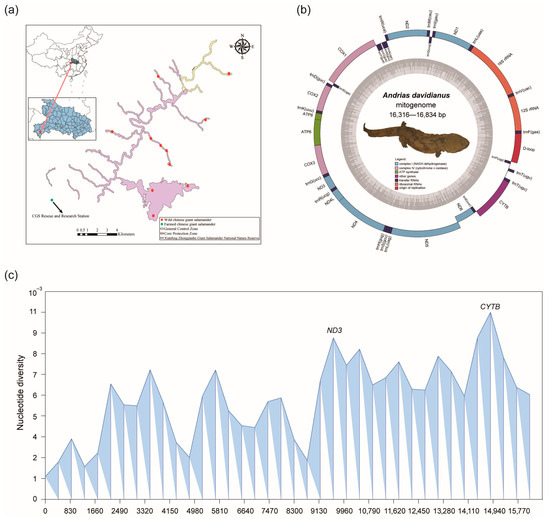
In this study, muscle samples were collected from 27 captive and 11 wild CGS from the Hubei Xiangfeng Zhongjianhe National Salamander Nature Reserve, located between 108°37′08″ E to 109°20′08″ E and 29°19′28″ N to 30°02′52″ N (Figure 1a). Sample collection was conducted with permission from the State Forestry Administration of China. All 38 samples underwent microsatellite genotyping and mitogenome sequencing.
Figure 1.
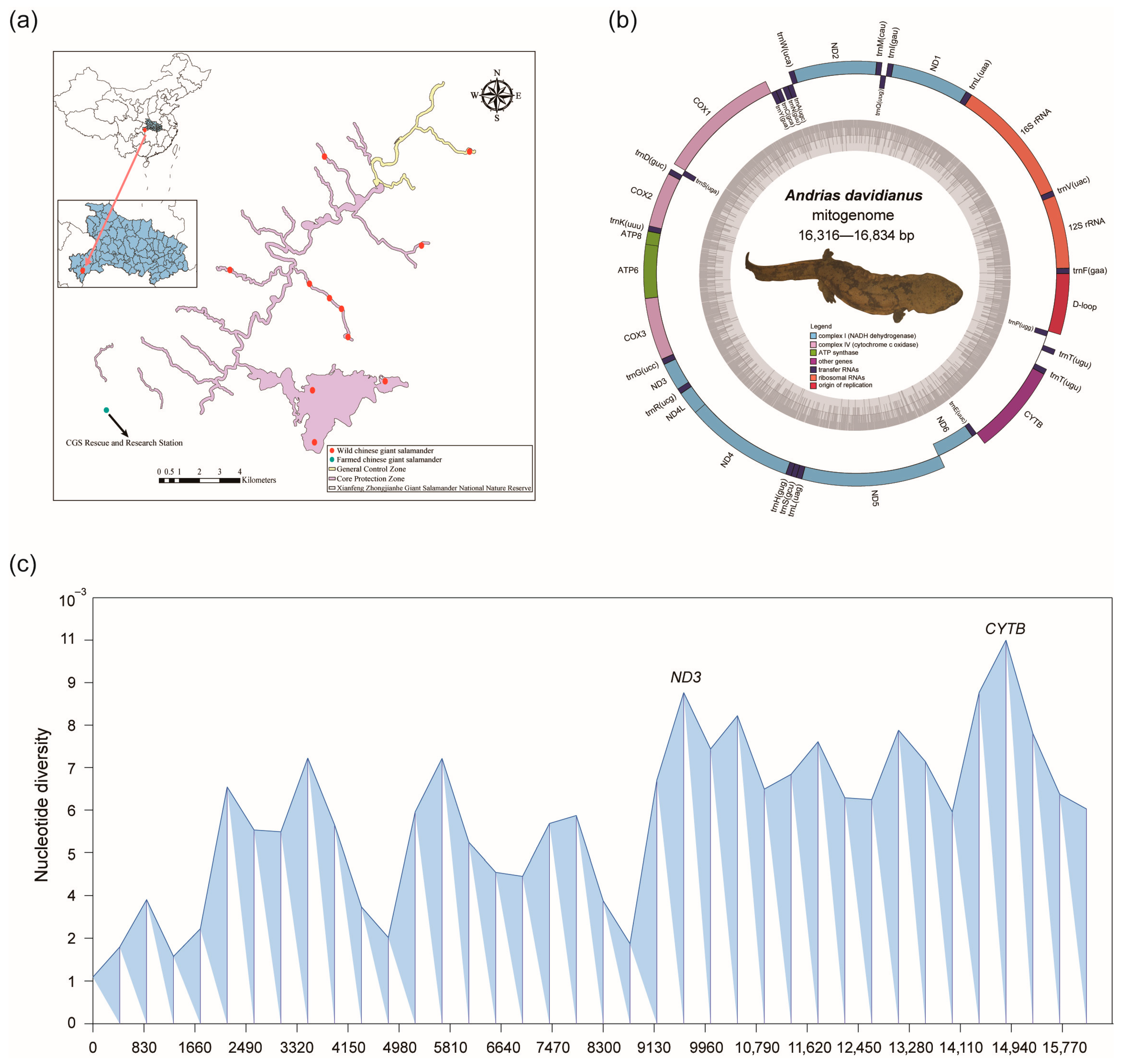
Sampling distribution, mitogenome organization, and nucleotide diversity of the CGSs. (a) Geographic distribution of the 38 sampled individuals. Wild Chinese giant salamanders were collected from the core protection zone (number = 10) and the general control zone (number = 1) of the Xianfeng Zhongjianhe Giant Salamander National Nature Reserve, while conservation-bred individuals (number = 27) originated from a rescue and research station. (b) Schematic representation of the mitogenomes of CGSs, showing the relative positions of 13 PCGs, 2 ribosomal RNA genes (12S and 16S rRNA), 23 transfer RNA genes, and the control region (D-loop). Genes involved in oxidative phosphorylation complexes, including NADH dehydrogenase (complex I), cytochrome c oxidase (complex IV), and atp synthase, are indicated. (c) Sliding-window analysis of nucleotide diversity (Pi) across the mitogenome. Peaks of nucleotide diversity highlight regions with elevated sequence variation, notably within the cytb and ND3 genes.
Using the MGI Easy Large-scale PCR-FREE Whole-Genome Low-Coverage Enzyme-Digested Library Preparation Kit in combination with the MGISP-960 (146 Beishan Road, Yantian District, Shenzhen) to extract genomic DNA from CGS samples and perform a short insertion library construction. Whole-genome resequencing was performed at BGI (Shenzhen Genomics Institute 7th–14th Floor, BGI Comprehensive Park, 21 Hong’an 3rd Street, Yantian District, Shenzhen, 518083, China). Subsequently, 2 × 150 bp paired-end reads were generated using the DNBseq platform. Adapters and low-quality reads were removed with SOAPnuke v2.0 [31], and the filtered reads were quality-checked using FastQC v0.12.0 [32].
2.2. Mitogenome Assembly and Annotation
The CGS mitogenomes were de novo assembled from high-quality clean short reads using GetOrganelle v.1.7.5 [33]. Assembly was performed with the parameters -R 15 -k 45, 65, 85, 105 -F animal_mt, which are optimized for animal mitogenome reconstruction. The integrity and circular structure of each assembly were subsequently examined and visually validated using Bandage v0.9.0 [34]. Following assembly, 38 mitogenomes were annotated with MitoZ v.3.6 [35] under the settings -thread 16 and -genetic_code 3. The published mitogenome annotation of Andrias japonicus (GenBank accession: AB308679) was used as the primary reference for gene boundary confirmation and functional assignment. To further improve annotation accuracy, all predicted genes were manually inspected and curated in Geneious Prime v.2021.2.2 [36], with particular attention to start/stop codons, tRNA boundaries, and potential annotation inconsistencies. Finally, graphical maps of the annotated mitogenomes were generated using OGDRAW (https://chlorobox.mpimp-golm.mpg.de/OGDraw.html accessed on 15 January 2026), providing a standardized visualization of genome organization and gene arrangement.
2.3. Phylogenetic Analysis
This study integrated newly sequenced mitogenomes with 43 existing mitogenomes from the NCBI database (see Supplementary Table S1) to construct a phylogenetic dataset. The public data samples encompassed multiple geographic regions, including the Yangtze, Yellow, and Pearl River basins, as well as Huangshan [11,13,37], demonstrating good spatial representation.
We used PhyloSuite v.1.2.3 [38] to extract 13 mtPCGs from the mitogenomes. Sequences for each gene were first aligned using MAFFT v.7.4 [39], followed by concatenation of all aligned sequences. Based on this concatenated sequence, we reconstructed the phylogenetic relationships of CGSs using both maximum likelihood (ML) and Bayesian inference (BI) methods.
For the ML analysis, trees were constructed using IQ-TREE v.2.1.2 [40]. ModelFinder identified the optimal nucleotide substitution model as TN + F + I + G4, with 1000 independent runs conducted to assess node support. For BI analysis, inference was performed using MrBayes v.3.2.6 with the GTR substitution model [41]. Specific parameter settings were: “lset nst = 6 rates = invgamma, mcmc ngen = 1,000,000 samplefreq = 100 nchains = 4, sump burnin = 250, sumt burnin = 250”.
2.4. Nucleotide Diversity and Sequence Variation Analysis
Multiple sequence alignment was performed using MAFFT v.7.4 [40]. Nucleotide diversity (Pi) in the mitogenome was calculated using DnaSP v.6.12.03 [42], with a window size of 200 and a step size of 100. Collinearity analysis was conducted using a custom-designed Python v3.14.3 script, and the aligned sequences were subsequently visualized in Geneious Prime v.2022.2.2 [43].
2.5. Repeat Structure Identification
Simple sequence repeats (SSRs) were detected using MISA v.2.1 [44], with minimum repeat thresholds of 10, 5, 4, 3, 3, and 3 for mono-, di-, tri-, tetra-, penta-, and hexanucleotide motifs, respectively. Palindromic, forward, reverse, and complementary repeats were identified using REPuter [45] (https://bibiserv.cebitec.uni-bielefeld.de/reputer accessed on 15 January 2026), with a minimum repeat length of 30 bp and a Hamming distance of 3.
2.6. Mitogenome Selective Pressure Analysis
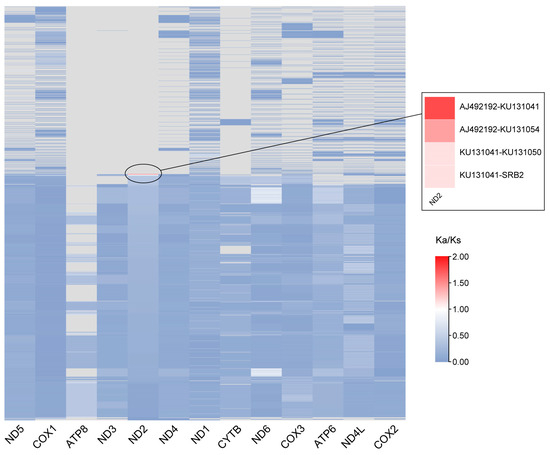
Ka and Ks substitution rates for 13 mtPCGs were calculated across 66 CGSs (2145 comparisons) using KaKs_Calculator v.2.0 [46] with the YN model. Selection regimes were inferred from Ka/Ks ratios, with values < 1, =1, and >1 indicating purifying, neutral, and positive selection, respectively; cases with Ks = 0 were denoted as NA.
2.7. Microsatellite Genotyping
Fifteen polymorphic microsatellite loci were developed based on mitogenome data. PCR amplifications were conducted in 20 μL reactions containing 1 μL genomic DNA, 17 μL Premix Ex Taq (TSINGKE), and 1.0 μL (10 mmol L−1) each of fluorescently labeled forward (FAM, HEX, TAMRA, or ROX) and reverse primers. Thermal cycling consisted of an initial denaturation at 98 °C for 3 min, followed by 35 cycles of 98 °C for 10 s, primer-specific annealing for 10 s, and 72 °C for 10 s, with a final extension at 72 °C for 5 min. PCR products were genotyped on an ABI 3730xl automated DNA analyzer, and allele sizes were scored using GeneMarker v.4.1 [40]. Genotypes were manually verified in three independent rounds to minimize scoring errors.
2.8. Genetic Diversity
Genetic diversity was evaluated using multiple complementary indices. For each microsatellite locus, the number of alleles (NA), observed heterozygosity (HO), expected heterozygosity (HE), and polymorphism information content (PIC) were calculated using PowerMarker v.3.35 [47]. Deviations from Hardy–Weinberg equilibrium (HWE) and linkage disequilibrium (LD) between loci were tested in GENEPOP v.3.1 [48], with significance levels adjusted using the continuous Bonferroni correction to account for multiple comparisons.
To further characterize genetic diversity at the population level, statistical analyses of diversity indices, including the mean number of alleles (NA), were conducted using GenAlEx v.6.5 [49]. In addition, for each catchment area, the effective number of alleles (NE), observed heterozygosity (HO), expected heterozygosity (HE), and Shannon’s diversity index (I) were calculated to provide a comprehensive assessment of genetic variation across geographic units.
2.9. Genetic Structure Analysis
Genetic structure was inferred using STRUCTURE v.2.0 [50] under the admixture model with correlated allele frequencies. For each analysis, a burn-in of 100,000 iterations was followed by 500,000 Markov chain Monte Carlo iterations. The number of genetic clusters (K) was evaluated from 1 to 10, with 10 independent runs performed for each K. The most likely K was determined based on posterior probabilities [ln P(X|K)] and the ΔK method, as implemented in STRUCTURE HARVESTER [51]. Individual assignment probabilities were visualized using DISTRUCT [52].
3. Results
3.1. Mitogenome Structure and Comparative Genomic Analysis of the CGSs
Among the 38 CGSs muscle samples analyzed, 11 were obtained from wild individuals, including 10 from the core protection zone and one from the general control zone of the Xianfeng Zhongjian River Giant Salamander National Nature Reserve, while the remaining 27 samples originated from conservation-bred individuals maintained at a rescue and research station (Figure 1a). This sampling design allowed comparisons between wild and ex situ populations across different management regimes.
The CGS mitogenomes ranged from 16,316 to 16,834 bp in length and exhibited a typical vertebrate mitochondrial architecture, comprising 12 or 13 mtPCGs; comprising 12 or 13 mtPCGs; specifically, 13 mtPCGs were identified in this study. two ribosomal RNA genes (12S and 16S rRNA), 23 transfer RNA genes, and a control region (D-loop) (Figure 1b; Supplementary Table S1). The gene order and orientation were highly conserved, and PCGs were associated with oxidative phosphorylation pathways, including complex I (NADH dehydrogenase), complex IV (cytochrome c oxidase), and atp synthase. The overall GC content averaged 35.44%, consistent with previously reported salamander mitogenomes. Analysis of mitogenome sequence variations revealed that these sequences exhibit very high similarity, ranging from 97.23% to 100.00%. The vast majority of species showed similarity of 99.00% or higher, and they share similar sequence variation patterns (Supplementary Table S5).
Sliding-window analysis of nucleotide diversity across the mitogenome revealed pronounced heterogeneity among loci (Figure 1c). Notably, the cytb and ND3 genes exhibited markedly elevated Pi values compared with other mitochondrial regions, indicating higher levels of sequence polymorphism. In contrast, commonly used barcoding loci such as cox1 showed relatively low nucleotide diversity.
3.2. Conserved Structure of the CGS Mitogenome and Potential Deleterious Mutations in the ND1 Gene
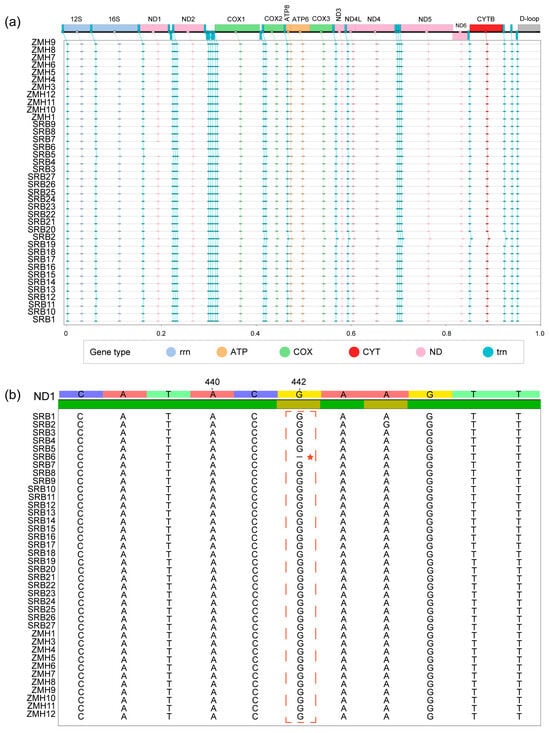
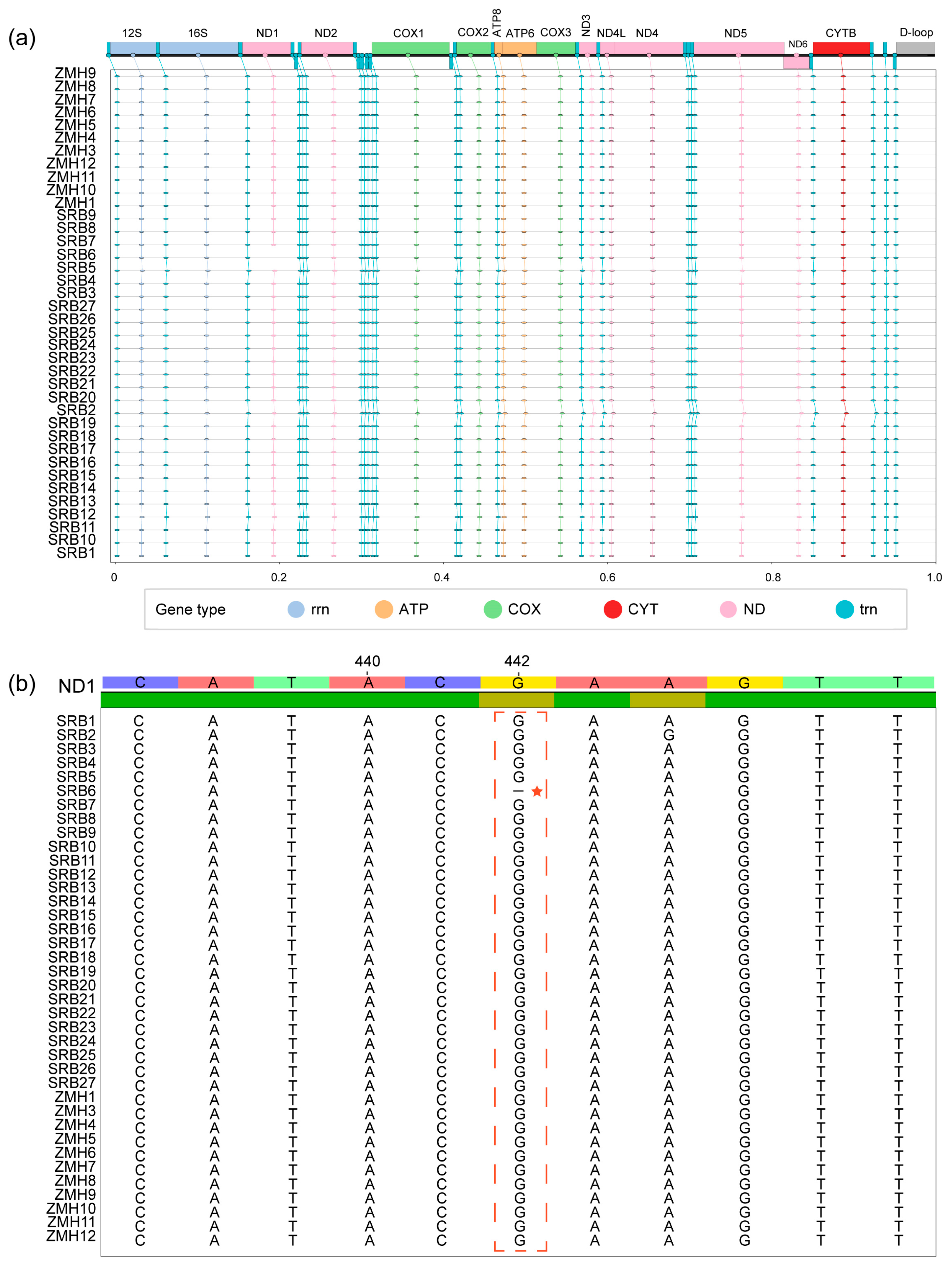
Comparative analyses revealed striking structural stability and evolutionary conservation of CGS mitogenomes. Whole-mitogenome collinearity analysis demonstrated near-complete synteny among all 38 individuals (Figure 2a). The gene order and overall genomic architecture were highly consistent across samples, suggesting that mitogenome organization in CGSs has remained remarkably stable during evolutionary history.
Figure 2.
Collinearity analysis of mitogenome and ND1 gene variation in CGSs. ★ Gene deletion site (a) Mitogenome collinearity analysis. (b) Alignment of the ND1 gene across all individuals. The deleted site is highlighted, and identical nucleotides are indicated by dots.
Specifically, all mitogenomes retained the complete set of core functional elements typical of vertebrate mitochondria, including ribosomal RNA genes (12S and 16S rRNAs), a full complement of transfer RNAs, as well as essential oxidative phosphorylation genes. These genes encompassed atp synthase subunits (atp6 and atp8), cytochrome c oxidase genes (cox1–cox3), cytochrome b (cytb), and the NADH dehydrogenase gene cluster (ND1–ND6 and ND4L). No large-scale rearrangements, inversions, duplications, or translocations were detected among individuals, indicating strong evolutionary constraints acting on mitogenome architecture.
Despite this overall genomic conservation, a rare and noteworthy gene loss–related mutation event was detected in one conservation-bred individual (SRB6). In this sample, the ND1 gene was disrupted by a single guanine (G) deletion at nucleotide position 442 (Figure 2b). This small deletion produced a frameshift mutation, leading to an altered reading frame and premature termination of translation. As a result, the encoded ND1 protein is predicted to be truncated and potentially nonfunctional.
Alignment of ND1 sequences across all individuals confirmed that this deletion was unique to SRB6, as no other wild or captive individuals carried the same mutation. This observation suggests that the mutation likely represents an individual-specific deleterious event rather than a population-wide polymorphism. Given that ND1 encodes a key subunit of mitochondrial complex I, which is essential for electron transport and atp production, mutations affecting ND1 are frequently linked to mitochondrial dysfunction and pathogenic phenotypes in animals. This deletion may have functional consequences for respiratory activity, oxidative phosphorylation efficiency, and overall energy metabolism [53].
Importantly, the occurrence of this mutation in a conservation-bred individual highlights the need for careful genetic monitoring in captive breeding programs. Even though mitogenomes are generally conserved, rare deleterious variants may arise under small population sizes or relaxed selective conditions, potentially influencing individual fitness and long-term conservation outcomes.
3.3. Selection Pressure Analysis in mtPCGs
A total of 2145 pairwise comparisons were conducted among 66 CGSs individuals with 13 mtPCGs (Supplementary Table S2). These comparisons encompassed all possible pairings of individuals and allowed for a comprehensive assessment of selective pressures acting on mitochondrial genes across different genetic lineages.
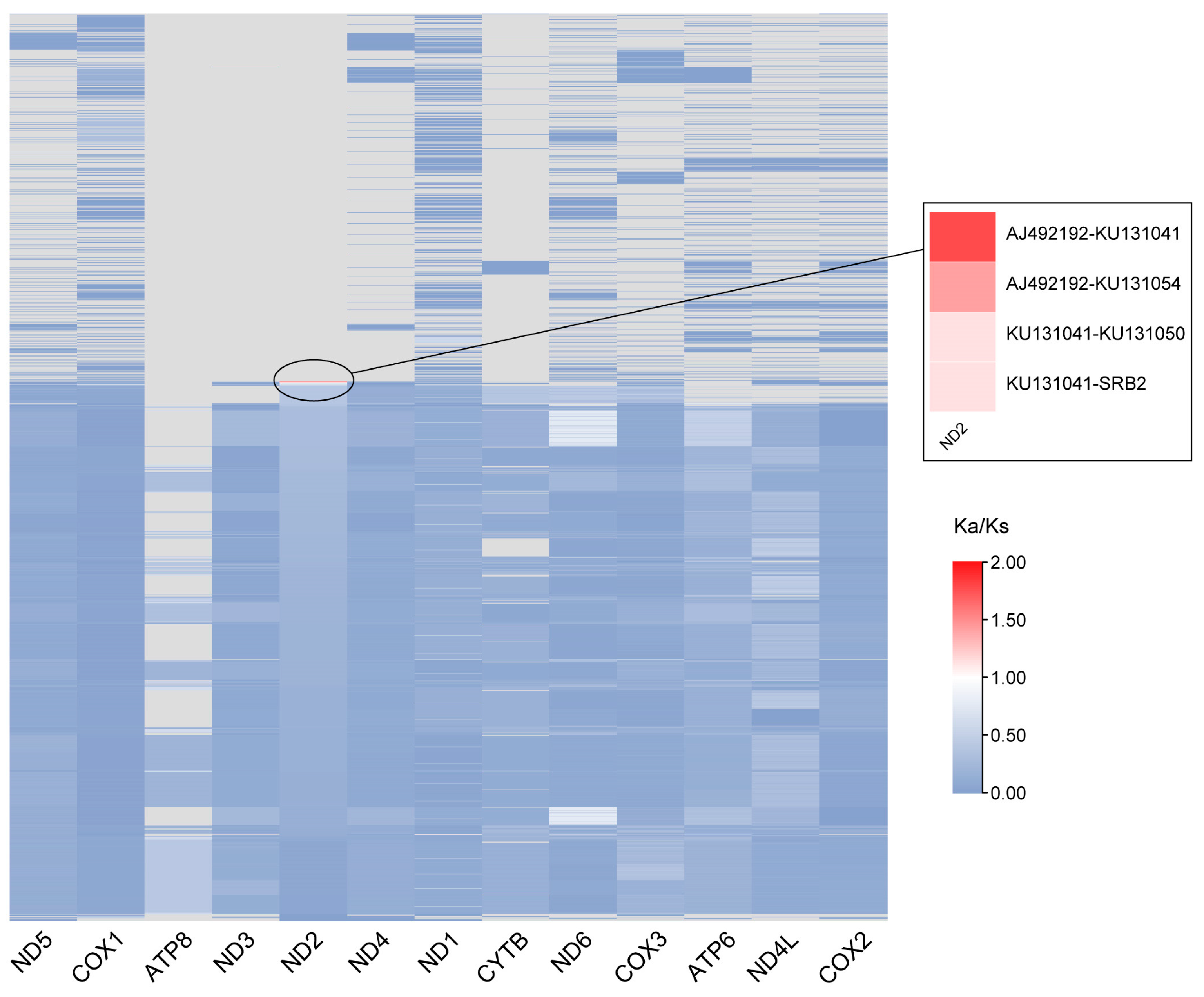
Overall, the Ka/Ks values for 12 of the 13 mitochondrial genes, including cox1, atp8, ND5, and cytb, were consistently below 1 across nearly all pairwise comparisons (Figure 3). The case occurred only between AJ492192 and KU131041 (1.77978), between AJ492192 and KU131054 (1.42177), between KU131041 and KU131050 (1.13594), and between KU131041 and SRB2 (1.13585). This pattern indicates that these genes are predominantly subject to strong purifying selection, reflecting their essential roles in oxidative phosphorylation and mitochondrial energy metabolism. The low Ka/Ks values suggest that non-synonymous substitutions in these genes are selectively constrained and that their amino acid sequences are highly conserved among CGS individuals.
Figure 3.
Selection pressure analysis of 13 mtPCGs across 66 CGSs. Heat map showing Ka/Ks values derived from 2145 pairwise comparisons among 66 individuals with complete mitochondrial gene sequences. The horizontal axis represents 13 mtPCGs, while the vertical axis represents individual pairwise comparisons. Color intensity indicates Ka/Ks values ranging from 0 to 2.
3.4. Lineage-Specific Distribution of Repetitive Elements and Mitochondrial Phylogenetic Structure in CGSs
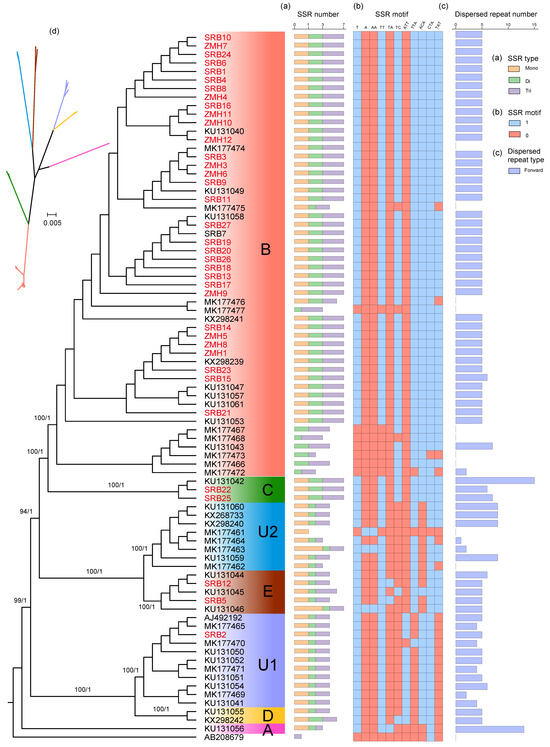
The distribution of simple sequence repeats (SSRs) across the CGS mitogenomes exhibited pronounced lineage-associated differentiation (Supplementary Table S3). As shown in Figure 4a, the total number of SSRs varied substantially among individuals, and this variation was clearly structured by phylogenetic lineage rather than being randomly distributed across the dataset. In particular, most individuals belonging to lineage B displayed a markedly higher abundance of SSRs compared with individuals from other lineages. In contrast, lineages such as A and U1 generally possessed fewer SSRs. These results indicate that SSR accumulation in CGS mitogenomes follows lineage-specific evolutionary trajectories. Consequently, variation in SSR number represents not only a genome-level characteristic but also a potentially informative marker reflecting maternal genetic structure and historical divergence among CGS lineages.
Figure 4.
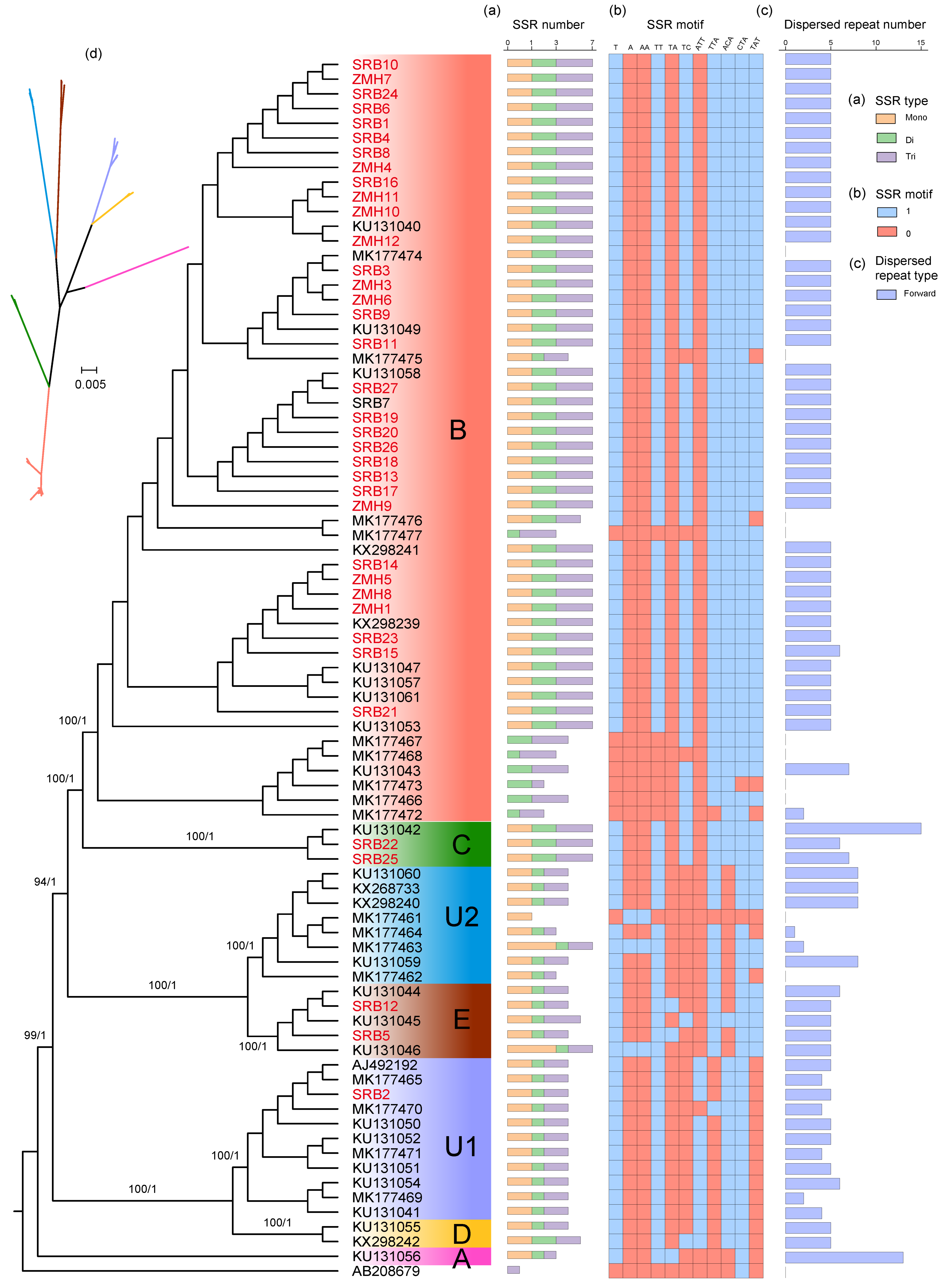
Samples in red font were collected in the field for this study, whereas those in black font were obtained from online databases, the same background color indicates the same lineage. Distribution of repetitive elements and mitochondrial phylogenetic structure in CGSs. (a) Quantitative analysis of simple sequence repeats (SSR). (b) SSR motif heatmap. Absence is denoted by 0, presence by 1. (c) Quantitative analysis of scattered repetitive sequences. (d) Phylogenetic tree constructed based on 13 mtPCGs. Numbers on branches represent support rates and posterior probabilities.
To further elucidate the sequence composition underlying these differences in SSR abundance, SSR motifs were summarized and visualized as a motif-frequency heatmap (Figure 4b; Supplementary Table S3). Across the 83 CGSs analyzed, SSR motifs showed a relatively conserved composition, primarily consisting of T, TT, TC, TTA, ACA, CTA, and TAT motifs. Overall, mitochondrial SSRs were dominated by trinucleotide repeats, consistent with the well-documented tendency of mitogenomes to accumulate short tandem repeats through replication slippage. Despite this general conservation, the relative frequencies of specific motifs exhibited clear lineage-specific patterns. Notably, lineage B showed a significantly higher proportion of dinucleotide motifs than lineages A and U1, suggesting that the generation and/or retention of SSRs may differ among maternal lineages. Such differences likely reflect lineage-dependent mutation biases during mitochondrial DNA replication, influenced by polymerase slippage and local sequence context. This motif heterogeneity, therefore, constitutes an additional molecular dimension of mitochondrial genetic diversity in CGSs and may provide useful markers for lineage discrimination and population-level genetic monitoring [54].
In addition to SSRs, dispersed repeats were analyzed to characterize the broader landscape of repetitive elements in CGS mitogenomes. As illustrated in Figure 4c (Supplementary Table S3), all mitogenomes contained only forward-dispersed repeats, with no reverse or palindromic repeats detected. The number of dispersed repeats varied considerably among individuals, ranging from 0 to 15, although most samples harbored approximately five repeats. This heterogeneous distribution suggests that dispersed repeat abundance is more variable than overall mitochondrial gene content and may reflect differences in lineage history, stochastic mutational processes, or distinct selective constraints acting on repetitive regions. Given that dispersed repeats can influence genome stability and potentially facilitate small-scale recombination-like events in some systems, their lineage-dependent variation may contribute to subtle structural or regulatory differences within otherwise highly conserved mitogenomes.
To resolve maternal phylogenetic relationships, a Bayesian inference phylogenetic tree was reconstructed using concatenated sequences of 13 mtPCGs (Figure 4d). The resulting topology revealed that the CGS individuals sampled from the reserve comprise multiple coexisting maternal lineages, indicating a genetically mixed population structure. Specifically, seven major maternal lineages—A, B, C, D, E, U1, and U2—were identified, and all field-collected individuals were assigned to these clades. This lineage composition is broadly consistent with previously proposed phylogeographic frameworks for CGSs across China. In those studies, lineage A is associated with the Pearl River basin in Guangxi; lineages B and C are widely distributed and primarily linked to the Yellow River basin; lineage D occurs mainly in Chongqing and Guizhou and extends into the Yangtze River basin; and lineage E is distributed in the Qiantang River basin, corresponding to the Huangshan population in Anhui. Notably, lineage A occupies a basal position in the phylogeny and forms the sister group to all remaining lineages, supporting its status as an early-diverging mitochondrial lineage. At higher hierarchical levels, lineage D clustered closely with U1, lineage E grouped with U2, and lineages B and C formed a separate major cluster. This clustering pattern aligns precisely with the phylogenetic architecture described by earlier investigators [13], reinforcing the robustness of mitogenome–based phylogenetic inference for CGS lineage classification and providing a stable maternal framework for subsequent comparative analyses.
3.5. Mitochondrial–Nuclear Phylogenetic Discordance Reveals Complex Evolutionary Histories in CGSs
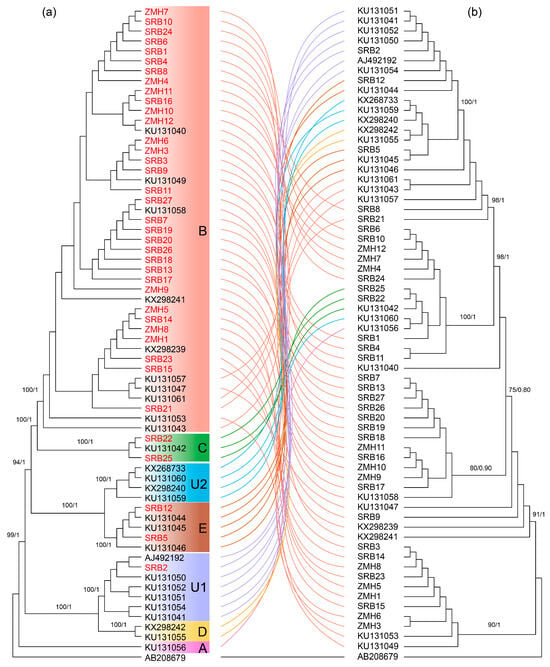
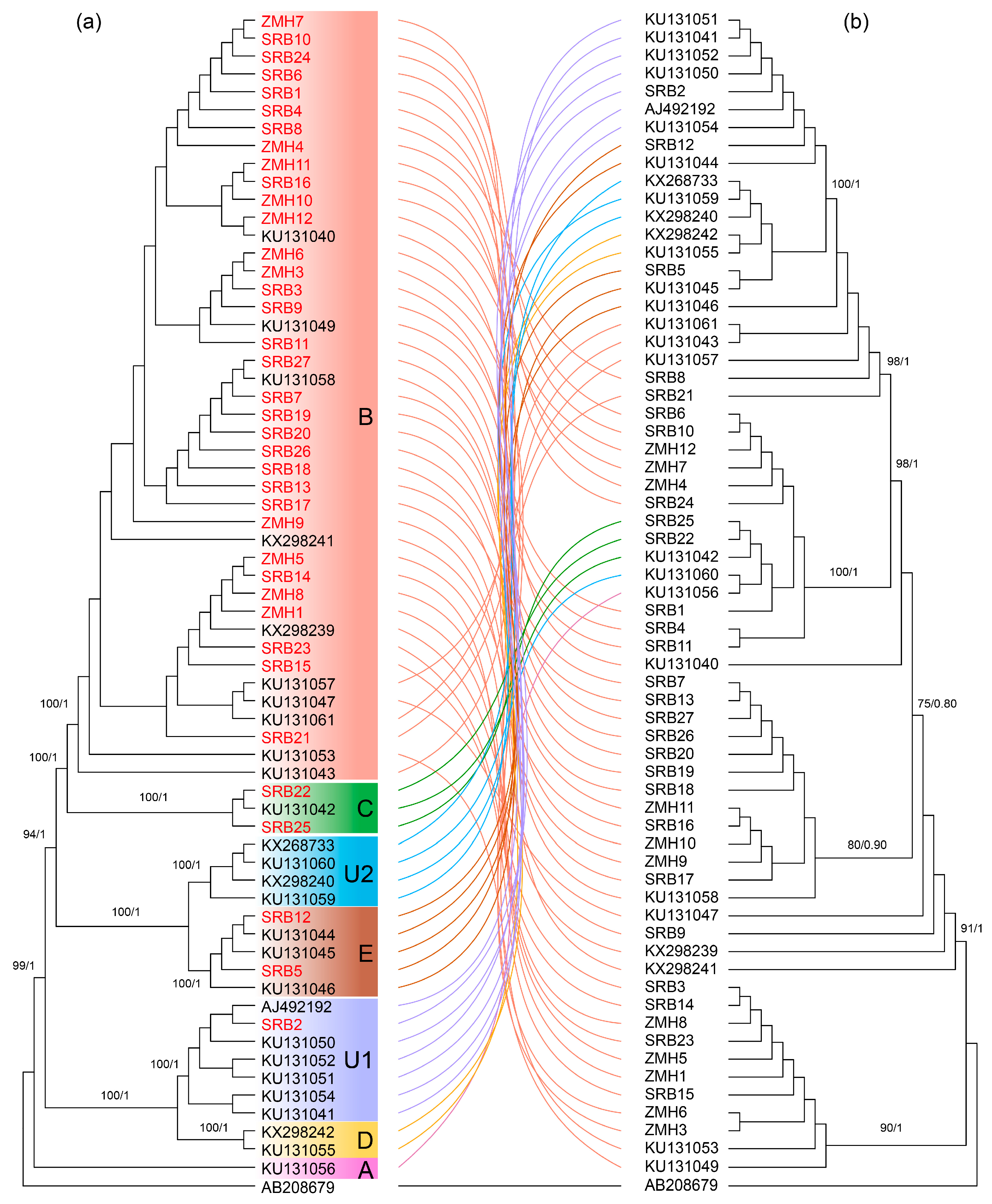
By reconstructing a phylogenetic tree based on mtPCGs and internal transcribed spacer (ITS) sequences (Figure 5) and conducting comparative analyses, we evaluated the consistency between the maternally inherited mitogenome and the biparentally inherited nuclear genome in CGS.
Figure 5.
Samples in red font were collected in the field for this study, whereas those in black font were obtained from online databases, the same background color indicates the same lineage. Comparative phylogenetic analysis based on mtPCGs and ITS markers in CGSs. (a) Phylogenetic tree constructed from 13 mtPCGs. (b) Phylogenetic tree constructed from ITS sequences. Colored lines connect identical individuals across both trees, highlighting consistent and inconsistent clustering patterns. Branch values indicate support rates (left) and posterior probabilities (right).
Conversely, individuals assigned to mitochondrial lineage B displayed a more dispersed and heterogeneous distribution in the nuclear ITS phylogeny. This dispersion suggests that lineage B may have experienced more frequent admixture or introgression events, leading to a decoupling of mitochondrial and nuclear evolutionary histories. Such a pattern is consistent with the wide geographic distribution and high representation of lineage B, which may have facilitated repeated secondary contact with other lineages. Together, these results demonstrate that although mitogenomes provide a clear and stable signal of maternal lineage structure, nuclear markers can uncover additional layers of population complexity. Integrating both mitochondrial and nuclear datasets is therefore essential for accurately reconstructing CGS evolutionary relationships and for informing conservation strategies that aim to preserve both maternal lineages and overall genomic integrity.
3.6. Mitogenomic SSR Analysis Reveals Admixed Population Structure in CGSs
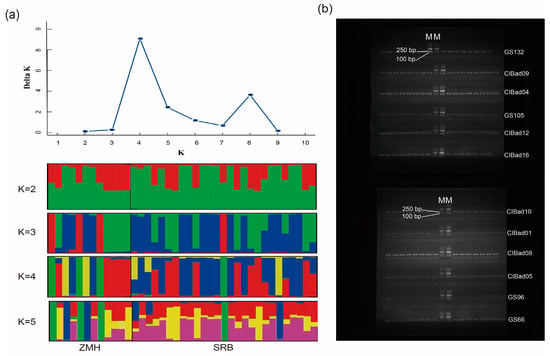
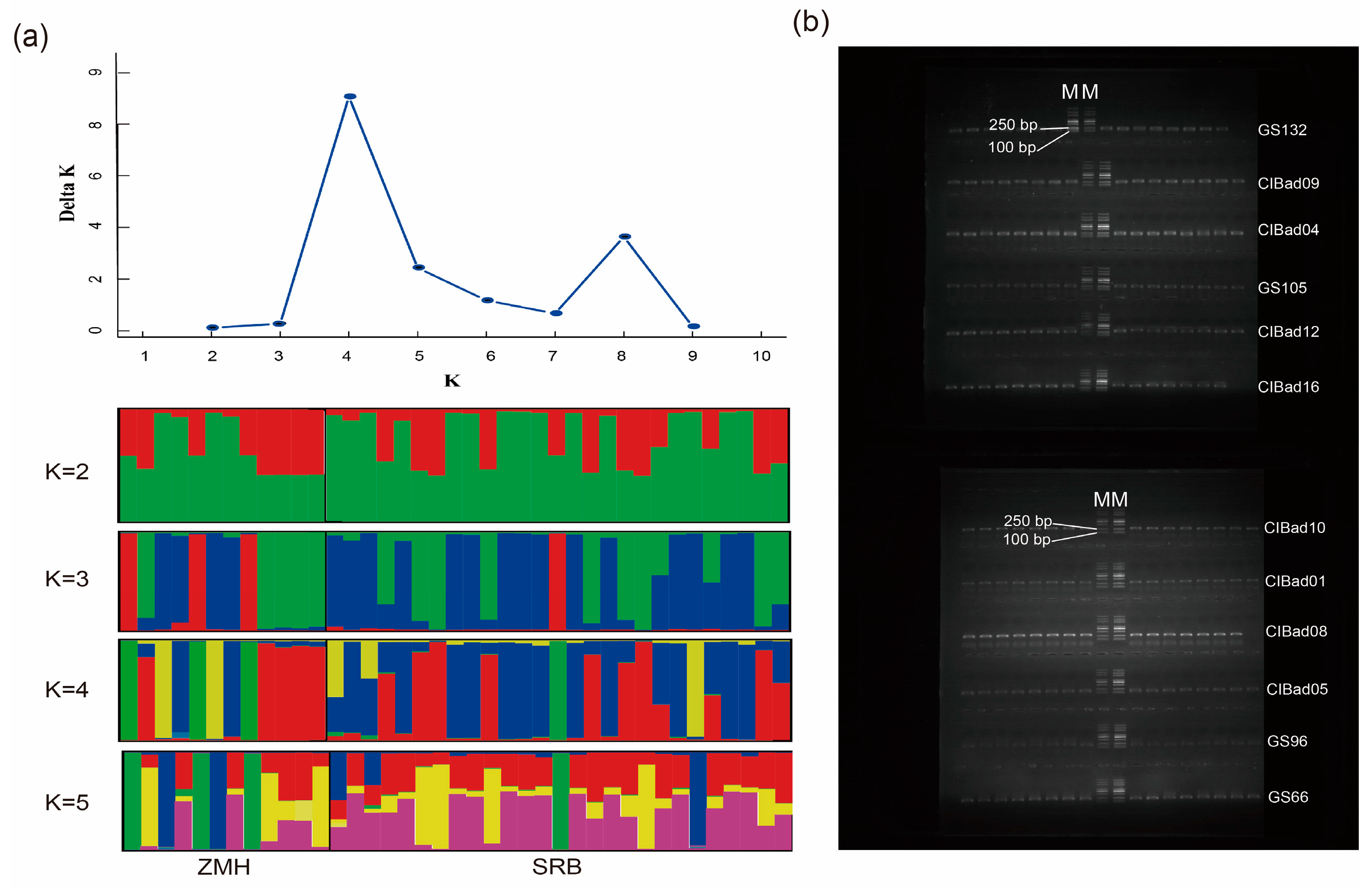
The population genetic structure of CGSs was further investigated using mitogenomic microsatellite (SSR) markers, which are highly informative for detecting recent population differentiation. We conducted a population genetic clustering analysis on 38 CGS individuals. Delta K analysis revealed a significant and distinct peak at K = 4, indicating that four genetic clusters best explain the population structure of sampled CGSs (Figure 6a). This result suggests that the population is not genetically homogeneous but instead composed of four major components. Structure bar plots corresponding to K values ranging from 2 to 5 are shown below the Delta K curve in Figure 6a, providing a visual representation of individual ancestry composition under different clustering scenarios. At K = 2, individuals from the ZMH and SRB subpopulations already exhibit mixed ancestry components, indicating incomplete genetic separation. With increasing K values (K = 3 and K = 4), the genetic structure becomes progressively more resolved. Notably, at K = 4—identified as the optimal clustering level—individuals from both ZMH and SRB subpopulations display varying proportions of four distinct genetic components. This mosaic-like pattern reflects substantial genetic admixture and suggests extensive historical or ongoing gene flow among maternal lineages within the CGS population. When K is increased further to 5, no additional clearly interpretable structure emerges, supporting K = 4 as the most biologically meaningful subdivision.
Figure 6.
Population genetic structure of Chinese giant salamanders based on mitogenomic microsatellite (SSR) markers. (a) Delta K analysis and STRUCTURE bar plots for 38 CGS individuals, different colors represent different genetic components. (b) Agarose gel electrophoresis profiles of representative SSR loci. “MM” indicates the 100 bp DNA ladder. Lanes represent individuals from different subpopulations. Differences in band presence and fragment length reflect allelic polymorphism at SSR loci, highlighting population-specific genetic variation.
Additionally, representative SSR markers were subjected to agarose gel electrophoresis analysis to validate SSR polymorphism reliability (Figure 6b). In the gel image, “MM” denotes the 100 bp DNA ladder, which serves as a molecular size reference for estimating the lengths of amplified SSR fragments. Each lane corresponds to an individual CGS sample from the ZMH, SRB, or other subpopulations. Clear differences in band presence, absence, and fragment length are visible among individuals, reflecting allelic polymorphism at the SSR loci. Importantly, some SSR markers show distinct banding patterns between the ZMH and SRB subpopulations, such as the absence of specific amplified fragments in certain lanes or size shifts indicative of different repeat numbers. These population-specific banding differences demonstrate that the selected mitogenomic SSR loci possess sufficient discriminatory power to distinguish genetic variation among subpopulations. The electrophoresis results, therefore, corroborate the STRUCTURE-based clustering patterns and confirm the reliability of mitogenomic SSRs as effective molecular markers for population genetic analyses in CGSs.
Collectively, the combined STRUCTURE analysis and SSR electrophoresis results reveal a genetically admixed population structure characterized by multiple ancestral components and incomplete differentiation between subpopulations. This pattern likely reflects a complex demographic history involving historical connectivity, admixture among maternal lineages, and potentially recent anthropogenic influences such as conservation-driven translocations or captive breeding. These findings underscore the importance of incorporating microsatellite-based population genetic information into conservation management strategies aimed at preserving genetic diversity and evolutionary potential in CGS populations.
4. Discussion
4.1. Mitogenome Structure and Lineage-Specific Genetic Variation
The mitogenomes of the CGS individuals analyzed in this study ranged from 16,316 to 16,834 bp in length and consistently contained 13 mtPCGs, two ribosomal RNA genes, and 23 transfer RNA genes, with an average GC content of 35.44%. This genomic organization is highly consistent with the mitogenome structure previously described for CGSs [55], reflecting the typical features of the Cryptobranchidae mitogenome: complete gene composition, conserved gene order, and overall structural stability. Such structural stability is consistent with the critical role of mitochondria in energy metabolism, where disruption of gene order could impair transcriptional regulation and respiratory chain efficiency.
Despite this structural conservation, nucleotide polymorphism analyses revealed marked heterogeneity in evolutionary rates among mitochondrial genes. In particular, the cytb and ND3 genes exhibited significantly higher levels of nucleotide variation compared with other mitochondrial loci. Aligning with earlier research [29,56], which demonstrated that NADH dehydrogenase subunit genes—especially ND3—evolve more rapidly than canonical barcode genes such as cox1. These results suggest that cytb and ND3 provide greater phylogenetic resolution at the intraspecific level and may represent more suitable mitochondrial markers for fine-scale population structure and lineage differentiation within the genus Andrias than the traditional cox1 barcode.
The ND2 gene exhibited a markedly different evolutionary pattern. Several pairwise comparisons involving individuals KU131041, KU131054, KU131050, and SRB2 showed Ka/Ks values greater than 1 for ND2, indicating an excess of nonsynonymous substitutions relative to synonymous ones. Notably, all four individuals belong to the U1 genetic lineage, as defined by phylogenetic analysis (Figure 4). Among them, individual KU131041 displayed the highest Ka/Ks value for ND2, reaching approximately 1.7, which substantially exceeds the neutral expectation (Ka/Ks = 1).
Given that ND2 encodes a core subunit of mitochondrial complex I, which plays a crucial role in electron transport and proton translocation, adaptive changes in this gene may be associated with lineage-specific physiological or environmental adaptations. Alternatively, the observed pattern could reflect a combination of positive selection and relaxed selective constraints in specific lineages. Regardless, the distinct evolutionary signal detected in ND2 contrasts sharply with the strong purifying selection observed in other mitochondrial genes, highlighting ND2 as a potential target of adaptive mitochondrial evolution in CGSs.
A notable finding was the identification of a single guanine (G) deletion at position 442 in the ND1 gene of one captive individual (SRB6). ND1 encodes a critical subunit of mitochondrial complex I, and mutations in this gene have been widely associated with mitochondrial dysfunction. Point mutations in ND1 have been demonstrated to destabilize complex I, suppress the expression of essential subunits like NDUFB8, and diminish oxidative phosphorylation capacity, consequently leading to reduced oxygen consumption, lower atp yield, and augmented proton leak [53]. Collectively, these effects can disrupt respiratory chain function and energy metabolism [57]. Although functional assays were not conducted in the present study, the presence of this mutation suggests a potential metabolic risk for the affected individual and underscores the importance of incorporating mitochondrial gene integrity into genetic health assessments of captive populations. Functional studies of the ND1 gene site mutation are warranted for follow-up [58].
From a conservation perspective, identifying potentially harmful mitochondrial mutations holds significant importance. If such mutations are heritable, they may increase disease risk or reduce fitness in offspring, thereby undermining conservation breeding efforts [59]. Accordingly, future conservation programs should incorporate genetic screening protocols to identify individuals carrying pathogenic or potentially harmful mitochondrial variants [60]. These individuals should be managed separately from genetically healthy stocks, and breeding programs should prioritize individuals with intact mitochondrial function. Such measures would help prevent the spread of deleterious alleles, maintain overall population health, and enhance the long-term viability of conservation initiatives.
4.2. Selection Pressure and Environmental Adaptation of Mitochondrial Genes
Selection pressure analyses revealed pronounced lineage-specific differentiation among CGSs. Across 66 individuals with complete mitochondrial gene sequences, only the ND2 gene in the U1 lineage exhibited a clear signal of positive selection, with Ka/Ks values exceeding 1 and reaching a maximum of 1.7. In contrast, all other mitochondrial genes—including ND2 in non-U1 lineages—remained under strong purifying selection (Ka/Ks < 1), reflecting functional constraint [61].
The observed positive selection on the ND2 gene in the U1 lineage likely represents a synergistic outcome of environmental heterogeneity and lineage-specific evolutionary history. According to the phylogeographic framework established in a previous study [9], this lineage predominantly occupies the upper Yangtze River basin and montane streams in eastern China, with a notable concentration in the Chongqing-Guizhou transitional zone. This region is characterized by complex topography, dramatic elevational gradients (500–1500 m), pronounced seasonal temperature variations, and highly variable dissolved oxygen concentrations driven by precipitation patterns. Such environmental instability likely imposes strong and fluctuating selective pressures on mitochondrial energy metabolism systems, thereby driving adaptive evolution of the ND2 gene [62].
In contrast, other CGS lineages occupy comparatively stable hydrological environments. Lineages B and C inhabit the middle and lower Yellow River basin; lineage A is restricted to relatively stable streams in the Pearl River basin, and lineage E occurs in the constant-temperature streams of the Huangshan region within the Qiantang River basin. These long-term stable environments likely impose relatively constant selective regimes, favoring purifying selection over adaptive diversification.
From an evolutionary perspective, the U1 lineage diverged relatively recently, approximately 2.3 million years ago, later than lineage B (~4.7 Mya) and lineage A. Moreover, previous population genetic analyses [11] reveal that the U1 lineage underwent a rapid demographic expansion following the Last Glacial Maximum. Such demographic expansion can amplify the fixation probability of beneficial mutations, particularly when populations colonize novel or heterogeneous habitats. Together, these ecological and historical factors provide a coherent explanation for why positive selection is restricted to the ND2 gene in the U1 lineage [63].
4.3. Phylogenetic Structure and Evolutionary Lineage Divergence
Phylogenetic analyses based on mitochondrial DNA and rRNA sequences resolved seven well-supported genetic clades: A, B, C, D, E, U1, and U2. This clade structure is highly congruent with the phylogeographic patterns identified via reduced-representation genomic approaches in a previous study [13], reinforcing the strong correlation between CGS genetic lineages and their geographic distributions.
The phylogenetic tree based on mtPCGs (Figure 5a) recovered all major genetic lineages (A, B, C, D, E, U1, and U2) with strong statistical support. Most lineage-defining nodes exhibited bootstrap/posterior probability values of 100/1, with only a small number showing slightly lower but still robust support. These high support values indicate a well-resolved mitochondrial phylogeny and clear separation among maternal lineages. In this mitochondrial-based tree, lineage B comprised the largest number of individuals and included samples from multiple series, such as SRB, ZMH, and other collections. This wide representation suggests that lineage B constitutes the most broadly distributed and numerically dominant maternal genetic unit within the sampled CGS population, potentially reflecting historical demographic expansion or a long-term persistence across multiple geographic regions.
In contrast, the phylogenetic tree reconstructed from nuclear ITS sequences (Figure 5b) revealed partially different clustering patterns, underscoring the distinct inheritance mode and evolutionary dynamics of nuclear markers. While some lineages retained a general correspondence between mitochondrial and nuclear phylogenies, several individuals occupied markedly different positions in the two trees. The colored lines connecting identical individuals between the mtPCGs and ITS trees clearly illustrate these positional shifts, providing visual evidence of mito-nuclear discordance.
This incongruence between mitochondrial and nuclear phylogenetic signals suggests the presence of nucleo-cytoplasmic discordance within the CGS population. Such discordance may arise from multiple evolutionary processes, including historical hybridization between divergent lineages, mitochondrial introgression, sex-biased dispersal, or incomplete lineage sorting of nuclear alleles. Notably, lineages U1, C, and D showed relatively compact and coherent clustering in the ITS-based tree, indicating that individuals within these lineages may maintain a more stable association between their mitochondrial background and nuclear genomic structure. This pattern implies a relatively conserved evolutionary history with limited recent admixture for these lineages.
Lineage A occupies a basal position in the phylogeny, suggesting that it represents an early-diverging mitochondrial lineage. Higher-level clustering further revealed close affinities between lineages D and U1, between E and U2, and between B and C. This hierarchical structure reflects both historical divergence and subsequent regional adaptation. Additionally, variation in the abundance of mitochondrial interspersed repeats among lineages may reflect differentiated selective pressures acting on non-coding regions during long-term evolutionary divergence [64], potentially contributing to lineage-specific genome dynamics.
STRUCTURE analysis of SSRs (Figure 6a) revealed extensive genetic admixture (K = 4) driven by recent (<100 generations) gene flow, whereas the mitochondrial phylogenetic tree (Figure 5a) identified seven deeply diverged maternal lineages (A–E, U1–U2) dating back to the Middle Pleistocene (~2.3–4.7 Mya). The analytical utility of mitochondrial SSR markers is demonstrated through their capacity to preserve long-term isolation signals and delineate fine-scale population structure. While maternal haplotype networks effectively identify cryptic genetic discontinuities, the strict geographic exclusivity observed among mitochondrial lineages underscores the necessity of conserving at least four distinct germplasm repositories to capture the species’ full evolutionary potential. Consequently, this study establishes a robust, generalizable paradigm for conservation unit delineation in endangered species, relying exclusively on uniparental (maternal) genetic markers.
5. Conclusions
This study provides a comprehensive mitogenomic perspective on the evolutionary dynamics, population structure, and conservation implications for CGSs. Despite striking structural conservation of mitogenomes across individuals, multiple layers of genetic heterogeneity were uncovered, including locus-specific nucleotide diversity, lineage-dependent selection regimes, and distinct distributions of repetitive elements.
Integrating mitogenomic SSR analyses and nuclear ITS phylogenies revealed extensive admixture and pronounced mito-nuclear discordance, particularly within widely distributed lineages, reflecting complex evolutionary histories involving introgression and historical connectivity. Collectively, these findings demonstrate that mitogenomes encode both conserved functional constraints and lineage-specific evolutionary signals. Such integrative genomic frameworks are essential for accurately reconstructing evolutionary relationships and for guiding evidence-based conservation strategies aimed at preserving both genetic diversity and evolutionary potential in endangered species.
Supplementary Materials
The following supporting information can be downloaded at: https://www.mdpi.com/article/10.3390/d18040207/s1. Supplementary Figure S1 Genomic DNA-Based SSR Genotyping in 38 Chinese Giant Salamanders Capillary Electrophoresis. Supplementary Figure S2 HiFi Sequencing Reveals High-Quality and Uniform Coverage of the Andrias davidianus Mitogenome with Minor Regional Variations. Supplementary Table S1 Comparative Study on Mitochondrial Genome Features Across Different Specimens of Andrias davidianus. Supplementary Table S2 Comparative Analysis of Mitochondrial Genomic Variation and Evolutionary Rates Among Andrias davidianus Species Specimens. Supplementary Table S3 Comprehensive Analysis of Simple Sequence Repeats (SSRs) in the Complete Genome Sequences (CGS) Dispersion Patterns, Quantity, and Motif Characteristics. Supplementary Table S4 Detailed SSR Primer Sequences and Nucleotide Diversity Indices in Complete Genome Sequences (Andrias davidianus). Supplementary Table S5 Detailed Characterization of Mitochondrial Genome Sequence Variations Elucidating the Degree of Mitochondrial Divergence.
Author Contributions
P.Z. was responsible for data collection, proposing research topics, and drafting the initial manuscript. J.X. completed data processing and assisted in manuscript writing. T.-G.Y. created figures and charts and revised the article content. S.-S.M. assisted with data processing. Y.-X.H. assisted in figure and chart creation and provided analytical insights. Professors R.Q. and H.L. provided funding support and academic guidance. All authors have read and agreed to the published version of the manuscript.
Funding
This work was supported by the Funding for Scientific Research Platforms and Academic Innovation Teams at South-Central Minzu University (No. XTZ24020 & CZD24002).
Institutional Review Board Statement
All applicable institutional, national and international guidelines for the care and use of animals were followed.
Data Availability Statement
The data that support the findings of this study are available from the corresponding author upon reasonable request. Reviewer sharing link: https://figshare.com/s/0177f69cb4ebe2258f93 accessed on 31 March 2026.
Conflicts of Interest
The authors hereby state that no competing interests exist among them in relation to the research, authorship, or publication of this article.
References
- Li, Z.; Chen, X.; Chen, Y.; Li, W.; Feng, Q.; Zhang, H.; Huang, X.; Luo, L. Effects of dietary mulberry leaf extract on the growth, gastrointestinal, hepatic functions of Chinese giant salamander (Andrias davidianus). Aquac. Res. 2020, 51, 2613–2623. [Google Scholar] [CrossRef] [Scilit]
- Turkozan, O.; Escoriza, D. Global patterns and trends in the international trade of amphibians and reptiles. Biodivers. Conserv. 2026, 35, 64. [Google Scholar] [CrossRef] [Scilit]
- Gao, K.; Shubin, N.H. Earliest known crown-group salamanders. Nature 2003, 422, 424–428. [Google Scholar] [CrossRef] [Scilit] [PubMed]
- Lavoué, S.; Miya, M.; Arnegard, M.E.; McIntyre, P.B.; Mamonekene, V.; Nishida, V. Remarkable morphological stasis in an extant vertebrate despite tens of millions of years of divergence. Proc. R. Soc. B Biol. Sci. 2011, 278, 1003–1008. [Google Scholar] [CrossRef] [Scilit] [PubMed]
- Murphy, R.W.; Fu, J.; Upton, D.E.; De Lema, T.; Zhao, E. Genetic variability among endangered Chinese giant salamanders, Andrias davidianus. Mol. Ecol. 2000, 9, 1539–1547. [Google Scholar] [CrossRef] [Scilit]
- Tao, F.; Wang, X.; Zheng, H. Analysis of complete cytochrome b sequences and genetic relationship among Chinese giant salamanders (Andrias davidianus) from different areas. Acta Hydrobiol. Sin. 2006, 30, 625–628. [Google Scholar] [CrossRef] [Scilit]
- Liang, Z.; Chen, W.; Wang, D.; Zhang, S.; Wang, C.; He, S.; Wu, Y.; He, P.; Xie, J.; Li, C.; et al. Phylogeographic patterns and conservation implications of the endangered Chinese giant salamander. Ecol. Evol. 2019, 9, 3879–3890. [Google Scholar] [CrossRef] [Scilit]
- Wang, H.; Su, Q.; Sun, H.; Meng, Y.; Xing, X.; Zheng, H.; Li, Y. Unexpected Microbial and Genetic Diversity in the Gut of Chinese Giant Salamander. Integr. Zool. 2025; Epub ahead of printing. [CrossRef] [Scilit]
- Yan, F.; Lü, J.; Zhang, B.; Yuan, Z.; Zhao, H.; Huang, S.; Wei, G.; Mi, X.; Zou, D.; Xu, W.; et al. The Chinese giant salamander exemplifies the hidden extinction of cryptic species. Curr. Biol. 2018, 28, R590–R592. [Google Scholar] [CrossRef] [Scilit]
- Nishikawa, K.; Matsui, M.; Yoshikawa, N.; Tominaga, A.; Eto, K.; Fukuyama, I.; Fukutani, K.; Matsubara, K.; Hattori, Y.; Iwato, S.; et al. Discovery of ex situ individuals of Andrias sligoi, an extremely endangered species and one of the largest amphibians worldwide. Sci. Rep. 2024, 14, 2575. [Google Scholar] [CrossRef] [Scilit]
- Yi, M.; Lu, P.; Peng, Y.; Tang, Y.; Xu, J.; Yin, H.; Zhang, L.; Weng, X.; Di, M.; Lei, J.; et al. Population status and habitat of Critically Endangered Jiangxi giant salamander (Andrias jiangxiensis). Biodivers. Sci. 2025, 33, 24145. [Google Scholar] [CrossRef] [Scilit]
- Long, Y.; Xu, J.; Huang, S.; Huang, Y.; Li, J.; Jiang, Y.; Yang, D.; Yu, J.; Zhang, Y.; Li, W. A New Species of the Giant Salamander of the Genus Andrias from Qimeng, Anhui, China (Amphibia: Cryptorchiidae). Chin. J. Zool. 2023, 58, 615–657. [Google Scholar]
- Matsui, M.; Tominaga, A.; Liu, W.; Tanaka-Ueno, T. Reduced genetic variation in the Japanese giant salamander, Andrias japonicus (Amphibia: Caudata). Chin. J. Zool. 2008, 49, 318–326. [Google Scholar] [CrossRef] [Scilit] [PubMed]
- Zardoya, R. Recent advances in understanding mitochondrial genome diversity. F1000Research 2020, 9, 270. [Google Scholar] [CrossRef] [Scilit] [PubMed]
- Zhang, J.; Kapli, P.; Pavlidis, P.; Stamatakis, A. A general species delimitation method with applications to phylogenetic placements. Bioinformatics 2013, 29, 2869–2876. [Google Scholar] [CrossRef] [Scilit] [PubMed]
- Curole, J.P.; Kocher, T.D. Mitogenomics: Digging deeper with complete mitochondrial genomes. Trends Ecol. Evol. 1999, 14, 394–398. [Google Scholar] [CrossRef] [Scilit]
- Elson, J.; Lightowlers, R. Mitochondrial DNA clonality in the dock: Can surveillance swing the case? Trends Genet. 2006, 22, 603–607. [Google Scholar] [CrossRef] [Scilit]
- Lin, C.; Danforth, B.N. How do insect nuclear and mitochondrial gene substitution patterns differ? Insights from Bayesian analyses of combined datasets. Mol. Phylogenet. Evol. 2004, 30, 686–702. [Google Scholar] [CrossRef] [Scilit]
- Chan, K.; Neokleous, D.N.; Anuar, S.; Brown, R.M.; Hutter, C.R.; Das, I.; Hertwig, S.T. A Genomic Perspective on Cryptic Species Reveals Complex Evolutionary Dynamics in the Gray Zone of the Speciation Continuum. Syst. Biol. 2026, 2026, syag001. [Google Scholar] [CrossRef] [Scilit]
- Deng, Y.; Zhang, X.; Xie, B.; Lin, L.; Hsiang, T.; Lin, X.; Lin, Y.; Zhang, X.; Ma, Y.; Miao, W.; et al. Intra-specific comparison of mitochondrial genomes reveals host gene fragment exchange via intron mobility in Tremella fuciformis. BMC Genom. 2020, 21, 426. [Google Scholar] [CrossRef] [Scilit]
- Liu, F.; Melton, J.T.; Lopez-Bautista, J.M.; Chen, N. Multiple Intraspecific Variations of Mitochondrial Genomes in the Green-Tide Forming Alga, Ulva compressa Linnaeus (Ulvophyceae, Chlorophyta). Front. Mar. Sci. 2020, 7, 714. [Google Scholar] [CrossRef] [Scilit]
- Feulner, P.G.D.; De-Kayne, R. Genome evolution, structural rearrangements and speciation. J. Evol. Biol. 2017, 30, 1488–1490. [Google Scholar] [CrossRef] [Scilit] [PubMed]
- Ravinet, M.; Faria, R.; Butlin, R.K.; Galindo, J.; Bierne, N.; Rafajlović, M.; Noor, M.A.F.; Mehlig, B.; Westram, A.M. Interpreting the genomic landscape of speciation: A road map for finding barriers to gene flow. J. Evol. Biol. 2017, 30, 1450–1477. [Google Scholar] [CrossRef] [Scilit] [PubMed]
- Yoshioka, Y.; Kanai, M.; Gishitomi, S.; Arakaki, N.; Koido, T.; Shinzato, C.; Inoue, J.; Nagata, T.; Satoh, N. Extensive mitochondrial genomic analyses reveal dynamic gene order rearrangements in the class Octocorallia (Cnidaria: Anthozoa). Gene Rep. 2025, 38, 102111. [Google Scholar] [CrossRef] [Scilit]
- Boore, J.L. Animal mitochondrial genomes. Nucleic Acids Res. 1999, 27, 1767–1780. [Google Scholar] [CrossRef] [Scilit]
- Hassanin, A.; Léger, N.; Deutsch, J. Evidence for Multiple Reversals of Asymmetric Mutational Constraints during the Evolution of the Mitochondrial Genome of Metazoa, and Consequences for Phylogenetic Inferences. Syst. Biol. 2005, 54, 277–298. [Google Scholar] [CrossRef] [Scilit]
- Xiao, Y.; Niu, G.; Shi, H.; Wang, Z.; Du, R.; Li, Y.; Wei, M. Enhanced dynamicity: Evolutionary insights into amphibian mitogenomes architecture. BMC Genom. 2025, 26, 261. [Google Scholar] [CrossRef] [Scilit]
- Zhang, P.; Chen, Y.; Liu, Y.; Zhou, H.; Qu, L. The complete mitochondrial genome of the Chinese giant salamander, Andrias davidianus (Amphibia: Caudata). Gene 2003, 311, 93–98. [Google Scholar] [CrossRef] [Scilit]
- Del Dotto, V.; Musiani, F.; Baracca, A.; Solaini, G. Variants in Human ATP Synthase Mitochondrial Genes: Biochemical Dysfunctions, Associated Diseases, and Therapies. Int. J. Mol. Sci. 2024, 25, 2239. [Google Scholar] [CrossRef] [Scilit]
- Hong, Y.; Yuan, Y.; Li, K.; Storey, K.B.; Zhang, J.; Zhang, S.; Yu, D. Differential Mitochondrial Genome Expression of Four Hylid Frog Species under Low-Temperature Stress and Its Relationship with Amphibian Temperature Adaptation. Int. J. Mol. Sci. 2024, 25, 5967. [Google Scholar] [CrossRef] [Scilit]
- Chen, Y.; Chen, Y.; Shi, C.; Huang, Z.; Zhang, Y.; Li, S.; Li, Y.; Ye, J.; Yu, C.; Li, Z.; et al. SOAPnuke: A MapReduce acceleration-supported software for integrated quality control and preprocessing of high-throughput sequencing data. GigaScience 2018, 7, gix120. [Google Scholar] [CrossRef] [Scilit] [PubMed]
- Brown, J.; Pirrung, M.; McCue, L.A. FQC Dashboard: Integrates FastQC results into a web-based, interactive, and extensible FASTQ quality control tool. Bioinformatics 2017, 33, 3137–3139. [Google Scholar] [CrossRef] [Scilit] [PubMed]
- Jin, J.; Yu, W.; Yang, J.; Song, Y.; dePamphilis, C.W.; Yi, T.; Li, D. GetOrganelle: A fast and versatile toolkit for accurate de novo assembly of organelle genomes. Genome Biol. 2020, 21, 241. [Google Scholar] [CrossRef] [Scilit] [PubMed]
- Wick, R.R.; Schultz, M.B.; Zobel, J.; Holt, K.E. Bandage: Interactive visualization of de novo genome assemblies. Bioinformatics 2015, 31, 3350–3352. [Google Scholar] [CrossRef] [Scilit]
- Meng, G.; Li, Y.; Yang, C.; Liu, S. MitoZ: A toolkit for animal mitochondrial genome assembly, annotation and visualization. Nucleic Acids Res. 2019, 47, e63. [Google Scholar] [CrossRef] [Scilit]
- Kearse, M.; Moir, R.; Wilson, A.; Stones-Havas, S.; Cheung, M.; Sturrock, S.; Buxton, S.; Cooper, A.; Markowitz, S.; Duran, C.; et al. Geneious Basic: An integrated and extendable desktop software platform for the organization and analysis of sequence data. Bioinformatics 2012, 28, 1647–1649. [Google Scholar] [CrossRef] [Scilit]
- Chai, J.; Lu, C.; Yi, M.; Dai, N.; Weng, X.; Di, M.; Peng, Y.; Tang, Y.; Shan, Q.; Wang, K.; et al. Discovery of a wild, genetically pure Chinese giant salamander creates new conservation opportunities. Zool. Res. 2022, 43, 469–480. [Google Scholar] [CrossRef] [Scilit]
- Zhang, D.; Gao, F.; Jakovlić, I.; Zou, H.; Zhang, J.; Li, W.; Wang, G. PhyloSuite: An integrated and scalable desktop platform for streamlined molecular sequence data management and evolutionary phylogenetics studies. Mol. Ecol. Resour. 2020, 20, 348–355. [Google Scholar] [CrossRef] [Scilit]
- Luo, T.; Zhao, Z.; Wang, Z.; Xiao, M.; Xiao, N.; Deng, H.; Zhou, J. Mitogenomic analysis reveals two cryptic lineages and provides insights into the historical biogeography of the genus Pseudohynobius (Caudata, Hynobiidae). Zoosyst. Evol. 2025, 101, 1639–1652. [Google Scholar] [CrossRef] [Scilit]
- Minh, B.Q.; Schmidt, H.A.; Chernomor, O.; Schrempf, D.; Woodhams, M.; Von Haeseler, A.; Lanfear, R. IQ-TREE 2: New Models and Efficient Methods for Phylogenetic Inference in the Genomic Era. Mol. Biol. Evol. 2020, 37, 1530–1534. [Google Scholar] [CrossRef] [Scilit]
- Ronquist, F.; Teslenko, M.; Van Der Mark, P.; Ayres, D.L.; Darling, A.; Höhna, S.; Larget, B.; Liu, L.; Suchard, J.P. MrBayes 3.2: Efficient Bayesian Phylogenetic Inference and Model Choice Across a Large Model Space. Syst. Biol. 2012, 61, 539–542. [Google Scholar] [CrossRef] [Scilit] [PubMed]
- Rozas, J.; Ferrer-Mata, A.; Sánchez-DelBarrio, J.C.; Guirao-Rico, S.; Librado, P.; Ramos-Onsins, S.; Sánchez-Gracia, A. DnaSP 6: DNA Sequence Polymorphism Analysis of Large Data Sets. Mol. Biol. Evol. 2017, 34, 3299–3302. [Google Scholar] [CrossRef] [Scilit] [PubMed]
- Liu, X.; Yang, W.; Zhang, D.; Liu, H.; Cui, Y.; Wang, L.; Hu, H.; Yin, Y.; Zhang, G. The complete chloroplast genome sequence of Ranunculus pekinensis (L. Liou) Luferov (Ranunculaceae), a species endemic to China. Mitochondrial DNA Part B 2022, 7, 841–843. [Google Scholar] [CrossRef] [Scilit] [PubMed]
- Pandey, S.; Bhargava, A. In-silico identification of simple sequence repeat (SSR) markers and phylogenetic analysis from chloroplast genomes of the genus Bambusa. Gene Rep. 2024, 37, 102048. [Google Scholar] [CrossRef] [Scilit]
- Wanga, V.O.; Dong, X.; Oulo, M.A.; Mkala, E.M.; Yang, J.; Onjalalaina, G.E.; Gichua, M.K.; Kirika, P.M.; Gituru, R.W.; Hu, G.W.; et al. Complete Chloroplast Genomes of Acanthochlamys bracteata (China) and Xerophyta (Africa) (Velloziaceae): Comparative Genomics and Phylogenomic Placement. Front. Plant Sci. 2021, 12, 691833. [Google Scholar] [CrossRef] [Scilit]
- Zhang, Z. KaKs_Calculator 3.0: Calculating Selective Pressure on Coding and Non-Coding Sequences. Genom. Proteom. Bioinform. 2022, 20, 536–540. [Google Scholar] [CrossRef] [Scilit]
- Liu, K.; Muse, S.V. PowerMarker: An integrated analysis environment for genetic marker analysis. Bioinformatics 2005, 21, 2128–2129. [Google Scholar] [CrossRef] [Scilit]
- Labate, J.A. Software for Population Genetic Analyses of Molecular Marker Data. Crop Sci. 2000, 40, 1521–1528. [Google Scholar] [CrossRef] [Scilit]
- Peakall, R.; Smouse, P.E. Genalex 6: Genetic analysis in Excel. Population genetic software for teaching and research. Mol. Ecol. Notes 2006, 6, 288–295. [Google Scholar] [CrossRef] [Scilit]
- Pritchard, J.K.; Stephens, M.; Donnelly, P. Inference of Population Structure Using Multilocus Genotype Data. Genetics 2000, 155, 945–959. [Google Scholar] [CrossRef] [Scilit]
- Evanno, G.; Regnaut, S.; Goudet, J. Detecting the number of clusters of individuals using the software structure: A simulation study. Mol. Ecol. 2005, 14, 2611–2620. [Google Scholar] [CrossRef] [Scilit]
- Taubert, O.; Reinartz, I.; Meyerhenke, H.; Schug, A. diSTruct v1.0: Generating biomolecular structures from distance constraints. Bioinformatics 2019, 35, 5337–5338. [Google Scholar] [CrossRef] [Scilit] [PubMed]
- Ru, Y.; Deng, X.; Chen, J.; Zhang, L.; Xu, Z.; Lv, Q.; Long, S.; Huang, Z.; Kong, M.; Guo, J.; et al. Maternal age enhances purifying selection on pathogenic mutations in complex I genes of mammalian mtDNA. Nat. Aging 2024, 4, 1211–1230. [Google Scholar] [CrossRef] [Scilit] [PubMed]
- Tang, M.; Tan, M.; Meng, G.; Yang, S.; Su, X.; Liu, S.; Song, W.; Li, Y.; Wu, Q.; Zhang, A.; et al. Multiplex sequencing of pooled mitochondrial genomes—A crucial step toward biodiversity analysis using mito-metagenomics. Nucleic Acids Res. 2014, 42, e166. [Google Scholar] [CrossRef] [Scilit] [PubMed]
- Xu, J.; Peng, L.; Chen, Y.; Yang, D.; Wu, Q.; Weng, S.; Zhang, Y.; Huang, S. Four complete mitochondrial genomes of living wild-type Chinese giant salamander Andrias davidianus (Amphibia: Cryptobranchidae). Mitochondrial DNA Part B 2018, 3, 1200–1202. [Google Scholar] [CrossRef] [Scilit]
- Feng, F.; Gao, M.; Zhang, M.; Yang, S.; Zhang, X. Complete mitochondrial genome of Andrias davidianus (Caudata: Cryptobrachidae): Sequencing and analysis. Mitochondrial DNA Part B 2016, 1, 869–870. [Google Scholar] [CrossRef] [Scilit]
- Vercellino, I.; Sazanov, L.A. The assembly, regulation and function of the mitochondrial respiratory chain. Nat. Rev. Mol. Cell Biol. 2022, 23, 141–161. [Google Scholar] [CrossRef] [Scilit]
- Gasparre, G.; Iommarini, L.; Porcelli, A.M.; Lang, M.; Ferri, G.G.; Kurelac, I.; Zuntini, R.; Mariani, E.; Pennisi, L.F.; Pasquini, E.; et al. An inherited mitochondrial DNA disruptive mutation shifts to homoplasmy in oncocytic tumor cells. Human Mutat. 2009, 30, 391–396. [Google Scholar] [CrossRef] [Scilit]
- Neaves, L.E.; Eales, J.; Whitlock, R.; Hollingsworth, P.M.; Burke, T.; Pullin, A.S. The fitness consequences of inbreeding in natural populations and their implications for species conservation—A systematic map. Environ. Evid. 2015, 4, 5. [Google Scholar] [CrossRef] [Scilit]
- Kumar, A.; Saha, S.; Nasir, N.; Gaurav, V.; Mathuria, Y.P.; Gupta, S.K.; Ranjan, A.; Ghosh, D.K. Variants in MTNAP1 underlie a neurodegenerative disorder by impairing mitochondrial stability. npj Genom. Med. 2026. Epub ahead of printing. [Google Scholar] [CrossRef] [Scilit]
- Wang, Z.; Guo, Y.; Chen, Y.; Gao, F.; Xue, Y.; Niu, Q.; Li, D.; Smagghe, G.; Gai, Y. Chloroplast genome sequencing of Poa pratensis and comparative chloroplast genomics analysis with other 29 grass species. Funct. Integr. Genom. 2026, 26, 44. [Google Scholar] [CrossRef] [Scilit]
- Yuan, F.; Li, W.; Li, A.; Tang, T.; Zhang, Y.; Xie, S.; Li, F.; Liu, F. Mitochondrial remodeling and metabolic reprogramming drive long-term salinity adaptation in Tetrahymena thermophila. mSystems 2026, 11, e01549-25. [Google Scholar] [CrossRef] [Scilit]
- Ledón-Rettig, C.C.; Ragsdale, E.J. Physiological Mechanisms and the Evolution of Plasticity. In Phenotypic Plasticity & Evolution: Causes, Consequences, Controversies; Pfennig, D.W., Ed.; CRC Press: Boca Raton, FL, USA, 2021; pp. 113–137. [Google Scholar]
- Gissi, C.; Iannelli, F.; Pesole, G. Evolution of the mitochondrial genome of Metazoa as exemplified by comparison of congeneric species. Heredity 2008, 101, 301–320. [Google Scholar] [CrossRef] [Scilit]
Disclaimer/Publisher’s Note: The statements, opinions and data contained in all publications are solely those of the individual author(s) and contributor(s) and not of MDPI and/or the editor(s). MDPI and/or the editor(s) disclaim responsibility for any injury to people or property resulting from any ideas, methods, instructions or products referred to in the content. |
© 2026 by the authors. Licensee MDPI, Basel, Switzerland. This article is an open access article distributed under the terms and conditions of the Creative Commons Attribution (CC BY) license.