Article

Boundaries Between Gardens and Landscapes: A Case Study of Horticultural Diversity on Koločep Island


Department for Mediterranean Plants, University of Dubrovnik, Marka Marojice 4, 20000 Dubrovnik, Croatia
*
Author to whom correspondence should be addressed.
Diversity 2026, 18(4), 200; https://doi.org/10.3390/d18040200
Submission received: 11 February 2026 / Revised: 15 March 2026 / Accepted: 23 March 2026 / Published: 30 March 2026
(This article belongs to the Special Issue Plant Diversity on Islands—2nd Edition)

Abstract

The protection of landscape and biological diversity on small Mediterranean islands represents a significant challenge in the context of intensive anthropogenic pressure and land-use change. The aim of this study was to determine the composition of ornamental flora in private gardens on the island of Koločep (IPA, Natura 2000 site), the smallest inhabited island in the Croatian part of the Adriatic, with special emphasis on invasive (IAS) and potentially invasive (PIAS) plant species, and to analyse their relationship with landscape changes and property types. A total of 161 private gardens were analysed, representing all private gardens on the island. In total, 2095 plant records corresponded to 255 unique horticultural taxa from 82 families. Allochthonous species dominate in the gardens (73%). Private gardens represent the primary pathway for the introduction of IAS and PIAS taxa on the island. The taxa with the highest invasion intensity were Ailanthus altissima and Carpobrotus edulis, while among PIAS species, high invasive potential was observed for Mirabilis jalapa and Diospyros virginiana. The study highlights the need for systematic monitoring of ornamental flora and landscape transformation, and the promotion of horticultural practices focused on autochthonous species in gardens, in order to preserve island biological and landscape diversity.

1. Introduction

Mediterranean islands represent exceptional reservoirs of biological and landscape diversity, hosting numerous endemic and relict taxa, whose presence results from complex historical biogeographic processes and millennia of human influence [1,2].
Studies on Mediterranean islands indicate that the majority of alien plant species have been deliberately introduced, with ornamental and horticultural uses representing the primary introduction pathway [3,4,5,6,7,8].
The Croatian flora comprises 4566 species and 1159 subspecies, reflecting a high level of plant diversity. Spatial analyses have identified two major centers of species richness in the country—the mountainous Dinaric Alps and the southeastern Adriatic coast, including the islands, where plant diversity is particularly high compared with other Mediterranean regions [9]. The Dalmatian archipelago, extending along the eastern Adriatic Sea, is the second largest insular system in the Mediterranean [10]. The flora of these islands is remarkably rich, with the number of vascular plant taxa estimated at approximately 1800 to 2600 [11,12].
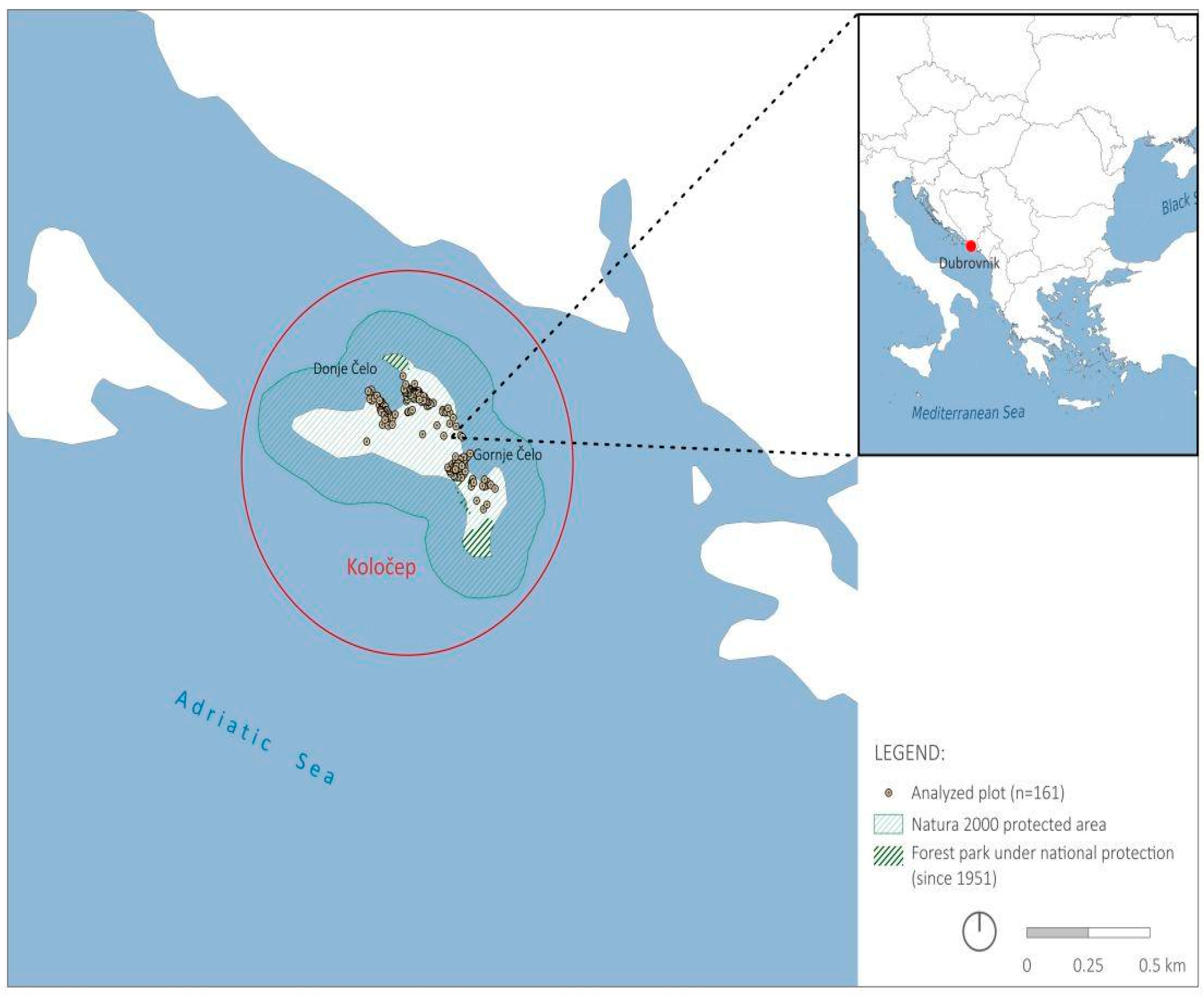
Koločep is the southernmost inhabited Croatian island and the smallest within the Elaphiti Archipelago, located in the southern Adriatic Sea in close proximity to the city of Dubrovnik (Figure 1). Although the island covers only 2.44 km2, this represents nearly 18% of the estimated vascular flora of the Adriatic islands [13]. According to the Flora Croatica Database, 465 vascular plant taxa, including 12 Illyrian-Adriatic endemics [14], have been recorded on Koločep [13], out of 63 endems recorded on Adriatic Islands [9].
The island has been designated as an Important Plant Area (IPA; BY IPA 003) [15] due to its exceptional floristic diversity and the presence of several threatened habitats [14]. Two park-forest areas (11.5 ha) have been protected since 1951 (Figure 1). The entire island lies within the Natura 2000 ecological network (Site HR4000028 Elafiti) [16,17].
Studies of Mediterranean island floras have shown that some islands can host a disproportionately high number of plant species relative to their size, including rare and endemic taxa, which further increases their sensitivity to anthropogenic pressures and biological invasions [4,18,19,20,21,22,23,24,25,26,27] and may allow them to function as regional plant diversity hotspots [21]. Consequently, this area is recognised as one of the most threatened regions in the Mediterranean basin [3,28]. Studies have shown that Mediterranean Croatia, particularly the Adriatic islands, hosts a disproportionately high number of invasive taxa, with about 67% of all invasive plant species in Croatia recorded on islands that represent only about 5% of the national territory, indicating their high vulnerability to biological invasions and habitat disturbance [3,12].
The island’s Koločep vegetation comprises the Quercus ilexPinus halepensis and MyrtoQuercetum ilicis communities, the Cisto–Ericion alliance is mainly associated with garigue vegetation, and Dauco majoriFoeniculetum vulgaris occurs on abandoned agricultural land [14].
The island has a Mediterranean climate (Csa), according to the Köppen climate classification system, with a mean annual temperature of 17 °C and an average annual precipitation of about 1020–1250 mm [29,30,31,32]. The relative air humidity does not exceed 70% [33]. Automorphic soils prevail on the island of Koločep. The predominant types are shallow, skeletal brown soils on limestone and calcareous-dolomitic black soils [34].
Systematic research on invasive alien plant species (IAS) in Croatia began two decades ago [3,35] with the islands’ vascular flora continuously studied through floristic, ethnobotanical, and invasion-focused research [3,36,37,38,39,40,41].
Despite the increasing attention given to plant invasions on Mediterranean islands, detailed assessments of cultivated and ornamental flora as potential sources of alien species introduction and spread remain limited.
Due to its small size, long history of cultivation, and relative ecological isolation, Koločep Island represents a suitable model for assessing how horticultural practices in private gardens influence the composition of ornamental flora and their potential impact on the island’s biological and landscape diversity through the introduction and spread of invasive (IAS) and potentially invasive alien species (PIAS). The main objectives of this study are: (i) to create, for the first time, a comprehensive inventory of the ornamental flora of the island of Koločep by documenting vascular plant taxa intentionally planted in private gardens, and classifying them according to taxonomic affiliation, origin, and life forms; (ii) to assess the occurrence of IAS and PIAS taxa and evaluate their invasion intensity according to the number of surveyed localities in which they were recorded (iii) to analyse landscape structural and functional changes in relation to land-use dynamics and the occurrence and spread of alien, invasive, and potentially invasive plant species.
By focusing on private gardens as key anthropogenic elements of the island landscape, this study evaluates the role of ornamental horticultural species in shaping plant assemblages on small Mediterranean islands.

2. Materials and Methods

2.1. Study Area

Koločep Island (42°40′43″ N 18°00′28″ E), located in the southern Adriatic Sea, is 3.1 km long and up to 1.2 km wide, with a coastline measuring 11.2 km in length. The island has rugged topography with two main elevations, Križ (125 m a.s.l.) and Spasovo Brdo (97 m a.s.l.), separated by a central depression and limestone ridges, the shorter of which extends along the northern coast facing the Koločep Channel. Two historical settlements are located at opposite ends of the island: Donje Čelo on the northwestern coast and Gornje Čelo on the southeastern coast.

2.2. Field Survey and Data Collection

The study was primarily based on fieldwork conducted during the 2025 growing season (April–October). A total of 10 surveys were carried out across three phenological periods: spring, summer, and autumn. In total, 161 private gardens were surveyed (Figure 1). The study focused exclusively on intentionally planted perennial ornamental species, including both autochthonous and allochthonous taxa. Annual plants and agricultural crops were excluded from the analysis, following the approach used in comparable studies [42,43,44,45]. Species were recorded through systematic floristic field surveys, and the collected data were documented on standardised survey forms and subsequently digitized into an Excel database (LTSC, version 16.0), following approaches commonly used in studies of ornamental flora [42,43,45]. The inventoried garden flora was classified according to property occupancy status into three categories: permanently occupied properties, weekend-use properties (holiday homes), and abandoned or unmanaged properties, in order to assess how different levels of garden maintenance influence species composition.
IAS and PIAS were recorded in private gardens, as well as in their immediate surroundings, along the main island pathways connecting settlements, including adjacent abandoned agricultural land and public spaces along these routes. Invasion intensity was assessed based on the frequency of occurrence of each taxon across surveyed properties and pathways, following approaches used in comparable studies [3,44,45,46].
Taxonomic identification was carried out using multiple floristic sources [7,8,47,48,49,50,51,52,53]. All surveyed sites and recorded taxa were georeferenced using smartphones equipped with built-in Global Navigation Satellite System (GNSS) functionality. Geographic coordinates (latitude and longitude) were recorded in the WGS84 coordinate system.

2.3. Data Processing and Analysis

Recorded plant taxa were classified according to geographic origin, invasion status, morpho-functional growth form, life form (Raunkiaer classification), leaf persistence and edibility. For allochthonous species, chronological status was additionally assigned. A database was compiled containing taxonomic, ecological, spatial, and site-use data for each recorded species and surveyed property (Supplementary Table S1). The study focused on assessing species occurrence frequencies across different island locations rather than determining the total number of individuals per species.
Maps were produced in a GIS environment (QGIS 3.34) using georeferenced layers from the Croatian State Geodetic and Nature Protection Information System [54,55], along with the interpretation of the Austrian cadastral survey from 1836 (HR-DAST-152) [56], field data on land use, floristic composition across surveyed sites, and the spatial distribution of IAS and PIAS taxa.

3. Results

3.1. Floristic Inventory and Analysis

Across 161 private gardens on the island of Koločep, a total of 2095 plant species records were documented, corresponding to 255 unique horticultural plant taxa belonging to 82 families. A comprehensive inventory of the ornamental flora of Koločep Island is presented in Table S1 in the Supplementary Materials.
Raunkiaer life-form classification shows a dominance of phanerophytes (57.65%), chamaephytes (19.61%), hemicryptophytes (10.98%), and geophytes (8.24%). Therophytes (3.14%) and hydrophytes (0.39%) occur only sporadically.
Shrubs are the most common growth form in private gardens on Koločep (36.9%), followed by herbs (30.6%) and trees (22.8%), while climbers (9.0%) and grasses (0.8%) are less frequent.
Evergreen species predominate (67.06%) over deciduous ones (32.94%), while non-edible species prevail (45.10%) and edible and partially edible species are equally represented (27.45% each).
Although non-edible species constitute the largest individual category (45.10%), edible and partially edible species together predominate, comprising 54.9% of the total garden flora.
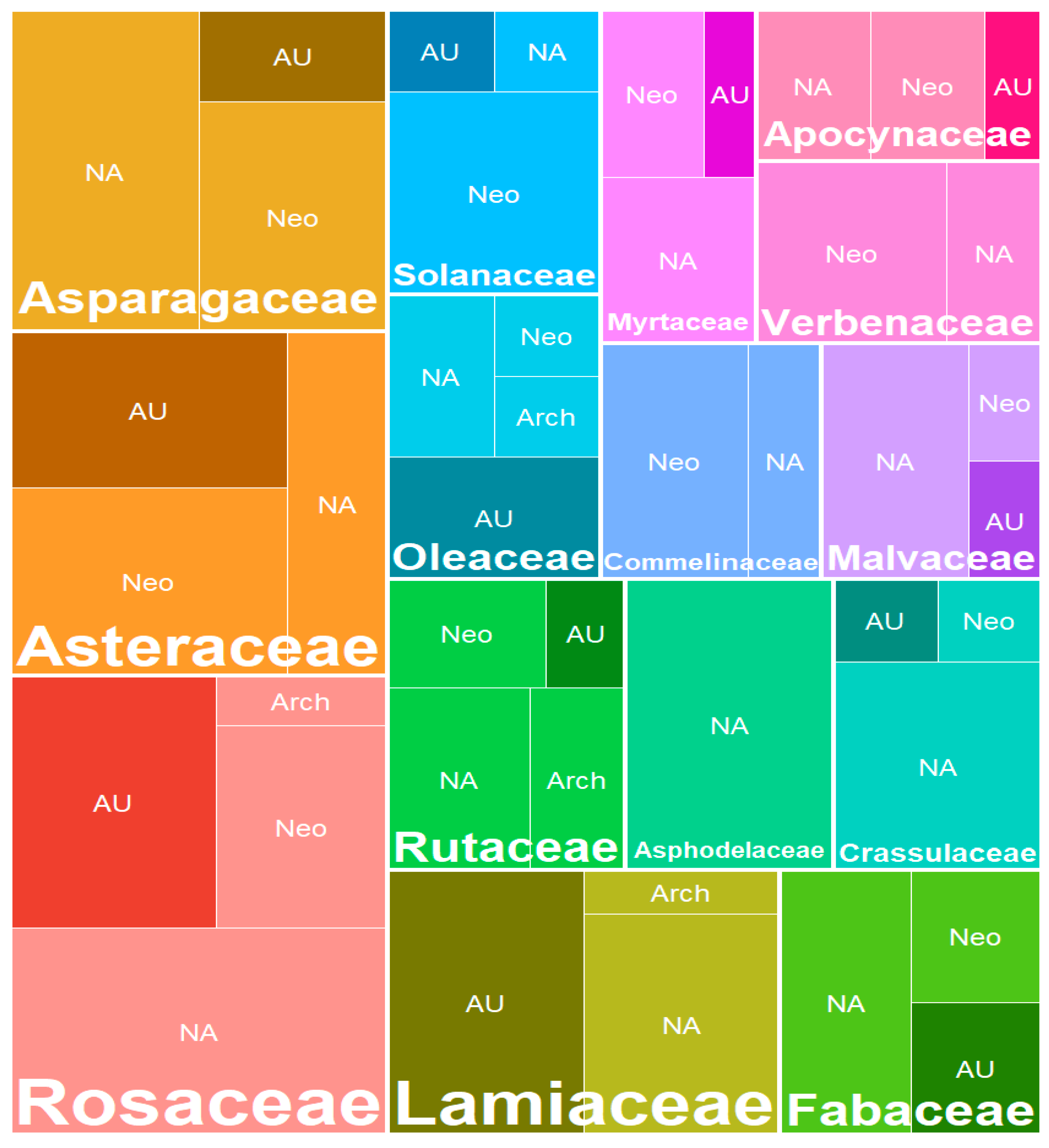
Figure 2 shows the fifteen most frequently recorded plant families, expressed as percentages of the total number of taxa. The highest species richness is Rosaceae (20 species), Asparagaceae (14 species), Asteraceae, and Lamiaceae (12 species each). These families account for 23% of all recorded species.
Allochthonous plant species dominate private gardens on the island of Koločep, accounting for approximately 73% of all recorded taxa. For most species, the introduction period is unknown (67.84%), whereas archaeophytes and neophytes account for 3.53% and 28.63%, respectively. However, a different pattern emerges when the dataset is analysed based on the number of recorded occurrences. Although neophytes do not represent the largest proportion of taxa in terms of total species richness, their share increases when measured by field occurrences. This indicates that neophyte species are recorded at a relatively higher number of sites compared to their proportion in the overall species pool. In contrast, taxa with an undefined chrono status contribute more strongly to species richness than to spatial frequency. Among archaeophytes, Punica granatum L. was the most frequent (2.48%), followed by Eriobotrya japonica (Thunb.) Lindl. (1.15%) and Citrus aurantifolia (Christm.) Swingle (0.33%). Among neophytes, Agapanthus africanus (L.) Hoffmanns. (2.05%), Lantana camara L. (1.81%) and Pittosporum tobira ‘Nana’ (1.62%) were the most commonly recorded taxa.
Autochthonous plant species made up 28% of the total flora, with the highest representation in the families Rosaceae and Lamiaceae (six species each). The representation of typical elements of Koločep’s Mediterranean flora in private gardens is extremely low, including Pinus halepensis Mill. (0.1%), Cupressus sempervirens L (0.3%), Laurus nobilis L. (1.9%), Myrtus communis L. (1.5%), Erica arborea L. (0.05%), and Pistacia lentiscus L. (1.3%), Arbutus unedo L. (0.6%).
Although many plant families were recorded, most families are represented by few taxa, indicating high taxonomic diversity but a limited number of dominant families.
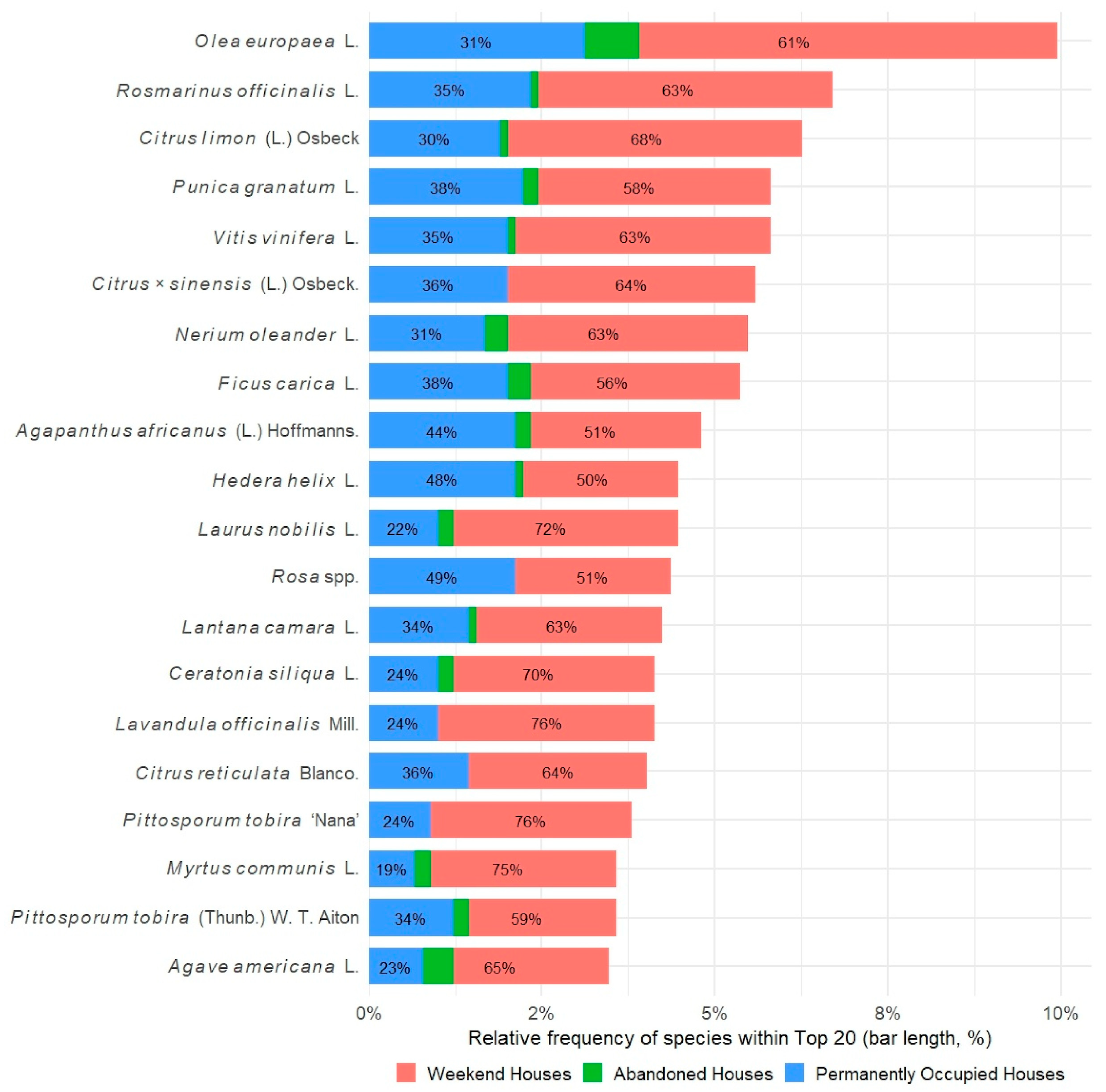
Fruit and ornamental species are the most common plant groups in the gardens of Koločep (Figure 3). Almost 63% of plant species were recorded in weekend-use properties. Permanently occupied properties have fruit species such as olive, pomegranate, and fig that are clearly dominant. Abandoned properties show the lowest overall presence of most plant species. Some species, such as Agave americana L., Hedera helix L., and Ceratonia siliqua L., were recorded with measurable presence even in abandoned areas.
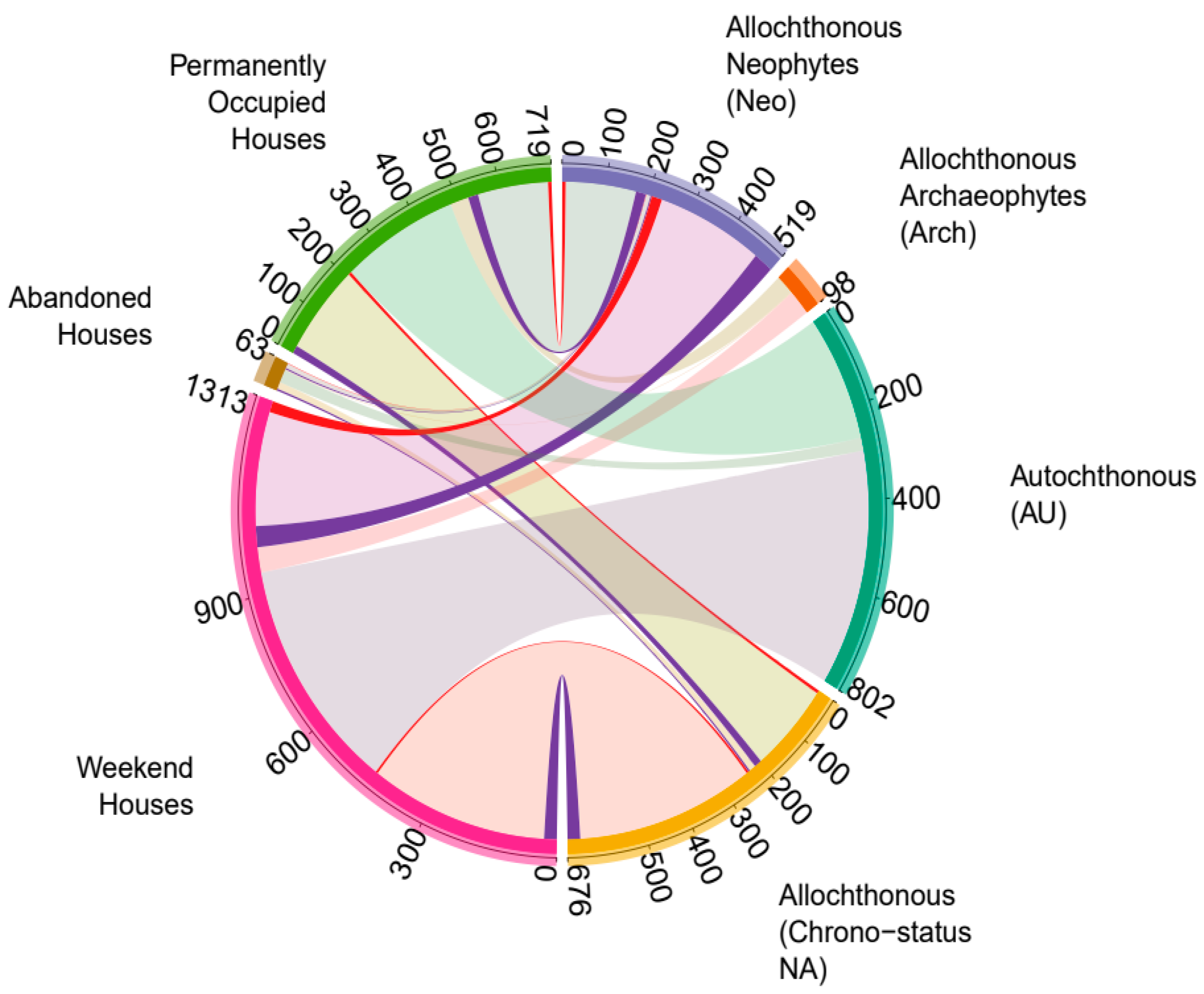
Weekend-use properties contain the most plant records and the greatest taxonomic diversity, encompassing all origin and invasion categories (Figure 4). In all property types, allochthonous (AL) taxa clearly dominate. Although autochthonous (AU) taxa do not dominate, they are most represented in weekend and permanently occupied properties. Abandoned properties have the lowest number of records overall, with autochthonous taxa (44.4%) and allochthonous taxa 55.6%, including neophytes (22.2%), archaeophytes (3.17%), and taxa with undefined chrono status (30.2%), as well as a low proportion of IAS (1.59%) and PIAS (11.1%).

Invasive and Potentially Invasive Taxa

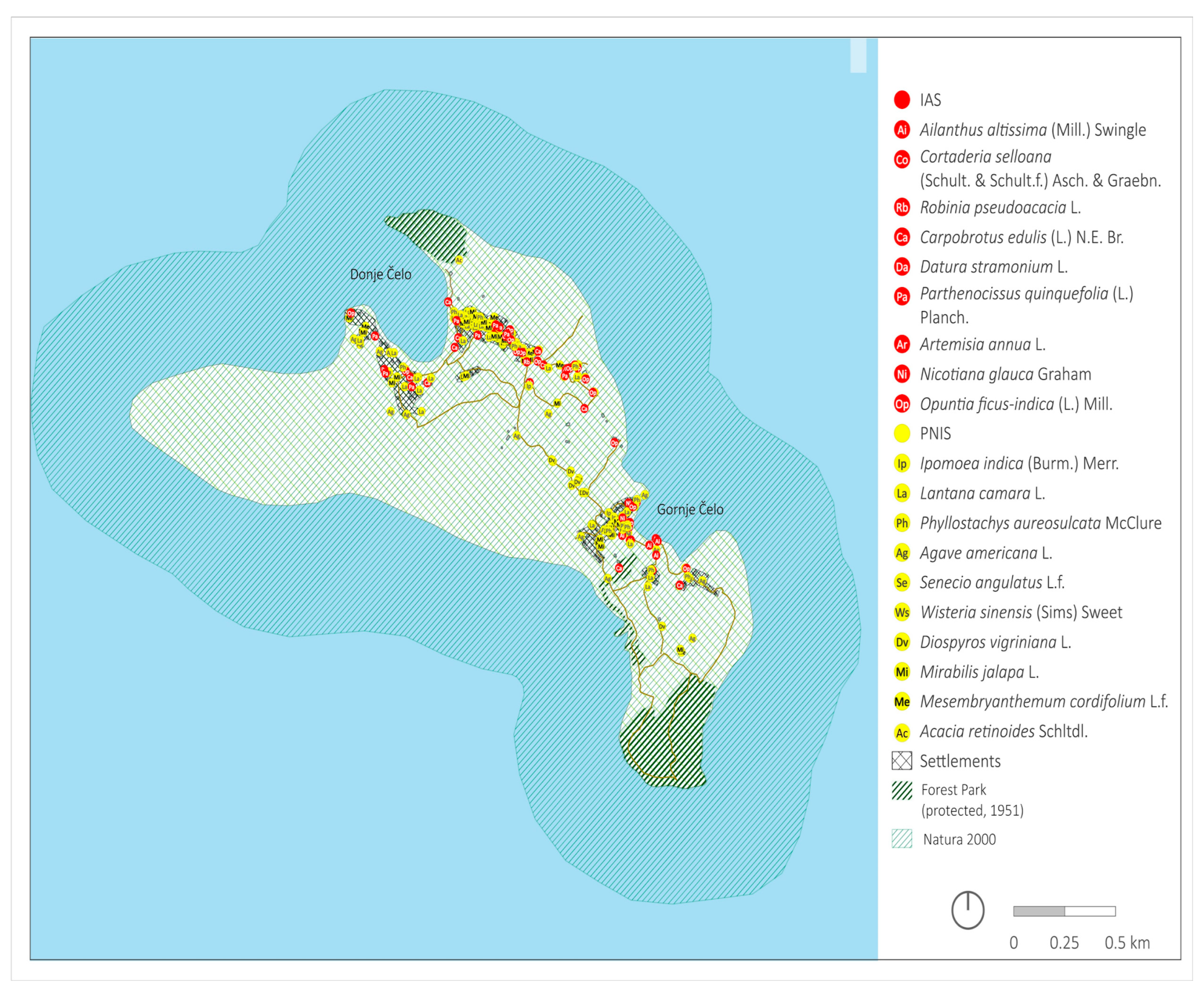
On Koločep Island, PIAS and IAS were recorded in 101 private gardens (out of 161 in total) and at 81 locations outside gardens, including their immediate surroundings, along the main pathways connecting settlements, and in adjacent abandoned agricultural areas and public spaces (Figure 5, Figure 6 and Figure 7; Table 1). Of the 255 taxa recorded on Koločep Island, 9 taxa (3.5%) were classified as IAS, and 10 taxa (4%) as PIAS. Within the IAS group are: Ailanthus altissima (Mill.) Swingle, Cortaderia selloana (Schult. & Schult.f.) Asch. & Graebn., Robinia pseudoacacia L., Carpobrotus edulis (L.) N.E.Br., Datura stramonium L., Parthenocissus quinquefolia (L.) Planch., Artemisia annua L., Nicotiana glauca Graham and Opuntia ficus-indica (L.) Mill.
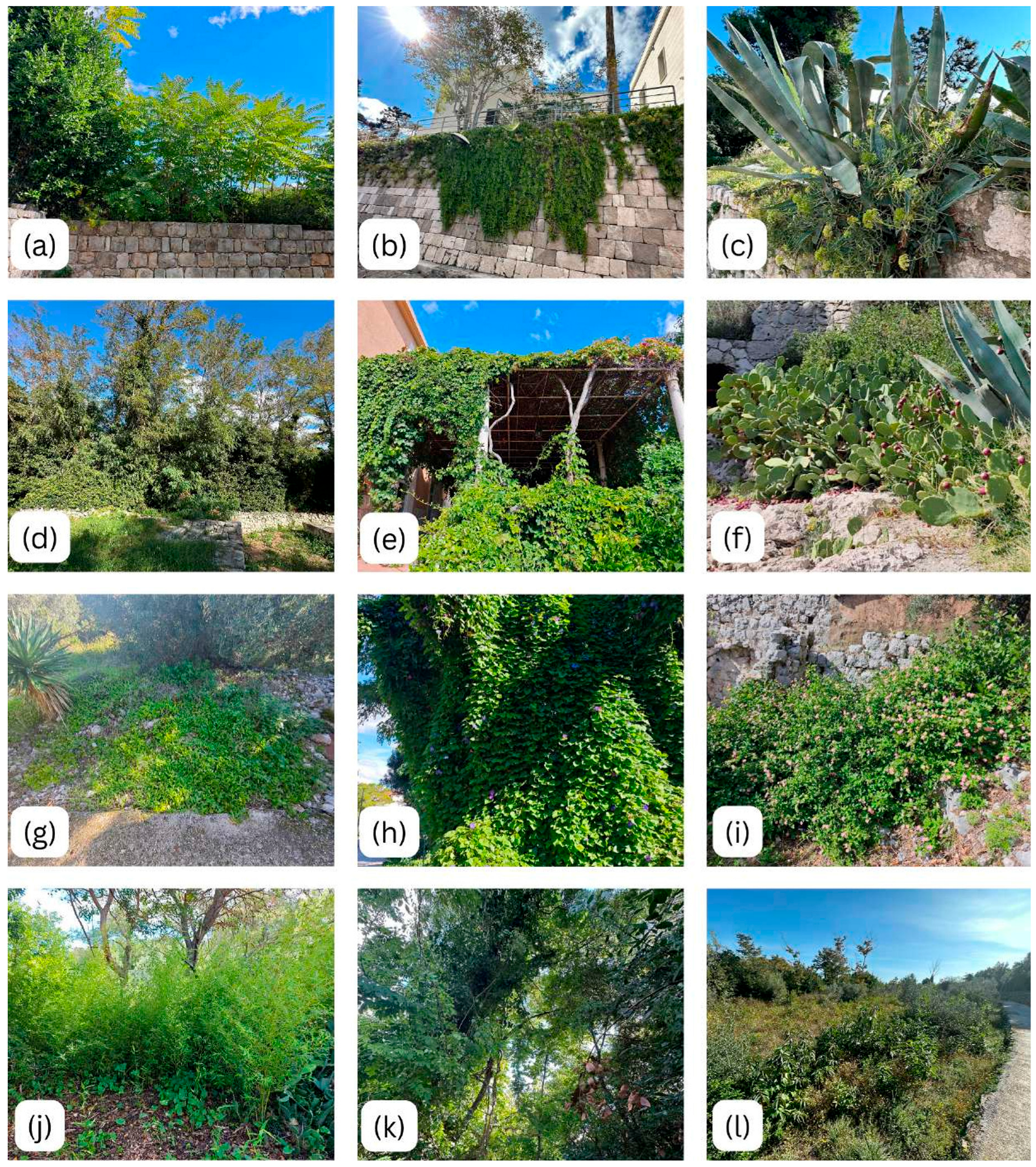
The PIAS group included: Ipomoea indica (Burm.) Merr., Lantana camara L., Phyllostachys aureosulcata McClure, Agave americana L., Mesembryanthemum cordifolium L.f., Mirabilis jalapa L., Senecio angulatus L.f., Diospyros virginiana L., Wisteria sinensis (Sims) Sweet. and Acacia retinoides Schltdl. The most frequently recorded species on Koločep Island are shown in Figure 6.
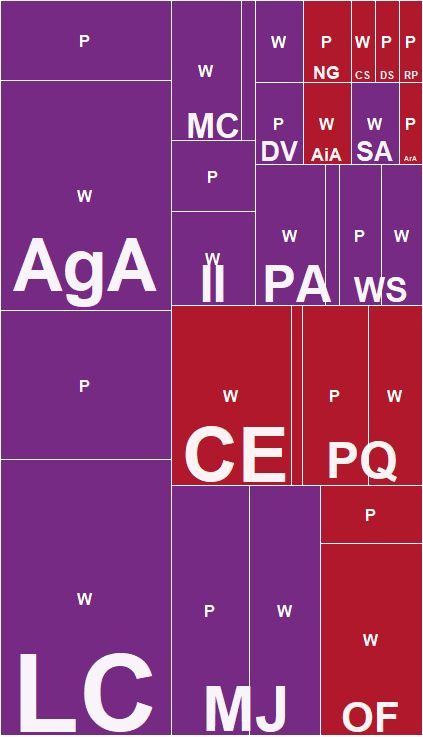
All taxa within IAS group were capable of sexual reproduction, while 60% of the taxa additionally reproduced vegetatively. Among them, 33% of IAS taxa exhibited high invasive behaviour, 11% moderate, and 56% low on Koločep. All PIAS taxa were capable of sexual reproduction, with several taxa additionally reproducing vegetatively. PIAS taxa were classified as moderate (50%), high (30%), while 20% showed low invasive behaviour. The IAS group comprised nine taxa (Figure 7), belonging to eight families, with Solanaceae being the most represented family (22.2%). The PIAS group comprised 10 taxa across 9 families, with Fabaceae contributing the highest proportion (20%).
Phanerophytes represented the dominant life form among the recorded alien taxa (63.2%, n = 12), followed by chamaephytes (15.8%), hemicryptophytes (10.5%), and therophytes (10.5%). Within the IAS group, phanerophytes predominated (55.6%), while therophytes accounted for 22.2%, and hemicryptophytes and chamaephytes each represented 11.1%. In the PIAS group, a predominance of phanerophytes was also observed (70.0%), followed by chamaephytes (20.%) and hemicryptophytes (10%), whereas therophytes were not recorded. Evergreen species slightly predominated (52.6%) over deciduous ones (47.4%) among both IAS and PIAS. IAS and PIAS taxa were predominantly woody perennials, succulents, and perennial herbaceous species, including trees, shrubs, climbers, and herbs.
The geographic origin of IAS and PIAS taxa was dominated by North America (42%) and Asia (26%), with isolated records from South America (16%), Africa (11%), and Australia (5%).
On Koločep Island, IAS taxa with the highest invasion intensity were A. altissima and C. edulis, while the most frequently recorded species were A. altissima, O. ficus-indica, and C. edulis. Among PIAS taxa, the most common were A. americana, M. jalapa, and D. virginiana, but M. jalapa and D. virginiana were categorized as having high invasion intensity. Although most taxa of IAS and PIAS (8%) of all recorded plant individuals were recorded in cultivated areas, occurrences outside gardens were confirmed for 30% of IAS taxa (3 of 9) and 40% of PIAS taxa (4 of 10). These records were primarily associated with public spaces (A. altissima, A. americana, M. jalapa) and abandoned agricultural plots (D. virginiana, I. indica, M. jalapa, A. altissima, R. pseudoacacia, W. sinensis). In public areas, A. altissima accounted for 48% of IAS locations, while D. virginiana was recorded in 11% of abandoned agricultural plots.
IAS taxa were most frequent in weekend-use properties (30%), followed by permanently inhabited (27%) and abandoned properties (11%). Weekend-use properties were dominated by O. ficus-indica (30%) and C. edulis (17%), whereas in permanently inhabited properties P. quinquefolia (18%) and O. ficus-indica (16%) were most common.
The highest number of PIAS records was documented in weekend-use properties (76%), followed by permanently inhabited properties (74%). In gardens of permanent residents, L. camara (72%) and A. americana (60%) were the most frequently recorded PIAS taxa, whereas in weekend-use properties, L. camara (21%) and M. jalapa (16%) predominated (Figure 7).

3.2. Spatial Analysis and Land-Use Dynamics

The frequent occurrence of IAS and PIAS species outside private gardens, in their immediate surroundings and along the main communication pathways, indicates a relationship between their spread and changes in land use. Therefore, an analysis of land-use changes on Koločep Island over the past two centuries was conducted (Table 2). Historical cadastral source, literature, and recent spatial datasets were interpreted to identify the main land-use categories and their spatial proportions. The analysis distinguished the following principal land-use categories: vineyards, vegetable crops, olive groves and orchards, pastures and meadows, forest and maquis, settlements, and rocky shoreline. The analysis revealed a pronounced long-term transformation of the island’s landscape structure.
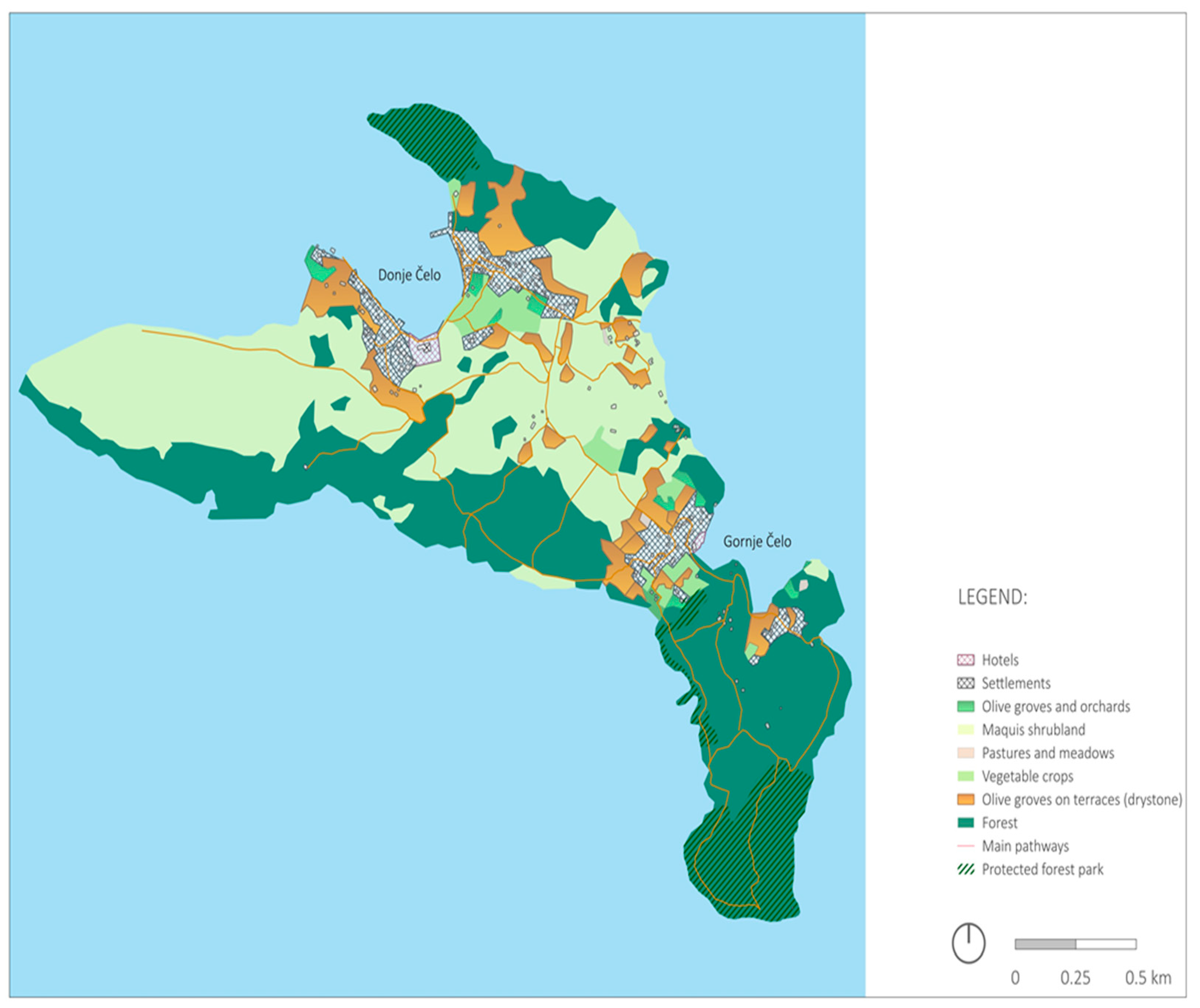
The interpretation of land use based on the Austrian cadastre from the 19th century (HR-DAST-152) indicates that the landscape of Koločep Island during that period was strongly dominated by agricultural land, which occupied approximately 74% of the island’s total area (≈181 ha). The largest share comprised pastures and meadows (36%), followed by olive groves and orchards (33%), whereas vineyards (4%) and vegetable crops (1.7%) accounted for smaller proportions. In contrast, forests and maquis vegetation covered only 17.2% of the island, primarily confined to steeper and less accessible terrain (Figure 8, Table 2).
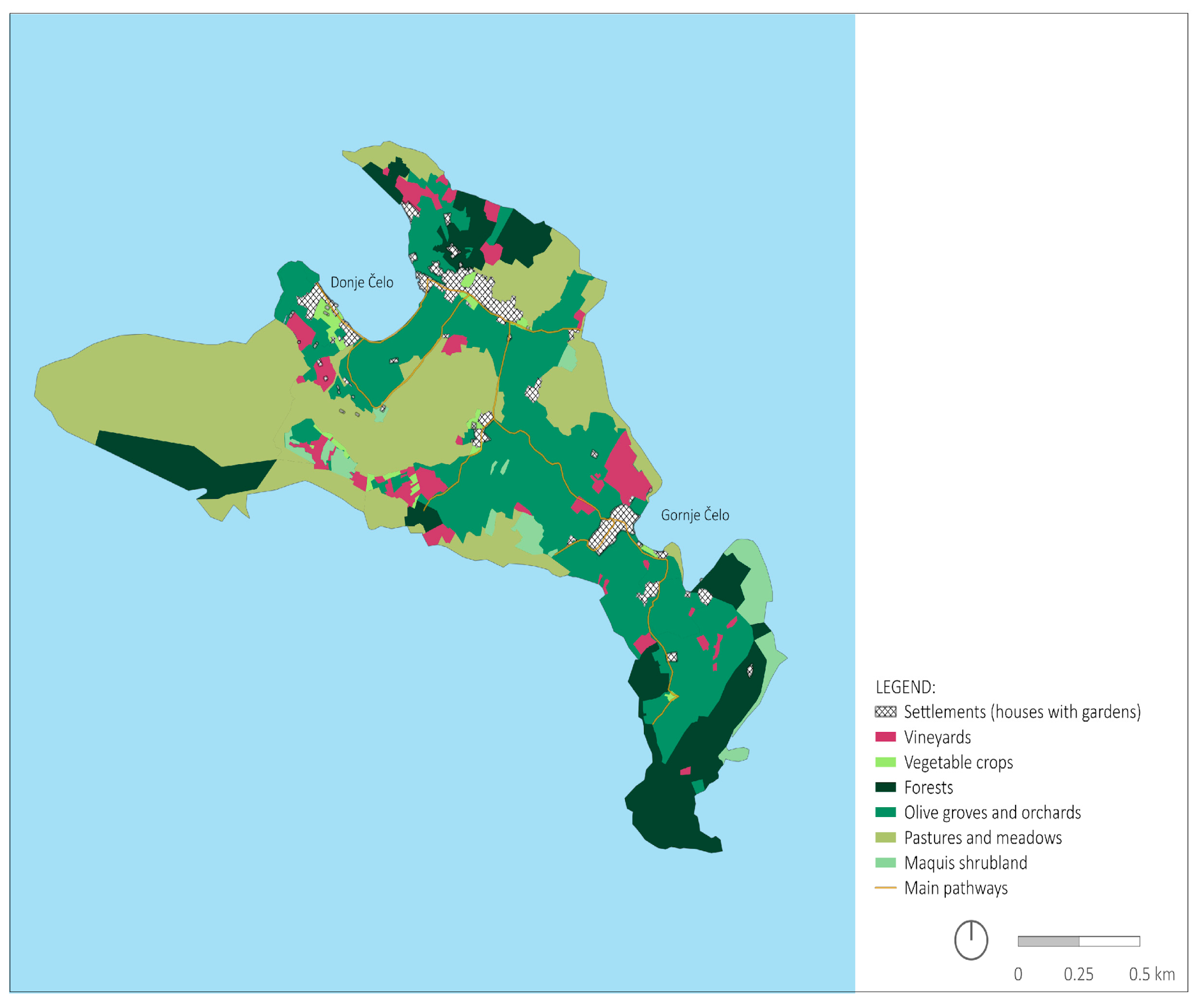
Orthoimagery analysis from 2025 [59] points to a pronounced transformation of Koločep Island’s landscape, from a predominantly agricultural land-use system (until the 19th century) to one increasingly dominated by natural and semi-natural habitats shaped by secondary succession and the expansion of pioneer autochthonous species (Figure 9, Table 2).
The central, once most fertile part of the island, is now largely shaped by natural succession. Forests and maquis dominate the landscape, covering approximately 77% of the total area (Table 2; Figure 9). Agricultural land occupies about 24.4% of the surface, including olive groves and orchards (7.2%), vegetable crops (2.7%), and pastures (0.2%), while extensive vineyard areas are no longer present, except for small plots adjacent to residential gardens. Remaining agricultural parcels are primarily concentrated around the main island settlements. The proportion of settlement areas (houses with gardens included) increased from 3% in 1836 to 5.8% of the island’s total area by 2025 (+100%).
Outside private gardens, field observations and orthophoto interpretation indicate that IAS and PIAS predominantly spread across abandoned, formerly most fertile agricultural land in the central part of the island, as well as near settlements. The analysis further indicates that the main dispersal routes follow the island’s primary pathways.

4. Discussion

4.1. Comprehensive Inventory of the Ornamental Flora

Data obtained from the analysis of the comprehensive inventory of the island of Koločep’s ornamental flora provides detailed insight into the structure of the flora and prevailing horticultural practices on the island. According to Raunkiaer’s classification, phanerophytes dominate on Koločep (57%), indicating a prevalence of woody perennial species, mainly trees and shrubs, in the structure of private gardens. This pattern is consistent with the findings of Di Gristina et al. [42], who reported an even higher dominance of phanerophytes (75.8%) in the ornamental vascular flora of Sicily.
Although the total number of recorded taxa (255) on Koločep Island may suggest that garden spaces contribute to the island’s overall biological and landscape diversity, detailed analyses of taxonomic structure and invasion status reveal a more complex pattern. The predominance of woody evergreen phanerophytes in island gardens reflects garden owners’ awareness (shaped for generations) of their specific requirements under Mediterranean island conditions (shade, salt spray, irrigation), their relatively low maintenance demands, and is consistent with some previous studies of ornamental flora on the Eastern Adriatic [59].
Dominance of allochthonous taxa (>70%) over autochthonous species in island gardens is consistent with previous studies of ornamental flora of other Mediterranean islands [2,59,60,61]. Namely, the human tendency to cultivate new and diverse plant species, often including taxa that pose threats to biodiversity and are promoted by horticultural trends, is as old as human society itself, regardless of geographical region [62]. This pattern suggests that island gardens, shaped by long-term human influence, serve as primary sites for the introduction and testing of plant species, where native and introduced taxa coexist and collectively shape the local ornamental flora.
The negligible representation of typical island vegetation in gardens on Koločep (0.5–1.5%) indicates a lower presence of often slow-growing species with more subtle ornamental traits (e.g., limited colourfulness and shorter flowering periods), despite their recognised importance for maintaining biodiversity and ecosystem resilience on islands [63]. This pattern is supported by studies of nursery production along the Adriatic coast, which indicate a strong predominance of allochthonous taxa (84.4%) compared to autochthonous species (15.6%) in the available planting material [64].
The still relatively high proportion of fully or partially edible plant species (54.9%) on Koločep reflects the persistence of local garden-design traditions shaped by centuries of cultivation on karst terrain with limited fertile soil, where plants were traditionally selected for both utilitarian and ornamental purposes [65]. Accordingly, the most frequently planted archaeophytes include P. granatum, E. japonica, and C. aurantifolia. This high proportion of edible taxa is relevant in light of global evidence that plants with economic uses show higher naturalization rates, with 41% of economically used taxa reported as naturalized outside their native ranges [66].

4.2. Occurrence and Frequency of IAS and PIAS

On Koločep Island, a relatively high number of IAS (9) and PIAS (10) was recorded. When related to the island area (2.44 km2), Koločep exhibits the highest invasion density (3.7 IAS/km2) compared to other Croatian islands, such as Žirje (≈0.95 IAS/km2), Vis (≈0.16 IAS/km2), Rab (≈0.13 IAS/km2), Brač (≈0.08 IAS/km2), and Hvar (≈0.04 IAS/km2) [3]. Similar patterns have been reported for other Mediterranean islands, where small island size combined with high floristic richness and strong anthropogenic influence results in elevated invasion intensity, expressed as the number of invasive taxa per unit area [23,67]. In this context, the life-form structure of alien taxa becomes particularly relevant. Galanidis et al. [5] reported that phanerophytes represent the dominant life form among alien species on Lesvos Island (40%), largely associated with deliberate horticultural introductions. It has been established that private gardens on Koločep serve as the primary pathway for the introduction of IAS and PIAS, consistent with findings from other studies [26,68].
Global and regional databases (GRIIS [53], EASIN [52], FCD [13]) represent important reference sources, primarily reflecting generalized invasion risk assessments. Therefore, assessing species invasiveness at the level of a specific locality is essential, as it is largely determined by the area’s particular ecological conditions [69,70,71].
In this study, IAS species that show a pronounced invasive potential on the island were identified, such as A. altissima and C. edulis, as well as those among the PIAS, such as D. virginiana and M. jalapa, which have been observed to pose a threat to island habitats.
Vilà et al. [72] found that the invasion of species of the genus Carpobrotus and the tree A. altissima (Mill.) significantly reduces species richness on Mediterranean islands and alters environmental conditions. A. altissima, although the subject of management strategies and recognized within legal regulations [73], is widespread throughout the island, which raises questions about the possibility of its eradication.
The research conducted by Máximo et al. [74] indicated that C. edulis can colonise coastal zones, significantly limiting the development of native plant communities. This pattern is also observed on Koločep, where the species suppresses Crithmum maritimum L., an important coastal halophytic plant of the European Mediterranean (Figure 6).
M. jalapa was observed on Koločep as being widely distributed in the immediate surroundings of private garden spaces. A similar pattern was recorded on the island of Korčula half a century ago [75], and the species has been characterized as one that “escapes cultivation” and establishes self-sown populations following anthropogenic habitats [76]. The reason for this is its high reproductive capacity, as it can propagate both vegetatively via its tuberous roots and by easily reseeding itself, and due to these traits, it is considered an environmental weed [77].
Contemporary changes in property use, particularly the increasing predominance of weekend houses, i.e., seasonal residences with ornamental plantings, represent an important pathway for the introduction of alien species. Namely, the management of private gardens is often seasonal and spatially fragmented. In the absence of a detailed management plan for this IPA area, such conditions may further facilitate the local persistence and spread of alien taxa [14]. One of the key management strategies for preventing the introduction of alien, IAS, and PIAS taxa into sensitive island ecosystems is the education of landowners about the high potential of native plants to meet both functional and aesthetic requirements in gardens, as demonstrated by Christoforidi et al. [78].

4.3. Landscape Dynamics and the Spread of IAS and PIAS

Islands are considered hotspots of unique biological and landscape diversity, yet, due to strong anthropogenic pressures, they also represent some of the most threatened ecosystems on Earth [20,79,80]. The land-use analysis of Koločep Island was conducted to identify key periods of landscape transformation and related cultivation patterns associated with the occurrence of IAS and PIAS taxa.
Relatively few studies emphasise the importance of the historical legacy of land-use changes as one of the key factors influencing the occurrence and spatial patterns of invasive species [81,82,83,84,85]. This type of analysis is equally important because of the opposite direction, as the introduction and spread of IAS and PIAS can profoundly reshape island landscapes, altering ecological processes, vegetation structure, and habitat connectivity [45,86,87].
Koločep represents a typical Mediterranean island where centuries of continuous human presence and agricultural activity have profoundly shaped the landscape. The clearing of native Q. ilex forests enabled the formation of agricultural plots that sustained local subsistence for centuries [58,88,89,90,91]. Historical sources and the Austrian cadastre from the 19th century indicate that more than 70% of the island’s surface was cultivated, primarily with olive groves, vineyards, citrus orchards, and vegetable gardens [92,93,94,95].
During the 20th century, population decline and the emergence of tourism [89,96,97,98] led to agricultural land abandonment, resulting in a twofold increase in forest and maquis cover compared to the 19th century, dominated by P. halepensis. The beginning of the 20th century was marked by the onset of more intensive horticultural importation of allochthonous flora [89,99], closely associated with the island’s growing touristic orientation.
The spread of IAS and PIAS originating from private gardens on Koločep is primarily associated with the most fertile, formerly cultivated soils along the main island pathways, as confirmed by the land-use and field analyses. From a landscape and land-use perspective, this pattern appears to be closely associated with changes in land management practices, particularly the abandonment of agricultural land linked to the gradual depopulation of the island and the shift toward other economic activities, in addition to the invasive potential of certain species. As a result, extensive areas of former agricultural land have undergone natural succession, creating favourable conditions for the establishment and spread of certain alien taxa. Certain forms of land use, such as ornamental gardens, abandoned agricultural plots, and degraded edge habitats, may facilitate the spread of invasive taxa, thereby accelerating ecological and landscape transformations on islands [82,85,100]. These processes have also modified the proportions of characteristic landscape patterns on the island, highlighting the importance of both monitoring IAS and PIAS and maintaining a mosaic of different land-use types and natural and semi-natural habitats through future management plans.

5. Conclusions

The conservation of landscape and biological diversity, especially on small Mediterranean islands, represents one of the key challenges in ecosystem protection. Such islands are biodiversity hotspots, hosting a high number of plant species and endemics within specific geographical conditions [80,101]. Due to spatial isolation and limited resources, island ecosystems are highly exposed to anthropogenic pressures and biological invasions [14] and are generally more vulnerable than mainland ecosystems [4].
The results of this study emphasise the importance of continuous monitoring of the ornamental flora and landscape dynamics on islands with predominant anthropogenic influence, where private gardens play an important role in the introduction and spread of alien species. To preserve biodiversity on small Mediterranean islands, a science-based approach to the control of invasive alien species (IAS) and potentially invasive alien species (PIAS) is required, together with the development of clear methodological frameworks and the involvement of the local community [5]. Furthermore, educating local residents about species with high invasive potential, which can significantly alter landscape physiognomy and negatively affect native plant populations, is essential for early detection and for preventing their introduction and human-mediated spread [101]. This study has shown that woody ornamental species are the most represented group in private gardens. Therefore, landscape and horticultural design should increasingly promote autochthonous, non-invasive species that meet functional and aesthetic criteria while posing minimal ecological risk [78,87].
The research highlights the need for systematic monitoring of the composition, occurrence, and frequency of invasive (IAS) and potentially invasive (PIAS) plant species on islands. Early detection and systematic data collection enable the identification of invasion hotspots and the modelling of their spatial dynamics, while anthropogenically disturbed and degraded areas in island systems have been identified as spatially concentrated zones of alien plant spread [80,85]. This study highlights the importance of compiling inventories of ornamental plant species and, in particular, monitoring IAS and PIAS taxa within the island’s private gardens and their immediate surroundings, which have proven to be key focal points and early indicators of their spread. Their spatial distribution reflects their invasive potential and provides a valuable basis for developing sustainable management strategies. These findings also underline the need to implement a comprehensive management plan for this IPA area in order to ensure the long-term conservation of the island’s biological and landscape diversity.

6. Limitations and Future Directions

This study assessed species occurrence across surveyed localities on the island, focusing on private gardens as primary pathways for the introduction of ornamental, IAS, and PIAS taxa. Future research should focus on long-term monitoring of IAS and PIAS dynamics on Koločep Island and the influence of abiotic factors associated with characteristic landscape patterns.

Supplementary Materials

The following supporting information can be downloaded at: https://www.mdpi.com/article/10.3390/d18040200/s1.

Author Contributions

Conceptualization, M.M.; methodology, M.M.; investigation, I.P.S., J.B., D.I.Ž. and M.M.; data curation, J.B.; visualization, D.I.Ž.; writing—original draft preparation, M.M., I.P.S., D.I.Ž. and J.B.; writing—review and editing, M.M., I.P.S., D.I.Ž. and J.B.; supervision, M.M. All authors have read and agreed to the published version of the manuscript.

Funding

This research received no external funding. The work was supported by the University of Dubrovnik.

Data Availability Statement

The original contributions presented in this study are included in the article and Supplementary Materials. Further inquiries can be directed to the corresponding authors.

Acknowledgments

The authors thank the University of Dubrovnik for institutional support and all individuals who assisted during field surveys on the island of Koločep.

Conflicts of Interest

The authors declare no conflicts of interest.

References

  1. Terzi, M.; Bogdanović, S.; D’amico, F.S.; Jasprica, N. Rare plant communities of the Vis Archipelago (Croatia). Bot. Lett. 2020, 167, 241–254. [Google Scholar] [CrossRef]
  2. Médail, F. Plant biogeography and vegetation patterns of the Mediterranean islands. Bot. Rev. 2022, 88, 63–129. [Google Scholar] [CrossRef]
  3. Nikolić, T.; Mitić, B.; Milašinović, B.; Jelaska, S.D. Invasive alien plants in Croatia as a threat to biodiversity of South-Eastern Europe: Distributional patterns and range size. Comptes Rendus Biol. 2013, 336, 109–121. [Google Scholar] [CrossRef]
  4. Guarino, R.; Chytrý, M.; Attorre, F.; Landucci, F.; Marcenò, C. Alien plant invasions in Mediterranean habitats: An assessment for Sicily. Biol. Invasions 2021, 23, 3091–3107. [Google Scholar] [CrossRef]
  5. Galanidis, A.; Bazos, I.; Dimitrakopoulos, P.G. Non-native flora of the Mediterranean Lesvos Island (East Aegean, Greece): Floristic analysis, traits, and assessment. Plants 2024, 13, 3375. [Google Scholar] [CrossRef] [PubMed]
  6. Novak, N.; Novak, M.; Marić, K. Povijesni pregled unosa stranih vrsta biljaka na teritorij Republike Hrvatske [Historical overview of the introduction of foreign plant species into the territory of the Republic of Croatia]. Glas. Biljn. Zaštite 2025, 25, 461–493. [Google Scholar]
  7. Pignatti, S. Flora d’Italia; Edagricole: Bologna, Italy, 1982; Volume 1–3. [Google Scholar]
  8. Tutin, T.G.; Heywood, V.H.; Burges, N.A.; Valentine, D.H.; Walters, S.M.; Webb, D.A. Flora Europaea; Cambridge University Press: Cambridge, UK, 1964. [Google Scholar]
  9. Nikolić, T.; Fois, M.; Milašinović, B. The endemic and range restricted vascular plants of Croatia: Diversity, distribution patterns and their conservation status. Phytotaxa 2020, 436, 125–140. [Google Scholar] [CrossRef]
  10. Leder, T.D.; Ujević, T.; Čala, M. Duljine obalne crte i površine otoka na hrvatskom dijelu Jadranskog mora određene sa topografskih karata mjerila [The lengths of the coastline and the areas of the islands in the Croatian part of the Adriatic Sea determined from topographic maps of the scale]. Geoadria 2017, 9, 5–32. [Google Scholar] [CrossRef]
  11. Mitić, E.; Boršić, I.; Dujmović, I.; Bogdanović, S.; Milović, M.; Cigić, P.; Rešetnik, I.; Nikolić, T. Alien flora of Croatia: Proposals for standards in terminology, criteria and related database. Nat. Croat. 2008, 17, 73–90. [Google Scholar]
  12. Nikolić, T. Flora of the Adriatic Islands. In Book of Abstracts. II Jornades de Botànica a Menorca. Illes i Plantes: Conservatió i Coneixement de la Flora a les Illes de la Mediterrània; Universitat de les Illes Balears: Palma, Spain, 2011; Available online: https://www.croris.hr/crosbi/publikacija/prilog-skup/592924 (accessed on 5 February 2026).
  13. Nikolić, T. Flora Croatica Database. Available online: http://hirc.botanic.hr/fcd (accessed on 2 November 2025).
  14. Jasprica, N. Koločep. In Botanički važna područja Hrvatske [Botanically important areas of Croatia]; Nikolić, T., Topić, J., Vuković, N., Eds.; Školska Knjiga, Prirodoslovno-Matematički Fakultet: Zagreb, Croatia, 2010. [Google Scholar]
  15. Plantlife International. PlantLife Important Plant Areas (IPA) Database. Factsheet for Blue Lakes (BY IPA 003). Available online: https://www.plantlifeipa.org/home (accessed on 4 February 2026).
  16. HR4000028 Elafiti. BIOportal—Ecological Network Natura 2000 [State Geodetic Administration]. Available online: https://bioportal.hr/gis/?site-code=HR4000028 (accessed on 1 February 2026).
  17. Council of the European Communities. Council Directive 92/43/EEC on the Conservation of Natural Habitats and of Wild Fauna and Flora. Off. J. Eur. Union 1992, 206, 7–50. [Google Scholar]
  18. Foxcroft, L.C.; Richardson, D.M.; Pyšek, P.; Genovesi, P. Invasive alien plants in protected areas: Threats, opportunities, and the way forward. In Plant Invasions in Protected Areas; Foxcroft, L.C., Pyšek, P., Richardson, D.M., Genovesi, P., Eds.; Springer: Dordrecht, The Netherlands, 2013; pp. 621–639. Available online: http://link.springer.com/10.1007/978-94-007-7750-7_28 (accessed on 6 February 2026). [CrossRef]
  19. Özden, Ö.; Yıldırım, S. Plant biodiversity and values of cultural landscapes in Cyprus. Int. J. Adv. Appl. Sci. 2019, 6, 1–4. [Google Scholar] [CrossRef]
  20. Fernández-Palacios, J.M.; Kreft, H.; Irl, S.D.; Norder, S.; Ah-Peng, C.; Borges, P.A.V.; Burns, K.C.; de Nascimento, L.; Meyer, J.-Y.; Montes, E.; et al. Scientists’ warning—The outstanding biodiversity of islands is in peril. Glob. Ecol. Conserv. 2021, 31, e01847. [Google Scholar] [CrossRef]
  21. Testolin, R.; Attorre, F.; Bruzzaniti, V.; Guarino, R.; Jiménez-Alfaro, B.; Lussu, M.; Martellos, S.; Di Musciano, M.; Pasta, S.; Sabatini, F.M.; et al. Plant species richness hotspots and related drivers across spatial scales in small Mediterranean islands. J. Sytematics Evol. 2024, 62, 242–256. [Google Scholar] [CrossRef]
  22. Schrader, J.; Weigelt, P.; Cai, L.; Westoby, M.; Fernández-Palacios, J.M.; Cabezas, F.J.; Plunkett, G.M.; Ranker, T.A.; Triantis, K.A.; Trigas, P.; et al. Islands are key for protecting the world’s plant endemism. Nature 2024, 634, 868–874. [Google Scholar] [CrossRef]
  23. Brundu, G. Invasive alien plants in protected areas in Mediterranean Islands: Knowledge gaps and main threats. In Plant Invasions in Protected Areas; Foxcroft, L.C., Pyšek, P., Richardson, D.M., Genovesi, P., Eds.; Springer: Dordrecht, The Netherlands, 2013; pp. 395–422. Available online: http://link.springer.com/10.1007/978-94-007-7750-7_18 (accessed on 16 December 2025). [CrossRef]
  24. Celesti-Grapow, L.; Bassi, L.; Brundu, G.; Camarda, I.; Carli, E.; D’Auria, G.; Del Guacchio, E.; Domina, G.; Ferretti, G.; Foggi, B.; et al. Plant invasions on small Mediterranean islands: An overview. Plant Biosyst. 2016, 150, 1119–1133. [Google Scholar] [CrossRef]
  25. Misuri, A.; Mugnai, M.; Giunti, M.; Dell’olmo, L.; Lazzaro, L. Invasive alien plants at Capraia Island (Italy): Distribution and threats to Natura 2000 habitats. Plant Sociol. 2024, 61, 31–44. [Google Scholar] [CrossRef]
  26. Cerrato, M.D.; Cortés-Fernández, I.; Ribas-Serra, A.; Mir-Rosselló, P.M.; Cardona, C.; Gil, L. Time pattern variation of alien plant introductions in an insular biodiversity hotspot: The Balearic Islands as a case study for the Mediterranean region. Biodivers. Conserv. 2023, 32, 2585–2605. [Google Scholar] [CrossRef]
  27. Sarigu, M.; Podda, L.; Calvia, G.; Lallai, A.; Bacchetta, G. Floristic inventory and diversity of urban green spaces in the municipality of Assemini (Sardinia, Italy). Plants 2025, 14, 1102. [Google Scholar] [CrossRef]
  28. Lopez-Alvarado, J.; Farris, E. Ecology and evolution of plants in the Mediterranean basin: Perspectives and challenges. Plants 2022, 11, 1584. [Google Scholar] [CrossRef]
  29. Šegota, T.; Filipčić, A. Köppenova podjela klima i hrvatsko nazivlje [Köppen's climate classification and Croatian terminology]. Geoadria 2017, 8, 17–37. [Google Scholar] [CrossRef]
  30. Makjanić, B.; Volarić, B. Neke osobine klime Lokruma i šire okolice [Some climatic characteristics of Lokrum and the wider surroundings]. In Otok Lokrum—Zbronik Radova; Meštrov, M., Ed.; Hrvatsko Ekološko Društvo: Zagreb, Croatia, 1989; pp. 27–46. [Google Scholar]
  31. Jelić, R. Klimatski podaci za Gruški zaljev Dubrovnik (razdoblje 1993.–2002.) [Climatic data for the Gruž Bay, Dubrovnik (period 1993–2002)]. Naše More 2003, 50, 221–230. [Google Scholar]
  32. Gajić-Čapka, M.; Mihajlović, D.; Cindrić, K.; Zaninović, K. Oborina. In Klimatski atlas Hrvatske [Climate atlas of Croatia 1961–1990., 1971–2000.]; Državni hidrometeorološki zavod: Zagreb, Croatia, 2008; pp. 43–59. [Google Scholar]
  33. Magaš, D.; Faričić, J.; Surić, M. Elafitsko otočje—Fizičko-geografska obilježja u funkciji društveno-gospodarskog razvitka [Elaphite Islands—Physical-Geographical Features in the Function of Socio-Economic Development]. Geoadria 2001, 6, 31–55. [Google Scholar]
  34. Husnjak, S. Bonitetno Vrednovanje Poljoprivrednog Zemljišta Dubrovačko-Neretvanske Županije s Bonitetnom Kartom Mjerila 1:100,000 [Land Capability Assessment of Agricultural Areas in the Dubrovnik–Neretva County with a Land Capability Map]; Dubrovnik–Neretva County: Zagreb, Croatia, 2016; Available online: https://www.zzpudnz.hr/Portals/0/1_DNZ/11_BONITETNO_VREDNOVANJE_DNZ.pdf?ver=Lm-9_g7Bbz71s4i30ufhBQ%3D%3D (accessed on 16 December 2025).
  35. Boršić, I.; Milović, M.; Dujmović, I.; Bogdanović, S.; Cigić, P.; Rešetnik, I.; Nikolić, T.; Mitić, B. Preliminary Check-List of invasive alien plant species (IAS) in Croatia. Nat. Croat. 2008, 17, 55–71. [Google Scholar]
  36. Pandža, M.; Milović, M. Flora of the islets near Pakoštane (Dalmatia, Croatia). Nat. Croat. 2015, 24, 19–35. [Google Scholar] [CrossRef]
  37. Pandža, M.; Milović, M. Flora of the Veliki Lagan and Mali Lagan islets [Dugi otok Island, Croatia]. Nat. Croat. 2015, 24, 215–222. [Google Scholar] [CrossRef]
  38. Jasprica, N.; Milović, M. The vegetation of the islet of Badija (South Croatia), with some notes on its flora. Nat. Croat. 2016, 25, 1–24. [Google Scholar] [CrossRef]
  39. Limić, I.; Šegota, V.; Alegro, A. Vascular and bryophyte flora of the islet of Mrduja (Eastern Adriatic, Croatia). Nat. Croat. 2018, 27, 27–39. [Google Scholar] [CrossRef]
  40. Jasprica, N.; Dolina, K.; Milović, M. The flora and vegetation of the NE Mediterranean islet with centuries-long human influences. Acta Bot. Croat. 2018, 77, 126–134. [Google Scholar] [CrossRef]
  41. Hruševar, D.; Mesaroš, J.; Vladović, D.; Vucić, A.; Belamarić, I.; Surać, L.; Mitić, B. Cardamine occulta Hornem.—A new concealed alien plant in the flora of Croatia. Nat. Croat. 2021, 30, 207–215. [Google Scholar] [CrossRef]
  42. Di Gristina, E.; Barone, G.; Domina, G.; Badalamenti, E.; Gargano, M.L.; Venturella, G.; Pardi, R. A checklist of the ornamental vascular flora of Sicily. Plants 2025, 14, 795. [Google Scholar] [CrossRef]
  43. Petřík, P.; Sádlo, J.; Hejda, M.; Štajerová, K.; Pyšek, P.; Pergl, J. Composition patterns of ornamental flora in the Czech Republic. NeoBiota 2019, 52, 87–109. [Google Scholar] [CrossRef]
  44. Pergl, J.; Sádlo, J.; Petřík, P.; Danihelka, J.; Chrtek, J., Jr.; Hejda, M.; Moravcová, L.; Perglová, I.; Štajerová, K.; Pyšek, P. Dark side of the fence: Ornamental plants as a source of wild-growing flora in the Czech Republic. Preslia 2016, 88, 163–188. [Google Scholar]
  45. Marco, A.; Lavergne, S.; Dutoit, T.; Bertaudiere-Montes, V. From the backyard to the backcountry: How ecological and biological traits explain the escape of garden plants into Mediterranean old fields. Biol. Invasions 2010, 12, 761–779. [Google Scholar] [CrossRef]
  46. Affre, L.; Suehs, C.M.; Charpentier, S.; Vilà, M.; Brundu, G.; Lambdon, P.; Traveset, A.; Hulme, P.E. Consistency in the habitat degree of invasion for three invasive plant species across Mediterranean islands. Biol. Invasions 2010, 12, 2537–2548. [Google Scholar] [CrossRef]
  47. Idžojtić, M. Dendrologija: Cvijet, Češer, Plod, Sjeme [Dendrology: Flower, Cone, Fruit, Seed]; Idžojtić, M., Ed.; Sveučilište u Zagrebu, Šumarski fakultet: Zagreb, Croatia, 2013. [Google Scholar]
  48. Euro+Med PlantBase. Botanic Garden and Botanical Museum Berlin-Dahlem. Euro+Med PlantBase—The Information Resource for Euro-Mediterranean Plant Diversity. 2006. Available online: http://ww2.bgbm.org/EuroPlusMed/ (accessed on 15 October 2025).
  49. Turland, N.J.; Wiersema, J.H.; Barrie, F.R.; Greuter, W.; Hawksworth, D.L.; Herendeen, P.S.; Knapp, S.; Kusber, W.-H.; Li, D.-Z.; Marhold, K.; et al. (Eds.) International Code of Nomenclature for Algae, Fungi and Plants; Regnum Vegetabile; Koeltz Botanical Books: Glashütten, Germany, 2018; Volume 159, Available online: https://www.iapt-taxon.org/nomen/main.php (accessed on 6 February 2026).
  50. Nikolić, T.; Mitić, B.; Boršić, I. Flora Hrvatske: Invazivne Biljke [Flora of Croatia: Invasive Plants]; Alfa: Zagreb, Croatia, 2014. [Google Scholar]
  51. EPPO Global Database. EPPO Global Database/EPPO Alert List [European and Mediterranean Plant Protection Organization] Phyllostachys aurea. 2026. Available online: https://www.eppo.int/ACTIVITIES/plant_quarantine/alert_list_plants/Phyllostachys_aurea (accessed on 5 February 2026).
  52. EASIN. European Commission—Joint Research Centre [European Commission, Joint Research Centre]. European Alien Species Information Network (EASIN). 2026. Available online: https://easin.jrc.ec.europa.eu/easin (accessed on 5 February 2026).
  53. GRIIS. IUCN SSC Invasive Species Specialist Group. Global Register of Introduced and Invasive Species (GRIIS). 2026. Available online: https://griis.org/ (accessed on 6 February 2026).
  54. State Geodetic Administration of the Republic of Croatia. State Geodetic Administration. Državna geodetska uprava [State Geodetic Administration]. 2026. Available online: https://dgu.gov.hr/ (accessed on 5 February 2026).
  55. GIS. Bioportal, Ministry of Economy and Sustainable Development of the Republic of Croatia. Bioportal—GIS Viewer. 2026. Available online: https://bioportal.hr/gis/ (accessed on 5 February 2026).
  56. Austrian Cadastral Survey; Croatian State Archives: Zagreb, Croatia, 1836.
  57. Arhiv mapa za Istru i Dalmaciju, k.o. Split, detaljni list XIV [Archive of Maps for Istria and Dalmatia, c.o. Split, Detailed Sheet XIV] [Austrian Cadastral Survey]; HR-DAST-152; Državni Arhiv u Splitu: Split, Croatia, 1831.
  58. Lučić, J. Iz prošlosti Dubrovačkog kraja u doba Republike [From the past of the Dubrovnik region in the period of the Republic]; Časopis Dubrovnik: Dubrovnik, Croatia, 1990; pp. 290–291. [Google Scholar]
  59. Perinčić, B.; Franin, K.; Marcelić, Š.; Radović, I.; Židovec, V. Hortikulturna flora okućnica zadarskog arhipelaga [Horticultural flora of the Zadar Archipelago]. Agron. Glas. Glas. Hrvat. Agron. Društva 2016, 78, 171–197. [Google Scholar]
  60. Lloret, F.; Medail, F.; Brundu, G.; Camarda, I.; Moragues, E.; Rita, J.; Lambdon, P.; Hulme, P.E. Species attributes and invasion success by alien plants on Mediterranean islands. J. Ecol. 2005, 93, 512–520. [Google Scholar] [CrossRef]
  61. Panitsa, M.; Tsakiri, M.; Constantinou, I.; Nikoloudis, I. The plant diversity of cultural habitat islands: Aspects of the flora of the Mystras UNESCO World heritage site (Greece). Diversity 2025, 17, 749. [Google Scholar] [CrossRef]
  62. Dutta, W.; Basuthakur, P.; Ray, P. Gardening the menace! Environ. Sustain. Indic. 2021, 12, 100148. [Google Scholar] [CrossRef]
  63. Russo, A.; Esperon-Rodriguez, M.; St-Denis, A.; Tjoelker, M.G. Native vs. non-native plants: Public preferences, ecosystem services, and conservation strategies for climate-resilient urban green spaces. Land 2025, 14, 954. [Google Scholar] [CrossRef]
  64. Marić, M.; Anić, J.; Auguštin, A.; Barbić, M.; Bazjak, D.; Bedaić, U.; Dorbić, B.; Soče, I.P.; Žeravica, D.I.; Baule, J.; et al. Non-native and invasive plant species in the Croatian nursery production. Glas. Future 2025, 8, 60–72. [Google Scholar] [CrossRef]
  65. Šišić, B. Dubrovnik renaissance gardens: Genesis and design characteristics. Zagreb, Dubrovnik: Zavod za povijesne znanosti Hrvatske akademije znanosti i umjetnosti u Dubrovniku centar za povijesne vrtove i razvoj krajobraza; Agronomski Fakultet Sveučilišta u Zagrebu: Zagreb, Croatia, 2008. [Google Scholar]
  66. van Kleunen, M.; Xu, X.; Yang, Q.; Maurel, N.; Zhang, Z.; Dawson, W.; Essl, F.; Kreft, H.; Pergl, J.; Pyšek, P.; et al. Economic use of plants is key to their naturalization success. Nat. Commun. 2020, 11, 3201. [Google Scholar] [CrossRef]
  67. Bjarnason, A.; Katsanevakis, S.; Galanidis, A.; Vogiatzakis, I.N.; Moustakas, A. Evaluating hypotheses of plant species invasions on Mediterranean Islands: Inverse patterns between alien and endemic species. Front Ecol. Evol. 2017, 5, 91. [Google Scholar] [CrossRef]
  68. Mayoral, O.; Mascia, F.; Podda, L.; Laguna, E.; Fraga, P.; Rita, J.; Frigau, L.; Bacchetta, G. Alien plant diversity in Mediterranean wetlands: A comparative study within Valencian, Balearic and Sardinian floras. Not. Bot. Horti Agrobot. 2018, 46, 317–326. [Google Scholar] [CrossRef]
  69. McGeoch, M.A.; Spear, D.; Kleynhans, E.J.; Marais, E. Uncertainty in invasive alien species listing. Ecol. Appl. 2012, 22, 959–971. [Google Scholar] [CrossRef]
  70. Pagad, S.; Genovesi, P.; Carnevali, L.; Schigel, D.; McGeoch, M.A. Introducing the global register of introduced and invasive species. Sci. Data 2018, 5, 170202. [Google Scholar] [CrossRef]
  71. Pyšek, P.; Hulme, P.E.; Simberloff, D.; Bacher, S.; Blackburn, T.M.; Carlton, J.T.; Dawson, W.; Essl, F.; Foxcroft, L.C.; Genovesi, P.; et al. Scientists’ warning on invasive alien species. Biol. Rev. 2020, 95, 1511–1534. [Google Scholar] [CrossRef]
  72. Vilà, M.; Tessier, M.; Suehs, C.M.; Brundu, G.; Carta, L.; Galanidis, A.; Lambdon, P.; Manca, M.; Médail, F.; Moragues, E.; et al. Local and regional assessments of the impacts of plant invaders on vegetation structure and soil properties of Mediterranean islands. J. Biogeogr. 2006, 33, 853–861. [Google Scholar] [CrossRef]
  73. Republic of Croatia. Order on the removal of the invasive alien species Ailanthus altissima (tree of heaven). Official Gazette of the Republic of Croatia, Report No.: 74/2025. April 2025.
  74. Máximo, P.; Ferreira, L.M.; Branco, P.S.; Lourenço, A. Invasive plants: Turning enemies into value. Molecules 2020, 25, 3529. [Google Scholar] [CrossRef]
  75. Trinajstić, I. Novi prilog flori otoka Korčule [A new contribution to the flora of the Island of Korčula]. Acta Bot. Croat. 1970, 30, 157–161. [Google Scholar]
  76. Pandža, M.; Krpina, V.; Tafra, D.; Milović, M. The flora of the island of Rivanj and the vegetation of the macchia and forest of Rivanj and the Sestrice islets. Šumar List. 2023, 147, 431431–431432. [Google Scholar] [CrossRef]
  77. Vélez-Gavilán, J. Mirabilis jalapa (four o’clock flower). Invasive Species Compend. 2020, 34254. [Google Scholar] [CrossRef]
  78. Christoforidi, I.; Kollaros, D.; Manios, T.; Daliakopoulos, I.N. Drought- and salt-tolerant plants of the Mediterranean and their diverse applications: The case of Crete. Land 2022, 11, 2038. [Google Scholar] [CrossRef]
  79. Pfadenhauer, W.G.; DiRenzo, G.V.; Bradley, B.A. Human activity drives establishment, but not invasion, of non-native plants on islands. Ecography 2024, 2024, e07379. [Google Scholar] [CrossRef]
  80. Compagnone, F.; Varricchione, M.; Stanisci, A.; Matteucci, G.; Carranza, M.L. Exploring the contribution of a generalist citizen science project for alien species detection and monitoring in coastal areas. A case study on the Adriatic of central Italy. Diversity 2024, 16, 746. [Google Scholar] [CrossRef]
  81. Wilcove, D.S.; Rothstein, D.; Dubow, J.; Phillips, A.; Losos, E. Quantifying threats to imperiled species in the United States. BioScience 1998, 48, 607–615. [Google Scholar] [CrossRef]
  82. Vilà, M.; Ibáñez, I. Plant invasions in the landscape. Landsc. Ecol. 2011, 26, 461–472. [Google Scholar] [CrossRef]
  83. Rodewald, A.D.; Arcese, P. Direct and indirect interactions between landscape structure and invasive or overabundant species. Curr. Landsc. Ecol. Rep. 2016, 1, 30–39. [Google Scholar] [CrossRef]
  84. González-Moreno, P.; Pino, J.; Cózar, A.; García-De-Lomas, J.; Vilà, M. The effects of landscape history and time-lags on plant invasion in Mediterranean coastal habitats. Biol. Invasions 2017, 19, 549–561. [Google Scholar] [CrossRef]
  85. Sunkur, R. Enhancing invasive alien plant species management through participatory GIS: A spatial analysis of species distribution on Rodrigues Island, Mauritius. Ecologies 2025, 6, 82. [Google Scholar] [CrossRef]
  86. Russell, J.C.; Kueffer, C. Island biodiversity in the Anthropocene. Annu. Rev. Environ. Resour. 2019, 44, 31–60. [Google Scholar] [CrossRef]
  87. Mircea, D.M.; Boscaiu, M.; Sestras, R.E.; Sestras, A.F.; Vicente, O. Abiotic stress tolerance and invasive potential of ornamental plants in the Mediterranean area: Implications for sustainable landscaping. Agronomy 2024, 15, 52. [Google Scholar] [CrossRef]
  88. Razzi, S. La Storia di Raugia; Busdraghi, V., Ed.; Per Vincentio Busdraghi: Lucca, Italy, 1595. [Google Scholar]
  89. Lisičar, V. Koločep Nekoć i Sada [Koločep: Then and Now]; Dubrovačka hrvatska tiskara: Dubrovnik, Croatia, 1932. [Google Scholar]
  90. Skok, P. Slavenstvo i Romanstvo na Hrvatskim Otocima [Slavism and Romance on the Croatian Islands]; Jadranski institut JAZU: Zagreb, Croatia, 1950. [Google Scholar]
  91. Lučić, J. Prošlost Dubrovačke Astareje: Župe, Šumeta, Rijeke, Zatona, Gruža i Okolice [The past of Dubrovnik Astaria: Župa, Šumeta, Rijeka, Zaton, Gruž and the surrounding area]; Matica Hrvatska: Dubrovnik, Croatia, 1970. [Google Scholar]
  92. Petter, F. Compendio Geografico della Dalmazia; Con Un’appendice al Montenero [Geographical Compendium of Dalmatia: With an Appendix on Montenegro]; Tipi dei Fratelli Battara: Zara, Dalmatia, 1834. [Google Scholar]
  93. Petter, F. Dalmatien in Seinen Verschiedenen Beziehungen [Dalmatia in Its Various Relations]; Justus Perthes: Gotha, Germany, 1857. [Google Scholar]
  94. Leutgeb, R. Landeskunde des Königreichs Dalmatien [Regional Geography of the Kingdom of Dalmatia. Part I: Dalmatia]. I. Heft.; Verlag von Moriz Perles: Wein, Austria, 1876. [Google Scholar]
  95. von Petermann, E. Führer durch Dalmatien [Guide through Dalmatia]; A. Hölder: Wein, Austria, 1899. [Google Scholar]
  96. Attilio, B. La Dalmazia; UTET: Torino, Italy, 1916. [Google Scholar]
  97. Salvator, L.; Wilhelm, M. Der Kanal von Calamotta; Druck und Verlag von Heinrich Mercy Sohn: Prague, Czech Republic, 1910. [Google Scholar]
  98. Seferović, S. Dubrovčani XX. Stoljeća [The People of Dubrovnik in the 20th Century]; Sv. 1–2; (Spomenar); Matica Hrvatska: Dubrovnik, Croatia, 2014. [Google Scholar]
  99. Mojaš, M. Naš iseljenik Pasko Baburica [Our Emigrant Paško Baburica]. Naše More Znan. časopis Za More I Pomor. 1962, 9, 76–79. [Google Scholar]
  100. Lenda, M.; Skórka, P.; Kotowska, D.; Chuda, K.; Guo, X.-L.; Moroń, D.; Possingham, H.P.; Knops, J.M.H. Biological invasions limit the effectiveness of land abandonment as a conservation strategy. Landsc. Ecol. 2025, 40, 235. [Google Scholar] [CrossRef]
  101. Minissale, P.; Cambria, S.; Montoleone, E.; Tavilla, G.; del Galdo, G.G.; Sciandrello, S.; Badalamenti, E.; La Mantia, T. The alien vascular flora of the Pantelleria Island National Park (Sicily Channel, Italy): New insights into the distribution of some potentially invasive species. BioInvasions Rec. 2023, 12, 861–885. [Google Scholar] [CrossRef]
Figure 1. Study sites on Koločep Island and its location in the eastern Mediterranean Basin.
Diversity 18 00200 g001
Figure 2. The treemap shows the most common plant families on Koločep Island. Polygon size represents the number of recorded taxa per family, while internal divisions distinguish autochthonous species (AU, darker colours) from allochthonous species (lighter colours), including archaeophytes (Arch), neophytes (Neo), and species with unknown introduction time (NA).
Diversity 18 00200 g002
Figure 3. A horizontal stacked bar chart shows the 20 most frequently recorded plant species in the study area, grouped by property type. The coloured parts of each bar represent the share of records for each property type and, together, add up to 100% for each species. Percent values for abandoned properties (green color) are not shown when their share is very small, to keep the figure clear and easy to read.
Diversity 18 00200 g003
Figure 4. The chord diagram illustrates the relationships between plant origin status (autochthonous and allochthonous categories) and property types. The width of the sectors corresponds to the total number of recorded taxa within each category, while the thickness of the chords represents the number of occurrences linking a given origin status to a specific property type. Chords highlighted in red indicate invasive alien species, whereas chords shown in purple denote potentially invasive alien species.
Diversity 18 00200 g004
Figure 5. Locations of invasive (IAS) and potentially invasive taxa (PIAS) on Koločep Island.
Diversity 18 00200 g005
Figure 6. The most frequently recorded IAS and PIAS species on Koločep Island. (a) Ailanthus altissima, (b) Carpobrotus edulis, (c) Agava americana, (d) Robinia pseudoacacia, (e) Parthenocissus quinquefolia, (f) Opuntia ficus-indica, (g) Mesembryanthemum cordifolium, (h) Ipomea indica, (i) Lantana camara, (j) Phyllostachys aureosulcata, (k) Wisteria sinensis, and (l) Diospyros virginiana.
Diversity 18 00200 g006
Figure 7. The figure shows the distribution of IAS and PIAS species in the study area. Each box represents a plant species (abbreviated), with colour indicating invasion status (IAS—red, PIAS—purple). Boxes are subdivided by property type: weekend (W), permanent (P), and abandoned (AB), with segment size reflecting recording frequency. Abbr: AiA (A. altissima), ArA (A. annua), CE (C. edulis), CS (C. selloana), DS (D. stramonium), NG (N. glauca), OF (O. ficus-indica), PQ (P. quinquefolia), and RP (R. pseudoacacia), AgA (A. americana), DV (D. virginiana), II (I. indica), LC (L. camara), MC (M. cordifolium), MJ (M. jalapa), PA (P. aureosulcata), SA (S. angulatus), and WS (W. sinensis).
Diversity 18 00200 g007
Figure 8. Land-use structure of Koločep Island in the 19th century.
Diversity 18 00200 g008
Figure 9. Present Land-use structure of Koločep Island.
Diversity 18 00200 g009
Table 1. Life forms (LF), biogeographical origin (OR), alien status (AS), distribution records (DR) including international databases (GRIIS, EASIN, FCD), reproduction mode (RM), invasion behaviour (IB) of invasive alien species (IAS) and potentially invasive alien species (PIAS) recorded on Koločep island.
Life Form (LF)TaxonOrigin (OR)Alien Status (AS)Distribution Records (DR)Reproduction Mode (RM)Invasion Behaviour (IB)Occurence
    GRIISEASINFCD  GardensOutside Gardens
PhA. altissimaAsNe+++sr, vrHw (2)pa (11)
HC. selloanaSANe+++srLw (1) 
PhR. pseudoacaciaNANe++sr, vrMp (1) 
ChC. edulisAfNe+++sr, vrHw (11), p (1)pa (7)
TD. stramoniumNANe+srLp (1) 
PhP. quinquefoliaNANe+sr, vrLw (5), p (6) 
TA. annuaAsNe+sr, vrLp (1) 
PhN. glaucaSANe++srLp (2) 
PhO. ficus-indicaNANe++sr, vrHw (10), p (3), a (1)pa (5)
PhI. indicaAsNesr, vrMw (4), a (2)aa (2)
PhL. camaraSANe++srMw (4), a (2)aa (2)
PhP.aureosulcataAsNe++sr, vrMw (24), p (13), a (1)pa (10)
ChA. americanaNANe+srHw (5), p (1), a (2)pa (5)
PhS. angulatusNANe+++sr, vrLw (20), p (7), a (4)pa (5)
PhW. sinensisAsNe++sr, vrMw (2) 
PhD. vigrinianaNANesrHw (3), p (3)pa (3)
HM. jalapaNANesr, vrHw (2), p (2)aa (9)
ChM. cordifoliumAfNe+sr, vrMw (9), p (10)pa (16)
PhA.retinoidesAUNesrMw (5), p (1)pa (4)
          pa (3)
Legend: Life form (LF): Ph—Phanerophyte, H—Hemicryptophyte, Ch—Chamaephyte, T—Therophyte; Origin (OR): As—Asia, SA—South America, NA—North America, Af—Africa, AU—Australia; Alien status (AS): Ne—neophyte, Arch—archaeophyte; Distribution records (DR): Global Register of Introduced and Invasive Species (GRIIS), European Alien Species Information Network (EASIN), and Flora Croatica Database (FCD); presence (+), absence (−); Reproduction mode (RM): sr—seed reproduction, vr—vegetative reproduction; Invasion behaviour (IB): L—low, M—moderate, H—high invasion intensity. IB categories were assigned based on the frequency of occurrence outside gardens and the estimated feasibility of eradication, reflecting species distribution across surveyed locations. H—High—species widely recorded outside gardens across multiple locations; eradication difficult; L—Low—species recorded at a few locations outside gardens; eradication feasible; M—Medium—species recorded at several locations outside gardens; eradication possible with management. Occurrence: aa—abandoned agriculture; pa—pathways and public areas; w—weekend properties; p—permanently occupied properties.
Table 2. Land-use categories on Koločep Island (19th–21st c.).
Land-Use Category1836 (ha/%)1960 (ha/%)2025 (ha/%)Trend (1836–2025)
Vineyards9.3/4%2.0/0.8%0/0%−100%
Vegetable crops4.2/1.7%21/8.6%6.5/2.7%Increase then decline
Forest and maquis42.1/17.2%104/42.6%188.8/77%+348%
Olive groves and orchards80.9/33%46/18.9%17.5/7.2%−78%
Pastures and meadows86.9/36%48/19.7%0.43/0.2%−99%
Settlements7.1/3%9.5/4%14.2/5.8%+100%
Rocky coastal line13.9/6%   
Total agricultural area181/74%117/48%24.4/10%−87%
Population (inhabitants)450243231−49%
Source: [55,57,58]. Note: The data are based on interpretative analysis of historical and contemporary spatial sources and should be regarded as indicative; nevertheless, they provide a robust representation of long-term land-use dynamics.
Disclaimer/Publisher’s Note: The statements, opinions and data contained in all publications are solely those of the individual author(s) and contributor(s) and not of MDPI and/or the editor(s). MDPI and/or the editor(s) disclaim responsibility for any injury to people or property resulting from any ideas, methods, instructions or products referred to in the content.