Article

Non-Indigenous Species in Four Major Greek Marinas: A Closer View of Polychaeta

1
Institute of Marine Biology, Biotechnology and Aquaculture (IMBBC), Hellenic Centre for Marine Research (HCMR), 71500 Heraklion, Greece
2
Institute of Oceanography (IO), Hellenic Centre for Marine Research (HCMR), 71500 Heraklion, Greece
3
Institute of Marine Biological Resources and Inland Waters (IMBRIW), Hellenic Centre for Marine Research (HCMR), 16452 Athens, Greece
*
Author to whom correspondence should be addressed.
Diversity 2026, 18(4), 197; https://doi.org/10.3390/d18040197
Submission received: 13 February 2026 / Revised: 22 March 2026 / Accepted: 25 March 2026 / Published: 26 March 2026

Abstract

Ports and recreational marinas are established hotspots for the introduction and secondary spread of non-indigenous species (NIS), mainly via vessel transport and biofouling on artificial substrates. In the AlienPorts project, we surveyed fouling and associated macrobenthic assemblages in four major Greek marinas across distinct marine regions—Rhodes (Levantine), Heraklion and Piraeus–Zea (Aegean), and Patra (Ionian)—from 2021 to 2022, applying two complementary protocols: (i) photoquadrat surveys and (ii) scraped assemblage sampling. The photoquadrats recorded twelve NIS and seven cryptogenic species, which were dominated by sessile fouling taxa, especially ascidians. The scraped samples revealed 106 polychaete and amphipod species, including 25 taxa (23 NIS, two cryptogenic). Six of the polychaetes are new NIS for the Mediterranean, and thirteen of the taxa are newly recorded as NIS in Greek waters. Heraklion had the highest NIS richness (18 NIS + two cryptogenic), while the other marinas hosted approximately ten NIS/cryptogenic taxa. In contrast, NIS often dominated the population densities, with Zea being the most impacted based on the NIS to native species ratios for both diversity and abundance. The two methods detected largely distinct biodiversity components and shared only one NIS, underscoring a strong complementarity. The multivariate analyses confirmed significant differences among marinas (ANOSIM, p < 0.01). These results support integrated, multi-method monitoring to enhance the early detection and impact assessment under MSFD Descriptor 2.

1. Introduction

Harbours, including both commercial ports and recreational marinas, concentrate artificial coastal infrastructure and its associated environmental pressures. The large engineering structures (e.g., breakwaters and dykes) reduce the wave exposure, while smaller installations (e.g., pontoons, floating docks, pilings, and mooring platforms) support vessel operations and recreational boating. Collectively, these structures can alter the local hydrodynamics, often increasing sedimentation, suspended particulate matter, and pollutant accumulation [1]. Such pressures are key determinants of the composition, structure, and function of the benthic communities inhabiting the anthropogenic habitats [2]. At the same time, these amenities substantially expand the available hard substrate, enabling the development of diverse hard bottom assemblages including fouling taxa. Artificial habitats such as marinas act as reservoirs for globally distributed species in both their native and introduced ranges [3].
Fouling communities on artificial substrates typically include a high proportion of sessile and sedentary taxa, such as macrophytes, hydrozoans, polychaetes, bryozoans, sponges, molluscs, crustaceans, and ascidians [4,5]. These taxa generate a complex three-dimensional biogenic structure that supports diverse epibenthic assemblages, which are often dominated by motile polychaetes and amphipods. Polychaetes can quickly colonise available empty hard substrates, such as those found in ports and marinas. Their frequent occurrence on ship hulls further underscores the role of maritime traffic as a driver of polychaete dispersal [6]. The diversity of the functional traits in polychaetes, including feeding modes, reproductive strategies, and life-history characteristics, reflects their resilience to disturbance, which is reinforced by the prevalence of the opportunistic species within the group [7,8]. Their small body size, high reproductive output, and rapid response to disturbance make them both ecologically successful in modified environments and valuable bioindicators of anthropogenic impacts in coastal ecosystems. Amphipods similarly exhibit a high colonisation potential in marinas due to their broad ecological tolerances and flexible life histories, especially on secondary substrata that can be used as shelter, such as filamentous functional groups [3,9,10]. Their mobility and ability to exploit both biogenic and artificial structures facilitate the rapid establishment within the port habitats, while transport via ballast water can enhance long-distance dispersal and increase introduction probabilities. These characteristics make marinas significant hotspots for both native and non-indigenous species (NIS), including potentially invasive species [11].
Ports and marinas are widely recognised as hubs in the regional and global spread of NIS, functioning both as primary introduction sites and as secondary “stepping-stone” habitats that facilitate further invasion [4,12,13]. Multiple anthropogenic pathways, such as commercial shipping, recreational boating, aquaculture, and artificial waterways (corridors), transfer species beyond their natural biogeographic ranges. The current EU legislation directly regulates only some of the vectors, e.g., aquaculture transfers [14] and ballast water discharge [15], whereas biofouling remains comparatively less regulated, as the binding international regulatory framework and management relied on voluntary IMO guidance [16] and continues to represent a major pathway for NIS introductions in Europe and globally [17,18]. Biofouling communities can develop on virtually any submerged vessel surface, irrespective of the hull type, material, or usage pattern, making recreational marinas effective accumulation points for the persistence and spread of NIS. Such species may outcompete native taxa, modify habitat structure, and disrupt ecological equilibrium, resulting in biodiversity loss and shifts in ecosystem functioning [19]. The Mediterranean Sea is considered among the most invaded marine regions globally, reflecting heavy maritime traffic relative to the basin size, high habitat heterogeneity, and direct connections with the Atlantic Ocean and the Red Sea via the Suez Canal [20].
The vulnerability of Eastern Mediterranean marinas to NIS establishment may be higher than in the western basin due to its proximity to the Levantine Basin, which is a hotspot for Lessepsian migration through the Suez Canal, which is one of the world’s major corridors for species translocation [20]. Once NIS establish self-sustaining populations, eradication is rarely feasible [21]. Currently, robust monitoring programmes, preventive measures targeting high-risk vectors and pathways, and mitigation actions integrated into comprehensive management plans remain the most effective strategies to limit the establishment and secondary spread of NIS in ports, marinas, and enclosed natural habitats. Despite the Eastern Mediterranean’s invasion susceptibility, quantitative monitoring in ports and marinas remains limited (Izmir [22]; Rhodes [23]; Alexandria [24]; El Alamein [25]; Abou Kir [26]). The existing protocols are often qualitative and focus on easily accessible structures (e.g., anchoring ropes and tyres) [27]. In contrast, standardised quantitative approaches typically rely on dedicated sampling units, such as autonomous reef monitoring structures (ARMS) [28] and PVC settlement plates [27], which are designed to quantify the succession of sessile benthic assemblages and can support early warning of NIS colonisation in ports and marinas.
Additionally, one of the 11 descriptors in the EU Marine Strategy Framework Directive (MSFD) (2008/56/EC) that refers to anthropogenic pressures on the marine environment as defined by the European Commission [29] is NIS (D2) and among the indicators describing their impact on biodiversity is the ratio of NIS to native species.
In this study, we aimed to: (a) compile an updated inventory of benthic species in four Greek marinas, with an emphasis on the NIS, using two complementary sampling protocols; (b) compare the diversity patterns between the marinas for both native and non-indigenous components of the assemblages; and (c) investigate the ratio of NIS to native species as an indicator of the impact of NIS.

2. Materials and Methods

2.1. Sampling Sites Description

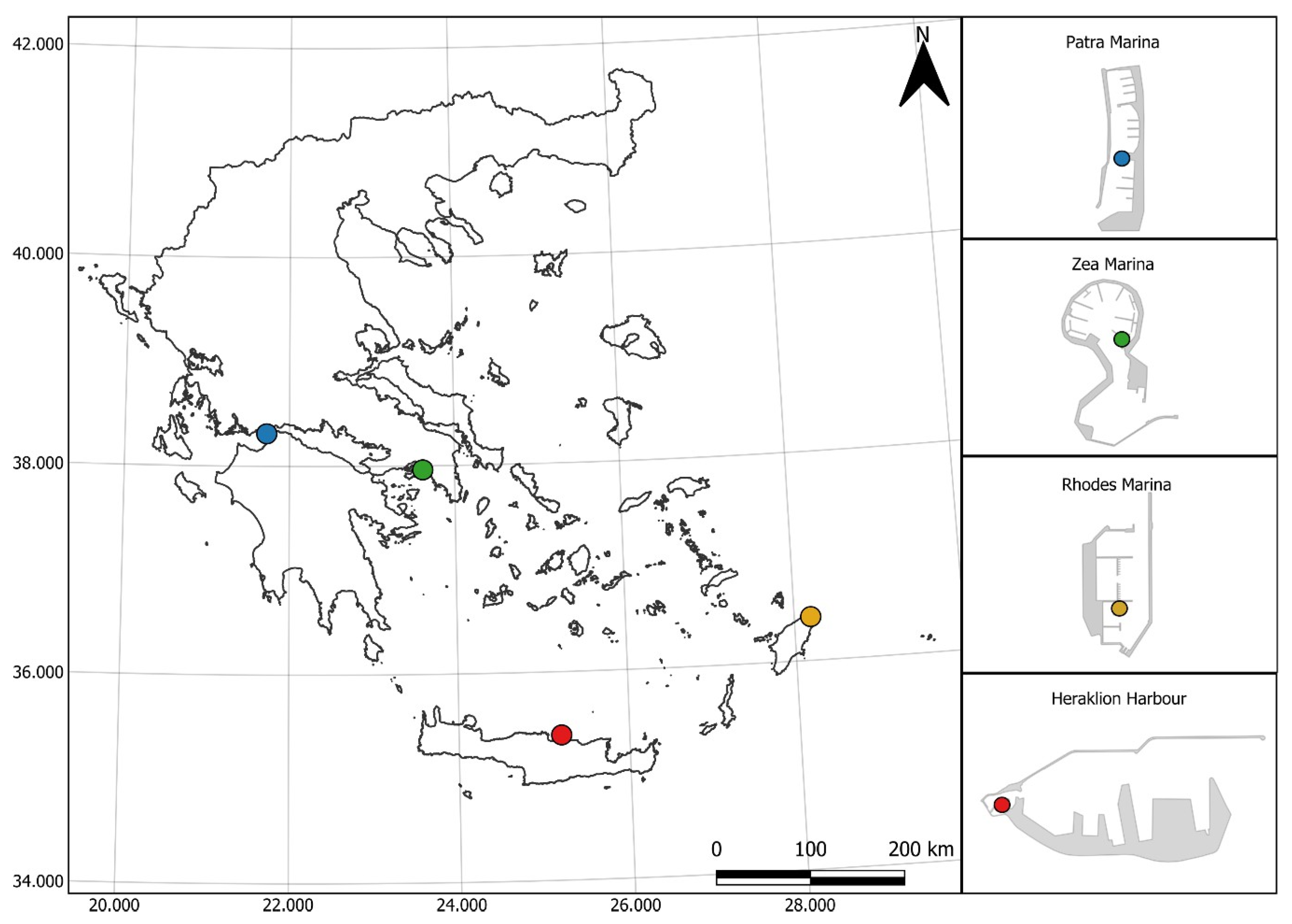
Within the framework of the AlienPorts project, sampling was conducted at four marinas in Greece, which were characterised by heavy maritime traffic and selected to provide broad geographic coverage across marine regions: the Levantine Sea, Rhodes; the Aegean Sea, Heraklion, Piraeus (Zea); and the Ionian Sea, Patra (Figure 1).
All the sites primarily support recreational boating and small-vessel activities; however, Heraklion represents a mixed-use port system that also includes commercial, passenger, tourist, and naval berthing areas within the same infrastructure (Table 1). The surveyed marinas ranged from approximately 100 berths (Heraklion marina section) to 670 berths (Zea). The maximum water depth at all the sampling sites did not exceed 5 m. The sampling was conducted from 2021 to 2022.

2.2. Sampling Collection

2.2.1. Non-Destructive Surveys: Photoquadrat Sampling

The sessile benthic assemblages on artificial hard substrates were surveyed using photoquadrats (25 × 25 cm). For each quadrat, one overview image of the full frame was acquired and used as the basis for the analysis. Additional close-up images (per quadrant) were taken only to assist taxonomic identification when the details were unclear in the overview image, particularly under the high turbidity conditions that are commonly encountered in ports and marinas. For overview images, the camera-to-substrate distance was maintained at approximately 30 cm, with minor adjustments being made based on the lens specifications and focusing constraints.
At each sampling location, 15 photoquadrats were collected. Where available (Heraklion, Zea, and Rhodes), additional photoquadrats (five in each marina) were also taken beneath the floating pontoons/docks. These shaded (“sciaphilic”) surfaces typically support assemblages with a reduced algal cover (turf) and an increased abundance of shade-tolerant taxa relative to more exposed structures. During each sampling event, supplementary photographs of taxa of particular interest and within the general habitat context were also collected. The photographic surveys were performed using two high-resolution underwater camera systems equipped with strobes to minimise shading: (i) a Sony RX100V (24–70 mm lens, Sony Corporation, Tokyo, Japan) with two Inon Z330 strobes (INON Inc., Kanagawa, Japan) and (ii) an Olympus TG-6 (Olympus Corporation, Tokyo, Japan) with an integrated flash.

2.2.2. Photographic Analysis

The photoquadrat images were analysed using photoQuad (ver. 1.4) [30]. For each frame, 100 stratified random points were overlaid, which were generated by subdividing the image into 100 equal cells and placing one random point within each cell to ensure an even spatial coverage. Each point was assigned to a taxon from a curated reference library developed for this study, including identified species and higher-level taxonomic or morpho-functional groups where species-level identification was not possible. The percentage coverage per category was calculated from point assignments and exported for statistical analysis. To retain the information on the taxa that were present within a frame but not intersected by any point, a value of 0.5 was assigned to ensure taxon representation with limited effect on the analysis [31,32].

2.2.3. Destructive Sampling: Scraped Assemblage Collection

Destructive sampling was used to characterise the motile and small-bodied fauna associated with the marina fouling assemblages. At each site, three replicate scraped samples (25 × 25 cm each) were collected from artificial hard substrates using a manually operated suction sampler (MANOSS) [33]. A plexiglass quadrat (25 × 25 cm), which was fitted with a 0.5 mm mesh net at the upper opening, was firmly positioned on the substrate to delimit the sampling area. The enclosed surface was thoroughly scraped, and the dislodged material was collected via suction. The samples were sieved through a 0.5 mm mesh, fixed, and preserved in 97% ethanol. In the laboratory, the specimens were examined under an Olympus SZx12 stereomicroscope (Olympus Corporation, Tokyo, Japan) and an Olympus BX50 compound microscope (Olympus Corporation, Tokyo, Japan) and identified using the most recent and relevant taxonomic literature. Following the sorting of the samples, polychaetes and amphipods were identified to the lowest possible taxonomic level (preferably species) and preserved in 97% ethanol.

2.2.4. Traits Analysis

Following Casties and Briski [34], six biological traits were selected to characterise the most abundant macrobenthic species and to evaluate trait patterns that were potentially associated with establishment in environmentally stressful marina conditions: body size, depth zonation, feeding type, habitat type, adult mobility, and substrate type. The traits were subdivided into 24 categories (Table 2). Each category was scored for each species using a binary approach (presence = 1, absence = 0). When a species exhibited multiple states within a given trait (e.g., more than one feeding type), all the applicable categories were scored as present. The trait definitions and category limits were derived/adjusted from the Polytraits database [35]. To account for the species contribution within each sample, binary trait scores were weighted by species abundance by multiplying each trait category score by the abundance of the respective species in that sample prior to analysis. The resulting abundance-weighted trait values were then summed across the species to obtain the sample-level trait composition. When species-level information was unavailable for a trait category, the information was inferred from congeneric species.

2.3. Statistical Analyses

2.3.1. Data Preparation and Visualisation

Multivariate analyses were conducted in PRIMER v6 [36]. For the photoquadrat dataset (the percentage coverage per taxon/morpho-functional group per frame), values were fourth-root transformed to reduce the influence of highly dominant taxa and increase the sensitivity to less abundant categories. Bray–Curtis similarity matrices were then computed [37]. For the collected samples (species abundance per replicate), the same transformation and resemblance procedures were applied prior to the multivariate analyses. The univariate differences in cover and/or abundance metrics among the sites were evaluated using the Kruskal–Wallis test [38], as appropriate to the response variable and distribution.

2.3.2. Ratio of NIS to Native Species

The ratio of NIS/native species has been suggested as a measure of impact under the D2 descriptor of MSFD [29]. The molecular analyses have revealed that some taxa that were considered cryptogenic (CRY) are NIS and vice versa. For example, Amathia verticillata (delle Chiaje, 1822), the most widespread bryozoan in ports and marinas, has been suggested to be provisionally classified as CRY [39]. On the other hand, the crab Percnon gibbesi (H. Milne Edwards, 1853) was initially considered as an NIS in the Mediterranean [40] until later studies [41] classified it as CRY/crypto-expanding (unknown if it expanded its distribution unaided or with vessels). Given the uncertainty of the true status of the CRY species and the fact that they are not native, they were merged with the NIS ones in calculating the ratio of NIS/native species. Thus, the estimated values represent the NIS + CRY/native species. The ratio was only calculated for the collected samples based on Polychaeta and Amphipoda. The heterogeneity of the identifications in the photo quadrat, from species to family or even the phylum level, does not permit such assessments, as it is unknown whether the specimens that are identified to a family level are NIS or native.

2.3.3. Non-Parametric Multivariate Analyses

The community-level similarity patterns were visualised using non-metric multidimensional scaling (nMDS [42]) based on Bray–Curtis similarities. In the case of photoquadrats, two datasets were created based on inclination (horizontal and vertical substrates). The ordination fit was assessed using the stress values. The differences in community composition among the groups were tested using the analysis of similarities (ANOSIM) [43]. The samples were grouped by (a) the sampling site and (b) the substrate context/structure (e.g., floating dock undersides versus the other sampled surfaces and/or the frame orientation where applicable) to evaluate the effects of spatial and structural factors on the assemblage composition. For destructive samples only, SIMPER [44] was used to identify the taxa that were contributing the most to within-group similarity and between-group dissimilarity.

3. Results

3.1. Non-Destructive Patterns (Photoquadrat Dataset)

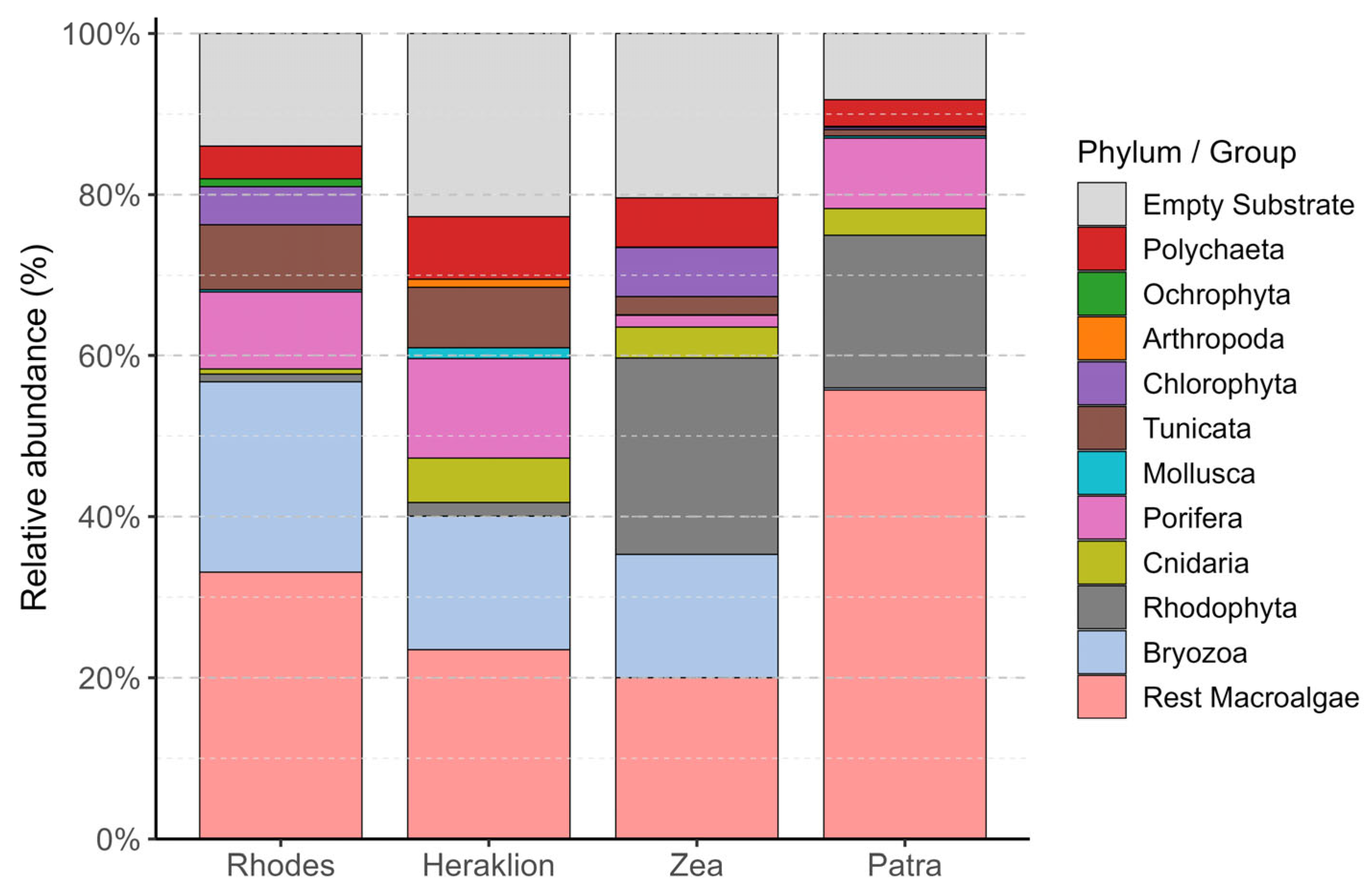
The results showed that 37 species were identified to the species level, four to the genus level, and the rest to the higher taxonomic levels (Supplementary File Table S1). The community composition differed among the marinas, with a strong variation in the relative contribution of major taxonomic groups. The total coverage ranged from 78% to 92%, leaving 8–22% empty (grey) or covered by unidentified biogenic material (UBS) [32]. Overall, Bryozoa and Rhodophyta dominated the available substrates, collectively accounting for approximately 50% of the total cover, whereas Porifera, Ascidia, Chlorophyta, and Polychaeta contributed with lower proportions. In Patra, a distinct pattern was observed, with turfs of unidentified macroalgae forming the dominant group (60%), followed by Rhodophyta (19%) and Porifera (9%) (Figure 2). However, the univariate comparisons of coverage percentages for the main identified taxonomic groups across the sampling locations did not detect significant differences among the marinas (Kruskal–Wallis and pairwise comparisons, p > 0.05). This suggests that among-marina differences were more evident in the overall assemblage composition than in the total cover of the broad taxonomic groups that were considered separately.

3.2. Destructive Patterns

A total of 111 taxonomic units (Polychaeta and Amphipoda) [106 at the species level, five at higher levels] were identified from the collected samples. The species richness differed among sites, with Heraklion hosting the highest number of taxa (70), followed by Patras (41), Zea (38), and Rhodes (30). For details, see Supplementary File Table S2. In contrast, patterns based on the total abundance differed; the mean macrobenthic abundance was the highest in Patras (8592 ± 2203 individuals m−2), followed by Zea (7786 ± 1286 individuals m−2), Heraklion (5280 ± 943 individuals m−2), and Rhodes (1839 ± 364 individuals m−2). These differences were amplified by the high abundance of two amphipods: Apocorophium acutum (Chevreux, 1908), which reached densities as high as 547 individuals m−2 (HER) and 6476 individuals m−2 (PAT), and Laticorophium baconi (Shoemaker, 1934), which presented densities of 1798 individuals m−2 (HER) up to 3130 individuals m−2 (ZEA).
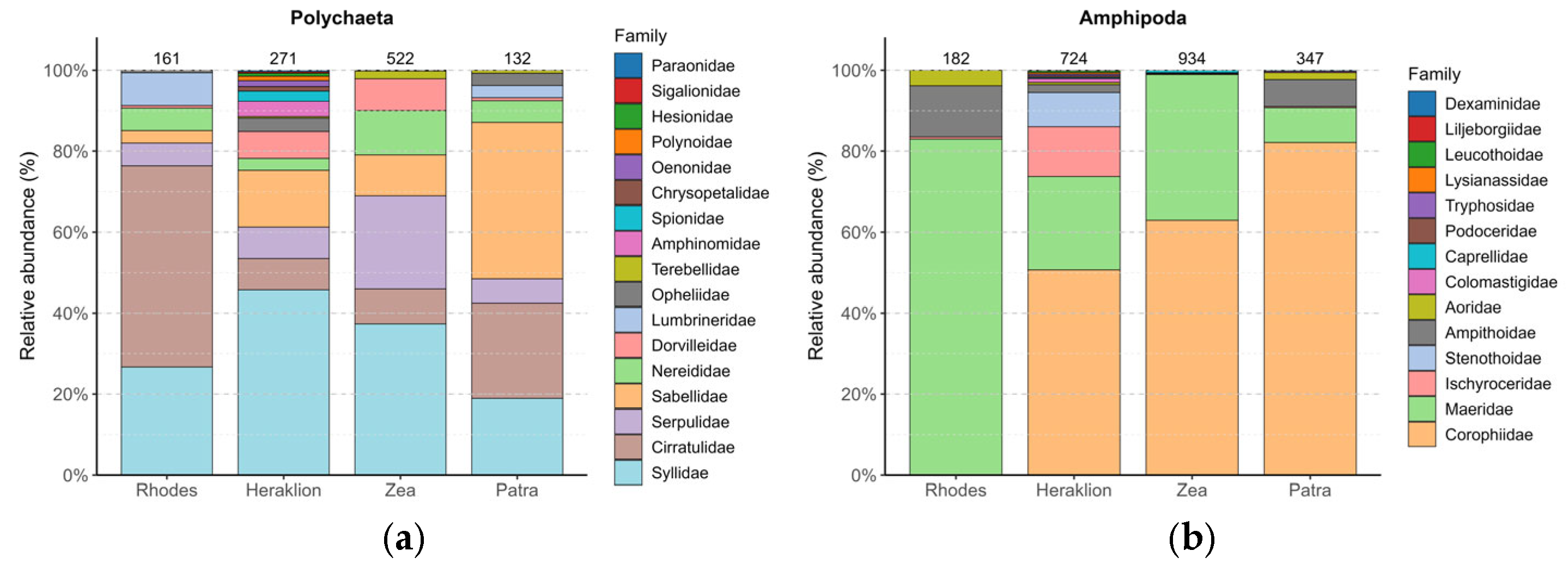
The family-level distributions showed no consistent spatial pattern across the marinas. Among polychaetes, Syllidae was the most abundant family, followed by Sabellidae and Cirratulidae (Figure 3a). Some families displayed strong site specificity; for example, Serpulidae was abundant at only one sampling location. The amphipod assemblages showed broadly similar patterns, with Corophiidae and Maeridae dominating the overall abundance. Notably, Corophiidae were absent from Patra (Figure 3b). The Kruskal–Wallis tests on the macrobenthic assemblages (polychaetes and amphipods) did not indicate statistically significant differences among the marinas (p > 0.05, as currently reported). The pairwise comparisons likewise did not detect significant differences (all p > 0.05), although Heraklion showed the strongest tendency to differ from the other sites based on rank distributions.
The comparisons of macrobenthic species indicated that five polychaete species [Composetia costae (Grube, 1840), Dodecaceria capensis (Day, 1961), Hydroides dirampha (Mörch, 1863), Serpula concharum (Langerhans, 1880), Syllis crassicirrata (Treadwell, 1925)] were shared among all the sampling locations and that Heraklion hosted the highest number of unique species (33), followed by Rhodes (12), Zea (10) and Patra (5).

3.3. Multivariate Patterns

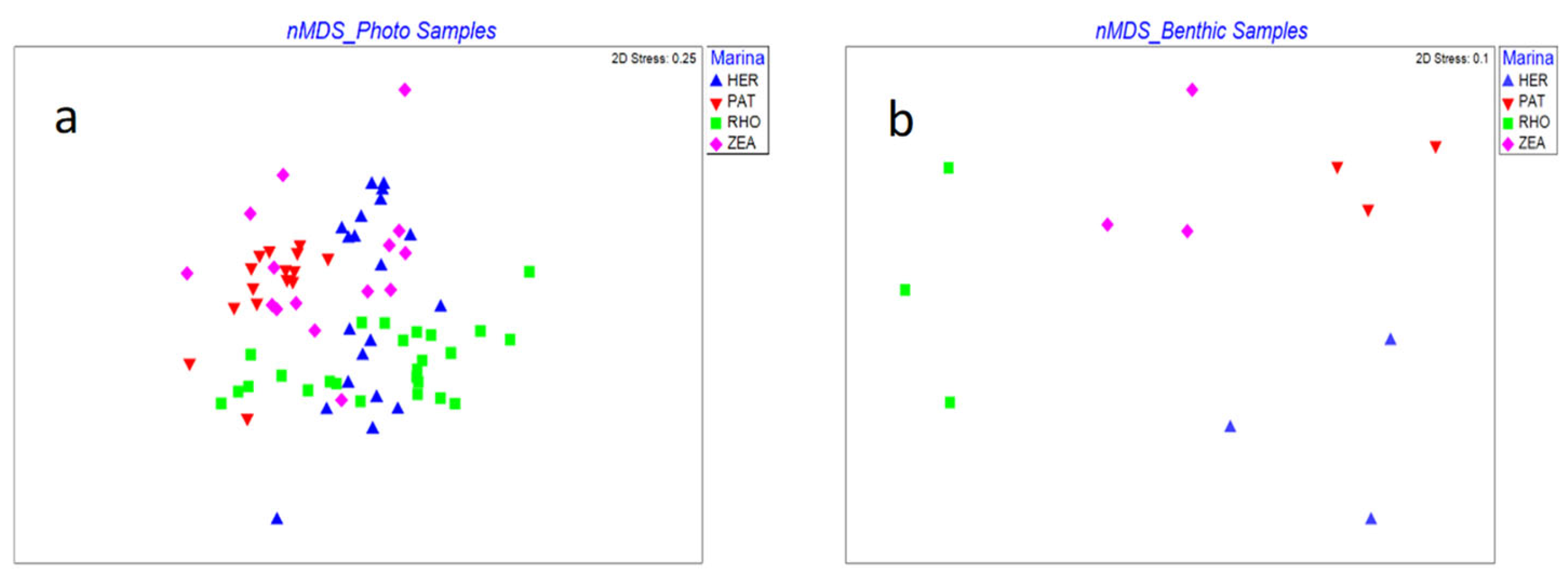
The nMDS ordination based on the photoquadrat data did not show a clear spatial separation among the marinas, whereas the ordination based on the collected samples indicated a stronger differentiation among the locations (Figure 4). Despite these visual patterns, ANOSIM detected significant differences among the marinas for all the datasets (photoquadrat horizontal samples: R = 0.357, p < 0.01; photoquadrat vertical samples: R = 0.18, p <0.01; and destructive samples: R = 0.691, p < 0.01). For the photoquadrat dataset, the pairwise ANOSIM tests indicated significant differences between the marinas (all p < 0.01). However, the corresponding nMDS ordination had a relatively high stress value and should therefore be interpreted cautiously as a visual representation of the among-marina patterns. In contrast, pairwise ANOSIM tests based on destructive samples did not identify significant differences between the individual marina pairs (all p > 0.01). Given the low replication per marina (n = 3), this lack of pairwise significance likely reflects a limited statistical power rather than a true biological similarity among communities.

3.4. Functional Patterns (Trait-Based Interpretation)

SIMPER analysis was performed only on the collected samples dataset, as trait-based analyses require species-level identification. The SIMPER results indicated that ten species accounted for most of the observed dissimilarity patterns among the sampling locations and collectively represented approximately 90% of the total abundance. Four of these ten taxa [Branchiosyllis maculata (Imajima, 1966), Branchiomma luctuosum (Grube, 1870), Hydroides dirampha (Mörch, 1863), and Syllis crassicirrata (Treadwell, 1925)] are non-indigenous. The trait information for these taxa was compiled from the available literature, and the distribution of the functional traits is summarised in Table 3.
Among the ten most frequent taxa, nine occurred on both bedrock and artificial substrates, seven were classified as motile, and seven exhibited broad depth distributions without a clear preference for littoral versus sublittoral zones. In addition, seven taxa preferentially occur on biogenic substrates.

3.5. NIS and Cryptogenic Species

Overall, 44 (35 NIS and nine cryptogenic) species were identified in our samples. The quadrat records comprised taxa from all taxonomic groups, including macroalgae, while only the Polychaeta and Amphipoda NIS were identified from the collected samples. Among our species, nine polychaetes, two ascidians and two amphipods are new NIS in Greek waters (Supplementary Tables S1 and S2), eight are new in the Levantine Sea (RHO marina), 13 are new in the Aegean Sea (HER and ZEA marinas), and five are new in the Ionian Sea (PAT marina). Six species are the first to be recorded in the Mediterranean Sea (Table 4).

3.5.1. Photoquadrat Samples

The photoquadrat surveys (Table 4), supported by the specimen collection, documented 12 non-indigenous species (NIS) and seven taxa that were classified as cryptogenic: Amathia verticillata, Ecteinascidia turbinata, Styela canopus, Percnon gibbesi, Bugula neritina, Bugula stolonifera, and Oculina patagonica. The NIS detections were dominated by sessile organisms (13 taxa), with three motile species noted only incidentally. The sessile assemblage included one green alga, one sponge, one cnidarian, three bivalves, two upright bryozoans, four solitary ascidians, and one colonial ascidian. Incidental motile observations comprised one decapod and two echinoderms (a sea urchin and a holothurian). Ascidians represented the largest share of the NIS occurrences.
Among the four marinas, Heraklion showed the greatest photographic NIS richness (15 species), six of which were unique to that site. Rhodes, Patra, and Zea yielded 11, which were six and five photographic NIS, respectively. The most consistently encountered taxa were the bryozoan Amathia verticillata and the ascidian Herdmania momus, which were both present at most locations. The colonial ascidian Botrylloides niger (Herdman, 1886) was observed in all four marinas. The several species that were restricted to a single site were Stypopodium schimperi, Brachidontes pharaonis, Pinctada radiata, Styela canopus, Didemnum perlucidum, Ecteinascidia turbinata, Diadema setosum, Percnon gibbesi, and Synaptula reciprocans (Table 4). Collectively, the results point to a marked among-site variability in NIS presence and underscore that multiple taxa are closely linked to highly disturbed marina environments.

3.5.2. Collected Samples

A total of 23 NIS and two cryptogenic species (Apocorophium acutum and Ericthonius brasiliensis) were identified from destructive samples (Table 4). Heraklion hosted the highest number (18 NIS, 2 CRY), followed by Zea (10 NIS, 1 CRY), Rhodes (10 NIS, 1 CRY), and Patras (9 NIS, 1 CRY). Across all NIS detected via the destructive sampling, 10 were recorded at only one marina, whereas four occurred across all four sampling marinas.
The unique NIS records comprised six taxa that were exclusive to Heraklion (Hydroides amri, Polydora cornuta, Prionospio japonica, Spirobranchus arabicus, Ericthonius brasiliensis and Stenothoe georgiana), two taxa that were exclusive to Rhodes (Dorvillea similis, Vermiliopsis annulata), and one taxon that was exclusive to Patras and Zea [Lumbrineris acutiformis and Syllis schulzi (Hartmann-Schröder, 1960), respectively]. Six species are the first to be recorded in the Mediterranean Sea, while an additional seven species are the first to be recorded in Greece (Table 4). The four NIS that were present at all sites were the polychaetes Branchiomma bairdi, Dodecaceria capensis, H. dirampha and Syllis crassicirrata (Table 4). Notably, the two sampling protocols detected only one NIS in common [Branchiomma bairdi (McIntosh, 1885)].

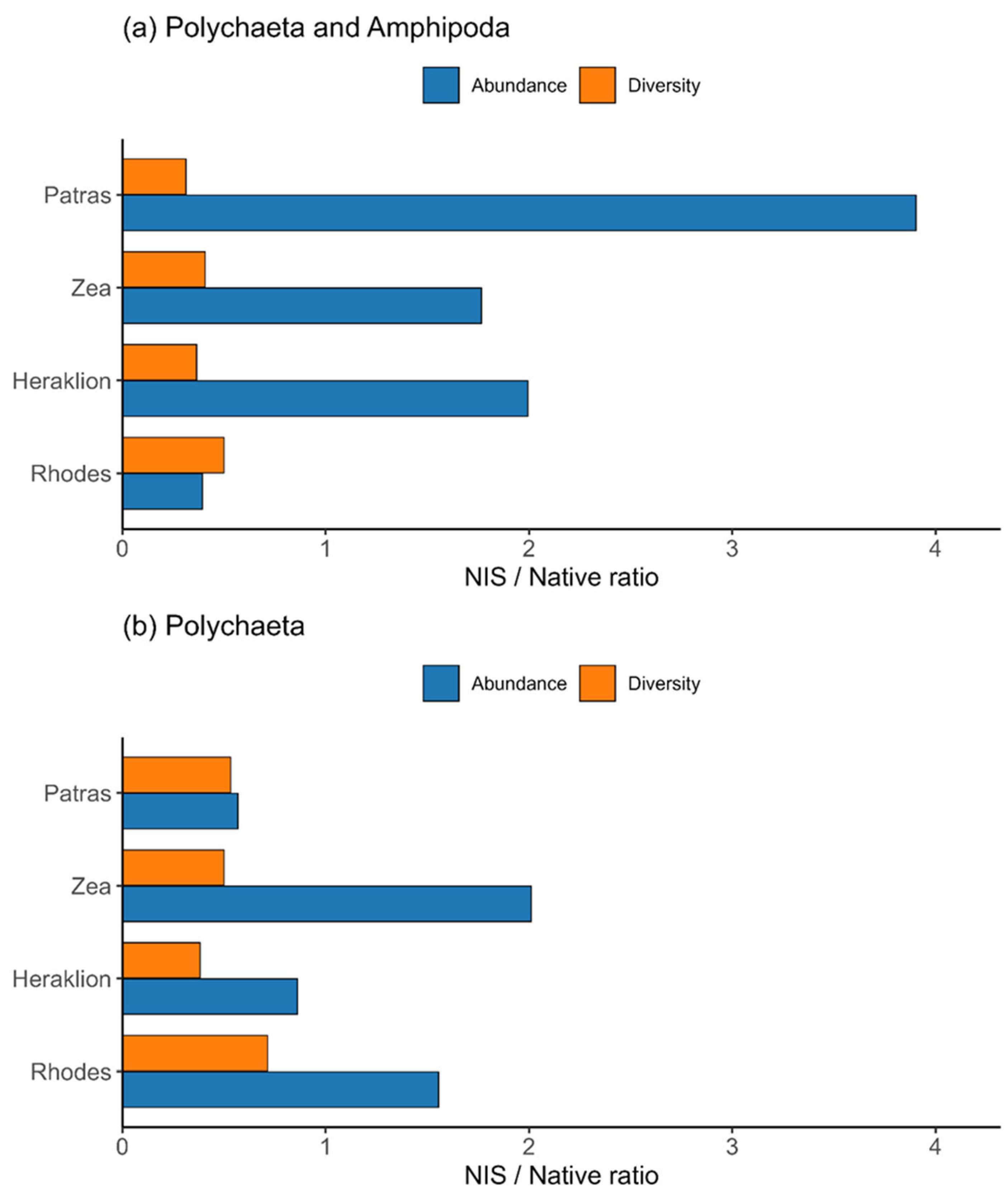
3.6. Ratio of NIS/Native

The ratio of NIS + CRY to the native species was calculated separately, considering species/taxa diversity and abundance based on polychaetes and amphipods (Figure 5a) and on polychaetes only (Figure 5b). Regarding diversity, the ratio ranged from 0.31 (PAT) to 0.50 (RHO). The low value in HER despite the high number of NIS + CRY (20 species) is attributed to the rich diversity of the native fauna. In terms of abundance, the ratio ranged from 0.39 (RHO) to 3.90 (PAT). Excluding RHO, the density of NIS was more than double that of the native species in the other marinas. The difference is clearly attributed to the high densities of the cryptogenic amphipods Apocorophium acutum and Laticorophium baconi, as described earlier.
When only Polychaeta were considered, the ratio of diversity peaked in the RHO marina (0.71), where the NIS richness was close to the native one (10 vs. 15), while in the other marinas the ratio was at most 0.5 (Figure 5b), meaning that in HER, ZEA and PAT about 40% of the polychaete species were NIS. In terms of abundance, NIS Polychaeta dominated over the native species at ZEA (2.1) and RHO (1.56) and were less in HER (ratio 0.86) and much less in PAT (ratio 0.57).

4. Discussion

On the Mediterranean scale, an increasing trend of new NIS, which were introduced up to 2010, has been reported, which is particularly evident in the Eastern Mediterranean, where the Suez Canal corridor and ongoing sea warming (“tropicalisation”) facilitate the establishment and expansion of warm-affinity taxa [20,45]. The comprehensive revisions of the NIS in the Mediterranean, which were introduced up to December 2021, reported more than 1000 species [20] and documented accelerated establishment after 2010 [46]. Besides the Indo-Pacific/Red Sea species that have entered the Mediterranean unaided (Lessepsian immigrants), a high number of species have most likely been introduced with vessels via the Suez Canal. Thus, a degree of uncertainty remains regarding the true pathway/vector of NIS in the Mediterranean.
The marinas are widely recognised as a risk area for the introduction of NIS and their secondary dispersion [4,5,47,48,49]. The marinas may amplify propagule pressure through the frequent arrival of yachts and other boats. At the same time, they provide both hard substrata (artificial infrastructures) and sheltered microhabitats that protect NIS from wave exposure and predators. Consequently, it is likely that NIS will be established in marinas prior to spreading to adjacent areas [5,27]. A study of 34 recreational marinas across the Mediterranean [4], using a rapid assessment survey (RAS) protocol targeting all fouling macroinvertebrate taxa, revealed 51 new NIS country records. In that survey, the two Greek marinas that were examined contained 27 NIS in Heraklion and 16 in Rhodes, with an overall Mediterranean range of 2–27 NIS per marina. In the present study, we recorded 35 NIS in Heraklion and 22 in Rhodes, indicating that the invasion levels observed in these Greek marinas are comparable to those previously reported from the Mediterranean marinas. These findings further reinforce the role of Greek marinas as invasion hubs in the Eastern Mediterranean and as potential stepping-stones for the spread to other marine regions.
In the photographic dataset, NIS were dominated by sessile fouling taxa, with ascidians accounting for the majority of records. This dominance is consistent with the evidence from the Mediterranean marinas indicating that ascidians are among the most successful invaders in these habitats [4,27,50,51]. Their success likely reflects a rapid growth and early reproduction, a tolerance to turbidity, opportunistic blooms (e.g., Botrylloides spp.) and chemical stressors, and a preferential occupation of shaded vertical and floating structures that are common in marinas [50,52,53]. Such taxa can exert strong competitive pressure on the native assemblages by monopolising space, altering biogenic structure, and modifying successional trajectories on artificial substrates. The repeated occurrence of widely reported marina-associated invaders such as Herdmania momus and Styela plicata in the photographic dataset) supports the view that some NIS have become effectively “marina-adapted” across parts of the Mediterranean, with artificial habitats sustaining regional metapopulations that can seed adjacent natural habitats when the conditions are favourable [4,5].
At the same time, photographic NIS showed a marked spatial heterogeneity, with most taxa occurring at a single site and only one present across all four marinas. This pattern suggests that each marina represents a distinct habitat template shaped by the local environmental conditions, infrastructure, microhabitat availability, and boating activity. Although multivariate analyses indicated significant differences among marinas, univariate comparisons based on phyla may be less sensitive because analysis at a higher taxonomic resolution can smooth the differences among sites.
The destructive sampling highlighted substantial spatial heterogeneity in macrobenthic assemblages and NIS richness (Polychaeta and Amphipoda), with Heraklion exhibiting higher NIS richness and more exclusive records than the other marinas. Despite recent studies in Heraklion, including the deployment of ARMS and RAS [4,28,54,55,56,57,58], 10 out of the 15 Polychaeta NIS and three amphipods are the first to be recorded in the area, while seven are the first to be recorded in Greek Waters. Overall, the two sampling methods produced 28 NIS in the Heraklion marina, nine of which were known from the area. However, our combined methods have failed to detect 20 more invertebrates that were reported in the aforementioned studies, such as the isopods [e.g., Cymodoce fuscina (Schotte and Kensley, 2005); Paracerceis sculpta (Holmes, 1904); Paradella dianae (Menzies, 1962); Paranthura japonica (Richardson, 1909); Sphaeroma walker (Stebbing, 1905)] and the bryozoans [Celleporaria brunnea (Hincks, 1884); Celleporaria vermiformis (Waters, 1909) Tricellaria inopinata (d’Hondt and Occhipinti Ambrogi, 1985)], which are all frequently introduced into Mediterranean marinas. This is most likely due to the lack of experts on Isopods and bryozoans among Greek marine taxonomists, a deficiency that has been highlighted in [59]. Conclusively, 39 invertebrate NIS and six cryptogenic species have been detected in the Heraklion port.
Eighteen invertebrate NIS have been reported to date from the marina of Rhodes [4,23]. Only seven of those were detected during our study, which rendered another 11 NIS, bringing the total to 29. The lower number of NIS in Rhodes compared to that in Heraklion could be attributed to its smaller size (620 m length, 172 berths vs. 1730 m length, 72 berths in Heraklion), but it is most likely due to the scientific effort.
As opposed to Heraklion and Rhodes, no studies have been conducted at the Zea (Saronikos) and Patra marinas. Consequently, all NIS findings are baseline records for the two marinas. However, the broader area of the Zea marina, the Saronikos Gulf, has been monitored for more than 40 years, and 43 invertebrate NIS have been reported as being introduced with vessels [13,60]. With the addition of eight new NIS in the area (Hydroides elegans and Spirobranchus arabicus, among others that were known), Saronikos hosts 51 invertebrate NIS. Three of the new species, namely the ascidian S. plicata, the polychaete H. dirampha, and the sponge Paraleucilla magna, were included in the watch list of [13]. The watch list predicted that NIS of high risk would be introduced with vessels in Saronikos, and our study confirms the prediction.
Overall, our study added 13 new NIS (nine polychaetes, two amphipods and two ascidians into Greek waters (Supplementary Tables S1 and S2). These were distributed to the Greek MSFD areas as follows: eight in the Levantine Sea (RHO marina), 13 in the Aegean Sea (HER and ZEA marinas), and five in the Ionian Sea (PAT marina). Seven species are the first to be recorded in the Mediterranean Sea (Table 4).
The variability in species diversity among the marinas was expected and may reflect the differences in vessel traffic intensity and origin, marina age, maintenance regimes, water exchange, and local stressors, which collectively shape both propagule pressure and habitat receptivity [5,27]. The success of a NIS in a new area depends on several chemical, physical and biotic conditions of the arrival port [61]. According to [62], the species composition and distribution of hull-fouling macroinvertebrates differ according to the areas where the research vessel operates. In this context, Heraklion represents a mixed-use system that is embedded within a larger port complex, likely increasing the exposure to multiple introduction vectors.
Although HER hosted the highest number of NIS, the ratio of NIS to native species, as a measure of impact, exhibited its highest value (0.50–0.71) in RHO, implying that it is the most invaded marina as it is closer to the Suez Canal. Indeed, RHO had the lowest number of native species (21) as opposed to HER, which had 52 native species (ratio 0.37–0.38). The estimated values, whether based on polychaetes only or on polychaetes and amphipods, are higher than those reported in the literature from some West Mediterranean marinas (ratio 0.02–0.33, AVG 0.21) [63]. However, these values should only be considered as indicative when assessing the true quality status; other benthic indicators should also be considered. As an example, when the ratio is based on the density of populations, the picture is very different. The marina of RHO appeared to be less impacted, while in ZEA, HER and PAT, the NIS population dominate over the native ones, which is a sign of severe ecosystem changes. Although the marina in Zea is not connected to the Piraeus commercial port, considering all ratio values, it appeared to be the most impacted one, a fact presumably related to its size. It is by far the largest marina (670 berths vs. 450 in Patra, 72 in Heraklion, 490 in Rhodes). The SIMPER results indicated that several highly influential taxa in the driving assemblage differences were NIS, suggesting that NIS are not only established but can also be numerically dominant within marina macrobenthic communities. Their functional attributes may contribute to the competitive success relative to the native taxa, potentially influencing community structure and ecosystem function. Given the current lack of comparative datasets from Greek marinas, our results provide the baseline information for future assessments of the macrobenthic community composition, the relative contribution of non-indigenous and native taxa, and the functional patterns in these environments.
Operational constraints often limit underwater survey approaches in marinas, including the low visibility, the restricted access, and the elevated risk associated with dense infrastructure and vessel traffic. Several standardised methods have been proposed, including RAS and settlement devices (e.g., ARMS) [16,28]. However, these approaches have limitations: RAS can be taxonomically selective and primarily qualitative, while settlement devices may preferentially capture early colonists and may not fully represent mature fouling communities or the complete spectrum of taxa present. A key outcome of this study is that photographic and destructive sampling produced non-equivalent but complementary assessments of the NIS occurrence. The photographic surveys effectively captured conspicuous sessile taxa (notably ascidians, bryozoans, and bivalves), indicating the potential NIS and the biodiversity patterns within each site, whereas destructive sampling revealed a broader set of small-bodied and cryptic taxa (including polychaetes and amphipods) that were embedded within complex fouling matrices. This complementarity aligns with the recommendations from the Mediterranean monitoring initiatives advocating multi-approach surveillance to improve the detection and comparability across sites and time [27]. From an applied perspective, routine marina surveillance would benefit from integrating RAS and visual/photographic methods with periodic targeted physical sampling, particularly in high-risk basins such as the Aegean (ZEA, HER) and Levantine sectors (RHO).
Finally, the co-occurrence of widely distributed NIS and site-restricted records has implications for invasion dynamics within marina networks. Recreational vessels can repeatedly introduce and redistribute alien taxa, creating recurrent inoculation events that increase the establishment probability and facilitate a stepping-stone spread among the marinas [11,15]. Under this framework, widespread detections across Greek marinas are consistent with the network processes in which local populations are continually reinforced by vessel movements, whereas single-site detections may reflect recent arrivals or taxa that are constrained by environmental or infrastructural conditions. Given the limited feasibility of eradicating established marine NIS, prevention and early detection remain the most cost-effective interventions [64,65]. The practical measures include the risk-based monitoring of high-surface-area structures (pontoons, ropes, fenders), outreach and compliance measures promoting hull and niche-area maintenance, and coordinated monitoring across marina networks to detect range expansions and emerging invaders [15,16,27]. Sampling via scientific diving in such hostile artificial environments is dangerous and time-consuming; however, to date, it remains the only reliable approach for collecting both sessile and motile macrobenthic fauna.

Supplementary Materials

The following supporting information can be downloaded at https://www.mdpi.com/article/10.3390/d18040197/s1.

Author Contributions

Conceptualisation, G.C.; investigation, G.C., I.R., M.L. and W.P.; methodology, G.C.; data curation, G.C. and I.R.; formal analysis, G.C., I.R. and A.Z.; visualisation, G.C. and I.R.; writing—original draft preparation, G.C.; writing—review and editing, I.R. and A.Z. All authors have read and agreed to the published version of the manuscript.

Funding

This research was funded by the Hellenic Foundation for Research and Innovation, “first call for H.F.R.I. research projects to support postdoctoral researchers, grant number 441”.

Data Availability Statement

The data are available on MedOBIS at https://doi.org/10.25607/0o1xd7.

Acknowledgments

The authors gratefully acknowledge Eirini Gratsia, Grigorio Skouradaki and Dimitri Androulaki for their support in field sampling and taxon validation from photographic material, Markos Digenis and Vasilis Gerovasileiou for taxon validation from photographic material, and the port management authorities for granting permissions and facilitating the sampling activities.

Conflicts of Interest

The authors declare no conflicts of interest.

References

  1. Bulleri, F.; Airoldi, L.; Branca, G.M.; Abbiati, M. The influence of environmental factors and biological interactions on the distribution of the intertidal mussel Mytilus galloprovincialis in the north-western Mediterranean. Austral Ecol. 2005, 30, 655–667. [Google Scholar] [CrossRef]
  2. Chatzinikolaou, E.; Faulwetter, S.; Syranidou, E.; Papageorgiou, N.; Katsiaras, N.; Chatzigeorgiou, G.; Pafilis, E.; Arvanitidis, C. Microplastics in marine sediments: A dataset from coastal areas of the Eastern Mediterranean Sea. Sci. Total Environ. 2018, 624, 648–660. [Google Scholar] [CrossRef] [PubMed]
  3. Ros, M.; Vázquez-Luis, M.; Guerra-García, J.M. The role of marinas and recreational boating in the introduction and spread of non-indigenous marine species: A Mediterranean perspective. Biol. Invasions 2016, 18, 2983–3000. [Google Scholar] [CrossRef]
  4. Ulman, A.; Ferrario, J.; Occhipinti-Ambrogi, A.; Arvanitidis, C.; Bandi, A.; Bertolino, M.; Bogi, C.; Chatzigeorgiou, G.; Corsini-Foka, M.; Crocetta, F.; et al. A massive update of non-indigenous species records in Mediterranean marinas. PeerJ 2017, 5, e3954. [Google Scholar] [CrossRef]
  5. Tempesti, J.; Langeneck, J.; Castelli, A.; Cioffi, R.; Rizzo, L.; Marchini, A.; Lardicci, C. Non-indigenous fouling species in Mediterranean ports: Patterns, drivers and implications. Mar. Environ. Res. 2020, 161, 105056. [Google Scholar] [CrossRef]
  6. Crocetta, F.; Al Marbruk, S.A.; Azzurro, E.; Bakiu, R.; Bariche, M.; Batjakas, I.E.; Bejaoui, T.; Ben Souissi, J.; Cauchi, J.; Corsini-Foka, M.; et al. New Alien Mediterranean Biodiversity Records (November 2021). Mediterr. Mar. Sci. 2021, 22, 724–746. [Google Scholar] [CrossRef]
  7. Gambi, M.C.; Musco, L.; Giangrande, A.; Badalamenti, F.; Micheli, F.; Kroeker, K.J. Distribution and functional traits of polychaetes in a CO2 vent system: Winners and losers among closely related species. Mar. Ecol. Prog. Ser. 2016, 550, 121–134. [Google Scholar] [CrossRef]
  8. Miri, M.; Seyfabadi, J.; Ghodrati Shojaei, M.; Rahimian, H.; Valipour, M. Polychaete Diversity and Functional Trait Composition in Subtropical Mangrove Ecosystems. Diversity 2023, 15, 998. [Google Scholar] [CrossRef]
  9. Ros, M.; Guerra-García, J.M.; González-Macías, M.; Saavedra, Á.; López-Fe, C.M. Influence of fouling communities on the establishment success of the exotic caprellid Caprella scaura Templeton, 1836. Mar. Biol. Res. 2013, 9, 261–273. [Google Scholar] [CrossRef]
  10. Aikins, S.; Kikuchi, E. Studies on habitat selection by amphipods using artificial substrates within an estuarine environment. Hydrobiologia 2001, 457, 77–86. [Google Scholar] [CrossRef]
  11. Ulman, A.; Ferrario, J.; Forcada, A.; Seebens, H.; Arvanitidis, C.; Occhipinti-Ambrogi, A.; Marchini, A. A Hitchhiker’s guide to Mediterranean marina travel for alien species. J. Environ. Manag. 2019, 241, 328–339. [Google Scholar] [CrossRef] [PubMed]
  12. Ferrario, J.; Marchini, A.; Occhipinti-Ambrogi, A. Role of commercial harbours and recreational marinas in the spread of non-indigenous fouling species. Biofouling 2017, 33, 651–660. [Google Scholar] [CrossRef] [PubMed]
  13. Kalyvioti, N.; Galanidi, G.; Zenetos, A. Risk assessment to identify high-risk voyage origin ports and a watch list for NIS introduction in the Mediterranean with vessels: The case of Saronikos Gulf, Greece. Manag. Biol. Invasions 2024, 15, 337–370. [Google Scholar] [CrossRef]
  14. Council of the European Union. Council Regulation (EC) No 708/2007 of 11 June 2007 concerning use of alien and locally absent species in aquaculture. Off. J. Eur. Union 2007, L168, 1–17. [Google Scholar]
  15. International Maritime Organization (IMO). International Convention for the Control and Management of Ships’ Ballast Water and Sediments; International Maritime Organization: London, UK, 2004. [Google Scholar]
  16. Helsinki Commission (HELCOM). Biofouling Management Guidance for Recreational Craft; HELCOM: Helsinki, Finland, 2025. [Google Scholar]
  17. Korpinen, S.; Klančnik, K.; Peterlin, M.; Nurmi, M.; Laamanen, L.; Zupančič, G.; Popit, A.; Murray, C.; Harvey, T.; Andersen, J.H.; et al. Multiple Pressures and Their Combined Effects in Europe’s Seas; European Topic Centre on Inland, Coastal and Marine Waters (ETC/ICM): Magdeburg, Germany, 2019; pp. 1–164. [Google Scholar]
  18. Bailey, S.A.; Brown, L.; Campbell, M.L.; Canning-Clode, J.; Carlton, J.T.; Castro, N.; Chainho, P.; Chan, F.T.; Creed, J.C.; Curd, A.; et al. Trends in the detection of aquatic non-indigenous species across global marine, estuarine and freshwater ecosystems: A 50-year perspective. Divers. Distrib. 2020, 26, 1780–1797. [Google Scholar] [CrossRef]
  19. Katsanevakis, S.; Wallentinus, I.; Zenetos, A.; Leppäkoski, E.; Çinar, M.E.; Oztürk, B.; Grabowski, M.; Golani, D.; Cardoso, A.C. Impacts of invasive alien marine species on ecosystem services and biodiversity: A pan-European review. Aquat. Invasions 2014, 9, 391–423. [Google Scholar] [CrossRef]
  20. Galanidi, M.; Aissi, M.; Ali, M.; Bakalem, A.; Bariche, M.; Bartolo, A.G.; Bazairi, H.; Beqiraj, S.; Bilecenoglu, M.; Bitar, G.; et al. Validated Inventories of Non-Indigenous Species (NIS) for the Mediterranean Sea as Tools for Regional Policy and Patterns of NIS Spread. Diversity 2023, 15, 962. [Google Scholar] [CrossRef]
  21. Hopkins, G.A.; Forrest, B.M.; Jiang, W.; Gardner, J.P.A. Successful eradication of a non-indigenous marine bivalve from a subtidal soft-sediment environment. J. Appl. Ecol. 2011, 48, 424–431. [Google Scholar] [CrossRef]
  22. Çinar, M.E.; Bilecenoğlu, M.; Yokeş, M.B.; Öztürk, B.; Taşkin, E.; Bakir, K.; Doğan, A.; Açik, Ş. Current status (as of end of 2020) of marine alien species in Turkey. PLoS ONE 2021, 16, e0251086. [Google Scholar] [CrossRef]
  23. Corsini-Foka, M.; Zenetos, A.; Crocetta, F.; Cinar, M.; Kocak, F.; Golani, D.; Katsanevakis, S.; Tsiamis, K.; Cottier-Cook, E.; Froglia, C.; et al. Inventory of alien and cryptogenic species of the Dodecanese (Aegean Sea, Greece): Collaborations through COST action training school. Manag. Biol. Invasions 2015, 6, 351–366. [Google Scholar] [CrossRef]
  24. Ramadan, S.H.E.; Kheirallah, A.M.; Abdel-Salam, K.H.M. Marine fouling community in the Eastern harbour of Alexandria, Egypt compared with four decades of previous studies. Mediterr. Mar. Sci. 2006, 7, 19–30. [Google Scholar] [CrossRef]
  25. Sghaier, Y.R.; Zakhama-Sraieb, R.; Hmida, A.B.; Charfi, F. An inventory of non-indigenous species (NIS) inside and outside three tourist marinas from the southern Mediterranean coast. J. Black Sea/Mediterr. Environ. 2019, 25, 29–48. [Google Scholar]
  26. Nour, O.M.; Santos-Simón, M.; Langeneck, J.; Marchini, A.; Ramos-Esplá, A.A.; Ferrario, J. Preliminary inventory of marine fouling invertebrates’ community in Abu-Qir Port, Alexandria, Egyptian Mediterranean Sea. Mediterr. Mar. Sci. 2026, in press. [Google Scholar]
  27. Tamburini, M.; Keppel, E.; Marchini, A.; Repetto, M.F.; Ruiz, G.M.; Ferrario, J.; Occhipinti-Ambrogi, A. Monitoring Non-indigenous Species in Port Habitats: First Application of a Standardized North American Protocol in the Mediterranean Sea. Front. Mar. Sci. 2021, 8, 700730. [Google Scholar] [CrossRef]
  28. Obst, M.; Exter, K.; Allcock, A.L.; Arvanitidis, C.; Axberg, A.; Bustamante, M.; Cancio, I.; Carreira-Flores, D.; Chatzinikolaou, E.; Chatzigeorgiou, G.; et al. A Marine Biodiversity Observation Network for Genetic Monitoring of Hard-Bottom Communities (ARMS-MBON). Front. Mar. Sci. 2020, 7, 572680. [Google Scholar] [CrossRef]
  29. European Commission. Commission Decision (EU) 2017/848 of 17 May 2017 laying down criteria and methodological standards on good environmental status of marine waters and specifications and standardised methods for monitoring and assessment, and repealing Decision 2010/477/EU. Off. J. Eur. Union 2017, L125, 43–74. [Google Scholar]
  30. Trygonis, V.; Sini, M. PhotoQuad: A dedicated seabed image processing software, and a comparative error analysis of four photoquadrat methods. J. Exp. Mar. Biol. Ecol. 2012, 424–425, 99–108. [Google Scholar] [CrossRef]
  31. Bacchiocchi, F.; Airoldi, L. Distribution and dynamics of epibiota on hard structures for coastal protection. Estuar. Coast. Shelf Sci. 2003, 56, 1157–1166. [Google Scholar] [CrossRef]
  32. Rallis, I.; Chatzigeorgiou, G.; Florido, M.; Sedano, F.; Procopiou, A.; Chertz-Bynichaki, M.; Vernadou, E.; Plaiti, W.; Koulouri, P.; Dounas, C. Early Succession Patterns of Benthic Assemblages on Artificial Reefs in the Oligotrophic Eastern Mediterranean Basin. J. Mar. Sci. Eng. 2022, 10, 620. [Google Scholar] [CrossRef]
  33. Chatzigeorgiou, G.; Dailianis, T.; Faulwetter, S.; Pettas, M.; Arvanitidis, C. MANOSS—A manually operated suction sampler for hard bottom benthos. Transit. Waters Bull. 2012, 6, 42–49. [Google Scholar] [CrossRef]
  34. Casties, I.; Briski, E. Life history traits of aquatic non-indigenous species: Freshwater vs. marine habitats. Aquat. Invasions 2019, 14, 566–581. [Google Scholar] [CrossRef]
  35. Faulwetter, S.; Markantonatou, V.; Pavloudi, C.; Papageorgiou, N.; Keklikoglou, K.; Chatzinikolaou, E.; Pafilis, E.; Chatzigeorgiou, G.; Vasileiadou, K.; Dailianis, T.; et al. Polytraits: A database on biological traits of marine polychaetes. Biodivers. Data J. 2014, 2, e1024. [Google Scholar] [CrossRef]
  36. Clarke, K.R.; Gorley, R.N. PRIMER v6: User Manual/Tutorial; PRIMER-E Ltd.: Plymouth, UK, 2006. [Google Scholar]
  37. Bray, J.R.; Curtis, J.T. An ordination of the upland forest communities of southern Wisconsin. Ecol. Monogr. 1957, 27, 325–349. [Google Scholar] [CrossRef]
  38. Kruskal, W.H.; Wallis, W.A. Use of ranks in one-criterion variance analysis. J. Am. Stat. Assoc. 1952, 47, 583–621. [Google Scholar] [CrossRef]
  39. Nascimento, K.B.; Migotto, A.E.; Fehlauer-Ale, K.H. Molecular data suggest the worldwide introduction of the bryozoan Amathia verticillata (Ctenostomata, Vesiculariidae). Mar. Biol. 2021, 168, 33. [Google Scholar] [CrossRef]
  40. Relini, M.; Orsi Relini, L.; Puccio, V.; Azzurro, E. The exotic crab Percnon gibbesi (H. Milne Edwards, 1853) (Decapoda, Grapsidae) in the central Mediterranean. Sci. Mar. 2000, 64, 337–340. [Google Scholar] [CrossRef]
  41. Mannino, A.M.; Parasporo, M.; Crocetta, F.; Balistreri, P. An updated overview of the marine alien and cryptogenic species from the Egadi Islands Marine Protected Area (Italy). Mar. Biodivers. 2017, 47, 469–480. [Google Scholar] [CrossRef]
  42. Kruskal, J.B.; Wish, M. Multidimensional Scaling; Sage University Paper Series on Quantitative Applications in the Social Sciences, No. 07-011; SAGE Publications: Newbury Park, CA, USA, 1978; 93p. [Google Scholar]
  43. Clarke, K.R.; Green, R.H. Statistical Design and Analysis For A Biological Effects Study. Mar. Ecol. Prog. Ser. 1988, 46, 213–226. [Google Scholar] [CrossRef]
  44. Clarke, K.R. Non-parametric multivariate analyses of changes in community structure. Austral Ecol. 1993, 18, 117–143. [Google Scholar] [CrossRef]
  45. Raitsos, D.E.; Beaugrand, G.; Georgopoulos, D.; Zenetos, A.; Pancucci-Papadopoulou, M.A.; Theocharis, A.; Papathanassiou, E. Global climate change amplifies the entry of tropical species into the Eastern Mediterranean Sea. Limnol. Oceanogr. 2010, 55, 1478–1484. [Google Scholar] [CrossRef]
  46. Zenetos, A.; Albano, P.G.; López Garcia, E.; Stern, N.; Tsiamis, K.; Galanidi, M. Established non-indigenous species increased by 40% in 11 years in the Mediterranean Sea. Mediterr. Mar. Sci. 2022, 23, 196–212. [Google Scholar] [CrossRef]
  47. Woods, C.; Seaward, K.; Pryor Rodgers, L.; Buckthought, D.; Carter, M.; Lyon, W.; Neill, K.; Olsen, L.; Smith, M.; Tait, L.; et al. Marine High Risk Site Surveillance. Annual Synopsis Report for All High Risk Sites, 2018–19 (SOW18048); Biosecurity New Zealand Technical Paper No. 2019/31; Ministry for Primary Industries: Wellington, New Zealand, 2019; 229p.
  48. Lazarus, E.D.; Ziros, L.A. Yachts and marinas as hotspots of coastal risk. Anthr. Coasts 2021, 4, 61–76. [Google Scholar] [CrossRef]
  49. Zhang, W.; Ge, Z.; Baskaran, M.M. Where land meets ocean: The vulnerable interface. Estuar. Coast. Shelf Sci. 2020, 243, 106893. [Google Scholar] [CrossRef]
  50. Izquierdo Muñoz, A.; Ramos-Esplá, A.A. Updating the list of recent non-indigenous ascidians (Chordata: Tunicata) and its spreading in the Mediterranean Sea. Ten years later (2009–2019). In Frontiers in Marine Science, Proceedings of the XX Iberian Symposium on Marine Biology Studies (SIEBM XX), Braga, Portugal, 9-12 September 2019; Frontiers: Lausanne, Switzerland, 2019. [Google Scholar] [CrossRef]
  51. Rallis, I.; Digenis, M.; Gerovasileiou, V.; Gratsia, E.; Chatzigeorgiou, G. Assessment of sessile benthos in marinas of Greece with a focus on non-indigenous species. In Proceedings of the 2nd Mediterranean Symposium on the Non-Indigenous Species, Antalya, Türkiye, 17-18 January 2022; Bouafif, C., Ouerghi, A., Eds.; SPA/RAC–UNEP/MAP: Tunis, Tunisia, 2022; pp. 62–67. [Google Scholar]
  52. Lambert, C.C.; Lambert, G. Non-indigenous ascidians in southern California harbors and marinas. Mar. Biol. 1998, 130, 675–688. [Google Scholar] [CrossRef]
  53. Arenas, F.; Bishop, J.D.D.; Carlton, J.T.; Dyrynda, P.J.; Farnham, W.F.; Gonzalez, D.J.; Jacobs, M.W.; Lambert, C.; Lambert, S.E.; Penarson, J.A.; et al. Alien species and other notable records from a rapid assessment survey of marinas on the south coast of England. J. Mar. Biol. Assoc. UK 2006, 86, 1329–1337. [Google Scholar] [CrossRef]
  54. Fernández-Gutiérrez, J.; Rubal, M.; Sampaio, L.; Moreira, J.; Ramil, F.; Sousa-Pinto, I.; Veiga, P. Structure of non-indigenous fouling assemblages and biocontamination levels in Portuguese recreational marinas under different salinity conditions. Diversity 2025, 17, 245. [Google Scholar] [CrossRef]
  55. Martínez-Laiz, G.; Ulman, A.; Ros, M.; Marchini, A. Is recreational boating a potential vector for non-indigenous peracarid crustaceans in the Mediterranean Sea? A combined biological and social approach. Mar. Pollut. Bull. 2019, 141, 266–272. [Google Scholar] [CrossRef]
  56. Orfanidis, S.; Alvito, A.; Azzurro, E.; Badreddine, A.; Ben Souissi, J.; Chamorro, C.; Crocetta, F.; Dalyan, C.; Fortič, A.; Galanti, L.; et al. New Alien Mediterranean Biodiversity Records (March 2021). Mediterr. Mar. Sci. 2021, 22, 180–198. [Google Scholar] [CrossRef]
  57. Pagnier, J.; Allcock, A.L.; Cancio, I.; Chatzinikolaou, E.; Chatzigeorgiou, G.; Chrismas, N.; Costantini, F.; Dailianis, T.; Deneudt, K.; Díaz de Cerio, O.; et al. A Long-Term Ecological Research Data Set from the Marine Genetic Monitoring Programme ARMS-MBON 2020–2021. ARPHA Prepr. 2025, e149221. [Google Scholar] [CrossRef]
  58. Idan, T.; Shefer, S.; Chatzigeorgiou, G.; Gerovasileiou, V.; Goren, L. Testing the effect of host availability on endobiont diversity: Proposing the single hotel hypothesis. Sci. Rep. 2025, 15, 21717. [Google Scholar] [CrossRef]
  59. Karachle, P.K.; Zenetos, A.; Xentidis, N.J. The EASIN countries’ marine alien species experts: An updated inventory. Acta Zool. Bulg. 2017, 9, 261–282. [Google Scholar]
  60. Zenetos, A.; Ovalis, P.; Giakoumi, S.; Kontadakis, C.; Lefkaditou, E.; Mpazios, G.; Simboura, N.; Tsiamis, K. Saronikos Gulf: A hotspot area for alien species in the Mediterranean Sea. BioInvasions Rec. 2020, 9, 873–889. [Google Scholar] [CrossRef]
  61. Ferrario, J.; Marchini, A.; Gazzola, F.; Occhipinti-Ambrogi, A. The influence of recreational boat traffic in the introduction of non-indigenous fouling species in three Ligurian marinas (Mediterranean Sea, Italy). Estuar. Coast. Shelf Sci. 2024, 303, 108810. [Google Scholar] [CrossRef]
  62. Lee, H.-G.; Yu, O.-H.; Kim, S.-L.; Kang, J.-H.; Shin, K.-S. Species Composition and Distribution of Hull-Fouling Macroinvertebrates Differ According to the Areas of Research Vessel Operation. J. Mar. Sci. Eng. 2024, 12, 613. [Google Scholar] [CrossRef]
  63. Ferrario, J.; Ulman, A.; Occhipinti-Ambrogi, A.; Bandi, A.; Bogi, C.; Princisgh, E.; Martinez-Laiz, G.; Merlo, G.; Scribano, G.; Marchini, A. High occurrence of non-indigenous species on recreational boat hulls in the Mediterranean Sea. Biol. Mar. Mediterr. 2019, 26, 239–242. [Google Scholar]
  64. Tsiamis, K.; Azzurro, E.; Bariche, M.; Çinar, M.E.; Crocetta, F.; De Clerck, O.; Galil, B.; Gómez, F.; Hoffman, R.; Jensen, K.R.; et al. Prioritizing marine invasive alien species in the European Union through horizon scanning. Aquat. Conserv. Mar. Freshw. Ecosyst. 2020, 30, 794–845. [Google Scholar] [CrossRef]
  65. Miralles, L.; Ibabe, A.; González, M.; García-Vázquez, E.; Borrell, Y.J. “If You Know the Enemy and Know Yourself”: Addressing the problem of biological invasions in ports through a new NIS invasion threat score, routine monitoring, and preventive action plans. Front. Mar. Sci. 2021, 8, 633118. [Google Scholar] [CrossRef]
Figure 1. The map of sampling locations and stations.
Diversity 18 00197 g001
Figure 2. The coverage percentages of the most dominant taxonomic groups at each marina.
Diversity 18 00197 g002
Figure 3. The families’ abundance among the sampling locations, (a) is polychaetes and (b) is Amphipoda. Numbers indicate the total abundance of taxon in each sampling site.
Diversity 18 00197 g003
Figure 4. The multidimensional scaling plots comparing the similarity matrices produced from different sampling locations for: (a) all the photographic samples and (b) the benthic samples.
Diversity 18 00197 g004
Figure 5. The ratio of NIS + CRY to native taxa in terms of (a) the taxa diversity and abundance (Polychaeta and Amphipoda) and (b) the taxa diversity and abundance of Polychaeta only.
Diversity 18 00197 g005
Table 1. The descriptive information for the sampling sites. The hosted vessel types: commercial (C), fishing (F), and leisure (L).
Sampling SiteCoordinatesTypeLength in mSampling Year
Rhodes: (RHO)36.43372428.239593L6202021
Heraklion (HER)35.34583325.142222C, F, L17302021
Piraeus: Zea (ZEA)37.93689323.648474L8002022
Patra (PAT)38.26390421.738039F, L10002022
Table 2. The biological traits and the relative categories from Faulwetter et al. [35].
TraitCategory
Body size (mm)2.5–10
10–20
21–50
Depth zonationLittoral zone
Sublittoral zone
Feeding TypePredator
Suspension
Selective
Herbivore
Habitat typeAlgae
Biogenic
Crevices
Mobility of adultCrawler
Non-motile/semi-motile
Mixed
Artificial
Table 3. The distribution of the functional traits among the most abundant species. The NIS or Cryptogenic species are noted with an asterisk.
TraitBody Size (mm)Depth ZonationFeeding TypeHabitat TypeMobility of AdultSubstrate Type
Species2.5–1011–2021–50Littoral ZoneSublittoral ZonePredatorSuspensionSelectiveHerbivoreAlgaeBiogenicCrevicesCrawlerNon-Motile/Semi-MotileBedrockCoarse CleanMixedArtificial
Amphiglena mediterraneaX X X X XX X
Branchiomma bairdi * X XX X X XX X
Branchiosyllis maculata *X X XXXX X XX X
Ceratonereis (Composetia) costae X XXX X XX X X
Hydroides dirampha * X XX X XX
Sphaerosyllis piriferaX X XXXX X XX X
Syllis crassicirrata *X X XXXX X XX X
Apocorophium acutum * X XXX X X X
Chondrochelia savignyiX XX X XX XXX
Elasmopus rapaxX XX X XX XXXX
Sphaerosyllis piriferaX X XXXX X XX X
Table 4. The presence of NIS in sampling locations based on scraped (+) and photoquadrat (#) samples. The first species recorded at the Mediterranean scale are marked with (*) and at the national scale are marked with (**).
Species NameRHOHERZEAPAT
Non-Indigenous Species
POLBranchiomma bairdi (McIntosh, 1885)++ #++
POLBranchiosyllis maculata (Imajima, 1966) *++ +
POLCaulleriella fragilis (Leidy, 1855) *+ +
POLDodecaceria capensis (Day, 1961)++++
POLDodecaceria concharum (Örsted, 1843) *++ +
POLDorvillea similis (Crossland, 1924)+
POLHydroides amri (Sun, Wong, ten Hove, Hutchings, Williamson and Kupriyanova, 2015) * +
POLHydroides dirampha (Mörch, 1863)++++
POLHydroides elegans (Haswell, 1883) [nomen protectum]+++
POLHydroides operculata (Treadwell, 1929) ** ++
POLLinopherus canariensis (Langerhans, 1881) +
POLLumbrineris acutiformis (Gallardo, 1968) ** +
POLPolydora cornuta (Bosc, 1802) +
POLPrionospio japonica (Okuda, 1935) * +
POLPseudonereis anomala (Gravier, 1899) +++
POLSpirobranchus arabicus (Monro, 1937) +
POLSyllis crassicirrata (Treadwell, 1925) **++++
POLSyllis schulzi (Hartmann-Schröder, 1960) ** +
POLVermiliopsis annulata (Schmarda, 1861) *+
AMPCaprella scaura (Templeton, 1836) + +
AMPJassa slatteryi (Conlan, 1990) ** +
AMPLaticorophium baconi (Shoemaker, 1934) ++
AMPStenothoe georgiana (Bynum and Fox, 1977) ** +
ASCBotrylloides niger (Herdman, 1886) **####
ASCDidemnum perlucidum (Monniot F., 1983) **##
ASCHerdmania momus (Savigny, 1816)## #
ASCPhallusia nigra (Savigny, 1816)##
ASCStyela plicata (Lesueur, 1823) # #
ECHDiadema setosum (Leske, 1778)#
ECHSynaptula reciprocans (Forsskål, 1775)#
MOLBrachidontes pharaonis (P. Fischer, 1870) #
MOLDendostrea crenulifera (G. B. Sowerby II, 1871)## #
MOLPinctada radiata (Leach, 1814) #
OCHRStypopodium schimperi (Kützing, Verlaque and Boudouresque, 1991)#
PORParaleucilla magna (Klautau, Monteiro and Borojevic, 2004) #
Cryptogenic Species
AMPApocorophium acutum (Chevreux, 1908) +++
AMPEricthonius brasiliensis (Dana, 1853) +
DECPercnon gibbesi (H. Milne Edwards, 1853) #
BRYAmathia verticillata (delle Chiaje, 1822) ###
BRYBugula neritina (Linnaeus, 1758)###
BRYBugulina stolonifera (Ryland, 1960)###
ASCEcteinascidia turbinata (Herdman, 1880)#
ASCStyela canopus (Savigny, 1816) #
CNIOculina patagonica (de Angelis D’Ossat, 1908) ##
Disclaimer/Publisher’s Note: The statements, opinions and data contained in all publications are solely those of the individual author(s) and contributor(s) and not of MDPI and/or the editor(s). MDPI and/or the editor(s) disclaim responsibility for any injury to people or property resulting from any ideas, methods, instructions or products referred to in the content.