
Interannual Variation in Poisonous Plant Assemblages on Central Kazakhstan Pastures Across Landscapes Under Contrasting Hydroclimatic Conditions

Abstract
1. Introduction
2. Materials and Methods
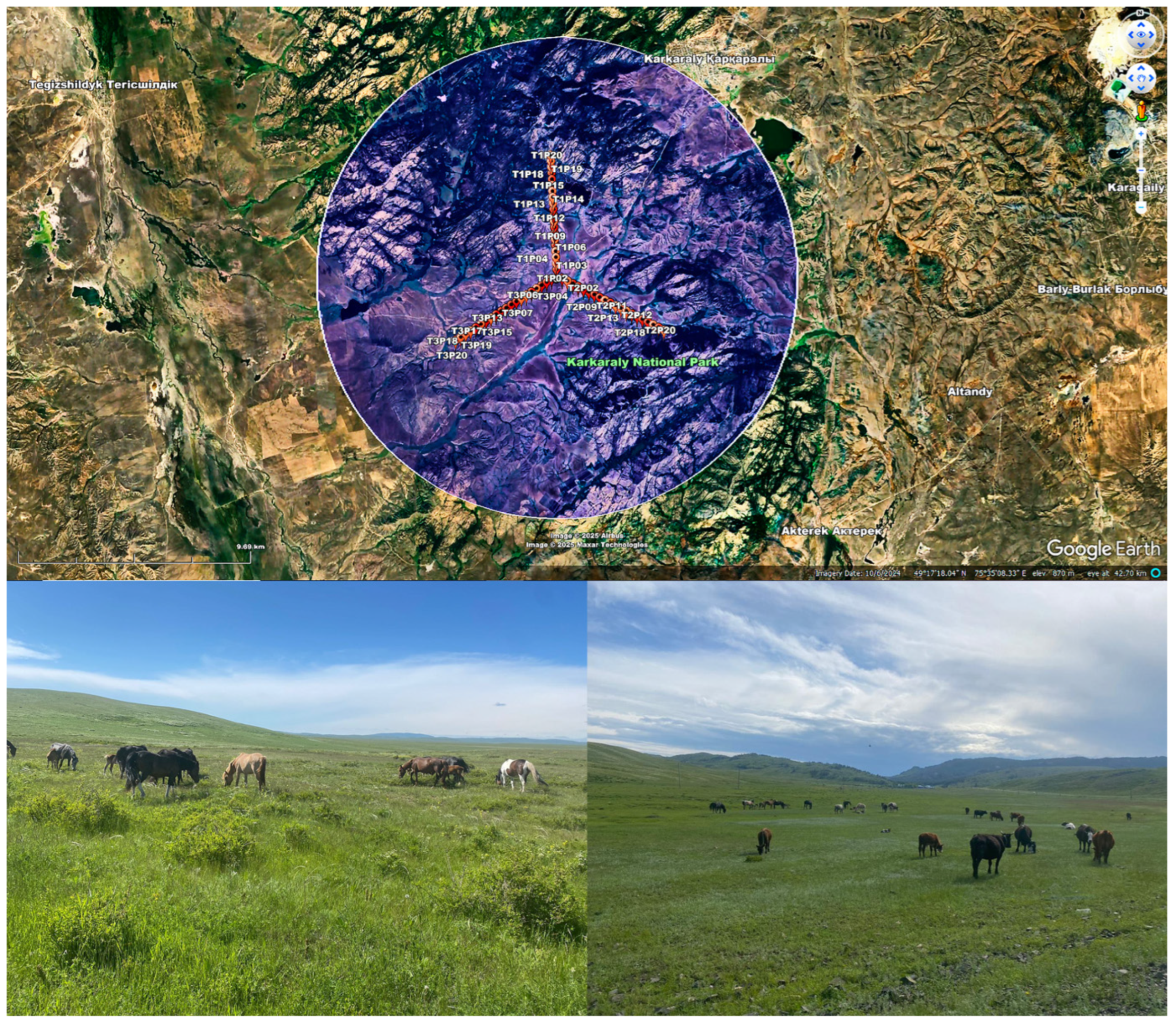
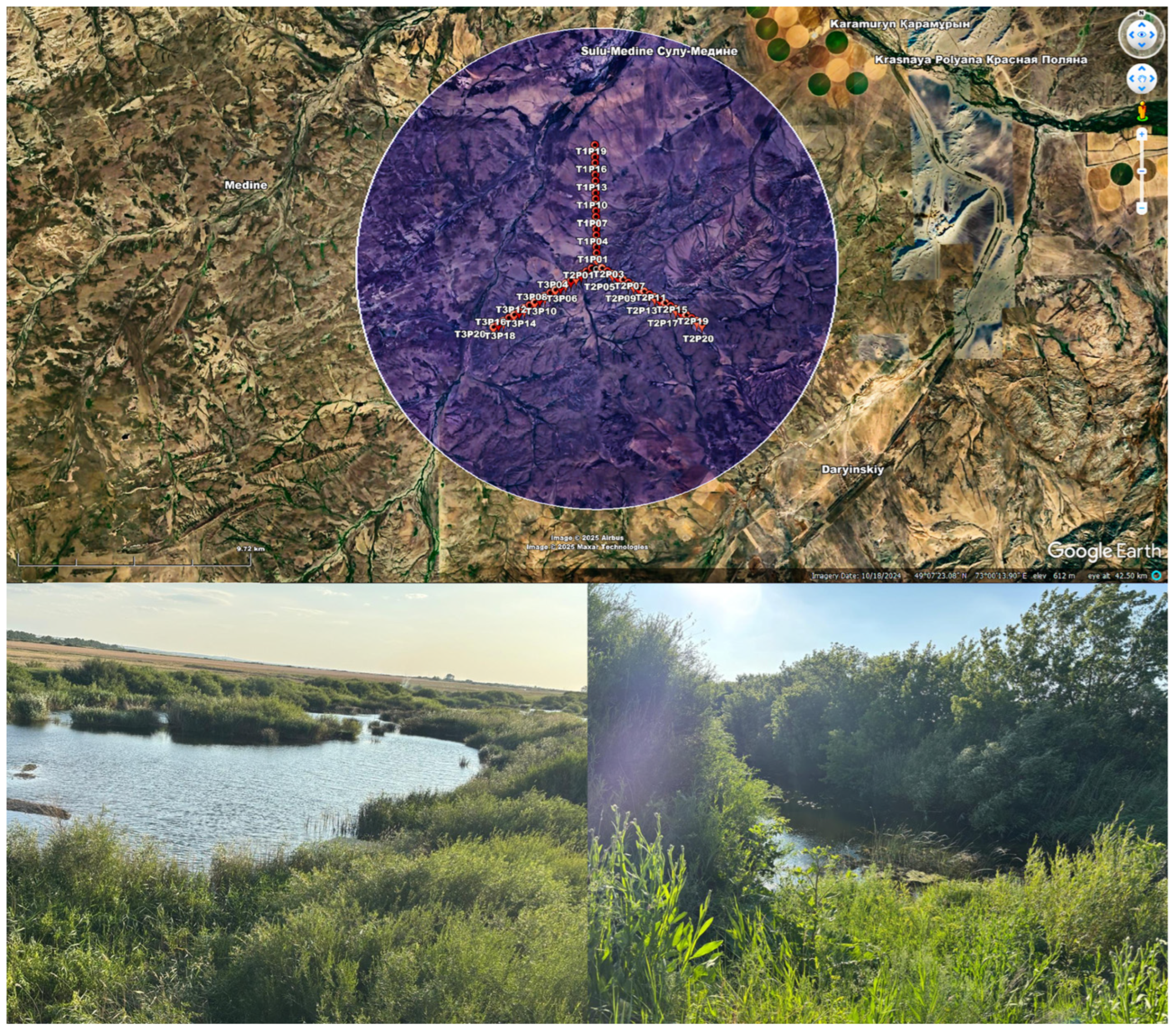
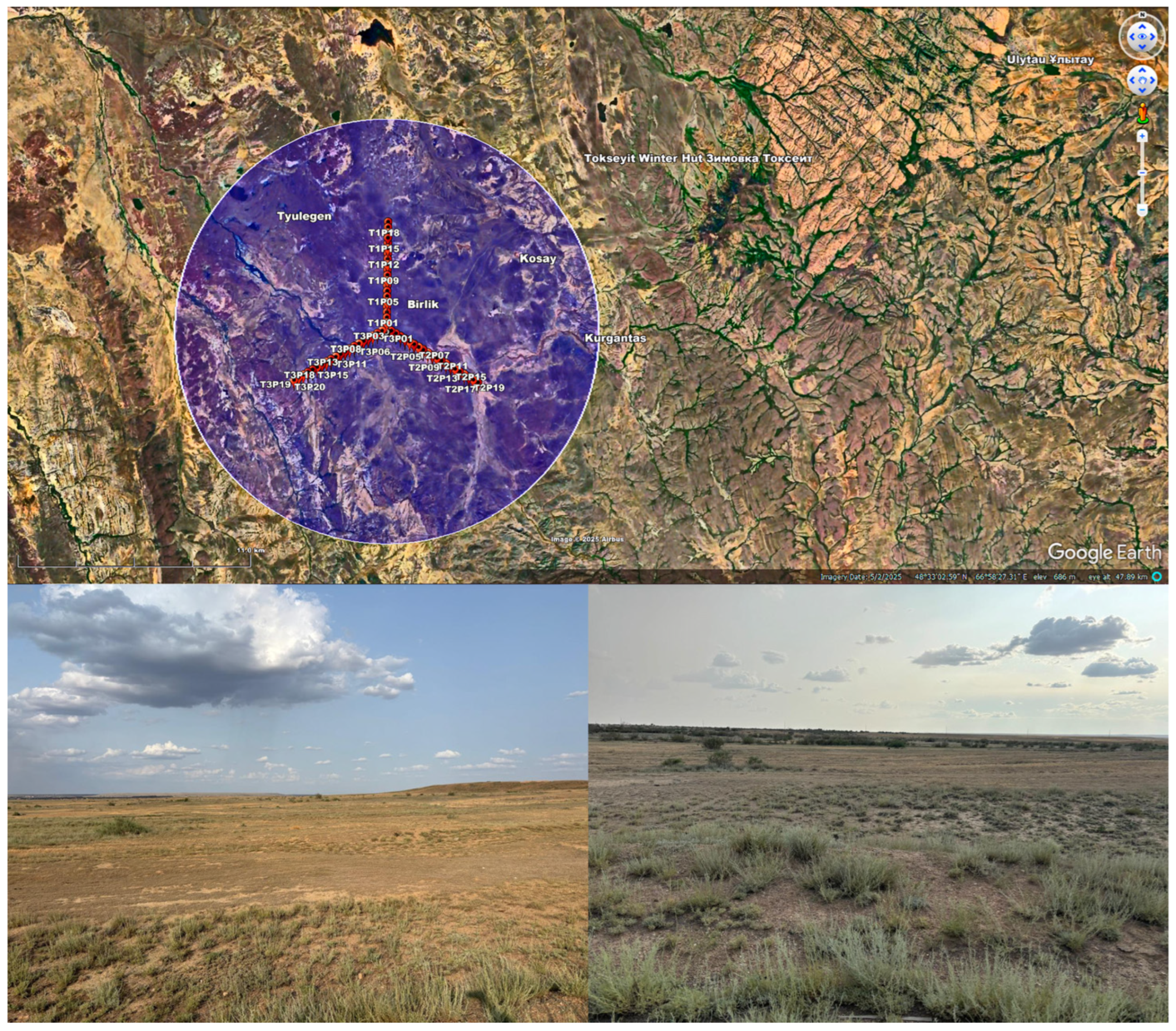
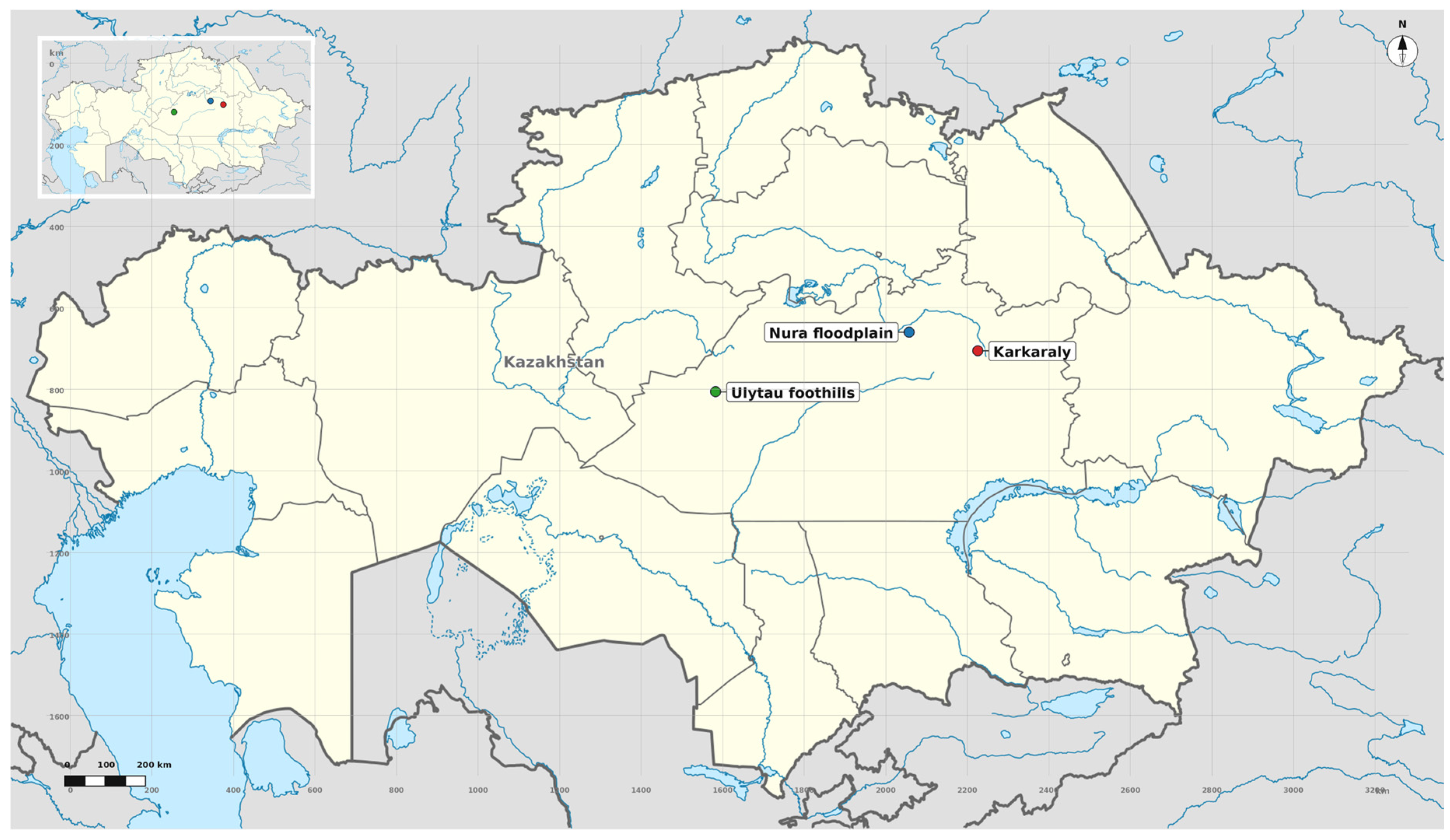
2.1. Study Rangelands
2.2. Temperature–Precipitation Regime in 2023–2024
2.3. Classification of Moisture-Affinity Groups and Abundance Scale
- •
- Xerophytes are plants optimally adapted to prolonged drought; they typically possess deep, well-developed root systems, a waxy cuticle, strongly reduced or small leaves, and thickened succulent stems that function as water reservoirs.
- •
- Mesophytes are species inhabiting moderately moist conditions, without pronounced morphophysiological adaptations to either water excess or water deficit; they predominate in habitats with an “intermediate” water regime.
- •
- Xeromesophytes are plants capable of tolerating both moderately moist and dry phases due to a plastic water balance and switchable adaptive mechanisms.
- •
- Mesoxerophytes are species that develop normally under relatively moist conditions but can withstand short-term drought periods through moderately expressed xeromorphic traits. Xeromesophytes and mesoxerophytes were treated as intermediate moisture-affinity groups along the xerophyte–mesophyte gradient (Bykov-type ecological grouping framework used in regional geobotanical practice). In this study, xeromesophytes denote taxa intermediate between mesophytes and mesoxerophytes (i.e., closer to mesophytes), whereas mesoxerophytes denote taxa of insufficient-moisture habitats with stronger xeric affinity (i.e., intermediate toward xerophytes). Thus, assignment was based on the relative position of each species on the moisture gradient rather than on a binary moist/dry distinction.
- •
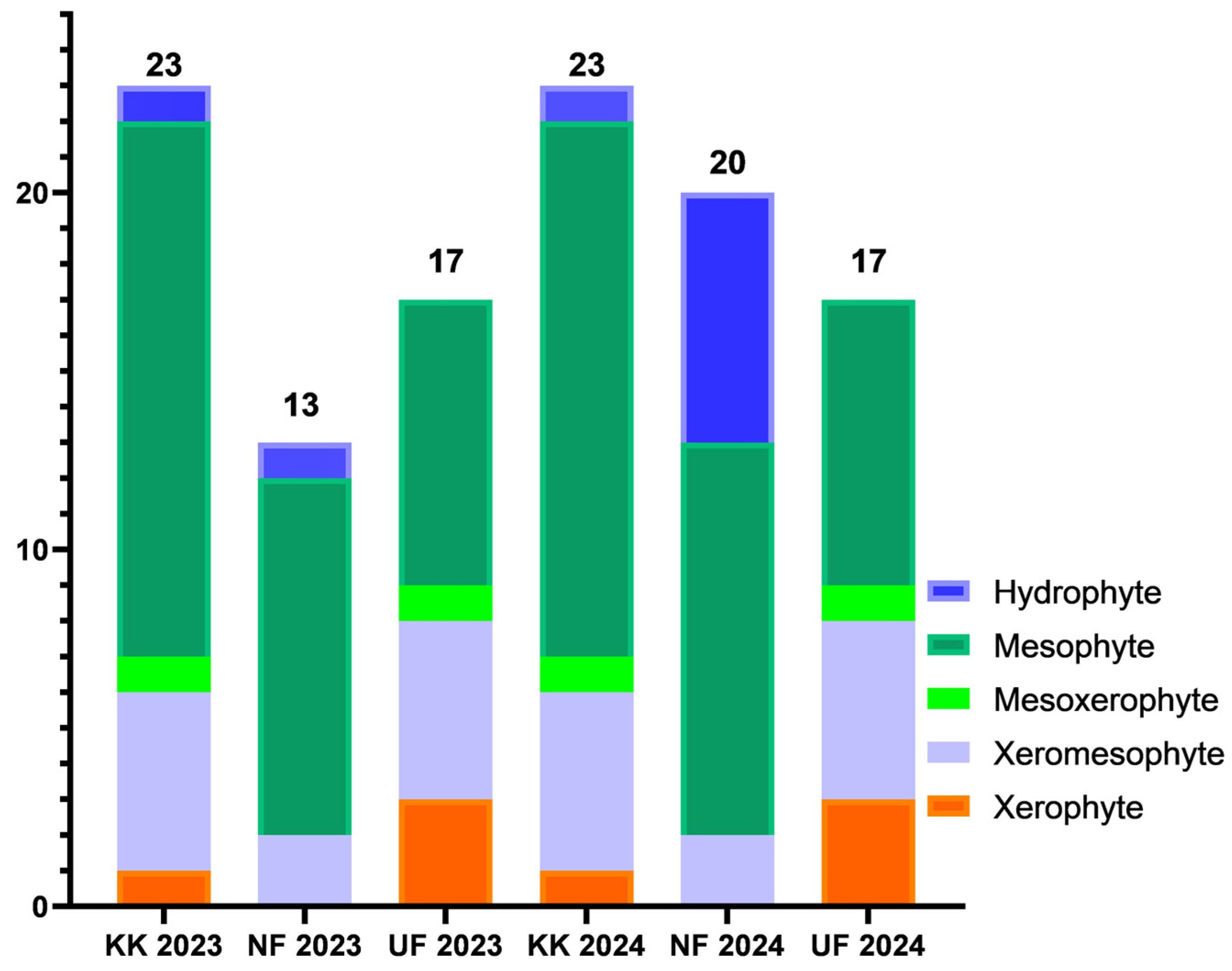
- Wet-associated taxa (operational wet-end group in the present analysis) include species associated with strongly water-influenced habitats (floodplain depressions, waterlogged soils, margins of channels and shallow-water zones), including hygrophilous taxa and truly hydrophytic species. This pooled category was used for comparative categorical analysis across sites and years in order to capture recruitment of hydrologically sensitive poisonous plants under wet-year conditions. Thus, in the present study, the category should be interpreted as a broad wet-habitat affiliation group rather than a strict hydrophyte-only classification [38,39].
2.4. Species Identification and Toxicity Verification
2.5. Statistical Analysis
3. Results
3.1. Poisonous Plant Species on Central Kazakhstan Rangelands: Diversity, Families, and Principal Toxic Effects

| Family | Species | Life Span (Major Category) | Major Toxic Compounds | Brief Toxic Effects |
|---|---|---|---|---|
| Apiaceae | Cicuta virosa | Per | Cicutoxin and other polyacetylenes [51] | Blockade of GABAergic neurotransmission, convulsive syndrome, neurotoxic paralysis, and respiratory failure [52,53]. |
| Apiaceae | Chaerophyllum temulum | Ann/Bienn | Polyacetylene (Z)-falcarinol (dominant component of root essential oil); sesquiterpenes in aerial parts [54] | Falcarinol-type polyacetylenes are skin irritants and sensitizers: contact dermatitis may occur upon exposure to plant sap (as is typical for Apiaceae polyacetylenes) [55,56] |
| Apiaceae | Conium maculatum | Ann/Bienn | Piperidine alkaloids (coniine, γ-coniceine) [57] | Blockade of nicotinic ACh receptors → paralysis and respiratory failure; no specific antidote [58,59,60] |
| Apiaceae | Oenanthe aquatica (syn. O. phellandrium) | Ann/Bienn | Furanocoumarins (incl. xanthotoxin/8-methoxypsoralen) [61] | Cutaneous photosensitization; phototoxic reactions under UVA exposure (typical of linear furanocoumarins such as xanthotoxin) [62] |
| Ranunculaceae | Pulsatilla patens | Per | Ranunculin → protoanemonin; saponins/triterpenes [63] | Marked irritation of the GI tract and mucosae, colic, dermatitis [64,65,66] |
| Ranunculaceae | Caltha palustris | Per | Protoanemonin, saponins, flavonoids [67] | GI irritation/toxicity (effects as described for the plant’s compounds) [67] |
| Ranunculaceae | Ranunculus sceleratus | Ann/Bienn | Ranunculin → protoanemonin (formed when fresh plant tissue is damaged); accompanying terpene/phenolic constituents [68,69] | Fresh plant parts are strong skin–mucosal irritants/vesicants (phytocontact dermatitis; bullous lesions with topical application of plant material). In livestock: GI irritation, colic/diarrhea; toxicity decreases upon drying [70,71,72,73] |
| Ranunculaceae | Delphinium consolida (syn. Consolida ajacis) | Ann/Bienn | Diterpenoid alkaloids (delphinine, delcosine, methyllycaconitine) [74] | Antagonism of nicotinic ACh receptors (nAChRs)—primarily the muscle subtype (NMJ) and neuronal α7; neuromuscular blockade → profound weakness, ataxia/collapse, respiratory failure, and potentially rapid death [75] |
| Brassicaceae | Erysimum cheiranthoides | Ann/Bienn | Glucosinolates (e.g., sinigrin derivatives); cardenolides (cardiac glycosides) also reported in the genus as co-defense [76] | Irritation of airways/mucosae, cough/burning upon inhalation of isothiocyanates [77,78] |
| Brassicaceae | Sinapis arvensis (syn. Brassica arvensis) | Ann/Bienn | Glucosinolates (sinigrin, gluconapin, glucobrassicin) [79,80] | GI irritation, hemolytic anemia, thyroid dysfunction, reproductive disorders; an acute case has been documented in sheep [79] |
| Fabaceae | Thermopsis lanceolata | Per | Alkaloids cytisine, thermopsine; (molecular mechanism of thermopsine) [81,82,83] | Neuro- and respiratory toxicity in livestock: vomiting, diarrhea, risk of respiratory failure [84] |
| Fabaceae | Lathyrus palustris | Per | Nitrilopropionamide and β-ODAP (lathyrogen) in the genus Lathyrus; closely related chemistry confirmed for L. palustris (family-level hazard for livestock) [85,86] | Neurotoxicity (lathyrism) with chronic high-dose intake; possible weakness, tremor/paresis. In livestock, respiratory and cardiovascular disturbances may occur with poisoning via feed contaminated with Lathyrus [85,87] |
| Fabaceae | Astragalus penduliflorus (syn. A. danicus) | Per | Swainsonine (indolizidine alkaloid) linked to the systemic seed-transmitted endophyte Alternaria sect. Undifilum (formerly Undifilum/Embellisia); swainsonine documented in many Astragalus/Oxytropis species [88,89] | “Locoism”: inhibition of lysosomal α-mannosidase → impaired glycoprotein degradation, accumulation of mannosides, cellular dysfunction; in ruminants—depression/lethargy, tremor and ataxia, weight loss, abortions, chronic neurologic and visceral lesions [90,91] |
| Solanaceae | Hyoscyamus niger | Ann/Bienn | Tropane alkaloids (hyoscyamine, scopolamine, atropine) [92,93] | Severe anticholinergic syndrome: dryness, mydriasis, tachycardia, agitation/delirium, hallucinations [94] |
| Solanaceae | Datura stramonium | Ann/Bienn | Tropane alkaloids (atropine, scopolamine, hyoscyamine) [95] | Pronounced anticholinergic toxidrome; poisonings are often linked to contamination of feed/food products [96,97] |
| Solanaceae | Solanum nigrum | Ann/Bienn | Steroidal glycoalkaloids (solanine, solanidine) [98] | GI disturbances, neuromuscular paralysis, seizures, respiratory failure; oxidative tissue damage [99,100,101,102] |
| Asteraceae | Tanacetum vulgare | Per | Major toxic constituents: thujone (monoterpene); sesquiterpene lactones (incl. parthenolide) [103] | Antagonism of GABA(_A) receptors → excitation/seizures at high doses; hepatotoxicity and neurologic signs are possible in livestock [104,105] |
| Asteraceae | Lactuca virosa | Ann/Bienn | Lactucin, lactucopicrin [106,107] | Sedative–analgesic effects; in livestock—depression, ataxia, tachycardia, possible seizures/respiratory depression (case report) [106,107] |
| Asteraceae | Senecio jacobaea (syn. Jacobaea vulgaris) | Per | 1,2-unsaturated PAs (senecionine, jacobine, retrorsine and N-oxides) [108,109,110,111] | Chronic hepatotoxicity: megalocytosis, fibrosis/cirrhosis, hepatic encephalopathy, photosensitization in cattle/horses [109,110,111,112] |
| Plantaginaceae | Gratiola officinalis | Per | Iridoid glycosides (gratiooside/gratiolin) and other phytochemicals [113,114] | In livestock—GI irritation (diarrhea, vomiting, colic); potential systemic toxicity with ingestion of large amounts (summaries on toxic plants in livestock) [115,116] |
| Plantaginaceae | Digitalis purpurea | Ann/Bienn | Cardiac glycosides (digitoxin, digoxin; aglycones digitoxigenin/digoxigenin) [117] | Inhibition of membrane Na(^+)/K(^+)-ATPase by cardenolides (digitoxin/digoxin) → increased myocardial excitability, arrhythmias, GI symptoms; cardiotoxic cases described in livestock [118,119] |
| Euphorbiaceae | Euphorbia peplus | Ann/Bienn | Ingenane diterpenoids (incl. ingenol mebutate/ingenol 3-angelate) and other ingenol/ingol derivatives in plant latex [120,121] | Latex causes irritant contact dermatitis (erythema, vesicles/bullae, pain) upon skin contact; severe local skin reactions reported with topical ingenol mebutate; ocular exposure causes acute keratoconjunctivitis/keratitis [121,122,123] |
| Euphorbiaceae | Euphorbia esula (syn. E. virgata) | Per | Diterpenoids (ingenol and its esters), phorbol esters [124] | Skin reactions (blistering/ulceration) upon sap contact; in livestock—marked GI irritation, reduced palatability/productivity; sheep/goats are relatively more tolerant [125] |
| Poaceae | Lolium temulentum | Ann/Bienn | Loline-type alkaloids (loline, norloline) detected in L. temulentum seeds [126]; potentially other endophyte-associated alkaloids (as a general feature of grass–endophyte symbioses) [127]. Ergot alkaloids (ergotamine, ergonovine, etc.) produced by Claviceps spp. on grasses (incl. Lolium) [128,129] | When ergot alkaloids are present, ergotism predominates: pronounced vasoconstriction, hyperthermia/stress responses, ischemic lesions of limbs (necrosis in severe cases), reduced productivity [128,129]. “Darnel poisoning” is mainly CNS-type: lethargy/somnolence, dizziness, tremor, ataxia and impaired coordination, weakness; symptom severity may increase with fungal contamination of feed and mixed alkaloid profiles [130,131] |
| Boraginaceae | Nonea pulla (syn. N. incarnata) | Per | Pyrrolizidine alkaloids (lycopsamine, intermedine) [132,133] | Cumulative hepatotoxicity: wasting, photosensitization, hepatic veno-occlusive disease; suspected mass poisonings in cattle [133] |
| Caryophyllaceae | Saponaria officinalis | Per | Saponins (saponariosides; sapogenin derivatives; diosgenin-like structures) [134] | Excess intake may cause GI irritation (diarrhea, vomiting, abdominal pain) in livestock [135] |
| Convolvulaceae | Convolvulus arvensis | Per | Calystegines (nortropane alkaloid glycosidase inhibitors) are characteristic [136,137] | Data on calystegine toxicity in humans/livestock are limited; potential effects are linked to glycosidase inhibition and disruption of carbohydrate metabolism at high exposure [136,137] |
| Ephedraceae | Ephedra distachya | Per | Ephedrine-type alkaloids (ephedrine, etc.) [138] | Sympathomimetic syndrome: tachycardia, hypertension, agitation/hyperactivity; in severe cases—cardiovascular complications, seizures [139] |
| Geraniaceae | Geranium pseudosibiricum | Per | Tannins (ellagitannin geraniin), flavonoids, phenolic compounds [140] | At high doses, polyphenols may cause GI irritation; evidence for severe systemic toxicity is limited [141] |
| Juncaginaceae | Triglochin maritima | Per | Cyanogenic glycosides (e.g., triglochinin) [142] | Inhibition of cytochrome-c oxidase and tissue hypoxia due to HCN release; acute/chronic neurologic and cardiorespiratory effects are possible [143] |
| Lamiaceae | Galeopsis tetrahit | Ann/Bienn | Essential oils of aerial parts; predominance of sesquiterpene hydrocarbons (e.g., germacrene D, β-/γ-elemene) [144] | As with many essential oils, components may irritate skin and mucosae and can cause allergic contact dermatitis upon contact; with inhalation/ingestion of concentrated essential oils, toxic effects are possible (nausea/vomiting, CNS depression, etc.)—general effects typical of terpene-rich oils [145,146] |
| Papaveraceae | Chelidonium Per majus | Alkaloids (chelidonine, chelerythrine, sanguinarine, etc.) [147,148] | GI disturbances, dermatotoxicity; herb-induced hepatotoxicity has been reported with ingestion of extracts [149] |
3.2. Spatial Patterns and Interannual Changes in Poisonous-Plant Diversity and Moisture-Affinity Group Composition
| Species/Pasture | Moisture Group | 2023 KK | 2023 NF | 2023 UF | 2024 KK | 2024 NF | 2024 UF |
|---|---|---|---|---|---|---|---|
| Astragalus penduliflorus (syn. A. danicus) | Xerophyte | — | — | Sol | — | — | Sol |
| Ephedra distachya | Xerophyte | — | — | Sol | — | — | Sol |
| Nonea pulla (syn. N. incarnata) | Xerophyte | Sol | — | Sp | Sol | — | Sp |
| Pulsatilla patens (syn. Anemone patens, Pulsatilla multifida) | Mesoxerophyte | Cop1 | — | Sp | Cop1 | — | Sp |
| Convolvulus arvensis | Xeromesophyte | Cop1 | Cop1 | Cop1 | Cop1 | Cop1 | Cop2 |
| Delphinium consolida (syn. Consolida ajacis = D. ajacis) | Xeromesophyte | Sp | — | Un | Sp | — | Un |
| Euphorbia esula (syn. E. virgata) | Xeromesophyte | Cop1 | — | Cop1 | Cop1 | — | Cop1 |
| Lactuca virosa (syn. L. scariola var. virosa) | Xeromesophyte | Sol | Sol | Sp | Sol | Sol | Sp |
| Thermopsis lanceolata (syn. T. montana subsp. lanceolata) | Xeromesophyte | Cop1 | — | Sp | Cop2 | — | Sp |
| Chaerophyllum temulum | Mesophyte | Un | — | — | Un | — | — |
| Chelidonium majus | Mesophyte | Sol | — | — | Sol | — | — |
| Conium maculatum | Mesophyte | Sol | Sp | Un | Sol | Sp | Un |
| Datura stramonium | Mesophyte | Sol | Sol | Sp | Sol | Sol | Sp |
| Digitalis purpurea | Mesophyte | Un | — | — | Un | — | — |
| Erysimum cheiranthoides | Mesophyte | Sol | Sol | Sp | Sol | Sol | Sp |
| Euphorbia peplus (syn. Chamaesyce peplus) | Mesophyte | Sol | Un | — | Sol | Un | — |
| Galeopsis tetrahit | Mesophyte | Un | — | — | Un | — | — |
| Geranium pseudosibiricum | Mesophyte | Cop1 | — | — | Cop1 | — | — |
| Hyoscyamus niger | Mesophyte | Sol | Sol | Sp | Sol | Sol | Sp |
| Lolium temulentum | Mesophyte | Sp | Sol | Sp | Sp | Sol | Sp |
| Senecio jacobaea (syn. Jacobaea vulgaris) | Mesophyte | — | — | — | — | Un | — |
| Sinapis arvensis (syn. Brassica arvensis) | Mesophyte | Cop1 | Cop1 | Sp | Cop2 | Cop2 | Sp |
| Solanum nigrum (syn. S. vulgare) | Mesophyte | Sol | Sol | Sp | Sol | Sol | Sp |
| Saponaria officinalis | Mesophyte | Un | Un | — | Un | Un | — |
| Tanacetum vulgare (syn. Chrysanthemum vulgare) | Mesophyte (slightly xerophilous) | Cop2 | Cop1 | Sp | Cop2 | Cop1 | Sp |
| Caltha palustris | Wet-associated | Sol | Sol | — | Sol | Sol | — |
| Cicuta virosa | Wet-associated | — | — | — | — | Un | — |
| Gratiola officinalis | Wet-associated | — | — | — | — | Un | — |
| Lathyrus palustris (syn. Lathyrostylis palustris) | Wet-associated | — | — | — | — | Un | — |
| Oenanthe aquatica (syn. O. phellandrium) | Wet-associated | — | — | — | — | Sp | — |
| Ranunculus sceleratus | Wet-associated | — | — | — | — | Un | — |
| Triglochin maritima | Wet-associated | — | — | — | — | Un | — |
4. Discussion
5. Conclusions
Author Contributions
Funding
Data Availability Statement
Conflicts of Interest
Abbreviations
| Abbreviation | Full Form/Meaning |
| ACh | acetylcholine |
| ACAPS | Assessment Capacities Project |
| CNS | central nervous system |
| ECHO | European Civil Protection and Humanitarian Aid Operations |
| EFSA | European Food Safety Authority |
| GABA | gamma-aminobutyric acid |
| GI | gastrointestinal (tract) |
| HCN | hydrogen cyanide |
| KK | Karkaraly Hills (study site code) |
| nAChR | nicotinic acetylcholine receptor |
| NF | Nura Floodplain (study site code) |
| NMJ | neuromuscular junction |
| ODAP | β-N-oxalyl-L-α,β-diaminopropionic acid |
| PAs | pyrrolizidine alkaloids |
| UF | Ulytau foothills (study site code) |
References
- Briske, D.D.; Cromsigt, P.G.M.; Davies, J.; Fernández-Giménez, M.E.; Luizza, M.W.; Manzano, P.; Singh, R. Pastoralism Can Mitigate Biodiversity Loss on Global Rangelands. BioScience 2025, 76, 78–89. [Google Scholar] [CrossRef]
- Simba, L.D.; Te Beest, M.; Hawkins, H.J.; Larson, K.W.; Palmer, A.R.; Sandström, C.; Smart, K.G.; Kerley, G.I.H.; Cromsigt, J.P.G.M. Wilder rangelands as a natural climate opportunity: Linking climate action to biodiversity conservation and social transformation. Ambio 2024, 53, 678–696. [Google Scholar] [CrossRef]
- Maestre, F.T.; Le Bagousse-Pinguet, Y.; Delgado-Baquerizo, M.; Eldridge, D.J.; Saiz, H.; Berdugo, M.; Gozalo, B.; Ochoa, V.; Guirado, E.; García-Gómez, M.; et al. Grazing and ecosystem service delivery in global drylands. Science 2022, 378, 915–920. [Google Scholar] [CrossRef]
- Briske, D.D.; Archer, S.R.; Burchfield, E.K.; Burnidge, W.R.; Derner, J.D.; Gosnell, H.; Hatfield, J.L.; Kazanski, C.E.; Khalil, M.; Lark, T.J.; et al. Supplying ecosystem services on US rangelands. Nat. Sustain. 2023, 6, 1524–1532. [Google Scholar] [CrossRef]
- Viana, C.M.; Freire, D.; Abrantes, P.; Rocha, J.; Pereira, P. Agricultural land systems importance for supporting food security and sustainable development goals: A systematic review. Sci. Total Environ. 2022, 806, 150718. [Google Scholar] [CrossRef] [PubMed]
- Stegelmeier, B.L.; David, T.Z.; Panter, K.E.; Welch, K.D.; Knoppel, E.L. A Review of Intermittent Poisoning to Mitigate Toxic Plant-Induced Disease in Livestock. Vet. Sci. 2024, 12, 13. [Google Scholar] [CrossRef] [PubMed]
- Abdisa, T.; Dilbato, T. Toxic Plants and Their Impact on Livestock Health and Economic Losses: A Comprehensive Review. J. Toxicol. 2024, 2024, 9857933, Erratum in J. Toxicol. 2025, 2025, 9787082. [Google Scholar] [CrossRef] [PubMed]
- Rocha, V.; Filho, G.; Souza, M.; Assis, E.; Alves da Silva, M.; Sousa, M.; Sousa, E.; Simões, S.; Lucena, R. Abortions and Congenital Malformations in Small Ruminants Associated with Toxic Plant Consumption in the Brazilian Semi-Arid Region. Animals 2025, 15, 356. [Google Scholar] [CrossRef]
- Erb, M.; Kliebenstein, D.J. Plant Secondary Metabolites as Defenses, Regulators, and Primary Metabolites: The Blurred Functional Trichotomy. Plant Physiol. 2020, 184, 39–52. [Google Scholar] [CrossRef]
- Aboling, S. Do Poisonous Plants in Pastures Communicate Their Toxicity? Meta-Study and Evaluation of Poisoning Cases in Central Europe. Animals 2023, 13, 3795. [Google Scholar] [CrossRef]
- Kingsbury, J.M. Common Poisonous Plants; Information Bulletin 104; Cornell Cooperative Extension: Ithaca, NY, USA, 1994; pp. 1–40. Available online: https://ag.purdue.edu/btny/purdueweedscience/wp-content/uploads/2021/03/Common-Poisonous-Plants.pdf (accessed on 14 January 2026).
- Meat & Livestock Australia. Weeds of Significance to the Grazing Industries of Australia. Available online: https://www.mla.com.au/research-and-development/reports/2005/weeds-of-significance-to-the-grazing-industries-of-australia/ (accessed on 14 January 2026).
- Cortinovis, C.; Caloni, F. Epidemiology of intoxication of domestic animals by plants in Europe. Vet. J. 2013, 197, 163–168. [Google Scholar] [CrossRef] [PubMed]
- Pomfret, R. Central Asian Economies: Thirty Years After Dissolution of the Soviet Union. Comp. Econ. Stud. 2021, 63, 537–556. [Google Scholar] [CrossRef] [PubMed]
- Shomurodov, H.; Khayitov, R.; Abduraimov, O.S.; Makhmudov, A.; Abduraimov, A. Poisonous and harmful plants of pastures in the Kyzylkum desert (Uzbekistan). E3S Web Conf. 2024, 539, 01008. (In Russian) [Google Scholar] [CrossRef]
- Zhaparov, A.Z. Ispol’zovanie sezonnykh pastbishch v Kyrgyzstane i ekologicheskie problemy [Use of seasonal pastures in Kyrgyzstan and environmental problems]. Mir Bol’shogo Altaya 2015, 1, 237–245. (In Russian) [Google Scholar]
- Madaminov, A.A.; Khodzhimatov, M. Yadovitye rasteniya Tadzhikistana [Poisonous plants of Tajikistan]. Izv. Akad. Nauk Resp. Tadzhikistan Otd. Biol. Med. Nauk 2012, 2, 7–17. (In Russian) [Google Scholar]
- Minervin, V.N. Yadovitye Rasteniya Turkmenistana, Ikh Pol’za i Vred dlya Sel’skokhozyaystvennykh Zhivotnykh [Poisonous Plants of Turkmenistan, Their Benefits and Harms for Farm Animals]; Izd-vo AN Turkmenistan SSR: Ashkhabad, Turkmenistan, 1958; 269p. (In Russian) [Google Scholar]
- Food and Agriculture Organization of the United Nations (FAO). Kazakhstan Works toward Securing Precious Pastures for Future Generations; News Release, 22 October 2020. Available online: https://www.fao.org/europe/news/detail/Kazakhstan-works-toward-securing-precious-pastures-for-future-generations/en (accessed on 14 January 2026).
- Kolluru, V.; John, R.; Chen, J.; Konkathi, P.; Kolluru, S.; Saraf, S.; Henebry, G.; Xiao, J.; Jain, K.; Kussainova, M. Dominant role of grazing and snow cover variability on vegetation shifts in the drylands of Kazakhstan. Commun. Earth Environ. 2024, 5, 424. [Google Scholar] [CrossRef]
- Rachkovskaya, E.I. Desert sagebrush-bunchgrass steppes of Central Kazakhstan. Veg. Russ. 2016, 28, 108–124. [Google Scholar] [CrossRef]
- Wesche, K.; Ambarlı, D.; Kamp, J.; Török, P.; Treiber, J.; Dengler, J. The Palaearctic steppe biome: A new synthesis. Biodivers. Conserv. 2016, 25, 2197–2231. [Google Scholar] [CrossRef]
- Werger, M.J.A.; van Staalduinen, M.A. (Eds.) Eurasian Steppes: Ecological Problems and Livelihoods in a Changing World; Springer: Dordrecht, The Netherlands, 2012. [Google Scholar] [CrossRef]
- Malakhov, D.V.; Vitkovskaya, I.S.; Batyrbayeva, M.Z. Metodicheskie podkhody k izucheniyu opustynennoi stepi Kazakhstana: Perspektivy ispol’zovaniya nekommercheskikh dannykh DZZ [Methodological approaches to the study of desertified steppe in Kazakhstan: Prospects for using non-commercial remote sensing data]. Vopr. Stepovedeniya 2021, 2, 19–33. (In Russian) [Google Scholar] [CrossRef]
- Shokparova, D.; Sirazhitdinova, M.; Bissenbayeva, S.; Patel, N. Remote sensing and GIS-based land assessment in Zhanaarka region of Ulytau oblast, Kazakhstan. Front. Environ. Sci. 2025, 13, 1516460. [Google Scholar] [CrossRef]
- Dikareva, T.V.; Soldatov, M.S. Geographical conditions and factors that affect the distribution of poisonous plants in Kazakhstan. Arid Ecosyst. 2024, 14, 72–78. [Google Scholar] [CrossRef]
- U.S. Department of the Interior; Bureau of Land Management (BLM). Sampling Vegetation Attributes. Interagency Technical Reference 1734-4; BLM: Denver, CO, USA, 1996; Revised 1997, 1999. Available online: https://www.nrcs.usda.gov/sites/default/files/2022-09/stelprdb1044175.pdf (accessed on 14 January 2026).
- Kent, M. Vegetation Description and Data Analysis: A Practical Approach, 2nd ed.; Wiley-Blackwell: Chichester, UK, 2012; ISBN 978-1-4443-3260-6. [Google Scholar]
- Montana Department of Environmental Quality (DEQ). Vegetation Sampling Guidelines; Montana DEQ: Helena, MT, USA, 2009. Available online: https://deq.mt.gov/files/Land/CoalUranium/Forms/Vegetation%20Sampling%20Guidelines.pdf (accessed on 14 January 2026).
- Dikareva, T.V.; Leonova, N.B. Fitoraznoobrazie sopok Karkaralinskogo natsional’nogo parka (Respublika Kazakhstan) [Phytodiversity of the hills of Karkaraly National Park (Republic of Kazakhstan)]. Arid. Ecosyst. 2014, 20, 105–114. (In Russian) [Google Scholar]
- Tabelinova, A.S. Vyyavlenie dinamiki i sovremennogo sostoyaniya rastitel’nogo pokrova, pozharoopasnykh territorii na osnove distantsionnykh i GIS-metodov v Karkaralinskom natsional’nom prirodnom parke [Assessing vegetation-cover dynamics and the current state of fire-prone areas using remote sensing and GIS methods in Karkaraly National Nature Park]. In Innovatsii v Sokhranenii i Ustoichivom Razvitii Lesnykh Ekosistem (Proceedings of the International Scientific and Practical Conference), Burabay, Kazakhstan, 5 November 2020; State National Natural Park “Burabay” UAP RK: Burabay, Kazakhstan, 2020; pp. 54–58. (In Russian) [Google Scholar]
- Hroudová, Z.; Zákravský, P.; Hrouda, L.; Ostrý, I. Oenanthe aquatica (L.) Poir.: Seed reproduction, population structure, habitat conditions and distribution in Czechoslovakia. Folia Geobot. Phytotaxon. 1992, 27, 301–335. [Google Scholar] [CrossRef]
- Egorova, T.V. The Sedges (Carex L.) of Russia and Adjacent States (Within the Limits of the Former USSR); St. Petersburg State Chemical-Pharmaceutical Academy: St. Petersburg, Russia; Missouri Botanical Garden Press: St. Louis, MO, USA, 1999; 772p, ISBN 0-915279-67-3. [Google Scholar]
- Kazhydromet. Annual Bulletin of Monitoring the State and Climate Change of Kazakhstan: 2023; RSE “Kazhydromet”: Astana, Kazakhstan, 2024; 90p, Available online: https://www.kazhydromet.kz/uploads/files/1891/file_en/675274f0f001bezhegodnyy-byulleten-ik-za-2023_eng_ot_27-11-2024.pdf (accessed on 14 January 2026).
- RSE “Kazhydromet”. Kazhydromet RSE has released the main flood forecast for spring 2024. 2024. Available online: https://www.kazhydromet.kz/en/post/2551 (accessed on 14 January 2026).
- ACAPS. Kazakhstan: Floods—Briefing Note. 2024. Available online: https://reliefweb.int/report/kazakhstan/acaps-briefing-note-kazakhstan-floods-23-april-2024 (accessed on 14 January 2026).
- European Commission; ECHO. Kazakhstan–Russia Floods: Update. Daily Flash, 10 April 2024. Available online: https://reliefweb.int/report/kazakhstan/russia-kazakhstan-floods-update-kazhydromet-meteo-rf-media-echo-daily-flash-10-april-2024 (accessed on 14 January 2026).
- Bykov, B.A. Geobotany; Alma-Ata, Kazahstan, 1957; 382p. (In Russian) [Google Scholar]
- Pozdnyakova, Y.; Murzatayeva, A. Urban cemeteries as biodiversity refuges: A comparative study of plant ecobiomorphs in Central Kazakhstan. Diversity 2024, 16, 668. [Google Scholar] [CrossRef]
- Drude, O. Handbuch der Pflanzengeographie; Verlag von J. Engelhorn: Stuttgart, Germany, 1890; 582p. (In German) [Google Scholar]
- Gotelli, N.J.; Ellison, A.M. A Primer of Ecological Statistics, 2nd ed.; Sinauer Associates: Sunderland, MA, USA, 2013; 614p, ISBN 978-1-60535-064-6. [Google Scholar]
- Pavlov, N.V. Flora of Kazakhstan; Publishing House of the Academy of Sciences of the Kazakh SSR: Alma-Ata, Kazahstan, 1956–1966; Volumes I–IX. (In Russian) [Google Scholar]
- EFSA. Compendium of botanicals reported to contain naturally occurring substances of possible concern. EFSA J. 2012, 10, 2663. [Google Scholar] [CrossRef]
- EFSA CONTAM Panel. Risks for human health related to the presence of pyrrolizidine alkaloids in honey, tea, herbal infusions and food supplements. EFSA J. 2017, 15, 4908. [Google Scholar] [CrossRef] [PubMed]
- Cortinovis, C.; Caloni, F. Alkaloid-Containing Plants Poisonous to Cattle and Horses in Europe. Toxins 2015, 7, 5301–5307. [Google Scholar] [CrossRef]
- Fisher, R.A. The logic of inductive inference. J. R. Stat. Soc. 1935, 98, 39–82. [Google Scholar] [CrossRef]
- Freeman, G.H.; Halton, J.H. Note on an exact treatment of contingency, goodness of fit and other problems of significance. Biometrika 1951, 38, 141–149. [Google Scholar] [CrossRef]
- McNemar, Q. Note on the sampling error of the difference between correlated proportions or percentages. Psychometrika 1947, 12, 153–157. [Google Scholar] [CrossRef]
- Agresti, A. Categorical Data Analysis, 3rd ed.; Wiley: Hoboken, NJ, USA, 2013; 744p, ISBN 978-0-470-46363-5. [Google Scholar]
- Fay, M.P. exact2x2: Exact Tests and Confidence Intervals for 2×2 Tables. R package version 1.7, 2023. Available online: https://CRAN.R-project.org/package=exact2x2 (accessed on 14 January 2026).
- Wittstock, U.; Hadacek, F.; Wurz, G.; Teuscher, E.; Greger, H. Polyacetylenes from water hemlock, Cicuta virosa. Planta Med. 1995, 61, 439–445. [Google Scholar] [CrossRef] [PubMed]
- Green, B.T.; Goulart, C.; Welch, K.D.; Pfister, J.A.; McCollum, I.; Gardner, D.R. The non-competitive blockade of GABAA receptors by an aqueous extract of water hemlock (Cicuta douglasii) tubers. Toxicon 2015, 108, 11–14. [Google Scholar] [CrossRef] [PubMed]
- Arsenova, R.; Prager, C.; Becker, L.L.; Scholtis, S.; Methling, M.; Kaindl, A.M. Beware of neurotoxins in common plants: Water hemlock poisoning presenting as convulsive status epilepticus. Pediatr. Neurol. 2022, 127, 39–40. [Google Scholar] [CrossRef] [PubMed]
- Stamenković, J.G.; Stojanović, G.S.; Radojković, I.R.; Petrović, G.M.; Zlatković, B.K. Chemical composition of the essential oil from Chaerophyllum temulum (Apiaceae). Nat. Prod. Commun. 2015, 10, 1439–1441. [Google Scholar] [CrossRef]
- Hausen, B.M.; Bröhan, J.; König, W.A.; Faasch, H.; Hahn, H.; Bruhn, G. Allergic and irritant contact dermatitis from falcarinol and didehydrofalcarinol in common ivy (Hedera helix L.). Contact Dermat. 1987, 17, 1–9. [Google Scholar] [CrossRef]
- Rozas-Muñoz, E.; Lepoittevin, J.-P.; Pujol, R.M.; Giménez-Arnau, A. Allergic contact dermatitis to plants: Understanding the chemistry will help our diagnostic approach. Actas Dermosifiliogr. 2012, 103, 456–477. [Google Scholar] [CrossRef]
- López, T.A.; Cid, M.S.; Bianchini, M.L. Biochemistry of hemlock (Conium maculatum L.) alkaloids and their acute and chronic toxicity in livestock: A review. Toxicon 1999, 37, 841–865. [Google Scholar] [CrossRef]
- Keeler, R.F.; Balls, L.D.; Shupe, J.L.; Crowe, M.W. Teratogenicity and toxicity of coniine in cows, ewes, and mares. Cornell Vet. 1980, 70, 19–26. [Google Scholar]
- Green, B.T.; Lee, S.T.; Welch, K.D.; Pfister, J.A.; Panter, K.E. Fetal muscle-type nicotinic acetylcholine receptor activation in TE-671 cells and inhibition of fetal movement in a day 40 pregnant goat model by optical isomers of the piperidine alkaloid coniine. J. Pharmacol. Exp. Ther. 2013, 344, 295–307. [Google Scholar] [CrossRef]
- Panter, K.E.; James, L.F.; Gardner, D.R. Lupines, poison-hemlock and Nicotiana spp.: Toxicity and teratogenicity in livestock. J. Nat. Toxins 1999, 8, 117–134. [Google Scholar]
- Świątek, Ł.; Sieniawska, E.; Mahomoodally, M.F.; Sadeer, N.B.; Wojtanowski, K.K.; Rajtar, B.; Polz-Dacewicz, M.; Paksoy, M.Y.; Zengin, G. Phytochemical profile and biological activities of the extracts from two Oenanthe species (O. aquatica and O. silaifolia). Pharmaceuticals 2022, 15, 50. [Google Scholar] [CrossRef] [PubMed]
- Wu, A.; Lu, J.; Zhong, G.; Lu, L.; Qu, Y.; Zhang, C. Xanthotoxin (8-methoxypsoralen): A review of its chemistry, pharmacology, pharmacokinetics, and toxicity. Phytother. Res. 2022, 36, 3805–3832. [Google Scholar] [CrossRef] [PubMed]
- Łaska, G.; Sienkiewicz, A.; Stocki, M.; Zjawiony, J.; Sharma, V.; Bajguz, A.; Piotrowska-Niczyporuk, A.; Jacob, M.; Khan, S. Phytochemical screening of Pulsatilla species and investigation of their biological activities. Acta Soc. Bot. Pol. 2019, 88, 3613. [Google Scholar] [CrossRef]
- Pañeda, A.G.V.; Apan, M.T. Synthesis and cytotoxic evaluation of protoanemonin and three brominated derivatives. Rev. Colomb. Quim. 2020, 49, 13–18. [Google Scholar] [CrossRef]
- Sirak, B.; Aragaw, M.; Tadesse, S. Ranunculin, protoanemonin, and anemonin: Pharmacological and chemical perspectives. Curr. Med. Chem. 2025, 32, 1659–1673. [Google Scholar] [CrossRef]
- Hong, K.R.; Shin, J.Y.; Kim, J.E.; Lee, S.H.; Park, Y.L. A Case of Irritant Contact Dermatitis Associated with Pulsatilla koreana. Ann. Dermatol. 2019, 31, S54–S55. [Google Scholar] [CrossRef]
- Liakh, V.; Konechna, R.; Mylyanych, A.; Zhurakhivska, L.; Hubytska, I.; Novikov, V. Caltha palustris. Analytical overview. ScienceRise Pharm. Sci. 2020, 2, 51–56. [Google Scholar] [CrossRef]
- Goo, Y.-K. Therapeutic Potential of Ranunculus Species (Ranunculaceae): A Literature Review on Traditional Medicinal Herbs. Plants 2022, 11, 1599. [Google Scholar] [CrossRef]
- Purdue University; College of Agriculture. Buttercup (Ranunculus)—Toxic principle: Ranunculin → protoanemonin. 2024. Available online: https://ag.purdue.edu/department/arge/PACs/sipac/toxic-plants/buttercup.html (accessed on 14 January 2026).
- Degirmenci, E.; Duman, N.; Mat, A.; Bavunoğlu, I.; Ikizceli, I.; Aktas, C. Phytocontact Dermatitis: A Case Study. J. Acad. Emerg. Med. Case Rep. 2015, 6, 66–68. [Google Scholar] [CrossRef]
- Jeon, B.K.; Koh, M.O.; Park, S.D. Three cases of primary irritant dermatitis due to buttercup. Korean J. Dermatol. 1992, 30, 886–891. [Google Scholar]
- University of Missouri Extension. Buttercup: Blistering Beauty Poisons Cattle. 2020. Available online: https://extension.missouri.edu/news/buttercup-blistering-beauty-poisons-cattle (accessed on 14 January 2026).
- Oregon State University Extension. Buttercups, Ranunculus spp. 2014. Available online: https://smallfarms.oregonstate.edu/sites/agscid7/files/pp_buttercups.pdf (accessed on 14 January 2026).
- Meriçli, F.; Meriçli, A.H.; Desai, H.K.; Ulubelen, A.; Pelletier, S.W. Diterpenoid alkaloids from Consolida regalis S. F. Gray subsp. paniculata (Host) Soo var. paniculata. Sci. Pharm. 2001, 69, 63–67. [Google Scholar] [CrossRef] [PubMed]
- Green, B.T.; Gardner, D.R.; Pfister, J.A.; Welch, K.D.; Bennett, G.L.; Cook, D. The effect of alkaloid composition of larkspur (Delphinium) species on the intoxication of Angus heifers. J. Anim. Sci. 2019, 97, 1415–1423. [Google Scholar] [CrossRef] [PubMed]
- Younkin, G.C.; Alani, M.L.; Páez-Capador, A.; Fischer, H.D.; Mirzaei, M.; Hastings, A.P.; Agrawal, A.A.; Jander, G. Cardiac glycosides protect wormseed wallflower (Erysimum cheiranthoides) against some, but not all, glucosinolate-adapted herbivores. New Phytol. 2024, 242, 2719–2733. [Google Scholar] [CrossRef] [PubMed]
- New Jersey Department of Health. Allyl Isothiocyanate Hazardous Substance Fact Sheet. 2011 (revised). Available online: https://www.nj.gov/health/eoh/rtkweb/documents/fs/0086.pdf (accessed on 14 January 2026).
- California Environmental Protection Agency; Department of Pesticide Regulation (DPR). Allyl Isothiocyanate—Risk Characterization Document; CA DPR: Sacramento, CA, USA, 2016. [Google Scholar]
- EFSA CONTAM Panel. Glucosinolates as undesirable substances in animal feed. EFSA J. 2008, 590, 1–76. [Google Scholar] [CrossRef]
- Keywanloo, M.; Shahroozian, E.; Ahmadi-Hamedani, M.; Javaheri-Vayeghan, A.; Emadi Chashmi, H. Possible Acute Poisoning by Sinapis arvensis in Sheep: Clinical, Laboratory and Necropsy Findings. Arch. Razi Inst. 2021, 76, 699–706. [Google Scholar] [CrossRef]
- Lin, X.; Tang, J. Thermopsin. Methods Enzymol. 1995, 248, 156–168. [Google Scholar] [CrossRef]
- Rouden, J.; Lasne, M.C.; Blanchet, J.; Baudoux, J. (−)-Cytisine and derivatives: Synthesis, reactivity, and applications. Chem. Rev. 2014, 114, 712–778. [Google Scholar] [CrossRef]
- Keeler, R.F.; Johnson, A.E.; Chase, R.L. Toxicity of Thermopsis montana in cattle. Cornell Vet. 1986, 76, 115–127. [Google Scholar]
- Molyneux, R.J.; Panter, K.E. Alkaloids toxic to livestock. Alkaloids Chem. Biol. 2009, 67, 143–216. [Google Scholar] [CrossRef]
- Lambein, F.; Travella, S.; Kuo, Y.H.; Van Montagu, M.; Heijde, M. Grass pea (Lathyrus sativus L.): Orphan crop, nutraceutical or just plain food? Planta 2019, 250, 821–838. [Google Scholar] [CrossRef]
- De Bruyn, A.; Becu, C.; Lambein, F.; Kebede, N.; Abegaz, B.; Nunn, P.B. The mechanism of the rearrangement of the neurotoxin β-ODAP to α-ODAP. Phytochemistry 1994, 36, 85–89. [Google Scholar] [CrossRef]
- Enneking, D. The nutritive value of grasspea (Lathyrus sativus) and allied species, their toxicity to animals and the role of malnutrition in neurolathyrism. Food Chem. Toxicol. 2011, 49, 694–709. [Google Scholar] [CrossRef] [PubMed]
- Cook, D.; Gardner, D.R.; Grum, D.; Pfister, J.A.; Ralphs, M.H.; Welch, K.D.; Green, B.T. Swainsonine and endophyte relationships in Astragalus mollissimus and Astragalus lentiginosus. J. Agric. Food Chem. 2011, 59, 1281–1287. [Google Scholar] [CrossRef] [PubMed]
- Wu, C.; Wang, W.; Liu, X.; Ma, F.; Cao, D.; Yang, X.; Wang, S.; Geng, P.; Lu, H.; Zhao, B. Pathogenesis and preventive treatment for animal disease due to locoweed poisoning. Environ. Toxicol. Pharmacol. 2014, 37, 336–347. [Google Scholar] [CrossRef]
- Ralphs, M.H.; Stegelmeier, B.L. Locoweed Toxicity, Ecology, Control, and Management; USDA-ARS Poisonous Plant Research Laboratory: Logan, UT, USA, 2011. [Google Scholar]
- Green, B.T.; Welch, K.D.; Lee, S.T.; Stonecipher, C.A.; Gardner, D.R.; Stegelmeier, B.L.; Davis, T.Z.; Cook, D. Biomarkers and their potential for detecting livestock plant poisonings in Western North America. Front. Vet. Sci. 2023, 10, 1104702. [Google Scholar] [CrossRef]
- Albayrak, İ.; Demirci, T.; Özmen, S.; Baydar, N.G. Cadmium chloride as an alternative application to increase the production of tropane alkaloids and phenolics in root cultures of Hyoscyamus niger L. S. Afr. J. Bot. 2024, 167, 562–569. [Google Scholar] [CrossRef]
- Hassan, I.N. Hyoscyamus niger poisoning in Sudan: A case report. Trop. Doct. 2025, 55, 69–70. [Google Scholar] [CrossRef]
- Sharma, M.; Dhaliwal, I.; Rana, K.; Delta, A.K.; Kaushik, P. Phytochemistry, Pharmacology, and Toxicology of Datura Species—A Review. Antioxidants 2021, 10, 1291, Erratum in Antioxidants 2025, 14, 226. [Google Scholar] [CrossRef]
- Shi, Z.; Zou, W.; Zhu, Z.; Xiong, Z.; Li, S.; Dong, P.; Zhu, Z. Tropane alkaloids (hyoscyamine, scopolamine and atropine) from genus Datura: Extractions, contents, syntheses and effects. Ind. Crops Prod. 2022, 186, 115283. [Google Scholar] [CrossRef]
- González-Gómez, L.; Morante-Zarcero, S.; Pérez-Quintanilla, D.; Sierra, I. Occurrence and Chemistry of Tropane Alkaloids in Foods, with a Focus on Sample Analysis Methods: A Review on Recent Trends and Technological Advances. Foods 2022, 11, 407. [Google Scholar] [CrossRef]
- Caprai, E.; Prizio, I.; Peloso, M.; Sonfack, G.; Bonan, S.; Benini, N.; Ghidini, S.; Varrà, M.O.; Zanardi, E.; Lanza, G.T.; et al. Case reports of tropane alkaloid contamination in spinach from Italy and its potential implications for consumer health. Food Control 2024, 160, 110334. [Google Scholar] [CrossRef]
- Schrenk, D.; Bignami, M.; Bodin, L.; Chipman, J.K.; del Mazo, J.; Hogstrand, C.; Hoogenboom, L.; Leblanc, J.-C.; Nebbia, C.; Nielsen, E.; et al. Risk assessment of glycoalkaloids in feed and food, in particular in potatoes and potato-derived products. EFSA J. 2020, 18, 6222. [Google Scholar] [CrossRef]
- Glover, R.L.; Connors, N.J.; Stefan, C.; Wong, E.; Hoffman, R.S.; Nelson, L.S.; Milstein, M.; Smith, S.W.; Swerdlow, M. Electromyographic and laboratory findings in acute Solanum torvum poisoning. Clin. Toxicol. 2016, 54, 61–65. [Google Scholar] [CrossRef] [PubMed]
- Sackmann, W.; Kern, H.; Wiesmann, E. [Studies on the biological effects of tomatin and solanin]. Schweiz. Z. Pathol. Bakteriol. 1959, 22, 557–563. (In German) [Google Scholar] [PubMed]
- Friedman, M. Potato glycoalkaloids and metabolites: Roles in the plant and in the diet. J. Agric. Food Chem. 2006, 54, 8655–8681. [Google Scholar] [CrossRef] [PubMed]
- Schieren, J. Solaninvergiftung und enzootischer Herztod der Schweine [Solanine poisoning and enzootic cardiac death in pigs]. Berl. Munch. Tierarztl. Wochenschr. 1946, 5, 50–53. (In German) [Google Scholar]
- Šukele, R.; Lauberte, L.; Kovalcuka, L.; Logviss, K.; Bārzdiņa, A.; Brangule, A.; Horváth, Z.M.; Bandere, D. Chemical Profiling and Antioxidant Activity of Tanacetum vulgare L. Wild-Growing in Latvia. Plants 2023, 12, 1968. [Google Scholar] [CrossRef]
- Pelkonen, O.; Abass, K.; Wiesner, J. Thujone and thujone-containing herbal medicinal and botanical products: Toxicological assessment. Regul. Toxicol. Pharmacol. 2013, 65, 100–107. [Google Scholar] [CrossRef]
- Burdelnaya, Y.; Solyanov, D.; Akhmetova, S.; Pozdnyakova, Y. Ultrasound-Assisted Extraction of Bioactive Compounds from Tanacetum vulgare L.: Antibacterial and Cytotoxic Evaluation. Emerg. Sci. J. 2025, 9, 2179–2193. [Google Scholar] [CrossRef]
- Ilgün, S.; Küpeli Akkol, E.; Ilhan, M.; Çiçek Polat, D.; Baldemir Kılıç, A.; Coşkun, M.; Sobarzo-Sánchez, E. Sedative Effects of Latexes Obtained from Some Lactuca L. Species Growing in Turkey. Molecules 2020, 25, 1587. [Google Scholar] [CrossRef]
- Nozohour, Y.; Jalilzadeh-Amin, G.; Maham, M. First case report of toxicity with Lactuca virosa in a lamb. Adv. Herb. Med. 2020, 6, 56–62. Available online: https://fnp.skums.ac.ir/PDF/fnp-114.pdf (accessed on 14 January 2026).
- Xiong, A.; Yang, F.; Fang, L.; Yang, L.; He, Y.; Wan, Y.J.; Xu, Y.; Qi, M.; Wang, X.; Yu, K.; et al. Metabolomic and genomic evidence for compromised bile acid homeostasis by senecionine, a hepatotoxic pyrrolizidine alkaloid. Chem. Res. Toxicol. 2014, 27, 775–786, Erratum in Chem. Res. Toxicol. 2014, 27, 1458. [Google Scholar] [CrossRef] [PubMed]
- Chung, W.G.; Buhler, D.R. Major factors for the susceptibility of guinea pig to the pyrrolizidine alkaloid jacobine. Drug Metab. Dispos. 1995, 23, 1263–1267. [Google Scholar] [CrossRef] [PubMed]
- Lehmann, A.; Geburek, I.; These, A.; Hessel-Pras, S.; Hengstler, J.G.; Albrecht, W.; Mielke, H.; Müller-Graf, C.; Yang, X.; Kloft, C.; et al. PBTK modeling of the pyrrolizidine alkaloid retrorsine to predict liver toxicity in mouse and rat. Arch. Toxicol. 2023, 97, 1319–1333. [Google Scholar] [CrossRef] [PubMed]
- Bildfell, R. Pyrrolizidine Alkaloidosis in Animals (Seneciosis, Senecio Poisoning, Ragwort Toxicity). MSD (Merck) Veterinary Manual, Professional Version. Reviewed/Revised: April 2022; Modified: September 2024. Available online: https://www.merckvetmanual.com/toxicology/pyrrolizidine-alkaloidosis/pyrrolizidine-alkaloidosis-in-animals (accessed on 14 January 2026).
- García, J.A.; Rosas, J.E.; Santos, C.G.Y.; Streitenberger, N.; Feijoo, M.; Dutra, F. Senecio spp. transboundary introduction and expansion affecting cattle in Uruguay: Clinico-pathological, epidemiological and genetic survey, and experimental intoxication with Senecio oxyphyllus. Toxicon 2020, 173, 68–74. [Google Scholar] [CrossRef]
- Stuppner, H.; Müller, E.P. Structure revision of gratioside. Phytochemistry 1994, 37, 1483–1485. [Google Scholar] [CrossRef]
- Zia-Ul-Haq, M.; Kausar, A.; Shahid, S.A.; Qayum, M.; Ahmad, S.; Khan, I. Phytopharmacological profile of Gratiola officinalis Linn.: A review. J. Med. Plant Res. 2012, 6, 3087–3092. [Google Scholar] [CrossRef]
- Panter, K.E.; Ralphs, M.H.; Pfister, J.A.; Gardner, D.R.; Stegelmeier, B.L.; Lee, S.T.; Welch, K.D.; Green, B.T.; Davis, T.Z.; Cook, D. Plants Poisonous to Livestock in the Western States. U.S. Department of Agriculture, Agricultural Research Service, Agriculture Bulletin No. 415 (Revised April 2011), USA, 2011. Available online: https://www.ars.usda.gov/ARSUserFiles/oc/np/PoisonousPlants/PoisonousPlants.pdf (accessed on 14 January 2026).
- Kurchatova, M.N.; Polukonova, N.V.; Durnova, N.A. Determination of the toxicity class of a Gratiola officinalis L. plant extract, using larvae Chironomus riparius as a new test object. Toxicol. Rev. 2014, 6, 40–43. [Google Scholar]
- Hauptman, P.J.; Kelly, R.A. Digitalis. Circulation 1999, 99, 1265–1270. [Google Scholar] [CrossRef]
- Thomas, D.L.; Quick, M.P.; Morgan, R.P. Suspected foxglove (Digitalis purpurea) poisoning in a dairy cow. Vet. Rec. 1987, 120, 300–301. [Google Scholar] [CrossRef]
- Iraci, F.; Herdeg, C.; Holzwarth, M.; Storz, M.A. Of mixed vegetables and cardiac arrhythmias—Digitalis purpurea confused with Borago officinalis: A case series of accidental digitoxin intoxications. J. Cardiol. Cases 2023, 28, 86–90. [Google Scholar] [CrossRef]
- Aditya, S.; Gupta, S. Ingenol mebutate: A novel topical drug for actinic keratosis. Indian Dermatol. Online J. 2013, 4, 246–249. [Google Scholar] [CrossRef] [PubMed]
- European Medicines Agency (EMA). Picato (Ingenol Mebutate)—EPAR Summary for the Public; EMA: London, UK, 2012; Available online: https://www.ema.europa.eu/en/documents/overview/picato-epar-summary-public_en.pdf (accessed on 14 January 2026).
- Calnan, C.D. Petty spurge (Euphorbia peplus L.). Contact Dermat. 1975, 1, 128. [Google Scholar] [CrossRef] [PubMed]
- McVeigh, K. Ubiquitous euphorbia is anything but euphoria for the eye: A reminder to get any area of contact with the toxic sap under the tap. Eye 2018, 32, 243–247. [Google Scholar] [CrossRef] [PubMed]
- Halaweish, F.T.; Kronberg, S.; Hubert, M.B.; Rice, J.A. Toxic and aversive diterpenes of Euphorbia esula. J. Chem. Ecol. 2002, 28, 1599–1611. [Google Scholar] [CrossRef]
- Waterman, R.C.; Richardson, K.D.; Lodge-Ivey, S.L. Effects of Euphorbia esula L. (leafy spurge) on cattle and sheep in vitro fermentation and gas production. J. Sci. Food Agric. 2011, 91, 2053–2060. [Google Scholar] [CrossRef]
- di Menna, M.E.; Finch, S.C.; Popay, A.J.; Smith, B.L. A review of the Neotyphodium lolii/Lolium perenne symbiosis and its associated effects on animal and plant health, with particular emphasis on ryegrass staggers. N. Z. Vet. J. 2012, 60, 315–328. [Google Scholar] [CrossRef]
- Gallagher, R.T.; Hawkes, A.D.; Steyn, P.S.; Vleggaar, R. Tremorgenic neurotoxins from perennial ryegrass causing ryegrass staggers disorder of livestock: Structure elucidation of lolitrem B. J. Chem. Soc. Chem. Commun. 1984, 9, 614–616. [Google Scholar] [CrossRef]
- EFSA CONTAM Panel. Scientific Opinion on ergot alkaloids in food and feed. EFSA J. 2012, 10, 2798. [Google Scholar] [CrossRef]
- EFSA CONTAM Panel. Risks for animal health related to the presence of ergot alkaloids in feed. EFSA J. 2024, 22, 8496. [Google Scholar] [CrossRef]
- Merck Veterinary Manual. Perennial Ryegrass Toxicosis in Animals. Available online: https://www.msdvetmanual.com/toxicology/grass-and-grain-toxicoses/perennial-ryegrass-toxicosis-in-animals (accessed on 14 January 2026).
- Browning, R., Jr.; Leite-Browning, M.L. Effect of ergotamine and ergonovine on thermal regulation and cardiovascular function in cattle. J. Anim. Sci. 1997, 75, 176–181. [Google Scholar] [CrossRef]
- Wang, Z.; Qiao, L.; Zheng, Q.; Han, H.; Li, Z.; Zhang, X.; Chen, H. Combined hepatotoxicity and toxicity mechanism of intermedine and lycopsamine. Toxins 2022, 14, 633. [Google Scholar] [CrossRef] [PubMed]
- Wiedenfeld, H.; Altanchimeg, D.; Gantur, A.; Narantuya, S. Toxic pyrrolizidine alkaloids from three Mongolian plants: A possible risk for cattle poisoning. J. Nat. Toxins 2002, 11, 187–192. [Google Scholar] [PubMed]
- Charalambous, D.; Christoforou, M.; Christou, K.; Christou, M.; Ververis, A.; Andreou, M.; Christodoulou, K.; Koutsoulidou, A.; Papachrysostomou, C.; Pantelidou, M. Saponin and phenolic composition and assessment of biological activities of Saponaria officinalis L. root extracts. Plants 2024, 13, 1982. [Google Scholar] [CrossRef] [PubMed]
- Francis, G.; Kerem, Z.; Makkar, H.P.S.; Becker, K. The biological action of saponins in animal systems: A review. Br. J. Nutr. 2002, 88, 587–605. [Google Scholar] [CrossRef]
- EFSA CONTAM Panel. Overview of available toxicity data for calystegines. EFSA J. 2019, 17, 5574. [Google Scholar] [CrossRef]
- Schimming, T.; Jenett-Siems, K.; Mann, P.; Tofern-Reblin, B.; Milson, J.; Johnson, R.W.; Deroin, T.; Eich, E. Calystegines as chemotaxonomic markers in the Convolvulaceae. Phytochemistry 2005, 66, 469–480. [Google Scholar] [CrossRef]
- Gad, M.Z.; Azab, S.S.; Khattab, A.R.; Farag, M.A. Over a century since ephedrine discovery: An updated revisit to its pharmacological aspects, functionality and toxicity in comparison to its herbal extracts. Food Funct. 2021, 12, 9563–9582. [Google Scholar] [CrossRef]
- Haller, C.A.; Benowitz, N.L. Adverse cardiovascular and central nervous system events associated with dietary supplements containing ephedra alkaloids. N. Engl. J. Med. 2000, 343, 1833–1838. [Google Scholar] [CrossRef]
- Graça, V.C.; Ferreira, I.C.F.R.; Santos, P.F. Bioactivity of the Geranium genus: A comprehensive review. Curr. Pharm. Des. 2020, 26, 1838–1865. [Google Scholar] [CrossRef]
- Moorthy, M.; Khoo, J.; Palanisamy, U. Acute oral toxicity of the ellagitannin geraniin and a geraniin-enriched extract from Nephelium lappaceum L. rind in Sprague Dawley rats. Heliyon 2019, 5, e02333. [Google Scholar] [CrossRef] [PubMed]
- Nielsen, J.S.; Møller, B.L. Biosynthesis of cyanogenic glucosides in Triglochin maritima and the involvement of cytochrome P450 enzymes. Arch. Biochem. Biophys. 1999, 368, 121–130. [Google Scholar] [CrossRef] [PubMed]
- Zagrobelny, M.; Bak, S.; Møller, B.L. Cyanogenesis in plants and arthropods. Phytochemistry 2008, 69, 1457–1468. [Google Scholar] [CrossRef] [PubMed]
- Flamini, G.; Cioni, P.; Morelli, I. Essential oils of Galeopsis pubescens and G. tetrahit from Tuscany (Italy). Flavour Fragr. J. 2004, 19, 327–329. [Google Scholar] [CrossRef]
- DermNet, N.Z. Allergic Contact Dermatitis to Essential Oils. 2020. Available online: https://dermnetnz.org/topics/allergic-contact-dermatitis-to-essential-oils (accessed on 14 January 2026).
- Royal Children’s Hospital (Melbourne). Clinical Practice Guidelines: Essential Oil Poisoning. Updated 2021. Available online: https://www.rch.org.au/clinicalguide/guideline_index/Essential_Oil_Poisoning/ (accessed on 14 January 2026).
- Maji, A.K.; Banerji, P. Chelidonium majus L. (Greater celandine)—A review on its phytochemical and therapeutic perspectives. Int. J. Herb. Med. 2015, 3, 10–27. Available online: https://www.florajournal.com/vol3issue1/may2015/2-6-10.1.pdf (accessed on 14 January 2026). [CrossRef]
- Gilca, M.; Gaman, L.; Panait, E.; Stoian, I.; Atanasiu, V. Chelidonium majus—An integrative review: Traditional knowledge versus modern findings. Forsch. Komplementmed. 2010, 17, 241–248. [Google Scholar] [CrossRef]
- Pantano, F.; Mannocchi, G.; Marinelli, E.; Gentili, S.; Graziano, S.; Busardò, F.P.; di Luca, N.M. Hepatotoxicity induced by greater celandine (Chelidonium majus L.): A review of the literature. Eur. Rev. Med. Pharmacol. Sci. 2017, 21, 46–52. [Google Scholar]
- Riet-Correa, F.; Machado, M.; Micheloud, J.F. Plants causing poisoning outbreaks of livestock in South America: A review. Toxicon X 2023, 17, 100150. [Google Scholar] [CrossRef]
- Capon, S.J. Effects of flooding on seedling emergence from the soil seed bank of a large desert flood-plain. Wetlands 2007, 27, 904–914. [Google Scholar] [CrossRef]
- Osunkoya, O.O.; Ali, S.; Nguyen, T.; Perrett, C.; Shabbir, A.; Navie, S.; Belgeri, A.; Dhileepan, K.; Adkins, S. Soil seed bank dynamics in response to an extreme flood event in a riparian habitat. Ecol. Res. 2014, 29, 1115–1129. [Google Scholar] [CrossRef]
- Zhang, J.; Chen, F.; Chen, S.; Wang, Y.; Wang, J. Effects of the seasonal flooding on the germinable soil seed bank along the altitudinal gradient in the drawdown zone of the Three Gorges Reservoir Region. SpringerPlus 2016, 5, 492. [Google Scholar] [CrossRef]
- Souza, E.B.; Ferreira, F.A.; Pott, A. Effects of flooding and its temporal variation on seedling recruitment from the soil seed bank of a Neotropical floodplain. Acta Bot. Bras. 2016, 30, 560–568. [Google Scholar] [CrossRef]
- Stegelmeier, B.L.; Davis, T.Z. Range and pasture plants likely to poison horses. Vet. Clin. North Am. Equine Pract. 2024, 40, 29–44. [Google Scholar] [CrossRef]
- Naudé, T.W.; Gerber, R.; Smith, R.J.; Botha, C.J. Datura contamination of hay as the suspected cause of an extensive outbreak of impaction colic in horses. J. S. Afr. Vet. Assoc. 2005, 76, a407. [Google Scholar] [CrossRef] [PubMed]
- Soler-Rodríguez, F.; Martín, A.; García-Cambero, J.P.; Oropesa, A.L.; Pérez-López, M. Datura stramonium poisoning in horses: A risk factor for colic. Vet. Rec. 2006, 158, 132–133. [Google Scholar] [CrossRef] [PubMed]
- van Raamsdonk, L.W.D.; Ozinga, W.A.; Hoogenboom, L.A.P.; Mulder, P.P.; Mol, J.G.; Groot, M.J.; van der Fels-Klerx, H.J.; de Nijs, M. Exposure assessment of cattle via roughages to plants producing compounds of concern. Food Chem. 2015, 189, 27–37. [Google Scholar] [CrossRef] [PubMed]
- Crews, C.; Anderson, W.A.C. Detection of ragwort alkaloids in toxic hay by liquid chromatography/time-of-flight mass spectrometry. Vet. Rec. 2009, 165, 568–569. [Google Scholar] [CrossRef]
- Bao, F.; Elsey-Quirk, T.; de Assis, M.A.; Pott, A. Seed bank of seasonally flooded grassland: Experimental simulation of flood and post-flood. Aquat. Ecol. 2018, 52, 93–105. [Google Scholar] [CrossRef]
- Le Bagousse-Pinguet, Y.; Gross, N.; Maestre,, F.T.; Maire, V.; de Bello, F.; Fonseca, C.R.; Kattge, J.; Valencia, E.; Lepš, J.; Liancourt, P. Testing the environmental filtering concept in global drylands. J. Ecol. 2017, 105, 1058–1069. [Google Scholar] [CrossRef]
- Sala, O.E.; Gherardi, L.A.; Reichmann, L.; Jobbágy, E.; Peters, D.P.C. Legacies of precipitation fluctuations on primary production: Theory and data synthesis. Philos. Trans. R. Soc. Lond. B Biol. Sci. 2012, 367, 3135–3144. [Google Scholar] [CrossRef]
- Gherardi, L.A.; Sala, O.E. Enhanced precipitation variability decreases grass- and increases shrub-productivity. Proc. Natl. Acad. Sci. USA 2015, 112, 12735–12740. [Google Scholar] [CrossRef]
- Capon, S.J. Flood variability and spatial variation in plant community composition and structure on a large arid floodplain. J. Arid Environ. 2005, 60, 283–302. [Google Scholar] [CrossRef]
- Sarneel, J.M.; Janssen, R.H.; Rip, W.J.; Bender, I.M.A.; Bakker, E.S. Windows of opportunity for germination of riparian species after restoring water level fluctuations: A field experiment with controlled seed banks. J. Appl. Ecol. 2014, 51, 1006–1014. [Google Scholar] [CrossRef]
- Tolegenova, A.I.; Dzhangildinova, S.A.; Zhunusova, M.I.; Kuvatbaeva, K.N. Assessment of the cytogenetic effect of the atmospheric air of the city of Karaganda (Central Kazakhstan) on the meristems of woody plants. Med. Ecol. 2022, 4, 8–9. (In Kazakh) [Google Scholar]


| Class | 2023 (n = 53 Records) | 2024 (n = 60 Records) | Δ |
|---|---|---|---|
| Cop2 | 1 | 5 | ×5 |
| Cop1 | 11 | 7 | −36% |
| Sol | 19 | 19 | 0 |
| Sp | 15 | 16 | +7% |
| Un | 8 | 14 | +75% |
| Year | p (Monte Carlo, 100,000 Replicates) | Interpretation |
|---|---|---|
| 2023 | 0.510 | No differences among rangelands were detected |
| 2024 | 0.016 | Moisture-affinity group profiles differ, driven by the pooled wet-associated group at NF |
| Rangeland | Gains (b) | Losses (c) | p (exact) | Interpretation |
|---|---|---|---|---|
| Karkaraly Hills (KK) | 0 | 0 | 1.000 | No directional change |
| Nura Floodplain (NF) | 7 | 0 | 0.016 | Significant net gain |
| Ulytau Foothills (UF) | 0 | 0 | 1.000 | No directional change |
Disclaimer/Publisher’s Note: The statements, opinions and data contained in all publications are solely those of the individual author(s) and contributor(s) and not of MDPI and/or the editor(s). MDPI and/or the editor(s) disclaim responsibility for any injury to people or property resulting from any ideas, methods, instructions or products referred to in the content. |
© 2026 by the authors. Licensee MDPI, Basel, Switzerland. This article is an open access article distributed under the terms and conditions of the Creative Commons Attribution (CC BY) license.
Share and Cite
Pozdnyakova, Y.; Murzatayeva, A.; Omarova, G. Interannual Variation in Poisonous Plant Assemblages on Central Kazakhstan Pastures Across Landscapes Under Contrasting Hydroclimatic Conditions. Diversity 2026, 18, 165. https://doi.org/10.3390/d18030165
Pozdnyakova Y, Murzatayeva A, Omarova G. Interannual Variation in Poisonous Plant Assemblages on Central Kazakhstan Pastures Across Landscapes Under Contrasting Hydroclimatic Conditions. Diversity. 2026; 18(3):165. https://doi.org/10.3390/d18030165
Chicago/Turabian StylePozdnyakova, Yelena, Aigul Murzatayeva, and Gulnara Omarova. 2026. "Interannual Variation in Poisonous Plant Assemblages on Central Kazakhstan Pastures Across Landscapes Under Contrasting Hydroclimatic Conditions" Diversity 18, no. 3: 165. https://doi.org/10.3390/d18030165
APA StylePozdnyakova, Y., Murzatayeva, A., & Omarova, G. (2026). Interannual Variation in Poisonous Plant Assemblages on Central Kazakhstan Pastures Across Landscapes Under Contrasting Hydroclimatic Conditions. Diversity, 18(3), 165. https://doi.org/10.3390/d18030165