


Abstract
Dacentrurinae is a subclade within the iconic dinosaur group Stegosauria, first discovered in the late 19th century and characteristic of Late Jurassic Europe. The taxon “Alcovasaurus” longispinus (Wyoming, USA) has been recombined as the dacentrurine Miragaia longispinus, after comparisons with Miragaia longicollum (Portugal) found it closer to the latter than to the cohabiting Stegosaurus. This demonstrated that dacentrurines were also present in Late Jurassic North America and opened the possibility of more occurrences being found. After first-hand examination of various paleontological collections from the USA and reviews of the literature, at least five more occurrences of dacentrurines were identified, including four in the genus Miragaia. The material reviewed comprises one cervical plate, one dorsal vertebra, and three caudal spines from the Upper Jurassic Morrison Formation of Wyoming or Utah. The existing holotype material of M. longispinus was also analyzed here. These findings further support the theorized dinosaur faunal interchange between Europe and North America during the Late Jurassic and suggest that the presence of dacentrurine stegosaurs in Late Jurassic North America was not a rare accidental occurrence; rather, they were an established part of that ecosystem, likely more diverse and widespread than can currently be determined.
Keywords:
Wyoming; Utah; Miragaia; Dacentrurinae; Stegosauria; Dinosauria; faunal interchange; Late Jurassic 1. Introduction
Stegosauria is an iconic group of herbivorous dinosaurs, characterized by a double row of bony plates and spines on their backs, found to have inhabited all continents but Antarctica and Australia, from the Middle Jurassic to Early Cretaceous [1]. The stegosaurian subclade Dacentrurinae was defined [2] as all stegosaurs closer to Dacentrurus armatus (Owen, 1875) [3] than Stegosaurus stenops Marsh, 1887 [4]. The type species, Dacentrurus armatus [3], was named based on a partial skeleton mostly comprising elements from the posterior part of the postcranial skeleton (NHMUK PV OR 46013; [5]) from the Kimmeridgian (Upper Jurassic) Kimmeridge Clay Formation of Swindon, Wiltshire, England [5,6]. Subsequently, most stegosaurs found in the Upper Jurassic and lowest Cretaceous of Europe throughout the 20th century were referred to D. armatus, Dacentrurus sp., or a new species within Dacentrurus, but currently only D. armatus is accepted as valid in the genus (for more details, see [7,8]). Dacentrurinae was brought with the naming of Miragaia longicollum Mateus et al., 2009 [2], a long necked dacentrurine stegosaur from the Late Jurassic Lourinhã Formation (Portugal), based on an almost complete anterior skeleton holotype (ML 433), and a referred partial juvenile skeleton (ML 433-A; [2]). The sister clade to Dacentrurinae is Stegosaurinae (defined as all stegosaurs closer to S. stenops than D. armatus; [7,9]), which includes the Late Jurassic North American taxa S. stenops and Hesperosaurus mjosi Carpenter et al., 2001 [10]. Adratiklit boulahfa Maidment et al., 2020 [11], from the Middle Jurassic El Mers III Formation of Morocco, was found morphologically closer to D. armatus than S. stenops [11], while [12] recovered both A. boulahfa and Thyreosaurus atlasicus Zafaty et al., 2024 [12] as dacentrurine stegosaurs (although, since both are very incomplete, these relations should be considered with care; [12]).
Dacentrurinae also appears to have been one of the most successful groups of non-avian dinosaurs in Iberia during the Late Jurassic, with its fossils outnumbering those of most other groups of large herbivorous dinosaurs, rather than among the rarest as in similar geological deposits such as the Morrison Formation [13,14].
In North America, stegosaurs have been extensively known from the Upper Jurassic western USA since the late 19th century with the naming of Stegosaurus armatus Marsh, 1877 [15], with various other possible species being named in the years after, including: S. stenops, represented by a nearly complete holotype (USNM V 4934), and the most complete Stegosaurus specimen (NHMUK PV R 36730; [16]); Stegosaurus sulcatus Marsh, 1887 [4], known for large caudal spines with wide bases; Stegosaurus longispinus Gilmore 1914 [17], characterized for exceptionally long and thin tail spines; and Stegosaurus ungulatus Marsh, 1879 [18], known for the largest specimens in the genus, as well as the longest spines after S. longispinus ([17,19]). Almost every stegosaur species named from North America (see Maidment et al., 2010) has since been synonymized with the type species (currently being S. stenops; [16,20]). Hesperosaurus mjosi was at a point named as a species of Stegosaurus [7], but other studies identified various features that differentiate it from S. stenops and find it closer to other genera (e.g., [21,22,23,24]), thus supporting it as its own unique additional stegosaur genus from the Late Jurassic of North America ([10,23,25,26]).
Stegosaurus longispinus was known from just one partial specimen (UW 20503, found near Alcova, Wyoming, USA; [17]) before it was destroyed in a flood in the 1920s, with the only surviving material being a femur and casts of the posterior pair of caudal spines [27], resulting in decades of uncertain classification and variable evolutionary relations for this species (e.g., [24,28,29,30]). Reference [27] reviewed the available surviving material (including contemporary photographs) and concluded that it evidenced enough differences from Stegosaurus to be in another genus, thus renaming it Alcovasaurus longispinus [27]. Later, another specimen of M. longicollum was described (MG 4863; [21]), which is also the most complete dacentrurine specimen so far known, including the first material from the posterior part of the skeleton known from the species [21,31]. Comparisons of this specimen revealed that all but two of the eight characters unique to Alcovasaurus longispinus according to [27] also occurred in M. longicollum (as well as other uniquely shared traits; see [21]), while three features were found to be also shared by the holotype of D. armatus. As a total of four features could be observed to be exclusive to UW 20503 and MG 4863 (differing from all other stegosaurs where known, including D. armatus), it was concluded that A. longispinus should belong to the genus Miragaia as the recombined taxon Miragaia longispinus (see [21]).
This demonstrated that dacentrurine stegosaurs were also present in North America and opened the possibility of more occurrences of the clade being identified (after reexamination of paleontological collections with fossils from the USA, as followed below). M. longispinus was however not the first evidence of shared stegosaurian taxa across the Late Jurassic proto-North Atlantic, as Stegosaurus is also conclusively known from Late Jurassic Europe by a specimen identified as S. cf. ungulatus from Batalha, Portugal ([32]). These support the hypothesis of ephemeral land bridges connecting the two continents at the end of the Jurassic, allowing the migration of non-avian dinosaurs between these continents, including dacentrurine stegosaurs.
2. Materials and Methods
The North American specimens described (and compared) below are those that were found, after literature review and first-hand analysis of various vertebrate fossil collections from the USA, to have the most support as additional occurrences of dacentrurine stegosaurs. These fossils are from the Upper Jurassic Morrison Formation of Wyoming and Utah (USA) and were previously of uncertain specific classification within Stegosauria or Ankylosauria (according to the respective institutional collections), namely AMNH 492, an isolated dorsal vertebra from the Bone Cabin Quarry (Albany County, WY, USA); the cervical plate UMNH VP 5572, the medium-sized caudal spine UMNH VP 5732, and YPM PU 14556 (another medium-sized caudal spine, partial dorsal rib and two chevrons) from the Cleveland-Lloyd Dinosaur Quarry (Emery County, UT, USA); and a large caudal spine, housed at MOAL, from the Griffin Ranch Quarry (Albany County, WY, USA; Figure 1a–c).
As the stegosaurine taxa S. stenops and He. mjosi are, besides the dacentrurine M. longispinus, the only two other stegosaur species known from the Late Jurassic of the USA (although other species in the Stegosaurus genus have been described; see [7,8,16]), the specimens here described are compared chiefly with these genera of stegosaurs to discern differences and similarities that could inform their assignment. In the below descriptions and comparisons, comparative observations supported by a specimen number are based on first-hand observations. Measurements provided were taken with a caliper or measuring tape for longer bones (except when publications are cited as sources). No Large Language Models or any other form of artificial data generation was used in this work.
3. Results
3.1. Geological Context
Temporary land bridges during the Callovian to Oxfordian transition between North America and the Iberian Peninsula have been proposed, which would allow terrestrial faunal exchange [33,34]. This is demonstrated by shared Late Jurassic non-avian dinosaur genera, mainly between the roughly contemporaneous Morrison Formation in North America and the Lourinhã Formation of Western Portugal (e.g., [32,34,35,36], including Stegosaurus; Miragaia; Torvosaurus Galton and Jensen, 1979 [37]; Allosaurus Marsh, 1877 [38]; Ceratosaurus Marsh, 1884 [39]; Supersaurus Jensen, 1985 [40]; or closely related species (e.g., [21,32,41,42,43,44]). The speciation in genera exclusive to each formation is, however, indicative that by the latest Jurassic the intercontinental sea was already considerably separating these landmasses, leading to the vicariance of these forms ([33,34]).
The Morrison Formation is well known for its Upper Jurassic sedimentary deposits, rich in a diverse and well-preserved dinosaurian fauna, that crop out from Montana to New Mexico (USA), covering about 1.2 million square kilometers [45,46,47]. The Morrison Formation is highly contested in lithostratigraphic definition, chronostratigraphic separations, and exact geographic extension (e.g., [45,46,47,48,49]), but it is mostly consensual that it was deposited over a time period of about 9 million years during the late Kimmeridgian and Tithonian (from about 156 to 147 million years ago; [45]). According to [45], it can be divided into three sequences, represented each by a period of degradation followed by aggradation, with younger deposition moving north.
Figure 1.
Distribution of Dacentrurinae occurrences in USA and comparisons with other occurrences: (a) simplified stratigraphic log of the Morrison Formation (based on [45,48,49]), with simplified lithostratigraphy restricted to northeast Utah and southern Wyoming, and chronostratigraphic placement of the sites of the fossils studied herein according to [45,47]; (b) simplified map of USA (lower 48 states) with outline of the range of the Morrison Formation colored in beige (based on [45,46]); (c) map detail of quarries with dacentrurine stegosaurs in USA (see herein, [21,27]), dashed grey lines indicate borders of USA states; (d) paleogeographic map of the north Atlantic region (North America and Europe mainly) during the Callovian (Middle Jurassic) based on [50], with approximate representative location of geological formations with dacentrurine stegosaur fossils (arrows indicate likely faunal trade during or before the Callovian).
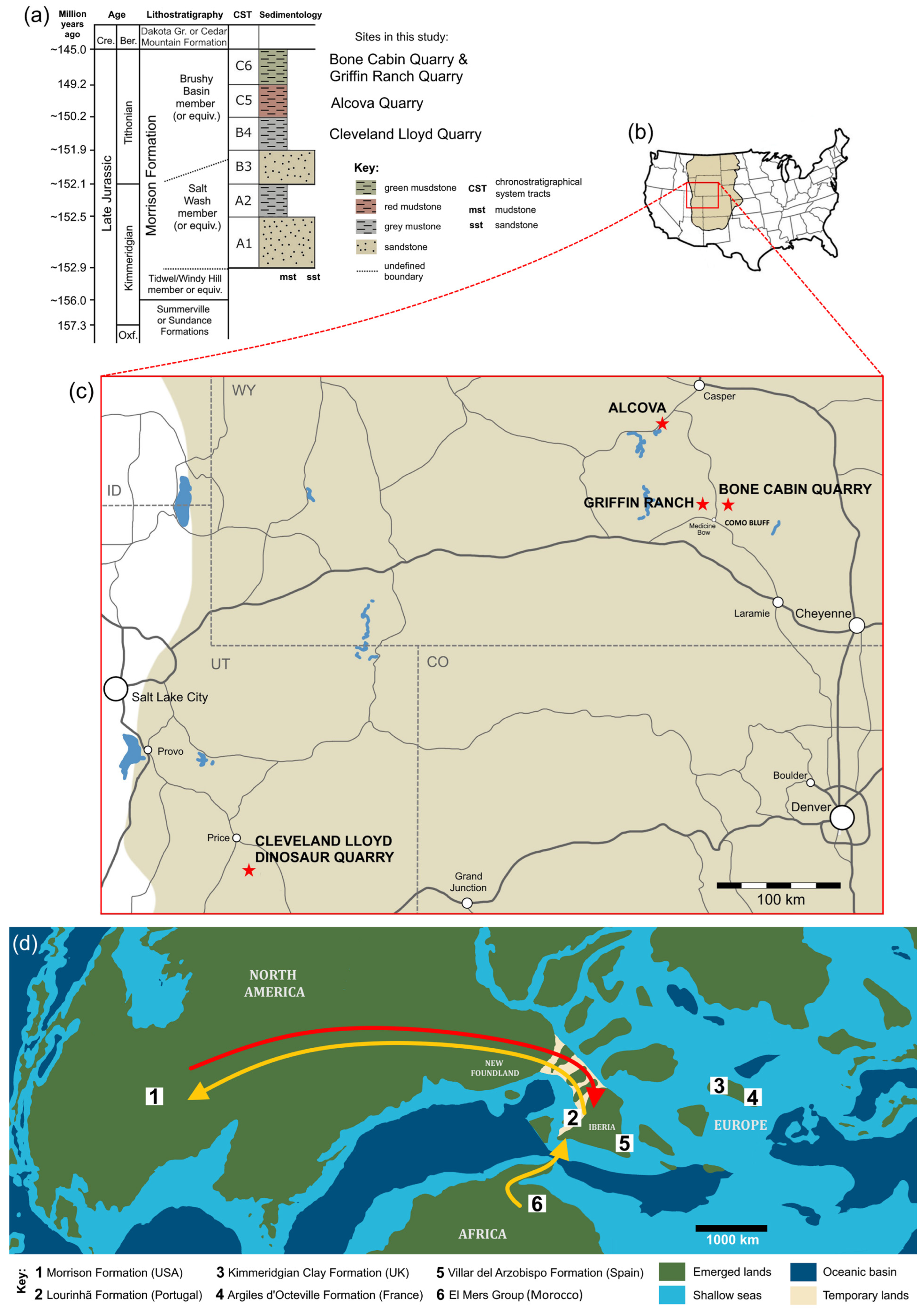
The fossils here described herald from various locations within the Morrison Formation (Figure 1a–c), namely (coordinates sourced from [47]) from the Cleveland-Lloyd Dinosaur Quarry (Emery County, UT, USA; 39.32399, −110.687622), part of the upper Brushy Basin Member of the Morrison Formation ([45,47,49,51]), and from the Bone Cabin Quarry (42.017776, −106.048615) and Griffin Ranch Quarry (41.967098, −106.291; Albany County, WY, USA), both adjacent to the Como Bluff Quarries, part of the uppermost Morrison Formation ([27,28,48,52,53]). Additionally, the holotype of Miragaia longispinus [27], also shown here, was collected in the Alcova Quarry (42.552223, −106.687599; Alcova, Natrona County, WY, USA; [52,54]). According to [45,47] (Supplementary Figure S2), these locations approximately should range from 152 to 147 million years in age (Figure 1a).
3.2. SYSTEMATIC PALEONTOLOGY
DINOSAURIA Owen, 1842 [55]
ORNITHISCHIA Seeley, 1888 [56]
THYREOPHORA Nopcsa, 1915 [57]
STEGOSAURIA Marsh, 1877 [15]
STEGOSAURIDAE Marsh, 1880 [58]
DACENTRURINAE Mateus et al., 2009 [2]
Type Species—Dacentrurus armatus (Owen, 1875) [3]
Definition—From [2]: all stegosaurs more closely related to Dacentrurus armatus (Owen, 1875) [3] than to Stegosaurus armatus Marsh, 1877 [15].
Diagnosis—Modified from [2,21,24]: centra of dorsal vertebrae wider than long; olecranon horn present on ulna; anterior end of anterior pubic process expanded dorsally; the supracetabular process of the ilium extends anteriorly beyond the anterior edge of the acetabulum.
Likely also diagnostic (modified from [21]): fusion of some of the cervical ribs to para- and diapophyses of cervical vertebrae; mid and posterior caudal centra wider than tall; mid and posterior caudal centra taller than long; mid and posterior caudal centra with deeply concave lateral sides; dorsal ribs ‘C’ shaped in cross-section proximally.
Comprising taxa—Dacentrurus armatus (Owen, 1875) [3], Miragaia longicollum Mateus et al., 2009 [2], Miragaia longispinus (Gilmore, 1914) [17], Thyreosaurus atlasicus Zafaty et al., 2024 [12].
Referred specimens herein (see below)—AMNH 492, an isolated dorsal vertebra.
3.2.1. AMNH 492
Description and comparisons:
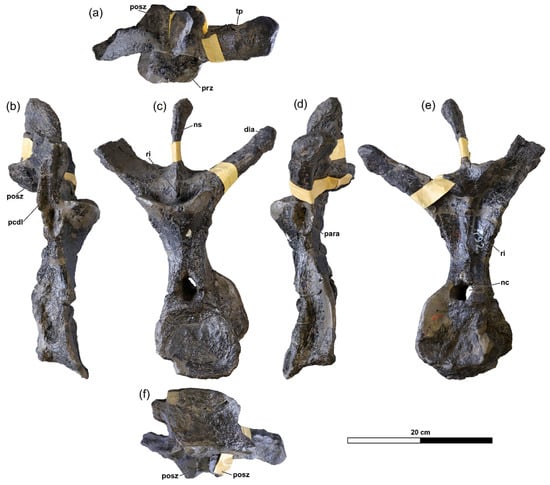
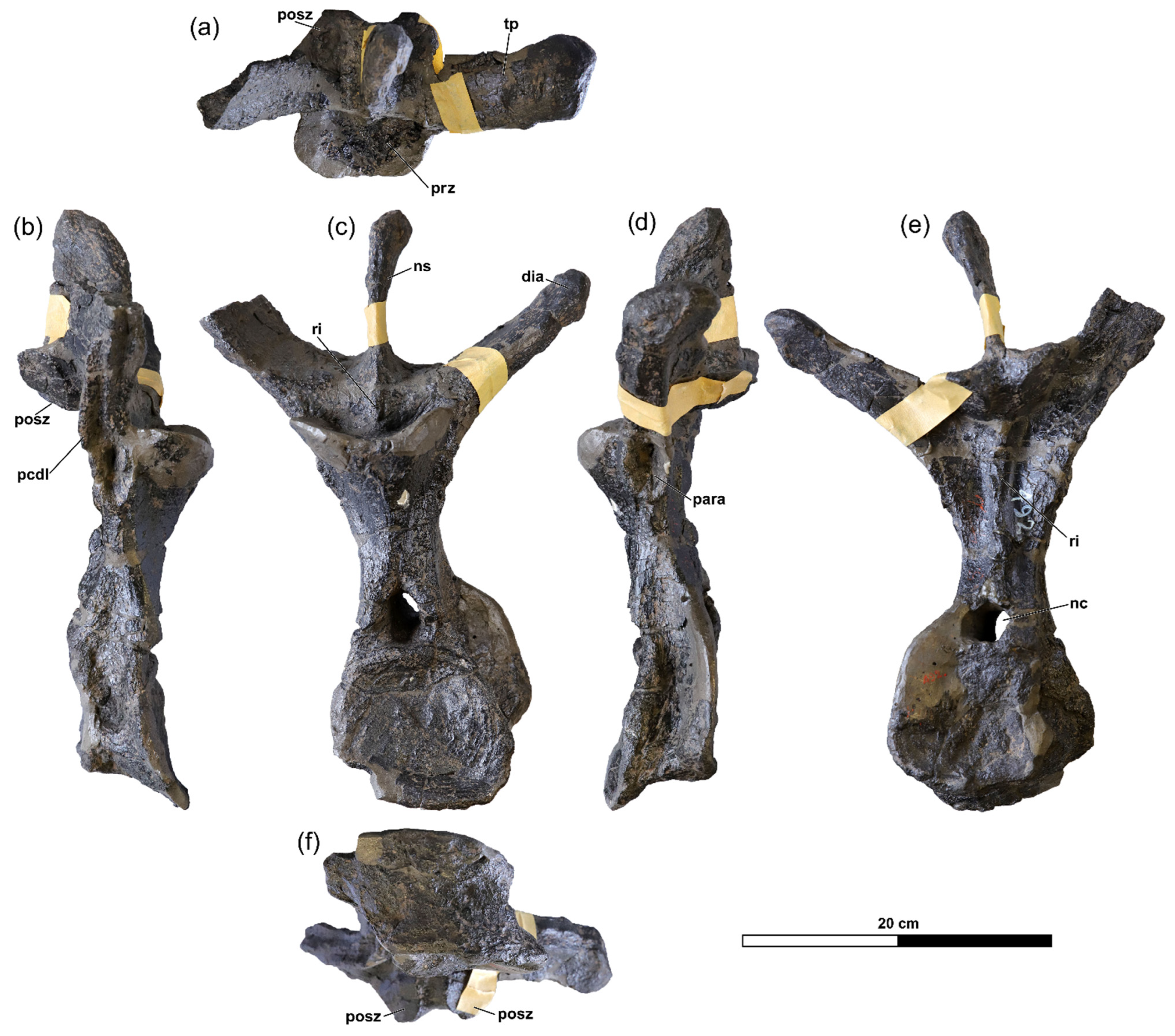
Isolated dorsal vertebra, almost complete (missing only the tip of the right transverse process and most of the prezygapophyses; Figure 2). Most comparable in dimensions and proportions to the mid dorsal vertebrae of M. longicollum (MG 4863; [21,31]), especially the sixth dorsal vertebra (see figure 5 in [31]), as well as the sixth dorsal vertebra of S. stenops (NHMUK PV R 36730) (see figure 23 in [16]), given the proportions of the extremities of the neural arch, the position of the parapophyses far dorsally on the centrum ([1,16]), and the proportional elongation of the pedicel between the neural canal and prezygapophyses (Figure 2c–e). AMNH 492 is also similar to the sixth dorsal vertebra of He. mjosi in proportions of the extremities of the neural arch (see figure 3.6F, G in [10]), but the latter differs in lacking dorsoventral elongation of the pedicel between the neural canal and prezygapophyses (while the posterior dorsal vertebrae of He. mjosi have such elongation, but differing from AMNH 492, the neural spines are proportionately much taller; [10]). So AMNH 492 is here identified as a mid-dorsal vertebra (either the sixth or axially approximate).
Figure 2.
Dorsal vertebra of Dacentrurinae indet. AMNH 492: (a) in dorsal view; (b) in right lateral view; (c) in anterior view; (d) in left lateral view; (e) in posterior view; (f) in ventral view. For anatomical abbreviations used, see Abbreviations section. Scale bar equal to 20 cm.
The centrum is just above one fourth the height of the whole vertebra (75 mm, while the whole vertebra is 370 mm tall), akin to the mid-posterior dorsal vertebrae of M. longicollum (MG 4863; [31]), as well as those of D. armatus; Huayangosaurus taibaii Dong et al., 1982 [59]; Th. atlasicus; and He. mjosi (which are between one third and one fourth the height; NHMUK PV OR 46013; [1,5,12]). AMNH 492 is unlike the dorsal vertebrae of stegosaurs that have markedly much taller neural arches, such as S. stenops; L. priscus Nopcsa, 1911 [60]; Kentrosaurus aethiopicus Hennig, 1915 [61]; Tuojiangosaurus multispinus Dong et al., 1977 [62]; and Yanbeilong ultimus Jia et al., 2024 [63] ([1,63]).
The anterior and posterior articular facets of the centrum are 112 and 102 wide, respectively, while anteroposteriorly the centrum is 70 mm long, shortened by compressive deformation. A more representative length prior to deformation can be measured diagonally between the skewed anterior and posterior centrum facets (Figure 2f), measuring at most 92 mm long, meaning that the centrum was wider transversely than anteroposteriorly long even before deformation. This makes it like M. longicollum, D. armatus, A. boulahfa, and Th. atlasicus ([2,5,6,11,12,21,31]), but unlike all other stegosaurs where known, as the dorsal centra are longer than wide (e.g., S. stenops; K. aethiopicus; Hu. taibaii, L. priscus; He. Mjosi; Tu. Multispinus; Wuerhosaurus homheni Dong, 1973 [64]; Bashanosaurus primitivus Dai et al., 2022 [65]; Gigantspinosaurus sichuanensis Ouyang, 1992 [66]; Chungkingosaurus jiangbeiensis Dong et al., 1983 [67]; and Y. ultimus; [1,5,10,16,17,61,62,63,68,69,70,71,72]).
The articular facets of the centrum are gently concave, as in most stegosaurs ([1]). A keel is not markedly visible in the ventral surface, but it is slightly concave ventrally in lateral view (Figure 2b,d,f). A neurocentral suture is not clearly visible. The sides of the centrum are markedly concave in ventral and lateral views (Figure 2b–f).
The neural canal is mostly oval anteriorly and round posteriorly in outline, with a slightly sharper indentation dorsally. It is one fourth the width of the centrum, slightly narrower than that of the sixth dorsal vertebra of M. longicollum (MG 4863; see figure 5 in [21]), but much narrower than most other stegosaurs including D. armatus and Th. atlasicus ([5,12]), where these are generally over half the width and height of the centrum ([1,12,72]).
The pedicel is a tall and solid column, slightly more than 1.5 times the height of the centrum, similar to D. armatus, A. boulahfa and Th. atlasicus ([5,11,12]). AMNH 492 differs from dorsal vertebrae with much taller neural arches, as in S. stenops, W. homheni, C. jiangbeiensis, L. priscus, K. aethiopicus, Tu. multispinus and Y. ultimus ([1,63]), and differs from those with short pedicels, not elongated dorsally between the neural canal and prezygapophyses (e.g., Hu. taibaii, He. mjosi, G. sichuanensis, Bas. primitivus and Baiyinosaurus baojiensis Li et al., 2024 ([10,65,69,70,73]).
Midline ridges are borne antero- and posterodorsally on the pedicel, from the neural canal until, respectively, the pre- and postzygapophyses, like in the dorsal vertebrae of M. longicollum (MG 4863; [31]), A. boulahfa ([11]), and in the seventh to ninth dorsal vertebrae of S. stenops ([16]). Such ridges are indistinct or absent in D. armatus and He. mjosi (NHMUK PV OR 46013; [5,23]).
The parapophyses are elliptical in outline, moderately developed and concave, and placed proximoventrally to the transverse processes. A posterior centrodiapophyseal lamina (PCDL) passes posteriorly to the parapophyses, while a paradiapophyseal lamina is also present, not as prominent and almost flat where it meets the top of the parapophyses, as in M. longicollum, Th. atlasicus and D. armatus (MG 4863; [5,12,31]). In He. mjosi (MOR 9728; [23]) a similar ridge is reported from the diapophyses, but at the parapophyses it diverts around onto the anterolateral corner of the neural arch, forming a fossa with the prezygapophyses, which is not observable in AMNH 492. A paradiapophyseal lamina is also present, but it is not as prominent as the PCDL and is almost flat where it meets the top of the parapophyses. Anterior centroparapophyseal laminae are present but indistinct, as in M. longicollum (ML 433; MG 4863; [2,31]), but unlike A. boulahfa and S. stenops where they are well defined and conspicuous ([11,16]), and unlike D. armatus and Th. atlasicus where they are absent (but a low process ventral to the parapophyses may be present instead; NHMUK PV OR 46013; [5,12]).
The prezygapophyses are incomplete and were reconstructed, so their morphology cannot be inferred. Posteriorly to the prezygapophyses, the intraprezygapophyseal shelf is concave, and on the vertical surface posterior to it, a central ridge extends dorsally to meet the neural spine (Figure 2c), as in M. longicollum (ML 433; MG 4863; [2,31]), S. stenops (MG 4863; NHMUK R 36730; [16,31]), and Th. atlasicus ([12]), while in A. boulahfa this ridge bifurcates ventrally ([11]), and a ridge is absent in D. armatus ([5]) and He. mjosi ([23]).
The facets of the postzygapophyses are sub-round in outline and extend posteriorly beyond the posterior articular facet of the centrum in lateral view (Figure 2b,d). In posterior view, the postzygapophyses unite ventromedially in a “V” shaped wedge, but with a marked rounded notch ventrally that extends posterodorsally, so the postzygapophyses are bifurcated in dorsal view, as in M. longicollum, D. armatus and Hu. taibaii ([1,31]). In other stegosaurs the postzygapophyses are mostly fused medially in dorsal or ventral views, including He. mjosi and S. stenops, but some variation is also present depending on axial position ([5,10,16,23]). The dorsal surface of the postzygapophyses is contiguous with the dorsal surface of the transverse processes, while its posterior edge is almost contiguous with the posteroventral margin of the neural spine.
The transverse processes have sub-parallel margins in dorsal view, but are slightly curved posteriorly, so the anterior margin is gently convex while the posterior is gently concave, as in M. longicollum (ML 433; MG 4863; [31]). The transverse processes are mostly flat dorsally and subtriangular in cross-section with a concavity posteroventrally in lateral outline. The transverse processes project at 35° to the horizontal, which is closer to the average 30° observed in M. longicollum (ML 433; MG 4863; [2,21,31]), D. armatus, A. boulahfa, Th. atlasicus and G. sichuanensis ([2,5,6,12,69]), while in other stegosaur taxa these are typically upturned between 50° and 60° above the horizontal (such as in S. stenops, L. priscus, and He. mjosi; [1,7,10,16,19,23,63]). This angle of the transverse processes can be very variable within the same specimen, such as in S. stenops NHMUK PV R 36730, as the transverse processes angle close to 30° in the most anterior and most posterior dorsal vertebrae, while the mid-dorsal vertebrae are closer to 50° ([16]).
The neural spine is offset posteriorly in relation to the rest of the vertebra, nearly hanging fully posteriorly beyond to the pedicel (i.e., the anterior margin of the neural spine is almost continuous vertically with the posterior margin of the pedicel and centrum in lateral view; Figure 2b,d). The neural spine is about as long anteroposteriorly as the pedicel and centrum, markedly longer than most stegosaurs except for M. longicollum (ML 433; MG 4863; [2,21,31]), where the neural spies are nearly as long, and even longer in Bai. baojiensis ([73]).
The neural spine is transversely thin and axially long, sub-rectangular in lateral view and taller than long (108 mm tall), with the apex gradually expanding transversely from about half the height, widest and most extensive dorsally in the posterodorsal tip, so its dorsal surface effectively faces anterodorsally (i.e., the apex slopes anteriorly in lateral view). This is as observed in Miragaia (MG 4863; ML 433 [2,21]) [31] and is like some dorsal vertebrae of D. armatus (NHMUK PV OR 46013; [5]) and Th. atlasicus ([12]). It differs from He. mjosi and S. stenops, however, where the spines are generally consistently laterally compressed throughout their height, and when transverse expansion is present, it is only at the very distal end and with a sub-horizontal dorsal surface ([10,16,23]).
- Taxonomic discussion:
The mid dorsal vertebra AMNH 492 (Figure 2) is classified here as Dacenturinae indet. due to the following combination of features: a centrum wider than long (differing from S. stenops and He. mjosi, and considered diagnostic of Dacentrurinae by various authors; e.g., [2,21]); the transverse processes projecting at about 30° to the horizontal, unlike most stegosaurs where these are characteristically upturned, with the exception of D. armatus, M. longicollum, A. boulahfa, Th. atlasicus, G. sichuanensis ([2,5,6,12,70,72]) and the most anterior and most posterior dorsal vertebrae of S. stenops (which, unlike AMNH 492, have dorsoventrally undeveloped pedicels; NHMUK PV R 36730; [16]); and the dorsal neural arch pedicels being elongated above the neural canal (differing from He. mjosi, where lack of elongation of the pedicel in mid-dorsal vertebrae is diagnostic of the species; [10,23]). The shape of the distal expansion of the neural spine is also unlike He. mjosi or S. stenops, but alike to the neural spines in M. longicollum, given how it develops from at least the last third of the height, and the apex sloping anteriorly (ML 433; MG 4863; [2,21,31]).
- MIRAGAIA Mateus et al., 2009 [2]
Type Species—Miragaia longicollum Mateus et al., 2009 [2]
Diagnosis—Modified from [21], based on [31]: transverse processes present in all caudal vertebrae; neural arch of mid and posterior caudal vertebrae one third or less the height and width of the centrum; mid and posterior caudal centra with deep excavation of a ventral groove and the neural canal (“apple-shaped” outline); lateral ossification of the posterior rim of the posteriormost caudal centra.
Likely also diagnostic: two pairs of elongate posterior dermal tail spines (~90% of femoral length) with slender shafts; caudal spines with sigmoid-shaped cross-section (rotational symmetry) at mid height.
Comprising taxa—Miragaia longicollum Mateus et al., 2009 [2], and Miragaia longispinus (Gilmore, 1914) [17].
Referred specimens herein (see below)—UMNH VP 5572, an isolated cervical plate; YPM PU 14556, a medium sized caudal spine, dorsal rib, and two chevron; UMNH VP 5732, a medium sized caudal; a large caudal spine from MOAL (see [27]).
3.2.2. YPM PU 14556 and UMNH VP 5732
Description and comparisons:
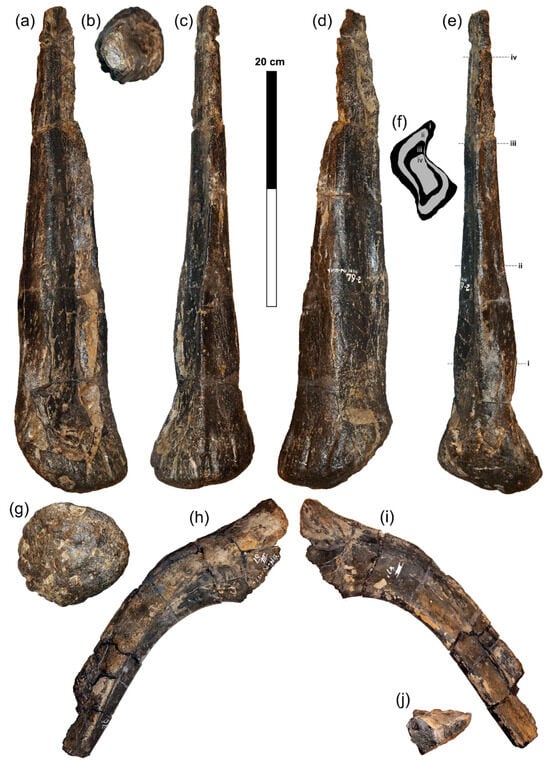
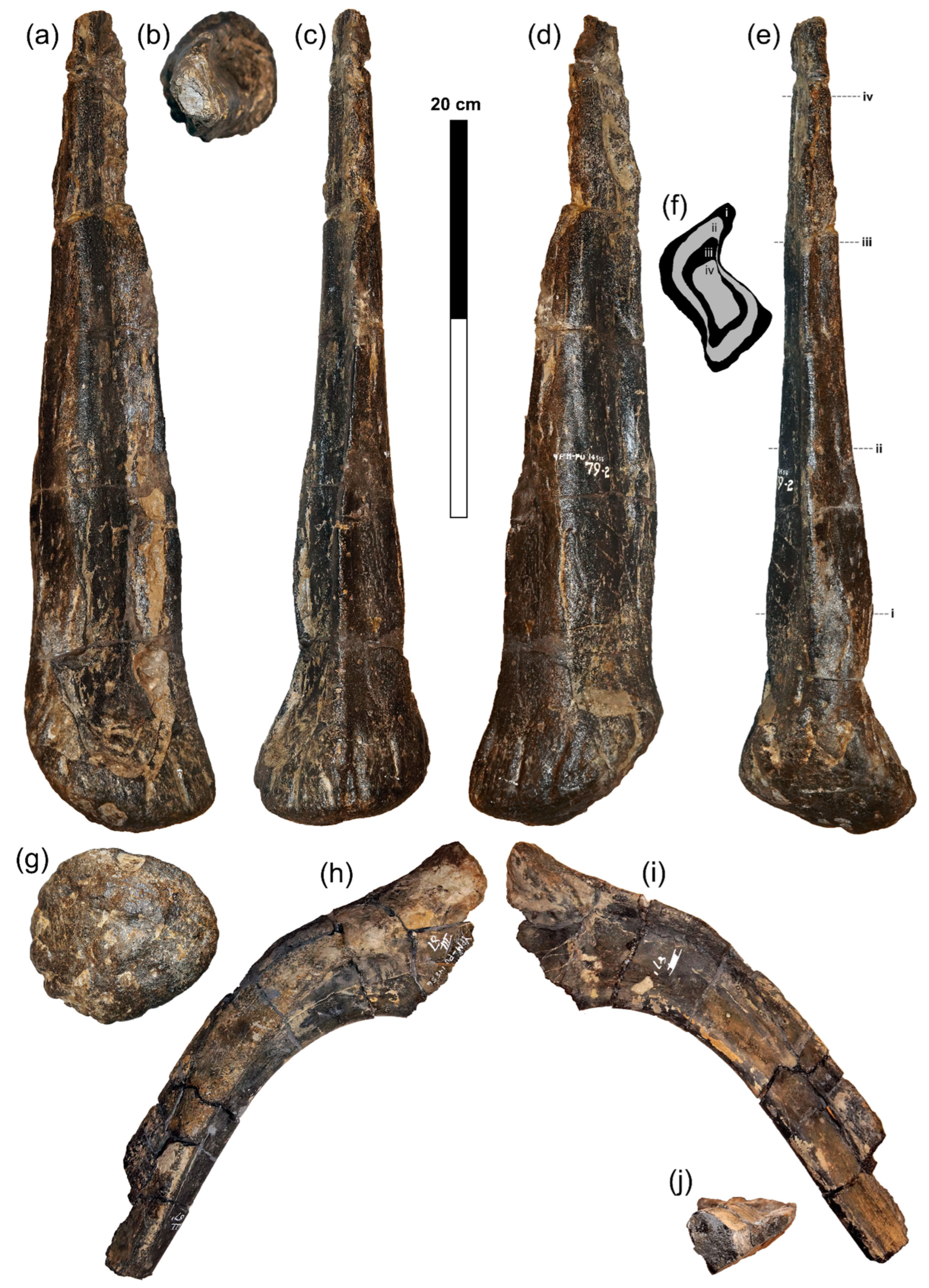
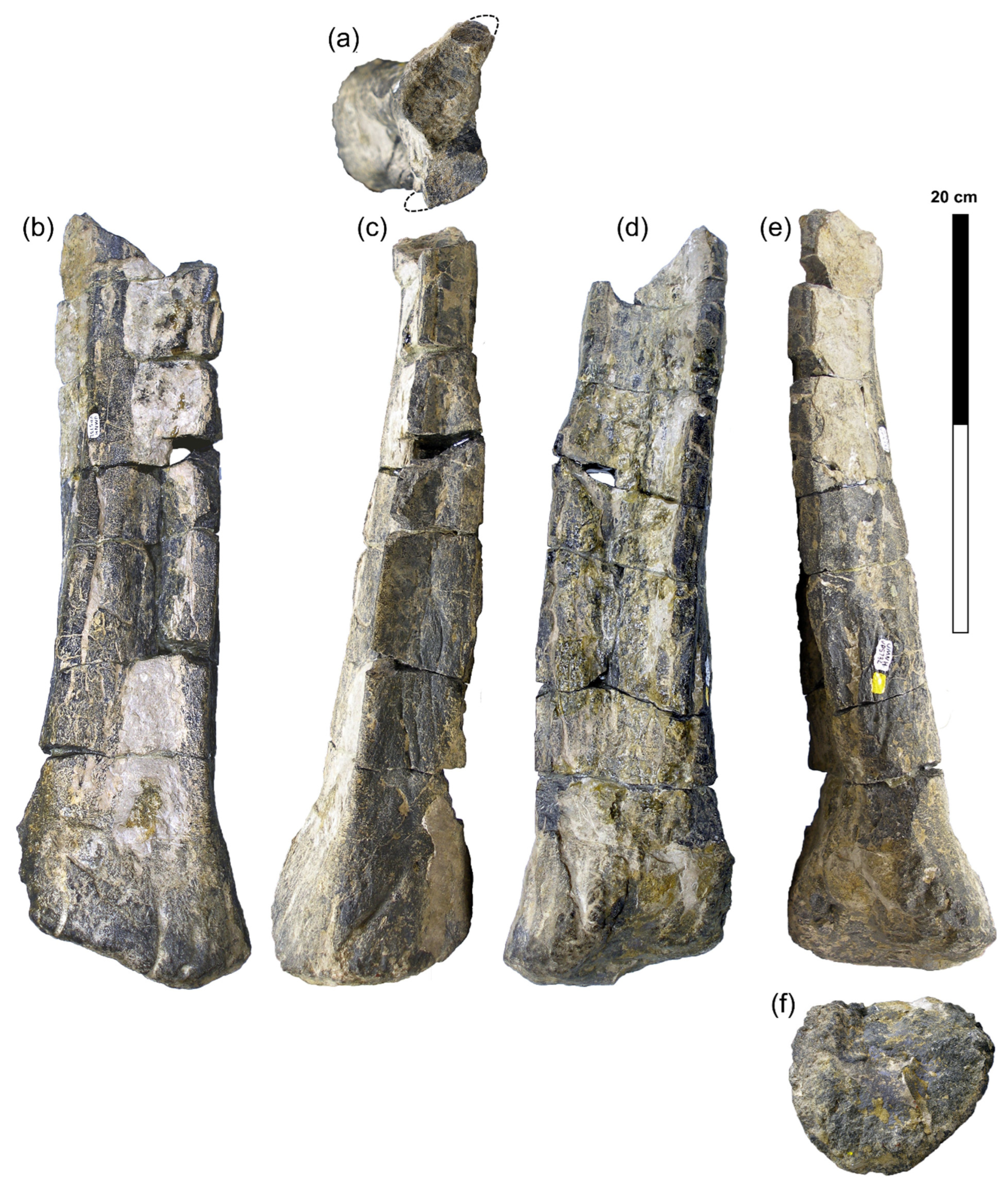
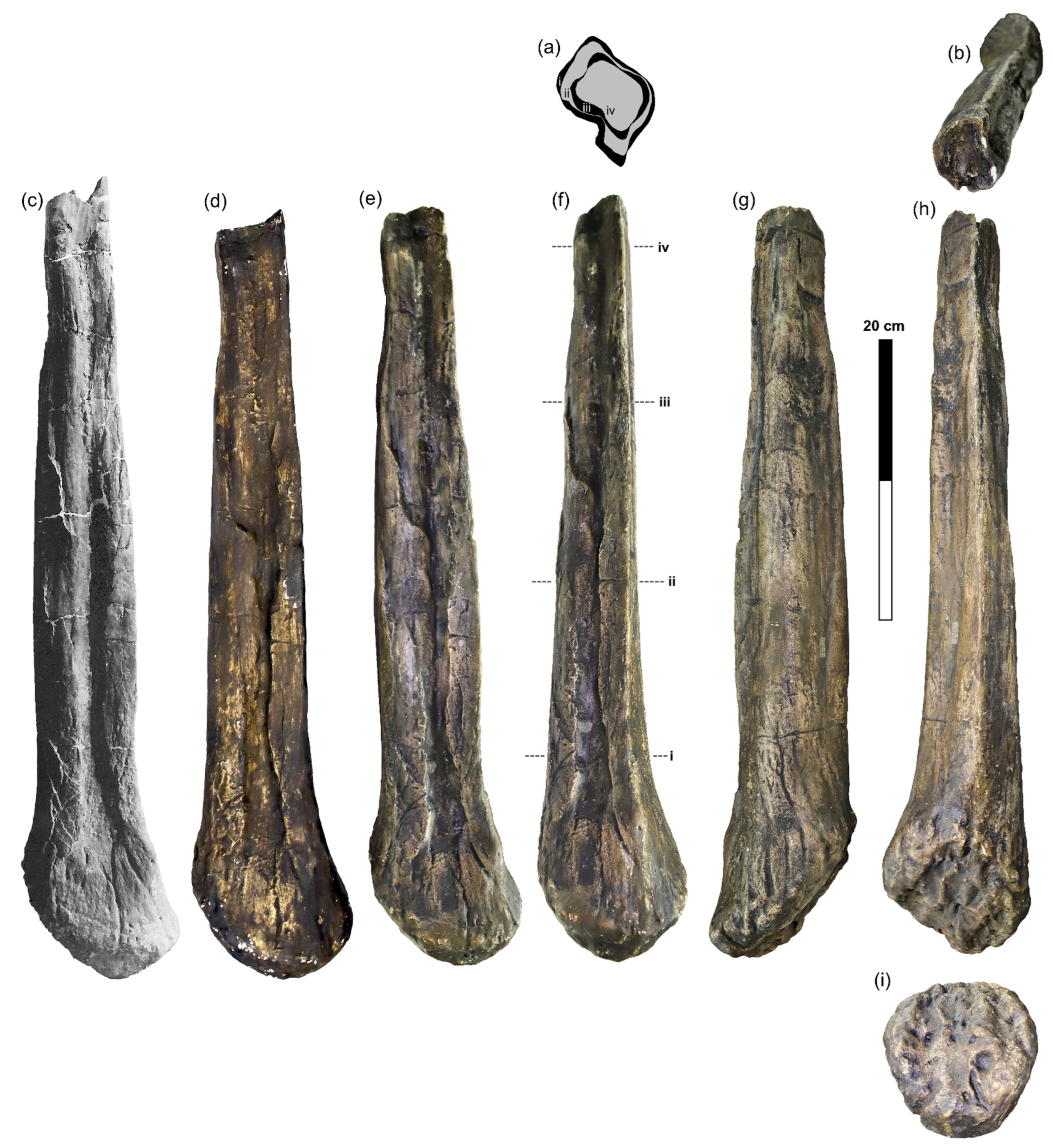
The caudal spine from YPM PU 14556 (Figure 3a–g) and the spine identified as UMNH VP 5732 (Figure 4) are almost identical in morphology and dimensions (Table 1), and given that both were found in the Cleveland-Lloyd Quarry, it is possible these are from animals from the same species or closely related species. Both spines have gently expanded bases, set diagonally at 120–130° from the shafts (Figure 3a,d,e and Figure 4b,d,e); YPM PU 14556 is also gently convex ventrally, while UMNH VP 5732 is gently concave ventrally. Both are sharply double edged, giving them a sigmoid outline in cross-section (i.e., drawing a plane between both edges, one concave surface is present on each side, opposite to which is a convex surface, in a form of 180° rotational symmetry; Figure 3e,f and Figure 4a). This morphology is present in the spines of M. longispinus (UW 20503, USNM V 8036; Figure 8 and Figure 9), as well as various purportedly dacentrurine spines from Iberia (e.g., ML 812; ML 2043; ML 436; SHN.LPP 123; MPA D-313/315/314; [21,74,75]); Figure S1c–e,h–q), where the shaft proximally to the base is close to sub-rhomboidal in outline (Figure S1e,h,i,n,o), becoming sigmoidal in outline passing distally (Figure S1j–m,p,q). These differ from the spines of stegosaurine stegosaurs, more frequent in the Morrison Formation, which are oval or elliptical in cross-section, as well as bilaterally symmetrical, without marked edges or with only one poorly defined edge (e.g., S. stenops, He. mjosi; CM 11341; USNM V 4714; 4934; 4937; 6099; 6137; NHMUK PV R36730; [10,19]; Figure S1a,b).
Figure 3.
Caudal spine (right) and dorsal rib (right) of Miragaia sp. YPM PU 1455: (a–g) caudal spine; (h–j) dorsal rib; (f) stacked transverse cross-sections of caudal spine (approximate corresponding section identified in (e) as the dashed lines i–iv); (a) in lateral (right) view; (b,f) in distal (dorsal) view; (c,h) in anterior view; (d) in medial (left) view; (e,i) in posterior view; (g) in proximal (ventral) view; (j) in distal (ventral) view. Scale bar equals 20 cm.
Figure 4.
Caudal spine (right) of Miragaia sp. UMNH VP 5732: (a) in distal (dorsal) view; (b) in lateral (right) view; (c) in anterior view; (d) in medial (left) view; (e) in posterior view; (f) in proximal (ventral) view. Dashed lines indicate probable extension of missing fossil bone. Scale bar equals 20 cm. Photographs kindly provided by Shoji Hayashi.
Table 1.
Comparative measurements of caudal spines. Measurements in millimeters.
YPM PU 14556 also includes two chevrons (not described) and a reported dermal plate, but the latter was verified to be the proximal section of a dorsal rib, missing proximally most of the capitulum, but preserving the tuberculum (Figure 3h–j). The associated rib is, distal to the tuberculum, concave anterodorsally and convex posteroventrally, giving it an “L”- or “C”-shaped cross-section, like the proximal rib section in M. longicollum, D. armatus and Th. atlasicus (ML 433; MG 4863; NHMUK PV OR 46013; [5,12,21]). This differs from the “T”-shaped cross-section of the rib distally to the tuberculum in stegosaurines such as L. priscus and S. stenops (NHMUK PV R3167; NHMUK PV R36730; [1,63]), as ridges project both anteriorly and posteriorly. The proximal section of the rib of YPM PU 14556 is set at an obtuse angle of approximately 130° degrees with the rib shaft, similarly to M. longicollum (ML 433; MG 4863; [21]), but differing from most stegosaurs where these are closer to perpendicular to the shafts (as in S. stenops; NHMUK PV R36730; [1,16])
- Taxonomic discussion:
The caudal spines UMNH VP 5732 and from YPM PU 14556 are double edged, sigmoid in cross-sections, and proportionally elongated (Table 1), like those of M. longispinus ([17,27]; Figures 8 and 9), as well as similar in cross-section proximally to the caudal spine from M. longicollum (MG 4863; Figure S1h,i) (see figure 68 in [21]). These differ from the proportionately shorter and sub-ellipsoid in cross-section spines from the coeval S. stenops and He. mjosi (e.g., UNSM V 4934, 4937; NHMUK PV R 36730; [1,10,16,17,28]; Figure S1a,b). These spines also differ from the caudal spine of D. armatus for its markedly sub-round cross-section (NHMUK PV OR 46013; see Figure S1f,g; [3,5]), so this sigmoid outline is most likely characteristic and diagnostic of Miragaia, and both these specimens are here identified as Miragaia sp. YPM PU 14556 also includes a dorsal rib like those in M. longicollum and D. armatus (mainly for being “C” shaped in cross-section proximally) and different from those in S. stenops, L. priscus and He. mjosi (which are ‘T’ shaped in cross-section; [72]), supporting its classification within Dacentrurinae.
3.2.3. MOAL Spine
Description and comparisons:
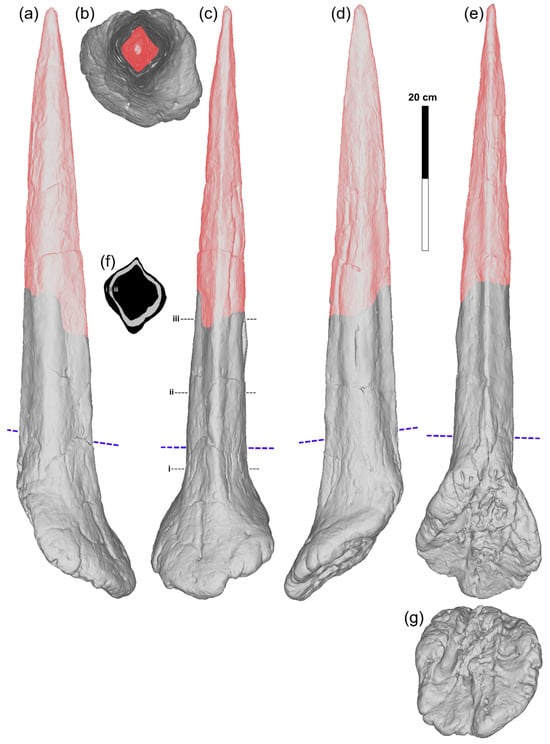
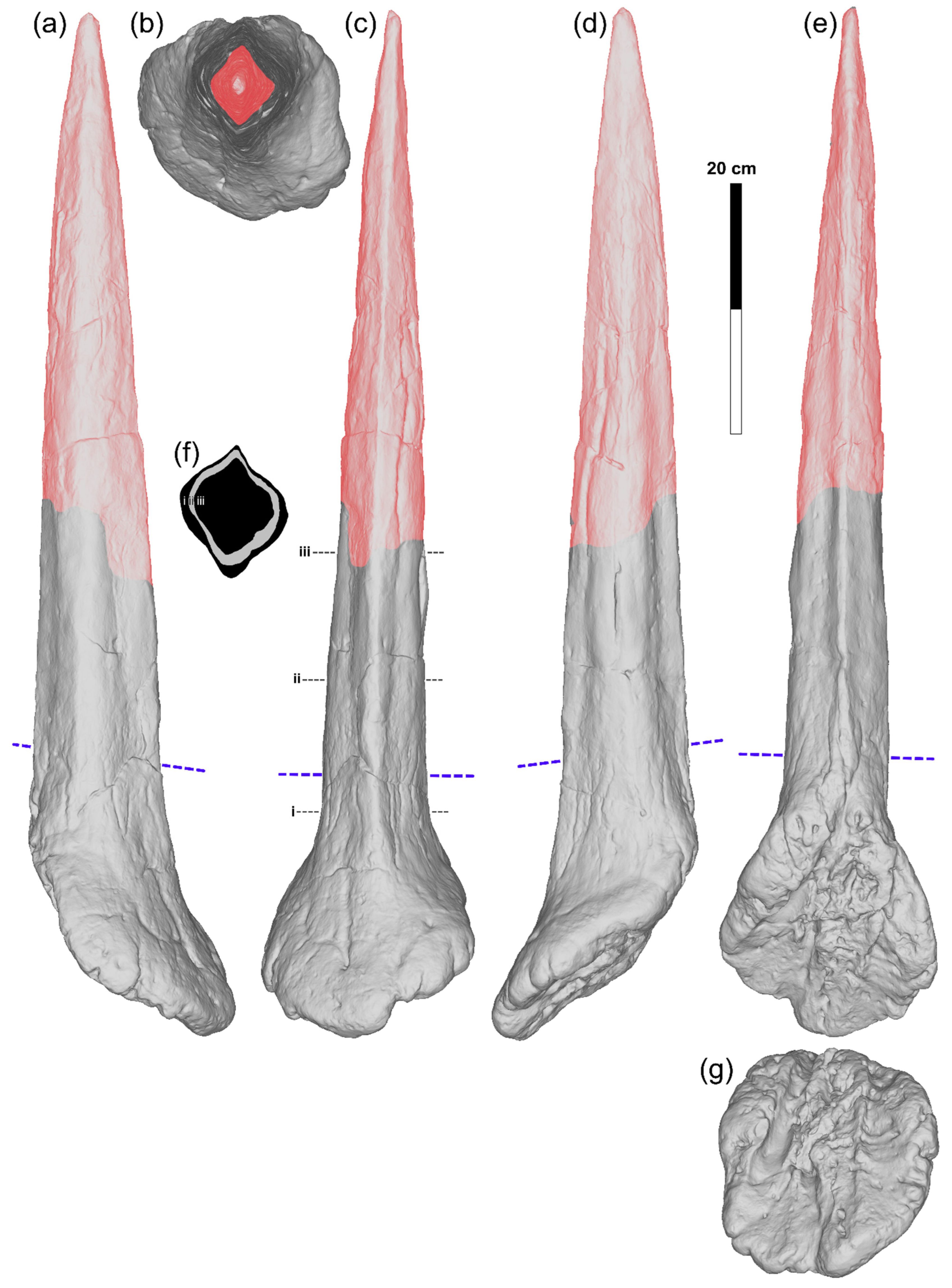
The spine is referred to Alcovasaurus longispinus by [27] (Figure 5e) and reported as mislaid by [27,28], but it can be observed to be in exhibit at MOAL [76]. The description accompanying the spine in the exhibit (MOAL; [76]) supports that this is the actual fossil. A replica of this spine (including its reconstructed distal end) is part of the collection at NOVA-FCT and was the main basis for the description herein, while another replica (DMNH 33431) only incorporates the proximal section of the spine.
Figure 5.
Caudal spine (right) of Miragaia sp. from MOAL: (a) in lateral (right) view; (b,f) in distal (dorsal) view; (c) in anterior view; (d) in medial (left) view; (e) in posterior view; (g) in proximal (ventral) view; (f) stacked transverse cross-sections of caudal spine (approximate corresponding section identified in (c) as the dashed lines i–iii). Colored in red is the likely reconstructed section (from observations of the replica at NOVA-FCT), grey is the likely extension of fossil bone. Dashed lines in blue indicate approximately the level at which the original fossil at MOAL appears lighter (below) and darker (above). Screenshots of 3D model of replica from NOVA-FCT. Scale bar equals 20 cm.
According to [27], only the base and proximal part of the shaft of the fossil spine were preserved, so it was reconstructed distally to the tip following a uniform taper continuous with that from the shaft. The spine as exhibited (MOAL; [76]) has approximately a quarter of its distal height in a light grey color (likely due to prolonged surface exposure in situ, in contrast to the rest of the spine distally which is nearly black in color) appearing to correspond to the extension of the DMNH 33431 replica (see Figure 5: dashed line). This could imply this lighter section to be the preserved fossil, but it was affirmed by a professional responsible for the reconstruction that the actual fossil extends further, close to half the total height [77]. The latter is supported by observations of the NOVA-FCT replica, as the texture of the proximal half of the spine evidently differs the distal half (see Figure 5: areas colored in light grey and red), including by indentations on the proximal half of the spine congruous with marks left by pneumatic air-scribes from laboratorial preparation in less-accessible concave areas (e.g., [78]). So, it is plausible that the base of the spine was exposed in the field earlier than the rest, broken off, and replicated as DMNH 33431, while the middle section was only later attached to the base of the spine after being freed from the matrix, as well as the distal section being reconstructed. Thus, reconstructed distally, the MOAL spine reaches approximately 900 mm in length (Table 1), making it markedly much larger in distal length (as well as transverse width) than those more commonly known from the synchronous and sympatric S. stenops and He. mjosi (e.g., YPM 1853, USNM V 6099, USNM V 4934; [17]).
The pair of proximal spines of the holotype of S. sulcatus (USNM V 4937; Table 1; Figure S1a,b; [17,19]) somewhat resemble the MOAL spine in thickness of the shaft, but differ in having a transversely wider and posteriorly developed base, and tapering more proximally, therefore being longitudinally shorter in proportions and height (approximately 650 mm). The longest tail spines ascribed to Stegosaurus (USNM V 6099; hypotype of S. ungulatus, sensu [17]) are approximately 700 mm in length, so still much shorter longitudinally than the MOAL spine, differing also in showing almost no transverse development of the bases (Table 1) (see figures 59 and 60 in [17], and plate 55 in [19]).
The lateral and medial surfaces of the base of the MOAL spine are only slightly eroded, so would not have been much wider if better preserved. Ventrally the base is rugose and mostly flat as a whole, but with a clear wide canal passing anteroposteriorly through the ventromedial half of the base (Figure 5e). The base is slightly longer anteroposteriorly than transversely and has no expansion in the posterior direction. The cross-section progresses from a sub-rhomboidal outline proximally to a more sigmoidal shape passing distally, with longitudinal concavities most marked posteromedially and anterolaterally (Figure 5b,c,e,f).
- Taxonomic discussion:
Despite showing some similarities to the large stocky spines from the approximately coeval USNM V 4937 (holotype of S. sulcatus; sensu [4]) and USNM V 6099 (hypotype of S. ungulatus, sensu [17]), the morphology, proportions and maximum distal length of the MOAL spine match most closely those of M. longispinus UW 20503 (see below; Figure 8 and Figure 9; Table 1), as well as various purportedly dacentrurine stegosaurs from Iberia (e.g., ML 436; ML 2043; SHN.LPP 123; MAP D-313/315/314; [74]; Figure S1c–e,j–m,p,q), so it is more supported as belonging to a dacentrurine stegosaur. The MOAL spine also has a sub-rhomboid to sigmoid cross-section outline in its preserved proximal section, like the latter examples and M. longicollum MG 4863-39 ([21]; Figure S1h,i), while differing from the sub-round in cross-section caudal spine of D. armatus (NHMUK PV OR 46013; Figure S1f,g; see figures 9h, 10d,e in [5]), so it is here identified as Miragaia sp.
- MIRAGAIA LONGICOLLUM Mateus et al., 2009 [2]
Holotype—ML 433, an almost complete anterior skeleton: partial skull, forelimbs, pectoral girdle, cervical series, two first dorsal vertebrae, ribs, and cervical osteoderms [2].
Referred Specimens—ML 433-A, a juvenile specimen consisting of two dorsal centra, three dorsal neural arches, both pubes and the left ilium [2]; MG 4863, a partially complete adult specimen [21,31].
Diagnosis—modified from [2,21], based also on [31]: anterior tip of the premaxilla is drawn into a point; anterolateral rim of the premaxilla projects ventrally; at least 17 cervical vertebrae; cervical vertebrae with spinopostzygapophyseal laminae and an associated lower pair of medial ridges that pass laterally on the neural spine and culminate on the anteriormost projection on the base of it; mid and posterior cervical and anterior dorsal neural spines with transversely expanded apices; cervical neural spines are positioned over the anterior half of the centrum and become progressively more anteriorly positioned passing posteriorly on the cervical series; cervical transverse processes more than half the axial length of the centrum in all but the anteriormost cervical vertebrae; outline in lateral view of cervical prezygapophyses round posteriorly and straight anteriorly with an anterodorsal notch; progressively more posteriorly inclined neural spines of anterior caudal vertebrae, inclined at less than 45° to the horizontal between Cd8 and Cd11; neural spine reduced to one fifth the height and width from the 10th to the 12th caudal vertebra, vestigial further posteriorly in the vertebral series; presence of longitudinal cord-like ridges in the femur shaft, two posteriorly and one anterolateral with distal bifurcation; paired, slightly inwardly convex, triangular cervical dermal plates with a notch and a projection on the posterodorsal margin.
Locality, Horizon, and Age—West Portugal. Praia Azul Member and Praia da Amoreira-Porto Novo Member of the Lourinhã Formation, upper Kimmeridgian-lower Tithonian, Upper Jurassic (see [2,21,79]).
Synonymy—Dacentrurus longicollum [24] (p. 3)
Dacentrurus sp. [16] (p. 9)
3.2.4. UMNH VP 5572
Description and comparisons:
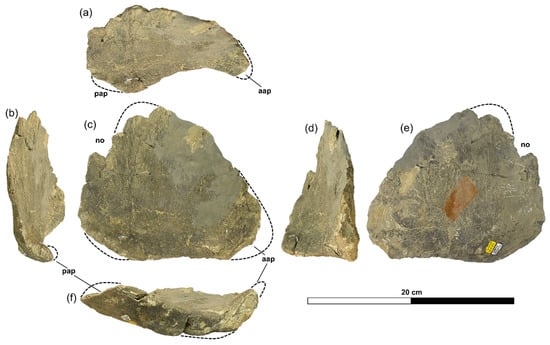
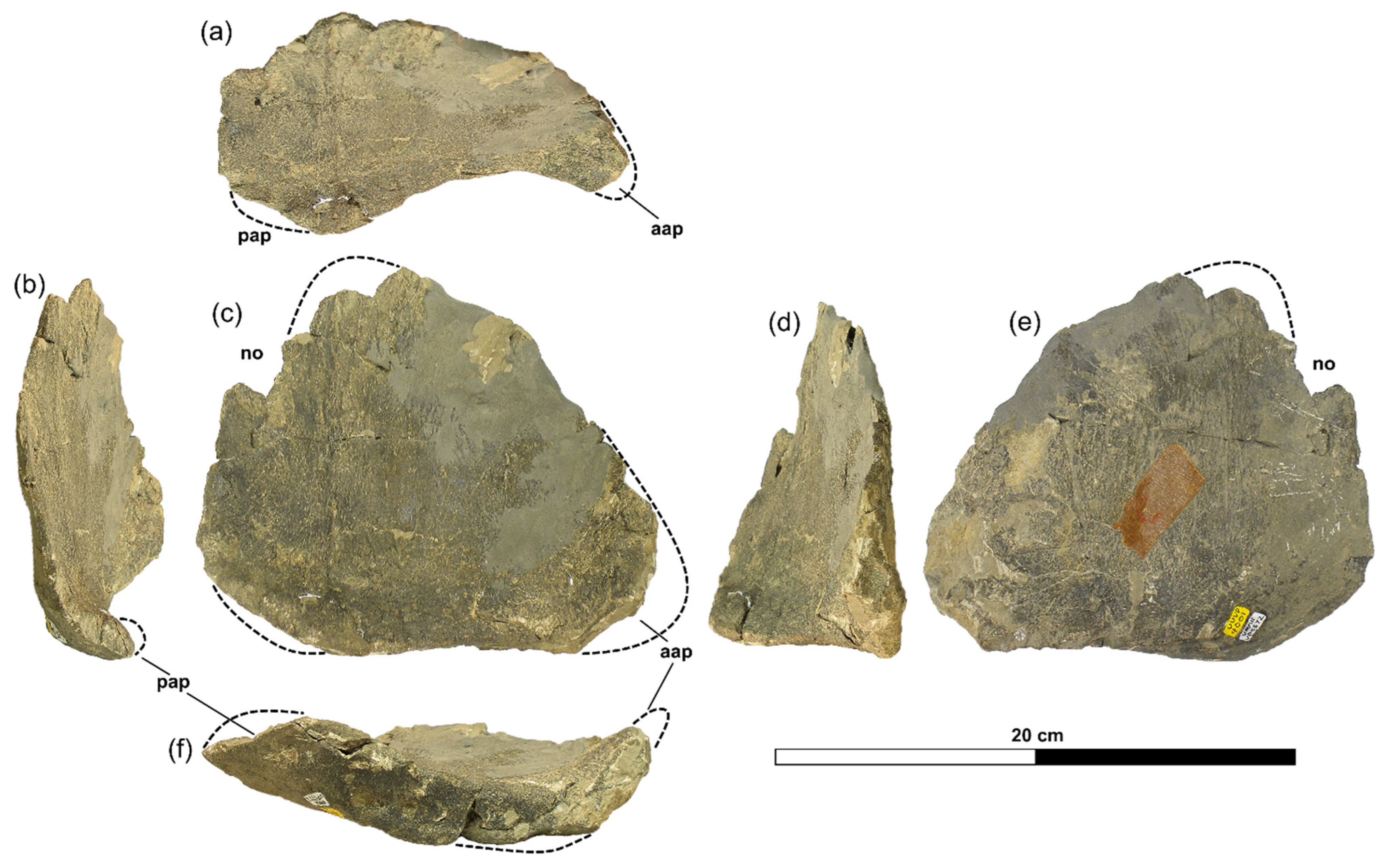
UMNH VP 5572 is a cervical dermal plate, strongly concave laterally and convex medially (Figure 6), both in dorsal or ventral views. It is sub-triangular in outline in lateral view, and has a clearly preserved notch on the posterodorsal margin, making it most similar to the cervical plates of the holotype of M. longicollum ([2,21]; Figure S2). In proportions and dimensions, it is most like the 10th cervical plate of the latter (ML 433-04; Figure S2h–m), also meaning that UMNH VP 5572 would be a right plate. The anteroventral, posteroventral and dorsal ends are partially broken distally, meaning that if more complete, this plate would be more triangular in shape in lateral view (Figure 6c), as well as more markedly concave laterally in ventral and dorsal views (Figure 6a,f). Like in all anterior and mid cervical plates of M. longicollum (ML 433; Figure S2), the plate is longer anteroposteriorly than tall dorsoventrally ([2]), and its base is mostly unexpanded transversely but gently concave ventrally where various conspicuous vascular canals are present (Figure 6f). Also, as in M. longicollum, in UMNH VP 5572 the posteroventral area is slightly thicker transversely than the anteroventral area and is slightly concave ventrally in lateral view (Figure 6c). This differs from the cervical plates of S. stenops (USNM V 4934; NHMUK PV R 36370; CM 11341), S. sulcatus (USNM V 4937), Jiangjunosaurus junggarensis Jia et al., 2007 [80], and most other stegosaurs where known ([1,27]), which are generally elliptical in outline and taller than long in lateral view (and mostly symmetrical), and in anterior view have flat vertical sides and transversely expanded bases markedly concave ventrally.
Figure 6.
Cervical plate (right) of cf. Miragaia longicollum UMNH VP 5572: (a) in dorsal (distal) view; (b) in posterior (distal) view; (c) in lateral (right) view; (d) in anterior view; (e) in medial (left) view; (f) in ventral (proximal) view. For anatomical abbreviations used, see Abbreviations section. Scale bar equal to 20 cm. Photographs kindly provided by Shoji Hayashi.
- Taxonomic discussion:
UMNH VP 5572 has a morphology clearly analogous to the cervical plates of Miragaia longicollum (closer to those than to Stegosaurus or other stegosaurian species), including most of one of the autapomorphies of M. longicollum (see [2,21]) by being triangular in shape and convex medially (and concave laterally) with a posterodorsal notch. However, since it cannot be verified if it was also paired with a symmetrical place, and this is only one of the autapomorphies for M. longicollum, it is here classified as cf. Miragaia longicollum. Given the speciation of species within the genera shared between Upper Jurassic Morrisson Formation and Lourinhã Formation (purportedly due to the vicariance between these continents at the time; see Introduction above), it is however very unlikely that UMNH VP 5572 belongs specifically to M. longicollum, more likely belonging to another related species within the genus with some differentiation from M. longicollum.
MIRAGAIA LONGISPINUS (Gilmore, 1914) [17]
Holotype—From [27]: UW 20503 (formerly UWGM D54), a right femur and casts of the posterior pair of dermal caudal spines (USNM V 8036 is another pair of casts of the spines). Given the original fossil having been lost, it includes also illustrations in [17] plus photographs (UW) of most of the original 42 vertebrae, and in situ photographs in the quarry of the sacrum, three anterior caudal centra, parts of both ilia and ischia, anterior process of left pubis, right femur and two posterior pairs of dermal caudal spines.
Diagnosis—From [21], modified from [27]: femoral condylar articular confined almost exclusively to the distal surface. Likely also diagnostic: posterior dermal tail spines with subequal bases and widest at ~25% of length.
Locality, Horizon, and Age—Approximately 2.4 km east of Alcova, Wyoming, USA. From unknown locality high in equivalent strata to the Brushy Basin Member, Morrison Formation, Kimmeridgian-Tithonian, Upper Jurassic ([27]).
Synonymy—Stegosaurus altispinus [17] (p. 81) (nomen dubium)
Stegosaurus longispinus [17] (p. 111)
Kentrosaurus longispinus [30] (p. 89)
Natronasaurus longispinus [81] (p. 21) (nomen dubium)
Alcovasaurus longispinus [27] (p. 185)
3.2.5. UW 20503 (Holotype of M. (=Alcovasaurus) longispinus)
Comparisons and observations:
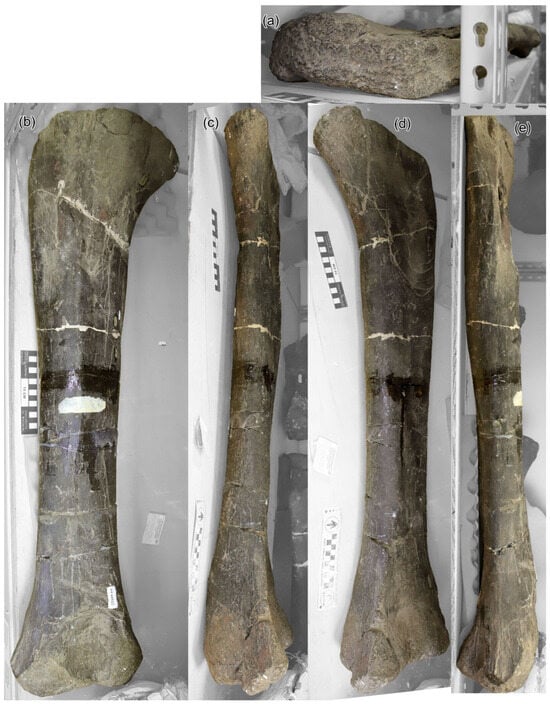
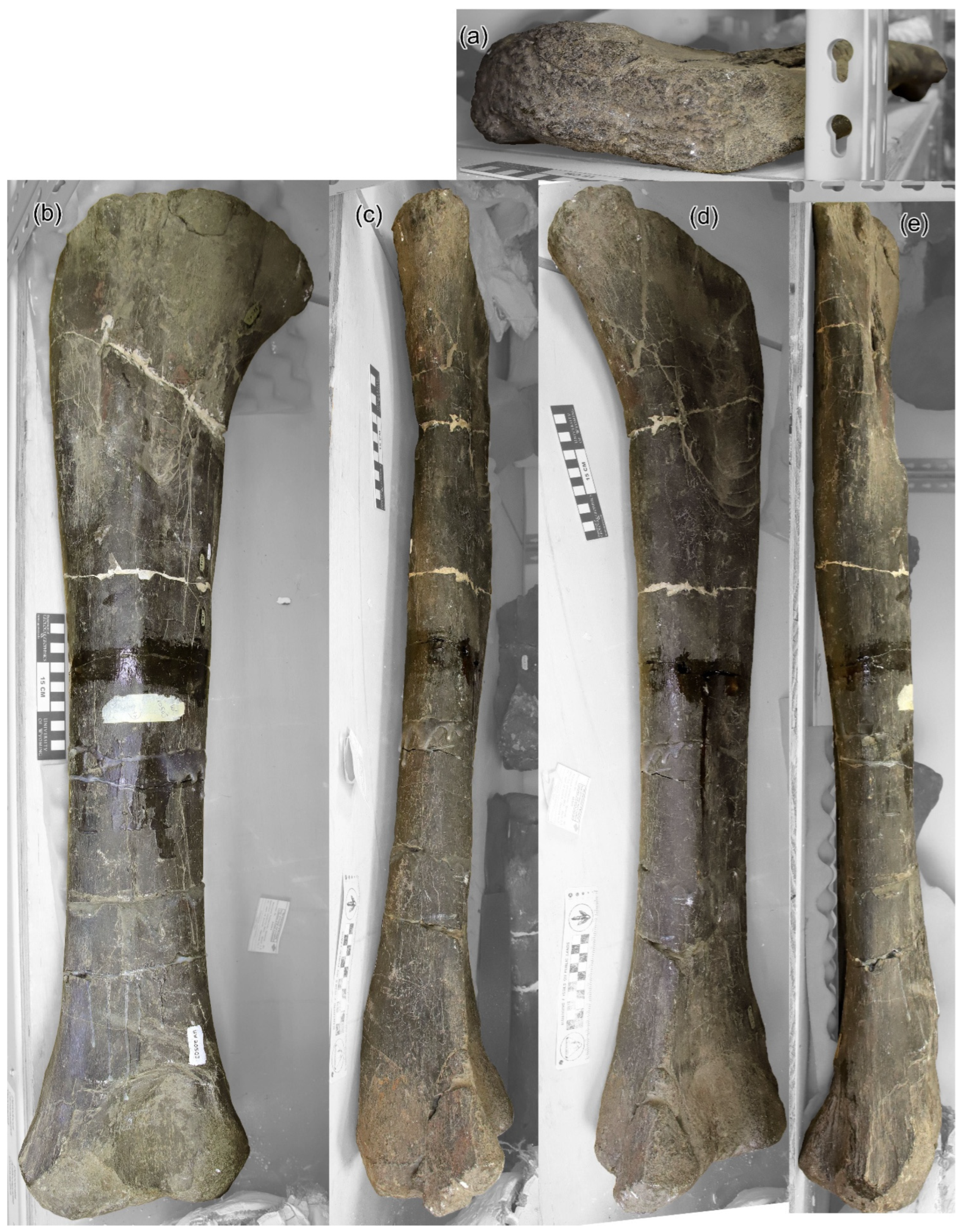
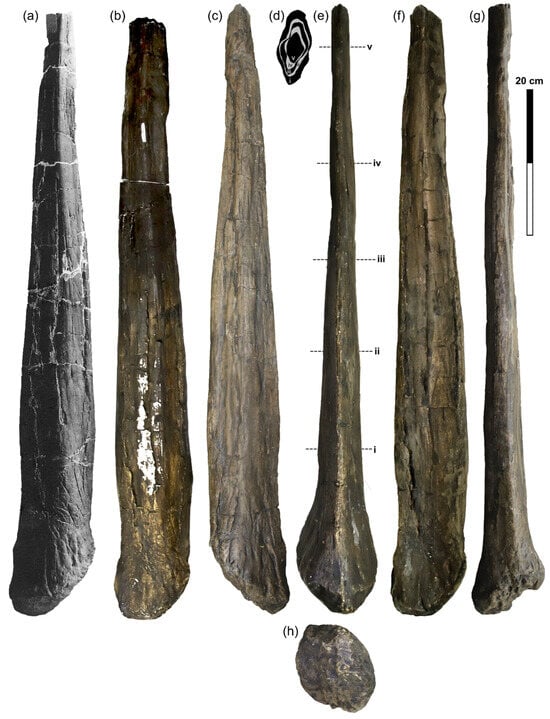
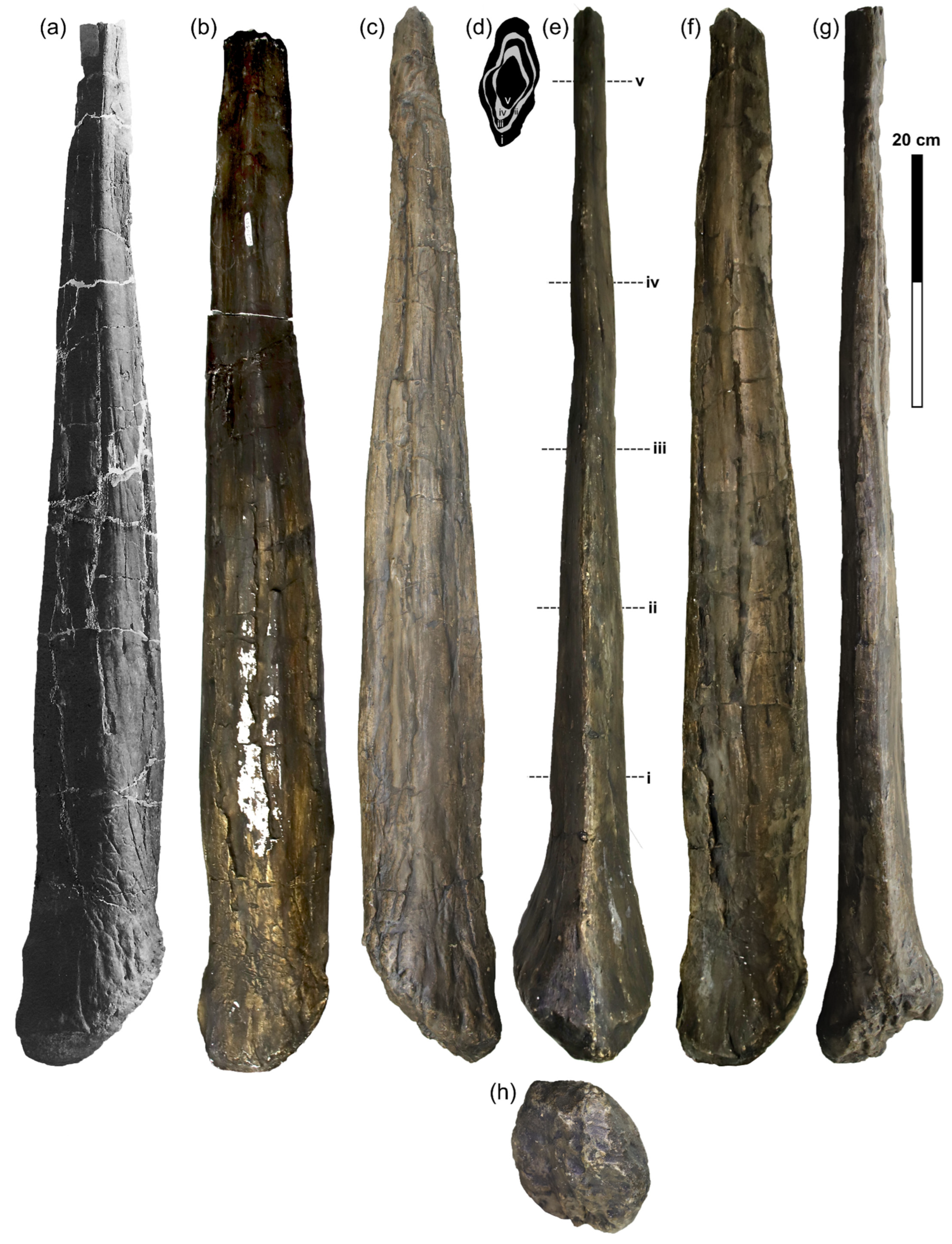
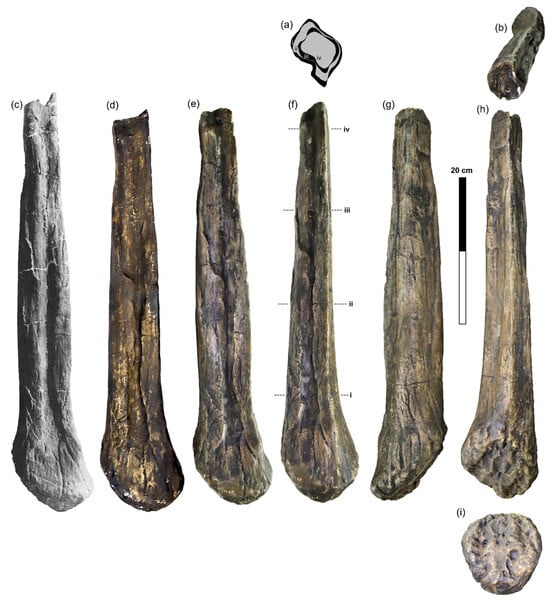
Found near Alcova, Natrona County (Wyoming), and described in [17,27]. The complete right femur (Figure 7) is the only remaining fossil material from this specimen, while two pairs of casts of the two distal caudal spines (Figure 8a and Figure 9c) also remain, one pair being part of UW 20503 (Figure 8b and Figure 9d). The other pair (USNM V 8036) were the first made from the mold [27] and are therefore more accurate, as well as better preserved (Figure 8c–h and Figure 9b,e–i).
Figure 7.
Fossil femur of Miragaia longispinus UW 20503: (a) in proximal view; (b) in anterior view; (c) in medial view; (d) in posterior view; (e) in lateral view. Due to logistical limitations when photographing this fossil, the different views are not at the same scale (background in grayscale, see scales with each). For other photographs and figures of this fossil, see [17,27].
Figure 8.
Distal caudal spine (left) of Miragaia longispinus UW 20503: (a) historic photograph of the fossil (Charles W. Gilmore, early 20th century, public domain); (b) replica UW 20503; (c–h) replica USNM V 8036; (a,b,f) in lateral (left) view; (c) in medial (right) view; (d) in distal view; (e) in anterior view; (g) in posterior view; (h) in proximal view; (f) stacked transverse cross-sections of caudal spine (approximate corresponding section identified in (e) as the dashed lines i–v). Scale bar equals 20 cm.
Figure 9.
Distal caudal spine (right) of Miragaia longispinus UW 20503: (a) stacked transverse cross-sections of caudal spine (approximate corresponding section identified in (f) as the dashed lines i–iv); (b,e–i) replica USNM V 8036; (c) historic photograph of the fossil (Charles W. Gilmore, early 20th century, public domain); (c) replica UW 20503; (a) in distal view; (b) in anterodistal view; (c–e) in lateral (right) view; (f) in anterior view; (g) in medial (left) view; (h) in posterior view; (i) in proximal view. Scale bar equals 20 cm.
The femur is complete, apart from the protruding lesser trochanter that had broken off (for more description details, see [27]). Longitudinal rugose ridges crossing either the anterior or posterior sides of the femora (as in M. longicollum MG 4863 and some specimens of D. armatus; [5,13,21]) are not evidently present. Some differences were observed from the actual femur when compared to the historical figures (see [17,27]), such as the lateral condyle being more developed laterally than the medial condyle is medially.
The spines of M. longispinus are double-bladed, with well-defined anterior and posterior edges that progress longitudinally from adjacent to the base until the distal end (Figure 8e,g and Figure 9f,h). In cross-section they are sigmoid in shape, as the anteromedial and posterolateral surfaces of the shaft are concave, while the anterolateral and posteromedial surfaces are convex (Figure 8d and Figure 9a), so the symmetry is rotational. This differs from the more common bilaterally symmetrical and ovoid shaped cross-sections of the spines of coeval stegosaurines ([7,27,28]) and D. armatus (NHMUK PV OR 46013; [5]). This sigmoidal outline is best preserved in the right spine of UW 20503 (although some crushing anteromedially exaggerated the concavity proximally; Figure 9). The left spine (Figure 8) appears flatter due to having been deformed by taphonomic compression in the lateromedial orientation (nearly identical deformation is evident in a spine from the Lourinhã Formation, while its paired opposite is elongated and sigmoidal in cross-section: see Figure S1c–e; [76]). This compressive deformation suffered by the left spine also appears to have exaggerated the condition of the spine being longer anteroposteriorly at ~25% its longitudinal length (diagnostic of M. (=Alcovasaurus) longispinus; [21,27]), which is not as evident in the right spine; Figure 9c–e,g). Similar widening is present in the distal spines of at least one specimen from the Lourinhã Formation (Lourinhã, Portugal; ML 2043; [21]; Figure S1k,m), so the diagnostic value of this condition may require revision (preferably with a more skeletally complete fossil record of M. longispinus from North America).
Greatly elongated spines ~90% the length of the femora (diagnostic of “Alcovasaurus” longispinus, sensu [27]; diagnostic of Miragaia, sensu [21]) or approximately a meter in length are not exclusive to M. longispinus or the USA, as fossils alike are known as well from Upper Jurassic Iberia, including the Lourinhã Formation where M. longicollum is present (e.g., ML 436; ML 812; ML 2043; SHN.LPP 123; Figure S1c–e,j–q; [21] p. 112). Reconstruction of a spine from M. longicollum (MG 4863-39; [21]) also supports it to have been approximately a meter in length if complete distally.
An affinity to Miragaia (and by extension Dacentrurinae) could be drawn for the caudal spines of USNM V 4937 (holotype of S. sulcatus; sensu [4]) for being relatively tall (similarly to M. longispinus UW 20503; Table 1) and having wide bases (resembling M. longicollum MG 4863-39; [21]: 68). However, the rest of the postcranial skeleton of USNM V 4937 clearly differs from dacentrurine stegosaurs and is analogous to coeval stegosaurine taxa (such as for dorsal centra being longer than wide, the ulna lacking an olecranon horn, the cervical centra lacking fusion to the ribs, and the cervical dermal plates being taller than long and flat with thick expanded bases, as in S. stenops and He. mjosi; USNM V 4937; [10,16,17]). Therefore, the placement of S. sulcatus among Stegosaurinae is far more supported than within Dacentrurinae, as found by various authors prior (e.g., [11,24,73,81]). This means that similarities evidenced by the large stocky spines of USNM V 4937 to some of those from dacentrurines should be due to homoplasy rather than a shared ancestral trait.
4. Discussion
The direct observations of the surviving fossil and cast material of the holotype of M. longispinus support it being classified to the genus Miragaia (as found in [21]), including by further affinities found in the morphology, dimensions and proportions of the distal tail spines essentially shared only with various stegosaur fossils from the Upper Jurassic Iberian Peninsula. The prevalence of the morphological combination of exceptionally long tail spines (up to or over a meter long), with a narrow base and double-bladed, occurring only in specimens of M. longispinus and various dacentrurine specimens from Iberia corroborates both the former as a dacentrurine stegosaur and the latter as being closely related to Miragaia. Specifically, the sigmoid cross-section of the caudal spines medially and distally (closer to sub-rhomboid proximally) is here observed to be shared by M. longispinus and M. longicollum while differing from the markedly round cross-section in the holotype of D. armatus, so it is here proposed as diagnostic of the Miragaia. Future studies of the record of dacentrurine osteoderms from Late Jurassic Europe should further elucidate the diagnostic value of these skeletal elements, including by ascertaining the axial placement, determining how much of the variations observed could be due to ontogeny while also evaluating which similarities could be due to homoplasies.
Based on the relatively recent perspective that dacentrurine stegosaurs were present in North America, it was plausible that re-analyzing other stegosaur fossils from the Upper Jurassic Morrison Formation could herald more occurrences of the clade. In their respective collection records, the dorsal vertebra AMNH 492 had previously been identified as Stegosaurus sp. [82], and YPM PU 14556 as Stegosaurus sp. [83], while UMNH VP 5732 was identified without certainty to either Stegosaurus or Ankylosaurus, and the cervical dermal plate UMNH VP 5572 to Ankylosauria [84]. Here, far more support is found for these representing specimens either of Miragaia sp., cf. M. longicollum, or Dacentrurinae indet. (see taxonomical discussions above for each). The previous uncertain classification of these fossils reflects how their morphology does not match the expected morphology of stegosaurine stegosaurs, well known to occur in the Morrison Formation. However, with the prospect of dacentrurine stegosaurs being also present in North America, their morphology can be resolved more conclusively by matching that known in dacentrurine stegosaurs. This parallels how recognizing “Stegosaurus” longispinus as a dacentrurine stegosaur (see [21]) provided more resolution and an explanation to why its morphology (clearly disparate from the coeval and coexisting S. stenops and He. mjosi) had confounded researchers for more than a century (e.g., [17,24,27,28,29,30,81]).
The reduced comparable material in the specimens described herein (mostly single isolated skeletal elements) mean that these mostly lack autapomorphic features to allow conclusive specific classifications (the exception is the cervical dermal plate UMNH VP 5572, which evidences most of an autapomorphy of M. longicollum, but it is more conclusive that it should belong to a species closely related, hence identified as cf. M. longicollum). This also means that the holotype of Miragaia longispinus (UW 20503) continues to be the only specimen that unambiguously represents that species currently. Given that the material of UW 20503 with diagnostic usefulness is very limited, more complete fossil specimens of M. longispinus are therefore essential to increase the knowledge of the osteology of the species and improve its diagnosis (including how it may have differed from the coeval stegosaurs from the Morrison Formation and M. longicollum from the Lourinhã Formation). This should also improve the classification of the fossils described herein, as these could be assumed to belong to M. longispinus (given that it is the only known species of Dacentrurinae from America), but that is not a conclusion that can be made with the currently available fossil record. Moreover, as the classifications of at least four specimens here to the genus Miragaia could only be supported by narrowly more than one character each, these classification hypotheses require more comparisons and fossil material to be strongly conclusive. On the other hand, the classification of these at least to Dacentrurinae can be better supported, providing more conclusive evidence of faunal interchange of members of this clade between Europe and North America.
The M. longicollum specimens known from Portugal can be aged approximately 150 to 152 million years old (see [31,34,79,85]), while the Miragaia (and one Dacentrurinae indet.) occurrences herein identified from the USA can be aged 152 to 147 million years old ([45,47]), which is congruous with the temporal range of species within a genus. This is also congruous with members of the Dacentrurinae clade, prior to the latest Jurassic, having migrated to North America from Europe rather than the opposite direction (Figure 1d), given both A. boulahfa and Th. atlasicus from the Bathonian of Morocco, found as likely dacentrurines (or at least closer to D. armatus than S. stenops; [11,13]). The migration of Dacentrurinae from Europe to North America, while the faunal interchange of stegosaurine stegosaurs occurred in the opposite direction, is also supported by the apparent relative prevalence of each subclade in each continent, at least if only considering the ratio of fossils found (see [13,14]). According to [13], a probable origin and diversification of Dacentrurinae from the Middle Jurassic of North Africa is also supported by the fossil record (including that considered herein) and correlates with Gondwana having had a more significant paleobiogeographic role in the early stages of stegosaurian evolution than previously considered.
5. Conclusions
After reviews of the literature and first-hand examination of various paleontological collections from the USA logistically available to analyze, at least five more occurrences of dacentrurine stegosaurs were identified, namely: one specimen is here identified as cf. Miragaia longicollum, three specimens are identified to Miragaia sp., and one to Dacentrurinae indet. Interpreting these specimens as possibly representing dacentrurine stegosaurs offers them more classification resolution than what was achievable before. However, further representative fossil material (especially of the American dacentrurine M. longispinus) is essential to conclusively corroborate or correct these classifications.
These new occurrences of Dacentrurinae on the North American continent corroborate the previous identification of the clade (previously known only for M. longispinus UW 20503) and suggest that dacentrurines were not a rare or accidental occurrence in the Upper Jurassic Morrison Formation, but rather that this sub-clade of stegosaurs was an established part of that paleo-ecosystem. These results also further support the faunal exchange of non-avian dinosaurs between North America and Europe during the Late Jurassic and suggest that dacentrurine stegosaurs had a wider distribution and possibly higher diversity than can be determined currently with the available fossil record. Stegosaurus sulcatus is also found well-supported as a stegosaurine stegosaur, despite some similarities in the morphology of the caudal spines to dacentrurine stegosaurs.
Logistical limitations resulted in not all collections with stegosaur fossils from North America being possible to visit and analyze for the study herein. This means that there is the potential of more occurrences of dacentrurine stegosaurs being identified with analyses of further fossil collections from the USA.
Supplementary Materials
The following supporting information can be downloaded at https://www.mdpi.com/article/10.3390/d18030143/s1: Figure S1: Comparisons of cross-section outlines of various stegosaurian caudal spines; Figure S2: Examples of cervical dermal plates from the stegosaur Miragaia longicollum.
Funding
This work was supported by the National Funds through FCT—Fundação para a Ciencia e a Tecnologia, I.P. (Portugal), through the Research Unit UIDB/04035/2020, the Project PTDC/CTA-PAL/2217/2021, and the grant SFRH/BD/148035/2019.
Institutional Review Board Statement
Not applicable.
Data Availability Statement
The original contributions presented in this study are included in the article/Supplementary Material. Further inquiries can be directed to the corresponding author.
Acknowledgments
I thank the visited scientific institutions in the USA and the respective coordinators and researchers that made this work possible: Matthew Carrano and Kay Behrensmeyer, Smithsonian National Museum of Natural History; Meng Jin, Carl Mehling and Alana Gishlick, American Museum of Natural History; Vanesa Rhue and Daniel Brinkman, Yale Peabody Museum of Natural History; Matt Lamanna and Amy Henrici, Carnegie Museum of Natural History; William F. Simpson, Field Museum of Chicago; Kristen MacKenzie and Joe Sertich, Denver Museum of Natura and Science; Carrie Levitt-Bussian, Natural History Museum of Utah; Laura A. Vietti and Julian Diepenbrock, Geological Museum of the University of Wyoming; and LS and Burkhard Pohl, Wyoming Dinosaur Center. I thank my colleagues and friends Alexandre Guillaume, André Saleiro, and Fillipo Rotatori for their company, assistance and patience during my first-time experience of visiting so many collections in another continent. I give a large thanks to Shoji Hayashi for allowing me to use his photographs from previous collection visits, and Octávio Mateus for access to the NOVA-FCT spine replica for study.
Conflicts of Interest
The author declares no conflicts of interest. The funders had no role in the design of the study; in the collection, analyses, or interpretation of data; in the writing of the manuscript; or in the decision to publish the results.
Abbreviations
The following abbreviations are used in this manuscript:
| aap | Anterior end of the base |
| AMNH | American Museum of Natural History, New York, NY, USA |
| CM | Carnegie Museum of Natural History, Pittsburgh, PA, USA |
| dia | Diapophysis |
| DMNH | Denver Museum of Nature & Science, CO, USA |
| keel | Ventral keel |
| ML | Museu da Lourinhã, Lourinhã, Portugal |
| MG | Museu Geológico, Lisboa, Portugal |
| MOAL | Museum of Ancient Life (previously known as North American Museum of Ancient Life, NAMAL), Thanksgiving Point Institute, Lehi, UT, USA |
| MPA | Museo Paleontológico de Alpuente, Valencia, Spain |
| MOR | Museum of the Rockies, Bozeman, MT, USA |
| nc | Neurocanal |
| NHMUK | The Natural History Museum, London, United Kingdom; |
| no | Posterodorsal notch |
| NOVA-FCT | Faculdade de Ciências e Tecnologia da Universidade Nova de Lisboa, Almada, Portugal; |
| ns | Neural spine |
| pap | Posterior end of the base |
| para | Parapophysis |
| pcdl | Posterior centrodiapophyseal lamina |
| posz | Postzygapophysis |
| prez | Prezygapophyses |
| ri | Posterior central ridge |
| SHN | Sociedade de História Natural, Torres Vedras, Portugal |
| tp | Transverse process |
| USNM | United States National Museum, Washington, DC, USA |
| UW | University of Wyoming Geological Museum, Laramie, WY, USA |
| YPM | Peabody Museum of Natural History, Yale University, New Haven, CT, USA. |
References
- Galton, P.M.; Upchurch, P. Stegosauria. In The Dinosauria, 2nd ed.; Weishampel, D.B., Dodson, P., Osmólska, H., Eds.; University of California Press: Berkeley, CA, USA, 2004; pp. 343–362. [Google Scholar]
- Mateus, O.; Maidment, S.C.R.; Christiansen, N.A. A new long-necked ‘sauropod-mimic’ stegosaur and the evolution of the plated dinosaurs. Proc. R. Soc. B Biol. Sci. 2009, 276, 1815–1821. [Google Scholar] [CrossRef] [Scilit]
- Owen, R. Part II (Genera Bothriospondylus, Cetiosaurus, Omosaurus). In A Monograph on the Fossil Reptilia of the Mesozoic Formations; Owen, R., Ed.; Palaeontographical Society: London, UK, 1875; pp. 15–93. [Google Scholar]
- Marsh, O.C. Principal characters of American Jurassic dinosaurs. Part IX: The skull and dermal armor of Stegosaurus. Am. J. Sci. 1887, 34, 413. [Google Scholar] [CrossRef] [Scilit]
- Galton, P.M. British plated dinosaurs (Ornithischia, Stegosauridae). J. Vertebr. Paléontol. 1985, 5, 211–254. [Google Scholar] [CrossRef] [Scilit]
- Galton, P.M. Postcranial remains of the stegosaurian dinosaur Dacentrurus from the Upper Jurassic of France and Portugal. Geol. Paleontol. 1991, 25, 299–327. [Google Scholar]
- Maidment, S.C.R.; Norman, D.B.; Barrett, P.M.; Upchurch, P. Systematics and phylogeny of Stegosauria (Dinosauria: Ornithischia). J. Syst. Palaeontol. 2008, 6, 364–407. [Google Scholar] [CrossRef] [Scilit]
- Maidment, S.C.R. Stegosauria: A historical review of the body fossil record and phylogenetic relationships. Swiss J. Geosci. 2010, 103, 199–210. [Google Scholar] [CrossRef] [Scilit]
- Sereno, P.C. The evolution of dinosaurs. Science 1999, 284, 2137–2147. [Google Scholar] [CrossRef] [Scilit] [PubMed]
- Carpenter, K.; Miles, C.A.; Cloward, K. New primitive stegosaur from the Morrison Formation, Wyoming. In The Armored Dinosaurs; Carpenter, K., Ed.; Indiana University Press: Bloomington, IN, USA, 2001; pp. 55–75. [Google Scholar]
- Maidment, S.C.R.; Raven, T.J.; Ouarhache, D.; Barrett, P.M. North Africa’s first stegosaur: Implications for Gondwanan thyreophoran dinosaur diversity. Gondwana Res. 2020, 77, 82–97. [Google Scholar] [CrossRef] [Scilit]
- Zafaty, O.; Oukassou, M.; Riguetti, F.; Company, J.; Bendrioua, S.; Tabuce, R.; Charrière, A.; Pereda-Suberbiola, X. A new stegosaurian dinosaur (Ornithischia: Thyreophora) with a remarkable dermal armour from the Middle Jurassic of North Africa. Gondwana Res. 2024, 131, 344–362. [Google Scholar] [CrossRef] [Scilit]
- Cobos, A.; Royo-Torres, R.; Luque, L.; Alcalá, L.; Mampel, L. An Iberian stegosaurs paradise: The Villar del Arzobispo Formation (Tithonian–Berriasian) in Teruel (Spain). Palaeogeogr. Palaeoclimatol. Palaeoecol. 2010, 293, 223–236. [Google Scholar] [CrossRef] [Scilit]
- Guillaume, A.R.D.; Costa, F.; Mateus, O. Stegosaur tracks from the Upper Jurassic of Portugal: New occurrences and perspectives. Earth Sci. J. 2022, 20, 37–60. [Google Scholar] [CrossRef] [Scilit]
- Marsh, O.C. A new order of extinct reptilia (Stegosauria) from the Jurassic of the Rocky Mountains. Am. J. Sci. 1877, 3, 513–514. [Google Scholar] [CrossRef] [Scilit]
- Maidment, S.C.R.; Brassey, C.; Barrett, P.M. The postcranial skeleton of an exceptionally complete individual of the plated dinosaur Stegosaurus stenops (Dinosauria: Thyreophora) from the Upper Jurassic Morrison Formation of Wyoming, USA. PLoS ONE 2015, 10, e0138352. [Google Scholar] [CrossRef] [Scilit] [PubMed]
- Gilmore, C.W. Osteology of the armored Dinosauria in the United States National Museum, with special reference to the genus Stegosaurus. U. S. Natl. Mus. Bull. 1914, 89, 1–143. [Google Scholar]
- Marsh, O.C. Notice of new Jurassic reptiles. Am. J. Sci. 1879, 3, 501–505. [Google Scholar] [CrossRef] [Scilit]
- Ostrom, J.A.; McIntosh, J.S. Marsh’s Dinosaurs. The Collections from Como Bluff, 2nd ed.; Yale University Press: New Haven, CT, USA, 1999; pp. 1–388. [Google Scholar]
- ICZN. Opinion 2320: Stegosaurus 1877 Marsh, (Dinosauria, Ornithischia): Type species replaced with Stegosaurus stenops Marsh, 1887. Bull. Zool. Nomencl. 2013, 70, 129–130. [Google Scholar] [CrossRef] [Scilit]
- Costa, F.; Mateus, O. Dacentrurine stegosaurs (Dinosauria): A new specimen of Miragaia longicollum from the Late Jurassic of Portugal resolves taxonomical validity and shows the occurrence of the clade in North America. PLoS ONE 2019, 14, e0224263. [Google Scholar] [CrossRef] [Scilit]
- Li, N.; Li, D.; Peng, G.; You, H. The first stegosaurian dinosaur from Gansu Province, China. Cretac. Res. 2024, 158, 105852. [Google Scholar] [CrossRef] [Scilit]
- Maidment, S.C.R.; Woodruff, D.C.; Horner, J.R. A new specimen of the ornithischian dinosaur Hesperosaurus mjosi from the Upper Jurassic Morrison Formation of Montana, USA, and implications for growth and size in Morrison stegosaurs. J. Vertebr. Paleontol. 2018, 38, e1406366. [Google Scholar] [CrossRef] [Scilit]
- Raven, T.J.; Maidment, S.C. A new phylogeny of Stegosauria (Dinosauria, Ornithischia). Palaeontology 2017, 60, 401–418. [Google Scholar] [CrossRef] [Scilit]
- Saitta, E.T. Evidence for sexual dimorphism in the plated dinosaur Stegosaurus mjosi (Ornithischia, Stegosauria) from the Morrison Formation (Upper Jurassic) of western USA. PLoS ONE 2015, 10, e0123503. [Google Scholar] [CrossRef] [Scilit] [PubMed]
- Woodruff, D.C.; Trexler, D.; Maidment, S.C. Two new stegosaur specimens from the Upper Jurassic Morrison Formation of Montana, USA. Acta Palaeontol. Pol. 2019, 64, 461–480. [Google Scholar] [CrossRef] [Scilit]
- Galton, P.M.; Carpenter, K. The plated dinosaur Stegosaurus longispinus Gilmore, 1914 (Dinosauria: Ornithischia; Upper Jurassic, western USA), type species of Alcovasaurus n. gen. Neues Jahrb. Für Geol. Und Paläontologie Abh. 2016, 279, 185–208. [Google Scholar] [CrossRef] [Scilit]
- Galton, P.M. Notes on plated dinosaurs (Ornithischia: Stegosauria), mostly on dermal armor from Middle and Upper Jurassic of England (also France, Iberia), with a revised diagnosis for Loricatosaurus priscus (Callovian, England). Neues Jahrb. Für Geol. Und Paläontologie Abh. 2016, 282, 1–25. [Google Scholar] [CrossRef] [Scilit]
- Olshevsky, G.; Ford, T. The origin and evolution of the stegosaurs. Dino-Frontline 1993, 4, 64–103. [Google Scholar]
- Ulansky, R.E. Evolution of the stegosaurs (Dinosauria; Ornithischia). Dinologia 2014, 1, 1–35. [Google Scholar]
- Costa, F.; Maidment, S.C.R.; Sequero, C.; Crespo, V.D. Miragaia longicollum MG 4863: New fossil and historical evidence from the most complete stegosaur from Europe. Comun. Geológicas 2025, 112, 35–58. [Google Scholar] [CrossRef]
- Escaso, F.; Ortega, F.; Dantas, P.; Malafaia, E.; Pimentel, N.L.; Pereda-Suberbiola, X.; Sanz, J.L.; Kullberg, J.C.; Kullberg, M.C.; Barriga, F. New evidence of shared dinosaur across Upper Jurassic Proto-North Atlantic: Stegosaurus from Portugal. Naturwissenschaften 2007, 94, 367–374. [Google Scholar] [CrossRef] [Scilit] [PubMed]
- Mateus, O. Late Jurassic of Morrison Formation and Portugal tetrapods compared: A model to explain faunal exchange and similarity. In Proceedings of the Annual Meeting of the Society of Vertebrate Paleontology, Salt Lake City, UT, USA, 26–29 October 2016. [Google Scholar]
- Mateus, O.; Dinis, J.; Cunha, P.P. The Lourinhã Formation: The Upper Jurassic to lower most Cretaceous of the Lusitanian Basin, Portugal–landscapes where dinosaurs walked. Ciências Terra 2017, 19, 75–97. [Google Scholar] [CrossRef] [Scilit]
- Brikiatis, L. Late Mesozoic North Atlantic land bridges. Earth-Sci. Rev. 2016, 159, 47–57. [Google Scholar] [CrossRef] [Scilit]
- Lockley, M.G.; Garcia-Ramos, J.C.; Pinuela, L.; Avanzini, M. A review of vertebrate track assemblages from the Late Jurassic of Asturias, Spain with comparative notes on coeval ichnofaunas from the western USA: Implications for faunal diversity in siliciclastic facies assemblages. Oryctos 2008, 8, 53–70. [Google Scholar]
- Galton, P.M.; Jensen, J.A. A new large theropod dinosaur from the Upper Jurassic of Colorado. Brigh. Young Univ. Geol. Stud. 1979, 26, 1–12. [Google Scholar]
- Marsh, O.C. Notice of New Dinosaurian Reptiles from the Jurassic formation. Am. J. Sci. 1877, 3, 514–516. [Google Scholar] [CrossRef] [Scilit]
- Marsh, O.C. Principal characters of American Jurassic dinosaurs; Part VIII, the order Theropoda. Am. J. Sci. 1884, 1, 329–340. [Google Scholar] [CrossRef] [Scilit]
- Jensen, J.A. Three new sauropod dinosaurs from the Upper Jurassic of Colorado. Great Basin Nat. 1985, 45, 697–709. [Google Scholar] [CrossRef] [Scilit]
- Hendrickx, C.; Mateus, O. Torvosaurus gurneyi n. sp., the largest terrestrial predator from Europe, and a proposed terminology of the maxilla anatomy in nonavian theropods. PLoS ONE 2014, 9, e88905. [Google Scholar] [CrossRef] [Scilit]
- Mateus, O. Late Jurassic dinosaurs from the Morrison Formation (USA), the Lourinhã and Alcobaça formations (Portugal), and the Tendaguru Beds (Tanzania): A comparison. New Mex. Mus. Nat. Hist. Sci. Bull. 2006, 36, 223–231. [Google Scholar]
- Mateus, O.; Walen, A.; Antunes, M.T. The large theropod fauna of the Lourinhã Formation (Portugal) and its similarity to that of the Morrison Formation, with a description of a new species of Allosaurus. Paleontol. Geol. Up. Jurass. Morrison Form. 2006, 36, 123–129. [Google Scholar]
- Tschopp, E.; Mateus, O.; Benson, R.B. A specimen-level phylogenetic analysis and taxonomic revision of Diplodocidae (Dinosauria, Sauropoda). PeerJ 2015, 3, e857. [Google Scholar] [CrossRef] [Scilit]
- Maidment, S.C.R.; Muxworthy, A. A chronostratigraphic framework for the Upper Jurassic Morrison Formation, western USA. J. Sediment. Res. 2019, 89, 1017–1038. [Google Scholar] [CrossRef] [Scilit]
- Turner, C.E.; Peterson, F. Reconstruction of the Upper Jurassic Morrison Formation extinct ecosystem—A synthesis. Sediment. Geol. 2004, 167, 309–355. [Google Scholar] [CrossRef] [Scilit]
- Maidment, S.C.R. Diversity through time and space in the Upper Jurassic Morrison Formation, Western USA. J. Vertebr. Paleontol. 2024, 43, e2326027. [Google Scholar] [CrossRef] [Scilit]
- Trujillo, K.; Kowallis, B. Recalibrated legacy 40Ar/39Ar ages for the Upper Jurassic Morrison Formation, Western Interior, USA. Geol. Intermt. West 2015, 2, 1–8. [Google Scholar] [CrossRef] [Scilit]
- Foster, J. Jurassic West: The Dinosaurs of the Morrison Formation and Their World, 2nd ed.; Indiana University Press: Bloomington, IN, USA, 2020; pp. 1–531. [Google Scholar]
- Wilhem, C. Maps of the Callovian and Tithonian Paleogeography of the Caribbean, Atlantic, and Tethyan Realms: Facies and Environments. Geol. Soc. Am. Digit. Map Chart 2014, 17, 1–9. [Google Scholar] [CrossRef] [Scilit]
- Stokes, W.L. Dinosaur Quarry near Cleveland, Utah. Utah Acad. Proc. 1961, 38, 132–133. [Google Scholar]
- Turner, C.E.; Peterson, F.; Gillette, D.D. Biostratigraphy of dinosaurs in the Upper Jurassic Morrison Formation of the Western Interior, USA. Vertebr. Paleontol. Utah 1999, 99, 77–114. [Google Scholar]
- Osborn, H.F. Manus, sacrum, and caudals of Sauropoda. Bull. Am. Mus. Nat. Hist. 1904, 20, 181–190. [Google Scholar]
- Allen, A. The Dinosaur Beds of The Morrison Formation (Jurassic) Alcova Lake, Wyoming. Tate Mus. Casper Coll. Publ. 1994, 48, 1–35. [Google Scholar]
- Owen, R. Report on British fossil reptiles. Reports of the British Association for the Advancement of Science. Proc. R. Soc. Lond. 1842, 11, 60–204. [Google Scholar]
- Seeley, H.G.I. On the classification of the fossil animals commonly named Dinosauria. Proc. R. Soc. Lond. 1888, 43, 165–171. [Google Scholar] [CrossRef] [Scilit]
- Nopcsa, F. Die Dinosaurier der Siebenbu¨rgischen Landesteile Ungarns. Mitteilungen Aus Dem Jahrbuche KöniglichUngarischen Geol. Reichsanst. 1915, 23, 1–26. [Google Scholar]
- Marsh, O.C. Principal characters of American Jurassic dinosaurs. Am. J. Sci. 1880, 19, 253–259. [Google Scholar] [CrossRef] [Scilit]
- Dong, Z.M.; Tang, Z.; Zhou, S.W. Note on the new mid-Jurassic stegosaur from Sichuan Basin, China. Vertebr. Palasiat. 1982, 20, 83–87. [Google Scholar]
- Nopcsa, B.F. Notes on British Dinosaurs. Part IV: Stegosaurus priscus, sp. nov. Geol. Mag. 1911, 8, 109–115. [Google Scholar] [CrossRef] [Scilit]
- Hennig, E. Kentrosaurus aethiopicus, der Stegosauride des Tendaguru. Sitzungsberichte Ges. Naturforschender Freunde Berl. 1915, 219–247. [Google Scholar]
- Dong, Z.M.; Li, X.M.; Zhou, S.W.; Chang, Y.H. Stegosaurian remain from Zigeng (Tzekung), Zsechuan Province. Vertebr. Palasiat. 1977, 15, 307. [Google Scholar]
- Jia, L.; Li, N.; Dong, L.; Shi, J.; Kang, Z.; Wang, S.; Xu, S.; You, H. A new stegosaur from the late Early Cretaceous of Zuoyun, Shanxi Province, China. Hist. Biol. 2025, 37, 420–429. [Google Scholar] [CrossRef] [Scilit]
- Dong, Z.M. Dinosaurs from Wuerho; Institute of Paleontology and Paleoanthropology Memoir: Beijing, China, 1973; Volume 11, pp. 45–52.
- Dai, H.; Li, N.; Maidment, S.C.R.; Wei, G.; Zhou, Y.; Hu, X.; Ma, Q.; Wang, X.; Hu, H.; Peng, G. New stegosaurs from the Middle Jurassic Lower Member of the Shaximiao Formation of Chongqing, China. J. Vertebr. Paleontol. 2022, 41, e1995737. [Google Scholar] [CrossRef] [Scilit]
- Ouyang, H. Discovery of Gigantspinosaurus sichuanensis and its scapular spine orientation. In Abstracts and Summaries for Youth Academic Symposium on New Discoveries and Ideas in Stratigraphic Paleontology; Southwest Petroleum University: Chengdu, China, 1992; Volume 47. [Google Scholar]
- Dong, Z.; Zhou, S.; Zhang, Y. Dinosaurs from the Jurassic of Sichuan. Palaeontol. Sin. 1983, 16, 1–151. [Google Scholar]
- Galton, P.M. A partial skeleton of the stegosaurian dinosaur Lexovisaurus from the uppermost Lower Callovian (Middle Jurassic) of Normandy, France. Geol. Paleontol. 1990, 24, 185–199. [Google Scholar]
- Hao, B.; Zhang, Q.; Peng, G.; Ye, Y.; You, H. Redescription of Gigantspinosaurus sichuanensis (Dinosauria, Stegosauria) from the Late Jurassic of Sichuan, Southwestern China. Acta Geol. Sin. 2018, 92, 431–441. [Google Scholar] [CrossRef] [Scilit]
- Maidment, S.C.R.; Wei, G.B. A review of Late Jurassic stegosaurs from the People’s Republic of China. Geol. Mag. 2006, 143, 621–634. [Google Scholar] [CrossRef] [Scilit]
- Zhou, S.W. Stegosaurs. In The Middle Jurassic Dinosaurian Fauna from Dashanpu, Zigong, Sichuan; Zhou, S.W., Ed.; Sichuan Scientific and Technological Publishing House: Sichuan, China, 1984; Volume 2, pp. 45–51. [Google Scholar]
- Raven, T.J.; Barrett, P.M.; Joyce, C.B.; Maidment, S.C.R. The phylogenetic relationships and evolutionary history of the armoured dinosaurs (Ornithischia: Thyreophora). J. Syst. Palaeontol. 2023, 21, 2205433. [Google Scholar] [CrossRef] [Scilit]
- Li, N.; Maidment, S.C.R.; Li, D.; You, H.; Peng, G. A new stegosaur (Dinosauria: Ornithischia) from the Middle Jurassic of Gansu Province, China. Sci. Rep. 2024, 14, 15241. [Google Scholar] [CrossRef] [Scilit] [PubMed]
- Company, J.; Pereda-Suberbiola, X.; Ruiz-Omeñaca, J.I. New stegosaurian (Ornithischia, Thyreophora) remains from Jurassic-Cretaceous transition beds of Valencia province (Southwestern Iberian Range, Spain). J. Iber. Geol. 2010, 36, 243–252. [Google Scholar] [CrossRef] [Scilit]
- Escaso, F.S. Historia Evolutiva de los Ornithischia (Dinosauria) del Jurásico Superior de Portugal. Ph.D. Thesis, Universidad Autónoma de Madrid, Madrid, Spain, 2014. [Google Scholar]
- Mountain America Museum of Ancient Life. Available online: https://thanksgivingpoint.org/attractions-tickets/museum-of-ancient-life/ (accessed on 1 March 2022).
- Sisson, B. (Fossilogic, Lehi, UT, USA). Personal communication, 2021.
- Wiest, L.A.; Ferraro, J.V.; Binetti, K.M.; Forman, S.L.; Esker, D.A.; Kibunjia, M.; Brugal, J.P.; Zechmann, B. Morphological characteristics of preparator air-scribe marks: Implications for taphonomic research. PLoS ONE 2018, 13, e0209330. [Google Scholar] [CrossRef] [Scilit]
- Araújo, R.; Mateus, O.; Walen, A.; Christiansen, N. Preparation techniques applied to a stegosaurian dinosaur from Portugal. J. Paleontol. Tech. 2009, 5, 1–23. [Google Scholar]
- Jia, C.; Forster, C.A.; Xu, X.; Clark, J.M. The first stegosaur (Dinosauria, Ornithischia) from the Upper Jurassic Shishugou Formation of Xinjiang, China. Acta Geol. Sin. 2007, 81, 351–356. [Google Scholar] [CrossRef] [Scilit]
- Ulansky, R.E. Natronasaurus longispinus, 100 years with another name. Dinologia 2014, 1, 1–10d. [Google Scholar]
- American Museum of Natural History. Available online: http://research.amnh.org/paleontology/search.php (accessed on 1 March 2022).
- Yale Peabody Museum. Available online: https://collections.peabody.yale.edu (accessed on 1 March 2022).
- Levitt-Bussian, C. (Natural History Museum of Utah, Salt Lake City, UT, USA). Personal communication, 2022.
- Taylor, A.M.; Gowland, S.; Leary, S.; Keogh, K.J.; Martinius, A.W. Stratigraphical correlation of the Late Jurassic Lourinhã Formation in the Consolação Sub-basin (Lusitanian Basin), Portugal. Geol. J. 2014, 49, 143–162. [Google Scholar] [CrossRef] [Scilit]

Disclaimer/Publisher’s Note: The statements, opinions and data contained in all publications are solely those of the individual author(s) and contributor(s) and not of MDPI and/or the editor(s). MDPI and/or the editor(s) disclaim responsibility for any injury to people or property resulting from any ideas, methods, instructions or products referred to in the content. |
© 2026 by the author. Licensee MDPI, Basel, Switzerland. This article is an open access article distributed under the terms and conditions of the Creative Commons Attribution (CC BY) license.