
Communication

Rhopilema nomadica in the Mediterranean: Molecular Evidence for Migration and Insights into Its Proliferation

1
The Steinhardt Museum of Natural History, Tel Aviv University, Tel Aviv 6997801, Israel
2
Recanati Institute for Maritime Studies and the Department of Maritime Civilizations, University of Haifa, Haifa 3498838, Israel
3
School of the Environment and Earth Sciences, Department of Geophysical, Atmospheric and Planetary Sciences, Tel Aviv University, Tel Aviv 6997801, Israel
4
Independent Researcher, Dar es Salaam 11000, Tanzania
5
Department of Aquatic Sciences and Fisheries Technology, University of Dar es Salaam, Dar es Salaam 60091, Tanzania
*
Author to whom correspondence should be addressed.
Diversity 2026, 18(2), 94; https://doi.org/10.3390/d18020094 (registering DOI)
Submission received: 5 December 2025 / Revised: 25 January 2026 / Accepted: 28 January 2026 / Published: 3 February 2026
(This article belongs to the Special Issue Cnidaria: Diversity, Ecology, and Evolution)

Abstract

Since it was first observed in Israel in the 1970s, and due to its subsequent negative impact on human activities, the nomad jellyfish Rhopilema nomadica has earned itself a spot on the list of the 100 Worst Invasive Alien Species in the Mediterranean. It was assumed to originate in the Red Sea, or in the Indo-Pacific region, but in the absence of additional reports of live specimens outside the Mediterranean, its origins have remained a mystery. Here, via molecular analysis, we present the first verified results of the existence of R. nomadica in the Western Indian Ocean. Moreover, using additional evidence from Cassiopea andromeda and R. nomadica, we propose that the construction of the Aswan High Dam may have led to the proliferation of R. nomadica in the Levantine Basin.

1. Introduction

The scyphomedusa Rhopilema nomadica was first reported in coastal waters of the southeastern Mediterranean Sea in the 1970s [1]. By the mid-1980s, large aggregations of this species appeared annually along the Israeli coast, mainly during the summer [2,3,4]. Thereafter, R. nomadica expanded north and westward into the central Mediterranean, appearing in Turkey [5], Greece [6], Malta [7], Tunisia [8], and more recently, Sardinia and Sicily [9]. Dense swarms of R. nomadica, often exceeding 10 individuals m−2 (Figure 1) and encompassing many kilometers, cause environmental, economic, and social damage, reducing biodiversity [10], clogging water intake pipes of coastal infrastructure [11,12], causing damage to the fishing industry [13,14], and disrupting coastal recreation and tourism [15]. As a result of its expansion and the effects of the swarms, R. nomadica is considered one of the “100 worst invasive species” in the Mediterranean [10,16] and one of the most “impacting species” in European seas [17].
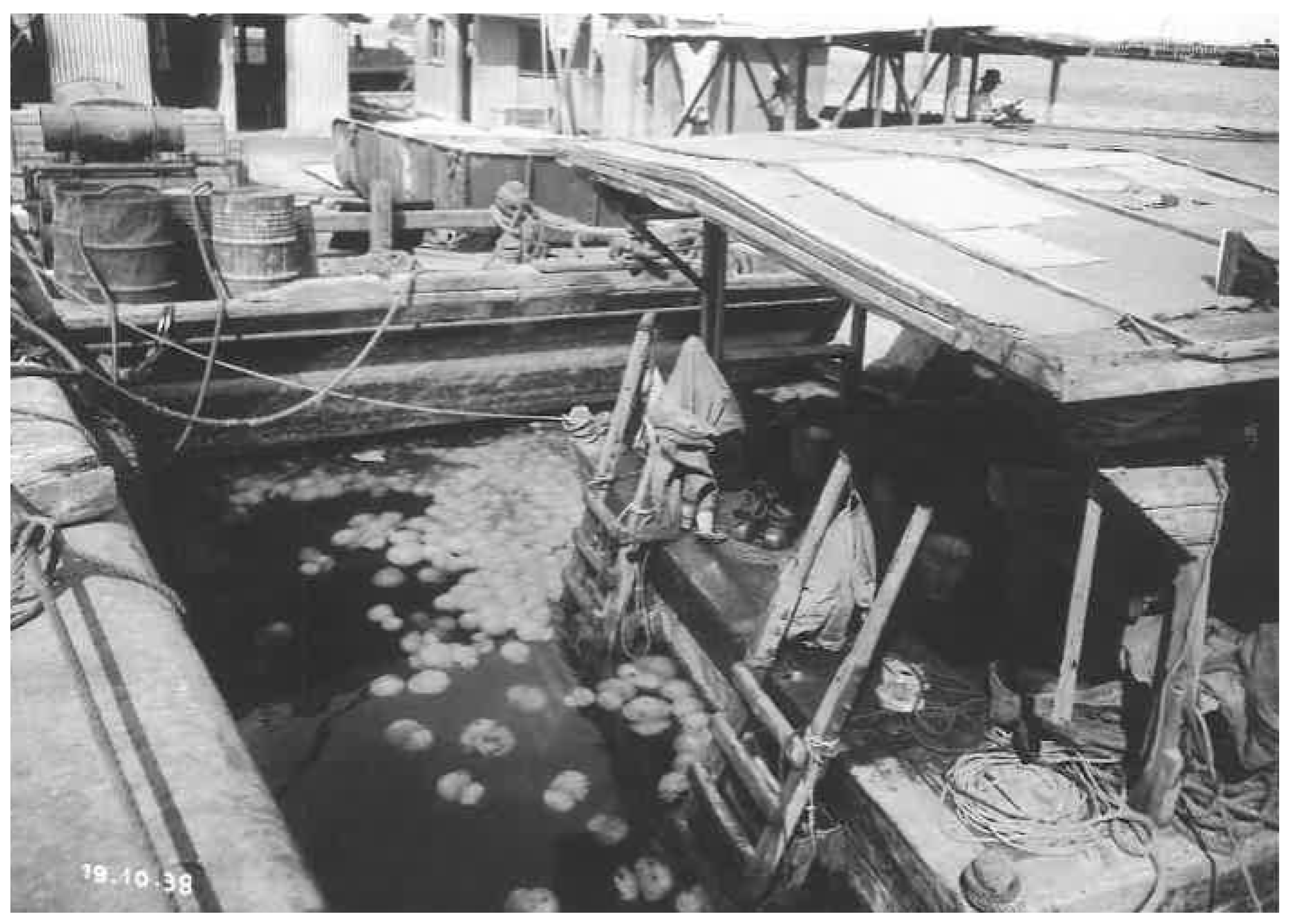
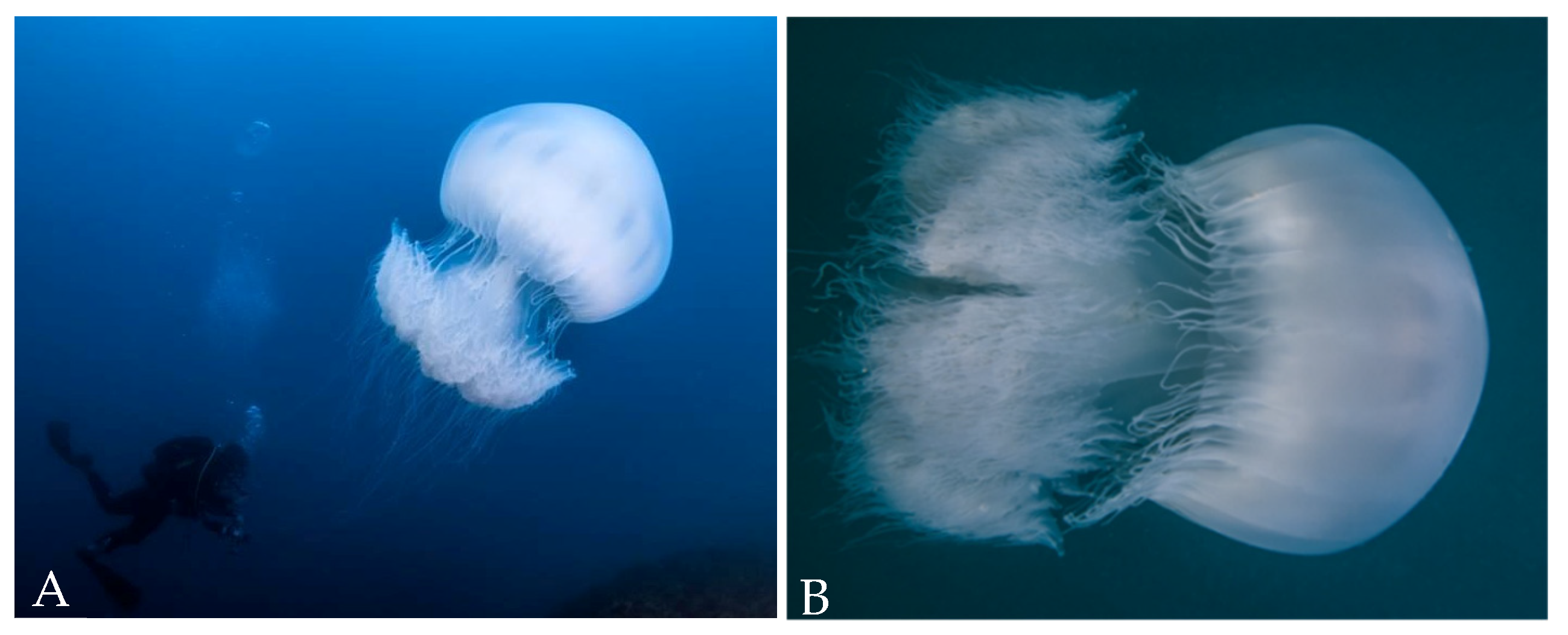
Rhopilema nomadica is listed among many other species that have been introduced to the Mediterranean; since opening in 1869, the Suez Canal has served as a corridor for introducing >400 multicellular species [18]. However, there are gaps in our understanding of its ecology, origin, and geographical expansion. Until recently, as there were no reports of R. nomadica in the Mediterranean Sea prior to the 1970s [1], it was assumed to have arrived around this time. However, a unique photograph taken in 1938 (Rakotsh, Figure 2), presented at a public exhibition in the city of Haifa, Israel, in 2002, shows a dense aggregation of R. nomadica in Haifa Port. Furthermore, despite it being considered a Lessepsian migrant, based on a specimen collected off Kamaran, Yemen, southern Red Sea, in 1939 (holotype, RMNH 7038) [1], there have been no additional reports of R. nomadica from the Red Sea since then. Only Berggren [19] and Tahera & Kazmi [20] have reported R. nomadica outside the Mediterranean, and the report by Tahera & Kazmi [20] was found to be a misidentification [21]. Divers and researchers in eastern Africa have recently reported the presence of “nomad medusae” with similar morphology to R. nomadica near Dar es Salaam, Tanzania (Figure 3) (e.g., https://seaunseen.com) [22], suggesting that the Western Indian Ocean may be the source of the Mediterranean population. However, this conjecture has yet to be tested.
Here, we provide evidence that the western Indian Ocean “nomad medusa” is R. nomadica. We then explore why it has only relatively recently established persistent annual swarms in the Mediterranean. We propose that R. nomadica medusae were introduced into the Mediterranean over the last century, possibly soon after the Suez Canal was constructed. Moreover, we suggest that its apparent appearance in the late 1970s was due to changing environmental conditions, favoring the success of its reproductive benthic stage [Box 1].
Box 1. Summary of the metagenic life cycle of Rhopilema nomadica.
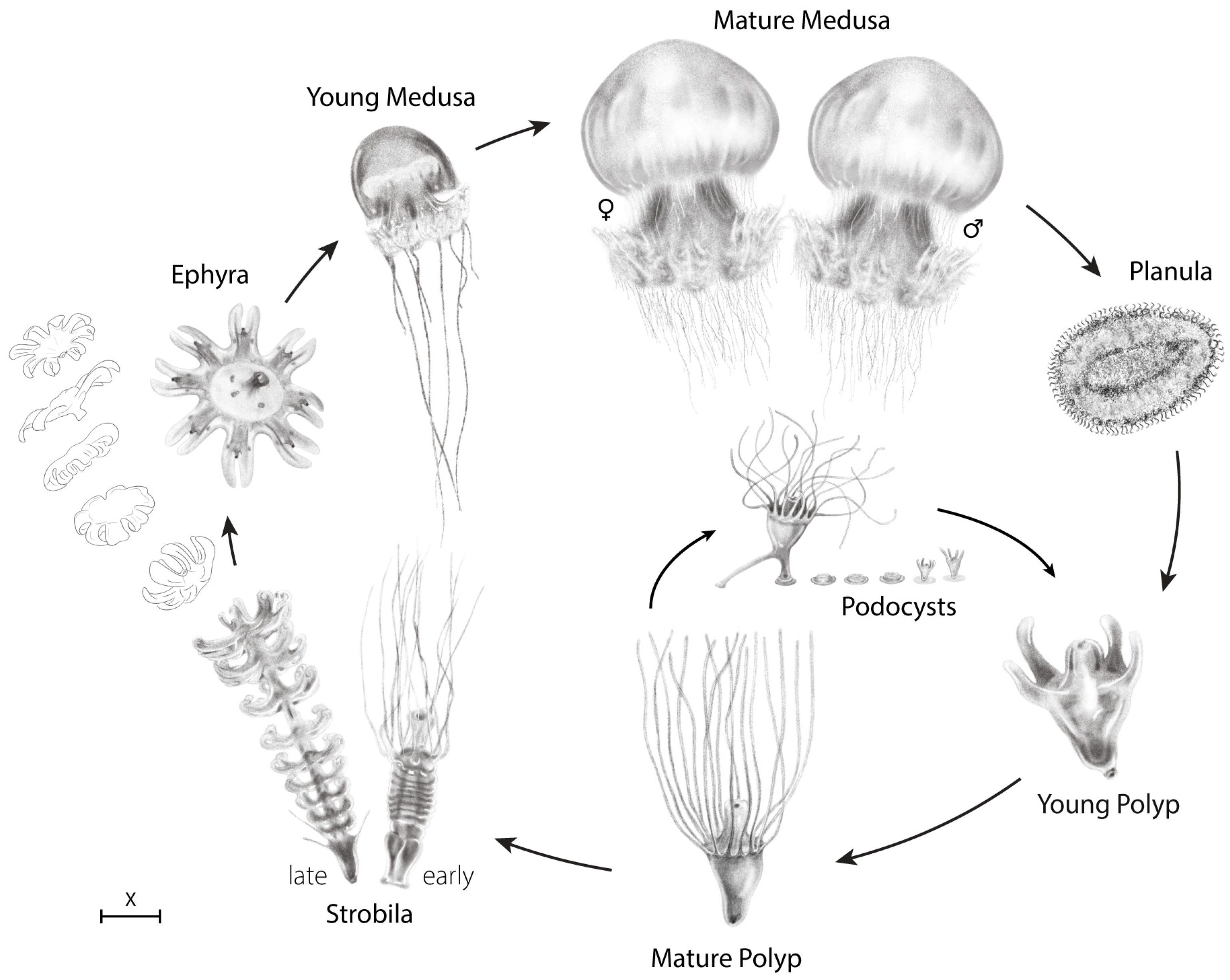
Rhopilema nomadica has a metagenic life cycle composed of the free-swimming, planktonic medusa, and the benthic sessile polyp (Figure 4). Sexual reproduction occurs in the medusa stage and asexual reproduction occurs in the polyp stage. The medusa is gonochoric, releasing sperm or oocytes. Fertilization occurs in the water column. Fertilized eggs develop into free-swimming ciliated planula larvae that seek a suitable surface to settle on. After settlement, the planula metamorphoses into a sessile polyp called ‘scyphistoma’. The scyphistoma then begins to reproduce asexually through podocyst formation, with the potential to create dense populations of scyphistomae within weeks. Given suitable conditions (e.g., temperature, food), the scyphistoma starts to produce medusae through a process called ‘strobilation’. The success of the benthic/scyphistoma stage is undoubtedly responsible for the formation of the medusa swarms [23,24]. Nevertheless, for most species this stage is cryptic, and scyphistoma populations have rarely been observed in the wild.
Figure 4. Rhopilema nomadica life cycle (clockwise). Scale for each of the life stages: mature medusa, X = 10 cm; planula, X = 90 µm; young polyp, X = 100 µm; mature polyp, X = 700 µm; podocysts, X = 600 µm; strobila, X = 630 µm; ephyra, X = 800 µm; young medusa, X = 1.5 cm (sketch by Rahel Wachs).
Diversity 18 00094 g004

2. Materials and Methods

DNA Sampling, Amplification, and Phylogenetic Analyses

In order to genetically confirm the identity and understand the phylogenetic position of R. nomadica from Tanzania (three medusae stranded on the beach in Dar es Salaam, Tanzania, 6°44′28.76″ S, 39°16′33.39″ E, sampled on 18 September 2016 by A. Sutton, a co-author based in Tanzania), a genus-level phylogeny was reconstructed. For the molecular analyses, 217 individuals of Rhopilema were included, of which three were the newly collected specimens from Tanzania (labeled RN1P, RN2P, and RN3P; GenBank accession numbers PX760500–2, respectively), and 214 available specimens were retrieved from GenBank (48 of R. esculentum, 50 of R. hispidum, 113 of R. nomadica, and three of R. verrilli). It is noteworthy that all the available sequences of R. nomadica were solely from the Mediterranean Sea, i.e., the newly generated Tanzanian sequences were the only ones from outside the Mediterranean region. Additionally, four sequences of the genus Rhizostoma (also from the family Rhizostomatidae) were retrieved from GenBank to root the phylogenetic trees (two sequences each for R. luteum and R. pulmo, from the northeast Atlantic Ocean and from Tunisia, respectively). Table S1 provides details on the identification, collection localities, and GenBank accession numbers of all sequences included in this study.
DNA was extracted using a CTAB-phenol/chloroform protocol [25]. The samples were PCR-amplified and bi-directionally sequenced for the mitochondrial protein-coding gene fragment of cytochrome oxidase subunit 1 (COI). The mitochondrial COI was amplified for a fragment of 316 bp using the species-specific primer set RNF (5′-AGACATACCAGGGGCTCTCA-3′) and RNR (5′-CCGTTTTAATCGGAGGGTTT-3′) [26]. PCR cycling conditions included initial denaturation at 94 °C for 3 min; 35 cycles at 94 °C for 30 s, 58 °C for 30 s, and 72 °C for 1 min; and a final extension at 72 °C for 5 min. Both strands of the PCR products were sequenced, and chromatographs were checked, assembled, and edited using Geneious v.7.1.9 (Biomatter Ltd., Auckland, New Zealand). The Mafft plugin of Geneious was used with default settings to align all sequences. The sequences were translated to amino acids, and no stop codons were detected.
For the phylogenetic analyses, the COI dataset of 316 bp was analysed under Maximum Likelihood (ML) and Bayesian Inference (BI) methods. The ML analyses were performed using IQ-TREE v. 1.6.12 [27] through the web interface [28]. The best-fit substitution model was selected automatically by ModelFinder [29], as implemented in IQ-TREE, determined as TPM2u+F+I+G4 according to the BIC model selection criteria. Branch support was assessed with the Shimodaira-Hasegawa-like approximate likelihood ratio test (SH-aLRT; [30]) and the ultrafast bootstrap (UFBoot; [31,32]), both with 1000 replicates. The BI analyses were carried out using MrBayes v.3.2.7 [33]. The best substitution model was determined using JModelTest v.2.1.7 [34,35] which resulted in the HKY+G model. Nucleotide substitution model parameters were unlinked across partitions, and the different partitions were allowed to evolve at different rates. Two simultaneous parallel runs were performed with four chains per run (three heated, one cold) for 10 million generations with sampling frequency of every 1000 generations. Stationarity was determined by the standard deviations of the split frequencies being lower than 0.01. The standard deviation of the split frequencies between the two runs and the Potential Scale Reduction Factor (PSRF) diagnostic were examined. The first 25% of trees were conservatively discarded as burn-in. Nodes with SH-aLRT ≥ 80, UFBoot ≥ 95, and a Bayesian posterior probability ≥ 0.95 were considered strongly supported. We calculated inter- and intraspecific uncorrected p-distance between Rhopilema and Rhizostoma species for the COI mitochondrial fragment, with pairwise deletion, in MEGA11 [36].

3. Results and Discussion

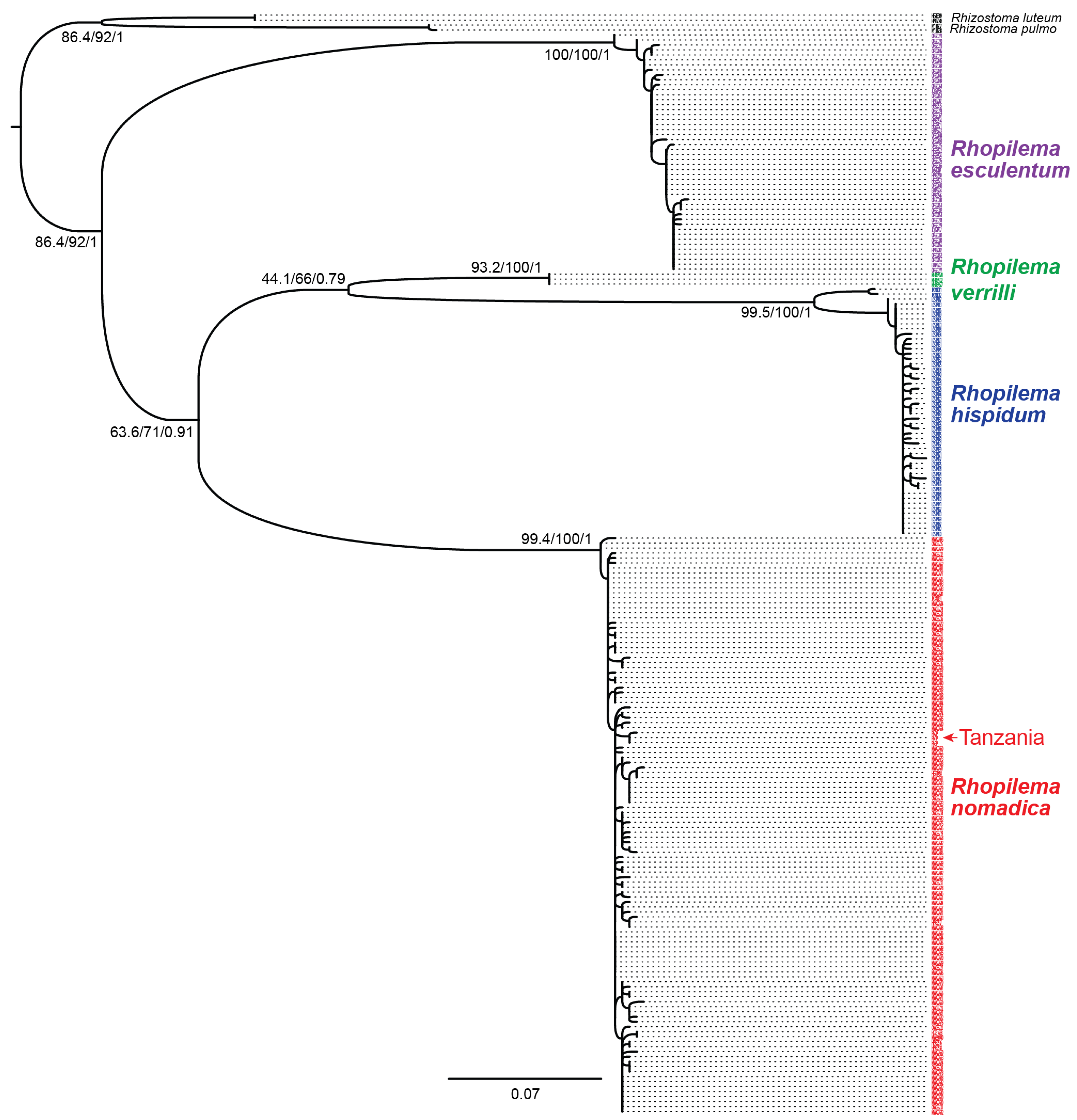
The results of the phylogenetic analyses, based on the COI dataset and using BI and ML analyses, produced similar trees, differing mostly in the less supported nodes at the intraspecific level (Figure 5). Rhopilema was recovered and found to be monophyletic (SH-aLRT = 86.4/UFBoot = 92/Bayesian posterior probability = 1.0; support values are given in the same order hereafter). Monophyly of all species of the genus was strongly supported (R. esculentum: 100/100/1.0; R. verrilli: 93.2/100/1.0; R. hispidum: 99.5/100/1.0; R. nomadica: 99.4/100/1.0). The species R. esculentum was recovered as the sister taxon to all the other Rhopilema species included in the analysis. A sister-taxon relationship between R. hispidum and R. verrilli was recovered, though with weak support (44.1/66/0.79), as was their inferred relationship with R. nomadica (63.6/71/0.91). The species R. nomadica showed low genetic differentiation, with all three Tanzanian specimens being phylogenetically grouped within the same clade as those from the Mediterranean Sea. Among these three Tanzanian specimens, two (RN1P and RN3P) had identical sequences, whereas the third (RN2P) differed from them by a single nucleotide at position 307.
The uncorrected genetic distance in the COI fragment was in the range of 16.5–18.9% among Rhopilema species, and 15.8–19.9% between Rhopilema and Rhizostoma. The lowest distance among Rhopilema species was 16.5% between R. verrilli and R. hispidum, and the highest was 18.9% between R. verrilli and R. esculentum. The level of genetic variability within Rhopilema species was relatively low and ranged between 0 and 3% (R. esculentum, 3%; R. nomadica, 1%; R. hispidum, 1%; R. verrilli, 0%).
The phylogenetic analyses confirm that the medusae collected from Dar es Salaam, Tanzania, were R. nomadica (Figure 5). These analyses reveal strong genetic affinities within R. nomadica between the Indo-Pacific and Mediterranean regions. This is the first genetic indication that the R. nomadica in the Mediterranean may have originated in the Indo-Pacific region, possibly via ballast water in ships from east African waters [37,38].
Galil et al. [1] reported that R. nomadica was found in the Red Sea and that it entered the Mediterranean via the Suez Canal (i.e., it is a Lessepsian migrant), yet there have been no published reports of its presence elsewhere in the Red Sea, nor anywhere else, aside from the Mediterranean. It was only in 1994, in the waters of Mozambique, 2500 km south of Tanzania, that a medusa, serving as a host to a pelagic shrimp, was identified as R. nomadica [19]; however, this identification was based on photographs (unpublished), taken while snorkeling (Berggren, personal communication). Hence, our results are the first to provide sound molecular evidence for the presence of R. nomadica in the waters off East Africa. It appears that this medusa, now identified as R. nomadica, is seasonally abundant offshore of Dar es Salaam, Tanzania (A. Sutton, personal communication), generally between October and December.
In common with other ephemeral jellyfish that have a metagenic life cycle, we propose that R. nomadica may exist and persist as cryptic populations (albeit in small numbers) in a variety of habitats and may remain unnoticed if they do not swarm or if no one is looking for them. In 2000, a swarm of the previously unreported rhizostome Phyllorhiza punctata occurred in the northern Gulf of Mexico [39]. This scyphomedusa likely entered the Atlantic Ocean from the Pacific through the Panama Canal some 50 years earlier [39], but the cryptic population was undetected until it bloomed. Likewise, in Brazil, the first report of the genus Cassiopea was published in 2002 [40]; however, based on molecular findings, within that genus, the species C. andromeda may have existed unnoticed in Brazilian waters for as long as 500 years before this medusa was first described in Brazil [41].
It seems that the date of first observation of a migrant species does not necessarily correspond to the date of introduction, as it may take some time for this species to be detected [42]. This applies even more strongly to scyphozoans, which have a metagenic life cycle. As Walsh et al. [42] suggested, a long time lag between introduction and detection, as observed for R. nomadica, is not uncommon, but the real challenge is identifying the reasons for the proliferation of a species that had previously maintained a low population density.
Here we propose that a cryptic population of R. nomadica occurred in the eastern Mediterranean years before it was described, and its presence became apparent only following changes in environmental conditions. This idea (see also Thibault et al. [43]) took root following an observation in 2014, when a sudden bloom of C. andromeda occurred in our flowing seawater aquaria. Although it was designated as one of the first Lessepsian migrants [44], reports of the medusa stage of C. andromeda in the Mediterranean coastal waters of Israel are relatively rare. A short search in our seawater aquaria revealed a rock, covered with C. andromeda polyps, that was arbitrarily collected at sea for a different purpose, and left in one of the tanks. Most likely, the protected waters in the aquarium, the mode of asexual reproduction via planuloid buds, and possibly abundant food from aquarium feedings resulted in an increased number of polyps, leading to enhanced strobilation and to the outbreak of this species. Following this introduction, C. andromeda became a dominant ‘fouling’ organism in the flowing seawater system, where polyps continue to proliferate and strobilate, and ephyrae are released seasonally.
Realizing that polyps of C. andromeda are probably common in the Israeli coastal waters of the Mediterranean, and following its proliferation in laboratory conditions, we propose a similar scenario for R. nomadica in the wild. We know what conditions C. andromeda needs to bloom, but what conditions does R. nomadica need? Perhaps therein lies the answer to the apparent absence of R. nomadica medusae until the 1970s. The findings of Edelist et al. [45] concur with our assumption that the origin of R. nomadica swarms in the eastern Mediterranean is in the Nile Delta, suggesting that this is the region where many of the polyps reside and release ephyrae. Success of the polyp stage is often inhibited by sub-optimal temperatures, insufficient food quality and quantity, or a combination of these [23,46,47,48].
Therefore, we searched for environmental changes on a regional scale that could have affected polyp reproduction and the subsequent medusa populations.
The opening of the Aswan High Dam in 1965 caused a change in the nutrient regime in eastern Mediterranean waters [49], which may have led to changes in R. nomadica abundances. Prior to 1965, nutrient enrichment from the Nile, most notably the August–October flood, led to Mediterranean phytoplankton blooms [50]. Unlike other parts of the oligotrophic eastern Mediterranean [51], these plankton-rich Egyptian coastal waters, dominated by diatoms (>90%) [52,53,54], were the source of rich planktivorous fisheries. Shortly after the Aswan High Dam became operational (early 1970s), the phytoplankton composition changed to a nearly balanced mix of diatoms and small flagellates [54], followed by the collapse of the sardine population [55]. More than a decade later, 60–80% of chlorophyll-a biomass in the south-eastern Mediterranean consisted of small (nano- and pico-) phytoplankton [54], such as flagellates, in contrast with the large diatoms of pre-Aswan High Dam construction. These changes in the lower trophic level may have led to an increase in ciliates [56] that feed on small flagellates [57] and are in turn grazed upon by zooplankton [58]. Ciliates may also sustain benthic scyphozoan polyps and ephyrae [59,60,61], enabling a substantial increase in their abundances and subsequently to adult jellyfish blooms, as observed in the late 1970s and early 1980s [1]. Since microzooplankton was also found to comprise at least 50% of adult R. nomadica’s diet [62], a shift towards smaller prey could also support a larger number of medusae.
Another factor to be considered is the ongoing warming trend of the Mediterranean Sea [63]. Recently, Dror and Angel [48] showed that the rising sea surface temperatures play a major role in polyp life history, positively affecting both polyp survival and asexual reproduction rates of R. nomadica. This is also supported by the findings of Schiariti et al. [64], who demonstrated that food sufficiency and increased temperatures enhance podocyst production in some podocyst-forming rhizostomes (e.g., R. esculentum, Rhizostoma pulmo). Mono-mode podocyst-forming species (i.e., species that reproduce exclusively via podocysts) are considered to have lower reproductive rates, and their podocysts serve as a means to maintain polyp populations under harsh environmental conditions [64,65]. However, Dror and Angel [48] found that in the ‘mono-mode’ R. nomadica podocysts serve as a mechanism for accelerated population amplification in the current season; excystment of podocysts occur within just two weeks after podocyst production. Strobilation of the proliferated polyps inevitably leads to an increase in ephyrae, the seed of the massive annual swarms that now characterize the eastern Mediterranean Sea. However, a cryptic reservoir of dormant podocysts may also have contributed to the dramatic increase in R. nomadica swarms observed since the 1980s, as environmental conditions—particularly temperature and food availability—became increasingly favorable.
While temperature and food availability are recognized as key drivers of scyphozoan polyp development [23,48], the presence and availability of suitable benthic substrate constitute an additional, and potentially limiting, factor that warrants consideration [66].
Since the early 1970s, the Nile Delta coastline, which is predominantly sandy, aside from the natural rocky formations of Alexandria, has experienced extensive “hard” coastal engineering, including the construction and subsequent expansion of jetties, groins, seawalls, detached breakwaters, and revetments at multiple sites. Many of these interventions were implemented or substantially reinforced after 1981, transforming historically sandy and morphodynamically active shorelines into environments increasingly dominated by armorstone, concrete elements, and rubble-mound structures, as well as stabilizing several inlets and navigation channels [67]. However, the initial emergence of R. nomadica swarms in the Levant during the 1980s predates much of the large-scale expansion of artificial coastal structures in this region [68], suggesting that coastal engineering was unlikely to have been a primary driver of the early population outbreaks. In this context, we further suggest that the natural rocky formations present along the Alexandria coastline may have supported cryptic populations of R. nomadica polyps prior to the onset of widespread jellyfish blooms. Such populations could have persisted at low, undetected densities on naturally available hard substrates [69], without giving rise to recurrent or large-scale medusa outbreaks. Rather, broad-scale environmental changes, including rising sea temperatures and altered trophic conditions, appear to have played a more fundamental role in facilitating the establishment of the species. Nevertheless, the subsequent increase in artificial hard substrates may have contributed locally to the persistence and spatial expansion of polyp populations by providing additional firm settlement surfaces [70] and modified nearshore hydrodynamic conditions [71]. Thus, coastal structures are best viewed as a secondary or reinforcing factor that may have enhanced population maintenance in later decades, rather than as a principal cause of the initial proliferation of R. nomadica in the Levantine Basin.
Interestingly, considering the image from 1938 (Figure 2), it seems that the establishment and colonization dynamics of R. nomadica, are similar to those described for the Australian spotted jellyfish, P. punctata, and the bottom-dwelling C. andromeda in the Mediterranean. These dynamics include a slow initial establishment phase, followed by rapid dispersal, and probably a period of several decades from first observation in the Levant to a pan-Mediterranean distribution [72,73]. Nevertheless, neither P. punctata nor C. andromeda establish dense aggregations like those frequently seen for R. nomadica in the eastern Mediterranean. This is particularly intriguing with respect to P. punctata, a bloom-forming species that forms large aggregations in warm coastal waters [39,74]. The absence of large populations of P. punctata in the Mediterranean may be related to the relatively low number of semi-enclosed, sheltered coastal lagoons, required for the success of its early life stages [72]. Other traits, such as different asexual reproduction strategies, may also play a role in shaping its population dynamics. Unlike R. nomadica, which reproduces exclusively via podocysts and releases multiple ephyrae via polydisc strobilation, P. punctata and C. andromeda polyps reproduce through free-swimming planuloid buds, followed by the release of a single ephyra via monodisc strobilation. This suggests that, in addition to the different modes of reproduction, there may be other physiological and ecological traits that could explain why one species forms swarms and other species do not, as clearly observed in the Levant.
The new data presented here are consistent with an Indo-Pacific origin for this species, most likely from the Indian Ocean. An alternative scenario, whereby R. nomadica migrated from the Mediterranean to the Indian Ocean (e.g., an anti-Lessepsian migration), cannot be entirely excluded. However, this scenario appears unlikely, given that the majority of rhizostome jellyfish are of tropical and subtropical origin [43], sharing physiological traits such as branched oral arms, multiple mouthlets, and nematocyst-bearing surfaces, presumably the result of their evolutionary history in tropical oligotrophic waters [75,76]. Considering R. nomadica’s absence from the Red Sea, based on the lack of reports, we can rule out the possibility that any of its pelagic life forms swam from the Indian Ocean, through the Suez Canal, to the Mediterranean; thus, it was probably introduced via ballast water or as hull fouling. Nevertheless, the dynamics of its proliferation need to be further investigated via polyp feeding trials, prey preference analyses, growth trials, and studies of population genetics to better understand the relationship between eastern African R. nomadica populations and those of the Mediterranean.
Improved understanding of these dynamics could provide essential information to help track the dispersal of the nomad jellyfish and predict its future distributions. The fact that R. nomadica became a dominant species in the eastern Mediterranean only in the late 1970s, long after it was first documented in 1938, raises interesting questions concerning the ecological dynamics involved. Nevertheless, we may never know if it was the opening of the Aswan High Dam that triggered a series of ecological changes that resulted in R. nomadica becoming the dominant species in the Levant.

Supplementary Materials

The following supporting information can be downloaded at: https://www.mdpi.com/article/10.3390/d18020094/s1. Table S1: List of sequences and associated COI GenBank accession numbers used for the phylogenetic analyses in this study

Author Contributions

Conceptualization, Z.K. and D.L.A.; methodology, Z.K., H.D., K.T. and D.L.A.; software, K.T.; validation, K.T.; formal analysis, K.T. and H.D.; investigation, Z.K., H.D., K.T., A.S. and D.L.A.; resources, Z.K. and D.L.A.; data curation, Z.K., H.D. and K.T.; writing—original draft preparation, Z.K., H.D., K.T., A.S., J.L., B.L. and D.L.A.; writing—review and editing, Z.K., H.D., K.T., A.S., J.L., B.L. and D.L.A.; visualization, Z.K. and K.T.; supervision, Z.K. and D.L.A.; project administration, Z.K.; funding acquisition, D.L.A. All authors have read and agreed to the published version of the manuscript.

Funding

This work was supported by the European Union’s Horizon 2020 and Horizon Europe Framework Programmes for Research and Innovation under grant agreement nos. 101037643 (Iliad) and 101094041 (Otters).

Data Availability Statement

The raw data supporting the conclusions of this article will be made available by the authors on request.

Acknowledgments

We are very grateful to David Montagnes for his suggestions on the draft manuscript. We are deeply indebted to Andre C. Morandini, University of São Paulo, Brazil, for his expertise and support with the inspection of the jellyfish image from Haifa Port. We thank Rafael Yavetz, Liel Uziyahu, and the Mevo’ot-Yam high school for the use of their flowing seawater facilities and their invaluable technical assistance. We are grateful to Victoria Fidel of Omri Bronstein’s lab, the Steinhardt Museum of Natural History, Tel Aviv University, for their technical support with the DNA extraction.

Conflicts of Interest

The authors declare no competing interests.

References

  1. Galil, B.; Spanier, E.; Ferguson, W. The Scyphomedusae of the Mediterranean Coast of Israel, Including Two Lessepsian Migrants New to the Mediterranean. Zool. Meded. 1990, 64, 95–105. [Google Scholar]
  2. Spanier, E. Swarming of Jellyfishes along the Mediterranean Coast of Israel. Isr. J. Zool. 1989, 36, 55–56. [Google Scholar]
  3. Lotan, A.; Ben-Hillel, R.; Loya, Y. Life Cycle of Rhopilema nomadica: A New Immigrant Scyphomedusan in the Mediterranean. Mar. Biol. 1992, 112, 237–242. [Google Scholar] [CrossRef]
  4. Galil, B.S.; Zenetos, A. A Sea Change—Exotics in the Eastern Mediterranean Sea. In Invasive Aquatic Species of Europe: Distribution, Impacts and Management; Leppäkoski, E., Gollasch, S., Olenin, S., Eds.; Springer: Dordrecht, The Netherlands, 2002; pp. 325–336. [Google Scholar]
  5. Öztürk, B.; İşinibilir, M. An Alien Jellyfish Rhopilema nomadica and Its Impacts to the Eastern Mediterranean Part of Turkey. J. Black Sea/Mediterr. Environ. 2010, 16, 149–156. [Google Scholar]
  6. Siokou-Frangou, I. First Record of the Scyphomedusa Rhopilema nomadica Galil, 1990 (Cnidaria: Scyphozoa: Rhizostomeae) in Greece. Aquat. Invasions 2006, 1, 194–195. [Google Scholar] [CrossRef]
  7. Deidun, A.; Arrigo, S.; Piraino, S. The Westernmost Record of Rhopilema nomadica (Galil, 1990) in the Mediterranean—Off the Maltese Islands. Aquat. Invasions 2011, 6, S99–S103. [Google Scholar] [CrossRef]
  8. Daly-Yahia, M.N.; Daly-Yahia, O.K.; Gueroun, S.K.M.; Aissi, M.; Deidun, A.; Fuentes, V.; Piraino, S. The Invasive Tropical Scyphozoan Rhopilema nomadica Galil, 1990 Reaches the Tunisian Coast of the Mediterranean Sea. BioInvasions Rec. 2013, 2, 319–323. [Google Scholar] [CrossRef]
  9. Balistreri, P.; Spiga, A.; Deidun, A.; Gueroun, S.K.M.; Daly-Yahia, M.N. Further Spread of the Venomous Jellyfish Rhopilema nomadica Galil, Spannier & Ferguson, 1990 (Rhizostomeae, Rhizostomatidae) in the Western Mediterranean. BioInvasions Rec. 2017, 6, 19–24. [Google Scholar] [CrossRef]
  10. Streftaris, N.; Zenetos, A. Alien Marine Species in the Mediterranean—The 100 ‘Worst Invasives’ and Their Impact. Mediterr. Mar. Sci. 2006, 7, 87–118. [Google Scholar] [CrossRef]
  11. Rilov, G.; Galil, B. Marine Bioinvasions in the Mediterranean Sea—History, Distribution and Ecology. In Biological Invasions in Marine Ecosystems; Rilov, G., Crooks, J.A., Eds.; Springer: Berlin/Heidelberg, Germany, 2009; pp. 549–575. [Google Scholar] [CrossRef]
  12. Rahav, E.; Belkin, N.; Nnebuo, O.; Sisma-Ventura, G.; Guy-Haim, T.; Sharon-Gojman, R.; Geisler, E.; Bar-Zeev, E. Jellyfish Swarm Impair the Pretreatment Efficiency and Membrane Performance of Seawater Reverse Osmosis Desalination. Water Res. 2022, 215, 118231. [Google Scholar] [CrossRef]
  13. Nakar, N.; Disegni, D.; Angel, D. Economic Evaluation of Jellyfish Effects on the Fishery Sector—A Case Study from the Eastern Mediterranean. In Proceedings of the Thirteenth Annual BIOECON Conference, Geneva, Switzerland, 11–13 September 2011. [Google Scholar]
  14. Angel, D.L.; Edelist, D.; Freeman, S. Local Perspectives on Regional Challenges: Jellyfish Proliferation and Fish Stock Management along the Israeli Mediterranean Coast. Reg. Environ. Change 2016, 16, 315–323. [Google Scholar] [CrossRef]
  15. Ghermandi, A.; Galil, B.; Gowdy, J.; Nunes, P.A. Jellyfish Outbreak Impacts on Recreation in the Mediterranean Sea: Welfare Estimates from a Socioeconomic Pilot Survey in Israel. Ecosyst. Serv. 2015, 11, 140–147. [Google Scholar] [CrossRef]
  16. Zenetos, A.; Gofas, S.; Verlaque, M.; Cinar, M.E.; Raso, J.E.G.; Bianchi, C.N.; Morri, C.; Azzurro, E.; Bilecenoglu, M.; Froglia, C.; et al. Alien Species in the Mediterranean Sea by 2010. A Contribution to the Application of European Union’s Marine Strategy Framework Directive (MSFD). Part I. Spatial Distribution. Mediterr. Mar. Sci. 2010, 11, 381–493. [Google Scholar] [CrossRef]
  17. Katsanevakis, S.; Wallentinus, I.; Zenetos, A.; Golani, D. Impacts of Invasive Alien Marine Species on Ecosystem Services and Biodiversity: A Pan-European Review. Aquat. Invasions 2014, 9, 391–423. [Google Scholar] [CrossRef]
  18. Galil, B.S.; Mienis, H.K.; Hoffman, R.; Goren, M. Non-Indigenous Species along the Israeli Mediterranean Coast: Tally, Policy, Outlook. Hydrobiologia 2021, 848, 2011–2029. [Google Scholar] [CrossRef]
  19. Berggren, M. Periclimenes nomadophila and Tuleariocaris sarec, Two New Species of Pontoniine Shrimps (Decapoda: Pontoniinae), from Inhaca Island, Mozambique. J. Crustac. Biol. 1994, 14, 782–802. [Google Scholar] [CrossRef]
  20. Tahera, Q.; Kazmi, Q.B. Occurrence of Rhopilema nomadica Galil, 1990 (Cnidaria: Scyphozoa: Rhizostomeae) in Pakistani Waters. Int. J. Biol. Res. 2015, 3, 49–51. [Google Scholar]
  21. Morandini, A.C.; Gul, S. Rediscovery of Sanderia malayensis and Remarks on Rhopilema nomadica Record in Pakistan (Cnidaria: Scyphozoa). Pap. Avulsos Zool. 2016, 56, 171–175. [Google Scholar] [CrossRef]
  22. Richmond, M.D. A Field Guide to the Seashores of Eastern Africa and the Western Indian Ocean Islands, 2nd ed.; SIDA/Department for Research Cooperation, SAREC: Stockholm, Sweden, 2002. [Google Scholar]
  23. Lucas, C.H.; Graham, W.M.; Widmer, C. Jellyfish Life Histories: Role of Polyps in Forming and Maintaining Scyphomedusa Populations. Adv. Mar. Biol. 2012, 63, 133–196. [Google Scholar] [CrossRef]
  24. Fu, Z.; Shibata, M.; Makabe, R.; Ikeda, H.; Uye, S.I. Body Size Reduction under Starvation, and the Point of No Return, in Ephyrae of the Moon Jellyfish Aurelia aurita. Mar. Ecol. Prog. Ser. 2014, 510, 255–263. [Google Scholar] [CrossRef]
  25. Dawson, M.N.; Jacobs, D.K. Molecular Evidence for Cryptic Species of Aurelia aurita (Cnidaria, Scyphozoa). Biol. Bull. 2001, 200, 92–96. [Google Scholar] [CrossRef] [PubMed]
  26. Nakar, N. Jellyfish Impact on Fisheries and Planula Settlement Dynamics of the Scyphozoan Medusa Rhopilema nomadica on the Mediterranean Coast of Israel. Master’s Thesis, Department of Maritime Civilizations, University of Haifa, Haifa, Israel, 2011. [Google Scholar]
  27. Nguyen, L.T.; Schmidt, H.A.; von Haeseler, A.; Minh, B.Q. IQ-TREE: A Fast and Effective Stochastic Algorithm for Estimating Maximum-Likelihood Phylogenies. Mol. Biol. Evol. 2015, 32, 268–274. [Google Scholar] [CrossRef] [PubMed]
  28. Trifinopoulos, J.; Nguyen, L.T.; von Haeseler, A.; Minh, B.Q. W-IQ-TREE: A Fast Online Phylogenetic Tool for Maximum Likelihood Analysis. Nucleic Acids Res. 2016, 44, W232–W235. [Google Scholar] [CrossRef] [PubMed]
  29. Kalyaanamoorthy, S.; Minh, B.Q.; Wong, T.K.; von Haeseler, A.; Jermiin, L.S. ModelFinder: Fast Model Selection for Accurate Phylogenetic Estimates. Nat. Methods 2017, 14, 587–589. [Google Scholar] [CrossRef]
  30. Guindon, S.; Dufayard, J.F.; Lefort, V.; Anisimova, M.; Hordijk, W.; Gascuel, O. New Algorithms and Methods to Estimate Maximum-Likelihood Phylogenies: Assessing the Performance of PhyML 3.0. Syst. Biol. 2010, 59, 307–321. [Google Scholar] [CrossRef]
  31. Minh, B.Q.; Nguyen, M.A.T.; Von Haeseler, A. Ultrafast approximation for phylogenetic bootstrap. Mol. Biol. Evol. 2013, 30, 1188–1195. [Google Scholar] [CrossRef]
  32. Hoang, D.T.; Chernomor, O.; von Haeseler, A.; Minh, B.Q.; Vinh, L.S. UFBoot2: Improving the Ultrafast Bootstrap Approximation. Mol. Biol. Evol. 2018, 35, 518–522. [Google Scholar] [CrossRef]
  33. Ronquist, F.; Teslenko, M.; van der Mark, P.; Ayres, D.L.; Darling, A.; Höhna, S.; Larget, B.; Liu, L.; Suchard, M.A.; Huelsenbeck, J.P. MrBayes 3.2: Efficient Bayesian Phylogenetic Inference and Model Choice across a Large Model Space. Syst. Biol. 2012, 61, 539–542. [Google Scholar] [CrossRef]
  34. Guindon, S.; Gascuel, O. A Simple, Fast, and Accurate Algorithm to Estimate Large Phylogenies by Maximum Likelihood. Syst. Biol. 2003, 52, 696–704. [Google Scholar] [CrossRef]
  35. Darriba, D.; Taboada, G.L.; Doallo, R.; Posada, D. jModelTest 2: More Models, New Heuristics and Parallel Computing. Nat. Methods 2012, 9, 772. [Google Scholar] [CrossRef]
  36. Tamura, K.; Stecher, G.; Kumar, S. MEGA11: Molecular Evolutionary Genetics Analysis Version 11. Mol. Biol. Evol. 2021, 38, 3022–3027. [Google Scholar] [CrossRef]
  37. Shefer, S.; Abelson, A.; Mokady, O.; Geffen, E.L.I. Red to Mediterranean Sea Bioinvasion: Natural Drift through the Suez Canal, or Anthropogenic Transport? Mol. Ecol. 2004, 13, 2333–2343. [Google Scholar] [CrossRef] [PubMed]
  38. Safriel, U.N. The “Lessepsian Invasion”—A Case Study Revisited. Isr. J. Ecol. Evol. 2013, 59, 214–238. [Google Scholar] [CrossRef]
  39. Graham, W.M.; Martin, D.L.; Felder, D.L.; Asper, V.L.; Perry, H.M. Ecological and Economic Implications of a Tropical Jellyfish Invader in the Gulf of Mexico. In Marine Bioinvasions: Patterns, Processes and Perspectives; Pederson, J., Ed.; Springer: Dordrecht, The Netherlands, 2003; Volume 5, pp. 53–69. [Google Scholar] [CrossRef]
  40. Migotto, A.E.; Marques, A.C.; Morandini, A.C.; Silveira, F.L.D. Checklist of the Cnidaria Medusozoa of Brazil. Biota Neotrop. 2002, 2, 1–31. [Google Scholar] [CrossRef]
  41. Morandini, A.C.; Stampar, S.N.; Maronna, M.M.; Silveira, F.L.D. All Non-Indigenous Species Were Introduced Recently? The Case Study of Cassiopea (Cnidaria: Scyphozoa) in Brazilian Waters. J. Mar. Biol. Assoc. U. K. 2017, 97, 321–328. [Google Scholar] [CrossRef]
  42. Walsh, J.R.; Munoz, S.E.; Vander Zanden, M.J. Outbreak of an Undetected Invasive Species Triggered by a Climate Anomaly. Ecosphere 2016, 7, e01628. [Google Scholar] [CrossRef]
  43. Thibault, D.; Kuplik, Z.; Prieto, L.; Brown, M.; Uye, S.; Doyle, T.; Pitt, K.; Fitt, W.; Gibbons, M. Ecology of Rhizostomeae. Adv. Mar. Biol. 2024, 98, 397–509. [Google Scholar] [CrossRef]
  44. Maas, O. Die Scyphomedusen der Siboga-Expedition; Buchhandlung und Druckerei Vormals EJ Brill: Leiden, The Netherlands, 1903. [Google Scholar] [CrossRef]
  45. Edelist, D.; Knutsen, Ø.; Ellingsen, I.; Majaneva, S.; Aberle, N.; Dror, H.; Angel, D.L. Tracking Jellyfish Swarm Origins Using a Combined Oceanographic–Genetic–Citizen Science Approach. Front. Mar. Sci. 2022, 9, 869619. [Google Scholar] [CrossRef]
  46. Chi, X.; Mueller-Navarra, D.C.; Hylander, S.; Sommer, U.; Javidpour, J. Food Quality Matters: Interplay among Food Quality, Food Quantity and Temperature Affecting Life History Traits of Aurelia aurita (Cnidaria: Scyphozoa) Polyps. Sci. Total Environ. 2019, 656, 1280–1288. [Google Scholar] [CrossRef]
  47. Loveridge, A.; Lucas, C.H.; Pitt, K.A. Shorter, Warmer Winters May Inhibit Production of Ephyrae in a Population of the Moon Jellyfish Aurelia aurita. Hydrobiologia 2021, 848, 739–749. [Google Scholar] [CrossRef]
  48. Dror, H.; Angel, D. Rising Seawater Temperatures Affect the Fitness of Rhopilema nomadica Polyps and Podocysts and the Expansion of This Medusa into the Western Mediterranean. Mar. Ecol. Prog. Ser. 2024, 728, 123–143. [Google Scholar] [CrossRef]
  49. Halim, Y.; Samaan, A.; Zaghloul, F.A. Estuarine Plankton of the Nile and the Effect of Freshwater. In Fresh-Water on the Sea, Proceedings of the Influence of Fresh-Water Outflow on Biological Processes in Fjords and Coastal Waters Symposium; The Association of Norwegian Oceanographers: Oslo, Norway, 1976. [Google Scholar]
  50. Sharaf El Din, S.H. Effect of the Aswan High Dam on the Nile Flood and on the Estuarine and Coastal Circulation Pattern along the Mediterranean Egyptian Coast. Limnol. Oceanogr. 1977, 22, 194–207. [Google Scholar] [CrossRef]
  51. Azov, Y. Eastern Mediterranean—A Marine Desert? Mar. Pollut. Bull. 1991, 23, 225–232. [Google Scholar] [CrossRef]
  52. Halim, Y. Observations on the Nile Bloom of Phytoplankton in the Mediterranean. ICES J. Mar. Sci. 1960, 26, 57–67. [Google Scholar] [CrossRef]
  53. Aleem, A.A.; Dowidar, N. Phytoplankton Production in Relation to Nutrients along the Egyptian Mediterranean Coast. Stud. Trop. Oceanogr. 1967, 5, 305. [Google Scholar]
  54. Dowidar, N.M. Phytoplankton Biomass and Primary Productivity of the South-Eastern Mediterranean. Deep Sea Res. Part A Oceanogr. Res. Pap. 1984, 31, 983–1000. [Google Scholar] [CrossRef]
  55. Aleem, A.A. Effect of River Outflow Management on Marine Life. Mar. Biol. 1972, 15, 200–208. [Google Scholar] [CrossRef]
  56. Stoecker, D.; Capuzzo, J.M. Predation on Protozoa: Its Importance to Zooplankton. J. Plankton Res. 1990, 12, 891–908. [Google Scholar] [CrossRef]
  57. Jonsson, P. Particle size selection, feeding rates and growth dynamics of marine planktonic oligotrichous ciliates (Ciliophora: Oligotrichina). Mar. Ecol. Prog. Ser. 1986, 33, 265–277. [Google Scholar] [CrossRef]
  58. Nixon, S.W. Replacing the Nile: Are Anthropogenic Nutrients Providing the Fertility Once Brought to the Mediterranean by a Great River? Ambio 2003, 32, 30–39. [Google Scholar] [CrossRef]
  59. Kamiyama, T. Planktonic Ciliates as a Food Source for the Scyphozoan Aurelia aurita (s.l.): Feeding Activity and Assimilation of the Polyp Stage. J. Exp. Mar. Biol. Ecol. 2011, 407, 207–215. [Google Scholar] [CrossRef]
  60. Kamiyama, T. Planktonic Ciliates as Food for the Scyphozoan Aurelia aurita (s.l.): Effects on Asexual Reproduction of the Polyp Stage. J. Exp. Mar. Biol. Ecol. 2013, 445, 21–28. [Google Scholar] [CrossRef]
  61. Kamiyama, T. Planktonic Ciliates as Food for the Scyphozoan Aurelia coerulea: Feeding and Growth Responses of Ephyra and Metephyra Stages. J. Oceanogr. 2018, 74, 53–63. [Google Scholar] [CrossRef]
  62. Kuplik, Z.; Angel, D.L. Diet Composition and Some Observations on the Feeding Ecology of the Rhizostome Rhopilema nomadica in Israeli Coastal Waters. J. Mar. Biol. Assoc. U. K. 2020, 100, 681–689. [Google Scholar] [CrossRef]
  63. Pastor, F.; Valiente, J.A.; Khodayar, S. A Warming Mediterranean: 38 Years of Increasing Sea Surface Temperature. Remote Sens. 2020, 12, 2687. [Google Scholar] [CrossRef]
  64. Schiariti, A.; Morandini, A.C.; Jarms, G.; von Glehn Paes, R.; Franke, S.; Mianzan, H. Asexual Reproduction Strategies and Blooming Potential in Scyphozoa. Mar. Ecol. Prog. Ser. 2014, 510, 241–253. [Google Scholar] [CrossRef]
  65. Kawahara, M.; Ohtsu, K.; Uye, S.I. Bloom or Non-Bloom in the Giant Jellyfish Nemopilema nomurai (Scyphozoa: Rhizostomeae): Roles of Dormant Podocysts. J. Plankton Res. 2013, 35, 213–217. [Google Scholar] [CrossRef]
  66. Xie, C.; Fan, M.; Wang, X.; Chen, M. Dynamic Model for Life History of Scyphozoa. PLoS ONE 2015, 10, e0130669. [Google Scholar] [CrossRef]
  67. Fanos, A.M.; Khafagy, A.A.; Dean, R.G. Protective Works on the Nile Delta Coast. J. Coast. Res. 1995, 11, 516–528. [Google Scholar]
  68. Frihy, O.E.; Debes, E.A.; El Sayed, W.R. Processes Reshaping the Nile Delta Promontories of Egypt: Pre- and Post-Protection. Geomorphology 2003, 53, 263–279. [Google Scholar] [CrossRef]
  69. van Walraven, L.; van Bleijswijk, J.; van der Veer, H.W. Here Are the Polyps: In Situ Observations of Jellyfish Polyps and Podocysts on Bivalve Shells. PeerJ 2020, 8, e9260. [Google Scholar] [CrossRef]
  70. Duarte, C.M.; Pitt, K.A.; Lucas, C.H.; Purcell, J.E.; Uye, S.I.; Robinson, K.; Brotz, L.; Decker, M.B.; Sutherland, K.R.; Malej, A.; et al. Is Global Ocean Sprawl a Cause of Jellyfish Blooms? Front. Ecol. Environ. 2013, 11, 91–97. [Google Scholar] [CrossRef]
  71. Nordstrom, K.F. Living with Shore Protection Structures: A Review. Estuar. Coast. Shelf Sci. 2014, 150, 11–23. [Google Scholar] [CrossRef]
  72. Fernández-Alías, A.; Quispe-Becerra, J.I.; Conde-Caño, M.R.; Marcos, C.; Pérez-Ruzafa, A. Mediterranean Biogeography, Colonization, Expansion, Phenology, and Life Cycle of the Invasive Jellyfish Phyllorhiza punctata von Lendenfeld, 1884. Estuar. Coast. Shelf Sci. 2024, 299, 108699. [Google Scholar] [CrossRef]
  73. Ramos-Perez, P.; Quispe-Becerra, J.I.; Oliver, J.A.; Marcos, C.; Perez-Ruzafa, A.; Fernández-Alías, A. Colonization of the Mediterranean Sea by the Lessepsian Invasive Jellyfish Cassiopea andromeda (Forskål, 1775)—A Systematic Review. Mediterr. Mar. Sci. 2025, 26, 714–730. [Google Scholar] [CrossRef]
  74. Rippingale, R.J.; Kelly, S.J. Reproduction and Survival of Phyllorhiza punctata (Cnidaria: Rhizostomeae) in a Seasonally Fluctuating Salinity Regime in Western Australia. Mar. Freshw. Res. 1995, 46, 1145–1151. [Google Scholar] [CrossRef]
  75. Kramp, P.L. Zoogeographical Studies on Rhizostomeae (Scyphozoa). Vidensk. Medd. Dansk Naturhist. Foren. 1970, 133, 57–66. [Google Scholar]
  76. Dawson, M.N.; Hamner, W.M. A Character-Based Analysis of the Evolution of Jellyfish Blooms: Adaptation and Exaptation. Hydrobiologia 2009, 616, 193–215. [Google Scholar] [CrossRef]
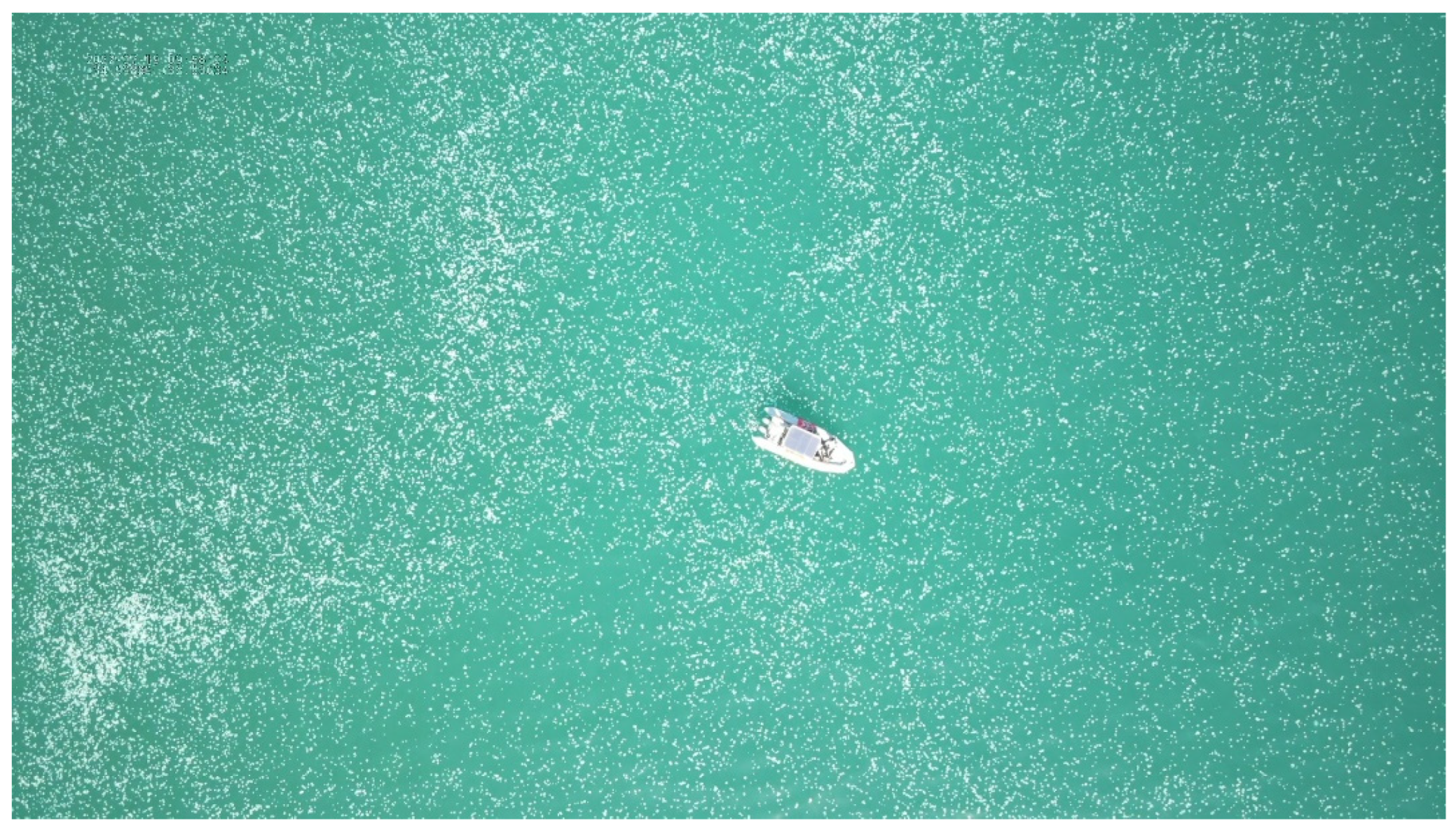
Figure 1. A drone image of Rhopilema nomadica (each white dot represents a medusa) swarming off the coast of Haifa, Israel, July 2022. Height of the drone while shooting the swarm was approximately 50 m. For scale, the boat length is 6.5 m (photo: Rotem Sadeh, Israel Nature and Parks Authority).
Diversity 18 00094 g001
Figure 2. Yitzhak Rakotsh, Jellyfish in the Port. 19.10.1938. Silver print, 16.5 × 23 cm. From Home Port, the story of Haifa Port, October 2002. Haifa Museums, Haifa City Museum. Courtesy of Haifa Port. The species was suggested to be R. nomadica by the authors and by Prof. André C. Morandini, an expert in scyphomedusa taxonomy, University of São Paulo, Brazil.
Diversity 18 00094 g002
Figure 3. (A) Rhopilema nomadica in Israeli waters (photo: B.S. Rothman); (B) Rhopilema nomadica in Tanzanian waters, Mafia Island (photo: https://seaunseen.com). The estimated diameter of both medusae is 30 cm.
Diversity 18 00094 g003
Figure 5. Phylogenetic position of the Tanzanian specimens of R. nomadica. The phylogenetic tree was derived from the maximum likelihood analysis of Rhopilema (each species is highlighted in a different color: R. esculentum in purple; R. verrilli in green; R. hispidum in blue; R. nomadica in red) and Rhizostoma outgroup taxa. The colored arrow indicates the location of the three Tanzanian specimens of R. nomadica. Numbers near the nodes indicate support values in the following order: SH-aLRT, UFBoot, posterior probability resulting from the Bayesian analysis.
Diversity 18 00094 g005
Disclaimer/Publisher’s Note: The statements, opinions and data contained in all publications are solely those of the individual author(s) and contributor(s) and not of MDPI and/or the editor(s). MDPI and/or the editor(s) disclaim responsibility for any injury to people or property resulting from any ideas, methods, instructions or products referred to in the content.