
New Species of Vegavis (Neornithes) from Antarctica Highlights Unexpected Cretaceous Antarctic Diversity

 ,
,  , ,
, ,
Abstract
1. Introduction
2. Materials and Methods
3. Geological Setting
4. Systematic Paleontology
- Loss of teeth (at least in the mandible of MLP-PV 15-I-7-52).
- A hyperinflated cerebrum with ventrally shifted optic lobes (inferred from the endocranial morphology in MLP-PV 15-I-7-52).
- Distal extension of the condylus lateralis beyond the condylus medialis on the femur.
- Condylae of the quadrate separated by an incisura intercapitularis.
- Presence of tuberculum preacetabulare.
Emended Diagnosis
- Deeply excavated fossa temporalis bounded rostrally by the steep, shelf-like fronto-parietal contact and ventrally by a sharp, dorsoventrally compressed ridge. *
- Pterygoid with three anterior, pointed processes and a fan-shaped facies articularis quadratica forming a double articulation with the quadrate. *
- Facies articularis quadratica strongly bent laterally. Rostral pterygoid process spiralled and tapered. *
- Mandible with cotylae lateralis and medialis arranged almost perpendicular to the ramus mandibulae. *
- Deep mandibular neurovascular canal closer to the dorsal margin than to the ventral, making the ventral portion higher than the dorsal one. *
- Well-defined tuberculum laterale. *
- Presence of a fossa at the rostromedial margin of the cotyla lateralis of the mandible [6]. *
- Crista transversa of the mandible with a concave rostral surface (modified from [6]). *
- Lateral crest of mandible projected rostrally.
- Fossa caudalis with a thick and laterally emarginated caudolateral rim (modified [6]). *
- Cotyla medialis of the mandible extended caudomedially to the cotyla lateralis, such that the cotyla medialis approaches the lateral margin of the mandible. *
- Medially projected tubercle on the dorsomedial edge of the mandible, caudal to the “processus coronoideus” (in the sense of mandibular apex). *
- Femur medially curved, with a proximal rounded fossa [1] *
- Well-marked laterocaudal scar for the musculus gastrocnemialis lateralis. *
- Low ridge on the medial edge of the proximal tibiotarsus.
4.1. Vegavis geitononesos sp. nov.
4.1.1. Holotype
4.1.2. Derivation of Name
4.1.3. Diagnosis
- Ala preacetabularis ilii extremely reduced.
- Acetabulum proportionally larger relative to the ala preacetabularis ilii.
- Foramina intervertebralia of synsacrum with figure of eight.
- Femur with narrow sulcus intercondylaris.
- Subequal rostral extension of the trochlea fibularis and crista fibularis.
- Linea intermuscularis lateralis expanded proximodistally and laterally, forming a shelf-like projection (distolateral scar [11]).
- Fossa for insertion of the flexor perforatus digiti II deep, proximolaterally expanded.
- Tarsometatarsal shaft rounded.
- Tarsometatarsus with sulcus extensorius deep and wide.
- Crista dorsalis medialis of the tarsometatarsus lower and broader than the crista dorsalis lateralis.
- Hypotarsus with a closed canal for flexor digitorum longus.
- Narrower cotyla lateralis of the mandible.
- Lateral crest of the mandible extended to the “processus coronoideus”.
- Stronger crista intecotylaris.
- Thinner processus lateralis mandibulare.
- Fossa caudalis of the mandible caudally oriented.
- “Processus retroarticularis” short and ventrally projected.
- “Processus retroarticularis” separated from the ramus mandibulae through a longer ventral margin.
- Lateral crest of the mandible extended to the “processus coronoideus”.
- Higher “processus coronoideus”.
- Concave ventral margin of the articular region.
- Rostrum mandibulare slightly ventrally curved.
4.1.4. Remarks
- Quadrangular processus basipterygoideus in ventral view, separated from the rostrum parasphenoidale, with lateral articular facets.
- Elongated processus orbitalis, tapering distally and directed toward the processus basipterygoideus.
4.1.5. Provenance
4.2. Vegavis notopothousa sp. nov.
4.2.1. Holotype
4.2.2. Derivation of Name
4.2.3. Diagnosis
- Narrows and oval cotyla lateralis of mandible.
- Deeper and laterally displaced fossa in the cotyla lateralis of the mandible.
- Lateral crest of mandible extended to the level of the tuberculum mediale, without a deep, longitudinal fossa.
- Fossa caudalis caudodorsally oriented.
- Crista intercotylaris stronger.
- “Processus retroarticularis” separated from the ramus mandibulae through a shorter and deeper concave ventral margin.
- Caudal margin of the sulcus glandulae nasalis with a defined boundary.
- Basisphenoid with fenestrae.
- More robust medial tubercle of the mandible.
- Medial tubercle caudally displaced respect to the “processus coronoideus” (in the sense of mandibular apex).
- Anterior crest of the cotyla lateralis almost perpendicular to the ramus mandibulae.
- Lateral crest of the mandible rostrally extended to the level of the tuberculum mediale in dorsal view, and not reaching the “processus coronoideus”.
- Fenestra caudalis mandibulae present.
- “Processus coronoideus” (in the sense of mandibular apex) rounded and lower.
- Rostrum mandibulare slightly dorsally curved.
- Convex ventral margin of the articular region of the mandible.
- “Processus retroarticularis” separated from the ramus mandibulae through a shorter and deeper concave ventral margin.
4.2.4. Remarks
4.2.5. Provenance
5. Results
5.1. Description of V. geitononesos sp. nov. and Comparisons
5.1.1. Skull
5.1.2. Lacrimal
5.1.3. Quadrate
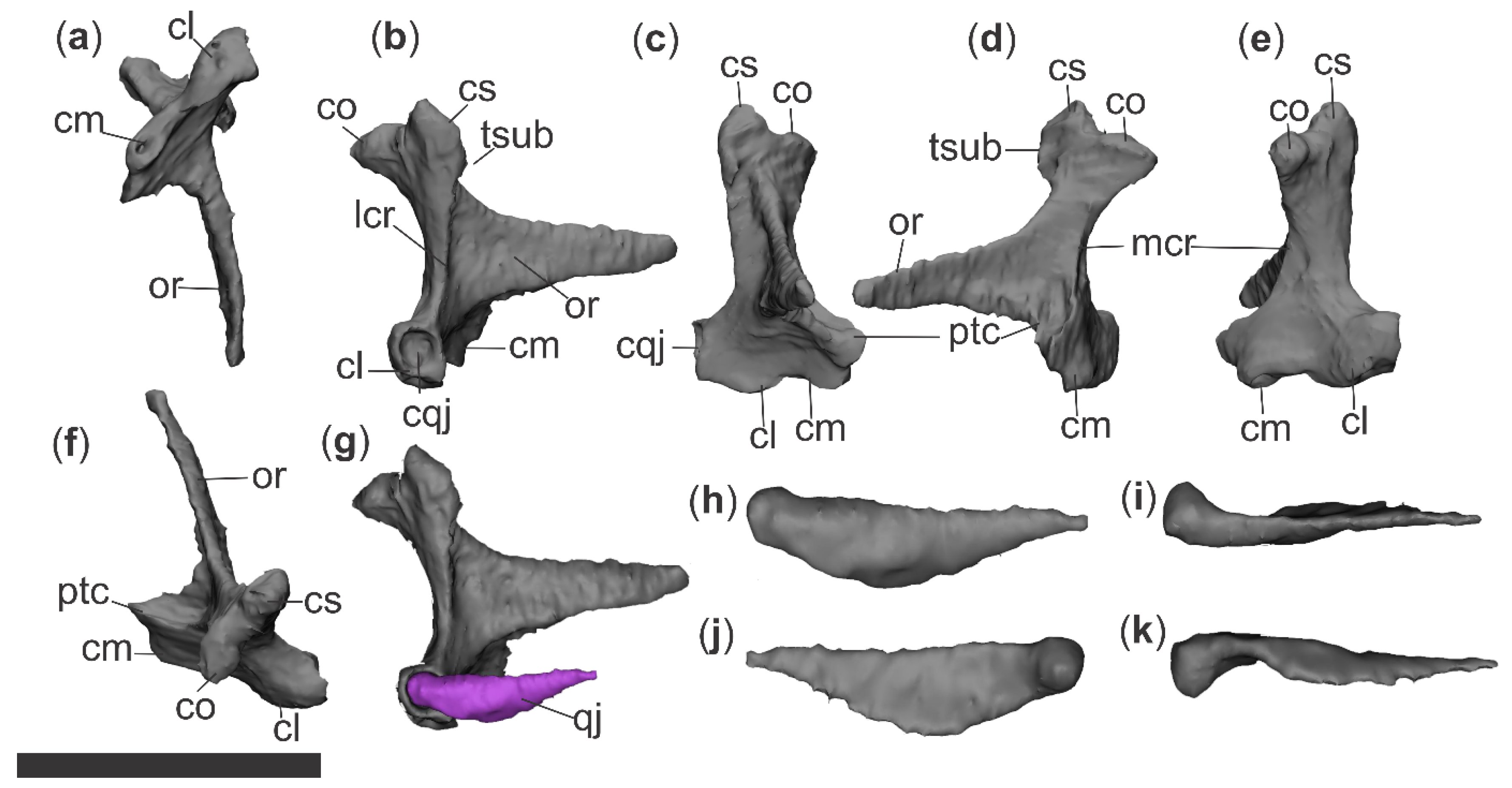
5.1.4. Quadratojugal
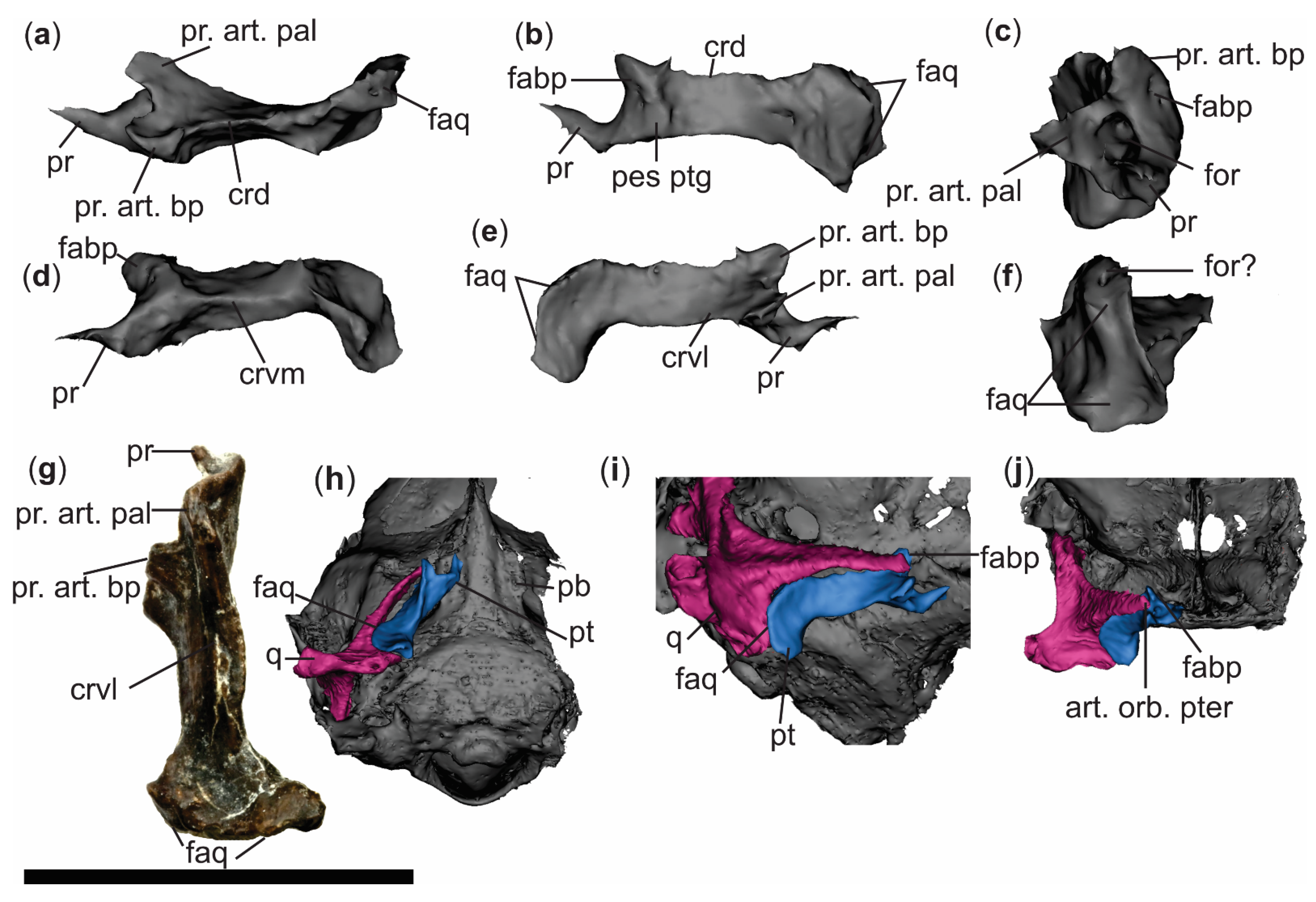
5.1.5. Pterygoid
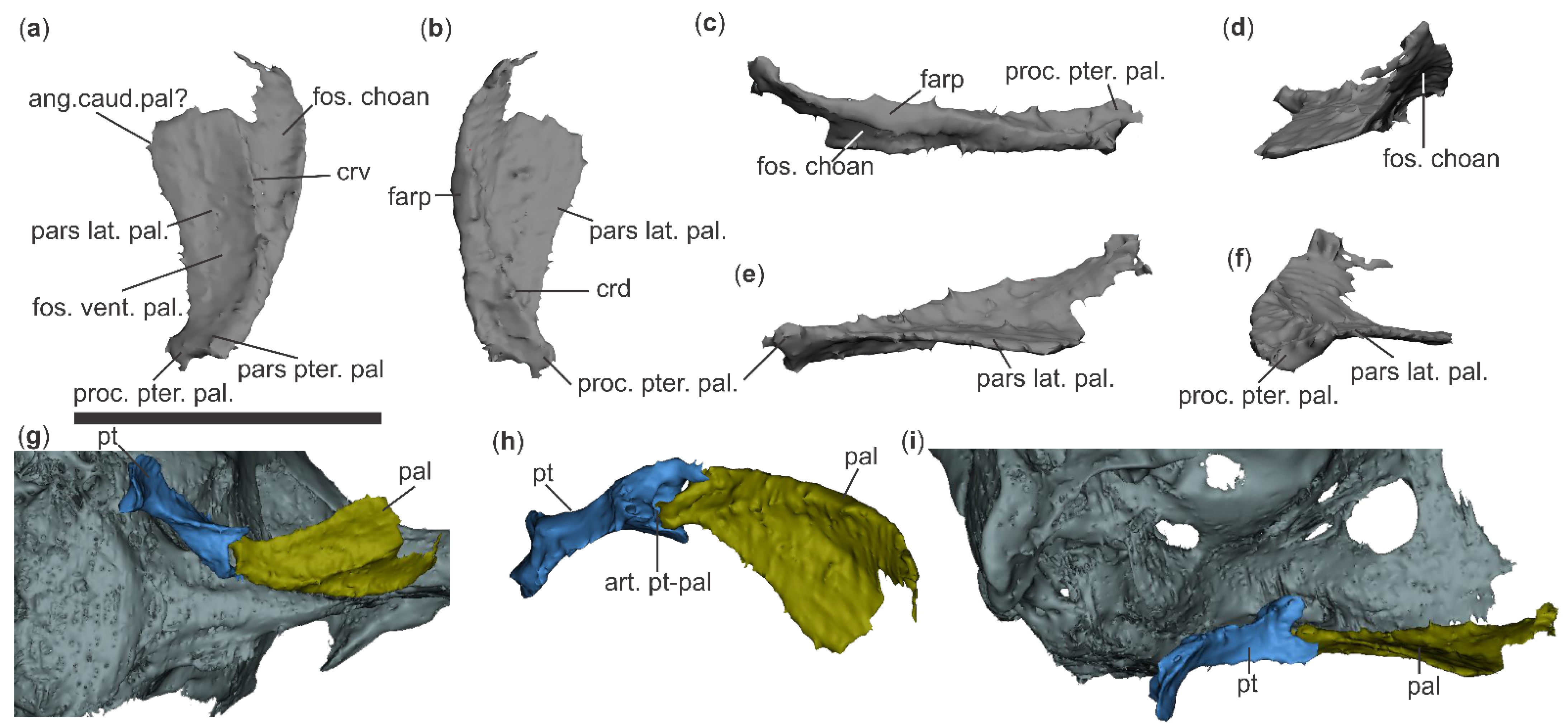
5.1.6. Palatinum
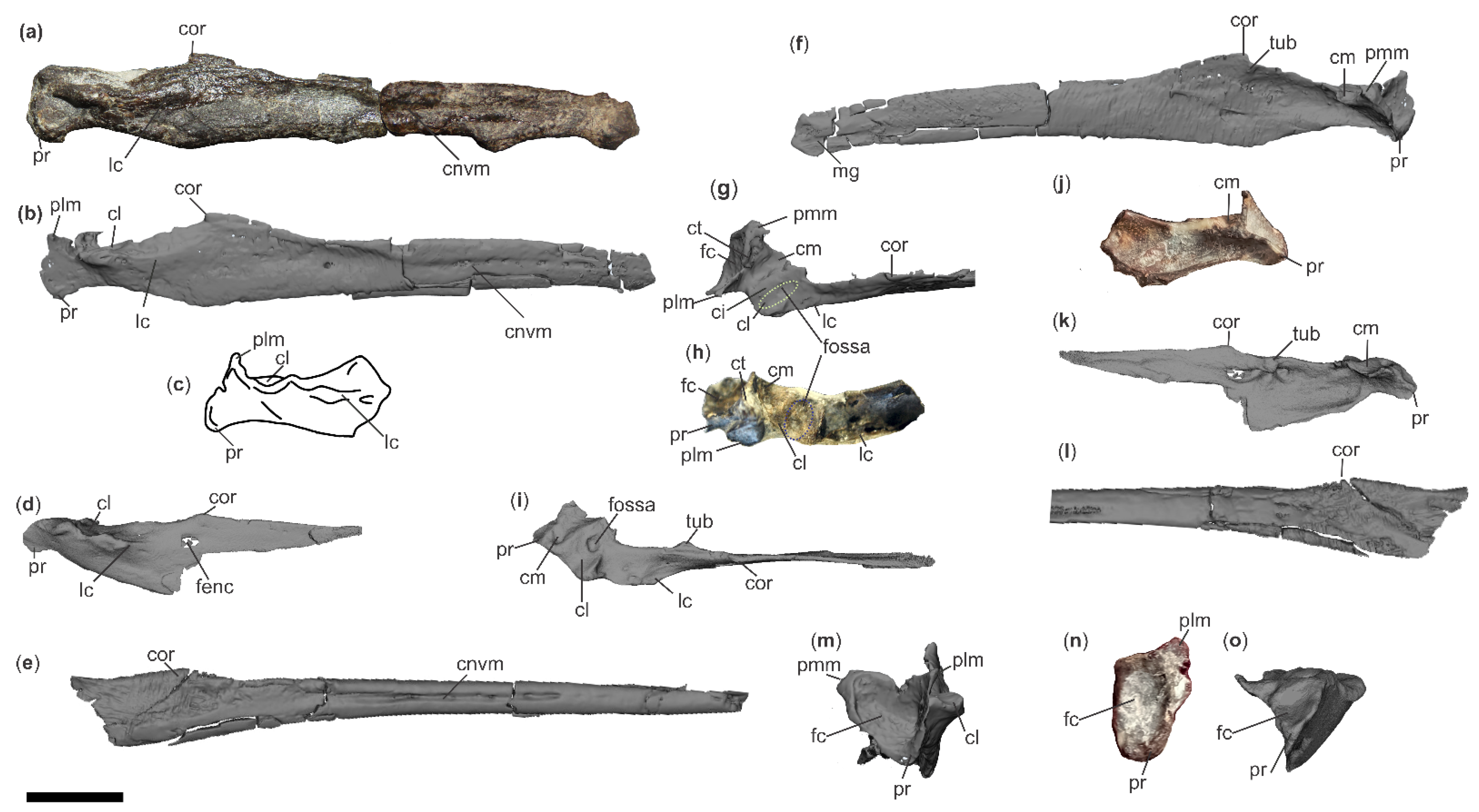
5.1.7. Mandible
5.1.8. Cervical Vertebra Indet
5.1.9. Pelvis
5.1.10. Synsacrum
5.1.11. Femur
5.1.12. Tarsometatarsus
6. Discussion
6.1. Ontogenetic Maturity
6.2. Sexual Dimorphism
- Estimated using the diameters in section.
6.3. Taxonomic Differences
6.4. Insights from Vegavis into Neognathous Palate Evolution
6.5. Paleoecological Implications
7. Conclusions
Supplementary Materials
Author Contributions
Funding
Data Availability Statement
Acknowledgments
Conflicts of Interest
References
- Clarke, J.A.; Tambussi, C.P.; Noriega, J.I.; Erickson, G.M.; Ketcham, R.A. Definitive fossil evidence for the extant avian radiation in the Cretaceous. Nature 2005, 433, 305–308. [Google Scholar] [CrossRef] [PubMed]
- Clarke, J.A.; Chatterjee, S.; Li, Z.; Riede, T.; Agnolin, F.; Goller, F.; Isasi, M.P.; Martinioni, D.R.; Mussel, F.J.; Novas, F.E. Fossil evidence of the avian vocal organ from the Mesozoic. Nature 2016, 538, 502–505. [Google Scholar] [CrossRef]
- Noriega, J.I.; Tambussi, C.P. A Late Cretaceous Presbyornithidae (Aves: Anseriformes) from Vega Island, Antarctic Peninsula: Paleobiogeographic implications. Ameghiniana 1995, 32, 57–61. [Google Scholar]
- Acosta Hospitaleche, C.; Worthy, T.H. New data on the Vegavis iaai holotype from the Maastrichtian of Antarctica. Cretac. Res. 2021, 124, 104818. [Google Scholar] [CrossRef]
- Alvarez-Herrera, G.P.; Rozadilla, S.; Agnolín, F.L.; Novas, F.E. Jaw anatomy of Vegavis iaai (Clarke et al., 2005) from the Late Cretaceous Antarctica, and its phylogenetic implications. Geobios 2024, 83, 11–20. [Google Scholar] [CrossRef]
- Torres, C.R.; Clarke, J.A.; Groenke, J.R.; Lamanna, M.C.; MacPhee, R.D.; Musser, G.M.; Sertich, J.J.W.; O’Connor, P.M. Cretaceous Antarctic bird skull elucidates early avian ecological diversity. Nature 2025, 638, 146–151. [Google Scholar] [CrossRef] [PubMed]
- Field, D.J. Paleontology: Ducks all the way down? Curr. Biol. 2025, 35, R409–R412. [Google Scholar] [CrossRef]
- Crane, A.H.; Benito, J.; Chen, A.; Ksepka, D.T.; Field, D.J. Mandibular morphology clarifies phylogenetic relationships near the origin of crown birds. BMC Ecol. Evo. 2025, 26, 11. [Google Scholar] [CrossRef]
- De Souza, G.A.; Bulak, B.A.; Soares, M.B.; Sayão, J.M.; Weinschütz, L.C.; Batezelli, A.; Kellner, A.W. The Cretaceous Neornithine record and new Vegaviidae specimens from the López de Bertodano Formation (Upper Maastrichtian) of Vega Island, Antarctic Peninsula. An. Acad. Bras. Ciênc. 2023, 95, e20230802. [Google Scholar] [CrossRef]
- Case, J.; Reguero, M.; Martin, J.; Cordes-Person, A. A cursorial bird from the Maastrichtian of Antarctica. J. Verteb. Paleont. 2006, 26, 48A. [Google Scholar]
- West, A.R.; Torres, C.R.; Case, J.A.; Clarke, J.A.; O’Connor, P.M.; Lamanna, M.C. An avian femur from the Late Cretaceous of Vega Island, Antarctic Peninsula: Removing the record of cursorial landbirds from the Mesozoic of Antarctica. PeerJ 2019, 7, e7231. [Google Scholar] [CrossRef]
- Worthy, T.H.; Degrange, F.J.; Handley, W.D.; Lee, M.S.Y. The evolution of giant flightless birds and novel phylogenetic relationships for extinct fowl (Aves, Galloanseres). R. Soc. Open Sci. 2017, 4, 170975. [Google Scholar] [CrossRef]
- Field, D.J.; Benito, J.; Chen, A.; Jagt, J.W.M.; Ksepka, D.T. Late Cretaceous neornithine from Europe illuminates the origins of crown birds. Nature 2020, 579, 397–401. [Google Scholar] [CrossRef]
- Irazoqui, F.; Acosta Hospitaleche, C.; Gelfo, J.N.; Carabajal, A.P.; Bona, P.; Burlaille, L.A. Diving in the Maastrichtian of Marambio (Seymour) Island: A new member of the Neoaves in the Cretaceous Antarctic avifauna. Cretac. Res. 2025, 165, 106259. [Google Scholar] [CrossRef]
- Agnolín, F.L.; Egli, F.B.; Chatterjee, S.; Marsà, J.A.G.; Novas, F.E. Vegaviidae, a new clade of southern diving birds that survived okthe K/T boundary. Sci. Nat. 2017, 104, 87. [Google Scholar] [CrossRef]
- Mayr, G.; De Pietri, V.L.; Scofield, R.P.; Worthy, T.H. On the taxonomic composition and phylogenetic affinities of the recently proposed clade Vegaviidae Agnolín et al., 2017—neornithine birds from the Upper Cretaceous of the Southern Hemisphere. Cretac. Res. 2018, 86, 178–185. [Google Scholar] [CrossRef]
- McLachlan, S.M.S.; Kaiser, G.W.; Longrich, N.R. Maaqwi cascadensis: A large, marine diving bird (Avialae: Ornithurae) from the Upper Cretaceous of British Columbia, Canada. PLoS ONE 2017, 12, e0189473. [Google Scholar] [CrossRef] [PubMed]
- Baumel, J.J.; Witmer, L.M. Osteologia. In Handbook of Avian Anatomy: Nomina Anatomica Avium, 2nd ed.; Baumel, J.J., Ed.; Publications of the Nuttall Ornithological Club: Cambridge, MA, USA, 1993; pp. 45–132. [Google Scholar]
- Mayr, G. Variations in the hypotarsus morphology of birds and their evolutionary significance. Acta Zool. 2016, 97, 196–210. [Google Scholar] [CrossRef]
- Field, D.J.; Lynner, C.; Brown, C.; Darroch, S.A. Skeletal correlates for body mass estimation in modern and fossil flying birds. PLoS ONE 2013, 8, e82000. [Google Scholar] [CrossRef]
- Rinaldi, C.; Massabie, A.; Morelli, J.; Rosenman, L.; Del Valle, R. Geología de la Isla Vicecomodoro Marambio, Antártida; Instituto Antártico Argentino: Buenos Aires, Argentina, 1978; Volume 217, pp. 1–37. [Google Scholar]
- Macellari, C. Stratigraphy, sedimentology, and paleoecology of Upper Cretaceous/Paleocene shelf-deltaic sediments of Seymour Island. In Geology and Paleontology of Seymour Island, Antarctic Peninsula; Feldmann, R.M., Woodburne, M.O., Eds.; Geological Society of America: Boulder, CO, USA, 1988; Volume 169, pp. 25–53. [Google Scholar]
- Marenssi, S.; Santillana, S.; Rinaldi, C. Stratigraphy of La Meseta Formation (Eocene), Marambio Island, Antarctica. Rev. Asoc. Paleontol. Argent. Publ. Espec. 1998, 5, 137–146. [Google Scholar]
- Montes, M.; Nozal, F.; Olivero, E.; Gallastegui, G.; Santillana, S.; Maestro, A.; López-Martínez, J.; González, L.; Martín-Serrano, A. Geología y geomorfología de Isla Marambio (Seymour). In Geología y Geomorfología de Isla Marambio (Seymour); Montes, M., Nozal, F., Eds.; Instituto Geológico y Minero de España: Madrid, Spain; Instituto Antártico Argentino: Buenos Aires, Argentina, 2019. [Google Scholar]
- Olivero, E.; Ponce, J.; Martinioni, D. Sedimentology and architecture of sharp-based tidal sandstones in the Upper Marambio Group, Maastrichtian of Antarctica. Sediment. Geol. 2008, 210, 11–26. [Google Scholar] [CrossRef]
- Crame, J.; Francis, J.; Cantrill, D.; Pirrie, D. Maastrichtian stratigraphy of Antarctica. Cretac. Res. 2004, 25, 411–423. [Google Scholar] [CrossRef]
- Olivero, E.; Medina, F. Patterns of Late Cretaceous ammonite biogeography in southern high latitudes: The Family Kossmaticeratidae in Antarctica. Cretac. Res. 2000, 21, 269–279. [Google Scholar] [CrossRef]
- International Union of Geological Sciences. The First 100 IUGS Geological Heritage Sites: Cretaceous–Paleogene Transition at Seymour (Marambio) Island (Site 021); IUGS: Paris, France, 2022. [Google Scholar]
- Walsh, S.A.; Milner, A.C.; Bourdon, E. A reappraisal of Cerebavis cenomanica (Aves, ornithurae), from Melovatka, Russia. J. Anat. 2016, 229, 215–227. [Google Scholar] [CrossRef]
- Tambussi, C.P.; Degrange, F.J.; De Mendoza, R.S.; Sferco, E.; Santillana, S. A stem anseriform from the early Palaeocene of Antarctica provides new key evidence in the early evolution of waterfowl. Zool. J. Linn. Soc. 2019, 186, 673–700. [Google Scholar] [CrossRef]
- Elzanowski, A.; Stidham, T.A. Morphology of the quadrate in the Eocene anseriform Presbyornis and extant galloanserine birds. J. Morphol. 2010, 271, 305–323. [Google Scholar] [CrossRef]
- Kuo, P.C.; Benson, R.B.; Field, D.J. The influence of fossils in macroevolutionary analyses of 3D geometric morphometric data: A case study of galloanseran quadrates. J. Morphol. 2023, 284, e21594. [Google Scholar] [CrossRef] [PubMed]
- Field, D.J.; Hanson, M.; Burnham, D.; Wilson, L.E.; Super, K.; Ehret, D.; Ebersole, J.A.; Bhullar, B.A.S. Complete Ichthyornis skull illuminates mosaic assembly of the avian head. Nature 2018, 557, 96–100. [Google Scholar] [CrossRef]
- Wang, M.; Li, D.; O’Connor, J.K.; Zhou, Z.; You, H. Second species of enantiornithine bird from the Lower Cretaceous Changma Basin, northwestern China with implications for the taxonomic diversity of the Changma avifauna. Cret. Res. 2015, 55, 56–65. [Google Scholar] [CrossRef]
- Wang, M.; Hu, H. A comparative morphological study of the jugal and quadratojugal in early birds and their dinosaurian relatives. Anatom. Rec. 2017, 300, 62–75. [Google Scholar] [CrossRef] [PubMed]
- Benito, J.; Kuo, P.-C.; Widrig, K.E.; Jagt, J.W.M.; Field, D.J. Cretaceous ornithurine supports a neognathous crown bird ancestor. Nature 2022, 612, 100–105. [Google Scholar] [CrossRef]
- Acosta Hospitaleche, C.; Tambussi, C.; Donato, M.; Cozzuol, M. A new Miocene penguin from Patagonia and its phylogenetic relationships. Acta Palaeontol. Pol. 2007, 52, 299–314. [Google Scholar]
- Degrange, F.J.; Ksepka, D.T.; Tambussi, C.P. Redescription of the oldest crown clade penguin: Cranial osteology, jaw myology, neuroanatomy, and phylogenetic affinities of Madrynornis mirandus. J. Vertebr. Paleontol. 2018, 38, e1445636. [Google Scholar] [CrossRef]
- Starck, J.M.; Chinsamy, A. Bone histology of birds. In Bone Histology of Fossil Tetrapods; Chinsamy-Turan, A., Ed.; University of California Press: Berkeley, CA, USA, 2002; pp. 149–179. [Google Scholar]
- Tumarkin-Deratzian, A.R.; Vann, D.R.; Dodson, P. Bone surface texture as an ontogenetic indicator in long bones of the Canada goose Branta canadensis (Anseriformes: Anatidae). Zool. J. Linn. Soc. 2006, 148, 133–168. [Google Scholar] [CrossRef]
- Sosa, M.A.; Acosta Hospitaleche, C. Ontogenetic variations of the head of Aptenodytes forsteri (Aves, Sphenisciformes): Muscular and skull morphology. Polar Biol. 2018, 41, 225–235. [Google Scholar] [CrossRef]
- Piro, A.; Acosta Hospitaleche, C. Skull morphology and ontogenetic variation of the Southern Giant Petrel Macronectes giganteus (Aves: Procellariiformes). Polar Biol. 2019, 42, 27–45. [Google Scholar] [CrossRef]
- Bailleul, A.M.; Scannella, J.; Horner, J.; Evans, D. Fusion patterns in the skulls of modern archosaurs reveal that sutures are ambiguous maturity indicators for the Dinosauria. PLoS ONE 2016, 11, e0147687. [Google Scholar] [CrossRef]
- Schmid, E.; Tütken, T.; Wings, O. Bone Histology of Birds; Wiley-Blackwell: Chichester, UK, 2013. [Google Scholar]
- Maxwell, E.E.; Harrison, L.B.; Larsson, H.C. Assessing the phylogenetic utility of sequence heterochrony: Evolution of avian ossification sequences as a case study. Zoology 2010, 113, 57–66. [Google Scholar] [CrossRef] [PubMed]
- Plateau, O.; Green, T.L.; Gignac, P.M.; Foth, C. Comparative digital reconstruction of Pica pica and Struthio camelus and their cranial suture ontogenies. Anat. Rec. 2024, 307, 5–48. [Google Scholar]
- Watanabe, J. Ontogeny of macroscopic morphology of limb bones in modern aquatic birds and their implications for ontogenetic ageing. Contrib. MACN 2017, 7, 183–220. [Google Scholar]
- Watanabe, J. Ontogeny of surface texture of limb bones in modern aquatic birds and applicability of textural ageing. Anat. Rec. 2018, 301, 1026–1045. [Google Scholar]
- Maxwell, E.E. Ossification sequence of the avian order Anseriformes, with comparison to other precocial birds. J. Morphol. 2008, 269, 1095–1113. [Google Scholar] [CrossRef] [PubMed]
- Acosta Hospitaleche, C.; Picasso, M.J. Textural ageing in Pygoscelis antarctica (Aves, Sphenisciformes): A new comparative scale for penguin bones. Vertebr. Zool. 2020, 70, 125–139. [Google Scholar]
- Carrier, D.; Leon, L.R. Skeletal growth and function in the California gull (Larus californicus). J. Zool. 1990, 222, 375–389. [Google Scholar]
- Habib, M.B.; Ruff, C.B. The effects of locomotion on limb bone structure in birds. Zool. J. Linn. Soc. 2008, 153, 601–624. [Google Scholar]
- Ksepka, D.T.; Werning, S.; Sclafani, M.; Boles, Z.M. Bone histology in extant and fossil penguins (Aves: Sphenisciformes). J. Anat. 2015, 227, 611–630. [Google Scholar]
- De Mendoza, R.S.; Tambussi, C.P. Osteosclerosis in the extinct Cayaoa bruneti (Aves, Anseriformes): Insights on behavior and flightlessness. Ameghiniana 2015, 52, 305–313. [Google Scholar] [CrossRef]
- Kriloff, A.; Germain, D.; Canoville, A.; Vincent, P.; Sache, M.; Laurin, M. Patterns of bone density in diving birds. J. Morphol. 2008, 269, 532–541. [Google Scholar]
- Griffin, C.T.; Stocker, M.R.; Colleary, C.; Stefanic, C.M.; Lessner, E.J.; Riegler, M.; Formoso, K.K.; Koeller, K.; Nesbitt, S.J. Assessing ontogenetic maturity in extinct saurian reptiles. Biol. Rev. 2021, 96, 470–525. [Google Scholar]
- Watanabe, J.; Matsuoka, H. Ontogenetic change of morphology and surface texture of long bones in the Gray Heron (Ardea cinerea, Ardeidae). In Proceedings of the 8th International Meeting of the Society of Avian Paleontology and Evolution, Vienna, Austria, 12–16 June 2012; pp. 279–306. [Google Scholar]
- Székely, T.; Lislevand, T.; Figuerola, J. Sexual size dimorphism in birds. In Sex, Size and Gender Roles: Evolutionary Studies of Sexual Size Dimorphism; Fairbairn, D.J., Blanckenhorn, W.U., Székely, T., Eds.; Oxford University Press: Oxford, UK, 2007; pp. 27–37. [Google Scholar]
- Livezey, B.C.; Humphrey, P.S. Sexual dimorphism in continental steamer-ducks. Condor 1984, 86, 368–377. [Google Scholar] [CrossRef]
- Handley, W.D.; Chinsamy, A.; Yates, A.M.; Worthy, T.H. Sexual dimorphism in the late Miocene mihirung Dromornis stirtoni (Aves: Dromornithidae) from the Alcoota Local Fauna of central Australia. J. Verteb. Paleont. 2016, 36, e1180298. [Google Scholar] [CrossRef]
- Livezey, B.C. Morphometric patterns in recent and fossil penguins (Aves, Sphenisciformes). J. Zool. 1989, 219, 269–307. [Google Scholar] [CrossRef]
- Kerry, K.R.; Agnew, D.J.; Clarke, J.R.; Else, G.D. Use of morphometric parameters for the determination of sex of Adelie Penguins. Wildl. Res. 1992, 19, 657–664. [Google Scholar] [CrossRef]
- Serrano-Meneses, M.A.; Székely, T. Sexual size dimorphism in seabirds: Sexual selection, fecundity selection and differential niche-utilisation. Oikos 2006, 113, 385–394. [Google Scholar] [CrossRef]
- Einoder, L.D.; Page, B.; Goldsworthy, S.D. Sexual size dimorphism and assortative mating in the Short-tailed Shearwater Puffinus tenuirostris. Mar. Ornithol. 2008, 36, 167–173. [Google Scholar] [CrossRef]
- Pazvant, G.; İnce, N.G.; Özkan, E.; Gündemir, O.; Avanus, K.; Szara, T. Sex determination based on morphometric measurements in yellow-legged gulls (Larus michahellis) around Istanbul. BMC Zool. 2022, 7, 35. [Google Scholar] [CrossRef] [PubMed]
- Aina, O.O.; Ekeolu, O.K. Sexual Dimorphism of the Pelvic Bone and Limbs of Francolinus bicalcaratus. Savannah Vet. J. 2021, 4, 49–55. [Google Scholar]
- Chatterjee, S. The morphology and systematics of Polarornis, a Cretaceous loon (Aves: Gaviidae) from Antarctica. In Proceedings of the 5th Symposium of the Society of Avian Paleontology and Evolution, Beijing, China, 1–4 June 2000; Zhou, Z., Zhang, F., Eds.; Science Press: Beijing, China, 2002; pp. 125–155. [Google Scholar]
- Brownstein, C.D. A juvenile bird with possible crown-group affinities from a dinosaur-rich Cretaceous ecosystem in North America. BMC Ecol. Evol. 2024, 24, 20. [Google Scholar]
- Elzanowski, A. On the role of basipterygoid processes in some birds. Verh. Anat. Ges. 1977, 71, 1303–1307. [Google Scholar]
- Mayr, G.; De Pietri, V.L.; Proffitt, J.; Blokland, J.C.; Clarke, J.A.; Love, L.; Mannering, A.A.; Scofield, R.P. Multiple exceptionally preserved fossils from the Paleocene Waipara Greensand inform the diversity of the oldest stem group Sphenisciformes and the formation of their diving adaptations. Zool. J. Linn. Soc. 2025, 204, zlaf080. [Google Scholar] [CrossRef]
- Wilken, A.T.; Sellers, K.C.; Davis, J.L.; Witmer, L.M.; Holliday, C.M. Reply to Benito et al.: Problems in the Cretaceous evolution of the avian palatobasal joint. Proc. Natl. Acad. Sci. USA 2026, 123, e2520865123. [Google Scholar] [CrossRef]
- Bock, W.J. Kinetics of the avian skull. J. Morphol. 1964, 114, 1–42. [Google Scholar] [CrossRef]
- Acosta Hospitaleche, C.I.; Piro, A.; Sosa, M.A. The mandibulosphenoidal joint in penguins, albatrosses, and petrels: Comparative anatomy and functional implications. Vert. Zool. 2020, 12, 118. [Google Scholar]
- Houde, P.; Dickson, M.; Camarena, D. Basal anseriformes from the early Paleogene of North America and Europe. Diversity 2023, 15, 233. [Google Scholar] [CrossRef]
- Elzanowski, A.; Stidham, T.A. A galloanserine quadrate from the Late Cretaceous Lance Formation of Wyoming. Auk 2011, 128, 138–145. [Google Scholar] [CrossRef]
- Kuo, P.-C.; Navalón, G.; Benson, R.B.J.; Field, D.J. Macroevolutionary drivers of morphological disparity in the avian quadrate. Proc. R. Soc. B 2024, 291, 20232250. [Google Scholar] [CrossRef]
- Crane, A.; Benito, J.; Chen, A.; Musser, G.; Torres, C.R.; Clarke, J.A.; Lamanna, M.C.; O’Connor, P.M.; Ksepka, D.T.; Field, D.J. Taphonomic damage obfuscates interpretation of the retroarticular region of the Asteriornis mandible. Geobios 2025, 90, 31–43. [Google Scholar] [CrossRef]
- Mayr, G. Cenozoic mystery birds—On the phylogenetic affinities of bony-toothed birds (Pelagornithidae). Zool. Scr. 2011, 40, 448–467. [Google Scholar] [CrossRef]
- Acosta Hospitaleche, C.; Irazoqui, F.; Bona, P.; Paulina-Carabajal, A. Review of the Cretaceous avian diversity of Antarctica: A changing scenario for the evolution of early Neornithine birds. Adv. Polar Sci. 2024, 35, 1–13. [Google Scholar] [CrossRef]
- Bell, A.; Chiappe, L.M. The Hesperornithiformes: A review of the diversity, distribution, and ecology of the earliest diving birds. Diversity 2022, 14, 267. [Google Scholar] [CrossRef]
- Petalas, C.; Lazarus, T.; Layoie, R.A.; Elliott, K.H.; Guigueno, M.F. Foraging niche partitioning in sympatric seabird populations. Sci. Res. 2021, 11, 2493. [Google Scholar] [CrossRef] [PubMed]
- Watanuki, Y.; Burger, A.E. Body mass and dive duration in alcids and penguins. Can. J. Zool. 1999, 77, 1838–1842. [Google Scholar] [CrossRef]
- Halsey, L.G.; Blackburn, T.M.; Butler, P.J. A comparative analysis of the diving behaviour of birds and mammals. Funct. Ecol. 2006, 20, 889–899. [Google Scholar] [CrossRef]
- Kooyman, G.L.; Ponganis, P.J. The physiological basis of diving to depth: Birds and mammals. Annu. Rev. Physiol. 1998, 60, 19–32. [Google Scholar] [CrossRef]
- de Vries, J.; van Eerden, M.R. Thermal conductance in aquatic birds in relation to the degree of water contact, body mass, and body fat: Energetic implications of living in a strong cooling environment. Physiol. Zool. 1995, 68, 1143–1163. [Google Scholar] [CrossRef]
- Houssaye, A. “Pachyostosis” in aquatic amniotes: A review. Integr. Zool. 2009, 4, 325–340. [Google Scholar] [CrossRef]
- Taylor, M.A. Functional significance of bone ballastin in the evolution of buoyancy control strategies by aquatic tetrapods. Hist. Biol. 2000, 14, 15–31. [Google Scholar] [CrossRef]
- Dumont, M.; Laurin, M.; Jacques, F.; Pellé, E. Inner architecture of vertebral bone in terrestrial and aquatic amniotes and its relation to density. J. Morphol. 2013, 274, 1089–1100. [Google Scholar] [CrossRef]
- García Marsà, J.A.; Agnolín, F.; Novas, F.E. Bone microstructure of Vegavis iaai (Aves, Anseriformes) from the Upper Cretaceous of Vega Island, Antarctic Peninsula. Hist. Biol. 2019, 31, 163–167. [Google Scholar] [CrossRef]
- Fabbri, M.; Navalón, G.; Benson, R.B.; Pol, D.; O’Connor, J.; Bhullar, B.A.S.; Erickson, G.M.; Norell, M.A.; Orkney, A.; Lamanna, M.C.; et al. Subaqueous foraging among carnivorous dinosaurs. Nature 2022, 603, 852–857. [Google Scholar] [CrossRef]
- Cordes-Person, A.; Acosta Hospitaleche, C.; Case, J.; Martin, J. An enigmatic bird from the lower Maastrichtian of Vega Island, Antarctica. Cretac. Res. 2020, 108, 104314. [Google Scholar] [CrossRef]
- De Mendoza, R.S.; Gómez, R.O. Ecomorphology of the tarsometatarsus of waterfowl (Anseriformes) based on geometric morphometrics and its application to fossils. Anat. Rec. 2022, 305, 3243–3253. [Google Scholar] [CrossRef]
- Clifton, G.T.; Carrano, M.T.; Hutchinson, J.R. Evolution of pelvic limb muscle moment arms in birds and their relationship to locomotor behaviour. Proc. R. Soc. B 2018, 285, 20171766. [Google Scholar]
- Hutchinson, J.R. The evolution of hindlimb tendons and muscles on the line to crown-group birds. Comp. Biochem. Physiol. A 2002, 133, 1051–1086. [Google Scholar]
- Hutchinson, J.R.; Allen, V. The evolutionary continuum of limb function from early theropods to birds. Naturwissenschaften 2009, 96, 423–448. [Google Scholar]
- Zeffer, A.; Johansson, L.C.; Marmebro, Å. Functional correlation between habitat use and leg morphology in birds (Aves). Biol. J. Linn. Soc. 2003, 79, 461–484. [Google Scholar] [CrossRef]
- Doube, M.; Yen, S.C.; Kłosowski, M.M.; Farke, A.A.; Hutchinson, J.R.; Shefelbine, S.J. Whole-bone scaling of the avian pelvic limb. J. Anat. 2012, 221, 21–29. [Google Scholar] [CrossRef] [PubMed]



| Taxa | Element | Estimator (Author) | BM | Min BM | Max BM |
|---|---|---|---|---|---|
| Polarornis gregorii | Femur (1) | Circumference [20], | 2820 g | 1895 g | 3745 g |
| Pujatopouli soberana | Humerus | Circumference | 2030 g | 1454 g | 2606 g |
| Vegavis iaai MLP-PV 93-I-3-1 | Femur | Circumference [20], | 1189 g | 799 g | 1579 g |
| V. iaai MLP-PV 93-I-3-1 | coracoid | Faceta humeralis [20], | 1180 g | 1027 g | 1333 g |
| V. geitononesos MLP-PV 15-I-7-52 | Femur | Circumference [20], | 696 g | 468 g | 924 g |
| Antarcticavis capelambensis | Femur | Circumference [20], | 870 g | 623 g | 1117 g |
| Conflicto antarcticus | Femur | Circumference [20], | 1642 g | 1102 g | 2178 g |
Disclaimer/Publisher’s Note: The statements, opinions and data contained in all publications are solely those of the individual author(s) and contributor(s) and not of MDPI and/or the editor(s). MDPI and/or the editor(s) disclaim responsibility for any injury to people or property resulting from any ideas, methods, instructions or products referred to in the content. |
© 2026 by the authors. Licensee MDPI, Basel, Switzerland. This article is an open access article distributed under the terms and conditions of the Creative Commons Attribution (CC BY) license.
Share and Cite
Irazoqui, F.; Acosta Hospitaleche, C.; Paulina-Carabajal, A.; Bona, P.; Vega, N. New Species of Vegavis (Neornithes) from Antarctica Highlights Unexpected Cretaceous Antarctic Diversity. Diversity 2026, 18, 82. https://doi.org/10.3390/d18020082
Irazoqui F, Acosta Hospitaleche C, Paulina-Carabajal A, Bona P, Vega N. New Species of Vegavis (Neornithes) from Antarctica Highlights Unexpected Cretaceous Antarctic Diversity. Diversity. 2026; 18(2):82. https://doi.org/10.3390/d18020082
Chicago/Turabian StyleIrazoqui, Facundo, Carolina Acosta Hospitaleche, Ariana Paulina-Carabajal, Paula Bona, and Nahuel Vega. 2026. "New Species of Vegavis (Neornithes) from Antarctica Highlights Unexpected Cretaceous Antarctic Diversity" Diversity 18, no. 2: 82. https://doi.org/10.3390/d18020082
APA StyleIrazoqui, F., Acosta Hospitaleche, C., Paulina-Carabajal, A., Bona, P., & Vega, N. (2026). New Species of Vegavis (Neornithes) from Antarctica Highlights Unexpected Cretaceous Antarctic Diversity. Diversity, 18(2), 82. https://doi.org/10.3390/d18020082