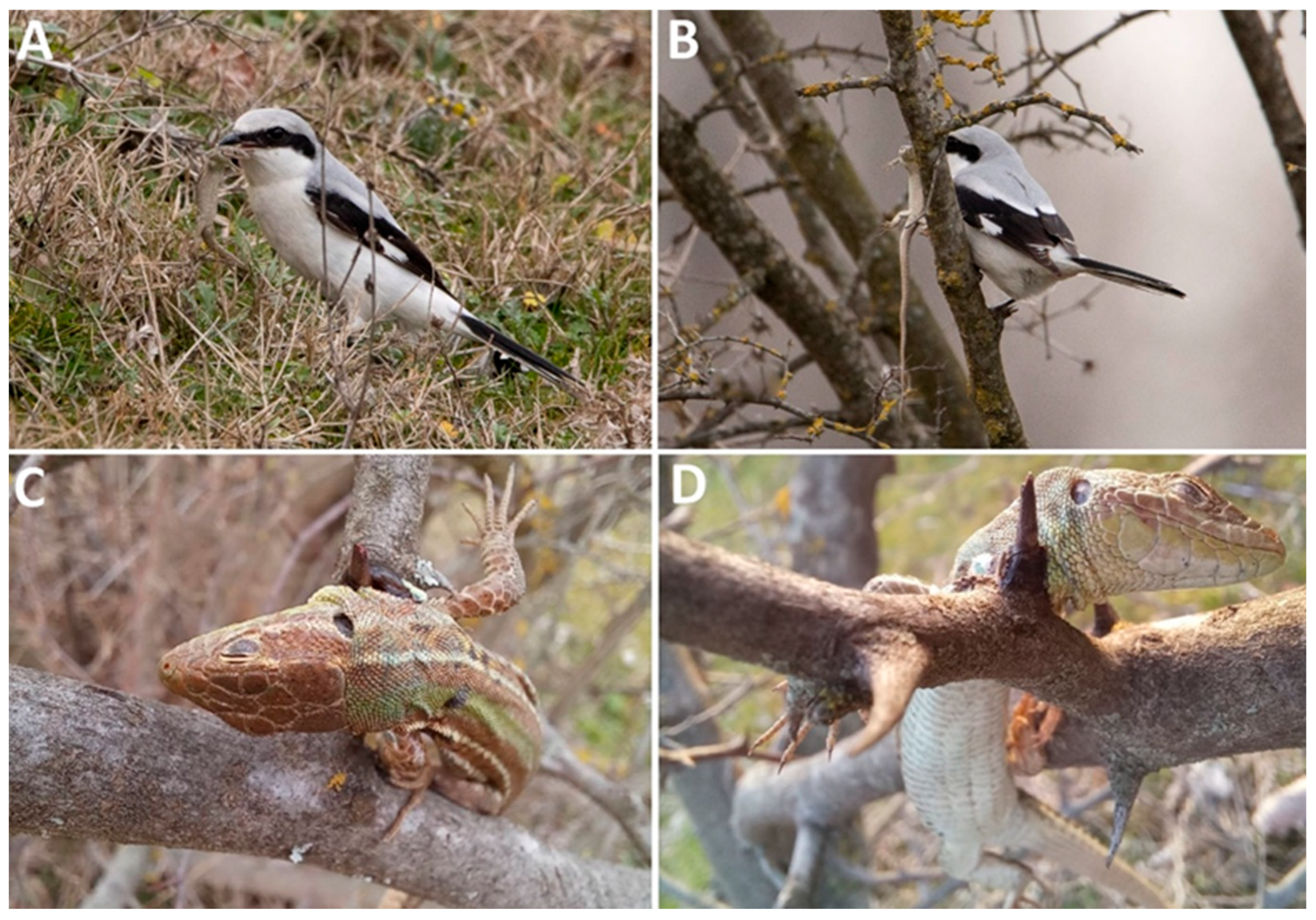

Venturing out of Overwinter Refuge: A Case of Winter Predation on Podarcis tauricus (Georgi, 1801) (Squamata: Lacertidae) by Lanius excubitor Linnaeus, 1758 (Aves: Laniidae) in Greece



Abstract
Author Contributions
Funding
Institutional Review Board Statement
Data Availability Statement
Acknowledgments
Conflicts of Interest
References
- Fuchs, J.; Alström, P.; Yosef, R.; Olsson, U. Miocene diversification of an open-habitat predatorial passerine radiation, the shrikes (Aves: Passeriformes: Laniidae). Zool. Scr. 2019, 48, 571–588. [Google Scholar] [CrossRef]
- Padilla, D.P.; González-Castro, A.; Nieves, C.; Nogales, M. Trophic ecology of the Southern Grey Shrike (Lanius meridionalis) in insular environments: The influence of altitude and seasonality. J. Ornithol. 2009, 150, 557–568. [Google Scholar] [CrossRef]
- Morelli, F.; Saltarelli, M.; Pruscini, F.; Benedetti, Y. First description of red-backed shrike Lanius collurio food caching in Central Italy: Prey’s type and spatial position into the larders. Avocetta 2013, 37, 27–34. [Google Scholar]
- Cogălniceanu, D.; Valdeón, A.; Gosá, A.; Al-Hemaidi, A.A.M.; Castilla, A.M. Shrike predation on the lizard Mesalina adramitana in Qatar; a review of reported reptile and amphibian prey. QScience Connect 2015, 2015, 1–8. [Google Scholar] [CrossRef]
- Taibi, A.; Brahimi, D.; Doumandji, S. Food larders of the Southern Grey Shrike Lanius meridionalis algeriensis (Laniidae, Passeriformes) in Algeria. North West J. Zool. 2018, 14, 273–275. [Google Scholar]
- Kočí, J.; Krištín, A. On the occurrence and diet of a migrating Woodchat Shrike (Lanius senator) in Slovakia. Tichodroma 2020, 32, 47–50. [Google Scholar] [CrossRef]
- Caballero, J.M.; Balmori-de la Puente, A.; Calderón, T.; de la Calle, I.; Balmori, A. Southern grey shrike as a predator of reptiles on the island of gran canaria and a comparison between island and mainland predation rates. Herpetol. Bull. 2021, 157, 16–20. [Google Scholar] [CrossRef]
- Tryjanowski, P.; Hromada, M.; Antczak, M. Breeding habitat selection in the Great Grey Shrike Lanius excubitor—The importance of meadows and spring crops. Acta Ornithol. 1999, 34, 59–63. [Google Scholar]
- Nikolov, B.P.; Kodzhabashev, N.D.; Popov, V.V. Diet composition and spatial patterns of food caching in wintering Great Grey Shrikes (Lanius excubitor) in Bulgaria. Biol. Lett. 2004, 41, 119–133. [Google Scholar]
- Brzezinski, M.; Zalewski, A.; Szalanski, P.; Kowalczyk, R. Feeding habits of Great Grey Shrike (Lanius excubitor) wintering in north-eastern Poland: Does prey abundance affect selection of prey size? Ornis Fenn. 2010, 87, 1–14. [Google Scholar] [CrossRef]
- Antczak, M.; Hromada, M.; Tryjanowski, P. Sex differences in impaling behaviour of Great Grey Shrike Lanius excubitor: Do males have better impaling skills than females? Behav. Process. 2012, 91, 50–53. [Google Scholar] [CrossRef] [PubMed]
- Handrinos, G.; Akriotis, T. The Birds of Greece; Christopher Helm: London, UK, 1997. [Google Scholar]
- Grönlund, S.; Itämies, J.; Mikkola, H. On the food and feeding habits of the great grey shrike (ILanius excubitor) in Finland. Ornis Fenn. 1970, 47, 167–171. [Google Scholar]
- Lorek, G.; Tryjanowski, P.; Lorek, J. Birds as prey of the Great Grey Shrike (Lanius excubitor). Ring 2000, 22, 37–44. [Google Scholar]
- Karlsson, S. Analysis on prey composition of overwintering great grey shrikes Lanius excubitor in southern Finland. Ornis Fenn. 2002, 79, 181–189. [Google Scholar]
- Karlsson, S. Food consumption and roosting behaviour of Great Grey Shrikes Lanius excubitor wintering in south-western Finland. Ornis Fenn. 2007, 84, 57–65. [Google Scholar]
- Antczak, M.; Hromada, M.; Tryjanowski, P. Frogs and toads in the food of the Great Grey Shrike (Lanius excubitor): Larders and skinning as two ways to consume dangerous prey. Anim. Biol. 2005, 55, 227–233. [Google Scholar] [CrossRef]
- Antczak, M.; Ekner-Grzyb, A.; Majláth, I.; Majláthová, V.; Bona, M.; Hromada, M.; Tryjanowski, P. Do males pay more? A male-biased predation of common lizard (Zootoca vivipara) by great grey shrike (Lanius excubitor). Acta Ethol. 2019, 22, 155–162. [Google Scholar] [CrossRef]
- Paczuska, M.; Golawski, A. Winter Records of Amphibians as Avian Prey: The Case of the Great Grey Shrike and the Smooth Newt. Ornithol. Sci. 2021, 20, 115–118. [Google Scholar] [CrossRef]
- Paczuska, M.; Jaskuła, R.; Golawski, A. Diet composition and prey choice by the Great Grey Shrike Lanius excubitor during the non-breeding period: Comparing two methods of diet analysis. Bird Study 2021, 68, 183–189. [Google Scholar] [CrossRef]
- O’Shea, M. Lizards of the World: A Guide to Every Family; Ivy Press: Brighton, UK, 2021; ISBN 978-1-78240-957-1. [Google Scholar]
- Uetz, P.; Freed, P.; Aguilar, R.; Reyes, F.; Kudera, J.; Hošek, J. The Reptile Database. Available online: http://www.reptile-database.org (accessed on 20 March 2025).
- Psonis, N.; Antoniou, A.; Kukushkin, O.; Jablonski, D.; Petrov, B.; Crnobrnja-Isailović, J.; Sotiropoulos, K.; Gherghel, I.; Lymberakis, P.; Poulakakis, N. Hidden diversity in the Podarcis tauricus (Sauria, Lacertidae) species subgroup in the light of multilocus phylogeny and species delimitation. Mol. Phylogenet. Evol. 2017, 106, 6–17. [Google Scholar] [CrossRef]
- Valakos, E.; Pafilis, P.; Lymberakis, P.; Maragou, P.; Sotiropoulos, K.; Foufopoulos, J. The Amphibians and Reptiles of Greece; Edition Chimaira: Frankfurt am Main, Germany, 2008; ISBN 9783899734614. [Google Scholar]
- Fischer, D.; Babická, K.; Fischerová, J.; Lerch, Z.; Mikátová, B.; Reiter, A.; Rehák, I. Discovery of the Podarcis tauricus population in the Czech Republic (Squamata: Lacertidae). Acta Soc. Zool. Bohem. 2019, 83, 239–254. [Google Scholar]
- Sas-Kovács, É.H.; Sas-Kovács, I. Can I borrow your burrow? Use of the burrows of Geolycosa vultuosa (Araneae: Lycosidae) by Podarcis tauricus (Squamata: Lacertidae). Biharean Biol. 2020, 14, 127–129. [Google Scholar]
- Mollov, I.; Valkanova, M. Risks and Opportunities of Urbanization—Structure of Two Populations of the Balkan Wall Lizard Podarcis tauricus (Pallas, 1814) in the City of Plovdiv. Ecol. Balk. 2009, 1, 27–39. [Google Scholar]
- Mollov, I.; Boyadzhiev, P.; Donev, A. Trophic role of the Marsh Frog Pelophylax ridibundus (Pallas, 1771) (Amphibia, Anura) in the aquatic ecosystems. Bulg. J. Agric. Sci. 2010, 16, 298–306. [Google Scholar]
- Sándor, A.D. The summer diet of barn owl (Tyto alba) (Aves: Strigiformes) in the southern part of Danube Delta Biosphere Reserve. Acta Zool. Bulg. 2009, 61, 87–92. [Google Scholar]
- Móré, A.; Mizsei, E.; Vadász, C.; Tóthmérész, B.; Heltai, M. Analysis of mammal mesopredator scat samples indicates significant predation on the endangered Hungarian meadow viper (Vipera ursinii rakosiensis). Wildlife Biol. 2022, 2022, e01033. [Google Scholar] [CrossRef]
- Zevgolis, Y.G.; Kotselis, C.; Kouris, A.D.; Christopoulos, A. A New Aspect of Predator–Prey Dynamics: The Case of a Livestock Guardian Dog Predating upon an Invasive Coypu in Lake Kerkini, Greece. Conservation 2024, 4, 609–616. [Google Scholar] [CrossRef]
- Padilla, D.P.; Nogales, M.; Pérez, A.J. Seasonal diet of an insular endemic population of Southern Grey Shrike Lanius meridionalis koenigi on Tenerife, Canary Islands. Ornis Fenn. 2005, 82, 155–165. [Google Scholar]
- Hodar, J.A. Diet composition and prey choice of the Southern grey shrike Lanius meridionalis L. in South-eastern Spain: The importance of vertebrates in the diet. Ardeola 2006, 53, 237–249. [Google Scholar]
- Pujol-buxó, E.; Vasconcelos, R.; Suleiman, A.S.; Santos, X. Predation on Trachylepis socotrana by Lanius meridionalis. Boletín La Asoc. Herpetológica Española 2014, 25, 33–35. [Google Scholar]
- Sonerud, G.A. Nordic Society Oikos Allocation of Prey between Self-Consumption and Transport in Two Different-Sized Central Place Foragers. Ornis Scand. 1989, 20, 69–71. [Google Scholar] [CrossRef]
- Bijlsma, R.G. Voedsel van Klapeksters Lanius excubitor in het broedseizoen. Drentse Vogels 1995, 8, 85–96. [Google Scholar]
- Kati, V.; Foufopoulos, J.; Ioannidis, Y.; Papaioannou, H.; Poirazidis, K.; Lebrun, P. Diversity, ecological structure and conservation of herpetofauna in a Mediterranean area (Dadia National Park, Greece). Amphib. Reptil. 2007, 28, 517–529. [Google Scholar] [CrossRef]
- Pafilis, P.; Maragou, P. Atlas of Amphibian and Reptiles of Greece; Broken Hill Publishers Ltd.: Nicosia, Cyprus, 2020; ISBN 978-9925-588-03-9. [Google Scholar]
- Mizsei, E.; Fejes, Z.; Malatinszky, Á.; Lengyel, S.; Vadász, C. Reptile responses to vegetation structure in a grassland restored for an endangered snake. Community Ecol. 2020, 21, 203–212. [Google Scholar] [CrossRef]
- Kuczyński, L.; Antczak, M.; Czechowski, P.; Grzybek, J.; Jerzak, L.; Zabocki, P.; Tryjanowski, P. A large scale survey of the great grey shrike Lanius excubitor Poland: Breeding densities, habitat use and population trends. Ann. Zool. Fenn. 2010, 47, 67–78. [Google Scholar] [CrossRef]
- Schneider, S.; Steinmetz, M.; Coppes, J. Hunting habitat selection of breeding great grey shrikes Lanius excubitor Linnaeus, 1758 in Luxembourg. Bull. Soc. Nat. Luxemb 2019, 121, 291–308. [Google Scholar]
- HNMS. Climatic Data for Selected Stations in Greece. Available online: https://www.emy.gr/en/climatic-data?tab=statistics-tab (accessed on 15 May 2025).
- Stefanidis, K.; Varlas, G.; Papadopoulos, A.; Dimitriou, E. Four Decades of Surface Temperature, Precipitation, and Wind Speed Trends over Lakes of Greece. Sustainability 2021, 13, 9908. [Google Scholar] [CrossRef]

Disclaimer/Publisher’s Note: The statements, opinions and data contained in all publications are solely those of the individual author(s) and contributor(s) and not of MDPI and/or the editor(s). MDPI and/or the editor(s) disclaim responsibility for any injury to people or property resulting from any ideas, methods, instructions or products referred to in the content. |
© 2025 by the authors. Licensee MDPI, Basel, Switzerland. This article is an open access article distributed under the terms and conditions of the Creative Commons Attribution (CC BY) license (https://creativecommons.org/licenses/by/4.0/).
Share and Cite
Christopoulos, A.; Kotselis, C.; Zevgolis, Y.G. Venturing out of Overwinter Refuge: A Case of Winter Predation on Podarcis tauricus (Georgi, 1801) (Squamata: Lacertidae) by Lanius excubitor Linnaeus, 1758 (Aves: Laniidae) in Greece. Diversity 2025, 17, 829. https://doi.org/10.3390/d17120829
Christopoulos A, Kotselis C, Zevgolis YG. Venturing out of Overwinter Refuge: A Case of Winter Predation on Podarcis tauricus (Georgi, 1801) (Squamata: Lacertidae) by Lanius excubitor Linnaeus, 1758 (Aves: Laniidae) in Greece. Diversity. 2025; 17(12):829. https://doi.org/10.3390/d17120829
Chicago/Turabian StyleChristopoulos, Apostolos, Christos Kotselis, and Yiannis G. Zevgolis. 2025. "Venturing out of Overwinter Refuge: A Case of Winter Predation on Podarcis tauricus (Georgi, 1801) (Squamata: Lacertidae) by Lanius excubitor Linnaeus, 1758 (Aves: Laniidae) in Greece" Diversity 17, no. 12: 829. https://doi.org/10.3390/d17120829
APA StyleChristopoulos, A., Kotselis, C., & Zevgolis, Y. G. (2025). Venturing out of Overwinter Refuge: A Case of Winter Predation on Podarcis tauricus (Georgi, 1801) (Squamata: Lacertidae) by Lanius excubitor Linnaeus, 1758 (Aves: Laniidae) in Greece. Diversity, 17(12), 829. https://doi.org/10.3390/d17120829