
First Account of Epibiotic Diatom Taxa from the Carapaces of Green Swimming Crab Callinectes bellicosus (Stimpson 1859) (Decapoda, Portunidae)

 , ,
, , 
Abstract
1. Introduction
2. Materials and Methods
3. Results
4. Discussion
Author Contributions
Funding
Institutional Review Board Statement
Data Availability Statement
Acknowledgments
Conflicts of Interest
References
- Dvoretsky, A.G.; Dvoretsky, V.G. Epibiotic communities of common crab species in the coastal Barents Sea: Biodiversity and infestation patterns. Diversity 2022, 14, 6. [Google Scholar] [CrossRef] [Scilit]
- Totti, C.; Romagnoli, T.; De Stefano, M.; Camillo, D.C.G.; Bavestrello, G. The diversity of epizoic Diatoms. In All Flesh Is Grass. Cellular Origin, Life in Extreme Habitats and Astrobiology; Dubinsky, Z., Seckbach, J., Eds.; Springer: Dordrecht, The Netherlands, 2010; Volume 16. [Google Scholar] [CrossRef] [Scilit]
- Tiffany, M.A. Epizoic and Epiphytic Diatoms. In The Diatom World; Seckbach, J., Kociolek, J.P., Eds.; Springer: New York, NY, USA, 2011; pp. 197–209. [Google Scholar] [CrossRef] [Scilit]
- Wujek, D.E. Epizoic Diatoms on the cerci of Ephemenoptera (Caenidae) Naiads. Great Lakes Entomol. 2013, 46, 8. [Google Scholar] [CrossRef] [Scilit]
- Cribb, A.B. Algae on the Hawks-Bill turtle. Qsl. Nat. 1969, 19, 108–109. [Google Scholar]
- Croll, D.A.; Holmes, R.-W. A note on the occurrence of diatoms on the feathers of diving seabirds. Auk 1982, 99, 765–766. [Google Scholar] [CrossRef] [Scilit]
- Denys, L. Morphology and taxonomy of epizoic diatoms (Epiphalaina and Tursiocola) on a sperm whale (Physeter macrocephalus) stranded on the coast of Belgium. Diatom. Res. 1997, 12, 1–18. [Google Scholar] [CrossRef] [Scilit]
- Hart, T.J. On the diatoms of the skin film of whales, and their possible bearing on problems of whale movements. Discov. Rep. 1935, 10, 247–282. [Google Scholar]
- Holmes, R.W. The Morphology of diatoms epizoic on Cetaceans and their transfer from Cocconeis to two new genera, Bennettella and Epipellis. Br. Phycol. J. 1985, 20, 43–57. [Google Scholar] [CrossRef] [Scilit]
- Becker, K. Epibionts on carapaces of some Malacostracans from the Gulf of Thailand. J. Crustac. Biol. 1996, 16, 92–104. [Google Scholar] [CrossRef] [Scilit]
- Gaiser, E.E.; Bachmann, R.W. The ecology and taxonomy of epizoic diatoms on Cladocera. Limnol. Oceanogr. 1993, 38, 628–637. [Google Scholar] [CrossRef] [Scilit]
- Gibson, R.A. Pseudohimantidium pacificum, an epizoic diatom new to the Florida current (western North Atlantic Ocean). J. Phyc. 1978, 14, 371–373. [Google Scholar] [CrossRef] [Scilit]
- Prasad, A.K.S.K.; Livingston, R.J.; Ray, G.L. The marine epizoic diatom Falcula hyaline from Chactawatchee Bay, the northeastern Gulf of Mexico: Frustule morphology and ecology. Diatom. Res. 1989, 4, 119–129. [Google Scholar] [CrossRef] [Scilit]
- Russell, D.J.; Norris, R.E. Ecology and taxonomy of an epizoic diatom. Pac. Sci. 1971, 25, 357–367. [Google Scholar]
- Key, M.M.; Winston, J.E.; Volpe, J.W.; Jeffries, W.B.; Voris, H.K. Briozoan fouling of the blue crab Callinectes sapidus at Beaufort, North Caroline. Bull. Mar. Sci. 1999, 64, 513–533. [Google Scholar]
- Sánchez-Vargas, D.P.; Hendrickx, M.E. Utilization of algae and sponges by tropical decorating crabs (Majidae) in the Southeastern Gulf of California. Rev. Biol. Trop. 1987, 35, 161–164. [Google Scholar]
- Madkour, F.F.; Sallam, W.S.; Wicksten, M.K. Epibiota of the spider crab Schizophrys dahlak (Brachyura: Majidae) from the Suez Canal with special reference to epizoic diatoms. Mar. Biodivers. Rec. 2012, 5, e64. [Google Scholar] [CrossRef] [Scilit]
- Patil, J.S.; Anil, A.C. Epibiotic community of the horseshoe crab Tachypleus gigas. Mar Biol. 2000, 136, 699–713. [Google Scholar] [CrossRef] [Scilit]
- Escamilla-Montes, R.; De la Cruz-Agüero, G.; Villalejo-Fuerte, M.T.; Duarte-Plata, G. Fecundidad de Callinectes arcuatus (Ordway, 1863) y C. bellicosus (Stimpson, 1859) (Decapoda: Brachyura: Portunidae) en la Ensenada de La Paz, Golfo de California, México. Univ. Cienc. 2013, 29, 53–61. [Google Scholar]
- Hendrickx, M.E. Cangrejos. In Guía FAO para la Identificación de Especies para los Fines de la Pesca. Pacífico Centro-Oriental. Volumen, I. In Plantas e Invertebrados; Fischer, W., Krupp, F., Schneider, W., Sommer, C., Carpenter, K.E., Niem, V.H., Eds.; FAO: Rome, Italy, 1995; Volume I, pp. 565–636. [Google Scholar]
- Hernández, L.; Arreola-Lizárraga, J.A. Estructura de tallas y crecimiento de los cangrejos Callinectes arcuatus y C. bellicosus (Decapoda: Portunidae) en la laguna costera Las Guásimas, México. Rev. Biol. Trop. 2007, 55, 225–233. Available online: http://www.redalyc.org/articulo.oa?id=44955124 (accessed on 1 December 2023). [CrossRef] [Scilit]
- Hines, A.H.; Lipcius, R.N.; Haddon, A.M. Population dynamics and habitat partitioning by size, sex and molt stage of blue crab Callinectes sapidus in a subestuary of central Chesapeake Bay. Mar. Ecol. 1987, 36, 55–64. Available online: https://scholarworks.wm.edu/vimsarticles/1982 (accessed on 1 December 2023). [CrossRef] [Scilit]
- McLay, C.L. Dispersal and use of sponges and ascidian camouflage by Cryptodromia hilgendorfi (Brachyura: Decapoda). Mar. Biol. 1983, 76, 17–32. [Google Scholar] [CrossRef] [Scilit]
- Sato, M.; Wada, K. Resource utilization for decorating in three intertidal Majidae crabs (Brachyura: Majidae). Mar. Biol. 2000, 137, 705–714. [Google Scholar] [CrossRef] [Scilit]
- López-Fuerte, F.O.; Siqueiros Beltrones, D.A. A checklist of marine benthic diatoms (Bacillariophyta) from Mexico. Phytotaxa 2016, 283, 201–258. [Google Scholar] [CrossRef] [Scilit]
- Cleve-Euler, A. Die Diatomeen von Schweden und Finnland. Part V. (Schluss.). K. Sven. Vetensk. Akad. Handl. Ser. 4 1952, 3, 1–153. [Google Scholar]
- Cleve-Euler, A. Die Diatomeen Von Schweden und Finnland. Teil II. Araphideae, Brachyraphideae. Mit 35 Tafeln; Almqvist & Wiksells Boktryckeri Ab: Stockholm, Sweden, 1953; p. 158. [Google Scholar]
- Cleve-Euler, A. Die Diatomeen von Schweden und Finnland. Part III. Monoraphideae, Biraphideae 1; Kongliga Svenska Vetenskaps Akademiens Handligar: Stockholm, Sweden, 1953; p. 255. [Google Scholar]
- Cleve-Euler, A. Die Diatomeen von Schweden und Finnland. Part IV. Biraphideae 2. K. Sven. Vetensk. Akad. Handl. Ser. 4 1955, 5, 1–232. [Google Scholar]
- Foged, N. Some littoral diatoms from the coasts of Tanzania. Biblioth. Phycol. 1975, 16, 1–127. [Google Scholar]
- Foged, N. Diatoms in Eastern Australia. Biblioth. Phycol. 1978, 41, 1–243. [Google Scholar]
- Foged, N. Freshwater and littoral diatoms from Cuba. Biblioth. Diatom. 1984, 5, 1–242. [Google Scholar]
- Hustedt, F. Die kieselalgen Deutschlands, Osterreichs and der Schweis, Bacillariophyta (Diatomae) Heft 10. In Die Süsswasser-Flora Mitteleuropas; Pascher, A., Ed.; Gustav Fischer: Jena, Germany, 1930; p. 466. [Google Scholar]
- Hustedt, F. Die kieselalgen Deutschlands, Osterreichs and der Schweis. In Kryptogammen-Flora; VII Band, II Teil; Rabenhorts, L., Ed.; Koeltz Scientific Book: Leipzig, Germany, 1959; p. 845. [Google Scholar]
- Hustedt, F. Die kieselalgen Deutschlands, Osterreichs and der Schweis. In Kryptogammen-Flora; VII Band, III Teil; Rabenhorst, L., Ed.; Koeltz Scientific Book: Leipzig, Germany, 1966; p. 816. [Google Scholar]
- Krammer, K.; Lange-Bertalot, H. Bacillariophyceae 3. Teil: Centrales, Fragilariaceae, Eunotiaceae. In Suesswasserflora von Mitteleuropa 2 (3); Gustav Fisher: Jena, Germany, 1991; 576p. [Google Scholar]
- Lange-Bertalot, H.; Krammer, K. Bacillariaceae, Epithemiaceae, Surirellaceae. Neue und wenig bekannte Taxa, neue Kombinationen und Synonyme sowie Bemerkungen und Ergänzungen zu den Naviculaceae. Biblioth. Diatom. 1987, 15, 1–289. [Google Scholar]
- Lange-Bertalot, H.; Kulbs, K.; Lauser, T.; Norpel-Schempp, M.; Willmann, M. Diatom taxa introduced by Georg Krasske: Documentation and revision. In Iconographia Diatomologica; Lange-Bertalot, H., Ed.; Koeltz Scientific Books: Konigstein, Germany, 1996; Volume 3, 358p. [Google Scholar]
- Lobban, C.S.; Schefter, M.; Jordan, R.W.; Arai, Y.U.; Sasaki, A.S.; Theriot, E.C.; Ashworth, M.A.; Ruck, E.C.; Pennesi, C.H. Coral-reef diatoms (Bacillariophyta) from Guam: New records and preliminary checklist, with emphasis on epiphytic species from farmer-fish territories. Micronesica 2012, 43, 237–479. [Google Scholar]
- Loir, M.; Novarino, G. Marine Mastogloia Thwaites ex W. Sm. and Stigmaphora Wallich Species from the French Lesser Antille; Diatom Monographs, Koeltz Scientific Books: Königstein, Germany, 2013; Volume 16, p. 133. [Google Scholar]
- Moreno, J.L.; Licea, S.; Santoyo, H. Diatomeas del Golfo de California; Universidad Autónoma de Baja California Sur-SEP-FOMESPROMARCO: Tijuana, Mexico, 1996; p. 273. [Google Scholar]
- Peragallo, H.; Peragallo, M. Diatomées Marines de France et des Districts Maritimes Voisins; Tempère, J., Ed.; Micrographe-Editeur: À Grez-sur-Loing, France, 1908. [Google Scholar]
- Schmidt, A.; Schmidt, M.V.; Fricke, F.V.; Heiden, H.; Muller, O.; Hustedt, F. Atlas der Diatomaceenkunde; Heft 1–120, Tafeln 1–460; Reisland: Leipzig, Germany, 1959. [Google Scholar]
- Stidolph, S.R.; Sterrenburg, F.A.S.; Smith, K.E.L.; Kraberg, A.; Stuart, R. Stidolph Diatom Atlas. U.S. Geological Survey Open-File Report 2012-1163. Available online: http://pubs.usgs.gov/of/2012/1163/ (accessed on 1 December 2023).
- Witkowski, A.; Lange-Bertalot, H.; Metzeltin, D. Diatom Flora of Marine Coasts. In Iconographia Diatomologica; Lange-Bertalot, H., Ed.; Koeltz Scientific Books: Königstein, Germany, 2000; pp. 1–925. [Google Scholar]
- Kingston, J.C. Araphid and monoraphid diatoms. In Freshwater Algae of North America, Ecology and Classification; Wehr, J.D., Sheath, R.G., Eds.; Academic Press: San Diego, CA, USA, 2003; pp. 595–636. [Google Scholar]
- Kociolek, J.P.; Spaulding, S.A. Symmetrical naviculoid diatoms. In Freshwater Algae of North America, Ecology and Classification; Wehr, J.D., Sheath, R.G., Eds.; Academic Press: San Diego, CA, USA, 2003; pp. 637–654. [Google Scholar]
- Medlin, L.K.; Kaczmarska, I. Evolution of the diatoms: V. Morphological and cytological support for the major clades and a taxonomic revision. Phycologia 2004, 43, 245–270. [Google Scholar] [CrossRef] [Scilit]
- Round, F.E.; Crawford, R.M.; Mann, D.G. The Diatoms: Biology & Morphology of the Genera; Cambridge University Press: Cambridge, UK, 1990; p. 747. [Google Scholar]
- Guiry, M.D.; Guiry, G.M. Algaebase. World-Wide Electronic Publication; National University of Ireland: Galway, Ireland; Available online: http://www.algaebase.org (accessed on 1 December 2023).
- WoRMS Editorial Board. World Register ofMarine Species. Available online: http://www.marinespecies.org (accessed on 1 December 2023).
- Siqueiros Beltrones, D.A. Diatomeas bentónicas asociadas a trombolitos vivos registrados por primera vez en México. CICIMAR Oceán. 2006, 21, 113–143. [Google Scholar]
- Siqueiros Beltrones, D.A.; Morzaria Luna, H. New records of marine benthic diatom species for the north-western Mexican region. Oceánides 1999, 14, 89–95. [Google Scholar]
- Siqueiros Beltrones, D.A.; Sánchez-Castrejón, E. Structure of benthic diatom assemblages from a mangrove environment in a Mexican Subtropical Lagoon. Biotropica 1999, 31, 48–70. [Google Scholar]
- López-Fuerte, F.O.; Siqueiros Beltrones, D.A.; Navarro, J.N. Benthic Diatoms Associated with Mangrove Environments in the Northwest Region of Mexico; CONABIO-UABCS-IPN: La Paz, Mexico, 2010; p. 217. [Google Scholar]
- López-Fuerte, F.; Siqueiros-Beltrones, D.; Jakes-Cota, U.; Tripp-Valdéz, A. New Records of Marine Diatoms for the American Continent Found on Stone Scorpionfish Scorpaena mystes. Open J. Mar. Sci. 2019, 9, 98–112. [Google Scholar] [CrossRef]
- Siqueiros Beltrones, D.A.; López-Fuerte, F.O.; Martínez, Y.J.; Altamirano-Cerecedo, M.C. A first estimate of species diversity for benthic diatom assemblages from the Revillagigedo Archipelago, Mexico. Diversity 2021, 13, 458. [Google Scholar] [CrossRef] [Scilit]


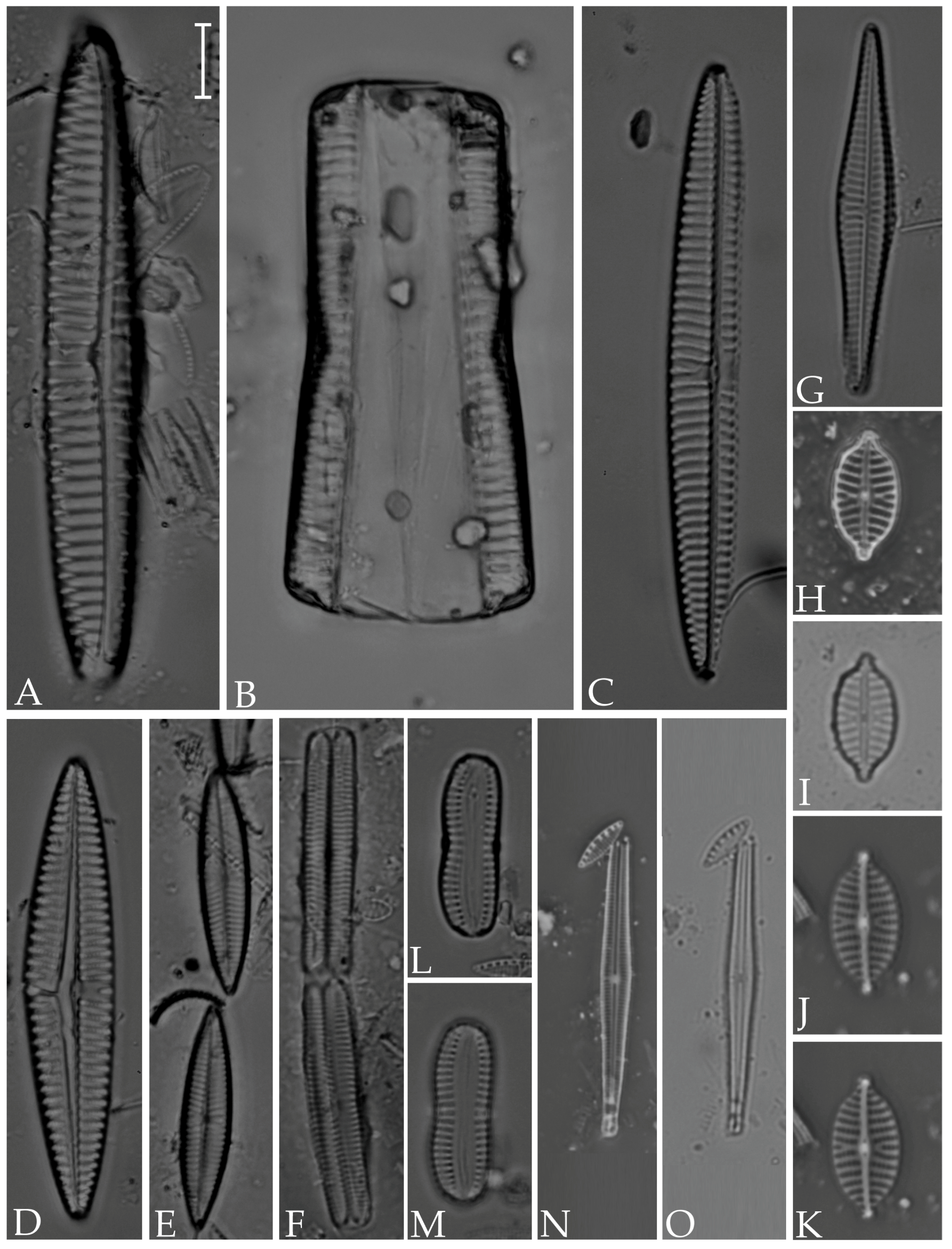
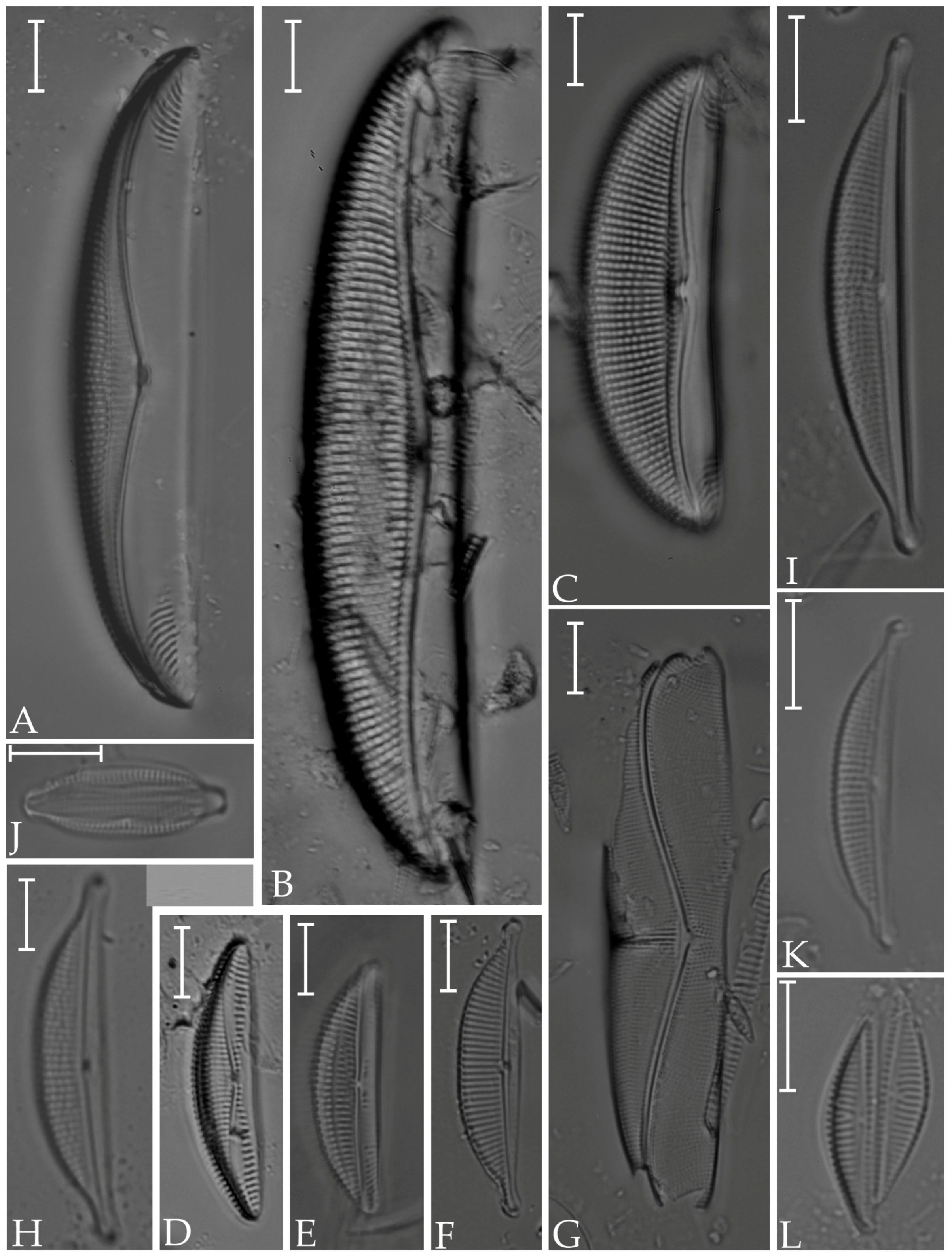
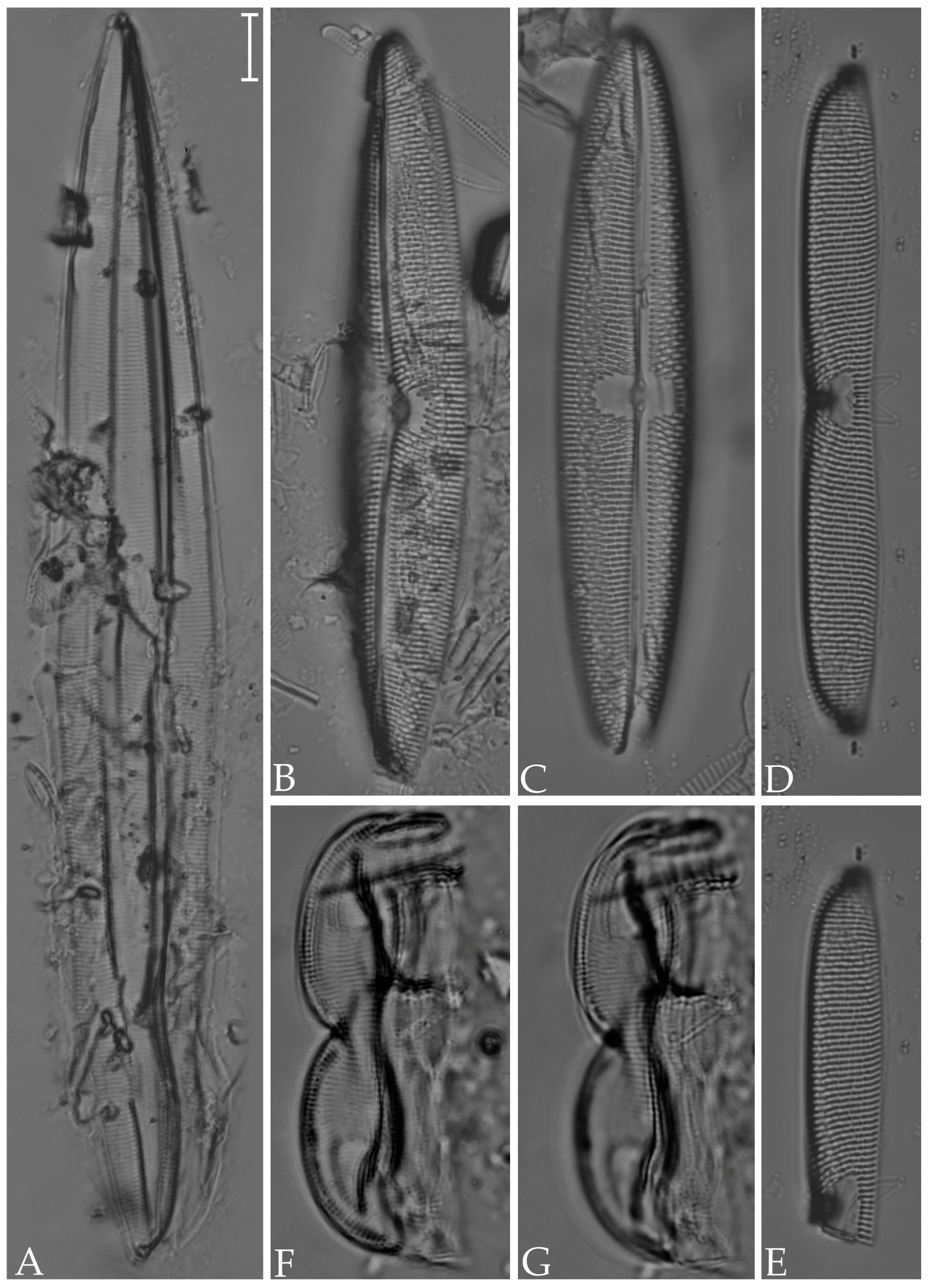
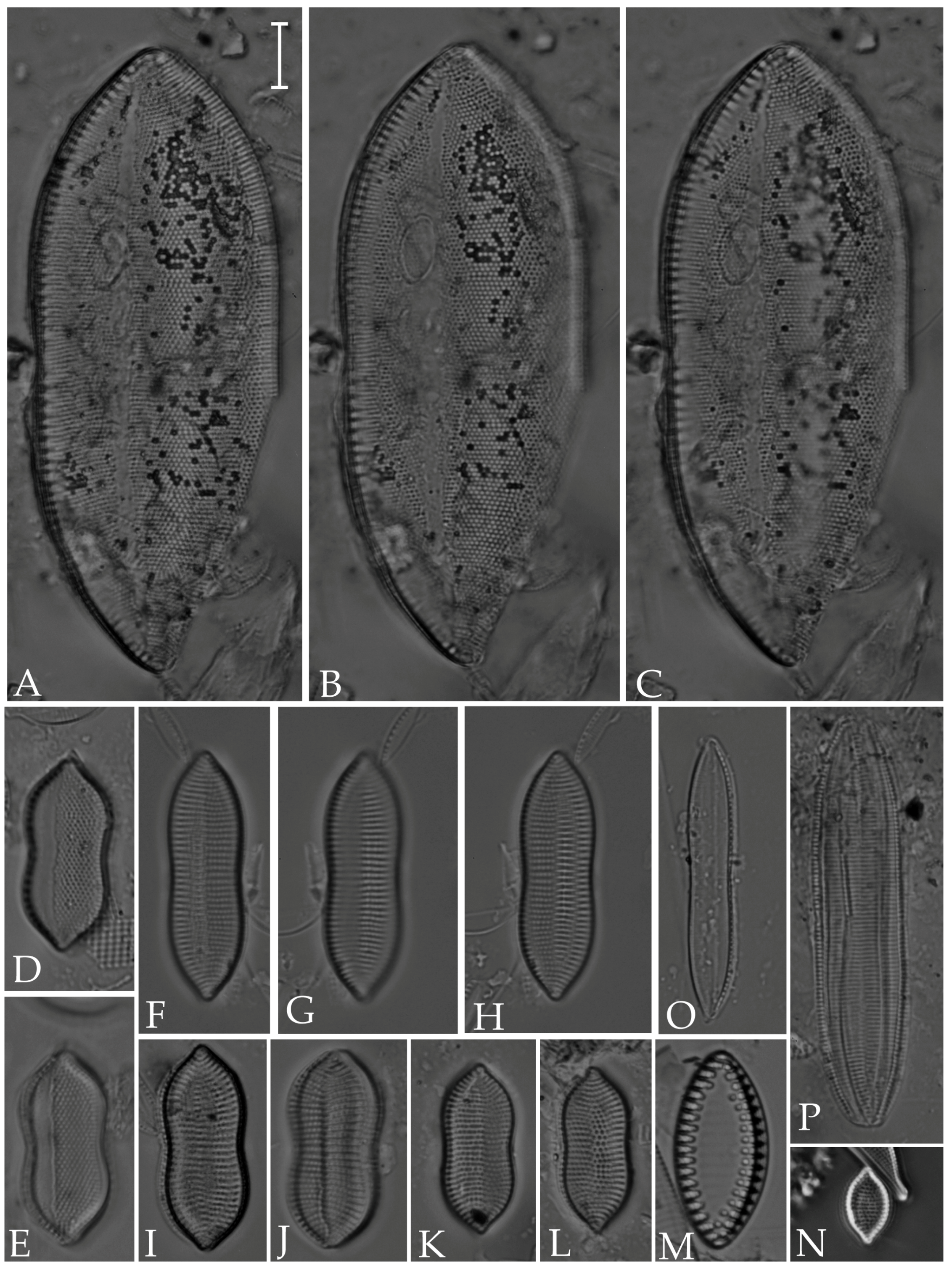

| Division Bacillariophyta Silva |
| Subdivision Bacillariophytina Medlin & Kaczmarska |
| Class Coscinodiscophyceae Round et Crawford in Round et al. emend. Medlin & Kaczmarska |
| Order Coscinodiscales Round & Crawford in Round et al. |
| Family Heliopeltaceae Smith |
| Genus Actinoptychus Ehrenberg |
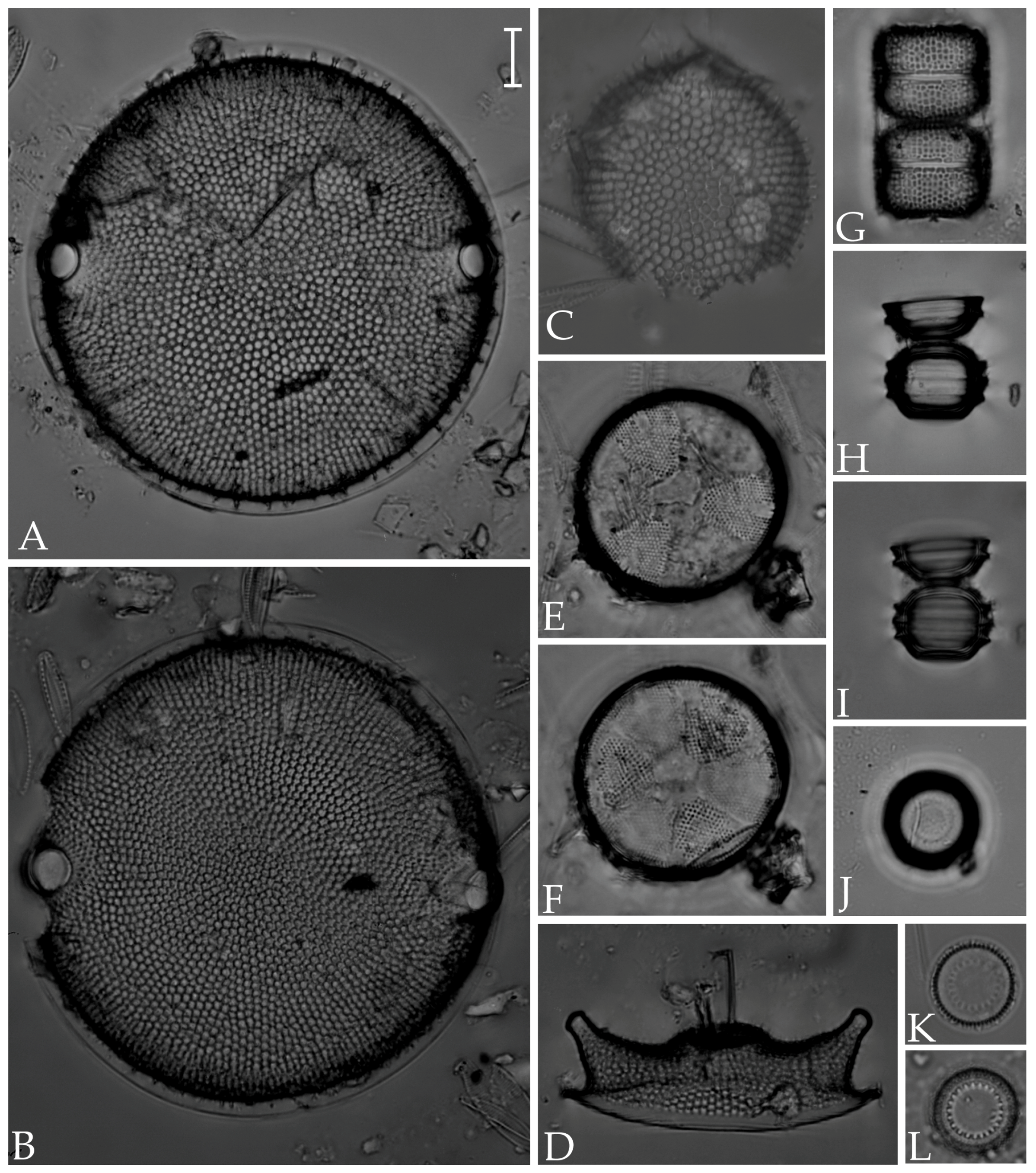
| Actinoptychus senarius (Ehrenberg) Ehrenberg (Figure 3E,F; SG) |
| Order Melosirales Crawford in Round et al. |
| Family Melosiraceae Kützing emend. Crawford in Round et al. |
| Genus Melosira Agardh |
| Melosira distans var. lyrata (Ehrenberg) Müller (Figure 3G) |
| Melosira nummuloides Agardh (Figure 3J) |
| Melosira westii var. quadrata Jurilj * (Figure 3H,I) |
| Order Paraliales Crawford |
| Family Paraliaceae Crawford |
| Genus Paralia Heiberg |
| Paralia sulcata (Ehrenberg) Cleve (Figure 3K,L; SG) |
| Class Mediophyceae (Jousé & Proshkina-Lavrenko) Medlin & Kaczmarska |
| Order Biddulphiales Krieger |
| Family Biddulphiaceae Kützing |
| Genus Biddulphia Gray |
| Biddulphia californica (Schmidt) Wolle * (Figure 3A,B; SG) |
| Order Anaulales Round & Crawford |
| Family Anaulaceae (Schütt) Lemmermann |
| Genus Eunotogramma Weisse |
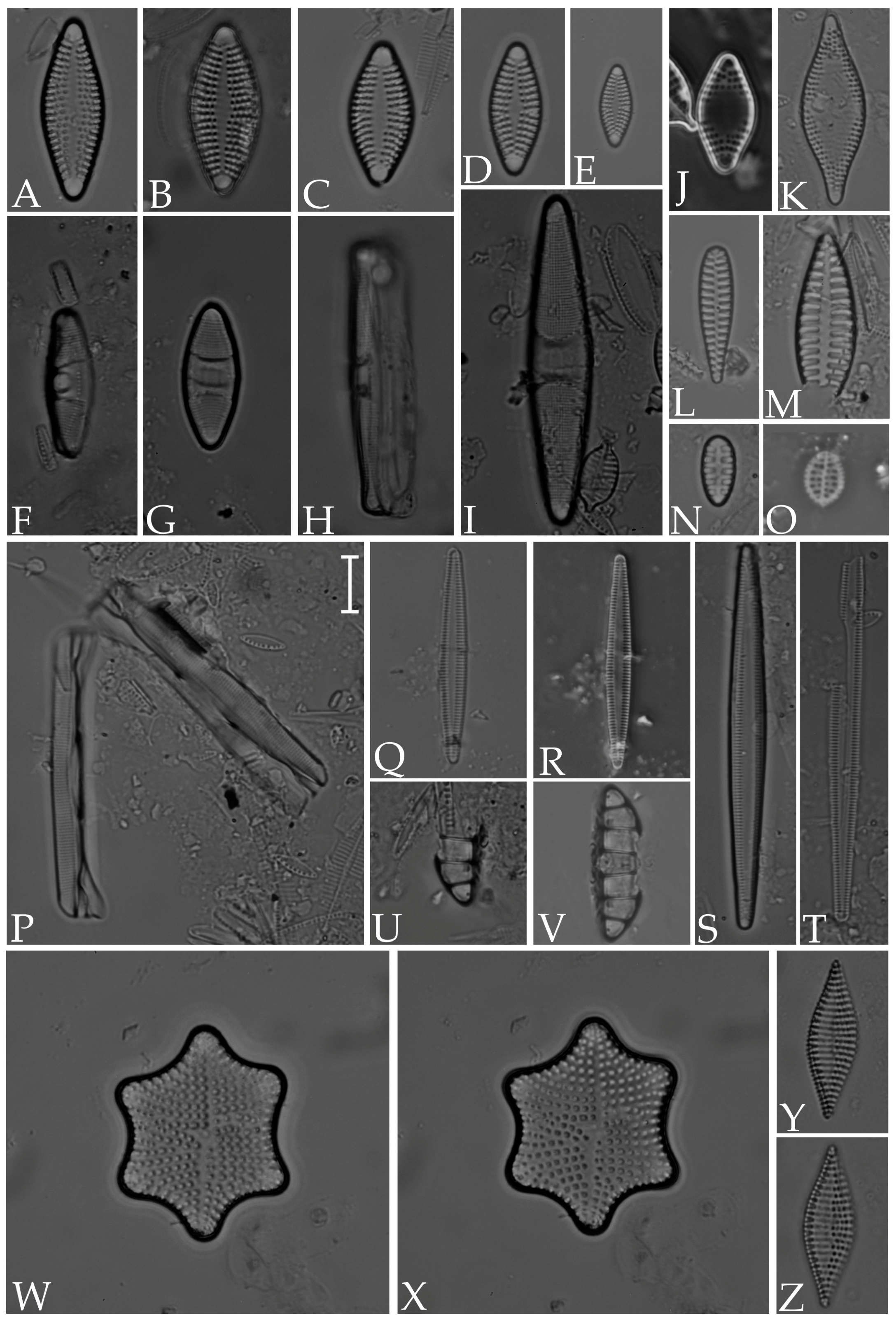
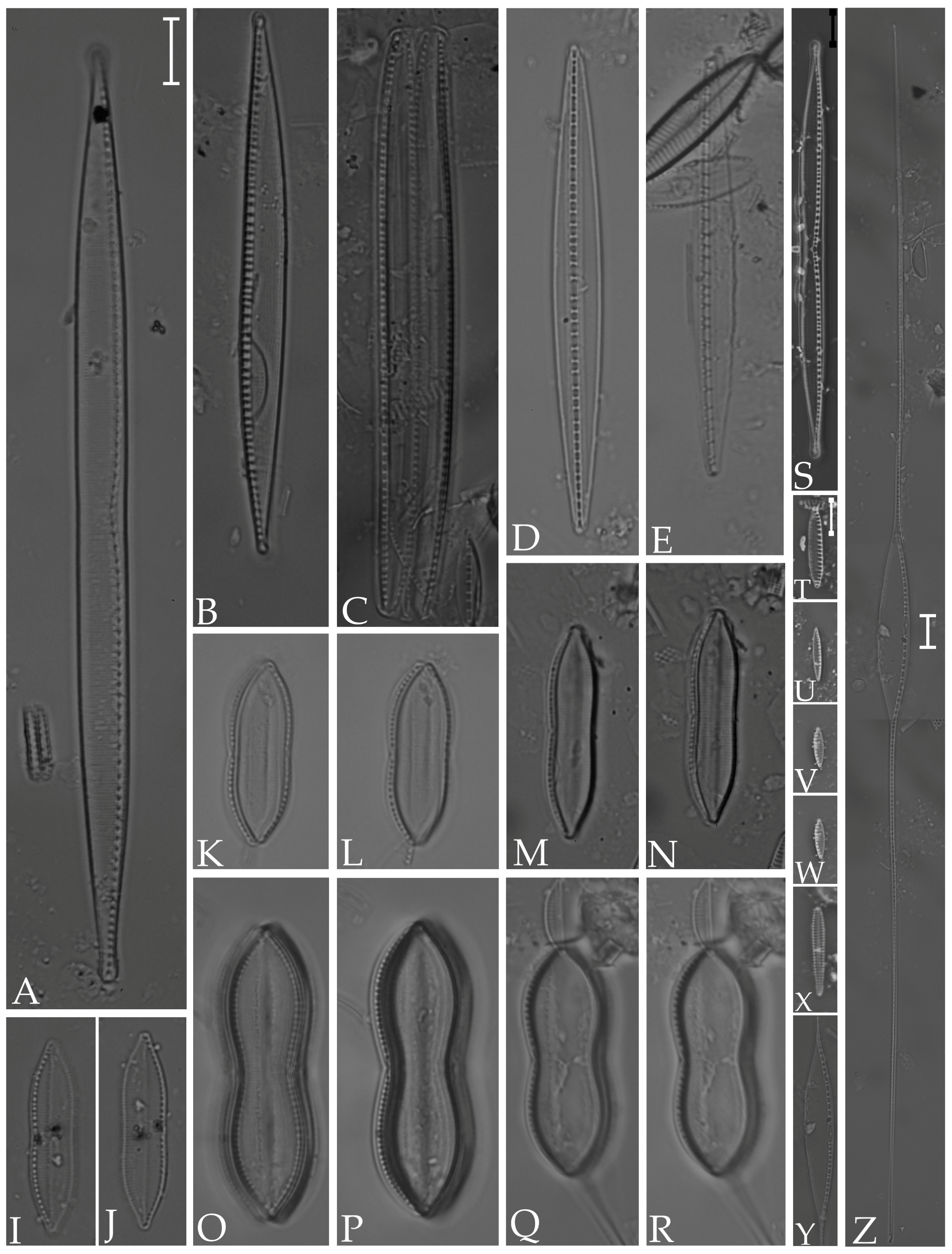
| Eunotogramma litorale Amspoker (Figure 4U,V; SG) |
| Order Eupodiscales Nikolaev & Harwood |
| Family Odontellaceae Sims, Williams & Ashworth |
| Genus Odontella Agardh |
| Odontella aurita (Lyngbye) Agardh (Figure 3D; SG) |
| Class Bacillariophyceae Haeckel emend. Medlin & Kaczmarska |
| Order Achnanthales Silva |
| Family Achnanthaceae Kützing |
| Genus Achnanthes Bory |
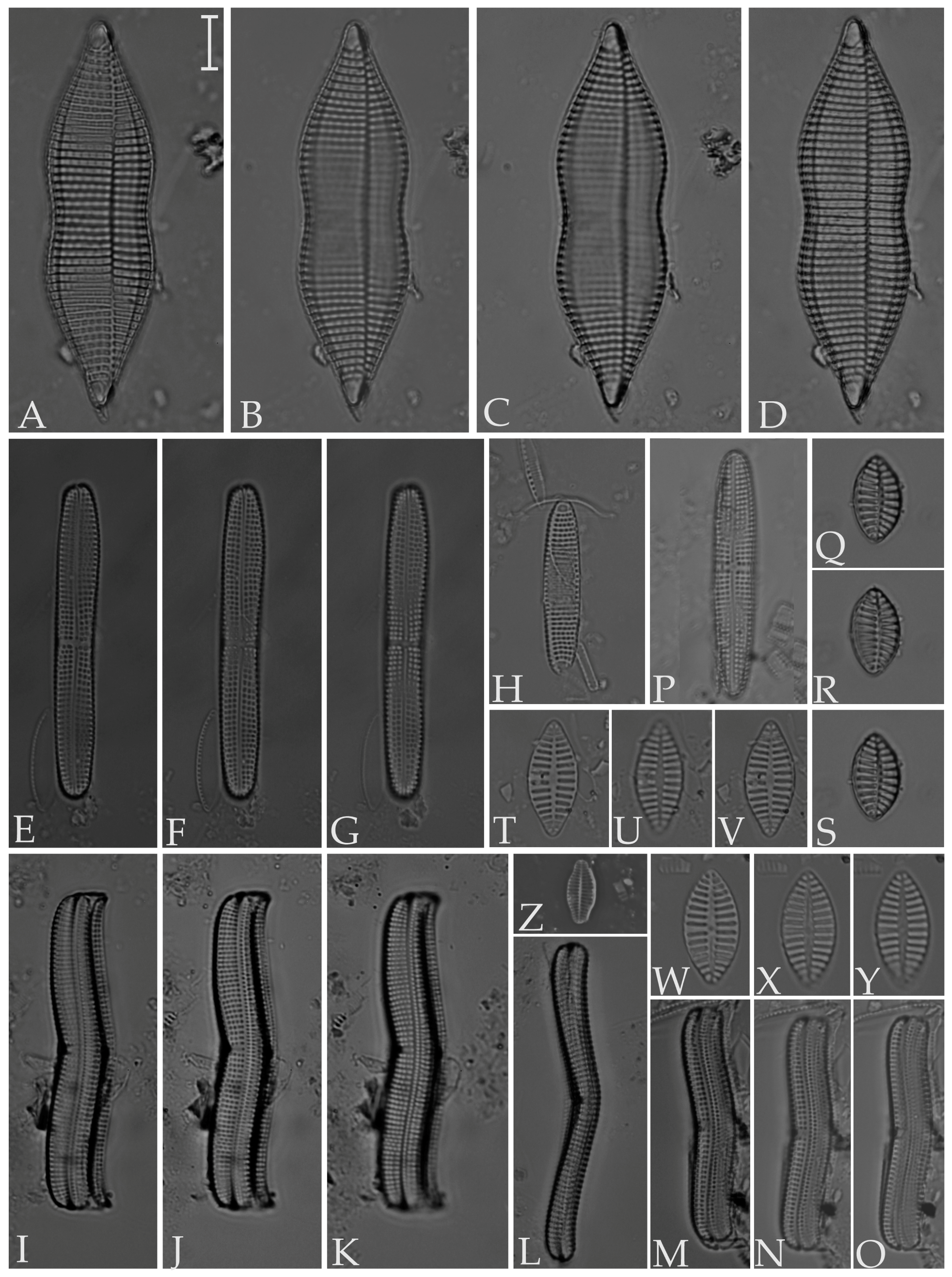
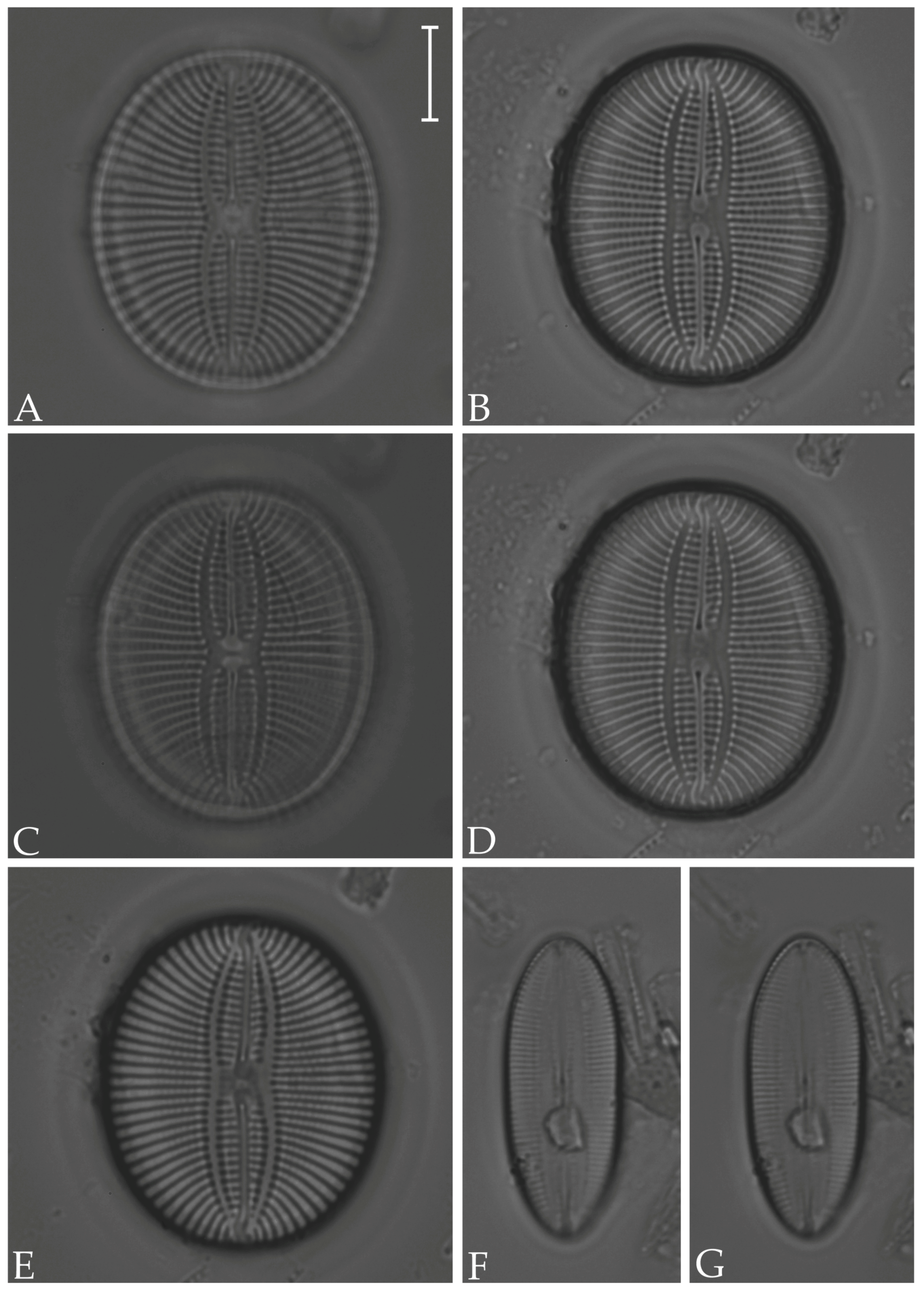
| Achnanthes brevipes var. angustata (Greville) Cleve (Figure 5E–P) |
| Achnanthes yaquinensis McIntire & Reimer (Figure 5A–D) |
| Family: Achnanthidiaceae D.G. Mann |
| Genus: Karayevia Round & Bukhtiyarova ex Round |
| Karayevia cf. amoena (Hustedt) Bukhtiyarova (Figure 5Z) |
| Genus Planothidium Round & Bukhtiyarova |
| Planothidium hauckianum (Grunow) Bukhtiyarova (Figure 5T–Y) |
| Planothidium delicatulum (Kützing) Round & Bukhtiyarova var.? (Figure 5Q–S) |
| Family Cocconeidaceae Kützing |
| Genus Cocconeis Ehrenberg |
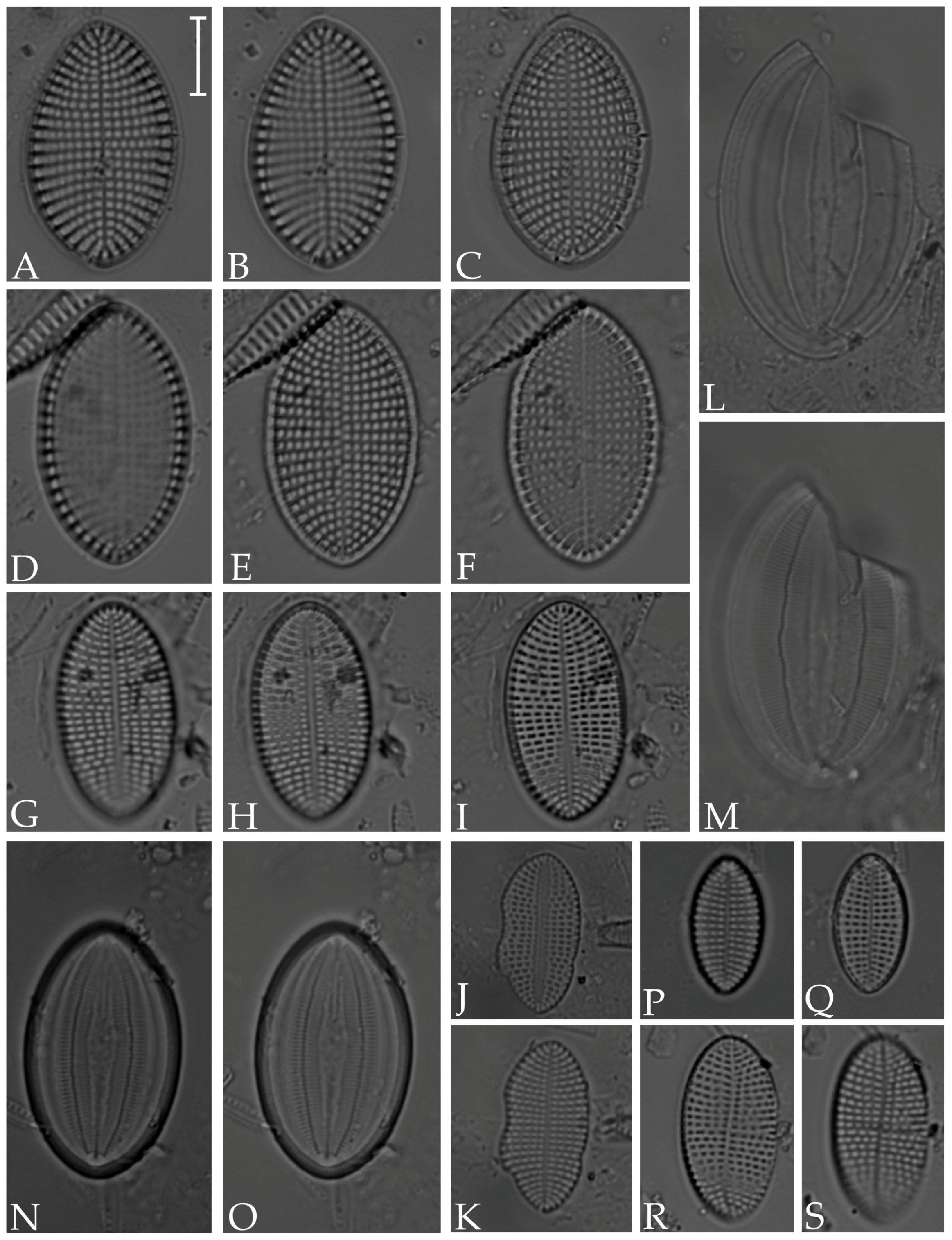
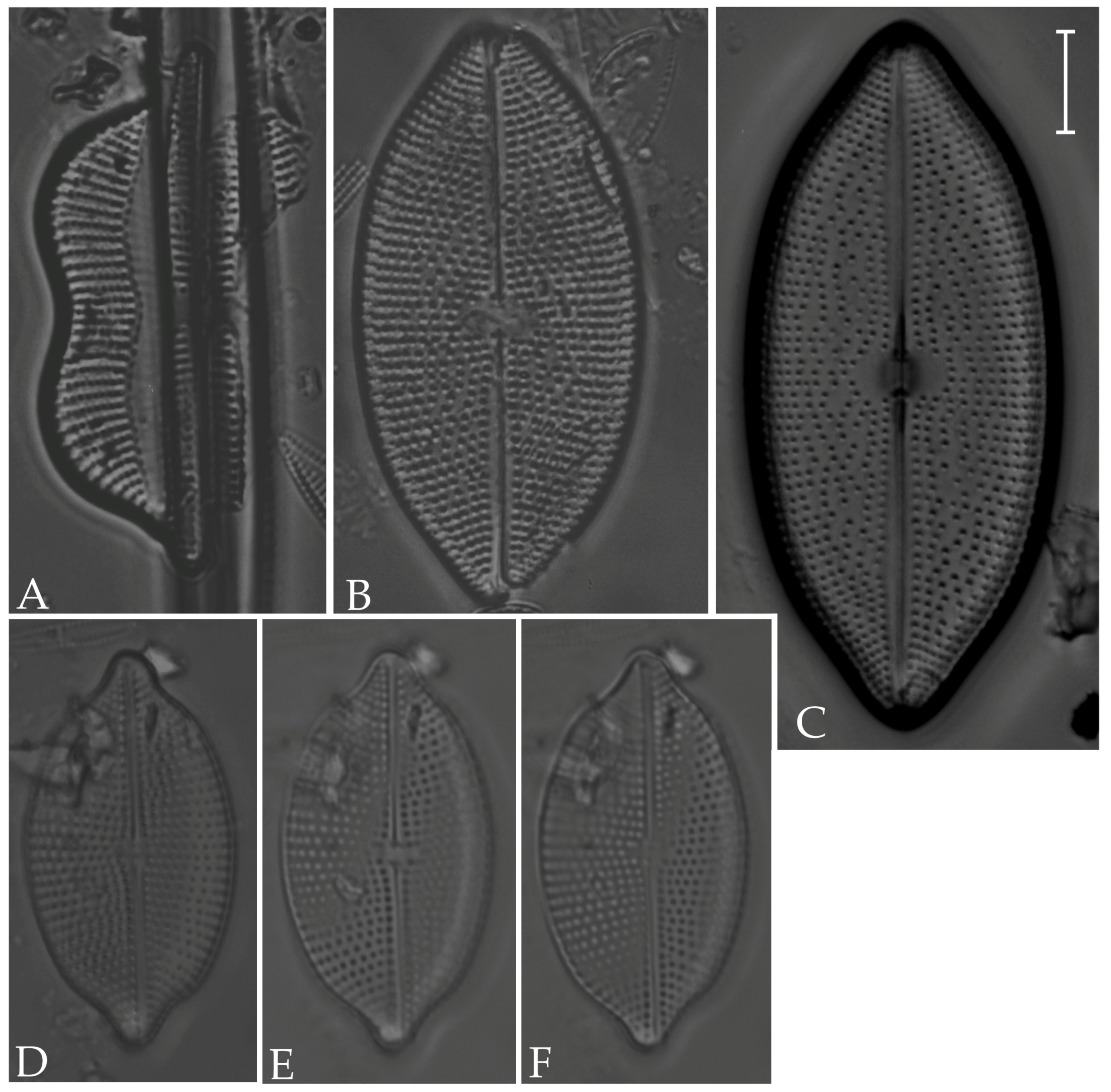
| Cocconeis cf. pseudolineata (Geitler) Lange-Bertalot (Figure 6P,Q) |
| Cocconeis cf. euglypta Ehrenberg (Figure 6G–K) |
| Cocconeis pseudodiruptoides Foged (Figure 6R,S) |
| Cocconeis pseudomarginata Gregory (Figure 6L,O) |
| Cocconeis scutellum Ehrenberg (Figure 6A–F) |
| Order Bacillariales Hendey emend. Mann in Round et al. |
| Family Bacillariaceae Ehrenberg |
| Genus Homoeocladia Agardh, nom. rejic. |
| Homoeocladia distans (Gregory) Kuntze (Figure 17D,E) |
| Genus Nitzschia Hassall |
| Nitzschia carnicobarica Desikachary & Prema (Figure 17O–R) |
| Nitzschia frustulum (Kützing) Grunow (Figure 17T–W) |
| Nitzschia fusoides Ehrlich (Figure 4Y,Z) |
| Nitzschia ligowskii Witkowski, Lange-Bertalot, Kociolek & Brzezinska * (Figure 17M,N) |
| Nitzschia persuadens Cholnoky (Figure 17K,L) |
| Nitzschia longissima (Brébisson ex Kützing) Grunow (Figure 17Y,Z) |
| Nitzschia scalpelliformis Grunow (Figure 17S) |
| Nitzschia sigma (Kützing) Smith (Figure 17B,C) |
| Nitzschia subconstricta Desikachary & Prema (Figure 17I,J) |
| Nitzschia vidovichii (Grunow) Grunow (Figure 17A) |
| Genus Psammodictyon Mann |
| Psammodictyon constrictum (Gregory) Mann (Figure 16D,E) |
| Psammodictyon panduriforme (Gregory) Mann (Figure 16A–C) |
| Genus Tryblionella Smith |
| Tryblionella coarctata (Grunow) Mann (Figure 16F–L) |
| Tryblionella hungarica (Grunow) Frenguelli (Figure 16O,P) |
| Tryblionella hyalina (Amossé) Ohtsuka (Figure 16M) |
| Tryblionella pararostrata (Lange-Bertalot) Clavero & Hernández-Mariné * (Figure 16N) |
| Order Cymbellales Mann in Round et al. |
| Family Cymbellaceae Greville |
| Genus Navicymbula Krammer |
| Navicymbula pusilla var. lata Krammer (Figure 14L; SG) |
| Family Rhoicospheniaceae Chen & Zhu |
| Genus Gomphoseptatum Medlin |
| Gomphoseptatum aestuarii (Cleve) Medlin (Figure 17X; SG) |
| Order Lyrellales Mann |
| Family Lyrellaceae Mann |
| Genus Lyrella Karayeva |
| Lyrella exsul (Schmidt) Mann (Figure 9A; SG) |
| Genus Petroneis Stickle & Mann |
| Petroneis besarensis (Giffin) Witkowski, Lange-Bertalot & Witkowski * (Figure 9D–F) |
| Petroneis granulata Mann, nom. illeg. (Figure 9B,C) |
| Order Mastogloiales Mann |
| Family Mastogloiaceae Mereschkowsky |
| Genus Mastogloia Thwaites ex Smith |
| Mastogloia acutiuscula var. elliptica Hustedt (Figure 12M,N) |
| Mastogloia angulata Lewis (Figure 12A,B) |
| Mastogloia apiculata Smith (Figure 12G,H) |
| Mastogloia binotata (Grunow) Cleve (Figure 12C,D) |
| Mastogloia exigua Lewis (Figure 12E,F) |
| Mastogloia gieskesii Cholnoky (Figure 12P) |
| Mastogloia braunii Grunow (Figure 12J,O) |
| Mastogloia robusta Hustedt (Figure 12K,L) |
| Mastogloia pisciculus Cleve (Figure 12I) |
| Order Naviculales Bessey emend. Mann in Round et al. |
| Family Diploneidaceae Mann in Round et al. |
| Genus Diploneis (Ehrenberg) Cleve |
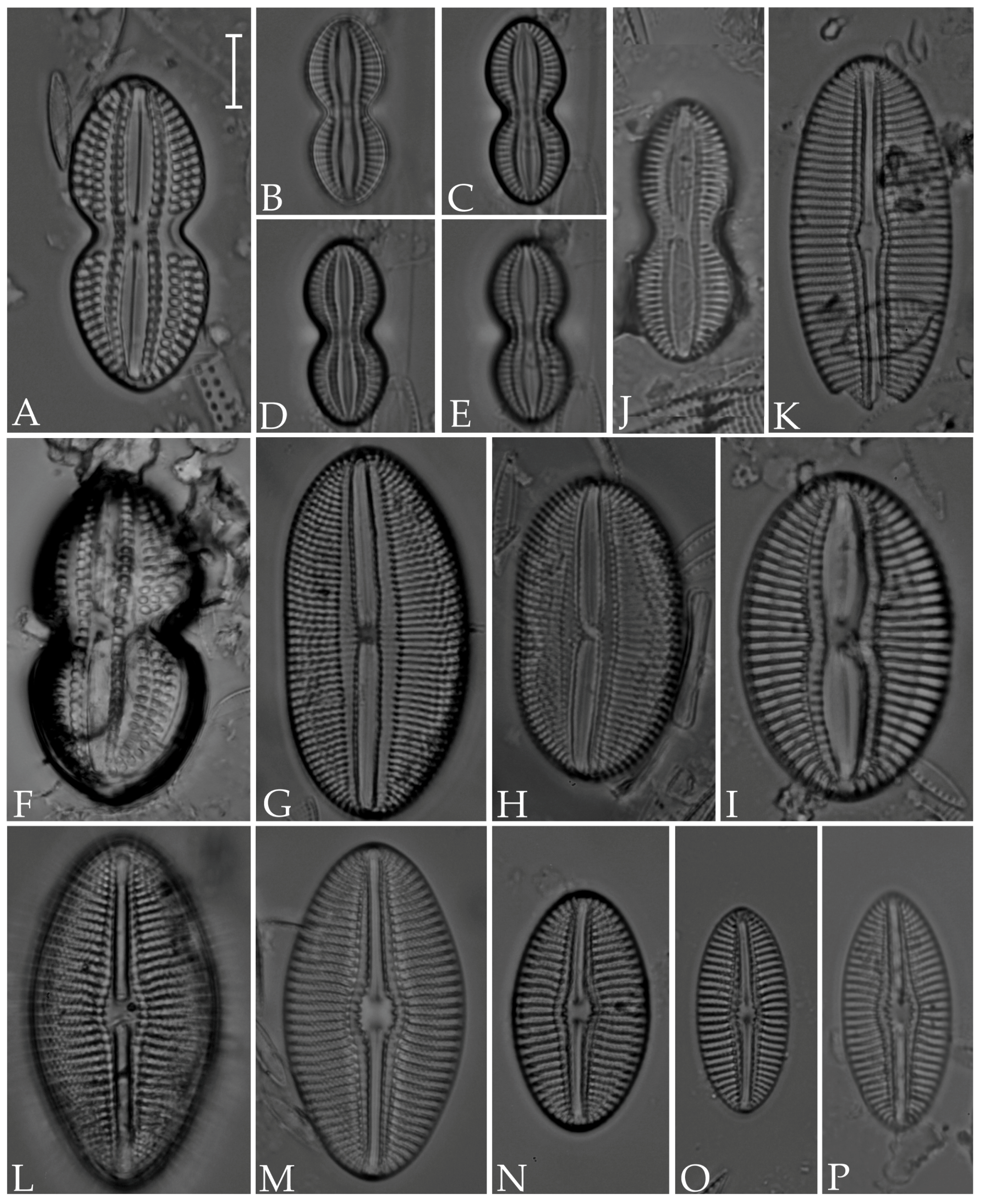
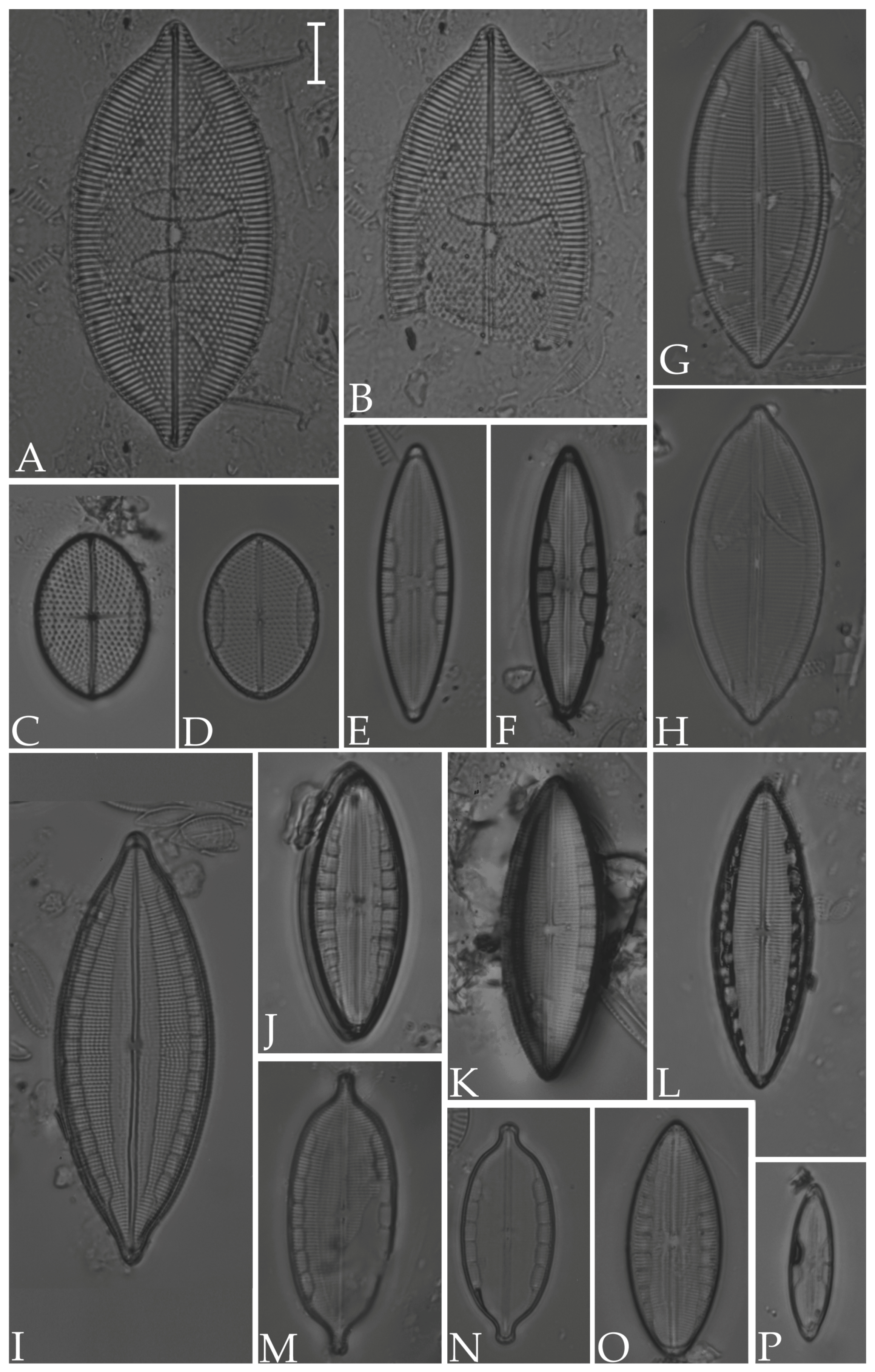
| Diploneis coffeiformis (Schmidt) Cleve (Figure 8I) |
| Diploneis gruendleri (Schmidt) Cleve (Figure 8A,F) |
| Diploneis gravelleana Hagelstein (Figure 8B–E) |
| Diploneis incurvata (Gregory) Cleve (Figure 8J) |
| Diploneis obliqua (Brun) Hustedt (Figure 8G,H) |
| Diploneis smithii (Brébisson) Cleve (Figure 8L–P) |
| Diploneis vacillans (Schmidt) Cleve (Figure 8K) |
| Family Naviculaceae Kützing emend. Mann in Round et al. |
| Genus Navicula Bory |
| Navicula abunda Hustedt (Figure 13G) |
| Navicula cancellata Donkin (Figure 13A,B) |
| Navicula cincta Pantocsek, nom. illeg. (Figure 13F) |
| Navicula longa var. irregularis Hustedt (Figure 13C) |
| Navicula normaloides Cholnoky (Figure 13E) |
| Navicula pennata Schmidt (Figure 13D) |
| Navicula platyventris Meister (Figure 13H–K) |
| Genus Trachyneis Cleve |
| Trachyneis aspera (Ehrenberg) Cleve (Figure 15D,E) |
| Trachyneis velata (Schmidt) Cleve (Figure 15B,C) |
| Family Naviculaceae Kützing |
| Genus Seminavis Mann |
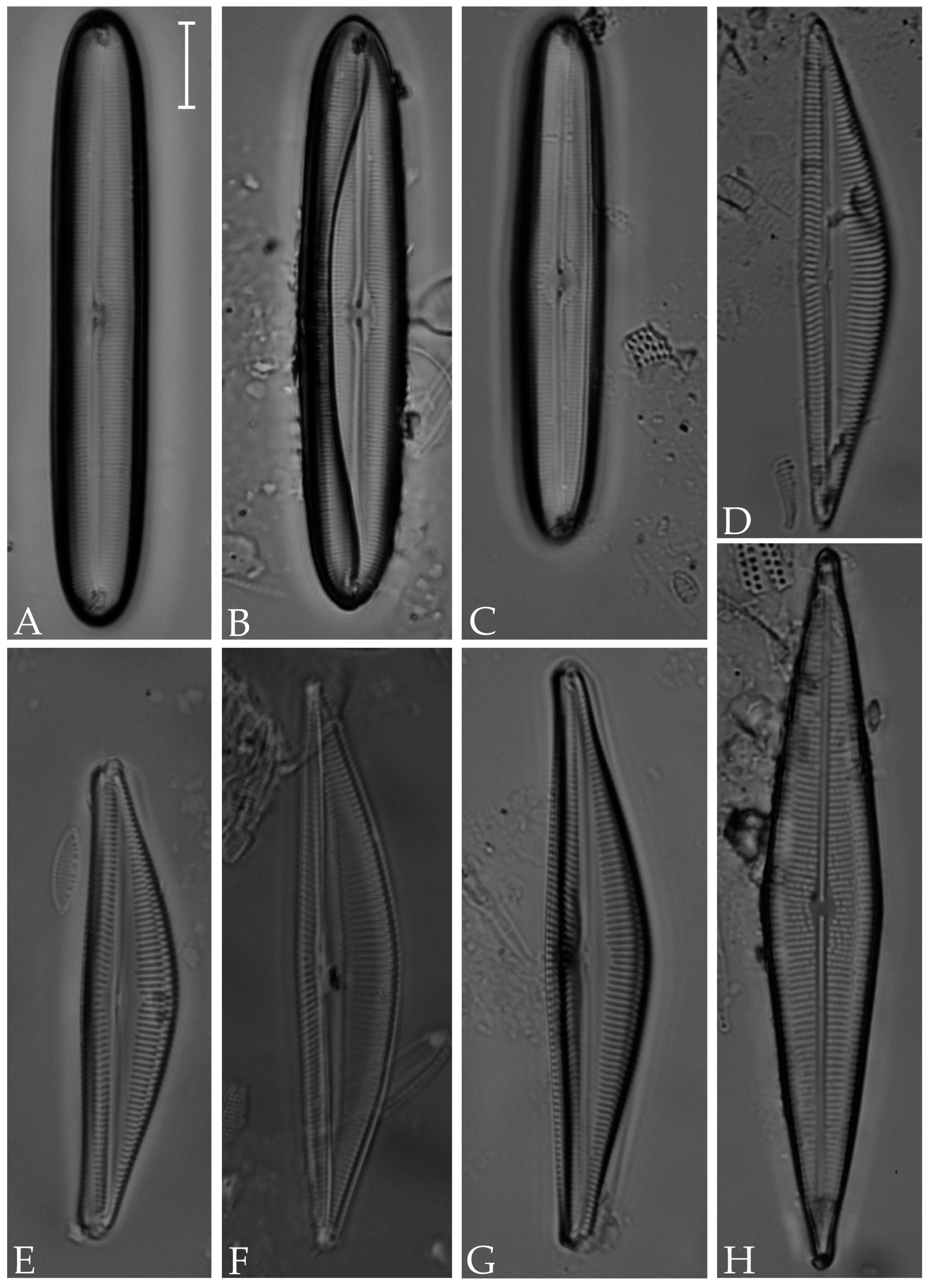
| Seminavis robusta Danielidis & Mann (Figure 7D–G; SG) |
| Family Plagiotropidaceae Mann |
| Genus Plagiotropis Pfitzer nom. illeg. |
| Plagiotropis pusilla (Gregory) Kuntze (Figure 15A; SG) |
| Family Pleurosigmataceae Mereschkowsky |
| Genus Gyrosigma Hassall |
| Gyrosigma balticum (Ehrenberg) Rabenhorst (Figure 11A) |
| Gyrosigma eximium (Thwaites) Boyer (Figure 11F–H) |
| Gyrosigma peisonis (Grunow) Hustedt (Figure 11D) |
| Gyrosigma variistriatum Hagelstein (Figure 11B) |
| Genus Pleurosigma Smith nom. et typ. cons |
| Pleurosigma diversestriatum Meister (Figure 11E) |
| Pleurosigma salinarum (Grunow) Grunow (Figure 11C) |
| Family Berkeleyaceae Mann |
| Genus Parlibellus Cox |
| Parlibellus rhombicula (Hustedt) Witkowski, Lange-Bertalot & Metzeltin (Figure 7H; SG) |
| Family Brachysiraceae Mann in Round et al. |
| Genus Brachysira Kützing |
| Brachysira cf. estoniarum Witkowski, Lange-Bertalot & Metzeltin |
| (Figure 13N,O; SG) |
| Family Diadesmidaceae Mann in Round et al. |
| Genus Caloneis Cleve |
| Caloneis linearis (Cleve) Boyer (Figure 7A–C; SG) |
| Family Scoliotropidaceae Mereschkowsky |
| Genus Biremis Mann & Cox |
| Biremis ridicula (Giffen) Mann (Figure 13L,M; SG) |
| Order Rhopalodiales Mann in Round et al. |
| Family Rhopalodiaceae (Karsten) Topachevskyj & Oksiyuk |
| Genus Rhopalodia Müller |
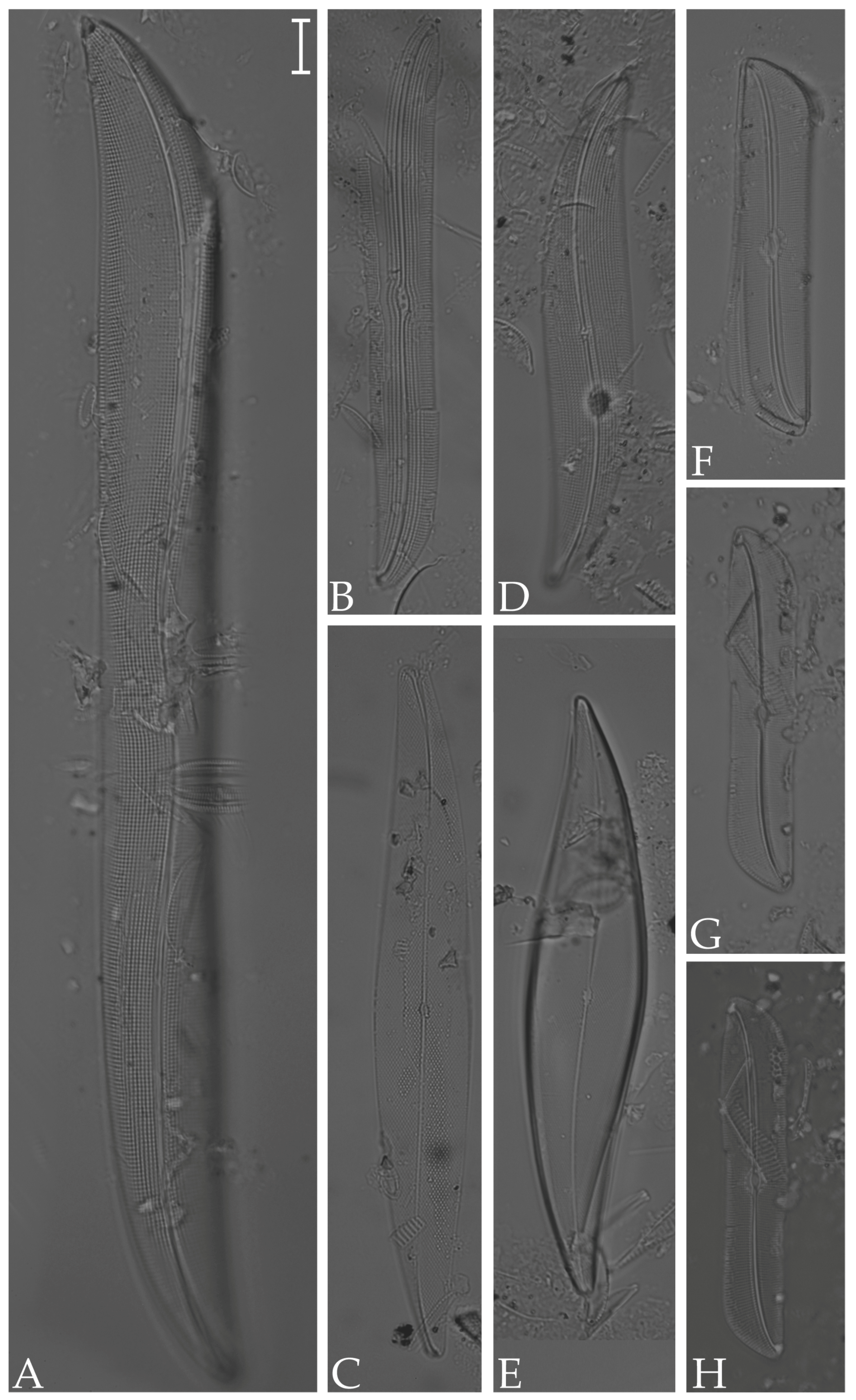
| Rhopalodia acuminata Krammer (Figure 18B) |
| Rhopalodia gibberula (Ehrenberg) Müller (Figure 18A) |
| Rhopalodia musculus (Kützing) Müller (Figure 18C) |
| Order Surirellales Mann in Round et al. |
| Family Entomoneidaceae Reimer |
| Genus Entomoneis Ehrenberg |
| Entomoneis paludosa (Smith) Reimer (Figure 15F,G; SG) |
| Family Surirellaceae Kützing |
| Genus Campylodiscus Ehrenberg ex Kützing |
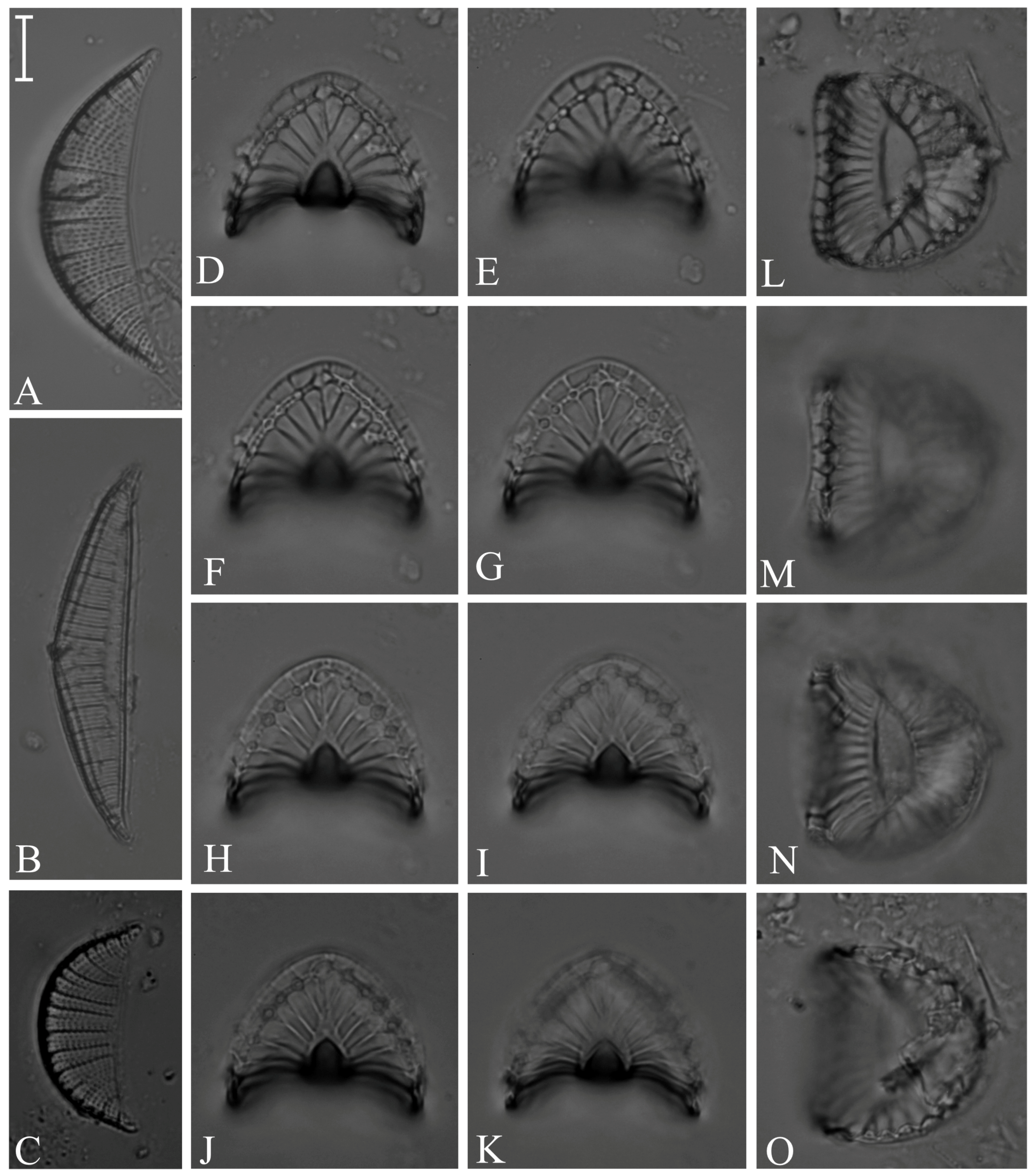
| Campylodiscus subangularis Cleve & Möller * (Figure 18L–O, S) |
| Genus Coronia (Ehrenberg ex Grunow) Ehrenberg |
| Coronia ambigua (Greville) Ruck & Guiry (Figure 18D–K; SG) |
| Order Thalassiophysales Mann in Round et al. |
| Family Catenulaceae Mereschkowsky |
| Genus Amphora Ehrenberg ex Kützing |
| Amphora cingulata Cleve (Figure 14G) |
| Amphora holsaticoides Nagumo & Kobayasi (Figure 14F) |
| Amphora marina Smith (Figure 14D,E) |
| Amphora proteus var. contigua Cleve (Figure 14C) |
| Amphora proteus var. proteus Gregory (Figure 14A,B) |
| Genus Halamphora (Cleve) Levkov |
| Halamphora acutiuscula (Kützing) Levkov (Figure 14K) |
| Halamphora coffeiformis (Agardh) Mereschkowsky (Figure 14I,J) |
| Halamphora holsatica (Hustedt) Levkov (Figure 14H) |
| Family Sellaphoraceae Mereschkowsky |
| Genus Fallacia Stickle & Mann |
| Fallacia litoricola (Hustedt) Mann (Figure 10F,G) |
| Fallacia nummularia (Greville) Mann (Figure 10A–E) |
| Order Fragilariales Silva emend. Round in Round et al. |
| Family Staurosiraceae Medlin |
| Genus Opephora Petit |
| Opephora mutabilis Sabbe & Vyverman, nom. inval. (Figure 4L) |
| Opephora pacifica (Grunow) Petit (Figure 4M) |
| Genus Staurosirella Wiliams & Round |
| Staurosirella martyi (Héribaud) Morales & Manoylov (Figure 4N; SG) |
| Order Licmophorales Round in Round et al. |
| Family Ulnariaceae Cox |
| Genus Tabularia Williams & Round |
| Tabularia fasciculata (Agardh) Williams & Round (Figure 4Q–S) |
| Tabularia tabulata (Agardh) Snoeijs (Figure 4T) |
| Order Rhabdonematales Round & Crawford |
| Family Grammatophoraceae Lobban & Ashworth |
| Genus Grammatophora Ehrenberg |
| Grammatophora oceanica Ehrenberg (Figure 4P; SG) |
| Order Plagiogrammales Cox |
| Family Plagiogrammaceae De Toni |
| Genus Dimeregramma Ralfs |
| Dimeregramma maculatum (Cleve) Frenguelli (Figure 4J,K; SG) |
| Genus Plagiogramma Greville |
| Plagiogramma minus (Gregory) Li, Ashworth & Witkowski (Figure 4A–E) |
| Plagiogramma tenuistriatum Cleve (Figure 4F–I) |
| Order Rhaphoneidales Round |
| Family Rhaphoneidaceae Forti |
| Genus Delphineis Ehrenberg |
| Delphineis minutissima (Hustedt) Simonsen (Figure 4O; SG) |
| Genus Rhaphoneis Ehrenberg |
| Rhaphoneis castracanei Grunow (Figure 4W,X; SG) |
| Class Bacillariophyceae incertae sedis |
| Order Bacillariophyceae ordo incertae sedis |
| Family Bacillariophyceae familia incertae sedis |
| Genus Ralfsiella Sims, Williams & Ashworth |
| Ralfsiella smithii (Ralfs) Sims, Williams & Ashworth (Figure 3C; SG) |
Disclaimer/Publisher’s Note: The statements, opinions and data contained in all publications are solely those of the individual author(s) and contributor(s) and not of MDPI and/or the editor(s). MDPI and/or the editor(s) disclaim responsibility for any injury to people or property resulting from any ideas, methods, instructions or products referred to in the content. |
© 2024 by the authors. Licensee MDPI, Basel, Switzerland. This article is an open access article distributed under the terms and conditions of the Creative Commons Attribution (CC BY) license (https://creativecommons.org/licenses/by/4.0/).
Share and Cite
López-Fuerte, F.O.; Siqueiros Beltrones, D.A.; Hernández, L.; Flores-Ramírez, S. First Account of Epibiotic Diatom Taxa from the Carapaces of Green Swimming Crab Callinectes bellicosus (Stimpson 1859) (Decapoda, Portunidae). Diversity 2024, 16, 302. https://doi.org/10.3390/d16050302
López-Fuerte FO, Siqueiros Beltrones DA, Hernández L, Flores-Ramírez S. First Account of Epibiotic Diatom Taxa from the Carapaces of Green Swimming Crab Callinectes bellicosus (Stimpson 1859) (Decapoda, Portunidae). Diversity. 2024; 16(5):302. https://doi.org/10.3390/d16050302
Chicago/Turabian StyleLópez-Fuerte, Francisco Omar, David Alfaro Siqueiros Beltrones, Luis Hernández, and Sergio Flores-Ramírez. 2024. "First Account of Epibiotic Diatom Taxa from the Carapaces of Green Swimming Crab Callinectes bellicosus (Stimpson 1859) (Decapoda, Portunidae)" Diversity 16, no. 5: 302. https://doi.org/10.3390/d16050302
APA StyleLópez-Fuerte, F. O., Siqueiros Beltrones, D. A., Hernández, L., & Flores-Ramírez, S. (2024). First Account of Epibiotic Diatom Taxa from the Carapaces of Green Swimming Crab Callinectes bellicosus (Stimpson 1859) (Decapoda, Portunidae). Diversity, 16(5), 302. https://doi.org/10.3390/d16050302