



Assessing Browsing Impact in Beech Forests: The Importance of Tree Responses after Browsing


Abstract
1. Introduction
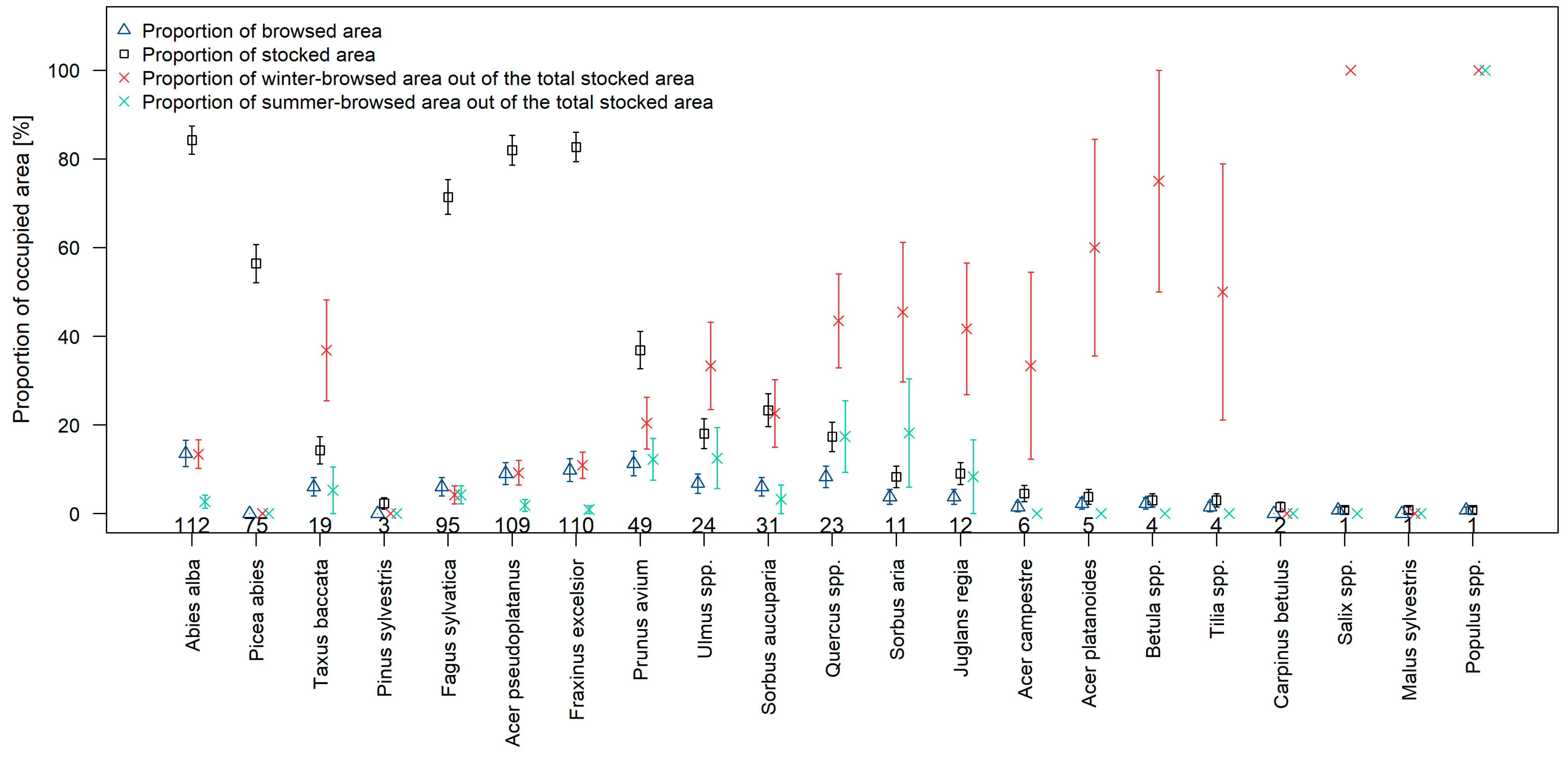
- Browsing is selective regarding preference for known palatable tree species and individual vigorously growing saplings. Species recommended for enhancing the adaptation of these beech forests to climate change are particularly selected by ungulates.
- The vigorous growth of saplings leads to light browsing and thus few impacts.
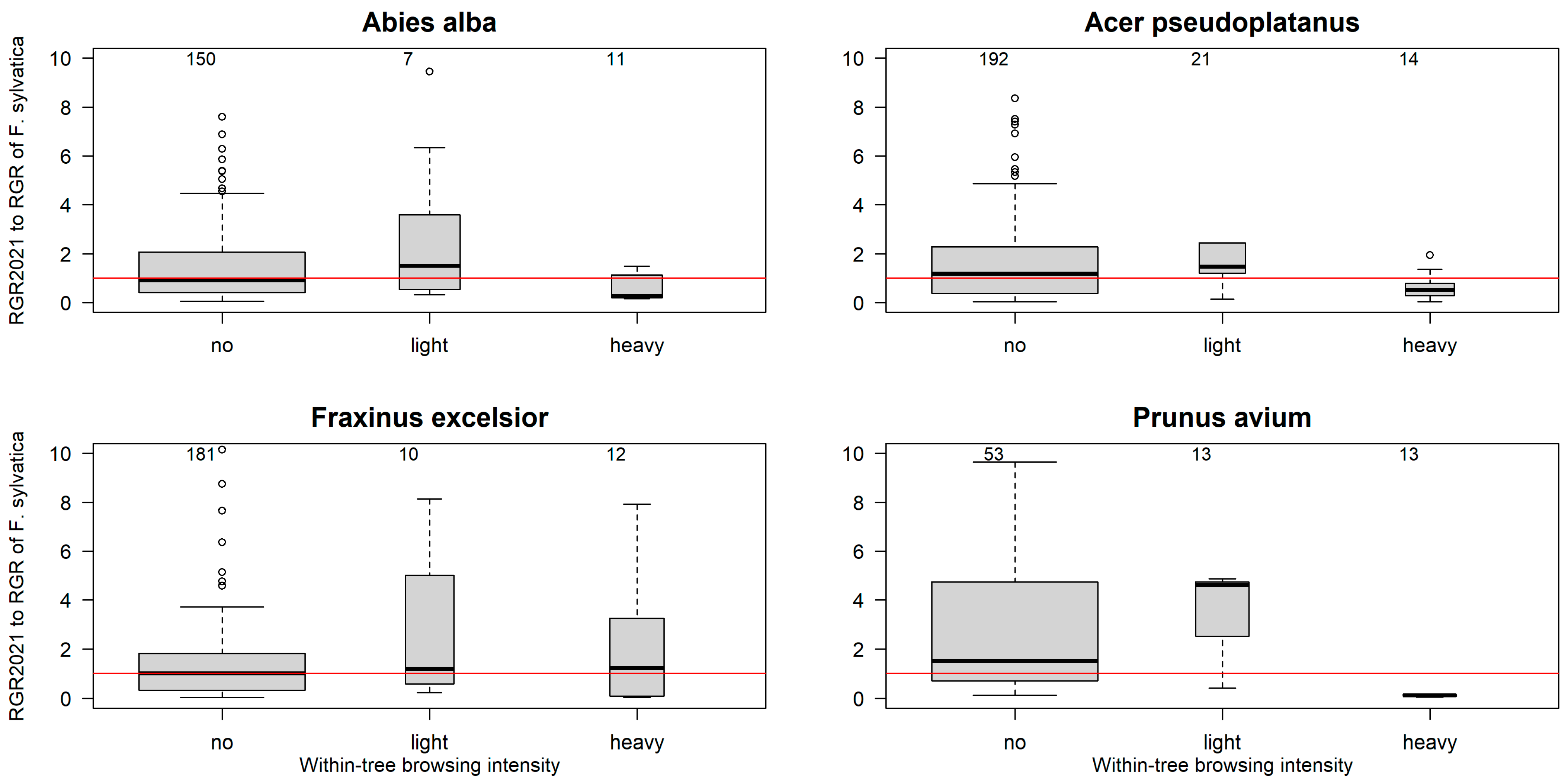
- Coniferous tree species are mainly lightly browsed in winter and respond in the following vegetation period by forming a new leader shoot. Thus, there are no delays in the tree response after browsing, which can be neglected in further surveys.
- Deciduous tree species are mainly lightly browsed in summer and can respond within the same vegetation period. Therefore, a survey in autumn is optimal for capturing the impact of browsing on these tree species.
- Browsing in forest islands is more frequent than in larger forest complexes, and this difference should be considered when systematic grids are established.
2. Materials and Methods
2.1. Study Site
2.2. Study Design and Plot-Level Data
2.3. Tree Regeneration Data
2.4. Statistical Analyses
2.4.1. Descriptive Analysis
2.4.2. Regression Analysis

| BPU | S | HC0 | HC1 | HC2 | HC3 | HC4 | HC5 | Total | |
|---|---|---|---|---|---|---|---|---|---|
| Abies alba | 5 | S | 178 | 197 | 87 | 50 | 27 | 28 | 567 |
| Picea abies | 1 | R | 112 | 63 | 35 | 28 | 22 | 260 | |
| Taxus baccata | 5 | S | 34 | 26 | 0 | 0 | 0 | 0 | 60 |
| Pinus sylvestris | 2 | R | 3 | 0 | 0 | 0 | 0 | 3 | |
| Fagus sylvatica | 3 | R | 150 | 145 | 128 | 107 | 115 | 645 | |
| Acer pseudoplatanus | 5 | S | 195 | 99 | 62 | 39 | 37 | 432 | |
| Fraxinus excelsior | 5 | S | 200 | 108 | 40 | 19 | 13 | 380 | |
| Prunus avium | 4 | S | 60 | 27 | 18 | 5 | 6 | 116 | |
| Ulmus spp. | 5 | S | 28 | 22 | 9 | 8 | 9 | 76 | |
| Sorbus aucuparia | 5 | S | 34 | 20 | 6 | 3 | 4 | 67 | |
| Quercus spp. | 4 | S | 25 | 5 | 1 | 0 | 0 | 31 | |
| Sorbus aria | 5 | S | 9 | 7 | 3 | 0 | 2 | 21 | |
| Juglans regia | 1 | R | 6 | 6 | 2 | 2 | 0 | 16 | |
| Acer campestre | 5 | S | 7 | 4 | 4 | 0 | 0 | 15 | |
| Acer platanoides | 5 | S | 7 | 5 | 0 | 1 | 0 | 13 | |
| Betula spp. | 2 | R | 1 | 3 | 2 | 1 | 0 | 7 | |
| Tilia spp. | 3 | R | 2 | 3 | 2 | 0 | 0 | 7 | |
| Carpinus betulus | 4 | R | 3 | 0 | 0 | 0 | 1 | 4 | |
| Salix spp. * | 5 | R | 1 | 2 | 0 | 0 | 0 | 3 | |
| Malus sylvestris | 2 | 1 | 0 | 0 | 0 | 3 | |||
| Populus spp. | 4 | R | 1 | 0 | 0 | 0 | 0 | 1 | |
| Total all species | 212 | 1069 | 607 | 362 | 240 | 237 | 2727 |
3. Results
3.1. Stocked Stand Area and Spatial Distribution
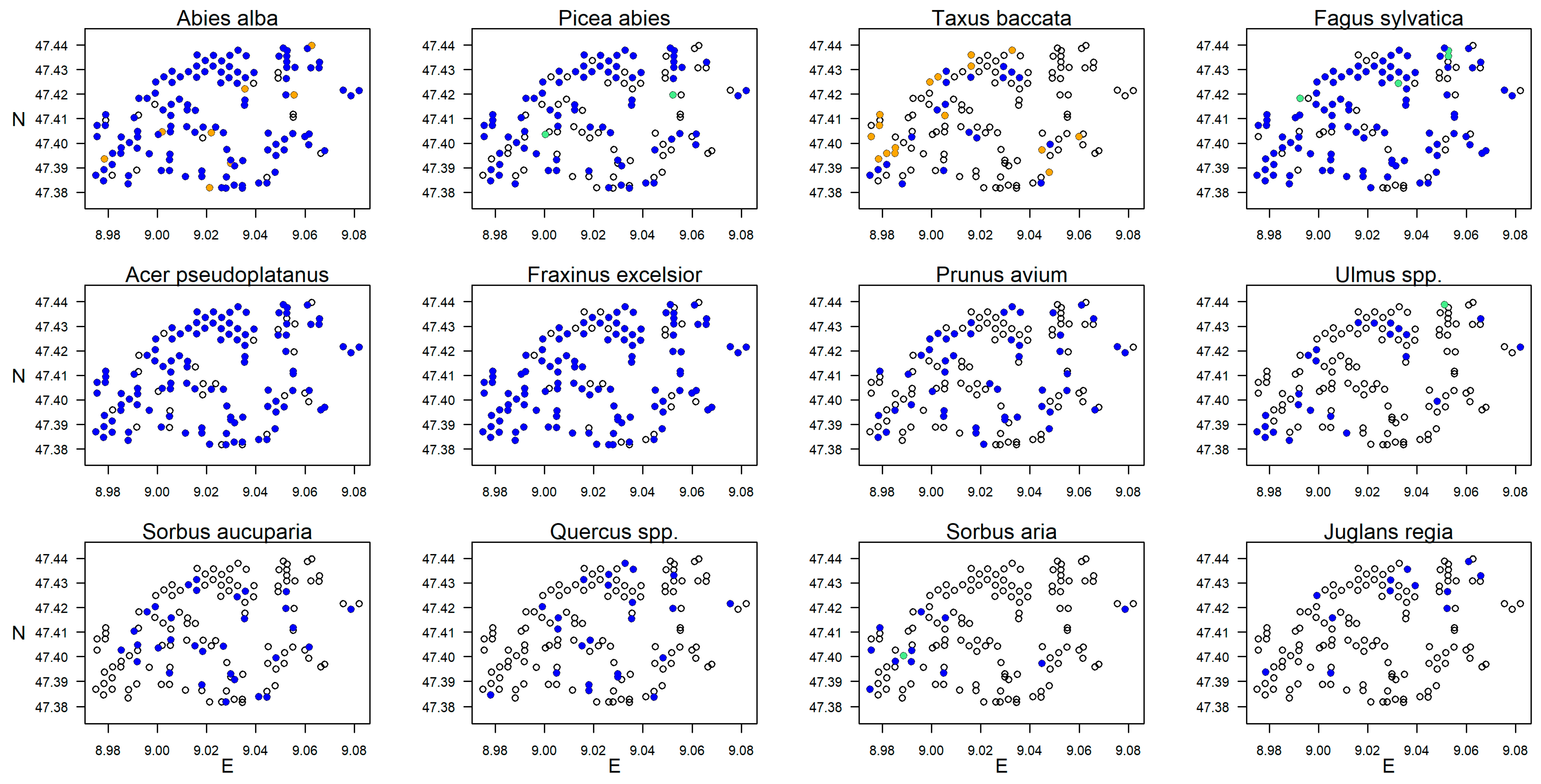
3.2. Frequency, Season and Within-Tree Browsing Intensity
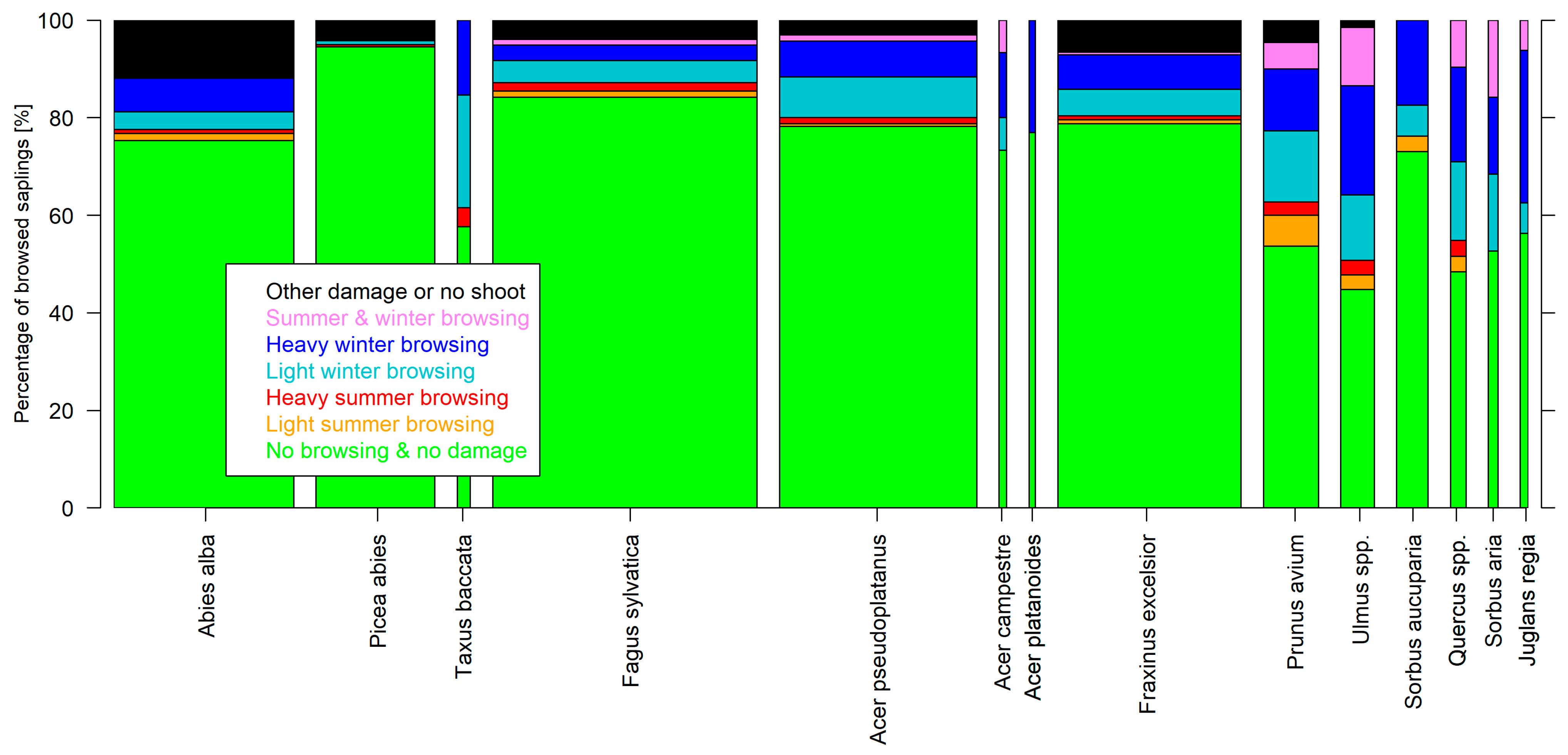
3.3. Height Growth
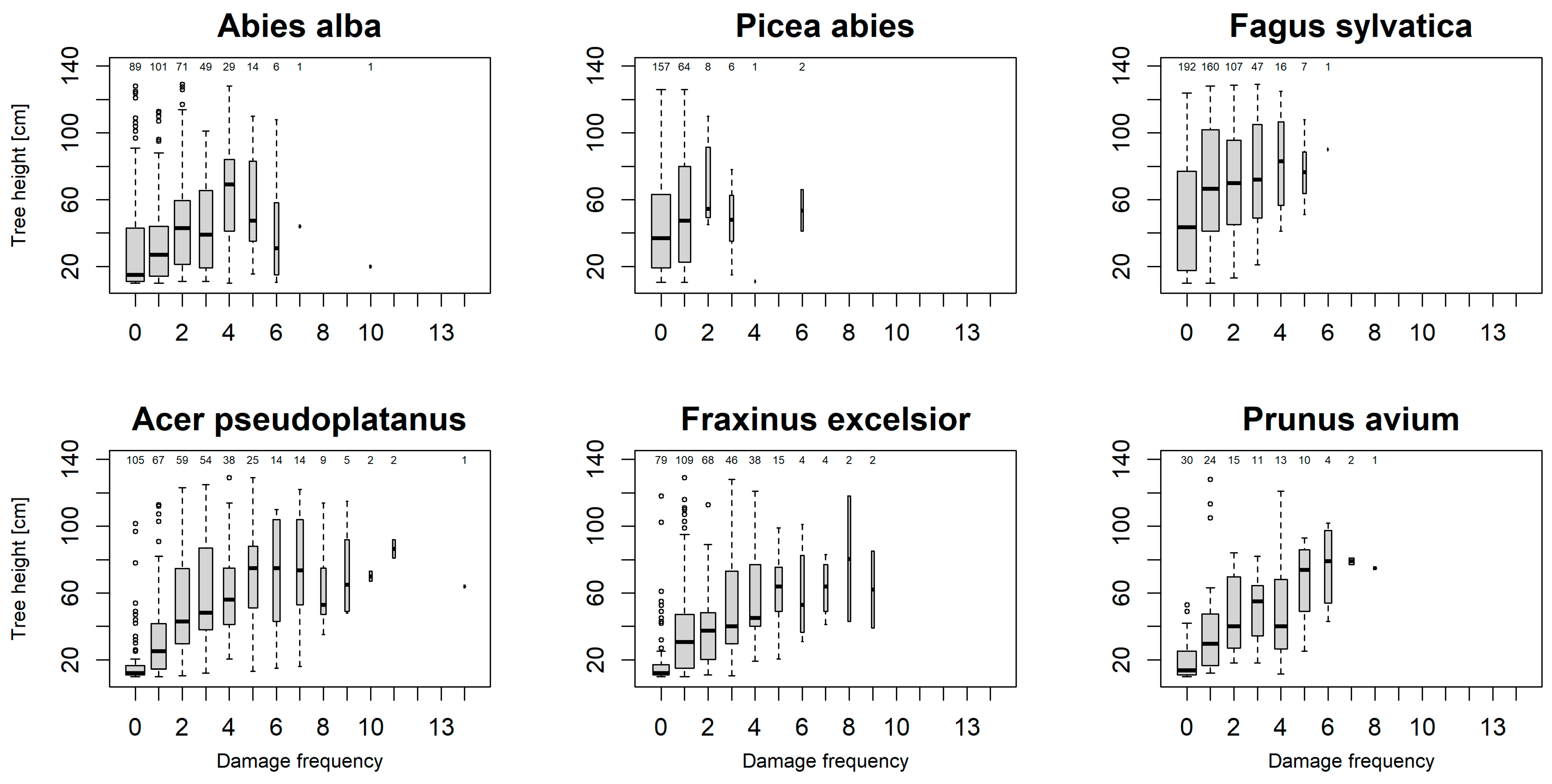
| Regression Model | N | Species | Tree Height | Damage Frequency | Twig Browsing | Canopy Shading |
|---|---|---|---|---|---|---|
| All 21 species | 2226 | BPU * | 0.017 | −0.144 | * | −0.017 |
| 6 main species | 1954 | S * | 0.017 | −0.150 | * | −0.020 |
| Abies alba | 334 | - | 0.020 | −0.122 | ns | −0.015 |
| Picea abies | 231 | - | 0.015 | ns | ns | −0.019 |
| Fagus sylvatica | 527 | - | 0.012 | −0.307 | ns | −0.021 |
| Acer pseudoplatanus | 391 | - | 0.015 | −0.123 | ns | −0.022 |
| Fraxinus excelsior | 363 | - | 0.027 | −0.193 | * | −0.015 |
| Prunus avium | 108 | - | 0.022 | −0.239 | ns | ns |
| Susceptible species | 232 | - | 0.019 | −0.164 | ns | ns |
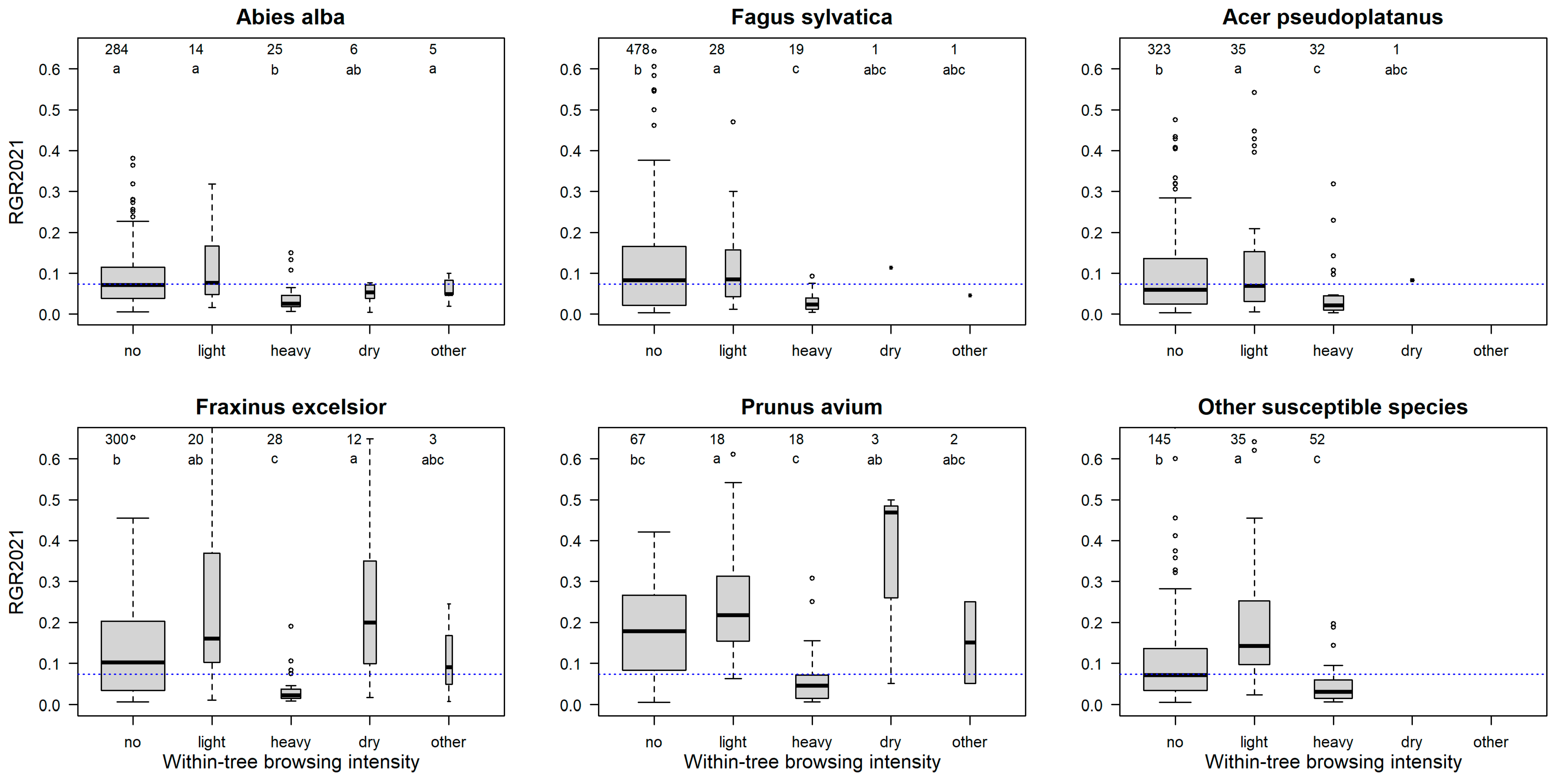
3.4. Response to Browsing
| Species | Light Winter Browsing [%] | Heavy Winter Browsing [%] |
|---|---|---|
| Abies alba | 28.6 (22.7) | 40.0 (36.7) |
| Fagus sylvatica | 35.7 | 21.1 |
| Acer pseudoplatanus | 22.9 | 15.6 |
| Fraxinus excelsior | 0.0 | 17.9 |
| Prunus avium | 0.0 | 27.8 |
3.5. Damage Frequency
4. Discussion
- 1.
- Browsing is selective regarding preference for known palatable tree species and individual vigorously growing saplings. Species recommended for enhancing the adaptation of these beech forests to climate change are particularly selected by ungulates.
- 2.
- The vigorous growth of saplings leads to light browsing and thus few impacts.
- 3.
- Coniferous tree species are mainly lightly browsed in winter and respond in the following vegetation period. Thus, there are no delays in the tree response after browsing, which can be neglected in further surveys.
- 4.
- Deciduous tree species are mainly lightly browsed in summer and can respond within the same vegetation period. Therefore, a survey in autumn is optimal for capturing the impact of browsing on these species.
- 5.
- Browsing in forest islands is more frequent than in larger forest complexes, and this difference should be considered when systematic grids are established.
5. Conclusions
Author Contributions
Funding
Institutional Review Board Statement
Informed Consent Statement
Data Availability Statement
Acknowledgments
Conflicts of Interest
Appendix A
References
- Cornelis, J.; Casaer, J.; Hermy, M. Impact of season, habitat and research techniques on diet composition of roe deer (Capreolus capreolus): A review. J. Zool. 1999, 248, 195–207. [Google Scholar] [CrossRef]
- Tixier, H.; Duncan, P.; Scehovic, J.; Yant, A.; Gleizes, M.; Lila, M. Food selection by European roe deer (Capreolus capreolus): Effects of plant chemistry, and consequences for the nutritional value of their diets. J. Zool. 1997, 242, 229–245. [Google Scholar] [CrossRef] [Scilit]
- Boulanger, V.; Baltzinger, C.; Saı, S.; Ballon, P.; Picard, J.-F.; Dupouey, J.-L. Ranking temperate woody species along a gradient of browsing by deer. For. Ecol. Manag. 2009, 258, 1397–1406. [Google Scholar] [CrossRef] [Scilit]
- Kullberg, Y.; Bergström, R. Winter browsing by large herbivores on planted deciduous seedlings in southern Sweden. Scand. J. For. Res. 2001, 16, 371–378. [Google Scholar] [CrossRef]
- Kupferschmid, A.D. Compensation capacity of Central European tree species in response to leader shoot browsing. In Ungulates: Evolution, Diversity and Ecology; Menendez, A., Sands, N., Eds.; Nova Science Publishers: Hauppauge, NY, USA, 2017; pp. 1–63. [Google Scholar]
- Kupferschmid, A.D.; Heiri, C. Recovery of Abies alba and Picea abies saplings to browsing and frost damage depends on seed source. Ecol. Evol. 2019, 2019, 3335–3354. [Google Scholar] [CrossRef] [Scilit] [PubMed]
- Frank, A.; Heiri, C.; Kupferschmid, A.D. Growth and quality of Fagus sylvatica saplings depend on seed source, site, and browsing intensity. Ecosphere 2019, 10, e02580. [Google Scholar] [CrossRef] [Scilit]
- Götmark, F.G.; Berglund, A.; Wiklander, K. Browsing damage on broadleaved trees in semi-natural temperate forest in Sweden, with a focus on oak regeneration. Scand. J. For. Res. 2005, 20, 223–234. [Google Scholar] [CrossRef] [Scilit]
- Krueger, L.M.; Peterson, C.J.; Royo, A.; Carson, W.P. Evaluating relationships among tee growth rate, shade tolerance, and browse tolerance following disturbance in an eastern deciduous forest. Can. J. For. Res. 2009, 39, 2460–2469. [Google Scholar] [CrossRef] [Scilit]
- Churski, M.; Bubnicki, J.W.; Jędrzejewska, B.; Kuijper, D.P.; Cromsigt, J.P. Brown world forests: Increased ungulate browsing keeps temperate trees in recruitment bottlenecks in resource hotspots. New Phytol. 2017, 214, 158–168. [Google Scholar] [CrossRef] [Scilit]
- Gill, R.M.A. A review of damage by mammals in North Temperate forests: 3. Impact on trees and forests. Forestry 1992, 65, 363–388. [Google Scholar] [CrossRef] [Scilit]
- Schulze, E.D.; Bouriaud, O.; Wäldchen, J.; Eisenhauer, N.; Walentowski, H.; Seele, C.; Heinze, E.; Pruschitzki, U.; Danila, G.; Marin, G.; et al. Ungulate browsing causes species loss in deciduous forests independent of community dynamics and silvicultural management in Central and Southeastern Europe. Ann. For. Res 2014, 57, 267–288. [Google Scholar] [CrossRef] [Scilit]
- Tremblay, J.-P.; Huot, J.; Potvin, F. Density-related effects of deer browsing on the regeneration dynamics of boreal forests. J. Appl. Ecol. 2007, 44, 552–562. [Google Scholar] [CrossRef] [Scilit]
- Brzeziecki, B.; Kienast, F. Classifying the life- history strategies of trees on the basis of the Grimian model. For. Ecol. Manag. 1994, 69, 167–187. [Google Scholar] [CrossRef] [Scilit]
- Gill, R.M.A. A review of damage by mammals in north temperate forests: 1. Deer. Forestry 1992, 65, 145–169. [Google Scholar] [CrossRef] [Scilit]
- Berwert-Lopes, R. Assessment of tolerable browsing by Eiberle’s method: Limitations and future prospects. For. Ecol. Manag. 1996, 88, 87–91. [Google Scholar] [CrossRef] [Scilit]
- Kupferschmid, A.D.; Bütikofer, L.; Hothorn, T.; Schwyzer, A.; Brang, P. Quantifying the relative influence of terminal shoot browsing by ungulates on tree regeneration. For. Ecol. Manag. 2019, 446, 331–344. [Google Scholar] [CrossRef] [Scilit]
- Kupferschmid, A.D.; Greilsamer, R.; Brang, P.; Bugmann, H. Assessment of the impact of ungulate browsing on tree regeneration. In Animal Nutrition—Annual Volume 2022 [Working Title]; Gonzalez Ronquillo, M., Ed.; IntechOpen Limited: London, UK, 2022. [Google Scholar]
- Reimoser, F.; Armstrong, H.; Suchant, R. Measuring forest damage of ungulates: What should be considered. For. Ecol. Manag. 1999, 120, 47–58. [Google Scholar] [CrossRef] [Scilit]
- Kupferschmid, A.D.; Wasem, U.; Bugmann, H. Light availability and ungulate browsing determine growth, height and mortality of Abies alba saplings. For. Ecol. Manag. 2014, 318, 359–369. [Google Scholar] [CrossRef] [Scilit]
- Reimoser, F.; Odermatt, O.; Roth, R.; Suchant, R. Die Beurteilung von Wildverbiss durch Soll-Ist Vergleich. Allg. Forst-Jagdztg. 1997, 168, 214–227. [Google Scholar]
- Kleinn, C.; Vilčko, F.; Fehrmann, L.; Hradetzky, J. Zur Auswertung der k-Baum-Probe [About the evaluation of k-trees samples]. Allg. Forst. Jagdz. 2009, 180, 228–237. [Google Scholar]
- Bayerisches Staatsministerium für Ernährung, Landwirtschaft und Forsten. Anweisung für die Erstellung der Forstlichen Gutachten zur Situation der Waldverjüngung 2021; Bayerische Forstverwaltung: München, Germany, 2020; p. 35. Available online: https://www.stmelf.bayern.de/mam/cms01/wald/jagd/dateien/anweisung_forstliches_gutachten_2021_und_anlagen1-4.pdf (accessed on 6 February 2023).
- Eiberle, K.; Bucher, H. Interdependenzen zwischen dem Verbiss verschiedener Baumarten in einem Plenterwaldgebiet. Z. Jagdwiss. 1989, 35, 235–244. [Google Scholar] [CrossRef] [Scilit]
- Kupferschmid, A.D.; Gmür, P.A. Einschätzung des Verbisseinflusses in zwei Wildräumen des Kantons St. Gallen. Schweiz. Z. Forstwes. 2020, 171, 79–90. [Google Scholar] [CrossRef] [Scilit]
- Kleinn, C.; Vilčko, F. A new empirical approach for estimation in k-tree sampling. For. Ecol. Manag. 2006, 237, 522–533. [Google Scholar] [CrossRef] [Scilit]
- Stein, W.I. Regeneration surveys and evaluation. In Reforestation Practices in Southwestern Oregon and Northern California; Hobbs, S.D., Tesch, S.D., Owston, P.W., Eds.; Forest Research Laboratory, Oregon State University: Corvallis, OR, USA, 1992; p. 465. [Google Scholar]
- Bryant, D.M.; Ducey, M.J.; Innes, J.C.; Lee, T.D.; Eckert, R.T.; Zarin, D.J. Forest community analysis and the point-centered quarter method. Plant Ecol. 2005, 175, 193–203. [Google Scholar] [CrossRef] [Scilit]
- Huber, M.; Schwyzer, A.; Kupferschmid, A.D. A comparison between plot-count and nearest-tree method in assessing tree regeneration features. Curr. Trends Forest Res. 2018, 10, CTFR-122. [Google Scholar] [CrossRef]
- Düggelin, C.; Abegg, M.; Bischof, S.; Brändli, U.; Cioldi, F.; Fischer, C.; Meile, R. Schweizerisches Landesforstinventar. Anleitung für die Feldaufnahmen der fünften Erhebung 2018–2026. WSL Ber. 2020, Heft 90, 1–174. [Google Scholar]
- Magnussen, S. A new composite k-tree estimator of stem density. Eur. J. Forest Res. 2012, 131, 1513–1527. [Google Scholar] [CrossRef] [Scilit]
- Kupferschmid, A.D.; Gmür, P.A. Methoden zur Einschätzung des Verbisseinflusses: Vergleich der Messungen an den k nächsten Bäumchen mit Zählungen im Probekreis. Schweiz. Z. Forstwes. 2020, 171, 69–78. [Google Scholar] [CrossRef] [Scilit]
- Nopp-May, U.; Schöll, E.M.; Sachser, F.; Reimoser, S.; Reimoser, F. Does ungulate herbivory translate into diversity of woody plants? A long-term study in a montane forest ecosystem in Austria. Diversity 2023, 15, 165. [Google Scholar] [CrossRef] [Scilit]
- Reimoser, F.; Schodterer, H.; Reimoser, S. Erfassung und Beurteilung des Schalenwildeinflusses auf die Waldverjüngung—Vergleich verschiedener Methoden des Wildeinfluss-Monitorings (”WEM-Methodenvergleich”); Bundesforschungs- und Ausbildungszentrum für Wald, Naturgefahren und Landschaft: Wien, Austria, 2014; p. 177. [Google Scholar]
- Brazaitis, G.; Pėtelis, K.; Žalkauskas, R.; Olgirda, B.; Danusevičius, D.; Marozas, V.; Narauskaitė, G. Landscape effect for the Cervidaes Cervidae in human-dominated fragmented forests. Eur. J. For. Res. 2014, 133, 857–869. [Google Scholar] [CrossRef] [Scilit]
- Reyes, G.; Vasseur, L. Factors influencing deer browsing damage to red spruce (Picea rubens) seedlings in coastal red spruce-balsam fir stands of southwestern Nova Scotia. For. Ecol. Manag. 2003, 186, 349–357. [Google Scholar] [CrossRef] [Scilit]
- Bütler, L.; Dietschi, T.; Frehner, M.; Frey, H.-U.; Veneziani, M. Waldstandorte St.Gallen; Kantonsforstamt St. Gallen: St.Gallen, Switzerland, 2016; p. 211. Available online: https://www.sg.ch/umwelt-natur/wald/-rund-um-den-st-galler-wald/waldfunktionen/waldbiodiversitaet/Waldstandorte.html (accessed on 1 December 2022).
- Meteoblue. Simulierte historische Klima- und Wetterdaten für Kirchberg SG. 2023. Available online: https://www.meteoblue.com/de/wetter/historyclimate/climatemodelled/kirchberg-sg_schweiz_2660155 (accessed on 5 January 2023).
- Keller, M. (Ed.) Schweizerisches Landesforstinventar, Feldaufnahmeanleitung 2013; Eidg. Forschungsanstalt WSL: Birmensdorf, Switzerland, 2013; p. 214. [Google Scholar]
- Kupferschmid, A.D. Selective browsing behaviour of ungulates influences the growth of Abies alba differently depending on forest type. For. Ecol. Manag. 2018, 429, 317–326. [Google Scholar] [CrossRef] [Scilit]
- Bühler, U. Jungwaldentwicklung als Eingangsgrösse in die Jagdplanung: Erfahrungen aus dem Kanton Graubünden. In Proceedings of the Forum für Wissen 2005: Wald und Huftiere—Eine Lebensgemeinschaft im Wandel, Birmensdorf, Switzerland, 10 November 2005; pp. 59–65. [Google Scholar]
- Müller, F. Mindest-Soll-Pflanzenzahlen für die Beurteilung des Wildeinflusses an vorhandenen Verjüngungspflanzen. In Erfassung und Beurteilung des Schalenwildeinflusses auf die Waldverjüngung—Vergleich verschiedener Methoden des Wildeinfluss-Monitorings (“WEM-Methodenvergleich”); Reimoser, F., Schodterer, H., Reimoser, S., Eds.; Bundesforschungszentrum für Wald: Wien, Austria, 2004; Volume 17, p. 181. [Google Scholar]
- Bates, D.; Maechler, M.; Bolker, B.; Walker, S. Fitting Linear Mixed-Effects Models Using lme4. J. Stat. Softw. 2015, 67, 1–48. [Google Scholar] [CrossRef] [Scilit]
- R Core Team. R: A Language and Environment for Statistical Computing; R Foundation for Statistical Computing: Vienna, Austria, 2020; Available online: http://www.R-project.org (accessed on 10 April 2022).
- Chianucci, F.; Macek, M. hemispheR: An R package for fisheye canopy image analysis. bioRxiv 2022. [Google Scholar] [CrossRef] [Scilit]
- Kuznetsova, A.; Brockhoff, P.B.; Christensen, R.H.B. lmerTest package: Tests in linear mixed effects models. J. Stat. Softw. 2017, 82, 1–26. [Google Scholar] [CrossRef] [Scilit]
- Hothorn, T.; Bretz, F.; Westfall, P. Simultaneous inference in general parametric models. Biom. J. 2008, 50, 346–363. [Google Scholar] [CrossRef] [Scilit]
- Rosenthal, J.P.; Kotanen, P.M. Terrestrial plant tolerance to herbivory. Trends Ecol. Evol. 1994, 9, 145–148. [Google Scholar] [CrossRef] [Scilit]
- Didion, M.; Kupferschmid, A.D.; Wolf, A.; Bugmann, H. Ungulate herbivory modifies the effects of climate change on mountain forests. Clim. Chang. 2011, 109, 647–669. [Google Scholar] [CrossRef] [Scilit]
- Fehr, M.; Zürcher Gasser, N.; Schneider, O.; Burger, T.; Kupferschmid, A.D. Gutachtliche Beurteilung des Wildeinflusses auf die Waldverjüngung. Schweiz. Z. Forstwes. 2019, 170, 135–141. [Google Scholar] [CrossRef] [Scilit]
- Brooks, M.E.; Kristensen, K.; van Benthem, K.J.; Magnusson, A.; Berg, C.W.; Nielsen, A.; Skaug, H.J.; Maechler, M.; Bolker, B.M. glmmTMB balances speed and flexibility among packages for zero-inflated generalized linear mixed modeling. R J. 2017, 9, 378–400. Available online: https://journal.r-project.org/archive/2017/RJ-2017-066/index.html (accessed on 1 December 2022). [CrossRef] [Scilit]
- Unkule, M.; Piedallu, C.; Balandier, P.; Courbaud, B. Climate and ungulate browsing impair regeneration dynamics in spruce-fir-beech forests in the French Alps. Ann. For. Sci. 2022, 79, 11. [Google Scholar] [CrossRef] [Scilit]
- Frerker, K.; Sonnier, G.; Waller, D.M. Browsing rates and ratios provide reliable indices of ungulate impacts on forest plant communities. For. Ecol. Manag. 2013, 291, 55–64. [Google Scholar] [CrossRef] [Scilit]
- Moser, B.; Schütz, M.; Hindenlang, K. Importance of alternative food resources for browsing by roe deer on deciduous trees: The role of food availability and species quality. For. Ecol. Manag. 2006, 226, 248–255. [Google Scholar] [CrossRef] [Scilit]
- Reimoser, F.; Gossow, H. Impact of ungulates on forest vegetation and its dependence on the silvicultural system. For. Ecol. Manag. 1996, 88, 107–119. [Google Scholar] [CrossRef] [Scilit]
- Felton, A.M.; Hedwall, P.O.; Felton, A.; Widemo, F.; Wallgren, M.; Holmström, E.; Löfmarrck, E.; Malmsten, J.; Wam, H.K. Forage availability, supplementary feed and ungulate density: Associations with ungulate damage in pine production forests. For. Ecol. Manag. 2022, 513, 120187. [Google Scholar] [CrossRef] [Scilit]
- Čermák, P.; Horsák, P.; Špiřík, M.; Mrkva, R. Relationships between browsing damage and woody species dominance. J. For. Sci. 2009, 55, 23–31. [Google Scholar] [CrossRef] [Scilit]
- Price, P.W. The plant vigor hypothesis and herbivore attack. OIKOS 1991, 62, 244–251. [Google Scholar] [CrossRef] [Scilit]
- Dobrowolska, D. Growth and development of silver fir (Abies alba Mill.) regeneration and restoration of the species in the Karkonsze Mountains. J. For. Sci. 2008, 54, 398–408. [Google Scholar] [CrossRef] [Scilit]
- Kučeravá, B.; Dobrovolný, L.; Remeš, J. Responses of Abies alba seedlings to different site conditions in Picea abies plantations. Dendrobiology 2013, 69, 49–58. [Google Scholar] [CrossRef] [Scilit]
- Robakowski, P.; Wyka, T.; Samardakiewicz, S.; Kierzkowski, D. Growth, photosynthesis, and needle structure of silver fir (Abies alba Mill.) seedlings under different canopies. For. Ecol. Manag. 2004, 201, 211–227. [Google Scholar] [CrossRef] [Scilit]
- Olesen, C.R.; Madsen, P. The impact of roe deer (Capreolus capreolus), seedbed, light and seed fall on natural beech (Fagus sylvatica) regeneration. For. Ecol. Manag. 2008, 255, 3962–3972. [Google Scholar] [CrossRef] [Scilit]
- Vera, F.W.M. Grazing Ecology and Forest History; CABI: New York, NY, USA, 2000. [Google Scholar]
- Dinca, L.; Marin, M.; Radu, V.; Murariu, G.; Drasovean, R.; Cretu, R.; Georgescu, L.; Timiș-Gânsac, V. Which are the best site and stand conditions for silver fir (Abies alba Mill.) located in the Carpathian mountains? Diversity 2022, 14, 547. [Google Scholar] [CrossRef] [Scilit]
- Kupferschmid, A.D.; Wasem, U.; Bugmann, H. Ungulate browsing leads to height and diameter growth reduction on Abies alba saplings planted along light gradients. Eur. J. For. Res. 2015, 134, 75–87. [Google Scholar] [CrossRef] [Scilit]
- Kupferschmid, A.D.; Zimmermann, S.; Bugmann, H. Browsing regime and growth response of naturally regenerated Abies alba saplings along light gradients. For. Ecol. Manag. 2013, 310, 393–404. [Google Scholar] [CrossRef] [Scilit]
- Eiberle, K.; Zehnder, U. Kriterien zur Beurteilung des Wildverbisses bei der Weisstanne. Schweiz. Z. Forstwes. 1985, 136, 399–414. [Google Scholar]
- Eiberle, K.; Dürr, C. Grenzen der Verbissbelastung für die Weisstanne (Abies alba) in der kollinen Stufe. Waldhygiene 1985, 16, 95–106. [Google Scholar]
- Dupré, S.; Thiébaut, B.; Teissier du Cros, E. Morphologie et architecture des jeunes hêtres (Fagus sylvatica L.). Influence du milieu, variabilité génétique. Ann. Sci. For. 1986, 43, 85–102. [Google Scholar] [CrossRef] [Scilit]
- Metzger, F.T. Sugar maple and yellow birch seedling growth after simulated browsing. U S For. Serv. Res. Pap. NC 1977, 140, 1–6. [Google Scholar]
- Bartels, H. Gehölzkunde: Einführung in die Dendrologie; Ulmer: Stuttgart, Germany, 1993; p. 336. [Google Scholar]
- Kupferschmid, A.D.; Bugmann, H. Ungulate browsing in winter reduces the growth of Fraxinus and Acer saplings in subsequent unbrowsed years. Plant Ecol. 2008, 198, 121–134. [Google Scholar] [CrossRef] [Scilit]
- Weber, R.; Schwendener, A.; Schmid, S.; Lambert, S.; Wiley, E.; Landhausser, S.M.; Hartmann, H.; Hoch, G. Living on next to nothing: Tree seedlings can survive weeks with very low carbohydrate concentrations. New Phytol. 2018, 218, 107–118. [Google Scholar] [CrossRef] [Scilit]
- Millard, P.; Hester, A.J.; Wendler, R.; Wendler, B. Interspecific defoliation responses of trees depend on sites of winter nitrogen storage. Funct. Ecol. 2001, 15, 535–543. [Google Scholar] [CrossRef] [Scilit]
- Ericsson, A.; Larsson, S.; Tenow, O. Effects of early and late season defoliation on growth and carbohydrate dynamics in Scots pine. J. Apl. Ecol. 1980, 17, 747–769. [Google Scholar] [CrossRef] [Scilit]
- Honkanen, T.; Haukioja, E.; Suomela, J. Effects of simulated defoliation and debudding on needle and shoot growth in Scots pine (Pinus sylvestris): Implications of plant source/sink relationships for plant-herbivore studies. Funct. Ecol. 1994, 8, 631–639. [Google Scholar] [CrossRef] [Scilit]
- Wagner, S.; Collet, C.; Madsen, P.; Nakashizuka, T.; Nyland, R.D.; Sagheb-Talebi, K. Beech regeneration research: From ecological to silvicultural aspects. For. Ecol. Manag. 2010, 259, 2172–2182. [Google Scholar] [CrossRef] [Scilit]
Disclaimer/Publisher’s Note: The statements, opinions and data contained in all publications are solely those of the individual author(s) and contributor(s) and not of MDPI and/or the editor(s). MDPI and/or the editor(s) disclaim responsibility for any injury to people or property resulting from any ideas, methods, instructions or products referred to in the content. |
© 2023 by the authors. Licensee MDPI, Basel, Switzerland. This article is an open access article distributed under the terms and conditions of the Creative Commons Attribution (CC BY) license (https://creativecommons.org/licenses/by/4.0/).
Share and Cite
Angst, J.K.; Kupferschmid, A.D. Assessing Browsing Impact in Beech Forests: The Importance of Tree Responses after Browsing. Diversity 2023, 15, 262. https://doi.org/10.3390/d15020262
Angst JK, Kupferschmid AD. Assessing Browsing Impact in Beech Forests: The Importance of Tree Responses after Browsing. Diversity. 2023; 15(2):262. https://doi.org/10.3390/d15020262
Chicago/Turabian StyleAngst, Janika Kim, and Andrea Doris Kupferschmid. 2023. "Assessing Browsing Impact in Beech Forests: The Importance of Tree Responses after Browsing" Diversity 15, no. 2: 262. https://doi.org/10.3390/d15020262
APA StyleAngst, J. K., & Kupferschmid, A. D. (2023). Assessing Browsing Impact in Beech Forests: The Importance of Tree Responses after Browsing. Diversity, 15(2), 262. https://doi.org/10.3390/d15020262

