
Short Note

10-(3,5-Di-tert-butylphenyl)-9-methylacridinium Tetrafluoroborate
1
Institute for Open and Transdisciplinary Research Initiatives (OTRI), The University of Osaka, 1-6 Yamada-oka, Suita 565-0871, Osaka, Japan
2
Organization for Carbon Neutrality Collaboration (OCNC), The University of Osaka, 1-6 Yamada-oka, Suita 565-0871, Osaka, Japan
*
Author to whom correspondence should be addressed.
Molbank 2026, 2026(4), M2203; https://doi.org/10.3390/M2203
Submission received: 27 June 2026 / Revised: 8 July 2026 / Accepted: 10 July 2026 / Published: 14 July 2026
(This article belongs to the Collection Molecules from Catalytic Processes)

Abstract

A 9-methylacridinium salt, 10-(3,5-di-tert-butylphenyl)-9-methylacridin-10-ium tetrafluoroborate (2), was synthesized from the corresponding acridone by treatment with methylmagnesium bromide followed by tetrafluoroboric acid. Compound 2 was obtained as a yellow solid in 95% yield and characterized by NMR spectroscopy and high-resolution mass spectrometry. Electrochemical measurements revealed irreversible reduction behavior, with a reduction potential of −0.52 V vs. SCE determined by second-harmonic alternating-current voltammetry. Compound 2 exhibited absorption extending into the visible region and fluorescence at 492 nm with a lifetime of 4.6 ns. Unlike the previously reported 9-mesityl analogue, compound 2 was fluorescent, a difference that may reflect the absence of the high-lying donor orbital associated with the 9-mesityl group. Its singlet excited-state reduction potential was estimated to be +2.21 V vs. SCE, indicating substantial photooxidizing ability. DFT and TD-DFT calculations provided complementary insight into its frontier molecular orbital distributions and principal electronic transitions. These findings highlight the influence of the 9-substituent on the electronic and emissive properties of acridinium-based photoactive molecules.

1. Introduction

Acridinium ions are electron-deficient aromatic cations that can absorb visible light and exhibit strong oxidizing ability in their electronically excited states. Accordingly, acridinium derivatives have been widely investigated as photooxidants for photoinduced electron-transfer and photoredox processes [1,2,3,4,5,6,7,8,9,10,11,12,13,14,15]. Their electrochemical and photophysical properties can be modified through substitution at the 9- and 10-positions, which can affect absorption and emission behaviors, redox potentials, excited-state lifetimes, chemical stability, and intramolecular electron-transfer pathways [5,6,7,16,17,18,19,20]. Understanding these substituent effects is therefore important for the rational design of acridinium-based photoactive molecules.
In 9-aryl-substituted acridinium compounds, the aryl group can act as an electron donor to the photoexcited acridinium acceptor. Photoinduced intramolecular electron transfer may generate a charge-separated state and provide a competing pathway for deactivation of the emissive excited state [21,22]. This behavior has been widely studied in 9-mesitylacridinium systems, in which the nearly orthogonal arrangement of the mesityl and acridinium units limits their electronic interaction in the ground state while potentially allowing electron transfer after photoexcitation [21,22]. The electronic character of the 9-substituent may therefore influence the balance between emission and intramolecular charge separation.
We previously reported a related acridinium derivative bearing a mesityl group at the 9-position and a 3,5-di-tert-butylphenyl group on the acridinium nitrogen atom [23]. This compound showed no detectable fluorescence under the examined conditions. Its HOMO was calculated to be predominantly localized on the mesityl group and higher in energy than the occupied orbitals localized on the acridinium framework. This orbital arrangement may facilitate intramolecular electron transfer from the mesityl group to the photoexcited acridinium moiety, possibly providing a nonradiative deactivation pathway through formation of a charge-separated state [21,22,23]. Replacing the mesityl group with a methyl group eliminates the high-lying donor orbital associated with the 9-mesityl group and may therefore alter the emissive behavior of the acridinium framework.
In the present study, we newly synthesized and characterized a 9-methylacridinium salt 10-(3,5-di-tert-butylphenyl)-9-methylacridin-10-ium tetrafluoroborate (2). Its electrochemical and photophysical properties were investigated by voltammetric, absorption, steady-state fluorescence, and time-resolved fluorescence measurements. The singlet excited-state reduction potential was estimated from the electrochemical and spectroscopic data, and DFT and TD-DFT calculations were used to examine the frontier molecular orbitals and principal electronic transitions. This study was undertaken to clarify how replacement of the 9-mesityl group with a methyl group affects the electronic structure and emissive properties of the acridinium framework.

2. Results and Discussion

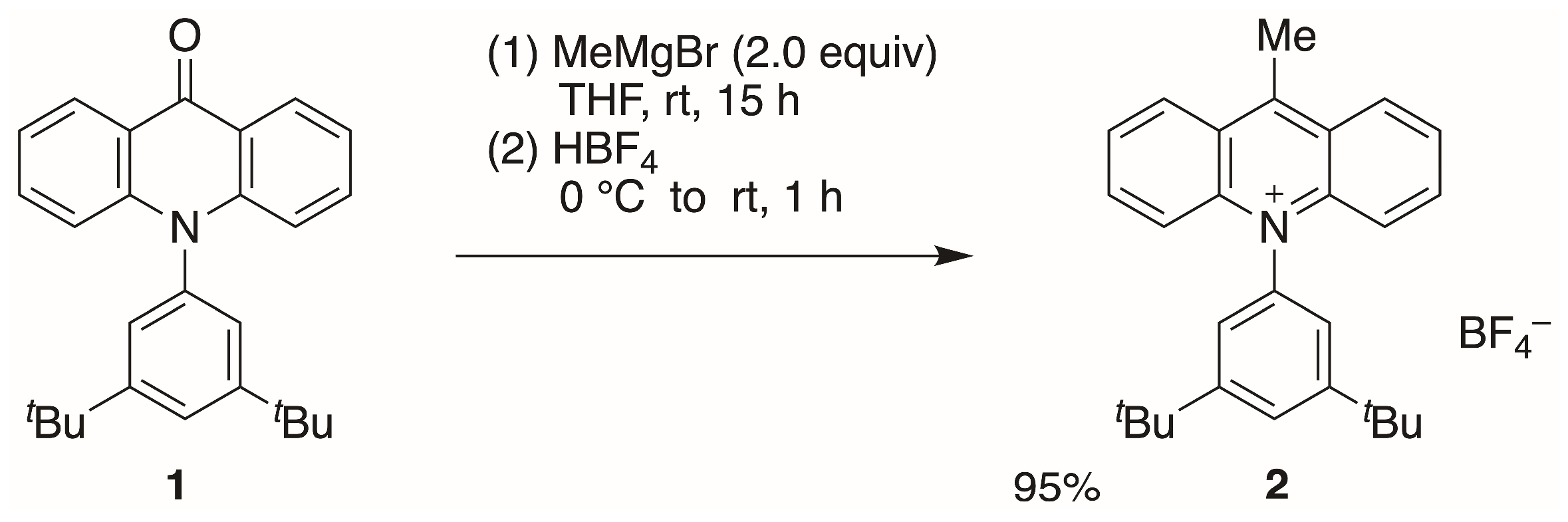
The synthesis of 10-(3,5-di-tert-butylphenyl)-9-methylacridinium tetrafluoroborate (2) is shown in Scheme 1. Acridone 1 was treated with methylmagnesium bromide, followed by tetrafluoroboric acid, to form the 9-methylacridinium framework. After purification, compound 2 was isolated as a yellow solid in 95% yield.
The structure of 2 was confirmed by 1H and 13C{1H} NMR spectroscopy and high-resolution mass spectrometry. In the 1H NMR spectrum, singlets at δ 3.67 and 1.41 ppm, integrating to three and eighteen protons, respectively, were assigned to the 9-methyl group and the two tert-butyl groups. The remaining signals were consistent with the acridinium and 3,5-di-tert-butylphenyl moieties. High-resolution ESI mass spectrometry gave an ion at m/z 382.2530, in good agreement with the calculated value for [C28H32N]+ (m/z 382.2529).
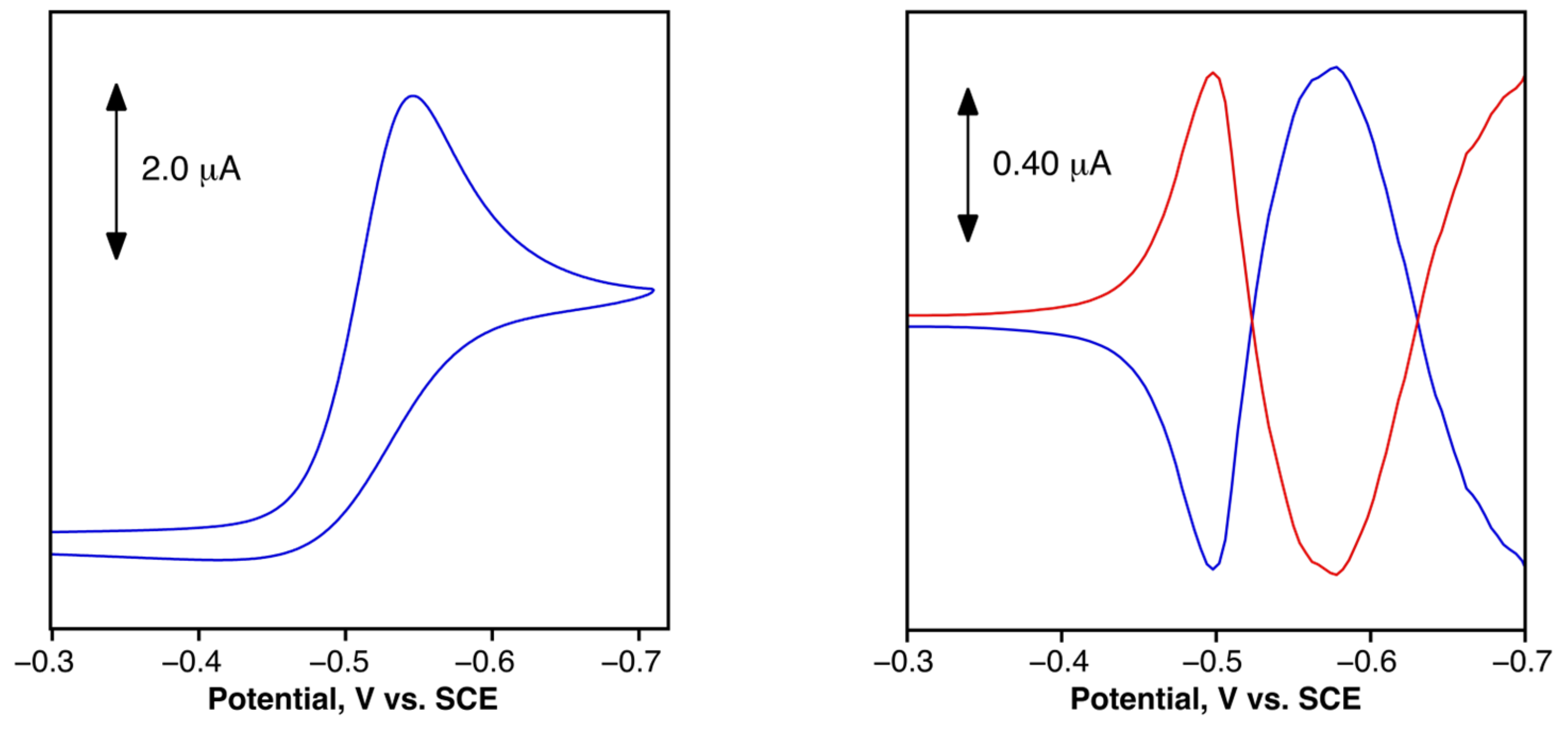
The electrochemical properties of acridinium salt 2 were examined by cyclic voltammetry (CV) in deaerated MeCN containing 0.10 M Bu4NClO4 as the supporting electrolyte. At a scan rate of 50 mV s−1, 2 exhibited a cathodic peak at Epc = −0.55 V vs. SCE (Figure 1, left panel). No well-defined corresponding anodic peak was observed on the reverse scan, indicating that the reduction process was electrochemically irreversible under the measurement conditions. The irreversible response was retained at scan rates of up to 10,000 V s−1 by fast scanning CV measurements [24].
Related acridinium compounds bearing an aryl substituent at the 9-position have been reported to exhibit reversible or quasi-reversible reduction waves [25]. The irreversible behavior of 2 may be related in part to the lower steric protection provided by the 9-methyl substituent. Following one-electron reduction, the resulting acridinyl radical may undergo a subsequent chemical process, such as intermolecular coupling, before reoxidation can occur. Because the reduced products were not identified, however, the origin of the irreversibility remains uncertain.
Because an irreversible CV response does not permit reliable determination of an equilibrium reduction potential when electron transfer is followed by a chemical reaction [26,27], second-harmonic alternating-current voltammetry (SHACV) was employed [26,28,29,30,31,32]. The zero-crossing potential of the second-harmonic response gave Ered = −0.52 V vs. SCE (Figure 1, right panel). This value was used together with the spectroscopically estimated E0,0 to calculate the singlet excited-state reduction potential of 2.
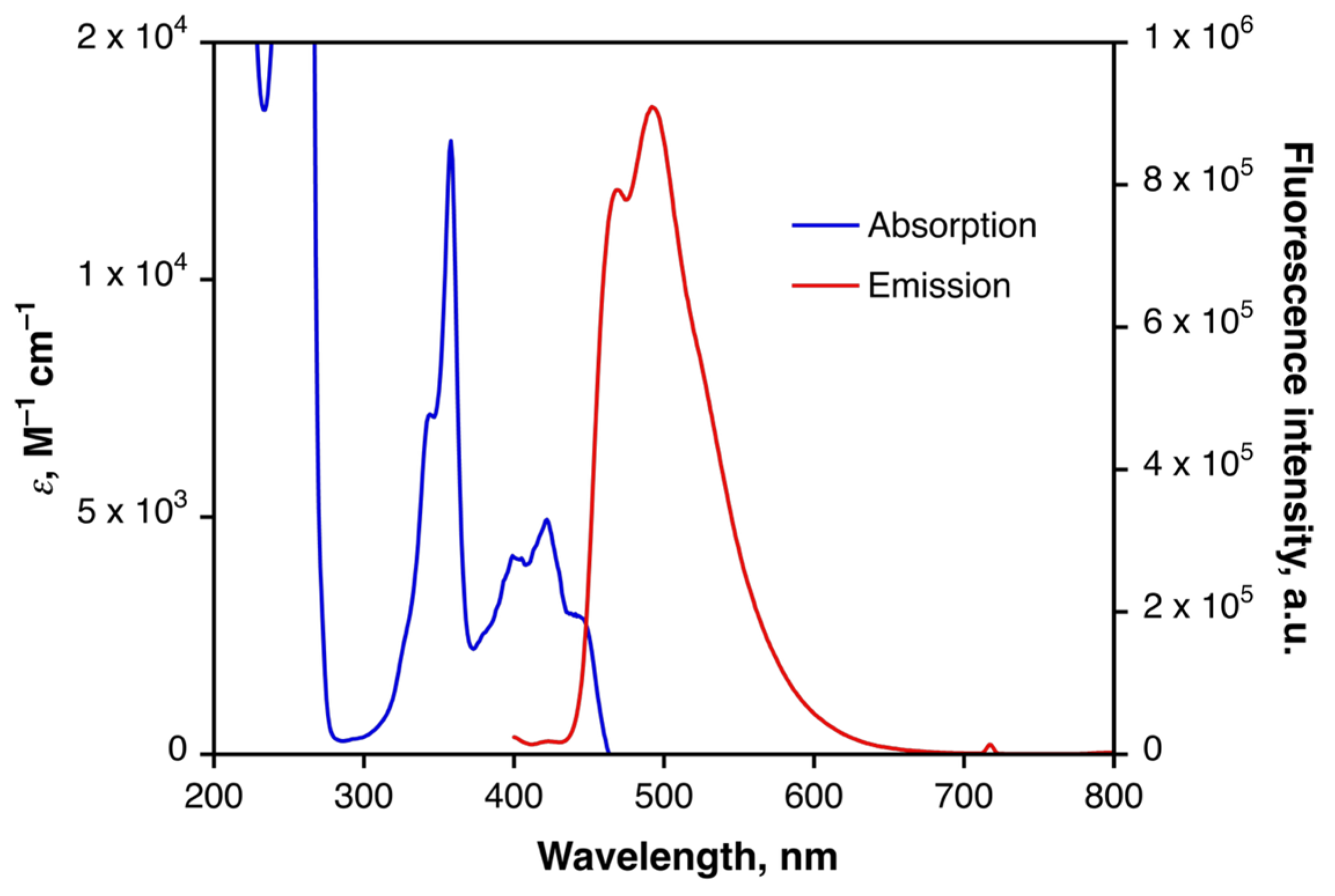
The photophysical properties of acridinium salt 2 were investigated in deaerated acetonitrile by UV–Vis absorption, steady-state fluorescence, and time-resolved fluorescence measurements. The absorption spectrum exhibited maxima at 358, 399, and 422 nm, with molar absorption coefficients of 1.29 × 10⁴, 4.18 × 10³, and 4.94 × 10³ M–1 cm–1, respectively (Figure 2). Thus, 2 absorbs in both the near-UV and visible regions.
Upon excitation at 358 nm, 2 exhibited a broad fluorescence band with a principal maximum at 492 nm and a shoulder at approximately 469 nm. Relative to the lowest-energy absorption maximum at 422 nm, the principal fluorescence maximum corresponds to an apparent Stokes shift of 70 nm, or approximately 3.37 × 103 cm–1. No phosphorescence was observed at room temperature [33].
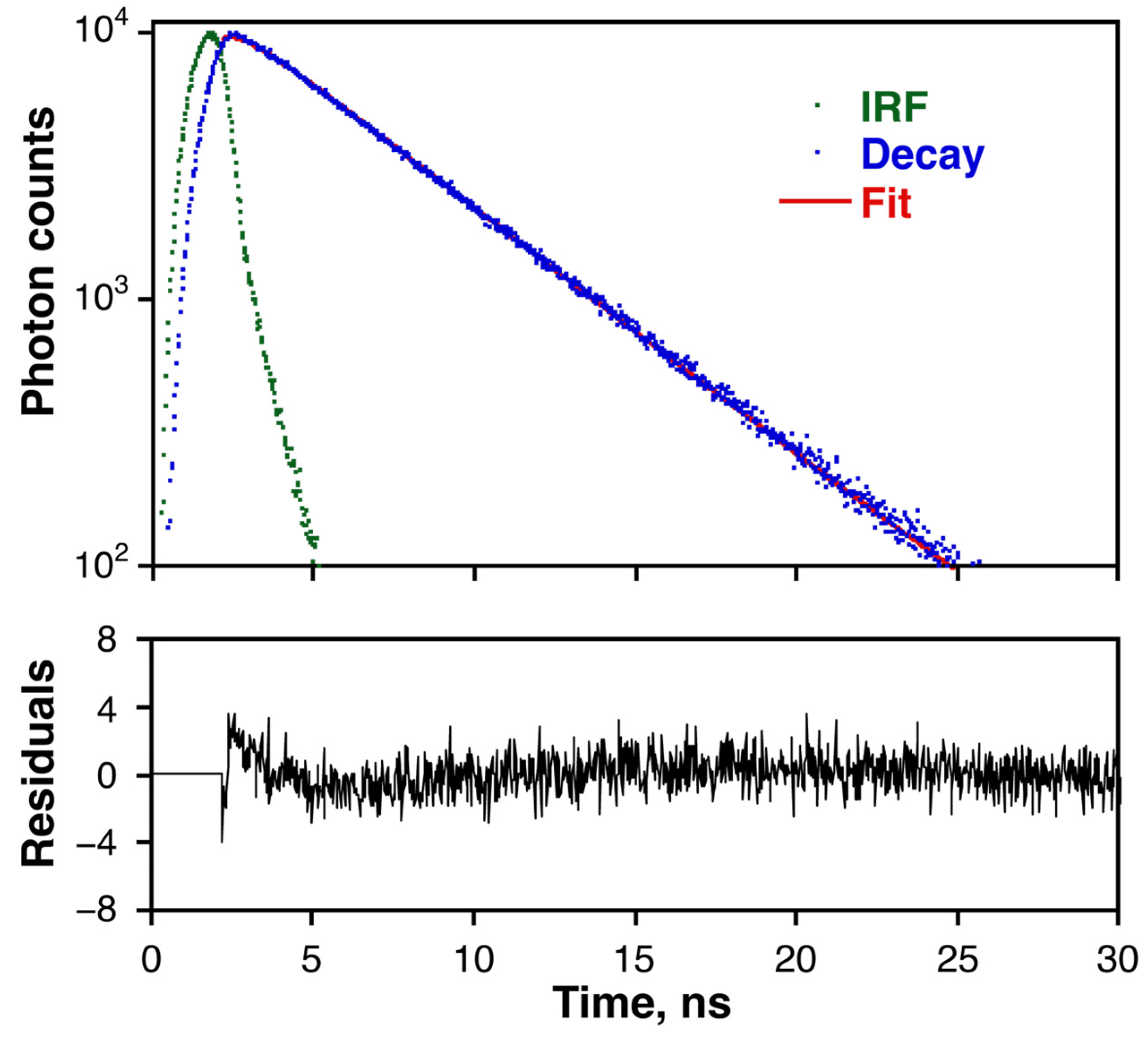
Time-resolved fluorescence measurements gave a monoexponential fluorescence lifetime of 4.6 ns in deaerated acetonitrile (Figure 3). In contrast, the previously reported 9-mesityl analogue showed no detectable fluorescence under the reported conditions [23]. In that compound, the high-lying HOMO localized on the 9-mesityl group may facilitate photoinduced intramolecular electron transfer to the excited acridinium moiety, potentially providing a nonradiative deactivation pathway [21,22,23]. Replacement of the mesityl group with a methyl group removes this specific mesityl-centered donor orbital and may therefore suppress this pathway, contributing to the fluorescence observed for 2.
The zero–zero transition energy, E0,0, was approximated from the mean of the energies corresponding to the lowest-energy absorption maximum at 422 nm and the principal fluorescence maximum at 492 nm. The resulting value was 2.73 eV. Using the ground-state reduction potential determined by SHACV, Ered = −0.52 V vs. SCE, the singlet excited-state reduction potential was estimated according to E*red = Ered + E0,0 [34,35,36,37]. The resulting value, E*red = +2.21 V vs. SCE, indicates that the singlet excited state of 2 has substantial photooxidizing ability.
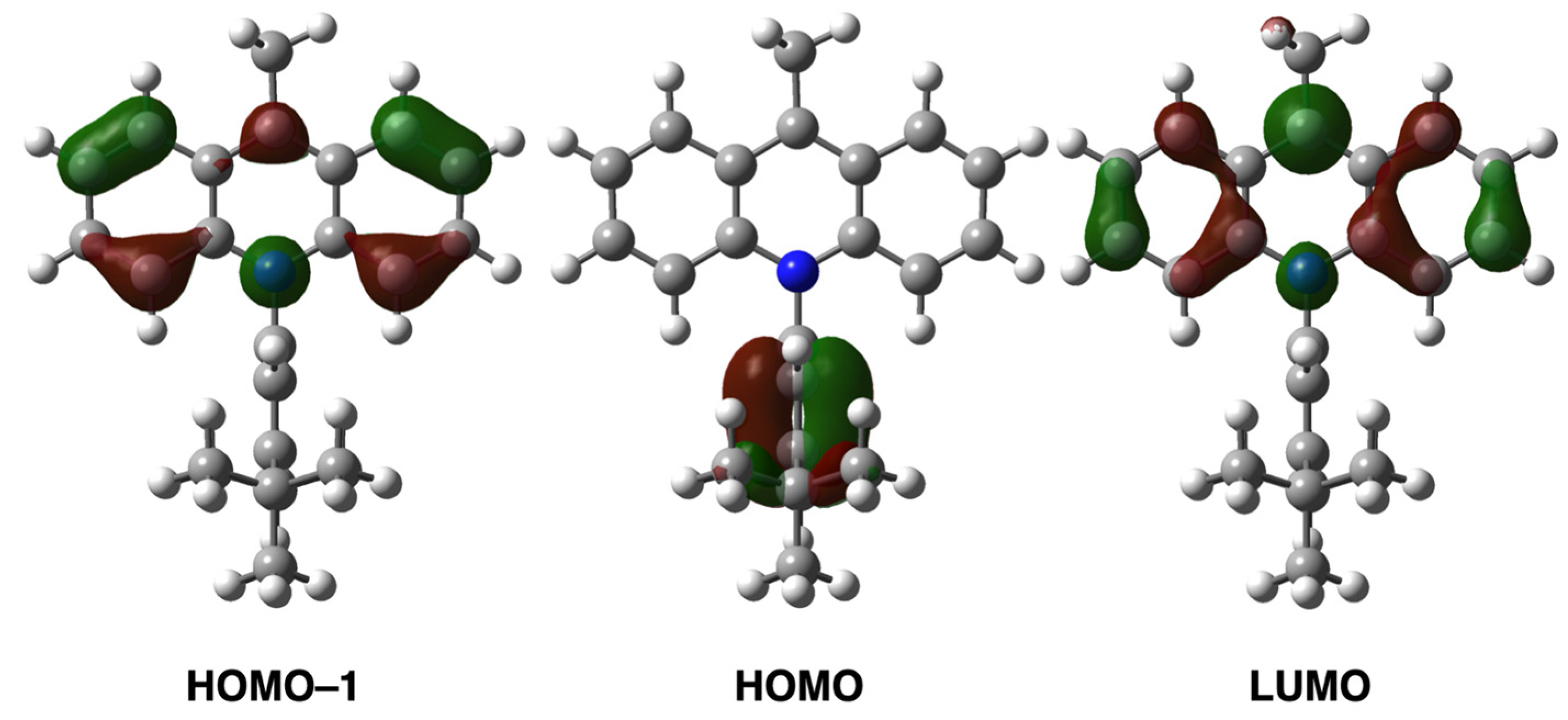
DFT and TD-DFT calculations were performed to support the interpretation of the electronic structure and absorption properties of compound 2. The HOMO and HOMO−1 energies were calculated to be −11.0 and −11.1 eV, respectively, whereas the LUMO energy was −5.29 eV. The HOMO was mainly localized on the N-bound 3,5-di-tert-butylphenyl group, while the HOMO−1 and LUMO were predominantly distributed over the acridinium framework (Figure 4). The absence of the high-lying donor orbital associated with the 9-mesityl group may contribute to the different emission behavior of 2 relative to the previously reported 9-mesityl analogue [23]. The LUMO distribution is consistent with reduction being centered primarily on the acridinium framework.
The lowest-energy singlet excited state was calculated at 368 nm (3.37 eV, f = 0.132) and was dominated by the HOMO−1 → LUMO configuration. This excitation is reasonably assigned to the lowest-energy absorption band observed in the 400 nm region. The difference between the calculated and experimental wavelengths may arise from the simplified gas-phase model of the isolated acridinium cation, which does not account for solvent and counteranion effects.

3. Materials and Methods

3.1. Materials

10-(3,5-Di-tert-butylphenyl)-9(10H)-acridinone (1) was prepared according to a previously reported procedure [23]. Methylmagnesium bromide (1.0 M in THF) was purchased from Kanto Chemical Co., Inc. (Tokyo, Japan), and aqueous tetrafluoroboric acid (48 wt%) was purchased from Sigma-Aldrich Co. LLC (St. Louis, MO, USA). HPLC-grade acetonitrile used for optical and electrochemical measurements was purchased from KISHIDA Chemical Co., Ltd. (Osaka, Japan). Tetrabutylammonium perchlorate (Bu4NClO4) was purchased from Nacalai Tesque, Inc. (Kyoto, Japan) and recrystallized from ethanol before use. Unless otherwise stated, all other reagents were commercially available and used as received.
Nuclear magnetic resonance (NMR) spectra were recorded on a JEOL JNM-ECS-400 spectrometer (1H: 400 MHz; 13C: 101 MHz; 19F: 376 MHz; JEOL Ltd., Tokyo, Japan). Chemical shifts were calibrated relative to tetramethylsilane (δ = 0 ppm for 1H NMR), the residual solvent signal (CDCl3, δ = 77.16 ppm for 13C NMR), or hexafluorobenzene (δ = −162.9 ppm for 19F NMR). The following abbreviations were used to describe signal multiplicities: s, singlet; d, doublet; t, triplet; q, quartet; m, multiplet; and br, broad. A high-resolution mass spectrum was recorded using a JEOL JMS-T100LP mass spectrometer (JEOL Ltd., Tokyo, Japan).

3.2. Synthetic Procedures

A flame-dried Schlenk tube equipped with a magnetic stir bar was charged with 10-(3,5-di-tert-butylphenyl)-9(10H)-acridinone (1) (384 mg, 1.0 mmol) under an argon atmosphere. A 1.0 M solution of methylmagnesium bromide in THF (2.0 mL, 2.0 mmol, 2.0 equiv) was added dropwise at room temperature. The reaction mixture was stirred for 15 h at room temperature. The reaction was then cooled in an ice–water bath, and 48 wt% aqueous tetrafluoroboric acid (2.0 mL) was added dropwise with stirring. After stirring for 1 h at 0 °C to room temperature, water and CHCl3 were added, and the layers were separated. The organic phase was treated with NaBF4 to remove residual water, filtered, and concentrated under reduced pressure. Reprecipitation from CHCl3/diethyl ether afforded 10-(3,5-di-tert-butylphenyl)-9-methylacridinium tetrafluoroborate (2) as a yellow solid (447 mg, 95%). 1H NMR (400 MHz, chloroform-d) δ 8.88 (d, J = 8.7 Hz, 2H), 8.13 (t, J = 7.8 Hz, 2H), 8.00 (t, J = 7.8 Hz, 2H), 7.87 (s, 1H), 7.45 (d, J = 9.2 Hz, 2H), 7.30 (s, 2H), 3.67 (s, 3H), 1.41 (s, 18H). The spectrum is shown in Figure S1. 13C{1H} NMR (101 MHz, chloroform-d) 163.2, 155.4, 141.2, 138.6, 136.8, 128.3, 128.2, 126.2, 125.6, 121.9, 119.7, 35.6, 31.5, 17.2. 19F NMR (376 MHz, chloroform-d) −155.2. The spectrum is shown in Figure S3. HRMS (ESI) m/z ([M]+) calcd for C28H32N: 382.2529, found: 382.2530. The spectrum is shown in Figure S4. IR ν max ˜ /cm−1: 2956, 2869, 1610, 1580, 1542, 1459, 1379, 1303, 1288, 1249, 1166, 1048, 933, 901, 884, 837, 754, 714, 614, 600. The spectrum is shown in Figure S5. m.p. 214–216 °C (decomp.).

3.3. Electrochemical Measurements

Cyclic voltammetry (CV) and second-harmonic alternating-current voltammetry (SHACV) were performed at 298 K using a BAS ALS 610E electrochemical analyzer (BAS Inc., Tokyo, Japan). Measurements were conducted in acetonitrile containing compound 2 (1.0 mM) and Bu4NClO4 (0.10 M) as the supporting electrolyte. Before each measurement, the solution was deaerated by bubbling with argon for 5 min.
A platinum disk electrode (1.6 mm diameter; BAS Inc., Tokyo, Japan), a platinum wire, and an Ag/AgNO3 electrode were used as the working, counter, and reference electrodes, respectively. The reference electrode contained AgNO3 (10 mM) and tetrabutylammonium hexafluorophosphate (0.10 M) in acetonitrile. Before use, the working electrode was polished with an alumina suspension and rinsed with acetone.
Cyclic voltammograms were initially recorded at a scan rate of 50 mV s−1. Additional measurements were performed at scan rates of up to 10,000 V s−1 using a Pt wire microelectrode as working electrode. SHACV measurements were performed using an AC frequency of 100 Hz, an AC amplitude of 0.025 V, and a DC scan rate of 4 mV s−1. The reduction potential was determined from the zero-crossing point of the second-harmonic response [26,28,29,30,31,32]. Potentials measured against Ag/AgNO3 were converted to the SCE scale using E (vs. SCE) = E (vs. Ag/AgNO3) + 0.29 V [38]. All electrochemical potentials are reported vs. SCE.

3.4. Spectroscopic Measurements

Spectroscopic measurements were performed at 298 K using a deaerated acetonitrile solution of compound 2 (25 μM) in a 1 cm quartz cuvette. UV–Vis absorption spectra were recorded using an Agilent 8453A UV–Vis spectrophotometer (Agilent Technologies, Inc., Santa Clara, CA, USA). Steady-state fluorescence spectra were recorded using a FluoroMax-4 spectrofluorometer (HORIBA, Ltd., Kyoto, Japan). The sample was excited at 358 nm, and emission spectra were recorded from 400 to 800 nm. No correction for the wavelength-dependent response of the detection system was applied.
Time-resolved fluorescence measurements were performed using a DeltaFlex fluorescence lifetime system (HORIBA, Ltd., Kyoto, Japan) equipped with a 360 nm pulsed LED. Fluorescence decay was monitored at 492 nm. The instrument response function was measured using water as the scattering medium, and the decay profile was analyzed by reconvolution using a monoexponential function.

3.5. Calculations

Geometry optimization and frequency calculations were performed in the gas phase at the CAM-B3LYP/6-311+G(d,p) level [39] with a charge of +1 and singlet multiplicity. The Kohn–Sham orbitals [40] were visualized using GaussView 6.1.1 with an isosurface value of 0.04 a.u. All calculations were performed using Gaussian 16, Revision C.02 [41].

4. Conclusions

The 9-methylacridinium salt 2 was synthesized and characterized, and its electrochemical, photophysical, and electronic properties were examined. Compound 2 exhibited irreversible reduction behavior and visible-region absorption, together with fluorescence centered at 492 nm and a lifetime of 4.6 ns. Its singlet excited-state reduction potential of +2.21 V vs. SCE indicates substantial photooxidizing ability. DFT and TD-DFT calculations showed that the HOMO−1 and LUMO are mainly localized on the acridinium framework, whereas the HOMO is localized on the N-bound aryl group. In contrast to the previously reported 9-mesityl analogue, compound 2 was fluorescent, which may reflect the absence of the high-lying donor orbital associated with the 9-mesityl group. These results highlight the importance of the 9-substituent in controlling intramolecular electron-transfer pathways and emission from acridinium-based photoactive molecules.

Supplementary Materials

The following supporting information can be downloaded online. Figure S1: 1H-NMR spectrum (400 MHz, chloroform-d) of 10-(3,5-di-tert-butylphenyl)-9-methylacridinium tetrafluoroborate (2). A peak observed at 1.7 ppm is due to H2O; Figure S2: 13C{1H}-NMR spectrum (101 MHz, chloroform-d) of 10-(3,5-di-tert-butylphenyl)-9-methylacridinium tetrafluoroborate (2); Figure S3: 19F-NMR spectrum (376 MHz, chloroform-d) of 10-(3,5-di-tert-butylphenyl)-9-methylacridinium tetrafluoroborate (2); Figure S4: High-resolution mass spectrum of 10-(3,5-di-tert-butylphenyl)-9-methylacridinium tetrafluoroborate (2); Figure S5: FTIR spectrum of 10-(3,5-di-tert-butylphenyl)-9-methylacridinium tetrafluoroborate (2); Table S1: Cartesian Coordinate of 10-(3,5-di-tert-butylphenyl)-9-methylacridinium.

Author Contributions

Conceptualization, Y.I. and K.O.; methodology, Y.I. and K.O.; validation, Y.I. and K.O.; formal analysis, Y.I.; investigation, Y.I.; resources, K.O.; writing—review and editing, Y.I. and K.O.; supervision, Y.I. and K.O. All authors have read and agreed to the published version of the manuscript.

Funding

This work was supported by JSPS KAKENHI Grants JP23K13709, JP26K17741, and JP26H00490 (to Y.I.) and JP24K21770 (to K.O.), the Japan Science and Technology Agency (JST) e-ASIA Joint Research Program (e-ASIA JRP; Grant No. 26012678, to K.O.), and the JST Startup Creation Fund Grant (Grant No. JPMJSF2317, to K.O.).

Data Availability Statement

The raw data supporting the conclusions of this article will be made available by the authors on request.

Acknowledgments

The authors thank the Faculty of Pharmaceutical Sciences, the University of Osaka, for assistance with high-resolution mass spectrometry (HRMS) measurements. The authors also thank Kei Umino for assistance with the synthesis.

Conflicts of Interest

The authors declare no conflicts of interest.

References

  1. Prier, C.K.; Rankic, D.A.; MacMillan, D.W.C. Visible Light Photoredox Catalysis with Transition Metal Complexes: Applications in Organic Synthesis. Chem. Rev. 2013, 113, 5322–5363. [Google Scholar] [CrossRef] [PubMed]
  2. Shaw, M.H.; Twilton, J.; MacMillan, D.W.C. Photoredox Catalysis in Organic Chemistry. J. Org. Chem. 2016, 81, 6898–6926. [Google Scholar] [CrossRef] [PubMed]
  3. Romero, N.A.; Nicewicz, D.A. Organic Photoredox Catalysis. Chem. Rev. 2016, 116, 10075–10166. [Google Scholar] [CrossRef] [PubMed]
  4. Margrey, K.A.; Nicewicz, D.A. A General Approach to Catalytic Alkene Anti-Markovnikov Hydrofunctionalization Reactions. Acc. Chem. Res. 2016, 49, 1997–2006. [Google Scholar] [CrossRef] [PubMed]
  5. Joshi-Pangu, A.; Lévesque, F.; Roth, H.G.; Oliver, S.F.; Campeau, L.-C.; Nicewicz, D.A.; DiRocco, D.A. Acridinium-Based Photocatalysts: A Sustainable Option in Photoredox Catalysis. J. Org. Chem. 2016, 81, 7244–7249. [Google Scholar] [CrossRef] [PubMed]
  6. White, A.R.; Wang, L.; Nicewicz, D.A. Synthesis and Characterization of Acridinium Dyes for Photoredox Catalysis. Synlett 2019, 30, 827–832. [Google Scholar] [CrossRef] [PubMed]
  7. Tlili, A.; Lakhdar, S. Acridinium Salts and Cyanoarenes as Powerful Photocatalysts: Opportunities in Organic Synthesis. Angew. Chem. Int. Ed. 2021, 60, 19526–19549. [Google Scholar] [CrossRef] [PubMed]
  8. Speckmeier, E.; Fischer, T.G.; Zeitler, K. A Toolbox Approach to Construct Broadly Applicable Metal-Free Catalysts for Photoredox Chemistry: Deliberate Tuning of Redox Potentials and Importance of Halogens in Donor–Acceptor Cyanoarenes. J. Am. Chem. Soc. 2018, 140, 15353–15365. [Google Scholar] [CrossRef] [PubMed]
  9. Hamilton, D.S.; Nicewicz, D.A. Direct Catalytic Anti-Markovnikov Hydroetherification of Alkenols. J. Am. Chem. Soc. 2012, 134, 18577–18580. [Google Scholar] [CrossRef] [PubMed]
  10. Nicewicz, D.A.; Nguyen, T.M. Recent Applications of Organic Dyes as Photoredox Catalysts in Organic Synthesis. ACS Catal. 2014, 4, 355–360. [Google Scholar] [CrossRef]
  11. Itabashi, Y.; Asahara, H.; Ohkubo, K. Chlorine-Radical-Mediated C–H Oxygenation Reaction under Light Irradiation. Chem. Commun. 2023, 59, 7506–7517. [Google Scholar] [CrossRef] [PubMed]
  12. Fukuzumi, S.; Lee, Y.-M.; Nam, W. Photoredox Catalysis of Acridinium and Quinolinium Ion Derivatives. Bull. Korean Chem. Soc. 2025, 46, 4–23. [Google Scholar] [CrossRef]
  13. Zilate, B.; Fischer, C.; Sparr, C. Design and Application of Aminoacridinium Organophotoredox Catalysts. Chem. Commun. 2020, 56, 1767–1775. [Google Scholar] [CrossRef] [PubMed]
  14. Singh, P.P.; Singh, J.; Srivastava, V. Visible-Light Acridinium-Based Organophotoredox Catalysis in Late-Stage Synthetic Applications. RSC Adv. 2023, 13, 10958–10986. [Google Scholar] [CrossRef] [PubMed]
  15. Bera, S.K.; Porcheddu, A. Pioneering Metal-Free Late-Stage C–H Functionalization Using Acridinium Salt Photocatalysis. Chem. Eur. J. 2024, 30, e202402809. [Google Scholar] [CrossRef] [PubMed]
  16. Valeur, B.; Berberan-Santos, M.N. Molecular Fluorescence: Principles and Applications, 2nd ed.; Wiley-VCH: Weinheim, Germany, 2012. [Google Scholar]
  17. Nakamura, S.; Kawaguchi, S.; Nishimura, Y.; Harimoto, T.; Hasegawa, J.-Y.; Suzuki, T.; Ishigaki, Y. Nitrogen-Centred Helical Acridiniums with a 6–7–6–6 Fused Ring Skeleton. Chem. Commun. 2026, 62, 4268–4271. [Google Scholar] [CrossRef] [PubMed]
  18. Fischer, C.; Kerzig, C.; Zilate, B.; Wenger, O.S.; Sparr, C. Modulation of Acridinium Organophotoredox Catalysts Guided by Photophysical Studies. ACS Catal. 2020, 10, 210–215. [Google Scholar] [CrossRef]
  19. Cao, Y.-X.; Zhu, G.; Li, Y.; Le Breton, N.; Gourlaouen, C.; Choua, S.; Boixel, J.; de Rouville, H.-P.J.; Soulé, J.-F. Photoinduced Arylation of Acridinium Salts: Tunable Photoredox Catalysts for C–O Bond Cleavage. J. Am. Chem. Soc. 2022, 144, 5902–5909. [Google Scholar] [CrossRef] [PubMed]
  20. Wang, J.Y.; Fan, F.; Ruos, M.E.; Adao Gomes, L.; Lavin, M.; O’Connor, T.J.; Lopez, S.A.; Doyle, A.G. Diversification of Acridinium Photocatalysts: Property Tuning and Reactivity in Model Reactions. Tetrahedron Lett. 2025, 160, 155546. [Google Scholar] [CrossRef]
  21. Fukuzumi, S.; Kotani, H.; Ohkubo, K.; Ogo, S.; Tkachenko, N.V.; Lemmetyinen, H. Electron-Transfer State of 9-Mesityl-10-methylacridinium Ion with a Much Longer Lifetime and Higher Energy Than That of the Natural Photosynthetic Reaction Center. J. Am. Chem. Soc. 2004, 126, 1600–1601. [Google Scholar] [CrossRef] [PubMed]
  22. Hoshino, M.; Uekusa, H.; Tomita, A.; Koshihara, S.; Sato, T.; Nozawa, S.; Adachi, S.; Ohkubo, K.; Kotani, H.; Fukuzumi, S. Determination of the Structural Features of a Long-Lived Electron-Transfer State of 9-Mesityl-10-methylacridinium Ion. J. Am. Chem. Soc. 2012, 134, 4569–4572. [Google Scholar] [CrossRef] [PubMed]
  23. Itabashi, Y.; Ohkubo, K. A Bulky Aryl–Substituted Acridinium Salt: 10-(3,5-Di-tert-butylphenyl)-9-mesitylacridinium Tetrafluoroborate. Molbank 2026, 2026, M2164. [Google Scholar] [CrossRef]
  24. Venton, B.J.; Cao, Q. Fundamentals of Fast-Scan Cyclic Voltammetry for Dopamine Detection. Analyst 2020, 145, 1158–1168. [Google Scholar] [CrossRef] [PubMed]
  25. Matsuda, M.; Uchiyama, M.; Itabashi, Y.; Ohkubo, K.; Kamigaito, M. Acridinium Salts as Photoredox Organocatalysts for Photomediated Cationic RAFT and DT Polymerizations of Vinyl Ethers. Polym. Chem. 2022, 13, 1031–1039. [Google Scholar] [CrossRef]
  26. Bard, A.J.; Faulkner, L.R. Electrochemical Methods: Fundamentals and Applications, 2nd ed.; John Wiley & Sons: New York, NY, USA, 2001; Chapter 10; pp. 368–416. [Google Scholar]
  27. Nicholson, R.S.; Shain, I. Theory of Stationary Electrode Polarography. Single Scan and Cyclic Methods Applied to Reversible, Irreversible, and Kinetic Systems. Anal. Chem. 1964, 36, 706–723. [Google Scholar] [CrossRef]
  28. McCord, T.G.; Smith, D.E. Second Harmonic A.C. Polarography. Theoretical Predictions for Systems with First-Order Chemical Reactions Following the Charge-Transfer Step. Anal. Chem. 1969, 41, 1423–1441. [Google Scholar] [CrossRef]
  29. Bond, A.M.; Smith, D.E. Direct Measurement of Er1/2 with Reversible and EC Electrode Processes by Second Harmonic Alternating Current Polarography and Voltammetry. Anal. Chem. 1974, 46, 1946–1951. [Google Scholar] [CrossRef]
  30. Wasielewski, M.R.; Breslow, R. Thermodynamic Measurements on Unsubstituted Cyclopropenyl Radical and Anion, and Derivatives, by Second Harmonic Alternating Current Voltammetry of Cyclopropenyl Cations. J. Am. Chem. Soc. 1976, 98, 4222–4229. [Google Scholar] [CrossRef]
  31. Arnett, E.M.; Amarnath, K.; Harvey, N.G.; Cheng, J.-P. Determination and Interrelation of Bond Heterolysis and Homolysis Energies in Solution. J. Am. Chem. Soc. 1990, 112, 344–355. [Google Scholar] [CrossRef]
  32. Ofial, A.R.; Ohkubo, K.; Fukuzumi, S.; Lucius, R.; Mayr, H. Role of Electron-Transfer Processes in Reactions of Diarylcarbenium Ions and Related Quinone Methides with Nucleophiles. J. Am. Chem. Soc. 2003, 125, 10906–10912. [Google Scholar] [CrossRef] [PubMed]
  33. Zhang, X.; Liu, Z.-X.; Mu, Y.; Wang, J.-Q.; Du, J.-J.; Yao, L.; Su, H. Phosphorescence Enables Identification of Electronic State for Acridinium Salt in Solutions. J. Phys. Chem. Lett. 2021, 12, 12242–12248. [Google Scholar] [CrossRef] [PubMed]
  34. Rehm, D.; Weller, A. Kinetics of Fluorescence Quenching by Electron and H-Atom Transfer. Isr. J. Chem. 1970, 8, 259–271. [Google Scholar] [CrossRef]
  35. Turro, N.J.; Ramamurthy, V.; Scaiano, J.C. Modern Molecular Photochemistry of Organic Molecules; University Science Books: Sausalito, CA, USA, 2010. [Google Scholar]
  36. Arias-Rotondo, D.M.; McCusker, J.K. The Photophysics of Photoredox Catalysis: A Roadmap for Catalyst Design. Chem. Soc. Rev. 2016, 45, 5803–5820. [Google Scholar] [CrossRef] [PubMed]
  37. Ogasahara, R.; Mae, M.; Itabashi, Y.; Ohkubo, K.; Matsuura, K.; Shimizu, H.; Ban, K.; Togami, M.; Udagawa, T.; Fujioka, H.; et al. Photocatalytic and Chemoselective H/D Exchange at α-Thio C(sp3)–H Bonds. J. Am. Chem. Soc. 2025, 147, 15499–15509. [Google Scholar] [CrossRef] [PubMed]
  38. Mann, C.K.; Barnes, K.K. Electrochemical Reactions in Nonaqueous Systems; Marcel Dekker: New York, NY, USA, 1970. [Google Scholar]
  39. Yanai, T.; Tew, D.P.; Handy, N.C. A New Hybrid Exchange–Correlation Functional Using the Coulomb-Attenuating Method (CAM-B3LYP). Chem. Phys. Lett. 2004, 393, 51–57. [Google Scholar] [CrossRef]
  40. Kohn, W.; Sham, L.J. Self-Consistent Equations Including Exchange and Correlation Effects. Phys. Rev. 1965, 140, A1133–A1138. [Google Scholar] [CrossRef]
  41. Frisch, M.J.; Trucks, G.W.; Schlegel, H.B.; Scuseria, G.E.; Robb, M.A.; Cheeseman, J.R.; Scalmani, G.; Barone, V.; Petersson, G.A.; Nakatsuji, H.; et al. Gaussian 16, Revision C.02; Gaussian, Inc.: Wallingford, CT, USA, 2019.
Scheme 1. Synthesis of compound 2 from acridone 1.
Molbank 2026 m2203 sch001
Figure 1. Cyclic voltammogram (left panel) and second-harmonic alternating-current voltammogram (right panel) of acridinium salt 2 in acetonitrile.
Molbank 2026 m2203 g001
Figure 2. UV–Vis absorption (blue) and fluorescence (red) spectra of acridinium salt 2 in acetonitrile.
Molbank 2026 m2203 g002
Figure 3. Time-resolved fluorescence decay of acridinium salt 2 in deaerated acetonitrile with instrument response function (IRF, green). The solid line represents the mono-exponential fit (red line). The residuals of the fit for a lifetime of τ = 4.6 ns are plotted in the bottom frame.
Molbank 2026 m2203 g003
Figure 4. Kohn–Sham HOMO−1, HOMO, and LUMO of the acridinium cation of compound 2.
Molbank 2026 m2203 g004
Disclaimer/Publisher’s Note: The statements, opinions and data contained in all publications are solely those of the individual author(s) and contributor(s) and not of MDPI and/or the editor(s). MDPI and/or the editor(s) disclaim responsibility for any injury to people or property resulting from any ideas, methods, instructions or products referred to in the content.