Short Note

N-(4-fluorobenzyl)-N′-(4-fluorobenzylidene)-4-methylbenzenesulfonohydrazide

Liaoning Key Laboratory of Development and Utilization for Natural Products Active Molecules Liaoning, College of Chemistry and Life Sciences, Anshan Normal University, Anshan 114007, China
*
Authors to whom correspondence should be addressed.
These authors contributed equally to this work.
Molbank 2026, 2026(4), M2200; https://doi.org/10.3390/M2200
Submission received: 12 June 2026 / Revised: 28 June 2026 / Accepted: 1 July 2026 / Published: 6 July 2026

Abstract

Herein, we present the synthesis of N-(4-fluorobenzyl)-N’-(4-fluorobenzylidene)-4-methylbenzenesulfonohydrazide. The compound has been thoroughly characterized through melting-point determination, 1H and 13C NMR spectroscopy and mass spectrometry. The structure was unequivocally determined by X-ray analysis. The comprehensive analytical data obtained from these techniques confirm the successful preparation and structural integrity of the newly synthesized molecule.

1. Introduction

N-tosylhydrazones are widely recognized as safe alternative reagents to diazo compounds. Characterized by excellent stability, facile preparation, operational safety and broad structural diversity, they can efficiently generate carbene coupling reagents in situ via the Bamford–Stevens reaction [1,2] to construct carbon–carbon and carbon–heteroatom bonds [3,4,5,6] and are commonly deployed in the synthesis of cyclic frameworks [7,8], bioactive pharmaceutical molecules [9,10] and other high-value compounds [11,12].
This work reports the successful preparation of N-(4-fluorobenzyl)-N’-(4-fluorobenzylidene)-4-methylbenzenesulfonohydrazide. To confirm the structure of the target compound, comprehensive characterization was performed, covering melting-point determination and 1H and 13C NMR spectroscopy, as well as full single-crystal X-ray diffraction structure determination and detailed structural analysis.

2. Results

The 1H NMR spectrum confirms the presence of all 24 expected protons. The methyl groups appear at δ 2.39 ppm as a singlet integrating for three protons. A singlet signal at δ 4.76 ppm in the 1H NMR spectrum was assigned to the methylene group belonging to the benzyl moiety formed during the N-alkylation reaction (see Supplementary Figure S1). The signal at δ 51.8 ppm in the 13C NMR spectrum, assigned to the methylene group, also supports this structural assignment (see Supplementary Figure S2). HRMS: m/z [M + H]+ calcd for C21H19F2N2O2S+: 401.1130; found: 401.1129 (see Supplementary Figure S2).
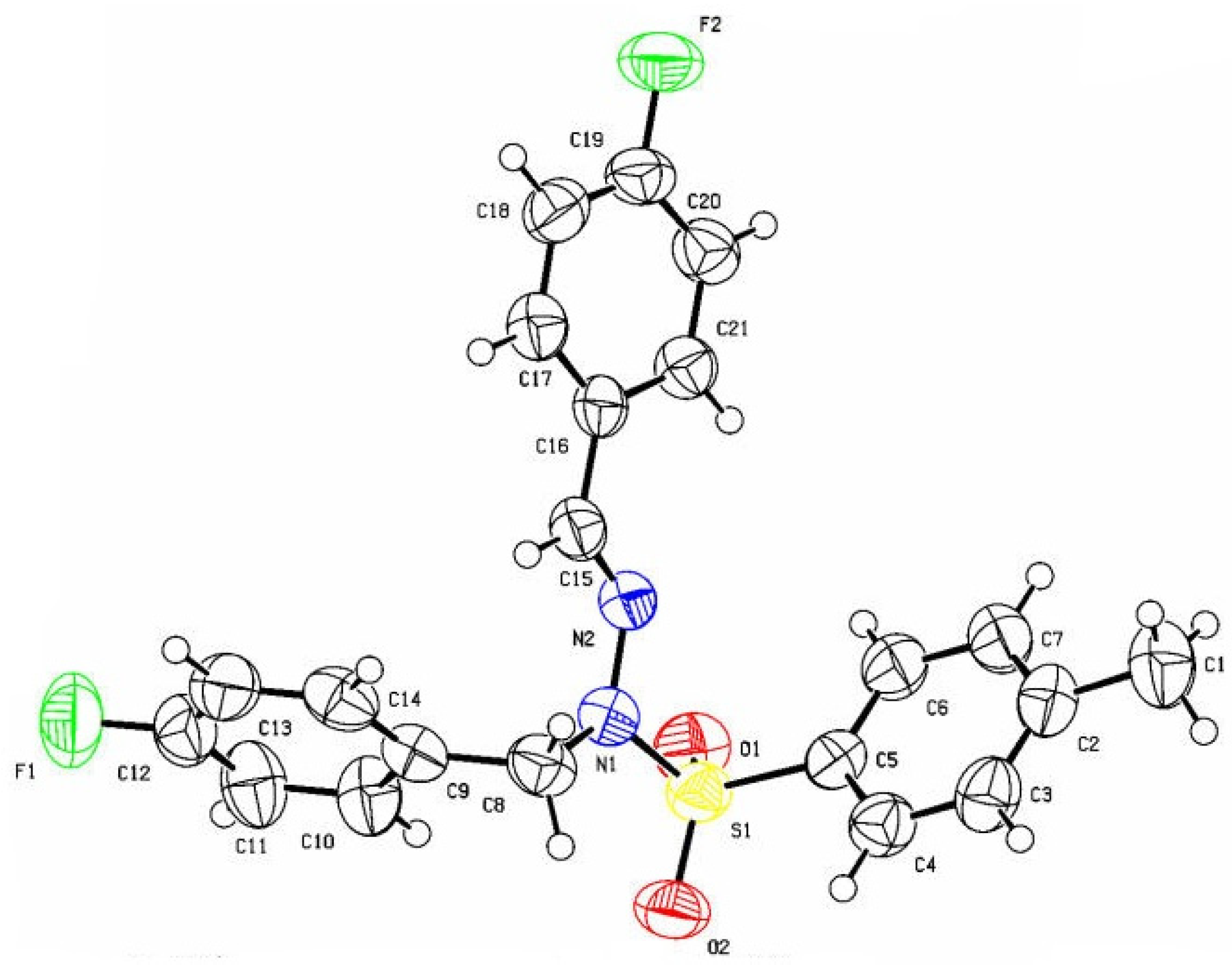
N-(4-fluorobenzyl)-N’-(4-fluorobenzylidene)-4-methylbenzenesulfonohydrazide was obtained as a crystalline solid from an ethyl acetate/n-hexane/acetone (v/v/v 6/1/1) solution through slow evaporation. Single-crystal X-ray crystallography was used to study it, allowing this compound to be unequivocally identified. Crystallographic data and structural refinement parameters of compound 2 are summarized in Table 1 and an ORTEP representation of the structure of compound 2 is shown in Figure 1.
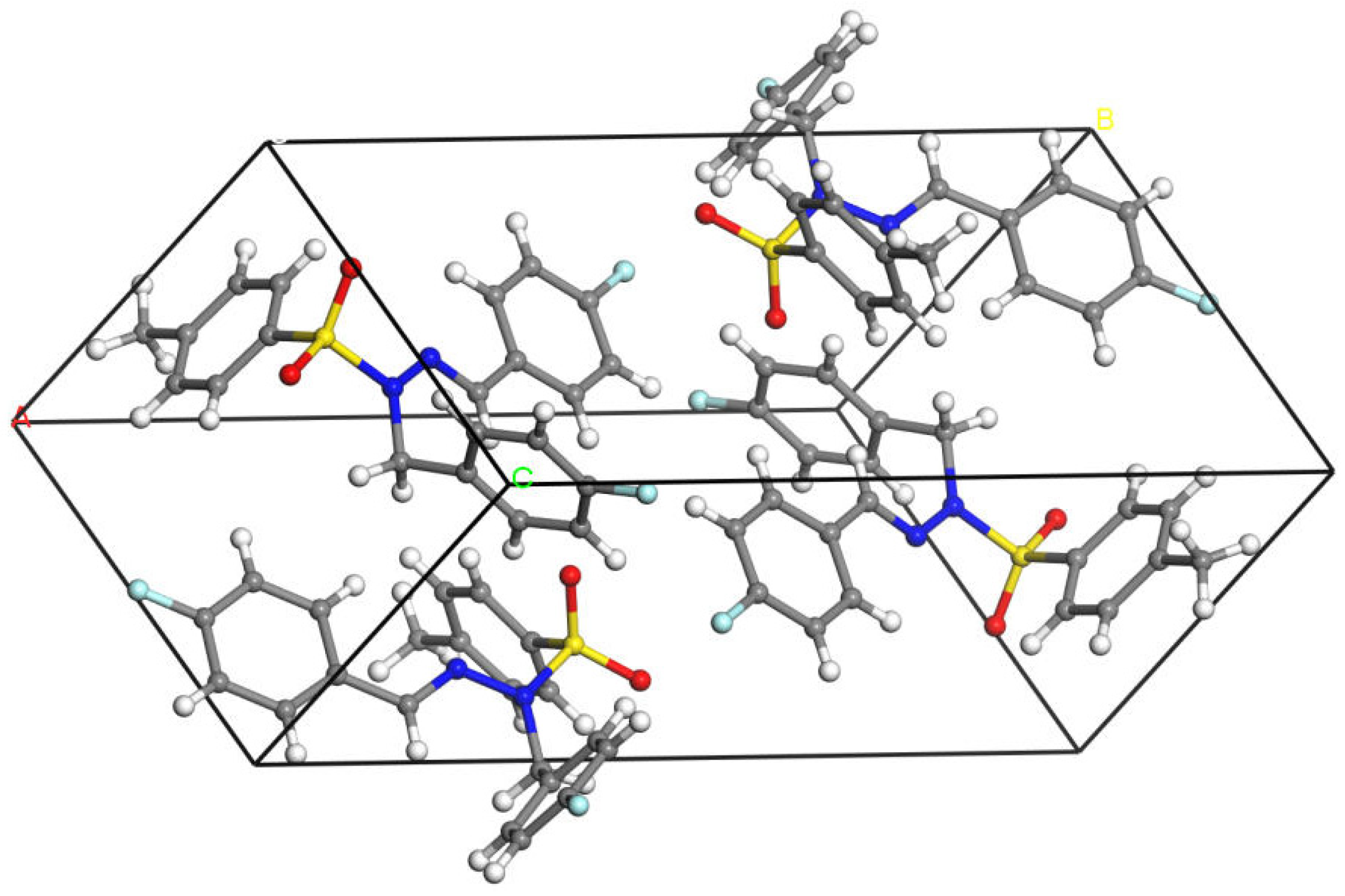
Compound 2 crystallized in the monoclinic centrosymmetric P21/c space group, with four molecules in the asymmetric unit. The characteristic C=N bond angles were present in this molecule, displaying N(2)-C(15)-H(15) and N(2)-C(15)-C(16) angles of 120.03° and 119.93(12)°, respectively (see Table 2). Furthermore, the N(1)-N(2) bond distance is 1.372(15) Å aligned with that reported for other hydrazides in the literature [13,14]. The crystal packing is depicted in Figure 2.

3. Materials and Methods

1H NMR and 13C NMR spectra were collected on a Bruker NEO 400 MB spectrometer (Bruker, Billerica, MA, USA), with CDCl3 as the solvent and Me4Si as the internal standard. Mass spectra were acquired in electron ionization (EI) mode at 70 eV with 200 °C on a Shimadzu GCMS-QP2010 Plus instrument (Shimadzu, Kyoto, Japan) using a direct inlet probe. Only molecular and parent ion peaks (m/z) are reported.
All starting materials were purchased from Energy Chemical Company (Hefei, China). All solvents and reagents were of reagent grade and were used without further purification unless otherwise specified. Column chromatography was performed on a flash chromatography system with silica gel, using petroleum ether (60–90 °C) and ethyl acetate as the eluent. Pre-coated silica gel GF-254 plates (Qiwei, Hangzhou, China) were used for thin-layer chromatography (TLC).
For the X-ray diffraction studies, crystals of compound 2 were obtained by the slow evaporation of a dilute hexane solution, and the reflections were acquired with a Bruker APEX DUO (Bruker, Billerica, MA, USA) diffractometer equipped with an Apex II CCD detector (Bruker, Billerica, MA, USA), with Mo Kα radiation (λ = 0.71073 Å) at 100 K. Frames were collected using omega scans and integrated with SAINT, and multi-scan absorption correction (SADABS) was applied. Direct methods (SHELXS-97) were employed to solve the structure [15]. Subsequent difference-Fourier syntheses revealed the remaining atoms, which were then refined anisotropically against F2 by full-matrix least-squares fitting using SHELXL [16] and the ShelXle GUI [17]. The C-H hydrogen atoms were positioned geometrically at idealized locations.

N-(4-fluorobenzyl)-N’-(4-fluorobenzylidene)-4-methylbenzenesulfonohydrazide 2

White solid (272 mg, 76% yield), mp = 131–133 °C. 1H NMR (400 MHz, CDCl3) δ 7.82 (d, J = 8.3 Hz, 2H), 7.63 (s, 1H), 7.52 (d, J = 5.4 Hz, 1H), 7.50 (d, J = 5.4 Hz, 1H), 7.34 (d, J = 8.1 Hz, 2H), 7.31 (d, J = 5.3 Hz, 1H), 7.29 (d, J = 5.3 Hz, 1H), 7.02 (t, J = 8.6 Hz, 4H), 4.76 (s, 2H), 2.44 (s, 3H). 13C NMR (101 MHz, CDCl3) δ 164.0 (d, J = 250 Hz), 162.3 (d, J = 245 Hz), 147.3, 144.4, 134.3, 131.1 (d, J = 2.9 Hz), 130.1 (d, J = 3.4 Hz), 129.7, 129.4 (d, J = 8.5 Hz), 128.8 (d, J = 8.0 Hz), 128.3, 115.9 (d, J = 5.0 Hz), 115.7 (d, J = 5.2 Hz), 51.8, 21.6. HRMS: m/z [M + H]+ calc for C21H19F2N2O2S+: 401.1130; found: 401.1129.
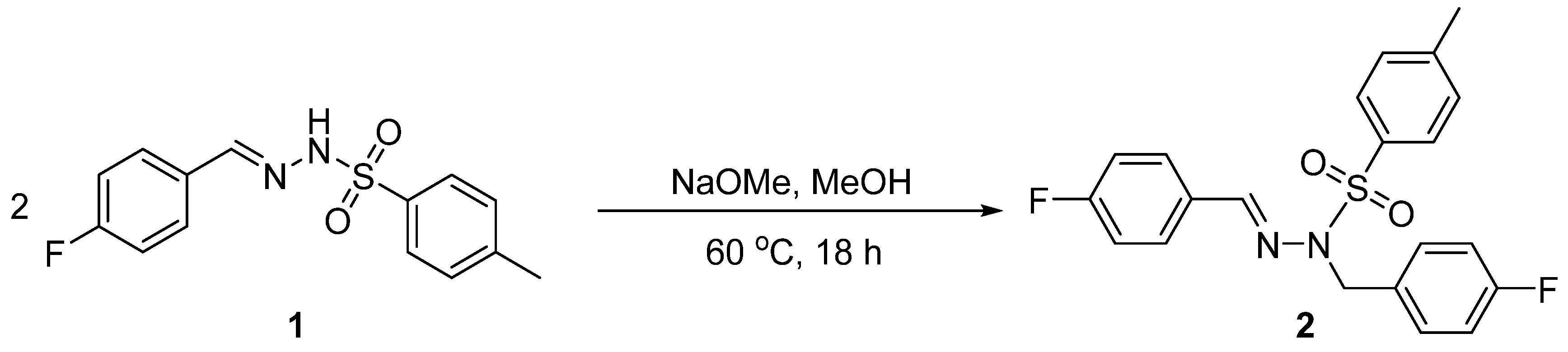
N’-(4-fluorobenzylidene)-4-methylbenzenesulfonohydrazide (2 mmol 0.584 g) and NaOMe (1 mmol 0.054 g) were dissolved in methanol (6 mL). The mixture was heated at 60 °C for 18 h. After the reaction was complete, the resulting mixture was filtered to remove the solid, and the liquor was extracted with ethyl acetate (3 × 10 mL) and washed with saturated sodium chloride solution (3 × 10 mL). The resulting organic phase was dried with anhydrous sodium sulfate and concentrated under reduced pressure. The residue was isolated by column chromatography using ethyl acetate/petroleum ether (v/v 6/1) as the eluent for N’-(4-fluorobenzylidene)-4-methylbenzenesulfonohydrazide (Scheme 1).

Supplementary Materials

The following supporting information can be downloaded online. Figure S1: 1H NMR of N-(4-fluorobenzyl)-N′-(4-fluorobenzylidene)-4-methylbenzenesulfonohydrazide (2); Figure S2: 13C NMR of N-(4-fluorobenzyl)-N′-(4-fluorobenzylidene)-4-methylbenzenesulfonohydrazide (2); Figure S3: HRMS [(M+H)+] N-(4-fluorobenzyl)-N′-(4-fluorobenzylidene)-4-methylbenzenesulfonohydrazide (2).

Author Contributions

Conceptualization, L.X. and L.G.; methodology, Y.Z. and L.X.; software, L.G. and Y.Z.; validation, L.X., J.Z. and D.B.; formal analysis, Y.Z., Z.Z. and X.W.; investigation, L.G.; resources, L.X. and L.G.; data curation, L.G.; writing—original draft preparation, L.G.; writing—review and editing, L.G.; visualization, L.G. and X.W.; supervision, Z.Z.; project administration, L.G.; funding acquisition, J.Z. and Y.Z. All authors have read and agreed to the published version of the manuscript.

Funding

This research was funded Natural Science Foundation of Liaoning Provincial Department of Education (LJ212510169002); the Key R & D Program of Liaoning Province-people’s livelihood science and technology (2024JH2/102500101); Natural Science Foundation of Liaoning Provincial Department of Education (LJ222410169013) and Natural Science Foundation of Liaoning Provincial Department of Education (LJKMZ20221810).

Data Availability Statement

The raw data supporting the conclusions of this article will be made available by the authors on request. CDDC 2559979 contains the supplementary crystallographic data for this paper. These data can be obtained free of charge via https://www.ccdc.cam.ac.uk/structures/Search?access=referee&ccdc=2559979&Author=Yue+Zhang, accessed on 28 June 2026 (or from the CCDC, 12 Union Road, Cambridge CB2 1EZ, UK; Fax: +44-1223-336033; E-mail: deposit@ccdc.cam.ac.uk).

Conflicts of Interest

The authors declare no conflicts of interest.

References

  1. Bamford, W.R.; Stevens, T.S. 924. The Decomposition of Toluene- p-sulphonylhydrazones by Alkali. J. Chem. Soc. 1952, 155, 4735–4740. [Google Scholar] [CrossRef]
  2. Gao, L.; Li, Z. Direct Synthesis of 1-Arylprop-1-ynes with Calcium Carbide as an Acetylene Source. Synlett 2019, 30, 1580–1584. [Google Scholar] [CrossRef]
  3. Zhao, X.; Wu, G.; Zhang, Y.; Wang, J. Copper-Catalyzed Direct Benzylation or Allylation of 1,3-Azoles with N-Tosylhydrazones. J. Am. Chem. Soc. 2011, 133, 3296–3299. [Google Scholar] [CrossRef] [PubMed]
  4. Ye, F.; Ma, X.; Xiao, Q.; Li, H.; Zhang, Y.; Wang, J. C(sp)−C(sp3) Bond Formation through Cu-Catalyzed Cross-Coupling of N-Tosylhydrazones and Trialkylsilylethynes. J. Am. Chem. Soc. 2012, 134, 5742–5745. [Google Scholar] [CrossRef] [PubMed]
  5. Hamze, A.; Treguier, B.; Brion, J.D.; Alami, M. Copper-catalyzed reductive coupling of tosylhydrazones with amines: A convenient route to a-branched amines. Org. Biomol. Chem. 2011, 9, 6200–6204. [Google Scholar] [CrossRef] [PubMed]
  6. Ding, Q.; Cao, B.; Yuan, J.; Liu, X.; Peng, Y. Synthesis of thioethers via metal-free reductive coupling of tosylhydrazones with thiols. Org. Biomol. Chem. 2011, 9, 748–751. [Google Scholar] [CrossRef] [PubMed]
  7. Tang, M.; Wang, Y.; Wang, H.; Kong, Y.F. Aluminum Chloride Mediated Reactions of N-Alkylated Tosylhydrazones and Terminal Alkynes: A Regioselective Approach to 1,3,5-Trisubstituted Pyrazoles. Synthesis 2016, 48, 3065–3076. [Google Scholar] [CrossRef]
  8. Zhang, Q.; Tang, M. Regioselective Synthesis of Highly Functionalized Pyrazoles from N-Tosylhydrazones. Org. Lett. 2019, 21, 1917–1920. [Google Scholar] [CrossRef] [PubMed]
  9. Frazzetto, M.; Suphioglu, C.; Zhu, J.; Schmidt-Kittler, O.; Jennings, I.G.; Cranmer, S.L.; Jackson, S.P.; Kinzler, K.W.; Vogelstein, B.; Thompson, P.E. Dissecting isoform selectivity of PI3K inhibitors: The role of non-conserved residues in the catalytic pocket. Biochem. J. 2008, 414, 383–390. [Google Scholar] [CrossRef] [PubMed]
  10. Zheng, Z.; Amran, S.I.; Thompson, P.E.; Jennings, I.G. Isoform-Selective Inhibition of Phosphoinositide 3-Kinase: Identification of a New Region of Nonconserved Amino Acids Critical for p110a Inhibition. Mol. Pharmacol. 2011, 80, 657–664. [Google Scholar] [CrossRef] [PubMed]
  11. Mudal, D.A.; Lutz, K.E.; Thomson, R.J. Stereoselective Synthesis of Dienes from N-Allylhydrazones. Org. Lett. 2009, 11, 465–468. [Google Scholar] [CrossRef]
  12. Xiao, A.J.; Kang, T.R.; He, L.; Chen, L.M.; Li, W.T.; Yang, J.L.; Liu, Q.Z. Metal-Free Ring-Expansion Reaction of Six-membered Sulfonylimines with Diazomethanes: An Approach toward Seven-Membered Enesulfonamides. Angew. Chem. Int. Ed. 2016, 128, 1463–1466. [Google Scholar] [CrossRef]
  13. Wang, L.; Xu, K.; Wang, N. Synthesis and Crystal Structure of N, N′-Bisphenylacetic Hydrazide. IOP Conf. Ser. Earth Environ. Sci. 2020, 440, 022055. [Google Scholar] [CrossRef]
  14. Sivajeyanthi, P.; Jeevaraj, M.; Edison, B.; Balasubramani, K. Crystal structure and Hirshfeld surface analysis of (E)-2-(5-bromo-2-hydroxybenzylidene)hydrazinecarbothioamide dimethyl sulfoxide monosolvate. Acta Crystallogr. 2018, 74, 119–123. [Google Scholar] [CrossRef]
  15. Bruker AXS. APEX; Bruker SAINT, and SADABS; Bruker AXS Inc.: Madison, WI, USA, 2007. [Google Scholar]
  16. Sheldrick, G.M. A short history of SHELX. Acta Crystallogr. 2008, 64, 112–122. [Google Scholar] [CrossRef]
  17. Sheldrick, G.M. Crystal structure refinement with SHELXL. Acta Crystallogr. 2015, 71, 3–8. [Google Scholar] [CrossRef]
Figure 1. Geometric structure of compound 2 obtained by X-ray diffraction; displacement ellipsoids are drawn at the 50% probability level.
Molbank 2026 m2200 g001
Figure 2. Crystal packing of compound 2.
Molbank 2026 m2200 g002
Scheme 1. Synthesis of N-(4-fluorobenzyl)-N’-(4-fluorobenzylidene)-4-methylbenzenesulfonohydrazide (2).
Molbank 2026 m2200 sch001
Table 1. Crystallographic data for the structural analysis of compound 2.
Crystal Data2
Empirical formulaC21H18F2N2O2S
Formula weight400.43
Temperature/K293.0
Crystal systemmonoclinic
Space groupP21/c
a/Å10.629(5)
b/Å18.201(8)
c/Å10.698(4)
α/°90
β/°113.245(15)
γ/°90
Volume/Å31901.6(14)
Z4
Density (calculated, Mg/m3)1.399
Absorption coefficient µ (mm−1)0.209
F(000)832.0
Crystal size/mm30.25 × 0.22 × 0.21
RadiationMoKα (λ = 0.71073)
2Θ range for data collection/°4.476 to 52.462
Index ranges−13 ≤ h ≤ 13, −22 ≤ k ≤ 22, −13 ≤ l ≤ 13
Reflections collected13,758
Independent reflections3790 [Rint = 0.0577, Rsigma = 0.0596]
Data/restraints/parameters3790/0/255
Goodness-of-fit on F21.035
Final R indexes [I >= 2σ(I)]R1 = 0.0534, wR2 = 0.1408
Final R indexes [all data]R1 = 0.0719, wR2 = 0.1587
Largest diff. peak/hole/e Å−30.21/−0.31
Table 2. Selected bond distances (Å) and bond angles (deg) for compound 2.
BondDistance (Å)BondAngle (°)
N(1)-N(2)1.372(15)N(2)-C(15)-H(15)120.03
N(1)-C(8)1.457(16)N(2)-C(15)-C(16)119.93(12)
N(2)-C(15)1.277(19)C(8)-N(1)-N(2)123.28(11)
S(1)-C(5)1.747(13)C(15)-N(2)-N(1)120.61(11)
S(1)-N(1)1.649(12)N(2)-N(1)-S(1)111.10(8)
S(1)-O(1)1.415(10)C(8)-N(1)-S(1)123.49(9)
S(1)-O(2)1.422(10)O(1)-S(1)-O(2)120.21(6)
C(8)-H(8)0.970O(1)-S(1)-N(1)107.05(6)
C(8)-C(9)1.503(18)O(1)-S(1)-C(5)107.80(6)
Disclaimer/Publisher’s Note: The statements, opinions and data contained in all publications are solely those of the individual author(s) and contributor(s) and not of MDPI and/or the editor(s). MDPI and/or the editor(s) disclaim responsibility for any injury to people or property resulting from any ideas, methods, instructions or products referred to in the content.