1. Introduction
The leishmaniases are classified as neglected tropical diseases (NTDs) by the World Health Organization (WHO), which defines them as a group of conditions that primarily affect the most impoverished populations in tropical and subtropical regions [
1]. Caused by various species of the genus
Leishmania, these infections remain a major public health problem in many parts of the world. Current treatments have numerous limitations, including significant side effects, difficult administration, high costs, and the emergence of resistance. Consequently, there is an urgent need to develop new therapeutic alternatives [
2,
3].
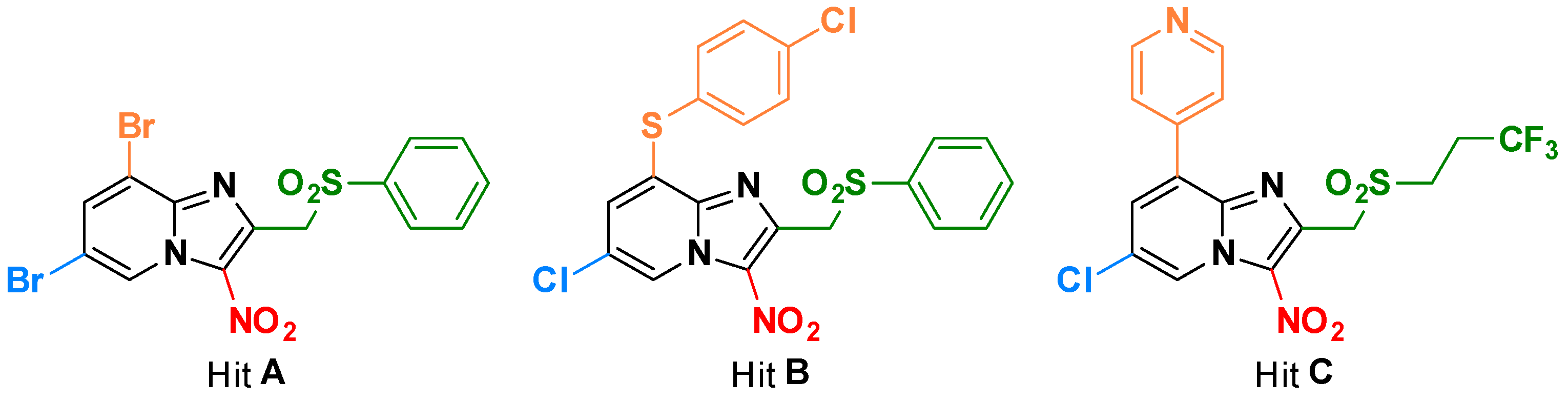
As part of our research to identify new antileishmanial agents, our team has previously identified several hits from the 3-nitroimidazo[1,2-
a]pyridine scaffold (
Figure 1) [
4,
5,
6]. These derivatives have shown promising activity and have enabled the determination of antileishmanial structure–activity relationships. Notably, these hit compounds are substituted at position 6 by a halogen (bromine atom for hit
A or chlorine atom for hits
B and
C), providing an interesting structural basis for further chemical exploration.
Like other nitroheterocyclic derivatives, the biological activity of 3-nitroimidazo[1,2-
a]pyridine derivatives results from intraparasitic bioactivation via reduction of the nitro group, yielding toxic metabolites. However, in vivo studies in a murine model of one of our hit compounds revealed rapid inactivation associated with reduction of the nitro group to an inactive amine derivative [
7]. This observation led us to investigate the reduction potential of the nitro group (E
0), a parameter readily measured by cyclic voltammetry and directly related to the susceptibility of nitro groups to reduction. A correlation was observed between the relatively high E
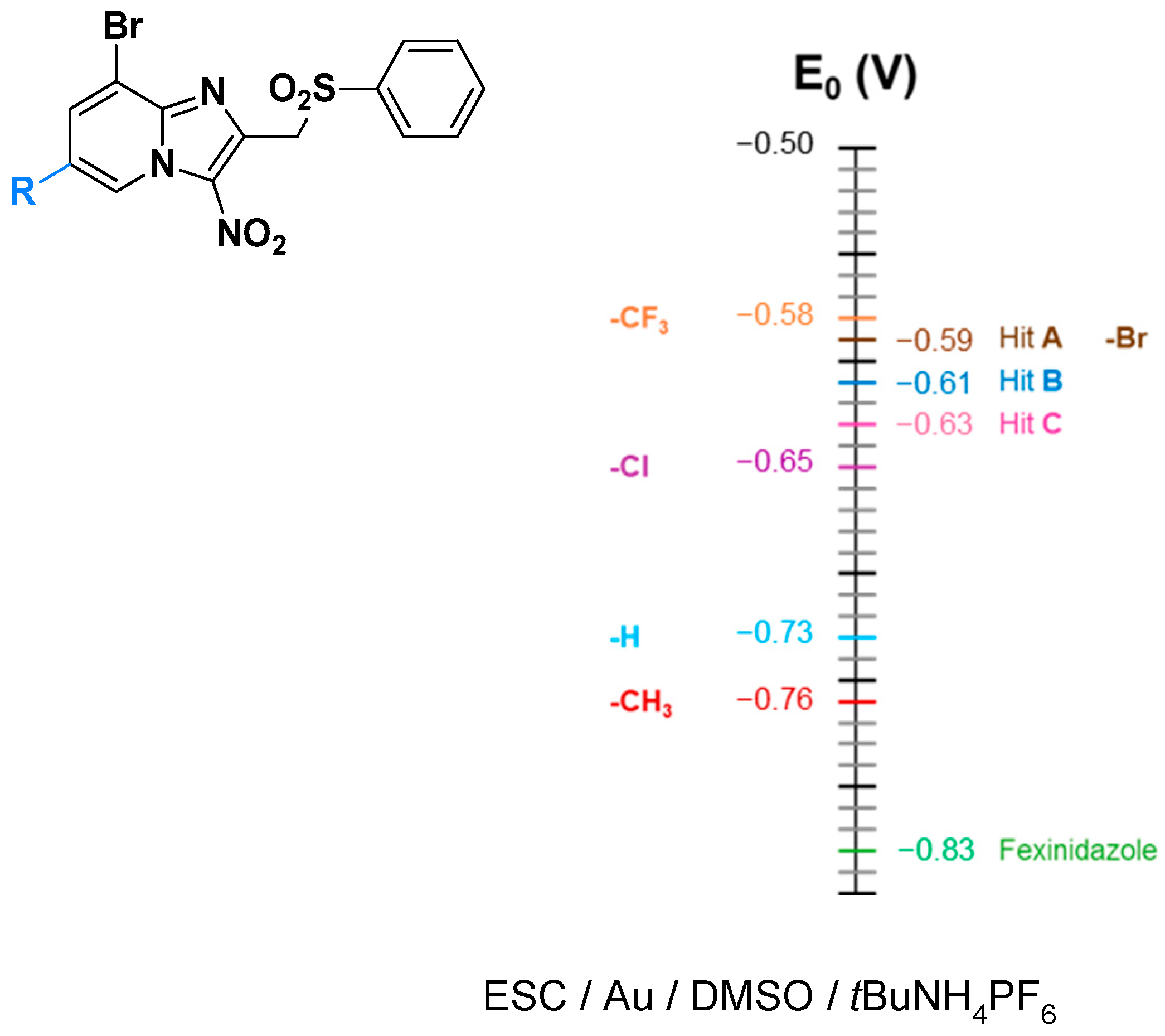
0 values of the hits (close to −0.60 V) and an increased susceptibility to this non-specific metabolic reduction. In contrast, nitro compounds that have demonstrated in vivo antiparasitic activity, such as fexinidazole, exhibit lower E
0 values (−0.83 V).
Studies conducted in our laboratory have also shown that the electronic properties of substituents at position 6 of the ring strongly influence this parameter. Electron-withdrawing groups, such as halogens or trifluoromethyl, result in E
0 values ranging from −0.58 to −0.65 V. In contrast, less electron-withdrawing substituents, such as hydrogen or methyl, lower this potential to values close to −0.75 V (
Figure 2) [
8]. These results underscore the particular interest in modulating at position 6 to lower the E
0 while maintaining structural similarity to previously identified active compounds, with the aim of obtaining compounds that are likely to be active in vivo.
The aim of this study was to introduce a methoxy group at position 6, a substituent characterized by low steric hindrance and electron-donating properties. The objective was to obtain new analogs of the previously described hit compounds, while modulating the molecular electronic environment. Consequently, a synthetic route to 6-methoxy-3-nitroimidazo[1,2-a]pyridine derivatives was developed. However, an unanticipated regioselectivity in the nitration process was observed, resulting in a preferential formation of nitro derivatives at position 5.
2. Results
The 8-bromo-2-chloromethyl-6-methoxyimidazo[1,2-
a]pyridine intermediate (
2) was obtained via a two-step synthesis (
Scheme 1). 2-Amino-3-bromo-5-methoxypyridine (
1) was obtained by bromination of commercial 2-amino-5-methoxypyridine in acetic acid according to a procedure described in the literature [
9]. Intermediate (
1) was then engaged in a cyclocondensation reaction with 1,3-dichloroacetone in refluxing ethanol under conditions previously described in our laboratory to give the intermediate (
2).
Intermediate (
2) was subjected to classical nitration conditions with nitric acid in sulfuric acid at 0 °C, followed by stirring at room temperature. After 1 h of reaction, compound (
3), nitrated at positions 3 and 5, was isolated (
Table 1). To avoid polynitration, shorter reaction times (5, 10, and 30 min) were investigated. Under these conditions, mixtures of mono- and dinitrated products were obtained; however, the isolated mononitrated derivative consistently corresponded to compound (
4), nitrated at position 5. Unexpectedly, nitration solely at position 3 was not observed under any of the investigated conditions (
Table 1).
The structures of compounds (3) and (4) were initially determined by spectroscopic analyses. Specifically, 1H and 13C NMR spectroscopy, along with HRMS, were used to distinguish mono- and dinitrated compounds. However, these data alone were insufficient to unambiguously determine the nitration position on the imidazo[1,2-a]pyridine ring.
To address this issue, detailed two-dimensional NMR experiments, including HSQC and HMBC analyses, were performed. A comparative interpretation of the 2D NMR spectra of compounds (
2), (
3), and (
4) was undertaken, enabling the identification of key long-range interactions (see
Supplementary Data). These interactions allowed for a confident assignment of the substitution patterns for compounds (
3) and (
4).
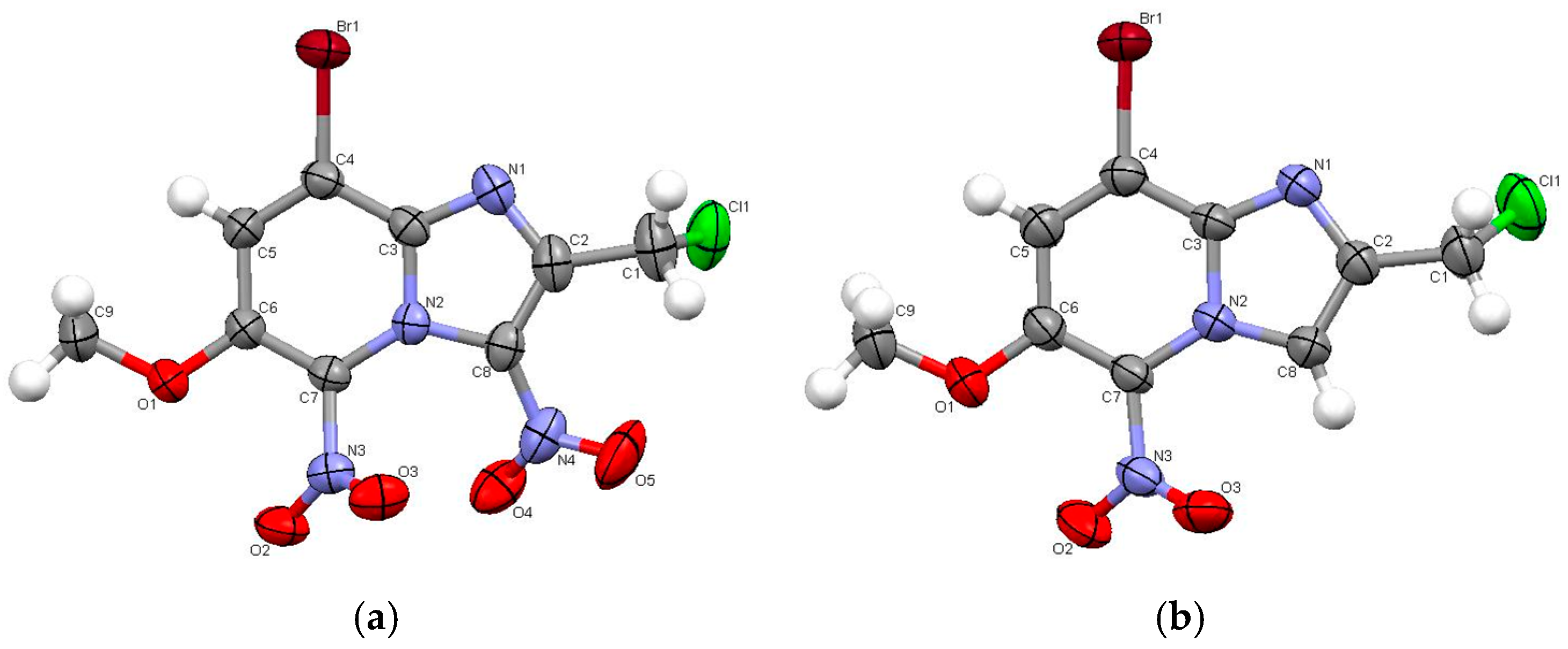
Finally, the regiochemistry of compounds (
3) and (
4) was unambiguously confirmed by single-crystal X-ray diffraction analysis (
Figure 3), which identified compound (
3) as 8-bromo-2-(chloromethyl)-6-methoxy-3,5-dinitroimidazo[1,2-
a]pyridine and compound (
4) as 8-bromo-2-(chloromethyl)-6-methoxy-5-nitroimidazo[1,2-
a]pyridine.
3. Discussion
The nitration of imidazo [1,2-
a]pyridine derivatives has been described for several decades, and the regioselectivity of these reactions has been studied under conventional nitration conditions using a sulfonitric acid mixture at 0 °C and then at room temperature [
10,
11,
12]. Depending on the structure of the starting substrates, nitration at positions 3 or 5, or polysubstitution has been reported in the literature. Although 6-methoxyimidazo [1,2-
a]pyridine derivatives have been previously documented [
13], no examples of selective nitration at the 5-position or dinitration at the 3- and 5-positions of a 6-methoxyimidazo [1,2-
a]pyridine derivative have been described to date under classical nitration conditions using H
2SO
4/HNO
3. The compounds obtained in this study are, therefore, to the best of our knowledge, the first such examples to be described.
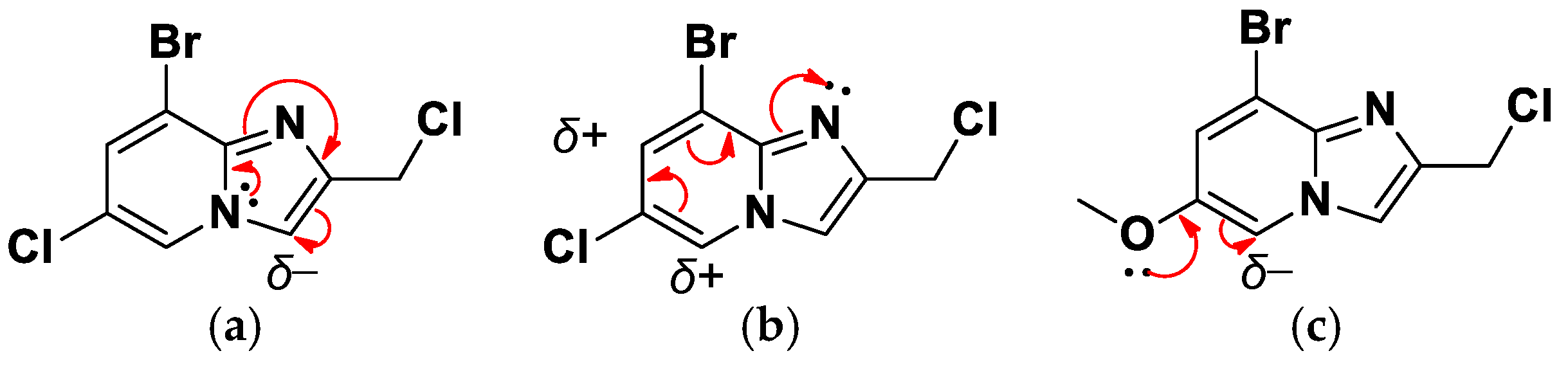
This reactivity disparity appears to be linked to the methoxy group’s inherent electronic properties. In the series previously studied in the laboratory, substitutions such as halogens at position 6 led to specific nitration at position 3, yielding the desired 3-nitro derivatives. In these derivatives, the intrinsic electronic distribution of the heterocyclic core, arising from the combined mesomeric effects of the imidazole nitrogen atoms, may favor electrophilic substitution at position 3 while keeping positions 5 and 7 relatively electron-deficient (
Figure 4a,b).
Conversely, the methoxy group exhibits a significant electron-donating mesomeric effect (+M), which can modify the electron density distribution within the aromatic system (
Figure 4c). This results in increased electron density at position 5, making this site more susceptible to electrophilic attack and thereby altering the regioselectivity of the nitration reaction. Although no theoretical calculations were performed at this stage, these electronic effects provide a plausible rationale for the experimental observations, but they still need to be confirmed.
Single-crystal X-ray diffraction analysis showed that compounds (
3) and (
4) adopt very similar molecular conformations. In both structures, the fused heteroaromatic framework is essentially planar, while the substituents adopt conformations that maintain conjugation with the aromatic system. Consequently, the principal differences between the two compounds arise from their supramolecular organization rather than from significant changes in molecular geometry. The crystal packing of (
3) is mainly stabilized by weak intermolecular contacts typical of aromatic heterocycles, including π⋯π and C–H⋯O interactions. In contrast, compound (
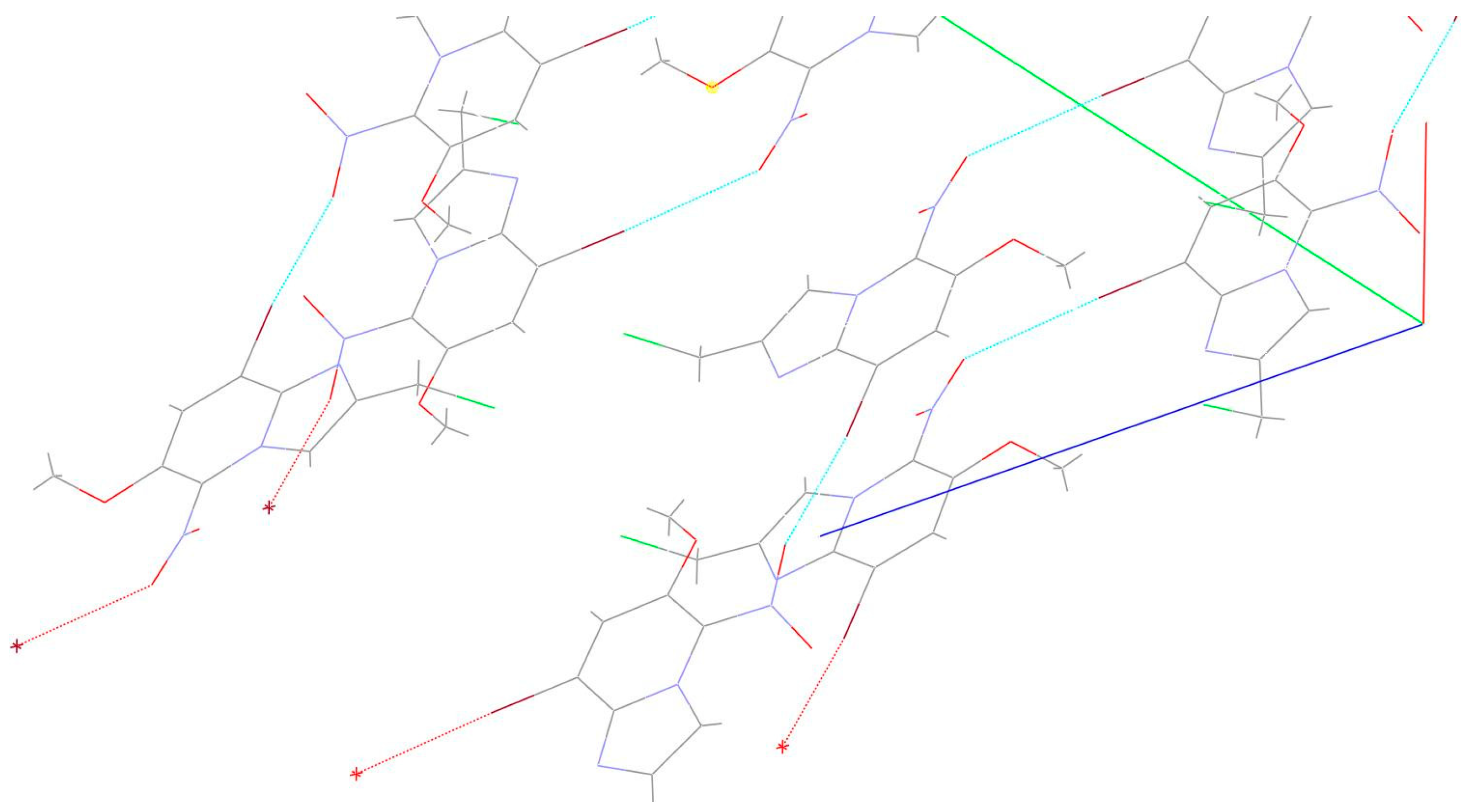
4) exhibits a distinctive short intermolecular Br
1⋯O
2 contact [Br
1⋯O
2 = 2.92 Å; symmetry code: 1 + x, 3/2 − y, −1/2 + z], which is significantly shorter than the sum of the van der Waals radii of bromine and oxygen (≈3.37 Å). This close approach is consistent with a weak but directional Br⋯O halogen-bonding interaction that contributes to the stabilization of the crystal packing (
Figure 5).
This present work is of twofold interest. First, it highlights a distinct reactivity within this series of imidazo[1,2-a]pyridines and contributes to expanding our understanding of the chemistry of 6-substituted nitro derivatives. Conversely, the compounds obtained in this study introduce a new structural family whose biological properties remain to be explored. Indeed, to the best of our knowledge, the antileishmanial activity of 5-nitroimidazo [1,2-a]pyridine derivatives has not been studied.
However, this unexpected regioselectivity also poses a significant limitation to the development of the initially targeted analogs. The absence of mononitration at the 3-position under the conditions studied prevents direct access to the targeted 3-nitro derivatives. To overcome this limitation, alternative synthetic strategies, such as an ipsonitration approach or the use of pre-functionalized intermediates, should be considered.
4. Materials and Methods
4.1. General Information
Reagents were purchased from Sigma-Aldrich (Saint-Louis, MO, USA), Fischer Scientific (Pittsburgh, PA, USA) or Fluorochem (Hadfield, UK) and used without further purification. Reaction monitoring was performed using aluminum TLC plates (5 cm × 10 cm) coated with silica gel Xtra SIL G UV254 ALUGRAM® (Macherey-Nagel, Düren, Nordrhein-Westfalen, Germany) in an appropriate eluent. Visualization was performed with ultraviolet light (254 nm). Melting points were determined on a Stuart SMP3 melting point apparatus (Barloworld, Sandton, South Africa) and were uncorrected. HRMS spectra (ESI) were recorded on a SYNAPT G2 HDMS (Waters, Milford, MA, USA) at the Faculté des Sciences de Saint-Jérôme (Marseille, France). Single-crystal X-ray diffraction was recorded on a SuperNova Dual Source Diffractometer (Agilent Technologies, Santa Carla, CA, USA) with Rigaku Oxford Diffraction (Rigaku, Tokyo, Japan) at the Faculté des Sciences de Saint-Jérôme (Marseille, France). NMR spectra were recorded on a Bruker Avance NEO 400 MHz NanoBay spectrometer (Bruker, Billerica, MA, USA) at the Faculté de Pharmacie of Marseille (France). (1H NMR: reference DMSO-d6 = 2.50 ppm and 13C NMR: reference DMSO-d6 = 39.52 ppm). The following adsorbent was used for column chromatography: silica gel 60 (Merck KGaA, Darmstadt, Germany, particle size 0.063–0.200 mm, 70–230 mesh ASTM). Flash-chromatography was performed with a puriFlash® 5.020 (Interchim, Montluçon, France), using a silica column (IR-50SI) with a size adapted to the crude sample load. The data were processed with InterSoft X (version 10.23.1).
4.2. Preparation of 8-Bromo-2-chloromethyl-6-methoxyimidazo [1,2-a]pyridine (2)
To a solution of 3-bromo-5-methoxypyridin-2-amine (1.3 g, 6.40 mmol, 1 equiv.) in ethanol (140 mL), 1,3-dichloroacetone (894 mg, 7.04 mmol, 1.1 equiv.) was added. The reaction mixture was stirred for 48 h at 80 °C, and then evaporated. The mixture was then poured in dichloromethane leading to the formation of a precipitate. The solid was collected by filtration and dried under reduced pressure. Compound (2) was obtained after recrystallization in acetonitrile as a white solid in 58% yield.
1H NMR (400 MHz, DMSO-d6) δ 8.67 (s, 1H, H7), 8.31 (s, 1H, H3), 7.91 (s, 1H, H5), 4.98 (d, J = 2.1 Hz, 2H, -CH2Cl), 3.83 (s, 3H, -OCH3). 13C NMR (101 MHz, DMSO-d6) δ 149.8 (C6), 137.3 (C2), 136.9 (C9), 126.9 (C5), 115.7 (C3), 110.6 (C7), 106.8 (C8), 57.0 (-CH2Cl), 36.4 (-OCH3). HRMS (+ESI): 276.9559 [M + H]+. Calcd for C9H9BrClN2O: 276.9559.
4.3. Preparation of 8-Bromo-2-chloromethyl-6-methoxy-3,5-dinitroimidazo [1,2-a]pyridine (3)
To a solution of 8-bromo-2-chloromethyl-6-methoxyimidazo [1,2-a]pyridine (2) (200 mg, 0.726 mmol, 1 equiv.) in 96% sulfuric acid (5 mL) cooled by an ice-water bath, 68% nitric acid (290 µL, 4.36 mmol, 6 equiv.) was added. The reaction mixture was stirred for 1 h at room temperature, and then slowly poured in an ice-water bath and precipitated. The solid was collected by filtration and dried under reduced pressure. Compound (3) was obtained after purification by chromatography on silica gel (eluent: dichloromethane) as a yellow solid in 45% yield.
1H NMR (400 MHz, DMSO-d6) δ 8.65 (s, 1H, H7), 5.09 (s, 2H, -CH2Cl), 4.15 (s, 3H, -OCH3). 13C NMR (101 MHz, DMSO-d6) δ 147.8 (C6), 146.4 (C2), 138.1 (C9), 131.7 (C3), 129.5 (C5), 125.2 (C7), 119.1 (C8), 59.6 (-OCH3), 38.2 (-CH2Cl). HRMS (+ESI): 366.9259 [M + H]+. Calcd for C9H7BrClN4O5: 366.9261.
Crystal data for compound (3): C9H6BrClN4O5 (M = 365.54): monoclinic, space group P212121, a = 7.6123 (1) Å, b = 12.8349 (1) Å, c = 13.3868 (1) Å, α = 90°, β = 90°, γ = 90°, V = 1307.93 (2) Å3, Z = 4, T = 295 K, CuKα = 6.442 mm−1, Dcalc = 1.856 g/cm3, 2566 reflections measured, 2512 unique. The final R1 values were 0.0224 (I > 2σ(I)) and 0.0576 (all data). The goodness of fit on F2 was 1.061.
4.4. Preparation of 8-Bromo-2-chloromethyl-6-methoxy-5-nitroimidazo [1,2-a]pyridine (4)
To a solution of 8-bromo-2-chloromethyl-6-methoxyimidazo [1,2-a]pyridine (2) (200 mg, 0.726 mmol, 1 equiv.) in 96% sulfuric acid (5 mL) cooled by an ice-water bath, 68% nitric acid (290 µL, 4.36 mmol, 6 equiv.) was added. The reaction mixture was stirred for 5 min at 0 °C, and then slowly poured in an ice-water bath. The mixture was extracted three times with dichloromethane, then the organic layer was dried over Na2SO4, filtered, and evaporated. Compound (4) was obtained after purification by chromatography on silica gel (eluent: dichloromethane) as an orange solid in 60% yield.
1H NMR (400 MHz, DMSO-d6) δ 8.65 (s, 1H, H3), 8.13 (s, 1H, H7), 4.93 (s, 2H, -CH2Cl), 4.09 (s, 3H, -OCH3). 13C NMR (101 MHz, DMSO-d6) δ 147.3 (C6), 144.4 (C2), 139.6 (C9), 129.6 (C5), 119.0 (C8), 118.8 (C7), 116.7 (C3), 59.1 (-OCH3), 40.2 (-CH2Cl). HRMS (+ESI): 321.9410 [M + H]+. Calcd for C9H8BrClN3O3: 321.9410.
Crystal data for compound (4): C9H7BrClN3O3 (M = 320.53): monoclinic, space group P21/c, a = 4.32798 (6) Å, b = 18.6731 (2) Å, c = 14.11229 (18) Å, α = 90°, β = 95.3108 (12)°, γ = 90°, V = 1135.61 (3) Å3, Z = 4, T = 295 K, CuKα = 7.145 mm−1, Dcalc = 1.875 g/cm3, 2238 reflections measured, 2111 unique. The final R1 values were 0.0272 (I > 2σ(I)) and 0.0755 (all data). The goodness of fit on F2 was 1.078.




 ,
, 




 Display in JSmol Viewer