Short Note

Olean-18α-19β,28-epoxy-3β-benzoate


1
College of Food Sciences and Engineering, Henan University of Technology, Zhengzhou 450001, China
2
Research Institute of Pharmaceutical Sciences, College of Pharmacy, Seoul National University, Seoul 08826, Republic of Korea
3
Quality Inspection and Analysis Testing Research Center, Henan Academy of Sciences, Zhengzhou 450002, China
*
Authors to whom correspondence should be addressed.
Molbank 2026, 2026(4), M2197; https://doi.org/10.3390/M2197
Submission received: 16 May 2026 / Revised: 21 June 2026 / Accepted: 29 June 2026 / Published: 1 July 2026

Abstract

Allobetulin 3-benzoate was obtained as an unexpected byproduct during the acid-mediated protection–deprotection of betulin. Single-crystal X-ray diffraction analysis shows that it crystallizes in the triclinic space group P1 with Z = 2 and contains two crystallographically independent molecules in the asymmetric unit. Compared with allobetulin (P21, Z = 4) and allobetulin 3-acetate (C2, Z = 4), the benzoyl substitution at C-3 induces distinct molecular packing and intermolecular interaction patterns, highlighting the influence of steric and electronic effects on crystal architecture.

1. Introduction

Betulin, chemically named lup-20(29)-ene-3β,28-diol, is a pentacyclic lupane-type triterpene found in the birch tree bark. Betulin and its derivatives possess numerous pharmacological properties, including antiviral [1], anticancer [2], anti-inflammatory [3], antibacterial [4], antioxidant [5], anticonvulsant [6], and protective effects against non-alcoholic fatty liver disease [7]. It can also be used to produce edible packaging materials with antibacterial and antioxidant activities [8], as well as dental restorative resins [9].
Chemical modifications of betulin are commonly performed at its C-3 and C-28 hydroxyl groups to enhance solubility and biological activity, leading to the formation of various derivatives, such as esters [10], amides [11], ethers [12], hydrazones [13], and imines [14]. Due to the presence of two hydroxyl groups in the betulin structure, selective protection or deprotection strategies are required to enable targeted functionalization at a specific hydroxyl site [15].
Allobetulin, chemically known as 3β-hydroxy-19β,28-epoxy-18α-olean, is an oleane derivative found in birch bark extract and can also be obtained as a Wagner–Meerwein rearrangement product of betulin under acid catalysis [16]. During this process, the configuration at C-3 remains unchanged, and the stereochemistry of rings A, B, C, and D is retained. Since the precursor C-28 is beta-configured, the Wagner–Meerwein rearrangement yields exclusively the structurally defined compound allobetulin. Therefore, it crystallizes as a single chemical entity. Similar to other pentacyclic triterpenes, allobetulin exhibits antiviral, anticancer, anti-inflammatory, antichlamydial, antioxidant, and neuroprotective effects [17].
During the preparation of betulin derivatives, crystals of allobetulin 3-benzoate were obtained as a byproduct. Although this compound has been synthesized previously [18], this work reports its serendipitous isolation and the first crystal structure elucidation of this unexpected rearrangement product.

2. Results and Discussion

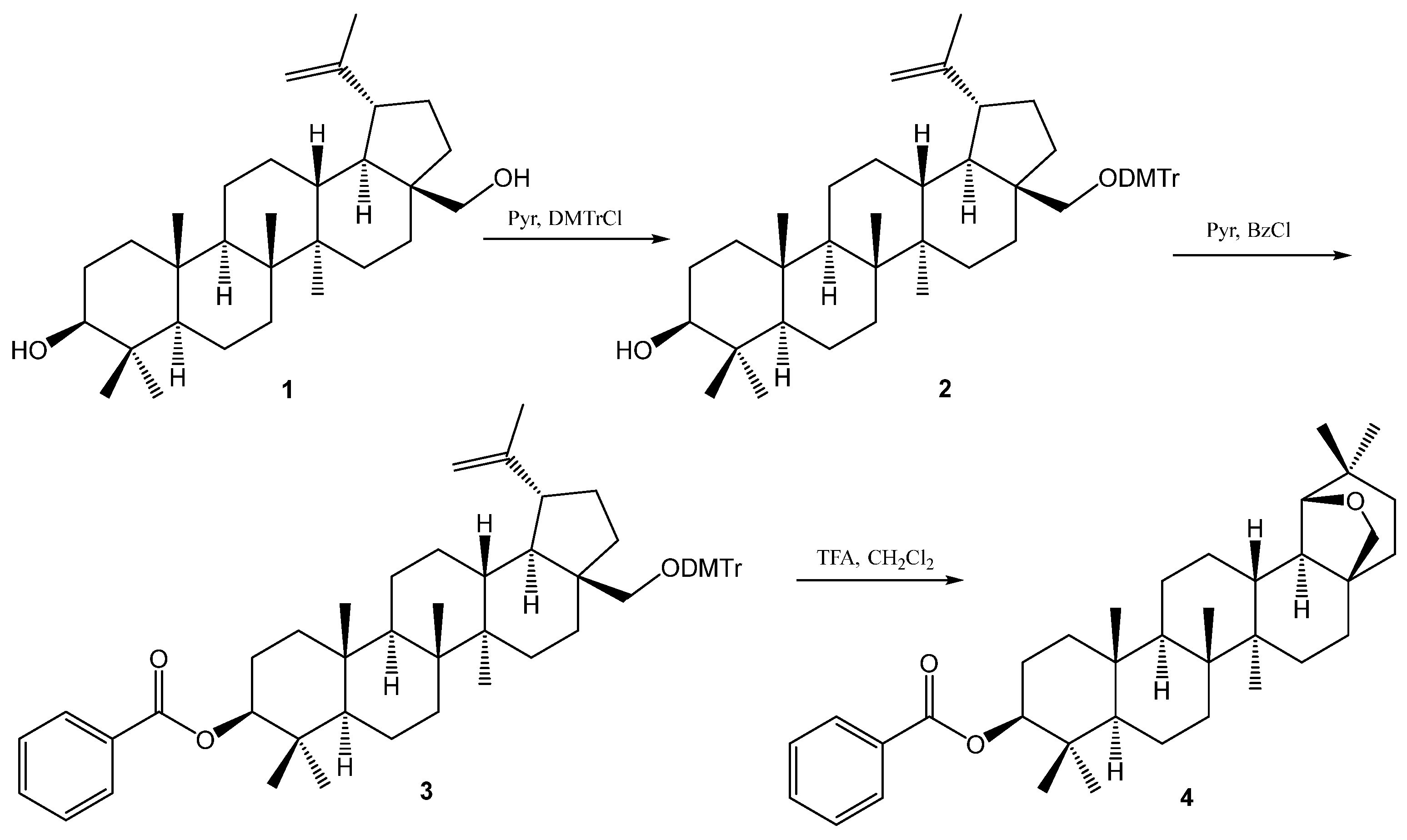
Contrary to our synthetic plan aimed at obtaining 3-benzoate betulin, the TFA-mediated deprotection led to an unexpected Wagner–Meerwein rearrangement, yielding allobetulin 3-benzoate as a crystalline byproduct. Herein, we report the crystal structure of this serendipitously obtained compound.

2.1. Synthesis Procedure of Allobetulin 3-Benzoate

In the chemical modification of betulin, selective protection or deprotection of C-3 and C-28 hydroxyl groups is required. To facilitate convenient monitoring of the reaction, we initially selected a protecting group containing a benzene moiety. DMTrCl is a commonly used reagent for the selective protection of hydroxyl groups lacking steric hindrance. However, when we attempted to remove the DMTr using TFA, a Wagner–Meerwein rearrangement occurred, producing allobetulin instead of regenerating betulin. Consequently, we replaced DMTrCl with tert-butyldiphenylsilyl chloride (TBDPSCl) to obtain 3-benzoate betulin.

2.2. Crystal Structure of Allobetulin 3-Benzoate (4)

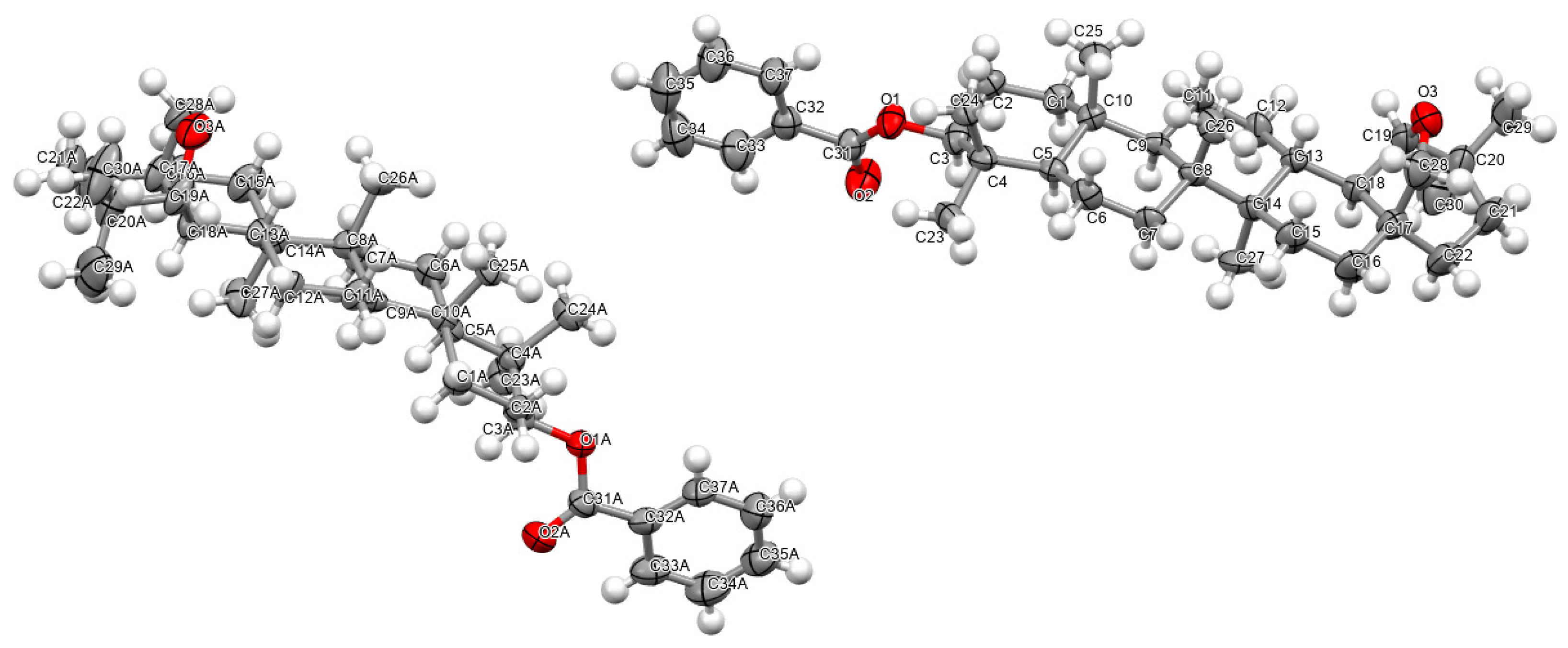
The asymmetric unit contains two allobetulin-3-benzoate (4) molecules (Figure 1).
The colorless transparent crystal of 3-benzoate (C37H54O3, MW = 546.82) crystallize in the triclinic crystal system. At 293 K, the unit cell parameters are: a = 6.4892(3) Å, b = 7.4581(3) Å, c = 35.7576(17) Å, α = 85.586(4), β = 87.682(4), γ = 64.257(5), space group P1, Z = 2. The structure contains two crystallographically independent molecules (Molecule A and Molecule B) within the asymmetric unit. The benzoate benzene rings in the two independent molecules (C32–C37 and C32A–C37A) are oriented approximately perpendicular to the pentacyclic triterpenoid A-ring scaffold, with dihedral angles of approximately 86° and 89°, respectively. Furthermore, the two benzoate rings themselves are nearly perfectly parallel, with an interplanar angle of merely 0.36°. The crystal structure of allobetulin 3-benzoate differs from that of allobetulin 3-acetate (CCDC 630831) [19] and allobetulin (CCDC 2330918) [20].
A comparison with related structures deposited in the Cambridge Crystallographic Data Centre (CCDC) highlights the significant influence of the C-3 substituent on the crystal packing. The parent compound, allobetulin, crystallizes in the monoclinic space group P21 with Z = 4 (CCDC 2330918) [20], while its 3-acetate derivative adopts the monoclinic space group C2, also with Z = 4 (CCDC 630831) [19]. In stark contrast, the introduction of the bulkier benzoyl group in the title compound induces a distinct packing motif, resulting in the formation of a triclinic polymorph with space group P1 and Z = 2. This difference in space group and molecular packing, characterized by two crystallographically independent molecules in the asymmetric unit, suggests a distinct intermolecular interaction network in the 3-benzoate derivative. Such variations in packing arrangement may contribute to differences in physicochemical properties, including solubility and stability, compared with other allobetulin derivatives.

3. Materials and Methods

3.1. General

All reagents were purchased commercially and used without further purification. The progress of reactions was monitored by thin-layer chromatography (TLC) on silica gel plates, visualized under UV light at 254 nm. 1H and 13C NMR spectra were recorded on a JNM-ECZ 400s spectrometer (JEOL Ltd., Tokyo, Japan). Chemical shifts are reported in parts per million (δ ppm) relative to the residual solvent peak, and coupling constants (J) are given in hertz (Hz). Single-crystal X-ray diffraction data were collected on a Rigaku Oxford Diffraction SuperNova dual-source diffractometer (Rigaku Corporation, Tokyo, Japan) with Cu Kα radiation (λ = 1.54184 Å) and an AtlasS2 detector (Rigaku Corporation, Tokyo, Japan).

3.2. Preparation of Allobetulin 3-Benzoate (4)

Betulin was dissolved in pyridine and stirred at 0 °C, followed by the addition of 4,4′-dimethoxytrityl chloride (DMTrCl). The reaction mixture was stirred at room temperature. When the reaction was completed, the solvent was removed under reduced pressure. The residue was extracted with ethyl acetate to obtain compound 2 for the next step. Compound 2 was dissolved in pyridine and stirred at 0 °C, after which benzoyl chloride (BzCl) was added. The reaction mixture was stirred at room temperature until the conversion of compound 2 was completed (monitoring by TLC). The solvent was evaporated under reduced pressure, and the crude product was purified by column chromatography on silica gel (6–60% EtOAc/hexane) to yield compound 3 as a white solid. Compound 3 was dissolved in dichloromethane (CH2Cl2) and then trifluoroacetic acid (TFA) was added. After completion, the solvent was removed under vacuum, and the crude residue was purified by column chromatography on silica gel (2–30% EtOAc/hexane) to afford compound 4 (Scheme 1) as a white solid [18]. The 1H NMR spectra of compound 3 and 4, and the 13C NMR spectrum of compound 4 are provided in Figures SI-1–SI-3.
Compound 3, 1H NMR (CDCl3): δ 8.00–8.08 (m, 2H), 7.51–7.59 (m, 1H), 7.40–7.51 (m, 4H), 7.34–7.40 (m, 4H), 7.25–7.32 (m, 2H), 7.17–7.23 (m, 1H), 6.78–6.89 (m, 4H), 4.69 (dd, J = 11.1, 5.2 Hz, 1H), 6.59 (dd, J = 2.5, 1.0 Hz, 1H), 4.53 (dd, J = 2.5, 1.4 Hz, 1H), 3.80 (s, 3H), 3.09 (d, J = 8.9 Hz, 1H), 2.89 (d, J = 8.8 Hz, 1H), 2.11–2.29 (m, 2H), 1.65 (s, 3H), 0.98 (s, 3H), 0.91 (s, 3H), 0.90 (s, 3H), 0.83 (s, 3H), 0.54 (s, 3H).
Compound 4, 1H NMR (CDCl3): δ 8.00–8.09 (m, 2H), 7.50–7.59 (m, 1H), 7.39–7.48 (m, 2H), 4.73 (dd, J = 10.9, 5.2 Hz, 1H), 3.78 (dd, J = 7.7, 1.6 Hz, 1H), 3.54 (s, 1H), 3.45 (d, J = 7.8 Hz, 1H), 1.00 (s, 3H), 1.00 (s, 3H), 0.93 (s, 6H), 0.93 (s, 3H), 0.92 (s, 3H), 0.80 (s, 3H). 13C NMR (CDCl3): δ 166.3, 132.7, 131.0, 129.5, 128.3, 87.9, 81.5, 71.3, 55.6, 51.0, 46.8, 41.5, 40.7, 40.6, 38.6, 38.2, 37.2, 36.7, 36.3, 34.1, 33.8, 32.7, 28.8, 28.1, 26.4, 26.4, 26.2, 24.5, 23.7, 21.0, 18.1, 16.8, 16.5, 15.7, 13.5.

3.3. Single-Crystal X-Ray Crystallography

Compound 4 (10 mg) was dissolved in dichloromethane (1.0 mL) in a glass vial. After standing at room temperature, the single crystals of 4 were obtained. X-ray diffraction data of 4 (CCDC No: 2478874) were obtained on a SuperNova dual-source diffractometer (Tokyo, Japan) with Cu Kα radiation (λ = 1.54184 Å) and an AtlasS2 detector. Using Olex2 [21], the structure was solved with the ShelXT [22] structure solution program using Direct Methods and refined with the ShelXL [23] refinement package using Least Squares minimization. CCDC 2478874 contain the supplementary crystallographic data for this paper. These data can be obtained free of charge from the Cambridge Crystallographic Data Centre via www.ccdc.cam.ac.uk/structures (07/08/2025) (or from the CCDC, 12 Union Road, Cambridge CB2 1EZ, UK; Fax: +44 1223 336033; E-mail: data_request@ccdc.cam.ac.uk).

Supplementary Materials

The following supporting information can be downloaded online: Figure SI-1. 1H NMR spectrum of compound 3; Figure SI-2. 1H NMR spectrum of compound 4; Figure SI-3. 13C NMR spectrum of compound 4; Figure SI-4. 1H NMR spectrum of 3-benzoate betulin; CIF report of compound 4; Crystallographic data for compound 4 have been deposited at the Cambridge Crystallographic Data Centre (CCDC No. 2478874).

Author Contributions

Conceptualization, L.S.J. and Q.W.; methodology, Q.W.; validation, Q.W.; investigation, X.G., J.H.P., B.L., J.Z., X.S. and Y.W.; resources, Q.W.; data curation, X.G. and J.H.P.; writing—original draft preparation, X.G.; writing—review and editing, Q.W.; visualization, J.H.P.; supervision, L.S.J. and Q.W.; project administration, Q.W.; funding acquisition, Q.W. All authors have read and agreed to the published version of the manuscript.

Funding

This work was supported by the Graduate Innovation Project of Henan Academy of Sciences (24330222), the High-level Research Achievement Reward and Cultivation Program of Henan Academy of Sciences (20252202001), the Basel Research Fund of Henan Academy of Sciences (20250602002), and the International Science and Technology Cooperation Project of Henan Province (262102521015).

Data Availability Statement

Data will be made available upon request.

Acknowledgments

The authors gratefully acknowledge Yu Zhu at Zhengzhou University for her invaluable assistance with crystallographic data analysis and interpretation.

Conflicts of Interest

The authors of this work declare that they have no conflicts of interest.

Abbreviations

The following abbreviations are used in this manuscript:
TBDPSClTert-butyldiphenylsilyl chloride
DMTrCl4,4′-dimethoxytrityl chloride
BzClBenzoyl chloride
NMRNuclear magnetic resonance
TFATrifluoroacetic acid
TLCThin-layer chromatography

References

  1. Kristgen, M.; Lowjaga, K.A.A.T.; Müller, S.F.; Goldmann, N.; Lehmann, F.; Alakurtti, S.; Yli-kauhaluoma, J.; Glebe, D.; Geyer, J. Selective hepatitis B and D virus entry inhibitors from the group of pentacyclic lupane-type betulin-derived triterpenoids. Sci. Rep. 2020, 10, 21772. [Google Scholar] [CrossRef] [PubMed]
  2. Lv, M.; Zheng, Y.; Wu, J.; Shen, Z.; Guo, B.; Hu, G.; Huang, Y.; Zhao, J.; Qian, Y.; Su, Z.; et al. Evoking ferroptosis by synergistic enhancement of a cyclopentadienyl iridium-betulin immune agonist. Angew. Chem. Int. Ed. 2023, 62, e202312897. [Google Scholar] [CrossRef] [PubMed]
  3. Wu, Y.H.; Ramírez, F.D.M.; Lin, Y.Y.; Shieh, T.M.; Chang, T.C.; Tang, C.H. Betulin inhibits the production of inflammatory cytokines in human gingival fibroblasts and ligature-induced periodontitis. Int. Immunopharmacol. 2025, 147, 114018. [Google Scholar] [CrossRef] [PubMed]
  4. Deng, Y.; Wang, R.; Ma, Z.; Zuo, W.; Zhu, M. S-alkylated sulfonium betulin derivatives: Synthesis, antibacterial activities, and wound healing applications. Bioorg. Chem. 2025, 154, 108056. [Google Scholar] [CrossRef] [PubMed]
  5. Zhang, W.; Jiang, H.; Yang, J.; Jin, M.; Du, Y.; Sun, Q.; Cao, L.; Xu, H. Safety assessment and antioxidant evaluation of betulin by LC-MS combined with free radical assays. Anal. Biochem. 2019, 587, 113460. [Google Scholar] [CrossRef] [PubMed]
  6. Eghbali, F.; Dehkordi, H.T.; Amini-Khoei, H.; Lorigooini, Z.; Rahimi-Madiseh, M. The potential role of nitric oxide in the anticonvulsant effects of betulin in pentylenetetrazole (PTZ)-induced seizures in mice. IBRO Neurosci. Rep. 2024, 16, 527–534. [Google Scholar] [CrossRef] [PubMed]
  7. Farage, A.E.; Abdo, W.; Osman, A.; Abdel-Kareem, M.A.; Hakami, Z.H.; Alsulimani, A.; Bin-Ammar, A.; Alanazi, A.S.; Alsuwayt, B.; Alanazi, M.M.; et al. Betulin prevents high fat diet-induced non-alcoholic fatty liver disease by mitigating oxidative stress and upregulating Nrf2 and SIRT1 in rats. Life Sci. 2023, 322, 121688. [Google Scholar] [CrossRef] [PubMed]
  8. Gao, S.; Zhang, Y.; Wang, R.; Li, F.; Zhang, Y.; Zhu, S.; Wei, H.; Zhao, L.; Fu, Y.; Ye, F. Fabrication and characterization of betulin/hydroxypropyl-beta-cyclodextrin inclusion complex nanofibers: A potential edible antibacterial and antioxidant packaging material. Food Chem. 2025, 481, 144059. [Google Scholar] [CrossRef] [PubMed]
  9. Ma, Z.; Chen, Y.; Wang, R.; Zhu, M. Synthesis of polymerizable betulin maleic diester derivative for dental restorative resins with antibacterial activity. Dent. Mater. 2024, 40, 941–950. [Google Scholar] [CrossRef] [PubMed]
  10. Kadela-Tomanek, M.; Jastrzębska, M.; Marciniec, K.; Chrobak, E.; Bębenek, E.; Latocha, M.; Kuśmierz, D.; Boryczka, S. Design, synthesis and biological activity of 1,4-quinone moiety attached to betulin derivatives as potent DT-diaphorase substrate. Bioorg. Chem. 2021, 106, 104478. [Google Scholar] [CrossRef] [PubMed]
  11. Kazakova, O.; Petrova, A.; Terekhova, A.; Vakhitova, Y.; Polovyanenko, D.; Bagryanskaya, I. A series of azepano-betulins with cytotoxic activity. ChemistrySelect 2024, 9, e202402593. [Google Scholar] [CrossRef]
  12. Kadela-Tomanek, M.; Bębenek, E.; Chrobak, E.; Marciniec, K.; Latocha, M.; Kuśmierz, D.; Jastrzębska, M.; Boryczka, S. Betulin-1,4-quinone hybrids: Synthesis, anticancer activity and molecular docking study with NQO1 enzyme. Eur. J. Med. Chem. 2019, 177, 302–315. [Google Scholar] [CrossRef] [PubMed]
  13. Wang, J.; Wu, J.; Han, Y.; Zhang, J.; Lin, Y.; Wang, H.; Wang, J.; Bu, M. Synthesis and biological evaluation of novel betulin derivatives with aromatic hydrazone side chain as potential anticancer agents. J. Braz. Chem. Soc. 2022, 33, 227–237. [Google Scholar] [CrossRef]
  14. Iftime, M.M.; Ailiesei, G.L.; Shova, S.; Miron, C.; Tanaka, H.; Hori, M.; Marin, L. New betulin imine derivatives with antioxidant and selective antitumor activity. New J. Chem. 2023, 47, 16551–16563. [Google Scholar] [CrossRef]
  15. Xu, G.; Xu, X.; Liu, J.; Jia, Q.; Ke, C.; Zhang, H.; Xu, C.; Ou, E.; Tan, W.; Zhao, Y. Mitochondria-targeted triphenylphosphonium conjugated C-3 modified betulin: Synthesis, antitumor properties and mechanism of action. ChemMedChem 2022, 17, e202100659. [Google Scholar] [CrossRef] [PubMed]
  16. Thibeault, D.; Gauthier, C.; Legault, J.; Bouchard, J.; Dufour, P.; Pichette, A. Synthesis and structure-activity relationship study of cytotoxic germanicane- and lupane-type 3β-O-monodesmosidic saponins starting from betulin. Bioorg. Med. Chem. 2007, 15, 6144–6157. [Google Scholar] [CrossRef] [PubMed]
  17. Dehaen, W.; Mashentseva, A.A.; Seitembetov, T.S. Allobetulin and its derivatives: Synthesis and biological activity. Molecules 2011, 16, 2443–2466. [Google Scholar] [CrossRef] [PubMed]
  18. Levdanskii, A.V.; Kondrasenko, A.A.; Levdanskii, V.A.; Kuznetsov, B.N. New Synthesis of Allobetulin 3-O-Acylates. Chem. Nat. Compd. 2018, 54, 806–807. [Google Scholar] [CrossRef]
  19. Medvedeva, N.I.; Flechter, O.B.; Korlyukov, A.A. Molecular and crystal structure of 23,24,25,26,27,29,30-heptamethyl-19,28-oxahexacyclo[15.13.18.017,18.013,14.08,9.05,10] tetracos-3-yl acetate. J. Struct. Chem. 2009, 50, 387–389. [Google Scholar] [CrossRef]
  20. Razgulyaeva, Y.D.; Zaytsev, A.V.; Bakibaev, A.A. Crystal structure of 3β-hydroxy-19β,28-epoxy-18α-olean (allobetulin). J. Struct. Chem. 2025, 66, 73–77. [Google Scholar] [CrossRef]
  21. Dolomanov, O.V.; Bourhis, L.J.; Gildea, R.J.; Howard, J.A.K.; Puschmann, H. OLEX2: A complete structure solution, refinement and analysis program. J. Appl. Crystallogr. 2009, 42, 339–341. [Google Scholar] [CrossRef]
  22. Sheldrick, G.M. SHELXT–Integrated space-group and crystal-structure determination. Acta Crystallogr. Sect. A 2015, A71, 3–8. [Google Scholar] [CrossRef] [PubMed]
  23. Sheldrick, G.M. A short history of SHELX. Acta Crystallogr. Sect. A 2008, A64, 112–122. [Google Scholar] [CrossRef] [PubMed]
Figure 1. Crystal structure of allobetulin 3-benzoate.
Molbank 2026 m2197 g001
Scheme 1. Synthesis of allobetulin 3-benzoate.
Molbank 2026 m2197 sch001
Disclaimer/Publisher’s Note: The statements, opinions and data contained in all publications are solely those of the individual author(s) and contributor(s) and not of MDPI and/or the editor(s). MDPI and/or the editor(s) disclaim responsibility for any injury to people or property resulting from any ideas, methods, instructions or products referred to in the content.