Short Note

1α-Methoxy-3-oxo-8α-hydroxy-10αH-eremophila-7(11)-en-12,8β-olide from Ligularia fischeri

1
State Key Laboratory of Medicinal Chemical Biology, College of Pharmacy and Tianjin Key Laboratory of Molecular Drug Research, Nankai University, Tianjin 300353, China
2
Key Laboratory of Functional Feed and Healthy Breeding Technology, Ministry of Agriculture and Rural Affairs, Tianjin 300383, China
3
S&E Burgeoning Biotechnology (Tianjin) Co., Ltd., Tianjin 300383, China
4
Tianjin Jikun Technology Co., Ltd., Tianjin 301700, China
*
Authors to whom correspondence should be addressed.
Molbank 2026, 2026(3), M2193; https://doi.org/10.3390/M2193 (registering DOI)
Submission received: 14 May 2026 / Revised: 5 June 2026 / Accepted: 10 June 2026 / Published: 12 June 2026
(This article belongs to the Section Natural Product Chemistry)

Abstract

One unreported eremophilane sesquiterpenoid, 1α-methoxy-3-oxo-8α-hydroxy-10αH- eremophila-7(11)-en-12,8β-olide (1), was isolated from Ligularia fischeri. The structure of 1 was identified by detailed 1D and 2D NMR and HRMS analyses.

1. Introduction

Ligularia fischeri Turcz. is a perennial herb belonging to the Asteraceae family. The traditional Chinese medicine “Shanziwan” is derived from the roots of L. fischeri and is used to treat bronchitis and asthma [1]. The L. fischeri plantlets are also utilized for the amelioration of indigestion, pulmonary abscess and toxemia [2]. During our investigation of natural products from L. fischeri [3], a previously undescribed eremophilane sesquiterpenoid, 1α-methoxy-3-oxo-8α-hydroxy-10αH-eremophila-7(11)-en-12,8β-olide (1), was obtained from the title plant. The structure of 1 was identified by HRMS and NMR analyses.

2. Results and Discussion

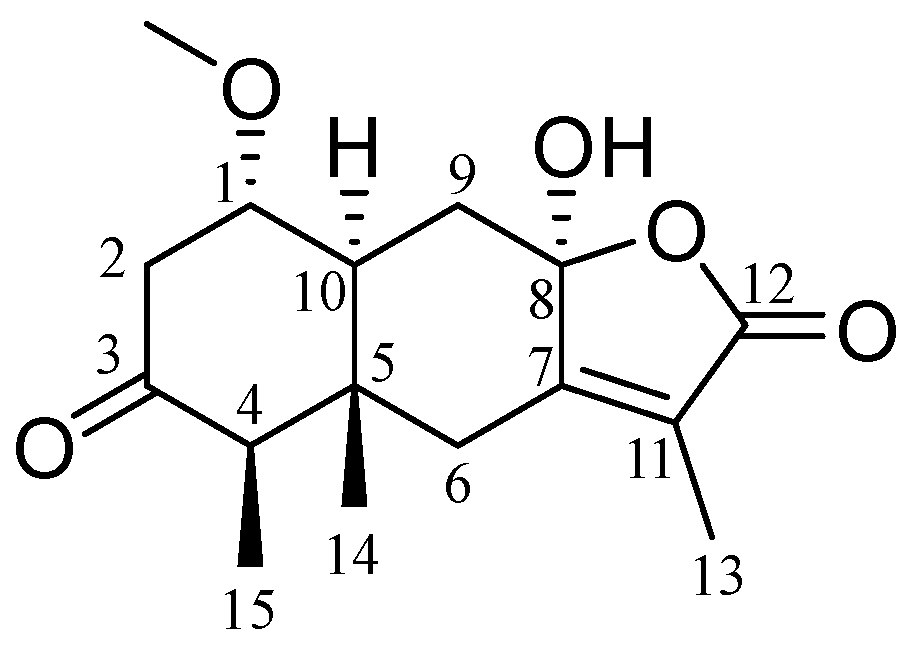
One novel eremophilane derivative 1α-methoxy-3-oxo-8α-hydroxy-10αH-eremophila- 7(11)-en-12,8β-olide (1) was purified from the whole plant of L. fischeri (Figure 1).
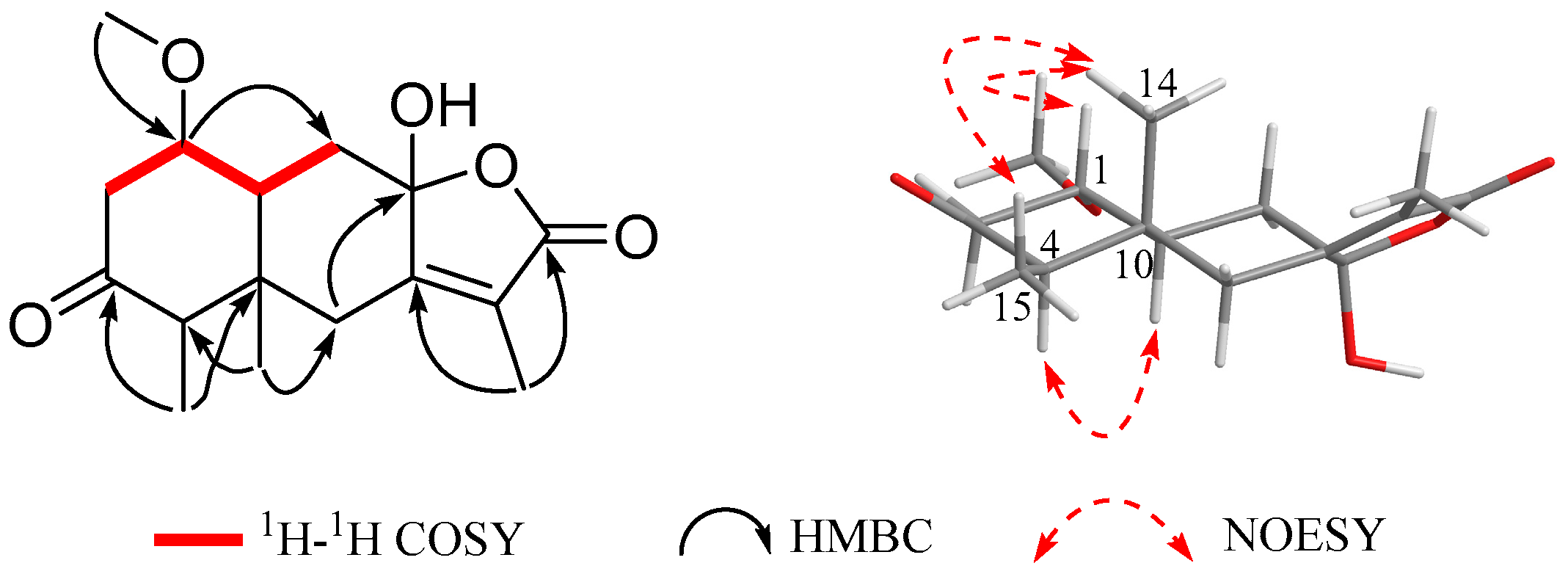
Compound 1, obtained as yellow powder, possessed the molecular formula C16H22O5 based on the molecular ion peak at m/z 295.1542 [M + H]+ (calcd for C16H23O5, 295.1545) in HRESIMS. The IR spectrum showed the absorbance at 3355 cm−1, 1758 cm−1 and 1712 cm−1 for a hydroxyl group, an α, β-unsaturated-γ-lactone and a ketone carbonyl, respectively [4]. The 1H NMR spectrum showed signals of four methyl groups at δH 3.33 (3H, s), 1.78 (3H, s), 1.01 (3H, d, J = 6.7 Hz), 0.53 (3H, s) and an oxymethine at δH 3.22 (1H, m). The 13C NMR and DEPT spectra exhibited signals corresponding to 16 carbons. Except for one methoxyl group (δC 55.5), the remaining 15 carbons were classified into three methyls (δC 11.6, 6.6, 6.3), three methylenes (δC 46.0, 36.3, 35.7), three methines (δC 77.9, 54.5, 46.8), and six quaternary carbon (δC 209.1, 172.8, 158.7, 123.1, 103.6, 41.5). The signal at δC 103.6 was attributed to the hemiketal carbon at C-8 of 1 [5,6]. These spectroscopic features implied that 1 might be an eremophilenolide derivative, since they were isolated frequently from the genus Ligularia [7]. The NMR data of 1 was similar to the known compound fischerin A, except for the presence of one hydroxyl group in 1 instead of the methoxyl group at C-8 in fischerin A [3], which was supported by 1H–1H COSY correlations of H-2/H-1/H-10/H-9 and HMBC correlations of H3-OMe to C-1, H3-15 to C-3 and C-5, H3-14 to C-4, C-6 and C-10, H3-13 to C-7 and C-12, H-1 to C-9, and H-6 to C-8 (Figure 2). Consequently, the planar structure of 1 was determined.
The NOESY correlations established the relative configuration of 1 (Figure 2). The eremophilane sesquiterpenoids from Asteraceae generally exhibited the β-orientation for CH3-14 and CH3-15 [8]. The NOESY correlation of H3-14/H3-15 and H3-14/H-1 revealed the β-orientation of H-1, while the presence of NOESY correlation of H-4/H-10 supported the α-orientation of H-10. Additionally, the OH-8 was assigned as α-oriented by comparing the proton signals of CH3-14 and CH3-15 based on the Naya rule [9]. The structure of 1 was therefore determined and named 1α-methoxy-3-oxo-8α-hydroxy-10αH-eremophila-7(11)-en-12,8β-olide.

3. Materials and Methods

3.1. General Experimental Procedures

The experimental or plant materials were as reported previously [3]. The IR spectrum (KBr) was acquired on a Bruker TENSOR 37 instrument (Bruker, Ettlingen, Germany). The NMR spectra were recorded in CD3OD at room temperature by a Bruker AV 400 spectrometer (Bruker, Fallanden, Switzerland). HR-ESIMS spectrum was measured by an LTQ-Orbitrap mass spectrometer (Thermo Fisher Scientific, Bremen, Germany).

3.2. Extraction and Isolation

The whole plants of L. fischeri (9.8 kg) were extracted with methanol three times under reflux. The combined filtrate was evaporated in vacuo to yield a MeOH extract (975 g), which was further suspended in H2O and partitioned with EtOAc. The EtOAc-soluble part (265 g) was chromatographed on silica gel column eluting with a petroleum ether/acetone (100:0–100:30, v/v) gradient to give eight fractions (F1–F8). Fraction F6 was chromatographed on the MPLC (75–90% MeOH in H2O) to afford eight subfractions F6-1–F6-8. The further purification of F6-1 by semipreparative HPLC (54% MeOH in H2O) gave compound 1 (tR = 31.3 min, 10.9 mg).
1α-methoxy-3-oxo-8α-hydroxy-10αH-eremophila-7(11)-en-12,8β-olide (1): yellow powder, [ α ] D 19 -115.6 (c 0.06, CH2Cl2); IR (KBr) νmax 3355, 2971, 1758, 1712, 1438, 1385, 1339, 1253, 1211, 1113, 1084, 955, 736, 697; 1H-NMR (400 MHz, CD3OD) and 13C-NMR (100 MHz, CD3OD) data, see Table 1; HRESIMS m/z 295.1542 [M + H]+ (calcd for C16H23O5 295.1545).

4. Conclusions

An unreported member of the eremophilane class was isolated from L. fischeri based on a search across SciFinder. Its structure was identified as 1α-methoxy-3-oxo-8α-hydroxy-10αH-eremophila-7(11)-en-12,8β-olide through IR, HRESIMS and NMR analysis, which added a member to the Ligularia eremophilane family.

Supplementary Materials

The following supporting information can be downloaded online: Figure S1: 1H NMR spectrum of compound 1; Figure S2: 13C NMR spectrum of compound 1; Figure S3: DEPT (θ = 135°) NMR spectrum of compound 1; Figure S4: 1H–1H COSY spectrum of compound 1; Figure S5: HMQC spectrum of compound 1; Figure S6: HMBC spectrum of compound 1; Figure S7: NOESY spectrum of compound 1; Figure S8: HRESIMS spectrum of compound 1; Figure S9: IR spectrum of compound 1.

Author Contributions

X.Z.: Investigation, Visualization, Formal Analysis, Writing—Original Draft; D.L.: Conceptualization, Writing—Review and Editing; F.L.: Conceptualization, Writing—Review and Editing; C.Y.: Methodology, Writing—Review and Editing; J.G.: Conceptualization, Writing—Review and Editing, Project Administration; C.X.: Methodology, Supervision, Writing—Original Draft. All authors have read and agreed to the published version of the manuscript.

Funding

This research received no external funding.

Data Availability Statement

Data are contained within the article and Supplementary Materials.

Conflicts of Interest

Authors Dingkuo Liu and Fang Liu were employed by the company S&E Burgeoning Biotechnology (Tianjin) Co., Ltd.; author Jingjing Gao was employed by the companies S&E Burgeoning Biotechnology (Tianjin) Co., Ltd. and Tianjin Jikun Technology Co., Ltd. The remaining authors declare that the research was conducted in the absence of any commercial or financial relationships that could be construed as a potential conflict of interest.

References

  1. Compilatory Group of Compilation of Chinese Herbal Medicine. Compilation of Chinese Herbal Medicine; People’s Health Press: Beijing, China, 1996; pp. 873–874. [Google Scholar]
  2. Editorial Committee of Chinese Materia Medica. Chinese Materia Medica: Mongolian Medicine Volume; Shanghai Science and Technology Press: Shanghai, China, 2004; pp. 407–409.
  3. Zhai, B.; Li, H.; Hu, Y.; Wu, D.; Li, J.; Zhang, X.; Gao, Q.; Xie, C.; Yang, C. Anti-inflammatory sesquiterpenoids from Ligularia fischeri Turcz. Fitoterapia 2024, 177, 106088. [Google Scholar] [CrossRef] [PubMed]
  4. Wu, Q.X.; Shi, Y.P.; Yang, L. Eremophilane sesquiterpene lactones from Ligularia virgaurea ssp. oligocephala. Planta Med. 2004, 70, 479–482. [Google Scholar] [PubMed]
  5. Wang, W.S.; Gao, K.; Jia, Z.J. Two new eremophilenolides from Ligularia fischeri. Chin. Chem. Lett. 1999, 10, 571–572. [Google Scholar]
  6. Wang, W.S.; Gao, K.; Yang, L.; Jia, Z.J. Eremophilenolides from Ligularia fischeri. Planta Med. 2000, 66, 189–191. [Google Scholar] [CrossRef]
  7. Wu, L.; Liao, Z.; Liu, C.; Jia, H.; Sun, J. Eremophilane Sesquiterpenes from the Genus Ligularia. Chem. Biodivers. 2016, 13, 645–671. [Google Scholar] [CrossRef]
  8. Wang, W.; Zhu, X.; Gao, K.; Jia, Z. Sesquiterpenes from Ligularia fischeri. J. Chin. Chem. Soc. 2000, 47, 1291–1293. [Google Scholar] [CrossRef]
  9. Naya, K.; Nogi, N.; Makiyama, Y.; Takashina, H.; Imagawa, T. The photosensitized oxygenation of furanoeremophilanes. II. The preparation and stereochemistry of the isomeric hydroperoxides and the corresponding lactones from furanofukinin and furanoeremophilane. Bull. Chem. Soc. Jpn. 1997, 50, 3002–3006. [Google Scholar] [CrossRef]
Figure 1. The chemical structure of 1.
Molbank 2026 m2193 g001
Figure 2. Key 1H–1H COSY, HMBC and NOESY correlations of 1.
Molbank 2026 m2193 g002
Table 1. 1H-NMR (400 MHz, CD3OD) and 13C-NMR (100 MHz, CD3OD) spectroscopic data for compound 1.
PositionδH (J = Hz)δCPositionδHδC
13.22 m77.99α1.48 t (13.1)35.7
2α2.90 dd (13.3, 4.8)46.02.72 m
2.39 m 102.28 m46.8
3 209.111 123.1
42.68 m54.512 172.8
5 41.5131.78 s6.6
6α2.32 m36.3140.53 s11.6
6β2.70 m 151.01 d (6.7)6.3
7 158.71-OMe3.33 s55.5
8 103.6
Disclaimer/Publisher’s Note: The statements, opinions and data contained in all publications are solely those of the individual author(s) and contributor(s) and not of MDPI and/or the editor(s). MDPI and/or the editor(s) disclaim responsibility for any injury to people or property resulting from any ideas, methods, instructions or products referred to in the content.