
Short Note

Uranyl Complex of 1,3-bis(ditertbutylphosphinoxidomethyl)benzene

1
Department of Chemistry and Biochemistry, George Mason University, Fairfax, VA 22030, USA
2
Department of Biological and Physical Sciences, South Carolina State University, Orangeburg, SC 29117, USA
3
Rigaku Americas Corporation, 9009 New Trails Drive, The Woodlands, TX 77381, USA
4
Department of Chemistry, Tennessee State University, Nashville, TN 37209, USA
*
Author to whom correspondence should be addressed.
Molbank 2026, 2026(3), M2191; https://doi.org/10.3390/M2191
Submission received: 3 May 2026 / Revised: 29 May 2026 / Accepted: 3 June 2026 / Published: 9 June 2026
(This article belongs to the Section Structure Determination)

Abstract

This short note presents a new molecule isolated and characterized from the reaction of uranyl nitrate with the PCP-type pincer ligand 1,3-bis(ditertbutylphosphinomethyl)benzene in the presence of UV light under ambient conditions. The new dinuclear uranyl-PCP complex was characterized by using FT-IR spectroscopy and single-crystal X-ray crystallography. As revealed by the crystal structure, the new complex had oxygen atoms coordinating from the phosphinoxides that were oxidized under ambient conditions. Each uranium atom of this dinuclear complex was found to exhibit pentagonal bipyramidal coordination geometry.

Graphical Abstract

1. Introduction

Coordination compounds of uranium have drawn significant interest in recent years due to their diverse applications in radioactive waste management, catalysis, and various industrial processes. Most of the research in this field has traditionally focused on aqueous systems utilizing air- and moisture-stable ligands [1,2,3,4,5,6,7,8,9,10,11,12,13,14,15,16,17]. The famous plutonium uranium reduction by extraction (PUREX) process uses tributyl phosphate (TBP) in kerosene solution as the extracting ligand [18]. This short note reports the coordination compound synthesized from the reaction of a PCP-type sterically crowded phosphine ligand and uranyl ions in tetrahydrofuran (THF) under ambient conditions.
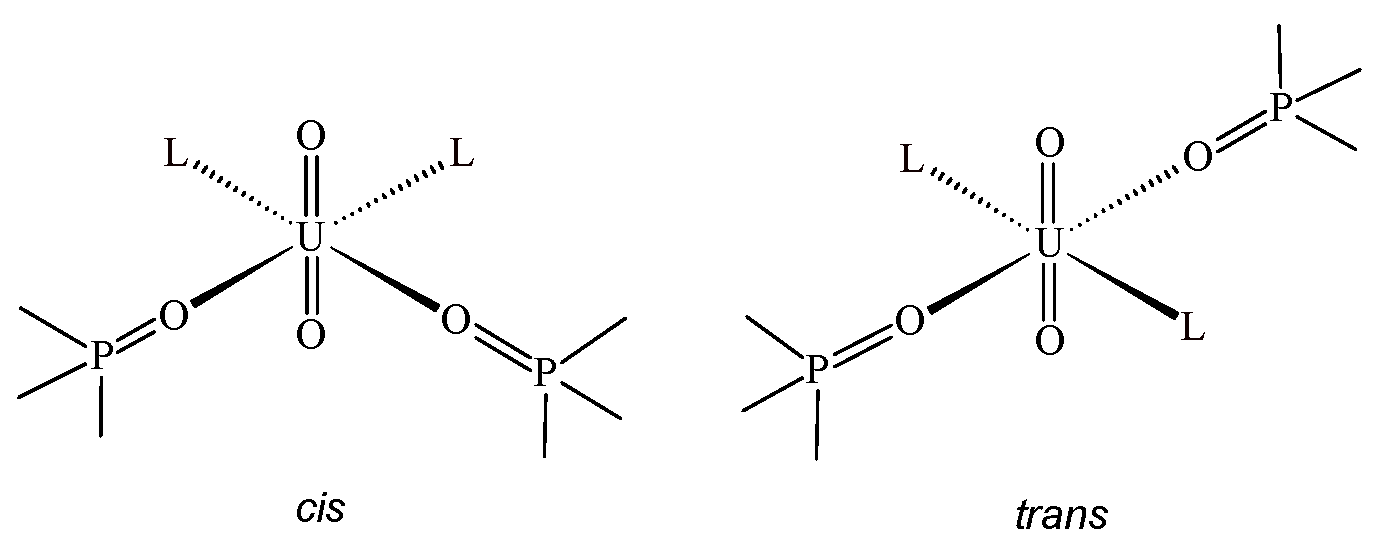
The coordination chemistry of uranium is complex and multifaceted, involving various oxidation states and coordination environments. Uranium, primarily in the form of uranyl ions (UO22+), exhibits a strong tendency to form stable complexes with a wide range of ligands. The uranyl ion, with its linear O=U=O structure, is particularly known for its high affinity towards oxygen donor ligands. Phosphinoxides are well-known strong coordinating ligands for lanthanoids and actinoids [18,19,20,21,22,23,24]. Most phosphine ligands oxidize in the presence of ambient oxygen. Among these, pincer-type phosphine ligands, such as the oxidized form of 1,3-bis(ditertbutylphosphinomethyl)benzene, have shown potential to coordinate with metal atoms via the cis-coordination mode or trans-coordination mode (Figure 1). This type of coordination can result in the formation of mononuclear, dinuclear, or polymeric complexes [25,26,27,28,29].
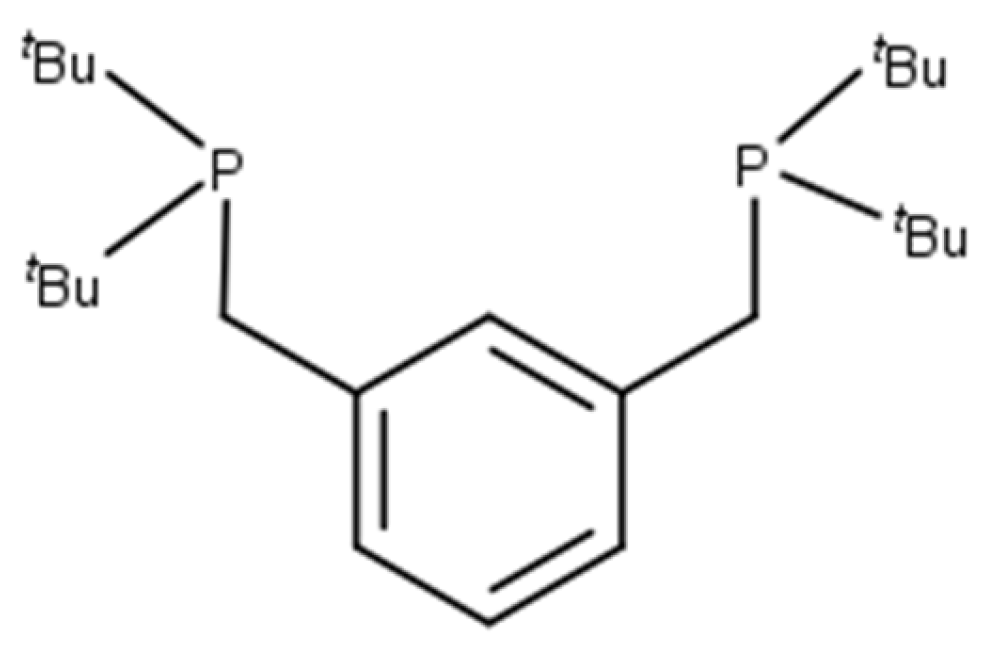
In a previous report, it was shown that pincer-type phosphine ligands coordinated with the europium (III) ion under ambient conditions [21]. It was found that the in situ oxidation of the phosphine moieties to phosphine oxide facilitated the ligand-to-metal coordination, leading to a mononuclear complex. The europium complex had water molecules that coordinated with the metal atom. The reaction was conducted in a nonaqueous solvent, THF, and ambient conditions. We wanted to explore the coordination of pincer-type ligands with uranyl ions under ambient conditions in THF. The TBP coordinated with the uranyl complex [18] exhibits a trans-coordination mode (Figure 1). We expected that the coordination complex of pincer-type ligands and uranyl ions would lead to a compound with a cis chelating coordination mode, as seen in the europium complex [21] (Figure 1). We used a PCP-type ligand, 1,3-bis(ditertbutylphosphinomethyl)benzene (Figure 2), to react with uranyl nitrate under ambient and nonaqueous conditions followed by irradiation with ultraviolet (UV) light.
We report here the complexation study of uranyl nitrate with 1,3-bis(ditertbutylphosphinomethyl)benzene in a nonaqueous medium under ambient conditions followed by irradiation with UV light. The reaction was monitored using analytical thin-layer chromatography (TLC) and the appearance of insoluble crystals on the reaction vial. Infrared (FT-IR) spectroscopy and single-crystal X-ray crystallography were used for structure determination.

2. Results and Discussion

2.1. Synthesis of Metal Complex: Formation of Dinuclear Complex

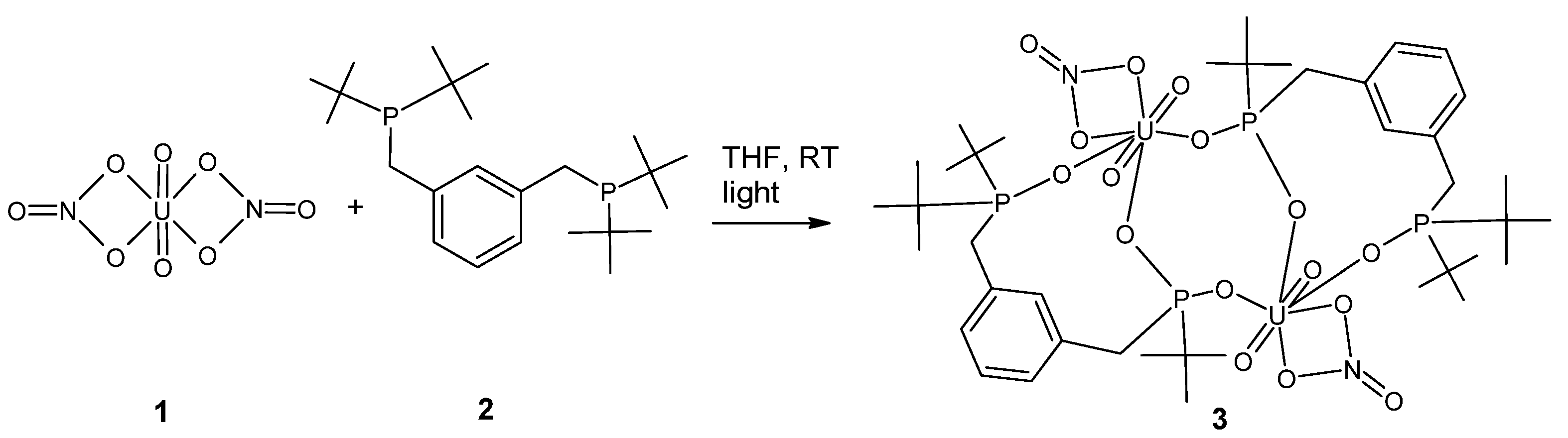
A THF solution of uranyl nitrate (1) reacts with 1,3-bis(ditertbutylphosphinomethyl)benzene (2) (tertbutyl-PCP) in the presence of light and yields a dinuclear uranium complex (3) with a 71.9% yield. The phosphine moieties of the ligand were oxidized during the reaction. This allowed the ligand-to-metal coordination to better fit hard-to-hard coordination. Previous reports have applied this concept by using phosphine oxide as a starting material. We observed that PNP or PCP-type aromatic ligands undergo rapid oxidation in the solution phase if there is an oxygen source in the ligand environment [21].
We observe the oxidation of the phosphorus atoms on the ligand (2). The dinuclear complex contains two ligands (2) (Scheme 1). There are four phosphorus atoms in one complex, two from each ligand. The two phosphorus atoms of each ligand reacted with ambient oxygen differently. One of the phosphines was oxidized by adding one oxygen atom, and the other phosphine was oxidized by adding two oxygen atoms. The phosphorus with two oxygen atoms lost one tBu group from each PCP ligand. Ligand coordination took place by the elimination of one NO3 ligand from each uranium atom. No ambient water molecules or the solvent molecule, THF, were noticed to be coordinated with either of the uranyl atoms of compound 3. The two oxygen atoms of the UO22+ ion perhaps prevent the coordination of ambient water molecules or any THF solvent molecules.

2.2. IR Spectroscopy of Compound (3)

The IR spectrum (Figure S1) was obtained using a Thermo Nicolet FTIR spectrometer. The crystalline compound was used for the IR spectrum without further purification. The oxidized ligand provided a better donor atom for a hard cation like U(VI). The metal atom in the product was hepta-coordinated by seven oxygen atoms. Tentative assignments of the IR bands are as follows: The band centered at 2900 cm−1 was assigned to the CH stretching frequency of the tBu groups and the benzene ring. Bands centered around 1700 and 1500 cm−1 were assigned to the NO stretching frequencies of the coordinated nitrate ligands. The resonance centered around 1350 cm−1 was assigned to the methylene CH stretching frequency. The bands in the fingerprint region between 1100 and 900 cm−1 were attributed to various P-O/P=O/P-C and O=U=O stretching frequencies [30].

2.3. Single-Crystal X-Ray Crystallography

X-ray crystallographic data reveals the formation of (3) as a dinuclear complex. Both phosphine ligands of the PCP ligand are oxidized and coordinated with different uranyl (UO22+) cations.
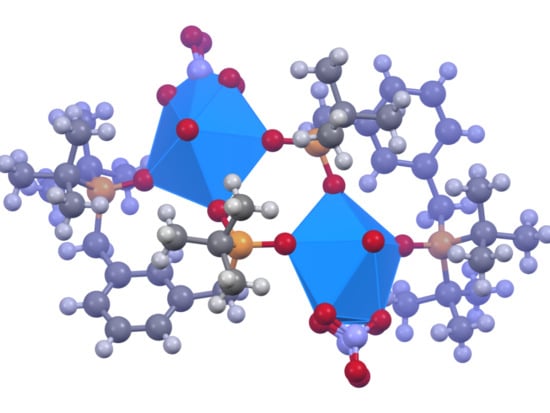
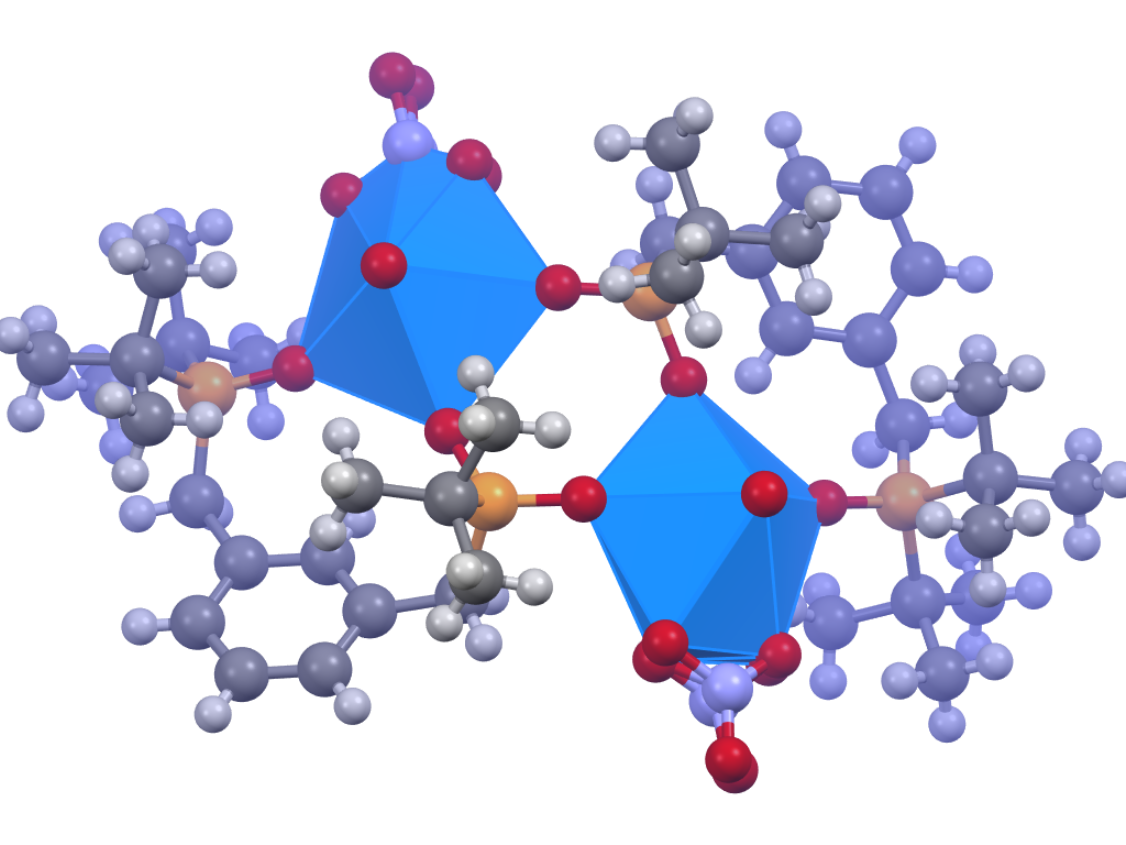
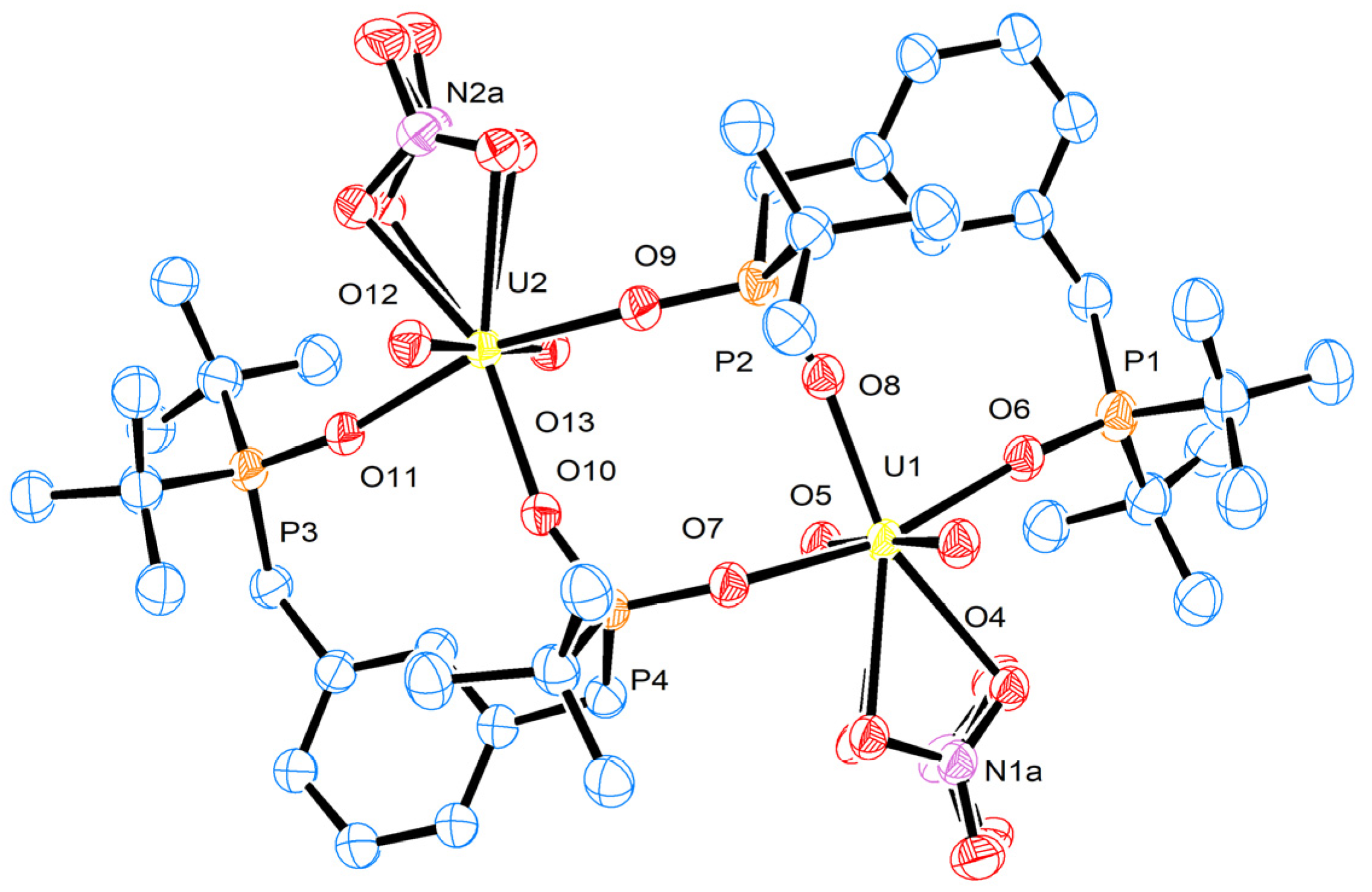
Each uranium atom of the dinuclear complex is hepta-coordinated by oxygen atoms (Figure 3) in pentagonal bipyramidal geometry. U(1) is equatorially coordinated by O(6) and O(8) from the phosphinoxide of one of the PCP ligands, O(7) from the phosphinoxide of the other PCP ligand and O(1) and O(1a) from the nitrate ligand. U(1) is axially coordinated by O(4) and O(5) from the oxo ligands in the UO22+ cation. The other uranium atom U(2) of the dinuclear complex has a similar coordination pattern. The phosphorous atoms of each PCP ligand were oxidized differently. One of them, P(1), oxidized with one oxygen atom, O(6), and the other one, P(2), oxidized with two oxygen atoms, O(8) and O(9). The latter phosphorous atom, P(2), bridges the two metal atoms, U(1) and U(2), by the oxygen atoms connected to them. A similar structural pattern was observed for the other PCP ligand, where P(4) was oxidized by two oxygen atoms, O(7) and O(10), and P(3) was oxidized by one oxygen atom, O(11). Phosphorous atoms oxidized by two oxygen atoms lost one of the two tBu groups, whereas the other oxidized by a single oxygen atom retained both tBu groups. Both uranium atoms lost one nitrate anion during the reaction. The original charge (2+) on the uranyl cations was neutralized by two NO3- ions on each uranyl nitrate molecule. The charge imbalance on the uranyl cations due to the loss of one nitrate ion was balanced by one of the oxygen atoms bridging P(2) and P(4) atoms in this complex. The P-O bonds for these P-O- moieties (1.515(8) Å) were longer than those of P=O (1.511(8) Å). However, the bond distances were not consistent for the P-O bonds of both ligands. This could be due to the steric effect of the tBu groups while packing. Each uranium atom retained its original VI oxidation state. The two axial U=O bond distances are slightly different: U(1)-O(4) = 1.761(8) Å and U(1)-O(5) = 1.738(8) Å. This could be due to cation–cation interactions (CCIs) since the O=U=O moieties are in proximity to the complex [10]. The nitrate ligands were modeled as disordered. The cross distances between O7/O9 and O8/O10 are roughly 3.598 Å and 3.938 Å, respectively. These are slightly shorter than the cross distances for previously reported similar structures (3.830 and 4.004 Å [31] and 3.883 and 4.041 Å [32]). However, a similar trend of uneven cross distances for these oxygen atoms is observed. The packing diagram (Figure S2) did not reveal any hydrogen bonding in the structure. The solid-state structural data has been submitted to the Cambridge Crystallographic Data Center. The structure deposition number of (3) is CCDC 1009491. Crystallographic data for the complex is provided in Table 1.

3. Materials and Methods

All chemicals and solvents were purchased from Sigma Aldrich, WI, USA except UO2(NO3)2 which was previously secured from IBI Labs, Boca Raton FL, USA and used as received without further purification. A handheld dual wavelength UV lamp (UVGL-58) from UVP, Upland, CA, USA was used as UV source. IR spectrum was obtained using Thermo Nicolet FTIR spectrometer, NICOLET iS10 (Mdison, WI, USA). Omnic software, Imnic32 was used for IR spectrometry. Crystallographic studies were conducted on a Rigaku XtaLab Mini from Rigaku Americas Corporation, The Woodlands, TX, USA.
In total, 25.8 mg (0.063 mmol) of UO2(NO3)2 (1) and 41.6 mg (0.11 mmol) of 1,3-bis-tert-butylphosphinomethylbenzene (2) were mixed in a test tube. To this solid mixture, 1.5 mL of THF was added. Immediately, a clear solution was formed, which quickly started becoming cloudy. This cloudy mixture was irradiated by UV radiation at a wavelength of 365 nm for 7 h. After this, the cloudiness disappeared and a TLC analysis was conducted, but the result was inconclusive. The resulting reddish orange solution was further irradiated with UV radiation of 254 nm for 34 h. Pale-yellow diamond-shaped crystals formed on the wall of the test tube. These crystals were separated, and suitable crystals were selected for diffraction studies. The rest of the solid material was collected to the amount of 0.0325 g. Using UO2(NO3)2 as the limiting reactant, the theoretical yield was predicted to be 0.0452 g and the reaction achieved a 71.9% yield.
A pale-yellow prism of 3 with dimensions of 0.12 × 0.11 × 0.07 mm3 was secured to a Mitegen mount using super glue, and its single-crystal X-ray diffraction data was collected at 273 K using a Rigaku XtaLABmini X-ray diffractometer equipped with a Rigaku Mercury CCD detector and graphite-monochromated Mo Kα1 (λ = 0.71073 Å) radiation. Using CrystalClear, a data collection strategy was carried out to ensure data redundancy and percent completeness [33]. Data processing was completed using CrysAlisPro [34] and included a multi-scan absorption correction on 3 applied using the SCALE3 ABSPACK scaling algorithm [35]. The structure was solved via intrinsic phasing methods using ShelXT version 2015 [36] and refined with ShelXL, version 2015 [36] within the Olex2 graphical user interface [37]. The space group was unambiguously verified by PLATON version 2009 [38]. The final structural refinement included anisotropic temperature factors on all constituent non-hydrogen atoms. Hydrogen atoms were attached via the riding model at calculated positions using suitable HFIX commands. Within the structural model for 3, qualitative indicators suggesting disorder within the [NO3]- anions were observed. The occupancy ratios for the two independent [NO3]- anions were freely refined to 0.58/0.42 and 0.55/0.45 with respect to one another after being split, and the commands RIGU and EADP were used to attain reasonable thermal parameters. Additionally for 3, a solvent mask was applied to regions of electron density presumed to be an identifiable solvent molecule whose disorder could not be satisfactorily modeled.

4. Conclusions

In this short report, we revealed a new dinuclear complex synthesized by the reaction of uranyl ions with the PCP-type ligand 1,3-bis(ditertbutylphosphinomethyl)benzene in a polar nonaqueous medium. The structure of this new complex was deduced and confirmed via an X-ray diffraction study. The phosphine moieties of the ligand were oxidized, facilitating their coordination with different metal atoms. Future studies could include the complexation of oxygen donor ligands to uranyl cations and investigate their catalytic potential.

Supplementary Materials

The following supporting information can be downloaded online. Figure S1: IR spectrum of compound 3; Figure S2: Packing diagram generated by Mercury CSD version 3.1 of compound 3 along c-axis.

Author Contributions

Conceptualization, T.A.S.; methodology, T.A.S., M.M.A., and M.A.G.; validation, E.R. All authors have read and agreed to the published version of the manuscript.

Funding

This research was partially funded by the US Department of Education, fund number 221269-13105.

Data Availability Statement

The solid-state structural data has been submitted to the Cambridge Crystallographic Data Center. The structure deposition number of (3) is CCDC 1009491. The structure can be viewed and downloaded in .cif format at https://www.ccdc.cam.ac.uk/structures/ (accessed on 2 June 2026). Additional data supporting the findings of this study is available from the corresponding author upon reasonable request.

Acknowledgments

T.A.S. thanks Koen Vercruysse for the donation of the UO2(NO3)2 sample.

Conflicts of Interest

The co-author Eric Reinheimer works at Rigaku Americas Corporation. The authors declare that this research was conducted in the absence of any commercial or financial relationship that could be considered a potential conflict of interest.

References

  1. Thuery, P.; Harrowfield, J. Bifunctional ligands in uranyl chemistry: Metalloligands and zwitterions. Coord. Chem. Rev. 2024, 510, 215821. [Google Scholar] [CrossRef]
  2. Birchard, E.E.; Decoteau, E.A.; Matthew, J.; Polinski, M.J. Synthesis and characterization of uranyl complexes containing orotate and isoorotate. Polyhedron 2025, 265, 117279. [Google Scholar] [CrossRef]
  3. Pang, Y.; Rajeshkumar, T.; Scopelliti, R.; Maron, L.; Mazzanti, M. C–C bond cleavage and carbonylation enabled by an NNN-pincer uranium scaffold via metal–arene interaction. Chem. Sci. 2025, 16, 16101–16109. [Google Scholar] [CrossRef]
  4. Urbank, C.; Golz, C.; Vondung, L. Synthesis and characterisation of uranium(IV) complexes with tridentate NNS ligands. Inorganica Chim. Acta 2026, 589, 122946. [Google Scholar] [CrossRef]
  5. Pang, Y.; Batov, M.S.; Rajeshkumar, T.; Zivkovic, I.; Scopelliti, R.; Maron, L.; Mazzanti, M. Dinitrogen Cleavage and Hydrogenation by a Uranium Hydride Complex Enabled through Metal–Ligand Cooperativity. J. Am. Chem. Soc. 2026, 148, 9231–9237. [Google Scholar] [CrossRef] [PubMed]
  6. Hakey, B.M.; Dylan CLeary, D.C.; Lopez, L.M.; Valerio, L.R.; Brennessel, W.W.; Milsmann, C.; Ellen MMatson, E.M. Synthesis and Characterization of Pyridine Dipyrrolide Uranyl Complexes. Inorg. Chem. 2022, 61, 6182–6192. [Google Scholar] [CrossRef]
  7. Azam, M.; Kumar, U.; Olowoyo, J.O.; Al-Resayes, S.I.; Trzesowska-Kruszynska, A.; Kruszynski, R.; Islam, M.S.; Khan, M.R.; Adil, S.F.; Siddiqui, M.R.; et al. Dinuclear uranium(vi) salen coordination compound: An efficient visible-light-active catalyst for selective reduction of CO2 to methanol. Dalton Trans. 2020, 49, 17243–17251. [Google Scholar] [CrossRef] [PubMed]
  8. Sachin, A.R.; Gopakumar, G.; Rao, C.V.S.B.; Nagarajan, S. Exploring phosphoryl oxygen basicity in U(VI) complexation: A comparative study from trialkyl phosphate to phosphine oxide. J. Comput. Chem. 2024, 45, 70–82. [Google Scholar] [CrossRef] [PubMed]
  9. Hu, S.-X.; Gao, J.-H.; Zhang, L.; Wei, Z.-Y.; Zhang, P. Phosphine Oxide Group Enhances the In-Plane σ-Bonding Covalency in Actinyl Phenanthroline-Derivative Complexes. J. Phys. Chem. A 2025, 129, 2411–2419. [Google Scholar] [CrossRef]
  10. Baker, R.J. New Reactivity of Uranyl(VI) Ion. Chem. Eur. J. 2012, 18, 16258–16271. [Google Scholar] [CrossRef]
  11. Arnold, P.L.; Pecharman, A.-F.; Hollis, E.; Yahia, A.; Maron, L.; Parsons, S.; Love, J.B. Uranyl oxo activation and functionalization by metal cation coordination. Nat. Chem. 2010, 2, 1056–1061. [Google Scholar] [CrossRef]
  12. Arnold, P.L.; Pecharman, A.-F.; Lord, R.M.; Jones, G.M.; Hollis, E.; Nichol, G.S.; Maron, L.; Fang, J.; Davin, T.; Love, J.B. Control of Oxo-Group Functionalization and Reduction of the Uranyl Ion. Inorg. Chem. 2015, 54, 3702–3710. [Google Scholar] [CrossRef]
  13. Arnold, P.L.; Love, J.B.; Patel, D. Pentavalent uranyl complexes. Coord. Chem. Rev. 2009, 253, 1973–1978. [Google Scholar] [CrossRef]
  14. Jones, M.B.; Gaunt, A.J. Recent developments in synthesis and structural chemistry of nonaqueous actinide complexes. Chem. Rev. 2013, 113, 1137–1198. [Google Scholar] [CrossRef]
  15. Hayton, T.W.; Wu, G. Synthesis, characterization, and reactivity of a uranyl beta-diketiminate complex. J. Am. Chem. Soc. 2008, 130, 2005–2014. [Google Scholar] [CrossRef] [PubMed]
  16. Duval, P.B.; Kannan, S. Anhydrous photochemical reduction of well-defined uranyl(VI) complexes. J. Alloys Compd. 2007, 444–445, 673–676. [Google Scholar] [CrossRef]
  17. Alcock, N.W.; Roberts, M.M.; Brown, D. Actinide structural studies. Part 1. Crystal and molecular structures of dinitratodioxobis(triphenylphosphineoxide)neptunium (VI), dinitratodioxobis (triphenylphosphineoxide)uranium(VI), and dichlorodioxo-(triphenylphosphine oxide)neptunium(VI). J. Chem. Soc. Dalton Trans. 1982, 1, 25–31. [Google Scholar] [CrossRef]
  18. Burns, J.H. Solvent-extraction complexes of the uranyl ion. 2. Crystal and molecular structures of catena-bis(.mu.-di-n-butyl phosphato-O,O′)dioxouranium(VI) and bis(.mu.-di-n-butyl phosphato-O,O′)bis[(nitrato)(tri-n-butylphosphine oxide)dioxouranium(VI)]. Inorg. Chem. 1983, 22, 1174–1178. [Google Scholar] [CrossRef]
  19. Lees, A.M.J.; Platt, A.W.G. Complexes of Lanthanide Nitrates with Bis(diphenylphosphino)methane Dioxide. Inorg. Chem. 2003, 42, 4673–4679. [Google Scholar] [CrossRef] [PubMed]
  20. Piskula, Z.; Kubicki, M.; Lis, S. The structural and spectroscopic studies of UO22+ complexes with diethyl benzylphosphonate and diethyl (carboxymethyl)phosphonate in solution and in the solid state. Polyhedron 2013, 62, 243–249. [Google Scholar] [CrossRef]
  21. Goni, M.A.; Daniels, L.M.; Siddiquee, T.A. Coordination nature of europium(III) with tBuPNP (2,6-bis(di-tert-butylphosphinomethyl) pyridine) ligand. Inorganica Chim. Acta 2013, 394, 645–648. [Google Scholar] [CrossRef]
  22. Spichal, Z.; Necas, M.; Pinkas, J.; Novosad, J. The Synthesis and Crystal Structures of Two-Dimensional Coordination Polymers of Ph2P(O)-CH2CH2-P(O)Ph2 and Ph2P(O)-C5H3N-P(O)Ph2 with Praseodymium. Inorg. Chem. 2004, 43, 2776–2778. [Google Scholar] [CrossRef]
  23. Kannan, S.; Deb, S.B.; Drew, M.G.B. Synthesis, characterization and molecular structure of 1,1′ bis(diphenylphosphino ferrocene)dioxide complex of uranyl nitrate. Inorganica Chim. Acta 2010, 363, 2338–2340. [Google Scholar] [CrossRef]
  24. Hu, C.; Lu, Y.-L.; Li, Y.-Z.; Yang, Y.-P.; Liu, M.; Liu, J.-M.; Li, Y.-Y.; Jin, Q.-H.; Niu, Y.-Y. Facile high yield, excellent catalytic performance of polyoxometalate-based lanthanide phosphine oxide complexes: Syntheses, structures, photocatalysis and THz spectra. Environ. Res. 2022, 206, 112267. [Google Scholar] [CrossRef]
  25. Stadler, B.; Hilary HYMeng, H.H.Y.; Belazregue, S.; Webster, L.W.; Byrne, A.C.K.M.; Krämer, T.; Chadwick, F.M. PCP Pincer Complexes of Titanium in the +3 and +4 Oxidation States. Organometallics 2023, 42, 1278–1285. [Google Scholar] [CrossRef]
  26. Teyar, B.; Boucenina, S.; Belkhiri, L.; Guennic, B.L.; Boucekkine, A.; Mazzanti, A. Theoretical Investigation of the Electronic Structure and Magnetic Properties of Oxo-Bridged Uranyl(V) Dinuclear and Trinuclear Complexes. Inorg. Chem. 2019, 58, 10097–10110. [Google Scholar] [CrossRef]
  27. Brancatelli, G.; Pappalardo, A.; Sfrazzetto, G.T.; Notti, A.; Geremia, S. Mono- and dinuclear uranyl(VI) complexes with chiral Schiff base ligand. Inorg. Chim. Acta 2013, 396, 25–29. [Google Scholar] [CrossRef]
  28. Yang, W.; Wang, H.; Tian, W.-G.; Li, J.; Sun, Z.-M. The First Family of Actinide Carboxyphosphinates: Two- and Three-Dimensional Uranyl Coordination Polymers. Eur. J. Inorg. Chem. 2014, 31, 5252–5451. [Google Scholar] [CrossRef]
  29. Valdés, H.; Germán-Acacio, J.M.; van Koten, G.; Morales-Morales, D. Bimetallic complexes that merge metallocene and pincer-metal building blocks: Synthesis, stereochemistry and catalytic reactivity. Dalton Trans. 2022, 51, 1724–1744. [Google Scholar] [CrossRef]
  30. Monteiro, B.; Fernandes, J.A.; Pereira, C.C.L.; Vilela, S.M.F.; Tome, J.P.C.; Marcalo, J.; Almeida Paz, F.A. Metalorganic frameworks based on uranyl and phosphonate ligands. Acta Cryst. 2014, 70, 28–36. [Google Scholar] [CrossRef]
  31. Charushnikova, I.A.; Fedosseev, A.M.; Den Auwer, C.; Moisy, P. Crystal structure of Th (IV) perchlorate and U (VI) nitrate complexes with trimethyl phosphate:[Th(OP(OCH3)3)4(O2P(OCH3)2)2]2[ClO4]4 and [UO2 (OP(OCH3)3)(O2P(OCH3)2)(NO3)]2. Radiochim. Acta 2012, 100, 173–178. [Google Scholar] [CrossRef]
  32. Xu, J.F.; Chen, P.; Zhuang, R.; Huang, C.C.; Zhang, H.H. catena-Poly [1, 2-ethylenediammonium [[nitratouranyl]-μ3-phosphito] dihydrate]. Struct. Rep. 2006, 62, m763–m764. [Google Scholar] [CrossRef]
  33. Pflugrath, J.W. The finer things in X-ray diffraction data collection. Acta Cryst. 1999, 55, 1718–1725. [Google Scholar] [CrossRef] [PubMed]
  34. CrysAlisPro. Rigaku Oxford Diffraction, version 171.42.75a; Rigaku Corporation: Tokyo, Japan, 2022.
  35. SCALE3 ABSPACK. A Rigaku Oxford Diffraction Program for Absorption Corrections, version 2017; Rigaku Oxford Diffraction: Tokyo, Japan, 2017.
  36. Sheldrick, G.M. Crystal structure refinement with SHELXL. Acta Cryst. 2015, 71, 3–8. [Google Scholar]
  37. Dolomanov, O.V.; Bourhis, L.J.; Gildea, R.J.; Howard, J.A.K.; Puschmann, H. OLEX2: A complete structure solution, refinement and analysis program. J. Appl. Cryst. 2009, 42, 339–341. [Google Scholar] [CrossRef]
  38. Spek, A.L. Structure validation in chemical crystallography. Acta Cryst. 2009, 65, 148–155. [Google Scholar] [CrossRef] [PubMed]
Figure 1. cis and trans mode of coordination by the phosphine oxide.
Molbank 2026 m2191 g001
Figure 2. Pincer-type ligand (PCP).
Molbank 2026 m2191 g002
Scheme 1. Synthesis of uranyl(UO22+)-based dinuclear compound (3).
Molbank 2026 m2191 sch001
Figure 3. An ORTEP diagram (30% probability) of the dinuclear complex (3); tBu-groups and the hydrogen atoms are not shown for clarity. The nitrate ligands are modeled as disordered.
Molbank 2026 m2191 g003
Table 1. Crystal data and structure refinement for compound 3.
ItemData
Empirical FormulaC40H70N2O16P4U2
Formula weight1434.92
Temperature/K273(2)
Crystal systemmonoclinic
Space groupI2/a
a24.8075(16)
b16.2901(10)
c30.8179(19)
α90
β103.843(6)
γ90
Volume/Å312,092.3(13)
Z8
ρcalcg/cm31.576
μ/mm15.511
F(000)5568.0
Crystal size/mm0.12 × 0.11 × 0.07
RadiationMo Kα (λ = 0.71073)
2Θ range for data collection/°3.784 to 50.334
Index ranges−28 ≤ h ≤ 29, −19 ≤ k ≤ 19, −36 ≤ l ≤ 36
Reflections collected45,332
Independent reflections10,821 [Rint = 0.2083, Rsigma = 0.1778]
Data/restraints/parameters10,821/678/646
Goodness of fit on F21.001
Final R indexes [I ≥ 2σ (I)]R1 = 0.0690, wR2 = 0.0945
Final R indexes [all data]R1 = 0.1594, wR2 = 0.1152
Largest diff. peak/hole/e Å−30.91/−0.85
Disclaimer/Publisher’s Note: The statements, opinions and data contained in all publications are solely those of the individual author(s) and contributor(s) and not of MDPI and/or the editor(s). MDPI and/or the editor(s) disclaim responsibility for any injury to people or property resulting from any ideas, methods, instructions or products referred to in the content.