1. Introduction
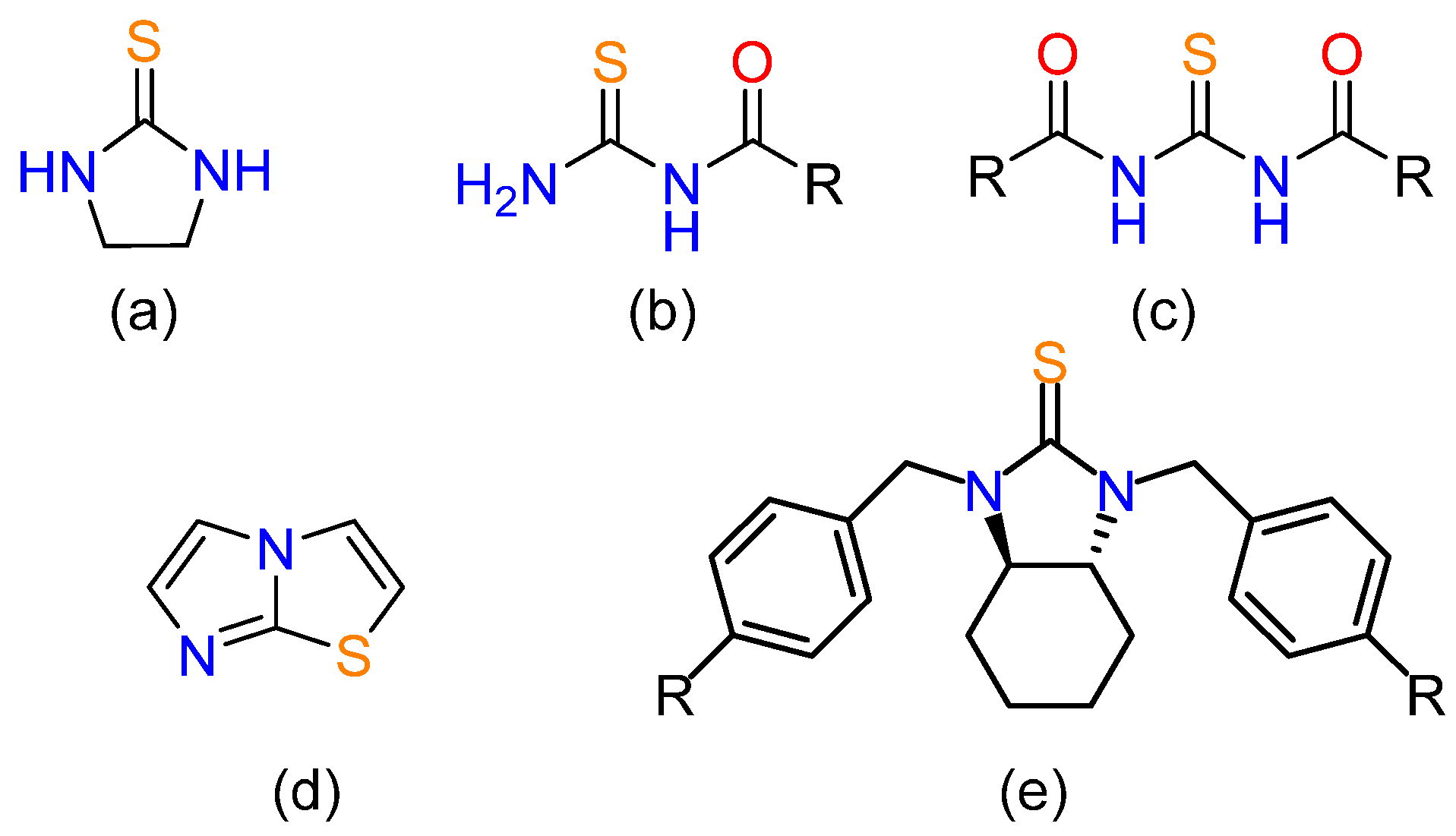
Imidazolidin-2-thiones (
Figure 1) constitute a relevant class of sulfur-containing heterocycles of broad interest in medicinal chemistry due to their biological properties, such as antiviral, antitumor, anti-inflammatory, and analgesic activities, which have driven the development of more efficient and sustainable synthetic routes [
1]. Among the most prominent methods is the reaction of diaminoalkanes with carbon disulfide, optimized using MgO nanoparticles as catalysts, which enables the production of cyclic thioureas under mild conditions, with high yields and without hydrogen sulfide emissions, thereby overcoming the limitations of traditional methods [
1,
2]. Furthermore, the chemical versatility of this nucleus enables functionalization, for example, via reactions with acyl chlorides to produce mono- and diacylthioureas, yielding compounds with good pharmacokinetic properties and potential as non-cytotoxic scaffolds in medicinal chemistry [
3].
From a biological perspective, imidazolidin-2-thiones have demonstrated remarkable broad-spectrum antimicrobial activity, being particularly effective against Gram-positive bacteria and, to a lesser extent, against Gram-negative bacteria, with structure–activity relationships indicating that substituents influence inhibitory activity [
1]. Specific derivatives have been shown to inhibit the growth of multiple pathogens, particularly those with methyl substitutions at key positions, thereby significantly improving their efficacy [
1]. Furthermore, these structures serve as precursors for the synthesis of condensed systems such as imidazo [2,1-
b]thiazoles, which exhibit both antimicrobial and antioxidant activities, thereby expanding their relevance in the design of novel bioactive agents [
4]. The formation of metal complexes with imidazolidin-2-thiones enhances and diversifies their biological properties. Copper(I) complexes derived from
N-substituted halides and ligands display diverse structures, including mono-, di-, tetra-, and hexanuclear species, and have been characterized by spectroscopic and crystallographic methods [
5]. These compounds exhibit antimicrobial activity against Gram-positive and Gram-negative bacteria and yeasts, with selective cytotoxicity depending on their structure [
5]. Copper complexes containing co-ligands such as triphenylphosphine also exhibit strong bactericidal activity, in some cases exceeding that of standard drugs, particularly against Gram-positive bacteria [
6]. In addition, silver, antimony, and bismuth complexes with imidazolidin-2-thiones exhibit significant antimicrobial and anticancer activities, along with good biocompatibility [
7]. Silver complexes are generally more active than free ligands due to their higher lipophilicity and stronger interactions with biological systems [
7]. Some halogenated silver complexes are particularly effective against resistant bacteria, including MRSA, with MIC values lower than those of conventional antibiotics [
8]. Antimony(III) and bismuth(III) complexes show lower cytotoxicity toward cancer cells while maintaining enzymatic activity, including lipoxygenase inhibition, suggesting potential applications in inflammatory disorders [
9].
Recently, Hoyos-Orozco et al. [
10] reported a pseudo-multicomponent protocol for the synthesis of 1,3-disubstituted imidazolidin-2-one derivatives. Their methodology involved the in situ formation of a Schiff base from
trans-(
R,
R)-1,2-diaminocyclohexane, followed by reduction to the corresponding diamine and cyclization using carbonyldiimidazole (CDI). This approach stands out for its efficiency and sustainability, as reaction conditions were optimized using statistical analysis, yielding 55–81% [
10]. Inspired by this methodology, the present work describes the synthesis of a novel imidazolidin-2-thione derivative through a three-step sequence involving Schiff base formation from 1,2-diamine and 4-nitrobenzaldehyde, reduction with NaBH
4, microwave-assisted thiocarbonylation to generate the imidazolidin-2-thione core, and final reduction of the nitro substituents to amines using an Fe/CaCl
2 system. The synthesis and structural elucidation of the title compound are presented below.
2. Results and Discussion
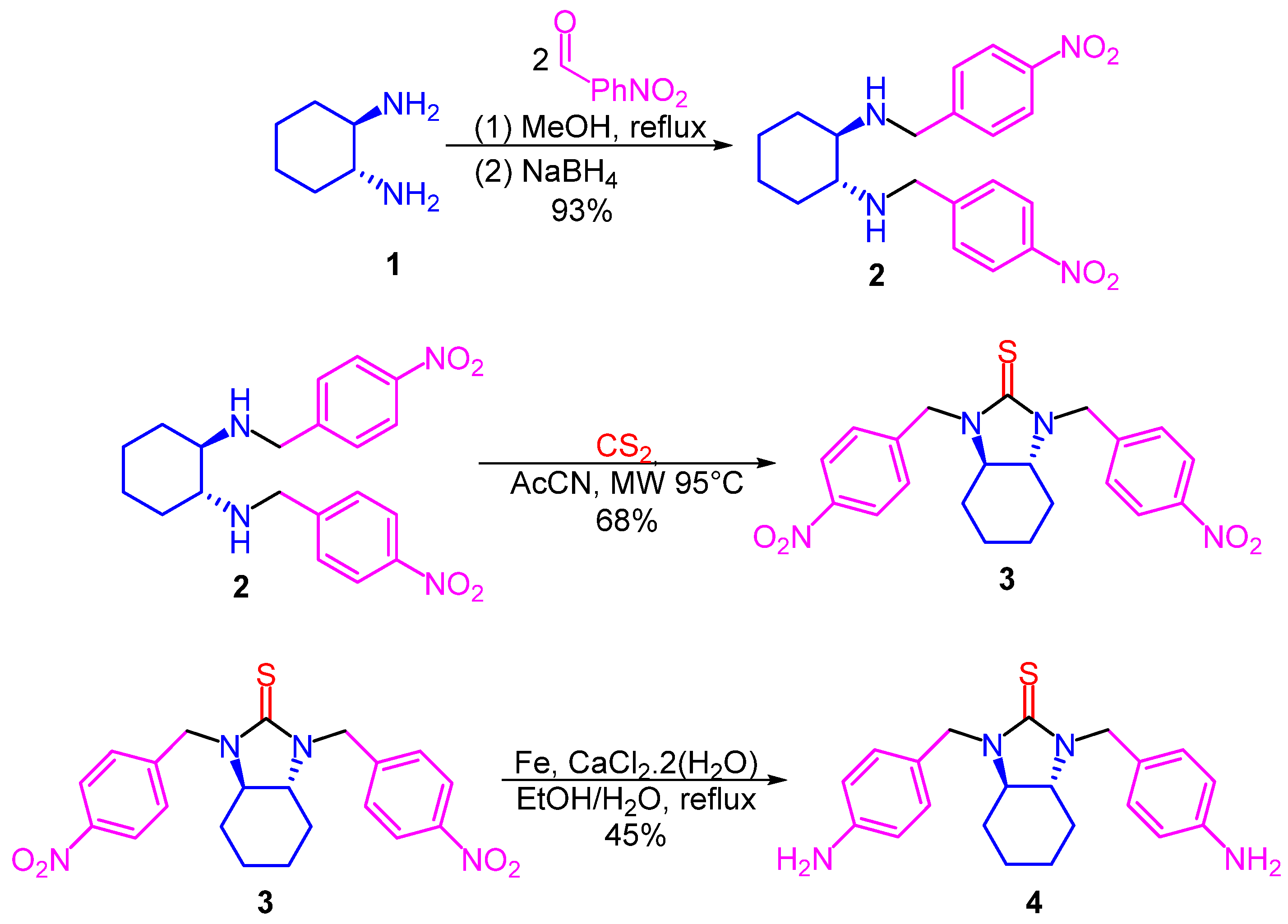
The synthesis began with the formation of a Schiff base from
trans-(
R,
R)-1,2-diaminocyclohexane
1 and 4-nitrobenzaldehyde, followed by reduction with NaBH
4 to afford diamine
2 (
Scheme 1). The synthetic strategy employed in this manuscript is consistent with widely reported methods for the preparation of imidazolidine-type heterocycles from diamines. In particular, the initial formation of the Schiff base from
trans-(
R,
R)-1,2-diaminocyclohexane and 4-nitrobenzaldehyde, followed by its reduction, is well supported in the literature. Hoyos-Orozco et al. [
10] studied a pseudo-multicomponent approach in which the in situ formation of the Schiff base from diamines and its subsequent reduction provides efficient access to key diamine intermediates for further cyclizations, with yields up to 81%. This report supported the feasibility of the first step of the proposed route and suggests that the observed efficiency is consistent with that of analogous systems. The second step consisted of a thiocarbonylation reaction to form the corresponding imidazole-2-thione
3 using acetonitrile as the solvent and carbon disulfide (CS
2) under microwave irradiation (MW), affording 68% yield. Regarding the cyclization step via thiocarbonylation with CS
2, this yield is considered adequate compared with the reported outcome in the literature. The reaction of amines with carbon disulfide has been reported to proceed via dithiocarbamate-type intermediates that subsequently cyclize to form sulfur-containing heterocycles, with yields typically moderate to high under the specified conditions [
11]. Furthermore, a previously reported study [
12] indicates that MW irradiation significantly improves reaction kinetics, reducing reaction times and, in many cases, increasing yields compared to conventional methods. However, it has also been noted that these conditions can favor side reactions or partial decomposition of CS
2, which could explain the non-quantitative yield. Alternative methodologies for the synthesis of imidazolidin-2-thiones, such as solvent-free or mechanochemical routes, have achieved higher yields (even approaching 100% in some cases), suggesting that modifying reaction conditions could optimize the cyclization step. However, these methodologies often require specific conditions—such as milling or the use of strong bases—that may not be compatible with all substrates.
The structural elucidation of compound
3 was carried out using FT-IR, UV-Vis,
1H, and
13C NMR spectroscopies, which are consistent with the formation of a nitrogen-containing bicyclic system bearing 4-nitro aromatic substituents and a thioamide (N-(C=S)) functionality. The FT-IR spectrum of the compound
3 (
Figure S1) showed characteristic bands consistent with the formation of a cyclic
N,
N′-disubstituted thiourea with
p-nitrobenzyl groups. The signals observed at 2930 and 2857 cm
−1 correspond to the asymmetric and symmetric aliphatic C–H stretching of the methylene groups present on both the cyclohexane ring and the benzyl substituents. The band at 1721 cm
−1 is attributed to a vibration of the thioamide system, reflecting the conjugated character of the C=S bond. The strong absorptions at 1603, 1598, and 1519 cm
−1 are characteristic of the asymmetric N–O stretching of the nitro group, with additional contributions from the aromatic ring vibrations. The band at 1334 cm
−1 corresponds to the symmetric stretching, confirming the presence of the nitro groups in the para position. Likewise, the signals at 1520, 1434, 1251, 1117, and 950 cm
−1 are consistent with typical thioamide bands, originating from vibrational coupling between the C=S and C–N bonds, thus confirming the presence of the thiourea nucleus in the synthesized structure. The UV-Vis spectrum of the compound
3 (
Figure S2) exhibited two absorption maxima at 232 and 256 nm in dichloromethane, attributable to transitions of the conjugated aromatic system influenced by the nitro group, which acts as a strongly electron-withdrawing substituent and favors the appearance of additional bands.
The
1H NMR spectrum (
Figure S3) shows two characteristic signals in the aromatic region at δ
H 8.21 and 7.56 ppm, both as doublets with a coupling constant
J = 8.7 Hz, indicating an AX-type aromatic system with
ortho coupling. This pattern is consistent with
para-disubstituted benzene rings, as expected for the 4-nitrophenyl fragments present in the structure. In the midfield region, two doublets are detected at δ
H 5.14 and 4.92 ppm with a geminal coupling constant (
J = 16 Hz), attributable to a N–CH
2–Ar group. The difference in chemical shifts and geminal coupling clearly indicates that these protons are diastereotopic, confirming a chiral or pseudochiral environment generated by the bicyclic system’s rigidity. The signals at δ
H 3.02–2.91 ppm, assigned to a multiplet of two hydrogen atoms, are attributed to protons on the chiral carbons labeled H-3a and H-7a, which are adjacent to nitrogen atoms, thus accounting for their relative lack of shielding. In the aliphatic region, the signals between δ
H 1.94 and 1.75 ppm correspond to equatorial protons on C4 and C7, while the singlet signal at δ
H 1.62 ppm is assigned to protons on C5 and C6 in a similar and relatively shielded chemical environment. The signals observed between δ
H 1.28–1.22 ppm could be attributed to axial protons at C4, C5, C6, and C7, reflecting the conformational dynamics of the fused cyclohexane ring.
The
13C NMR spectrum (
Figure S4) shows a highly deshielded signal at δ
C 187.8 ppm, a characteristic of a thioamide-type carbon (C=S), confirming the presence of the thiocarbonyl group in the structure. The signals at δ
C 147.4 and 144.7 ppm correspond to substituted aromatic carbons, likely the
ipso carbons bonded to the nitro group and nitrogen, while the signals at δ
C 128.5 and 123.9 ppm are consistent with CH aromatic carbons. The signal at δ
C 65.3 ppm is assigned to the bridging carbons C3a and C7a, which are bonded to nitrogen, explaining their low-field shift. The methylene carbon bonded to the aromatic nitrogen appears at δ
C 49.6 ppm, consistent with an N–CH
2–Ar system. Finally, the signals at δ
C 28.6 and 24.0 ppm correspond to the aliphatic carbon atoms of the cyclohexane system (C4–C7), indicating two distinct chemical environments.
The final step of the synthetic protocol involved reducing the nitro group to an amine. For this transformation, two different methodologies were evaluated using metal-mediated conditions. The first method employed zinc and acetic acid in dichloromethane, as reported previously; however, the desired product was not observed. Consequently, an alternative methodology reported by Chandrappa [
13] was used, involving iron as the catalyst with calcium chloride in an ethanol/water mixture under reflux. Under these conditions, the diamine
4 was obtained in 45% yield. Thus, the synthesis of a new imidazole-2-thione
4 is reported in 28% overall yield. The final nitro reduction step is clearly the rate-limiting step in the sequence. The lack of reactivity observed with the Zn/AcOH system in dichloromethane can be explained by the fact that this type of reduction depends heavily on the accessibility of the nitro group and on the system’s compatibility with other heteroatoms present. In sulfur-containing compounds, such as imidazolidin-2-thiones, metal–sulfur interactions have been reported to deactivate the reducing agent or decrease its efficiency. The use of iron as a reducing agent represents a more compatible alternative for functionalized systems. Several studies have demonstrated that iron-based systems are effective for organic transformations involving multiple heteroatoms, exhibiting good functional tolerance and operating under relatively mild conditions [
14]. In this context, the alternative iron/CaCl
2 method in a hydroalcoholic medium yields the desired product in 45% yield, which, although moderate, is consistent with reports indicating that the reduction of nitro groups in complex heterocyclic systems is limited by competing processes or diffusion problems in the reaction medium. It is important to note that reducing imidazolidin-2-thione derivatives can lead to side reactions, such as over-reduction or even ring opening, under certain conditions, thereby decreasing the overall yield. Finally, the overall yield of 28% obtained in the three-step sequence is within the typical range for multi-step synthesis of functionalized heterocycles. Contrasted with reported protocols, where yields typically range from 20% to 40% for comparable systems, the results obtained are acceptable.
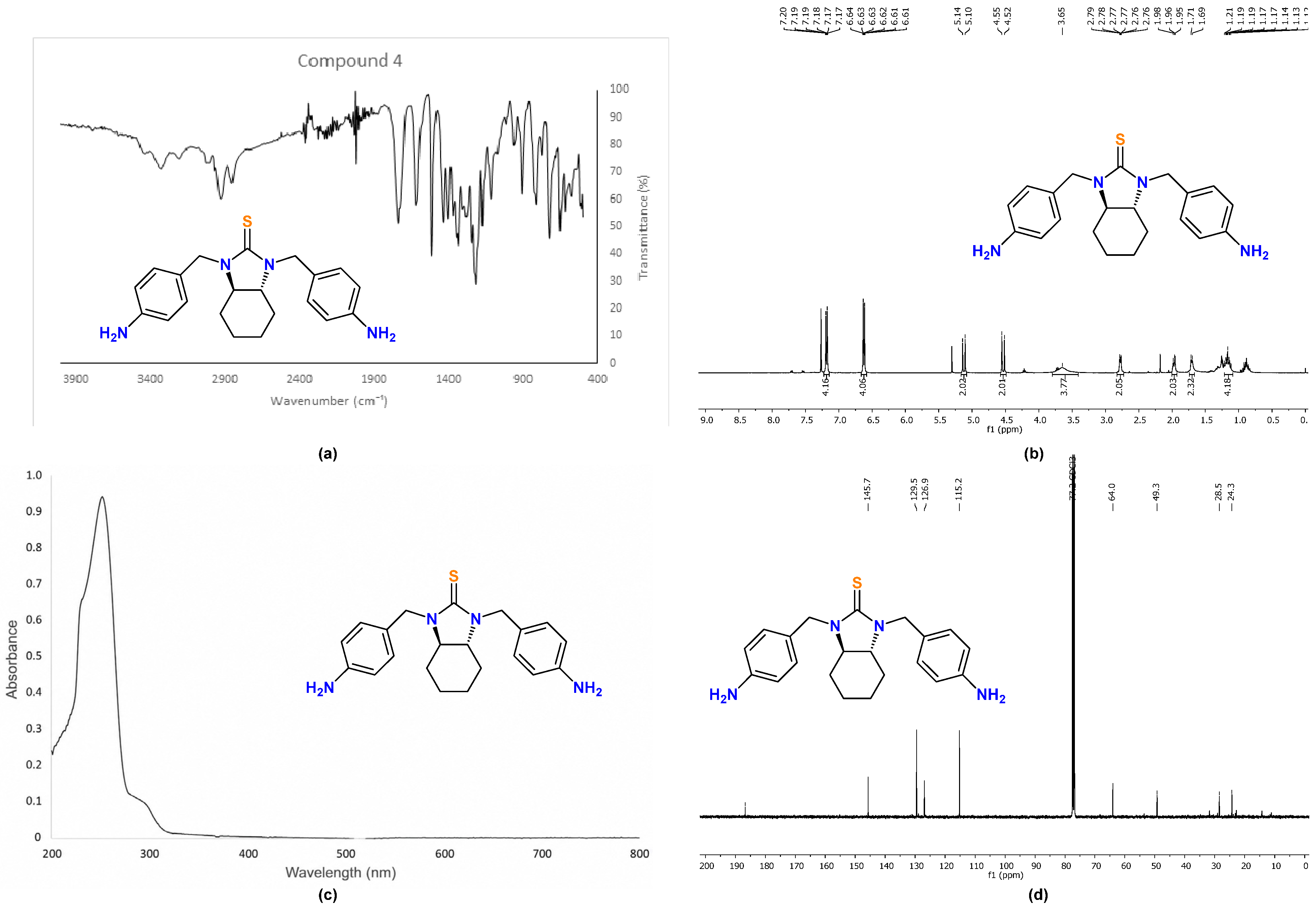
The FT-IR spectrum of compound
4 (
Figure 2a) shows bands at 3347 and 3222 cm
−1, which were assigned to the asymmetric and symmetric N-H stretching of the primary amino group in the para position of the aromatic rings. The signals at 2936 and 2861 cm
−1 correspond to the aliphatic C-H stretching of the methylene and cyclohexane groups. The band at 1615 cm
−1 can be attributed to both the N-H stretching of the amino group and the C=C aromatic conjugate system, while the intense absorption at 1512 cm
−1 is related to the corresponding characteristic bands associated with the vibrational coupling of the C=S group in substituted thioamides. The band at 1219 cm
−1 corresponds to another characteristic vibration of the thioamide system. Meanwhile, the signal at 817 cm
−1 is consistent with out-of-plane deformation of
para-disubstituted aromatic rings, confirming 4-aminobenzylic substitution. The band at 727 cm
−1 can be assigned to out-of-plane deformations of aromatic C-H bonds and contributions from the cycloaliphatic skeleton. UV-Vis spectrum of compound
4 (
Figure 2c) exhibited a single main band at 253 nm in dichloromethane associated with π-π* transitions of the aromatic system modified by the amino group, whose electron-donating character alters the electronic distribution of the chromophore. The slight shift and simplification of the spectral profile after reduction of the nitro group to an amino group demonstrate a change in the molecule’s electronic properties.
The formation of the title compound
4 was evidenced by some characteristic signal shifts in the
1H and
13C NMR spectra (
Figure 2b,d). A comparative analysis confirmed both the conservation of the bicyclic skeleton and the successful conversion of the nitro groups to amines. In the
1H NMR spectrum, the aromatic region shows two sets of signals at δ
H 7.21–7.15 ppm and 6.65–6.59 ppm, both as multiplets integrating for a total of 8 protons. This pattern corresponds to an AB-type aromatic system, characteristic of
para-disubstituted benzene rings with NH
2 groups, in contrast to the AX system observed in the precursor with nitro groups. The clear difference in chemical shifts (shift towards high field) is due to the electron-donating effect of the amino group, as opposed to the strongly electron-withdrawing character of the nitro group in the starting compound. A distinctive feature of the reduced product is the appearance of a singlet at δ
H 3.65 ppm, integrating for four protons, assigned to the hydrogens of the –NH
2 groups. This signal is not present in the precursor and constitutes direct evidence of nitro group reduction. The diastereotopic benzylic protons appear as two doublets at δ
H 5.12 and 4.53 ppm with
J = 16 Hz, slightly shifted from the precursor
3 (δ
H 5.14 and 4.92 ppm,
J = 16 Hz). This small shift and the slight decrease in the coupling constant reflect the electronic change in the aromatic ring upon reduction, which affects the environment of the N–CH
2–Ar group. The signals corresponding to the bicyclical aliphatic system remain virtually unchanged. The H-3a and H-7a bridging protons appear at δ
H 2.83–2.72 ppm, while the equatorial and axial protons of cyclohexane are distributed in regions similar to those of the precursor (δ
H 2.00–1.10 ppm). This result confirms that the system’s core structure remains intact during the reduction reaction.
In the 13C NMR spectrum, the signal of the thioamide carbon (C=S) is observed at δC 186.7 ppm, virtually unchanged from the precursor (δC 187.8 ppm), indicating that this functional group is unaffected by the reduction conditions. The most notable differences are observed in the aromatic region, with carbons appearing at δC values of 145.7, 129.5, 126.9, and 115.2 ppm, indicating a general shift toward higher electron density relative to the precursor. This change is consistent with the substitution of nitro (deactivating) groups with amino (activating) groups, thereby increasing the ring’s electron density. The bridging carbons (C3a and C7a) and the benzylic methylene group (N–CH2–Ar) appear at δC 64.0 and 49.3 ppm, respectively, virtually unchanged from the precursor, as are the aliphatic carbons of the ring (δC 28.5 and 24.3 ppm).
Recently, Hu [
15] presented a methodology for the synthesis of this class of derivatives, using thiocarbonyl fluoride generated in situ from difluorocarbene, which allowed the synthesis of five-membered heterocycles such as imidazolidin-2-thiones, oxazolidin-2-thiones, and thiazolidin-2-thiones using alkyl amines, including
trans-1,2-diaminocyclohexane. However, compounds
3 and
4 reported in this work are novel in chemical structure, constituting this manuscript as the first report of their synthesis [
15]. Moreover, these results indicate that the synthetic route is viable and provides access to a novel imidazolidin-2-thione derivative, although optimizing the final reduction step represents a clear opportunity for improvement. Future strategies include catalytic hydrogenation or more selective alternative reduction systems, as well as exploring milder conditions during the cyclization stage to maximize overall yield.
3. Materials and Methods
3.1. Procedure for the Synthesis of Compound 3
Compound
3 was prepared using previously reported methods with modifications [
16]. The diamine
2 (107 mg, 279 µmol) was dissolved in acetonitrile (ACN, 0.46 M), and carbon disulfide (CS
2, 168 µL, 10 equiv.) was added. The reaction mixture was heated to 95 °C for 1 h under microwave irradiation. The mixture was concentrated under vacuum, and the crude product was purified by column chromatography on silica gel, eluting with petroleum ether/ethyl acetate (5:1).
(3aR,7aR)-1,3-bis(4-nitrobenzyl)octahydro-2H-benzo[d]imidazole-2-thione 3. Orange solid, soluble in dichlorometane, chloroform, and methanol; yield: 68% (81 mg, 0.19 mmol). 1H NMR (400 MHz, CDCl3) 8.21 (d, J = 8.7 Hz, 4H), 7.56 (d, J = 8.7 Hz, 4H), 5.14 (d, J = 16.0 Hz, 2H), 4.92 (d, J = 16.0 Hz, 2H), 3.02 − 2.91 (m, 2H), 1.94 − 1.75 (m, 2H), 1.62 (s, 2H), 1.28 − 1.22 (m, J = 6.0, 2.6 Hz, 4H).13C NMR (101 MHz, CDCl3) δ 187.8, 147.4, 144.7, 128.5, 123.9, 65.3, 49.6, 28.6, 24.0. IR (neat, ATR) (cm−1): 2930, 2857, 1721, 1598, 1603, 1520, 1434, 1519, 1334, 1251, 1117, 950. ESI-MS (m/z) calcd for C21H23N4O4S [M+H]+: 427; found: 427. = +72.2 ± 0.6° (c 0.72, DCM).
3.2. Procedure for the Synthesis of Compound 4
Compound
4 was prepared based on previously reported methods [
13]. Compound
3 (21 mg, 51 µmol), iron (Fe, 20 mg, 7 equiv.), calcium chloride dihydrate (CaCl
2 · 2H
2O, 38 mg, 5 equiv.), and ethanol/water (20:1) (1 mL, 0,051 M) were added to the reaction vessel. The reaction mixture was heated at reflux for 3 h. After completion, the mixture was concentrated under reduced pressure, then extracted with water and ethyl acetate. The crude product was purified by column chromatography on silica gel, eluting with petroleum ether/ethyl acetate (4:1).
(3aR,7aR)-1,3-bis(4-aminobenzyl)octahydro-2H-benzo[d]imidazole-2-thione 4. Dark orange solid, soluble in dichlorometane, chloroform, and methanol; yield: 45% (8 mg, 0.023 mmol). 1H NMR (400 MHz, CDCl3) δ 7.21 − 7.15 (m, 4H), 6.65 − 6.59 (m, 4H), 5.12 (d, J = 16.0 Hz, 2H), 4.53 (d, J = 16.0 Hz, 2H), 3.65 (s, 4H), 2.83 − 2.72 (m, 2H), 2.00 − 1.93 (m, 2H), 1.70 (d, J = 7.9 Hz, 2H), 1.21 − 1.10 (m, 4H). 13C NMR (101 MHz, CDCl3) δ 186.7, 145.7, 129.5, 126.9, 115.2, 64.0, 49.3, 28.5, 24.3. IR (neat, ATR) (cm−1): 3347, 3222, 2936, 2861, 1740, 1615, 1512, 1219, 817, 727. ESI-MS (m/z) calcd for C21H27N4S+ [M+H]+: 367; found: 367. = +101.6° ± 0.7 (c 0.05, DCM).







 Display in JSmol Viewer