Communication

Synthesis of 2-Aminonicotinonitriles via Photodecarboxylation of Azirine-2-Carboxylic Acids

by
Julia I. Pavlenko
,
Mikhail S. Novikov
and
Anastasiya V. Agafonova
*
Institute of Chemistry, St. Petersburg State University, 7/9 Universitetskaya Nab., 199034 St. Petersburg, Russia
*
Author to whom correspondence should be addressed.
Molbank 2026, 2026(2), M2165; https://doi.org/10.3390/M2165
Submission received: 17 March 2026 / Revised: 8 April 2026 / Accepted: 10 April 2026 / Published: 14 April 2026
(This article belongs to the Section Organic Synthesis and Biosynthesis)

Abstract

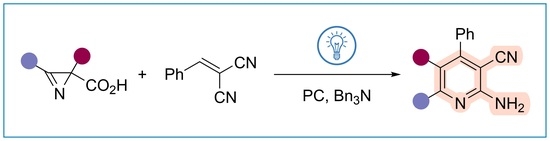
2-Aminonicotinonitriles represent an important class of heterocycles with diverse biological activities. Herein, we report an unexpected photochemical transformation of azirine-2-carboxylic acids leading to the formation of 2-aminonicotinonitrile derivatives. Optimization of the reaction conditions enabled the synthesis of the target products in moderate yields. The structure of the obtained product was confirmed by NMR spectroscopy, HRMS, and single-crystal X-ray diffraction analysis.

Graphical Abstract

1. Introduction

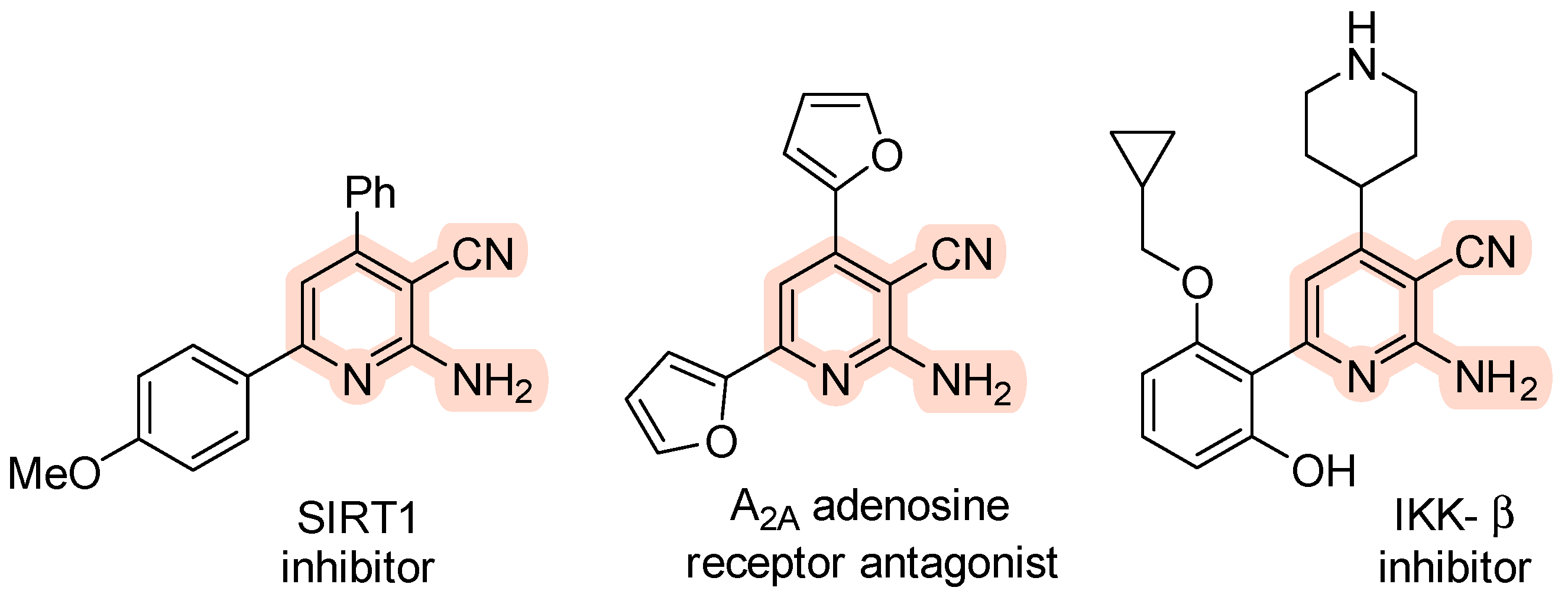
Pyridine derivatives represent an important class of nitrogen-containing heterocycles widely found in natural products, pharmaceuticals, and biologically active molecules [1,2,3,4,5]. Among these compounds, 2-aminonicotinonitrile derivatives constitute a valuable structural motif that has been extensively explored in medicinal chemistry. These molecules exhibit a broad spectrum of biological activities and have been reported as inhibitors of several biologically relevant targets, including SIRT1 [6], IKKβ [7], and A2A adenosine receptors [8] (Scheme 1). In addition, various 2-aminonicotinonitrile derivatives demonstrate antibacterial [9], antiviral [10], anti-inflammatory [11], and antitumor properties [12]. Beyond their biological properties, APNs have also shown promise as fluorescent sensors for monitoring photopolymerization processes [13] and steel corrosion inhibitors [14].
Several synthetic approaches toward 2-aminonicotinonitrile derivatives have been reported. The classical method involves multicomponent condensation reactions of aldehydes or ketones with malononitrile and ammonia or ammonium salts, often referred to as a Chichibabin-type pyridine synthesis [15]. More recently, improved protocols have been developed, including Cu-catalyzed cyclization of oxime esters [16], annulation reactions of α-keto vinyl azides with α,α-dicyanoalkenes [17], or even direct modification of 2-amino-3-bromopyridines [18].

2. Results and Discussion

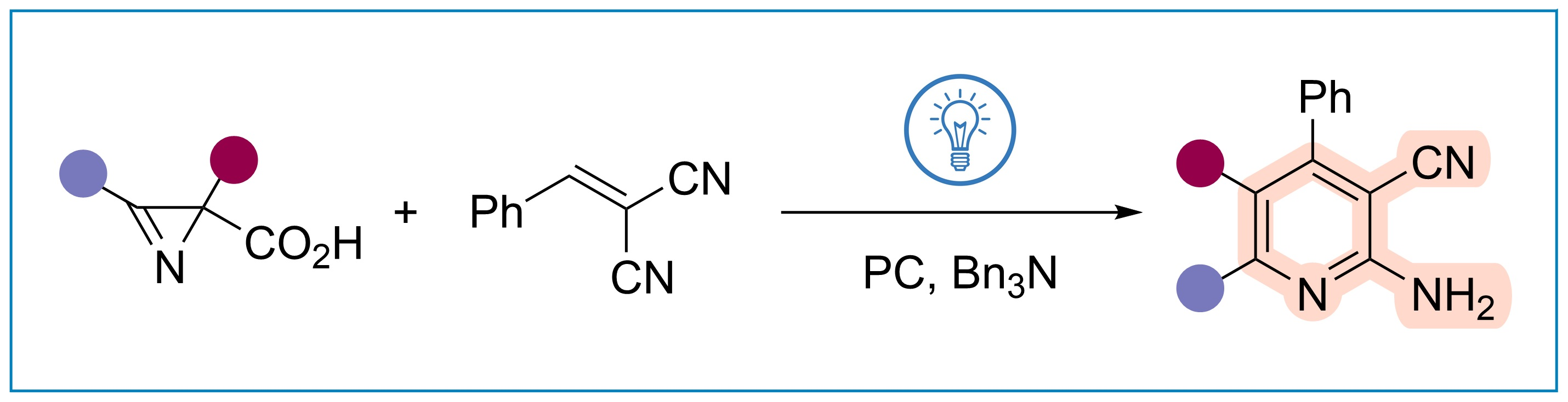
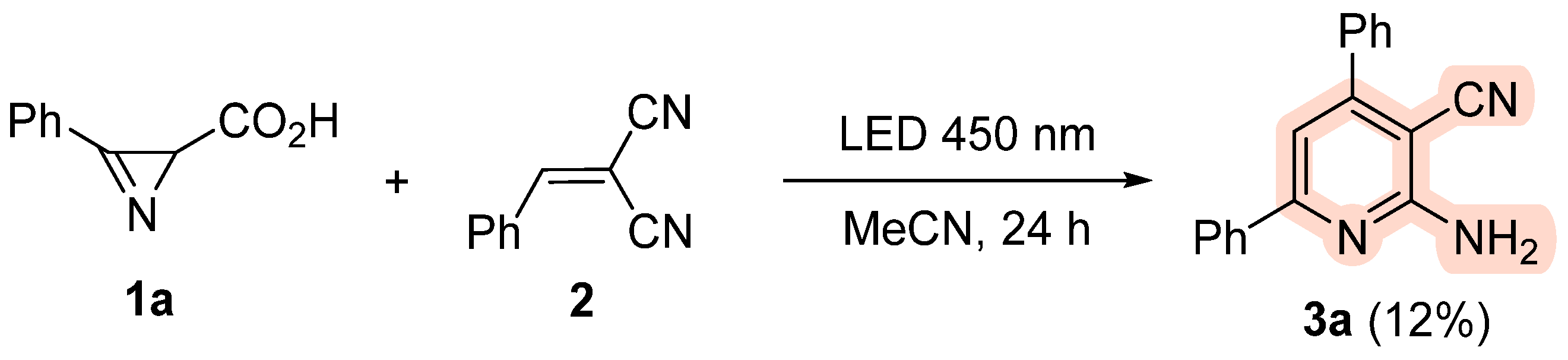
Recently, we reported a radical strategy for the generation of 2H-azirin-2-yl radicals under halogen-atom transfer (XAT) conditions from readily available 2-bromo-2H-azirine-2-carboxylic esters. These highly reactive intermediates undergo regioselective Giese-type additions to electron-deficient alkenes, including 2-benzylidenemalononitrile, providing densely functionalized azirine adducts while preserving the azirine ring [19]. Encouraged by these results, we sought to extend this strategy to non-functionalized azirinyl radicals by turning to photodecarboxylation methods [20,21,22] for their generation. However, when azirine-2-carboxylic acid 1a [23] was employed as an azirinyl radical precursor in the reaction with 2-benzylidenemalononitrile 2 under UV-LED (450 nm) irradiation, the reaction pathway changed dramatically (Scheme 2). Instead of the expected Giese-type product, the transformation proceeded further, leading to the formation of 2-aminonicotinonitrile derivative 3a. The structure of 3a was established by NMR, HRMS, and XRD methods. The NMR data were in full agreement with the literature data for this compound [24].
To optimize the reaction conditions, the reaction between azirine-2-carboxylic acid 1a and 2-benzylidenemalononitrile 2 was investigated under visible-light irradiation (Table 1 and extended Supplementary Materials Table S1 in the Supporting Information). Initial experiments in the presence of PC-1 and 20 mol% of Cs2CO3 showed that the use of an equimolar amount of acid 1a resulted in a 5% yield of target compound 3, whereas increasing its amount to 2 equiv led to a gradual improvement in yield, reaching 17% (Table S1, entries 1–5). Control experiments under daylight or in the dark resulted in only trace product formation (Table S1, entries 7–8).
Screening of several photocatalysts (PC-1–3) revealed only a minor effect on the reaction outcome (Table 1, entries 1–3). Similarly, the reaction was found to proceed even in the absence of base, giving a 15% yield (Table S1, entry 11), indicating that the base is not strictly required but influences the efficiency of the transformation. A moderate improvement was observed upon decreasing the loading of Cs2CO3 from 20 mol % to 5 mol %, increasing the yield to 23% (Table S1, entry 12), whereas higher base loadings (50–300 mol %) led to a substantial decrease in yield (Table S1, entries 13–16).
Further evaluation of different bases showed that organic amines are generally more effective, with Bn3N (5 mol %) providing the best result (24%, Table S1, entry 17), while other bases such as DMAP, K3PO4, DBU, TMG, and DABCO gave lower yields (Table S1, entries 18–22). The reaction concentration also had an effect, with both dilution and increased concentration leading to diminished yields (Table S1, entries 23–24).
Finally, extending the reaction time led to a gradual increase in the yield, reaching 34% after 96 h under otherwise identical conditions (Table 1, entries 4–6). Under the optimized conditions, full consumption of the starting materials was observed, but no significant amounts of well-defined side products were isolated.
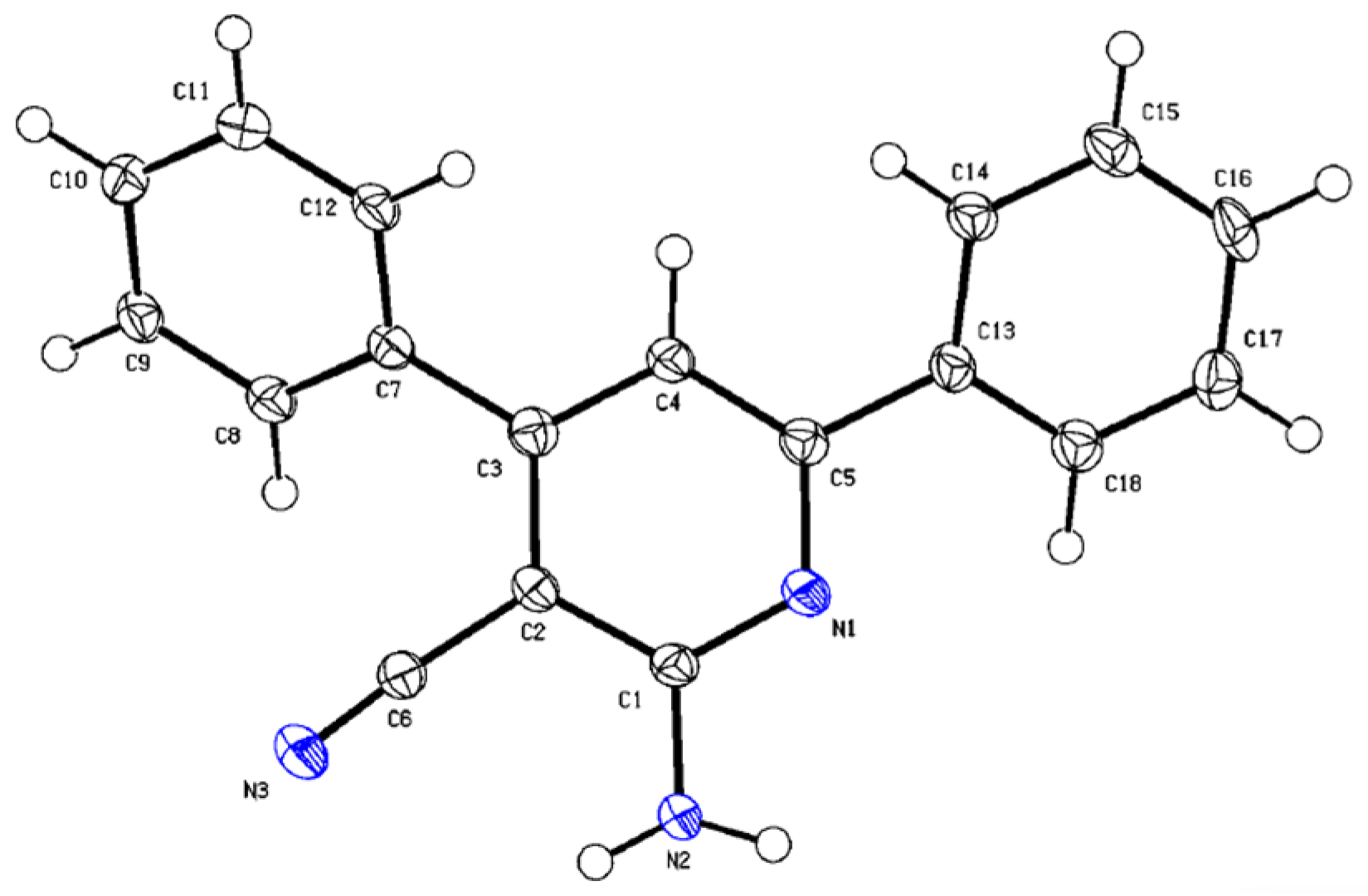
Structure of 3a was unambiguously confirmed by single-crystal X-ray diffraction analysis (Figure 1).
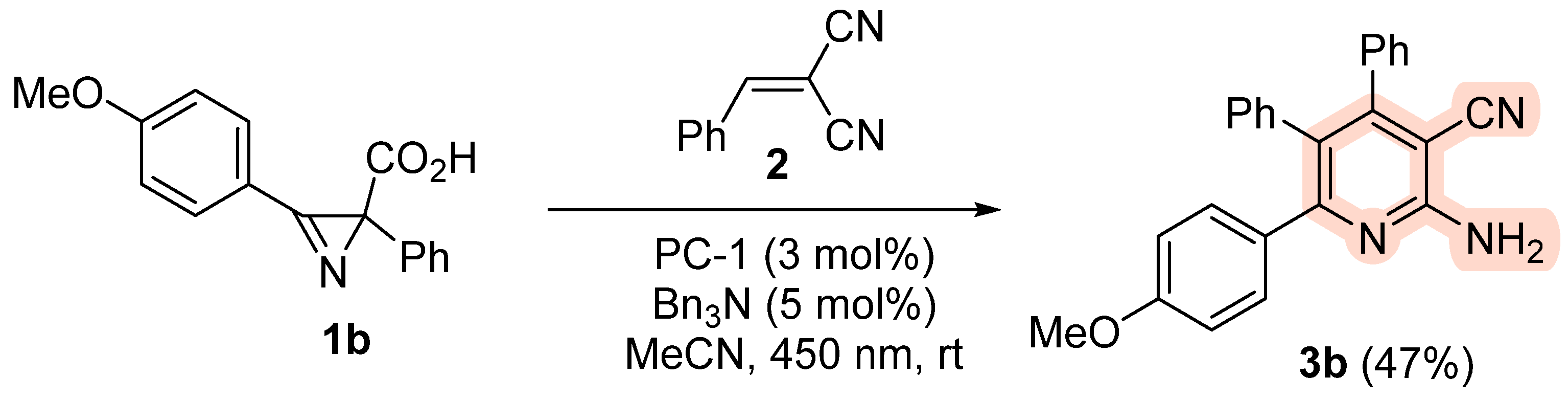
The moderate yield of 3a (34%) can likely be attributed to the limited stability of the azirin-2-yl radical generated after the photochemical decarboxylation step. To increase the stability of this intermediate, we introduced an additional substituent into the azirine ring. When the more substituted azirine-2-carboxylic acid 1b was employed under the optimized reaction conditions, the yield of the corresponding 2-aminonicotinonitrile 3b increased to 47% (Scheme 3). Nicotinonitrile 3b is a new compound; its structure was confirmed by NMR spectroscopy and HRMS methods.

3. Materials and Methods

3.1. General Instrumentation

The melting point was determined on a Stuart SMP30 melting-point apparatus. NMR spectra were recorded on a Bruker Avance 400 spectrometer (Karlsruhe, Germany) in CDCl3. 1H and 13C{1H} NMR spectra were calibrated according to the residual signal of CDCl3 (δ = 7.28 ppm for 1H and 77.00 ppm for 13C). High-resolution mass spectra were recorded with a Bruker maXis HRMS-QTOF (Bremen, Germany) via electrospray ionization. Thin-layer chromatography (TLC) was conducted on aluminum sheets precoated with SiO2 ALUGRAM SIL G/UV254 (Macherey-Nagel, Düren, Germany). Column chromatography was performed on silica gel 60 M (0.04–0.063 mm). All solvents were distilled and dried prior to use. Single crystals of compound 3a were grown by slow evaporation of its solution in a diethyl ether–hexane–dichloromethane mixture. Crystallographic data were collected on a SuperNova, single source at offset/far, HyPix3000 diffractometer (Rigaku, Wroclaw, Poland) using graphite monochromatic Cu–Kα radiation (λ = 1.54184 A). The crystal was kept at 100.01(11) K during data collection. Using the Olex2 version 1.5 [25], the structure was solved with the ShelXT [26] structure solution programme using the Intrinsic Phasing method and refined with the ShelXL [27] refinement package using Least Squares minimization. CCDC 2534715 contains crystallographic data for compound 3a. The data can be obtained free of charge from the Cambridge Crystallographic Data Centre via www.ccdc.cam.ac.uk/structures (accessed on 6 April 2026).

3.2. Synthesis of 2-Aminonicotinonitriles

A stirred solution of 2-benzylidenemalononitrile 2 (30.8 mg, 0.2 mmol), azirine-2-carboxylic acid 1 (0.4 mmol, 2 equiv), Bn3N (2.9 mg, 0.01 mmol, 5 mol%), and PC-1 (2.8 mg, 0.006 mmol, 3 mol%) in MeCN (1 mL) was irradiated at 450 nm under an Ar atmosphere for 96 h. After the reaction completion, the solvent was evaporated under reduced pressure, and the residue was purified by column chromatography on silica gel (benzene–EtOAc) to give 2-aminonicotinonitrole 3.
  • 2-Amino-4,6-diphenylnicotinonitrile 3a
Compound 3a (18.4 mg, 0.068 mmol, 34%; grey solid) was obtained according to the general procedure from azirine-2-carboxylic acid 1a (64.5 mg, 0.4 mmol).
Mp: 184–185 °C.
1H NMR (400 MHz, CDCl3), δ, ppm: 8.04–8.02 (m, 2H), 7.67–7.65 (m, 2H), 7.58–7.49 (m, 6H), 7.23 (s, 1H), 5.43 (s, 2H).
13C{1H} NMR (100 MHz, CDCl3), δ, ppm: 160.2, 159.8, 155.1, 137.9, 136.9, 130.2, 129.8, 128.9, 128.8, 128.1, 127.3, 117.1, 111.2, 88.3.
HRMS (ESI/Q-TOF) m/z: [M + H]+ Calcd for C18H14N3+ 272.1182; found 272.1185.
  • 2-Amino-6-(4-methoxyphenyl)-4,5-diphenylnicotinonitrile 3b
Compound 3b (34.3 mg, 0.094 mmol, 47%; grey solid) was obtained according to the general procedure from azirine-2-carboxylic acid 1b (106.9 mg, 0.4 mmol).
Mp: 210–212 °C.
1H NMR (400 MHz, CDCl3), δ, ppm: 7.26–7.21 (m, 5H), 7.11–7.09 (m, 2H), 7.04–7.03 (m, 3H), 6.81–6.79 (m, 2H), 6.73–6.71 (m, 2H), 5.36 (s, 2H), 3.77 (s, 3H).
13C{1H} NMR (100 MHz, CDCl3), δ, ppm: 160.3, 159.7, 158.2, 155.0, 136.9, 136.5, 131.9, 131.6, 131.2, 129.1, 128.3, 128.0, 127.7, 126.5, 125.8, 116.7, 113.1, 90.5, 55.2.
HRMS (ESI/Q-TOF) m/z: [M + H]+ Calcd for C25H20N3O+ 378.1601; found 378.1608.

4. Conclusions

In summary, we have discovered an unexpected photochemical transformation of azirine-2-carboxylic acids with benzylidenemalononitriles, leading to the formation of 2-aminonicotinonitrile derivatives. This transformation reveals a previously unexplored reactivity of azirinyl radicals and provides an alternative approach to functionalized 2-aminonicotinonitriles. The structure of compound 3a was confirmed by single-crystal X-ray diffraction analysis. The developed method was used to synthesize a new representative of the 2-aminonicotinonitrile series, compound 3b.

Supplementary Materials

The following supporting information can be downloaded online: complete table of the reaction conditions optimization, 1H, 13C{1H} spectra of compound 3a, 3b; crystallographic data for compound 3a.

Author Contributions

Conceptualization, A.V.A. and M.S.N.; methodology, J.I.P. and A.V.A.; investigation, J.I.P. and A.V.A.; writing—original draft preparation, A.V.A.; writing—review and editing, A.V.A. and M.S.N.; supervision, A.V.A.; project administration, A.V.A. All authors have read and agreed to the published version of the manuscript.

Funding

The study was supported by the Russian Science Foundation (Grant No. 24-73-00041).

Data Availability Statement

Data are contained within the article and Supplementary Materials.

Acknowledgments

This research used resources of the Magnetic Resonance Research Centre, Chemical Analysis and Materials Research Centre, and Centre for X-ray Diffraction Studies of the Research Park of St. Petersburg State University.

Conflicts of Interest

The authors declare no conflicts of interest.

References

  1. Gutierrez-Nicolas, F.; Oberti, J.C.; Ravelo, A.G.; Estevez-Braun, A. β-Agarofurans and Sesquiterpene Pyridine Alkaloids from Maytenus spinosa. J. Nat. Prod. 2014, 77, 1853–1863. [Google Scholar] [CrossRef]
  2. Altaf, A.A.; Shahzad, A.; Gul, Z.; Rasool, N.; Badshah, A.; Lal, B.; Khan, E. A Review on the Medicinal Importance of Pyridine Derivatives. J. Drug Des. Med. Chem. 2015, 1, 1–11. [Google Scholar]
  3. De, S.; Kumar, S.K.A.; Shah, S.K.; Kazi, S.; Sarkar, N.; Banerjee, S.; Dey, S. Pyridine: The Scaffolds with Significant Clinical Diversity. RSC Adv. 2022, 12, 15385–15406. [Google Scholar] [CrossRef]
  4. Mulla, M.Z.D.; Siddiqui, N.M.; Patel, N.B.; Patel, V.M.; Shaikh, F.M. A Review of Newer Biologically Potent Pyridine Analogues. Curr. Bioact. Compd. 2025, 21, e15734072347787. [Google Scholar] [CrossRef]
  5. Kapletiya, S.; Mehta, H.; Pathan, S. A Mini-Review on Pyridine—A Versatile Compound in the Field of Therapeutic Agents. Russ. J. Bioorg. Chem. 2025, 51, 251–265. [Google Scholar] [CrossRef]
  6. Challa, C.S.; Katari, N.K.; Nallanchakravarthula, V.; Nayakanti, D.; Kapavarapu, R.; Pal, M. Amberlyst-15 catalysed sonochemical synthesis of 2-amino-4,6-disubstituted nicotinonitrile derivatives and their biological evaluation. J. Mol. Struct. 2021, 1240, 130541. [Google Scholar] [CrossRef]
  7. Mantri, M.; Graaf, O.; Veldhoven, J.; Goblyos, A.; Frijtag, J.K.; Kunzel, D.; Mulder-Krieger, T.; Link, R.; Vries, H.; Beukers, M.W.; et al. 2-Amino-6-furan-2-yl-4-substituted Nicotinonitriles as A2A Adenosine Receptor Antagonists. J. Med. Chem. 2008, 51, 4449–4455. [Google Scholar] [CrossRef]
  8. Murata, T.; Shimada, M.; Sakakibara, S.; Yoshino, T.; Masuda, T.; Shintani, T.; Sato, H.; Koriyama, Y.; Fukushima, K.; Nunami, N.; et al. Synthesis and Structure–Activity Relationships of Novel IKK-β Inhibitors. Part 3: Orally Active Anti-inflammatory Agents. Bioorg. Med. Chem. Lett. 2004, 14, 4019–4022. [Google Scholar] [CrossRef]
  9. Piyush, N.K.; Shailesh, P.S.; Jemin, R.A.; Dipak, K.R. Ultrasound-assisted One-pot Four-component Synthesis of Novel 2-Amino-3-cyanopyridine Derivatives Bearing 5-Imidazopyrazole Scaffold and Their Biological Broadcast. Eur. J. Med. Chem. 2014, 83, 655–664. [Google Scholar]
  10. Ibrahim, E.S.; Elgemeie, G.E.H.; Abbasic, M.M.; Abbasd, Y.A.; Elbadawic, M.A.; Attiad, A.M.E. Synthesis of N-Glycosylated Pyridines as New Antiviral Agents. Nucleosides Nucleotides 1995, 14, 1415–1423. [Google Scholar] [CrossRef]
  11. Kumar, N.; Chauhan, A.; Drabu, S. Synthesis of Cyanopyridine and Pyrimidine Analogues as New Anti-inflammatory and Antimicrobial Agents. Biomed. Pharmacother. 2011, 65, 375–380. [Google Scholar] [CrossRef] [PubMed]
  12. Al-Mohizea, A.M.; Al-Omar, M.A.; Abdalla, M.M.; Amr, A.E. 5α-Reductase Inhibitors, Antiviral and Anti-tumor Activities of Some Seroidal Cyanopyridinone Derivatives. Int. J. Biol. Macromol. 2012, 50, 171–179. [Google Scholar] [CrossRef] [PubMed]
  13. Ortyl, J.; Fiedor, P.; Chachaj-Brekiesz, A.; Pilch, M.; Hola, E.; Galek, M. The Applicability of 2-Amino-4,6-diphenyl-pyridine-3-carbonitrile Sensors for Monitoring Different Types of Photopolymerization Processes and Acceleration of Cationic and Free-Radical Photopolymerization under Near UV Light. Sensors 2019, 19, 1668. [Google Scholar] [CrossRef]
  14. Lamghafri, S.; Zarrouk, A.; Daoudi, W.; Aatiaoui, A.; Lamhamdi, A. Current Trend Review in the Application of Pyridine-Based Molecule as Robust Steel Corrosion Inhibitors. J. Bio. Tribo. Corros. 2024, 10, 102. [Google Scholar] [CrossRef]
  15. Kambe, S.; Saito, K.; Sakurai, A.; Midorikawa, H. A Simple Method for the Preparation of 2-Amino-4-aryl-3-cyanopyridines by the Condensation of Malononitrile with Aromatic Aldehydes and Alkyl Ketones in the Presence of Ammonium Acetate. Synthesis 1980, 1980, 366–368. [Google Scholar] [CrossRef]
  16. Wu, Q.; Zhang, Y.; Cui, S. Divergent Syntheses of 2-Aminonicotinonitriles and Pyrazolines by Copper-Catalyzed Cyclization of Oxime Ester. Org. Lett. 2014, 16, 1350–1353. [Google Scholar] [CrossRef]
  17. Shu, K.; Shao, J.; Li, H.; Chen, B.; Tang, P.; Liu, X.; Chen, W.; Yu, Y. Base-Mediated Synthesis of Highly Functionalized 2-Aminonicotinonitriles from α-Keto Vinyl Azides and α,α-Dicyanoalkenes. RSC Adv. 2016, 6, 49123–49126. [Google Scholar] [CrossRef]
  18. Zhang, D.; Sun, H.; Zhang, L.; Zhou, Y.; Li, C.; Jiang, H.; Chen, K.; Liu, H. An Expedient Pd/DBU Mediated Cyanation of Aryl/heteroaryl Bromides with K4[Fe(CN)6]. Chem. Commun. 2012, 48, 2909–2911. [Google Scholar] [CrossRef]
  19. Agafonova, A.V.; Pavlenko, J.I.; Zanakhov, T.O.; Khlebnikov, A.F.; Novikov, M.S. XAT-Generated Azirinyl Radicals in Selective Giese-Type Alkylation of 2H-Azirines. Org. Lett. 2025, 27, 12634–12638. [Google Scholar] [CrossRef]
  20. Beil, S.B.; Chen, T.Q.; Intermaggio, N.E.; MacMillan, D.W.C. Carboxylic Acids as Adaptive Functional Groups in Metallaphotoredox Catalysis. Acc. Chem. Res. 2022, 55, 3481–3494. [Google Scholar] [CrossRef]
  21. Crespi, S.; Fagnoni, M. Generation of Alkyl Radicals: From the Tyranny of Tin to the Photon Democracy. Chem. Rev. 2020, 120, 9790–9833. [Google Scholar] [CrossRef]
  22. Prier, C.K.; Rankic, D.A.; MacMillan, D.W.C. Visible Light Photoredox Catalysis with Transition Metal Complexes: Applications in Organic Synthesis. Chem. Rev. 2013, 113, 5322–5363. [Google Scholar] [CrossRef]
  23. Sakharov, P.A.; Koronatov, A.N.; Khlebnikov, A.F.; Novikov, M.S.; Glukharev, A.G.; Rogacheva, E.V.; Kraeva, L.A.; Sharoyko, V.V.; Tennikova, T.B.; Rostovskii, N.V. Non-natural 2H-Azirine-2-carboxylic Acids: An Expedient Synthesis and Antimicrobial Activity. RSC Adv. 2019, 9, 37901–37905. [Google Scholar] [CrossRef] [PubMed]
  24. Wang, S.; Xie, Z.; Li, M.; Wang, C. K2CO3-Promoted Ring-Opening/Cyclization Reactions of Multi-substituted Donor-Acceptor Cyclopropanes with Thiourea: Access to 2-Amino-4,6-diarylnicotinonitrile Derivatives. ChemistrySelect 2020, 5, 6011–6015. [Google Scholar] [CrossRef]
  25. Dolomanov, O.V.; Bourhis, L.J.; Gildea, R.J.; Howard, J.A.K.; Puschmann, H. OLEX2: A Complete Structure Solution, Refinement and Analysis Program. J. Appl. Cryst. 2009, 42, 339–341. [Google Scholar] [CrossRef]
  26. Sheldrick, G.M. SHELXT—Integrated Space-group and Crystal-structure Determination. Acta Cryst. 2015, 71, 3–8. [Google Scholar] [CrossRef]
  27. Sheldrick, G.M. Crystal Structure Refinement with SHELXL. Acta Cryst. 2015, 71, 3–8. [Google Scholar] [CrossRef]
Scheme 1. Selected examples of biologically active 2-aminonicotinonitriles. Color represents the 2-aminonicotinonitrile moiety.
Molbank 2026 m2165 sch001
Scheme 2. Noncatalytic photoreaction of acid 1a with dinitrile 2. Color represents the 2-aminonicotinonitrile moiety.
Molbank 2026 m2165 sch002
Figure 1. Molecular structure of 3a; thermal ellipsoids are drawn at a 50% probability level. Blue color represents nitrogen atoms on the X-ray diffraction picture.
Molbank 2026 m2165 g001
Scheme 3. Synthesis of nicotinonitrile 3b. Color represents the 2-aminonicotinonitrile moiety.
Molbank 2026 m2165 sch003
Table 1. Optimization of the reaction conditions.
Molbank 2026 m2165 i001
Entry 1Photocatalyst (3 mol %)BaseTimeYield of 3a
1PC-1Cs2CO3, 20 mol %24 h17%
2PC-2Cs2CO3, 20 mol %24 h16%
3PC-3Cs2CO3, 20 mol %24 h17%
4PC-1Cs2CO3, 5 mol %24 h23%
5PC-1Bn3N, 5 mol %24 h24%
6PC-1Bn3N, 5 mol %48 h32%
7PC-1Bn3N, 5 mol %96 h34%
1 Reaction conditions: 1a (0.4 mmol), 2 (0.2 mmol), PC (3 mol%), base, MeCN (1 mL), 450 nm, rt.
Disclaimer/Publisher’s Note: The statements, opinions and data contained in all publications are solely those of the individual author(s) and contributor(s) and not of MDPI and/or the editor(s). MDPI and/or the editor(s) disclaim responsibility for any injury to people or property resulting from any ideas, methods, instructions or products referred to in the content.