Short Note

3a-Phenylhexahydropentalene-1,6-dione

1
State Key Laboratory of Natural Product Chemistry, College of Chemistry and Chemical Engineering, Lanzhou University, Lanzhou 730000, China
2
School of Pharmaceutical Sciences, Key Laboratory of Advanced Pharmaceutical Technology, Ministry of Education of China, Zhengzhou University, Zhengzhou 450001, China
3
Henan Technical Institute of Applied Technology, Zhengzhou 450001, China
4
Department of Pharmaceutical Chemistry, School of Pharmacy, University of Health and Allied Sciences, Ho PMB 31, Ghana
5
Pingyuan Laboratory, Zhengzhou University, Zhengzhou 450001, China
*
Authors to whom correspondence should be addressed.
Molbank 2026, 2026(2), M2154; https://doi.org/10.3390/M2154
Submission received: 11 February 2026 / Revised: 13 March 2026 / Accepted: 16 March 2026 / Published: 18 March 2026
(This article belongs to the Section Organic Synthesis and Biosynthesis)

Abstract

Bicyclo[3.3.0]skeleton is a common structural motif present in many natural products and pharmaceutical agents. Here we have synthesized a rigid 3a-arylhexahydropentalene-1,6-dione from cyclopent-2-en-1-one which is an easy and readily available starting material.

1. Introduction

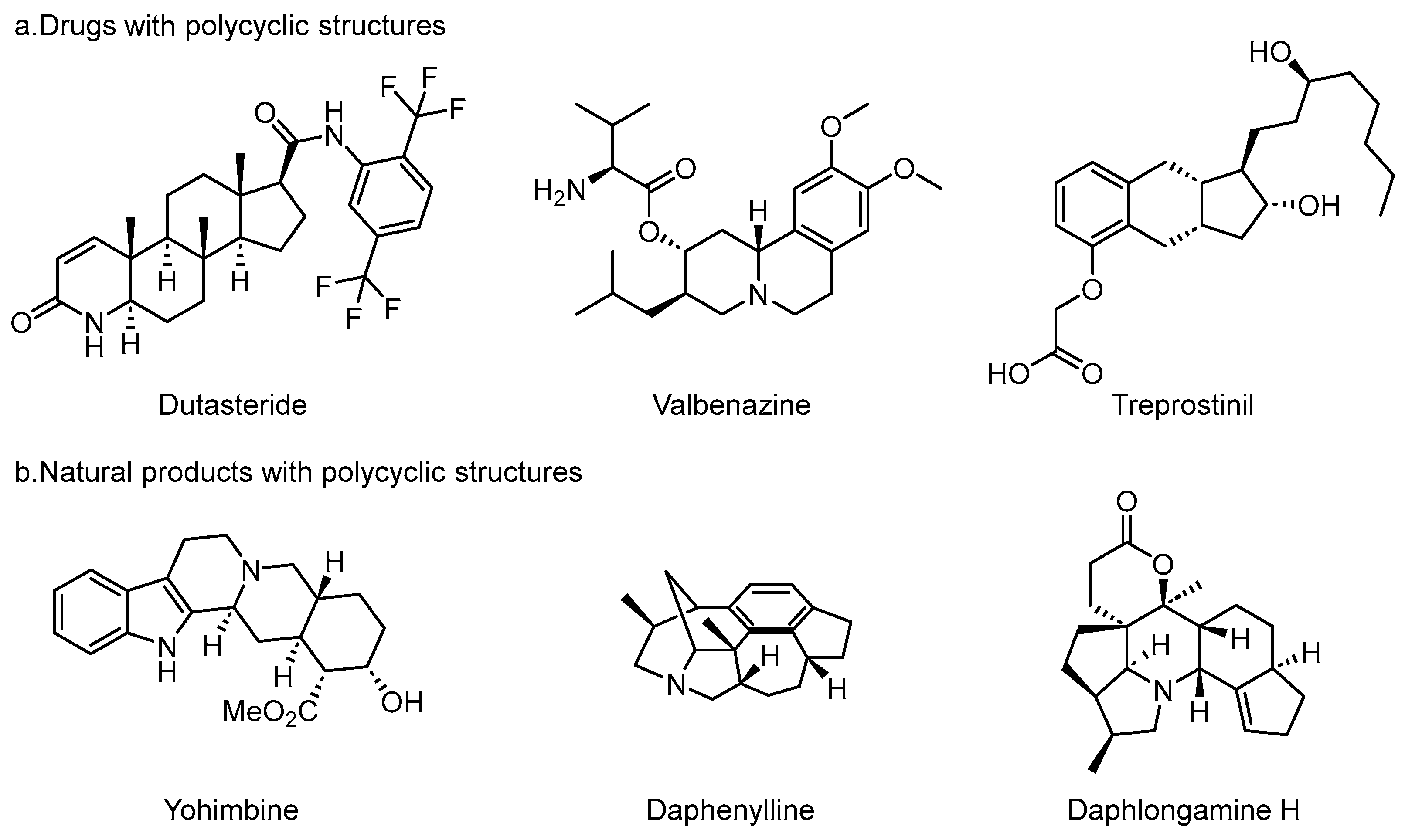
Saturated bicyclic and polycyclic frameworks are common structural patterns found in both pharmaceutical substances and organic compounds. Dutasteride (Avodart) [1,2,3], a steroidal 5α-reductase inhibitor, is clinically used to treat benign prostatic hyperplasia and androgenetic alopecia. Valbenazine (INGREZZA) [4], a selective vesicular monoamine transporter 2 (VMAT2) inhibitor containing a nitrogen heterocycle, is approved for the treatment of two hyperkinetic movement disorders, tardive dyskinesia (TD) and chorea associated with Huntington’s disease (HD). Oral treprostinil (Orenitram) [5] is a prostacyclin analogue used to treat pulmonary arterial hypertension (PAH). Oral treprostrinil contains a central structural motif of a chiral bicyclic[4.3.0]nonane core (Figure 1a). Besides synthetic drugs, many natural products also have complex, highly functionalized fused-ring structures, such as monoterpenoid indole alkaloids (MIAs) [6,7,8] and daphniphyllum alkaloid (Figure 1b) [9]. The importance of these frameworks continues to inspire chemists to develop new synthetic methods.
In this type of structurally rich framework, multifunctional bicyclic diketones are considered important structural units in organic synthesis. They are highly functionalized, containing two carbonyl groups, and therefore possess great chemical flexibility. Under different reaction conditions, they can undergo various transformations, such as ring expansion, rearrangement [10] and selective ring opening reaction [11], thereby achieving skeletal recombination and producing different molecular structures. Therefore, these diketones are used in the total synthesis of complex natural products and the modular construction of pharmaceutically relevant scaffolds [12,13].
Since bicyclic diketones can be used to synthesize structurally diverse and biologically active molecules, developing efficient and scalable methods for producing bicyclic diketones has been a fascinating goal in the fields of medicinal chemistry and synthetic chemistry. This article introduces a concise and convenient three-step method for the synthesis of aryl-substituted bicyclic diketones, which can serve as useful intermediate for drug discovery and natural product synthesis.

2. Results and Discussion

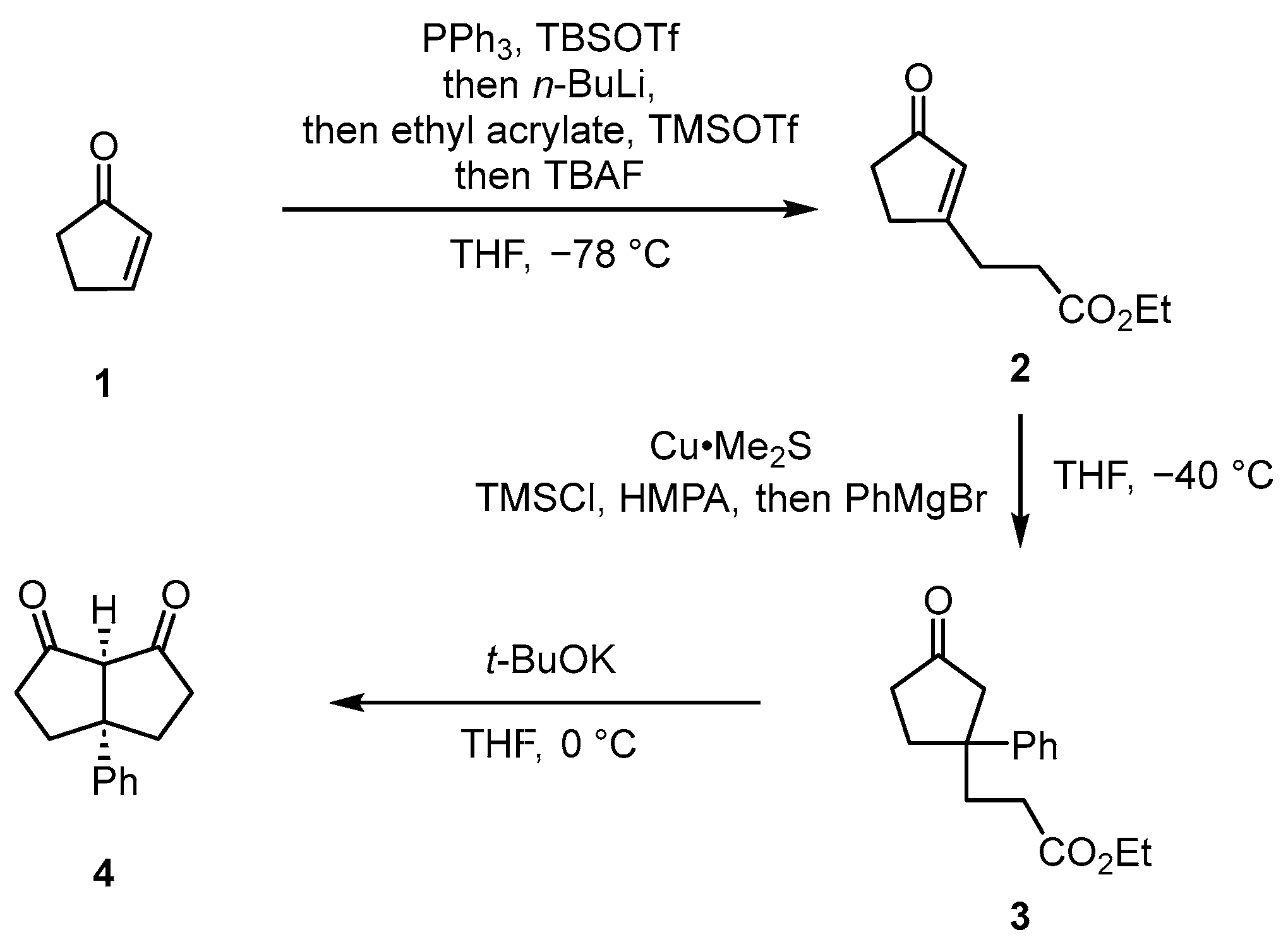
Compound 2 was synthesized from cyclopent-2-en-1-one via a one-step process following a previously reported procedure [10]. In this reaction, triphenylphosphine was reacted with cyclopent-2-en-1-one in the presence of tert-butyldimethylsilyltrifluoromethanesulfonate (TBSOTf) to generate an umpolung ylide intermediate. The intermediate was then reacted with ethyl acrylate, which was activated by trimethylsilyl trifluoromethanesulfonate (TMSOTf). Finally, the compound was treated with tetra-n-butylammonium fluoride (TBAF) to obtain target compound 2 (Scheme 1).
After obtaining compound 2, it was reacted with phenylmagnesium bromide in the presence of copper(I) bromide dimethyl sulfide complex (CuBr·Me2S) and trimethylchlorosilane (TMSCl). The corresponding 1,4-addition product 3 was obtained. Subsequently, compound 3 undergoes a condensation reaction in the presence of potassium tert-butoxide (t-BuOK) to generate compound 4 as a single isomer.
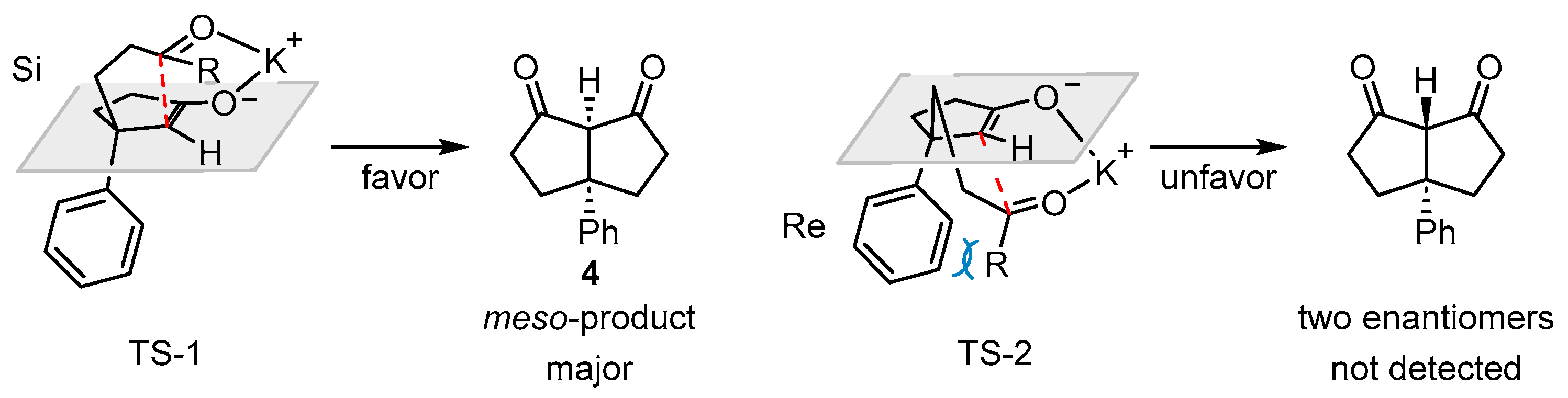
Theoretically, this cyclization reaction can produce a pair of enantiomers and a meso compound, but only one isomer was obtained in the experiment. Based on the analysis of the transition state in the condensation step, this selectivity can be rationalized: when nucleophilic addition occurs on the Si face of the cyclopentanone plane (corresponding to transition state TS1), the resulting transition state is relatively favourable in terms of steric hindrance and ring strain, ultimately leading to the meso product. Conversely, when addition occurs on the Re face (transition state TS2), the ester group has difficulty approaching it, and there is a significant repulsive interaction between the R group and the benzene ring, making this pathway very unfavourable (Figure 2). These factors together lead to the exclusive formation of meso isomer.
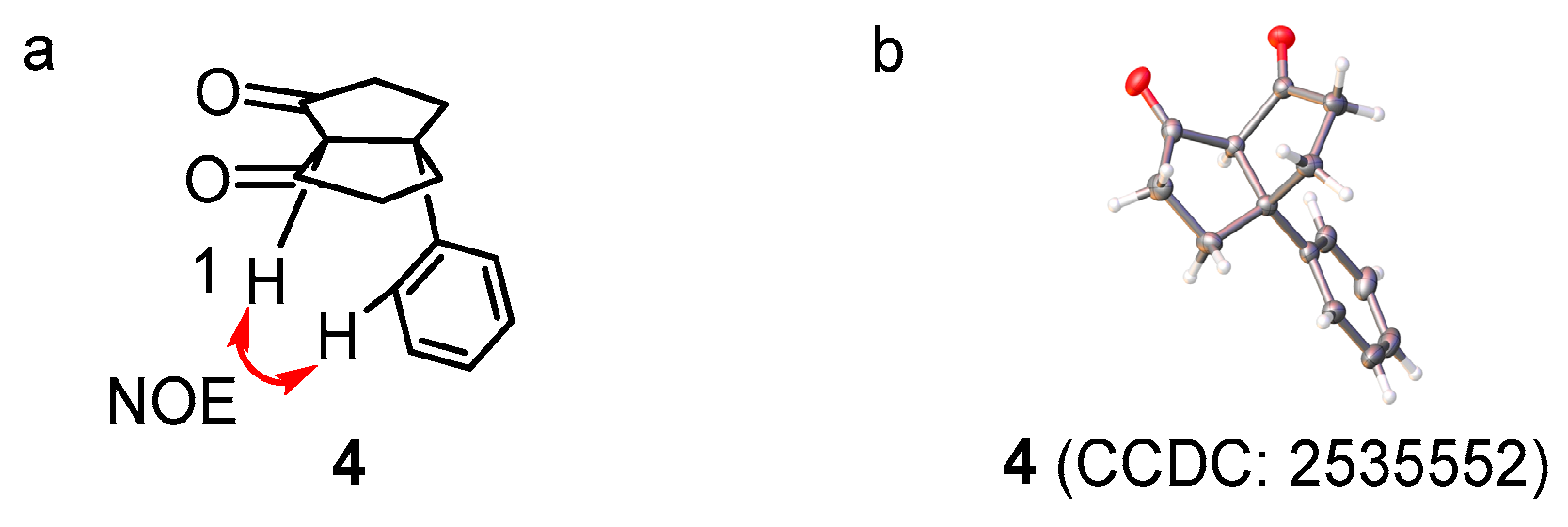
The structure of compound 4 was preliminarily established through 13C NMR spectroscopy: only four carbon signals were observed in the δ 70–0 range, and a single carbonyl carbon signal was detected at δ 208.1, which initially suggesting a meso configuration. Further NOESY analysis (see Supplementary Materials for details) revealed a weak correlation between H-1 and the phenyl protons (Figure 3a), indicating that H-1 and the phenyl ring are likely located on the same side of the molecule. Ultimately, single-crystal X-ray diffraction analysis (CCDC: 2535552) conclusively confirmed the meso configuration of the compound (Figure 3b), validating the above inferences. Additionally, the proposed structure was further validated by the 1H NMR, 13C NMR, DEPT, 1H-1HCOSY, and HSQC spectra of compound 4 (see Supplementary Materials for details).

3. Materials and Methods

3.1. Chemicals and Instrumentations

Unless otherwise specified, all reagents used were of analytical grade. The key reagents included: cyclopent-2-en-1-one, triphenylphosphine, ethyl acrylate, tert-butyldimethylsilyl trifluoromethanesulfonate, n-butyllithium, copper(I) dimethyl sulfide complex, phenylmagnesium bromide, potassium tert-butoxide. All chemical structures in this paper were drawn using ChemDraw (v2022).The following main instruments were used to characterize and analyze the compounds: Thermostatic heating magnetic stirrer (Model DF-101S) (Shanghai, China), manufactured by Shanghai Yukang Science and Education Instrument Equipment Co, Ltd., Rotary evaporator (Model N-1100V), obtained from EYELA (Tokyo Rika Kikai Co., Ltd., Tokyo, Japan); Chemical diaphragm pump (Model MZ 2C NT), product of Vacuubrand GmbH, Wertheim Germany; Vacuum drying oven (Model DZF-6020) (Gongyi, China), supplied by Gongyi Jinghua Instrument Co., Ltd.; Circulating water vacuum pump (Model SHZ-D(ΙΙΙ)) (Zhengzhou, China), produced by Zhengzhou Yuxiang Instrument Equipment Co., Ltd.; Electronic balance (Model ME203E), brand of Mettler Toledo, Zurich, Switzerland; 1H NMR and 13C NMR spectra were on Bruker AVANCEIII 400 MHz, or Bruker AVANCE NEO 600 MHz (Karlsruhe, Germany) instrument using CDCl3 as solvent. Chemical shifts (δ) were reported in ppm relative to residual solvent peak or tetramethylsilane as internal standard (CDCl3: 7.26 ppm for 1H NMR, 77.0 ppm for 13C NMR; Multiplicity and qualifier abbreviations are as follows: s = singlet, d = doublet, t = triplet, q = quartets, dd = doublet of doublets, ddd = doublet of doublet of doublets, dddd = doublet of doublet of doublet of doublets, dt = doublet of triplets, dq = doublet of quartets, ddq = doublet of doublet of quartets, td = triplet of doublets, qd = quartet of doublets, m = multiplet. High-resolution mass spectral analysis (HRMS) data were measured on a Bruker ApexII mass spectrometer (Rheinstetten, Germany) using the ESI technique. The single-crystal diffractometer (XtaLAB Synergy-DW), obtained from Rigaku (Rigaku Corporation., Tokyo, Japan).

3.2. Synthesis of Ethyl 3-(3-oxocyclopent-1-en-1-yl)propanoate (2)

In this synthesis process, the method was adapted from the research of Stoltz et al. [10]. A flame-dried 500 mL flask with a magnetic stir bar was charged with PPh3 (9.2 g, 35.0 mmol, 1.05 equiv.) and THF (150 mL). TBSOTf (9.3 g, 8.0 mL, 35.0 mmol, 1.05 equiv.) was then added, followed by cyclopentenone (2.7 g, 2.7 mL, 33.3 mmol, 1.0 equiv.). The reaction mixture was stirred for 2 h to allow complete consumption of cyclopentenone, and the results were monitored by thin-layer chromatography. The solution was cooled to −78 °C and held at this temperature for 20 min, and then n-butyllithium (2.5 M in hexane, 16.0 mL, 40.0 mmol, 1.2 equiv.) was added. After being added, the solution first turned red, and then almost black. The reaction mixture was kept at −78 °C for 45 min. In a separate flame-dried flask equipped with a magnetic stir bar, THF (60 mL) and ethyl acrylate (3.7 g, 3.9 mL, 36.7 mmol, 1.1 equiv.) were added. After cooling this solution to −78 °C, one part of TMSOTf (8.4 g, 6.8 mL, 37.6 mmol, 1.13 equiv.) was added. The resultant solution was quickly transferred by cannula to the stirring ylide solution at −78 °C, where it was kept for 45 min. TBAF (1.0 M in THF, 90.0 mL, 90.0 mmol) was then added. After removing the cooling bath and adding 100 mL of water, the reaction mixture was allowed to warm to room temperature for 30 min. Next, the reaction mixture was extracted with 100 mL of water and ethyl acetate (100 mL). The organic layer was washed with brine, dried with anhydrous sodium sulfate, and concentrated under reduced pressure. The crude residue was purified by column chromatography to obtain the title compound 2 as a yellow solid (3.8 g, yield 62%).

3.3. Ethyl 3-(3-oxo-1-phenylcyclopentyl)propanoate (3)

In this synthesis process, the method was adapted from the research of Stoltz et al. [10]. CuBr·Me2S (310 mg, 1.5 mmol, 0.3 equiv.) was added to a flame-dried 100 mL flask equipped with a stir bar and a rubber septum, and the flask was purged with nitrogen. THF (15 mL) was added, followed by HMPA (5.2 mL, 30.6 mmol, 6.0 equiv.). The resulting pale green mixture was cooled to −40 °C, and then TMSCl (3.8 mL, 30.6 mmol, 6.0 equivalent) was added dropwise. Then, compound 2 (0.9 g, 5.1 mmol, 1.0 equiv.) in THF (10 mL) was rapidly added dropwise. Finally, phenyl magnesium bromide (15.3 mmol, 3 equiv.) was injected dropwise via a syringe pump over a 2 h interval. After adding the Grignard reagent, the reaction mixture was stirred for another hour and then quenched with acetic acid (1.1 mL, 20.4 mmol, 4.0 equiv.). The mixture was warm to room temperature and then extracted with water and ethyl acetate (40 mL). The combined organic layers were washed with a saturated aqueous solution of NaHCO3 (30 mL) and brine (50 mL), dried with Na2SO4, and concentrated under reduced pressure. The crude residue was purified by column chromatography to give title compound 3 as a colourless oil (820 mg), with a yield of 61%. Rf = 0.4 (hexane:ethyl acetate = 1:1). 1H NMR (400 MHz, CDCl3) δ 7.35 (t, J = 7.8 Hz, 2H), 7.29–7.19 (m, 3H), 4.03 (q, J = 7.2 Hz, 2H), 2.70 (d, J = 17.6 Hz, 1H), 2.49 (d, J = 17.6 Hz, 1H), 2.43–2.20 (m, 4H), 2.17–1.95 (m, 4H). δ 1.19 (t, J = 7.2 Hz, 3H). 13C NMR (101 MHz, CDCl3) δ 217.5, 173.1, 144.6, 128.6, 126.7, 126.3, 60.4, 50.4, 47.0, 36.4, 36.3, 34.3, 30.2, 14.1. HRMS (m/z, ESI): Calcd. For C16H20O3Na+ [M + Na]+: 283.1305; found: 283.1304.

3.4. 3a-Phenylhexahydropentalene-1,6-dione (4)

Ketone 3 (2.0 mmol, 1.0 equiv.) was added to a flame-dried 100 mL flask equipped with a stir bar. THF (30 mL) was added and then cooled the solution to 0 °C. Subsequently, anhydrous t-BuOK (336 mg, 3.0 mmol, 1.5 equiv.) was added in one go. After stirring the mixture for 20 min, the TLC showed that the starting material had been completely consumed. The reaction was quenched with a saturated aqueous NH4Cl, and the mixture was warm to room temperature. The aqueous layer was extracted three times with ethyl acetate (20 mL). The combined organic layers were washed with brine (30 mL), dried with Na2SO4, and concentrated under reduced pressure. The crude product residue was purified by column chromatography to give title compound 4 as a white solid (291 mg), with a yield of 68%. Rf = 0.6 (hexane:ethyl acetate = 1:1) 1H NMR (600 MHz, CDCl3) δ 7.37 (t, J = 7.8 Hz, 2H), 7.28 (t, J = 7.4 Hz, 1H), 7.25–7.22 (m, 2H), 3.44 (s, 1H), 2.48 (t, J = 8.0 Hz, 4H), 2.44–2.36 (m, 2H), 2.34–2.26 (m, 2H). 13C NMR (151 MHz, CDCl3) δ 208.1, 145.4, 128.9, 127.1, 125.3, 68.8, 54.0, 37.5, 33.8. HRMS (m/z, ESI): Calcd. For C14H14O2Na+ [M + Na]+: 237.0886; found: 237.0884. m.p.: 120–121 °C.

3.5. X-Ray Crystallography

X-ray structural analysis of compound 4 was carried out on an XtaLAB Synergy-DW diffractometer equipped with a HyPix-6000HE detector using Cu Kα radiation (λ = 1.54184 Å) at 149.91(19) K. The structure was solved and refined using the SHELX program package [14]. Molecular graphics and preparation of the manuscript were performed with the OLEX2 software package [15].
Selected crystallographic data: C14H14O2, M = 214.25, orthorhombic, a = 11.42584(16), b = 13.9530(2), c = 6.89357(9) Å, α = 90°, β = 90°, γ = 90°, V = 1099.00(3) Å3, T = 149.91(19) K, space group Pca21, Z = 4, ρcalc = 1.295 g/cm3. More detailed information can be found in the Supporting Materials. CCDC 2535552 contains the supplementary crystallographic data for this paper. These data can be obtained free of charge from The Cambridge Crystallographic Data Centre via www.ccdc.cam.ac.uk/structures (accessed on 6 March 2026).

4. Conclusions

In summary, bicyclic[3.3.0]diones were successfully synthesized using simple starting materials. The structure of compound 4 was characterized by single-crystal X-ray diffraction analysis and nuclear magnetic resonance spectroscopy techniques, including 1H NMR, 13C NMR, DEPT, 1H-1H COSY, and HSQC.

Supplementary Materials

The following supporting information can be downloaded online. 1H NMR spectrum and 13C NMR spectrum of compound 3, and 4; DEPT, NOESY, HSQC, 1H-1H-COSY and Structure Analysis of Compound 4; HRMS spectra; Crystal data and structure refinement for 4; Figure S1: NOESY analysis of compound 4; Figure S2. HSQC spectra of compound 4; Figure S3. 1H–1H COSY spectra of compound 4.

Author Contributions

Conceptualization, Y.L.; Software, C.D.K.A.; investigation, H.K.; Formal Analysis, M.A.-W.; Data Curation, X.H. and H.K.; writing—original draft preparation, Y.L.; writing—review and editing, E.Z. and Y.Z.; supervision, E.Z. All authors have read and agreed to the published version of the manuscript.

Funding

This work was supported by the Department of Science and Technology of Henan Province (No. 252102311218) and the Open Grant from the Pingyuan Laboratory (2023PY-OP-0103).

Data Availability Statement

The data are contained within this article and the Supplementary Materials.

Acknowledgments

We gratefully acknowledge the Department of Science and Technology of Henan Province and the Pingyuan Laboratory for financial support.

Conflicts of Interest

The authors declare no conflicts of interest.

References

  1. Roehrborn, C.G.; Boyle, P.; Nickel, J.C.; Hoefner, K.; Andriole, G. Efficacy and safety of a dual inhibitor of 5-alpha-reductase types 1 and 2 (dutasteride) in men with benign prostatic hyperplasia. Urology 2002, 60, 434–441. [Google Scholar] [CrossRef] [PubMed]
  2. Roehrborn, C.G.; Siami, P.; Barkin, J.; Damião, R.; Major-Walker, K.; Nandy, I.; Morrill, B.B.; Gagnier, R.P.; Montorsi, F. The effects of combination therapy with dutasteride and tamsulosin on clinical outcomes in men with symptomatic benign prostatic hyperplasia: 4-year results from the combAT study. Eur. Urol. 2010, 57, 123–131. [Google Scholar] [CrossRef]
  3. Tasleem, A.; Konchok, D.; Mohammad, A.; Marwa, S. Dutasteride in androgenetic alopecia: An apdate. Curr. Clin. Pharmacol. 2017, 12, 31–35. [Google Scholar] [CrossRef]
  4. Hauser, R.A.; Factor, S.A.; Marder, S.R.; Knesevich, M.A.; Ramirez, P.M.; Jimenez, R.; Burke, J.; Liang, G.S.; O’Brien, C.F. KINECT 3: A phase 3 randomized, double-blind, placebo-controlled trial of valbenazine for tardive dyskinesia. Am. J. Psychiatry 2017, 174, 476–484. [Google Scholar] [CrossRef] [PubMed]
  5. Davis, B.N.J.; Suplicki, T.; Patzlaff, N.; White, J. Plain language summary: Oral treprostinil (Orenitram) for the treatment of pulmonary arterial hypertension (PAH). Future Cardiol. 2025, 21, 651–661. [Google Scholar] [CrossRef] [PubMed]
  6. O’Connor, S.E.; Maresh, J.J. Chemistry and biology of monoterpene indole alkaloid biosynthesis. Nat. Prod. Rep. 2006, 23, 532–547. [Google Scholar] [CrossRef] [PubMed]
  7. Mauger, A.; Jarret, M.; Kouklovsky, C.; Poupon, E.; Evanno, L.; Vincent, G. The chemistry of mavacurane alkaloids: A rich source of bis-indole alkaloids. Nat. Prod. Rep. 2021, 38, 1852–1886. [Google Scholar] [CrossRef]
  8. Yuan, Y.-H.; Han, X.; Zhu, F.-P.; Tian, J.-M.; Zhang, F.-M.; Zhang, X.-M.; Tu, Y.-Q.; Wang, S.-H.; Guo, X. Development of bifunctional organocatalysts and application to asymmetric total synthesis of naucleofficine I and II. Nat. Commun. 2019, 10, 3394. [Google Scholar] [CrossRef] [PubMed]
  9. Wu, B.-L.; Yao, J.-N.; Long, X.-X.; Tan, Z.-Q.; Liang, X.; Feng, L.; Wei, K.; Yang, Y.-R. Enantioselective total synthesis of (−)-daphenylline. J. Am. Chem. Soc. 2024, 146, 1262–1268. [Google Scholar] [CrossRef] [PubMed]
  10. Hicks, E.F.; Inoue, K.; Stoltz, B.M. Enantioselective total synthesis of (−)-hunterine a enabled by a desymmetrization/rearrangement strategy. J. Am. Chem. Soc. 2024, 146, 4340–4345. [Google Scholar] [CrossRef]
  11. Guo, Y.; Guo, Z.; Lu, J.-T.; Fang, R.; Chen, S.-C.; Luo, T. Total synthesis of (−)-batrachotoxinin A: A local-desymmetrization approach. J. Am. Chem. Soc. 2020, 142, 3675–3679. [Google Scholar] [CrossRef]
  12. Hou, S.-H.; Tu, Y.-Q.; Liu, L.; Zhang, F.-M.; Wang, S.-H.; Zhang, X.-M. Divergent and efficient syntheses of the lycopodium alkaloids (−)-lycojaponicumin C, (−)-8-deoxyserratinine, (+)-fawcettimine, and (+)-fawcettidine. Angew. Chem. Int. Ed. 2013, 52, 11373–11376. [Google Scholar] [CrossRef] [PubMed]
  13. Yin, J.-J.; Wang, Y.-P.; Xue, J.; Zhou, F.-F.; Shan, X.-Q.; Zhu, R.; Fang, K.; Shi, L.; Zhang, S.-Y.; Hou, S.-H.; et al. Total syntheses of polycyclic diterpenes phomopsene, methyl phomopsenonate, and iso-phomopsene via reorganization of C–C single bonds. J. Am. Chem. Soc. 2023, 145, 21170–21175. [Google Scholar] [CrossRef] [PubMed]
  14. Sheldrick, G.M. A short history of SHELX. Acta Crystallogr. 2008, 64, 112–122. [Google Scholar] [CrossRef] [PubMed]
  15. Dolomanov, O.V.; Bourhis, L.J.; Gildea, R.J.; Howard, J.A.K.; Puschmann, H. OLEX2: A Complete Structure Solution, Refinement and Analysis Program. J. Appl. Crystallogr. 2009, 42, 339–341. [Google Scholar] [CrossRef]
Figure 1. (a). Drugs with polycyclic structures. (b). Natural products with polycyclic structure.
Molbank 2026 m2154 g001
Scheme 1. Synthesis of compounds 4.
Molbank 2026 m2154 sch001
Figure 2. Analysis of the transition state in the condensation step. The red dotted line indicates the bond formation during the condensation reaction, while the blue line represents the repulsive force between the groups.
Molbank 2026 m2154 g002
Figure 3. (a). NOESY correlations of compound 4. The red arrow indicates an NOE correlation between these two parts. (b). Single-crystal structure of compound 4.
Molbank 2026 m2154 g003
Disclaimer/Publisher’s Note: The statements, opinions and data contained in all publications are solely those of the individual author(s) and contributor(s) and not of MDPI and/or the editor(s). MDPI and/or the editor(s) disclaim responsibility for any injury to people or property resulting from any ideas, methods, instructions or products referred to in the content.