Short Note

(1S,4R)-4,7,7-Trimethyl-1-(1H-perimidin-2-yl)-2-oxabicyclo[2.2.1]heptan-3-one

by
Elżbieta Speina
1,
Krzysztof Łyczko
2 and
Adam Mieczkowski
1,*
1
Institute of Biochemistry and Biophysics, Polish Academy of Sciences, Pawińskiego 5a, 02-106 Warsaw, Poland
2
Institute of Nuclear Chemistry and Technology, Dorodna 16, 03-195 Warsaw, Poland
*
Author to whom correspondence should be addressed.
Molbank 2025, 2025(4), M2111; https://doi.org/10.3390/M2111
Submission received: 25 November 2025 / Revised: 11 December 2025 / Accepted: 12 December 2025 / Published: 16 December 2025
(This article belongs to the Collection Heterocycle Reactions)

Abstract

Perimidine derivatives are versatile heterocycles with growing significance in medicinal chemistry and materials sciences. However, their structural variety remains limited. This study focused on the synthesis and crystal structure characterization of a new perimidine-based molecule. A bicyclic perimidine lactone, (1S,4R)-4,7,7-trimethyl-1-(1H-perimidin-2-yl)-2-oxabicyclo[2.2.1]heptan-3-one (1), was synthesized through an intramolecular dehydration of a monoamide intermediate formed from 1,8-diaminonaphthalene and (1S)-(–)-camphanic chloride under basic conditions. The product was purified and crystallized from acetone, giving single crystals suitable for X-ray diffraction. Structural analysis revealed two stereogenic centers and crystallization in the chiral tetragonal P43212 space group, with stabilization through N—H···O and C—H···N hydrogen bonds as well as C—H···π interactions.

1. Introduction

Perimidine is a tricyclic heterocyclic compound that features two nitrogen atoms in its structure. It has the potential for a variety of applications in both material science and medicine. This compound could be used to develop novel dyes [1], corrosion inhibitors [2], and conducting polymers [3]. Moreover, perimidine derivatives are an attractive target for the development of cytotoxic and anticancer agents. For example, Zhou synthesized novel perimidine o-quinone derivatives as non-intercalative topoisomerase II catalytic inhibitors [4]. Kumar reported a solvent-free synthesis of perimidine derivatives that exhibited inhibitory activity against breast (T47D), lung (NCI-H522), colon (HCT-15), ovary (PA-1), and liver (HepG2) cancer cell lines [5]. Additionally, Eldeab and coworkers developed a green synthetic protocol for perimidine compounds that demonstrated cytotoxic activity against human breast (MCF-7) and liver (HepG2) cancer cells [6]. In the present report, we synthesized a novel perimidine derivative 1, bearing a bicyclic lactone ring, from inexpensive, commercially available 1,8-diaminonaphthalene (2) and (1S)-(−)-camphanic chloride (3). The described method is based on the formation of a monoamide intermediate 4, which undergoes fast intramolecular cyclization to a novel perimidine derivative 1. Furthermore, as the crystal structures of permidines remain limited [7,8], we obtained and reported here the crystal structure of a newly synthesized compound.

2. Results and Discussion

2.1. Synthesis

Commercially available, 1,8-diaminonaphthalene (2), dissolved in tetrahydrofuran, was treated with (1S)-(−)-camphanic chloride ((1S)-3-oxo-4,7,7-trimethyl-2-oxabicyclo[2.2.1]heptane-1-carbonyl chloride (3)) in the presence of an excess of trimethylamine (Scheme 1). We expected to synthesize a monoamide (4) required for further modifications. Surprisingly, instead of the expected 4 (M = 338.40 g∙mol−1), we obtained a product with a molecular mass M = 320.39 g∙mol−1, indicating that during the reaction, a water molecule must have been formed and separated from product 4. Indeed, under the basic conditions, intermediate 4 underwent rapid intramolecular dehydration, yielding the cyclized product, bicyclic perimidine lactone 1 with 76% yield. After chromatographic purification and crystallization of 1 from acetone afforded yellow crystals suitable for X-ray crystal structure determination.

2.2. Molecular and Crystal Structure of 1

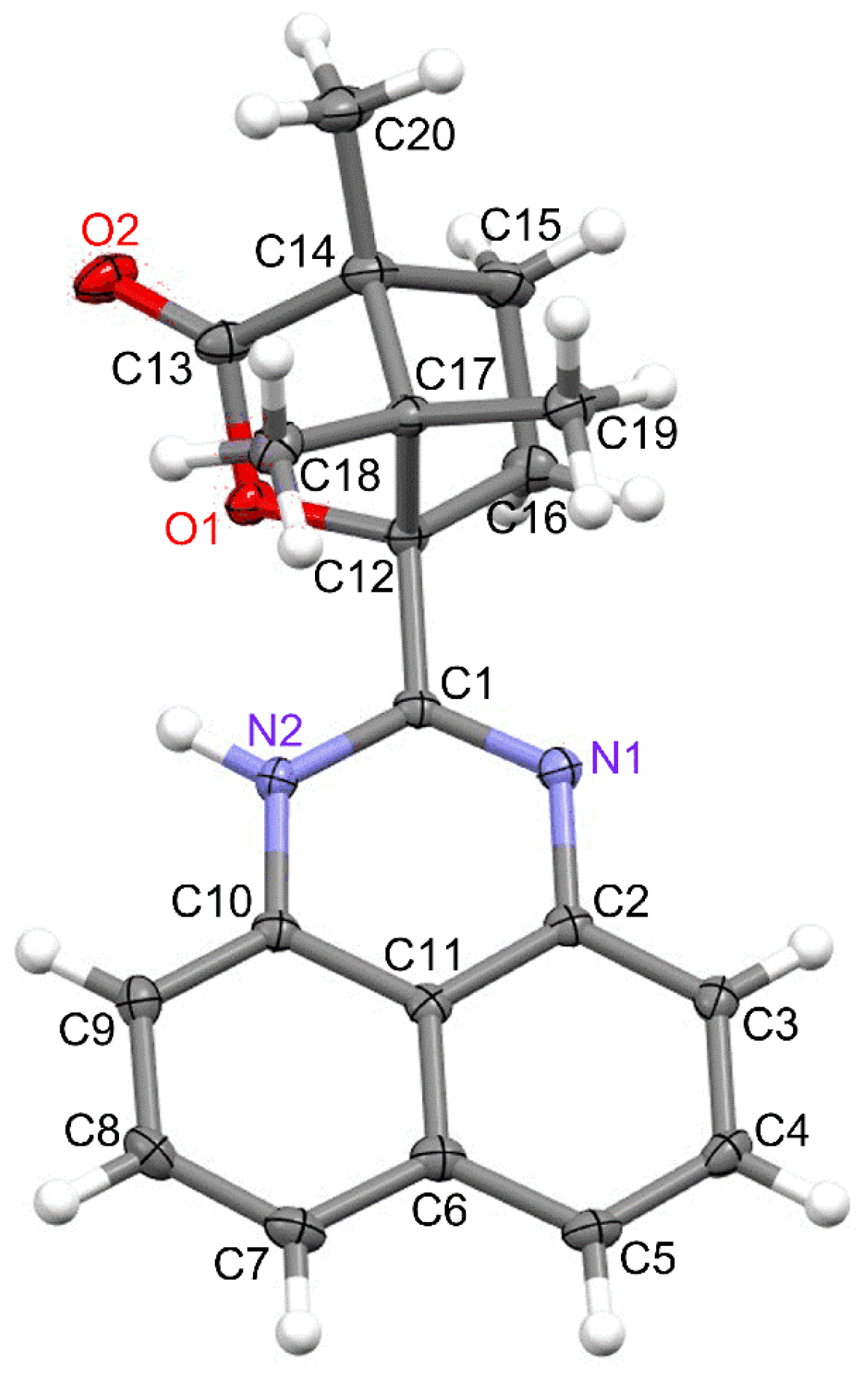
The molecular structure of the titled compound is shown in Figure 1. It has two chiral centers on carbon atoms (C12 and C14) and crystallizes in the chiral tetragonal P43212 space group, with 8 molecules in the unit cell and 1 molecule in the asymmetric unit. Selected geometrical parameters are presented in Table 1. Bond lengths and angles in this molecule remain within typical ranges.
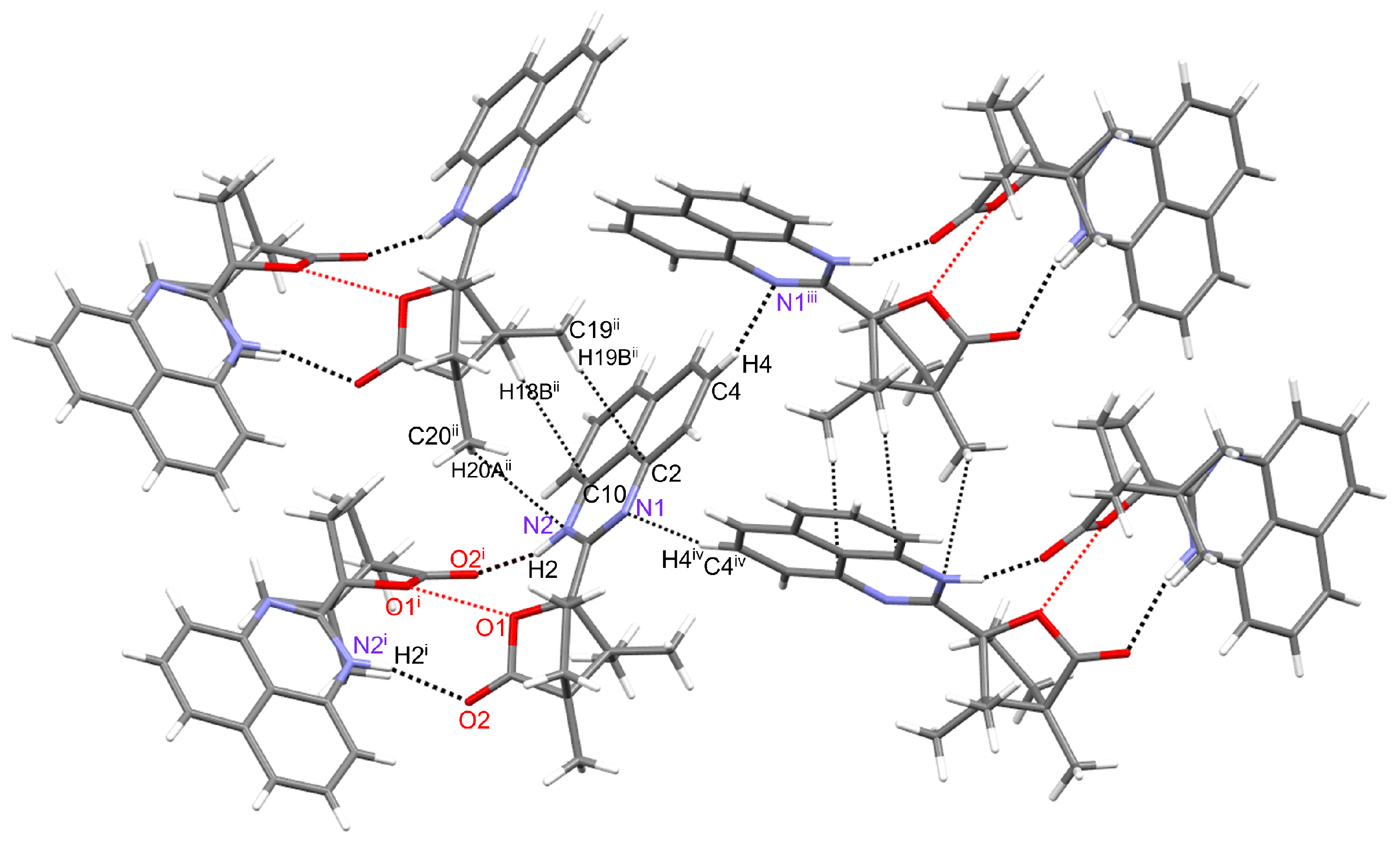
The crystal structure of 1 contains molecules linked into dimers through intermolecular N—H···O hydrogen bonds (H2···O2i, 2.04(2) Å; N2···O2i, 2.920(2) Å; N—H—O, 157(2)°; Figure 2) involving the NH groups and the carbonyl O atoms. There is also a quite short distance between the etheric oxygen atoms in the dimer (O1···O1i, 2.937(2) Å). In turn, the dimers are stabilized together in the crystal lattice by the formation of weak intermolecular C—H···N hydrogen bonds (H4···N1iii, 2.702 Å; C4···N1iii, 3.607(2) Å; C—H—Niii, 159.7°; Figure 2) and some C—H···π interactions between methyl groups and aromatic rings of the neighboring molecules (C2···C19ii, 3.701(2) Å; C10···C18ii, 3.913(2) Å; N2···C20ii, 3.596(2) Å; Figure 2).

3. Materials and Methods

Commercially available chemicals were of reagent grade and used without further purification. Reactions were monitored by thin-layer chromatography (TLC) using silica gel plates (Kieselgel 60 F254, E. Merck, Darmstadt, Germany). Column chromatography was performed using silica gel 60 M (0.040–0.063 mm, E. Merck, Darmstadt, Germany). Melting points are uncorrected and were measured using a Büchi Melting Point B-540 apparatus (New Castle, DE, USA). The 1H and 13C spectra were recorded in DMSO-d6 at the Department of Chemistry, University of Warsaw, using an AVANCE III HD 500 MHz spectrometer (Bruker, Billerica, MA, USA); shift values in parts per million are relative to the internal reference Me4Si. A high-resolution mass spectrum was recorded at the Laboratory of Mass Spectrometry, Institute of Biochemistry and Biophysics, PAS (Warsaw, Poland), using an LTQ Orbitrap Velos instrument (Thermo Scientific, Waltham, MA, USA).
The crystal structure measurement was performed on a Rigaku SuperNova (Agilent Technologies SuperNova (Oxford, UK) (dual source) four-circle diffractometer working with an EOS CCD detector and a mirror-monochromated Cu Kα radiation (λ = 1.54184 Å) from a microfocus Nova X-ray source. CrysAlis PRO software (CrysAlisPro, version 1.171.43.143a; Rigaku Oxford Diffraction: Abingdon, UK, 2024) was used for all necessary operations, including data collection, data reduction, and multi-scan absorption correction. The structure was solved by direct methods and then refined by full-matrix least-squares treatment on F2 data using the SHELXS and SHELXL programs [9,10], integrated with the OLEX2 version 1.3 crystallographic software [11]. The Mercury program was used to graphically present the molecular structure of the studied compound [12]. Anisotropic displacement parameters were achieved during the refinement procedure for all non-hydrogen atoms. Hydrogens bonded to carbons were inserted in calculated positions with C−H = 0.99 (methylene), 0.98 (methyl), and 0.95 Å (aromatic) and refined isotropically as a riding model with Uiso(H) equal to 1.5Ueq(C) for methyl H atoms and 1.2Ueq(C) for methylene and aromatic H atoms. Only the H atom of the NH group was located from a different Fourier map, and its position was freely refined. CCDC 2505086 contains the supplementary crystallographic data for this paper, accessed on 24 November 2025. These data can be obtained free of charge via https://www.ccdc.cam.ac.uk/ (or from the CCDC, 12 Union Road, Cambridge CB2 1EZ, UK; Fax: +44-1223-336033; E-mail: deposit@ccdc.cam.ac.uk).
Crystal data C20H20N2O2 (M = 320.38 g∙mol−1): yellow, crystal dimensions 0.15 × 0.12 × 0.10 mm, tetragonal, space group P43212 (No. 96), a = 7.81547(12) Å, b = 7.81547(12) Å, c = 53.8654(8) Å, α = β = γ = 90°, V = 3290.18(11) Å3, Z = 8, μ(CuKα) = 0.672 mm−1, Dcalc = 1.294 g·cm−3, T = 100 K, Goodness of fit on F2 1.079, 18,287 reflections measured, 3052 unique (Rint = 0.0294), which were used in all calculations. The final R1 [I > 2σ(I)] was 0.0515, and wR2 (all data) was 0.0773. Largest diff. peak and hole were 0.148 and −0.219 e∙Å−3.
Synthesis of 1: 1,8-Diaminonaphthalene (1, 1.64 g, 10.4 mmol, 1 equiv) was dissolved in 50 mL of dry THF, then triethylamine (8.82 mL, 31.1 mmol, 3 equiv.) was added, and the obtained solution was cooled down to 0 °C. (1S)-(−)-camphanic chloride (2, 2.47 g, 11.4 mmol, 1.1 equiv.) was added dropwise as a solution in dry THF (20 mL), and the reaction mixture was stirred at rt for 18 h. The reaction mixture was evaporated with silica gel, and the crude product was purified by column chromatography using 5%, 10%, and finally 15% v/v ethyl acetate in toluene. (1S,4R)-4,7,7-trimethyl-1-(1H-perimidin-2-yl)-2-oxabicyclo[2.2.1]heptan-3-one (1) was obtained as a yellow solid. Mp.: 259.5–261.5 °C. Yield: 76%. 1H NMR (500.2 MHz, DMSO-d6) 10.32 (s, 1H, NH), 7.15–7.11 (m, 1H, HAr), 7.10–7.02 (m, 2H, HAr), 7.01–6.97 (m, 1H, HAr), 6.63 (dd, 1H, J1 = 1.0 Hz, J2 = 7.5 Hz, HAr), 6.56 (dd, 1H, J1 = 1.0 Hz, J2 = 7.5 Hz, HAr), 2.65–2.54 (m, 1H, CH2), 2.03–1.86 (m, 2H, CH2), 1.62–1.52 (m, 1H, CH2), 1.05 (s, 3H, CH3), 1.04 (s, 3H, CH3), 0.95 (s, 3H, CH3); 13C NMR (125.79 MHz, DMSO-d6) 178.12 (C=O), 151.64 (CIV), 144.05 (CIV), 137.68 (CIV), 135.01 (CIV), 128.72 (CH), 127.94 (CH), 121.90 (CIV), 119.49 (CH), 117.95 (CH), 113.68 (CIV), 103.31 (CH), 91.68 (CIV), 54.53 (CIV), 53.87 (CIV), 30.53 (CH2), 28.13 (CH2), 16.46 (CH3), 16.38 (CH3), 9.77 (CH3); HRMS (ESI): m/z [M + H]+ calcd for C20H21N2O2: 321.15975, found: 321.16009. The figures of NMR and HRMS spectra are included in the Supplementary file.

4. Summary and Conclusions

In this work, we synthesized a new perimidine-based bicyclic lactone, (1S,4R)-4,7,7-trimethyl-1-(1H-perimidin-2-yl)-2-oxabicyclo[2.2.1]heptan-3-one (1), and characterized its structure using single-crystal X-ray diffraction. The molecule crystallizes in a tetragonal chiral space group and forms a three-dimensional network stabilized by intermolecular hydrogen bonds and C–H···π contacts.

Supplementary Materials

The following supporting information can be downloaded online, Figure S1: 1H-NMR spectrum of 1; Figure S2: 13C NMR spectrum of 1; Figure S3: Dept135 NMR spectrum of 1; Figure S4: HRMS spectrum of 1.

Author Contributions

Conceptualization, E.S. and A.M.; methodology, E.S., K.Ł. and A.M.; validation, A.M.; formal analysis, E.S., K.Ł. and A.M.; investigation, E.S., K.Ł. and A.M.; resources, E.S., K.Ł. and A.M.; writing—original draft preparation, E.S., K.Ł. and A.M.; writing—review and editing, E.S. and A.M. All authors have read and agreed to the published version of the manuscript.

Funding

This research received no external funding.

Data Availability Statement

The original contributions presented in this study are included in the article/Supplementary Material. Further inquiries can be directed at the corresponding author.

Acknowledgments

We thank Jacek Olędzki (Institute of Biochemistry and Biophysics, Polish Academy of Sciences) for recording the ES-MS spectra.

Conflicts of Interest

The authors declare no conflicts of interest.

References

  1. Kalle, P.; Kiseleva, M.A.; Tatarin, S.V.; Smirnov, D.E.; Zakharov, A.Y.; Emets, V.V.; Churakov, A.V.; Bezzubov, S.I. A Panchromatic Cyclometalated Iridium Dye Based on 2-Thienyl-Perimidine. Molecules 2022, 27, 3201. [Google Scholar] [CrossRef] [PubMed]
  2. Ma, Q.; Cai, J.; Mu, S.; Zhang, H.; Liu, K.; Liu, J.; Hong, J. Novel Perimidine Derivatives as Corrosion Inhibitors of HRB400 Steel in Simulated Concrete Pore Solution. Coatings 2023, 13, 73. [Google Scholar] [CrossRef]
  3. Czichy, M.; Janasik, P.; Wagner, P.; Officer, D.L.; Lapkowski, M. Electrochemical and Spectroelectrochemical Studies on the Reactivity of Perimidine–Carbazole–Thiophene Monomers towards the Formation of Multidimensional Macromolecules versus Stable π-Dimeric States. Materials 2021, 14, 2167. [Google Scholar] [CrossRef]
  4. Zhou, D.-C.; Lu, Y.-T.; Mai, Y.-W.; Zhang, C.; Xia, J.; Yao, P.-F.; Wang, H.-G.; Huang, S.-L.; Huang, Z.-S. Design, Synthesis and Biological Evaluation of Novel Perimidine o-Quinone Derivatives as Non-Intercalative Topoisomerase II Catalytic Inhibitors. Bioorg. Chem. 2019, 91, 103131. [Google Scholar] [CrossRef] [PubMed]
  5. Kumar, A.; Banerjee, S.; Roy, P.; Sondhi, S.M.; Sharma, A. Solvent-Free Synthesis and Anticancer Activity Evaluation of Benzimidazole and Perimidine Derivatives. Mol. Divers. 2018, 22, 113–127. [Google Scholar] [CrossRef] [PubMed]
  6. Eldeab, H.A.; Eweas, A.F. A Greener Approach Synthesis and Docking Studies of Perimidine Derivatives as Potential Anticancer Agents. J. Heterocycl. Chem. 2018, 55, 431–439. [Google Scholar] [CrossRef]
  7. Goge, M.N.; Sithebe, S.; Papo, T.R. 2-[2-(Diphenylphosphoryl)Phenyl]-1H-Perimidine. Molbank 2022, 2023, M1537. [Google Scholar] [CrossRef]
  8. Petkova, Z.; Rusew, R.; Bakalova, S.; Shivachev, B.; Kurteva, V. 2-(1H-Imidazol-2-Yl)-2,3-Dihydro-1H-Perimidine. Molbank 2023, 2023, M1587. [Google Scholar] [CrossRef]
  9. Sheldrick, G.M. A short history of SHELX. Acta Crystallogr. A 2008, 64, 112–122. [Google Scholar] [CrossRef] [PubMed]
  10. Sheldrick, G.M. Crystal Structure Refinement with SHELXL. Acta. Cryst. C 2015, 71, 3–8. [Google Scholar] [CrossRef] [PubMed]
  11. Dolomanov, O.V.; Bourhis, L.J.; Gildea, R.J.; Howard, J.A.K.; Puschmann, H. OLEX2: A Complete Structure Solution, Refinement and Analysis Program. J. Appl. Crystallogr. 2009, 42, 339–341. [Google Scholar] [CrossRef]
  12. Macrae, C.F.; Bruno, I.J.; Chisholm, J.A.; Edgington, P.R.; McCabe, P.; Pidcock, E.; Rodriguez-Monge, L.; Taylor, R.; van de Streek, J.; Wood, P.A. Mercury CSD 2.0—New Features for the Visualization and Investigation of Crystal Structures. J. Appl. Crystallogr. 2008, 41, 466–470. [Google Scholar] [CrossRef]
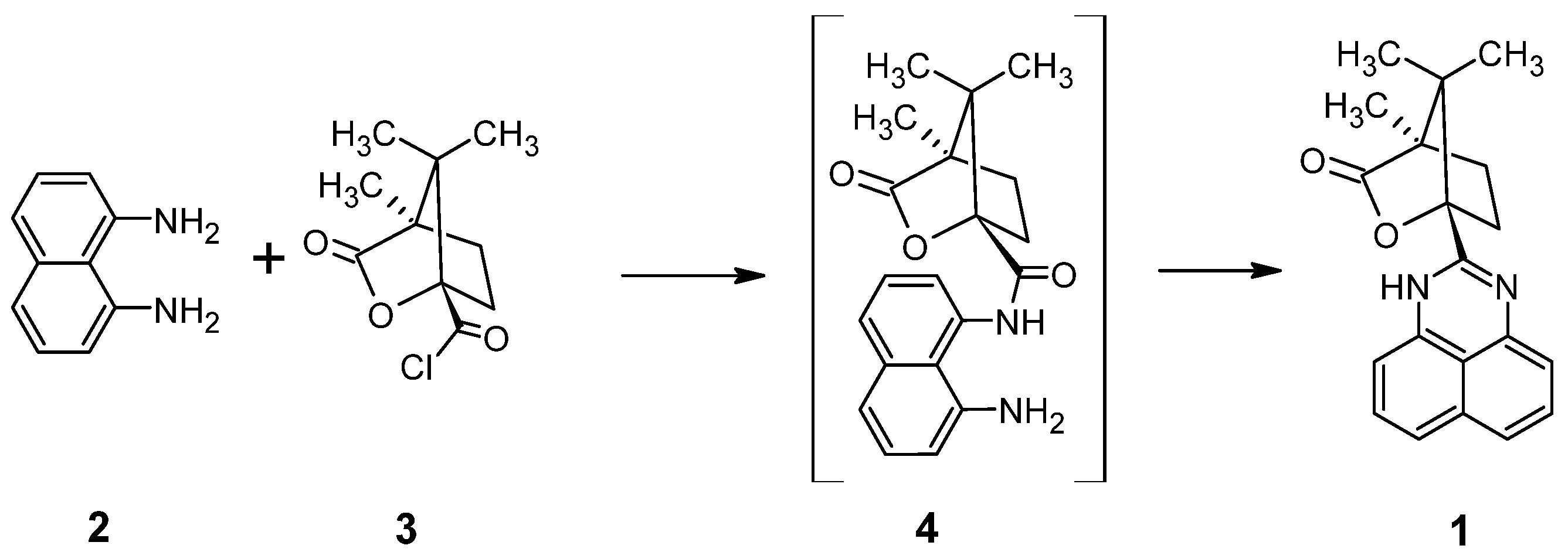
Scheme 1. The synthesis of perimidine lactone 1: triethylamine, THF, 0 °C to rt, 18 h, 76%.
Molbank 2025 m2111 sch001
Figure 1. Molecular structure of 1 showing the atom numbering scheme. Non-hydrogen atoms are presented as 50% ellipsoids.
Molbank 2025 m2111 g001
Figure 2. Fragment of the crystal structure showing some intermolecular interactions (black dotted lines) and contacts (red dotted lines) between neighboring molecules (symmetry codes: (i) y, x, −z + 1; (ii) x + 1, y, z; (iii) x + 0.5, −y +2.5, −z + 1.25; (iv) x − 0.5, −y +2.5, −z + 1.25).
Molbank 2025 m2111 g002
Table 1. Selected bond length (Å) and angles (°) for 1.
Bond Lengths Angles
C12—O11.475(2)O1—C13—O2122.0(2)
C13—O11.359(2)C12—O1—C13106.0(1)
C13—O21.206(2)O1—C12—C17101.6(1)
C1—N11.296(2)O2—C13—C14130.0(2)
C2—N11.411(2)C12—C17—C1491.5(1)
C1—N21.364(2)C13—C14—C1798.7(1)
C10—N21.399(2)C18—C17—C19109.1(1)
Disclaimer/Publisher’s Note: The statements, opinions and data contained in all publications are solely those of the individual author(s) and contributor(s) and not of MDPI and/or the editor(s). MDPI and/or the editor(s) disclaim responsibility for any injury to people or property resulting from any ideas, methods, instructions or products referred to in the content.