Abstract
3-(1-Ethylamino-ethylidene)-1-methyl-pyrrolidine-2,4-dione was obtained as an unexpected product in a three-step synthesis starting with o-nitrobenzoyl sarcosine, acetoacetanilide and ethylamine. The compound showed moderate antibacterial activity against S. aureus and E. coli.
1. Introduction
The pyrrolidine-2,4-diones, also known as tetramic acids, and their 3-acyl derivatives in particular, are a large group of naturally occurring compounds [1,2]. Although the spectrum of biological activities shown by these compounds is quite broad, the most notable representatives of this group are known for their antimicrobial and antifungal properties [3,4]. Compounds such as equisetin [5], trichosetin [6], reutericyclin [7] and magnesidin [8] are effective inhibitors of S. aureus and other Gram-positive bacteria. Of particular interest are synthetic analogs effective against methicillin-resistant S. aureus [9]. The enamines of 3-acyltetramic acids are much less abundant in nature [10,11] but are nevertheless of interest as potentially bioactive aza-analogues of the 3-acyltetramic acids [12,13]. Some synthetic enaminotetramic derivatives are reported to exhibit an interesting combination of herbicidal and antifungal activities [14].
2. Results
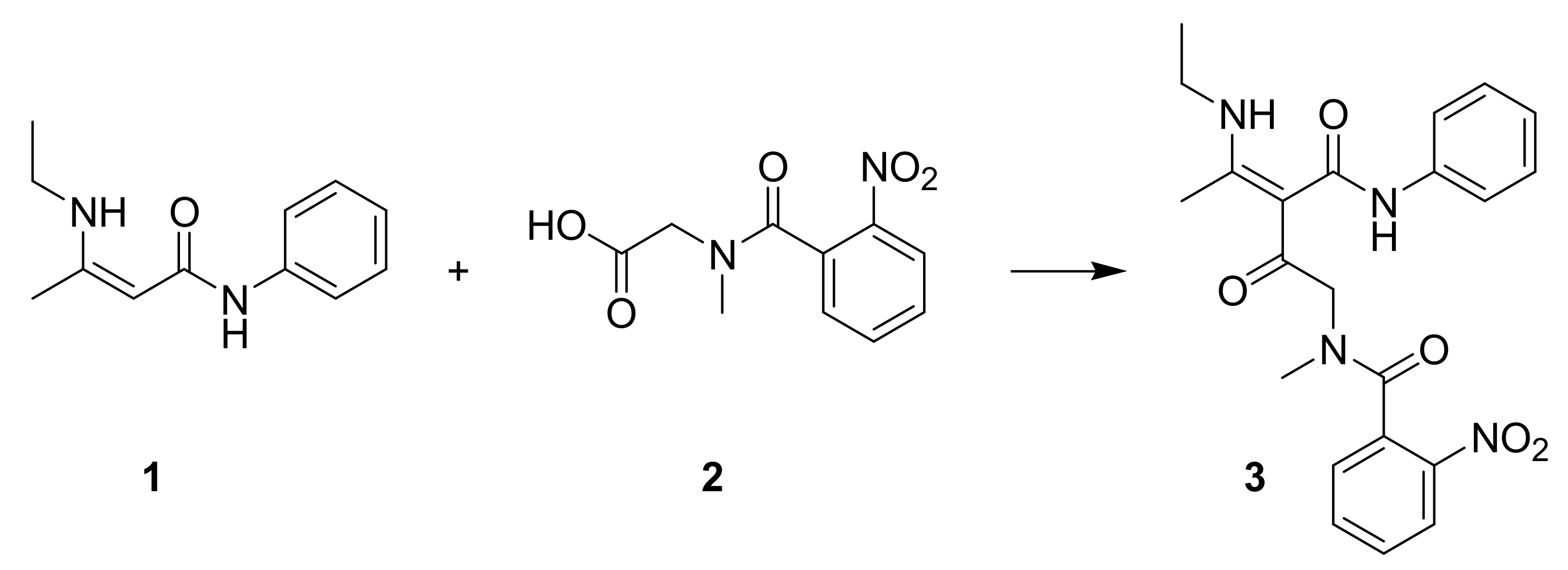
We have previously demonstrated a novel synthesis of 1-alkoxycarbonyl-3-enaminotetramic acid derivatives, based on α-C-acylation of β-enamino amides with N-protected α-amino acids [15]. Currently, while working on a methodologically related approach towards benzodiazepine enamines, we came across an unexpected formation of a hitherto unknown 1-methyl-3-enamino tetramic derivative 4. At the start, we prepared the intermediate 3, following our well-established procedure for acylation of β-enamino amides with N-protected amino acids [15]. In this particular case, compound 3 was obtained in a 85% yield by acylation of enamino amide 1 with o-nitrobenzoylsarcosine 2, using the mixed carbonic anhydride method (Scheme 1).
Scheme 1.
Reagents and conditions: 2, N-methylmorpholine, EtOCOCl, 5 min at 0–5 °C in CH2Cl2. Then, 1, DMAP (0.2 equiv.) in CH2Cl2, 1 h at r.t.
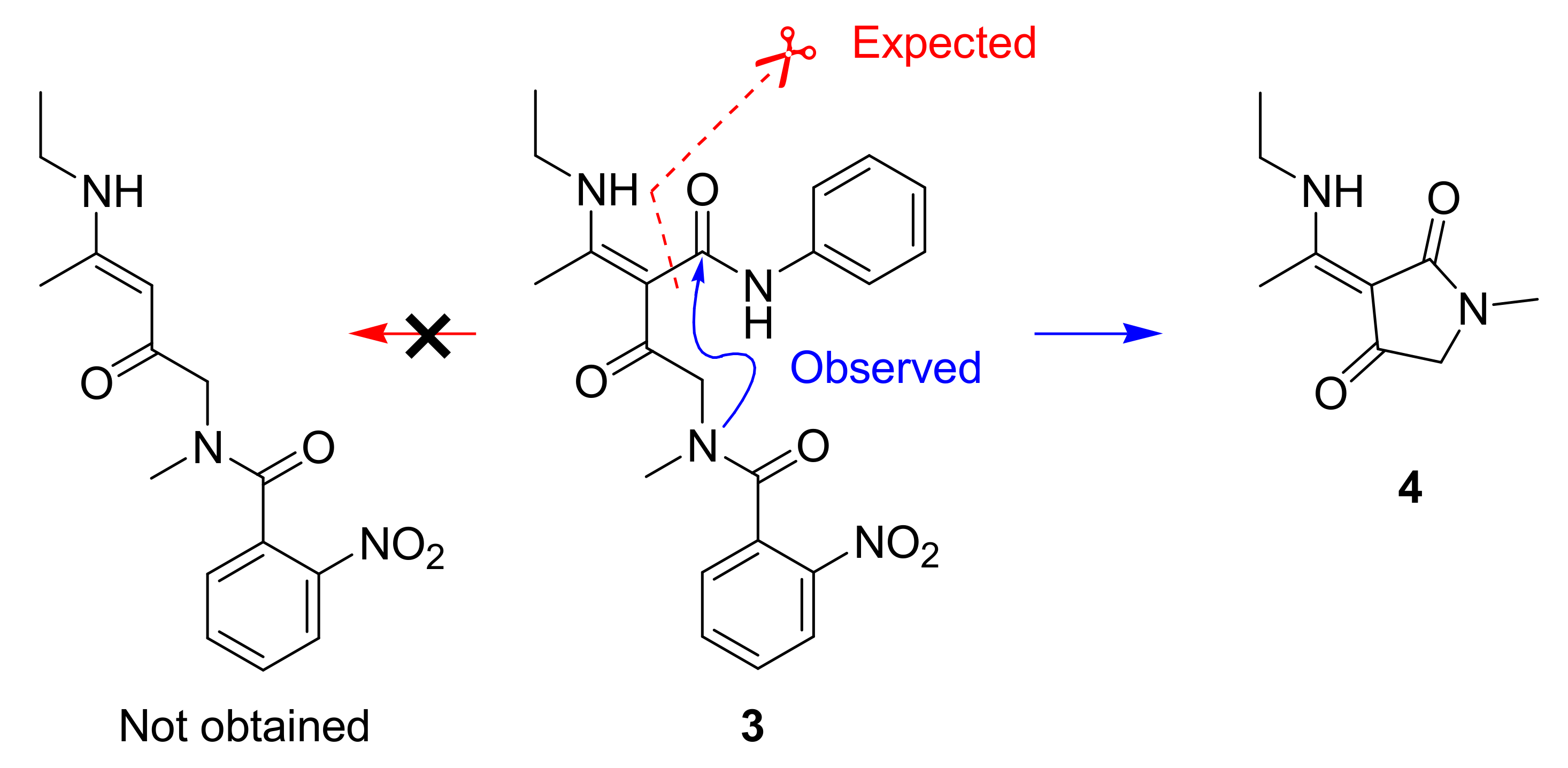
Compound 3 was expected to undergo a decarbamoylative C-C bond cleavage [16] in the next step of our planned synthesis—a reactivity observed by us in other derivatives of this type possessing a tertiary nitrogen in their amino acid moiety (Scheme 2). Here, however, the o-nitrobenzoyl group proved unstable under the reaction conditions (H3PO4 at 60 °C), and compound 3 underwent a cyclisation to the tetramic derivative 4 as a single product—a reactivity common for analogous compounds with secondary nitrogen in the amino acid residue [15]. Compound 4 was isolated in an 82% yield after column chromatography. Although unexpected, this result indicates a possible extension of our previously published procedure, giving access to enaminotetramic derivatives with methyl, rather than an alkoxycarbonyl substituent, at the N-atom of the tetramic ring.
Scheme 2.
Reagents and conditions: neat H3PO4, 60 °C, 30 min.
The unexpected product 3-(1-Ethylamino-ethylidene)-1-methyl-pyrrolidine-2,4-dione (4) showed NMR spectral characteristics typical for the enamines of 3-acyltetramic acids, which are known to equilibrate between the Z and E forms in solution [13,17,18]. Interestingly, in the case of compound 4, clearly separated NMR signals of the different π-diastereomers were observed in DMSO-d6, but not in CDCl3 (see Supplementary Materials).

Even though compound 4 was obtained as an unexpected product, it was interesting to test its antibacterial activity in comparison with similar enaminotetramic derivatives, obtained by us earlier [15]. The antimicrobial bioassays of 4, along with two structural analogs, were conducted against S. aureus and E. coli, using the hole plate method in Mueller–Hinton agar with 100 µL loading of 2 mg/mL solutions in DMSO. While the N-alkoxycarbonyl analogs were completely inactive, compound 4 showed moderate antibacterial activity against both strains, with inhibition zones of 17 mm and 15 mm for E. coli and S. aureus, respectively (Table 1).
Table 1.
Antibacterial activity of compound 4 (R = CH3) and N-alkoxycarbonyl analogs.
3. Materials and Methods
All reagents and solvents were purchased from Sigma-Aldrich, Darmstadt, Germany and were used as supplied. NMR spectra were run on a Bruker Avance AV600 (600/150 MHz 1H/13C) or Bruker NEO 400 (400/100 MHz 1H/13C) spectrometer at BAS-IOCCP, Sofia. Chemical shifts (δ, ppm) are downfield from TMS. IR spectra were measured on a Bruker Alpha II FT IR spectrometer. High resolution mass spectral measurements were performed on a Thermo Scientific Q Exactive hybrid quadrupole-orbitrap mass spectrometer. TLC was done on aluminum-backed Silica gel 60 sheets (Merck, Rahway, NJ, USA) with KMnO4 staining; Melting point measurement was done on a Boëtius hot stage apparatus and is not corrected.
Synthesis of 3-Ethylamino-but-2-enoic acid phenylamide (1): Ethylamine (70% aq. solution, 1.6 mL, 20 mmol) was added to a solution of acetoacetanilide (3.54 g, 20 mmol) in 50 mL DCM. The mixture was stirred intensely in a sealed flask for 2 h; then, anhydrous sodium sulfate was added, and the stirring was continued overnight at r.t. Then, the sulfate was filtered off, and the solvent was evaporated under reduced pressure. The oily residue crystallized upon trituration with a small amount of diethyl ether to give the β-enamino amide 1 as a white solid in a nearly quantitative yield (3.85 g, 95%), m.p. 90–92 °C. 1H-NMR (CDCl3, δ ppm, J Hz): 1,24 (t, J = 7.0, 3H), 1.95 (s, 3H), 3.27 (m, 2H), 4.43 (s, 1H), 6.65 (br s, 1H), 7.03–7.46 (m, 5H), 9.16 (br s, 1H); 13C-NMR (CDCl3, δ ppm): 15.8, 19.5, 37.7, 84.4, 119.7, 122.8, 128.9, 139.3, 160.4, 169.2; IR (KBr, cm−1): 3298, 3130, 3061, 2997, 1631, 1608, 1593, 1524; HRMS m/z (ES+): calcd. for C12H16N2NaO+ [M + Na]+ 227.1155, found 227.1157.
Synthesis of N-(4-Ethylamino-2-oxo-3-phenylcarbamoyl-pent-3-enyl)-N-methyl-2-nitro-benzamide (3): N-methylmorpholine (3 mmol, 0.33 mL) was added to a magnetically stirred suspension of o-nitrobenzoylsarcosine 2 (715 mg, 3 mmol) in CH2Cl2 (15 mL). The resulting solution was then cooled in an ice bath, and ethyl chloroformate (3 mmol, 0.3 mL) was added dropwise. The mixture was left to stir for 5 min, and after that, a solution of enamino amide 1 (613 mg, 3 mmol) and DMAP (73 mg, 0.6 mmol) in CH2Cl2 (45 mL) was added in one go. The ice bath was then removed, the reaction mixture was allowed to warp up to r.t. and was left to stir for one more hour. The reaction mixture was then transferred to a separatory funnel with 20 more mL of CH2Cl2 and washed with aqueous (10:1) HCl. The aqueous layer was extracted with 20 more mL of CH2Cl2, the combined organic layers were dried with anhydrous sodium sulfate, the drying agent was removed by filtration, and the solvent was distilled off. The crude α-C-acylated product 3 crystallized upon trituration with diethyl ether. Yield: 1.08 g (85%), yellow solid, m.p. 151–153 °C. 1H-NMR (DMSO-d6, δ ppm, J Hz): 1.21 (t, J = 7.0, 3H), 2.02/2.08 (s, 3H), 2.80/2.95 (s, 3H), 3.41 (m, 2H), 4.02/4.39 (s, 2H), 7.01–8.20 (m, 9H, Aryl), 10.05/10.27 (s, 1H, NH), 11.44/11.53 (t, J = 5.6, 1H, NH); 13C-NMR (DMSO-d6, δ ppm): 15.4/15.6 (CH2CH3), 16.5/16.7 (=CCH3), 33.9/37.9 (NCH3), 38.1/38.2 (NHCH2CH3), 53.0/56.2 (COCH2N), 106.9/107.0 (C), 119.6, 123.8, 125.1, 128.4, 128.8, 129.1, 129.2, 130.7, 132.8, 133.2, 134.9, 135.3, 139.7, 140.0, 145.5, 145.9 (Aryl C, CH), 164.3/165.0 (CO), 167.4 (C=C-CO) 167.6/167.9 (CO), 186.8/187.4 (CO). Some signals are doubled because of rotamers. IR (KBr, cm−1): 3283, 3060, 3037, 2977, 2936, 2877, 1637, 1595, 1578, 1529, 1347. HRMS m/z (ES+): calcd. for C22H24N4NaO5+ [M + Na]+ 447.1639, found 447.1636.
Synthesis of 3-(1-Ethylamino-ethylidene)-1-methyl-pyrrolidine-2,4-dione (4): Compound 3 (424 mg, 1 mmol) was mixed with anhydrous ortho-phosphoric acid (H3PO4, 5 g) in a glass vial and was stirred intensely at 60 °C until full homogenization. Then, the stirring was continued for 30 more min. at the same temperature. The mixture was then diluted with cold water to 60–70 mL and extracted twice with CH2Cl2 (2 × 40 mL). The combined organic layers were dried with Na2SO4, the solvent was removed on a rotary evaporator, and the residue was purified by column chromatography on silica gel with diethyl ether as the eluent (increasing polarity with methanol to Et2O: MeOH = 20:1 by volume). Compound 4 was isolated as a colorless oil (150 mg, 82%). 1H-NMR (DMSO-d6, δ ppm, J Hz): 1.17/1.18 (t, J = 7.0, 3H, NHCH2CH3), 2.47/2.50 (s, 3H, =CCH3), 2.80/2.81 (s, 3H, NCH3), 3.41 (m, 2H, NHCH2CH3), 3.54/3.61 (s, 2H, NCH2CO), 10.36/10.67 (br s, 1H, NHCH2CH3); 13C-NMR (DMSO-d6, δ ppm): 12.7/13.8 (CH3), 14.9/15.0 (CH3), 28.2/28.6 (CH3), 37.2/37.5 (CH2), 55.2/56.8 (CH2), 94.8/96.6 (C=C), 167.0/167.6 (C=C), 170.4/173.4 (C=O), 191.7/194.7 (C=O); All signals are doubled because of a Z/E equilibrium. HRMS m/z (ES+): calcd. for C9H14N2NaO2+ [M + Na]+ 205.0947, found 205.0949.

Supplementary Materials
The spectral data can be downloaded online.
Author Contributions
Conceptualization, chemical synthesis and manuscript writing: P.A.; chemical synthesis: P.T.; Antimicrobial assays: D.G. All authors have read and agreed to the published version of the manuscript.
Funding
This research was funded by Bulgarian National Science Fund, grant number KP-06-N59/14, and Royal Society of Chemistry (UK), grant number R21-2062713611.
Institutional Review Board Statement
Not applicable.
Informed Consent Statement
Not applicable.
Data Availability Statement
The data presented in this study are available in this article and in the supporting Supplementary Materials.
Acknowledgments
The authors are grateful to the Faculty of Biology, Department of Plant Physiology and Molecular Biology for access to a high-resolution mass spectrometer, provided under the EC FP7/REGPOT-2009-1/BioSupport project.
Conflicts of Interest
The authors declare no conflict of interest.
References
- Mo, X.; Li, Q.; Ju, J. Naturally occurring tetramic acid products: Isolation, structure elucidation and biological activity. RSC Adv. 2014, 4, 50566–50593. [Google Scholar] [CrossRef]
- Petermichl, M.; Schobert, R. 3-Acyltetramic Acids: A Decades-Long Approach to a Fascinating Natural Product Family. Synlett 2017, 28, 654–663. [Google Scholar] [CrossRef]
- Schobert, R.; Schlenk, A. Tetramic and tetronic acids: An update on new derivatives and biological aspects. Bioorg. Med. Chem. 2008, 16, 4203–4221. [Google Scholar] [CrossRef] [PubMed]
- Jeong, Y.-C.; Moloney, M.G. Tetramic Acids as Scaffolds: Synthesis, Tautomeric and Antibacterial Behaviour. Synlett 2009, 2009, 2487–2491. [Google Scholar] [CrossRef]
- Burmeister, H.R.; Bennett, G.A.; Vesonder, R.F.; Hesseltine, C.W. Antibiotic Produced by Fusarium equiseti NRRL 5537. Antimicrob. Ag. Chemother. 1974, 5, 634–639. [Google Scholar] [CrossRef] [PubMed]
- Marfori, E.C.; Kajiyama, S.; Fukusaki, E.; Kobayashi, A. Trichosetin, a Novel Tetramic Acid Antibiotic Produced in Dual Culture of Trichoderma harzianum and Catharanthus roseus Callus. Z. Für Nat. C 2002, 57, 465–470. [Google Scholar] [CrossRef] [PubMed]
- Gänzle, M.G. Reutericyclin: Biological activity, mode of action, and potential applications. Appl. Microbiol. Biotechnol. 2004, 64, 326–332. [Google Scholar] [CrossRef] [PubMed]
- Gandhi, N.M.; Nazareth, J.; Divekar, P.V.; Kohl, H.; de Souza, N.J. Magnesidin, a novel magnesium-containing antibiotic. J. Antibiot. 1973, 26, 797–798. [Google Scholar] [CrossRef] [PubMed]
- Mathiadis, D.; Tsironis, D.; Stefanou, V.; Boussias, S.; Panagiotopoulou, A.; McKee, V.; Igglessi-Markopoulou, O.; Markopoulos, J. Synthesis, biological evaluation and structure-activity relationships of 5-arylidene tetramic acids with antibacterial activity against methicillin-resistant Staphylococcus aureus. Bioorg. Med. Chem. Lett. 2020, 30, 127107. [Google Scholar] [CrossRef] [PubMed]
- Linder, D.; Schobert, R. Synthesis of the fungus metabolite cladosin C. Org. Biomol. Chem. 2017, 15, 7672–7677. [Google Scholar] [CrossRef] [PubMed]
- Reber, K.P.; Mease, J.; Kim, J. Total Synthesis of Cladosins B and C. J. Org. Chem. 2020, 85, 11571–11578. [Google Scholar] [CrossRef] [PubMed]
- Yuki, H.; Kaizu, Y.; Yoshida, S.; Higuchi, S.; Honda, S.; Takiura, K. Studies of Tenuazonic Acid Analogs. I. Synthesis of 5-Substituted 3-(1’-Anilinoethylidene) pyrrolidine-2, 4-dione. Chem. Pharm. Bull. 1971, 19, 1664–1668. [Google Scholar] [CrossRef]
- Jeong, Y.-C.; Anwar, M.; Moloney, M.G. Synthesis, antibiotic activity and structure–activity relationship study of some 3-enaminetetramic acids. Bioorg. Med. Chem. Lett. 2014, 24, 1901–1906. [Google Scholar] [CrossRef] [PubMed]
- Wang, X.-F.; Si, T.-F.; Li, Q.-B.; Zhu, X.-J.; Qiang, S.; Yang, C.-L. Synthesis, characterization and biological activity of novel (5-RS,6-S)-5-sec-butyl-3-(1-substituted-amino)-ethylidene-1H-pyrrolidine-2,4-diones. ARKIVOC 2010, 2010, 31–48. [Google Scholar] [CrossRef]
- Angelov, P.; Ivanova, S.; Yanev, P. Enamines of 3-acyltetramic acids from β-enamino amides and amino acids. Tetrahedron Lett. 2017, 58, 4776–4778. [Google Scholar] [CrossRef]
- Venkov, A.P.; Angelov, P.A. Synthesis of Unsymmetrical β-Enamino Ketones. Synthesis 2003, 2003, 2221–2225. [Google Scholar] [CrossRef]
- Tietze, O.; Schiefner, B.; Ziemer, B.; Zschunke, A. Assignment of E/Z isomers in Schiff bases of 3-acyltetramic acids with ethylenediamine by 1H and 13C NMR spectroscopy. Fresenius. J. Anal. Chem. 1997, 357, 477–481. [Google Scholar] [CrossRef]
- Gavrielatos, E.; Markopoulos, J.; Igglessi-Markopoulou, O. Synthesis and NMR spectroscopic studies of novel N-acetyl-3-aminoalkyl tetramic acids. Heterocyclic Comm. 1999, 5, 515–520. [Google Scholar] [CrossRef]
Disclaimer/Publisher’s Note: The statements, opinions and data contained in all publications are solely those of the individual author(s) and contributor(s) and not of MDPI and/or the editor(s). MDPI and/or the editor(s) disclaim responsibility for any injury to people or property resulting from any ideas, methods, instructions or products referred to in the content. |
© 2023 by the authors. Licensee MDPI, Basel, Switzerland. This article is an open access article distributed under the terms and conditions of the Creative Commons Attribution (CC BY) license (https://creativecommons.org/licenses/by/4.0/).