3,6-Bis(5’-bromo-3’-indolyl)-1,4-dimethypiperazine-2,5-dione

Abstract
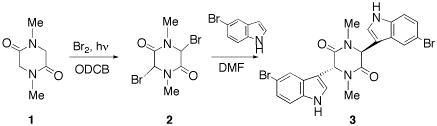
:
1. Introduction
2. Results and Discussion
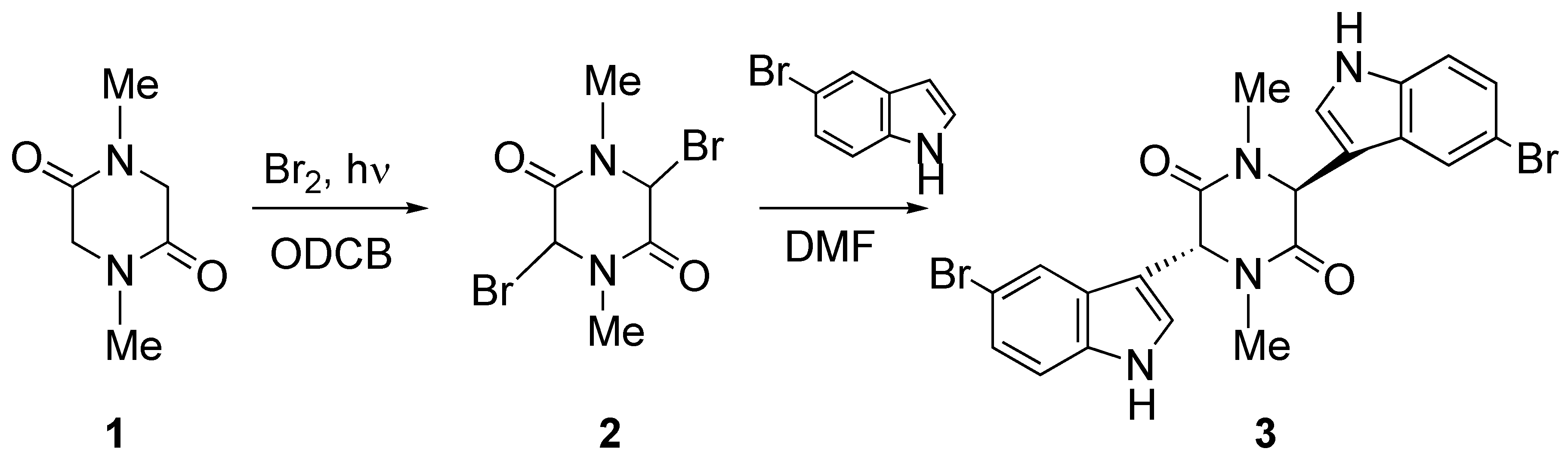
3. Experimental Section
Supplementary materials
Supplementary File 1Supplementary File 2Supplementary File 3Acknowledgements
References and Notes
- Kohmoto, S.; Kashman, Y.; McConnell, O.J.; Rinehart, K.L., Jr.; Wright, A.; Koehn, F. Dragmacidin, a new cytotoxic bis(indole) alkaloid from a deep water marine sponge, Dragmacidon sp. J. Org. Chem. 1988, 53, 3116–3118. [Google Scholar] [CrossRef]
- Wright, A.E.; Pomponi, S.A.; Cross, S.S.; McCarthy, P. A new bis-(indole) alkaloid from a deep-water marine sponge of the genus Spongosorites. J. Org. Chem. 1992, 57, 4772–4775. [Google Scholar] [CrossRef]
- Capon, R.J.; Rooney, F.; Murray, L.M.; Collins, E.; Sim, A.T.R.; Rostas, J.A.P.; Butler, M.S.; Carroll, A.R. Dragmacidins: New protein phosphatase inhibitors from a southern Australian deep-water marine sponge, Spongosorites sp. J. Nat. Prod. 1998, 61, 660–662. [Google Scholar] [CrossRef] [PubMed]
- Capon, R.J.; Rooney, F.; Murray, L.M. 1,9-Dimethylhypoxanthine from a southern Australian marine sponge Spongosorites species. J. Nat. Prod. 2000, 63, 261–262. [Google Scholar] [CrossRef] [PubMed]
- Bao, B.; Sun, Q.; Yao, X.; Hong, J.; Lee, C.O.; Cho, H.Y.; Jung, J.H. Bisindole alkaloids of the topsentin and hamacanthin classes from a marine sponge Spongosorites sp. J. Nat. Prod. 2007, 70, 2–8. [Google Scholar] [CrossRef] [PubMed]
- Morris, S.A.; Andersen, R.J. Brominated bis(indole) alkaloids from the marine sponge hexadella sp. Tetrahedron 1990, 46, 715–720. [Google Scholar] [CrossRef]
- Yang, C.-G.; Huang, H.; Jiang, B. Progress in studies of novel marine bis(indole) alkaloids. Curr. Org. Chem. 2004, 8, 1691–1720. [Google Scholar] [CrossRef]
- Bao, B.; Sun, Q.; Xinsheng, Y.; Hong, J.; Lee, C.-O.; Sim, C.J.; Im, K.S.; Jung, J.H. Cytotoxic bisindole alkaloids from a marine sponge Spongosorites sp. J. Nat. Prod. 2005, 68, 711–715. [Google Scholar] [CrossRef] [PubMed]
- Sakemi, S.; Sun, H.H. Nortopsentins A, B, and C. Cytotoxic and antifungal imidazolediylbis[indoles] from the sponge Spongosorites ruetzleri. J. Org. Chem. 1991, 56, 4304–4307. [Google Scholar] [CrossRef]
- Gunasekera, S.P.; McCarthy, P.J.; Kelly-Borges, M. Hamacanthins A and B, new antifungal bis indole alkaloids from the deep-water marine sponge, Hamacantha sp. J. Nat. Prod. 1994, 57, 1437–1441. [Google Scholar] [CrossRef] [PubMed]
- Whitlock, C.R.; Cava, M.P. A total synthesis of dragmacidin B. Tetrahedron Lett. 1994, 35, 371–374. [Google Scholar] [CrossRef]
- Miles, D.; Whitlock, C. An improved, one-pot synthesis of 3,6-bis(3’-indolyl)-1,4-dimethylpiperazine-2,5-dione. Het. Comm. 2009, 15, 61–62. [Google Scholar]
© 2009 by the authors; licensee Molecular Diversity Preservation International, Basel, Switzerland. This article is an open-access article distributed under the terms and conditions of the Creative Commons Attribution license (http://creativecommons.org/licenses/by/3.0/).
Share and Cite
Crooke, S.; Davis-McGibony, M.; Whitlock, C. 3,6-Bis(5’-bromo-3’-indolyl)-1,4-dimethypiperazine-2,5-dione. Molbank 2009, 2009, M627. https://doi.org/10.3390/M627
Crooke S, Davis-McGibony M, Whitlock C. 3,6-Bis(5’-bromo-3’-indolyl)-1,4-dimethypiperazine-2,5-dione. Molbank. 2009; 2009(4):M627. https://doi.org/10.3390/M627
Chicago/Turabian StyleCrooke, Stephen, Michele Davis-McGibony, and Christine Whitlock. 2009. "3,6-Bis(5’-bromo-3’-indolyl)-1,4-dimethypiperazine-2,5-dione" Molbank 2009, no. 4: M627. https://doi.org/10.3390/M627
APA StyleCrooke, S., Davis-McGibony, M., & Whitlock, C. (2009). 3,6-Bis(5’-bromo-3’-indolyl)-1,4-dimethypiperazine-2,5-dione. Molbank, 2009(4), M627. https://doi.org/10.3390/M627
 Display in JSmol Viewer