Chemical Constituents, Pharmacological Activities, and Cardiovascular Protective Mechanisms of Dendrobium Species: A Review


Abstract
1. Introduction
2. Main Chemical Components and Physiological Activities of Dendrobium
2.1. Alkaloids
2.2. Bibenzyls
2.3. Flavonoids
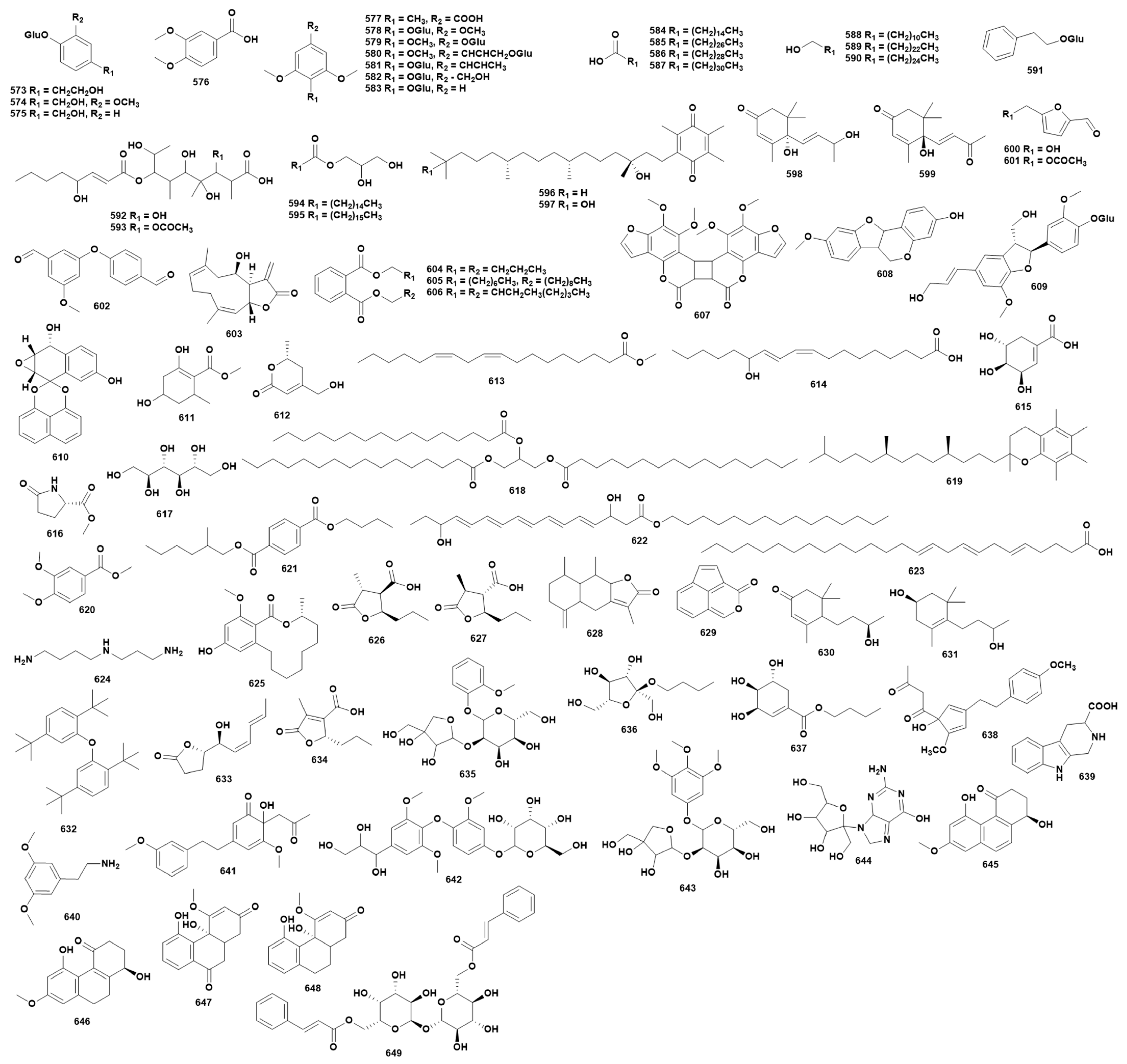
2.4. Phenolic Compounds
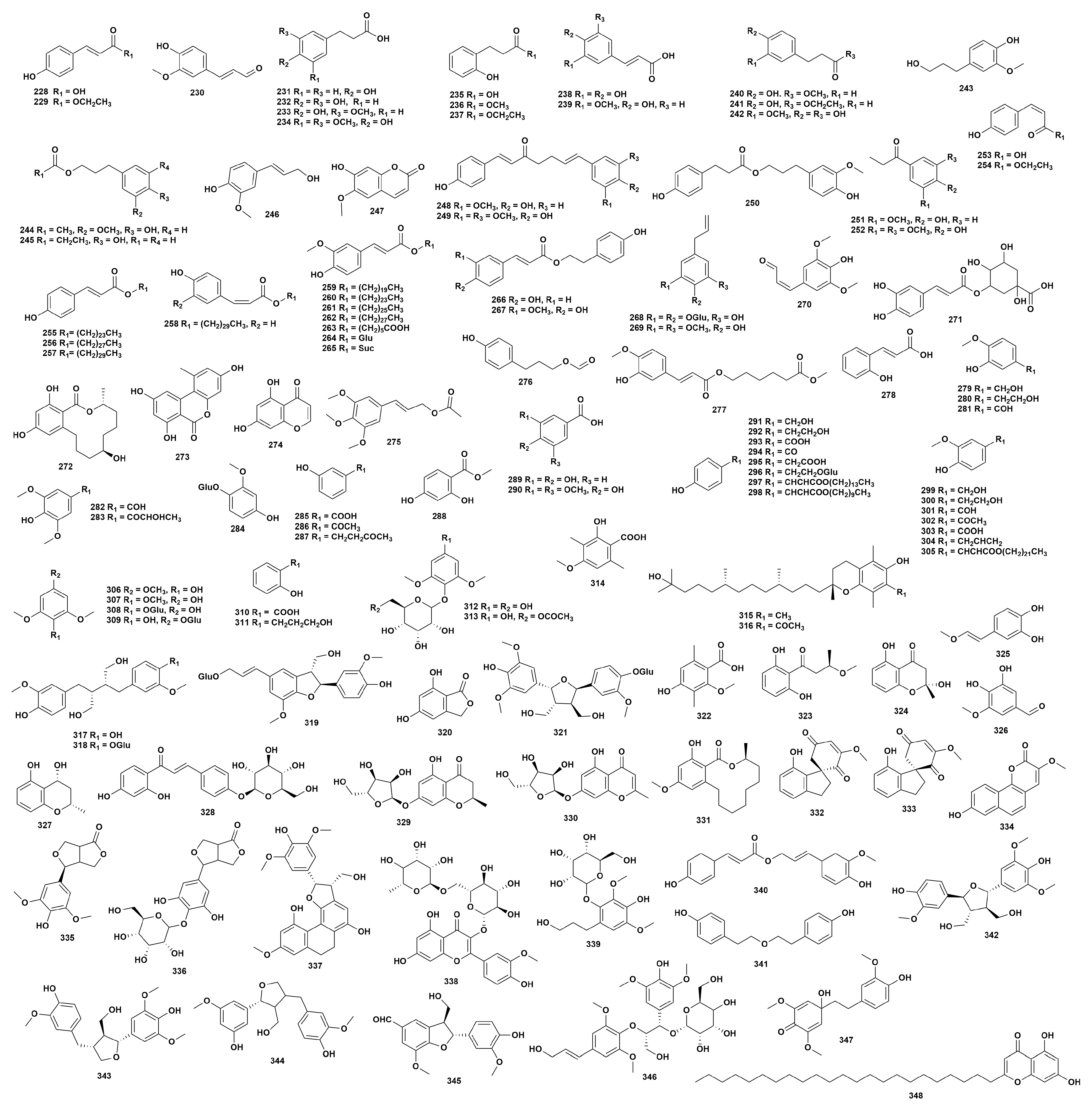
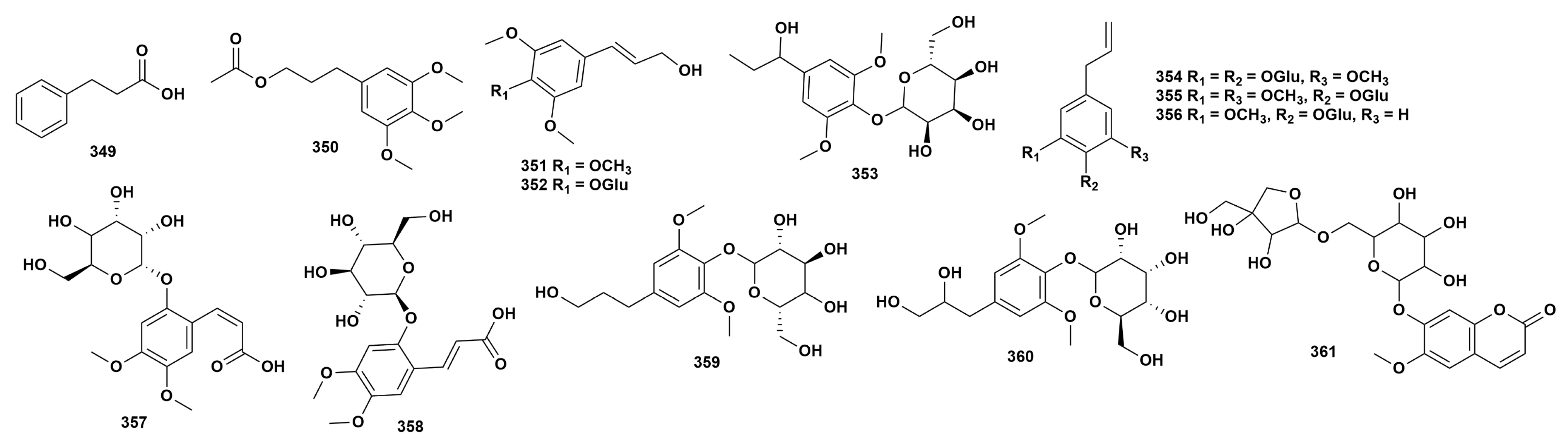
2.5. Simple Phenylpropanoids
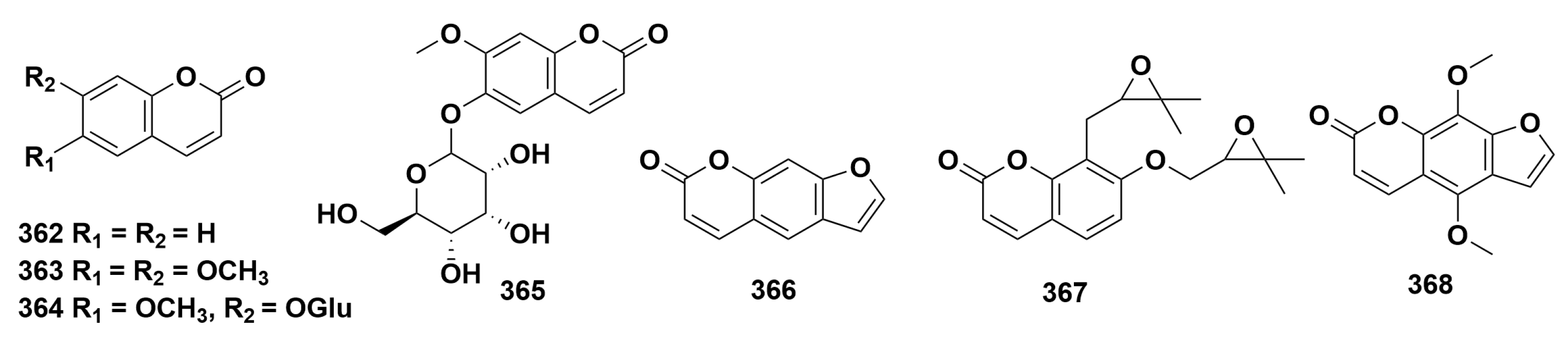
2.6. Coumarins
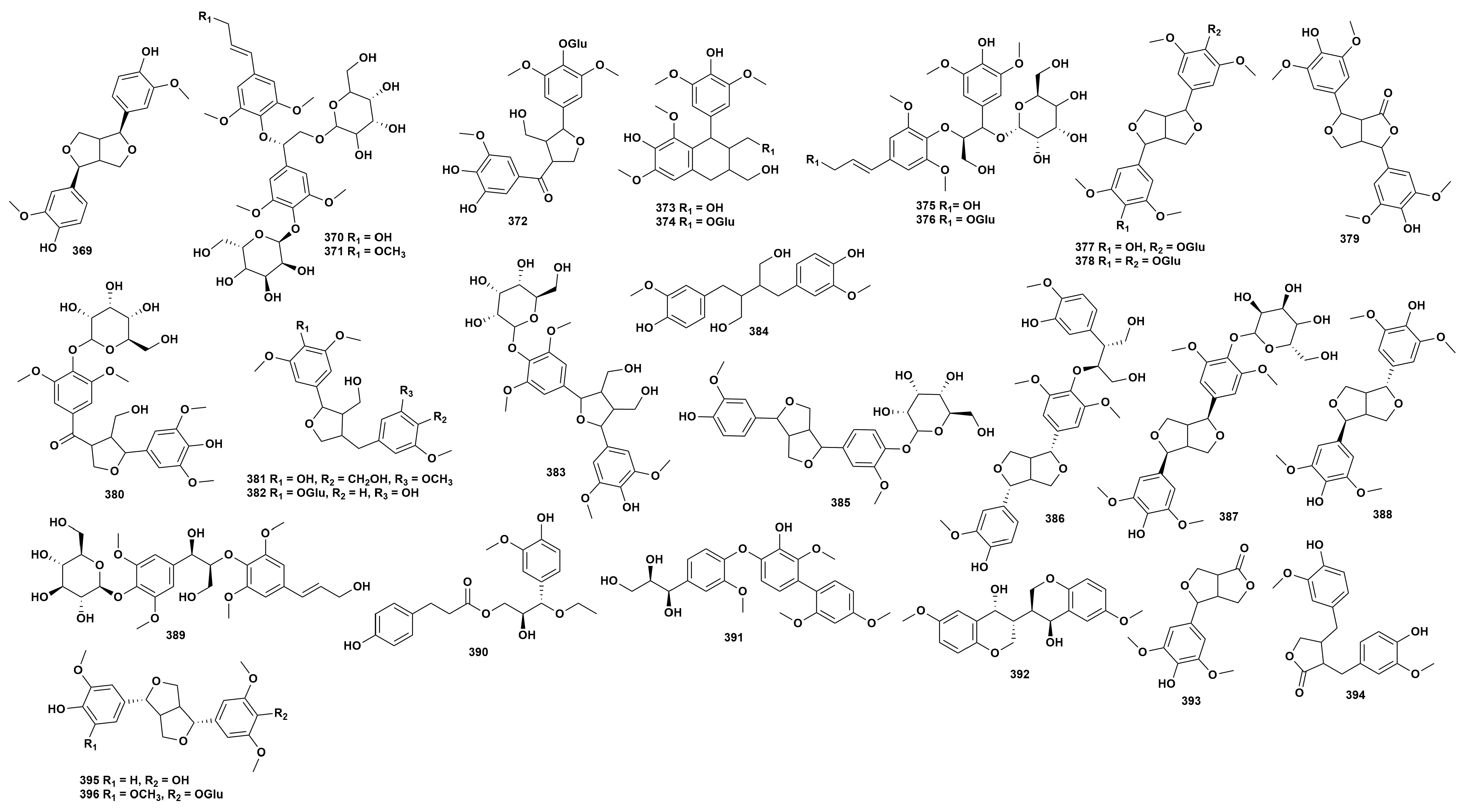
2.7. Lignans
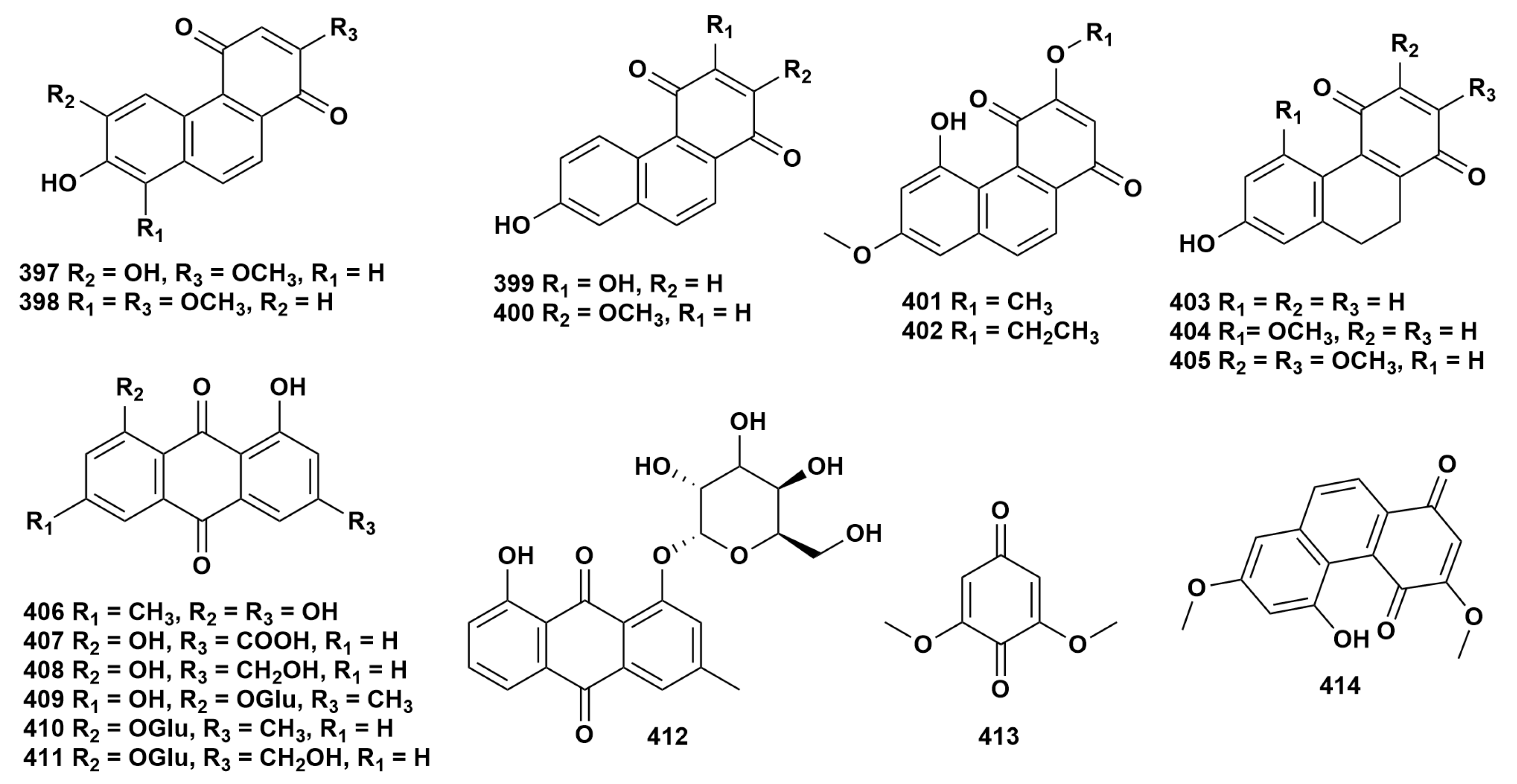
2.8. Quinonoids
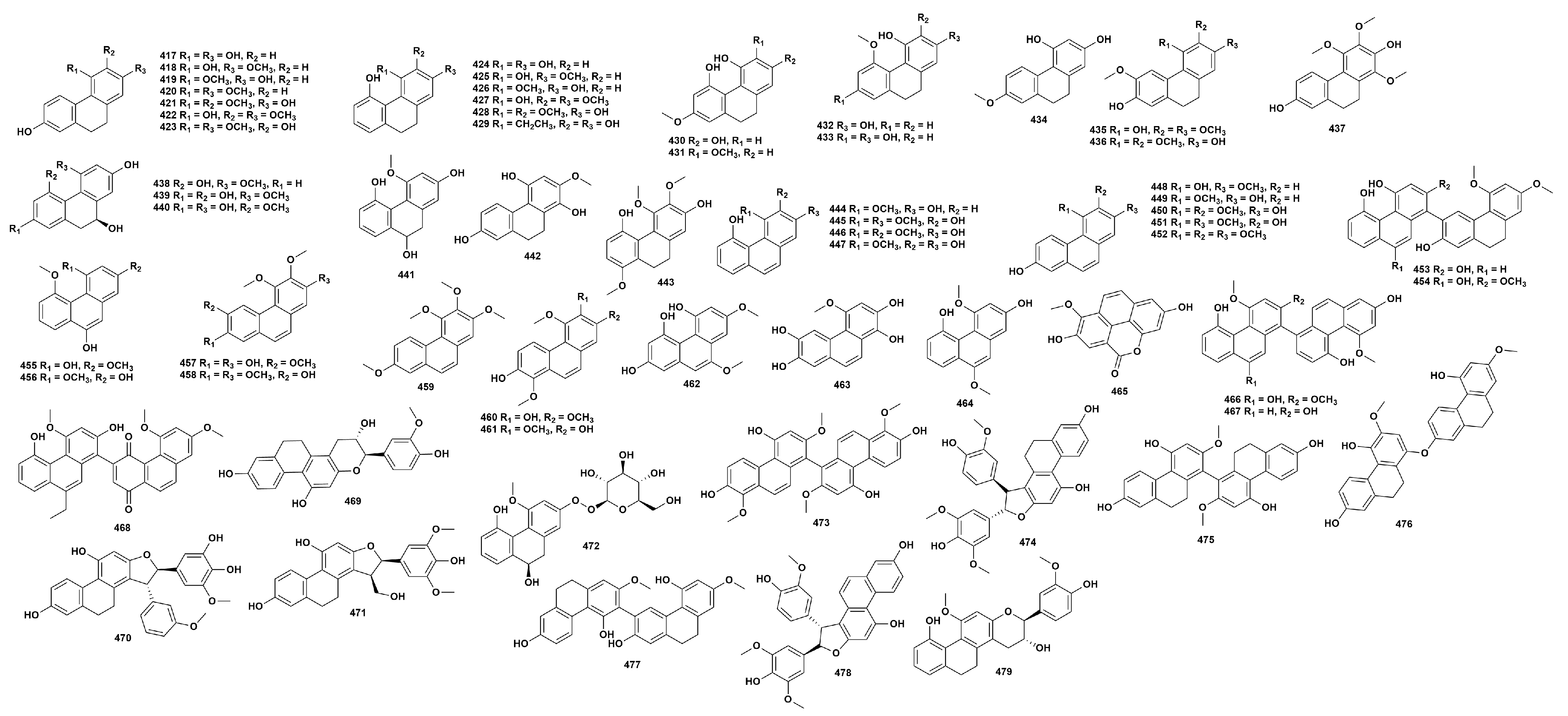
2.9. Phenanthrene Compounds
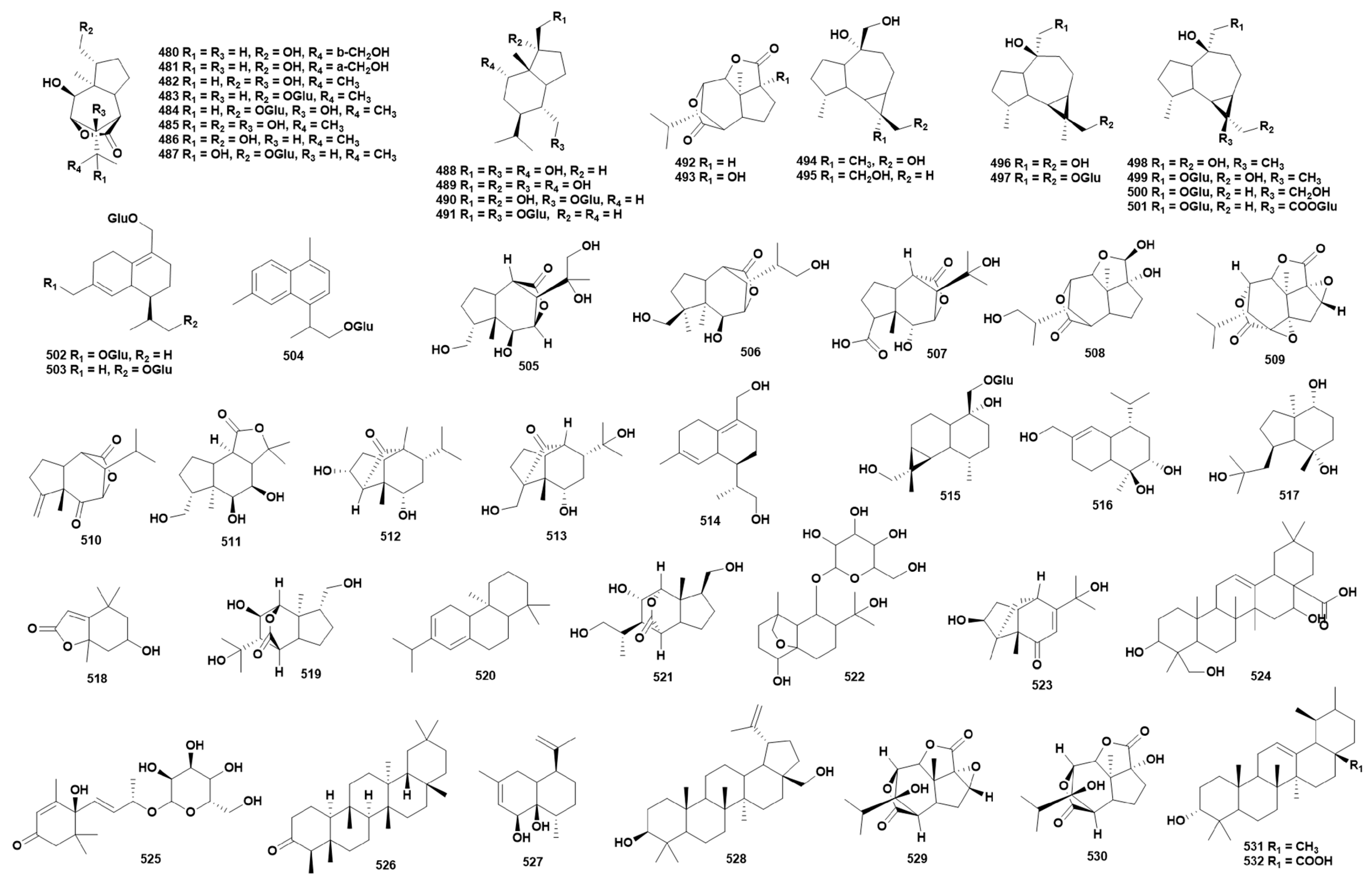
2.10. Terpenoids
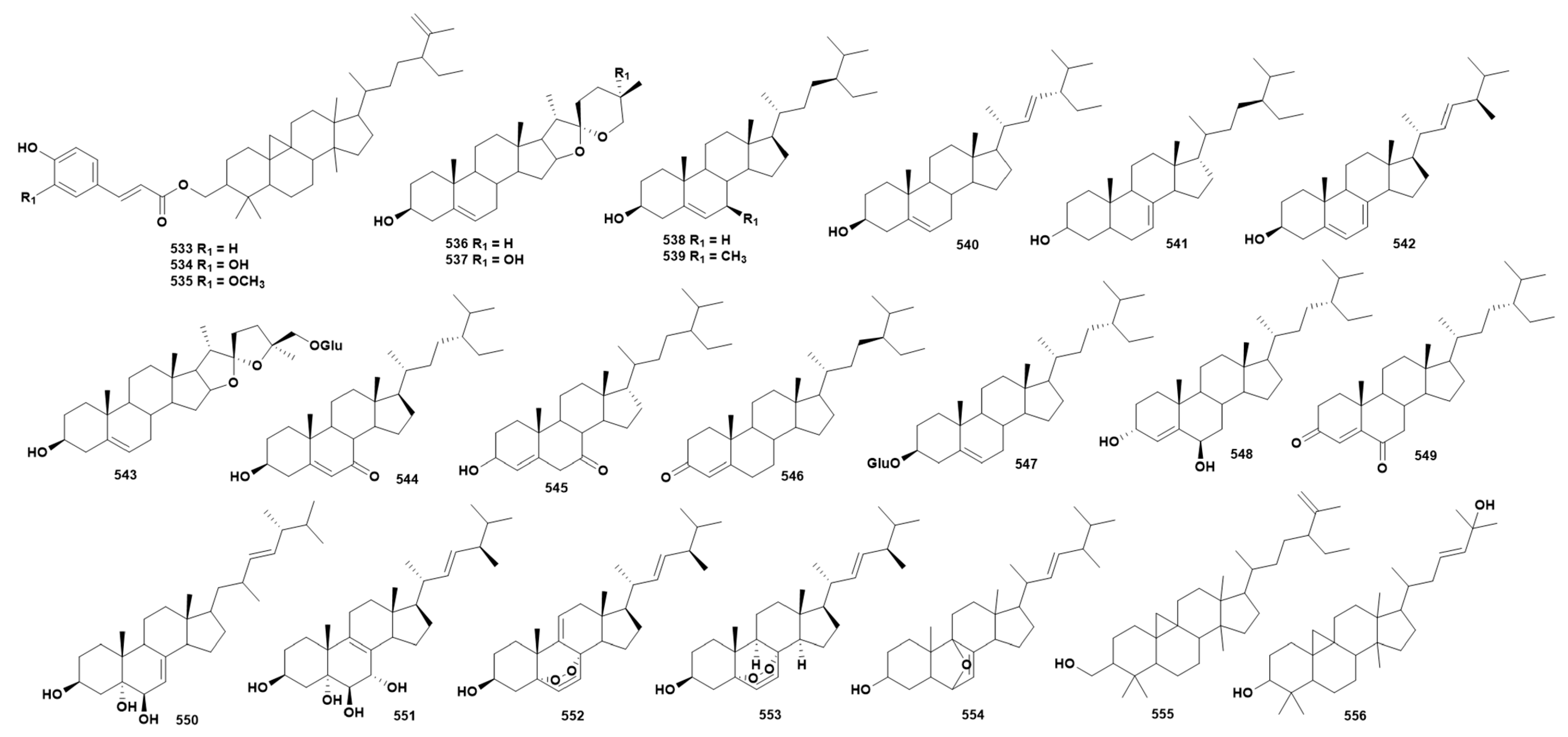
2.11. Steroids
2.12. Nucleosides
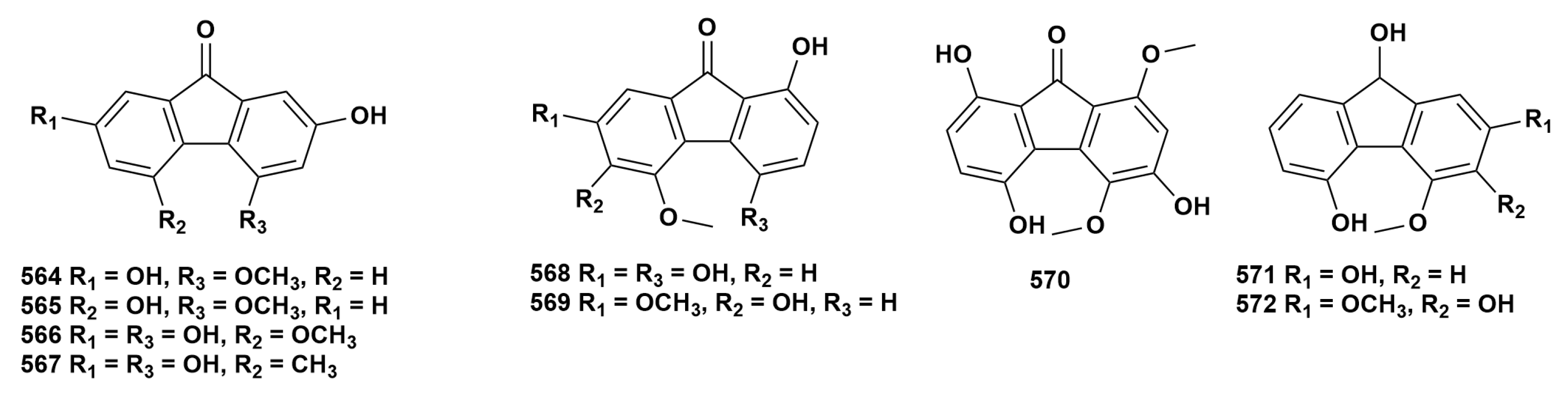
2.13. Fluorenone Compounds
2.14. Others
2.15. Summary of Chemical Diversity and Active Components
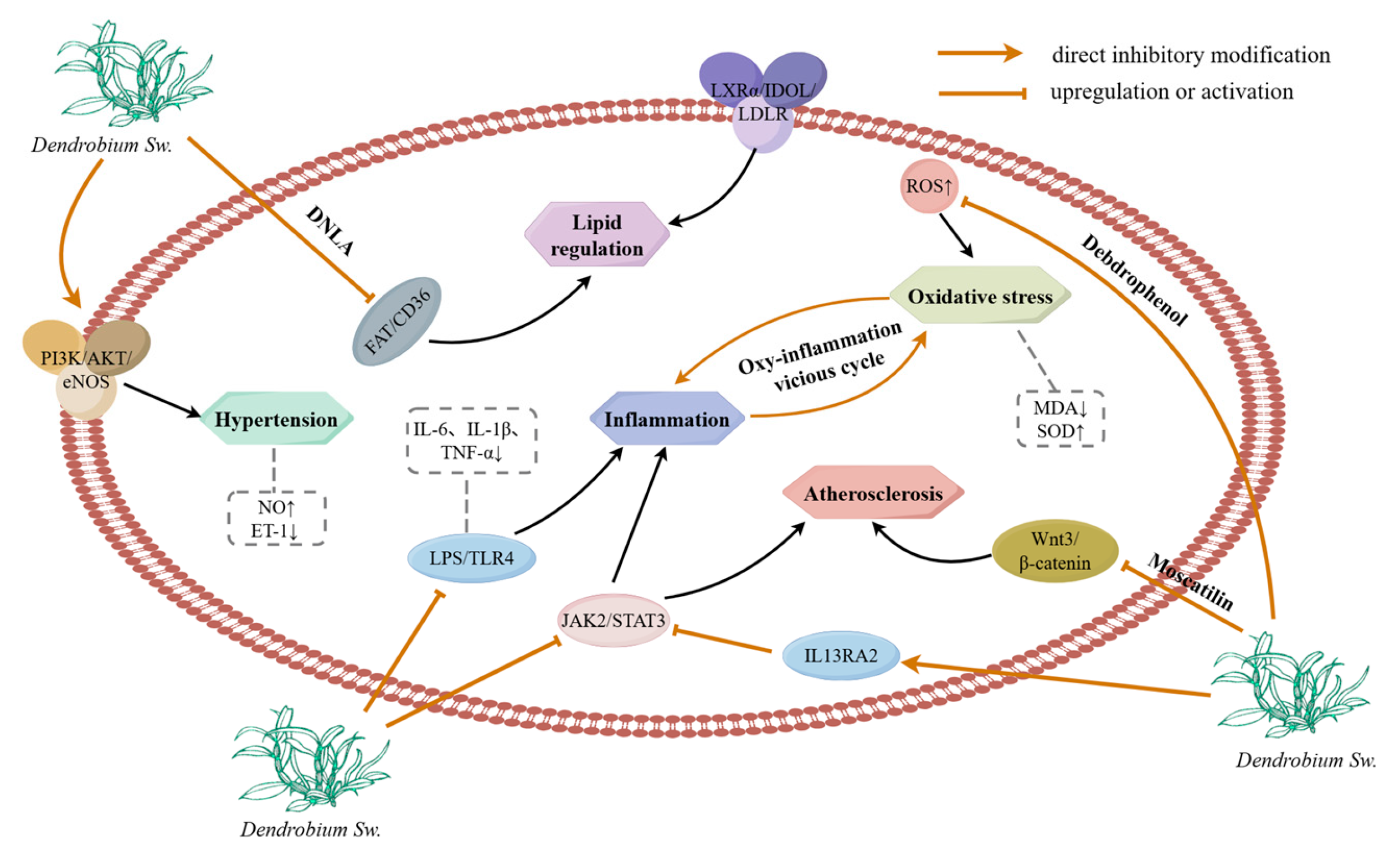
3. Application and Pharmacological Mechanism of Active Components of Dendrobium in CVDs
3.1. Antioxidant Stress
3.2. Lipid Regulation
3.3. Anti-Atherosclerosis
3.4. Anti-Inflammatory and Anti-Myocardial Fibrosis
3.5. Anti-Hypertensive Effect and Vascular Endothelial Dysfunction Improvement
4. Challenges and Prospects for Clinical Application
4.1. Limitations of This Review
4.2. Challenges for Clinical Application
5. Conclusions and Prospects
Supplementary Materials
Author Contributions
Funding
Data Availability Statement
Acknowledgments
Conflicts of Interest
References
- Li, Z.; Lin, L.; Wu, H.; Yan, L.; Wang, H.; Yang, H.; Li, H. Global, Regional, and National Death, and Disability-Adjusted Life-Years (DALYs) for Cardiovascular Disease in 2017 and Trends and Risk Analysis from 1990 to 2017 Using the Global Burden of Disease Study and Implications for Prevention. Front. Public Health 2021, 9, 559751. [Google Scholar] [CrossRef] [PubMed]
- Schnell, O.; Battelino, T.; Bergenstal, R.; Blüher, M.; Böhm, M.; Brosius, F.; Carr, R.D.; Ceriello, A.; Forst, T.; Giorgino, F.; et al. Report from the CVOT Summit 2021: New cardiovascular, renal, and glycemic outcomes. Cardiovasc. Diabetol. 2022, 21, 50. [Google Scholar] [CrossRef]
- Fan, J.; Zhu, T.; Tian, X.; Wang, M.; Li, Z.; Li, W. Targeting Programmed Cell Death as an Innovative Strategy Against Atherosclerosis: Potential of Natural Compound Supplements. Phytother. Res. PTR 2025, 39, 3664–3708. [Google Scholar] [CrossRef]
- Global Burden of Cardiovascular Diseases and Risks 2023 Collaborators. Global, Regional, and National Burden of Cardiovascular Diseases and Risk Factors in 204 Countries and Territories, 1990–2023. J. Am. Coll. Cardiol. 2025, 86, 2167–2243. [CrossRef]
- National Center for Cardiovascular Diseases. Annual Report on Cardiovascular Health and Diseases in China. 2024. Available online: https://www.nccd.org.cn/News/Information/Index/1089 (accessed on 3 March 2026).
- Zheng, S.-G.; Hu, Y.-D.; Zhao, R.-X.; Yan, S.; Zhang, X.-Q.; Zhao, T.-M.; Chun, Z. Genome-wide researches and applications on Dendrobium. Planta 2018, 248, 769–784. [Google Scholar] [CrossRef]
- Zhao, J.-R.; Wang, Y.-H.; Jin, Y.; Jiang, C.; Zhan, Z.-L. Research advances in chemical constituents and pharmacological activities of Dendrobium plants. China J. Chin. Mater. Medica 2022, 47, 2358–2372. [Google Scholar] [CrossRef]
- Chen, X.Q.; Liu, Z.J.; Zhu, G.H.; Lang, K.Y.; Ji, Z.H.; Luo, Y.B. Orchidaceae; Science Press: Beijing, China; Missouri Botanical Garden Press: St. Louis, MO, USA, 2009; Volume 25. [Google Scholar]
- Jiao, L.-K.; Zeng, Y.; Wang, J.-Y.; Deng, Q.-C.; Li, X.-D.; Cheng, Y.-W.; Sun, D.-X.; Zhou, H.-Y. A Summary of the Herbalogical Textual Research on the Base Resource of Dendrobium. Mod. Chin. Med. 2019, 21, 542–551. [Google Scholar] [CrossRef]
- Shun, Q.S.; Wei, G.; Wang, Y.J. The History and Present Situation of Traditional Medicine Dendrobium. Tradit. Chin. Drug Res. Clin. Pharmacol. 2017, 28, 838–843. [Google Scholar] [CrossRef]
- Chinese Pharmacopoeia Commission. Pharmacopoeia of the People’s Republic of China, 2020 ed.; China Medical Science Press: Beijing, China, 2020; Volume 1.
- Lam, Y.; Ng, T.B.; Yao, R.M.; Shi, J.; Xu, K.; Sze, S.C.W.; Zhang, K.Y. Evaluation of Chemical Constituents and Important Mechanism of Pharmacological Biology in Dendrobium Plants. Evid.-Based Complement. Altern. Med. 2015, 2015, 841752. [Google Scholar] [CrossRef]
- Wang, Y.-H. Traditional uses, chemical constituents, pharmacological activities, and toxicological effects of Dendrobium leaves: A review. J. Ethnopharmacol. 2021, 270, 113851. [Google Scholar] [CrossRef]
- He, L.; Su, Q.; Bai, L.; Li, M.; Liu, J.; Liu, X.; Zhang, C.; Jiang, Z.; He, J.; Shi, J.; et al. Recent research progress on natural small molecule bibenzyls and its derivatives in Dendrobium species. Eur. J. Med. Chem. 2020, 204, 112530. [Google Scholar] [CrossRef]
- Tan, L.C.; Li, Z.; Yang, J.Y.; Li, J.J. Research Progress on Chemical Constituents and Pharmacological Effects of Dendrobium. Shandong Chem. Ind. 2023, 52, 74–76. [Google Scholar] [CrossRef]
- Ling-Hu, C.; Gu, R.; Qin, L.-K. Research progress on chemical constituents and pharmacological effects of Dendrobium nobile. Chin. Tradit. Herb. Drugs 2021, 52, 7693–7708. [Google Scholar] [CrossRef]
- Inubushi, Y.; Nakano, J. Structure of dendrine. Tetrahedron Lett. 1965, 5, 2723–2728. [Google Scholar] [CrossRef] [PubMed]
- Liu, Q.F.; Zhao, W.M. A New Dendrobine-Type Alkaloid from Dendrobium nobile. Chin. Chem. Lett. 2003, 14, 278–279. [Google Scholar]
- Inubushi, Y.; Ishii, H.; Yasui, B.; Konita, T.; Harayama, T. Isolation and Characterization of Alkaloids of the Chinese Drug “Chin-Shih-Hu”. Chem. Pharm. Bull. 1964, 12, 1175–1180. [Google Scholar] [CrossRef][Green Version]
- Hedman, K.; Leander, K. Studies on Orchidaceae Alkaloids. XXVII. Quaternary Salts of the Dendrobine Type from Dendrobium nobile Lindl. Acta Chem. Scand. 1972, 26, 3177–3180. [Google Scholar] [CrossRef]
- Yang, D.; Cheng, Z.-Q.; Yang, L.; Hou, B.; Yang, J.; Li, X.-N.; Zi, C.-T.; Dong, F.-W.; Liu, Z.-H.; Zhou, J.; et al. Seco-Dendrobine-Type Alkaloids and Bioactive Phenolics from Dendrobium findlayanum. J. Nat. Prod. 2018, 81, 227–235. [Google Scholar] [CrossRef] [PubMed]
- Wang, H.; Zhao, T.; Che, C.-T. Dendrobine and 3-hydroxy-2-oxodendrobine from Dendrobium nobile. J. Nat. Prod. 1985, 48, 796–801. [Google Scholar] [CrossRef]
- Okamoto, T.; Natsume, M.; Onaka, T.; Uchinaru, F.; Shimizu, M. Further Studies on the Alkaloidal Constituents of Dendrobium nobile (Orchidaceae)-Structure Determination of 4-Hydroxy-dendroxine and Nobilomethylene. Chem. Pharm. Bull. 1972, 20, 418–421. [Google Scholar] [CrossRef]
- Okamoto, T.; Natsume, M.; Onaka, T.; Uchimaru, F.; Shimizu, M. The structure of dendramine (6-oxydendrobine) and 6-oxydendroxine the fourth and fifth alkaloid from Dendrobium nobile. Chem. Pharm. Bull. 1966, 14, 676–680. [Google Scholar] [CrossRef]
- Khumploy, P.; Raksat, A.; Choodej, S.; Aree, T.; Ngamrojanavanich, N.; Pudhom, K. Picrotoxane sesquiterpene and α-pyrone derivative from Dendrobium signatum and their free radical scavenging potency. J. Nat. Med. 2021, 75, 967–974. [Google Scholar] [CrossRef]
- Okamoto, T.; Natsume, M.; Onaka, T.; Uchimaru, F.; Shimizu, M. The Structure of Dendroxine The Third Alkaloid from Dendrobium nobile. Chem. Pharm. Bull. 1966, 14, 672–675. [Google Scholar] [CrossRef] [PubMed]
- Lei, H.; Zou, S.; Lin, J.; Zhai, L.; Zhang, Y.; Fu, X.; Chen, S.; Niu, H.; Liu, F.; Wu, C.; et al. Antioxidant and anti-inflammatory activity of constituents isolated from Dendrobium nobile (Lindl.). Front. Chem. 2022, 10, 988459. [Google Scholar] [CrossRef] [PubMed]
- Liu, G.-Y.; Tan, L.; Cheng, L.; Ding, L.-S.; Zhou, Y.; Deng, Y.; He, Y.-Q.; Guo, D.-L.; Xiao, S.-J. Dendrobine-type alkaloids and bibenzyl derivatives from Dendrobium findlayanum. Fitoterapia 2020, 142, 104497. [Google Scholar] [CrossRef] [PubMed]
- Wang, P.; Chen, X.; Wang, H.; Huang, S.; Cai, C.; Yuan, J.; Zhu, G.; Xu, X.; Mei, W.; Dai, H. Four New Picrotoxane-Type Sesquiterpenes from Dendrobium nobile Lindl. Front. Chem. 2019, 7, 812. [Google Scholar] [CrossRef]
- Meng, C.-W.; He, Y.-L.; Peng, C.; Ding, X.-J.; Guo, L.; Xiong, L. Picrotoxane sesquiterpenoids from the stems of Dendrobium nobile and their absolute configurations and angiogenesis effect. Fitoterapia 2017, 121, 206–211. [Google Scholar] [CrossRef]
- Zhang, C.; Liu, S.-J.; Yang, L.; Yuan, M.-Y.; Li, J.-Y.; Hou, B.; Li, H.-M.; Yang, X.-Z.; Ding, C.-C.; Hu, J.-M. Sesquiterpene amino ether and cytotoxic phenols from Dendrobium wardianum Warner. Fitoterapia 2017, 122, 76–79. [Google Scholar] [CrossRef]
- Mei, Y.; Ye, Q.H.; Yang, P.M.; Kong, D.Y.; Cheng, L. Chemical Constituents of Dendrobium polyanthum Lindl. Chin. J. Pharm. 2014, 45, 224–228. [Google Scholar] [CrossRef]
- Lüning, B.; Leander, K.; Gröndahl, N.J.; Guthrie, C.; Hinton, M. Studies on Orchidaceae Alkaloids. III. The Alkaloids in Dendrobium primulinum Lindl. and Dendrobium chrysanthum Wall. Acta Chem. Scand. 1965, 19, 1607–1611. [Google Scholar] [CrossRef]
- Xu, X.; Chen, X.; Yang, R.; Li, Z.; Zhou, H.; Bai, Y.; Yu, M.; Li, B.; Ding, G. Crepidtumines A and B, Two Novel Indolizidine Alkaloids from Dendrobium crepidatum. Sci. Rep. 2020, 10, 9564. [Google Scholar] [CrossRef]
- Ding, X.-Q.; Zou, Y.-Q.; Liu, J.; Wang, X.-C.; Hu, Y.; Liu, X.; Zhang, C.-F. Dendrocrepidamine, a novel octahydroindolizine alkaloid from the roots of Dendrobium crepidatum. J. Asian Nat. Prod. Res. 2021, 23, 1085–1092. [Google Scholar] [CrossRef]
- Hu, Y.; Zhang, C.; Zhao, X.; Wang, Y.; Feng, D.; Zhang, M.; Xie, H. (±)-Homocrepidine A, a Pair of Anti-inflammatory Enantiomeric Octahydroindolizine Alkaloid Dimers from Dendrobium crepidatum. J. Nat. Prod. 2015, 79, 252–256. [Google Scholar] [CrossRef]
- Zhao, H.S.; Xu, F.Q.; Chen, X.X.; Hu, J.M.; Zeng, F.J.; Peng, D.Y.; Wu, D.L. Chemical constituents of Dendrobium huoshanense C. Nat. Prod. Res. Dev. 2021, 33, 1491–1498. [Google Scholar] [CrossRef]
- Liu, W.-H.; Hua, Y.-F.; Zhan, Z.-J. Moniline, a new alkaloid from Dendrobium moniliforme. J. Chem. Res. 2007, 6, 317–318. [Google Scholar] [CrossRef]
- Gao, W.; Yang, L.; Li, H.-H.; Liu, C.-Q.; Liu, S.-J.; Hu, J.-M. Phytochemical Study of Dendrobium gratiosissimum. Mod. Chin. Med. 2015, 17, 311–314. [Google Scholar]
- Meng, Z.-X.; Dong, H.-L.; Wang, C.-L.; Guo, S.-X. Chemical Constituents of Dendrobium devonianum. Chin. Pharm. J. 2013, 48, 855–859. [Google Scholar]
- Zhang, S.-Y.; Gong, X.-J.; Zhou, X.; Mu, Y.-S.; Chen, H.-G.; Liang, K.; Zhao, C. Research progress on chemical components and pharmacological effects of Dendrobium officinale. J. Gansu Agric. Univ. 2024, 59, 257–278. [Google Scholar] [CrossRef]
- Cheng, L.; Cheng, Z.-Y.; Shang, Z.-M.; Zhang, M.-S.; Li, X.-F.; Zhang, J.-Y.; Xiao, S.-J. Chemical constituents of Dendrobium hercoglossum. Chin. Tradit. Herb. Drugs 2020, 51, 3126–3130. [Google Scholar] [CrossRef]
- Li, H.-F.; Qin, S.-H.; Zhou, Z.-Q.; Yang, L.; Hu, J.-M. Phenolic chemical components from Dendrobium wardianum. Chin. Tradit. Herb. Drugs 2021, 55, 711–719. [Google Scholar] [CrossRef]
- Wang, D.F.; Chou, G.X.; Zhao, N.Y.; Zhang, T.; Xu, H. Study on chemical constituents in stems of Dendrobium nobile. Chin. Tradit. Herb. Drugs 2012, 43, 1492–1495. [Google Scholar]
- Guan, H.J.; Zhang, X.; Tu, F.J.; Yao, X.S. Study on chemical constituents of Dendrobium officinale. Chin. Tradit. Herb. Drugs 2009, 40, 1873–1876. [Google Scholar]
- Zhang, A.-L.; Yu, M.; Xu, H.-H.; Si, J.-P. Constituents of Dendrobium devonianum and their antioxidant activity. China J. Chin. Mater. Medica 2013, 38, 844–847. [Google Scholar] [CrossRef]
- Zhang, C.-H.; Xu, Q.-L.; Zeng, L.; Wang, S.; Luo, Q.-W.; Chen, Y.-L. Chemical Constituents from Leaves of Dendrobium officinale. For. Environ. Sci. 2020, 36, 30–34. [Google Scholar]
- He, R.-S.; Wang, M.; Li, S.-W.; Xue, B.-X.; Zhang, L.-H.; Wu, H.-H. Chemical constituents from Dendrobium aphyllum. Chin. Tradit. Pat. Med. 2023, 45, 3633–3638. [Google Scholar] [CrossRef]
- Hu, Y.; Ren, J.; Wang, L.; Zhao, X.; Zhang, M.; Shimizu, K.; Zhang, C. Protective effects of total alkaloids from Dendrobium crepidatum against LPS-induced acute lung injury in mice and its chemical components. Phytochemistry 2018, 149, 12–23. [Google Scholar] [CrossRef]
- Meng, W.T.; Meng, X.; Niu, L.T.; Zhang, S.S.; Ouyang, C.J.; Ding, C.H.; Zhu, L.J.; Zhang, X. A new bibenzyl dervative from stems of Dendrobium officinale. China J. Chin. Mater. Medica 2023, 48, 700–706. [Google Scholar] [CrossRef]
- Zhou, X.-M.; Zheng, C.-J.; Gan, L.-S.; Chen, G.-Y.; Zhang, X.-P.; Song, X.-P.; Li, G.-N.; Sun, C.-G. Bioactive Phenanthrene and Bibenzyl Derivatives from the Stems of Dendrobium nobile. J. Nat. Prod. 2016, 79, 1791–1797. [Google Scholar] [CrossRef]
- Yang, Z.-Y.; Zhang, Y.; Yang, J.; Luo, W.-L.; Zhang, M.-S.; Wang, G.; Sun, C.X.; Dong, M.-J.; Xiao, S.-J. Chemical constituents from Dendrobium moschatum. Chin. Tradit. Pat. Med. 2022, 44, 3517–3521. [Google Scholar] [CrossRef]
- Sun, J.-W.; Liu, J.-M.; Chen, R.-D.; Liu, Y.-Y.; Li, Y.; Cen, S.; Chen, X.-M.; Guo, S.-X.; Dai, J.-G. Study on chemical bibenzyls in Dendrobium gratiosissimum. China J. Chin. Mater. Medica 2020, 45, 4929–4937. [Google Scholar] [CrossRef]
- Ren, G.; Chen, Y.-T.; Ye, J.-B.; Zhong, G.-Y.; Xiao, C.-Y.; Deng, W.-Z.; Chen, Y.-L. Phytochemical investigation of leaves of Dendrobium officinale. Chin. Tradit. Herb. Drugs 2020, 51, 3637–3644. [Google Scholar] [CrossRef]
- Su, S.-Q.; Jiang, H.; Li, Q.-M.; Zha, X.-Q.; Luo, J.-P. Study on chemical constituents of Dendrobium huoshanense stems and their anti-inflammatory activity. China J. Chin. Mater. Medica 2020, 45, 3452–3458. [Google Scholar] [CrossRef]
- Yang, X.-B.; Yan, S.; Hu, J.-M.; Zhou, J. Chemical constituents from Dendrobium heterocarpum Lindl. Nat. Prod. Res. Dev. 2019, 31, 1745–1752. [Google Scholar] [CrossRef]
- Yang, D.; Cheng, Z.-Q.; Ding, Z.-T.; Zhou, J.; Hu, J.-M. Chemical constituents of Dendrobium crystallinum. Guihaia 2017, 37, 1182–1186. [Google Scholar] [CrossRef]
- Shang, Z.-M.; Cheng, L.; Liu, G.-Y.; Zhang, M.-S.; Li, X.-F.; Xiao, S.-J. Chemical constituents of Dendrobium bellatulum. Chin. Tradit. Herb. Drugs 2019, 50, 2036–2040. [Google Scholar] [CrossRef]
- Zhuang, C.X.; Li, Y.P. Research Progresson Chemical Constituents and Pharmacological Effects of Dendrobium polyanthum. Ind. Microbiol. 2024, 54, 48–50. [Google Scholar] [CrossRef]
- Yang, D.; Liu, L.-Y.; Cheng, Z.-Q.; Xu, F.-Q.; Fan, W.-W.; Zi, C.-T.; Dong, F.-W.; Zhou, J.; Ding, Z.-T.; Hu, J.-M. Five new phenolic compounds from Dendrobium aphyllum. Fitoterapia 2015, 100, 11–18. [Google Scholar] [CrossRef]
- Liu, Y.; Zhang, J.Q.; Zhan, R.; Chen, Y.G. Isopentenylated Bibenzyls and Phenolic Compounds from Dendrobium chrysotoxum Lindl. Chem. Biodivers. 2022, 19, e202200259. [Google Scholar] [CrossRef]
- Li, X.W.; Chen, H.P.; He, W.B.; Yang, W.L.; Ni, F.Y.; Huang, Z.W.; Hu, H.Y.; Wang, J. Polyphenols from Dendrobium loddigesii and their biological activities. Acta Sci. Nat. Univ. Sunyatseni 2019, 58, 96–102. [Google Scholar] [CrossRef]
- Wang, L.; Zhang, C.-F.; Wang, Z.-T.; Zhang, M.; Xu, L.-S. Chemical constituents of Dendrobium crystallinum. Chin. Tradit. Herb. Drugs 2011, 42, 31–33. [Google Scholar]
- Luo, W.-L.; Wang, M.Y.; Yang, Z.Y.; Zhang, M.-S.; Wang, G.; Sun, C.-X.; Dong, M.-J.; Xiao, S.-J. Chemical constituents from Dendrobidium strongylanthum. Chin. Tradit. Pat. Med. 2022, 44, 3192–3195. [Google Scholar] [CrossRef]
- Wang, H.Y.; Li, M.; Hao, J.L.; Chen, L.L.; Ma, G.Y. Research Advances of Dendrobium devonianum. Chin. Arch. Tradit. Chin. Med. 2014, 32, 2732–2735. [Google Scholar] [CrossRef]
- Deng, G.-H.; Yu, N.-J.; Wang, Y.-Y.; Ye, M.-J.; Cai, X.; Zhang, X.-Q.; Peng, D.-Y. Research progress on effect and mechanism of Dendrobium huoshanense and its active components against liver diseases. Chin. Tradit. Herb. Drugs 2022, 53, 6959–6967. [Google Scholar] [CrossRef]
- Chen, X.M.; Wang, C.L.; Yang, J.S.; Guo, S.X. Research Progress on Chemical Composition and Chemical Analysis of Dendrobium officinale. Chin. Pharm. J. 2013, 48, 1634–1640. [Google Scholar] [CrossRef]
- Cai, M.; Cai, J.W.; Yang, Q.S.; Yu, J.; Xie, H.Q.; Han, L.; Peng, D.Y. Review of chemical composition and pharmacological effects of Dendrobium huoshanense and prediction of its Q-markers. China J. Chin. Mater. Medica 2024, 49, 4860–4873. [Google Scholar] [CrossRef]
- Zhang, T.; Zhang, C.-F.; Wang, Z.-T.; Xu, L.-S. Studies on Chemical Constituents of Dendrobium trigonopus Rchb. f. Chin. J. Nat. Med. 2005, 3, 28–30. [Google Scholar]
- Yang, L.; Zhou, Q.-M.; Peng, C.; Guo, L.; Zhang, T.-M.; Xiong, L. Chemical constituents from Drobium aurantiacum var. denneanum. Chin. Tradit. Herb. Drugs 2015, 46, 2193–2197. [Google Scholar] [CrossRef]
- Zhang, X.; Xu, J.-K.; Wang, J.; Wang, N.-L.; Kurihara, H.; Kitanaka, S.; Yao, X.-S. Bioactive Bibenzyl Derivatives and Fluorenones from Dendrobium nobile. J. Nat. Prod. 2007, 70, 24–28. [Google Scholar] [CrossRef] [PubMed]
- Warinhomhoun, S.; Muangnoi, C.; Buranasudja, V.; Mekboonsonglarp, W.; Rojsitthisak, P.; Likhitwitayawuid, K.; Sritularak, B. Antioxidant Activities and Protective Effects of Dendropachol, a New Bisbibenzyl Compound from Dendrobium pachyglossum, on Hydrogen Peroxide-Induced Oxidative Stress in HaCaT Keratinocytes. Antioxidants 2021, 10, 252. [Google Scholar] [CrossRef]
- Kyokong, N.; Muangnoi, C.; Thaweesest, W.; Kongkatitham, V.; Likhitwitayawuid, K.; Rojsitthisak, P.; Sritularak, B. A new phenanthrene dimer from Dendrobium palpebrae. J. Asian Nat. Prod. Res. 2018, 21, 391–397. [Google Scholar] [CrossRef]
- Yu muyuan Hj, H.y. Study on chemical constituents of Dendrobium moniliforme. Energy Environ. 2014, 3, 35–36. [Google Scholar]
- Shang, Z.-M.; Xia, D.; Cheng, L.; Liu, G.-Y.; Zhang, M.-S.; Zhang, J.-Y.; Li, X.-F.; Xiao, S.-J. Chemical constituents from Dendrobium hancockii. Chin. Tradit. Herb. Drugs 2019, 50, 3760–3763. [Google Scholar] [CrossRef]
- Li, C.-Y.; Lu, Y.; Chen, Y.; Zheng, J.-W.; Wang, J. Chemical Components of Dendrobium loddigesii. Acta Sci. Nat. Univ. Sunyatseni 2013, 52, 73–76. [Google Scholar] [CrossRef]
- Li, J.-J.; Ren, F.-C.; Hu, J.-M.; Zhou, J. Chemical constituents and cytotoxic activities of Dendrobium wardianum. Chin. Tradit. Herb. Drugs 2020, 51, 1819–1824. [Google Scholar] [CrossRef]
- Zhang, C.F.; Shao, L.; Huang, W.H.; Wang, L.; Wang, Z.T.; Xu, L.S. Phenolic components from herbs of Dendrobium aphyllum. China J. Chin. Mater. Medica 2008, 33, 2922–2925. [Google Scholar]
- Wang, L.; Zhang, C.-F.; Wang, Z.-T.; Zhang, M.; Shao, L.; Xu, L.-S. Studies on chemical constituents of Dendrobium crystallinum. China J. Chin. Mater. Medica 2008, 33, 1847–1848. [Google Scholar] [CrossRef]
- Yang, M.; Zhang, Y.; Chen, L.; Chen, Y. A new (propylphenyl)bibenzyl derivative from Dendrobium williamsonii. Nat. Prod. Res. 2017, 32, 1699–1705. [Google Scholar] [CrossRef] [PubMed]
- Bi, Z.-M.; Wang, Z.-T.; Xu, L.-S. Chemical Constituents of Dendrobium moniliforme. Acta Bot. Sin. 2004, 46, 124–126. [Google Scholar]
- Guo, D.S.; Yang, L.; Song, X.Q.; Mei, W.L.; Chen, H.Q.; Dai, H.F. Chemical Constituents from Aerial Parts of Dendrobium hercoglossum (Orchidaceae) and Their Biological Activities. J. Trop. Subtrop. Bot. 2024, 32, 287–293. [Google Scholar] [CrossRef]
- Thant, M.T.; Chatsumpun, N.; Mekboonsonglarp, W.; Sritularak, B.; Likhitwitayawuid, K. New Fluorene Derivatives from Dendrobium gibsonii and Their α-Glucosidase Inhibitory Activity. Molecules 2020, 25, 4931. [Google Scholar] [CrossRef]
- Ma, G.-X.; Wang, T.-S.; Li, Y.; Yang, P.; Xu, G.-J.; Xu, L.-S. Studies on Chemical Constituents of Dendrobium chryseum. J. Chin. Pharm. Sci. 1998, 7, 52–54. [Google Scholar]
- Tan, C.-Y.; Mei, W.-L.; Zhao, Y.-X.; Huang, S.-Z.; Kong, F.-D.; Yang, N.-N.; Song, X.-Q.; Dai, H.-F. Chemical Constituents from Dendrobium sinense. J. Trop. Subtrop. Bot. 2017, 25, 189–194. [Google Scholar] [CrossRef]
- Bi, Z.M.; Wang, Z.T.; Zhang, M.; Xu, D.R.; Xu, L.S.; Xu, G.J. Studies on Chemical Constituents of Dendrobium fimbriatum Hook. (II). J. China Pharm. Univ. 2001, 32, 421–422. [Google Scholar]
- Qin, Z.M.; Zhu, X.Y.; Fu, H.; Hu, J.; Yang, M.H. Study on Chemical Constituents of Dendrobium stuposum. Chin. J. Ethnomed. Ethnopharm. 2019, 28, 19–22. [Google Scholar]
- Hu, J.; Fan, W.; Dong, F.; Miao, Z.; Zhou, J. Chemical Components of Dendrobium chrysotoxum. Chin. J. Chem. 2012, 30, 1327–1330. [Google Scholar] [CrossRef]
- Xiao, S.-J.; Liu, Z.; Zhang, M.-S.; Chen, Y.-Z.; Nie, X.-Q.; Zhang, J.-Y.; He, Y.-Q.; Shi, J.-S. A new bibenzyl compound from Dendrobium nobile. Acta Pharm. Sin. 2016, 51, 1117–1120. [Google Scholar] [CrossRef]
- Ye, Q.H.; Zhao, W.M.; Qin, G.W. Study on chemical constituents of Dendrobium chrysanthum. Chin. Tradit. Herb. Drugs 2004, 35, 1101–1103. [Google Scholar]
- Yang, L.; Wang, Y.; Bi, Z.-M.; Lin, P.; Wang, Z.-T.; Xu, L.-S. Studies on Chemical Constituents of Dendrobium chrysanthum. Chin. J. Nat. Med. 2004, 2, 280–282. [Google Scholar]
- Zhang, G.N.; Zhang, C.F.; Wang, Z.T.; Xu, L.S. Studies on Chemical Constituents of Dendrobium thyrsiflorum Rchb.f (I). Chin. J. Nat. Med. 2004, 2, 78–82. [Google Scholar]
- Ma, G.X.; Xu, G.J.; Xu, L.S.; Wang, Z.T.; Kickchi, T. Studies on Chemical Constituents of Dendrobium chrysotoxum Lindl. Acta Pharm. Sin. 1994, 29, 763–766. [Google Scholar] [CrossRef]
- Bi, Z.M.; Yang, Y.S.; Wang, Z.-T.; Gong, Y.-Q.; He, J.-X.; Tani, T. Chemical Constituents of Dendrobium fimbriatum Hook. (I). J. China Pharm. Univ. 2001, 32, 200–202. [Google Scholar]
- Xu, L.; Wang, J.-R.; Guo, L.; Zhang, T.-M. Chemical constituents from Dendrobium nobile. Chin. Tradit. Pat. Med. 2018, 40, 1110–1112. [Google Scholar] [CrossRef]
- Zhang, M.S.; Linghu, L.; Li, X.F.; Zhang, J.Y.; Nie, X.Q.; Guo, D.L.; Xiao, S.J. Bibenzyl Derivatives from Dendrobium nobile. Chin. J. Org. Chem. 2019, 39, 3289–3293. [Google Scholar] [CrossRef]
- Zhu, L.-J.; Wang, M.-Q.; Qin, Y.; Wang, M.-N.; Zhang, G.-Q.; Niu, L.-T.; Chen, J.-B.; Zhang, X.; Yao, X.-S. Two new dibenzyl derivatives from the stems of Dendrobium catenatum. J. Asian Nat. Prod. Res. 2020, 23, 955–960. [Google Scholar] [CrossRef]
- Cheng, L.; Guo, D.-L.; Zhang, M.-S.; Linghu, L.; Fu, S.-B.; Deng, Y.; He, Y.-Q.; Xiao, S.-J. Dihydrophenanthrofurans and bisbibenzyl derivatives from the stems of Dendrobium nobile. Fitoterapia 2020, 143, 104586. [Google Scholar] [CrossRef] [PubMed]
- Cai, C.H.; Tan, C.Y.; Chen, H.Q.; Wang, H.; Mei, W.L.; Song, X.Q.; Dai, H.F. Chemical constituents from Dendrobium sinense (II). Guihaia 2020, 40, 1368–1374. [Google Scholar] [CrossRef]
- Hu, J.-M.; Chen, J.-J.; Yu, H.; Zhao, Y.-X.; Zhou, J. Two novel bibenzyls from Dendrobium trigonopus. J. Asian Nat. Prod. Res. 2008, 10, 647–651. [Google Scholar] [CrossRef] [PubMed]
- Cao, Y.; Dong, S.; Li, B.-T.; Zhang, S.-H.; Liang, C.; Zhang, G.-G. Isolation and identification of ethanol extract from Dendrobium officinale Kimura et Migo. Chin. J. Med. Chem. 2019, 29, 385–389. [Google Scholar] [CrossRef]
- Jie, X.; Feng, Y.; Jiahao, F.; Ganggui, L.; Jiani, Y.; Zhongyu, X.; Yuan, Y.; Tinggang, Z.; Xiaodan, Z.; Zongsuo, L. Comprehensive chemical profiling of two Dendrobium species and identification of anti-hepatoma active constituents from Dendrobium chrysotoxum by network pharmacology. BMC Complement. Med. Ther. 2023, 23, 217. [Google Scholar] [CrossRef]
- Sritularak, B.; Chaotham, C.; Chanvorachote, P.; Pongrakhananon, V. A Bibenzyl from Dendrobium ellipsophyllum inhibits epithelial-to-mesenchymal transition and sensitizes lung cancer cells to anoikis. Anticancer Res. Int. J. Cancer Res. Treat. 2014, 34, 1931–1938. [Google Scholar]
- Wang, J.-W.; Xu, X.-N.; Zhang, H.-L.; Lei, G.-P.; Xu, W.; Yang, Y.-Z. Flavonoids from Dendrobium fimbriatum and its protective effect on corticosterone-induced PC12 cell damage. Cent. South Pharm. 2024, 22, 974–979. [Google Scholar] [CrossRef]
- Wang, M.; Zhang, C.-F.; Wang, Z.-T.; Zhang, M. Studies on constituents of Dendrobium gratiosissimum. China J. Chin. Mater. Medica 2007, 32, 701–703. [Google Scholar]
- Feng, H.L.; Peng, C.S.; Li, X.B. Study on the separation and identification of flavone C-glycosides from the leaves of Dendrobium officinale and their inhibitory activities to α-gulcosidase. China Pharm. 2022, 33, 2187–2191. [Google Scholar] [CrossRef]
- Wei, Z.-Y.; Lu, J.-J.; Jin, C.S.; Xia, H. Chemical Constituents from n-butanol Extracts of Dendrobium officinale. Mod. Chin. Med. 2013, 15, 1042–1045. [Google Scholar] [CrossRef]
- Zhou, J.; Zhou, X.-L.; Liang, C.-Q.; Su, X.-J.; Li, B.-L.; Qin, Y.-Y.; Wu, Y.-E. Chemical constituents of Dendrobium officinale. Chin. Tradit. Herb. Drugs 2015, 46, 1292–1295. [Google Scholar] [CrossRef]
- Shao, L.; Huang, H.-W.; Zhang, Z.-F.; Wang, L.; Zhang, M.; Wang, Z.-T. Study on chemical from stem of Dendrobium aphyllum. China J. Chin. Mater. Medica 2008, 33, 1693–1695. [Google Scholar] [CrossRef]
- Zhou, Y.-J.; Wang, J.-H.; Xue, Y.-F.; Xu, H.; Chou, G.-X.; Wang, Z.-T. Study on chemical constituents from active ethyl acetate fraction of Dendrobium officinale. Chin. Tradit. Herb. Drugs 2021, 52, 5218–5225. [Google Scholar] [CrossRef]
- Li, Y.; Wang, C.-L.; Wang, F.-F.; Dong, H.-L.; Guo, S.-X.; Yang, J.-S.; Xiao, P.-G. Phenolic Components and Flavanones from Dendrobium candidum. Chin. Pharm. J. 2010, 45, 975–979. [Google Scholar]
- Chi, L.-H.; Chen, H.-Q.; Huang, S.-Z.; Wu, F.; Mei, W.-L.; Song, X.-Q.; Dai, H.-F. Chemical constituents from the stems and leaves of Dendrobium formosum and their biological activities. Chin. Tradit. Pat. Med. 2025, 47, 467–473. [Google Scholar] [CrossRef]
- Liu, S.-S.; Li, H.-R.; Sun, J.-X.; Wang, R.-S.; Shao, J.-L.; Liu, H.-C.; Huang, X.-Z.; Li, Y.-H. Chemical constituents from the ethanol extracts of Dendrobium fimbriatum Hook. J. Yunnan Natl. Univ. 2022, 31, 375–380. [Google Scholar] [CrossRef]
- Roy, A.; Khan, A.; Ahmad, I.; Alghamdi, S.; Rajab, B.S.; Babalghith, A.O.; Alshahrani, M.Y.; Islam, S.; Islam, M.R.; Ullah, R. Flavonoids a Bioactive Compound from Medicinal Plants and Its Therapeutic Applications. BioMed Res. Int. 2022, 2022, 5445291. [Google Scholar] [CrossRef]
- Xu, L.; Liu, X.-W.; Wang, J.-R.; Ye, Q.; Guo, L.; Zhang, T.-M. Chemical constituents of Dendrobium aurantiacum Rchb. f. var. denneanum (Kerr) Z. H. Tsi. Chin. Tradit. Pat. Med. 2015, 37, 1010–1012. [Google Scholar] [CrossRef]
- Wang, J.-H.; Lu, W.-X.; Wu, S.-J.; Li, J.; Wang, Z.-T.; Xu, H. A new allo-aromadendrane sesquiterpene from Dendrobium nobile. China J. Chin. Mater. Medica 2023, 48, 6088–6092. [Google Scholar] [CrossRef]
- Bi, Y.F.; Zhu, X.Y.; Su, Y.M.; Li, M.J.; Yuan, X.Y.; Yang, M.H. On the Chemical Constituents from the Flowers of Dendrobium aurantiacum Rchb. f. var. denneanum. Ind. Microbiol. 2023, 53, 14–16. [Google Scholar] [CrossRef]
- Yang, D.; Cheng, Z.Q.; Ding, Z.T.; Zhou, J.; Hu, J.M. Phenolic chemical constituents of Dendrobium aphyllum. Chin. Tradit. Herb. Drugs 2017, 48, 2839–2842. [Google Scholar] [CrossRef]
- Zhang, X.; Gao, H.; Wang, N.-L.; Yao, X.-S. Phenolic components from Dendrobium nobile. Chin. Tradit. Herb. Drugs 2006, 37, 652–655. [Google Scholar] [CrossRef]
- Yan, S.; Ma, R.-J.; Yang, L.; Li, J.-Y.; Yang, X.-B.; Hu, J.-M. Chemical constituents and skin caring activities of Dendrobium loddigesii. Nat. Prod. Res. Dev. 2019, 31, 615–620. [Google Scholar] [CrossRef]
- Zhang, G.N.; Zhang, C.F.; Luo, Y.; Wang, Z.T.; Xu, L.S. Chemical Constituents of Dendrobium thyrsiflorum Rchb. f (II). Chin. J. Nat. Med. 2005, 3, 287–290. [Google Scholar]
- Luo, D.; Zhang, C.-F.; Lin, P.; Wang, Z.-T.; Xu, L.-S. Study on chemical constituents of Dendrobium nobile. Chin. Tradit. Herb. Drugs 2006, 37, 36–38. [Google Scholar]
- Zheng, W.-P.; Tang, Y.-P.; Lou, F.-C.; Zhi, F. Studies on the Constituents of Dendrobium chryseum Rolfe. J. China Pharm. Univ. 2000, 31, 5–7. [Google Scholar]
- Bi, Z.-M.; Mai, J.-F.; Zhu, L.; Wang, Z.-T.; Xu, L.-S. Study on Chemical Constituents of Dendrobium aduncum. Chin. Pharm. J. 2006, 41, 1618–1620. [Google Scholar] [CrossRef]
- Ni, J.; Cai, J.Y.; Lv, H.C.; Chen, T.H. Study on hypoglycemic activity and chemical constituents from Dendrobium chrysanthum Lindl. J. Guangdong Pharm. Univ. 2015, 31, 10–13. [Google Scholar] [CrossRef]
- Shu, Y.; Guo, S.-X.; Chen, X.-M.; Wang, C.-L.; Yang, J.-S. Study on chemical constituents of Dendrobium nobile. Chin. Pharm. J. 2004, 39, 421–422. [Google Scholar]
- Zhao, X.; Zhang, C.-F.; Zhan, M.; Wang, Z.-T.; Xu, L.-S. Study on Chemical Constituents from Stems of Dendrobium crepidatum. Pharm. Clin. Res. 2011, 19, 136–138. [Google Scholar]
- Bi, Z.M.; Wang, Z.-T.; Xu, L.-S.; Xu, G.-J. Studies on the chemical constituents of Dendrobium fimbriatum. Acta Pharm. Sin. 2003, 38, 526–529. [Google Scholar] [CrossRef]
- Li, Y.R.; Chen, X.X.; Xu, F.Q.; Wang, R.Z.; Wu, D.L. Anti-inflammatory and Cytotoxic Activity of Dendrobium huoshanense C. Z. Tang et S. J. Cheng. Res. Pract. Chin. Med. 2023, 37, 28–33. [Google Scholar] [CrossRef]
- Cai, B.-X.; Song, L.-X.; Hu, H.-J.; Han, Z.-Z.; Zhou, Y.; Wang, Z.-T.; Yang, L. Structures and biological evaluation of phenylpropanoid derivatives from Dendrobium sonia. Nat. Prod. Res. 2020, 35, 5120–5124. [Google Scholar] [CrossRef]
- Huang, C.J.; Cai, J.Y.; Ni, J.; Yang, C.; Zhang, T. Study on chemical constituents from Dendrobium chrysanthum Wall. ex Lindl. J. Guangdong Pharm. Univ. 2016, 32, 279–281. [Google Scholar] [CrossRef]
- Pan, H.M.; Chen, B.; Li, F.; Wang, M.K. Chemical Constituents of Dendrobium denneanum. Chin. J. Appl. Environ. Biol. 2012, 18, 378–380. [Google Scholar] [CrossRef]
- Liu, J.-N.; Wang, S.-S.; Dai, X.-F. Current Research Status of Chemical Constituents and Pharmacological Activity of Dendrobium chrysotoxum and Dendrobium fimbriatum. Food Nutr. China 2020, 26, 42–49. [Google Scholar]
- Zhuang, C.-X.; Wang, H.M.; Chen, Y.-P.; Zhang, R.; Zheng, J.-R.; Li, M.-H.; Li, Y.-P. Chemical Compounds Isolated from Dendrobium crepidatum and Their Bioactive Activities. J. Kunming Med. Univ. 2023, 44, 1–5. [Google Scholar] [CrossRef]
- Hu, M.; Yang, X.-Q.; Zhou, Q.-Y.; Li, S.-Q.; Wang, B.-Y.; Ruan, B.-H.; Yang, Y.-B.; Zhang, Z.-X.; Zhou, H.; Ding, Z.-T. Benzopyran derivatives from endophytic Daldinia eschscholzii JC-15 in Dendrobium chrysotoxum and their bioactivities. Nat. Prod. Res. 2017, 33, 1431–1435. [Google Scholar] [CrossRef] [PubMed]
- Wu, L.; Lu, Y.; Ding, Y.; Zhao, J.; Xu, H.; Chou, G. Four new compounds from Dendrobium devonianum. Nat. Prod. Res. 2018, 33, 2160–2168. [Google Scholar] [CrossRef] [PubMed]
- Pan, H.M.; Chen, B.; Li, F.; Wang, M.K. Chemical Constituents from the Stems of Dendrobium denneanum (II). Chin. J. Appl. Environ. Biol. 2013, 19, 952–955. [Google Scholar] [CrossRef]
- Youyuan, Z. Chemical Components and Bioactivities of Dendrobium hainanense (Orchidaceae). Master’s Thesis, Hainan University, Hainan, China, 2015. [Google Scholar]
- Jiang, S.Q.; Luo, J.; Wei, C.L.; Chen, Y.; Liu, X.Q. Research progress on phenylpropanoid components and their pharmacological effects in Acanthopanax Miq. plants. J. Hunan Univ. Chin. Med. 2024, 44, 1335–1345. [Google Scholar] [CrossRef]
- Li, Z.Y.; Shi, J.H.; Liu, N.; Xue, Y.T.; Li, W.Q.; Jiang, Z.K.; Zhou, J.Y.; Liu, H.; Xiong, S. Research progress on the biological activity of coumarin derivatives. Fine Spec. Chem. 2024, 32, 23–30. [Google Scholar] [CrossRef]
- Shi, Y.-J.; Zhou, F.-X.; Li, X.; Fan, Y.-C.; Liu, H.-C. Determination and analysis of phenylpropanol and coumarin compounds in eight kinds of Dendrobium. Nat. Prod. Res. Dev. 2019, 31, 803–807, 819. [Google Scholar] [CrossRef]
- Feng, Y.; Deng, X.-D.; Chen, H.-Y.; Duan, T.; Zhang, Z.-Q.; Yu, X.-P.; Zhang, W.-W. Research progress on chemical constituents and efficacy of Dendrobium denneanum. J. Chengdu Med. Coll. 2015, 10, 612–615. [Google Scholar] [CrossRef]
- Yang, Y.-L.; Huang, Y.L.; Li, L.; Cai, Q.-H.; Guo, X.B.; Tian, Y.-Q. Research Progress of Dendrobium aurantiacum Rchb. var. denneanum (Kerr) Z.H.Tsi. Chin. J. Trop. Agric. 2020, 40, 50–58. [Google Scholar] [CrossRef]
- Zhang, Y.-Y.; Song, X.-Q.; Mei, W.-L.; Zuo, W.-J.; Cai, C.-H.; Cheng, J.; Dai, H.-F. Chemical Constituents from Dendrobium hainanense (Orchidaceae) in Hainan. J. Trop. Subtrop. Bot. 2015, 23, 317–322. [Google Scholar] [CrossRef]
- Meng, X.; Niu, L.-T.; Meng, W.-T.; Zhou, F.-S.; Li, J.; Zhang, L.-X.; Ding, C.-H.; Zhu, L.-J.; Zhang, X. Phenylpropanoids from the Stems of Dendrobium officinale. J. Chin. Pharm. Sci. 2023, 58, 1368–1375. [Google Scholar] [CrossRef]
- Liu, Y.-H.; Lin, F.-X.; Tan, Y.-F.; Yang, J.-Y.; Zhang, B.; Zhou, X.-M.; Song, X.-M. Three New Phenanthraquinones from the Root of Dendrobium nobile. Chin. J. Org. Chem. 2021, 41, 2112–2115. [Google Scholar] [CrossRef]
- Zhang, X.W.; Cheng, M.; Wang, X.J.; Ji, Y.L.; Zhou, C.S. Denbinobin suppresses ovarian cancer proliferation and metastasis. Pharmacol. Clin. Chin. Mater. Medica 2016, 32, 72–75. [Google Scholar] [CrossRef]
- Yang, H.; Wang, Z.-T.; Xu, L.-S.; Hu, Z.-B. Chemical Constituents of Dendrobium chrysotoxum. J. Chem. Pharm. Univ. 2002, 33, 367–369. [Google Scholar]
- Cai, J.-Y.; Ni, J.; Chen, T.-H.; Zhang, T. A new phenanthrene from Dendrobium chrysanthum. Chin. Tradit. Herb. Drugs 2017, 48, 1506–1508. [Google Scholar] [CrossRef]
- Wang, X.-Y.; Meng, C.-W.; Zhou, Q.-M. Research progress of sesquiterpenoids from Dendrobium nobile. Nat. Prod. Res. Dev. 2019, 31, 1837–1845. [Google Scholar] [CrossRef]
- Li, A.H.; Zhang, Z.H.; Shen, Y.W. Chemical Constituents from Stem of Dendrobium wardianum. Nat. Prod. Res. Dev. 2012, 24, 479–480. [Google Scholar]
- Siyu, W. Chemical Constituents and Anti-Inflammatory Studies of the Stems of Dendrobium henanense. Master’s Thesis, Anhui University of Chinese Medicine, Hefei, China, 2023. [Google Scholar]
- Zhao, W.; Ye, Q.; Tan, X.; Jiang, H.; Li, X.; Chen, K.; Kinghorn, A.D. Three New Sesquiterpene Glycosides from Dendrobium nobile with Immunomodulatory Activity. J. Nat. Prod. 2001, 64, 1196–1200. [Google Scholar] [CrossRef]
- Chen, Y.P.; Liu, P.; Zhang, Z.; Zhang, J.; Zhang, K.L.; Huang, R.; Wen, X.L. Chemical Constituents from the Flowers of Dendrobium thyrsiflorum. J. Kunming Med. Univ. 2016, 37, 5–7. [Google Scholar]
- Weng, R.X.; Li, P.; Chen, L.J.; Huang, R.; Tao, Y.S.; Wang, J.; Li, S.; Wen, X.L.; Zhang, G.H. Chemical Constituents from the Herbs of Dendrobium Chrysanthum. J. Kunming Med. Univ. 2017, 38, 6–9. [Google Scholar]
- Chen, Y.P.; Wang, Z.; Li, Y.P.; Zhang, J.; Weng, R.X.; Yang, X.L. Research of Chemical Constituents from Dendrobium chrysotoxum. Asia-Pac. Tradit. Med. 2015, 11, 14–15. [Google Scholar] [CrossRef]
- Zhang, W.W.; Xiang, S.; Chen, H.; Yang, L. Research Progress on the Protective Effects and Mechanism of β-sitosterol in the Prevention and Treatment of Cancer. Her. Med. 2024, 43, 757–761. [Google Scholar]
- Jiang, Y.Y.; Li, L.; Lv, W.; Yang, B.H.; Zhu, P.; Cao, X.H.; Chen, L.L. Protection and Mechanism of Daucosterol Against Oxidative Stress Induced by Hydrogen Peroxide in Human Renal Tubular Epithelial Cells. J. Med. Res. 2024, 53, 144–148. [Google Scholar] [CrossRef]
- Wang, X.P.; Wu, L.L.; Li, L.L.; Xiang, Y.; Liu, H.; Wan, X. Research status on pharmacological effects of daucosterol. Chin. J. Clin. Pharmacol. 2019, 35, 722–724. [Google Scholar] [CrossRef]
- Li, Y.; Wang, C.L.; Wang, F.F.; Dong, H.L.; Yang, J.S.; Xiao, P.G. Chemical constituents of Dendrobium candidum. China J. Chin. Mater. Medica 2010, 35, 1715–1719. [Google Scholar] [CrossRef] [PubMed]
- Zhou, M.X.; Zheng, C.J.; Wu, T.J.; Chen, Y.G.; Zhang, B.; Sun, C.G. A new phenolic glycoside from the stem of Dendrobium nobile. Nat. Prod. Res. 2017, 31, 1042–1046. [Google Scholar]
- Ding, X.J.; Xiong, L.; Zhou, Q.M.; Ye, Q.; Guo, L.; Liu, F. Advances in Studies on Chemical Structure and Pharmacological Activities of Natural Nucleosides. J. Chengdu Univ. TCM 2018, 41, 102–108. [Google Scholar] [CrossRef]
- Liu, J.L.; Yu, N.J.; Xing, L.H.; Wang, R.; Xu, J.; Peng, D.Y.; Tong, X.H.; Ou, J.M.; He, X.L. Simultaneous determination and analysis of amino acids and nucleosides in Dendrobium by UHPLC-QTRAP-MS/MS. China J. Chin. Mater. Medica 2020, 45, 3890–3899. [Google Scholar]
- Wu, Z.H.; Hu, L.; Li, J.Y.; Zhang, L.; Huang, Y.C.; Li, Y.R.; Wei, G. Study on the Contents of Nucleosides Components and Polysaccharides of Dendrobium officinale from Guangxi Province. J. Guangzhou Univ. Tradit. Chin. Med. 2023, 40, 1766–1772. [Google Scholar] [CrossRef]
- Gong, Y.Q.; Yang, H.; Yun, L.; Liang, A.Q.; Wang, Z.T.; Xu, L.S.; Hu, Z.B. Studies on chemical constituents in stem of Dendrobium chrysotoxum. China J. Chin. Mater. Medica 2006, 31, 304–306. [Google Scholar] [PubMed]
- Liu, M.X.; Cui, Y.D.; Deng, B.W.; Shi, S.; Zhang, C.Y.; Zhang, G.G. Isolation and identification of chemical constituents from Dendrobium officinale Kimura et Migo. J. Shenyang Pharm. Univ. 2018, 35, 739–749. [Google Scholar] [CrossRef]
- Wang, C.F. Studies on the Chemical Constituents of Dendrobium nobile Lindl. Master’s Thesis, Yunnan Normal University, Kunming, China, 2023. [Google Scholar]
- Zhao, C.S.; Liu, Q.F.; Halaweish, F.; Shao, B.P.; Ye, Y.Q.; Zhao, W.M. Copacamphane, picrotoxane, and alloaromadendrane sesquiterpene glycosides and phenolic glycosides from Dendrobium moniliforme. J. Nat. Prod. 2003, 66, 1140–1143. [Google Scholar] [CrossRef] [PubMed]
- Zhang, X.; Xu, K.; Wang, N.L.; Hiroshi, K.; Yao, X.S.; Wang, Z. Study on antioxidant activity of bibenzyl and phenolic components from Dendrobium nobile. Chin. Pharm. J. 2008, 43, 829–832. [Google Scholar]
- Higashi, Y. Roles of Oxidative Stress and Inflammation in Vascular Endothelial Dysfunction-Related Disease. Antioxidants 2022, 11, 1958. [Google Scholar] [CrossRef] [PubMed]
- Zhang, Z.; Zhang, D.; Dou, M.; Li, Z.; Zhang, J.; Zhao, X. Dendrobium officinale Kimura et Migo attenuates diabetic cardiomyopathy through inhibiting oxidative stress, inflammation and fibrosis in streptozotocin-induced mice. Biomed. Pharmacother. 2016, 84, 1350–1358. [Google Scholar] [CrossRef] [PubMed]
- Han, J.; Dong, J.; Zhang, R.; Zhang, X.; Chen, M.; Fan, X.; Li, M.; Li, J.; Zhu, J.; Shang, J.; et al. Dendrobium catenatum Lindl. Water Extracts Attenuate Atherosclerosis. Mediat. Inflamm. 2021, 2021, 9951946. [Google Scholar] [CrossRef]
- Dakal, T.C.; Xiao, F.; Bhusal, C.K.; Sabapathy, P.C.; Segal, R.; Chen, J.; Bai, X. Lipids dysregulation in diseases: Core concepts, targets and treatment strategies. Lipids Health Dis. 2025, 24, 61. [Google Scholar] [CrossRef]
- Pan, S.S.; Liang, G.Y.; Yang, X.L.; Xiao, R.H.; Ke, X.X.; Zhang, D.S.; Wang, L.P.; Zhang, C.J.; Zhao, L. Effect of Dendrobium nobile Lindl. alkaloids on myocardial lipid metabolism during cardiopulmonary bypass ischemia-reperfusion in dogs. Zhonghua Yi Xue Za Zhi 2020, 100, 1582–1587. [Google Scholar] [CrossRef]
- Sun, J.; Liu, H.R.; Zhu, Y.X.; Zhang, W.; Shi, J.S.; Wu, Q.; Xu, R.X. Dendrobium nobile Lindl. alkaloids improve lipid metabolism by increasing LDL uptake through regulation of the LXRα/IDOL/LDLR pathway and inhibition of PCSK9 expression in HepG2 cells. Exp. Ther. Med. 2025, 29, 46. [Google Scholar] [CrossRef]
- Jebari-Benslaiman, S.; Galicia-García, U.; Larrea-Sebal, A.; Olaetxea, J.R.; Alloza, I.; Vandenbroeck, K.; Benito-Vicente, A.; Martín, C. Pathophysiology of Atherosclerosis. Int. J. Mol. Sci. 2022, 23, 3346. [Google Scholar] [CrossRef]
- Ajoolabady, A.; Pratico, D.; Lin, L.; Mantzoros, C.S.; Bahijri, S.; Tuomilehto, J.; Ren, J. Inflammation in atherosclerosis: Pathophysiology and mechanisms. Cell Death Dis. 2024, 15, 817. [Google Scholar] [CrossRef] [PubMed]
- Zhang, T.; Zhu, M.; Ma, J.; Liu, Z.; Zhang, Z.; Chen, M.; Zhao, Y.; Li, H.; Wang, S.; Wei, X.; et al. Moscatilin inhibits vascular calcification by activating IL13RA2-dependent inhibition of STAT3 and attenuating the WNT3/β-catenin signalling pathway. J. Adv. Res. 2025, 68, 445–457. [Google Scholar] [CrossRef] [PubMed]
- Fan, X.C.; Cao, W.Y.; He, M.Y.; Wang, H.K.; Hao, Q.; Liu, W.J.; Ren, Z.Y.; Wang, L.J.; Wang, J.Y.; Wang, F.X.; et al. Dendrobium huoshanense C. Z. Tang & S. J. Cheng alleviates atherosclerosis by reducing lipid and improving vascular endothelial dysfunction. Front. Nutr. 2025, 12, 1649161. [Google Scholar] [CrossRef] [PubMed]
- Li, H.; Zhang, Y.; Wang, Q.; Li, L.; Zheng, G.; Zheng, R.; Wang, T.; Yang, X.; Shi, Z.; Yang, F.; et al. Key toxicological targets identification for atherosclerosis induced by environmental hazardous substance nicotine exposure and its antagonists screening from active components of Dendrobium officinale. J. Hazard. Mater. 2025, 501, 140799. [Google Scholar] [CrossRef]
- Cacciatore, S.; Andaloro, S.; Bernardi, M.; Oterino Manzanas, A.; Spadafora, L.; Figliozzi, S.; Asher, E.; Rana, J.S.; Ecarnot, F.; Gragnano, F.; et al. Chronic Inflammatory Diseases and Cardiovascular Risk: Current Insights and Future Strategies for Optimal Management. Int. J. Mol. Sci. 2025, 26, 3071. [Google Scholar] [CrossRef]
- Alfaddagh, A.; Martin, S.S.; Leucker, T.M.; Michos, E.D.; Blaha, M.J.; Lowenstein, C.J.; Jones, S.R.; Toth, P.P. Inflammation and cardiovascular disease: From mechanisms to therapeutics. Am. J. Prev. Cardiol. 2020, 4, 100130. [Google Scholar] [CrossRef]
- Su, J.; Wang, T.; Yan, M.Q.; Yu, J.J.; Xu, J.B.; Zhuge, R.C.; Yu, H.H.; Chen, S.H.; Lyu, G.Y. Effect of Dendrobii officinalis superfine powder on overeating greasy-induced metabolic hypertension in rats. China J. Chin. Mater. Medica 2021, 46, 1658–1666. [Google Scholar] [CrossRef]
- Liu, J.; Zhu, T.; Niu, Q.; Yang, X.; Suo, H.; Zhang, H. Dendrobium nobile Alkaloids Protects against H(2)O(2)-Induced Neuronal Injury by Suppressing JAK-STATs Pathway Activation in N2A Cells. Biol. Pharm. Bull. 2020, 43, 716–724. [Google Scholar] [CrossRef]
- Fuchs, F.D.; Whelton, P.K. High Blood Pressure and Cardiovascular Disease. Hypertension 2020, 75, 285–292. [Google Scholar] [CrossRef]
- Pluta, W.; Lubkowska, A.; Dudzińska, W. Vascular Endothelium in Health and Disease: Structure, Function, Assessment and Role in Metabolic Disorders. Vasc. Health Risk Manag. 2025, 21, 729–747. [Google Scholar] [CrossRef]
- Yin, C.; Xu, Y.Y.; Chen, G.Y.; Li, B.; He, M.; Shi, Q.Q.; Wang, T.; Lyu, G.Y.; Chen, S.H. Efficacy of compound Dendrobium on PI3K/AKT/eNOS signaling pathway in hypertensive rats induced by “dietary disorders”. China J. Chin. Mater. Medica 2018, 43, 2345–2351. [Google Scholar] [CrossRef]
- Li, B.; He, X.; Jin, H.Y.; Wang, H.Y.; Zhou, F.C.; Zhang, N.Y.; Jie, D.Y.; Li, L.Z.; Su, J.; Zheng, X.; et al. Beneficial effects of Dendrobium officinale on metabolic hypertensive rats by triggering the enteric-origin SCFA-GPCR43/41 pathway. Food Funct. 2021, 12, 5524–5538. [Google Scholar] [CrossRef]




Disclaimer/Publisher’s Note: The statements, opinions and data contained in all publications are solely those of the individual author(s) and contributor(s) and not of MDPI and/or the editor(s). MDPI and/or the editor(s) disclaim responsibility for any injury to people or property resulting from any ideas, methods, instructions or products referred to in the content. |
© 2026 by the authors. Licensee MDPI, Basel, Switzerland. This article is an open access article distributed under the terms and conditions of the Creative Commons Attribution (CC BY) license.
Share and Cite
Hu, Y.; Li, Z.; Li, J.; Li, X.; Wang, M. Chemical Constituents, Pharmacological Activities, and Cardiovascular Protective Mechanisms of Dendrobium Species: A Review. Int. J. Mol. Sci. 2026, 27, 4149. https://doi.org/10.3390/ijms27094149
Hu Y, Li Z, Li J, Li X, Wang M. Chemical Constituents, Pharmacological Activities, and Cardiovascular Protective Mechanisms of Dendrobium Species: A Review. International Journal of Molecular Sciences. 2026; 27(9):4149. https://doi.org/10.3390/ijms27094149
Chicago/Turabian StyleHu, Yue, Zhiyong Li, Jian Li, Xiaowen Li, and Meina Wang. 2026. "Chemical Constituents, Pharmacological Activities, and Cardiovascular Protective Mechanisms of Dendrobium Species: A Review" International Journal of Molecular Sciences 27, no. 9: 4149. https://doi.org/10.3390/ijms27094149
APA StyleHu, Y., Li, Z., Li, J., Li, X., & Wang, M. (2026). Chemical Constituents, Pharmacological Activities, and Cardiovascular Protective Mechanisms of Dendrobium Species: A Review. International Journal of Molecular Sciences, 27(9), 4149. https://doi.org/10.3390/ijms27094149