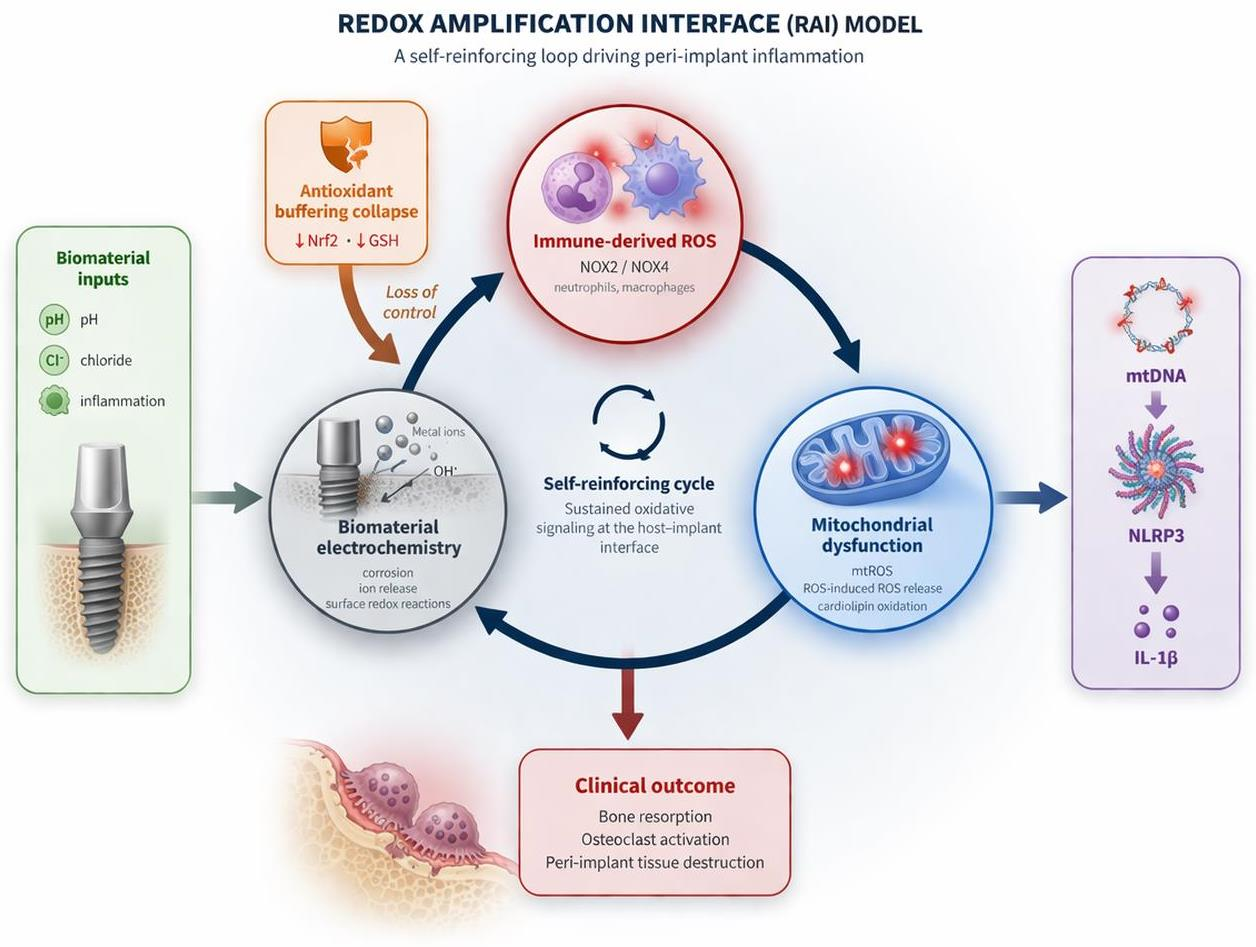
A Redox Amplification Interface Linking Mitochondrial Dysfunction, Immune-Derived Oxidants, and Biomaterial Electrochemistry in Chronic Inflammation

 ,
,  ,
,  ,
,  ,
,
Abstract
1. Introduction
2. Physiological Redox Signaling in Peri-Implant Tissue Homeostasis
3. Redox Buffering Collapse and Immune–Mitochondrial Amplification in Peri-Implant Inflammation
3.1. Failure of Antioxidant Buffering: Nrf2 Exhaustion and Glutathione Depletion
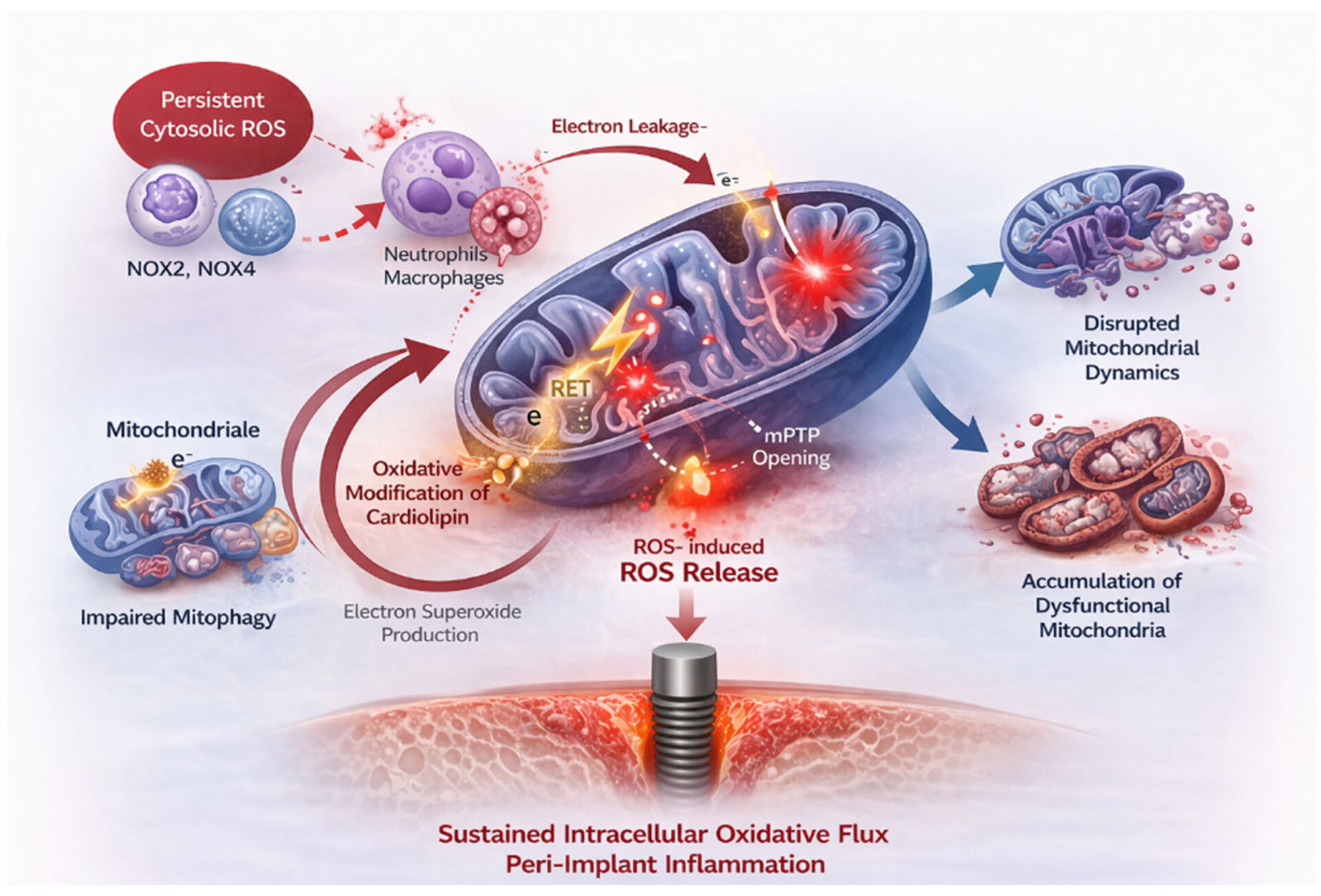
3.2. Mitochondrial Dysfunction and ROS-Induced ROS Release as the Central Amplification Engine
3.3. Redox-Driven Immune–Mitochondrial Inflammatory Feedback Loop
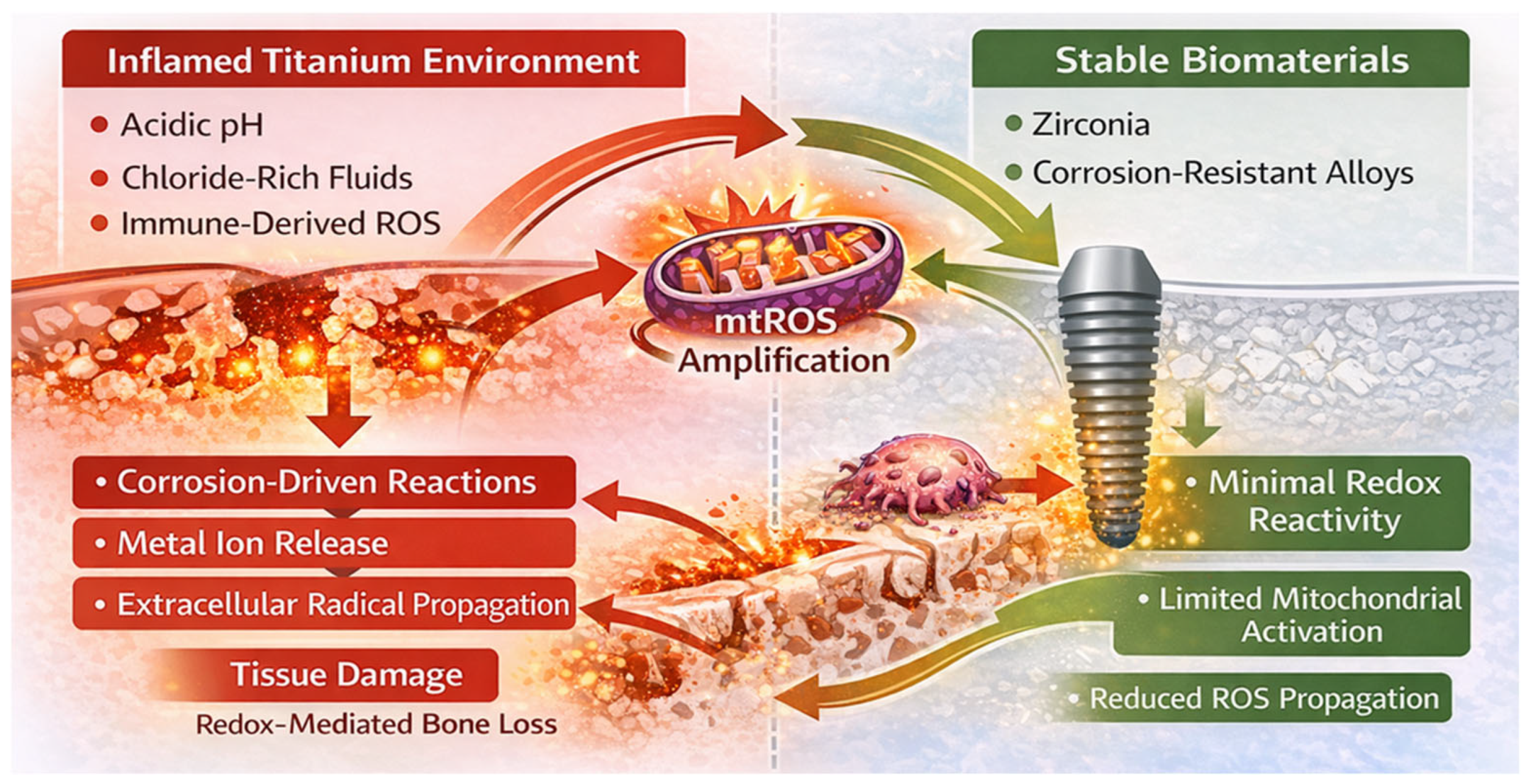
4. Biomaterial-Driven Redox Amplification at the Host–Implant Interface
4.1. Corrosion Electrochemistry and Oxidative Microenvironments
4.2. Metal Particle Immunology and Inflammatory ROS Generation
4.3. Implant Surface Redox Catalysis and Interfacial Oxidative Processes
4.4. Integration of Material Reactivity with Host Redox Susceptibility
5. Clinical Redox Phenotypes and Oxidative Biomarkers as Functional Readouts
5.1. Oxidative Damage Markers Reflecting Mitochondrial and Inflammatory ROS Activity
5.2. Biomarkers of Redox Buffering Capacity and Antioxidant Depletion
5.3. Emerging Approaches: Redox Proteomics and Oxidative Signaling Signatures
5.4. Local Versus Systemic Oxidative Biomarkers
5.5. Redox Phenotypes and Translational Implications
6. Redox-Targeted Therapeutic Strategies at the Host–Implant Interface
6.1. Modulation of Immune-Derived ROS Generation at the Biomaterial Interface
6.2. Restoration of Endogenous Antioxidant Capacity and Redox Buffering
6.3. Targeting Mitochondrial Oxidative Amplification and Bioenergetic Dysfunction
6.4. Biomaterial Strategies to Limit Redox Amplification
6.5. Toward Biomarker-Guided Redox Therapy
7. Testable Predictions of the Redox Amplification Interface Model
8. Experimental Validation Strategies for the RAI Framework
9. Discussion
10. Materials and Methods
11. Conclusions
Author Contributions
Funding
Institutional Review Board Statement
Informed Consent Statement
Data Availability Statement
Acknowledgments
Conflicts of Interest
References
- Derks, J.; Tomasi, C. Peri-implant health and disease. A systematic review of current epidemiology. J. Clin. Periodontol. 2015, 42, S158–S171. [Google Scholar] [CrossRef]
- Schwarz, F.; Derks, J.; Monje, A.; Wang, H.L. Peri-implantitis. J. Periodontol. 2018, 89, S267–S290. [Google Scholar] [CrossRef]
- Berglundh, T.; Armitage, G.; Araujo, M.G.; Avila-Ortiz, G.; Blanco, J.; Camargo, P.M.; Chen, S.; Cochran, D.; Derks, J.; Figuero, E.; et al. Peri-implant diseases and conditions: Consensus report of workgroup 4 of the 2017 World Workshop. J. Clin. Periodontol. 2018, 45, S286–S291. [Google Scholar] [CrossRef]
- Albrektsson, T.; Canullo, L. Clinical relevance of marginal bone loss around dental implants. Clin. Implant Dent. Relat. Res. 2021, 23, 299–304. [Google Scholar] [CrossRef]
- Sczepanik, F.S.C.; Grossi, M.L.; Casati, M.; Goldberg, M.; Glogauer, M.; Fine, N.; Tenenbaum, H.C. Periodontitis is an inflammatory disease of oxidative stress: We should treat it that way. Periodontology 2000, 84, 45–68. [Google Scholar] [CrossRef]
- Romandini, M.; Lima, S.; Pedrinaci, I.; Araoz, A.; Soldini, M.C.; Sanz, M. Prevalence and risk/protective indicators of peri-implant diseases: A university-representative cross-sectional study. J. Clin. Periodontol. 2021, 48, 112–122. [Google Scholar] [CrossRef] [PubMed]
- Lee, C.T.; Huang, Y.W.; Zhu, L.; Weltman, R. Prevalences of peri-implantitis and peri-implant mucositis: Systematic review and meta-analysis. J. Dent. 2017, 62, 1–12. [Google Scholar] [CrossRef] [PubMed]
- Renvert, S.; Polyzois, I. Risk indicators for peri-implant mucositis: A systematic literature review. J. Clin. Periodontol. 2015, 42, S172–S186. [Google Scholar] [CrossRef]
- Heitz-Mayfield, L.J.A.; Salvi, G.E. Peri-implant mucositis. J. Clin. Periodontol. 2018, 45, S237–S245. [Google Scholar] [CrossRef] [PubMed]
- Van Dyke, T.E.; Sima, M.J. Understanding resolution of inflammation in periodontitis: Is chronic inflammatory disease a failure to resolve? J. Periodontol. 2020, 91, 133–141. [Google Scholar] [CrossRef]
- Kamodyová, N.; Tóthová, L.; Celec, P. Salivary markers of oxidative stress and antioxidant status: Influence of external factors. Dis. Markers 2013, 34, 313–321. [Google Scholar] [CrossRef] [PubMed]
- Viglianisi, G.; Tartaglia, G.M.; Santonocito, S.; Amato, M.; Polizzi, A.; Mascitti, M.; Isola, G. The emerging role of salivary oxidative stress biomarkers as prognostic markers of periodontitis: New insights for a personalized approach in dentistry. J. Pers. Med. 2023, 13, 166. [Google Scholar] [CrossRef] [PubMed]
- Moldogazieva, N.T.; Mokhosoev, I.M.; Feldman, N.B.; Lutsenko, S.V. ROS and RNS signalling: Adaptive redox switches through oxidative/nitrosative protein modifications. Free Radic. Res. 2018, 52, 507–543. [Google Scholar] [CrossRef] [PubMed]
- Forman, H.J.; Zhang, H.; Rinna, A. Glutathione: Overview of its protective roles, measurement, and biosynthesis. Mol. Asp. Med. 2009, 30, 1–12. [Google Scholar] [CrossRef] [PubMed]
- Schieber, M.; Chandel, N.S. ROS function in redox signaling and oxidative stress. Curr. Biol. 2014, 24, R453–R462. [Google Scholar] [CrossRef]
- Cuadrado, A.; Rojo, A.I.; Wells, G.; Hayes, J.D.; Cousin, S.P.; Rumsey, W.L.; Attucks, O.C.; Franklin, S.; Levonen, A.L.; Kensler, T.W.; et al. Therapeutic targeting of the NRF2 pathway: Clinical development and challenges. Nat. Rev. Drug. Discov. 2019, 18, 295–317. [Google Scholar] [CrossRef]
- Yamamoto, M.; Kensler, T.W.; Motohashi, H. The KEAP1-NRF2 system: A thiol-based sensor-effector apparatus for maintaining redox homeostasis. Physiol. Rev. 2018, 98, 1169–1203. [Google Scholar] [CrossRef]
- Murphy, M.P. How mitochondria produce reactive oxygen species. Biochem. J. 2009, 417, 1–13. [Google Scholar] [CrossRef]
- Zorov, D.B.; Juhaszova, M.; Sollott, S.J. Mitochondrial reactive oxygen species (ROS) and ROS-induced ROS release. Physiol. Rev. 2014, 94, 909–950. [Google Scholar] [CrossRef]
- Paradies, G.; Paradies, V.; Ruggiero, F.M.; Petrosillo, G. Oxidative stress, cardiolipin and mitochondrial dysfunction in nonalcoholic fatty liver disease. World J. Gastroenterol. 2014, 20, 14205–14218. [Google Scholar] [CrossRef]
- West, A.P.; Shadel, G.S. Mitochondrial DNA in innate immune responses and inflammatory pathology. Nat. Rev. Immunol. 2017, 17, 363–375. [Google Scholar] [CrossRef] [PubMed]
- Hanawa, T. Titanium-tissue interface reaction and its control with surface treatment. Front. Bioeng. Biotechnol. 2019, 7, 170. [Google Scholar] [CrossRef]
- Souza, J.C.; Sordi, M.B.; Kanazawa, M.; Ravindran, S.; Henriques, B.; Silva, F.S.; Aparicio, C.; Cooper, L.F. Nano-scale modification of titanium implant surfaces to enhance osseointegration. Acta Biomater. 2019, 94, 112–131. [Google Scholar] [CrossRef] [PubMed]
- Furlanetto, M.; Castro, R.; Silva, F.; Pereira, J.; Macedo, J.; Soares, S. Titanium particle impact on immune cells, cytokines, and inflammasomes: Helping to profile peri-implantitis—A systematic review. Oral 2025, 5, 80. [Google Scholar] [CrossRef]
- Souza, J.C.; Apaza-Bedoya, K.; Benfatti, C.A.; Silva, F.S.; Henriques, B. A comprehensive review on the corrosion pathways of titanium dental implants and their biological adverse effects. Metals 2020, 10, 1272. [Google Scholar] [CrossRef]
- Hotchkiss, K.M.; Ayad, K.; Hyzy, J.P.; Schwartz, Z.; Boyan, B.D.; Olivares-Navarrete, R. Titanium surface characteristics, including topography and wettability, alter macrophage activation. Acta Biomater. 2016, 31, 425–434. [Google Scholar] [CrossRef]
- Zhong, J.X.; Raghavan, P.; Desai, T.A. Harnessing biomaterials for immunomodulatory-driven tissue engineering. Regen. Eng. Transl. Med. 2023, 9, 224–239. [Google Scholar] [CrossRef]
- Sabini, E.; Arboit, L.; Khan, M.P.; Lanzolla, G.; Schipani, E. Oxidative phosphorylation in bone cells. Bone Rep. 2023, 18, 101688. [Google Scholar] [CrossRef]
- Georgiou-Siafis, S.K.; Tsiftsoglou, A.S. The key role of GSH in keeping the redox balance in mammalian cells: Mechanisms and significance of GSH in detoxification via formation of conjugates. Antioxidants 2023, 12, 1953. [Google Scholar] [CrossRef]
- Yang, J.; Carroll, K.S.; Liebler, D.C. The expanding landscape of the thiol redox proteome. Mol. Cell. Proteom. 2016, 15, 1–11. [Google Scholar] [CrossRef]
- Paulsen, C.E.; Carroll, K.S. Cysteine-mediated redox signaling: Chemistry, biology, and tools for discovery. Chem. Rev. 2013, 113, 4633–4679. [Google Scholar] [CrossRef]
- Go, Y.M.; Jones, D.P. Redox compartmentalization in eukaryotic cells. Biochim. Biophys. Acta Gen. Subj. 2008, 1780, 1273–1290. [Google Scholar] [CrossRef]
- Bedard, K.; Krause, K.H. The NOX family of ROS-generating NADPH oxidases: Physiology and pathophysiology. Physiol. Rev. 2007, 87, 245–313. [Google Scholar] [CrossRef]
- Nguyen, G.T.; Green, E.R.; Mecsas, J. Neutrophils to the ROScue: Mechanisms of NADPH oxidase activation and bacterial resistance. Front. Cell. Infect. Microbiol. 2017, 7, 373. [Google Scholar] [CrossRef] [PubMed]
- Lennicke, H.; Cochemé, M.P. Redox metabolism: ROS as specific molecular regulators of cell signaling and function. Mol. Cell 2021, 81, 3691–3707. [Google Scholar] [CrossRef] [PubMed]
- Mills, E.L.; Kelly, B.; O’Neill, L.A.J. Mitochondria are the powerhouses of immunity. Nat. Immunol. 2017, 18, 488–498. [Google Scholar] [CrossRef]
- Tannahill, G.M.; Curtis, A.M.; Adamik, J.; Palsson-McDermott, E.M.; McGettrick, A.F.; Goel, G.; Frezza, C.; Bernard, N.J.; Kelly, B.; Foley, N.H.; et al. Succinate is an inflammatory signal that induces IL-1β through HIF-1α. Nature 2013, 496, 238–242. [Google Scholar] [CrossRef] [PubMed]
- Manolagas, S.C. From estrogen-centric to aging and oxidative stress: A revised perspective of the pathogenesis of osteoporosis. Endocr. Rev. 2010, 31, 266–300. [Google Scholar] [CrossRef]
- Lu, J.S.; Zhao, Y.H.; Mu, F.Y.; Song, C.Y.; Yang, M.; Huang, Y.S.; Wang, K.Y. Mitochondrial regulation of stem cell osteogenic differentiation: A key driver for bone regeneration. World J. Stem Cells 2025, 17, 113032. [Google Scholar] [CrossRef]
- Agidigbi, T.S.; Kim, C. Reactive oxygen species in osteoclast differentiation and possible pharmaceutical targets of ROS-mediated osteoclast diseases. Int. J. Mol. Sci. 2019, 20, 3576. [Google Scholar] [CrossRef]
- Xu, X.; Pang, Y.; Fan, X. Mitochondria in oxidative stress, inflammation and aging. Signal Transduct. Target. Ther. 2025, 10, 45. [Google Scholar] [CrossRef]
- Dominic, A.; Le, N.T.; Takahashi, M. A loop between NLRP3 inflammasome and reactive oxygen species. Antioxid. Redox Signal. 2022, 36, 784–799. [Google Scholar] [CrossRef] [PubMed]
- Chen, Y.; Ye, X.; Escames, G.; Lei, W.; Zhang, X.; Li, M.; Jing, T.; Yao, Y.; Qiu, Z.; Wang, Z.; et al. The NLRP3 inflammasome: Contributions to inflammation-related diseases. Cell. Mol. Biol. Lett. 2023, 28, 51. [Google Scholar] [CrossRef] [PubMed]
- Litwiniuk, A.; Baranowska-Bik, A.; Domańska, A.; Kalisz, M.; Bik, W. Contribution of mitochondrial dysfunction combined with NLRP3 inflammasome activation in selected neurodegenerative diseases. Pharmaceuticals 2021, 14, 1221. [Google Scholar] [CrossRef]
- Pervin, M.; de Haan, J.B. Dysregulated redox signaling and its impact on inflammatory pathways, mitochondrial dysfunction, autophagy and cardiovascular diseases. Antioxidants 2025, 14, 1278. [Google Scholar] [CrossRef]
- Pickles, S.; Vigié, P.; Youle, R.J. Mitophagy and quality control mechanisms in mitochondrial maintenance. Curr. Biol. 2018, 28, R170–R185. [Google Scholar] [CrossRef]
- Bernardi, P.; Di Lisa, F. The mitochondrial permeability transition pore: Molecular nature and role as a target in cardioprotection. J. Mol. Cell. Cardiol. 2015, 78, 100–106. [Google Scholar] [CrossRef] [PubMed]
- Tilokani, L.; Nagashima, S.; Paupe, V.; Prudent, J. Mitochondrial dynamics: Overview of molecular mechanisms. Essays Biochem. 2018, 62, 341–360. [Google Scholar] [CrossRef]
- Winterbourn, C.C. Biological production, detection, and fate of hydrogen peroxide. Antioxid. Redox Signal. 2018, 29, 541–551. [Google Scholar] [CrossRef]
- Dikalov, S.I. Cross talk between mitochondria and NADPH oxidases. Free Radic. Biol. Med. 2020, 152, 190–201. [Google Scholar] [CrossRef]
- Tonelli, C.; Chio, I.I.C.; Tuveson, D.A. Transcriptional regulation by Nrf2. Antioxid. Redox Signal. 2018, 29, 1727–1745. [Google Scholar] [CrossRef]
- Kobayashi, E.H.; Suzuki, T.; Funayama, R.; Nagashima, T.; Hayashi, M.; Sekine, H.; Tanaka, N.; Moriguchi, T.; Motohashi, H.; Nakayama, K.; et al. Nrf2 suppresses macrophage inflammatory response by blocking proinflammatory cytokine transcription. Nat. Commun. 2016, 7, 11624. [Google Scholar] [CrossRef] [PubMed]
- Bellezza, I.; Giambanco, I.; Minelli, A.; Donato, R. Nrf2-Keap1 signaling in oxidative and reductive stress. Biochim. Biophys. Acta Mol. Cell Res. 2018, 1865, 721–733. [Google Scholar] [CrossRef] [PubMed]
- Saha, S.; Buttari, B.; Panieri, E.; Profumo, E.; Saso, L. An overview of Nrf2 signaling pathway and its role in inflammation. Molecules 2020, 25, 5474. [Google Scholar] [CrossRef]
- Lu, S.C. Glutathione synthesis. Biochim. Biophys. Acta Gen. Subj. 2013, 1830, 3143–3153. [Google Scholar] [CrossRef]
- Crisman, E.; Duarte, P.; Dauden, E.; Cuadrado, A.; Rodríguez-Franco, M.I.; López, M.G.; León, R. KEAP1-NRF2 protein-protein interaction inhibitors: Design, pharmacological properties and therapeutic potential. Med. Res. Rev. 2023, 43, 237–287. [Google Scholar] [CrossRef]
- Dodson, M.; Castro-Portuguez, R.; Zhang, D.D. NRF2 plays a critical role in mitigating lipid peroxidation and ferroptosis. Redox Biol. 2019, 23, 101107. [Google Scholar] [CrossRef]
- Ursini, L.; Maiorino, M. Lipid peroxidation and ferroptosis: The role of glutathione peroxidase 4. Free Radic. Biol. Med. 2020, 152, 175–185. [Google Scholar] [CrossRef]
- Chen, T.H.; Wang, H.C.; Chang, C.J.; Lee, S.Y. Mitochondrial glutathione in cellular redox homeostasis and disease manifestation. Int. J. Mol. Sci. 2024, 25, 1314. [Google Scholar] [CrossRef]
- Li, B.; Ming, H.; Qin, S.; Nice, E.C.; Dong, J.; Du, Z.; Huang, C. Redox regulation: Mechanisms, biology and therapeutic targets in diseases. Signal Transduct. Target. Ther. 2025, 10, 72. [Google Scholar] [CrossRef] [PubMed]
- Bellanti, F.; Coda, A.R.D.; Trecca, M.I.; Lo Buglio, A.; Serviddio, G.; Vendemiale, G. Redox imbalance in inflammation: The interplay of oxidative and reductive stress. Antioxidants 2025, 14, 656. [Google Scholar] [CrossRef]
- Chouchani, E.T.; Pell, V.R.; Gaude, E.; Aksentijević, D.; Sundier, S.Y.; Robb, E.L.; Logan, A.; Nadtochiy, S.M.; Ord, E.N.; Smith, A.C.; et al. Ischaemic accumulation of succinate controls reperfusion injury through mitochondrial ROS. Nature 2014, 515, 431–435. [Google Scholar] [CrossRef]
- Dorrington, M.G.; Fraser, I.D. NF-κB signaling in macrophages: Dynamics, crosstalk, and signal integration. Front. Immunol. 2019, 10, 705. [Google Scholar] [CrossRef] [PubMed]
- Antonucci, S.; Di Lisa, F.; Kaludercic, N. Mitochondrial reactive oxygen species in physiology and disease. Cell Calcium 2021, 94, 102344. [Google Scholar] [CrossRef] [PubMed]
- Yan, J.; Jiang, J.; He, L.; Chen, L. Mitochondrial superoxide/hydrogen peroxide: An emerging therapeutic target for metabolic diseases. Free Radic. Biol. Med. 2020, 152, 33–42. [Google Scholar] [CrossRef]
- El-Hafidi, M.; Correa, F.; Zazueta, C. Mitochondrial dysfunction in metabolic and cardiovascular diseases associated with cardiolipin remodeling. Biochim. Biophys. Acta Mol. Basis Dis. 2020, 1866, 165744. [Google Scholar] [CrossRef]
- Tang, Y.; Wu, J.; Sun, X.; Tan, S.; Li, W.; Yin, S.; Liu, L.; Chen, Y.; Liu, Y.; Tan, Q.; et al. Cardiolipin oxidized by ROS from complex II acts as a target of gasdermin D to drive mitochondrial pore and heart dysfunction in endotoxemia. Cell Rep. 2024, 43, 114237, Erratum in Cell Rep. 2025, 43, 115395. [Google Scholar] [CrossRef]
- Zheng, Y.; Sun, J.; Luo, Z.; Li, Y.; Huang, Y. Emerging mechanisms of lipid peroxidation in regulated cell death and its physiological implications. Cell Death Dis. 2024, 15, 859. [Google Scholar] [CrossRef]
- Bernardi, P.; Gerle, C.; Halestrap, A.P.; Jonas, E.A.; Karch, J.; Mnatsakanyan, N.; Pavlov, E.; Sheu, S.S.; Soukas, A.A. Identity, structure, and function of the mitochondrial permeability transition pore: Controversies, consensus, recent advances, and future directions. Cell Death Differ. 2023, 30, 1869–1885. [Google Scholar] [CrossRef]
- Bonora, M.; Giorgi, C.; Pinton, P. Molecular mechanisms and consequences of mitochondrial permeability transition. Nat. Rev. Mol. Cell Biol. 2022, 23, 266–285. [Google Scholar] [CrossRef] [PubMed]
- Khatun, J.; Gelles, J.D.; Chipuk, J.E. Dynamic death decisions: How mitochondrial dynamics shape cellular commitment to apoptosis and ferroptosis. Dev. Cell 2024, 59, 2549–2565. [Google Scholar] [CrossRef]
- Giacomello, M.; Pyakurel, A.; Glytsou, C.; Scorrano, L. The cell biology of mitochondrial membrane dynamics. Nat. Rev. Mol. Cell Biol. 2020, 21, 204–224. [Google Scholar] [CrossRef]
- Emaus, K.J.; Fogo, G.M.; Wider, J.M.; Sanderson, T.H. The role of cardiolipin in mitochondrial dynamics and quality control in neuronal ischemia/reperfusion injury. Cell Death Dis. 2025, 16, 494. [Google Scholar] [CrossRef]
- Ma, Y.; Song, R.; Duan, C. Mitochondrial quality control and transfer communication in neurological disorders and neuroinflammation. Front. Immunol. 2025, 16, 1542369. [Google Scholar] [CrossRef] [PubMed]
- Chai, Z.; Zhou, Y.; Hossain, S.; Huynh, K.; Hajimirzaei, S.; Zhang, Y.; Qi, J.; Zhang, G.; Li, Z.; Wei, Y. Cardiolipin’s multifaceted role in immune response: A focus on interacting proteins. Front. Immunol. 2025, 16, 1680326. [Google Scholar] [CrossRef]
- Forrester, S.J.; Kikuchi, D.S.; Hernandes, M.S.; Xu, Q.; Griendling, K.K. Reactive oxygen species in metabolic and inflammatory signaling. Circ. Res. 2018, 122, 877–902. [Google Scholar] [CrossRef]
- O’Neill, L.A.J.; Artyomov, M.N. Itaconate: The poster child of metabolic reprogramming in macrophage function. Nat. Rev. Immunol. 2019, 19, 273–281. [Google Scholar] [CrossRef] [PubMed]
- Sedghi, L.M.; Bacino, M.; Kapila, Y.L. Periodontal disease: The good, the bad, and the unknown. Front. Cell. Infect. Microbiol. 2021, 11, 766944. [Google Scholar] [CrossRef]
- Kumar, S.; Dikshit, M. Nitric oxide: Regulation and function in neutrophil immune responses. Antioxid. Redox Signal. 2024, 40, 998–1024. [Google Scholar] [CrossRef]
- Veith, C.; Boots, A.W.; Idris, M.; van Schooten, F.J.; van der Vliet, A. Redox imbalance in idiopathic pulmonary fibrosis: A role for oxidant cross-talk between NADPH oxidase enzymes and mitochondria. Antioxid. Redox Signal. 2019, 31, 1092–1115. [Google Scholar] [CrossRef] [PubMed]
- Sies, H.; Jones, D.P. Reactive oxygen species (ROS) as pleiotropic physiological signalling agents. Nat. Rev. Mol. Cell Biol. 2020, 21, 363–383. [Google Scholar] [CrossRef]
- Averill-Bates, D.A. Reactive oxygen species and cell signaling. Biochim. Biophys. Acta Mol. Cell Res. 2024, 1871, 119573. [Google Scholar] [CrossRef] [PubMed]
- Liu, T.; Zhang, L.; Joo, D.; Sun, S.C. NF-κB signaling in inflammation. Signal Transduct. Target. Ther. 2017, 2, 17023. [Google Scholar] [CrossRef]
- Youn, G.S.; Lee, K.W.; Choi, S.Y.; Park, J. Overexpression of HDAC6 induces pro-inflammatory responses by regulating ROS-MAPK-NF-κB/AP-1 signaling pathways in macrophages. Free Radic. Biol. Med. 2016, 97, 14–23. [Google Scholar] [CrossRef]
- Zhong, Z.; Liang, S.; Sanchez-Lopez, E.; He, F.; Shalapour, S.; Lin, X.J.; Wong, J.; Ding, S.; Seki, E.; Schnabl, B.; et al. New mitochondrial DNA synthesis enables NLRP3 inflammasome activation. Nature 2018, 560, 198–203. [Google Scholar] [CrossRef]
- Kodi, T.; Sankhe, R.; Gopinathan, A.; Nandakumar, K.; Kishore, A. New insights on NLRP3 inflammasome: Mechanisms of activation, inhibition, and epigenetic regulation. J. Neuroimmune Pharmacol. 2024, 19, 7. [Google Scholar] [CrossRef] [PubMed]
- Swanson, A.; Deng, W.; Ting, J.P.Y. The NLRP3 inflammasome: Molecular activation and regulation. Nat. Rev. Immunol. 2019, 19, 477–489. [Google Scholar] [CrossRef]
- Yang, J.; Liu, C.; Sun, H.; Liu, Y.; Liu, Z.; Zhang, D.; Zhao, G.; Wang, Q.; Yang, D. The progress in titanium alloys used as biomedical implants: From the view of reactive oxygen species. Front. Bioeng. Biotechnol. 2022, 10, 1092916. [Google Scholar] [CrossRef]
- Zhang, Y.T.; Hu, C.; Zhang, S.X.; Zhou, H.H.; Xu, J.; Ma, J.D.; Dai, L.; Gu, Q. Euphoesulatin A prevents osteoclast differentiation and bone loss via inhibiting RANKL-induced ROS production and NF-κB and MAPK signal pathways. Bioorg. Chem. 2022, 119, 105511. [Google Scholar] [CrossRef]
- Yoon, H.; Park, S.G.; Kim, H.J.; Shin, H.R.; Kim, K.T.; Cho, Y.D.; Moon, J.I.; Park, M.S.; Kim, W.J.; Ryoo, H.M. Nicotinamide enhances osteoblast differentiation through activation of the mitochondrial antioxidant defense system. Exp. Mol. Med. 2023, 55, 1531–1543. [Google Scholar] [CrossRef] [PubMed]
- Wang, L.; Liang, Y.; Zhou, X.; Tian, Y.; Miao, Z.; Ko, C.C.; Hu, X. Nrf2 differentially regulates osteoclast and osteoblast differentiation for bone homeostasis. Biochem. Biophys. Res. Commun. 2023, 674, 19–26. [Google Scholar] [CrossRef]
- Mierzejewska, Ż.A.; Woźniak, Ł.; Lechien, J.R.; Borys, J.; Łukaszuk, K.; Antonowicz, B. Beyond biocompatibility: Immune dysregulation, oxidative stress, and tissue intolerance associated with Ti-6Al-4V dental implants—A critical review and perspective. Antioxidants 2026, 15, 365. [Google Scholar] [CrossRef] [PubMed]
- Stich, T.; Alagboso, F.; Křenek, T.; Kovářík, T.; Alt, V.; Docheva, D. Implant-bone interface: Reviewing the impact of titanium surface modifications on osteogenic processes in vitro and in vivo. Bioeng. Transl. Med. 2022, 7, e10239. [Google Scholar] [CrossRef]
- Zhang, W.N.; Chen, L.Y.; Saimi, A.; Huang, L.J.; He, J.J.; Luo, X.P. Passive film characteristics of laser powder bed fusion produced commercially pure titanium: Effects of temperature and annealing on corrosion resistance. J. Mater. Res. Technol. 2025, 36, 6604–6618. [Google Scholar] [CrossRef]
- Nagay, B.E.; Cordeiro, J.M.; Barão, V.A.R. Insight into corrosion of dental implants: From biochemical mechanisms to designing corrosion-resistant materials. Curr. Oral Health Rep. 2022, 9, 7–21. [Google Scholar] [CrossRef]
- Kandaswamy, E.; Harsha, M.; Joshi, V.M. Titanium corrosion products from dental implants and their effect on cells and cytokine release: A review. J. Trace Elem. Med. Biol. 2024, 84, 127464. [Google Scholar] [CrossRef]
- Darby, I. Risk factors for periodontitis and peri-implantitis. Periodontology 2000, 90, 9–12. [Google Scholar] [CrossRef]
- Mittal, M.; Siddiqui, M.R.; Tran, K.; Reddy, S.P.; Malik, A.B. Reactive oxygen species in inflammation and tissue injury. Antioxid. Redox Signal. 2014, 20, 1126–1167. [Google Scholar] [CrossRef] [PubMed]
- Borys, J.; Maciejczyk, M.; Antonowicz, B.; Krętowski, A.; Waszkiel, D.; Bortnik, P.; Czarniecka-Bargłowska, K.; Kocisz, M.; Szulimowska, J.; Czajkowski, M.; et al. Exposure to Ti4Al4V titanium alloy leads to redox abnormalities, oxidative stress, and oxidative damage in patients treated for mandible fractures. Oxid. Med. Cell. Longev. 2018, 2018, 3714725. [Google Scholar] [CrossRef]
- Chen, L.; Tong, Z.; Luo, H.; Qu, Y.; Gu, X.; Si, M. Titanium particles in peri-implantitis: Distribution, pathogenesis and prospects. Int. J. Oral Sci. 2023, 15, 49. [Google Scholar] [CrossRef] [PubMed]
- Madi, H.A.; Feine, E.J.; Tran, S.D. Titanium Dental Implant Corrosion in Peri-Implantitis and Implant Failure Corrosion of titanium dental implants in peri-implant inflammatory environments: Mechanisms and clinical implications. Adv. Exp. Med. Biol.;Bioact. Mater. 2026, 1492, 463–483. [Google Scholar] [CrossRef]
- Xu, A.; Alhamad, M.; Ampadi Ramachandran, R.; Shukla, A.; Barão, V.A.R.; Sukotjo, C.; Mathew, M.T. Peri-implantitis in relation to titanium corrosion: Current status and future perspectives. J. Bio-Tribo-Corros. 2022, 8, 46. [Google Scholar] [CrossRef]
- Boffano, P.; Brucoli, M.; Rocchetti, V. Corrosion features of titanium alloys in dental implants: A systematic review. J. Maxillofac. Oral Surg. 2024, 25, 189–197. [Google Scholar] [CrossRef] [PubMed]
- Alhamad, M.; Barão, V.A.R.; Sukotjo, C.; Yerokhin, A.L.; Mathew, M.T. Unpredictable electrochemical processes in Ti dental implants: The role of Ti ions and inflammatory products. ACS Appl. Bio Mater. 2023, 6, 3661–3673. [Google Scholar] [CrossRef] [PubMed]
- Fretwurst, T.; Nelson, K.; Tarnow, D.P.; Wang, H.L.; Giannobile, W.V. Is metal particle release associated with peri-implant bone destruction? An emerging concept. J. Dent. Res. 2018, 97, 259–265. [Google Scholar] [CrossRef]
- Sies, H.; Berndt, C.; Jones, D.P. Oxidative stress. Annu. Rev. Biochem. 2017, 86, 715–748. [Google Scholar] [CrossRef]
- Geetha, M.; Singh, A.K.; Asokamani, R.; Gogia, A.K. Ti based biomaterials, the ultimate choice for orthopaedic implants–A review. Prog. Mater. Sci. 2009, 54, 397–425. [Google Scholar] [CrossRef]
- Zhou, Z.; Shi, Q.; Wang, J.; Chen, X.; Hao, Y.; Zhang, Y.; Wang, X. The unfavorable role of titanium particles released from dental implants. Nanotheranostics 2021, 5, 321–332. [Google Scholar] [CrossRef]
- Bondarenko, O.O.; Rolduhina, M.O.; Bondarenko, N.S.; Maltsev, I.O.; Loskutov, O.Y.; Shpon’ka, I.S. Osteoimmunomodulation by functional protective coatings: Tuning innate and adaptive immunity for titanium implant osseointegration. Rep. Morphol. 2026, 32, 38–46. [Google Scholar] [CrossRef]
- Fretwurst, M.; Buzanich, G.; Nehles, S.; Woelber, J.P.; Riesemeier, H.; Nelson, K. Metal elements in tissue with dental peri-implantitis: A pilot study. Clin. Oral Implant. Res. 2015, 9, 1178–1186. [Google Scholar] [CrossRef] [PubMed]
- Toledano-Serrabona, J.; Bosch, B.M.; Díez-Tercero, L.; Gil, F.J.; Camps-Font, O.; Valmaseda-Castellón, E.; Gay-Escoda, C.; Sánchez-Garcés, M.Á. Evaluation of the inflammatory and osteogenic response induced by titanium particles released during implantoplasty of dental implants. Sci. Rep. 2022, 12, 15790. [Google Scholar] [CrossRef]
- Miron, R.J.; Bohner, M.; Zhang, Y.; Bosshardt, D.D. Osteoinduction and osteoimmunology: Emerging concepts. Periodontol. 2000 2023, 94, 9–26. [Google Scholar] [CrossRef] [PubMed]
- Wang, W.; Liang, X.; Liu, X.; Bai, J.; Zhang, W.; Li, W.; Wang, T.; Li, M.; Wu, Z.; Chen, L.; et al. NOX4 blockade suppresses titanium nanoparticle-induced bone destruction via activation of the Nrf2 signaling pathway. J. Nanobiotechnol. 2022, 20, 241. [Google Scholar] [CrossRef] [PubMed]
- Chai, H.; Huang, Q.; Jiao, Z.; Wang, S.; Sun, C.; Geng, D.; Xu, W. Osteocytes exposed to titanium particles inhibit osteoblastic cell differentiation via connexin 43. Int. J. Mol. Sci. 2023, 24, 10864. [Google Scholar] [CrossRef] [PubMed]
- Li, N.; Zhang, R.; Tang, M.; Zhao, M.; Jiang, X.; Cai, X.; Ye, N.; Su, K.; Peng, J.; Zhang, X.; et al. Recent progress and prospects of small molecules for NLRP3 inflammasome inhibition. J. Med. Chem. 2023, 66, 14447–14473. [Google Scholar] [CrossRef]
- Kelley, A.; Jeltema, R.; Duan, Y.; He, Y. The NLRP3 inflammasome: An overview of mechanisms of activation and regulation. Int. J. Mol. Sci. 2019, 20, 3328. [Google Scholar] [CrossRef]
- Romanos, G.E.; Fischer, G.A.; Delgado-Ruiz, R. Titanium wear of dental implants from placement, under loading and maintenance protocols. Int. J. Mol. Sci. 2021, 22, 1067. [Google Scholar] [CrossRef]
- Goodman, S.B.; Gibon, E.; Gallo, J.; Takagi, M. Macrophage polarization and the osteoimmunology of periprosthetic osteolysis. Curr. Osteoporos. Rep. 2022, 20, 43–52. [Google Scholar] [CrossRef]
- Wakuda, S.; Hasuike, A.; Fujiwara, K.; Sakai, R.; Chaurasia, A.; Uchiyama, T.; Sato, S. Titanium particle-induced inflammasome in human gingival epithelial cells. J. Dent. Sci. 2025, 20, 384–392. [Google Scholar] [CrossRef]
- Swalsky, A.; Noumbissi, S.S.; Wiedemann, T.G. The systemic and local interactions related to titanium implant corrosion and hypersensitivity reactions: A narrative review of the literature. Int. J. Implant Dent. 2024, 10, 58. [Google Scholar] [CrossRef]
- Hrir, H.; Ait Layachi, O.; Boudouma, A.; El Bouari, A.; Ait Sidimou, A.; El Marrakchi, M.; Khoumri, E. Electrochemical corrosion behavior of α-titanium alloys in simulated biological environments (comparative study). RSC Adv. 2024, 14, 38110–38119. [Google Scholar] [CrossRef] [PubMed]
- Forcina, G.C.; Dixon, S.J. GPX4 at the crossroads of lipid homeostasis and ferroptosis. Proteomics 2019, 19, 1800311. [Google Scholar] [CrossRef] [PubMed]
- Liu, S.; Liu, J.; Wang, Y.; Deng, F.; Deng, Z. Oxidative stress: Signaling pathways, biological functions, and disease. MedComm 2025, 6, e70268. [Google Scholar] [CrossRef]
- Callaghan, N.I.; Rempe, C.N.; Froom, Z.S.C.S.; Medd, K.T.; Huyer, L.D. Cell dynamics and metabolism of the foreign body response: Characterizing host–biomaterial interactions for next-generation medical implant biocompatibility. Mater. Adv. 2024, 5, 6719–6738. [Google Scholar] [CrossRef]
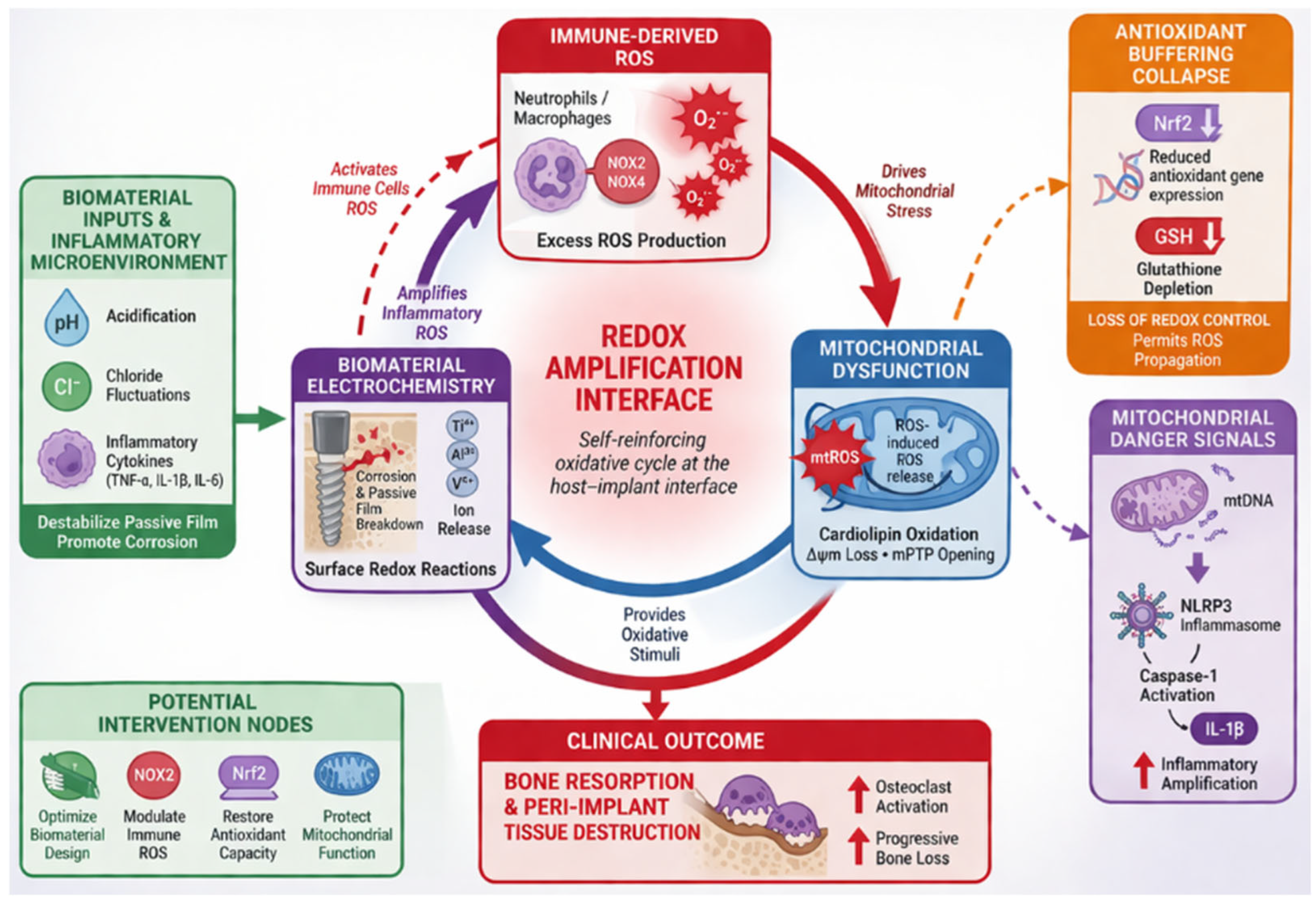


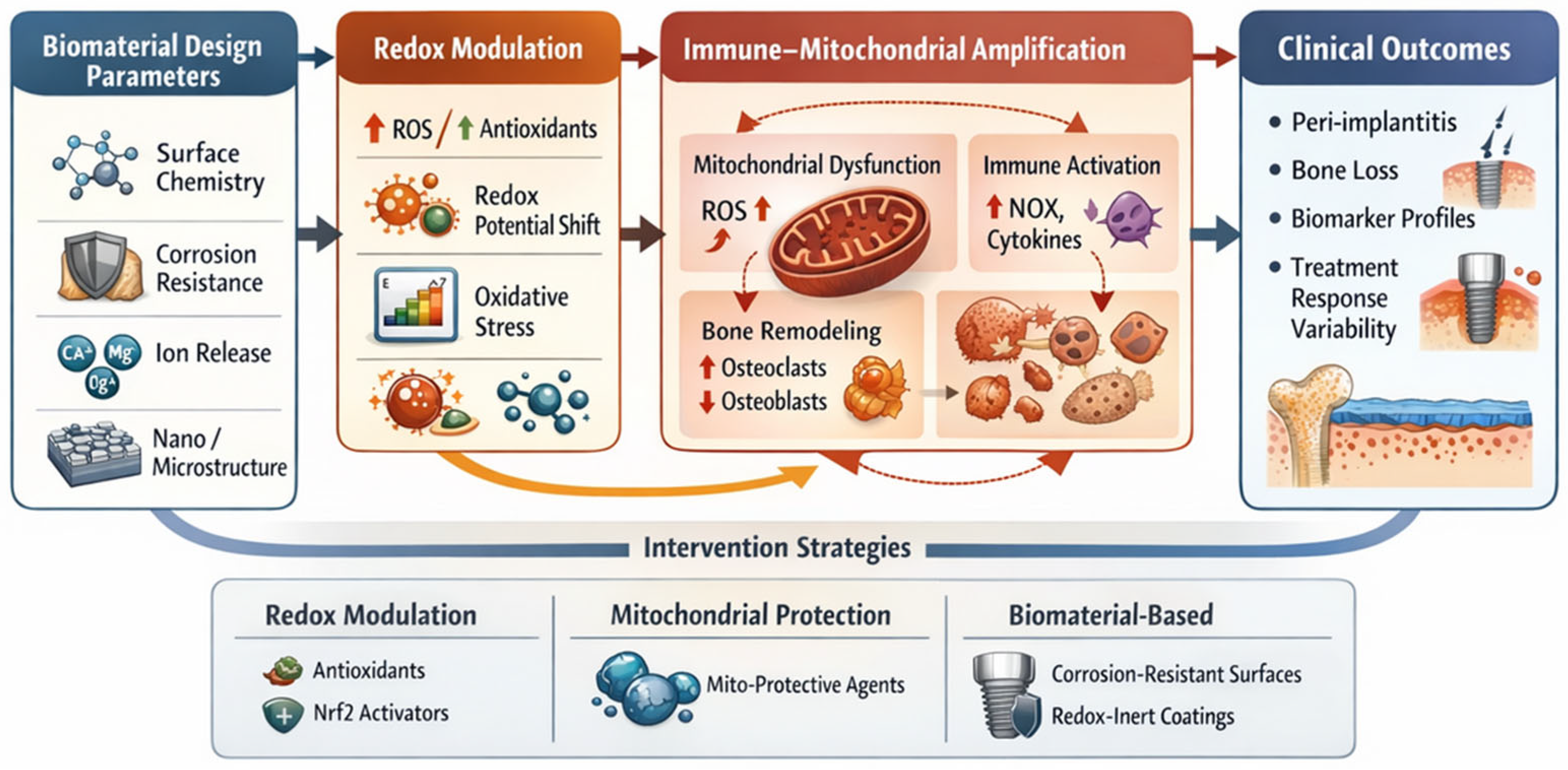

| Biological Domain | Physiological ROS Signaling | Redox Dysregulation Under Chronic Inflammation | Functional Outcome |
|---|---|---|---|
| Innate immunity | Transient NOX2/NOX4 activation with spatial confinement | Sustained NOX activity and mitochondrial ROS amplification | Persistent inflammatory signaling |
| Mitochondrial metabolism | Controlled ROS supporting bioenergetic regulation | ETC complex damage and ROS-induced ROS release | Metabolic dysfunction |
| Osteoblast biology | ROS-mediated activation of Runx2 and Wnt/β-catenin | Oxidative suppression of osteogenic transcription | Impaired bone formation |
| Osteoclast differentiation | Controlled ROS facilitation of RANKL signaling | Excessive NFATc1 activation and ROS amplification | Accelerated bone resorption |
| Angiogenesis | Redox-regulated HIF signaling and vascular adaptation | Oxidative endothelial injury | Impaired vascular adaptation |
| Antioxidant defense | Nrf2-regulated glutathione homeostasis | Nrf2 exhaustion and thiol depletion | Loss of redox buffering |
| Redox Control System | Primary Disruption | Molecular Consequence | Pathogenic Amplification |
|---|---|---|---|
| Nrf2-Keap1 signaling | Chronic inflammatory suppression | Reduced antioxidant gene expression | Progressive ROS accumulation |
| Glutathione system | Excess oxidant neutralization | Shift toward oxidized cellular redox potential | Mitochondrial vulnerability |
| Mitochondrial integrity | ETC complex I/III oxidative injury | Increased electron leakage | ROS-induced ROS release |
| Mitophagy pathways | Oxidative inhibition of quality control | Accumulation of dysfunctional mitochondria | Sustained oxidative flux |
| NADPH regeneration | Metabolic and inflammatory stress | Impaired glutathione recycling | Failure of redox recovery |
| Biomarker | Biological Target | RAI Layer Represented | Dominant Redox Mechanism | Translational Relevance |
|---|---|---|---|---|
| 8-hydroxy-2′-deoxyguanosine (8-OHdG) | Nuclear and mitochondrial DNA | Mitochondrial amplification | ROS-induced ROS release and mtDNA oxidation | Indicator of mitochondrial dysfunction and disease severity |
| Malondialdehyde (MDA) | Membrane lipids | Oxidative propagation layer | Lipid peroxidation and radical chain reactions | Reflects intensity of oxidative damage |
| Nitrotyrosine | Cellular proteins | Inflammatory redox coupling | Peroxynitrite-mediated nitrative stress | Marker of chronic inflammatory activation |
| Total antioxidant capacity | Systemic and local redox reserve | System-level resilience | Antioxidant network exhaustion | Predictor of disease susceptibility |
| Protein carbonyls | Structural and enzymatic proteins | Downstream oxidative damage | Irreversible protein oxidation | Indicator of cumulative oxidative injury |
| GSH/GSSG ratio | Cellular thiol pool | Antioxidant buffering layer | Redox buffering depletion | Marker of oxidative vulnerability |
| Biomarker | Biological target | RAI layer represented | Dominant redox mechanism | Translational relevance |
Disclaimer/Publisher’s Note: The statements, opinions and data contained in all publications are solely those of the individual author(s) and contributor(s) and not of MDPI and/or the editor(s). MDPI and/or the editor(s) disclaim responsibility for any injury to people or property resulting from any ideas, methods, instructions or products referred to in the content. |
© 2026 by the authors. Licensee MDPI, Basel, Switzerland. This article is an open access article distributed under the terms and conditions of the Creative Commons Attribution (CC BY) license.
Share and Cite
Mierzejewska, Ż.A.; Antonowicz, B.; Woźniak, Ł.; Lechien, J.R.; Vaira, L.A.; Dziełak, S.; Borys, J. A Redox Amplification Interface Linking Mitochondrial Dysfunction, Immune-Derived Oxidants, and Biomaterial Electrochemistry in Chronic Inflammation. Int. J. Mol. Sci. 2026, 27, 4121. https://doi.org/10.3390/ijms27094121
Mierzejewska ŻA, Antonowicz B, Woźniak Ł, Lechien JR, Vaira LA, Dziełak S, Borys J. A Redox Amplification Interface Linking Mitochondrial Dysfunction, Immune-Derived Oxidants, and Biomaterial Electrochemistry in Chronic Inflammation. International Journal of Molecular Sciences. 2026; 27(9):4121. https://doi.org/10.3390/ijms27094121
Chicago/Turabian StyleMierzejewska, Żaneta Anna, Bożena Antonowicz, Łukasz Woźniak, Jérôme R. Lechien, Luigi Angelo Vaira, Stanisław Dziełak, and Jan Borys. 2026. "A Redox Amplification Interface Linking Mitochondrial Dysfunction, Immune-Derived Oxidants, and Biomaterial Electrochemistry in Chronic Inflammation" International Journal of Molecular Sciences 27, no. 9: 4121. https://doi.org/10.3390/ijms27094121
APA StyleMierzejewska, Ż. A., Antonowicz, B., Woźniak, Ł., Lechien, J. R., Vaira, L. A., Dziełak, S., & Borys, J. (2026). A Redox Amplification Interface Linking Mitochondrial Dysfunction, Immune-Derived Oxidants, and Biomaterial Electrochemistry in Chronic Inflammation. International Journal of Molecular Sciences, 27(9), 4121. https://doi.org/10.3390/ijms27094121