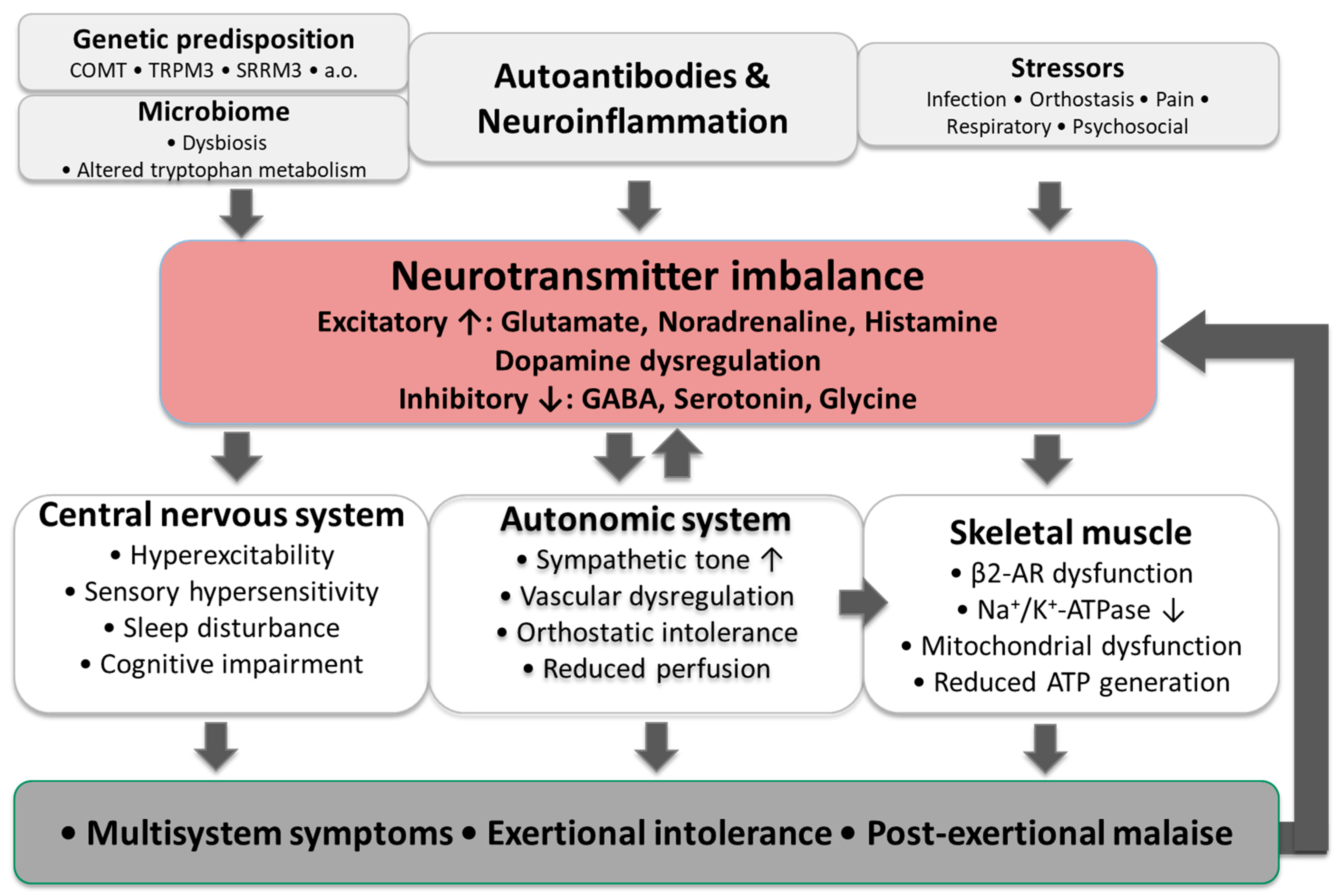
Imbalance of Excitatory and Inhibitory Neurotransmitter Systems in Myalgic Encephalomyelitis/Chronic Fatigue Syndrome


Abstract
1. Introduction
2. Disturbances of the Neurotransmitter Systems in ME/CFS
2.1. Noradrenergic System
2.2. Serotonin
2.3. GABA
2.4. Glutamate
2.5. Glycine
2.6. Dopamine
2.7. Histamine
2.8. Summary of the Neurotransmitter Disturbances
3. Role of Neurotransmitter Imbalance in the Pathophysiology of ME/CFS and Their Potential Contribution to Typical Symptoms
3.1. Sleep Disturbances, Cognitive Impairment, and Sensory Hypersensitivities
3.2. Skeletal Muscle Pathophysiology
4. Why Current Treatments Targeting Neurotransmitter Imbalance Show Limited Efficacy in ME/CFS
5. Conclusions
Author Contributions
Funding
Data Availability Statement
Conflicts of Interest
References
- Carruthers, B.M.; van de Sande, M.I.; De Meirleir, K.L.; Klimas, N.G.; Broderick, G.; Mitchell, T.; Staines, D.; Powles, A.C.; Speight, N.; Vallings, R.; et al. Myalgic encephalomyelitis: International Consensus Criteria. J. Intern. Med. 2011, 270, 327–338, Corrigendum in J. Intern. Med. 2017, 282, 353. [Google Scholar] [CrossRef] [Scilit]
- Kedor, C.; Freitag, H.; Meyer-Arndt, L.; Wittke, K.; Hanitsch, L.G.; Zoller, T.; Steinbeis, F.; Haffke, M.; Rudolf, G.; Heidecker, B.; et al. A prospective observational study of post-COVID-19 chronic fatigue syndrome following the first pandemic wave in Germany and biomarkers associated with symptom severity. Nat. Commun. 2022, 13, 5104, Correction in Nat. Commun. 2022, 13, 6009. [Google Scholar] [CrossRef] [Scilit] [PubMed]
- Wyller, V.B.; Saul, J.; Amlie, J.P.; Thaulow, E. Sympathetic predominance of cardiovascular regulation during mild orthostatic stress in adolescents with chronic fatigue. Clin. Physiol. Funct. Imaging 2007, 27, 231–238. [Google Scholar] [CrossRef] [Scilit] [PubMed]
- Freeman, R.; Komaroff, A.L. Does the chronic fatigue syndrome involve the autonomic nervous system? Am. J. Med. 1997, 102, 357–364. [Google Scholar] [CrossRef] [Scilit] [PubMed]
- Stewart, J.M. Autonomic Nervous System Dysfunction in Adolescents with Postural Orthostatic Tachycardia Syndrome and Chronic Fatigue Syndrome Is Characterized by Attenuated Vagal Baroreflex and Potentiated Sympathetic Vasomotion. Pediatr. Res. 2000, 48, 218–226. [Google Scholar] [CrossRef] [Scilit]
- Van Cauwenbergh, D.; Nijs, J.; Kos, D.; Van Weijnen, L.; Struyf, F.; Meeus, M. Malfunctioning of the autonomic nervous system in patients with chronic fatigue syndrome: A systematic literature review. Eur. J. Clin. Investig. 2014, 44, 516–526. [Google Scholar] [CrossRef] [Scilit]
- Nelson, M.J.; Bahl, J.S.; Buckley, J.D.; Thomson, R.L.; Davison, K. Evidence of altered cardiac autonomic regulation in myalgic encephalomyelitis/chronic fatigue syndrome: A systematic review and meta-analysis. Medicine 2019, 98, e17600. [Google Scholar] [CrossRef] [Scilit]
- Sisto, S.A.; Tapp, W.; Drastal, S.; Bergen, M.; DeMasi, I.; Cordero, D.; Natelson, B. Vagal tone is reduced during paced breathing in patients with the chronic fatigue syndrome. Clin. Auton. Res. 1995, 5, 139–143. [Google Scholar] [CrossRef] [Scilit]
- Beaumont, A.; Burton, A.R.; Lemon, J.; Bennett, B.K.; Lloyd, A.; Vollmer-Conna, U. Reduced cardiac vagal modulation impacts on cognitive performance in chronic fatigue syndrome. PLoS ONE 2012, 7, e49518. [Google Scholar] [CrossRef] [Scilit]
- Yamamoto, Y.; LaManca, J.J.; Natelson, B.H. A measure of heart rate variability is sensitive to orthostatic challenge in women with chronic fatigue syndrome. Exp. Biol. Med. 2003, 228, 167–174. [Google Scholar] [CrossRef] [Scilit]
- Boneva, R.S.; Decker, M.J.; Maloney, E.M.; Lin, J.-M.; Jones, J.F.; Helgason, H.G.; Heim, C.M.; Rye, D.B.; Reeves, W.C. Higher heart rate and reduced heart rate variability persist during sleep in chronic fatigue syndrome: A population-based study. Auton. Neurosci. 2007, 137, 94–101. [Google Scholar] [CrossRef] [Scilit]
- Van Oosterwijck, J.; Marusic, U.; De Wandele, I.; Meeus, M.; Paul, L.; Lambrecht, L.; Moorkens, G.; Danneels, L.; Nijs, J. Reduced parasympathetic reactivation during recovery from exercise in myalgic encephalomyelitis/chronic fatigue syndrome. J. Clin. Med. 2021, 10, 4527. [Google Scholar] [CrossRef] [Scilit] [PubMed]
- Słomko, J.; Estévez-López, F.; Kujawski, S.; Zawadka-Kunikowska, M.; Tafil-Klawe, M.; Klawe, J.J.; Morten, K.J.; Szrajda, J.; Murovska, M.; Newton, J.L.; et al. Autonomic phenotypes in chronic fatigue syndrome (CFS) are associated with illness severity: A cluster analysis. J. Clin. Med. 2020, 9, 2531. [Google Scholar] [CrossRef] [Scilit]
- Hendrix, J.; Fanning, L.; Wyns, A.; Ahmed, I.; Patil, M.S.; Richter, E.; Van Campenhout, J.; Ickmans, K.; Mertens, R.; Nijs, J.; et al. Adrenergic dysfunction in patients with myalgic encephalomyelitis/chronic fatigue syndrome and fibromyalgia: A systematic review and meta-analysis. Eur. J. Clin. Investig. 2025, 55, e14318. [Google Scholar] [CrossRef] [Scilit]
- Nakano, Y.; Wiechert, S.; Bánfi, B. Overlapping activities of two neuronal splicing factors switch the GABA effect from excitatory to inhibitory by regulating REST. Cell Rep. 2019, 27, 860–871. [Google Scholar] [CrossRef] [Scilit] [PubMed]
- Hoheisel, F.; Fleischer, K.M.; Rubarth, K.; Sepúlveda, N.; Bauer, S.M.; Konietschke, F.; Peters, C.K.; Stein, A.E.; Wittke, K.; Seifert, M.; et al. Exploratory Study on Autoantibodies to Arginine-rich Human Peptides Mimicking Epstein-Barr Virus in Women with Post-COVID and Myalgic Encephalomyelitis/Chronic Fatigue Syndrome. Front. Immunol. 2025, 16, 1650948. [Google Scholar] [CrossRef] [Scilit]
- Schlauch, K.A.; Khaiboullina, S.F.; De Meirleir, K.L.; Rawat, S.; Petereit, J.; Rizvanov, A.A.; Blatt, N.; Mijatovic, T.; Kulick, D.; Palotás, A.; et al. Genome-wide association analysis identifies genetic variations in subjects with myalgic encephalomyelitis/chronic fatigue syndrome. Transl. Psychiatry 2016, 6, e730. [Google Scholar] [CrossRef] [Scilit]
- Thapaliya, K.; Marshall-Gradisnik, S.; Eaton-Fitch, N.; Eftekhari, Z.; Inderyas, M.; Barnden, L. Imbalanced brain neurochemicals in long COVID and ME/CFS: A preliminary study using MRI. Am. J. Med. 2025, 138, 567–574. [Google Scholar] [CrossRef] [Scilit] [PubMed]
- Sotzny, F.; Filgueiras, I.S.; Kedor, C.; Freitag, H.; Wittke, K.; Bauer, S.; Sepúlveda, N.; da Fonseca, D.L.M.; Baiocchi, G.C.; Marques, A.H.C.; et al. Dysregulated autoantibodies targeting vaso- and immunoregulatory receptors in Post COVID Syndrome correlate with symptom severity. Front. Immunol. 2022, 13, 981532. [Google Scholar] [CrossRef] [Scilit]
- Kimura, Y.; Sato, W.; Maikusa, N.; Ota, M.; Shigemoto, Y.; Chiba, E.; Arizono, E.; Maki, H.; Shin, I.; Amano, K.; et al. Free-water-corrected diffusion and adrenergic/muscarinic antibodies in myalgic encephalomyelitis/chronic fatigue syndrome. J. Neuroimaging 2023, 33, 845–851. [Google Scholar] [CrossRef] [Scilit]
- Gyires, K.; Zádori, Z.S.; Török, T.; Mátyus, P. α2-Adrenoceptor subtypes-mediated physiological, pharmacological actions. Neurochem. Int. 2009, 55, 447–453. [Google Scholar] [CrossRef] [Scilit] [PubMed]
- Freitag, H.; Szklarski, M.; Lorenz, S.; Sotzny, F.; Bauer, S.; Philippe, A.; Arizono, E.; Maki, H.; Shin, I.; Amano, K.; et al. Autoantibodies to Vasoregulative G-Protein-Coupled Receptors Correlate with Symptom Severity, Autonomic Dysfunction and Disability in Myalgic Encephalomyelitis/Chronic Fatigue Syndrome. J. Clin. Med. 2021, 10, 3675. [Google Scholar] [CrossRef] [Scilit] [PubMed]
- Schmitz, B.; Garbsch, R.; Schäfer, H.; Bär, C.; Chatterjee, S.; Riemekasten, G.; Schulze-Forster, K.; Heidecke, H.; Schultheiß, C.; Binder, M.; et al. Autonomic dysfunction and vasoregulation in long COVID-19 are linked to anti-GPCR autoantibodies. J. Allergy Clin. Immunol. 2025, 157, 722–738. [Google Scholar] [CrossRef] [Scilit] [PubMed]
- Sommerfeldt, L.; Portilla, H.; Jacobsen, L.; Gjerstad, J.; Wyller, V.B. Polymorphisms of adrenergic cardiovascular control genes are associated with adolescent chronic fatigue syndrome. Acta Paediatr. 2011, 100, 293–298. [Google Scholar] [CrossRef] [Scilit]
- Hall, K.T.; Kossowsky, J.; Oberlander, T.F.; Kaptchuk, T.J.; Saul, J.P.; Wyller, V.B.; Fagermoen, E.; Sulheim, D.; Gjerstad, J.; Winger, A.; et al. Genetic variation in catechol-O-methyltransferase modifies effects of clonidine treatment in chronic fatigue syndrome. Pharmacogenomics J. 2016, 16, 454–460. [Google Scholar] [CrossRef] [Scilit]
- Polli, A.; Hendrix, J.; Ickmans, K.; Bakusic, J.; Ghosh, M.; Monteyne, D.; Velkeniers, B.; Bekaert, B.; Nijs, J.; Godderis, L. Genetic and epigenetic regulation of Catechol-O-methyltransferase in relation to inflammation in chronic fatigue syndrome and Fibromyalgia. J. Transl. Med. 2022, 20, 487. [Google Scholar] [CrossRef] [Scilit]
- Löbel, M.; Mooslechner, A.A.; Bauer, S.; Günther, S.; Letsch, A.; Hanitsch, L.G.; Grabowski, P.; Meisel, C.; Volk, H.-D.; Scheibenbogen, C. Polymorphism in COMT is associated with IgG3 subclass level and susceptibility to infection in patients with chronic fatigue syndrome. J. Transl. Med. 2015, 13, 264. [Google Scholar] [CrossRef] [Scilit]
- van Campen, C.L.; Rowe, P.C.; Visser, F.C. Deconditioning does not explain orthostatic intolerance in ME/CFS (myalgic encephalomyelitis/chronic fatigue syndrome). J. Transl. Med. 2021, 19, 193. [Google Scholar] [CrossRef] [Scilit]
- van Campen, C.M.; Cvan Rowe, P.C.; Visser, F.C. Orthostatic symptoms and reductions in cerebral blood flow in Long-Haul COVID-19 patients: Similarities with myalgic encephalomyelitis/chronic fatigue syndrome. Medicina 2021, 58, 28. [Google Scholar] [CrossRef] [Scilit]
- van Campen, C.; Visser, F.C. Long-Haul COVID patients: Prevalence of POTS are reduced but cerebral blood flow abnormalities remain abnormal with longer disease duration. Healthcare 2022, 10, 2105. [Google Scholar] [CrossRef] [Scilit]
- Adodo, R.; Da Nobrega, A.S.; Villar, R.; Webber, S.C.; Sanchez-Ramirez, D.C. Associations between heart rate and physical activity in people with post-COVID-19 condition accounting for myalgic encephalomyelitis/chronic fatigue syndrome symptoms. J. Rehabil. Med. 2026, 58, jrm43340. [Google Scholar] [CrossRef] [Scilit]
- Walitt, B.; Singh, K.; LaMunion, S.R.; Hallett, M.; Jacobson, S.; Chen, K.; Enose-Akahata, Y.; Apps, R.; Barb, J.J.; Bedard, P.; et al. Deep phenotyping of post-infectious myalgic encephalomyelitis/chronic fatigue syndrome. Nat. Commun. 2024, 15, 907. [Google Scholar] [CrossRef] [Scilit]
- Shore, P.A.; Giachetti, A. Reserpine: Basic and clinical pharmacology. In Handbook of Psychopharmacology: Volume 10, Neuroleptics and Schizophrenia; Springer: Berlin/Heidelberg, Germany, 1978; pp. 197–219. [Google Scholar]
- Weerink, M.A.; Struys, M.M.; Hannivoort, L.N.; Barends, C.R.; Absalom, A.R.; Colin, P. Clinical pharmacokinetics and pharmacodynamics of dexmedetomidine. Clin. Pharmacokinet. 2017, 56, 893–913. [Google Scholar] [CrossRef] [Scilit]
- van Campen, C.; Rowe, P.C.; Visser, F.C. Cerebral Blood Flow Is Reduced in Severe Myalgic Encephalomyelitis/Chronic Fatigue Syndrome Patients During Mild Orthostatic Stress Testing: An Exploratory Study at 20 Degrees of Head-Up Tilt Testing. Healthcare 2020, 8, 169. [Google Scholar] [CrossRef] [Scilit]
- Shan, Z.Y.; Finegan, K.; Bhuta, S.; Ireland, T.; Staines, D.R.; Marshall-Gradisnik, S.M.; Barnden, L.R. Brain function characteristics of chronic fatigue syndrome: A task fMRI study. NeuroImage Clin. 2018, 19, 279–286. [Google Scholar] [CrossRef] [Scilit] [PubMed]
- Shan, Z.Y.; Barnden, L.R.; Kwiatek, R.A.; Bhuta, S.; Hermens, D.F.; Lagopoulos, J. Neuroimaging characteristics of myalgic encephalomyelitis/chronic fatigue syndrome (ME/CFS): A systematic review. J. Transl. Med. 2020, 18, 335. [Google Scholar] [CrossRef] [Scilit]
- Tanaka, M.; Sadato, N.; Okada, T.; Mizuno, K.; Sasabe, T.; Tanabe, H.C.; Saito, D.N.; Onoe, H.; Kuratsune, H.; Watanabe, Y. Reduced responsiveness is an essential feature of chronic fatigue syndrome: A fMRI study. BMC Neurol. 2006, 6, 9. [Google Scholar] [CrossRef] [Scilit] [PubMed]
- Jothi, S.; Insel, M.; Claessen, G.; Kubba, S.; Howden, E.J.; Ruiz-Carmona, S.; Levine, T.; Rischard, F.P. Long COVID and chronic fatigue syndrome/myalgic encephalitis share similar pathophysiologic mechanisms of exercise limitation. Physiol. Rep. 2025, 13, e70535. [Google Scholar] [CrossRef] [Scilit] [PubMed]
- Lohse, M.J.; Engelhardt, S.; Eschenhagen, T. What is the role of β-adrenergic signaling in heart failure? Circ. Res. 2003, 93, 896–906. [Google Scholar] [CrossRef] [Scilit]
- Cotecchia, S.; Stanasila, L.; Diviani, D. Protein-protein interactions at the adrenergic receptors. Curr. Drug Targets 2012, 13, 15–27. [Google Scholar] [CrossRef] [Scilit] [PubMed]
- Pirkmajer, S.; Chibalin, A.V. Na,K-ATPase regulation in skeletal muscle. Am. J. Physiol. Endocrinol. Metab. 2016, 311, E1–E31. [Google Scholar] [CrossRef] [Scilit]
- Fredsted, A.; Gissel, H.; Ørtenblad, N.; Clausen, T. Effects of β2-agonists on force during and following anoxia in rat extensor digitorum longus muscle. J. Appl. Physiol. 2012, 112, 2057–2067. [Google Scholar] [CrossRef] [Scilit]
- Clausen, T. Na+-K+ Pump Regulation and Skeletal Muscle Contractility. Physiol. Rev. 2003, 83, 1269–1324. [Google Scholar] [CrossRef] [Scilit]
- Davenport, T.E.; Lehnen, M.; Stevens, S.R.; VanNess, J.M.; Stevens, J.; Snell, C.R. Chronotropic Intolerance: An Overlooked Determinant of Symptoms and Activity Limitation in Myalgic Encephalomyelitis/Chronic Fatigue Syndrome? Front. Pediatr. 2019, 7, 82. [Google Scholar] [CrossRef] [Scilit] [PubMed]
- Naschitz, J.E.; Slobodin, G.; Sharif, D.; Fields, M.; Isseroff, H.; Sabo, E.; Rosner, I. Electrocardiographic QT interval and cardiovascular reactivity in fibromyalgia differ from chronic fatigue syndrome. Eur. J. Intern. Med. 2008, 19, 187–191. [Google Scholar] [CrossRef] [Scilit]
- Wang, H.; Chen, Y.; Zhu, H.; Wang, S.; Zhang, X.; Xu, D.; Cao, K.; Zou, J. Increased response to β2-adrenoreceptor stimulation augments inhibition of IKr in heart failure ventricular myocytes. PLoS ONE 2012, 7, e46186. [Google Scholar] [CrossRef] [Scilit] [PubMed]
- Novodvorsky, P.; Bernjak, A.; Robinson, E.J.; Iqbal, A.; Macdonald, I.A.; Jacques, R.M.; Marques, J.L.B.; Sheridan, P.J.; Heller, S.R. Salbutamol-induced electrophysiological changes show no correlation with electrophysiological changes during hyperinsulinaemic–hypoglycaemic clamp in young people with Type 1 diabetes. Diabet. Med. 2018, 35, 1264–1272. [Google Scholar] [CrossRef] [Scilit]
- Joseph, P.; Pari, R.; Miller, S.; Warren, A.; Stovall, M.C.; Squires, J.; Chang, C.-J.; Xiao, W.; Waxman, A.B.; Systrom, D.M. Neurovascular Dysregulation and Acute Exercise Intolerance in Myalgic Encephalomyelitis/Chronic Fatigue Syndrome: A Randomized, Placebo-Controlled Trial of Pyridostigmine. Chest 2022, 162, 1116–1126. [Google Scholar] [CrossRef] [Scilit] [PubMed]
- Schlömer, E.; Stein, E.; Kedor, C.; Rust, R.; Brock, A.; Wittke, K.; Scheibenbogen, C.; Kim, L. Pyridostigmine improves hand grip strength in patients with myalgic encephalomyelitis/chronic fatigue syndrome. Front. Neurosci. 2025, 19, 1637838. [Google Scholar] [CrossRef] [Scilit]
- Wang, Y.; Pereira, E.; Maus, A.; Ostlie, N.; Navaneetham, D.; Lei, S.; Albuquerque, E.X.; Conti-Fine, B.M. Human bronchial epithelial and endothelial cells express α7 nicotinic acetylcholine receptors. Mol. Pharmacol. 2001, 60, 1201–1209, Correction in Mol. Pharmacol. 2002, 62, 192. [Google Scholar] [CrossRef] [Scilit]
- Iqbal, N.T.; Khan, H.; Khalid, A.; Mahmood, S.F.; Nasir, N.; Khanum, I.; de Siqueira, I.; Van Voorhis, W. Chronic inflammation in post-acute sequelae of COVID-19 modulates gut microbiome: A review of literature on COVID-19 sequelae and gut dysbiosis. Mol. Med. 2025, 31, 22. [Google Scholar] [CrossRef] [Scilit]
- Simadibrata, D.M.; Lesmana, E.; Gunawan, J.; Quigley, E.M.; Simadibrata, M. A systematic review of gut microbiota profile in COVID-19 patients and among those who have recovered from COVID-19. J. Dig. Dis. 2023, 24, 244–261. [Google Scholar] [CrossRef] [Scilit]
- Zhang, D.; Zhou, Y.; Ma, Y.; Chen, P.; Tang, J.; Yang, B.; Li, H.; Liang, M.; Xue, Y.; Liu, Y.; et al. Gut microbiota dysbiosis correlates with long COVID-19 at one-year after discharge. J. Korean Med. Sci. 2023, 38, e120. [Google Scholar] [CrossRef] [Scilit]
- Oh, S.; An, S.; Park, K.; Lee, S.; Han, Y.M.; Koh, S.-J.; Lee, J.; Gim, H.; Kim, D.; Seo, H. Gut Microbial Signatures in Long COVID: Potential Biomarkers and Therapeutic Targets. Infect. Dis. Ther. 2025, 14, 1461–1475. [Google Scholar] [CrossRef] [Scilit]
- Barton, J.R.; Londregan, A.K.; Alexander, T.D.; Entezari, A.A.; Covarrubias, M.; Waldman, S.A. Enteroendocrine cell regulation of the gut-brain axis. Front. Neurosci. 2023, 17, 1272955. [Google Scholar] [CrossRef] [Scilit]
- Kaelberer, M.M.; Buchanan, K.L.; Klein, M.E.; Barth, B.B.; Montoya, M.M.; Shen, X.; Bohórquez, D.V. A gut-brain neural circuit for nutrient sensory transduction. Science 2018, 361, eaat5236. [Google Scholar] [CrossRef] [Scilit]
- Guo, L.; Appelman, B.; Mooij-Kalverda, K.; Houtkooper, R.H.; van Weeghel, M.; Vaz, F.M.; Dijkhuis, A.; Dekker, T.; Smids, B.S.; Duitman, J.W.; et al. Prolonged indoleamine 2, 3-dioxygenase-2 activity and associated cellular stress in post-acute sequelae of SARS-CoV-2 infection. EBioMedicine 2023, 94, 104729. [Google Scholar] [CrossRef] [Scilit] [PubMed]
- Rus, C.P. Disruptions in serotonin-and kynurenine pathway metabolism in post-COVID: Biomarkers and treatment. Front. Neurol. 2025, 16, 1532383. [Google Scholar] [CrossRef] [Scilit] [PubMed]
- Cysique, L.A.; Jakabek, D.; Bracken, S.G.; Allen-Davidian, Y.; Heng, B.; Chow, S.; Dehhaghi, M.; Pires, A.S.; Darley, D.R.; Byrne, A.; et al. Post-acute COVID-19 cognitive impairment and decline uniquely associate with kynurenine pathway activation: A longitudinal observational study. Medrxiv, 2022; preprint.
- Cron, R.Q. Immunologic prediction of long COVID. Nat. Immunol. 2023, 24, 207–208. [Google Scholar] [CrossRef] [Scilit] [PubMed]
- Chilosi, M.; Doglioni, C.; Ravaglia, C.; Martignoni, G.; Salvagno, G.L.; Pizzolo, G.; Bronte, V.; Poletti, V. Unbalanced IDO1/IDO2 endothelial expression and skewed keynurenine pathway in the pathogenesis of COVID-19 and post-COVID-19 pneumonia. Biomedicines 2022, 10, 1332. [Google Scholar] [CrossRef] [Scilit]
- Wong, A.C.; Devason, A.S.; Umana, I.C.; Cox, T.O.; Dohnalová, L.; Litichevskiy, L.; Perla, J.; Lundgren, P.; Etwebi, Z.; Izzo, L.T.; et al. Serotonin reduction in post-acute sequelae of viral infection. Cell 2023, 186, 4851–4867. [Google Scholar] [CrossRef] [Scilit] [PubMed]
- Raij, T.; Raij, K. Association between fatigue, peripheral serotonin, and L-carnitine in hypothyroidism and in chronic fatigue syndrome. Front. Endocrinol. 2024, 15, 1358404. [Google Scholar] [CrossRef] [Scilit]
- Nagy-Szakal, D.; Barupal, D.K.; Lee, B.; Che, X.; Williams, B.L.; Kahn, E.J.R.; Ukaigwe, J.E.; Bateman, L.; Klimas, N.G.; Ko-maroff, A.L.; et al. Insights into myalgic encephalomyelitis/chronic fatigue syndrome phenotypes through comprehensive metabolomics. Sci. Rep. 2018, 8, 10056. [Google Scholar] [CrossRef] [Scilit]
- Mathé, P.; Götz, V.; Stete, K.; Walzer, D.; Hilger, H.; Pfau, S.; Hofmann, M.; Rieg, S.; Kern, W.V. No reduced serum serotonin levels in patients with post-acute sequelae of COVID-19. Infection 2025, 53, 463–466. [Google Scholar] [CrossRef] [Scilit] [PubMed]
- Abujrais, S.; Vallianatou, T.; Bergquist, J. Untargeted Metabolomics and Quantitative Analysis of Tryptophan Metabolites in Myalgic Encephalomyelitis Patients and Healthy Volunteers: A Comparative Study Using High-Resolution Mass Spectrometry. ACS Chem. Neurosci. 2024, 15, 3525–3534. [Google Scholar] [CrossRef] [Scilit]
- Rus, C.P.; de Vries, B.E.; de Vries, I.E.; Nutma, I.; Kooij, J.S. Treatment of 95 post-Covid patients with SSRIs. Sci. Rep. 2023, 13, 18599. [Google Scholar] [CrossRef] [Scilit] [PubMed]
- Giorgi, A.; Heckman, C.; Perreault, M.-C. Spinally Projecting Serotonergic Neurons in Motor Network Modulation. J. Neurophysiol. 2025, 134, 1619–1628. [Google Scholar] [CrossRef] [Scilit]
- Ghosh, M.; Pearse, D.D. The role of the serotonergic system in locomotor recovery after spinal cord injury. Front. Neural Circuits 2015, 8, 151. [Google Scholar] [CrossRef] [Scilit]
- Goodlich, B.I.; Del Vecchio, A.; Horan, S.A.; Kavanagh, J.J. Blockade of 5-HT2 receptors suppresses motor unit firing and estimates of persistent inward currents during voluntary muscle contraction in humans. J. Physiol. 2023, 601, 1121–1138. [Google Scholar] [CrossRef] [Scilit]
- Wirth, K.; Steinacker, J.M. The Potential Causes Of Myasthenia And Fasciculations In The Severely Ill Me/Cfs-Patient: Role Of Disturbed Electrophysiology. Front. Physiol. 2025, 16, 1693589. [Google Scholar] [CrossRef] [Scilit]
- Taenzer, M.; Löffler-Ragg, J.; Schroll, A.; Monfort-Lanzas, P.; Engl, S.; Weiss, G.; Brigo, N.; Kurz, K. Urine Metabolite analysis to identify Pathomechanisms of long COVID: A pilot study. Int. J. Tryptophan Res. 2023, 16, 11786469231220781. [Google Scholar] [CrossRef] [Scilit]
- Cabanas, H.; Muraki, K.; Balinas, C.; Eaton-Fitch, N.; Staines, D.; Marshall-Gradisnik, S. Validation of impaired Transient Receptor Potential Melastatin 3 ion channel activity in natural killer cells from Chronic Fatigue Syndrome/Myalgic Encephalomyelitis patients. Mol. Med. 2019, 25, 14. [Google Scholar] [CrossRef] [Scilit]
- Cabanas, H.; Muraki, K.; Eaton, N.; Balinas, C.; Staines, D.; Marshall-Gradisnik, S. Loss of Transient Receptor Potential Melastatin 3 ion channel function in natural killer cells from Chronic Fatigue Syndrome/Myalgic Encephalomyelitis patients. Mol. Med. 2018, 24, 44. [Google Scholar] [CrossRef] [Scilit]
- Eaton-Fitch, N.; Du Preez, S.; Cabanas, H.; Muraki, K.; Staines, D.; Marshall-Gradisnik, S. Impaired TRPM3-dependent calcium influx and restoration using Naltrexone in natural killer cells of myalgic encephalomyelitis/chronic fatigue syndrome patients. J. Transl. Med. 2022, 20, 94. [Google Scholar] [CrossRef] [Scilit]
- Seljeset, S.; Liebowitz, S.; Bright, D.P.; Smart, T.G. Pre- and postsynaptic modulation of hippocampal inhibitory synaptic transmission by pregnenolone sulphate. Neuropharmacology 2023, 233, 109530. [Google Scholar] [CrossRef] [Scilit] [PubMed]
- Löhn, M.; Wirth, K.J. Potential pathophysiological role of the ion channel TRPM3 in myalgic encephalomyelitis/chronic fatigue syndrome (ME/CFS) and the therapeutic effect of low-dose naltrexone. J. Transl. Med. 2024, 22, 630. [Google Scholar] [CrossRef] [Scilit]
- Delgado-Ramírez, X.; Alvarado-Cervantes, N.S.; Jiménez-Barrios, N.; Raya-Tafolla, G.; Felix, R.; Martínez-Rojas, V.A.; Delgado-Lezama, R. GABAB Receptors Tonically Inhibit Motoneurons and Neurotransmitter Release from Descending and Primary Afferent Fibers. Life 2023, 13, 1776. [Google Scholar] [CrossRef] [Scilit] [PubMed]
- Thorstensen, J.R.; Henderson, T.T.; Kavanagh, J.J. Serotonergic and noradrenergic contributions to motor cortical and spinal motoneuronal excitability in humans. Neuropharmacology 2024, 242, 109761. [Google Scholar] [CrossRef] [Scilit]
- Fujimoto, Y.; Abe, H.; Eiro, T.; Tsugawa, S.; Tanaka, M.; Hatano, M.; Nakajima, W.; Ichijo, S.; Arisawa, T.; Takada, Y.; et al. Systemic increase of AMPA receptors associated with cognitive impairment of long COVID. Brain Commun. 2025, 7, fcaf337. [Google Scholar] [CrossRef] [Scilit] [PubMed]
- VanElzakker, M.B.; Brumfield, S.A.; Lara Mejia, P.S. Neuroinflammation and Cytokines in Myalgic Encephalomyelitis/Chronic Fatigue Syndrome (ME/CFS): A Critical Review of Research Methods. Front. Neurol. 2018, 9, 1033, Corrigendum in Front. Neurol. 2019, 10, 316. Corrigendum in Front. Neurol. 2020, 11, 863. [Google Scholar] [CrossRef] [Scilit]
- Tate, W.; Walker, M.; Sweetman, E.; Helliwell, A.; Peppercorn, K.; Edgar, C.; Blair, A.; Chatterjee, A. Molecular mechanisms of neuroinflammation in ME/CFS and long COVID to sustain disease and promote relapses. Front. Neurol. 2022, 13, 877772. [Google Scholar] [CrossRef] [Scilit] [PubMed]
- Glassford, J.A. The neuroinflammatory etiopathology of myalgic encephalomyelitis/chronic fatigue syndrome (ME/CFS). Front. Physiol. 2017, 8, 88. [Google Scholar] [CrossRef] [Scilit] [PubMed]
- Lee, J.-S.; Sato, W.; Son, C.-G. Brain-regional characteristics and neuroinflammation in ME/CFS patients from neuroimaging: A systematic review and meta-analysis. Autoimmun. Rev. 2024, 23, 103484. [Google Scholar] [CrossRef] [Scilit]
- Yu, Q.; Kothe, K.; Kwiatek, R.A.; Del Fante, P.; Bonner, A.; Calhoun, V.D.; Shan, Z.Y. Evidence of White Matter Neuroinflammation in Myalgic Encephalomyelitis/Chronic Fatigue Syndrome: A Diffusion-Based Neuroinflammation Imaging Study. Hum. Brain Mapp. 2026, 47, e70505. [Google Scholar] [CrossRef] [Scilit]
- Bastos, V.C.; Greene, K.A.; Tabachnikova, A.; Bhattacharjee, B.; Sjögren, P.; Bertilson, B.; Reifert, J.; Zhang, M.; Kamath, K.; Shon, J.; et al. Cerebrospinal fluid immune phenotyping reveals distinct immunotypes of myalgic encephalomyelitis/chronic fatigue syndrome. J. Immunol. 2025, 214, vkaf087. [Google Scholar] [CrossRef] [Scilit]
- Garaschuk, O.; Verkhratsky, A. GABAergic astrocytes in Alzheimer’s disease. Aging 2019, 11, 1602. [Google Scholar] [CrossRef] [Scilit]
- Hu, S.; Sheng, W.S.; Ehrlich, L.C.; Peterson, P.K.; Chao, C.C. Cytokine effects on glutamate uptake by human astrocytes. Neuroimmunomodulation 2000, 7, 153–159. [Google Scholar] [CrossRef] [Scilit]
- Plioplys, A.V.; Plioplys, S. Amantadine and L-carnitine treatment of chronic fatigue syndrome. Neuropsychobiology 1997, 35, 16–23. [Google Scholar] [CrossRef] [Scilit]
- Harandi, A.A.; Pakdaman, H.; Medghalchi, A.; Kimia, N.; Kazemian, A.; Siavoshi, F.; Barough, S.S.; Esfandani, A.; Hosseini, M.H.; Sobhanian, S.A. A randomized open-label clinical trial on the effect of Amantadine on post COVID-19 fatigue. Sci. Rep. 2024, 14, 1343. [Google Scholar] [CrossRef] [Scilit] [PubMed]
- Shank, R.; Aprison, M.; Baxter, C. Precursors of glycine in the nervous system: Comparison of specific activities in glycine and other amino acids after administration of [U-14C] glucose, [3, 4-14C] glucose, [1-14C] glucose, [U-14C] serine or [1, 5-14C] citrate to the rat. Brain Res. 1973, 52, 301–308. [Google Scholar] [CrossRef] [Scilit]
- Baraniuk, J.N. Exertional Exhaustion (Post-Exertional Malaise, PEM) Evaluated by the Effects of Exercise on Cerebrospinal Fluid Metabolomics–Lipidomics and Serine Pathway in Myalgic Encephalomyelitis/Chronic Fatigue Syndrome. Int. J. Mol. Sci. 2025, 26, 1282. [Google Scholar] [CrossRef] [Scilit]
- Crosby, L.; Kalanidhi, S.; Bonilla, A.; Subramanian, A.; Ballon, J.; Bonilla, H. Off label use of Aripiprazole shows promise as a treatment for Myalgic Encephalomyelitis/Chronic Fatigue Syndrome (ME/CFS): A retrospective study of 101 patients treated with a low dose of Aripiprazole. J. Transl. Med. 2021, 19, 50, Correction in J. Transl. Med. 2021, 19, 217. [Google Scholar] [CrossRef] [Scilit] [PubMed]
- Wirth, K.J.; Löhn, M. Orthostatic Intolerance after COVID-19 Infection: Is Disturbed Microcirculation of the Vasa Vasorum of Capacitance Vessels the Primary Defect? Medicina 2022, 58, 1807. [Google Scholar] [CrossRef] [Scilit] [PubMed]
- Blandina, P.; Munari, L.; Provensi, G.; Passani, M.B. Histamine neurons in the tuberomamillary nucleus: A whole center or distinct subpopulations? Front. Syst. Neurosci. 2012, 6, 33. [Google Scholar] [CrossRef] [Scilit]
- Bested, A.; Saunders, P.; Logan, A. Chronic fatigue syndrome: Neurological findings may be related to blood–brain barrier permeability. Med. Hypotheses 2001, 57, 231–237. [Google Scholar] [CrossRef] [Scilit]
- Sandoval, A.E.; Li, M.; Jason, L.A. Two Neurocognitive Domains Identified for Patients with Myalgic Encephalomyelitis/Chronic Fatigue Syndrome and Post-Acute Sequelae of COVID-19. Front. Neurol. 2025, 16, 1612548. [Google Scholar] [CrossRef] [Scilit] [PubMed]
- Wortinger, L.A.; Endestad, T.; Melinder, A.M.D.; Øie, M.G.; Sevenius, A.; Bruun Wyller, V. Aberrant resting-state functional connectivity in the salience network of adolescent chronic fatigue syndrome. PLoS ONE 2016, 11, e0159351. [Google Scholar] [CrossRef] [Scilit]
- Schimmelpfennig, J.; Topczewski, J.; Zajkowski, W.; Jankowiak-Siuda, K. The role of the salience network in cognitive and affective deficits. Front. Hum. Neurosci. 2023, 17, 1133367. [Google Scholar] [CrossRef] [Scilit]
- Manca, R.; Khan, K.; Mitolo, M.; De Marco, M.; Grieveson, L.; Varley, R.; Wilkinson, I.D.; Venneri, A. Modulatory effects of cognitive exertion on regional functional connectivity of the salience network in women with ME/CFS: A pilot study. J. Neurol. Sci. 2021, 422, 117326. [Google Scholar] [CrossRef] [Scilit]
- Labrakakis, C. The role of the insular cortex in pain. Int. J. Mol. Sci. 2023, 24, 5736. [Google Scholar] [CrossRef] [Scilit]
- Wirth, K.J.; Scheibenbogen, C. A Unifying Hypothesis of the Pathophysiology of Myalgic Encephalomyelitis/Chronic Fatigue Syndrome (ME/CFS): Recognitions from the finding of autoantibodies against ss2-adrenergic receptors. Autoimmun. Rev. 2020, 19, 102527. [Google Scholar] [CrossRef] [Scilit]
- Bragée, B.; Michos, A.; Drum, B.; Fahlgren, M.; Szulkin, R.; Bertilson, B.C. Signs of Intracranial Hypertension, Hypermobility, and Craniocervical Obstructions in Patients With Myalgic Encephalomyelitis/Chronic Fatigue Syndrome. Front. Neurol. 2020, 11, 828. [Google Scholar] [CrossRef] [Scilit]
- Appelman, B.; Charlton, B.T.; Goulding, R.P.; Kerkhoff, T.J.; Breedveld, E.A.; Noort, W.; Offringa, C.; Bloemers, F.W.; van Weeghel, M.; Schomakers, B.V.; et al. Muscle abnormalities worsen after post-exertional malaise in long COVID. Nat. Commun. 2024, 15, 17. [Google Scholar] [CrossRef] [Scilit]
- Frost, N.; Barclay, S. Neuraxial biomechanics, fluid dynamics, and myodural regulation: Rethinking management of hypermobility and CNS disorders. Front. Neurol. 2024, 15, 1479545. [Google Scholar] [CrossRef] [Scilit]
- Wirth, K.J.; Scheibenbogen, C.; Paul, F. An attempt to explain the neurological symptoms of Myalgic Encephalomyelitis/Chronic Fatigue Syndrome. J. Transl. Med. 2021, 19, 471, Correction in J. Transl. Med. 2022, 20, 25. [Google Scholar] [CrossRef] [Scilit] [PubMed]
- Weber-Fahr, W.; Dommke, S.; Sack, M.; Alzein, N.; Becker, R.; Demirakca, T.; Ende, G.; Schilling, C. Reduced ATP-to-phosphocreatine ratios in neuropsychiatric post-COVID condition: Evidence from 31P magnetic resonance spectroscopy. Biol. Psychiatry 2026. [Google Scholar] [CrossRef] [Scilit]
- Hasan-Olive, M.M.; Hansson, H.-A.; Enger, R.; Nagelhus, E.A.; Eide, P.K. Blood-Brain Barrier Dysfunction in Idiopathic Intracranial Hypertension. J. Neuropathol. Exp. Neurol. 2019, 78, 808–818. [Google Scholar] [CrossRef] [Scilit] [PubMed]
- Burgess, C.; Lai, D.; Siegel, J.; Peever, J. An endogenous glutamatergic drive onto somatic motoneurons contributes to the stereotypical pattern of muscle tone across the sleep–wake cycle. J. Neurosci. 2008, 28, 4649–4660. [Google Scholar] [CrossRef] [Scilit]
- Charlton, B.T.; Goulding, R.P.; Jaspers, R.T.; Appelman, B.; van Vugt, M.; Wüst, R.C. Skeletal muscle adaptations and post-exertional malaise in long COVID. Trends Endocrinol. Metab. 2025, 36, 614–622. [Google Scholar] [CrossRef] [Scilit] [PubMed]


| Neurotransmitter | Effect | Receptors | Main Locations | Key Functions |
|---|---|---|---|---|
| Glutamate | Excitatory (main CNS excitatory transmitter) | Ionotropic: NMDA, AMPA, Kainate Metabotropic: mGluR (I–III) | Widely distributed in CNS (cortex, hippocampus, cerebellum) | Synaptic plasticity, learning and memory, motor control, sensory processing |
| Noradrenaline | Mainly excitatory | α1, α2, β1, β2, β3-adrenergic | Locus coeruleus, widespread CNS projections; peripheral sympathetic nerves | Arousal, attention, stress response, mood, blood pressure regulation |
| Acetylcholine (ACh) | Excitatory or inhibitory (receptor-dependent) | Nicotinic (ionotropic). Muscarinic (M1–M5) (metabotropic) | Neuromuscular junction, autonomic nervous system, basal forebrain | Muscle contraction, memory and learning, autonomic control |
| Histamine | Excitatory/ modulatory | H1, H2, H3, H4 | Hypothalamus (tuberomammillary nucleus), peripheral | Wakefulness, attention, appetite control, immune responses |
| GABA (γ-aminobutyric acid) | Inhibitory | GABA-A (ionotropic, Cl−), GABA-B (metabotropic), GABA-C | Brain and spinal cord | Inhibitory control, anxiety regulation, sleep, muscle tone |
| Glycine | Inhibitory | Glycine receptor (ionotropic, Cl−), Co-agonist at NMDA receptors | Spinal cord, brainstem | Motor and sensory inhibition, reflex control, NMDA receptor modulation |
| Serotonin (5-HT) | Mostly inhibitory/ modulatory | 5-HT1–7 (mostly metabotropic; 5-HT3 ionotropic) | Raphe nuclei, widespread CNS | Mood, sleep, appetite, pain modulation, emotional regulation |
Disclaimer/Publisher’s Note: The statements, opinions and data contained in all publications are solely those of the individual author(s) and contributor(s) and not of MDPI and/or the editor(s). MDPI and/or the editor(s) disclaim responsibility for any injury to people or property resulting from any ideas, methods, instructions or products referred to in the content. |
© 2026 by the authors. Licensee MDPI, Basel, Switzerland. This article is an open access article distributed under the terms and conditions of the Creative Commons Attribution (CC BY) license.
Share and Cite
Wirth, K.J.; Scheibenbogen, C. Imbalance of Excitatory and Inhibitory Neurotransmitter Systems in Myalgic Encephalomyelitis/Chronic Fatigue Syndrome. Int. J. Mol. Sci. 2026, 27, 4041. https://doi.org/10.3390/ijms27094041
Wirth KJ, Scheibenbogen C. Imbalance of Excitatory and Inhibitory Neurotransmitter Systems in Myalgic Encephalomyelitis/Chronic Fatigue Syndrome. International Journal of Molecular Sciences. 2026; 27(9):4041. https://doi.org/10.3390/ijms27094041
Chicago/Turabian StyleWirth, Klaus J., and Carmen Scheibenbogen. 2026. "Imbalance of Excitatory and Inhibitory Neurotransmitter Systems in Myalgic Encephalomyelitis/Chronic Fatigue Syndrome" International Journal of Molecular Sciences 27, no. 9: 4041. https://doi.org/10.3390/ijms27094041
APA StyleWirth, K. J., & Scheibenbogen, C. (2026). Imbalance of Excitatory and Inhibitory Neurotransmitter Systems in Myalgic Encephalomyelitis/Chronic Fatigue Syndrome. International Journal of Molecular Sciences, 27(9), 4041. https://doi.org/10.3390/ijms27094041